
Joshua 23:7

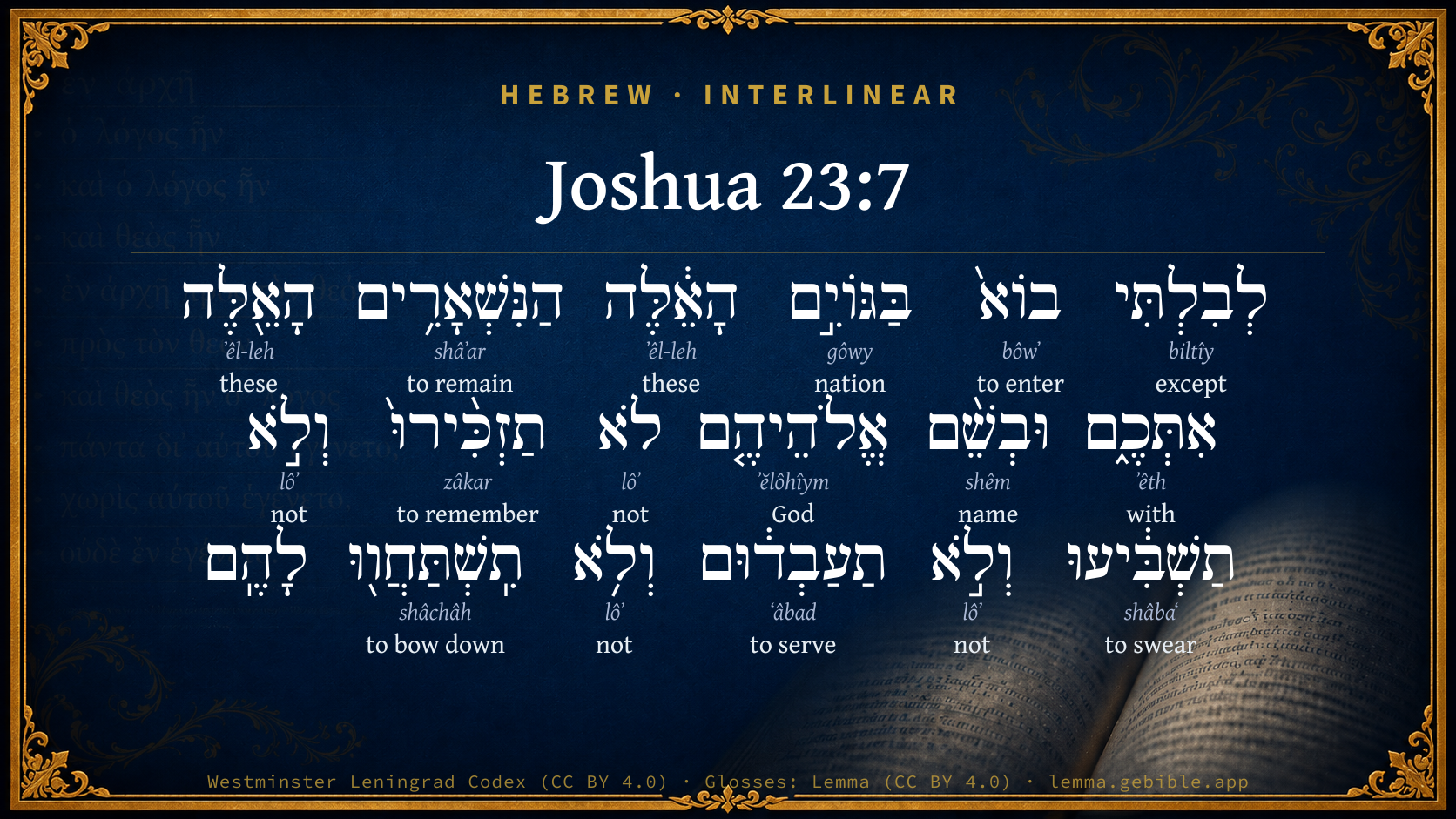
Hebrew (Westminster Leningrad Codex) Joshua 23:7 appears in the Hebrew Old Testament. The text above is from the Westminster Leningrad Codex. Each word links to its Strong’s number, a concise gloss, and parsing drawn from the Open Scriptures Hebrew Bible morphology. Click any word for its full Brown-Driver-Briggs (BDB) entry.
Download image
Cite this verse

Joshua 23:7 (World English Bible). Public Domain. Lemma interlinear Bible study tool, https://lemma.gebible.app/v/joshua/23/7.

Show BibTeX & RIS
BibTeX
RIS
English Translation
that you not come among these nations, these that remain among you; neither make mention of the name of their gods, nor cause to swear [by them], neither serve them, nor bow down yourselves to them;
World English Bible · Public Domain
Download a study sheet

One document with this verse’s original text, its word-by-word gloss line, the meaning frame, cross-references with their text, attributed commentary, and full source and license credits — printable, and it pastes into notes with its structure intact.

This verse Autodidact and up

Study sheet (.html) Plain text (.txt)

A passage Seminary Student

Up to 50 verses in one chapter. A passage sheet keeps up to 6 commentary sources and 12 cross-references per verse, in the order this page ranks them, and says so on the sheet whenever that leaves anything out. Ask for a single verse and you get the Autodidact verse sheet above.

Everything on this page stays free to read, with no account — the sheet is a download of what is already on screen, not access to it.

Want to remove ads? Support Godless Engineer
Compare translations 3

The same verse in 3 English versions, stacked beneath the original-language interlinear above. Click any original word for its lexicon entry.

Each is an independent rendering of the whole verse — the interlinear is not word-aligned to these translations.

Highlighted words mark where these versions differ — a whole-verse word diff, not a word-by-word alignment.

  • World English Bible Public Domain
    that you not come among these nations, these that remain among you; neither make mention of the name of their gods, nor cause to swear [by them], neither serve them, nor bow down yourselves to them;
  • King James Version Public Domain
    That ye come not among these nations, these that remain among you; neither make mention of the name of their gods, nor cause to swear by them, neither serve them, nor bow yourselves unto them:
  • unfoldingWord Literal Text CC BY-SA 4.0
    not to come among these nations, these ones remaining with you. And by the name of their gods you shall not invoke and you shall not swear, and you shall not serve them and you shall not bow down to them.

unfoldingWord Literal Text — © unfoldingWord, licensed CC BY-SA 4.0. Word-aligned USFM3 via Door43 (git.door43.org/unfoldingWord/en_ult).

Versions to compare (up to 4)

3 of 4 selected

Show all 18 translations

Every available English version of this verse, each an independent rendering of the whole verse.

  • World English Bible Public Domain
    that you not come among these nations, these that remain among you; neither make mention of the name of their gods, nor cause to swear [by them], neither serve them, nor bow down yourselves to them;
  • Berean Standard Bible Public Domain
    So you are not to associate with these nations that remain among you. You must not call on the names of their gods or swear by them, and you must not serve them or bow down to them.
  • Majority Standard Bible Public Domain
    So you are not to associate with these nations that remain among you. You must not call on the names of their gods or swear by them, and you must not serve them or bow down to them.
  • King James Version Public Domain
    That ye come not among these nations, these that remain among you; neither make mention of the name of their gods, nor cause to swear by them, neither serve them, nor bow yourselves unto them:
  • American Standard Version (1901) Public Domain
    that ye come not among these nations, these that remain among you; neither make mention of the name of their gods, nor cause to swear `by them', neither serve them, nor bow down yourselves unto them;
  • Revised Version (1885) Public Domain
    that ye come not among these nations, these that remain among you; neither make mention of the name of their gods, nor cause to swear by them, neither serve them, nor bow down yourselves unto them:
  • Geneva Bible (1599) Public Domain
    Neither companie with these nations: that is, with them which are left with you, neither make mention of the name of their gods, nor cause to sweare by them, neither serue them nor bowe vnto them:
  • Douay-Rheims (1899) Public Domain
    Lest after that you are come in among the Gentiles, who will remain among you, you should swear by the name of their gods, and serve them, and adore them:
  • Young's Literal Translation Public Domain
    so as not to go in among these nations, these who are left with you; and of the name of their gods ye do not make mention, nor do ye swear, nor do ye serve them, nor do ye bow yourselves to them;
  • Literal Standard Version CC BY-SA 4.0
    so as not to go in among these nations, these who are left with you; and you do not make mention of the name of their gods, nor do you swear, nor do you serve them, nor do you bow yourselves to them;
  • Unlocked Literal Bible CC BY-SA 4.0
    so you may not mix with these nations that remain among you or mention the names of their gods, swear by them, worship them, or bow down to them.
  • unfoldingWord Literal Text CC BY-SA 4.0
    not to come among these nations, these ones remaining with you. And by the name of their gods you shall not invoke and you shall not swear, and you shall not serve them and you shall not bow down to them.
  • Darby Bible Public Domain
    that ye enter not among these nations, these that remain among you; and ye shall make no mention of the name of their gods, nor cause to swear [by them], neither serve them, nor bow yourselves unto them;
  • World Messianic Bible Public Domain
    that you not come among these nations, these that remain among you; neither make mention of the name of their gods, nor cause to swear by them, neither serve them, nor bow down yourselves to them;
  • Webster's Bible Public Domain
    That ye come not among these nations, these that remain among you; neither make mention of the name of their gods, nor cause to swear by them, neither serve them, nor bow yourselves to them:
  • Free Bible Version CC BY-SA 4.0
    Don't associate with the nations that are left. Don't mention the names of their gods, and don't swear by them, worship them, or bow down to them.
  • Bible in Basic English Public Domain
    Have nothing to do with these nations who still are living among you; let not their gods be named by you or used in your oaths; do not be their servants or give them worship:
  • JPS Tanakh (1917) Public Domain
    that ye come not among these nations, these that remain among you; neither make mention of the name of their gods, nor cause to swear by them, neither serve them, nor worship them;

Literal Standard Version (2020), Covenant Press — licensed CC BY-SA 4.0. Text via the HelloAO Bible API (eBible.org). Unlocked Literal Bible (unfoldingWord) — licensed CC BY-SA 4.0. Text via the HelloAO Bible API (eBible.org). unfoldingWord Literal Text — © unfoldingWord, licensed CC BY-SA 4.0. Word-aligned USFM3 via Door43 (git.door43.org/unfoldingWord/en_ult). Free Bible Version, Dr. Jonathan Gallagher — licensed CC BY-SA 4.0. Text via the HelloAO Bible API (eBible.org).

Word by word

More ways to search: Search by grammar → Find every occurrence → Compare this word →

Practice this passage: Drill this verse → Learn its vocabulary →

לְבִלְתִּי
biltîy
H1115
“to/for · except”
Preposition + Conjunction
Part of Speech
Preposition + Conjunction
Full BDB Definition

Origin: constructive fem. of H1086 (equivalent to H1097 )

TWOT: 246i

not, except (substantive) - not (adverb) - except (after preceding negation) (adverb) - except (after an implied or expressed negation) (conjunction) - so as not, in order not (with preposition) - an account of not, because...not (with preposition) - until not (with preposition)
  1. בוֹא֙ bôwʼ H935 “to enter” Verb, Qal, Infinitive Construct
  2. בַּגּוֹיִ֣ם gôwy H1471 “in/at the · nations” Preposition, Determined + Noun, Common, Masculine, Plural, Absolute
  3. הָאֵ֔לֶּה ʼêl-leh H428 “the · these” Particle, Definite Article + Pronoun, Demonstrative, Common, Plural
  4. הַנִּשְׁאָרִ֥ים shâʼar H7604 “the · remaining” Particle, Definite Article + Verb, Niphal, Participle Active, Masculine, Plural, Absolute
  5. הָאֵ֖לֶּה ʼêl-leh H428 “the · these” Particle, Definite Article + Pronoun, Demonstrative, Common, Plural
  6. אִתְּכֶ֑ם ʼêth H854 “with · you” Preposition + Suffix, Personal, 2nd Person, Masculine, Plural
  7. וּבְשֵׁ֨ם shêm H8034 “and · in/at · name of” Conjunction + Preposition + Noun, Common, Masculine, Singular, Construct
  8. אֱלֹהֵיהֶ֤ם ʼĕlôhîym H430 “God(s) · their” Noun, Common, Masculine, Plural, Construct + Suffix, Personal, 3rd Person, Masculine, Plural
  9. לֹא lôʼ H3808 “not” Particle, Negative
  10. תַזְכִּ֨ירוּ֙ zâkar H2142 “to remember” Verb, Hiphil, Imperfect, 2nd Person, Masculine, Plural
  11. וְלֹ֣א lôʼ H3808 “and · not” Conjunction + Particle, Negative
  12. תַשְׁבִּ֔יעוּ shâbaʻ H7650 “to swear” Verb, Hiphil, Imperfect, 2nd Person, Masculine, Plural
  13. וְלֹ֣א lôʼ H3808 “and · not” Conjunction + Particle, Negative
  14. תַעַבְד֔וּם ʻâbad H5647 “to serve · them” Verb, Qal, Imperfect, 2nd Person, Masculine, Plural + Suffix, Personal, 3rd Person, Masculine, Plural
  15. וְלֹ֥א lôʼ H3808 “and · not” Conjunction + Particle, Negative
  16. תִֽשְׁתַּחֲו֖וּ shâchâh H7812 “to bow down” Verb, Hishtaphel, Imperfect, 2nd Person, Masculine, Plural

About this verse

These counts appear in no published source. They are computed here, from the morphology-tagged text and Lemma’s own curated glosses. What Lemma adds →

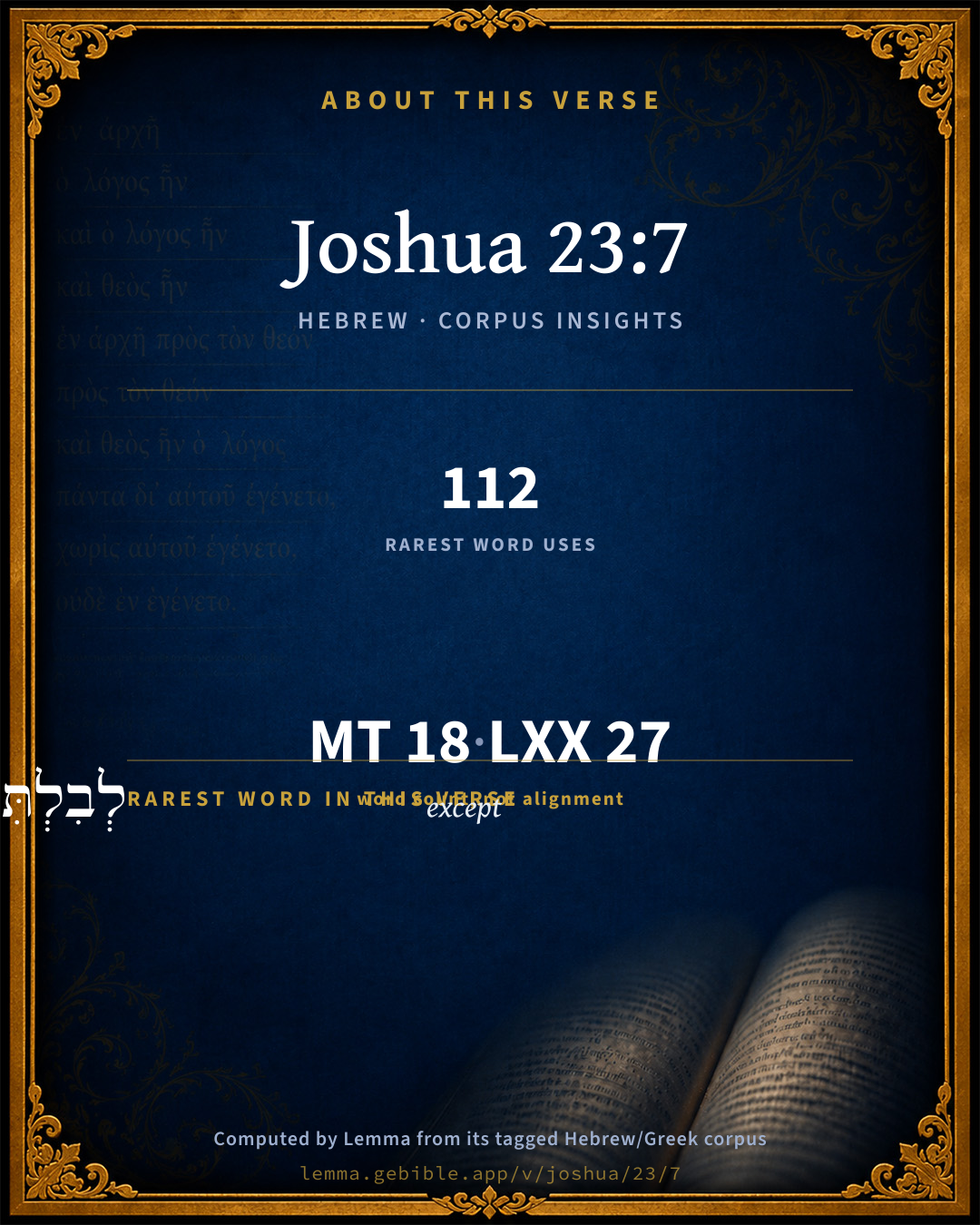
18
words
13
distinct lemmas
Historical
section

Grammatical profile

  • 6 verbs
  • 3 nouns
  • 2 pronouns
  • 2 prepositions
  • 1 conjunction
  • 4 particles

Verb forms

  • בוֹא֙ Qal · Infinitive Construct
  • הַנִּשְׁאָרִ֥ים Niphal · Participle Active
  • תַזְכִּ֨ירוּ֙ Hiphil · Imperfect
  • תַשְׁבִּ֔יעוּ Hiphil · Imperfect
  • תַעַבְד֔וּם Qal · Imperfect
  • תִֽשְׁתַּחֲו֖וּ Hishtaphel · Imperfect

Repetition

Words recur within this verse — often emphatic in Hebrew:

  • לֹא not H3808 ×4
  • הָאֵ֔לֶּה these H428 ×2

Hebrew & Septuagint length

In English translation the verse runs 36 words from the Hebrew and 35 from the Septuagint (LXX English) — closely comparable.

A rough comparison of the two English renderings, which tokenize alike — not a word-level alignment.

Word counts can differ between the Hebrew and the Greek without any difference in meaning — e.g. the Hebrew direct-object marker אֵת has no separate Greek word, and Greek often adds the article ὁ.

In the original languages it is 18 Hebrew tokens and 27 Greek tokens — but the two are counted differently (Hebrew bundles its prefixes and suffixes into one token; the Greek is in lemma form), so that isn’t a like-for-like length.

Cross-references

14

Topical passages linked to Joshua 23:7 in the Treasury of Scripture Knowledge — connected by theme and wording, ordered by reader-vote popularity; previews shown in the World English Bible.

  • Exodus 23:13 "Be careful to do all things that I have said to you; and don't invoke the name of other gods, neither let them be heard out of your mouth.
  • Psalms 16:4 Their sorrows shall be multiplied who give gifts to another god. Their drink-offerings of blood I will not offer, Nor take their names on my lips.
  • Deuteronomy 7:2–3 and when Yahweh your God shall deliver them up before you, and you shall strike them; then you shall utterly destroy them: you shall make no covenant with them, nor show mercy to them;
  • Jeremiah 5:7 How can I pardon you? your children have forsaken me, and sworn by them that are no gods: when I had fed them to the full, they committed adultery, and assembled themselves in troops at the prostitutes' houses.
  • Exodus 23:33 They shall not dwell in your land, lest they make you sin against me, for if you serve their gods, it will surely be a snare to you."
  • Joshua 23:12 Else if you do at all go back, and cleave to the remnant of these nations, even these who remain among you, and make marriages with them, and go in to them, and they to you;
  • Proverbs 4:14 Don't enter into the path of the wicked. Don't walk in the way of evil men.
  • Zephaniah 1:5 those who worship the host of the sky on the housetops, those who worship and swear by Yahweh and also swear by Malcam,
  • 1 Corinthians 15:33 Don't be deceived! "Evil companionships corrupt good morals."
  • 2 Corinthians 6:14–17 Don't be unequally yoked with unbelievers, for what fellowship have righteousness and iniquity? Or what communion has light with darkness?
  • Exodus 20:5 you shall not bow yourself down to them, nor serve them, for I, Yahweh your God, am a jealous God, visiting the iniquity of the fathers on the children, on the third and on the fourth generation of those who hate me,
  • Numbers 32:38 and Nebo, and Baal Meon, (their names being changed), and Sibmah: and they gave other names to the cities which they built.
  • Hosea 2:17 For I will take away the names of the Baals out of her mouth, And they will no more be mentioned by their name.
  • Ephesians 5:11 Have no fellowship with the unfruitful works of darkness, but rather even reprove them.

Cross-references courtesy of OpenBible.info (CC BY 4.0).

Hebrew and Greek witnesses Masoretic Hebrew ↔ Greek Septuagint

The same verse in the two great witnesses to the Old Testament, shown verse-for-verse.

These are two independent witnesses, not word-aligned to each other, and the Septuagint is shown in lemma (dictionary) form.

Hebrew Joshua 23:7 Masoretic · Westminster Leningrad Codex

לְבִלְתִּי בוֹא֙ בַּגּוֹיִ֣ם הָאֵ֔לֶּה הַנִּשְׁאָרִ֥ים הָאֵ֖לֶּה אִתְּכֶ֑ם וּבְשֵׁ֨ם אֱלֹהֵיהֶ֤ם לֹא תַזְכִּ֨ירוּ֙ וְלֹ֣א תַשְׁבִּ֔יעוּ וְלֹ֣א תַעַבְד֔וּם וְלֹ֥א תִֽשְׁתַּחֲו֖וּ לָהֶֽם

that you not come among these nations, these that remain among you; neither make mention of the name of their gods, nor cause to swear [by them], neither serve them, nor bow down yourselves to them;

World English Bible · Public Domain

Greek LXX Joshua 23:7 Septuagint · lemma form

ὅπως μή εἰςἔρχομαι εἰς ὁ ἔθνος ὁ καταλείπω οὗτος καί ὁ ὄνομα ὁ θεός αὐτός οὐ ὀνομάζω ἐν σύ οὐδέ μή προςκυνέω αὐτός οὐδέ μή λατρεύω αὐτός

that you⌃ go not in among these nations that are left; and the names of their gods shall not be named among you, neither shall you⌃ serve them, neither shall you⌃ bow down to them.

LXX2012 (modern English Septuagint) · Public Domain

On this verse, The Pulpit Commentary discusses the Septuagint’s reading. Read the note in Commentary ↓

Hebrew: Westminster Leningrad Codex (CC BY 4.0). Greek: Septuagint (public domain); English from LXX2012 (modern English Septuagint) (Public Domain). How the Septuagint differs from the Hebrew →

Targum (Aramaic paraphrase)

1

The Targum is the ancient Jewish Aramaic paraphrase of the Hebrew Scriptures — an interpretive translation, not the Hebrew text itself. Onkelos (literal) and Pseudo-Jonathan (expansive) render the Torah, and Jonathan the Prophets. Coverage is partial: where no permissively-licensed English translation exists for a verse, only the Aramaic is shown. This is verse-level text, not a word-by-word alignment to the Hebrew.

  1. Targum Jonathan Prophets (Joshua–Malachi)
    בְּדִיל דְלָא לְאִתְעֲרָבָא בְּעַמְמַיָא הָאִלֵין דִי אִשְׁתָּאֲרוּ הָאִלֵין עִמְכוֹן וּבְשׁוּם טַעֲוַתְהוֹן לָא תִדְכְּרוּן וְלָא תְקִימוּן וְלָא תִפְלְחוּנוּן וְלָא תִסְגְדוּן לְהוֹן:

    (no public-domain English translation for this verse)

    Targum Jonathan — Aramaic: “Mikraot Gedolot” (public domain). English: “Sefaria Community Translation” (CC0 1.0 (public-domain dedication)); “London "Chaldee Paraphrase," 1871” (public domain). Text via Sefaria.

Commentary

Notes on Joshua 23:7 from classic Christian and Jewish commentators (each source and its license shown beneath its notes). The classic Christian expositions comment on the surrounding passage and are grouped to its opening verse, so a note may address several verses; the Jewish commentaries on the Tanakh (Rashi and others) are per-verse, so they appear only where the commentator wrote on this verse.

Lemma curates 59 commentaries, every one of them public domain or Creative Commons licensed, each selected and text-cleaned for this edition rather than reprinted as found. About our sources →

Trapp's Complete Commentary

John Trapp

Jos 23:7 That ye come not among these nations, these that remain among you; neither make mention of the name of their gods, nor cause to swear [by them], neither serve them, nor bow yourselves unto them:

Ver. 7. That ye come not among these nations.] For if ye once give way to come amongst them and converse with them, you will easily and quickly be drawn to do worse; even all that is here mentioned, to make honourable mention of their gods, to swear by them, to serve them, &c. Sin is wondrous catching, and contagious, and Nemo repente fuit turpissimus.

John Trapp, A Commentary or Exposition upon All the Books of the Old and New Testament (1647–1656) — public domain. Text from a community e-Sword module.

Joseph Benson's Commentary

Jos 23:7. That ye come not among those nations — That ye avoid all familiar converse and contracts, but especially marriage, with them. Neither mention the name of their gods — To wit, unnecessarily and familiarly, lest the mention of them should lead to discourse about them, and so by degrees bring them to the approbation and worship of them. Nor cause to swear by them — Not to require or even admit a Gentile to swear by his god, as was usual, especially in leagues and contracts; for this would have been to suppose that these imaginary deities were conscious of men’s thoughts, and had power to punish those who were guilty of perjury. And the forbidding this was also to secure them against making leagues and covenants with the Gentiles, which they would not have considered as binding without an oath. It is to be lamented that, among Christians, the names of the heathen gods are so commonly used, especially in poems. Let those names, which have been set up in rivalship with God, be for ever loathed and lost. Nor bow — Neither give them any inward reverence, nor outward adoration. Here is an observable gradation, whereby he shows the progress which sin usually makes, and what need there is to look to the beginnings of it; forasmuch as a civil and common conversation with their persons was likely to bring them, and indeed did actually bring them, by insensible steps, to the worship of their gods. It is no wonder, therefore, if some things, not simply and in themselves evil, be forbidden by God, as here the naming of false gods is, because they are occasions and introductions to evil.

Joseph Benson's Commentary on the Old and New Testaments (1811–1818) — public domain. Text from a community e-Sword module.

Tyndale Open Study Notes

Tyndale Open Resources

23:7 Do not even mention . . . swear by . . . serve . . . or worship them: These four actions describe progressive involvement with idolatry.

Tyndale Open Study Notes — © Tyndale Open Resources, licensed CC BY-SA 4.0. Text via the HelloAO Bible API.

Geneva Bible (1599)

Geneva Bible translators

And not yet subdued.

Let not the Judges admit an oath which any shall swear by their idols.

Geneva Bible (1599) marginal notes — public domain. Text via Bolls.life.

Adam Clarke's Commentary

Verse 7. Come not among these nations] Have no civil or social contracts with them, (see Jos 23:12), as these will infallibly lead to spiritual affinities, in consequence of which ye will make honourable mention of the name of their gods, swear by them as the judges of your motives and actions, serve them in their abominable rites, and bow yourselves unto them as your creators and preservers; thus giving the whole worship of God to idols: and all this will follow from simply coming among them. He who walks in the counsel of the ungodly will soon stand in the way of sinners, and shortly sit in the seat of the scornful. Nemo repente fuit turpissimus. "No man rises to the highest stages of iniquity but by degrees." NERO himself, under the instructions of Seneca, was a promising youth.

Adam Clarke's Commentary on the Bible (1810–1826) — public domain. Text from a community e-Sword/MySword module.

John Calvin's Commentaries

7. That you come not among these nations, etc He distinctly admonishes them that it will be impossible rightly to discharge their duty if they be not carefully on their guard against all sources of corruption. This it was very necessary to enforce upon them. For they were surrounded on all sides by the snares of Satan, and we know how great their proneness to superstition was, or rather how headlong their eagerness for it. First, then, he warns them that intimate intercourse with the nations may involve them in fellowship in crime; for the term mingling used in this passage is equivalent to what is termed by St. Paul, being yoked. (2 Corinthians 6:14) In short, he first removes the incitements or allurements to idolatry, and then declares his detestation of idolatry itself. It is to be observed, however, that he does not expressly mention either bending of the knee, or sacrifices, or other rites, but designates all perverse modes of worship by the terms naming them and swearing by them. Whence we infer that God is defrauded of his honor when ever any particle, however small, of all the things which he claims for himself is transferred to idols. He accordingly concludes that they are to adhere to God alone; in other words, they are to be bound to him out and out.

John Calvin's Commentaries (1540-1563) — public domain. Text from the Calvin Translation Society English edition (1840s-50s) via the Christian Classics Ethereal Library (ccel.org). Calvin's coverage is partial (roughly two-thirds of the Bible); uncommented books and verses are honest gaps, never fabricated. The 19th-century editor's footnotes and remarks are omitted so the notes are faithfully Calvin's own voice.

Ellicott's Commentary for English Readers

(7) Come not among these nations—i.e., do not mix with them; literally, do not go in unto them. (See on Jos_13:2-7, for the rules to be observed in dealing with the nations.) It must always be remembered that, in proposing the extermination of the seven nations, Jehovah reserved to Himself the ordering of the details of the conquest and extermination. When the Lord thy God shall deliver them before thee, thou shalt smite them and utterly destroy them.” He did not propose to deliver them all to Israel at once, for reasons set forth in Judges 2, 3. Meantime, it was a trial of Israel’s faith and obedience to live among idolaters without making any peace with them, or lending any countenance to their idolatry.

A Bible Commentary for English Readers, edited by Charles John Ellicott (1878–1897) — public domain. Text from a community e-Sword module.

The Cambridge Bible for Schools and Colleges

gen. ed. J. J. S. Perowne

7. That ye come not among these nations] He especially warns them against all intercourse with the heathen nations, and, above all, against any participation in their idolatries.

make mention of the name of their gods] “To make mention of the names of the gods (Exo_23:13), to swear by them, to serve them with offerings, and to bow down to them, i.e. call upon them in prayer, represent the four expressions of divine worship.” See Deu_6:13; Deu_10:20.

The Cambridge Bible for Schools and Colleges (gen. ed. J. J. S. Perowne; Cambridge University Press, 1878–1918) — public domain. Text from a community e-Sword module.

John Gill's Exposition

That ye come not among these nations, those that remain among you,.... That remained unsubdued, or that were suffered to dwell among them, being tributaries to them; with these they were not to converse freely and familiarly, nor to carry on trade and commerce with them, nor enter into any alliances or marriages with them, and not even attend any of their feasts, and especially their idolatrous ones:

neither make mention of the name of their gods; not in common conversation, and still less in any religious matters; never with any reverence of them, or in any respectable manner; but always with indignation and contempt, calling them dunghill gods, and the like, as they often are in Scripture:

nor cause to swear by them; neither swear by them themselves, nor cause others to swear by them, as Abarbinel; or a man his neighbour, as Kimchi; no, not a Gentile, as Ben Melech; so it is said in the Misnah (p),"he that vows in the name of an idol, and confirms in his name, (which Bartenora interprets, swears by his name,) transgresses a negative precept.''Maimonides (q) also says,"he that vows in the name of an idol, and swears by it, is to be beaten--he that swears by it himself, or causes a Gentile to swear by it; for it is forbidden to cause a Gentile to swear by his fear (or idol), and even to cause him to make mention of it, though not in the way of an oath, it is forbidden:"

neither serve them; by offering any sacrifice or incense to them, or by praying to them, or offering them praises on any account, or by performing any religious service in any instance or form whatever:

nor bow yourselves unto them; give them any adoration or worship, external or internal.

(p) Sanhedrin, c. 7. sect. 6. (q) Hilchot & Obedeth Cochabim, c. 5. sect. 10.

John Gill's Exposition of the Whole Bible (1746–1763) — public domain (CC PDM 1.0). Text via the HelloAO Bible API.

Haydock's Catholic Bible Commentary

Come in, an expression which may denote any familiarity, or marriage. (Menochius) --- Hebrew is in the form of a prohibition, "Come not among (have no connections with) these nations....Neither mention their gods, nor swear (or cause to swear by them.") The psalmist (Psalm xv. 4,) says, speaking either of idols, (Haydock) or of sinners, Nor will I be mindful of their names by my lips. Osee (ii. 16,) says, She shall call me no more Baali, ("my lord," a term applied by wives to their husbands) on account of its reminding one of the idol Baal. Hence David calls Jerobaal, or Gedeon, Jeroboschot, 2 Kings xi. 21. St. Paul would not have Christians so much as to name the sins of impurity, Ephesians v. 3. The more religious Jews will not even mention an idol, or an unclean animal; and they beg pardon before they speak of a heretic. (Drusius) --- Some understand that the worship of idols is meant by naming them, as those who invoke the name of Jesus Christ, were his disciples, Acts ix. 14., 1 Timothy ii. 19., and Exodus xx. 24. To swear by idols is always sinful, (Exodus xxiii. 13,) while it is an act of religion to swear on proper occasions, by the name of God. Theophrastus (ap. Josephus, contra Apion i.) observes, that the laws of the Tyrians prohibit the using of foreign oaths, such as that of the Corban, which was peculiar to the Jews. (Calmet)

George Leo Haydock (1774–1849), Haydock's Catholic Family Bible and Commentary, 1859 edition — public domain. Excludes Psalms (Douay-Rheims chapter numbering differs from Protestant) and Deuterocanonical books (Catholic canon only).

Matthew Poole's English Annotations

Come not among these nations, i.e. avoid all familiar converse and contracts, but especially marriages, with them, as it is explained, Jos 23:12, and as the Hebrew word intimates, being oft used of coming or going in to a woman.

Neither make mention of the name of their gods, to wit, unnecessarily and familiarly, lest the mention of them breed discourse about them, and so by degrees bring a man to the approbation and worship of them. Compare Exo 23:13; Deu 12:3; Psa 16:4; Eph 5:3.

Nor cause to swear by them; nor require nor compel the Gentiles to swear by them, as they used to do; especially in leagues and contracts, which therefore the Israelites are here implicitly forbidden to make with them.

Neither serve them, nor bow yourselves unto them; neither give them any inward reverence, or outward adoration. Here is an observable gradation, whereby he shows what notable progress sin usually makes, and what reason there is to look to the beginnings of it, forasmuch as a civil and common conversation with their persons was likely to bring them, and indeed did actually bring them, by insensible steps, to the worship of their gods. So it is no wonder if some things not simply and in themselves evil be forbidden by God, as here the naming of their gods is, because they are occasions and introductions to evil.

Matthew Poole's English Annotations on the Holy Bible (1683–1685) — public domain. Text from a community e-Sword/MySword module.

Whedon's Commentary on the Bible

Daniel D. Whedon

7. Neither make mention — This not only forbids the admiring mention of the names of the pagan gods, but, as we believe, it commands the literal abstinence from uttering their names, as defiling the tongue. As the name of Jehovah was in Jewish estimation too holy to be pronounced, so the names of the Canaanite gods were too vile.

Nor cause to swear by them — Since swearing by them implied their existence, this also was forbidden.

[He who swears and he who administers an oath in the name of a false god virtually recognize and worship the false deity. Thus may a Christian state prostitute itself to idolatry, superstition, and even utter irreligion, by allowing in its courts of justice a careless, irreverent, or superstitious use of the oath. Better dispense with the civil oath entirely than prostitute the State to either idolatry, superstition, or atheism.] Neither serve, by external worship, nor bow yourselves, that is, enthrone them over yourselves as authorities to be revered in your hearts. Here is a fourfold prohibition of idolatry, which was rendered necessary by the uncultivated state of the Hebrews, by the strong influence of all the surrounding nations, and especially by that possessed by the idol-worshippers within their own borders whom they had failed to drive out.

Daniel D. Whedon (gen. ed.), Commentary on the Old and New Testaments (1874–1909) — public domain. Text from a community e-Sword module.

The Pulpit Commentary

That ye come not among these nations (see note on ver. 4). We can here perceive that the Israelites, though living among these nations, held no intercourse with them. Neither make mention of the name of their gods. Cf. Psa_16:4, which however is not a verbal quotation of this passage. The LXX here has, kai ta onomata twn yewn autwn ouk onomasyhsetai en umin ; the Vulgate simply, "ne juretis in nomine deorum earum." The Hebrew has the signification

(1) to bring to remembrance,

(2) to praise or celebrate.

The former is the better idea here, "let them not be named among you, as becometh saints," let them be quite forgotten, as though they had never been heard of; and this not with a purely theological, but with an ethical purpose, since "fornication and all uncleanness and greediness" (pleouexia ; see Eph_5:3) were the first principles of their rites (see Introduction). Nor cause to swear by them. These words are found in connection with what follows in Deu_10:20. So with "serve" and "bow down". (see Exo_20:5 Deu_4:19 Deu_5:9 Deu_8:19, etc.) Here again we have Joshua quoting Deuteronomy as the book of the Law of Moses. According to the "Deuteronomist" theory, the quotation is an audacious fiction, manufactured by the person who was at that moment forging the book from which he pretended to quote.

The Pulpit Commentary (1880–1919), ed. H.D.M. Spence-Jones & Joseph S. Exell — public domain. Text from a community e-Sword module.

John Wesley's Explanatory Notes

Come not - That is, avoid all familiar converse and contracts, but especially marriages with them. Name their gods - To wit, unnecessarily and familiarly, lest the mention of them breed discourse about them, and so by degrees bring to the approbation and worship of them. Nor cause - Nor require nor compel the Gentiles to swear by them, as they used to do; especially in leagues and contracts. It is pity, that among Christians, the name of the Heathen God's are so commonly used, especially in poems. Let those names which have been set up in rivalship with God, be forever loathed and lost. Nor bow - Neither give them any inward reverence, or outward adoration. Here is an observable gradation, whereby he shews what notable progress sin usually makes, and what need there is to look to the beginnings of it, forasmuch as a civil and common conversation with their persons was likely to bring them, and indeed did actually bring them, by insensible steps, to the worship of their gods. So it is no wonder, if some things not simply and in themselves evil, be forbidden by God, as here the naming of their gods is, because they are occasions and introductions to evil.

John Wesley, Explanatory Notes Upon the Whole Bible (1754–1765) — public domain. Text via the GEBible commentary corpus.

Lesson kit

Teaching starters — assembled from the data on this page, not authored interpretation. Every prompt links to the verse data it draws on. Edit before teaching.

Joshua, in the Historical, opens this verse with 18 words (13 distinct Hebrew lemmas). Its most distinctive word is biltîy (“except”). A historical commentator’s framing appears above. Read the whole chapter for the surrounding context.

Discussion questions

  1. The word biltîy carries the sense “except.” How does it shape the verse?
  2. Exodus 23:13 shares this passage’s theme. How do the two illuminate each other?
  3. “not” occurs 4× in this one verse. What is the effect of the repetition?
  4. These translations render this verse differently; the difference is in the English rendering, not the original. What questions does that raise?
  5. The verb «בוֹא֙» is Qal Infinitive Construct. How does its form color the action?
  6. Reading how Trapp's Complete Commentary and Joseph Benson's Commentary read this verse, where do the two commentators agree and where do they part?

Things to notice

Reading settings

Reading text

Shown beneath each verse's original-language words.

Old Testament
Old Testament edition

Read the OT as the Masoretic Hebrew (MT) or the Greek Septuagint (LXX).

English shown for the Greek Septuagint (in the Hebrew ↔ Greek comparison).

Comparing translations? Open the Compare panel on any verse page to stack up to four side by side.