
2 Kings 1:13

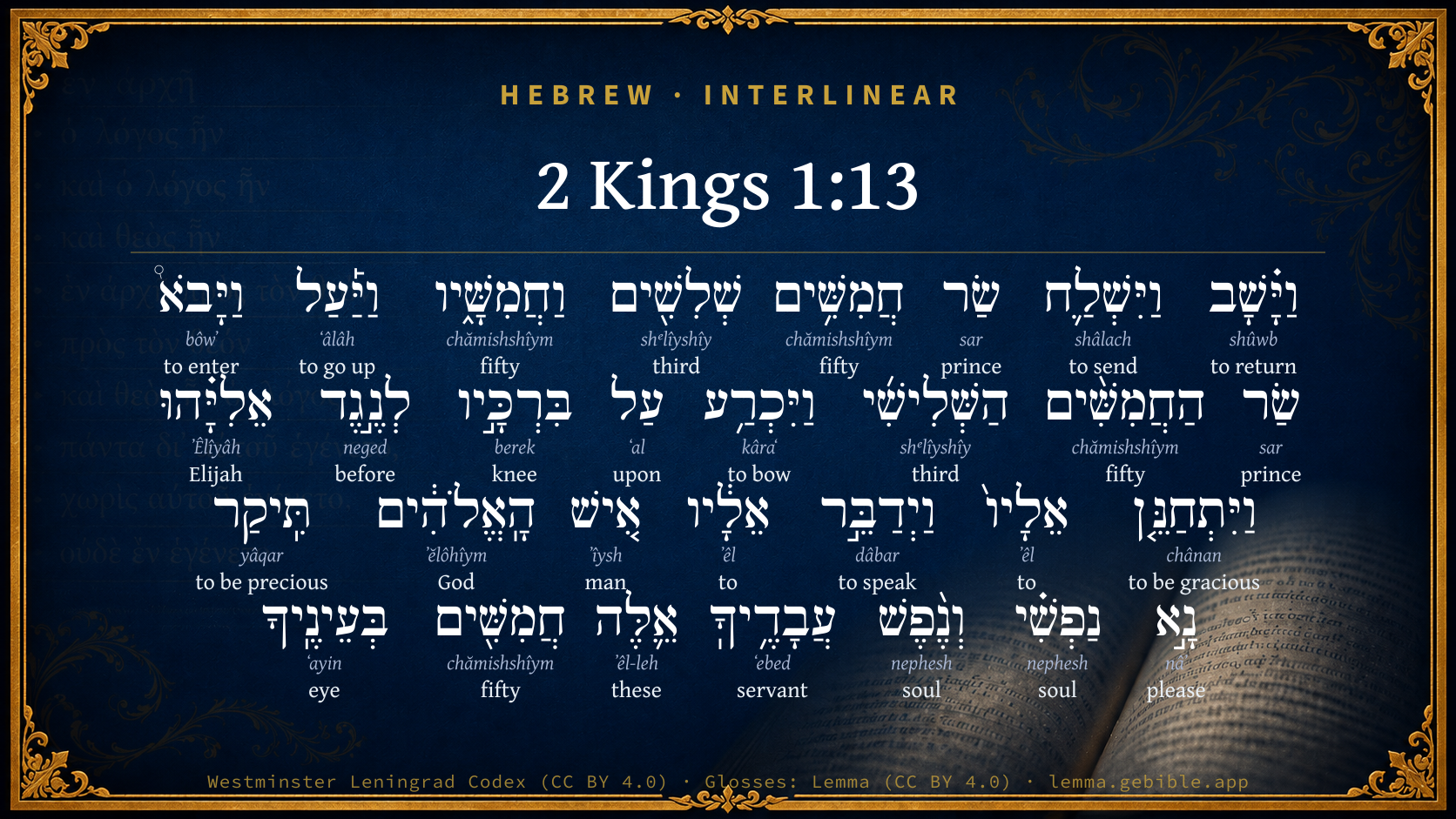
Hebrew (Westminster Leningrad Codex) 2 Kings 1:13 appears in the Hebrew Old Testament. The text above is from the Westminster Leningrad Codex. Each word links to its Strong’s number, a concise gloss, and parsing drawn from the Open Scriptures Hebrew Bible morphology. Click any word for its full Brown-Driver-Briggs (BDB) entry.
Download image
Cite this verse

2 Kings 1:13 (World English Bible). Public Domain. Lemma interlinear Bible study tool, https://lemma.gebible.app/v/2-kings/1/13.

Show BibTeX & RIS
BibTeX
RIS
English Translation
Again he sent the captain of a third fifty with his fifty. The third captain of fifty went up, and came and fell on his knees before Elijah, and begged him, and said to him, man of God, please let my life, and the life of these fifty your servants, be precious in your sight.
World English Bible · Public Domain
Download a study sheet

One document with this verse’s original text, its word-by-word gloss line, the meaning frame, cross-references with their text, attributed commentary, and full source and license credits — printable, and it pastes into notes with its structure intact.

This verse Autodidact and up

Study sheet (.html) Plain text (.txt)

A passage Seminary Student

Up to 50 verses in one chapter. A passage sheet keeps up to 6 commentary sources and 12 cross-references per verse, in the order this page ranks them, and says so on the sheet whenever that leaves anything out. Ask for a single verse and you get the Autodidact verse sheet above.

Everything on this page stays free to read, with no account — the sheet is a download of what is already on screen, not access to it.

Want to remove ads? Support Godless Engineer
Compare translations 3

The same verse in 3 English versions, stacked beneath the original-language interlinear above. Click any original word for its lexicon entry.

Each is an independent rendering of the whole verse — the interlinear is not word-aligned to these translations.

Highlighted words mark where these versions differ — a whole-verse word diff, not a word-by-word alignment.

  • World English Bible Public Domain
    Again he sent the captain of a third fifty with his fifty. The third captain of fifty went up, and came and fell on his knees before Elijah, and begged him, and said to him, man of God, please let my life, and the life of these fifty your servants, be precious in your sight.
  • King James Version Public Domain
    And he sent again a captain of the third fifty with his fifty. And the third captain of fifty went up, and came and fell on his knees before Elijah, and besought him, and said unto him, O man of God, I pray thee, let my life, and the life of these fifty thy servants, be precious in thy sight.
  • unfoldingWord Literal Text CC BY-SA 4.0
    And he returned and sent a third captain of fifty and his fifty. And the third captain of fifty went up and came and knelt on his knees in front of Elijah, and he pleaded with him and said to him, “Man of God, please let my life and the life of these your fifty servants be valuable in your eyes.

unfoldingWord Literal Text — © unfoldingWord, licensed CC BY-SA 4.0. Word-aligned USFM3 via Door43 (git.door43.org/unfoldingWord/en_ult).

Versions to compare (up to 4)

3 of 4 selected

Show all 18 translations

Every available English version of this verse, each an independent rendering of the whole verse.

  • World English Bible Public Domain
    Again he sent the captain of a third fifty with his fifty. The third captain of fifty went up, and came and fell on his knees before Elijah, and begged him, and said to him, man of God, please let my life, and the life of these fifty your servants, be precious in your sight.
  • Berean Standard Bible Public Domain
    So the king sent a third captain with his fifty men. And the third captain went up, fell on his knees before Elijah, and begged him, “Man of God, may my life and the lives of these fifty servants please be precious in your sight.
  • Majority Standard Bible Public Domain
    So the king sent a third captain with his fifty men. And the third captain went up, fell on his knees before Elijah, and begged him, “Man of God, may my life and the lives of these fifty servants of yours please be precious in your sight.
  • King James Version Public Domain
    And he sent again a captain of the third fifty with his fifty. And the third captain of fifty went up, and came and fell on his knees before Elijah, and besought him, and said unto him, O man of God, I pray thee, let my life, and the life of these fifty thy servants, be precious in thy sight.
  • American Standard Version (1901) Public Domain
    And again he sent the captain of a third fifty with his fifty. And the third captain of fifty went up, and came and fell on his knees before Elijah, and besought him, and said unto him, O man of God, I pray thee, let my life, and the life of these fifty thy servants, be precious in thy sight.
  • Revised Version (1885) Public Domain
    And again he sent the captain of a third fifty with his fifty. And the third captain of fifty went up, and came and fell on his knees before Elijah, and besought him, and said unto him, O man of God, I pray thee, let my life, and the life of these fifty thy servants, be precious in thy sight.
  • Geneva Bible (1599) Public Domain
    Yet againe he sent the third captaine ouer fiftie with his fiftie. And the thirde captaine ouer fiftie went vp, and came, and fell on his knees before Eliiah, and besought him, and saide vnto him, O man of God, I pray thee, let my life and the life of these thy fiftie seruants be precious in thy sight.
  • Douay-Rheims (1899) Public Domain
    Again he sent a third captain of fifty men, and the fifty that were with him. And when he was come, he fell upon his knees, before Elias, and besought him and said: Man of God, despise not my life, and the lives of thy servants that are with me.
  • Young's Literal Translation Public Domain
    And he turneth and sendeth a third head of fifty and his fifty, and the third head of fifty goeth up, and cometh in, and boweth on his knees over-against Elijah, and maketh supplication unto him, and speaketh unto him, `O man of God, let be precious, I pray thee, my soul and the soul of thy servants -- these fifty -- in thine eyes.
  • Literal Standard Version CC BY-SA 4.0
    And he turns and sends a third head of fifty and his fifty, and the third head of fifty goes up, and comes in, and bows on his knees before Elijah, and makes supplication to him, and speaks to him, “O man of God, please let my soul and the soul of your servants—these fifty—be precious in your eyes.
  • Unlocked Literal Bible CC BY-SA 4.0
    Yet again the king sent a third group of fifty warriors. This captain went up, fell on his knees before Elijah, and implored him and said to him, “You, man of God, I ask you, let my life and the life of these fifty servants of yours be precious in your sight.
  • unfoldingWord Literal Text CC BY-SA 4.0
    And he returned and sent a third captain of fifty and his fifty. And the third captain of fifty went up and came and knelt on his knees in front of Elijah, and he pleaded with him and said to him, “Man of God, please let my life and the life of these your fifty servants be valuable in your eyes.
  • Darby Bible Public Domain
    And again he sent the captain of a third fifty with his fifty. And the third captain of fifty went up, and came and fell on his knees before Elijah, and besought him and said to him, Man of God, I pray thee, let my life, and the life of these fifty thy servants, be precious in thy sight.
  • World Messianic Bible Public Domain
    Again he sent the captain of a third fifty with his fifty. The third captain of fifty went up, and came and fell on his knees before Elijah, and begged him, and said to him, “Man of God, please let my life and the life of these fifty of your servants be precious in your sight.
  • Webster's Bible Public Domain
    And he sent again a captain of the third fifty with his fifty. And the third captain of fifty went up, and came and fell on his knees before Elijah, and besought him, and said to him, O man of God, I pray thee, let my life, and the life of these fifty thy servants, be precious in thy sight.
  • Free Bible Version CC BY-SA 4.0
    So the king sent a third captain with his fifty men. The third captain went up, kneeled before Elijah, and pleaded with him, “Man of God, please value my life and the lives of these fifty men.
  • Bible in Basic English Public Domain
    Then he sent a third captain of fifty with his fifty men; and the third captain of fifty went up, and falling on his knees before Elijah, requesting mercy of him, said, O man of God, let my life and the life of these your fifty servants be of value to you.
  • JPS Tanakh (1917) Public Domain
    And again he sent the captain of a third fifty with his fifty. And the third captain of fifty went up, and came and fell on his knees before Elijah, and besought him, and said unto him: 'O man of God, I pray thee, let my life, and the life of these fifty thy servants, be precious in thy sight.

Literal Standard Version (2020), Covenant Press — licensed CC BY-SA 4.0. Text via the HelloAO Bible API (eBible.org). Unlocked Literal Bible (unfoldingWord) — licensed CC BY-SA 4.0. Text via the HelloAO Bible API (eBible.org). unfoldingWord Literal Text — © unfoldingWord, licensed CC BY-SA 4.0. Word-aligned USFM3 via Door43 (git.door43.org/unfoldingWord/en_ult). Free Bible Version, Dr. Jonathan Gallagher — licensed CC BY-SA 4.0. Text via the HelloAO Bible API (eBible.org).

Word by word

More ways to search: Search by grammar → Find every occurrence → Compare this word →

Practice this passage: Drill this verse → Learn its vocabulary →

תִּֽיקַר
yâqar
H3365
“to be precious”
Verb, Qal, Jussive, 3rd Person, Feminine, Singular
Part of Speech
Verb
Stem
Qal
Form
Jussive
Person
3rd Person
Gender
Feminine
Number
Singular
Full BDB Definition

Origin: a primitive root

TWOT: 905

to esteem, be prized, be valuable, be precious, be costly, be appraised - (Qal) - to be precious, be highly valued, be esteemed, be costly - to be appraised - (Hiphil) to make something precious
  1. וַיָּ֗שָׁב shûwb H7725 “and · to return” Conjunction + Verb, Qal, Sequential Imperfect, 3rd Person, Masculine, Singular
  2. וַיִּשְׁלַ֛ח shâlach H7971 “and · to send” Conjunction + Verb, Qal, Sequential Imperfect, 3rd Person, Masculine, Singular
  3. שַׂר sar H8269 “prince of” Noun, Common, Masculine, Singular, Construct
  4. חֲמִשִּׁ֥ים chămishshîym H2572 “fifty” Adjective, Cardinal number, Both, Plural, Absolute
  5. שְׁלִשִׁ֖ים shᵉlîyshîy H7992 “third” Adjective, Ordinal number, Masculine, Plural, Absolute
  6. וַחֲמִשָּׁ֑יו chămishshîym H2572 “and · fifty · his” Conjunction + Adjective, Cardinal number, Both, Plural, Construct + Suffix, Personal, 3rd Person, Masculine, Singular
  7. וַיַּ֡עַל ʻâlâh H5927 “and · to go up” Conjunction + Verb, Qal, Sequential Imperfect, 3rd Person, Masculine, Singular
  8. וַיָּבֹא֩ bôwʼ H935 “and · to enter” Conjunction + Verb, Qal, Sequential Imperfect, 3rd Person, Masculine, Singular
  9. שַׂר sar H8269 “prince of” Noun, Common, Masculine, Singular, Construct
  10. הַחֲמִשִּׁ֨ים chămishshîym H2572 “the · fifty” Particle, Definite Article + Adjective, Cardinal number, Both, Plural, Absolute
  11. הַשְּׁלִישִׁ֜י shᵉlîyshîy H7992 “the · third” Particle, Definite Article + Adjective, Ordinal number, Masculine, Singular, Absolute
  12. וַיִּכְרַ֥ע kâraʻ H3766 “and · to bow” Conjunction + Verb, Qal, Sequential Imperfect, 3rd Person, Masculine, Singular
  13. עַל ʻal H5921 “upon” Preposition
  14. בִּרְכָּ֣יו berek H1290 “knees · his” Noun, Common, Feminine, Dual, Construct + Suffix, Personal, 3rd Person, Masculine, Singular
  15. לְנֶ֣גֶד neged H5048 “to/for · before” Preposition + Preposition
  16. אֵלִיָּ֗הוּ ʼÊlîyâh H452 “Elijah” Noun, Proper
  17. וַיִּתְחַנֵּ֤ן chânan H2603 “and · to be gracious” Conjunction + Verb, Hithpael, Sequential Imperfect, 3rd Person, Masculine, Singular
  18. אֵלָיו֙ ʼêl H413 “to · him” Preposition + Suffix, Personal, 3rd Person, Masculine, Singular
  19. וַיְדַבֵּ֣ר dâbar H1696 “and · to speak” Conjunction + Verb, Piel, Sequential Imperfect, 3rd Person, Masculine, Singular
  20. אֵלָ֔יו ʼêl H413 “to · him” Preposition + Suffix, Personal, 3rd Person, Masculine, Singular
  21. אִ֚ישׁ ʼîysh H376 “man of” Noun, Common, Masculine, Singular, Construct
  22. הָֽאֱלֹהִ֔ים ʼĕlôhîym H430 “the · God(s)” Particle, Definite Article + Noun, Common, Masculine, Plural, Absolute
  23. נָ֣א nâʼ H4994 “please” Particle, Exhortation
  24. נַפְשִׁ֗י nephesh H5315 “soul · my” Noun, Common, Both, Singular, Construct + Suffix, Personal, 1st Person, Common, Singular
  25. וְנֶ֨פֶשׁ nephesh H5315 “and · soul of” Conjunction + Noun, Common, Both, Singular, Construct
  26. עֲבָדֶ֥יךָֽ ʻebed H5650 “servants · your” Noun, Common, Masculine, Plural, Construct + Suffix, Personal, 2nd Person, Masculine, Singular
  27. אֵ֛לֶּה ʼêl-leh H428 “these” Pronoun, Demonstrative, Common, Plural
  28. חֲמִשִּׁ֖ים chămishshîym H2572 “fifty” Adjective, Cardinal number, Both, Plural, Absolute
  29. בְּעֵינֶֽיךָ ʻayin H5869 “in/at · eyes · your” Preposition + Noun, Common, Both, Dual, Construct + Suffix, Personal, 2nd Person, Masculine, Singular

About this verse

These counts appear in no published source. They are computed here, from the morphology-tagged text and Lemma’s own curated glosses. What Lemma adds →

30
words
23
distinct lemmas
Historical
section

Notable vocabulary

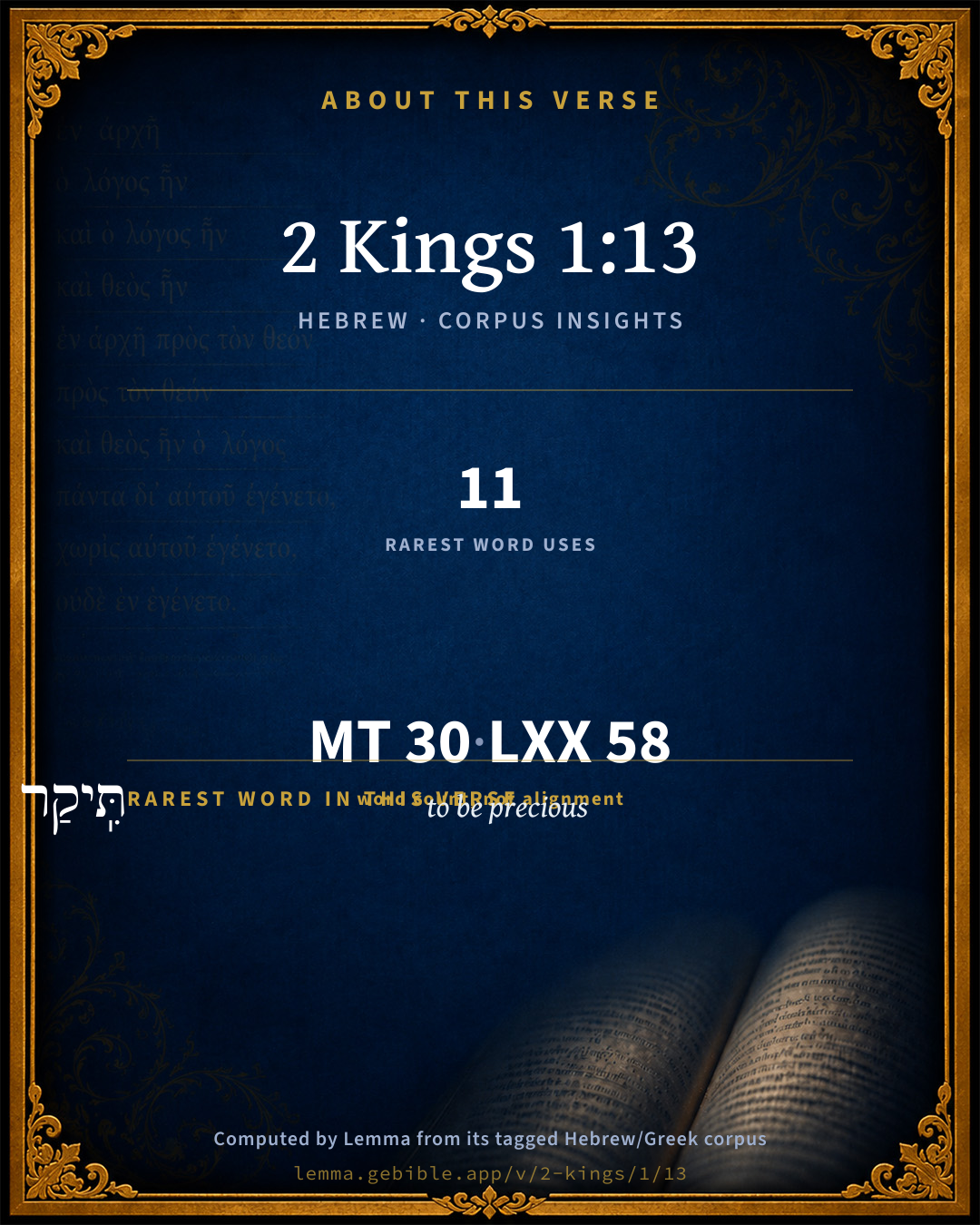
The rarest word here is תִּֽיקַר to be precious H3365 — appearing just 11 times in the whole Hebrew Bible.

Shared distinctive vocabulary

תִּֽיקַר to be precious H3365 occurs in 11 verses of the Hebrew Bible. Also found in:

Grammatical profile

  • 8 verbs
  • 10 nouns
  • 6 adjectives
  • 1 pronoun
  • 4 prepositions
  • 1 particle

Verb forms

  • וַיָּ֗שָׁב Qal · Sequential Imperfect
  • וַיִּשְׁלַ֛ח Qal · Sequential Imperfect
  • וַיַּ֡עַל Qal · Sequential Imperfect
  • וַיָּבֹא֩ Qal · Sequential Imperfect
  • וַיִּכְרַ֥ע Qal · Sequential Imperfect
  • וַיִּתְחַנֵּ֤ן Hithpael · Sequential Imperfect
  • וַיְדַבֵּ֣ר Piel · Sequential Imperfect
  • תִּֽיקַר Qal · Jussive

Repetition

Words recur within this verse — often emphatic in Hebrew:

  • חֲמִשִּׁ֥ים fifty H2572 ×4
  • שַׂר prince H8269 ×2
  • שְׁלִשִׁ֖ים third H7992 ×2
  • נַפְשִׁ֗י soul H5315 ×2
  • אֵלָיו֙ to H413 ×2

Hebrew & Septuagint length

In English translation the verse runs 55 words from the Hebrew and 54 from the Septuagint (LXX English) — closely comparable.

A rough comparison of the two English renderings, which tokenize alike — not a word-level alignment.

Word counts can differ between the Hebrew and the Greek without any difference in meaning — e.g. the Hebrew direct-object marker אֵת has no separate Greek word, and Greek often adds the article ὁ.

In the original languages it is 30 Hebrew tokens and 58 Greek tokens — but the two are counted differently (Hebrew bundles its prefixes and suffixes into one token; the Greek is in lemma form), so that isn’t a like-for-like length.

Cross-references

14

Topical passages linked to 2 Kings 1:13 in the Treasury of Scripture Knowledge — connected by theme and wording, ordered by reader-vote popularity; previews shown in the World English Bible.

  • Isaiah 1:5 Why should you be beaten more, That you revolt more and more? The whole head is sick, And the whole heart faint.
  • Exodus 11:8 All these your servants shall come down to me, and bow down themselves to me, saying, 'Get out, and all the people who follow you; and after that I will go out.'" He went out from Pharaoh in hot anger.
  • Numbers 12:11–13 Aaron said to Moses, Oh, my lord, please don't lay sin on us, for that we have done foolishly, and for that we have sinned.
  • 1 Samuel 26:21 Then said Saul, I have sinned: return, my son David; for I will no more do you harm, because my life was precious in your eyes this day: behold, I have played the fool, and have erred exceedingly.
  • 1 Kings 13:6 The king answered the man of God, Entreat now the favor of Yahweh your God, and pray for me, that my hand may be restored me again. The man of God entreated Yahweh, and the king's hand was restored him again, and became as it was before.
  • Job 15:25–26 Because he has stretched out his hand against God, And behaves himself proudly against the Almighty;
  • Psalms 72:14 He will redeem their soul from oppression and violence. Their blood will be precious in his sight.
  • Psalms 102:17 He has responded to the prayer of the destitute, And has not despised their prayer.
  • Proverbs 27:22 Though you grind a fool in a mortar with a pestle along with grain, Yet his foolishness will not be removed from him.
  • Ecclesiastes 9:3 This is an evil in all that is done under the sun, that there is one event to all: yes also, the heart of the sons of men is full of evil, and madness is in their heart while they live, and after that they go to the dead.
  • Isaiah 60:14 The sons of those who afflicted you shall come bending to you; and all those who despised you shall bow themselves down at the soles of your feet; and they shall call you The city of Yahweh, The Zion of the Holy One of Israel.
  • Isaiah 66:2 For all these things has my hand made, and [so] all these things came to be, says Yahweh: but to this man will I look, even to him who is poor and of a contrite spirit, and who trembles at my word.
  • James 4:7 Be subject therefore to God. But resist the devil, and he will flee from you.
  • Revelation 3:9 Behold, I give of the synagogue of Satan, of those who say they are Jews, and they are not, but lie. Behold, I will make them to come and worship before your feet, and to know that I have loved you.

Cross-references courtesy of OpenBible.info (CC BY 4.0).

Hebrew and Greek witnesses Masoretic Hebrew ↔ Greek Septuagint

The same verse in the two great witnesses to the Old Testament, shown verse-for-verse.

These are two independent witnesses, not word-aligned to each other, and the Septuagint is shown in lemma (dictionary) form.

Hebrew 2 Kings 1:13 Masoretic · Westminster Leningrad Codex

וַיָּ֗שָׁב וַיִּשְׁלַ֛ח שַׂר חֲמִשִּׁ֥ים שְׁלִשִׁ֖ים וַחֲמִשָּׁ֑יו וַיַּ֡עַל וַיָּבֹא֩ שַׂר הַחֲמִשִּׁ֨ים הַשְּׁלִישִׁ֜י וַיִּכְרַ֥ע עַל בִּרְכָּ֣יו לְנֶ֣גֶד אֵלִיָּ֗הוּ וַיִּתְחַנֵּ֤ן אֵלָיו֙ וַיְדַבֵּ֣ר אֵלָ֔יו אִ֚ישׁ הָֽאֱלֹהִ֔ים תִּֽיקַר נָ֣א נַפְשִׁ֗י וְנֶ֨פֶשׁ עֲבָדֶ֥יךָֽ אֵ֛לֶּה חֲמִשִּׁ֖ים בְּעֵינֶֽיךָ

Again he sent the captain of a third fifty with his fifty. The third captain of fifty went up, and came and fell on his knees before Elijah, and begged him, and said to him, man of God, please let my life, and the life of these fifty your servants, be precious in your sight.

World English Bible · Public Domain

Greek LXX 2 Kings 1:13 Septuagint · lemma form

καί προςτίθημι ὁ βασιλεύς ἔτι ἀποστέλλω ἡγέομαι πεντηκόνταρχος τρίτος καί ὁ πεντήκοντα αὐτός καί ἔρχομαι πρός αὐτός ὁ πεντηκόνταρχος ὁ τρίτος καί κάμπτω ἐπί ὁ γόνυ αὐτός κατέναντι ηλιου καί δέω αὐτός καί λαλέω πρός αὐτός καί εἶπον ἄνθρωπος ὁ θεός ἐντιμάω δή ὁ ψυχή ἐγώ καί ὁ ψυχή ὁ δοῦλος σύ οὗτος ὁ πεντήκοντα ἐν ὀφθαλμός σύ

And the king sent yet again a captain and his fifty. And the third captain of fifty came, and knelt on his knees before Eliu, and entreated him, and spoke to him and said, O man of God, let my life, and the life of these fifty your servants, be precious in your eyes.

LXX2012 (modern English Septuagint) · Public Domain

On this verse, Ellicott's Commentary for English Readers discusses the Septuagint’s reading. Read the note in Commentary ↓

Hebrew: Westminster Leningrad Codex (CC BY 4.0). Greek: Septuagint (public domain); English from LXX2012 (modern English Septuagint) (Public Domain). How the Septuagint differs from the Hebrew →

Targum (Aramaic paraphrase)

1

The Targum is the ancient Jewish Aramaic paraphrase of the Hebrew Scriptures — an interpretive translation, not the Hebrew text itself. Onkelos (literal) and Pseudo-Jonathan (expansive) render the Torah, and Jonathan the Prophets. Coverage is partial: where no permissively-licensed English translation exists for a verse, only the Aramaic is shown. This is verse-level text, not a word-by-word alignment to the Hebrew.

  1. Targum Jonathan Prophets (Joshua–Malachi)
    וְתַב וּשְׁלַח רַב חַמְשִׁין תְּלִיתָאֵי וְחַמְשִׁין דְעִמֵיהּ וּסְלֵיק וַאֲתָא רַב חַמְשִׁין תְּלִיתָאִין וּכְרַע עַל בִּרְכּוֹהִי לָקֳבֵיל אֵלִיָהוּ וּבְעָא מִן קֳדָמוֹהִי וּמַלֵיל עִמֵיהּ נְבִיָא דַייָ תִּיקַר כְּעַן נַפְשִׁי וְנַפְשָׁא דְעַבְדָךְ אִלֵין חַמְשִׁין בְּעֵינָךְ:

    (no public-domain English translation for this verse)

    Targum Jonathan — Aramaic: “Mikraot Gedolot” (public domain). English: “Sefaria Community Translation” (CC0 1.0 (public-domain dedication)); “London "Chaldee Paraphrase," 1871” (public domain). Text via Sefaria.

Commentary

Notes on 2 Kings 1:13 from classic Christian and Jewish commentators (each source and its license shown beneath its notes). The classic Christian expositions comment on the surrounding passage and are grouped to its opening verse, so a note may address several verses; the Jewish commentaries on the Tanakh (Rashi and others) are per-verse, so they appear only where the commentator wrote on this verse.

Lemma curates 59 commentaries, every one of them public domain or Creative Commons licensed, each selected and text-cleaned for this edition rather than reprinted as found. About our sources →

Trapp's Complete Commentary

John Trapp

2Ki 1:13 And he sent again a captain of the third fifty with his fifty. And the third captain of fifty went up, and came and fell on his knees before Elijah, and besought him, and said unto him, O man of God, I pray thee, let my life, and the life of these fifty thy servants, be precious in thy sight.

Ver. 13. And he sent again a captain.] Another pentacontarch; but of a better make than the former. Some think it was good Obadiah, whom be knew to be gracious with the prophet, and could prevail with him to come to the king.

John Trapp, A Commentary or Exposition upon All the Books of the Old and New Testament (1647–1656) — public domain. Text from a community e-Sword module.

The Biblical Illustrator

Joseph S. Exell

2Ki_1:13

Let my life, and the life of these fifty thy servants be precious in thy sight.

The preciousness of life

Question naturally arises, Is life precious? How does God value it? And how should His servants regard it?

I. This question seems to be answered in the negative.

1. By the general tenor of the Old Testament. Sinai thundered and lightened. The sight thereof was terrible. The voice was death. The Flood. Destruction of Sodom. Overthrows in the wilderness. Death of the two captains with their fifties.

2. By Gods continued judgments on the impenitent. The Galileans in our Lords day. Except ye repent (Luk_13:1-5). Many instances of this in the New Testament: Ananias and Sapphira; Herod Agrippa, in Act_12:1-25.

II. But for two reasons the reply is in the affirmative.

1. Because many lives were spared in the Old Testament.

(1) Through entreaty, as in the case of this captain. So Abraham entreated for Sodom. Moses and Aaron for the children of Israel (Num_14:15-20; Num_16:22).

(2) Through Gods sovereign mercy. People of Nineveh.

2. Because the greatest life of all has been given for all the children of men. Herein the Mosaic law fulfilled, which said, A life for a life. Nothing so highly esteemed of God as the precious blood of Christ. It was the full price of our salvation, and its efficacy is eternal (Psa_49:8; Heb_9:12).

Application.

1. There is no need that you should doubt whether God will receive you. You need not even retreat, Let my life be precious in Thy sight. It is precious. The best proof of this has been given.

2. Do not manifest an un-Christlike spirit. Vengeance is mine. Our duty is plain, to be like Christ in valuing the lives of our brethren. He came not to destroy life, but to save. (J. G. Tanner, M. A.)

The Biblical Illustrator, edited by Joseph S. Exell (c. 1880s–1900s) — public domain. Text from a community e-Sword module.

Joseph Benson's Commentary

2Ki 1:13. And fell on his knees before Elijah, and besought him — Expressing both reverence for his person, and a dread of God’s judgments, being struck with the fate of the two other captains and their fifties. There is nothing to be got by contending with God: if we would prevail with him, it must be by supplication. And those are wise that learn submission from the fatal consequences of obstinacy in others.

Joseph Benson's Commentary on the Old and New Testaments (1811–1818) — public domain. Text from a community e-Sword module.

Tyndale Open Study Notes

Tyndale Open Resources

1:13-14 In contrast to the first two officers, the third commander pleaded for mercy before Elijah and God.

Tyndale Open Study Notes — © Tyndale Open Resources, licensed CC BY-SA 4.0. Text via the HelloAO Bible API.

Geneva Bible (1599)

Geneva Bible translators

That is, spare my life, and let me not die as the other two.

Which humble myself before God and his servant.

Geneva Bible (1599) marginal notes — public domain. Text via Bolls.life.

Ellicott's Commentary for English Readers

(13) A captain of the third fifty.—Literally, a captain of a third fifty. But 2Ki_1:11, “another captain of fifty,” and the phrase which follows here, “the third captain of fifty,” indicate the right reading, “a third captain of fifty.” (So LXX. and Vulg.)

Fell.—Margin. (Comp. Isa_46:1, “Bel boweth down.”)

Besought him.—Begged favour, grace, or compossion of him (Gen_42:21; Hos_12:5).

These fifty thy servants.—Or, these thy servants, fifty (men), laying stress on the number of lives.

Be precious in thy sight.—Comp. Psa_72:14; 1Sa_26:21.

A Bible Commentary for English Readers, edited by Charles John Ellicott (1878–1897) — public domain. Text from a community e-Sword module.

The Cambridge Bible for Schools and Colleges

gen. ed. J. J. S. Perowne

13. a captain of the [R.V. a] third fifty] The LXX. omits the number ‘third’, and the grammar in the Hebrew is not quite regular.

came and fell on his knees] He utters no command, but as a suppliant recognises the power of which Elijah was the representative. Josephus makes him admit that he has only come because the king commanded it.

be precious in thy sight] A common phrase about a life that is spared. Cf. 1Sa_26:21; Psa_72:14.

The Cambridge Bible for Schools and Colleges (gen. ed. J. J. S. Perowne; Cambridge University Press, 1878–1918) — public domain. Text from a community e-Sword module.

Haydock's Catholic Bible Commentary

Again. This third captain is commonly supposed to be Abdias, (3 Kings xviii. 3.) though without much reason. (Calmet) --- John of Jerus, (c. 15) says he left the court, and became a disciple of Elias, and a prophet. (Menochius) --- But he is very different from the prophet, whose writings are still extant. (Calmet) --- The report of the two miracles had come to his ears, and filled him with fear. (Menochius) --- Despise not. Hebrew, "let my life....be precious in thy sight," 1 Kings xxvi. 21., and Psalm cxv. 15.

George Leo Haydock (1774–1849), Haydock's Catholic Family Bible and Commentary, 1859 edition — public domain. Excludes Psalms (Douay-Rheims chapter numbering differs from Protestant) and Deuterocanonical books (Catholic canon only).

Matthew Poole's English Annotations

Fell on his knees, and besought him; expressing both reverence to his person, and a belief of his power, and a dread of God’s judgments.

Matthew Poole's English Annotations on the Holy Bible (1683–1685) — public domain. Text from a community e-Sword/MySword module.

Whedon's Commentary on the Bible

Daniel D. Whedon

13. Fell on his knees before Elijah — This was very different from the manner of the two former.

These fifty thy servants — Not Ahaziah’s servants, but Elijah’s. This humble and reverential manner showed becoming respect for Elijah and his God, and turned away the fierce anger of Jehovah. Had the former captains observed like respect, the penal fire had not fallen.

Daniel D. Whedon (gen. ed.), Commentary on the Old and New Testaments (1874–1909) — public domain. Text from a community e-Sword module.

The Pulpit Commentary

A captain of the third fifty; rather, the captain of a third fifty (see the Revised Version). This captain went upi.e. ascended the hill on which Elijah was still seated, and there fell on his knees, or bowed himself down, before the prophet, as suppliants were wont to do, beseeching his compassion. The fate of the two former captains had become known to him by some means or other, and this induced him to assume an attitude, not of command, but of submission. He acknowledged that the prophet held his life and the lives of his fifty men at his free disposal, and begged that they might be precious in his sight, or, in other words, that he would spare them. What response Elijah would have made, had he been left to himself, is uncertain. But he was not left to himself. An angel of God again appeared to him, and directed his course of action.

The Pulpit Commentary (1880–1919), ed. H.D.M. Spence-Jones & Joseph S. Exell — public domain. Text from a community e-Sword module.

John Wesley's Explanatory Notes

Besought - Expressing both reverence to his person, and a dread of God's judgments. There is nothing to be got by contending with God: if we would prevail with him, it must be by supplication. And those are wise who learn submission from the fatal consequences of obstinacy in others.

John Wesley, Explanatory Notes Upon the Whole Bible (1754–1765) — public domain. Text via the GEBible commentary corpus.

Keil & Delitzsch

C. F. Keil & F. Delitzsch

The king, disregarding the punishing hand of the Lord, which, even if it might possibly have been overlooked in the calamity that befell the captain who was first sent and his company, could not be misunderstood when a similar fate befell the second captain with his fifty men, sent a third company, in his defiant obduracy, to fetch the prophet. (שׁלשׁים after חמשּׁים is apparently an error of the pen for שׁלישׁי, as the following word השּׁלישׁי shows). But the third captain was better than his king, and wiser than his two predecessors. He obeyed the command of the king so far as to go to the prophet; but instead of haughtily summoning him to follow him, he bent his knee before the man of God, and prayed that his own life and the lives of his soldiers might be spared.

Keil & Delitzsch — Biblical Commentary on the Old Testament (1861–1891) — public domain (CC PDM 1.0). Text via the HelloAO Bible API. (Old Testament only.)

unfoldingWord translationNotes

Door43 World Missions Community

fifty warriors

"50 warriors" or "50 soldiers" (See: Numbers)

implored him

"begged him"

these fifty servants of yours

The captain says that his servants are Elijah's servants to show him honor. AT "my fifty soldiers" (See: Assumed Knowledge and Implicit Information)

let my life and the life of ... be precious in your sight

Here Elijah's "sight" represents him judgement or evaluation. The captain is pleading with Elijah to let them live. AT: "please consider my life and the life of ... as precious to you" or "consider my life and the life of ... to be of worth to you and do not kill us" (See: Metaphor and Assumed Knowledge and Implicit Information)

let my life be precious in your sight

Here Elijah's "sight" represents him judgement or evaluation. The captain is repeating his request for Elijah to show kindness to him and let him live. AT: "please be kind to me" or "please allow me to live" (See: Metaphor and Assumed Knowledge and Implicit Information)

translationWords

life

servant

unfoldingWord translationNotes — © Distant Shores Media and the Door43 World Missions Community, licensed CC BY-SA 4.0. Source: git.door43.org/Door43/en_tn.

Lesson kit

Teaching starters — assembled from the data on this page, not authored interpretation. Every prompt links to the verse data it draws on. Edit before teaching.

2 Kings, in the Historical, opens this verse with 30 words (23 distinct Hebrew lemmas). Its most distinctive word is yâqar (“to be precious”). A historical commentator’s framing appears above. Read the whole chapter for the surrounding context.

Discussion questions

  1. How does “to be precious” (yâqar) shape what this verse is saying?
  2. How does 1 Samuel 18:30, which shares the word «to be precious», read alongside this verse?
  3. What does the repetition of “fifty” (4× in this one verse) do in this verse?
  4. The translations on this page render this verse differently — a whole-verse word diff, not a word-by-word alignment. What might account for the different wordings?
  5. «וַיָּ֗שָׁב» is a Qal Sequential Imperfect verb. How does that grammatical form shape the action described?
  6. Compare how Trapp's Complete Commentary and The Biblical Illustrator read this verse. Where do they agree or differ?

Things to notice

Reading settings

Reading text

Shown beneath each verse's original-language words.

Old Testament
Old Testament edition

Read the OT as the Masoretic Hebrew (MT) or the Greek Septuagint (LXX).

English shown for the Greek Septuagint (in the Hebrew ↔ Greek comparison).

Comparing translations? Open the Compare panel on any verse page to stack up to four side by side.