Genesis 46:28

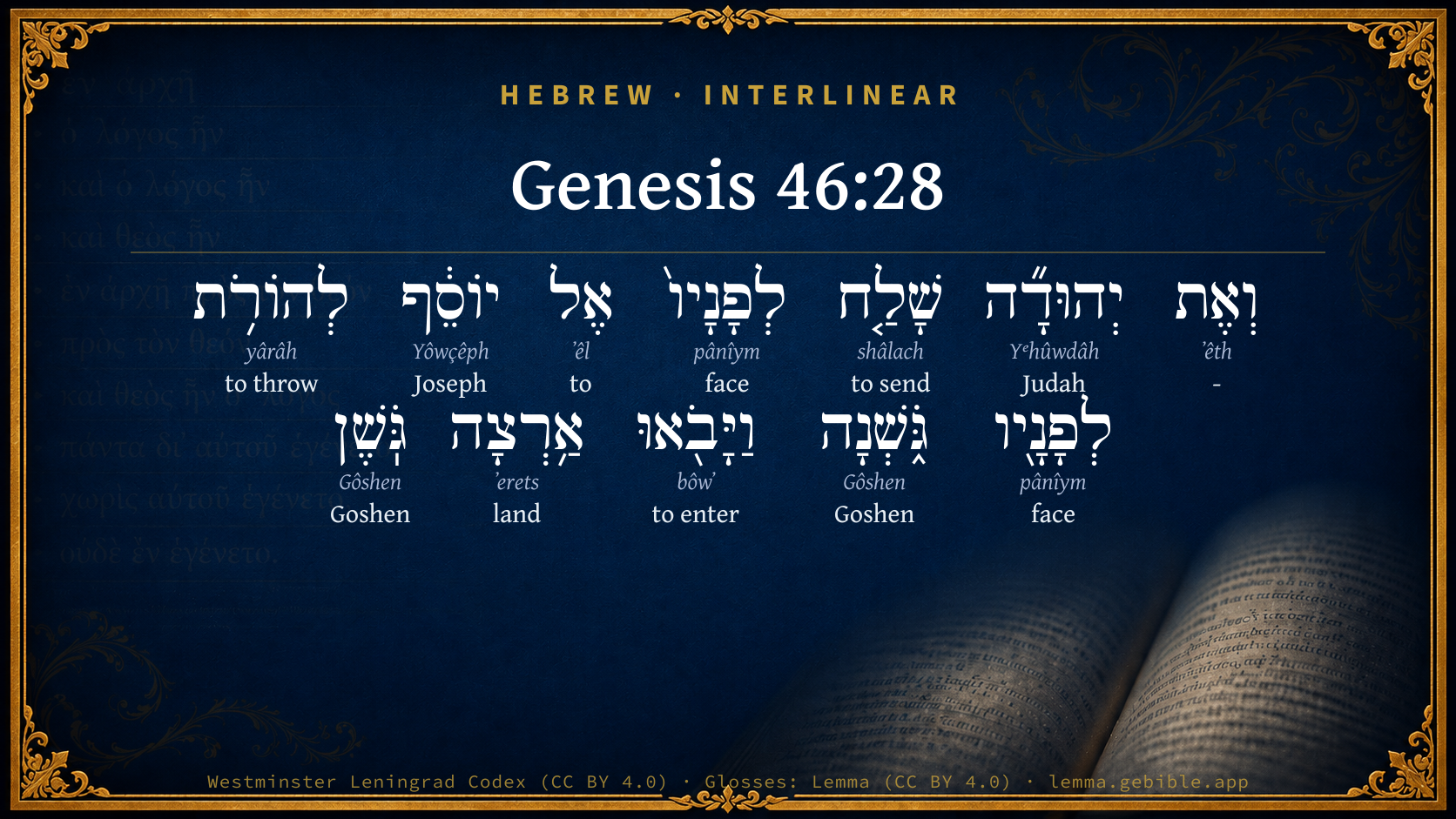
Hebrew (Westminster Leningrad Codex) Genesis 46:28 appears in the Hebrew Old Testament. The text above is from the Westminster Leningrad Codex. Each word links to its Strong’s number, a concise gloss, and parsing drawn from the Open Scriptures Hebrew Bible morphology. Click any word for its full Brown-Driver-Briggs (BDB) entry.
Download image
Cite this verse

Genesis 46:28 (World English Bible). Public Domain. Lemma interlinear Bible study tool, https://lemma.gebible.app/v/genesis/46/28.

Show BibTeX & RIS
BibTeX
RIS
English Translation
He sent Judah before him to Joseph, to show the way before him to Goshen, and they came into the land of Goshen.
World English Bible · Public Domain
Download a study sheet

One document with this verse’s original text, its word-by-word gloss line, the meaning frame, cross-references with their text, attributed commentary, and full source and license credits — printable, and it pastes into notes with its structure intact.

This verse Autodidact and up

Study sheet (.html) Plain text (.txt)

A passage Seminary Student

Up to 50 verses in one chapter. A passage sheet keeps up to 6 commentary sources and 12 cross-references per verse, in the order this page ranks them, and says so on the sheet whenever that leaves anything out. Ask for a single verse and you get the Autodidact verse sheet above.

Everything on this page stays free to read, with no account — the sheet is a download of what is already on screen, not access to it.

Want to remove ads? Support Godless Engineer
Compare translations 3

The same verse in 3 English versions, stacked beneath the original-language interlinear above. Click any original word for its lexicon entry.

Each is an independent rendering of the whole verse — the interlinear is not word-aligned to these translations.

Highlighted words mark where these versions differ — a whole-verse word diff, not a word-by-word alignment.

  • World English Bible Public Domain
    He sent Judah before him to Joseph, to show the way before him to Goshen, and they came into the land of Goshen.
  • King James Version Public Domain
    And he sent Judah before him unto Joseph, to direct his face unto Goshen; and they came into the land of Goshen.
  • unfoldingWord Literal Text CC BY-SA 4.0
    And he sent Judah before him to Joseph to show before him to Goshen. And they came to the land of Goshen.

unfoldingWord Literal Text — © unfoldingWord, licensed CC BY-SA 4.0. Word-aligned USFM3 via Door43 (git.door43.org/unfoldingWord/en_ult).

Versions to compare (up to 4)

3 of 4 selected

Show all 18 translations

Every available English version of this verse, each an independent rendering of the whole verse.

  • World English Bible Public Domain
    He sent Judah before him to Joseph, to show the way before him to Goshen, and they came into the land of Goshen.
  • Berean Standard Bible Public Domain
    Now Jacob had sent Judah ahead of him to Joseph to get directions to Goshen. When Jacob’s family arrived in the land of Goshen,
  • Majority Standard Bible Public Domain
    Now Jacob had sent Judah ahead of him to Joseph to get directions to Goshen. When Jacob’s family arrived in the land of Goshen,
  • King James Version Public Domain
    And he sent Judah before him unto Joseph, to direct his face unto Goshen; and they came into the land of Goshen.
  • American Standard Version (1901) Public Domain
    And he sent Judah before him unto Joseph, to show the way before him unto Goshen; and they came into the land of Goshen.
  • Revised Version (1885) Public Domain
    And he sent Judah before him unto Joseph, to shew the way before him unto Goshen; and they came into the land of Goshen.
  • Geneva Bible (1599) Public Domain
    The he sent Iudah before him vnto Ioseph, to direct his way vnto Goshen, and they came into the land of Goshen.
  • Douay-Rheims (1899) Public Domain
    And he sent Juda before him to Joseph, to tell him; and that he should meet him in Gessen.
  • Young's Literal Translation Public Domain
    And Judah he hath sent before him unto Joseph, to direct before him to Goshen, and they come into the land of Goshen;
  • Literal Standard Version CC BY-SA 4.0
    And Judah he has sent before him to Joseph, to direct before him to Goshen, and they come into the land of Goshen;
  • Unlocked Literal Bible CC BY-SA 4.0
    Jacob sent Judah ahead of him to Joseph to show the way before him to Goshen, and they came to the land of Goshen.
  • unfoldingWord Literal Text CC BY-SA 4.0
    And he sent Judah before him to Joseph to show before him to Goshen. And they came to the land of Goshen.
  • Darby Bible Public Domain
    And he sent Judah before him to Joseph, to give notice before he came to Goshen. And they came into the land of Goshen.
  • World Messianic Bible Public Domain
    Jacob sent Judah before him to Joseph, to show the way before him to Goshen, and they came into the land of Goshen.
  • Webster's Bible Public Domain
    And he sent Judah before him to Joseph, to direct his face to Goshen; and they came into the land of Goshen.
  • Free Bible Version CC BY-SA 4.0
    Jacob sent Judah on ahead to meet Joseph and find out the way to Goshen. When they arrived in Goshen,
  • Bible in Basic English Public Domain
    Now he had sent Judah before him to Goshen, to get word from Joseph; and so they came to the land of Goshen.
  • JPS Tanakh (1917) Public Domain
    And he sent Judah before him unto Joseph, to show the way before him unto Goshen; and they came into the land of Goshen.

Literal Standard Version (2020), Covenant Press — licensed CC BY-SA 4.0. Text via the HelloAO Bible API (eBible.org). Unlocked Literal Bible (unfoldingWord) — licensed CC BY-SA 4.0. Text via the HelloAO Bible API (eBible.org). unfoldingWord Literal Text — © unfoldingWord, licensed CC BY-SA 4.0. Word-aligned USFM3 via Door43 (git.door43.org/unfoldingWord/en_ult). Free Bible Version, Dr. Jonathan Gallagher — licensed CC BY-SA 4.0. Text via the HelloAO Bible API (eBible.org).

Word by word

More ways to search: Search by grammar → Find every occurrence → Compare this word →

Practice this passage: Drill this verse → Learn its vocabulary →

גֹּ֑שְׁנָה
Gôshen
H1657
“Goshen · toward”
Noun, Proper + Suffix, Demonstrative
Part of Speech
Noun
Type
Proper
Full BDB Definition

Origin: probably of Egyptian origin

TWOT: 390

Goshen = "drawing near" - a region in northern Egypt, east of the lower Nile, where the children of Israel lived from the time of Joseph to the time of Moses - a district in southern Palestine between Gaza and Gibeon - a town in the mountains of Judah probably in the district of Goshen
  1. וְאֶת ʼêth H853 “and · -” Conjunction + Particle, Direct Object
  2. יְהוּדָ֞ה Yᵉhûwdâh H3063 “Judah” Noun, Proper
  3. שָׁלַ֤ח shâlach H7971 “to send” Verb, Qal, Perfect, 3rd Person, Masculine, Singular
  4. לְפָנָיו֙ pânîym H6440 “to/for · face(s) · his” Preposition + Noun, Common, Both, Plural, Construct + Suffix, Personal, 3rd Person, Masculine, Singular
  5. אֶל ʼêl H413 “to” Preposition
  6. יוֹסֵ֔ף Yôwçêph H3130 “Joseph” Noun, Proper
  7. לְהוֹרֹ֥ת yârâh H3384 “to throw” Preposition + Verb, Hiphil, Infinitive Construct
  8. לְפָנָ֖יו pânîym H6440 “to/for · face(s) · his” Preposition + Noun, Common, Both, Plural, Construct + Suffix, Personal, 3rd Person, Masculine, Singular
  9. וַיָּבֹ֖אוּ bôwʼ H935 “and · to enter” Conjunction + Verb, Qal, Sequential Imperfect, 3rd Person, Masculine, Plural
  10. אַ֥רְצָה ʼerets H776 “land · toward” Noun, Common, Both, Singular, Construct + Suffix, Demonstrative
  11. גֹּֽשֶׁן Gôshen H1657 “Goshen” Noun, Proper

About this verse

These counts appear in no published source. They are computed here, from the morphology-tagged text and Lemma’s own curated glosses. What Lemma adds →

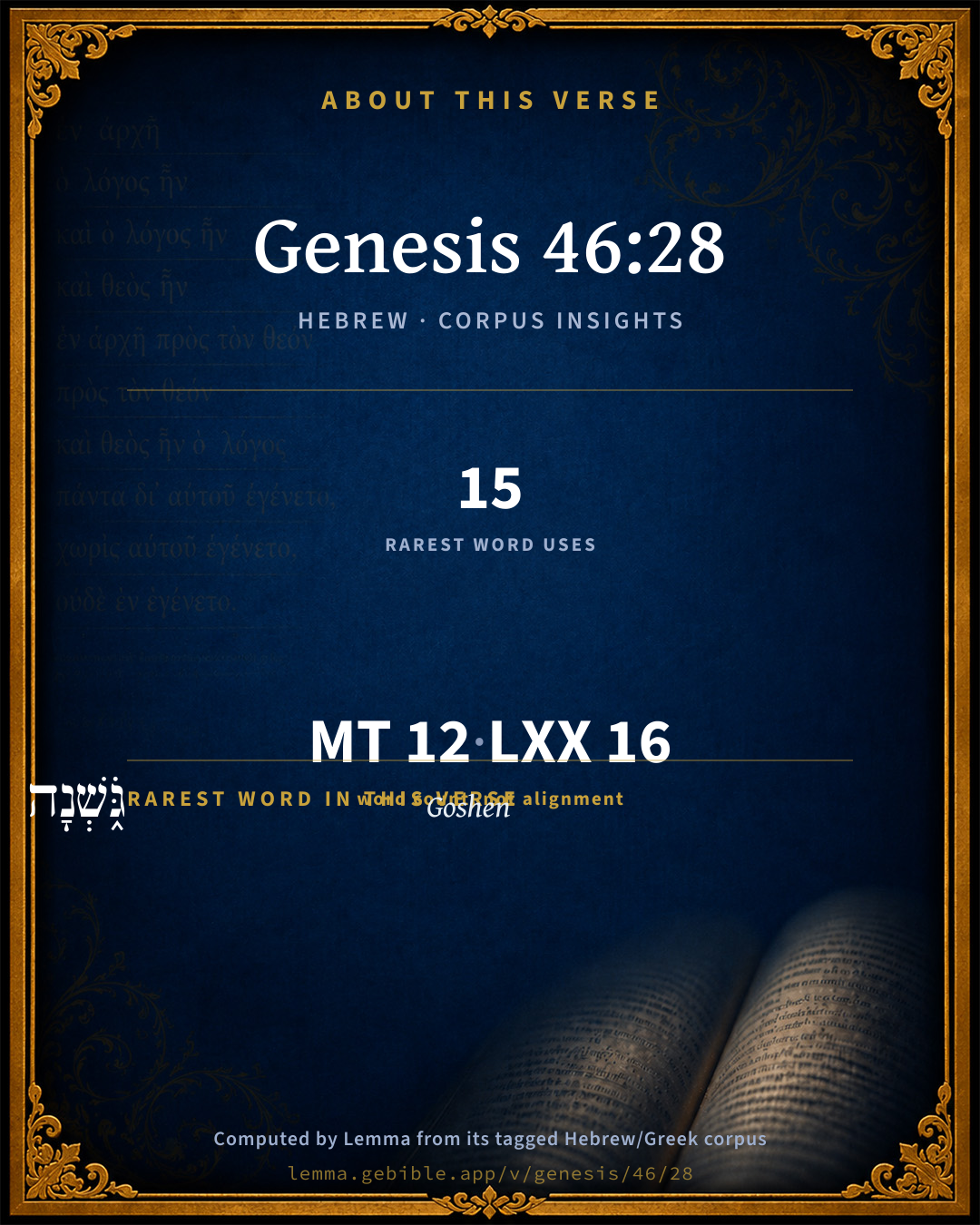
12
words
10
distinct lemmas
Pentateuch
section

Notable vocabulary

The rarest word here is גֹּ֑שְׁנָה Goshen H1657 — appearing just 15 times in the whole Hebrew Bible.

Shared distinctive vocabulary

גֹּ֑שְׁנָה Goshen H1657 occurs in 14 verses of the Hebrew Bible. Also found in:

Grammatical profile

  • 3 verbs
  • 7 nouns
  • 1 preposition
  • 1 particle

Verb forms

  • שָׁלַ֤ח Qal · Perfect
  • לְהוֹרֹ֥ת Hiphil · Infinitive Construct
  • וַיָּבֹ֖אוּ Qal · Sequential Imperfect

Repetition

Words recur within this verse — often emphatic in Hebrew:

  • לְפָנָיו֙ face H6440 ×2
  • גֹּ֑שְׁנָה Goshen H1657 ×2

Hebrew & Septuagint length

In English translation the verse runs 23 words from the Hebrew and 21 from the Septuagint (LXX English) — closely comparable.

A rough comparison of the two English renderings, which tokenize alike — not a word-level alignment.

Word counts can differ between the Hebrew and the Greek without any difference in meaning — e.g. the Hebrew direct-object marker אֵת has no separate Greek word, and Greek often adds the article ὁ.

In the original languages it is 12 Hebrew tokens and 16 Greek tokens — but the two are counted differently (Hebrew bundles its prefixes and suffixes into one token; the Greek is in lemma form), so that isn’t a like-for-like length.

Cross-references

6

Topical passages linked to Genesis 46:28 in the Treasury of Scripture Knowledge — connected by theme and wording, ordered by reader-vote popularity; previews shown in the World English Bible.

  • Genesis 45:10 You shall dwell in the land of Goshen, and you will be near to me, you, your children, your children's children, your flocks, your herds, and all that you have.
  • Genesis 31:21 So he fled with all that he had. He rose up, passed over the River, and set his face toward the mountain of Gilead.
  • Genesis 43:8 Judah said to Israel, his father, "Send the boy with me, and we will arise and go, so that we may live, and not die, both we, and you, and also our little ones.
  • Genesis 44:16–34 Judah said, "What will we tell my lord? What will we speak? Or how will we clear ourselves? God has found out the iniquity of your servants. Behold, we are my lord's bondservants, both we, and he also in whose hand the cup is found."
  • Genesis 46:34–47:1 that you shall say, 'Your servants have been keepers of cattle from our youth even until now, both we, and our fathers:' that you may dwell in the land of Goshen; for every shepherd is an abomination to the Egyptians."
  • Genesis 49:8 "Judah, your brothers will praise you: Your hand will be on the neck of your enemies; Your father's sons will bow down before you.

Cross-references courtesy of OpenBible.info (CC BY 4.0).

Hebrew and Greek witnesses Masoretic Hebrew ↔ Greek Septuagint

The same verse in the two great witnesses to the Old Testament, shown verse-for-verse.

These are two independent witnesses, not word-aligned to each other, and the Septuagint is shown in lemma (dictionary) form.

Hebrew Genesis 46:28 Masoretic · Westminster Leningrad Codex

וְאֶת יְהוּדָ֞ה שָׁלַ֤ח לְפָנָיו֙ אֶל יוֹסֵ֔ף לְהוֹרֹ֥ת לְפָנָ֖יו גֹּ֑שְׁנָה וַיָּבֹ֖אוּ אַ֥רְצָה גֹּֽשֶׁן

He sent Judah before him to Joseph, to show the way before him to Goshen, and they came into the land of Goshen.

World English Bible · Public Domain

Greek LXX Genesis 46:28 Septuagint · lemma form

ὁ δέ ἰούδας ἀποστέλλω ἔμπροσθεν αὐτός πρός ιωσηφ συνἀντάω αὐτός κατά ἥρως πόλις εἰς γῆ ραμεσση

And he sent Judas before him to Joseph, to meet him to the city of Heroes, into the land of Ramesses.

LXX2012 (modern English Septuagint) · Public Domain

On this verse, The Preacher's Complete Homiletical Commentary discusses the Septuagint’s reading. Read the note in Commentary ↓

Hebrew: Westminster Leningrad Codex (CC BY 4.0). Greek: Septuagint (public domain); English from LXX2012 (modern English Septuagint) (Public Domain). How the Septuagint differs from the Hebrew →

Targum (Aramaic paraphrase)

2

The Targum is the ancient Jewish Aramaic paraphrase of the Hebrew Scriptures — an interpretive translation, not the Hebrew text itself. Onkelos (literal) and Pseudo-Jonathan (expansive) render the Torah, and Jonathan the Prophets. Coverage is partial: where no permissively-licensed English translation exists for a verse, only the Aramaic is shown. This is verse-level text, not a word-by-word alignment to the Hebrew.

  1. Targum Onkelos Torah (Genesis–Deuteronomy)
    וְיָת יְהוּדָה שְׁלַח קֳדָמוֹהִי לְוַת יוֹסֵף לְפַנָּאָה קֳדָמוֹהִי לְגשֶׁן וַאֲתוֹ לְאַרְעָא דְגשֶׁן

    (no public-domain English translation for this verse)

    Targum Onkelos — Aramaic: “Onkelos Genesis” (public domain); “Onkelos Exodus” (public domain); “Onkelos Leviticus” (public domain); “Onkelos Numbers” (public domain); “Onkelos Deuteronomy” (public domain). English: “Sefaria Community Translation” (CC0 1.0 (public-domain dedication)); “J.W. Etheridge. The Targums of Onkelos and Jonathan Ben Uzziel on the Pentateuch. London: Longmans, Green, 1862” (public domain). Text via Sefaria.

  2. Targum Pseudo-Jonathan Torah (Genesis–Deuteronomy)
    וְיַת יְהוּדָה שָׁדַר קֳדָמוֹי לְוַת יוֹסֵף לִמְחַוְיָא קֳדָמוֹי אָרְחָא וּלְמִכְבְּשָׁא יַת עַמוּדַיָא דְאַרְעָא וּלְאָתַקְנָא קֳדָמוֹי בֵּית מֵישְׁרוֹי בְגוֹשְנָא וְאָתוֹ לְאַרְעָא דְגשֶׁן

    And he sent Jehuda before him to Joseph to indicate the way before him, to subdue the pillars of the earth, and to provide him a house of dwelling in Goshena. And they came to the land of Goshen.

    Targum Pseudo-Jonathan — Aramaic: “Targum Jonathan on Genesis” (public domain); “Targum Jonathan on Exodus” (public domain); “Targum Jonathan on Leviticus” (public domain); “Targum Jonathan on Numbers” (public domain); “Targum Jonathan on Deuteronomy” (public domain). English: “The Targum of Jonathan ben Uzziel, trans. J. W. Etheridge, London, 1862” (public domain). Text via Sefaria.

Commentary

Notes on Genesis 46:28 from classic Christian and Jewish commentators (each source and its license shown beneath its notes). The classic Christian expositions comment on the surrounding passage and are grouped to its opening verse, so a note may address several verses; the Jewish commentaries on the Tanakh (Rashi and others) are per-verse, so they appear only where the commentator wrote on this verse.

Lemma curates 59 commentaries, every one of them public domain or Creative Commons licensed, each selected and text-cleaned for this edition rather than reprinted as found. About our sources →

Matthew Henry's Commentary

We have here, I. The joyful meeting between Jacob and his son Joseph, in which observe,

1. Jacob's prudence in sending Judah before him to Joseph, to give him notice of his arrival in Goshen. This was a piece of respect owing to the government, under the protection of which these strangers had come to put themselves, Gen 46:28. We should be very careful not to give offence to any, especially not to the higher powers.

2. Joseph's filial respect to him. He went in his chariot to met him, and, in the interview, showed, (1.) How much he honoured him: He presented himself unto him. Note, It is the duty of children to reverence their parents, yea, though Providence, as to outward condition, has advanced them above their parents. (2.) How much he loved him. Time did not wear out the sense of his obligations, but his tears which he shed abundantly upon his father's neck, for joy to see him, were real indications of the sincere and strong affection he had for him. See how near sorrow and joy are to each other in this world, when tears serve for the expression of both. In the other world weeping will be restrained to sorrow only; in heaven there is perfect joy, but no tears of joy: all tears, even those, shall there be wiped away, because the joys there are, as no joys are here, without any alloy. When Joseph embraced Benjamin he wept upon his neck, but when he embraced his father he wept upon his neck a good while; his brother Benjamin was dear, but his father Jacob must be dearer.

3. Jacob's great satisfaction in this meeting: Now let me die, Gen 46:30. Not but that it was further desirable to live with Joseph, and to see his honour and usefulness; but he had so much pleasure and satisfaction in this first meeting that he thought it too much to desire or expect any more in this world, where our comforts must always be imperfect. Jacob wished to die immediately, and lived seventeen years longer, which, as our lives go now, is a considerable part of a man's age. Note, Death will not always come just when we call for it, whether in a passion of sorrow or in a passion of joy. Our times are in God's hand, and not in our own; we must die just when God pleases, and not either just when we are surfeited with the pleasures of life or just when we are overwhelmed with its griefs.

II. Joseph's prudent care concerning his brethren's settlement. It was justice to Pharaoh to let him know that such a colony had come to settle in his dominions. Note, If others repose a confidence in us, we must not be so base and disingenuous as to abuse it by imposing upon them. If Jacob and his family should come to be a charge to the Egyptians, yet it should never be said that they came among them clandestinely and by stealth. Thus Joseph took care to pay his respects to Pharaoh, Gen 46:31. But how shall he dispose of his brethren? Time was when they were contriving to get rid of him; now he is contriving to settle them to their satisfaction and advantage: This is rendering good for evil. Now, 1. He would have them to live by themselves, separate as much as might be from the Egyptians, in the land of Goshen, which lay nearest to Canaan, and which perhaps was more thinly peopled by the Egyptians, and well furnished with pastures for cattle. He desired they might live separately, that they might be in the less danger both of being infected by the vices of the Egyptians and of being insulted by the malice of the Egyptians. Shepherds, it seems, were an abomination to the Egyptians, that is, they looked upon them with contempt, and scorned to converse with them; and he would not send for his brethren to Egypt to be tramped upon. And yet, 2. He would have them to continue shepherds, and not to be ashamed to own that as their occupation before Pharaoh. He could have employed them under himself in the corn-trade, or perhaps, by his interest in the king, might have procured places for them at court or in the army, and some of them, at least, were deserving enough; but such preferments would have exposed them to the envy of the Egyptians, and would have tempted them to forget Canaan and the promise made unto their fathers; therefore he contrives to continue them in their old employment. Note, (1.) An honest calling is no disparagement, nor ought we to account it so either in ourselves or in our relations, but rather reckon it a shame to be idle, or to have nothing to do. (2.) It is generally best for people to abide in the callings that they have been bred to, and used to, Co1 7:24. Whatever employment or condition God, in his providence, has allotted for us, let us accommodate ourselves to it, and satisfy ourselves with it, and not mind high things. It is better to be the credit of a mean post than the shame of a high one.

Matthew Henry's Commentary on the Whole Bible (1708–1710) — public domain (CC PDM 1.0). Text via the HelloAO Bible API.

Jamieson, Fausset & Brown

Robert Jamieson, A. R. Fausset & David Brown

ARRIVAL IN EGYPT. (Gen 46:28-34)

he sent Judah before him unto Joseph--This precautionary measure was obviously proper for apprising the king of the entrance of so large a company within his territories; moreover, it was necessary in order to receive instruction from Joseph as to the locale of their future settlement.

Jamieson, Fausset & Brown — Commentary Critical and Explanatory on the Whole Bible (1871) — public domain (CC PDM 1.0). Text via the HelloAO Bible API.

Trapp's Complete Commentary

John Trapp

Gen 46:28 And he sent Judah before him unto Joseph, to direct his face unto Goshen; and they came into the land of Goshen.

Ver. 28. And he sent Judah before him.] "A good man guides his affairs with discretion"; {Psa 112:5} doth all things decently, and in order. It was great "joy" to the apostle to behold the Colossians’ "order." {Col 2:5}

John Trapp, A Commentary or Exposition upon All the Books of the Old and New Testament (1647–1656) — public domain. Text from a community e-Sword module.

The Biblical Illustrator

Joseph S. Exell

Gen_46:28-34

They came into the land of Goshen

The settlement of the children of Israel in Goshen

I.

THE WISE POLICY OF THIS STEP.

II. THE BEHAVIOUR OF JOSEPH.

1. He determines to announce their arrival to Pharaoh (Gen_46:31).

2. He gives instructions to his brethren (Gen_46:32; Gen_46:34). (T. H. Leale.)

Jacob and Joseph

I. A DIVINE PROMISE.

1. The occasion on which it was given. Jacob having heard that Joseph was alive, was anxious to see his son once more. Felt he could hardly leave the promised land except he had Divine permission. He went as far as he dared--to Beer-sheba, in the extreme south, and there offered sacrifice unto the God of his father. Then it was, in a vision, that the promise was spoken. Divine mercy and condescension, responding to the fathers desire. Like as a father pitieth his children, &c.

2. The nature of it.

(1) Confirmation of old promise (Gen_46:3.) Jacob had not forgotten it. But might not going down to Egypt prevent its fulfilment?

(2) Promise of Divine presence and protection. I will go, &c. (Gen_46:4).

(3) Promise that the father shall see his long-lost son.

3. Practical effect of it. In the strength of the encouragement it imparted, Jacob, 130 years old, sets out for Egypt.

II. A FATHERS MESSENGER. Judah. He had taken a chief part in the separating of father and son, and we now see him most active in bringing about the meeting. Those who have done wrong may not be able to undo the wrong they have done, but should, if possible, make reparation. Recall the activity of Judah all through the history. His intercession for Benjamin, &c. There seems to have been a radical change in him.

III. A HAPPY MEETING. Jacob and Joseph. Some twenty-two years had passed since they had seen each other. It was no prodigals return. Jacob would have been glad to see Joseph under any circumstances, but how great his pride at finding him thus exalted. Jacob, as a God-fearing man, had no need to be ashamed of the progress of his son.

IV. AN HONEST COUNCILLOR. Joseph to his brethren. They were not to disguise their calling; although the Egyptians abandoned it. They were to begin in their new home on the right principles, were to be true and honest. How many resort to unmanly concealments of humble extraction and lowly avocations when away from home. Honesty always right, and therefore the best policy. In this case the effect is evident. The Israelites were located by themselves. Their exodus the more easy and practicable when the time came. Had they been spread through the country, their collection and departure had been most difficult. Learn:

1. To seek Gods guidance in all our movements.

2. To look for the fulfilment of promise in an honest obedience.

3. Endeavour to repair results of past sins. Restitution and reparation.

4. Let conduct in absence of parents be such as to render the meeting happy.

5. Begin life on right principles. Honour, truth, honesty. (J. G. Gray.)

Duty and filial piety combined

A beautiful combination of official duty and filial piety! The whole land of Egypt is suffering from famine. Joseph is the controller and administrator of the resources of the land. He does not abandon his position and go away to Canaan; but he gets the chariot out and he must go part of the road. I know I am father to Pharaoh and all his great people. I shall not be away long; I shall soon be back again to my duties. I must go a little way to meet the old man from home. Yes, I dont care what our duties are, we can add a little pathos to them if we like; whatever we be in life, we can add a little sentiment to our life. And what is life without sentiment? What are the flowers without an occasional sprinkling of dew? It may be a grand thing to sit on high stool and wait till the old man comes upstairs. But it is an infinitely grander thing, a lordlier chivalry, to come off the stool and go away to meet him a mile or two on the road. Your home will be a better home--I dont care how poor the cot--if you will have a little sentiment in you, a little tenderness and nice feeling. These are things that sweeten life. I dont want a man to wait until there is an earthquake in order that he may call and say, How do you do? I dont want a man to do earthquakes for me. Sometimes I want a chair handed, and a door opened, and a kind pressure of the hand, and a gentle word. And as for the earthquakes, why--wait until they come. (J. Parker, D. D.)

Kindness to parents

The biographers of Abraham Lincoln, say: He never, in all his prosperity lost sight of his parents. He continued to aid and befriend them in every way, even when he could ill-afford it, and when his benefactions were imprudently used. (One Thousand New Illustrations.)

Not ashamed of parentage

Joseph, a prince, was no whir ashamed of the poor old shepherd, before so many of his compeers and other courtiers, that accompanied him, and abominated such kind of persons. Colonel Edwards is much commended for his ingenuous reply to a countryman of his, newly come to him, into the low countries, out of Scotland. This fellow, desiring entertainment of him, told him, my lord his father and such knights and gentlemen, his cousins and kinsmen, were in good health. Gentlemen, quoth Colonel Edwards to his friends by, believe not one word he says; my father is but a poor banker, whom this knave would make a lord, to curry favour with me, and make you believe I am a great man born. The truly virtuous and valorous are no whir ashamed of their mean parentage. (J. Trapp.)

.

The Biblical Illustrator, edited by Joseph S. Exell (c. 1880s–1900s) — public domain. Text from a community e-Sword module.

Joseph Benson's Commentary

Gen 46:28-30. Direct his face unto Goshen — Which was near the entrance of Egypt. The meaning seems to be, to give Joseph notice of his approach, that he might come to Goshen to meet him. Now let me die — Not but that it was desirable to live with Joseph, and to see his honour and usefulness; but he had so much satisfaction in this first meeting, that he thought it too much to desire or expect any more in this world.

Joseph Benson's Commentary on the Old and New Testaments (1811–1818) — public domain. Text from a community e-Sword module.

Whedon's Commentary on the Bible

Daniel D. Whedon

ISRAEL IN EGYPT, Gen_46:28-34.

28. And he sent Judah before him — “Judah appears as a leader among his brethren, having taken the responsibility for the return of Benjamin, and having conducted the negotiation with Joseph (chap. xliv) with such pathetic eloquence as to bring matters at once to a crisis, and compel Joseph to throw off his disguise.” — Newhall.

Daniel D. Whedon (gen. ed.), Commentary on the Old and New Testaments (1874–1909) — public domain. Text from a community e-Sword module.

The Preacher's Complete Homiletical Commentary

Joseph S. Exell (gen. ed.)

CRITICAL NOTES.—

Gen_46:8-28. And these are the names of the children of Israel, etc.] “Catalogue of Jacob’s sons, grandchildren, and great-grand children who went down into Egypt. The children are ranged according to their mothers. In Gen_46:27, the LXX make the whole number who went down to Egypt to be 75. This reckoning is followed by Stephen (Act_7:14), who as a Hellenistic Jew naturally goes by the LXX. The list is probably neither complete nor accurate, and must be regarded rather as a formal than as an historical document.” (Alford).—“If Stephen here quoted the LXX, he was accountable only for the correctness of his quotation, and not for the error which had crept into his authority. This was immaterial to his present purpose, and it was not the manner of the sacred speakers to turn aside from their grand task to the pedantry of criticism.” (Murphy).

Gen_46:29. And presented himself unto him.] The word is commonly used for Divine appearings. Knobel thinks that it is used here as according with the royal pomp with which Joseph was invested.—

Gen_46:34. Thy servants’ trade hath been about cattle.] “This would be the sufficient ground on which the district of Goshen would be granted to them, as keeping them more by themselves, and out of contact with the Egyptian people.” (Jacobus.)

MAIN HOMILETICS OF THE PARAGRAPH.—Gen_46:28-34

THE SETTLEMENT OF THE CHILDREN OF ISRAEL IN GOSHEN

In which two things are to be noticed.

I. The wise policy of this step.

1. In the choice of a leader. Jacob sent Judah before him unto Joseph. (Gen_46:28.) And he was qualified beyond his three brothers for this important mission. It was proper that he should receive from Joseph the necessary orders before entering the country. For Egypt was a well-ordered and organized kingdom, and it could not be permitted that a wandering tribe should pass the borders without ceremony.

2. In the choice of this particular place. They were shepherds, and Goshen was best fitted for pasture. Here they would be isolated from Egyptian society; for there were elements belonging to the two nations which rendered them mutually repulsive. The idolatries of the Egyptians would be abhorred by the worshippers of the true God, and “every shepherd is an abomination unto the Egyptians.” Religious aversion is the strongest of antipathies. Surely it was Divine wisdom which led Joseph thus to place the house of Israel under the protection of Egyptian contempt. He caused them to accept a humble position, which while it ministered to their temporal prosperity, at the same time promoted their spiritual prosperity as a holy nation.

II. The behaviour of Joseph. In the peculiar circumstances of the case, this was most suitable and dignified.

1. He determines to announce their arrival to Pharaoh. (Gen_46:31.) This was proper in itself, as well as a necessary formality. The rights of place and rank should be respected.

2. He gives instructions to his brethren. (Gen_46:33-34.) They must enter upon the necessary formality of an introduction to the king. Joseph gives them instructions what to answer, and in so doing is careful to keep them clear of the snares of Egypt. Joseph was a statesman but he had learned that truth is the highest policy; an open, but dignified frankness, the highest wisdom.

SUGGESTIVE COMMENTS ON THE VERSES

Gen_46:28. Judah had acquitted himself well in a former case of great delicacy, and this might recommend him in the present instance. He who could plead so well for his father shall have the honour of introducing him. It is fitting too that the father of the royal tribe, and of the Messiah, should not be the last in works of honour and usefulness, but rather that he should have the pre-eminence.—(Fuller.)

Gen_46:29. The intermission of comforts hath this advantage, that it sweetens our delights more in return than was abated in the forbearance. God doth oft-times hide away our Joseph for a time, that we may be more joyous and thankful in his recovery. This was the sincerest pleasure that Jacob ever had, which therefore God reserved for his eye. And if the meeting of earthly friends be so unspeakably comfortable, how happy shall we be in the light of the glorious face of God our Heavenly Father! of that our blessed Redeemer, whom we sold to death by our sins, and which now, after all that noble triumph, hath all power given Him in heaven and earth!—(Bp. Hall).

Gen_46:30. He feels so happy that he thinks of nothing but dying. Perhaps he thought he should die soon: having enjoyed as much as he could desire in this world, it was natural now to wish to go to another. Yet Jacob did not die for seventeen years; a proof this, that our feelings are no certain rule of what shall befal us.—(Fuller.)

Because thou art yet alive. If this were so great a matter to Jacob, what should it be to us, that Christ was dead and is alive; yea, that He ever lives to make request for us.—(Trapp.)

Gen_46:31-32. Joseph was loved for his own sake. The greatness of his character was too well established to be affected by the knowledge of any facts connected with his family.

It is observable with what “meekness of wisdom” Joseph demeaned himself in this affair. Most men in similar circumstances would have been for introducing their relations as speedily as possible into posts of honour and profit, lest they should disgrace him. But Joseph is more concerned for their purity than for their outward dignity. He sought to secure them a place as free as possible from the evil influence to which they would be exposed in a court.—(Bush.)

Gen_46:33-34. Joseph says in effect, “I will go before you, and will tell the king that you are shepherds, and have been so all your lives, and your fathers before you. This will prevent any proposals for raising you to any posts of honour in the state. And when you come before the king, and he shall ask you of your occupation, then do you confirm what I said of you; and as the employment of a shepherd is meanly accounted of in Egypt, and those that follow it are despised, and reckoned unfit for the higher offices of the state, this will determine the king to say nothing to you on the subject, but to grant you a place in Goshen.”—(Fuller.)

Thus began already in the house of Jacob, at its entrance into Egypt, that reproach of Christ which Moses afterwards esteemed greater riches than the treasures of Egypt. This antipathy of the Egyptians towards the shepherd-people was a fence to them, as was afterwards the law of Moses.—(Ross.)

The Preacher's Complete Homiletical Commentary (gen. ed. Joseph S. Exell; Funk & Wagnalls, c. 1892) — public domain (pre-1929). A full-Bible homiletical/sermon-outline anthology covering 65 of 66 books (2 John is absent from the source module). Text from a community e-Sword module.

Keil & Delitzsch

C. F. Keil & F. Delitzsch

This list of the house of Jacob is followed by an account of the arrival in Egypt.

Gen 46:28

Jacob sent his son Judah before him to Joseph, "to show (להורת) before him to Goshen;" i.e., to obtain from Joseph the necessary instructions as to the place of their settlement, and then to act as guide to Goshen.

Gen 46:29

As soon as they had arrived, Joseph had his chariot made ready to go up to Goshen and meet his father (ויּעל applied to a journey from the interior to the desert or Canaan), and "showed himself to him there (lit., he appeared to him; נראה, which is generally used only of the appearance of God, is selected here to indicate the glory in which Joseph came to meet his father); and fell upon his neck, continuing (עוד) upon his neck (i.e., in his embrace) weeping."

Gen 46:30

Then Israel said to Joseph: "Now (הפּעם lit., this time) will I die, after I have seen thy face, that thou (art) still alive."

Gen 46:31-32

But Joseph told his brethren and his father's house (his family) that he would to up to Pharaoh (עלה here used of going to the court, as an ideal ascent), to announce the arrival of his relations, who were מקנה אנשׁי "keepers of flocks," and had brought their sheep and oxen and all their possessions with them.

Gen 46:33-34

At the same time Joseph gave these instructions to his brethren, in case Pharaoh should send for them and inquire about their occupation: "Say, Thy servants have been keepers of cattle from our youth even until now, we like our fathers; that ye may dwell in the land of Goshen; for every shepherd is an abomination of the Egyptians." This last remark formed part of Joseph's words, and contained the reason why his brethren should describe themselves to Pharaoh as shepherds from of old, namely, that they might receive Goshen as their dwelling-place, and that their national and religion independence might not be endangered by too close an intercourse with the Egyptians. The dislike of the Egyptians to shepherds arose from the fact, that the more completely the foundations of the Egyptian state rested upon agriculture with its perfect organization, the more did the Egyptians associate the idea of rudeness and barbarism with the very name of a shepherd. This is not only attested in various ways by the monuments, on which shepherds are constantly depicted as lanky, withered, distorted, emaciated, and sometimes almost ghostly figures (Graul, Reise 2, p. 171), but is confirmed by ancient testimony. According to Herodotus (2, 47), the swine-herds were the most despised; but they were associated with the cow-herds (βουκόλοι) in the seven castes of the Egyptians (Herod. 2, 164), so that Diodorus Siculus (1, 74) includes all herdsmen in one caste; according to which the word βουκόλοι in Herodotus not only denotes cow-herds, but a potiori all herdsmen, just as we find in the herds depicted upon the monuments, sheep, goats, and rams introduced by thousands, along with asses and horned cattle.

Keil & Delitzsch — Biblical Commentary on the Old Testament (1861–1891) — public domain (CC PDM 1.0). Text via the HelloAO Bible API. (Old Testament only.)

Tyndale Open Study Notes

Tyndale Open Resources

46:28-34 Jacob finally saw his son Joseph again; their reunion was overwhelmingly joyful.

Tyndale Open Study Notes — © Tyndale Open Resources, licensed CC BY-SA 4.0. Text via the HelloAO Bible API.

Geneva Bible (1599)

Geneva Bible translators

Or, to prepare him a place.

Geneva Bible (1599) marginal notes — public domain. Text via Bolls.life.

Adam Clarke's Commentary

Verse 28. He sent Judah before him unto Joseph] Judah was certainly a man of sense, and also an eloquent man; and of him Joseph must have had a very favourable opinion from the speech he delivered before him, Ge 44:18, c. he was therefore chosen as the most proper person to go before and announce Jacob's arrival to his son Joseph.

To direct his face unto Goshen] The land of Goshen is the same, according to the Septuagint, as the land of Rameses, and Goshen itself the same as Heroopolis, 'Ἡρωων πολις Heroonpolis, the city of heroes, a name by which it went in the days of the Septuagint, and which it still retained in the time of Josephus, for he makes use of the same term in speaking of this place. See Clarke on Ge 46:34.

Adam Clarke's Commentary on the Bible (1810–1826) — public domain. Text from a community e-Sword/MySword module.

John Calvin's Commentaries

28. And he sent Judah before him unto Joseph. Because Goshen had been selected by Joseph as the abode of his father and his brethren, Jacob now desires, that, on his coming, he may find the place prepared for him: for the expression which Moses uses, implies, not that he requires a house to be built and furnished for him, but only that he may be permitted there to pitch his tent without molestation. For it was necessary that some unoccupied place should be assigned him; lest, by taking possession of the pastures or fields of the inhabitants, he might give them an occasion for exciting a tumult.

In the meeting of Jacob with his son Joseph, Moses describes their vehement feeling of joy, to show that the holy Fathers were not destitute of natural affection. It must, however, be remembered that, although the affections spring from good principles, yet they always contract some evil, from the corrupt propensity of the flesh; and have chiefly this fault, that they always exceed their bounds: whence it follows, that they do not need to be eradicated, but to be kept within due bounds.

John Calvin's Commentaries (1540-1563) — public domain. Text from the Calvin Translation Society English edition (1840s-50s) via the Christian Classics Ethereal Library (ccel.org). Calvin's coverage is partial (roughly two-thirds of the Bible); uncommented books and verses are honest gaps, never fabricated. The 19th-century editor's footnotes and remarks are omitted so the notes are faithfully Calvin's own voice.

Ellicott's Commentary for English Readers

ARRIVAL OF JACOB IN EGYPT.

(28) To direct his face unto Goshen.—Joseph does not bring his brethren into the narrow and populous Nile Valley which formed Egypt proper, because they could not have maintained there an isolated mode of life. But this was indispensable for them if they were to multiply into a nation fit to be the guardians and depositories of a growing revelation, until the fulness of the time should come, when the world would be ready to receive the perfect knowledge of God’s will. As the Egyptians were an agricultural people, and hated sheep and shepherds (Gen_46:34), the Israelites would run no danger of being absorbed by them so long as they continued to devote themselves to their old pursuits. As Goshen was admirably suited for a pastoral life, they would remain there as distinct and separate from the rest of mankind as they had been in Canaan.

A Bible Commentary for English Readers, edited by Charles John Ellicott (1878–1897) — public domain. Text from a community e-Sword module.

The Cambridge Bible for Schools and Colleges

gen. ed. J. J. S. Perowne

28. Judah] Jacob selects Judah as the brother who would be most certain to have secured the affection of Joseph.

to shew the way … Goshen] The meaning is obscure. According to the English version, Judah was to act as an outrider, or advanced guard, to shew Jacob the route into Goshen. Another interpretation is “that he, Joseph, might give instructions to him, Judah,” before Jacob’s arrival. The versions represent a slightly different reading: Judah is sent ahead to arrange “that he (Joseph) should appear before (Sam., Syr. Pesh.), or ‘come to meet’ (LXX συναντῆσαι) him” (Jacob).

Goshen] See note on Gen_45:10. The LXX here expands “Goshen” into “at Heroopolis into the land of Rameses” (καθʼ Ἡρώων πόλιν εἰς γῆν Ῥαμεσσῆ), probably a duplicate rendering; cf. Gen_47:11.

Heroopolis (modern Tel el-Maskhuta) is the same as “Pithom,” a town at the eastern extremity of the Wady-el-Tumilat, built by the Israelites (Exo_1:11) for the Pharaoh of the oppression, Rameses II.

28–34. Jacob’s Meeting with Joseph (J, E)

This passage follows upon Gen_46:1-5.

The Cambridge Bible for Schools and Colleges (gen. ed. J. J. S. Perowne; Cambridge University Press, 1878–1918) — public domain. Text from a community e-Sword module.

John Gill's Exposition

And the men are shepherds,.... That was their occupation and employment, by which they got their livelihood. Joseph was not ashamed of the business his father and brethren followed, even though mean; and besides, such men were an abomination to the Egyptians: this he thought proper to tell Pharaoh, lest he should think of putting them into some offices of the court or army, which would expose them to the envy of the Egyptians, and might endanger the corruption of their religion and manners, as well as be the means of separating them one from another, which he was careful to guard against, as Josephus (b) the historian suggests:

for their trade hath been to feed cattle; this was what they were brought up to from their youth, and were always employed in, and for which only they were fit:

and they have brought their flocks and their herds, and all that they have; in order to carry on the same business, and lead the same course of life.

(b) Ut supra. (Antiqu. l. 2. c. 7. sect. 5.)

John Gill's Exposition of the Whole Bible (1746–1763) — public domain (CC PDM 1.0). Text via the HelloAO Bible API.

Matthew Poole's English Annotations

To direct his face unto Goshen; Heb. to prepare, or to teach him, the way before his face, i.e. before his coming to Goshen; i.e. to show him where it was, and into what part of it he should come and settle himself; or to give notice unto Joseph of his approach, before his face or coming into Goshen.

Matthew Poole's English Annotations on the Holy Bible (1683–1685) — public domain. Text from a community e-Sword/MySword module.

The Pulpit Commentary

And he sent Judah before him unto Joseph (the noble qualities displayed by Judah had manifestly secured, as they had Certainly merited, the affectionate admiration and hearty confidence of the aged patriarch), to direct his face unto Goshen; i.e. that Joseph might supply him with the necessary instructions for conducting the pilgrims to their appointed settlement (Dathius, Rosenm Keil, Lange, Ainsworth, Murphy, "Speaker"s Commentary"), rather than that Joseph might meet him in Goshen (LXX, Vulgate, Samaritan, Kalisch)and (having received the necessary directions) they came into the land of Goshen. The LXX read eiv ghn JRamessh, as in Gen_47:11.

Vers. 28-34.

The meeting of the aged Jacob and his lost son Joseph.

I FULFILMENT OF DIVINE PROMISES. Both father and son examples of grace. Reminding us of Simeon, "Now lettest thou thy servant depart in peace," etc. (Judah is sent forward to Joseph again a distinction placed upon the royal tribe)." The meeting of father and son takes place in Goshen. For the people of God, although in Egypt must not be of it.

II SEPARATION AND DISTINCTION from the heathen world-enforced from the beginning. The policy of Joseph again is a mingling together of

III SIMPLICITY AND WISDOM. He does not attempt to conceal from Pharaoh the low caste of the shepherds, but he trusts in God that what was an abomination unto the Egyptians will be made by his grace acceptable. It was a preservation at the same time from intermarriage with Egyptians, and a security to the Israelites of the pastoral country of Goshen. It was better to suffer reproach with the people of God than to be received among the highest in the heathen land, at the cost of losing the sacredness of the chosen people. A lesson this on the importance of preserving ourselves unspotted from the world. R.

The Pulpit Commentary (1880–1919), ed. H.D.M. Spence-Jones & Joseph S. Exell — public domain. Text from a community e-Sword module.

Kretzmann's Popular Commentary

Paul E. Kretzmann

The Meeting of Jacob and Joseph

v. 28. And he sent Judah before him unto Joseph to direct his face unto Goshen. It was a distinction which was here conferred upon Judah on account of his recent heroic stand; he was to receive authoritative directions from Joseph concerning the exact place set aside for the settlement of the Israelites, and then act as the guide of the caravan. And they came in to the land of Goshen, in the northeastern part of Egypt, in the eastern delta of the Nile.

v. 29. And Joseph made ready his chariot, he had the horses hitched to his own fine wagon, and went up to meet Israel, his father, to Goshen, and presented himself unto him, appeared before him in all his royal glory; and he fell on his neck, and wept on his neck a good while, weeping in his embrace, his emotion over this happy reunion almost overwhelming him.

v. 30. And Israel said unto Joseph, Now let me die, since I have seen thy face, because thou art yet alive. Having experienced this last great token of the divine favor, Jacob was now ready and willing to die.

v. 31. And Joseph said unto his brethren and unto his father’s house, I will go up, and show Pharaoh, and say unto him, My brethren and my father’s house, which were in the land of Canaan, are come unto me;

v. 32. and the men are shepherds, for their trade hath been to feed cattle, they had been herders of sheep and cattlemen all their life; and they have brought their flocks, and their herds, and all that they have. This was a sort of frankness which did not consider the lowly derivation a disgrace, unlike the behavior of many children in our days who are ashamed of the lowly station of their parents and relatives.

v. 33. And it shall come to pass, when Pharaoh shall call you, order them to appear at the royal court, and shall say, What is your occupation?

v. 34. that ye shall say, Thy servants’ trade hath been about cattle from our youth even until now, being cattle-men was the traditional occupation of the family, both we and also our fathers; that ye may dwell in the land of Goshen, that Pharaoh might confirm the order of Joseph permitting them to make that their home; for every shepherd is an abomination unto the Egyptians. Since they themselves considered agriculture the basis of national stability, the Egyptians regarded all nomadic forms of living as a barbarian form of existence. There was a good deal of shrewdness in the attitude of Joseph, for he knew that his relatives, under cover of the Egyptians’ contempt, would remain secluded and unmixed, would keep their ancient religion and customs, and thus be worthy of being the bearers of the Messianic promise. Incidentally, they would be occupying a very rich section of the land of Egypt. It is far better to be in a lowly station and remain faithful to the Lord than to occupy a position of prominence and deny His goodness and mercy.

Paul E. Kretzmann, Popular Commentary of the Bible (1921–1924) — public domain. Text from a community e-Sword module.

unfoldingWord translationNotes

Door43 World Missions Community

to show the way before him to Goshen

"to show them the way to Goshen"

Joseph prepared his chariot and went up

Here "Joseph" stands for his servants. AT: "Joseph's servants prepared his chariot and Joseph went up" (See: Metonymy)

went up to meet Israel

The phrase "went up" is used because Joseph is traveling to a higher elevation to meet his father. AT: "went to meet Israel"

hugged his neck, and wept on his neck a long time

"put his arms around his father, and wept for a long time"

Now let me die

"Now I am ready to die" or "Now I will die happy"

since I have seen your face, that you are still alive

Here "face" stands for the entire person. Jacob was expressing joy at seeing Joseph. AT: "since I have seen you alive again" (See: Synecdoche)

translationWords

Jacob

Judah

Joseph (OT)

Goshen

chariot

life

unfoldingWord translationNotes — © Distant Shores Media and the Door43 World Missions Community, licensed CC BY-SA 4.0. Source: git.door43.org/Door43/en_tn.

Rashi

Rabbi Shlomo Yitzchaki (Rashi)

להורת לפניו TO DIRECT HIM — Render this as the Targum does: to prepare a place for him and to show him how he should settle in it.

לפניו BEFORE HIM — means before he should arrive there. A Midrashic comment is: להורת לפניו (in the sense of, “that there might be teaching before him”) — to establish for him a House of Study from which Teaching (הוראה or תורה) might go forth (Genesis Rabbah 95:3).

Rashi on the Tanakh — English translations: “The Judaica Press complete Tanach with Rashi, translated by A. J. Rosenberg” (CC BY 4.0); “Pentateuch with Rashi's commentary by M. Rosenbaum and A.M. Silbermann, 1929-1934” (public domain); “The Metsudah Tanach series, Lakewood, N.J” (CC BY 4.0); and “The Book of Joshua, Metsudah Publications, 1997” (CC BY 4.0). Text via Sefaria.

Radak

Rabbi David Kimhi (Radak)

ואת יהודה, Yaakov sent him ahead to Joseph in order for him to be given details about Goshen, the part of the country Joseph had said his brothers would be settled in (45,10) Alternatively, the meaning of our verse may be that the word להורות, refers to Yehudah providing information to Yaakov, to make sure the family would proceed on the best route and the best location in Goshen.

Radak on the Tanakh — English translations: “Sefaria Community Translation” (CC0 1.0 (public-domain dedication)); “Eliyahu Munk, HaChut Hameshulash” (CC BY 4.0); “Rabbi Mike Feuer, Jerusalem Anthology” (CC BY 4.0); and “R. David Kimhi on the first book of Psalms, Translated by R.G. Finch, London, 1919” (public domain). Text via Sefaria.

Lesson kit

Teaching starters — assembled from the data on this page, not authored interpretation. Every prompt links to the verse data it draws on. Edit before teaching.

Genesis, in the Pentateuch, opens this verse with 12 words (10 distinct Hebrew lemmas). Its most distinctive word is Gôshen (“Goshen”). A historical commentator’s framing appears above. Read the whole chapter for the surrounding context.

Discussion questions

  1. What does “Goshen” (Gôshen) contribute to the verse as a whole?
  2. Genesis 45:10 shares the word «Goshen» with this verse. How do the two illuminate each other?
  3. “face” occurs 2× in this one verse. What is the effect of the repetition?
  4. These translations render this verse differently. What is at stake in choosing one wording over another?
  5. The verb «שָׁלַ֤ח» is Qal Perfect. How does its form color the action?
  6. Reading how Matthew Henry's Commentary and Jamieson, Fausset & Brown read this verse, where do the two commentators agree and where do they part?

Things to notice

Reading settings

Reading text

Shown beneath each verse's original-language words.

Old Testament
Old Testament edition

Read the OT as the Masoretic Hebrew (MT) or the Greek Septuagint (LXX).

English shown for the Greek Septuagint (in the Hebrew ↔ Greek comparison).

Comparing translations? Open the Compare panel on any verse page to stack up to four side by side.