Exodus 24:18

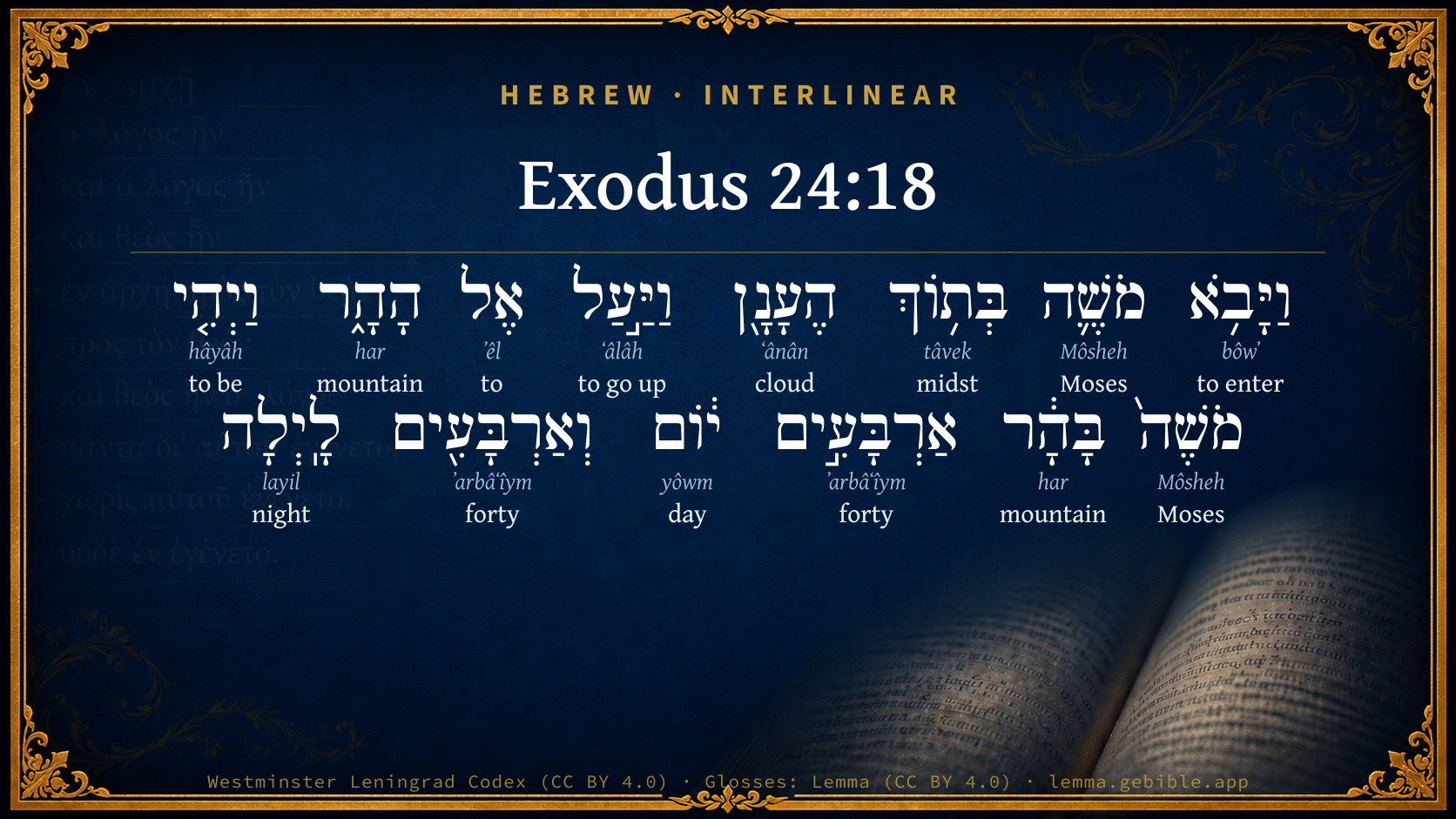
Hebrew (Westminster Leningrad Codex) Exodus 24:18 appears in the Hebrew Old Testament. The text above is from the Westminster Leningrad Codex. Each word links to its Strong’s number, a concise gloss, and parsing drawn from the Open Scriptures Hebrew Bible morphology. Click any word for its full Brown-Driver-Briggs (BDB) entry.
Download image
Cite this verse

Exodus 24:18 (World English Bible). Public Domain. Lemma interlinear Bible study tool, https://lemma.gebible.app/v/exodus/24/18.

Show BibTeX & RIS
BibTeX
RIS
English Translation
Moses entered into the midst of the cloud, and went up on the mountain; and Moses was on the mountain forty days and forty nights.
World English Bible · Public Domain
Download a study sheet

One document with this verse’s original text, its word-by-word gloss line, the meaning frame, cross-references with their text, attributed commentary, and full source and license credits — printable, and it pastes into notes with its structure intact.

This verse Autodidact and up

Study sheet (.html) Plain text (.txt)

A passage Seminary Student

Up to 50 verses in one chapter. A passage sheet keeps up to 6 commentary sources and 12 cross-references per verse, in the order this page ranks them, and says so on the sheet whenever that leaves anything out. Ask for a single verse and you get the Autodidact verse sheet above.

Everything on this page stays free to read, with no account — the sheet is a download of what is already on screen, not access to it.

Want to remove ads? Support Godless Engineer
Compare translations 3

The same verse in 3 English versions, stacked beneath the original-language interlinear above. Click any original word for its lexicon entry.

Each is an independent rendering of the whole verse — the interlinear is not word-aligned to these translations.

Highlighted words mark where these versions differ — a whole-verse word diff, not a word-by-word alignment.

  • World English Bible Public Domain
    Moses entered into the midst of the cloud, and went up on the mountain; and Moses was on the mountain forty days and forty nights.
  • King James Version Public Domain
    And Moses went into the midst of the cloud, and gat him up into the mount: and Moses was in the mount forty days and forty nights.
  • unfoldingWord Literal Text CC BY-SA 4.0
    And Moses entered the middle of the cloud and went up to the mountain. And Moses was on the mountain 40 days and 40 nights.

unfoldingWord Literal Text — © unfoldingWord, licensed CC BY-SA 4.0. Word-aligned USFM3 via Door43 (git.door43.org/unfoldingWord/en_ult).

Versions to compare (up to 4)

3 of 4 selected

Show all 18 translations

Every available English version of this verse, each an independent rendering of the whole verse.

  • World English Bible Public Domain
    Moses entered into the midst of the cloud, and went up on the mountain; and Moses was on the mountain forty days and forty nights.
  • Berean Standard Bible Public Domain
    Moses entered the cloud as he went up on the mountain, and he remained on the mountain forty days and forty nights.
  • Majority Standard Bible Public Domain
    Moses entered the cloud as he went up on the mountain, and he remained on the mountain forty days and forty nights.
  • King James Version Public Domain
    And Moses went into the midst of the cloud, and gat him up into the mount: and Moses was in the mount forty days and forty nights.
  • American Standard Version (1901) Public Domain
    And Moses entered into the midst of the cloud, and went up into the mount: and Moses was in the mount forty days and forty nights.
  • Revised Version (1885) Public Domain
    And Moses entered into the midst of the cloud, and went up into the mount: and Moses was in the mount forty days and forty nights.
  • Geneva Bible (1599) Public Domain
    And Moses entred into the middes of the cloude, and went vp to the mountaine: and Moses was in the mount fourtie dayes and fourty nightes.
  • Douay-Rheims (1899) Public Domain
    And Moses, entering into the midst of the cloud, went up into the mountain: and he was there forty days, and forty nights.
  • Young's Literal Translation Public Domain
    and Moses goeth into the midst of the cloud, and goeth up unto the mount, and Moses is on the mount forty days and forty nights.
  • Literal Standard Version CC BY-SA 4.0
    and Moses goes into the midst of the cloud, and goes up to the mountain, and Moses is on the mountain forty days and forty nights.
  • Unlocked Literal Bible CC BY-SA 4.0
    Moses entered the cloud and went up the mountain. He was up the mountain for forty days and forty nights.
  • unfoldingWord Literal Text CC BY-SA 4.0
    And Moses entered the middle of the cloud and went up to the mountain. And Moses was on the mountain 40 days and 40 nights.
  • Darby Bible Public Domain
    And Moses went into the midst of the cloud, and ascended the mountain. And Moses was on the mountain forty days and forty nights.
  • World Messianic Bible Public Domain
    Moses entered into the middle of the cloud, and went up on the mountain; and Moses was on the mountain forty days and forty nights.
  • Webster's Bible Public Domain
    And Moses went into the midst of the cloud, and ascended the mount: and Moses was on the mount forty days and forty nights.
  • Free Bible Version CC BY-SA 4.0
    Moses went into the cloud as he climbed up on the mountain, and he stayed on the mountain for forty days and nights.
  • Bible in Basic English Public Domain
    And Moses went up the mountain, into the cloud, and was there for forty days and forty nights.
  • JPS Tanakh (1917) Public Domain
    And Moses entered into the midst of the cloud, and went up into the mount; and Moses was in the mount forty days and forty nights.

Literal Standard Version (2020), Covenant Press — licensed CC BY-SA 4.0. Text via the HelloAO Bible API (eBible.org). Unlocked Literal Bible (unfoldingWord) — licensed CC BY-SA 4.0. Text via the HelloAO Bible API (eBible.org). unfoldingWord Literal Text — © unfoldingWord, licensed CC BY-SA 4.0. Word-aligned USFM3 via Door43 (git.door43.org/unfoldingWord/en_ult). Free Bible Version, Dr. Jonathan Gallagher — licensed CC BY-SA 4.0. Text via the HelloAO Bible API (eBible.org).

Word by word

More ways to search: Search by grammar → Find every occurrence → Compare this word →

Practice this passage: Drill this verse → Learn its vocabulary →

הֶעָנָ֖ן
ʻânân
H6051
“the · cloud”
Particle, Definite Article + Noun, Common, Masculine, Singular, Absolute
Part of Speech
Particle + Noun
Type
Common
Gender
Masculine
Number
Singular
State
Absolute
Full BDB Definition

Origin: from H6049

TWOT: 1655a

cloud, cloudy, cloud-mass - cloud-mass (of theophanic cloud) - cloud
  1. וַיָּבֹ֥א bôwʼ H935 “and · to enter” Conjunction + Verb, Qal, Sequential Imperfect, 3rd Person, Masculine, Singular
  2. מֹשֶׁ֛ה Môsheh H4872 “Moses” Noun, Proper
  3. בְּת֥וֹךְ tâvek H8432 “in/at · midst of” Preposition + Noun, Common, Masculine, Singular, Construct
  4. וַיַּ֣עַל ʻâlâh H5927 “and · to go up” Conjunction + Verb, Qal, Sequential Imperfect, 3rd Person, Masculine, Singular
  5. אֶל ʼêl H413 “to” Preposition
  6. הָהָ֑ר har H2022 “the · mountain” Particle, Definite Article + Noun, Common, Masculine, Singular, Absolute
  7. וַיְהִ֤י hâyâh H1961 “and · to be” Conjunction + Verb, Qal, Sequential Imperfect, 3rd Person, Masculine, Singular
  8. מֹשֶׁה֙ Môsheh H4872 “Moses” Noun, Proper
  9. בָּהָ֔ר har H2022 “in/at the · mountain” Preposition, Determined + Noun, Common, Masculine, Singular, Absolute
  10. אַרְבָּעִ֣ים ʼarbâʻîym H705 “forty” Adjective, Cardinal number, Both, Plural, Absolute
  11. י֔וֹם yôwm H3117 “day” Noun, Common, Masculine, Singular, Absolute
  12. וְאַרְבָּעִ֖ים ʼarbâʻîym H705 “and · forty” Conjunction + Adjective, Cardinal number, Both, Plural, Absolute
  13. לָֽיְלָה layil H3915 “night” Noun, Common, Masculine, Singular, Absolute

About this verse

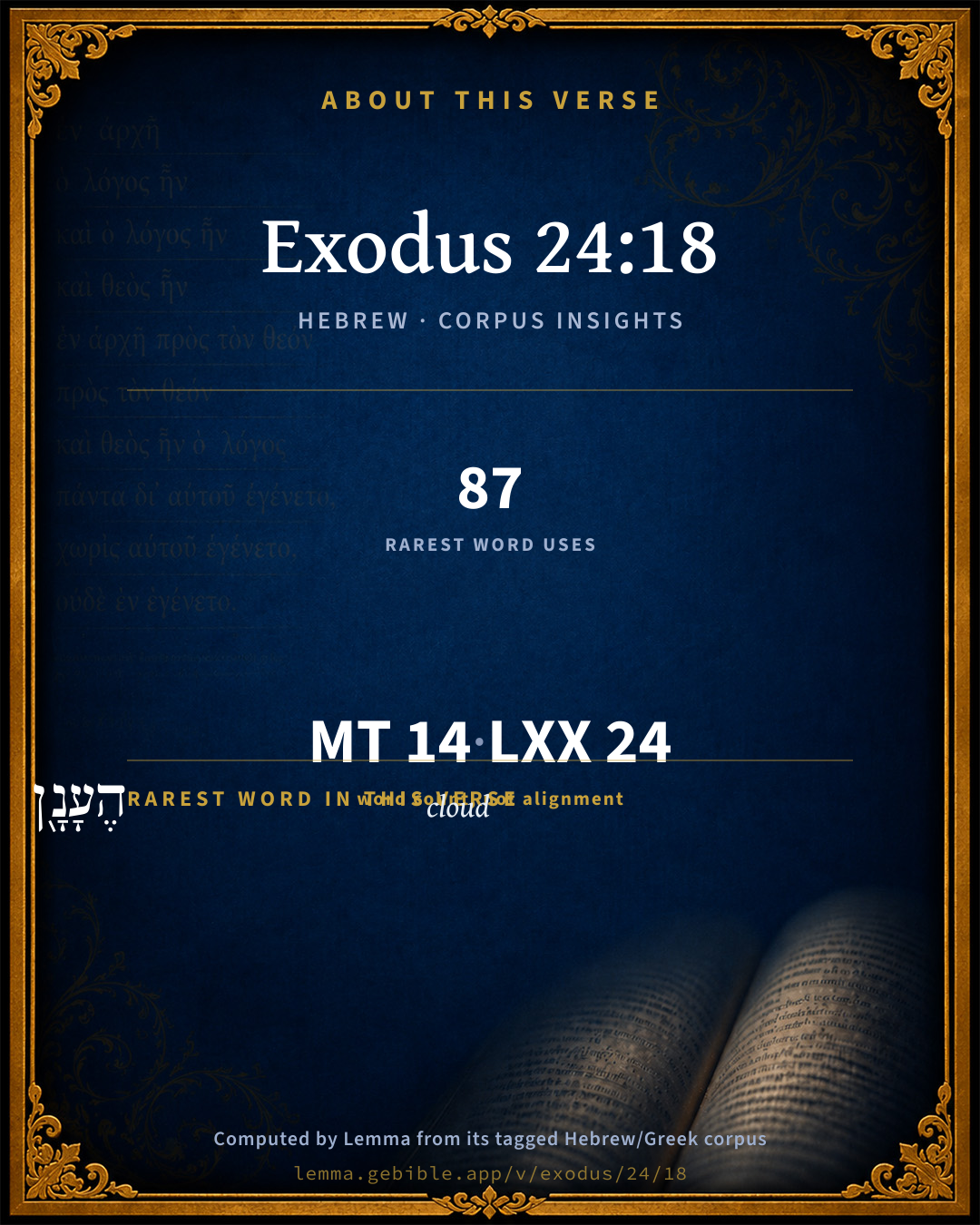
These counts appear in no published source. They are computed here, from the morphology-tagged text and Lemma’s own curated glosses. What Lemma adds →

14
words
11
distinct lemmas
Pentateuch
section

Grammatical profile

  • 3 verbs
  • 8 nouns
  • 2 adjectives
  • 1 preposition

Verb forms

  • וַיָּבֹ֥א Qal · Sequential Imperfect
  • וַיַּ֣עַל Qal · Sequential Imperfect
  • וַיְהִ֤י Qal · Sequential Imperfect

Repetition

Words recur within this verse — often emphatic in Hebrew:

  • מֹשֶׁ֛ה Moses H4872 ×2
  • הָהָ֑ר mountain H2022 ×2
  • אַרְבָּעִ֣ים forty H705 ×2

Hebrew & Septuagint length

In English translation the verse runs 25 words from the Hebrew and 26 from the Septuagint (LXX English) — closely comparable.

A rough comparison of the two English renderings, which tokenize alike — not a word-level alignment.

Word counts can differ between the Hebrew and the Greek without any difference in meaning — e.g. the Hebrew direct-object marker אֵת has no separate Greek word, and Greek often adds the article ὁ.

In the original languages it is 14 Hebrew tokens and 24 Greek tokens — but the two are counted differently (Hebrew bundles its prefixes and suffixes into one token; the Greek is in lemma form), so that isn’t a like-for-like length.

Cross-references

14

Topical passages linked to Exodus 24:18 in the Treasury of Scripture Knowledge — connected by theme and wording, ordered by reader-vote popularity; previews shown in the World English Bible.

  • Deuteronomy 9:9 When I was gone up onto the mountain to receive the tables of stone, even the tables of the covenant which Yahweh made with you, then I stayed on the mountain forty days and forty nights; I did neither eat bread nor drink water.
  • Exodus 34:28 He was there with Yahweh forty days and forty nights; he neither ate bread, nor drank water. He wrote on the tablets the words of the covenant, the ten commandments.
  • Deuteronomy 10:10 I stayed on the mountain, as at the first time, forty days and forty nights: and Yahweh listened to me that time also; Yahweh would not destroy you.
  • Deuteronomy 9:18 I fell down before Yahweh, as at the first, forty days and forty nights; I did neither eat bread nor drink water; because of all your sin which you sinned, in doing that which was evil in the sight of Yahweh, to provoke him to anger.
  • Deuteronomy 9:25 So I fell down before Yahweh the forty days and forty nights that I fell down, because Yahweh had said he would destroy you.
  • Exodus 9:29 Moses said to him, "As soon as I have gone out of the city, I will spread abroad my hands to Yahweh. The thunders shall cease, neither shall there be any more hail; that you may know that the earth is Yahweh's.
  • Exodus 9:33 Moses went out of the city from Pharaoh, and spread abroad his hands to Yahweh; and the thunders and hail ceased, and the rain was not poured on the earth.
  • Exodus 19:20 Yahweh came down on Mount Sinai, to the top of the mountain. Yahweh called Moses to the top of the mountain, and Moses went up.
  • Exodus 24:17 The appearance of the glory of Yahweh was like devouring fire on the top of the mountain in the eyes of the children of Israel.
  • 1 Kings 19:8 He arose, and ate and drink, and went in the strength of that food forty days and forty nights to Horeb the Mount of God.
  • Matthew 4:2 When he had fasted forty days and forty nights, he was hungry afterward.
  • Mark 1:13 He was there in the wilderness forty days tempted by Satan. He was with the wild animals; and the angels were ministering to him.
  • Luke 4:2 for forty days, being tempted by the devil. He ate nothing in those days. Afterward, when they were completed, he was hungry.
  • Proverbs 28:1 The wicked flee when no one pursues; But the righteous are as bold as a lion.

Cross-references courtesy of OpenBible.info (CC BY 4.0).

Hebrew and Greek witnesses Masoretic Hebrew ↔ Greek Septuagint

The same verse in the two great witnesses to the Old Testament, shown verse-for-verse.

These are two independent witnesses, not word-aligned to each other, and the Septuagint is shown in lemma (dictionary) form.

Hebrew Exodus 24:18 Masoretic · Westminster Leningrad Codex

וַיָּבֹ֥א מֹשֶׁ֛ה בְּת֥וֹךְ הֶעָנָ֖ן וַיַּ֣עַל אֶל הָהָ֑ר וַיְהִ֤י מֹשֶׁה֙ בָּהָ֔ר אַרְבָּעִ֣ים י֔וֹם וְאַרְבָּעִ֖ים לָֽיְלָה

Moses entered into the midst of the cloud, and went up on the mountain; and Moses was on the mountain forty days and forty nights.

World English Bible · Public Domain

Greek LXX Exodus 24:18 Septuagint · lemma form

καί εἰςἔρχομαι μωυσῆς εἰς ὁ μέσος ὁ νεφέλη καί ἀναβαίνω εἰς ὁ ὄρος καί εἰμί ἐκεῖ ἐν ὁ ὄρος τεσσαράκοντα ἡμέρα καί τεσσαράκοντα νύξ

And Moses went into the midst of the cloud, and went up to the mountain, and was there in the mountain forty days and forty nights.

LXX2012 (modern English Septuagint) · Public Domain

Hebrew: Westminster Leningrad Codex (CC BY 4.0). Greek: Septuagint (public domain); English from LXX2012 (modern English Septuagint) (Public Domain). How the Septuagint differs from the Hebrew →

Targum (Aramaic paraphrase)

2

The Targum is the ancient Jewish Aramaic paraphrase of the Hebrew Scriptures — an interpretive translation, not the Hebrew text itself. Onkelos (literal) and Pseudo-Jonathan (expansive) render the Torah, and Jonathan the Prophets. Coverage is partial: where no permissively-licensed English translation exists for a verse, only the Aramaic is shown. This is verse-level text, not a word-by-word alignment to the Hebrew.

  1. Targum Onkelos Torah (Genesis–Deuteronomy)
    וְעַל משֶׁה בְּגוֹ עֲנָנָא וּסְלֵיק לְטוּרָא וַהֲוָה משֶׁה בְּטּוּרָא אַרְבְּעִין יְמָמִין וְאַרְבְּעִין לֵילָוָן:

    (no public-domain English translation for this verse)

    Targum Onkelos — Aramaic: “Onkelos Genesis” (public domain); “Onkelos Exodus” (public domain); “Onkelos Leviticus” (public domain); “Onkelos Numbers” (public domain); “Onkelos Deuteronomy” (public domain). English: “Sefaria Community Translation” (CC0 1.0 (public-domain dedication)); “J.W. Etheridge. The Targums of Onkelos and Jonathan Ben Uzziel on the Pentateuch. London: Longmans, Green, 1862” (public domain). Text via Sefaria.

  2. Targum Pseudo-Jonathan Torah (Genesis–Deuteronomy)
    וְעָאל משֶׁה בְּגוֹ עֲנָנָא וּסְלֵיק לְטַוְורָא וַהֲוָה משֶׁה בְּטַוְורָא אַלִיף פִּתְגָמֵי אוֹרַיְיתָא מִן פּוּם קוּדְשָׁא יְהֵי שְׁמֵיהּ מְשַׁבַּח אַרְבְּעִין יְמָמִין וְאַרְבָּעִין לֵילְוָון

    And Mosheh entered into the midst of the Cloud, and ascended the mountain; and Mosheh was upon the mountain forty days and forty nights, learning the words of the Law from the mouth of the Holy One, whose Name be praised.

    Targum Pseudo-Jonathan — Aramaic: “Targum Jonathan on Genesis” (public domain); “Targum Jonathan on Exodus” (public domain); “Targum Jonathan on Leviticus” (public domain); “Targum Jonathan on Numbers” (public domain); “Targum Jonathan on Deuteronomy” (public domain). English: “The Targum of Jonathan ben Uzziel, trans. J. W. Etheridge, London, 1862” (public domain). Text via Sefaria.

Commentary

Notes on Exodus 24:18 from classic Christian and Jewish commentators (each source and its license shown beneath its notes). The classic Christian expositions comment on the surrounding passage and are grouped to its opening verse, so a note may address several verses; the Jewish commentaries on the Tanakh (Rashi and others) are per-verse, so they appear only where the commentator wrote on this verse.

Lemma curates 59 commentaries, every one of them public domain or Creative Commons licensed, each selected and text-cleaned for this edition rather than reprinted as found. About our sources →

Trapp's Complete Commentary

John Trapp

Exo 24:18 And Moses went into the midst of the cloud, and gat him up into the mount: and Moses was in the mount forty days and forty nights.

Ver. 18. Forty days.] All which time he never ate nor drank, {Deu 9:9} and so better merited the surname of Nesteutes, the faster, than that proud prelate John, Bishop of Constantinople.

John Trapp, A Commentary or Exposition upon All the Books of the Old and New Testament (1647–1656) — public domain. Text from a community e-Sword module.

Joseph Benson's Commentary

Exo 24:18. Moses went into the midst of the cloud — It was an extraordinary presence of mind which the grace of God furnished him with, else he durst not have ventured into the cloud, especially when it broke out in devouring fire. And Moses was in the mount forty days and forty nights — It should seem the six days were not part of the forty; for during those six days Joshua was with Moses, who did eat of the manna, and drink of the brook mentioned Deu 9:21, and while they were together, it is probable Moses did eat and drink with him; but when Moses was called into the midst of the cloud, he left Joshua without, who continued to eat and drink daily while he waited for Moses’ return, but from thenceforward Moses fasted.

Joseph Benson's Commentary on the Old and New Testaments (1811–1818) — public domain. Text from a community e-Sword module.

Jamieson, Fausset & Brown

Robert Jamieson, A. R. Fausset & David Brown

Moses went into the midst of the cloud--the visible token of God's presence. Divine grace animated and supported him to enter with holy boldness.

Moses was in the mount forty days and forty nights--The six days spent in waiting are not included. During that protracted period he was miraculously supported (Deu 9:9), on a peak scarcely thirty paces in compass.

Next: Exodus Chapter 25

Jamieson, Fausset & Brown — Commentary Critical and Explanatory on the Whole Bible (1871) — public domain (CC PDM 1.0). Text via the HelloAO Bible API.

Adam Clarke's Commentary

Verse 18. Forty days and forty nights.] During the whole of this time he neither ate bread nor drank water; see Ex 34:28; De 9:9. Both his body and soul were so sustained by the invigorating presence of God, that he needed no earthly support, and this may be the simple reason why he took none. Elijah fasted forty days and forty nights, sustained by the same influence, 1Kg 19:8; as did likewise our blessed Lord, when he was about to commence the public ministry of his own Gospel, Mt 4:2.

1. MOSES, who was the mediator of the Old Covenant, is alone permitted to draw nigh to God; none of the people are suffered to come up to the Divine glory, not even Aaron, nor his sons, nor the nobles of Israel. Moses was a type of Christ, who is the mediator of the New Covenant; and he alone has access to God in behalf of the human race, as Moses had in behalf of Israel.

2. The law can inspire nothing but terror, when viewed unconnected with its sacrifices, and those sacrifices are nothing but as they refer to Jesus Christ, the Lamb of God, who alone by the sacrifice of himself, bears away the sin of the world.

3. The blood of the victims was sprinkled both on the altar and on the people, to show that the death of Christ gave to Divine justice what it demanded, and to men what they needed. The people were sanctified by it unto God, and God was propitiated by it unto the people. By this sacrifice the law was magnified and made honourable, so Divine justice received its due; and those who believe are justified from all guilt, and sanctified from all sin, so they receive all that they need. Thus God is well pleased, and believers eternally saved. This is a glorious economy, highly worthy of God its author.

Adam Clarke's Commentary on the Bible (1810–1826) — public domain. Text from a community e-Sword/MySword module.

Ellicott's Commentary for English Readers

(18) Moses was in the mount forty days and forty nights.—During the whole of this time he took no food (Deu_9:9). Comp. The fast of Elijah (1Ki_19:8), and that of our blessed Lord (Mat_3:2). Modern imitations are in all probability impostures.

A Bible Commentary for English Readers, edited by Charles John Ellicott (1878–1897) — public domain. Text from a community e-Sword module.

Albert Barnes' Notes on the Bible

During this period of forty days, and the second period when the tables were renewed, Moses neither ate bread nor drank water. Compare marginal references. In like manner, Elijah fasted for forty days, when he visited the same spot 1Ki 19:8. The two who met our Saviour on the Mount of Transfiguration Mat 17:3, the one representing the law, the other representing the Prophets, thus shadowed forth in their own experience the Fast of Forty days in the wilderness of Judaea.

Albert Barnes' Notes on the Bible (1834–1885) — public domain. Text from a community e-Sword/MySword module.

Haydock's Catholic Bible Commentary

Forty, including the six mentioned before, ver. 16. The Rabbins pretend that Moses received the written law during the days, and their traditions during the nights. (R. Bechai ap. Buxtorf, syn. 1.) (Calmet)

George Leo Haydock (1774–1849), Haydock's Catholic Family Bible and Commentary, 1859 edition — public domain. Excludes Psalms (Douay-Rheims chapter numbering differs from Protestant) and Deuterocanonical books (Catholic canon only).

Matthew Poole's English Annotations

Into the midst of the cloud, the God that called him enabling him to enter and abide there; whereas, when he was left to himself, he could not enter into the tabernacle, Exo 40:35.

Forty days and forty nights; in which he did neither eat nor drink, Exo 34:28; Deu 9:9,18; whereby it seems most probable the six days mentioned Exo 24:16 were a part of these forty days, because Moses being in perpetual expectation of God’s call, seems not to have had leisure for eating and drinking, nor provision neither. Besides, he is not said to be in the midst of the cloud so long, but only

in the mount, where he was those six days, Exo 24:15,16.

Matthew Poole's English Annotations on the Holy Bible (1683–1685) — public domain. Text from a community e-Sword/MySword module.

Whedon's Commentary on the Bible

Daniel D. Whedon

18. Forty days and forty nights — We naturally compare with this Exo_34:28, and Deu_9:18. Also the fact that Elijah spent the same length of time at this mountain without food, (1Ki_19:8,) and Jesus fasted in the wilderness of his temptation forty days. There appears a symbolism about this number. The spies were forty days searching the land of promise, (Num_13:25,) and that generation was condemned to wander in the desert forty years, (Num_14:34,) to humble and prove them. Deu_8:2. In all these instances the period was one of great trial and discipline, as well as of gracious evidences of God’s mercy and truth.

Daniel D. Whedon (gen. ed.), Commentary on the Old and New Testaments (1874–1909) — public domain. Text from a community e-Sword module.

The Pulpit Commentary

And Moses went into the midst of the cloud. Quitting Joshua, Moses at last, in obedience to the call out of the midst of the cloud, entered within its shadow and disappeared from human vision In this abnormal condition, alone with God, he continued for thirty-four days, making, together with the six days before he entered the cloud, the forty days and forty nights of the text before us. It is noted in Deu_9:9, that during the whole of this time he was without food. Compare Elijah"s fast, (1Ki_19:8) and our blessed Lord"s. (Mat_3:2)

The Pulpit Commentary (1880–1919), ed. H.D.M. Spence-Jones & Joseph S. Exell — public domain. Text from a community e-Sword module.

John Wesley's Explanatory Notes

Moses went into the midst of the cloud - It was an extraordinary presence of mind, which the grace of God furnished him with, else he durst not have ventured into the cloud, especially when it broke out in devouring fire. And Moses was in the mount forty days and forty nights - It should seem the six days, were not part of the forty; for during those six days, Joshua was with Moses, who did eat of the manna, and drink of the brook mentioned, Deut. ix, 21, and while they were together, it is probable Moses did eat and drink with him; but when Moses was called into the midst of the cloud, he left Joshua without, who continued to eat and drink daily while he waited for Moses's return, but from thenceforward Moses fasted.

John Wesley, Explanatory Notes Upon the Whole Bible (1754–1765) — public domain. Text via the GEBible commentary corpus.

Rashi

Rabbi Shlomo Yitzchaki (Rashi)

בתוך הענן INTO THE MIDST OF THE CLOUD — This cloud was thick like smoke and God made a path for Moses through it (Yoma 4b).

Rashi on the Tanakh — English translations: “The Judaica Press complete Tanach with Rashi, translated by A. J. Rosenberg” (CC BY 4.0); “Pentateuch with Rashi's commentary by M. Rosenbaum and A.M. Silbermann, 1929-1934” (public domain); “The Metsudah Tanach series, Lakewood, N.J” (CC BY 4.0); and “The Book of Joshua, Metsudah Publications, 1997” (CC BY 4.0). Text via Sefaria.

Lesson kit

Teaching starters — assembled from the data on this page, not authored interpretation. Every prompt links to the verse data it draws on. Edit before teaching.

Exodus, in the Pentateuch, opens this verse with 14 words (11 distinct Hebrew lemmas). Its most distinctive word is ʻânân (“cloud”). A historical commentator’s framing appears above. Read the whole chapter for the surrounding context.

Discussion questions

  1. What does “cloud” (ʻânân) contribute to the verse as a whole?
  2. How does Deuteronomy 9:9, which shares this passage’s theme, read alongside this verse?
  3. What does the repetition of “Moses” (2× in this one verse) do in this verse?
  4. The translations on this page render this verse differently — a whole-verse word diff, not a word-by-word alignment. What might account for the different wordings?
  5. «וַיָּבֹ֥א» is a Qal Sequential Imperfect verb. How does that grammatical form shape the action described?
  6. Compare how Trapp's Complete Commentary and Joseph Benson's Commentary read this verse. Where do they agree or differ?

Things to notice

Reading settings

Reading text

Shown beneath each verse's original-language words.

Old Testament
Old Testament edition

Read the OT as the Masoretic Hebrew (MT) or the Greek Septuagint (LXX).

English shown for the Greek Septuagint (in the Hebrew ↔ Greek comparison).

Comparing translations? Open the Compare panel on any verse page to stack up to four side by side.