Genesis 35:6

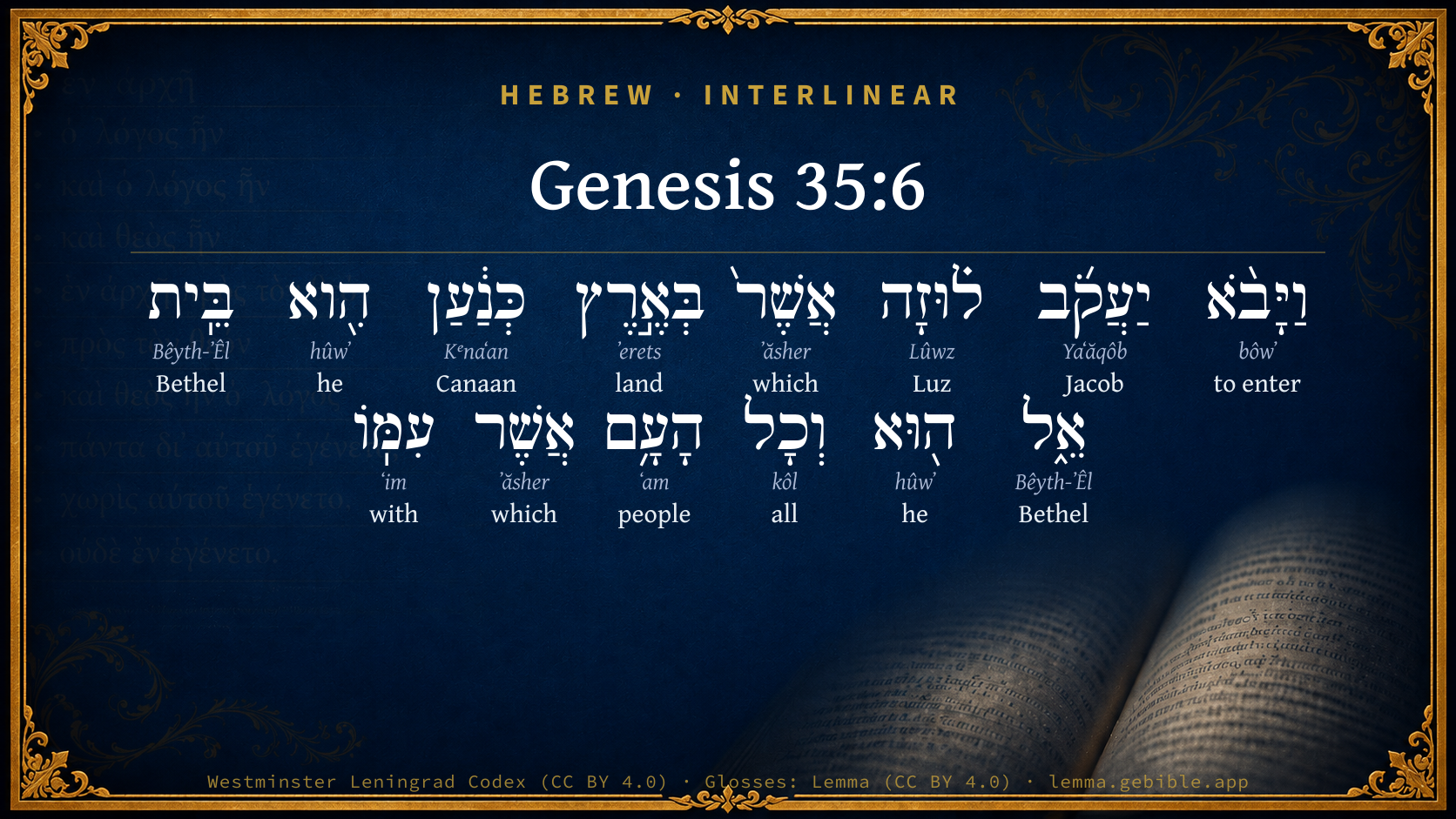
Hebrew (Westminster Leningrad Codex) Genesis 35:6 appears in the Hebrew Old Testament. The text above is from the Westminster Leningrad Codex. Each word links to its Strong’s number, a concise gloss, and parsing drawn from the Open Scriptures Hebrew Bible morphology. Click any word for its full Brown-Driver-Briggs (BDB) entry.
Download image
Cite this verse

Genesis 35:6 (World English Bible). Public Domain. Lemma interlinear Bible study tool, https://lemma.gebible.app/v/genesis/35/6.

Show BibTeX & RIS
BibTeX
RIS
English Translation
So Jacob came to Luz, which is in the land of Canaan (the same is Bethel), he and all the people who were with him.
World English Bible · Public Domain
Download a study sheet

One document with this verse’s original text, its word-by-word gloss line, the meaning frame, cross-references with their text, attributed commentary, and full source and license credits — printable, and it pastes into notes with its structure intact.

This verse Autodidact and up

Study sheet (.html) Plain text (.txt)

A passage Seminary Student

Up to 50 verses in one chapter. A passage sheet keeps up to 6 commentary sources and 12 cross-references per verse, in the order this page ranks them, and says so on the sheet whenever that leaves anything out. Ask for a single verse and you get the Autodidact verse sheet above.

Everything on this page stays free to read, with no account — the sheet is a download of what is already on screen, not access to it.

Want to remove ads? Support Godless Engineer
Compare translations 3

The same verse in 3 English versions, stacked beneath the original-language interlinear above. Click any original word for its lexicon entry.

Each is an independent rendering of the whole verse — the interlinear is not word-aligned to these translations.

Highlighted words mark where these versions differ — a whole-verse word diff, not a word-by-word alignment.

  • World English Bible Public Domain
    So Jacob came to Luz, which is in the land of Canaan (the same is Bethel), he and all the people who were with him.
  • King James Version Public Domain
    So Jacob came to Luz, which is in the land of Canaan, that is, Bethel, he and all the people that were with him.
  • unfoldingWord Literal Text CC BY-SA 4.0
    Then Jacob came to Luz, which Bethel, which in the land of Canaan, he and all the people who with him.

unfoldingWord Literal Text — © unfoldingWord, licensed CC BY-SA 4.0. Word-aligned USFM3 via Door43 (git.door43.org/unfoldingWord/en_ult).

Versions to compare (up to 4)

3 of 4 selected

Show all 18 translations

Every available English version of this verse, each an independent rendering of the whole verse.

  • World English Bible Public Domain
    So Jacob came to Luz, which is in the land of Canaan (the same is Bethel), he and all the people who were with him.
  • Berean Standard Bible Public Domain
    So Jacob and everyone with him arrived in Luz (that is, Bethel) in the land of Canaan.
  • Majority Standard Bible Public Domain
    So Jacob and everyone with him arrived in Luz (that is, Bethel) in the land of Canaan.
  • King James Version Public Domain
    So Jacob came to Luz, which is in the land of Canaan, that is, Bethel, he and all the people that were with him.
  • American Standard Version (1901) Public Domain
    So Jacob came to Luz, which is in the land of Canaan (the same is Beth-el), he and all the people that were with him.
  • Revised Version (1885) Public Domain
    So Jacob came to Luz, which is in the land of Canaan (the same is Beth-el), he and all the people that were with him.
  • Geneva Bible (1599) Public Domain
    So came Iaakob to Luz, which is in the land of Canaan: (the same is Beth-el) hee and all the people that was with him.
  • Douay-Rheims (1899) Public Domain
    And Jacob came to Luza, which is in the land of Chanaan, surnamed Bethel: he and all the people that were with him.
  • Young's Literal Translation Public Domain
    And Jacob cometh in to Luz which `is' in the land of Canaan (it `is' Bethel), he and all the people who `are' with him,
  • Literal Standard Version CC BY-SA 4.0
    And Jacob comes to Luz which [is] in the land of Canaan (it [is] Bethel), he and all the people who [are] with him,
  • Unlocked Literal Bible CC BY-SA 4.0
    So Jacob arrived at Luz (that is, Bethel), which is in the land of Canaan, he and all the people who were with him.
  • unfoldingWord Literal Text CC BY-SA 4.0
    Then Jacob came to Luz, which Bethel, which in the land of Canaan, he and all the people who with him.
  • Darby Bible Public Domain
    And Jacob came to Luz, which is in the land of Canaan, that is, Bethel, he and all the people that were with him.
  • World Messianic Bible Public Domain
    So Jacob came to Luz (that is, Bethel), which is in the land of Canaan, he and all the people who were with him.
  • Webster's Bible Public Domain
    So Jacob came to Luz, which is in the land of Canaan (that is Beth-el) he and all the people that were with him.
  • Free Bible Version CC BY-SA 4.0
    Jacob and everyone with him arrived at Luz (also known as Bethel) in the country of Canaan.
  • Bible in Basic English Public Domain
    And Jacob came to Luz in the land of Canaan (which is the same as Beth-el), he and all his people.
  • JPS Tanakh (1917) Public Domain
    So Jacob came to Luz, which is in the land of Canaan — the same is Beth-el — he and all the people that were with him.

Literal Standard Version (2020), Covenant Press — licensed CC BY-SA 4.0. Text via the HelloAO Bible API (eBible.org). Unlocked Literal Bible (unfoldingWord) — licensed CC BY-SA 4.0. Text via the HelloAO Bible API (eBible.org). unfoldingWord Literal Text — © unfoldingWord, licensed CC BY-SA 4.0. Word-aligned USFM3 via Door43 (git.door43.org/unfoldingWord/en_ult). Free Bible Version, Dr. Jonathan Gallagher — licensed CC BY-SA 4.0. Text via the HelloAO Bible API (eBible.org).

Word by word

More ways to search: Search by grammar → Find every occurrence → Compare this word →

Practice this passage: Drill this verse → Learn its vocabulary →

ל֗וּזָה
Lûwz
H3870
“Luz · toward”
Noun, Proper + Suffix, Demonstrative
Part of Speech
Noun
Type
Proper
Full BDB Definition

Origin: probably from H3869 (as growing there)

TWOT: None

Luz = "almond tree" - the early name of Bethel and probably the name of the town in close proximity to the actual location of the altar and pillar of Jacob - the name of a town in the land of the Hittites; site unknown
  1. וַיָּבֹ֨א bôwʼ H935 “and · to enter” Conjunction + Verb, Qal, Sequential Imperfect, 3rd Person, Masculine, Singular
  2. יַעֲקֹ֜ב Yaʻăqôb H3290 “Jacob” Noun, Proper
  3. אֲשֶׁר֙ ʼăsher H834 “which” Particle, Relative
  4. בְּאֶ֣רֶץ ʼerets H776 “in/at · land of” Preposition + Noun, Common, Both, Singular, Construct
  5. כְּנַ֔עַן Kᵉnaʻan H3667 “Canaan” Noun, Proper
  6. הִ֖וא hûwʼ H1931 “he” Pronoun, Personal, 3rd Person, Feminine, Singular
  7. בֵּֽית Bêyth-ʼÊl H1008 “Bethel” Noun, Proper
  8. אֵ֑ל Bêyth-ʼÊl H1008 “Bethel” Noun, Proper
  9. ה֖וּא hûwʼ H1931 “he” Pronoun, Personal, 3rd Person, Masculine, Singular
  10. וְכָל kôl H3605 “and · all of” Conjunction + Noun, Common, Masculine, Singular, Construct
  11. הָעָ֥ם ʻam H5971 “the · people” Particle, Definite Article + Noun, Common, Masculine, Singular, Absolute
  12. אֲשֶׁר ʼăsher H834 “which” Particle, Relative
  13. עִמּֽוֹ ʻim H5973 “with · him” Preposition + Suffix, Personal, 3rd Person, Masculine, Singular

About this verse

These counts appear in no published source. They are computed here, from the morphology-tagged text and Lemma’s own curated glosses. What Lemma adds →

14
words
11
distinct lemmas
Pentateuch
section

Notable vocabulary

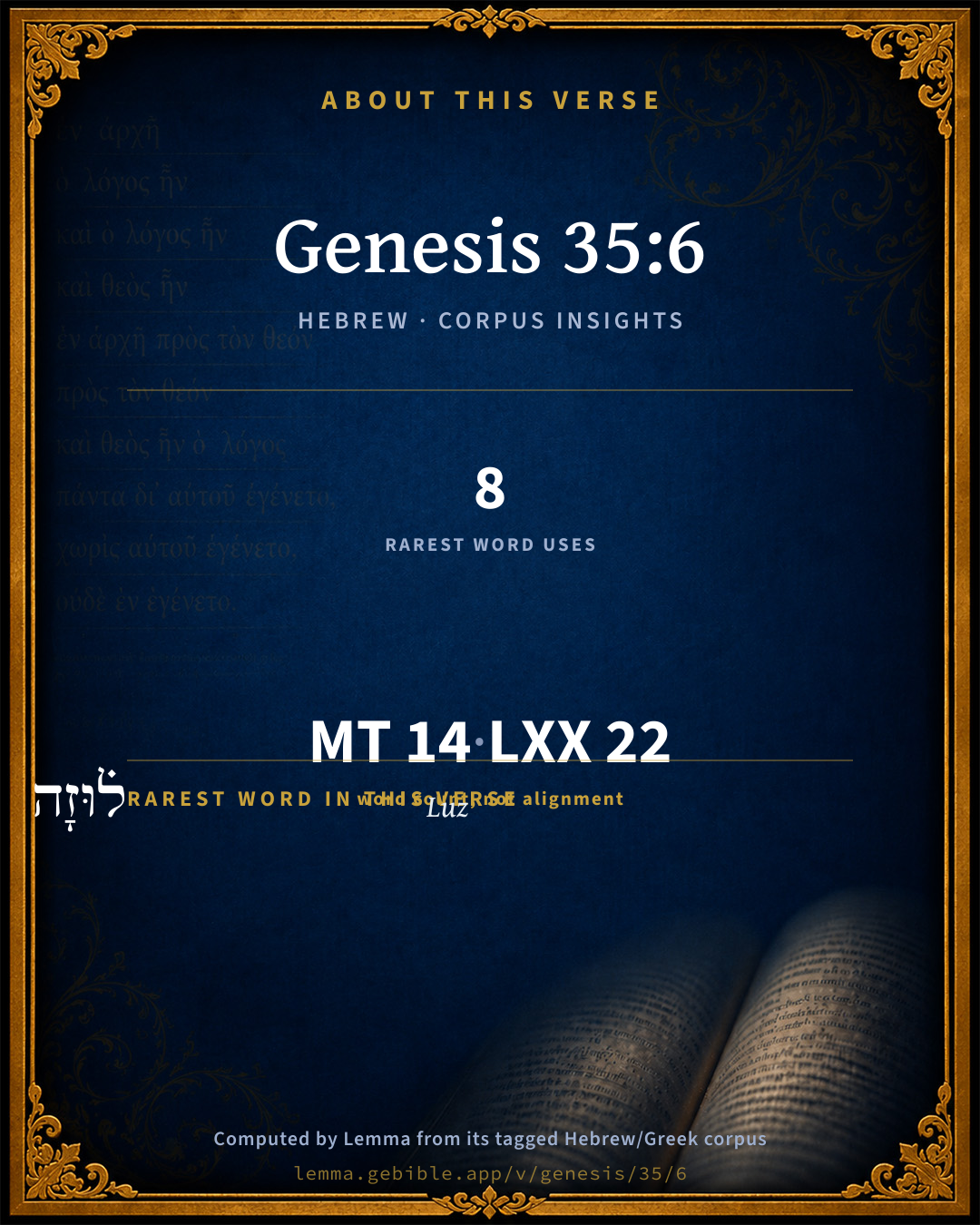
The rarest word here is ל֗וּזָה Luz H3870 — appearing just 8 times in the whole Hebrew Bible.

Shared distinctive vocabulary

ל֗וּזָה Luz H3870 occurs in 7 verses of the Hebrew Bible. Also found in:

Grammatical profile

  • 1 verb
  • 8 nouns
  • 2 pronouns
  • 1 preposition
  • 2 particles

Verb forms

  • וַיָּבֹ֨א Qal · Sequential Imperfect

Repetition

Words recur within this verse — often emphatic in Hebrew:

  • בֵּֽית Bethel H1008 ×2
  • אֲשֶׁר֙ which H834 ×2
  • הִ֖וא he H1931 ×2

Hebrew & Septuagint length

In English translation the verse runs 25 words from the Hebrew and 24 from the Septuagint (LXX English) — closely comparable.

A rough comparison of the two English renderings, which tokenize alike — not a word-level alignment.

Word counts can differ between the Hebrew and the Greek without any difference in meaning — e.g. the Hebrew direct-object marker אֵת has no separate Greek word, and Greek often adds the article ὁ.

In the original languages it is 14 Hebrew tokens and 22 Greek tokens — but the two are counted differently (Hebrew bundles its prefixes and suffixes into one token; the Greek is in lemma form), so that isn’t a like-for-like length.

Cross-references

5

Topical passages linked to Genesis 35:6 in the Treasury of Scripture Knowledge — connected by theme and wording, ordered by reader-vote popularity; previews shown in the World English Bible.

  • Genesis 28:19 He called the name of that place Bethel, but the name of the city was Luz at the first.
  • Genesis 12:8 He left from there to the mountain on the east of Bethel, and pitched his tent, having Bethel on the west, and Ai on the east. There he built an altar to Yahweh, and called on the name of Yahweh.
  • Genesis 28:22 then this stone, which I have set up for a pillar, will be God's house. Of all that you will give me I will surely give the tenth to you."
  • Genesis 48:3 Jacob said to Joseph, "God Almighty appeared to me at Luz in the land of Canaan, and blessed me,
  • Judges 1:22–26 The house of Joseph, they also went up against Bethel; and Yahweh was with them.

Cross-references courtesy of OpenBible.info (CC BY 4.0).

Hebrew and Greek witnesses Masoretic Hebrew ↔ Greek Septuagint

The same verse in the two great witnesses to the Old Testament, shown verse-for-verse.

These are two independent witnesses, not word-aligned to each other, and the Septuagint is shown in lemma (dictionary) form.

Hebrew Genesis 35:6 Masoretic · Westminster Leningrad Codex

וַיָּבֹ֨א יַעֲקֹ֜ב ל֗וּזָה אֲשֶׁר֙ בְּאֶ֣רֶץ כְּנַ֔עַן הִ֖וא בֵּֽית אֵ֑ל ה֖וּא וְכָל הָעָ֥ם אֲשֶׁר עִמּֽוֹ

So Jacob came to Luz, which is in the land of Canaan (the same is Bethel), he and all the people who were with him.

World English Bible · Public Domain

Greek LXX Genesis 35:6 Septuagint · lemma form

ἔρχομαι δέ ἰακώβ εἰς λουζα ὅς εἰμί ἐν γῆ χανααν ὅς εἰμί βαιθηλ αὐτός καί πᾶς ὁ λαός ὅς εἰμί μετά αὐτός

And Jacob came to Luza, which is in the land of Chanaan, which is Baethel, he and all the people that were with him.

LXX2012 (modern English Septuagint) · Public Domain

Hebrew: Westminster Leningrad Codex (CC BY 4.0). Greek: Septuagint (public domain); English from LXX2012 (modern English Septuagint) (Public Domain). How the Septuagint differs from the Hebrew →

Targum (Aramaic paraphrase)

2

The Targum is the ancient Jewish Aramaic paraphrase of the Hebrew Scriptures — an interpretive translation, not the Hebrew text itself. Onkelos (literal) and Pseudo-Jonathan (expansive) render the Torah, and Jonathan the Prophets. Coverage is partial: where no permissively-licensed English translation exists for a verse, only the Aramaic is shown. This is verse-level text, not a word-by-word alignment to the Hebrew.

  1. Targum Onkelos Torah (Genesis–Deuteronomy)
    וַאֲתָא יַעֲקֹב לְלוּז דִּי בְאַרְעָא דִכְנַעַן הִיא בֵּית אֵל הוּא וְכָל עַמָּא דִי עִמֵּהּ

    (no public-domain English translation for this verse)

    Targum Onkelos — Aramaic: “Onkelos Genesis” (public domain); “Onkelos Exodus” (public domain); “Onkelos Leviticus” (public domain); “Onkelos Numbers” (public domain); “Onkelos Deuteronomy” (public domain). English: “Sefaria Community Translation” (CC0 1.0 (public-domain dedication)); “J.W. Etheridge. The Targums of Onkelos and Jonathan Ben Uzziel on the Pentateuch. London: Longmans, Green, 1862” (public domain). Text via Sefaria.

  2. Targum Pseudo-Jonathan Torah (Genesis–Deuteronomy)
    וְאָתָא יַעֲקב לְלוּז בְּאַרְעָא דִכְנָעַן הוּא בֵית אֵל הוּא וְכָל עַמָא דְעִמֵיהּ

    And Jakob came to Luz in the land of Kenaan, which is Bethel, he and all the people who were with him.

    Targum Pseudo-Jonathan — Aramaic: “Targum Jonathan on Genesis” (public domain); “Targum Jonathan on Exodus” (public domain); “Targum Jonathan on Leviticus” (public domain); “Targum Jonathan on Numbers” (public domain); “Targum Jonathan on Deuteronomy” (public domain). English: “The Targum of Jonathan ben Uzziel, trans. J. W. Etheridge, London, 1862” (public domain). Text via Sefaria.

Commentary

Notes on Genesis 35:6 from classic Christian and Jewish commentators (each source and its license shown beneath its notes). The classic Christian expositions comment on the surrounding passage and are grouped to its opening verse, so a note may address several verses; the Jewish commentaries on the Tanakh (Rashi and others) are per-verse, so they appear only where the commentator wrote on this verse.

Lemma curates 59 commentaries, every one of them public domain or Creative Commons licensed, each selected and text-cleaned for this edition rather than reprinted as found. About our sources →

Trapp's Complete Commentary

John Trapp

Gen 35:6 So Jacob came to Luz, which [is] in the land of Canaan, that [is], Bethel, he and all the people that [were] with him.

Ver. 6. So Jacob came to Luz.] Which was thirty miles from Shechem: a long journey for such a large family, who went it with hearts full of heaviness, for, "without were fightings, within fears": but this was their comfort, they went to see the face of God at Bethel. As they that "passed through the valley of Baca," though they took many a weary step, yet went "from strength to strength," because they were to "appear before God in Zion." {Psa 84:6-7} Popish pilgrims, though used hardly and put to much expense and inconvenience, yet satisfy themselves in this, I have that I came for, viz., the sight of a dumb idol, as Calvin notes. What, then, should not we suffer to see God in his ordinances? "They shall bring your brethren as an offering to the Lord, upon horses, in chariots, and in litters," saith the prophet: {Isa 66:20} that is, though sick, weakly, and unfit for travel; yet, rather in litters, than not at all.

John Trapp, A Commentary or Exposition upon All the Books of the Old and New Testament (1647–1656) — public domain. Text from a community e-Sword module.

The Biblical Illustrator

Joseph S. Exell

Gen_35:6-7

So Jacob came to Luz, which is in the land of Canaan, that is, Bethel, he and all the people that were with him.

And he built there an altar, and called the place El-beth-el; because there God appeared unto him, when he fled from the face of his brother

The obituary of a name

Jacob is dead; Israel still lives. I want now to pronounce the obituary of Jacob. There are just two classes of lessons to be learned from the story of Bethel and Penuel, for there were just two persons in contact and conflict in this thirty years war. The type of all is found in the early vision of the ladder. At the foot of it lay Jacob on his pillow of stone: And behold, the Lord stood above it. Hence one class of lessons will instruct us concerning God, and one concerning man. One touches on doctrine, the other on duty. So everywhere The Scriptures principally teach what we are to believe concerning God, and what duty God requires of man.

I. We begin with the lessons of DOCTRINE. The same Divine Being, with all attributes and characteristics unchanged, rules to-day as then. It is wisely worth our while to note how He is wont to deal with a free-willed human creature, and how He manages a world of such.

1. Mark, for one thing, how independent God is in choosing His especial agents. He chooses whom He will for His purposes; and He chose this man Jacob.

2. Now let us learn a second lesson, and possibly we shall derive some slight help before we get through with that. See how wise God is in discriminating character. Why did God choose Jacob rather than Esau? Because he was the more serviceable man of the two. The long run in those days was a more desirable thing than the short cut. Patient steadiness was more serviceable for the Divine ends than mere executive rush. James would have been better than Peter to go on Old Testament errands.

3. But we pass on to a third lesson: indeed, we feel the need of it. Mark here how persistent God is in preparing men for a better life by means of His choice. Just tell over the old fable as you used to tell it to your little children, for there is an illustration of Divine truth in it; I mean that about the coward whose cure was effected by an enchanted sword put in his hand. He was timid enough, but the trusty blade was of itself belligerent. He could not drop it, for it clung to his hand. He could not run to the rear, for the sword remained steadily at the head of the attack. He could not surrender, for the moment he got his foolish lips ready to cry for quarter, the weapon had already leapt from the scabbard and was fighting like a thing of life. So at last he began to understand it, then he began to obey it, then he began to watch it, then he began to trust it; and then he began to be a new man under its working. And home from the campaign he came, the welkin ringing with praises of his prowess. There is fine truth in that little tale. The sword of the Spirit is the Word of God. It converts the man who carries it. And before you go any further in commenting on the singular choice God made of Jacob, thoughtfully consider that the choice was the exact force which made Jacob Israel.

4. One more lesson under this head; see here how perfectly satisfied God seems to be with the result of His election.

II. Lessons of DUTY.

1. One is concerning the recognition of God in even the personal biographies of men.

2. Another lesson is concerning what are sometimes called hard cases. All the wood-carvings in Gods temple have been made out of knots!

3. A third lesson is concerning the value of even one high attainment of grace. You see in some true Christians the glory of superior meekness; in others the beauty of unusual zeal. So on: these excellencies are costly. They are rare; they have used up labour; they have been found with pain; but they transform and transfigure the whole character. The little child asked its aged grandparent as it laid its tiny finger in the furrow of his forehead, What made that wrinkle? He might well ask, for an artist would have said it alone was the old mans feature of beauty. But what made it? An early sorrow first cut it, deep, sharp, painful. Then a time of generous success rounded its edges somewhat. Then a loss went over the line and made it plainer. As life rolled on, that wrinkle became one of the permanent institutions of the countenance, so that things gladdening and things saddening all went into it. And by-and-by there came to be fixed this quiet, resigned, gentle line in the face, to give it all its character. The Italians call Time an inaudible file. It took fifty years to smooth and fashion that one exquisite expression. So there are lines on the soul which do not come at conversion or grow in an hour. It is better to begin early to work for such. Any one may miss his chance by being careless and getting behindhand.

4. Our final lesson is concerning the folly of losing thirty years of time. (C. S.Robinson, D. D.)

Jacob back at Bethel

I. THAT MEN ARE LIABLE TO SUFFER LOSSES IN THIS WORLD EVEN WHEN OBEYING GODS COMMANDMENTS.

II. THAT WHEN OBEYING GODS WORD WE MAY EXPECT TO MEET GOD HIMSELF.

1. Meeting God is to have a greater knowledge of ourselves.

2. Meeting God is to have a clearer revelation of Him.

3. Meeting God will increase our usefulness.

4. Meeting God gives us an assurance of the future.

III. MEETING GOD IS A MEMORABLE EVENT. (Homilist.)

Lessons

1. God securing His by His terrors upon enemies, they come in safety where God calleth them.

2. Names of places old and new may be indifferently used without superstition.

3. Gods providence brings all with Jacob into the place of His security (Gen_35:6).

4. Jacob is working to honour providence, even as that worketh to save them.

5. Double indigitation of Gods name do His saints make upon continued goodness.

6. The revelation of God by Himself or angels requireth worship from His saints to the utmost (Gen_35:7). (G. Hughes, B. D.)

Grateful memory

In the midst of his greatest prosperity George Moore never forgot auld Cumberland. His mind was always turning back to the home of his birth and the scenes of his boyhood. The very name of Cumberland had a charm for him. When any Cumberland lad called upon him at his office, he welcomed him cheerfully, asked him to his house, and often got him a situation. (S. Smiles.)

Past scenes

The early childhood of Dean Hook was spent at the rectory of Hertingfordbury, and to this, the house of his earliest recollections, he ever looked back with the loudest affection. A very few years before his death he made a journey with his youngest son specially to see it: to pace once more the pleasant lawn and garden, and to see if the names were still legible which in his boyhood he had carrel upon some of the trees that shaded the path by the river-side, the names of himself and of his friend William Page Wood, together with the names of Shakespeare and Milton, both of whom they loved with passionate devotion.

The Biblical Illustrator, edited by Joseph S. Exell (c. 1880s–1900s) — public domain. Text from a community e-Sword module.

Tyndale Open Study Notes

Tyndale Open Resources

35:6-7 Jacob built an altar at Bethel as God had instructed (35:1; cp. 12:8).

Tyndale Open Study Notes — © Tyndale Open Resources, licensed CC BY-SA 4.0. Text via the HelloAO Bible API.

Matthew Henry's Commentary

Jacob and his retinue having safely arrived at Bethel, we are here told what passed there.

I. There he built an altar (Gen 35:7), and no doubt offered sacrifice upon it, perhaps the tenth of his cattle, according to his vow, I will give the tenth unto thee. With these sacrifices he joined praises for former mercies, particularly that which the sight of the place brought afresh to his remembrance; and he added prayers for the continuance of God's favour to him and his family. And he called the place (that is, the altar) El-beth-el, the God of Bethel. As, when he made a thankful acknowledgment of the honour God had lately done him in calling him Israel, he worshipped God by the name of El-elohe Israel; so, now that he was making a grateful recognition of God's former favour to him at Bethel, he worships God by the name of El-beth-el, the God of Bethel, because there God appeared to him. Note, The comfort which the saints have in holy ordinances is not so much from Bethel, the house of God, as from El-beth-el, the God of the house. The ordinances are but empty things if we do not meet with God in them.

II. There he buried Deborah, Rebekah's nurse, Gen 35:8. We have reason to think that Jacob, after he came to Canaan, while his family dwelt near Shechem, went himself (it is likely, often) to visit his father Isaac at Hebron. Rebekah probably was dead, but her old nurse (of whom mention is made Gen 24:59) survived her, and Jacob took her to his family, to be a companion to his wives, her country-women, and an instructor to his children; while they were at Bethel, she died, and died lamented, so much lamented that the oak under which she was buried was called Allon-bachuth, the oak of weeping. Note, 1. Old servants in a family, that have in their time been faithful and useful, ought to be respected. Honour was done to this nurse, at her death, by Jacob's family, though she was not related to them, and though she was aged. Former services, in such a case, must be remembered. 2. We do not know where death may meet us; perhaps at Beth-el, the house of God. Therefore let us be always ready. 3. Family-afflictions may come even when family-reformation and religion are on foot. Therefore rejoice with trembling.

III. There God appeared to him (Gen 35:9), to own his altar, to answer to the name by which he had called him, The God of Bethel (Gen 35:7), and to comfort him under his affliction, Gen 35:8. Note, God will appear to those in a way of grace that attend on him in a way of duty. Here, 1. He confirmed the change of his name, Gen 35:10. It was done before by the angel that wrestled with him (Gen 32:28), and here it was ratified by the divine Majesty, or Shechinah, that appeared to him. There it was to encourage him against the fear of Esau, here against the fear of the Canaanites. Who can be too hard for Israel, a prince with God? It is below those who are thus dignified to droop and despond. 2. He renewed and ratified the covenant with him, by the name El-shaddai. I am God Almighty, God all-sufficient (Gen 35:11), able to make good the promise in due time, and to support thee and provide for thee in the mean time. Two things are promised him which we have met with often before: - (1.) That he should be the father of a great nation, great in honour and power - a company of nations shall be of thee (every tribe of Israel was a nation, and all the twelve a company of nations), great in honour and power - kings shall come out of thy loins. (2.) That he should be the master of a good land (Gen 35:12), described by the grantees, Abraham and Isaac, to whom it was promised, not by the occupants, the Canaanites in whose possession it now was. The land that was given to Abraham and Isaac is here entailed on Jacob and his seed. He shall not have children without an estate, which is often the case of the poor, nor an estate without children, which is often the grief of the rich; but both. These two promises had a spiritual signification, of which we may suppose Jacob himself had some notion, though not so clear and distinct as we now have; for, without doubt, Christ is the promised seed, and heaven is the promised land; the former is the foundation, and the latter the top-stone, of all God's favours. 3. He then went up from him, or from over him, in some visible display of glory, which had hovered over him while he talked with him, Gen 35:13. Note, The sweetest communions the saints have with God in this world are short and transient, and soon have an end. Our vision of God in heaven will be everlasting; there we shall be ever with the Lord; it is not so here.

IV. There Jacob erected a memorial of this, Gen 35:14. 1. He set up a pillar. When he was going to Padan-aram, he set up for a pillar that stone on which he had laid his head. This was agreeable enough to his low condition and his hasty flight; but now he took time to erect one more stately, more distinguishable and durable, probably placing that stone in it. In token of his intending it for a sacred memorial of his communion with God, he poured oil and the other ingredients of a drink-offering upon it. His vow was, This stone shall be God's house, that is, shall be set up for his honour, as houses to the praise of their builders; and here he performs it, transferring it to God by anointing it. 2. He confirmed the name he had formerly given to the place (Gen 35:15), Beth-el, the house of God. Yet this very place afterwards lost the honour of its name, and became Beth-aven, a house of iniquity; for here it was that Jeroboam set up one of his calves. It is impossible for the best man to entail upon a place so much as the profession and form of religion.

Matthew Henry's Commentary on the Whole Bible (1708–1710) — public domain (CC PDM 1.0). Text via the HelloAO Bible API.

Jamieson, Fausset & Brown

Robert Jamieson, A. R. Fausset & David Brown

So Jacob came to Luz . . . that is, Beth-el--It is probable that this place was unoccupied ground when Jacob first went to it; and that after that period [CALVIN], the Canaanites built a town, to which they gave the name of Luz [Gen 28:19], from the profusion of almond trees that grew around. The name of Beth-el, which would, of course, be confined to Jacob and his family, did not supersede the original one, till long after. It is now identified with the modern Beitin and lies on the western slope of the mountain on which Abraham built his altar (Gen 12:8).

Jamieson, Fausset & Brown — Commentary Critical and Explanatory on the Whole Bible (1871) — public domain (CC PDM 1.0). Text via the HelloAO Bible API.

The Cambridge Bible for Schools and Colleges

gen. ed. J. J. S. Perowne

6. Luz] See Gen_28:19, Gen_48:3.

The Cambridge Bible for Schools and Colleges (gen. ed. J. J. S. Perowne; Cambridge University Press, 1878–1918) — public domain. Text from a community e-Sword module.

John Gill's Exposition

So Jacob came to Luz, which is in the land of Canaan, that is Bethel,.... The place Jacob had called Bethel, when he was there before, was formerly called Luz, Gen 28:19; and is here said to be in the land of Canaan, that is, in that part of the land which was inhabited by those who were properly called Canaanites, to distinguish it from another Luz, which was in the land of the Hittites; Jdg 1:26,

he and all the people that were with him; wives, children, servants, or whoever else came from Shechem, these all came safe to Luz without any molestation or loss.

John Gill's Exposition of the Whole Bible (1746–1763) — public domain (CC PDM 1.0). Text via the HelloAO Bible API.

Haydock's Catholic Bible Commentary

Chanaan, to distinguish it from another. Judges i. 26, (Menochius) or because Moses wrote this in Arabia. (Calmet)

George Leo Haydock (1774–1849), Haydock's Catholic Family Bible and Commentary, 1859 edition — public domain. Excludes Psalms (Douay-Rheims chapter numbering differs from Protestant) and Deuterocanonical books (Catholic canon only).

Matthew Poole's English Annotations

In the land of Canaan, properly so called, or where the Canaanites properly so called dwelt. Thus it is distingnished from another Luz, Jdg 1:26.

Matthew Poole's English Annotations on the Holy Bible (1683–1685) — public domain. Text from a community e-Sword/MySword module.

Whedon's Commentary on the Bible

Daniel D. Whedon

6. Luz… Beth-el — See on Gen_28:19. How must Jacob’s soul have burned with tender emotion as he came again to this holy spot!

Daniel D. Whedon (gen. ed.), Commentary on the Old and New Testaments (1874–1909) — public domain. Text from a community e-Sword module.

The Pulpit Commentary

So (literally, and) Jacob came to Luz (vide, Gen_28:19) which is in the land of Canaan (this clause is added to draw attention to the fact that Jacob had now accomplished his return to Canaan), that is, Bethel, he and all the people that were with himi.e. his household and the captured Shechemites.

The Pulpit Commentary (1880–1919), ed. H.D.M. Spence-Jones & Joseph S. Exell — public domain. Text from a community e-Sword module.

unfoldingWord translationNotes

Door43 World Missions Community

Luz

This is the name of a city. See how you translated this in Genesis 28:19. (See: How to Translate Names)

El Bethel

Translators may add a footnote that says: "The name El Bethel means 'God of Bethel.'" (See: How to Translate Names)

there God had revealed himself to him

"there God made himself known to Jacob"

Deborah

This is the name of a woman. (See: How to Translate Names)

Rebekah's nurse

A nurse is a woman who takes care of another woman's child. The nurse was highly honored and important to the family.

She was buried down from Bethel

This can be stated in active form. AT: "They buried her down from Bethel" (See: Active or Passive)

down from Bethel

The phrase "down from" is used because they buried her in a place that was lower in elevation than Bethel.

Allon Bakuth

Translators may add a footnote that says: "The name Allon Bakuth means 'Oak tree where there is weeping.'" (See: How to Translate Names)

translationWords

Jacob

Bethel

Canaan

altar

God

reveal

Rebekah

bury

oak

unfoldingWord translationNotes — © Distant Shores Media and the Door43 World Missions Community, licensed CC BY-SA 4.0. Source: git.door43.org/Door43/en_tn.

Radak

Rabbi David Kimhi (Radak)

לוזה אשר בארץ כנען, this teaches that there was a second place or town called “Luz.”

הוא וכל העם, the Torah wants to inform us that Yaakov had not suffered a single casualty among his servants, even, as a negative fallout of the killing of all the males in Shechem, not even on the way. This was all due to the intense fear of retribution by the G’d of Yaakov which had gripped the Canaanites of the region. They did not even dare pursue the family, [which might have been perceived as retreating, seeing that they had not made an attempt to take over the city, Ed.]

Radak on the Tanakh — English translations: “Sefaria Community Translation” (CC0 1.0 (public-domain dedication)); “Eliyahu Munk, HaChut Hameshulash” (CC BY 4.0); “Rabbi Mike Feuer, Jerusalem Anthology” (CC BY 4.0); and “R. David Kimhi on the first book of Psalms, Translated by R.G. Finch, London, 1919” (public domain). Text via Sefaria.

Lesson kit

Teaching starters — assembled from the data on this page, not authored interpretation. Every prompt links to the verse data it draws on. Edit before teaching.

Genesis, in the Pentateuch, opens this verse with 14 words (11 distinct Hebrew lemmas). Its most distinctive word is Lûwz (“Luz”). A historical commentator’s framing appears above. Read the whole chapter for the surrounding context.

Discussion questions

  1. How does “Luz” (Lûwz) shape what this verse is saying?
  2. Genesis 28:19 shares the word «Luz» with this verse. How do the two illuminate each other?
  3. “Bethel” occurs 2× in this one verse. What is the effect of the repetition?
  4. These translations render this verse differently. What is at stake in choosing one wording over another?
  5. The verb «וַיָּבֹ֨א» is Qal Sequential Imperfect. How does its form color the action?
  6. Reading how Trapp's Complete Commentary and The Biblical Illustrator read this verse, where do the two commentators agree and where do they part?

Things to notice

Reading settings

Reading text

Shown beneath each verse's original-language words.

Old Testament
Old Testament edition

Read the OT as the Masoretic Hebrew (MT) or the Greek Septuagint (LXX).

English shown for the Greek Septuagint (in the Hebrew ↔ Greek comparison).

Comparing translations? Open the Compare panel on any verse page to stack up to four side by side.