Genesis 26:10

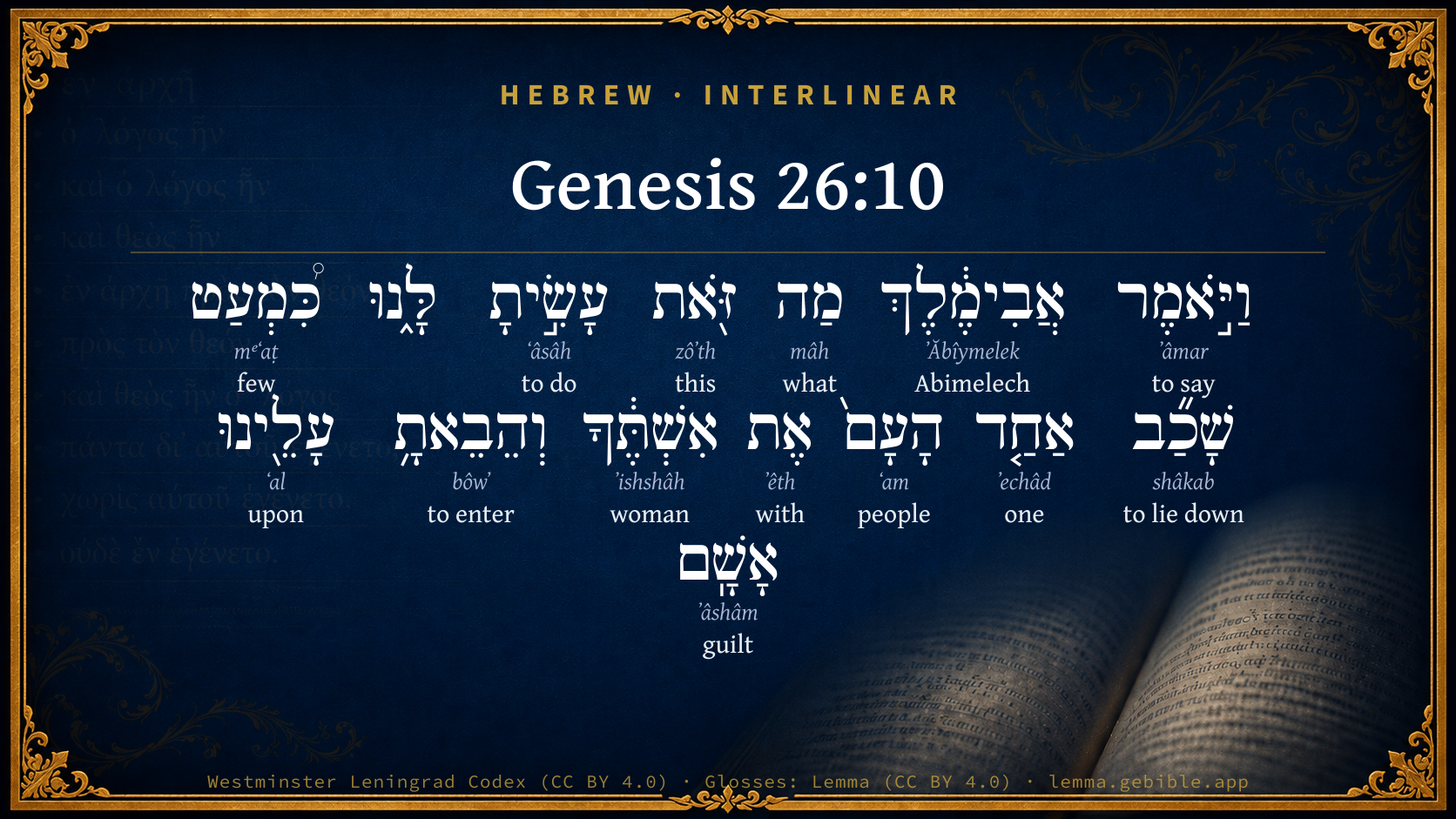
Hebrew (Westminster Leningrad Codex) Genesis 26:10 appears in the Hebrew Old Testament. The text above is from the Westminster Leningrad Codex. Each word links to its Strong’s number, a concise gloss, and parsing drawn from the Open Scriptures Hebrew Bible morphology. Click any word for its full Brown-Driver-Briggs (BDB) entry.
Download image
Cite this verse

Genesis 26:10 (World English Bible). Public Domain. Lemma interlinear Bible study tool, https://lemma.gebible.app/v/genesis/26/10.

Show BibTeX & RIS
BibTeX
RIS
English Translation
Abimelech said, "What is this you have done to us? One of the people might easily have lain with your wife, and you would have brought guilt on us!"
World English Bible · Public Domain
Highlights
  • 1 first appearance in the Hebrew Bible
Full analysis ↓
Download a study sheet

One document with this verse’s original text, its word-by-word gloss line, the meaning frame, cross-references with their text, attributed commentary, and full source and license credits — printable, and it pastes into notes with its structure intact.

This verse Autodidact and up

Study sheet (.html) Plain text (.txt)

A passage Seminary Student

Up to 50 verses in one chapter. A passage sheet keeps up to 6 commentary sources and 12 cross-references per verse, in the order this page ranks them, and says so on the sheet whenever that leaves anything out. Ask for a single verse and you get the Autodidact verse sheet above.

Everything on this page stays free to read, with no account — the sheet is a download of what is already on screen, not access to it.

Want to remove ads? Support Godless Engineer
Compare translations 3

The same verse in 3 English versions, stacked beneath the original-language interlinear above. Click any original word for its lexicon entry.

Each is an independent rendering of the whole verse — the interlinear is not word-aligned to these translations.

Highlighted words mark where these versions differ — a whole-verse word diff, not a word-by-word alignment.

  • World English Bible Public Domain
    Abimelech said, "What is this you have done to us? One of the people might easily have lain with your wife, and you would have brought guilt on us!"
  • King James Version Public Domain
    And Abimelech said, What is this thou hast done unto us? one of the people might lightly have lien with thy wife, and thou shouldest have brought guiltiness upon us.
  • unfoldingWord Literal Text CC BY-SA 4.0
    Then Abimelech said, “What this you have done to us? One of the people might easily have lain with your wife, and you would have brought guilt on us!”

unfoldingWord Literal Text — © unfoldingWord, licensed CC BY-SA 4.0. Word-aligned USFM3 via Door43 (git.door43.org/unfoldingWord/en_ult).

Versions to compare (up to 4)

3 of 4 selected

Show all 18 translations

Every available English version of this verse, each an independent rendering of the whole verse.

  • World English Bible Public Domain
    Abimelech said, "What is this you have done to us? One of the people might easily have lain with your wife, and you would have brought guilt on us!"
  • Berean Standard Bible Public Domain
    “What is this you have done to us?” asked Abimelech. “One of the people could easily have slept with your wife, and you would have brought guilt upon us.”
  • Majority Standard Bible Public Domain
    “What is this you have done to us?” asked Abimelech. “One of the people could easily have slept with your wife, and you would have brought guilt upon us.”
  • King James Version Public Domain
    And Abimelech said, What is this thou hast done unto us? one of the people might lightly have lien with thy wife, and thou shouldest have brought guiltiness upon us.
  • American Standard Version (1901) Public Domain
    And Abimelech said, What is this thou hast done unto us? One of the people might easily have lain with thy wife, and thou wouldest have brought guiltiness upon us.
  • Revised Version (1885) Public Domain
    And Abimelech said, What is this thou hast done unto us? one of the people might lightly have lain with thy wife, and thou shouldest have brought guiltiness upon us.
  • Geneva Bible (1599) Public Domain
    Then Abimelech said, Why hast thou done this vnto vs? one of the people had almost lien by thy wife, so shouldest thou haue brought sinne vpon vs.
  • Douay-Rheims (1899) Public Domain
    And Abimelech said: Why hadst thou deceived us? Some man of the people might have lain with thy wife, and thou hadst brought upon us a great sin. And he commanded all the people, saying:
  • Young's Literal Translation Public Domain
    And Abimelech saith, `What `is' this thou hast done to us? as a little thing one of the people had lain with thy wife, and thou hadst brought upon us guilt;'
  • Literal Standard Version CC BY-SA 4.0
    And Abimelech says, “What [is] this you have done to us? As a little thing one of the people had lain with your wife, and you had brought on us guilt”;
  • Unlocked Literal Bible CC BY-SA 4.0
    Abimelech said, “What is this you have done to us? One of the people might easily have slept with your wife, and you would have brought guilt upon us.”
  • unfoldingWord Literal Text CC BY-SA 4.0
    Then Abimelech said, “What this you have done to us? One of the people might easily have lain with your wife, and you would have brought guilt on us!”
  • Darby Bible Public Domain
    And Abimelech said, What is this thou hast done to us? But a little and one of the people might have lain with thy wife, and thou wouldest have brought a trespass on us.
  • World Messianic Bible Public Domain
    Abimelech said, “What is this you have done to us? One of the people might easily have lain with your wife, and you would have brought guilt on us!”
  • Webster's Bible Public Domain
    And Abimelech said, What is this thou hast done to us? one of the people might lightly have lain with thy wife, and thou wouldst have brought guiltiness upon us.
  • Free Bible Version CC BY-SA 4.0
    “Why would you do this to us?” Abimelech asked. “One of the men here might have slept with your wife, and you would have made us all guilty!”
  • Bible in Basic English Public Domain
    Then Abimelech said, What have you done to us? one of the people might well have had connection with your wife, and the sin would have been ours.
  • JPS Tanakh (1917) Public Domain
    And Abimelech said: 'What is this thou hast done unto us? one of the people might easily have lain with thy wife, and thou wouldest have brought guiltiness upon us.'

Literal Standard Version (2020), Covenant Press — licensed CC BY-SA 4.0. Text via the HelloAO Bible API (eBible.org). Unlocked Literal Bible (unfoldingWord) — licensed CC BY-SA 4.0. Text via the HelloAO Bible API (eBible.org). unfoldingWord Literal Text — © unfoldingWord, licensed CC BY-SA 4.0. Word-aligned USFM3 via Door43 (git.door43.org/unfoldingWord/en_ult). Free Bible Version, Dr. Jonathan Gallagher — licensed CC BY-SA 4.0. Text via the HelloAO Bible API (eBible.org).

Word by word

More ways to search: Search by grammar → Find every occurrence → Compare this word →

Practice this passage: Drill this verse → Learn its vocabulary →

אָשָֽׁם
ʼâshâm
H817
“guilt”
Noun, Common, Masculine, Singular, Absolute
Part of Speech
Noun
Type
Common
Gender
Masculine
Number
Singular
State
Absolute
Full BDB Definition

Origin: from H816

TWOT: 180b

guilt, offense, guiltiness - offense, trespass, fault - guilt, guiltiness - compensation (for offense) - trespass offering, guilt offering
  1. וַיֹּ֣אמֶר ʼâmar H559 “and · to say” Conjunction + Verb, Qal, Sequential Imperfect, 3rd Person, Masculine, Singular
  2. אֲבִימֶ֔לֶךְ ʼĂbîymelek H40 “Abimelech” Noun, Proper
  3. מַה mâh H4100 “what” Particle, Interrogative
  4. זֹּ֖את zôʼth H2063 “this” Pronoun, Demonstrative, Feminine, Singular
  5. עָשִׂ֣יתָ ʻâsâh H6213 “to do” Verb, Qal, Perfect, 2nd Person, Masculine, Singular
  6. כִּ֠מְעַט mᵉʻaṭ H4592 “like/as · few” Preposition + Noun, Common, Masculine, Singular, Absolute
  7. שָׁכַ֞ב shâkab H7901 “to lie down” Verb, Qal, Perfect, 3rd Person, Masculine, Singular
  8. אַחַ֤ד ʼechâd H259 “one” Adjective, Cardinal number, Masculine, Singular, Absolute
  9. הָעָם֙ ʻam H5971 “the · people” Particle, Definite Article + Noun, Common, Masculine, Singular, Absolute
  10. אֶת ʼêth H854 “with” Preposition
  11. אִשְׁתֶּ֔ךָ ʼishshâh H802 “woman · your” Noun, Common, Feminine, Singular, Construct + Suffix, Personal, 2nd Person, Masculine, Singular
  12. וְהֵבֵאתָ֥ bôwʼ H935 “and · to enter” Conjunction + Verb, Hiphil, Sequential Perfect, 2nd Person, Masculine, Singular
  13. עָלֵ֖ינוּ ʻal H5921 “upon · us” Preposition + Suffix, Personal, 1st Person, Common, Plural

About this verse

These counts appear in no published source. They are computed here, from the morphology-tagged text and Lemma’s own curated glosses. What Lemma adds →

15
words
14
distinct lemmas
Pentateuch
section

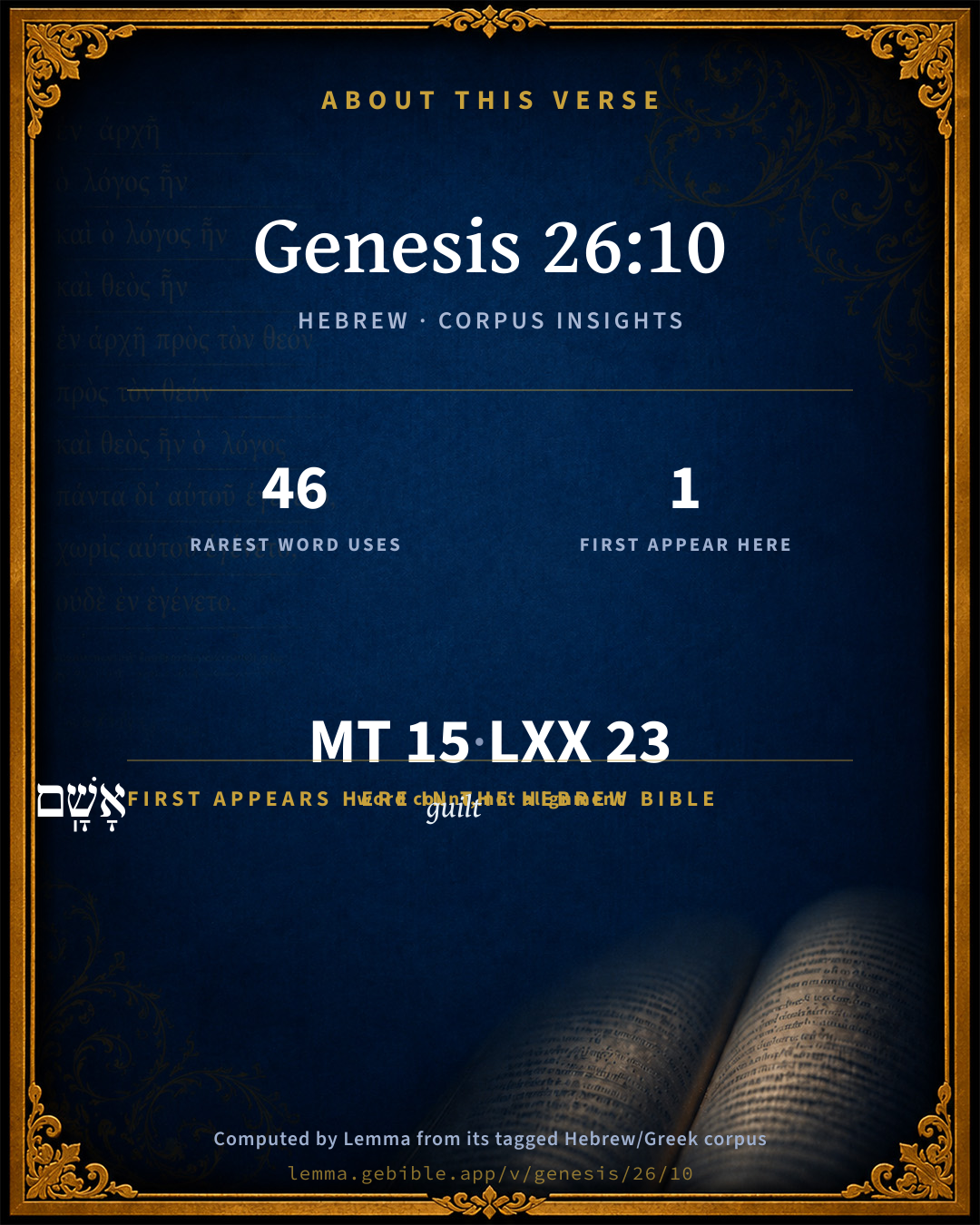
First appearance in Scripture

This word makes its first canonical appearance in the Hebrew Bible here:

  • אָשָֽׁם guilt H817

Shared distinctive vocabulary

אָשָֽׁם guilt H817 occurs in 41 verses of the Hebrew Bible. Also found in:

Grammatical profile

  • 4 verbs
  • 5 nouns
  • 1 adjective
  • 1 pronoun
  • 3 prepositions
  • 1 particle

Verb forms

  • וַיֹּ֣אמֶר Qal · Sequential Imperfect
  • עָשִׂ֣יתָ Qal · Perfect
  • שָׁכַ֞ב Qal · Perfect
  • וְהֵבֵאתָ֥ Hiphil · Sequential Perfect

Hebrew & Septuagint length

In English translation the verse runs 29 words from the Hebrew and 35 from the Septuagint (LXX English) — closely comparable.

A rough comparison of the two English renderings, which tokenize alike — not a word-level alignment.

Word counts can differ between the Hebrew and the Greek without any difference in meaning — e.g. the Hebrew direct-object marker אֵת has no separate Greek word, and Greek often adds the article ὁ.

In the original languages it is 15 Hebrew tokens and 23 Greek tokens — but the two are counted differently (Hebrew bundles its prefixes and suffixes into one token; the Greek is in lemma form), so that isn’t a like-for-like length.

Cross-references

2

Topical passages linked to Genesis 26:10 in the Treasury of Scripture Knowledge — connected by theme and wording, ordered by reader-vote popularity; previews shown in the World English Bible.

  • Genesis 12:18–19 Pharaoh called Abram, and said, "What is this that you have done to me? Why didn't you tell me that she was your wife?
  • Genesis 20:9–10 Then Abimelech called Abraham, and said to him, "What have you done to us? How have I sinned against you, that you have brought on me and on my kingdom a great sin? You have done deeds to me that ought not to be done!"

Cross-references courtesy of OpenBible.info (CC BY 4.0).

Hebrew and Greek witnesses Masoretic Hebrew ↔ Greek Septuagint

The same verse in the two great witnesses to the Old Testament, shown verse-for-verse.

These are two independent witnesses, not word-aligned to each other, and the Septuagint is shown in lemma (dictionary) form.

Hebrew Genesis 26:10 Masoretic · Westminster Leningrad Codex

וַיֹּ֣אמֶר אֲבִימֶ֔לֶךְ מַה זֹּ֖את עָשִׂ֣יתָ לָּ֑נוּ כִּ֠מְעַט שָׁכַ֞ב אַחַ֤ד הָעָם֙ אֶת אִשְׁתֶּ֔ךָ וְהֵבֵאתָ֥ עָלֵ֖ינוּ אָשָֽׁם

Abimelech said, "What is this you have done to us? One of the people might easily have lain with your wife, and you would have brought guilt on us!"

World English Bible · Public Domain

Greek LXX Genesis 26:10 Septuagint · lemma form

εἶπον δέ αὐτός αβιμελεχ τίς οὗτος ποιέω ἐγώ μικρός κοιμάω τις ὁ γένος ἐγώ μετά ὁ γυνή σύ καί ἐπιἄγω ἐπί ἐγώ ἄγνοια

And Abimelech said to him, Why have you done this to us? one of my kindred within a little had lain with your wife, and you would have brought a sin of ignorance upon us.

LXX2012 (modern English Septuagint) · Public Domain

On this verse, The Cambridge Bible for Schools and Colleges discusses the Septuagint’s reading. Read the note in Commentary ↓

Hebrew: Westminster Leningrad Codex (CC BY 4.0). Greek: Septuagint (public domain); English from LXX2012 (modern English Septuagint) (Public Domain). How the Septuagint differs from the Hebrew →

Targum (Aramaic paraphrase)

2

The Targum is the ancient Jewish Aramaic paraphrase of the Hebrew Scriptures — an interpretive translation, not the Hebrew text itself. Onkelos (literal) and Pseudo-Jonathan (expansive) render the Torah, and Jonathan the Prophets. Coverage is partial: where no permissively-licensed English translation exists for a verse, only the Aramaic is shown. This is verse-level text, not a word-by-word alignment to the Hebrew.

  1. Targum Onkelos Torah (Genesis–Deuteronomy)
    וַאֲמַר אֲבִימֶלֶךְ מָה דָא עֲבַדְתָּ לָנָא כִּזְעֵיר פּוֹן שָׁכִיב דִּמְיָחֵד בְּעַמָּא עִם אִתְּתָךְ וְאַיְתֵיתָא עֲלָנָא חוֹבָא

    (no public-domain English translation for this verse)

    Targum Onkelos — Aramaic: “Onkelos Genesis” (public domain); “Onkelos Exodus” (public domain); “Onkelos Leviticus” (public domain); “Onkelos Numbers” (public domain); “Onkelos Deuteronomy” (public domain). English: “Sefaria Community Translation” (CC0 1.0 (public-domain dedication)); “J.W. Etheridge. The Targums of Onkelos and Jonathan Ben Uzziel on the Pentateuch. London: Longmans, Green, 1862” (public domain). Text via Sefaria.

  2. Targum Pseudo-Jonathan Torah (Genesis–Deuteronomy)
    וַאֲמַר אֲבִימֶלֶךְ מָא דָא עָבַדְתְּ לָנָא כִּזְעֵיר פּוֹן שְׁכִיב מַלְכָּא דְמֵיחַד בְּעַמָא עִם אִנְתְּתָךְ וְאַיְיתֵיתָא עִלָנָא חוֹבָא

    And Abimelek said, Why hast thou done this to us? It might have been that the king, who is the principal of the people, had lain with thy wife, and thou wouldst have brought guilt upon us.

    Targum Pseudo-Jonathan — Aramaic: “Targum Jonathan on Genesis” (public domain); “Targum Jonathan on Exodus” (public domain); “Targum Jonathan on Leviticus” (public domain); “Targum Jonathan on Numbers” (public domain); “Targum Jonathan on Deuteronomy” (public domain). English: “The Targum of Jonathan ben Uzziel, trans. J. W. Etheridge, London, 1862” (public domain). Text via Sefaria.

Commentary

Notes on Genesis 26:10 from classic Christian and Jewish commentators (each source and its license shown beneath its notes). The classic Christian expositions comment on the surrounding passage and are grouped to its opening verse, so a note may address several verses; the Jewish commentaries on the Tanakh (Rashi and others) are per-verse, so they appear only where the commentator wrote on this verse.

Lemma curates 59 commentaries, every one of them public domain or Creative Commons licensed, each selected and text-cleaned for this edition rather than reprinted as found. About our sources →

Trapp's Complete Commentary

John Trapp

Gen 26:10 And Abimelech said, What [is] this thou hast done unto us? one of the people might lightly have lien with thy wife, and thou shouldest have brought guiltiness upon us.

Ver. 10. Brought guiltiness upon us.] Or, a shameful crime, subjecting us to condign punishment. This is more than many pseudo-Christians will yield; who hold adultery a light sin, if any at all, a trick of youth: being of the same mind with that old dotard in Terence: It is nothing for a young man to be found potting, piping, drinking, drabbing, swearing, whoring, &c. {a} And this poisonful position passed, it seems, for current at Corinth; whence the apostle Paul so strives to uproot that wretched opinion, by many arguments. {1Co 6:1-20} And {1Co 10:8} instead of the cloak of heat of youth, he puts upon fornication a bloody cloak, bathed in the blood of three and twenty thousand.

{a} Non est, mihi crede, flagitium, adolescentem belluari, potare, scortari, fores effringere.

John Trapp, A Commentary or Exposition upon All the Books of the Old and New Testament (1647–1656) — public domain. Text from a community e-Sword module.

Joseph Benson's Commentary

Gen 26:10. Lightly — Here, means perhaps. The heathen considered fornication either as no sin, or a very little one; but they had a different idea of adultery, considering it as heinous. Therefore, with a reference to it, Abimelech says, Thou shouldest have brought guiltiness upon us — Probably it might be fresh in his memory how sorely God had punished his predecessor and all his family in the days of Abraham (chap. 20.) for only an intention of adultery. It is very observable here, that Abimelech takes it for granted, that their ignorance of Rebekah’s being Isaac’s wife would not have been a sufficient excuse for their sin.

Joseph Benson's Commentary on the Old and New Testaments (1811–1818) — public domain. Text from a community e-Sword module.

Tyndale Open Study Notes

Tyndale Open Resources

26:10-11 Isaac, like his father, was rebuked by Abimelech (see study note on 20:1-18). This legal wording would remind Israel of how important it was to preserve marital purity. Abimelech recognized the danger to his own people. Though his decree preserved his own society, it was also a word from God that preserved the sanctity of Isaac’s and Israel’s marriages. If Isaac’s marriage had ended here, there would have been no Israelite society.

Tyndale Open Study Notes — © Tyndale Open Resources, licensed CC BY-SA 4.0. Text via the HelloAO Bible API.

Geneva Bible (1599)

Geneva Bible translators

In all ages men were persuaded that God’s vengeance should light upon wedlock breakers.

Geneva Bible (1599) marginal notes — public domain. Text via Bolls.life.

Adam Clarke's Commentary

Verse 10. Thou shouldest have brought guiltiness upon us.] It is likely that Abimelech might have had some knowledge of God's intentions concerning the family of Abraham, and that it must be kept free from all impure and alien mixtures; and that consequently, had he or any of his people taken Rebekah, the Divine judgment might have fallen upon the land. Abimelech was a good and holy man; and he appears to have considered adultery as a grievous and destructive crime.

Adam Clarke's Commentary on the Bible (1810–1826) — public domain. Text from a community e-Sword/MySword module.

John Calvin's Commentaries

10. What is this thou hast done unto us? The Lord does not chastise Isaac as he deserved, perhaps because he was not so fully endued with patience as his father was; and, therefore, lest the seizing of his wife should dishearten him, God mercifully prevents it. Yet, that the censure may produce the deeper shame, God constitutes a heathen his master and his reprover. We may add, that Abimelech chides his folly, not so much with the design of injuring him, as of upbraiding him. It ought, however, deeply to have wounded the mind of the holy man, when he perceived that his offense was obnoxious to the judgment even of the blind. Wherefore, let us remember that we must walk in the light which God has kindled for us, lest even unbelievers, who are wrapped in the darkness of ignorance, should reprove our stupor. And certainly when we neglect to obey the voice of God, we deserve to be sent to oxen and asses for instruction. Abimelech, truly, does not investigate nor prosecute the whole offense of Isaac, but only alludes to one part of it. Yet Isaac, when thus gently admonished by a single word, ought to have condemned himself, seeing that, instead of committing himself and his wife to God, who had promised to be the guardian of them both, he had resorted, through his own unbelief, to an illicit remedy. For faith has this property, that it confines us within divinely prescribed bounds, so that we attempt nothing except with God’s authority or permission. Whence it follows that Isaac’s faith wavered when he swerved from his duty as a husband. We gather, besides, from the words of Abimelech, that all nations have the sentiment impressed upon their minds, that the violation of holy wedlock is a crime worthy of divine vengeance, and have consequently a dread of the judgment of God. For although the minds of men are darkened with dense clouds, so that they are frequently deceived; yet God has caused some power of discrimination between right and wrong to remain, so that each should bear about with him his own condemnation, and that all should be without excuse. If, then, God cites even unbelievers to his tribunal, and does not suffer them to escape just condemnation, how horrible is that punishment which awaits us, if we endeavor to obliterate, by our own wickedness, that knowledge which God has engraven on our consciences?

John Calvin's Commentaries (1540-1563) — public domain. Text from the Calvin Translation Society English edition (1840s-50s) via the Christian Classics Ethereal Library (ccel.org). Calvin's coverage is partial (roughly two-thirds of the Bible); uncommented books and verses are honest gaps, never fabricated. The 19th-century editor's footnotes and remarks are omitted so the notes are faithfully Calvin's own voice.

The Cambridge Bible for Schools and Colleges

gen. ed. J. J. S. Perowne

10. lightly] Lit. “as a little”: i.e. “it might easily have happened.” See Gen_12:18, Gen_20:10. For “lien” = “lain,” cf. Psa_68:13 A.V. and P.B.V.).

guiltiness] Heb. âshâm; LXX ἄγνοιαν; Lat. grande peccatum. In spite of ignorance, national guilt would be involved in such an outrage as marriage with the wile of another man. For “guiltiness,” “guilt,” cf. Psa_68:22; Pro_14:9.

The Cambridge Bible for Schools and Colleges (gen. ed. J. J. S. Perowne; Cambridge University Press, 1878–1918) — public domain. Text from a community e-Sword module.

John Gill's Exposition

And Abimelech charged all his people,.... All his subjects throughout his kingdom, and particularly the inhabitants of Gerar, and more especially his courtiers and servants about him:

saying, he that toucheth this man or his wife; that does any injury to one either by words or deeds, or behaves immodestly to the other, or attempts to ravish her; this being sometimes used as a modest expression carnal knowledge of a woman; or that does either of them any harm or hurt in any respect whatever:

shall surely be put to death; this severe edict he published, in order to deter his subjects from using them ill, to which they might be provoked by Isaac's dissimulation, and by his evil suspicions of them.

John Gill's Exposition of the Whole Bible (1746–1763) — public domain (CC PDM 1.0). Text via the HelloAO Bible API.

Matthew Poole's English Annotations

The heathens esteemed fornication either no sin, or a very little one; but adultery was heinous and formidable even among the heathens, and especially here, because it was fresh in memory how sorely God had punished Abimelech, and all his family, only for an intention of adultery, Gen 20:1-18. Note here, they take it for granted that their ignorance had not been a sufficient excuse for their sin.

Matthew Poole's English Annotations on the Holy Bible (1683–1685) — public domain. Text from a community e-Sword/MySword module.

The Pulpit Commentary

And Abimelech said, What is this thou hast done unto us? one of the people might lightly have lain with thy wife, literally, within a little (cf. Psa_73:2 Psa_119:87) one of the people might have lain with thy wifeand thou shouldesti.e. (within a little) thou mightest have brought (or caused to come) guiltiness upon us (cf. Gen_20:9, where haFj is used instead of

The Pulpit Commentary (1880–1919), ed. H.D.M. Spence-Jones & Joseph S. Exell — public domain. Text from a community e-Sword module.

John Wesley's Explanatory Notes

Lightly - Perhaps.

John Wesley, Explanatory Notes Upon the Whole Bible (1754–1765) — public domain. Text via the GEBible commentary corpus.

Rashi

Rabbi Shlomo Yitzchaki (Rashi)

אחד העם ONE OF THE PEOPLE — the one singled out from the people — viz., the king (cf. Targum).

והבאת עלינו אשם means had he really lain with her you would have now brought guiltiness upon us (i. e. the verb is not in the future but in the conditional past tense).

Rashi on the Tanakh — English translations: “The Judaica Press complete Tanach with Rashi, translated by A. J. Rosenberg” (CC BY 4.0); “Pentateuch with Rashi's commentary by M. Rosenbaum and A.M. Silbermann, 1929-1934” (public domain); “The Metsudah Tanach series, Lakewood, N.J” (CC BY 4.0); and “The Book of Joshua, Metsudah Publications, 1997” (CC BY 4.0). Text via Sefaria.

Radak

Rabbi David Kimhi (Radak)

ויאמר.. כמעט שכב, he meant that it had been very likely that someone among his people would have slept with Rivkah seeing that Yitzchok had represented her as being his sister. They would not have considered such a sexual encounter as something sinful and therefore Yitzchok would have been to blame for any guilt arising from such an encounter.

Radak on the Tanakh — English translations: “Sefaria Community Translation” (CC0 1.0 (public-domain dedication)); “Eliyahu Munk, HaChut Hameshulash” (CC BY 4.0); “Rabbi Mike Feuer, Jerusalem Anthology” (CC BY 4.0); and “R. David Kimhi on the first book of Psalms, Translated by R.G. Finch, London, 1919” (public domain). Text via Sefaria.

Lesson kit

Teaching starters — assembled from the data on this page, not authored interpretation. Every prompt links to the verse data it draws on. Edit before teaching.

Genesis, in the Pentateuch, opens this verse with 15 words (14 distinct Hebrew lemmas). Its most distinctive word is ʼâshâm (“guilt”). A historical commentator’s framing appears above. Read the whole chapter for the surrounding context.

Discussion questions

  1. How does “guilt” (ʼâshâm) shape what this verse is saying?
  2. This is the first place “guilt” appears in Scripture (first appears here). What does its debut here establish?
  3. How does Leviticus 5:6, which shares the word «guilt», read alongside this verse?
  4. These translations render this verse differently; the difference is in the English rendering, not the original. What questions does that raise?
  5. «וַיֹּ֣אמֶר» is a Qal Sequential Imperfect verb. How does that grammatical form shape the action described?
  6. Compare how Trapp's Complete Commentary and Joseph Benson's Commentary read this verse. Where do they agree or differ?

Things to notice

Reading settings

Reading text

Shown beneath each verse's original-language words.

Old Testament
Old Testament edition

Read the OT as the Masoretic Hebrew (MT) or the Greek Septuagint (LXX).

English shown for the Greek Septuagint (in the Hebrew ↔ Greek comparison).

Comparing translations? Open the Compare panel on any verse page to stack up to four side by side.