Deuteronomy 23:2

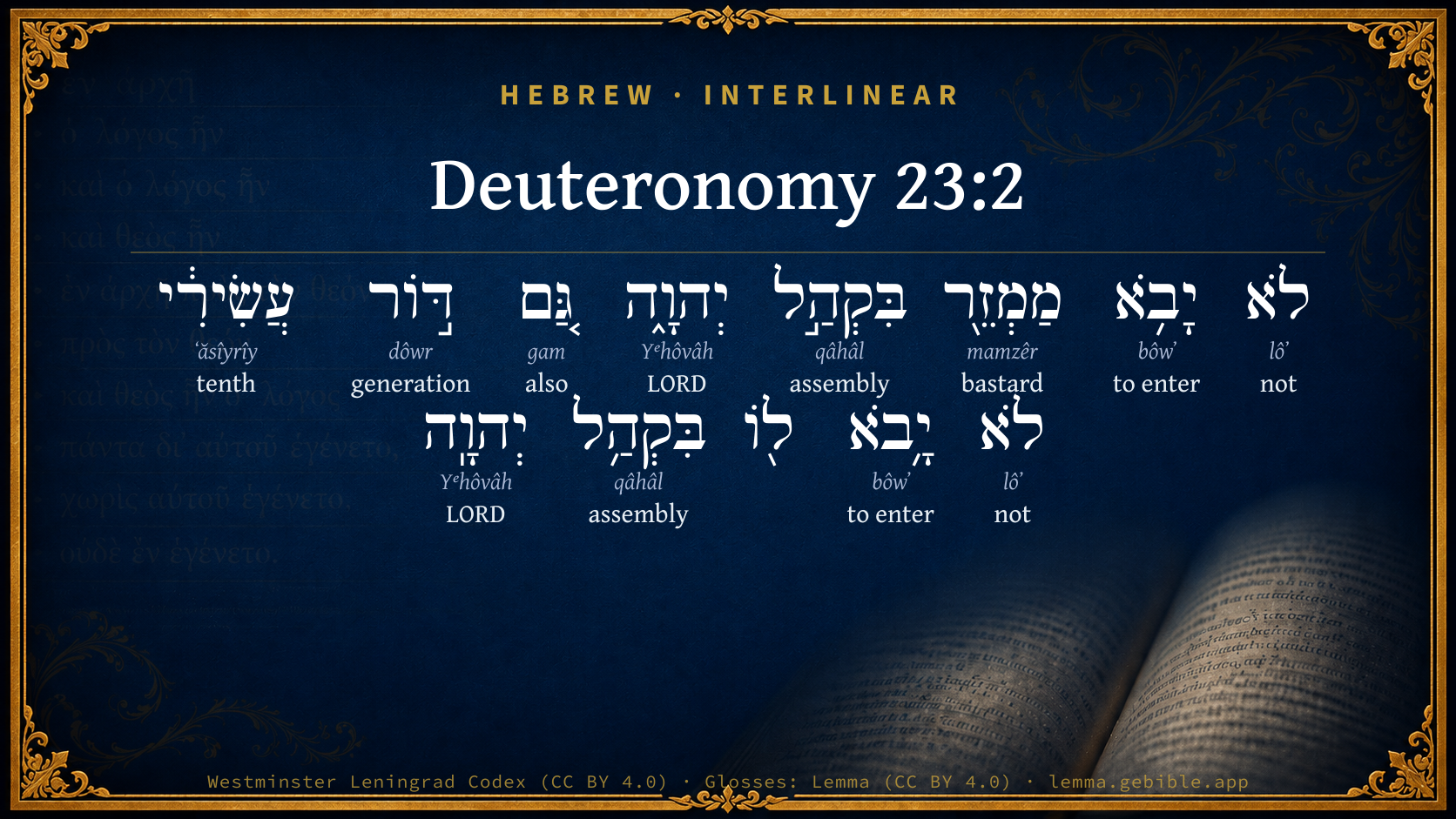
Hebrew (Westminster Leningrad Codex) Deuteronomy 23:2 appears in the Hebrew Old Testament. The text above is from the Westminster Leningrad Codex. Each word links to its Strong’s number, a concise gloss, and parsing drawn from the Open Scriptures Hebrew Bible morphology. Click any word for its full Brown-Driver-Briggs (BDB) entry.
Download image
Cite this verse

Deuteronomy 23:2 (World English Bible). Public Domain. Lemma interlinear Bible study tool, https://lemma.gebible.app/v/deuteronomy/23/2.

Show BibTeX & RIS
BibTeX
RIS
English Translation
A bastard shall not enter into the assembly of Yahweh; even to the tenth generation shall none of his enter into the assembly of Yahweh.
World English Bible · Public Domain
Highlights Full analysis ↓
Download a study sheet

One document with this verse’s original text, its word-by-word gloss line, the meaning frame, cross-references with their text, attributed commentary, and full source and license credits — printable, and it pastes into notes with its structure intact.

This verse Autodidact and up

Study sheet (.html) Plain text (.txt)

A passage Seminary Student

Up to 50 verses in one chapter. A passage sheet keeps up to 6 commentary sources and 12 cross-references per verse, in the order this page ranks them, and says so on the sheet whenever that leaves anything out. Ask for a single verse and you get the Autodidact verse sheet above.

Everything on this page stays free to read, with no account — the sheet is a download of what is already on screen, not access to it.

Want to remove ads? Support Godless Engineer
Compare translations 3

The same verse in 3 English versions, stacked beneath the original-language interlinear above. Click any original word for its lexicon entry.

Each is an independent rendering of the whole verse — the interlinear is not word-aligned to these translations.

Highlighted words mark where these versions differ — a whole-verse word diff, not a word-by-word alignment.

  • World English Bible Public Domain
    A bastard shall not enter into the assembly of Yahweh; even to the tenth generation shall none of his enter into the assembly of Yahweh.
  • King James Version Public Domain
    A bastard shall not enter into the congregation of the LORD; even to his tenth generation shall he not enter into the congregation of the LORD.
  • unfoldingWord Literal Text CC BY-SA 4.0
    No child of intermarriage shall enter the assembly of Yahweh; even his tenth generation shall not enter the assembly of Yahweh.

unfoldingWord Literal Text — © unfoldingWord, licensed CC BY-SA 4.0. Word-aligned USFM3 via Door43 (git.door43.org/unfoldingWord/en_ult).

Versions to compare (up to 4)

3 of 4 selected

Show all 18 translations

Every available English version of this verse, each an independent rendering of the whole verse.

  • World English Bible Public Domain
    A bastard shall not enter into the assembly of Yahweh; even to the tenth generation shall none of his enter into the assembly of Yahweh.
  • Berean Standard Bible Public Domain
    No one of illegitimate birth may enter the assembly of the LORD, nor may any of his descendants, even to the tenth generation.
  • Majority Standard Bible Public Domain
    No one of illegitimate birth may enter the assembly of the LORD, nor may any of his descendants, even to the tenth generation.
  • King James Version Public Domain
    A bastard shall not enter into the congregation of the LORD; even to his tenth generation shall he not enter into the congregation of the LORD.
  • American Standard Version (1901) Public Domain
    A bastard shall not enter into the assembly of Jehovah; even to the tenth generation shall none of his enter into the assembly of Jehovah.
  • Revised Version (1885) Public Domain
    A bastard shall not enter into the assembly of the LORD; even to the tenth generation shall none of his enter into the assembly of the LORD.
  • Geneva Bible (1599) Public Domain
    A bastard shall not enter into the Congregation of the Lord: euen to his tenth generation shall he not enter into the Congregation of the Lord.
  • Douay-Rheims (1899) Public Domain
    A mamzer, that is to say, one born of a prostitute, shall not enter into the church of the Lord, until the tenth generation.
  • Young's Literal Translation Public Domain
    a bastard doth not enter into the assembly of Jehovah; even a tenth generation of him doth not enter into the assembly of Jehovah.
  • Literal Standard Version CC BY-SA 4.0
    a bastard does not enter into the assembly of YHWH; even a tenth generation of him does not enter into the assembly of YHWH.
  • Unlocked Literal Bible CC BY-SA 4.0
    No illegitimate child may belong to the assembly of Yahweh; as far as to the tenth generation of his descendants, none of them may belong to the assembly of Yahweh.
  • unfoldingWord Literal Text CC BY-SA 4.0
    No child of intermarriage shall enter the assembly of Yahweh; even his tenth generation shall not enter the assembly of Yahweh.
  • Darby Bible Public Domain
    A bastard shall not come into the congregation of Jehovah; even his tenth generation shall not come into the congregation of Jehovah.
  • World Messianic Bible Public Domain
    A person born of a forbidden union shall not enter into the LORD’s assembly; even to the tenth generation shall no one of his enter into the LORD’s assembly.
  • Webster's Bible Public Domain
    A bastard shall not enter into the congregation of the LORD; even to his tenth generation shall he not enter into the congregation of the LORD.
  • Free Bible Version CC BY-SA 4.0
    No one of mixed race is allowed to enter the Lord's sanctuary, and none of his descendants may do so either, up to the tenth generation.
  • Bible in Basic English Public Domain
    One whose father and mother are not married may not come into the meeting of the Lord's people, or any of his family to the tenth generation.
  • JPS Tanakh (1917) Public Domain
    (23-3) A bastard shall not enter into the assembly of the LORD; even to the tenth generation shall none of his enter into the assembly of the LORD.

Literal Standard Version (2020), Covenant Press — licensed CC BY-SA 4.0. Text via the HelloAO Bible API (eBible.org). Unlocked Literal Bible (unfoldingWord) — licensed CC BY-SA 4.0. Text via the HelloAO Bible API (eBible.org). unfoldingWord Literal Text — © unfoldingWord, licensed CC BY-SA 4.0. Word-aligned USFM3 via Door43 (git.door43.org/unfoldingWord/en_ult). Free Bible Version, Dr. Jonathan Gallagher — licensed CC BY-SA 4.0. Text via the HelloAO Bible API (eBible.org).

Word by word

More ways to search: Search by grammar → Find every occurrence → Compare this word →

Practice this passage: Drill this verse → Learn its vocabulary →

מַמְזֵ֖ר
mamzêr
H4464
“bastard”
Noun, Common, Masculine, Singular, Absolute
Part of Speech
Noun
Type
Common
Gender
Masculine
Number
Singular
State
Absolute
Full BDB Definition

Origin: from an unused root meaning to alienate

TWOT: 1174a

bastard, child of incest, illegitimate child - bastard - mixed population (figuratively) - born of a Jewish father and a heathen mother or visa versa
  1. לֹא lôʼ H3808 “not” Particle, Negative
  2. יָבֹ֥א bôwʼ H935 “to enter” Verb, Qal, Imperfect, 3rd Person, Masculine, Singular
  3. בִּקְהַ֣ל qâhâl H6951 “in/at · assembly of” Preposition + Noun, Common, Masculine, Singular, Construct
  4. יְהוָ֑ה Yᵉhôvâh H3068 “LORD” Noun, Proper
  5. גַּ֚ם gam H1571 “also” Particle, Accusative
  6. דּ֣וֹר dôwr H1755 “generation” Noun, Common, Masculine, Singular, Absolute
  7. עֲשִׂירִ֔י ʻăsîyrîy H6224 “tenth” Adjective, Ordinal number, Masculine, Singular, Absolute
  8. לֹא lôʼ H3808 “not” Particle, Negative
  9. יָ֥בֹא bôwʼ H935 “to enter” Verb, Qal, Imperfect, 3rd Person, Masculine, Singular
  10. בִּקְהַ֥ל qâhâl H6951 “in/at · assembly of” Preposition + Noun, Common, Masculine, Singular, Construct
  11. יְהוָֽה Yᵉhôvâh H3068 “LORD” Noun, Proper

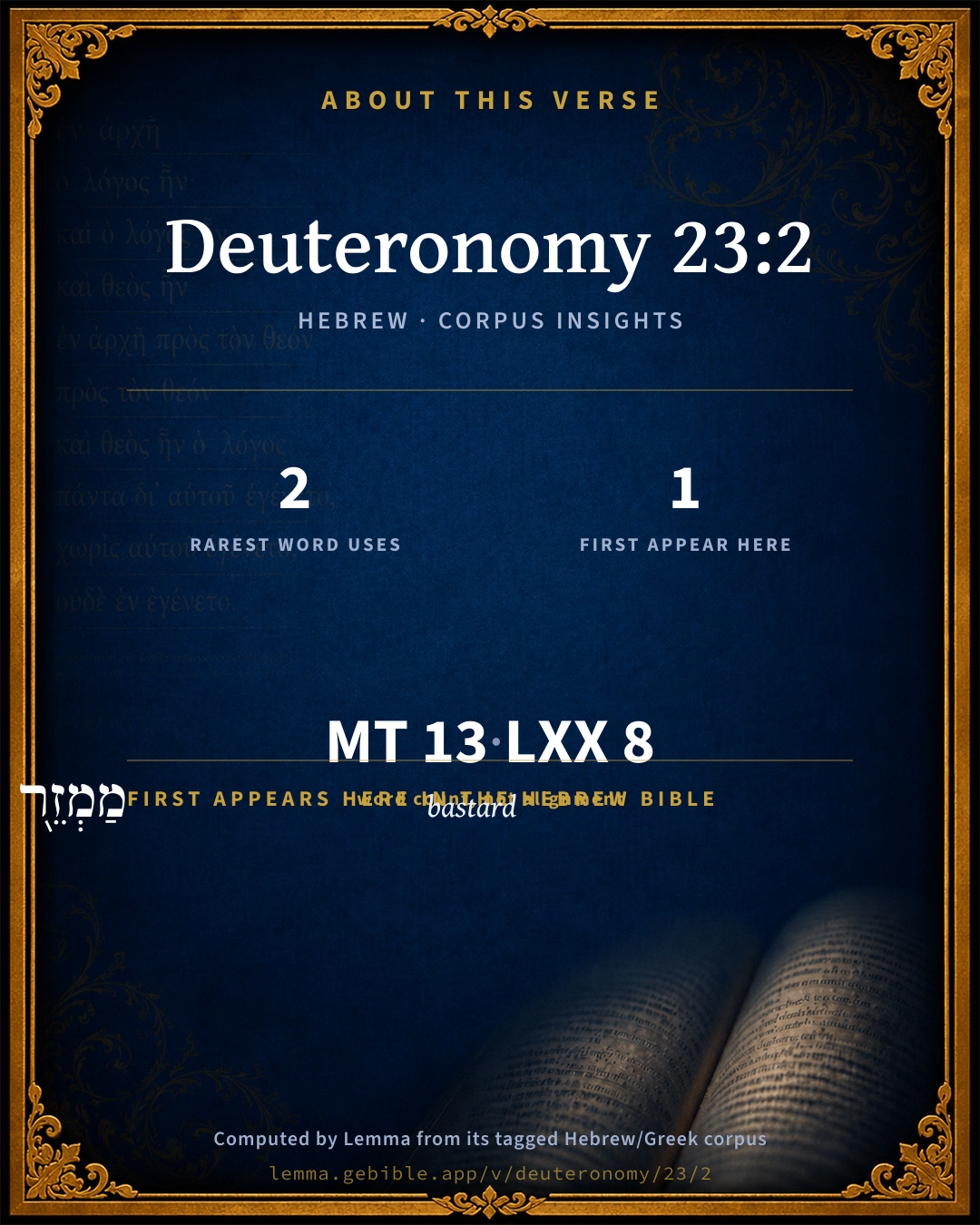
About this verse

These counts appear in no published source. They are computed here, from the morphology-tagged text and Lemma’s own curated glosses. What Lemma adds →

13
words
8
distinct lemmas
Pentateuch
section

Notable vocabulary

The rarest word here is מַמְזֵ֖ר bastard H4464 — appearing just 2 times in the whole Hebrew Bible.

First appearance in Scripture

This word makes its first canonical appearance in the Hebrew Bible here:

  • מַמְזֵ֖ר bastard H4464

Shared distinctive vocabulary

מַמְזֵ֖ר bastard H4464 occurs in 2 verses of the Hebrew Bible. Also found in:

Grammatical profile

  • 2 verbs
  • 6 nouns
  • 1 adjective
  • 1 preposition
  • 3 particles

Verb forms

  • יָבֹ֥א Qal · Imperfect
  • יָ֥בֹא Qal · Imperfect

Repetition

Words recur within this verse — often emphatic in Hebrew:

  • יָבֹ֥א to enter H935 ×2
  • בִּקְהַ֣ל assembly H6951 ×2
  • יְהוָ֑ה LORD H3068 ×2
  • לֹא not H3808 ×2

Hebrew & Septuagint length

In English translation the verse runs 25 words from the Hebrew and 14 from the Septuagint (LXX English) — the Septuagint runs noticeably shorter here. See the side-by-side →

A rough comparison of the two English renderings, which tokenize alike — not a word-level alignment.

Word counts can differ between the Hebrew and the Greek without any difference in meaning — e.g. the Hebrew direct-object marker אֵת has no separate Greek word, and Greek often adds the article ὁ.

In the original languages it is 13 Hebrew tokens and 8 Greek tokens — but the two are counted differently (Hebrew bundles its prefixes and suffixes into one token; the Greek is in lemma form), so that isn’t a like-for-like length.

Cross-references

4

Topical passages linked to Deuteronomy 23:2 in the Treasury of Scripture Knowledge — connected by theme and wording, ordered by reader-vote popularity; previews shown in the World English Bible.

  • Zechariah 9:6 Foriegners will dwell in Ashdod, And I will cut off the pride of the Philistines.
  • Isaiah 57:3 But draw near here, you sons of the sorceress, the seed of the adulterer and the prostitute.
  • Hebrews 12:8 But if you are without discipline, of which all have been made partakers, then are you illegitimate, and not children.
  • John 8:41 You do the works of your father." They said to him, "We were not born of sexual immorality. We have one Father, God."

Cross-references courtesy of OpenBible.info (CC BY 4.0).

Hebrew and Greek witnesses Masoretic Hebrew ↔ Greek Septuagint

The same verse in the two great witnesses to the Old Testament, shown verse-for-verse.

Here the Septuagint runs noticeably shorter than the Hebrew — LXX2012 (modern English Septuagint) 14 words vs World English Bible 25. A rough length comparison of the two English translations, not a word-level alignment — read both below.

These are two independent witnesses, not word-aligned to each other, and the Septuagint is shown in lemma (dictionary) form.

Hebrew Deuteronomy 23:2 Masoretic · Westminster Leningrad Codex

לֹא יָבֹ֥א מַמְזֵ֖ר בִּקְהַ֣ל יְהוָ֑ה גַּ֚ם דּ֣וֹר עֲשִׂירִ֔י לֹא יָ֥בֹא ל֖וֹ בִּקְהַ֥ל יְהוָֽה

A bastard shall not enter into the assembly of Yahweh; even to the tenth generation shall none of his enter into the assembly of Yahweh.

World English Bible · Public Domain

Greek LXX Deuteronomy 23:2 Septuagint · lemma form

οὐ εἰςἔρχομαι θλαδίας καί ἀποκόπτω εἰς ἐκκλησία κύριος

One born of a harlot shall not enter into the assembly of the Lord.

LXX2012 (modern English Septuagint) · Public Domain

On this verse, Haydock's Catholic Bible Commentary discusses the Septuagint’s reading. Read the note in Commentary ↓

Hebrew: Westminster Leningrad Codex (CC BY 4.0). Greek: Septuagint (public domain); English from LXX2012 (modern English Septuagint) (Public Domain). How the Septuagint differs from the Hebrew →

Targum (Aramaic paraphrase)

2

The Targum is the ancient Jewish Aramaic paraphrase of the Hebrew Scriptures — an interpretive translation, not the Hebrew text itself. Onkelos (literal) and Pseudo-Jonathan (expansive) render the Torah, and Jonathan the Prophets. Coverage is partial: where no permissively-licensed English translation exists for a verse, only the Aramaic is shown. This is verse-level text, not a word-by-word alignment to the Hebrew.

  1. Targum Onkelos Torah (Genesis–Deuteronomy)
    לָא יִדְכֵּי דְפָסִיק וְדִמְחַבַּל לְמֵעַל בִּקְהָלָא דַיְיָ

    (no public-domain English translation for this verse)

    Targum Onkelos — Aramaic: “Onkelos Genesis” (public domain); “Onkelos Exodus” (public domain); “Onkelos Leviticus” (public domain); “Onkelos Numbers” (public domain); “Onkelos Deuteronomy” (public domain). English: “Sefaria Community Translation” (CC0 1.0 (public-domain dedication)); “J.W. Etheridge. The Targums of Onkelos and Jonathan Ben Uzziel on the Pentateuch. London: Longmans, Green, 1862” (public domain). Text via Sefaria.

  2. Targum Pseudo-Jonathan Torah (Genesis–Deuteronomy)
    לָא יִדְכֵּי דִמְסָרֵיס וּדְפָסִיק גִידָא לְמִיסַב אִיתָא מִקְהַל עַמָּא דַיְיָ

    He who is castrated is not fit to take a wife from the congregation of the Lord’s people.

    Targum Pseudo-Jonathan — Aramaic: “Targum Jonathan on Genesis” (public domain); “Targum Jonathan on Exodus” (public domain); “Targum Jonathan on Leviticus” (public domain); “Targum Jonathan on Numbers” (public domain); “Targum Jonathan on Deuteronomy” (public domain). English: “The Targum of Jonathan ben Uzziel, trans. J. W. Etheridge, London, 1862” (public domain). Text via Sefaria.

Commentary

Notes on Deuteronomy 23:2 from classic Christian and Jewish commentators (each source and its license shown beneath its notes). The classic Christian expositions comment on the surrounding passage and are grouped to its opening verse, so a note may address several verses; the Jewish commentaries on the Tanakh (Rashi and others) are per-verse, so they appear only where the commentator wrote on this verse.

Lemma curates 59 commentaries, every one of them public domain or Creative Commons licensed, each selected and text-cleaned for this edition rather than reprinted as found. About our sources →

Trapp's Complete Commentary

John Trapp

Deu 23:2 A bastard shall not enter into the congregation of the LORD; even to his tenth generation shall he not enter into the congregation of the LORD.

Ver. 2. A bastard shall not enter.] Lest the reproach of his birth render him contemptible, or less courageous; {a} lest some son of Belial set upon him, as Saul did upon his son Jonathan, and say, "Thou son of the perverse rebellious woman." So of the base and beastly woman, "Do not I know that thou hast done this to the confusion of thy mother’s nakedness?" {1Sa 20:30} The mutinous Janizaries called their Emperor Bajizet II, drunkard, beast, rascal, bastard, bengi, that is, bachelor, or scholar; and told him, moreover, that they would teach him to use his great place and calling with more sobriety and discretion. {b} The English slighted and scorned their William the Conqueror, because a bastard; in spite also to whom, and disgrace to his mother Arlet, they called all whores harlots. The Jews at this day, amongst other opprobrious words, wherewith they spitefully load us, call all Christians Mamzer Gel, that is, heathen bastards. Our Saviour, upon better grounds, called them long since, a bastardly brood. {Mat 12:39} And their own prophet Isaiah did the same thing long before, {Isa 57:3-4} and that, for their profane scoffing at the truth and the professors thereof. Yet who so forward as they, to say, "We are not born of fornication," no bastards? {Joh 8:41}

{a} Utpote qui nati sunt ex prostibulo, plane incerto patre, sed certissima infamia.

{b} Turk. Hist.

John Trapp, A Commentary or Exposition upon All the Books of the Old and New Testament (1647–1656) — public domain. Text from a community e-Sword module.

Geneva Bible (1599)

Geneva Bible translators

This was to cause them to live chastely, that their posterity might not be rejected.

Geneva Bible (1599) marginal notes — public domain. Text via Bolls.life.

Adam Clarke's Commentary

Verse 2. A bastard shall not enter] ממזר mamzer, which is here rendered bastard, should be understood as implying the offspring of an illegitimate or incestuous mixture.

Adam Clarke's Commentary on the Bible (1810–1826) — public domain. Text from a community e-Sword/MySword module.

Ellicott's Commentary for English Readers

(2) A bastard shall not enter.—Such a person would not, even now, be circumcised by the Jews, or permitted to marry an Israelitish woman, or be buried with his people; therefore he was excluded from the covenant. It is manifest how efficacious would be the enforcement of this law also in preserving the purity of family life.

A Bible Commentary for English Readers, edited by Charles John Ellicott (1878–1897) — public domain. Text from a community e-Sword module.

John Gill's Exposition

A bastard shall not enter into the congregation of the Lord,.... That is born of whoredom, as the Targum of Jonathan; and for the sake of avoiding whoredom and deterring from it was this law made, according to Maimonides (h), that adulterers might see, as he observes, that they affect their whole family with an irreparable stain, should they commit such an infamous action; though the Jews commonly interpret it of one that is born of any of those incestuous copulations forbidden in Lev 18:1 which they gather from this following upon, and being near unto one of those incests mentioned in the last verse of the preceding chapter (i); and it is a rule with them (k), that persons born of such copulations were reckoned bastards; now such an one, according to Jarchi, might not marry an Israelitish woman, or rather might not be admitted into the assembly of elders, or bear any public office. Jephthah may seem to be an objection to this, who was the son of an harlot, Jdg 11:1 which might be owing to the badness of the times, the laws of God being neglected, or to the providence of God so ordering it, who is not bound by his own laws, though men are; nor was he the son of a common harlot, nor of an incestuous person, but of his father's concubine; besides some think such only are intended who were born of strangers and not Israelites:

even unto his tenth generation shall he not enter into the congregation of the Lord; which seems as if he might at the eleventh; but it is generally interpreted never, as is gathered from the following verse, and from the tenth number being an absolute and perfect one; yet according to the Jewish writers there were ways and means by which their posterity became legitimate; so they say, bastards may be purified (or legitimated), how? if one marries a servant maid, the child is a servant, who if he becomes free, (his) son is a free man (l).

(h) Targum Jon. in loc. Misn. Yebamot, c. 8. sect. 2, 4, 5, 6. Maimon. Moreh Nevochim, par. 3. c. 49. (i) Bartenora in Misn. Kiddushin, c. 3. sect. 12. (k) Misn. Kiddushin, c. 3. sect. 12. & Misn. Yebamot, c. 4. sect. 13. Jarchi & Aben Ezra in loc. (l) Misn. Kiddushin, c. 3. sect. 13.

John Gill's Exposition of the Whole Bible (1746–1763) — public domain (CC PDM 1.0). Text via the HelloAO Bible API.

Albert Barnes' Notes on the Bible

A bastard - Probably, a child born of incest or adultery.

Even to his tenth generation - i. e. (see the next verse and Neh 13:1), forever. Ten is the number of perfection and completeness.

Albert Barnes' Notes on the Bible (1834–1885) — public domain. Text from a community e-Sword/MySword module.

Haydock's Catholic Bible Commentary

Mamzer, &c. The author of the Vulgate adds the explication of mamzer, which only occurs again, Zacharias ix. 6. It may in both places denote a stranger, or one of a different religion from the Jews, as Jephte was the son of a prostitute, (Judges xi. 1,) and yet became a judge of Israel. But strangers, as long as they professed a false religion, could not be entitled to the privilege of Jewish citizens; and even after they had relinquished their false worship, they were bound to wait ten whole generations, or a long time, before they could fill the posts of honour and command. (Calmet) --- This, however, seems to be contrary to the disposition made in favour of the Idumeans and Egyptians, who were admitted in the third generation. A mamzer may, therefore, be (Haydock) a bastard of a different nation from the Jews, (Menochius) which was not the case of Jephte. (Haydock) --- The Rabbins specify three sorts of mamzers: 1. those born of parents who, by the law, are forbidden to marry, being to near akin; 2. those who are the fruit of adultery, or some criminal commerce, which is punished with death; and 3. those whose birth subjects the parents to be cut off or retrenched from the people. (Selden, Jur. v. 16.) --- the Septuagint, &c., exclude the children "of a harlot," which is the sense of mamzer in the canon law. The Christian Church rejects such from holy orders, and the Athenians would not suffer bastards to offer sacrifice in the city, but only in the cynosarge, dedicated to Hercules, whose birth any doubts might be entertained. (Calmet) --- It is observable, that such often imitate the wicked conduct of their parents; in which case, they are unfit for the magistracy; and though they may lead a very exemplary life, the law is intended to discourage such practices in parents, which may entail dishonour and loss upon their children; that, if they be not sufficiently restrained by their own personal disgrace, they may at least by the love for their innocent offspring. (Haydock) --- Tenth. In the 11th generation, when the stain was obliterated, the descendant might become a magistrate. (Menochius) --- Some understand that they were excluded for ever, as when the judges of the Areopagus ordered a man to appear again before them in 100 years’ time, they meant that his cause was entirely rejected. (Vatable; Casaub. in Atheneus vi.)

George Leo Haydock (1774–1849), Haydock's Catholic Family Bible and Commentary, 1859 edition — public domain. Excludes Psalms (Douay-Rheims chapter numbering differs from Protestant) and Deuterocanonical books (Catholic canon only).

Matthew Poole's English Annotations

A bastard; so the word is commonly rendered, and so it notes a person base-born, or born in fornication or adultery, or by incestuous or any prohibited mixtures of man and woman.

Object.

1. This law seems harsh, and too severe for the innocent bastard.

Answ. 1. It was only an exclusion from government, which was a tolerable burden.

2. It was a necessary caution to prevent and brand the sin of uncleanness, to which the Jews were more than ordinarily prone.

Object. 2. Pharez and Jephthah were both bastards, yet advanced to great honour and authority.

Answ. God gives laws to us, and not to himself; and, therefore he might, when he saw fit, confer what favour or power he pleased upon any such person, as he did to these. But some add, that the Hebrew word mamzer signifies not every bastard, but a bastard born of any strange woman, as the word may seem to intimate, and as such persons generally seem to have been, because of that special provision, that there should be no whore of the daughters of Israel, as it is here below, Deu 23:17.

To his tenth generation; or, his tenth generation, as it is in the Hebrew, and so in the following verses.

Matthew Poole's English Annotations on the Holy Bible (1683–1685) — public domain. Text from a community e-Sword/MySword module.

Whedon's Commentary on the Bible

Daniel D. Whedon

2. A bastard shall not enter — The Hebrew word which our translators have rendered bastard is of doubtful meaning. It occurs in only one other passage, Zec_9:6. The rabbins understand it to mean one born of incest or adultery.

Even to his tenth generation — This is equivalent to forever.

Daniel D. Whedon (gen. ed.), Commentary on the Old and New Testaments (1874–1909) — public domain. Text from a community e-Sword module.

The Pulpit Commentary

A bastard; one born of a harlot; so the Hebrew word (rzmm), which occurs only here and in Zec_9:6, is said to mean; LXX, ejk po Vulgate, de scorto natus; the Talmud and the rabbins represent the word as denoting one begotten in adultery or incest (Maimon., "Issure Biah.," c. 15. 2, 7, 9); so also the Syriac bar game, "son of adultery.

To his tenth generation; i.e. forever, ten being the number of indefiniteness (Gen_31:7; Num_14:22; Job_19:3; Psa_3:6, etc.)

The Pulpit Commentary (1880–1919), ed. H.D.M. Spence-Jones & Joseph S. Exell — public domain. Text from a community e-Sword module.

John Wesley's Explanatory Notes

The congregation - Taking the word as in the former verse.

John Wesley, Explanatory Notes Upon the Whole Bible (1754–1765) — public domain. Text via the GEBible commentary corpus.

Rashi

Rabbi Shlomo Yitzchaki (Rashi)

פצוע דכא means, one whose stones have been bruised (פצוע) or crushed (דכא) (Sifrei Devarim 247:1).

וכרות שפכה means, one whose membrum has a cut in it, so that it no longer forcibly ejects a continuous flow of sperm but it pours it forth slowly, and he thus cannot beget children (Sifrei Devarim 247:2; Yevamot 75b).

Rashi on the Tanakh — English translations: “The Judaica Press complete Tanach with Rashi, translated by A. J. Rosenberg” (CC BY 4.0); “Pentateuch with Rashi's commentary by M. Rosenbaum and A.M. Silbermann, 1929-1934” (public domain); “The Metsudah Tanach series, Lakewood, N.J” (CC BY 4.0); and “The Book of Joshua, Metsudah Publications, 1997” (CC BY 4.0). Text via Sefaria.

Lesson kit

Teaching starters — assembled from the data on this page, not authored interpretation. Every prompt links to the verse data it draws on. Edit before teaching.

Deuteronomy, in the Pentateuch, opens this verse with 13 words (8 distinct Hebrew lemmas). Its most distinctive word is mamzêr (“bastard”). The Greek Septuagint runs shorter here. A historical commentator’s framing appears above. Read the whole chapter for the surrounding context.

Discussion questions

  1. What does “bastard” (mamzêr) contribute to the verse as a whole?
  2. The word “bastard” first appears here in Scripture. What is being introduced at this debut?
  3. Zechariah 9:6 shares the word «bastard» with this verse. How do the two illuminate each other?
  4. “to enter” occurs 2× in this one verse. What is the effect of the repetition?
  5. Compared with the Hebrew, the Septuagint runs shorter here. What questions does that raise?
  6. These translations render this verse differently; the difference is in the English rendering, not the original. What questions does that raise?
  7. The verb «יָבֹ֥א» is Qal Imperfect. How does its form color the action?
  8. Reading how Trapp's Complete Commentary and Geneva Bible (1599) read this verse, where do the two commentators agree and where do they part?

Things to notice

Reading settings

Reading text

Shown beneath each verse's original-language words.

Old Testament
Old Testament edition

Read the OT as the Masoretic Hebrew (MT) or the Greek Septuagint (LXX).

English shown for the Greek Septuagint (in the Hebrew ↔ Greek comparison).

Comparing translations? Open the Compare panel on any verse page to stack up to four side by side.