
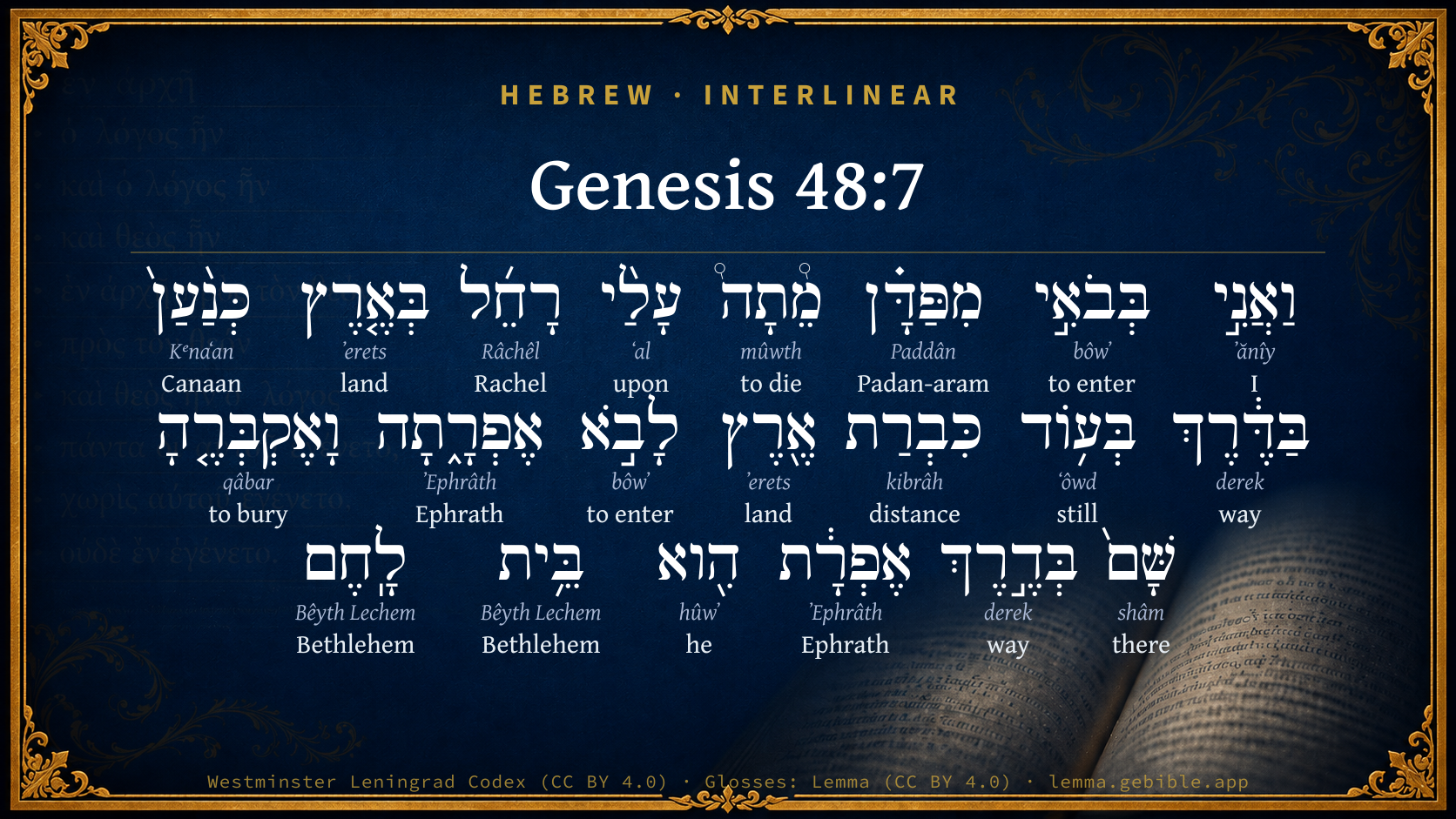
Genesis 48:7

Hebrew (Westminster Leningrad Codex) Genesis 48:7 appears in the Hebrew Old Testament. The text above is from the Westminster Leningrad Codex. Each word links to its Strong’s number, a concise gloss, and parsing drawn from the Open Scriptures Hebrew Bible morphology. Click any word for its full Brown-Driver-Briggs (BDB) entry.
Download image
Cite this verse

Genesis 48:7 (World English Bible). Public Domain. Lemma interlinear Bible study tool, https://lemma.gebible.app/v/genesis/48/7.

Show BibTeX & RIS
BibTeX
RIS
English Translation
As for me, when I came from Paddan, Rachel died by me in the land of Canaan in the way, when there was still some distance to come to Ephrath, and I buried her there in the way to Ephrath (the same is Bethlehem)."
World English Bible · Public Domain
Download a study sheet

One document with this verse’s original text, its word-by-word gloss line, the meaning frame, cross-references with their text, attributed commentary, and full source and license credits — printable, and it pastes into notes with its structure intact.

This verse Autodidact and up

Study sheet (.html) Plain text (.txt)

A passage Seminary Student

Up to 50 verses in one chapter. A passage sheet keeps up to 6 commentary sources and 12 cross-references per verse, in the order this page ranks them, and says so on the sheet whenever that leaves anything out. Ask for a single verse and you get the Autodidact verse sheet above.

Everything on this page stays free to read, with no account — the sheet is a download of what is already on screen, not access to it.

Want to remove ads? Support Godless Engineer
Compare translations 3

The same verse in 3 English versions, stacked beneath the original-language interlinear above. Click any original word for its lexicon entry.

Each is an independent rendering of the whole verse — the interlinear is not word-aligned to these translations.

Highlighted words mark where these versions differ — a whole-verse word diff, not a word-by-word alignment.

  • World English Bible Public Domain
    As for me, when I came from Paddan, Rachel died by me in the land of Canaan in the way, when there was still some distance to come to Ephrath, and I buried her there in the way to Ephrath (the same is Bethlehem)."
  • King James Version Public Domain
    And as for me, when I came from Padan, Rachel died by me in the land of Canaan in the way, when yet there was but a little way to come unto Ephrath: and I buried her there in the way of Ephrath; the same is Bethlehem.
  • unfoldingWord Literal Text CC BY-SA 4.0
    And I, as I was coming from Paddan, Rachel died beside me in the land of Canaan on the way, while still a distance of land to go to Ephrath. And I buried her there beside the road of Ephrath, which Bethlehem.”

unfoldingWord Literal Text — © unfoldingWord, licensed CC BY-SA 4.0. Word-aligned USFM3 via Door43 (git.door43.org/unfoldingWord/en_ult).

Versions to compare (up to 4)

3 of 4 selected

Show all 18 translations

Every available English version of this verse, each an independent rendering of the whole verse.

  • World English Bible Public Domain
    As for me, when I came from Paddan, Rachel died by me in the land of Canaan in the way, when there was still some distance to come to Ephrath, and I buried her there in the way to Ephrath (the same is Bethlehem)."
  • Berean Standard Bible Public Domain
    Now as for me, when I was returning from Paddan, to my sorrow Rachel died along the way in the land of Canaan, some distance from Ephrath. So I buried her there beside the road to Ephrath” (that is, Bethlehem).
  • Majority Standard Bible Public Domain
    Now as for me, when I was returning from Paddan, to my sorrow Rachel died along the way in the land of Canaan, some distance from Ephrath. So I buried her there beside the road to Ephrath” (that is, Bethlehem).
  • King James Version Public Domain
    And as for me, when I came from Padan, Rachel died by me in the land of Canaan in the way, when yet there was but a little way to come unto Ephrath: and I buried her there in the way of Ephrath; the same is Bethlehem.
  • American Standard Version (1901) Public Domain
    And as for me, when I came from Paddan, Rachel died by me in the land of Canaan in the way, when there was still some distance to come unto Ephrath: and I buried her there in the way to Ephrath (the same is Beth-lehem).
  • Revised Version (1885) Public Domain
    And as for me, when I came from Paddan, Rachel died by me in the land of Canaan in the way, when there was still some way to come unto Ephrath: and I buried her there in the way to Ephrath (the same is Beth-lehem).
  • Geneva Bible (1599) Public Domain
    Nowe when I came from Padan, Rahel died vpon mine hande in the lande of Canaan, by the way when there was but halfe a dayes iourney of grounde to come to Ephrath: and I buryed her there in the way to Ephrath: the same is Beth-lehem.
  • Douay-Rheims (1899) Public Domain
    For, when I came out of Mesopotamia, Rachel died from me in the land of Ohanaan in the very journey, and it was springtime: and I was going to Ephrata, and I buried her near the way of Ephrata, which by another name is called Bethlehem.
  • Young's Literal Translation Public Domain
    `And I -- in my coming in from Padan-`Aram' Rachel hath died by me in the land of Canaan, in the way, while yet a kibrath of land to enter Ephrata, and I bury her there in the way of Ephrata, which `is' Bethlehem.'
  • Literal Standard Version CC BY-SA 4.0
    And I—in my coming in from Padan-[Aram] Rachel has died by me in the land of Canaan, in the way, while yet a distance of land to enter Ephrata, and I bury her there in the way of Ephrata, which [is] Beth-Lehem.”
  • Unlocked Literal Bible CC BY-SA 4.0
    But as for me, when I came from Paddan, to my sorrow Rachel died in the land of Canaan on the way, while there was still some distance to go to Ephrath. I buried her there on the way to Ephrath” (that is, Bethlehem).
  • unfoldingWord Literal Text CC BY-SA 4.0
    And I, as I was coming from Paddan, Rachel died beside me in the land of Canaan on the way, while still a distance of land to go to Ephrath. And I buried her there beside the road of Ephrath, which Bethlehem.”
  • Darby Bible Public Domain
    And as for me, when I came from Padan, Rachel died by me in the land of Canaan on the way, when there was yet a certain distance to come to Ephrath; and I buried her there on the way to Ephrath, that is, Bethlehem.
  • World Messianic Bible Public Domain
    As for me, when I came from Paddan, Rachel died beside me in the land of Canaan on the way, when there was still some distance to come to Ephrath, and I buried her there on the way to Ephrath (also called Bethlehem).”
  • Webster's Bible Public Domain
    And as for me, when I came from Padan, Rachel died by me in the land of Canaan, in the way, when yet there was but a little way to come to Ephrath: and I buried her there in the way of Ephrath, the same is Beth-lehem.
  • Free Bible Version CC BY-SA 4.0
    I'm doing this because tragically for me when I was returning from Paddan-aram, Rachel died in Canaan some distance from Ephrath. I buried her there on the way to Ephrath” (also known as Bethlehem).
  • Bible in Basic English Public Domain
    And as for me, when I came from Paddan, death overtook Rachel on the way, when we were still some distance from Ephrath; and I put her to rest there on the road to Ephrath, which is Beth-lehem.
  • JPS Tanakh (1917) Public Domain
    And as for me, when I came from Paddan, Rachel died unto me in the land of Canaan in the way, when there was still some way to come unto Ephrath; and I buried her there in the way to Ephrath — the same is Beth-lehem.'

Literal Standard Version (2020), Covenant Press — licensed CC BY-SA 4.0. Text via the HelloAO Bible API (eBible.org). Unlocked Literal Bible (unfoldingWord) — licensed CC BY-SA 4.0. Text via the HelloAO Bible API (eBible.org). unfoldingWord Literal Text — © unfoldingWord, licensed CC BY-SA 4.0. Word-aligned USFM3 via Door43 (git.door43.org/unfoldingWord/en_ult). Free Bible Version, Dr. Jonathan Gallagher — licensed CC BY-SA 4.0. Text via the HelloAO Bible API (eBible.org).

Word by word

More ways to search: Search by grammar → Find every occurrence → Compare this word →

Practice this passage: Drill this verse → Learn its vocabulary →

כִּבְרַת
kibrâh
H3530
“distance of”
Noun, Common, Feminine, Singular, Construct
Part of Speech
Noun
Type
Common
Gender
Feminine
Number
Singular
State
Construct
Full BDB Definition

Origin: from H3528

TWOT: 947b

distance (undetermined length)
  1. וַאֲנִ֣י ʼănîy H589 “and · I” Conjunction + Pronoun, Personal, 1st Person, Common, Singular
  2. בְּבֹאִ֣י bôwʼ H935 “in/at · to enter · me” Preposition + Verb, Qal, Infinitive Construct + Suffix, Personal, 1st Person, Common, Singular
  3. מִפַּדָּ֗ן Paddân H6307 “from · Padan-aram” Preposition + Noun, Proper
  4. מֵ֩תָה֩ mûwth H4191 “to die” Verb, Qal, Perfect, 3rd Person, Feminine, Singular
  5. עָלַ֨י ʻal H5921 “upon · me” Preposition + Suffix, Personal, 1st Person, Common, Singular
  6. רָחֵ֜ל Râchêl H7354 “Rachel” Noun, Proper
  7. בְּאֶ֤רֶץ ʼerets H776 “in/at · land of” Preposition + Noun, Common, Both, Singular, Construct
  8. כְּנַ֨עַן֙ Kᵉnaʻan H3667 “Canaan” Noun, Proper
  9. בַּדֶּ֔רֶךְ derek H1870 “in/at the · way” Preposition, Determined + Noun, Common, Both, Singular, Absolute
  10. בְּע֥וֹד ʻôwd H5750 “in/at · still” Preposition + Adverb
  11. אֶ֖רֶץ ʼerets H776 “land” Noun, Common, Both, Singular, Absolute
  12. לָבֹ֣א bôwʼ H935 “to enter” Preposition + Verb, Qal, Infinitive Construct
  13. אֶפְרָ֑תָה ʼEphrâth H672 “Ephrath” Noun, Proper
  14. וָאֶקְבְּרֶ֤הָ qâbar H6912 “and · to bury · her” Conjunction + Verb, Qal, Sequential Imperfect, 1st Person, Common, Singular + Suffix, Personal, 3rd Person, Feminine, Singular
  15. שָּׁם֙ shâm H8033 “there” Adverb
  16. בְּדֶ֣רֶךְ derek H1870 “in/at · way of” Preposition + Noun, Common, Both, Singular, Construct
  17. אֶפְרָ֔ת ʼEphrâth H672 “Ephrath” Noun, Proper
  18. הִ֖וא hûwʼ H1931 “he” Pronoun, Personal, 3rd Person, Feminine, Singular
  19. בֵּ֥ית Bêyth Lechem H1035 “Bethlehem” Noun, Proper
  20. לָֽחֶם Bêyth Lechem H1035 “Bethlehem” Noun, Proper

About this verse

These counts appear in no published source. They are computed here, from the morphology-tagged text and Lemma’s own curated glosses. What Lemma adds →

21
words
16
distinct lemmas
Pentateuch
section

Notable vocabulary

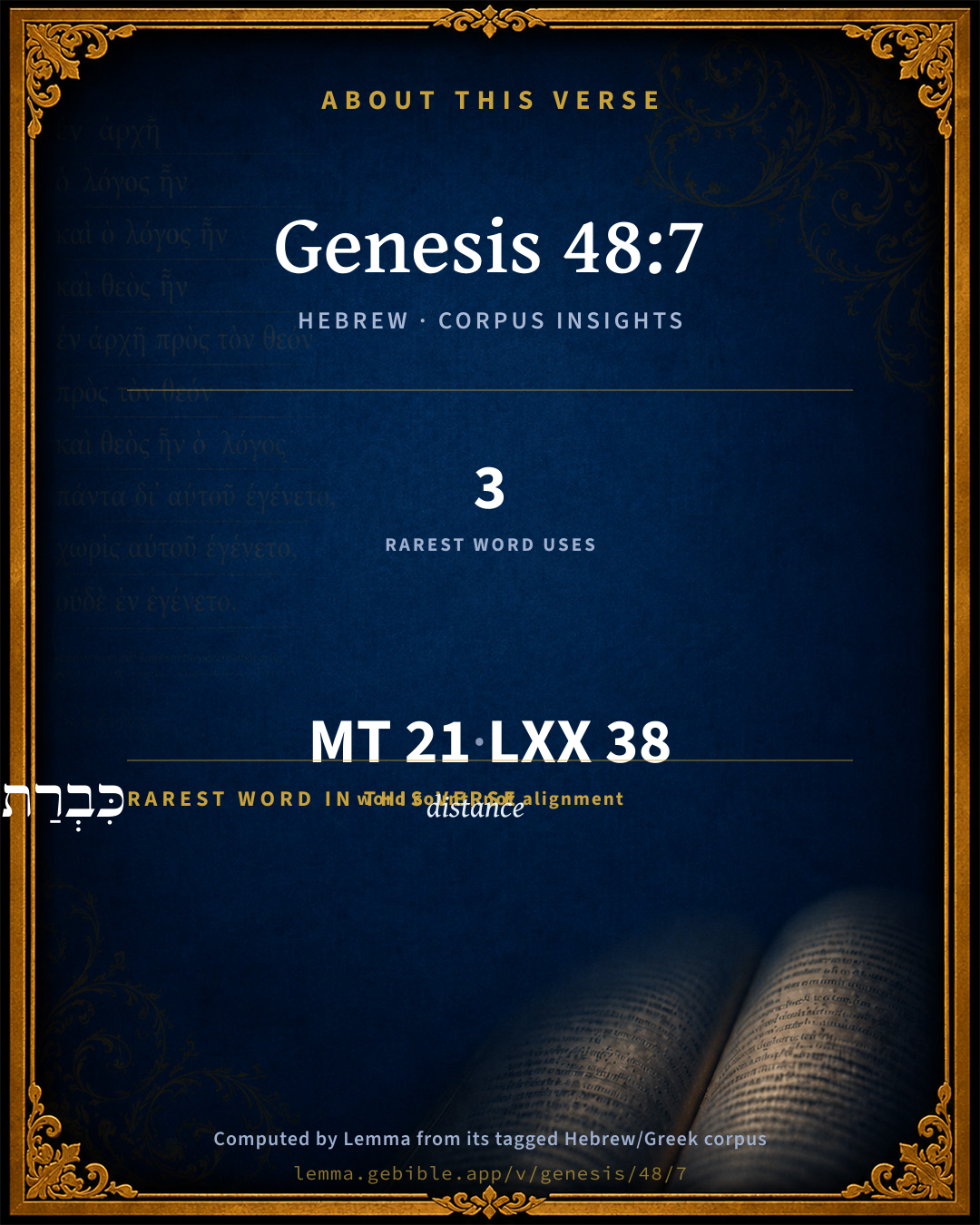
The rarest word here is כִּבְרַת distance H3530 — appearing just 3 times in the whole Hebrew Bible.

Shared distinctive vocabulary

כִּבְרַת distance H3530 occurs in 3 verses of the Hebrew Bible. Also found in:

Grammatical profile

  • 4 verbs
  • 12 nouns
  • 2 pronouns
  • 1 preposition
  • 2 adverbs

Verb forms

  • בְּבֹאִ֣י Qal · Infinitive Construct
  • מֵ֩תָה֩ Qal · Perfect
  • לָבֹ֣א Qal · Infinitive Construct
  • וָאֶקְבְּרֶ֤הָ Qal · Sequential Imperfect

Repetition

Words recur within this verse — often emphatic in Hebrew:

  • בְּבֹאִ֣י to enter H935 ×2
  • בְּאֶ֤רֶץ land H776 ×2
  • בַּדֶּ֔רֶךְ way H1870 ×2
  • אֶפְרָ֑תָה Ephrath H672 ×2
  • בֵּ֥ית Bethlehem H1035 ×2

Hebrew & Septuagint length

In English translation the verse runs 44 words from the Hebrew and 54 from the Septuagint (LXX English) — closely comparable.

A rough comparison of the two English renderings, which tokenize alike — not a word-level alignment.

Word counts can differ between the Hebrew and the Greek without any difference in meaning — e.g. the Hebrew direct-object marker אֵת has no separate Greek word, and Greek often adds the article ὁ.

In the original languages it is 21 Hebrew tokens and 38 Greek tokens — but the two are counted differently (Hebrew bundles its prefixes and suffixes into one token; the Greek is in lemma form), so that isn’t a like-for-like length.

Cross-references

9

Topical passages linked to Genesis 48:7 in the Treasury of Scripture Knowledge — connected by theme and wording, ordered by reader-vote popularity; previews shown in the World English Bible.

  • Genesis 35:9 God appeared to Jacob again, when he came from Paddan Aram, and blessed him.
  • Genesis 35:16–19 They traveled from Bethel. There was still some distance to come to Ephrath, and Rachel travailed. She had hard labor.
  • Matthew 2:18 "A voice was heard in Ramah, Lamentation, weeping and great mourning, Rachel weeping for her children; She wouldn't be comforted, Because they are no more."
  • Genesis 25:20 Isaac was forty years old when he took Rebekah, the daughter of Bethuel the Syrian of Paddan Aram, the sister of Laban the Syrian, to be his wife.
  • Ruth 1:2 The name of the man was Elimelech, and the name of his wife Naomi, and the name of his two sons Mahlon and Chilion, Ephrathites of Bethlehem Judah. They came into the country of Moab, and continued there.
  • 1 Samuel 1:1 Now there was a certain man of Ramathaim Zophim, of the hill-country of Ephraim, and his name was Elkanah, the son of Jeroham, the son of Elihu, the son of Tohu, the son of Zuph, an Ephraimite:
  • 1 Samuel 10:2 When you are departed from me today, then you shall find two men by Rachel's tomb, in the border of Benjamin at Zelzah; and they will tell you, The donkeys which you went to seek are found; and, behold, your father has left off caring for the donkeys, and is anxious for you, saying, What shall I do for my son?
  • 1 Samuel 17:12 Now David was the son of that Ephrathite of Bethlehem Judah, whose name was Jesse; and he had eight sons: and the man was an old man in the days of Saul, stricken [in years] among men.
  • Micah 5:2 But you, Bethlehem Ephrathah, Being small among the clans of Judah, Out of you one will come forth to me that is to be ruler in Israel; Whose goings forth are from of old, from everlasting.

Cross-references courtesy of OpenBible.info (CC BY 4.0).

Hebrew and Greek witnesses Masoretic Hebrew ↔ Greek Septuagint

The same verse in the two great witnesses to the Old Testament, shown verse-for-verse.

These are two independent witnesses, not word-aligned to each other, and the Septuagint is shown in lemma (dictionary) form.

Hebrew Genesis 48:7 Masoretic · Westminster Leningrad Codex

וַאֲנִ֣י בְּבֹאִ֣י מִפַּדָּ֗ן מֵ֩תָה֩ עָלַ֨י רָחֵ֜ל בְּאֶ֤רֶץ כְּנַ֨עַן֙ בַּדֶּ֔רֶךְ בְּע֥וֹד כִּבְרַת אֶ֖רֶץ לָבֹ֣א אֶפְרָ֑תָה וָאֶקְבְּרֶ֤הָ שָּׁם֙ בְּדֶ֣רֶךְ אֶפְרָ֔ת הִ֖וא בֵּ֥ית לָֽחֶם

As for me, when I came from Paddan, Rachel died by me in the land of Canaan in the way, when there was still some distance to come to Ephrath, and I buried her there in the way to Ephrath (the same is Bethlehem)."

World English Bible · Public Domain

Greek LXX Genesis 48:7 Septuagint · lemma form

ἐγώ δέ ἡνίκα ἄρχω ἐκ μεσοποταμία ὁ συρία ἀποθνήσκω ραχηλ ὁ μήτηρ σύ ἐν γῆ χανααν ἐγγίζω ἐγώ κατά ὁ ἱππόδρομος χαβραθα ὁ γῆ ὁ ἔρχομαι εφραθα καί καταὀρύσσω αὐτός ἐν ὁ ὁδός ὁ ἱππόδρομος οὗτος εἰμί βαιθλεεμ

And as for me, when I came out of Mesopotamia of Syria, Rachel, your mother, died in the land of Chanaan, as I drew near to the horse-course of Chabratha of the land of Chanaan, so as to come to Ephratha; and I buried her in the road of the course; this is Bethlehem.

LXX2012 (modern English Septuagint) · Public Domain

On this verse, The Cambridge Bible for Schools and Colleges discusses the Septuagint’s reading. Read the note in Commentary ↓

Hebrew: Westminster Leningrad Codex (CC BY 4.0). Greek: Septuagint (public domain); English from LXX2012 (modern English Septuagint) (Public Domain). How the Septuagint differs from the Hebrew →

Targum (Aramaic paraphrase)

2

The Targum is the ancient Jewish Aramaic paraphrase of the Hebrew Scriptures — an interpretive translation, not the Hebrew text itself. Onkelos (literal) and Pseudo-Jonathan (expansive) render the Torah, and Jonathan the Prophets. Coverage is partial: where no permissively-licensed English translation exists for a verse, only the Aramaic is shown. This is verse-level text, not a word-by-word alignment to the Hebrew.

  1. Targum Onkelos Torah (Genesis–Deuteronomy)
    וַאֲנָא בְּמֵיתִי מִפַּדָן מִיתַת עָלַי רָחֵל בְּאַרְעָא דִּכְנַעַן בְּאָרְחָא בְּעוֹד כְּרוּבָא דְאַרְעָא לְמֵיעַל לְאֶפְרָת וּקְבָרִתַּהּ תַּמָּן בְּאֹרַח אֶפְרָת הִיא בֵּית לָחֶם

    (no public-domain English translation for this verse)

    Targum Onkelos — Aramaic: “Onkelos Genesis” (public domain); “Onkelos Exodus” (public domain); “Onkelos Leviticus” (public domain); “Onkelos Numbers” (public domain); “Onkelos Deuteronomy” (public domain). English: “Sefaria Community Translation” (CC0 1.0 (public-domain dedication)); “J.W. Etheridge. The Targums of Onkelos and Jonathan Ben Uzziel on the Pentateuch. London: Longmans, Green, 1862” (public domain). Text via Sefaria.

  2. Targum Pseudo-Jonathan Torah (Genesis–Deuteronomy)
    וַאֲנָא דְבָּעִיתִי מִינָךְ לְמִקְבְּרִי עִם אַבְהָתַי מִיתַת עָלַי רָחֵל בִּתְכֵּיף בְּאַרְעָא דִכְנָעַן בְּאוֹרְחָא בְּעוֹד סוֹגְעֵי אַרְעָא לְמֵיעוּל לְאֶפְרָת וְלָא יְכֵילִית לְסוֹבְרוּתָהּ לְמִקְבְּרָהּ בִּמְעָרַת כְּפֵילְתָּא וּקְבַרְתָּהּ תַּמָן בְּאוֹרַח אֶפְרָת הִיא בֵּית לָחֶם

    And I beseech thee to bury me with my fathers. Rahel died by me suddenly in the land of Kenaan, while there was yet much ground to come to Ephrath; nor could I carry her to bury her in the Double Cave, but I buried her there, in the way of Ephrath which is Bethlechem.

    Targum Pseudo-Jonathan — Aramaic: “Targum Jonathan on Genesis” (public domain); “Targum Jonathan on Exodus” (public domain); “Targum Jonathan on Leviticus” (public domain); “Targum Jonathan on Numbers” (public domain); “Targum Jonathan on Deuteronomy” (public domain). English: “The Targum of Jonathan ben Uzziel, trans. J. W. Etheridge, London, 1862” (public domain). Text via Sefaria.

Commentary

Notes on Genesis 48:7 from classic Christian and Jewish commentators (each source and its license shown beneath its notes). The classic Christian expositions comment on the surrounding passage and are grouped to its opening verse, so a note may address several verses; the Jewish commentaries on the Tanakh (Rashi and others) are per-verse, so they appear only where the commentator wrote on this verse.

Lemma curates 59 commentaries, every one of them public domain or Creative Commons licensed, each selected and text-cleaned for this edition rather than reprinted as found. About our sources →

Trapp's Complete Commentary

John Trapp

Gen 48:7 And as for me, when I came from Padan, Rachel died by me in the land of Canaan in the way, when yet [there was] but a little way to come unto Ephrath: and I buried her there in the way of Ephrath; the same [is] Bethlehem.

Ver. 7. And I buried her there.] He could not carry her to the cave of Machpelah; and he would not bury her at Bethdehem among infidels. This he tells Joseph, to teach him and the rest not to set up their rest anywhere but in the land of Canaan.

John Trapp, A Commentary or Exposition upon All the Books of the Old and New Testament (1647–1656) — public domain. Text from a community e-Sword module.

Joseph Benson's Commentary

Gen 48:7. Rachel died by me — This circumstance he here mentions, partly because the sight of Joseph and his children brought his beloved Rachel, Joseph’s mother, to his remembrance; and partly that he might assign a reason for transferring the right of the firstborn to Joseph, which was not only because Rachel was his first rightful wife by designation and contract, but because by her early death he was cut off from all hopes of having more children by her, and therefore it was but fit that he should supply that defect by adopting Joseph’s children. The removal of dear relations from us is an affliction the remembrance of which cannot but abide with us a great while. Strong affections in the enjoyment of any blessing cause long afflictions in the loss of it.

Joseph Benson's Commentary on the Old and New Testaments (1811–1818) — public domain. Text from a community e-Sword module.

Adam Clarke's Commentary

Verse 7. Rachel died by me, c.] Rachel was the wife of Jacob's choice, and the object of his unvarying affection he loved her in life - he loves her in death: many waters cannot quench love, neither can the floods drown it. A match of a man's own making when guided by reason and religion, will necessarily be a happy one. When fathers and mothers make matches for their children, which are dictated by motives, not of affection, but merely of convenience, worldly gain, c., &c., such matches are generally wretched it is Leah in the place of Rachel to the end of life's pilgrimage.

Adam Clarke's Commentary on the Bible (1810–1826) — public domain. Text from a community e-Sword/MySword module.

John Calvin's Commentaries

7. And as for me, when I came from Padan. He mentions the death and burial of his wife Rachel, in order that the name of his mother might prove a stimulus to the mind of Joseph. For since all the sons of Jacob had sprung from Syria, it was not a little to the purpose, that they should be thoroughly acquainted with the history which we have before considered, namely, that their father, returning into the land of Canaan, by the command and under the protection of God, brought his wives with him. For if it was not grievous to women, to leave their father, and to journey into a distant land, their example ought to be no slight inducement to their sons to bid farewell to Egypt; and at the command of the same God, strenuously prepare themselves for taking possession of the land of Canaan.

John Calvin's Commentaries (1540-1563) — public domain. Text from the Calvin Translation Society English edition (1840s-50s) via the Christian Classics Ethereal Library (ccel.org). Calvin's coverage is partial (roughly two-thirds of the Bible); uncommented books and verses are honest gaps, never fabricated. The 19th-century editor's footnotes and remarks are omitted so the notes are faithfully Calvin's own voice.

Ellicott's Commentary for English Readers

(7) Rachel died by me.—Heb., died upon me, or as we should say, “died in my arms.” The mention of Rachel is to account for an act so authoritative as the bestowal of the double portion of the firstborn upon Joseph. Jacob grounds the justification of his act, not upon her being the chief wife, but upon her untimely death, which prevented her bearing other sons. Even now Leah, if we count Levi, had six tribes, each handmaid two, and Rachel three.

The same is Beth-lehem.—A note added subsequently, when the place was famous as the birthplace of David. It would not be called Beth-lehem until corn was cultivated there.

A Bible Commentary for English Readers, edited by Charles John Ellicott (1878–1897) — public domain. Text from a community e-Sword module.

The Cambridge Bible for Schools and Colleges

gen. ed. J. J. S. Perowne

7. And as for me] This verse, with its reference to Gen_35:16-19, is introduced very abruptly. The mention of Rachel’s grave is not followed by any further statement, and, standing by itself, it comes in strangely. It hardly admits of explanation as an old man’s wandering soliloquy. Such an explanation is too modern in character. Possibly the passage originally contained the tradition of Jacob’s request, that he might be buried in the same grave with his beloved wife, Rachel. But the entreaty to be buried at Machpelah having already (Gen_47:30) been inserted from J, it was necessary to drop the concluding portion of Jacob’s utterance, i.e. the request to be buried with Rachel, to which the allusion to Rachel’s death and burial at Ephrath was leading up. This theory accounts for the introduction of the touching allusion to Rachel and her burial-place, and for the sudden dropping of the subject.

Paddan] For “Paddan-aram,” as in LXX. See Gen_25:20.

by me] R.V. marg. to my sorrow, lit. “upon me,” expresses the full meaning. Compare “against me” in Gen_42:36; see note.

when there was still some way] See note on Gen_35:16. The Heb. gives a measure of distance; cf. 2Ki_5:19; and the LXX gives the strange rendering κατὰ τὸν ἱππόδρομον χαβραθὰ τῆς γῆς, where χαβραθὰ transliterates the Heb., and κατὰ τὸν ἱππόδρομον, “according to the race-course,” reproduces the tradition that the race-course at Alexandria was the length of this Hebrew measure; cf. Schleusner, s.v. The Vulg. has eratque vernum tempus (!). “On the way to Ephrath,” LXX ἐν τῇ ὁδῷ τοῦ ἱπποδρόμου.

The Cambridge Bible for Schools and Colleges (gen. ed. J. J. S. Perowne; Cambridge University Press, 1878–1918) — public domain. Text from a community e-Sword module.

John Gill's Exposition

And as for me, when I came from Padan,.... From Syria, from Laban's house:

Rachel died by me in the land of Canaan; his beloved wife, the mother of Joseph, on whose account he mentions her, and to show a reason why he took his sons as his own, because his mother dying so soon, he could have no more children by her; and she being his only lawful wife, Joseph was of right to be reckoned as the firstborn; and that as such he might have the double portion, he took his two sons as his own, and put them upon a level with them, even with Reuben and Simeon. By this it appears, as by the preceding account, that Rachel came with him into the land of Canaan, and there died:

in the way, when yet there was but a little way to come unto Ephrath; about a mile, or two thousand cubits, as Jarchi observes:

and I buried her there in the way of Ephrath; where she died, and dying in childbed, could not be kept so long as to carry her to Machpelah, the burying place of his ancestors; and especially as he had his flocks and herds with him, which could move but slowly; and what might make it more difficult to keep her long, and carry her thither, it might be, as Ben Melech conjectures, summertime; and the Vulgate Latin adds to the text, without any warrant from the original, "and it was springtime"; however, she was buried in the land of Canaan, and which is taken notice of, that Joseph might observe it: it follows:

the same is Bethlehem; that is, Ephrath; and so Bethlehem is called Bethlehem Ephratah, Mic 5:2; whether these are the words of Jacob, or of Moses, is not certain, but said with a view to the Messiah, the famous seed of Jacob that should be born there, and was.

John Gill's Exposition of the Whole Bible (1746–1763) — public domain (CC PDM 1.0). Text via the HelloAO Bible API.

Haydock's Catholic Bible Commentary

For when, &c. Hebrew, "as for me." Do not wonder that I should so earnestly desire to be laid in the tomb of Mambre, whereas your mother was buried at Ephrata. I was in a manner forced to bury her there, by the heat of the weather, (Menochius) and the confusion to which my family was then exposed, on account of the slaughter of the Sichemites. (Haydock) --- That place was, moreover, to be honoured with the birth of the Messias. (St. Augustine, q. 165.)

George Leo Haydock (1774–1849), Haydock's Catholic Family Bible and Commentary, 1859 edition — public domain. Excludes Psalms (Douay-Rheims chapter numbering differs from Protestant) and Deuterocanonical books (Catholic canon only).

Matthew Poole's English Annotations

Rachel died by me; or, beside me; near me, before mine eyes, I seeing, but not being able to help her in her extremity; which makes the remembrance of it more grievous to me. This story he here mentions, partly because the sight of Joseph and his children brought his beloved Rachel to his remembrance; partly to give the reason of this action of his to the rest of his children, which was not only because Rachel was his first rightful wife by designation and contract, and therefore the right of the first-born was truly Joseph’s; but because by her early death he was cut off from all hopes of having more children by her, and therefore it was but fit he should supply that defect by adopting Joseph’s children.

I buried her there, not out of disrespect to her, whose person was, and memory yet is, precious and honourable to me, but either because dying in childbed they could not keep her till they came to the burying-place of the patriarchs at Hebron, Gen 23:19, especially when they were tied to the slow motion of the flocks and herds; or because I would not bury her in the common burying-place with heathens and idolaters, in the city of Ephrath. By which he tacitly implies, that he would not have Joseph joined with the Egyptians in burial.

Matthew Poole's English Annotations on the Holy Bible (1683–1685) — public domain. Text from a community e-Sword/MySword module.

Whedon's Commentary on the Bible

Daniel D. Whedon

7. Rachel died by me — “Jacob honours his beloved Rachel by giving her eldest son the right of the firstborn. The reminiscence of the sudden and afflictive death of Jacob’s only real wife thus rises up amid these words of blessing.” — Newhall. The expression died by me has well been thought to contain emotional tenderness. According to Lange, “she died for him, since, while living, she shared with him and for him the toils of his pilgrimage life, and through this, perhaps, brought on her deadly travail.”

Daniel D. Whedon (gen. ed.), Commentary on the Old and New Testaments (1874–1909) — public domain. Text from a community e-Sword module.

The Pulpit Commentary

And as for me (literally, and I, the pronoun being emphatic), when I cams from Padan, literally, in my coming, i.e. while on my journey, from Padam, or Padan-aram. This is the only place where the shorter designation is employed (cf. Gen_25:20) Rachel the mention to Joseph of his beloved mother could not fail to kindle emotion in his breast, as obviously it had revived a pang of sorrow in that of the old man the remembrance of the never-to-be-forgotten one" causing a sudden spasm of feeling" (Delitzsch)died by me not for me in the sense of sharing with me my toils and perils, and so bringing on herself the deadly travail which cut her off (Lunge), which is too subtle and metaphysical in its refinement; but either upon me, i.e. as a heavy affliction falling on me (Rosenm Gesenius, Murphy, et alii); or at my side, i.e. near me (Keil, Wordsworth, "Speaker"s Commentary"); or perhaps to me, meaning, This happened to me, or, I saw Rachel die (Kalisch); or possibly with a touch of tender emotion, Rachel to me, i.e. my Rachel died (Tayler Lewis)in the land of Canaan in the way, when yet there was but a little way literally, a length of ground; the LXX add iJppodromov, meaning probably such a distance as a horse can go without being over-worked (vide Gen_35:16) to come unto Ephrath: and I buried her there in the way of Ephrath; the same is Bethlehem.

The Pulpit Commentary (1880–1919), ed. H.D.M. Spence-Jones & Joseph S. Exell — public domain. Text from a community e-Sword module.

John Wesley's Explanatory Notes

Mention is made of the death and burial of Rachel, Joseph's mother, and Jacob's best beloved wife. The removal of dear relations from us is an affliction, the remembrance of which cannot but abide with us a great while. Strong affections in the enjoyment cause long afflictions in the loss.

John Wesley, Explanatory Notes Upon the Whole Bible (1754–1765) — public domain. Text via the GEBible commentary corpus.

Rashi

Rabbi Shlomo Yitzchaki (Rashi)

'ואני בבאי מפדן וגו AND AS FOR ME, WHEN I CAME FROM PADAN etc. — “And although I trouble you to take me for burial into the land of Canaan and I did not do this for your mother (i.e., I did not take the trouble to bury her in a place other than that in which she died, which was by the road-side) which I might easily have done since she died quite close to Bethlehem”.

כברת ארץ is a measure of land equal to 2000 cubits which is the extent of a Sabbath day’s journey. This is according to the statement of R. Moses the Expositor. — “Do not imagine that it was the rains which prevented me from bringing her to Hebron for burial. It was the dry season when the ground is riddled and full of holes like a sieve (כברה).

ואקברה שם AND I BURIED HER THERE and did not carry her even the short distance to Bethlehem to bring her into a city. I know that in your heart you feel some resentment against me. Know, however, that I buried her there by the command of God”. And the future proved that God had commanded him to do this in order that she might help her children when Nebuzaradan would take them into captivity. For when they were passing along that road Rachel came forth from her grave and stood by her tomb weeping and beseeching mercy for them, as it is said, (Jeremiah 31:15) “A voice is heard in Rama, [the sound of weeping … Rachel weeping for her children]”, and the Holy One, blessed be He, replied to her (v. 16) “There is a reward for thy work, says the Lord etc. (v. 17) for thy children will return to their own border”. Onkelos translated it (כברת ארץ) by כרוב ארעא which is a full measure of one day’s ploughing. I am of opinion that they had a definite measure which they called “one full furrow”; old French cordié. So we say, (Bava Metzia 107a) “He ploughs (כריב) and ploughs again”, and (Yoma 43b) “as much earth as a fox carries on its feet from a ploughed field (בי כרבא).”

Rashi on the Tanakh — English translations: “The Judaica Press complete Tanach with Rashi, translated by A. J. Rosenberg” (CC BY 4.0); “Pentateuch with Rashi's commentary by M. Rosenbaum and A.M. Silbermann, 1929-1934” (public domain); “The Metsudah Tanach series, Lakewood, N.J” (CC BY 4.0); and “The Book of Joshua, Metsudah Publications, 1997” (CC BY 4.0). Text via Sefaria.

Ramban (Nachmanides)

Rabbi Moshe ben Nachman (Ramban / Nachmanides)

AND I BURIED HER THERE. In Rashi’s commentary it is written, “And I did not transport her for burial even to Bethlehem to bring her into the Land.”Now I do not know the meaning thereof. Was Rachel buried outside of the Land? Forbid it! She died within the Land, and she was buried there, just as it says here in the parshah: Rachel died by me in the land of Canaan. And there in the narrative of her death it is still more clearly written, And Jacob came to Luz, which is in the land of Canaan — the same is Beth-el, and it is further stated, And they journeyed from Beth-el and there was still some way to come to Ephrath, Verse 16. and Rachel died on the way between Beth-el and Bethlehem Ephratha in the Land of Israel.

AND I BURIED HER THERE. “Now I know that there is some resentment in your heart against me [for not having brought her into the city]. But you should know that I buried her there by the word of G-d, that she might help her children when Nebuzaradan would exile them,” for when they passed along that road, Rachel came forth from her grave and stood by her tomb beseeching mercy for them, as it is said, A voice is heard in Ramah, lamentation and bitter weeping, Rachel weeping for her children, and the Holy One, blessed by He, answered her, Thy work shall be rewarded … and the children shall return to their own border., Verses 16-17. This is the language of Rashi.Now in any case there should be some allusion in Scripture to this interpretation which is stated in this Agadah. Perhaps this is alluded to in the expression of the verse, She died by me … in the way … And I buried her in the way, (in the way) is unnecessary except as an allusion to “the way” which Rachel’s children were destined to use when they went into captivity. (Bachya. See my Hebrew commentary on Ramban, p. 261.) that is to say, “She died on the road which her children would pass, and I buried her there for her advantage.” She did not die on the road, but in Ramah, a city in the land of Benjamin, and there she was buried. [Thus, according to the Midrash, Scripture is implying that] she died on the road which her children were destined to pass in the future, as Scripture does not fully explain future events but only alludes to them in a general manner.In line with the plain meaning of Scripture, it is likewise understood that Jacob spoke to Joseph in an apologetic vein so that when he discerned his father’s wish to be buried in the cave of Machpelah, Joseph should not be angered about his failure to bury his mother there just as he buried Leah there. It was for this reason that Jacob told him that she died in the land of Canaan, and she was not buried outside of the Land in the manner in which an Egyptian burial would befall Jacob. Furthermore, she died on the road suddenly, and he could not bury her in the cave of Machpelah for how could he leave his children and his flocks on the road and hurry with her body to the cave of Machpelah? And where could he find doctors and medicines to embalm her? This is the meaning of the word alai (by me) [in the verse, Rachel died by me]. Even though the cave of Machpelah is but a half-day’s distance from the place of her death, Jacob was heavily laden with much cattle and family, and he would not arrive there for many days. Thus he did indeed spend many days on that road until he came to his father. Our Sages have further taught: “The bier of a woman may never be set down, out of respect.”Now it is my opinion that these are but words of apology as Joseph already knew that Rachel died on the road and was buried in the Land, and that honor was paid to her when she died. But the reason Jacob did not transport Rachel to the cave of Machpelah was so that he should not bury two sisters there, for he would be embarassed before his ancestors. Now Leah was the one he married first, and thus her marriage was permissible, while he married Rachel out of his love for her and because of the vow he made to her.

Ramban (Nachmanides) on the Tanakh — English translation: “Commentary on the Torah by Ramban (Nachmanides). Translated and annotated by Charles B. Chavel. New York, Shilo Pub. House, 1971-1976” (CC BY 4.0). Text via Sefaria.

Radak

Rabbi David Kimhi (Radak)

ואני, this entire paragraph was inserted to describe Yaakov’s apology or justification to Joseph why he, who was so insistent on where he wanted to be buried and who was putting Joseph to so much trouble in this connection, had himself not acted in a similar manner when it came to burying Joseph’s mother, his own favourite wife, seeing that he had buried Leah in the cave of Machpelah. He explained that he had in no way been at fault, that it was not negligence on his part, but that fate had intervened, Rachel dying suddenly on route to the land of Canaan. The fact that he was moving extremely slowly at the time on account of all his livestock, something that the Torah had reported Yaakov as explaining already to Esau at the time, (33,13) made it impossible for him to carry Rachel’s body with him seeing he had no means to embalm it and keep it from decaying and becoming putrid until he would reach Chevron. Presumably, the season was summer when it is even harder to keep a body from decaying quickly. He therefore chose to bury her without delay, in the most dignified manner which the prevailing conditions had permitted.

Radak on the Tanakh — English translations: “Sefaria Community Translation” (CC0 1.0 (public-domain dedication)); “Eliyahu Munk, HaChut Hameshulash” (CC BY 4.0); “Rabbi Mike Feuer, Jerusalem Anthology” (CC BY 4.0); and “R. David Kimhi on the first book of Psalms, Translated by R.G. Finch, London, 1919” (public domain). Text via Sefaria.

Lesson kit

Teaching starters — assembled from the data on this page, not authored interpretation. Every prompt links to the verse data it draws on. Edit before teaching.

Genesis, in the Pentateuch, opens this verse with 21 words (16 distinct Hebrew lemmas). Its most distinctive word is kibrâh (“distance”). A historical commentator’s framing appears above. Read the whole chapter for the surrounding context.

Discussion questions

  1. How does “distance” (kibrâh) shape what this verse is saying?
  2. How does Genesis 35:16, which shares the word «distance», read alongside this verse?
  3. What does the repetition of “to enter” (2× in this one verse) do in this verse?
  4. These translations render this verse differently; the difference is in the English rendering, not the original. What questions does that raise?
  5. «בְּבֹאִ֣י» is a Qal Infinitive Construct verb. How does that grammatical form shape the action described?
  6. Compare how Trapp's Complete Commentary and Joseph Benson's Commentary read this verse. Where do they agree or differ?

Things to notice

Reading settings

Reading text

Shown beneath each verse's original-language words.

Old Testament
Old Testament edition

Read the OT as the Masoretic Hebrew (MT) or the Greek Septuagint (LXX).

English shown for the Greek Septuagint (in the Hebrew ↔ Greek comparison).

Comparing translations? Open the Compare panel on any verse page to stack up to four side by side.