Nehemiah 3:5

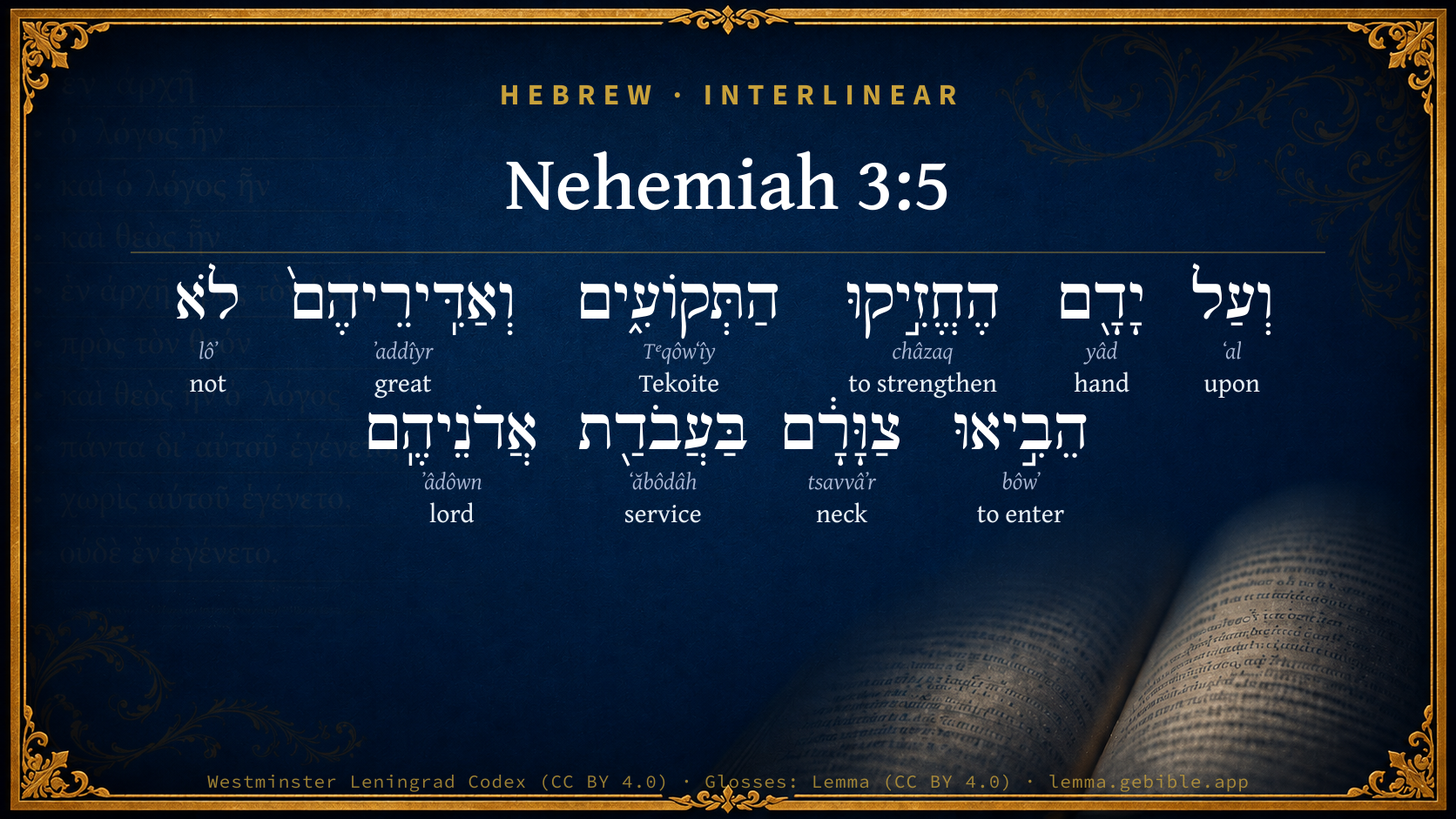
Hebrew (Westminster Leningrad Codex) Nehemiah 3:5 appears in the Hebrew Old Testament. The text above is from the Westminster Leningrad Codex. Each word links to its Strong’s number, a concise gloss, and parsing drawn from the Open Scriptures Hebrew Bible morphology. Click any word for its full Brown-Driver-Briggs (BDB) entry.
Download image
Cite this verse

Nehemiah 3:5 (World English Bible). Public Domain. Lemma interlinear Bible study tool, https://lemma.gebible.app/v/nehemiah/3/5.

Show BibTeX & RIS
BibTeX
RIS
English Translation
Next to them the Tekoites repaired; but their nobles didn't put their necks to the work of their lord.
World English Bible · Public Domain
Download a study sheet

One document with this verse’s original text, its word-by-word gloss line, the meaning frame, cross-references with their text, attributed commentary, and full source and license credits — printable, and it pastes into notes with its structure intact.

This verse Autodidact and up

Study sheet (.html) Plain text (.txt)

A passage Seminary Student

Up to 50 verses in one chapter. A passage sheet keeps up to 6 commentary sources and 12 cross-references per verse, in the order this page ranks them, and says so on the sheet whenever that leaves anything out. Ask for a single verse and you get the Autodidact verse sheet above.

Everything on this page stays free to read, with no account — the sheet is a download of what is already on screen, not access to it.

Want to remove ads? Support Godless Engineer
Compare translations 3

The same verse in 3 English versions, stacked beneath the original-language interlinear above. Click any original word for its lexicon entry.

Each is an independent rendering of the whole verse — the interlinear is not word-aligned to these translations.

Highlighted words mark where these versions differ — a whole-verse word diff, not a word-by-word alignment.

  • World English Bible Public Domain
    Next to them the Tekoites repaired; but their nobles didn't put their necks to the work of their lord.
  • King James Version Public Domain
    And next unto them the Tekoites repaired; but their nobles put not their necks to the work of their LORD.
  • unfoldingWord Literal Text CC BY-SA 4.0
    And the Tekoites strengthened at their hand, but their nobles did not bring their necks to the service of their lords.

unfoldingWord Literal Text — © unfoldingWord, licensed CC BY-SA 4.0. Word-aligned USFM3 via Door43 (git.door43.org/unfoldingWord/en_ult).

Versions to compare (up to 4)

3 of 4 selected

Show all 18 translations

Every available English version of this verse, each an independent rendering of the whole verse.

  • World English Bible Public Domain
    Next to them the Tekoites repaired; but their nobles didn't put their necks to the work of their lord.
  • Berean Standard Bible Public Domain
    Next to him, the Tekoites made repairs, but their nobles did not put their shoulders to the work under their supervisors.
  • Majority Standard Bible Public Domain
    Next to him, the Tekoites made repairs, but their nobles did not put their shoulders to the work under their supervisors.
  • King James Version Public Domain
    And next unto them the Tekoites repaired; but their nobles put not their necks to the work of their LORD.
  • American Standard Version (1901) Public Domain
    And next unto them the Tekoites repaired; but their nobles put not their necks to the work of their lord.
  • Revised Version (1885) Public Domain
    And next unto them the Tekoites repaired; but their nobles put not their necks to the work of their lord.
  • Geneva Bible (1599) Public Domain
    And next vnto them fortified the Tekoites: but the great men of them put not their neckes to the worke of their lordes.
  • Douay-Rheims (1899) Public Domain
    And next to them the Thecuites built: but their great men did not put their necks to the work of their Lord.
  • Young's Literal Translation Public Domain
    and by his hand have the Tekoites strengthened, and their honourable ones have not brought in their neck to the service of their Lord.
  • Literal Standard Version CC BY-SA 4.0
    and by his hand the Tekoites have strengthened, and their majestic ones have not brought in their neck to the service of their Lord.
  • Unlocked Literal Bible CC BY-SA 4.0
    Next to them the Tekoites repaired, but their leaders refused to do the work ordered by their supervisors.
  • unfoldingWord Literal Text CC BY-SA 4.0
    And the Tekoites strengthened at their hand, but their nobles did not bring their necks to the service of their lords.
  • Darby Bible Public Domain
    And next to them the Tekoites repaired; but their nobles put not their necks to the work of their Lord.
  • World Messianic Bible Public Domain
    Next to them, the Tekoites made repairs; but their nobles didn’t put their necks to the Lord’s work.
  • Webster's Bible Public Domain
    And next to them the Tekoites repaired; but their nobles put not their necks to the work of their Lord.
  • Free Bible Version CC BY-SA 4.0
    Next were the Tekoites, but their nobles refused to do manual work under a supervisor.
  • Bible in Basic English Public Domain
    Near them, the Tekoites were at work; but their chiefs did not put their necks to the work of their Lord.
  • JPS Tanakh (1917) Public Domain
    And next unto them the Tekoites repaired; and their nobles put not their necks to the work of their lord.

Literal Standard Version (2020), Covenant Press — licensed CC BY-SA 4.0. Text via the HelloAO Bible API (eBible.org). Unlocked Literal Bible (unfoldingWord) — licensed CC BY-SA 4.0. Text via the HelloAO Bible API (eBible.org). unfoldingWord Literal Text — © unfoldingWord, licensed CC BY-SA 4.0. Word-aligned USFM3 via Door43 (git.door43.org/unfoldingWord/en_ult). Free Bible Version, Dr. Jonathan Gallagher — licensed CC BY-SA 4.0. Text via the HelloAO Bible API (eBible.org).

Word by word

More ways to search: Search by grammar → Find every occurrence → Compare this word →

Practice this passage: Drill this verse → Learn its vocabulary →

הַתְּקוֹעִ֑ים
Tᵉqôwʻîy
H8621
“the · Tekoites”
Particle, Definite Article + Noun, Gentilic, Masculine, Plural, Absolute
Part of Speech
Particle + Noun
Type
Gentilic
Gender
Masculine
Number
Plural
State
Absolute
Full BDB Definition

Origin: patronymically from H8620

TWOT: None

Tekoite = see Tekoa " trumpet blast" - an inhabitant of Tekoa
  1. וְעַל ʻal H5921 “and · upon” Conjunction + Preposition
  2. יָדָ֖ם yâd H3027 “hand · their” Noun, Common, Both, Singular, Construct + Suffix, Personal, 3rd Person, Masculine, Plural
  3. הֶחֱזִ֣יקוּ châzaq H2388 “to strengthen” Verb, Hiphil, Perfect, 3rd Person, Common, Plural
  4. וְאַדִּֽירֵיהֶם֙ ʼaddîyr H117 “and · great · their” Conjunction + Adjective, Adjective, Masculine, Plural, Construct + Suffix, Personal, 3rd Person, Masculine, Plural
  5. לֹא lôʼ H3808 “not” Particle, Negative
  6. הֵבִ֣יאוּ bôwʼ H935 “to enter” Verb, Hiphil, Perfect, 3rd Person, Common, Plural
  7. צַוָּרָ֔ם tsavvâʼr H6677 “neck · their” Noun, Common, Masculine, Singular, Construct + Suffix, Personal, 3rd Person, Masculine, Plural
  8. בַּעֲבֹדַ֖ת ʻăbôdâh H5656 “in/at · service of” Preposition + Noun, Common, Feminine, Singular, Construct
  9. אֲדֹנֵיהֶֽם ʼâdôwn H113 “lords · their” Noun, Common, Masculine, Plural, Construct + Suffix, Personal, 3rd Person, Masculine, Plural

About this verse

These counts appear in no published source. They are computed here, from the morphology-tagged text and Lemma’s own curated glosses. What Lemma adds →

10
words
10
distinct lemmas
Historical
section

Notable vocabulary

The rarest word here is הַתְּקוֹעִ֑ים Tekoite H8621 — appearing just 7 times in the whole Hebrew Bible.

Shared distinctive vocabulary

הַתְּקוֹעִ֑ים Tekoite H8621 occurs in 7 verses of the Hebrew Bible. Also found in:

Grammatical profile

  • 2 verbs
  • 5 nouns
  • 1 adjective
  • 1 preposition
  • 1 particle

Verb forms

  • הֶחֱזִ֣יקוּ Hiphil · Perfect
  • הֵבִ֣יאוּ Hiphil · Perfect

Cross-references

13

Topical passages linked to Nehemiah 3:5 in the Treasury of Scripture Knowledge — connected by theme and wording, ordered by reader-vote popularity; previews shown in the World English Bible.

  • Nehemiah 3:27 After him the Tekoites repaired another portion, over against the great tower that stands out, and to the wall of Ophel.
  • 2 Samuel 14:2 Joab sent to Tekoa, and fetched there a wise woman, and said to her, please act like a mourner, and put on mourning clothing, Please, and don't anoint yourself with oil, but be as a woman who has a long time mourned for the dead:
  • Judges 5:23 Curse you Meroz, said the angel of Yahweh. Curse you bitterly the inhabitants of it, Because they didn't come to the help of Yahweh, To the help of Yahweh against the mighty.
  • Jeremiah 5:4–5 Then I said, Surely these are poor; they are foolish; for they don't know the way of Yahweh, nor the law of their God:
  • Jeremiah 27:2 Thus says Yahweh to me: Make you bonds and bars, and put them on your neck;
  • Jeremiah 27:8 It shall happen, that the nation and the kingdom which will not serve the same Nebuchadnezzar king of Babylon, and that will not put their neck under the yoke of the king of Babylon, that nation will I punish, says Yahweh, with the sword, and with the famine, and with the pestilence, until I have consumed them by his hand.
  • Jeremiah 27:12 I spoke to Zedekiah king of Judah according to all these words, saying, Bring your necks under the yoke of the king of Babylon, and serve him and his people, and live.
  • Jeremiah 30:8–9 It shall come to pass in that day, says Yahweh of Hosts, that I will break his yoke from off your neck, and will burst your bonds; and strangers shall no more make him their bondservant;
  • Amos 1:1 The words of Amos, who was among the herdsmen of Tekoa, which he saw concerning Israel in the days of Uzziah king of Judah, and in the days of Jeroboam the son of Joash king of Israel, two years before the earthquake.
  • Matthew 11:29 Take my yoke upon you, and learn from me, for I am gentle and lowly in heart; and you will find rest for your souls.
  • Acts 15:10 Now therefore why do you tempt God, that you should put a yoke on the neck of the disciples which neither our fathers nor we were able to bear?
  • 1 Corinthians 1:26 For you see your calling, brothers, that not many are wise according to the flesh, not many mighty, and not many noble;
  • 1 Timothy 6:17–18 Charge those who are rich in this present world that they not be haughty, nor have their hope set on the uncertainty of riches, but on the living God, who richly provides us with everything to enjoy;

Cross-references courtesy of OpenBible.info (CC BY 4.0).

Hebrew and Greek witnesses Masoretic Hebrew ↔ Greek Septuagint

The same verse in the two great witnesses to the Old Testament, shown verse-for-verse.

These are two independent witnesses, not word-aligned to each other, and the Septuagint is shown in lemma (dictionary) form.

Hebrew Nehemiah 3:5 Masoretic · Westminster Leningrad Codex

וְעַל יָדָ֖ם הֶחֱזִ֣יקוּ הַתְּקוֹעִ֑ים וְאַדִּֽירֵיהֶם֙ לֹא הֵבִ֣יאוּ צַוָּרָ֔ם בַּעֲבֹדַ֖ת אֲדֹנֵיהֶֽם

Next to them the Tekoites repaired; but their nobles didn't put their necks to the work of their lord.

World English Bible · Public Domain

Greek LXX Structure differs

The Septuagint has no separate book of Nehemiah. Its Greek text is the second half of Esdras B (2 Esdras), chapters 11–23; Ezra is the first half (1–10).

A verse-for-verse comparison isn’t shown here because the chapters and verses don’t line up. Switch to the LXX edition with the MT / LXX toggle above to read the Greek directly.

On this verse, The Cambridge Bible for Schools and Colleges discusses the Septuagint’s reading. Read the note in Commentary ↓

Hebrew: Westminster Leningrad Codex (CC BY 4.0). Greek: Septuagint (public domain); English from a public-domain English Septuagint. How the Septuagint differs from the Hebrew →

Commentary

Notes on Nehemiah 3:5 from classic Christian and Jewish commentators (each source and its license shown beneath its notes). The classic Christian expositions comment on the surrounding passage and are grouped to its opening verse, so a note may address several verses; the Jewish commentaries on the Tanakh (Rashi and others) are per-verse, so they appear only where the commentator wrote on this verse.

Lemma curates 59 commentaries, every one of them public domain or Creative Commons licensed, each selected and text-cleaned for this edition rather than reprinted as found. About our sources →

Trapp's Complete Commentary

John Trapp

Neh 3:5 And next unto them the Tekoites repaired; but their nobles put not their necks to the work of their Lord.

Ver. 5. The Tekoites repaired] The common sort of them; for the nobles refused. The lesser fishes bite best; the poor are gospelized, Mat 11:5, destined to the diadem, Jas 2:5.

But their nobles put not their necks] So haughty they were and high minded, they thought it a business below their greatness; somewhat of that profane earl of Westmoreland’s mind, who said that he had no need to pray to God, for he had tenants enough to pray for him. "Not many mighty, not many noble," saith the apostle, 1Co 1:26; well if any. The lion and eagle were not for sacrifice, as the lamb and dove were. Yet the old nobility of Israel were forward with their staves of honour, and are therefore famous, Num 21:18.

To the work of the Lord] Though they knew him to be Lord of lords, who are all his vassals and underlings; and, by special relation, their Lord, so avouched by these his holy day servants; yet so stiffnecked were they, that they would not stoop to his service; but cried out, as the Popish clergy do, Domine, nos sumus exempti, we may not work, we will not contribute.

John Trapp, A Commentary or Exposition upon All the Books of the Old and New Testament (1647–1656) — public domain. Text from a community e-Sword module.

Joseph Benson's Commentary

Neh 3:5. Next unto them the Tekoites repaired — The inhabitants of the city of Tekoa, in the tribe of Judah. But their nobles put not their necks to the work — Would not submit to it, would not further it, either through pride, or sloth, or covetousness, or secret compliance with the enemies of the Jews. Of their Lord — Of God, whom they owned for their Lord, whose work this was, because it had proceeded thus far by his singular providence; and because it was done for the defence of the city, and people, and temple of God. And therefore they are branded to all posterity. Let not nobles think any thing beneath them, by which they may benefit their country. What is their nobility good for, but that it places them in a higher and larger sphere of usefulness?

Joseph Benson's Commentary on the Old and New Testaments (1811–1818) — public domain. Text from a community e-Sword module.

Tyndale Open Study Notes

Tyndale Open Resources

3:5 The leaders of Tekoa might have been influenced by Geshem (2:19), who controlled the area south of Tekoa.

Tyndale Open Study Notes — © Tyndale Open Resources, licensed CC BY-SA 4.0. Text via the HelloAO Bible API.

Geneva Bible (1599)

Geneva Bible translators

The rich and mighty would not obey them which were appointed officers in this work, neither would they help thereunto.

Geneva Bible (1599) marginal notes — public domain. Text via Bolls.life.

Ellicott's Commentary for English Readers

(5) The Tekoites.—This verse is remarkable, as introducing men of Tekoah, not mentioned among Zerubbabel’s Returned, who furnish the solitary instance of internal opposition to the building; and as terming the common work “the work of the Lord.” The ordinary people of the place, however, did double duty. (See Neh_3:27.)

A Bible Commentary for English Readers, edited by Charles John Ellicott (1878–1897) — public domain. Text from a community e-Sword module.

The Cambridge Bible for Schools and Colleges

gen. ed. J. J. S. Perowne

5. the Tekoites] Tekoa was a town about 10 miles due S. of Jerusalem on the edge of the ‘Wilderness.’ It is well known as the home of the prophet Amos (Amo_1:1; Amo_7:14), and as the dwelling-place of ‘the wise woman’ of 2Sa_14:2. The absence of the name of Tekoa from the list of towns in Ezra 2. is remarkable. Perhaps the Jews in Zerubbabel’s time could not extend so far south. Here the mention of the Tekoites implies that the town was now occupied by Jews, or that old dwellers in Tekoa still formed a distinct community (cf. Neh_3:2) in Jerusalem. Their ardour in restoring the walls of Jerusalem receives further confirmation from Neh_3:27.

but their nobles] ‘Nobles’ (addirim = LXX. ἀδωρὶμ, Vulg. optimates), the same word is thus rendered in Neh_10:29; 2Ch_23:20; it differs from that used in Neh_2:16, Neh_4:14, Neh_5:7, Neh_6:17, Neh_7:5, Neh_13:17.

put not their necks] The metaphor is taken from the ox ploughing with its neck in the yoke, cf. Jer_27:12.

the work of their Lord] R.V. of their lord. Marg. ‘Or lords or Lord’. There are here three alternative renderings. (1) A.V. ‘of their Lord.’ The somewhat unusual phrase ‘the work of their Lord’ (Adonai) instead of ‘the work of the Lord (Jehovah),’ or ‘the work of their God,’ has been defended on the ground that it carries out the metaphor of the clause. This is the traditional Jewish interpretation. But the word is not common in these books as a Divine name (see note on Neh_1:11), and the use of the pronoun ‘their’ makes the interpretation improbable (Vulg. in opere Domini sui). The use of this title for God in plain narrative is most improbable.

(2) R.V. marg. ‘their lords,’ namely, the leaders of the Jews; but this would not be at all a suitable word to describe the relation of the ‘nobles’ of a town to the ‘rulers’ of Jerusalem.

(3) ‘their lord.’ This rendering of the R.V. seems the most natural, and is best understood to mean a reference to Nehemiah himself (cf. Ezr_10:3). He was ‘the lord’ of the Jews, appointed by the king, and ‘the nobles’ of the Jewish towns as well as of Jerusalem owed him service and assistance in his great work.

The hostility of Sanballat, Tobiah, and Geshem to Nehemiah would make itself felt on the towns upon the borders of the neighbouring races. The nobles of ‘Tekoa,’ which lay on the outskirts of the wilderness, may very possibly have sympathised with the Arabian chiefs represented by Geshem, or have had intimate relations with the outlying peoples.

The Cambridge Bible for Schools and Colleges (gen. ed. J. J. S. Perowne; Cambridge University Press, 1878–1918) — public domain. Text from a community e-Sword module.

John Gill's Exposition

And next unto them the Tekoites repaired,.... The inhabitants of Tekoa, a city in the tribe of Judah; see Amo 1:1

but their nobles put not their necks to the work of their Lord; either of Nehemiah, as some, or rather of the lord and prince appointed over their families, as Aben Ezra, to whom they would not be subject; though it seems best, with Jarchi, to understand it of the Lord their God, by whose command this work was begun; but they refused to give any assistance to it with their purses or presence, but withdrew from it, as refractory oxen withdraw their necks from the yoke. This is observed to their disgrace, when the common people of their city were ready to work, and did.

John Gill's Exposition of the Whole Bible (1746–1763) — public domain (CC PDM 1.0). Text via the HelloAO Bible API.

Albert Barnes' Notes on the Bible

Tekoites - See 2Sa 14:2 note.

Albert Barnes' Notes on the Bible (1834–1885) — public domain. Text from a community e-Sword/MySword module.

Matthew Poole's English Annotations

i.e. Did not submit to it, would not further it, either through pride, or sloth and carelessness, or covetousness, or secret compliance with the enemies of the Jews.

To the work of their Lord; either,

1. Of Nehemiah, who was their lord and governor, and had given a general command for the carrying on of this work. Or,

2. Of God, whom they owned for their Lord, whose work this was, partly because it had proceeded thus far by God’s singular providence and blessing; and partly because it was done for the defence of the city, and people, and temple of God. And therefore they are branded to all posterity for the neglect of so great and pious a work.

Matthew Poole's English Annotations on the Holy Bible (1683–1685) — public domain. Text from a community e-Sword/MySword module.

Whedon's Commentary on the Bible

Daniel D. Whedon

5. Tekoites — Men whose ancestral city and present homes were Tekoah, twelve miles south of Jerusalem. See on 2Sa_14:2.

Their nobles — The high born and wealthy among them.

Put not their necks to the work — They seem to have thought themselves too good for such work, and this their conduct is mentioned to their shame.

Of their Lord — Some understand this of Jehovah, others of Nehemiah. The suffix (their) favours the latter, though we incline to think the former is the writer’s meaning.

Daniel D. Whedon (gen. ed.), Commentary on the Old and New Testaments (1874–1909) — public domain. Text from a community e-Sword module.

The Pulpit Commentary

The Tekoites are the people of Tekoah, whence came the "wise woman" whom Joab sent to incline David to fetch home Absalom. (2Ki_14:2, 2Ki_14:3) It was a small place, and does not appear, either in the catalogue of those who returned with Zerubbabel, (Ezr_2:20-35 Neh_7:25-38) or in the census list of Nehemiah. (Neh_11:25-35) Their nobles put not their necks to the work. This imputation of blame has been thought out of harmony with the general narrative contained in the chapter, and various emendations have been proposed to remove the so-called difficulty. But it has really first to be shown that a difficulty exists. Surely it would have been more strange if there had been no opposition to Nehemiah"s wishes no withdrawal from the work, than if there were the amount of opposition that is recorded. And supposing opposition to be made, why should Nehemiah not notice it? In music, the force and value of harmonious notes is brought out by an occasional discord. A desire to do honour to those who deserved it would be quite compatible with a determination to brand with disgrace the undeserving. And the contrast would enhance the value of the praise. Thus, there is no reason for disturbing the existing text, nor for questioning its plain meaning. The upper classes at Tekoah, the adirim or "exalted, withdrew from the work, like oxen withdrawing their necks from the yoke, and stood aloof, leaving it to the common people to engage in it, or not, as they pleased. The common people were perhaps moved to the greater zeal by the defection of their natural leaders. They were among those who accomplished a double task, repairing a second portion of the wall (ver. 27) after having finished their first.

Indifference in high places.

"But their nobles put not their necks to the work of their Lord. Nehemiah, or other human ruler, is supposed by some to be meant by "their Lord." Better, as our translators evidently understood it, "God." The word translated "work" means the work of a servant==" service.

I THE WORK OF THE CHURCH IS THE LORD"S SERVICE. All work is to be so regarded, and cannot be done rightly otherwise. But the work of the Church is emphatically the service of God; whether the directly spiritual (evangelisation, instruction of Christians and their children), or the provision and maintenance of whatever is needful for it (ministers, teachers, buildings, etc.), or charitable aid to the poor.

1. God has redeemed and constituted his Church for these very ends. "Ye are not your own, for ye are bought with a price," etc. (1Co_6:20)

2. He has committed the work to his people.

3. He has given them directions for its fulfilment.

4. Hence loyalty to him requires them to do it. And only those who have faith and love towards him can do it truly and acceptably. We may judge of any work by this test: Can it be described as "the service of the Lord"? Much which goes by that name is misnamed, either because it is not of his appointment, or is not done in the spirit of love and obedience to him.

II This service CALLS FOR STRENUOUS EXERTION. Like that of draught-oxen "putting their necks" to their work. The Christian"s work is worthy of earnest effort, and cannot be well done without it. His "Lord" has a right to expect it.

III SOME WHO PROFESS TO BE SERVANTS OF GOD DECLINE THIS PART OF HIS SERVICE. Even amid general enthusiasm they remain unmoved.

1. The causes of their refusal. May be a total want of the piety they profess; or the dominance of indifference, selfishness, indolence, or pride (towards God, or those who would be their fellow-labourers).

2. Its guilt. To refuse to take part in a common work is

(1) injustice to others, who have thus an undue burden east upon them; and

(2) rebellion against God.

3. Its consequences. Loss of great honour and blessing, now and hereafter. Punishment for unfaithfulness. (Mat_25:26-30)

IV SUCH NEGLECT IS OFTEN FOUND AMONGST THOSE WHO SHOULD BE LEADERS OF OTHERS. "The nobles." The higher and richer classes have special gifts for the service of the Lord; but also special temptations to neglect it, from their position, education, habits of luxury and self-indulgence, sense of superiority, etc.; and too often they succumb to such temptations. They are reminded here that, however exalted they may be above their fellow-men, God is "their Lord," their Owner and Master, and has a right to their service equally with that of their social inferiors. The example of these should stimulate them. And great as their earthly dignity may be, it is not comparable to the honour of being humble and devoted servants of God.

V PIOUS ZEAL AND LABOUR ON THE PART OF THE COMMON PEOPLE IS THE MORE COMMENDABLE WHEN THEY ARE DEPRIVED OF THE CO-OPERATION OF THEIR NATURAL LEADERS. "The Tekoites," instead of imitating their nobles, repaired two lengths of the wall (see ver. 27). The middle and lower classes not unfrequently outstrip in godly and benevolent works the great of the earth, and make up in a measure for their indifference. It is not well, however, to waste time in reflecting upon others. Let each consider whether he is taking his own part in works of piety and charity, according to the measure of his ability and opportunities. "Every one of us shall give account of himself to God."

The Pulpit Commentary (1880–1919), ed. H.D.M. Spence-Jones & Joseph S. Exell — public domain. Text from a community e-Sword module.

John Wesley's Explanatory Notes

Their nobles - Did not submit to it, would not further it, either through sloth or covetousness, or secret compliance with the enemies of the Jews. Of their Lord - Of God, whom they owned for their Lord, whose work this was, because it had proceeded thus far by his singular providence: and because it was done for the defense of the city, and people, and temple of God. And therefore they are branded to all posterity. Let not nobles think any thing beneath them, by which they may benefit their country. What is their nobility good for, but that it places them in an higher and larger sphere of usefulness?

John Wesley, Explanatory Notes Upon the Whole Bible (1754–1765) — public domain. Text via the GEBible commentary corpus.

Rashi

Rabbi Shlomo Yitzchaki (Rashi)

the Tekoites They were called this because of their place, which was Tekoa.

but their mighty men the wealthy men of Tekoa.

did not bring their neck They did not assist in the service of the Holy One, blessed be He, to build the wall of the city.

Rashi on the Tanakh — English translations: “The Judaica Press complete Tanach with Rashi, translated by A. J. Rosenberg” (CC BY 4.0); “Pentateuch with Rashi's commentary by M. Rosenbaum and A.M. Silbermann, 1929-1934” (public domain); “The Metsudah Tanach series, Lakewood, N.J” (CC BY 4.0); and “The Book of Joshua, Metsudah Publications, 1997” (CC BY 4.0). Text via Sefaria.

Lesson kit

Teaching starters — assembled from the data on this page, not authored interpretation. Every prompt links to the verse data it draws on. Edit before teaching.

Nehemiah, in the Historical, opens this verse with 10 words (10 distinct Hebrew lemmas). Its most distinctive word is Tᵉqôwʻîy (“Tekoite”). A historical commentator’s framing appears above. Read the whole chapter for the surrounding context.

Discussion questions

  1. How does “Tekoite” (Tᵉqôwʻîy) shape what this verse is saying?
  2. How does 2 Samuel 14:4, which shares the word «Tekoite», read alongside this verse?
  3. These translations render this verse differently; the difference is in the English rendering, not the original. What questions does that raise?
  4. «הֶחֱזִ֣יקוּ» is a Hiphil Perfect verb. How does that grammatical form shape the action described?
  5. Compare how Trapp's Complete Commentary and Joseph Benson's Commentary read this verse. Where do they agree or differ?

Things to notice

Reading settings

Reading text

Shown beneath each verse's original-language words.

Old Testament
Old Testament edition

Read the OT as the Masoretic Hebrew (MT) or the Greek Septuagint (LXX).

English shown for the Greek Septuagint (in the Hebrew ↔ Greek comparison).

Comparing translations? Open the Compare panel on any verse page to stack up to four side by side.