
Daniel 11:10

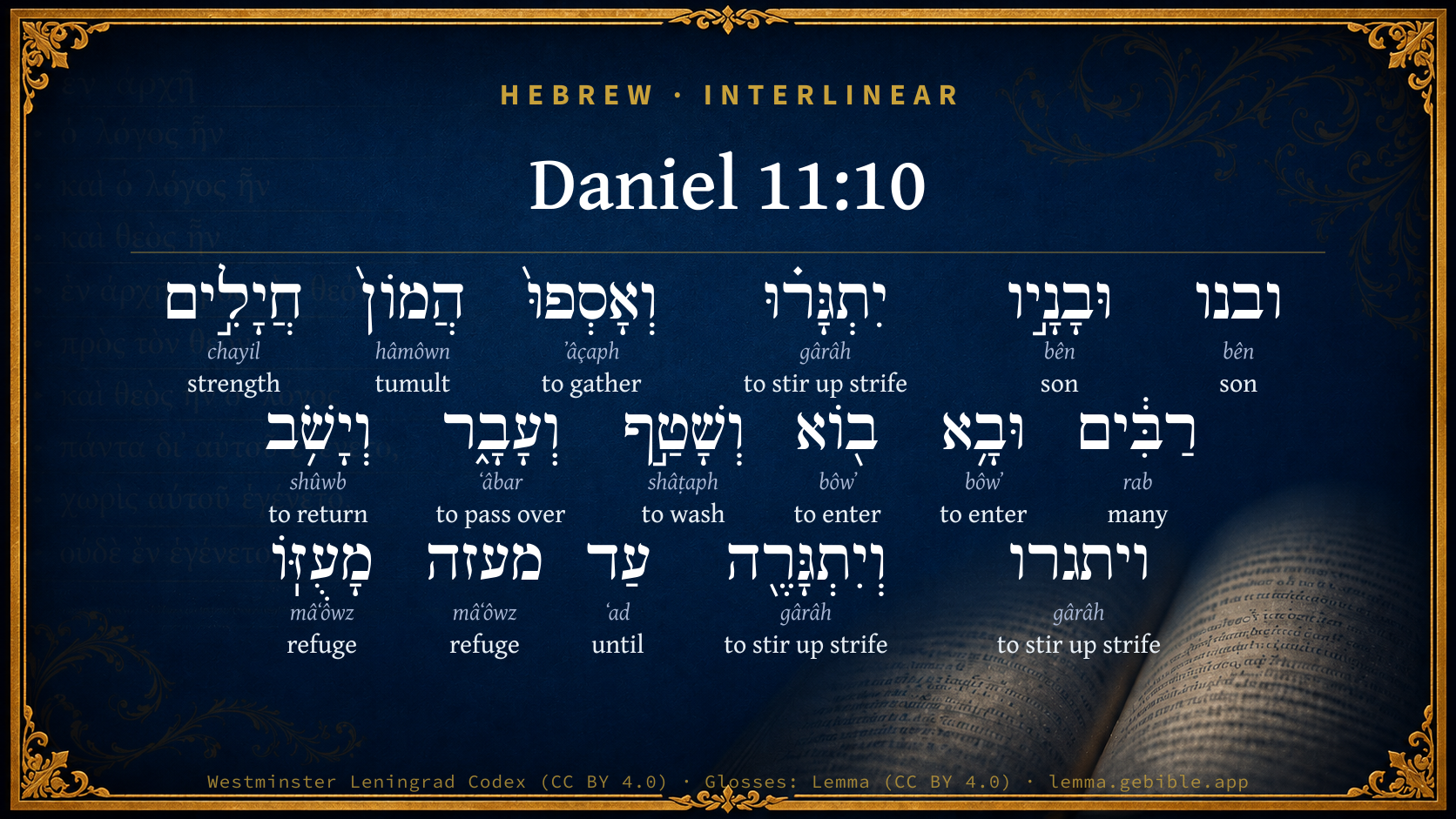
Hebrew (Westminster Leningrad Codex) Daniel 11:10 appears in the Hebrew Old Testament. The text above is from the Westminster Leningrad Codex. Each word links to its Strong’s number, a concise gloss, and parsing drawn from the Open Scriptures Hebrew Bible morphology. Click any word for its full Brown-Driver-Briggs (BDB) entry.
Download image
Cite this verse

Daniel 11:10 (World English Bible). Public Domain. Lemma interlinear Bible study tool, https://lemma.gebible.app/v/daniel/11/10.

Show BibTeX & RIS
BibTeX
RIS
English Translation
His sons shall war, and shall assemble a multitude of great forces, which shall come on, and overflow, and pass through; and they shall return and war, even to his fortress.
World English Bible · Public Domain
Download a study sheet

One document with this verse’s original text, its word-by-word gloss line, the meaning frame, cross-references with their text, attributed commentary, and full source and license credits — printable, and it pastes into notes with its structure intact.

This verse Autodidact and up

Study sheet (.html) Plain text (.txt)

A passage Seminary Student

Up to 50 verses in one chapter. A passage sheet keeps up to 6 commentary sources and 12 cross-references per verse, in the order this page ranks them, and says so on the sheet whenever that leaves anything out. Ask for a single verse and you get the Autodidact verse sheet above.

Everything on this page stays free to read, with no account — the sheet is a download of what is already on screen, not access to it.

Want to remove ads? Support Godless Engineer
Compare translations 3

The same verse in 3 English versions, stacked beneath the original-language interlinear above. Click any original word for its lexicon entry.

Each is an independent rendering of the whole verse — the interlinear is not word-aligned to these translations.

Highlighted words mark where these versions differ — a whole-verse word diff, not a word-by-word alignment.

  • World English Bible Public Domain
    His sons shall war, and shall assemble a multitude of great forces, which shall come on, and overflow, and pass through; and they shall return and war, even to his fortress.
  • King James Version Public Domain
    But his sons shall be stirred up, and shall assemble a multitude of great forces: and one shall certainly come, and overflow, and pass through: then shall he return, and be stirred up, even to his fortress.
  • unfoldingWord Literal Text CC BY-SA 4.0
    His sons will wage war and assemble a multitude of great forces. It will keep coming and overflow like a flood and pass through, and again will carry the war as far as his fortress.

unfoldingWord Literal Text — © unfoldingWord, licensed CC BY-SA 4.0. Word-aligned USFM3 via Door43 (git.door43.org/unfoldingWord/en_ult).

Versions to compare (up to 4)

3 of 4 selected

Show all 18 translations

Every available English version of this verse, each an independent rendering of the whole verse.

  • World English Bible Public Domain
    His sons shall war, and shall assemble a multitude of great forces, which shall come on, and overflow, and pass through; and they shall return and war, even to his fortress.
  • Berean Standard Bible Public Domain
    But his sons will stir up strife and assemble a great army, which will advance forcefully, sweeping through like a flood, and will again carry the battle as far as his fortress.
  • Majority Standard Bible Public Domain
    But his sons will stir up strife and assemble a great army, which will advance forcefully, sweeping through like a flood, and will again carry the battle as far as his fortress.
  • King James Version Public Domain
    But his sons shall be stirred up, and shall assemble a multitude of great forces: and one shall certainly come, and overflow, and pass through: then shall he return, and be stirred up, even to his fortress.
  • American Standard Version (1901) Public Domain
    And his sons shall war, and shall assemble a multitude of great forces, which shall come on, and overflow, and pass through; and they shall return and war, even to his fortress.
  • Revised Version (1885) Public Domain
    And his sons shall war, and shall assemble a multitude of great forces which shall come on, and overflow, and pass through: and they shall return and war, even to his fortress.
  • Geneva Bible (1599) Public Domain
    Wherefore his sonnes shall be stirred vp, and shall assemble a mightie great armie: and one shall come, and ouerflowe, and passe through: then shall he returne, and be stirred vp at his fortresse.
  • Douay-Rheims (1899) Public Domain
    And his sons shall be provoked, and they shall assemble a multitude of great forces: and he shall come with haste like a flood: and he shall return and be stirred up, and he shall join battle with his forces.
  • Young's Literal Translation Public Domain
    and his sons stir themselves up, and have gathered a multitude of great forces, and he hath certainly come in, and overflowed, and passed through, and he turneth back, and they stir themselves up unto his stronghold.
  • Literal Standard Version CC BY-SA 4.0
    and his sons stir themselves up, and have gathered a multitude of great forces, and he has certainly come in, and overflowed, and passed through, and he turns back, and they stir themselves up to his stronghold.
  • Unlocked Literal Bible CC BY-SA 4.0
    His sons will get ready and assemble a great army. It will keep coming and will flood everything; it will pass through all the way to his fortress.
  • unfoldingWord Literal Text CC BY-SA 4.0
    His sons will wage war and assemble a multitude of great forces. It will keep coming and overflow like a flood and pass through, and again will carry the war as far as his fortress.
  • Darby Bible Public Domain
    And his sons shall be stirred up, and shall assemble a multitude of great forces; and one shall certainly come, and overflow, and pass through; and he shall return and carry the war even to his fortress.
  • World Messianic Bible Public Domain
    His sons will wage war, and will assemble a multitude of great forces which will come on, and overflow, and pass through. They will return and wage war, even to his fortress.
  • Webster's Bible Public Domain
    But his sons shall be stirred up, and shall assemble a multitude of great forces: and one shall certainly come, and overflow, and pass through: then shall he return, and be stirred up, even to his fortress.
  • Free Bible Version CC BY-SA 4.0
    However, his sons will prepare for war, assembling a huge number of troops. One of them will lead an advance that rushes forward like a river bursting its banks, crossing over and pressing forward to attack the enemy fortress.
  • Bible in Basic English Public Domain
    And his son will make war, and will get together an army of great forces, and he will make an attack on him, overflowing and going past: and he will again take the war even to his strong place.
  • JPS Tanakh (1917) Public Domain
    And his sons shall stir themselves up, and shall assemble a multitude of great forces, and he shall come on, and overflow, as he passes through; and he shall return and stir himself up, even to his stronghold.

Literal Standard Version (2020), Covenant Press — licensed CC BY-SA 4.0. Text via the HelloAO Bible API (eBible.org). Unlocked Literal Bible (unfoldingWord) — licensed CC BY-SA 4.0. Text via the HelloAO Bible API (eBible.org). unfoldingWord Literal Text — © unfoldingWord, licensed CC BY-SA 4.0. Word-aligned USFM3 via Door43 (git.door43.org/unfoldingWord/en_ult). Free Bible Version, Dr. Jonathan Gallagher — licensed CC BY-SA 4.0. Text via the HelloAO Bible API (eBible.org).

Word by word

More ways to search: Search by grammar → Find every occurrence → Compare this word →

Practice this passage: Drill this verse → Learn its vocabulary →

יִתְגָּר֗וּ
gârâh
H1624
“to stir up strife”
Verb, Hithpael, Imperfect, 3rd Person, Masculine, Plural
Part of Speech
Verb
Stem
Hithpael
Form
Imperfect
Person
3rd Person
Gender
Masculine
Number
Plural
Full BDB Definition

Origin: a primitive root

TWOT: 378

to cause strife, stir up, contend, meddle, strive, be stirred up - (Piel) to stir up strife, excite strife - (Hithpael) - to excite oneself against, engage in strife - to excite oneself (against foe), wage war
  1. ובנו bên H1121 “and · son · his” Conjunction + Noun, Common, Masculine, Singular, Construct + Suffix, Personal, 3rd Person, Masculine, Singular
  2. וּבָנָ֣יו bên H1121 “and · sons · his” Conjunction + Noun, Common, Masculine, Plural, Construct + Suffix, Personal, 3rd Person, Masculine, Singular
  3. וְאָסְפוּ֙ ʼâçaph H622 “and · to gather” Conjunction + Verb, Qal, Sequential Perfect, 3rd Person, Common, Plural
  4. הֲמוֹן֙ hâmôwn H1995 “tumult of” Noun, Common, Masculine, Singular, Construct
  5. חֲיָלִ֣ים chayil H2428 “forces” Noun, Common, Masculine, Plural, Absolute
  6. רַבִּ֔ים rab H7227 “many” Adjective, Adjective, Masculine, Plural, Absolute
  7. וּבָ֥א bôwʼ H935 “and · to enter” Conjunction + Verb, Qal, Sequential Perfect, 3rd Person, Masculine, Singular
  8. ב֖וֹא bôwʼ H935 “to enter” Verb, Qal, Infinitive Absolute
  9. וְשָׁטַ֣ף shâṭaph H7857 “and · to wash” Conjunction + Verb, Qal, Sequential Perfect, 3rd Person, Masculine, Singular
  10. וְעָבָ֑ר ʻâbar H5674 “and · to pass over” Conjunction + Verb, Qal, Perfect, 3rd Person, Masculine, Singular
  11. וְיָשֹׁ֥ב shûwb H7725 “and · to return” Conjunction + Verb, Qal, Jussive, 3rd Person, Masculine, Singular
  12. ויתגרו gârâh H1624 “and · to stir up strife” Conjunction + Verb, Hithpael, Imperfect, 3rd Person, Masculine, Plural
  13. וְיִתְגָּרֶ֖ה gârâh H1624 “and · to stir up strife” Conjunction + Verb, Hithpael, Imperfect, 3rd Person, Masculine, Singular
  14. עַד ʻad H5704 “until” Preposition
  15. מעזה mâʻôwz H4581 “refuge · her” Noun, Common, Masculine, Singular, Construct + Suffix, Personal, 3rd Person, Feminine, Singular
  16. מָעֻזּֽוֹ mâʻôwz H4581 “refuge · his” Noun, Common, Masculine, Singular, Construct + Suffix, Personal, 3rd Person, Masculine, Singular

About this verse

These counts appear in no published source. They are computed here, from the morphology-tagged text and Lemma’s own curated glosses. What Lemma adds →

17
words
12
distinct lemmas
Prophets
section

Notable vocabulary

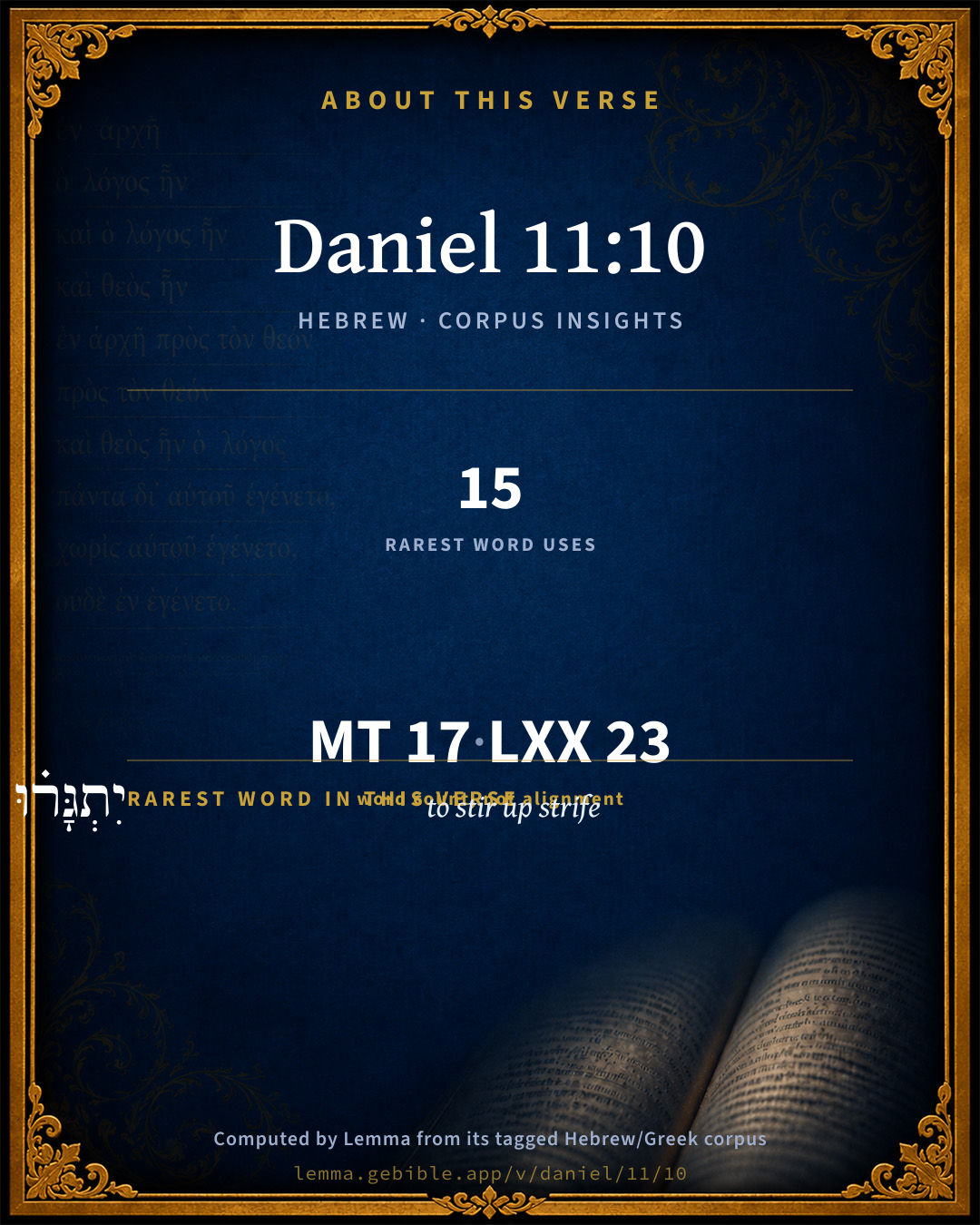
The rarest word here is יִתְגָּר֗וּ to stir up strife H1624 — appearing just 15 times in the whole Hebrew Bible.

Shared distinctive vocabulary

יִתְגָּר֗וּ to stir up strife H1624 occurs in 13 verses of the Hebrew Bible. Also found in:

Grammatical profile

  • 9 verbs
  • 6 nouns
  • 1 adjective
  • 1 preposition

Verb forms

  • יִתְגָּר֗וּ Hithpael · Imperfect
  • וְאָסְפוּ֙ Qal · Sequential Perfect
  • וּבָ֥א Qal · Sequential Perfect
  • ב֖וֹא Qal · Infinitive Absolute
  • וְשָׁטַ֣ף Qal · Sequential Perfect
  • וְעָבָ֑ר Qal · Perfect
  • וְיָשֹׁ֥ב Qal · Jussive
  • ויתגרו Hithpael · Imperfect
  • וְיִתְגָּרֶ֖ה Hithpael · Imperfect

Repetition

Words recur within this verse — often emphatic in Hebrew:

  • יִתְגָּר֗וּ to stir up strife H1624 ×3
  • ובנו son H1121 ×2
  • וּבָ֥א to enter H935 ×2
  • מעזה refuge H4581 ×2

Hebrew & Septuagint length

In English translation the verse runs 31 words from the Hebrew and 27 from the Septuagint (LXX English) — closely comparable.

A rough comparison of the two English renderings, which tokenize alike — not a word-level alignment.

Word counts can differ between the Hebrew and the Greek without any difference in meaning — e.g. the Hebrew direct-object marker אֵת has no separate Greek word, and Greek often adds the article ὁ.

In the original languages it is 17 Hebrew tokens and 23 Greek tokens — but the two are counted differently (Hebrew bundles its prefixes and suffixes into one token; the Greek is in lemma form), so that isn’t a like-for-like length.

Cross-references

9

Topical passages linked to Daniel 11:10 in the Treasury of Scripture Knowledge — connected by theme and wording, ordered by reader-vote popularity; previews shown in the World English Bible.

  • Jeremiah 51:42 The sea is come up on Babylon; she is covered with the multitude of the waves of it.
  • Daniel 9:26 After the sixty-two weeks the Anointed One shall be cut off, and shall have nothing: and the people of the prince who shall come shall destroy the city and the sanctuary; and the end of it shall be with a flood, and even to the end shall be war; desolations are determined.
  • Daniel 11:7 But out of a shoot from her roots shall one stand up in his place, who shall come to the army, and shall enter into the fortress of the king of the north, and shall deal against them, and shall prevail.
  • Daniel 11:26 Yes, they who eat of his dainties shall destroy him, and his army shall overflow; and many shall fall down slain.
  • Isaiah 8:7–8 now therefore, behold, the Lord brings up on them the waters of the River, strong and many, [even] the king of Assyria and all his glory: and it shall come up over all its channels, and go over all its banks;
  • Isaiah 25:12 The high fortress of your walls has he brought down, laid low, and brought to the ground, even to the dust.
  • Jeremiah 46:7–8 Who is this who rises up like the Nile, whose waters toss themselves like the rivers?
  • Daniel 11:22 The overwhelming forces shall be overwhelmed from before him, and shall be broken; yes, also the prince of the covenant.
  • Daniel 11:39–40 He shall deal with the strongest fortresses by the help of a foreign god: whoever acknowledges [him] he will increase with glory; and he shall cause them to rule over many, and shall divide the land for a price.

Cross-references courtesy of OpenBible.info (CC BY 4.0).

Hebrew and Greek witnesses Masoretic Hebrew ↔ Greek Septuagint

The same verse in the two great witnesses to the Old Testament, shown verse-for-verse.

These are two independent witnesses, not word-aligned to each other, and the Septuagint is shown in lemma (dictionary) form.

Hebrew Daniel 11:10 Masoretic · Westminster Leningrad Codex

ובנו וּבָנָ֣יו יִתְגָּר֗וּ וְאָסְפוּ֙ הֲמוֹן֙ חֲיָלִ֣ים רַבִּ֔ים וּבָ֥א ב֖וֹא וְשָׁטַ֣ף וְעָבָ֑ר וְיָשֹׁ֥ב ויתגרו וְיִתְגָּרֶ֖ה עַד מעזה מָעֻזּֽוֹ

His sons shall war, and shall assemble a multitude of great forces, which shall come on, and overflow, and pass through; and they shall return and war, even to his fortress.

World English Bible · Public Domain

Greek LXX Daniel 11:10 Septuagint · lemma form

καί ὁ υἱός αὐτός καί ἐρεθίζω καί συνἄγω συναγωγή ὄχλος πολύς καί εἰςἔρχομαι κατά αὐτός κατασύρω παραἔρχομαι καί ἐπιστρέφω καί παραὀξύνω ἐπί πολύς

And his sons shall gather a multitude among many: and one shall certainly come, and overflow, and pass through, and he shall rest, and collect his strength.

LXX2012 (modern English Septuagint) · Public Domain

On this verse, Ellicott's Commentary for English Readers discusses the Septuagint’s reading. Read the note in Commentary ↓

Hebrew: Westminster Leningrad Codex (CC BY 4.0). Greek: Septuagint (public domain); English from LXX2012 (modern English Septuagint) (Public Domain). How the Septuagint differs from the Hebrew →

Commentary

Notes on Daniel 11:10 from classic Christian and Jewish commentators (each source and its license shown beneath its notes). The classic Christian expositions comment on the surrounding passage and are grouped to its opening verse, so a note may address several verses; the Jewish commentaries on the Tanakh (Rashi and others) are per-verse, so they appear only where the commentator wrote on this verse.

Lemma curates 59 commentaries, every one of them public domain or Creative Commons licensed, each selected and text-cleaned for this edition rather than reprinted as found. About our sources →

The Cambridge Bible for Schools and Colleges

gen. ed. J. J. S. Perowne

10. his sons] Seleucus Ceraunos and Antiochus the Great, the two being grouped together, because (probably) the campaign of Seleucus in Asia Minor was the first stage in an organized plan of hostilities against Egypt.

shall stir themselves up] viz., as the word used implies, for war or combat (cf. ἐρεθίζω): so. Dan_11:25; Deu_2:5; Deu_2:9; Deu_2:19; Deu_2:24 [R.V. contend]; 2Ki_14:10 (properly, ‘Why shouldest thou stir thyself up against—i.e. advance against, challenge—calamity?’).

and he (or it) shall come on] i.e. either Antiochus, or his army (the ‘multitude’ just spoken of). The attack upon Egypt, planned originally by the two brothers, was, after the death of Seleucus, carried out by Antiochus.

and flood up and flow over] viz. in the campaigns of 219 in Cœle-Syria, and of 218 in Palestine (as described above). The words are borrowed from Isa_8:8 : the advancing hosts of Antiochus (as in Is. those of the Assyrians) are compared to a flood of waters inundating a land. Cf. Jer_47:2.

and he (or it) shall return] Antiochus, after wintering in Ptolemais, ‘returned’ to the attack upon Egypt in 217.

and they (his forces) shall stir themselves up (advancing) as far as his stronghold] Probably Gaza, which was the most important fortress of Palestine on the south, and a play upon the name of which (עזה) is perhaps intended by the Heb. word here used (מעזה). The strength of Gaza may be estimated by the fact that it resisted Alexander the Great for two months.

10–19. Seleucus III. (Ceraunos), 226–223, and Antiochus III. (the Great), 223–187: Ptolemy IV. (Philopator), 222–205, and Ptolemy V. (Epiphanes), 205–181.

Seleucus Callinicus left two sons, Seleucus Ceraunos and Antiochus. The former succeeded him, but was murdered, after two years, in the course of an expedition in Asia Minor (Polyb. v. 40). Antiochus, who then came to the throne, determined to resume the war with Egypt, hoping, in view of Ptolemy Philopator’s effeminacy and supineness, that an easy task lay before him (Polyb. v. 42)[360]. First, acting on the advice of his friend, the physician Apollophanes, he recovered the important fortress of Seleukeia (Polyb. v. 58–60, see above, on Dan_11:7); then Theodotus, Ptolemy’s præfect in Cœle-Syria (v. 40), invited him treacherously to take possession of that province, and enabled him further to secure Tyre, Ptolemais, and other neighbouring towns (v. 61). Meanwhile Ptolemy, roused from his lethargy by the loss of Cœle-Syria, had advanced his troops as far as Pelusium; and his ministers, wishing to gain time for further warlike preparations, succeeded in obtaining from Antiochus an armistice for four months. Antiochus accordingly retired for the winter to Seleukeia, leaving garrisons in Phœnicia and Cœle-Syria, which (being ignorant of Ptolemy’s real intentions) he hoped he had now finally secured (v. 62–66). However, in the following spring (218), a large Egyptian army, which had meantime been organized, marched under Nicolaus through Palestine as far as a spot between Lebanon and the sea, where it was met by Antiochus and completely defeated (v. 68–69). After this Antiochus advanced into Palestine, takes Philoteria, Scythopolis (Beth-shean) and Atabyrium, as also Abila, Gadara, and Rabbath-Ammon, on the E. of Jordan, leaves a governor, with 8000 soldiers, in Samaria, and retires into winter-quarters at Ptolemais (v. 70–71).

[360] The events summarized in Dan_11:10-12 are narrated at length in Polyb. v. 58–71, 79–87 (v. 62–68, 79–87, are translated in Mahaffy, l.c., pp. 250–263).

In the next spring (217) Antiochus and Ptolemy both take the field, with armies of 60,000 or 70,000 men each (v. 79). Ptolemy, starting from Alexandria, advances to within 50 stadia of Raphia (the border-fortress of Palestine, in the direction of Egypt); Antiochus first marches to Gaza, then by slow stages, passing Raphia, to within five stadia of the spot on which the army of Ptolemy was encamped (v. 80). In the battle which ensued (v. 82–85), Antiochus was defeated (with the loss of 10,000 infantry, 300 cavalry, besides 4,000 prisoners), and fell buck upon Gaza, retiring afterwards to Antioch (v. :86). He then sent to Ptolemy to ask terms of peace, which Ptolemy, satisfied with his victory, and with its natural consequence, the recovery of Cœle-Syria, granted for one year (v. 87).

The second part of Dan_11:12 refers plainly to Ptolemy’s victory at Raphia; but it is impossible to feel certain which of the events just described are referred to in Dan_11:10 b–12 a. The sequence of events as described in these verses seems, in fact, not to agree with that of the narrative of Polybius.

The Cambridge Bible for Schools and Colleges (gen. ed. J. J. S. Perowne; Cambridge University Press, 1878–1918) — public domain. Text from a community e-Sword module.

Trapp's Complete Commentary

John Trapp

Dan 11:10 But his sons shall be stirred up, and shall assemble a multitude of great forces: and [one] shall certainly come, and overflow, and pass through: then shall he return, and be stirred up, [even] to his fortress.

Ver. 10. But his sons.] Callinicus’s sons - viz., Seleucus, Ceraunus, and Antiochus Magnus, quasi duo fulmina belli.

Shall be stirred up.] As not enduring that Ptolemy Philopator, son of Euergetes, should possess any part of Syria under their noses.

Shall assemble a multitude of great forces.] Seventy thousand footmen, and fifty thousand horsemen, saith Polybius. {a}

And one shall certainly come.] One, not both; because Ceraunus, who seemed to be as swift and as irresistible as lightning, and therehence had his name, {b} was slain by Nicanor, so that Antiochus the Great was king alone.

And shall overflow and pass through.] To wit, against the captains of Ptolemy in Syria, Attalus, and Theodatus.

And he shall be stirred up, even to his fortress.] To Ptolemy’s fortress, or fortified city, Raphia, which lieth in the entrances of Egypt, saith Jerome.

{a} Lib. v.

{b} Ceraunias id est fulmineus: quod audaci et veloci ingenio praeditus. - Justin.

John Trapp, A Commentary or Exposition upon All the Books of the Old and New Testament (1647–1656) — public domain. Text from a community e-Sword module.

Joseph Benson's Commentary

Dan 11:10. But his sons shall be stirred up — “The sons of Seleucus Callinicus were Seleucus and Antiochus, the elder of whom, Seleucus, succeeded him in the throne, and, to distinguish him from others of the same name, was denominated Ceraunus, or the thunderer. He was indeed stirred up, and assembled a multitude of great forces, in order to recover his father’s dominions: but, being destitute of money, and unable to keep his army in obedience, he was poisoned by two of his generals, after an inglorious reign of two or three years. Upon his decease, his brother, Antiochus the Great, was proclaimed king. The angel’s expression is very remarkable, that his sons should be stirred up, &c.; but then the number is changed, and only ONE (he says) shall certainly come and overflow, &c. — Accordingly Antiochus came with a great army, retook Seleucia, and, by the means of Theodotus the Ætolian, recovered Syria. Then, after a truce, wherein both sides treated of peace, but prepared for war, Antiochus returned, and overcame in battle Nicolaus the Egyptian general, and had thought of invading Egypt itself.” He was stirred up even to his fortress — He made an attack on Raphia, a strong fortified town near the borders of Egypt.

Joseph Benson's Commentary on the Old and New Testaments (1811–1818) — public domain. Text from a community e-Sword module.

Keil & Delitzsch

C. F. Keil & F. Delitzsch

The decisive wars - Dan 11:10-12

Here the suffix in בּנו refers to the king of the north, who in Dan 11:9 was the person acting. Thus all interpreters with the exception of Kranichfeld, who understand בנו of the son of the Egyptian prince, according to which this verse ought to speak of the hostilities sought, in the wantonness of his own mind, of the king of the south against the king of the north. But this interpretation of Kranichfeld is shattered, not to speak of other verbal reasons which oppose it, against the contents of Dan 11:11. The rage of the king of the south, and his going to war against the king of the north, supposes that the latter had given rise to this rage by an assault. Besides, the description given in Dan 11:10 is much too grand to be capable of being referred to hostility exercised in mere wantonness. For such conflicts we do not assemble a multitude of powerful armies, and, when these powerful hosts penetrate into the fortresses of the enemy's country, then find that for the victorious invaders there is wanting the occasion of becoming exasperated for new warfare. The Kethiv בנו is rightly interpreted by the Masoretes as plur., which the following verbs demand, while the singulars ועבר ושׁטף וּבא (shall come, and overflow, and pass through) are explained from the circumstance that the hosts are viewed unitedly in המון (multitude). בּוא בּא expresses the unrestrained coming or pressing forward, while the verbs ועבר שׁטף, reminding us of Isa 8:8, describe pictorially the overflowing of the land by the masses of the hostile army. וישׁב (jussive, denoting the divine guidance), and shall return, expresses the repetition of the deluge of the land by the hosts marching back out of it after the עבּר, the march through the land, - not the new arming for war (Hv.), but renewed entrance into the region of the enemy, whereby they carry on the war מעזּה עד, to the fortress of the king of the south, corresponding with the הצּפון מלך בּמעוז in Dan 11:7 (to the fortress of the king of the north). יתגּרוּ signifies properly to stir up to war, i.e., to arm, then to engage in war. In the first member of the verse it has the former, and in the last the latter meaning. The violent pressing forward of the adversary will greatly embitter the king of the south, fill him with the greatest anger, so that he will go out to make war with him. The adversary marshals a great multitude of combatants; but these shall be given into his hand, into the hand of the king of the south. רב המון העמיד (he raised up a great multitude) the context requires us to refer to the king of the north. בּידו נתּן, v. Leng., Maurer, and Hitzig understand of the acceptance of the command over the army - contrary to the usage of the words, which mean, to give into the hand = to deliver up, cf. Kg1 20:28; Dan 1:2; Dan 8:12-13, and is contrary also to the context. The marshalling of the host supposes certainly the power to direct it, so that it needs not then for the first time to be given into the power of him who marshalled it. The expression also, "to give into his hand," as meaning "to place under his command," is not found in Scripture. To this is to be added, that the article in ההמון refers back to רב המון. But if ההמון is the host assembled by the king of the north, then it can only be given up into the hand of the enemy, i.e., the king of the south, and thus the suffix in בּידו can only refer to him. The statements in Dan 11:12 are in harmony with this, so far as they confessedly speak of the king of the south.

Keil & Delitzsch — Biblical Commentary on the Old Testament (1861–1891) — public domain (CC PDM 1.0). Text via the HelloAO Bible API. (Old Testament only.)

Scofield Reference Notes

C. I. Scofield

but his sons

Mat 11:10-19, prophetic foreview of the wars of Egypt and Syria, Palestine, Dan 11:17, the battleground, B.C. 284-175.

The Scofield Reference Bible (1917 edition), notes by C. I. Scofield — public domain. Text from a community e-Sword module.

The Expositor's Bible

SECOND SECTION

(Dan_11:10-19)

Events from the death of Ptolemy Euergetes (B.C. 247) to the death of Antiochus III (the Great, B.C. 175). In the following verses, as Behrmann observes, there is a sort of dance of shadows, only fully intelligible to the initiated.

Dan_11:10 -The sons of Seleucus Kallinikos were Seleucus III (Keraunos, B.C. 227-224) and Antiochus the Great (B.C. 224-187). Keraunos only reigned two years, and in B.C. 224 his brother Antiochus III succeeded him. Both kings assembled immense forces to avenge the insult of the Egyptian invasion, the defeat of their father, and the retention of their port and fortress of Seleucia. It was only sixteen miles from Antioch, and being still garrisoned by Egyptians, constituted a standing danger and insult to their capital city.

Dan_11:11 -After twenty-seven years the port of Seleucia is wrested from the Egyptians by Antiochus the Great, and he so completely reverses the former successes of the King of the South as to conquer Syria as far as Gaza.

Dan_11:12 (B.C. 217).-But at last the young Egyptian King, Ptolemy IV (Philopator), is roused from his dissipation and effeminacy, advances to Raphia (southwest of Gaza) with a great army of twenty thousand foot, five thousand horse, and seventy-three elephants, and there, to his own immense self-exaltation, he inflicts a severe defeat on Antiochus, and "casts down tens of thousands." Yet the victory is illusive, although it enables Ptolemy to annex Palestine to Egypt. For Ptolemy "shall not show himself strong," but shall, by his supineness, and by making a speedy peace, throw away all the fruits of his victory, while he returns to his past dissipation (B.C. 217-204).

Dan_11:13 -Twelve years later (B.C. 205) Ptolemy Philopator died, leaving an infant son, Ptolemy Epiphanes. Antiochus, smarting from his defeat at Raphia, again assembled an army, which was still greater than before (B.C. 203), and much war-material. In the intervening years he had won great victories in the East as far as India.

Dan_11:14 -Antiochus shall be aided by the fact that many-including his ally Philip, King of Macedon, and various rebel-subjects of Ptolemy Epiphanes-stood up against the King of Egypt and wrested Phoenicia and Southern Syria from him. The Syrians were further strengthened by the assistance of the "children of the violent" among the Jews, " who shall lift themselves up to fulfil the vision of the oracle ; but they shall fall. " We read in Josephus that many of the Jews helped Antiochus; but the allusion to "the vision" is entirely obscure. Ewald supposes a reference to some prophecy no longer extant. Dr. Joel thinks that the Hellenising Jews may have referred to Isaiah 19 in favour of the plans of Antiochus against Egypt.

Dan_11:15-16 -But however much any of the Jews may have helped Antiochus under the hope of ultimately regaining their independence, their hopes were frustrated. The Syrian King came, besieged, and took a well-fenced city-perhaps an allusion to the fact that he wrested Sidon from the Egyptians. After his great victory over the Egyptian general Scopas at Mount Panium (B.C. 198), the routed Egyptian forces, to the number of ten thousand, flung themselves into that city. This campaign ruined the interests of Egypt in Palestine, "the glorious land." Palestine now passed to Antiochus, who took possession "with destruction in his hand."

Dan_11:17 (B.C. 198-195).-After this there shall again be an attempt at "equitable negotiations"; by which, however, Antiochus hoped to get final possession of Egypt and destroy it. He arranged a marriage between "a daughter of women"-his daughter Cleopatra-and Ptolemy Epiphanes. But this attempt also entirely failed.

Dan_11:18 (B.C. 190).-Antiochus therefore "sets his face in another direction," and tries to conquer the islands and coasts of Asia Minor. But a captain-the Roman general, Lucius Cornelius Scipio Asiaticus-puts an end to the insolent scorn with which he had spoken of the Romans, and pays him back with equal scorn, utterly defeating him in the great Battle of Magnesia (B.C. 190), and forcing him to ignominious terms.

Dan_11:19 (B.C. 175).-Antiochus next turns his attention ("sets his face") to strengthen the fortress of his own land in the east and west; but making an attempt to recruit his dissipated wealth by the plunder of the Temple of Belus in Elymais, "stumbles and falls, and is not found."

William Robertson Nicoll, ed., The Expositor's Bible (London: Hodder & Stoughton, 1887–1910) — public domain. 65 of 66 books (1 Corinthians is not separately keyed, as that volume carries no machine-parseable verse references); section-level commentary keyed to the opening verse. Introductory and overview sections not keyed to a specific passage are excluded.

Tyndale Open Study Notes

Tyndale Open Resources

11:10-12 The sons of Seleucus II were Seleucus III Ceraunus (226–223 BC) and Antiochus III the Great (223–187 BC). • a mighty army that will advance like a flood: Antiochus III aggressively sought to regain lost territory, including Palestine. • as far as the enemy’s fortress: Antiochus III advanced to Raphia on the border of Egypt in 217 BC. In the ensuing battle, the king of the south—Ptolemy IV Philopater (221–203 BC)—defeated Antiochus III and retained control of Palestine.

Tyndale Open Study Notes — © Tyndale Open Resources, licensed CC BY-SA 4.0. Text via the HelloAO Bible API.

Geneva Bible (1599)

Geneva Bible translators

For his elder brother Seleucus died, or was slain while the wars were preparing.

Meaning, Seleucus and Antiochus the great, the sons of Callinicus, shall make war against Ptolemy Philopater the son of Philadelphus.

That is, Philopater when he shall see Antiochus to take great dominions from him in Syria, and also ready to invade Egypt.

Geneva Bible (1599) marginal notes — public domain. Text via Bolls.life.

Jamieson, Fausset & Brown

Robert Jamieson, A. R. Fausset & David Brown

his sons--the two sons of the king of the north, Seleucus Callinicus, upon his death by a fall from his horse, namely, Seleucus Ceraunus and Antiochus the Great.

one shall . . . come--Ceraunus having died, Antiochus alone prosecuted the war with Ptolemy Philopater, Euergetes' son, until he had recovered all the parts of Syria subjugated by Euergetes.

pass through--like an "overflowing" torrent (Dan 11:22, Dan 11:26, Dan 11:40; Isa 8:8). Antiochus penetrated to Dura (near Cæsarea), where he gave Ptolemy a four months' truce.

return--renew the war at the expiration of the truce (so Dan 11:13).

even to his fortress--Ptolemy's; Raphia, a border-fortress of Egypt against incursions by way of Edom and Arabia-Petræa, near Gaza; here Antiochus was vanquished.

Jamieson, Fausset & Brown — Commentary Critical and Explanatory on the Whole Bible (1871) — public domain (CC PDM 1.0). Text via the HelloAO Bible API.

Adam Clarke's Commentary

Verse 10. But his sons shall be stirred up] That is, the sons of Callinicus, who were Seleucus Ceraunus and Antiochus, afterwards called the Great.

Shall assemble a multitude] Seleucus Ceraunus did assemble a multitude of forces in order to recover his father's dominions; but, not having money to pay them, they became mutinous, and he was poisoned by two of his own generals. His brother Antiochus was then proclaimed king; so that one only of the sons did certainly come, and overflow, and pass through; he retook Seleucia, and regained Syria. He then returned, and overcame Nicolaus the Egyptian general; and seemed disposed to invade Egypt, as he came even to his fortress, to the frontiers of Egypt.

Adam Clarke's Commentary on the Bible (1810–1826) — public domain. Text from a community e-Sword/MySword module.

John Calvin's Commentaries

Here the angel passes to the third war, namely, that which the son of Callinicus stirred up against Ptolemy Philopator. After the death of Euergetes, the two sons of Callinicus united their forces, and endeavored to recover Syria, and especially that part of it of which they had been deprived. When they were already on their expedition, and their forces were on their march, the elder Seleucus died, and his surviving brother was Antiochus, called the Great. Ptolemy, called Philopator, which means a lover of his father, was then alive. He was so called in consequence of the parricide of which he was guilty, having put to death both parents, together with his brother. The word is used by way of ridicule, and a sense the opposite to that expressed is implied by this epithet, which is honorable in itself, and expresses the virtue of filial piety. But he slew his father, mother, and brother, and on account of all these impious murders, the name of Philopator was applied to him as a mark of disgrace. As, therefore, he was so thoroughly hated by his own people, the sons of Callinicus, namely, Seleucus Ceraunus the elder, and Antiochus the Great, thought the time had arrived for the recovery of the lost cities of Syria. For he was detested and despised in consequence of his numerous crimes. They therefore anticipated little trouble in recovering their possessions, when their enemy was thus branded with infamy, and had many domestic foes. This is the reason why the angel says of the sons of Callinicus, They shall be provoked, and shall lead a multitude of great armies; it may mean “great forces,” as some historians relate the collection of two very strong armies. Unless I am mistaken, Antiochus the Great had 70,000 foot and 5000 horse. Ptolemy excelled in cavalry as he had 6000 horse but only 62,000 foot, as Polybius informs us in his fifth book. They were nearly equal in forces, but the confidence of the two sons of Callinicus, of whom alone the angel now speaks, was increased when they beheld their wicked enemy so greatly detested in consequence of his parricide. He afterwards says, He shall come. He changes the number, since the elder brother, being the eldest son of Callinicus, namely, Seleucus Ceraunus, died while they were preparing for the war, and they say he was slain by his attendants in passing through Asia Minor. Whether this was so or not, all historians unite in stating that Antiochus the Great alone carried on the war with Philopator. He shall come so as to overflow and pass through He recovered that part of Syria which he had lost, and when he approached Egypt, then Philopator met him. Profane historians state him to have been a coward, and never to have obtained power by open bravery, but by fear alone. He was too late in preparing his forces for resisting his enemy.

This is the reason why the angel says, The king of Syria, or of the north, should come, even to the citadels, or fortifications; for at length Philopator roused himself from slumber, for he never put on his arms to repel an enemy except when compelled by the direst necessity. Hence he adds, The king of the south shall be irritated, or exasperated. He uses the word “exasperated,” because, as I have just said, he would never have opposed himself to his enemy Antiochus except lie had perceived his own kingdom placed in great jeopardy. He might have taken patiently the loss of Syria, so long as Egypt had been safe; but when his life and all his possessions were in danger, he became sufficiently exasperated to attack his foe; and yet he prevailed, as we shall afterwards see. I cannot complete this subject to-day, and so I shall draw to a close. Philopator became victorious, and yet he was so sluggish that he distrusted his friends and foes alike, and was forced by this very fear to make peace with his enemy, although he was really the conqueror. Not only could he have driven back his enemy whom he had vanquished, but he might have taken possession of his territories; but he did not dare to do this, he was conscious of being a parricide, and knew to his cost how hateful his name was among all men. Hence, although superior in strength, and actually the conqueror of his enemy in battle, he dared not proceed further. But we will explain the remainder another time.

John Calvin's Commentaries (1540-1563) — public domain. Text from the Calvin Translation Society English edition (1840s-50s) via the Christian Classics Ethereal Library (ccel.org). Calvin's coverage is partial (roughly two-thirds of the Bible); uncommented books and verses are honest gaps, never fabricated. The 19th-century editor's footnotes and remarks are omitted so the notes are faithfully Calvin's own voice.

Ellicott's Commentary for English Readers

(10) His sons.—The pronoun refers to the subject of Dan_11:9, which is the northern king (though, according to the LXX. and English Version, it must be his rival). There is a marginal alternative in the Hebrew “son.” The LXX. supports the text. If the king of the north last mentioned is Seleucus Callinicus, his sons must be Seleucus Ceraunus, a man of no importance, and Antiochus the Great. It is here stated of the sons that they are stirred up; that they collect a vast army, which advances steadily, overflowing like a torrent, while its masses pass through the land; that they shall return and carry on the war up to the frontier of the southern king. Considering the uncertainty of the readings in the Hebrew text, and the ambiguity of the language, this is anything but a definite statement. However, it has been explained to refer to the wars of Antiochus and Ptolemy Philopator, in course of which they took Seleucia, Tyre, and Ptolemais, besieged the Egyptians in Sidon, and actually took possession of Gaza.

One shall certainly come.—Not the king, but the multitude just spoken of. The words “overflow,” “pass through” “return,” all refer to the ebbing and flowing of the tide of war.

A Bible Commentary for English Readers, edited by Charles John Ellicott (1878–1897) — public domain. Text from a community e-Sword module.

John Gill's Exposition

But his sons shall be stirred up,.... Not of the king of the south, or Egypt, but of the king of the north, or Syria; the sons of Seleucus Callinicus, who died, as Justin (f) says, by a fall from his horse; these were Seleucus Ceraunus and Antiochus, who was afterwards called the great: these being irritated and provoked by what Ptolemy Euergetes had done in revenge of his sister, taking part of their father's kingdom from him, and carrying off so rich a booty, joined together, and exerted themselves to recover their dominions from him:

and shall assemble a multitude of great forces: or, "a multitude of men, even large armies" (g); which they put themselves at the head of, in order to make war with the king of Egypt:

and one shall certainly come, and overflow, and pass through; this is to be understood of Antiochus; for Seleucus dying in the third year of his reign, being slain in Phrygia, through the treachery of Nicator and Apaturius, as Jerom relates; or, as others, poisoned; Antiochus succeeded him, and alone headed the armies they had collected; and with which, like an inundation of water, to which armies are sometimes compared, he attacked Seleucia, and took it; and entered into Coelesyria, and overran it, being delivered into his hands by the treachery of Theodotus, who governed there for Ptolemy, whom he had offended: after this he came to Berytus, entered the province by a place which the countrymen called "the face of God"; and which Grotius, not improbably, takes to be Phanuel: took the town of Botris, and set fire to Trieres and Calamus, or Calene: he next invaded Palestine, and took several places in it; went as far as Rabata Massane, or Rabatamana, a city in Arabia, the same with Rabbathammon, which surrendered to him (h):

then shall he return, and be stirred up even to his fortress: the spring following he returned with a numerous army, and came to Raphia, a fortified city in Egypt, which lay between that and Palestine; where, as Strabo (i) says, Ptolemy the fourth (i.e. Philopator) fought with Antiochus the great.

(f) Ibid. (Justin, l. 27.) c. 3. (g) "multitudinem, copias amplas", Junius & Tremellius. (h) Vid. Polybium, l. 5. p. 256, 260, 261, 262. and Universal History, vol. 9. p. 216, 218, 219. (i) Geograph. l. 16. p. 522.

John Gill's Exposition of the Whole Bible (1746–1763) — public domain (CC PDM 1.0). Text via the HelloAO Bible API.

Albert Barnes' Notes on the Bible

But his sons shall be stirred up - Margin, “or, war.” The Hebrew word (יתגרוּ yı̂theggârû - from גרה gârâh) means, to be rough; then, in Piel, to excite, stir up; and then, in Hithpa, to excite one’s self, to be stirred up to anger, to make war upon .... Here it means, according to Gesenius (Lexicon), that they would be excited or angry. The reference here, according to Lengerke, Maurer, Gill, and others, is to the son of the king of the north, Seleucus Callinicus. He was killed, according to Justin (lib. xxvii. c. 3), by a fall from his horse. The war with Egypt was continued by his two sons, Seleucus Ceraunus and Antiochus the Great, until the death of the former, when it was prosecuted by Antiochus alone. See Prideaux, iii. 136. Seleueus Ceraunus succeeded his father - assuming the name of Ceraunus, or the Thunderer; but, dying soon, he left the crown to his brother, Antiochus the Great, then only fifteen years of age, by whom the war with Egypt was successfully prosecuted.

And shall assemble a multitude of great forces - Against Egypt. In such a war they would naturally summon to their aid all the forces which they could command.

And one shall certainly come - There is a change here in the Hebrew from the plural to the singular number, as is indicated in our translation by the insertion of the word “one.” The fact was, that the war was prosecuted by Antiochus the Great alone. Seleucus died in the third year of his reign, in Phrygia; being slain, according to one report (Jerome), through the treachery of Nicanor and Apaturius, or, according to another, was poisoned. See Prideaux, iii. 137. Antiochus succeeded to the empire, and prosecuted the war. This was done for the purpose of recovering Syria from the dominion of Ptolemy of Egypt, and was conducted with various degrees of success, until the whole was brought under the control of Antiochus. See Prideaux, “Con.” iii. 138, following.

And overflow - Like a torrent.

And pass through - Through the land - not the land of Egypt, but every part of Syria.

Then shall he return - Margin, “be stirred up again.” The margin is the more correct rendering - the Hebrew word being the same as what is used in the first part of the verse. The idea would seem to be, that he would be aroused or stirred up after a defeat, and would on the second expedition enter into the strongholds or fortresses of the land. This was literally true. Ptolemy marched into Syria with an army of seventy thousand foot, five thousand horse, and seventy-three elephants, and was met by Antiochus with an army of sixty-two thousand foot, six thousand horse, and one hundred and two elephants. In a great battle, Antiochus was defeated, and returned to Antioch (Prideaux, Con. iii. 151-153); but the following year he again rallied his forces, and invaded Syria, took Gaza and the other strongholds, and subdued the whole country of Syria (including Palestine) to himself. - Prideaux, “Con.” iii. 176, 177.

Even to his fortress - The singular for the plural; perhaps using the word “fortress” by way of eminence, as denoting his “strongest” fortress, and, therefore, including all the others.

Albert Barnes' Notes on the Bible (1834–1885) — public domain. Text from a community e-Sword/MySword module.

Haydock's Catholic Bible Commentary

His sons. Seleucus Ceraunius and Antiochus the great, the sons of Callinicus. (Challoner) --- The former was poisoned after three years’ reign, as he marched against Attalus. (Just. xxix.) --- Antiochus the great reconquered many provinces from Egypt, but was beaten at Raphia, on the confines, and lost Cœlo-syria. (Calmet) --- He shall, &c. Antiochus the great. (Challoner) --- He prosecuted the war, as his brother was prevented by death. (Worthington)

George Leo Haydock (1774–1849), Haydock's Catholic Family Bible and Commentary, 1859 edition — public domain. Excludes Psalms (Douay-Rheims chapter numbering differs from Protestant) and Deuterocanonical books (Catholic canon only).

Matthew Poole's English Annotations

His sons shall be stirred up; he means the sons of the king of the north, i.e. Antiochus, and Seleucus Ceraunus, shall be incensed with the deeds of Ptolemy Euergetes, and his son Ptolemy Philopater.

One shall certainly come, and overflow, and pass through; he means Antiochus the Great, because the other, viz. Seleucus Ceraunus, is taken off by poison at the beginning; he shall pass through Syria, and recover what the king of Egypt took from his father.

To his fortress, i.e. to the entering of Egypt Raphia, which was check to any irruptions from Arabia or Idumea, besides many other places. The cause of which success was partly the Egyptian king’s luxury, and the hatred his people had against him for his cruelty in slaying his father, mother, and sister; called Philopater ironically and reproachfully.

Matthew Poole's English Annotations on the Holy Bible (1683–1685) — public domain. Text from a community e-Sword/MySword module.

Whedon's Commentary on the Bible

Daniel D. Whedon

10. His sons — That is, Seleucus Ceraunos and Antiochus III, the sons of Seleucus II. Ceraunos, after a reign of about three years, was killed during a campaign in Asia Minor and was succeeded by his brother Antiochus III (the Great) who for thirty-six years ruled with a strong hand (B.C. 223 to 187), conquering Parthia and Bactria, and constantly threatening Egypt and the far-distant East with his immense armies.

But his sons shall be stirred up — Rather, and his sons shall war. (See above.) One shall certainly come, etc. — Rather, and he shall surely come, and overflow, and pass through: and he shall return and war, even to his fortress. This is a picture of the attack upon Egypt by Antiochus the Great, and of his renewed attack when he got only as far as Raphia, which was the extreme frontier stronghold of Egypt. A decisive battle was fought there a little later. (See next verse.) This is the usual modern view, although his fortress may possibly refer to some frontier stronghold of Antiochus.

Daniel D. Whedon (gen. ed.), Commentary on the Old and New Testaments (1874–1909) — public domain. Text from a community e-Sword module.

The Pulpit Commentary

But his sons shall be stirred up, and shall assemble a multitude of great forces: and one shall certainly come, and overflow, and pass through: then shall he return, and be stirred up, even to his fortress. The version of the Septuagint differs from this, "And his son shall both be stirred up, and shall assemble (sunaxei sunagwghn) a great multitude, and, ravaging with it (katasurwn), he shall enter, and pass by and return." The K"thib here supports this to the extent at least that it has "his son," not "his sons;" but the verbs are plural. The last clause of this verse in the Massoretic text is transferred by the Septuagint to the next; Theodotion, while, as usual, more closely in agreement with the Massoretic text, is not quite identical with it, "And his sons shall assemble a multitude moderately numerous (ajnason pollwn), and he that cometh and overfloweth shall come and shall pass by, and shall enter, and shall struggle hard (sumprosplakhsetai), even to his fortress (iJscuov)." The Peshitta and the Vulgate are in close agreement with the Massoretic text. But his sons shall be stirred up. The natural inference is that it is the sons of the king of the south who thus are stirred up, but, historically, it can only refer to the sons of Seleucus Callinicus, who, one after the other, succeeded him on the throne: Seleucus Ceraunus, who died after a short reign of rather more than two years; and Antiochus III, Magnus. Certainly Seleucus did little in this conflict, although he undertook a campaign to Asia Minor, in the course of which he was assassinated. It may be that this campaign was intended as a preparation for a great campaign against Egypt. On the death of Ceraunus, he was succeeded by Aatiochtus Magnus. This prince was very warlike. He began to assail Syria, which was in the possession of Philopotor, but was interrupted by news of war in the far East. After a successful campaign in Media and Persia, he wrested first Seleucia from the hands of Ptolemy Philopator; and then proceeded on his invasion of Coele-Syria and Palestine. And one shall certainly come, and overflow, and pass through. This describes in a compendious way the campaigns of Antiochus Magnus. And be stirred up, even to his.fortress. This is supposed to refer to the recovery of Seleucia. Some think that this rather states that he pierced nearly to Pelusium, the frontier fortress of Egypt.

The Pulpit Commentary (1880–1919), ed. H.D.M. Spence-Jones & Joseph S. Exell — public domain. Text from a community e-Sword module.

unfoldingWord translationNotes

Door43 World Missions Community

General Information:

The angel continues speaking to Daniel.

His sons

"The sons of the king of the North"

assemble a great army

"gather together many men who can fight in battles"

will flood everything

The way the large army covers the land will be like a flood of water. AT: "will be so great in number that they will cover all the land" (See: Simile)

translationWords

flood

stronghold

unfoldingWord translationNotes — © Distant Shores Media and the Door43 World Missions Community, licensed CC BY-SA 4.0. Source: git.door43.org/Door43/en_tn.

Rashi

Rabbi Shlomo Yitzchaki (Rashi)

And his sons [i.e., the sons] of the king of the north will agitate.

and he will come Heb. וּבָא בוֹא, like וְהוֹלֵךְ הָלוֹךְ. The son of the king of the north will come and pass to the land of the south.

and he will return and agitate against the king of the south.

until his stronghold his fortified city.

Rashi on the Tanakh — English translations: “The Judaica Press complete Tanach with Rashi, translated by A. J. Rosenberg” (CC BY 4.0); “Pentateuch with Rashi's commentary by M. Rosenbaum and A.M. Silbermann, 1929-1934” (public domain); “The Metsudah Tanach series, Lakewood, N.J” (CC BY 4.0); and “The Book of Joshua, Metsudah Publications, 1997” (CC BY 4.0). Text via Sefaria.

Lesson kit

Teaching starters — assembled from the data on this page, not authored interpretation. Every prompt links to the verse data it draws on. Edit before teaching.

Daniel, in the Prophets, opens this verse with 17 words (12 distinct Hebrew lemmas). Its most distinctive word is gârâh (“to stir up strife”). A historical commentator’s framing appears above. Read the whole chapter for the surrounding context.

Discussion questions

  1. What does “to stir up strife” (gârâh) contribute to the verse as a whole?
  2. Deuteronomy 2:5 shares the word «to stir up strife» with this verse. How do the two illuminate each other?
  3. “to stir up strife” occurs 3× in this one verse. What is the effect of the repetition?
  4. These translations render this verse differently; the difference is in the English rendering, not the original. What questions does that raise?
  5. The verb «יִתְגָּר֗וּ» is Hithpael Imperfect. How does its form color the action?
  6. Reading how The Cambridge Bible for Schools and Colleges and Trapp's Complete Commentary read this verse, where do the two commentators agree and where do they part?

Things to notice

Reading settings

Reading text

Shown beneath each verse's original-language words.

Old Testament
Old Testament edition

Read the OT as the Masoretic Hebrew (MT) or the Greek Septuagint (LXX).

English shown for the Greek Septuagint (in the Hebrew ↔ Greek comparison).

Comparing translations? Open the Compare panel on any verse page to stack up to four side by side.