Genesis 41:50

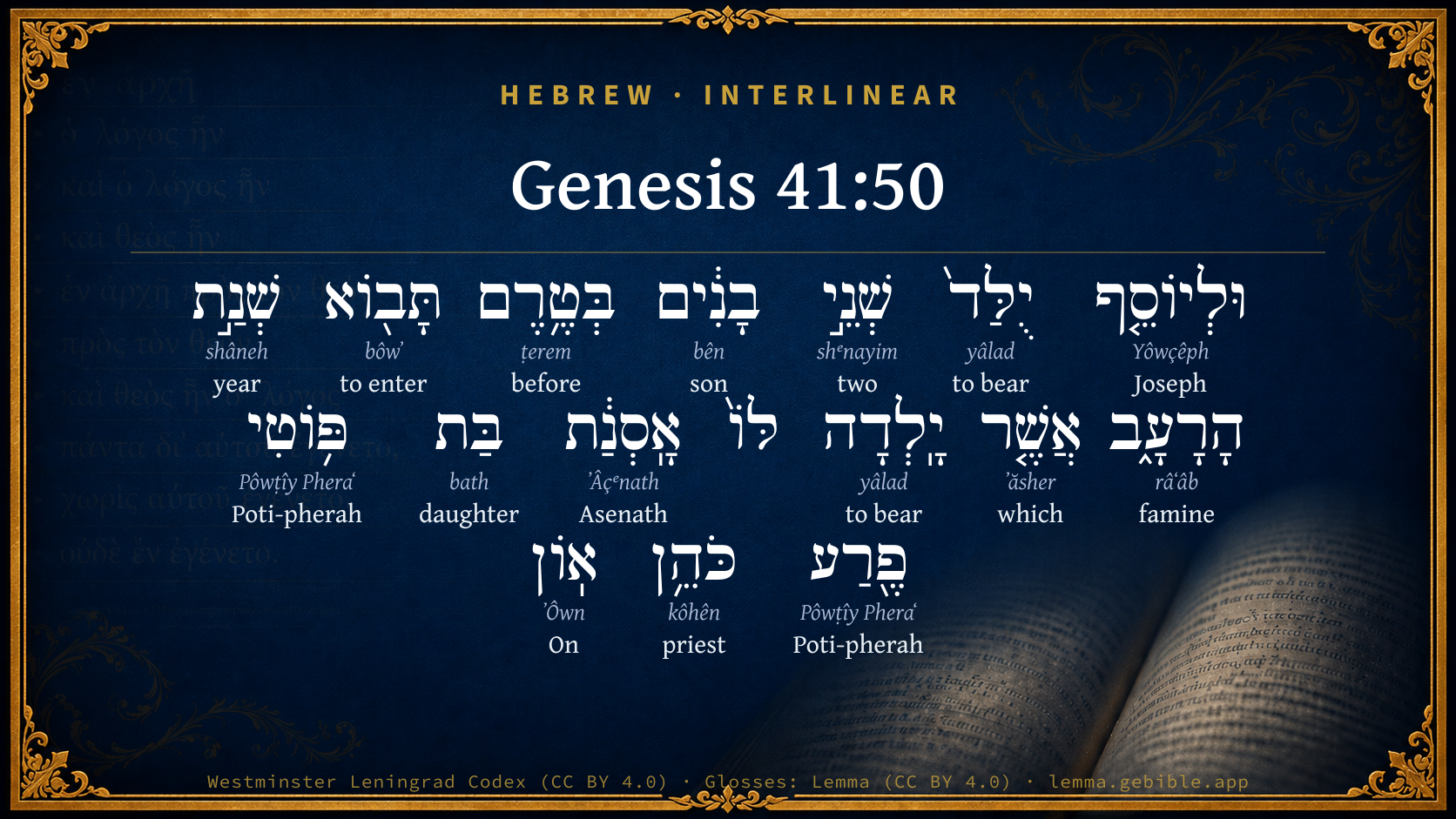
Hebrew (Westminster Leningrad Codex) Genesis 41:50 appears in the Hebrew Old Testament. The text above is from the Westminster Leningrad Codex. Each word links to its Strong’s number, a concise gloss, and parsing drawn from the Open Scriptures Hebrew Bible morphology. Click any word for its full Brown-Driver-Briggs (BDB) entry.
Download image
Cite this verse

Genesis 41:50 (World English Bible). Public Domain. Lemma interlinear Bible study tool, https://lemma.gebible.app/v/genesis/41/50.

Show BibTeX & RIS
BibTeX
RIS
English Translation
To Joseph were born two sons before the year of famine came, whom Asenath, the daughter of Potiphera priest of On, bore to him.
World English Bible · Public Domain
Download a study sheet

One document with this verse’s original text, its word-by-word gloss line, the meaning frame, cross-references with their text, attributed commentary, and full source and license credits — printable, and it pastes into notes with its structure intact.

This verse Autodidact and up

Study sheet (.html) Plain text (.txt)

A passage Seminary Student

Up to 50 verses in one chapter. A passage sheet keeps up to 6 commentary sources and 12 cross-references per verse, in the order this page ranks them, and says so on the sheet whenever that leaves anything out. Ask for a single verse and you get the Autodidact verse sheet above.

Everything on this page stays free to read, with no account — the sheet is a download of what is already on screen, not access to it.

Want to remove ads? Support Godless Engineer
Compare translations 3

The same verse in 3 English versions, stacked beneath the original-language interlinear above. Click any original word for its lexicon entry.

Each is an independent rendering of the whole verse — the interlinear is not word-aligned to these translations.

Highlighted words mark where these versions differ — a whole-verse word diff, not a word-by-word alignment.

  • World English Bible Public Domain
    To Joseph were born two sons before the year of famine came, whom Asenath, the daughter of Potiphera priest of On, bore to him.
  • King James Version Public Domain
    And unto Joseph were born two sons before the years of famine came, which Asenath the daughter of Potipherah priest of On bare unto him.
  • unfoldingWord Literal Text CC BY-SA 4.0
    And before the years of the famine came, two sons were born to Joseph, whom Asenath, the daughter of Potiphera, the priest of On, bore for him.

unfoldingWord Literal Text — © unfoldingWord, licensed CC BY-SA 4.0. Word-aligned USFM3 via Door43 (git.door43.org/unfoldingWord/en_ult).

Versions to compare (up to 4)

3 of 4 selected

Show all 18 translations

Every available English version of this verse, each an independent rendering of the whole verse.

  • World English Bible Public Domain
    To Joseph were born two sons before the year of famine came, whom Asenath, the daughter of Potiphera priest of On, bore to him.
  • Berean Standard Bible Public Domain
    Before the years of famine arrived, two sons were born to Joseph by Asenath daughter of Potiphera, priest of On.
  • Majority Standard Bible Public Domain
    Before the years of famine arrived, two sons were born to Joseph by Asenath daughter of Potiphera, priest of On.
  • King James Version Public Domain
    And unto Joseph were born two sons before the years of famine came, which Asenath the daughter of Potipherah priest of On bare unto him.
  • American Standard Version (1901) Public Domain
    And unto Joseph were born two sons before the year of famine came, whom Asenath, the daughter of Potiphera priest of On, bare unto him.
  • Revised Version (1885) Public Domain
    And unto Joseph were born two sons before the year of famine came, which Asenath the daughter of Poti-phera priest of On bare unto him.
  • Geneva Bible (1599) Public Domain
    Now vnto Ioseph were borne two sonnes (before the yeeres of famine came) which Asenath the daughter of Poti-pherah prince of On bare vnto him.
  • Douay-Rheims (1899) Public Domain
    And all the abundance of grain was laid up in every city.
  • Young's Literal Translation Public Domain
    And to Joseph were born two sons before the year of famine cometh, whom Asenath daughter of Poti-Pherah, priest of On, hath borne to him,
  • Literal Standard Version CC BY-SA 4.0
    And to Joseph were born two sons before the year of famine comes, whom Asenath daughter of Poti-Pherah, priest of On, has borne to him,
  • Unlocked Literal Bible CC BY-SA 4.0
    Joseph had two sons before the years of famine came, whom Asenath, the daughter of Potiphera priest of On, bore to him.
  • unfoldingWord Literal Text CC BY-SA 4.0
    And before the years of the famine came, two sons were born to Joseph, whom Asenath, the daughter of Potiphera, the priest of On, bore for him.
  • Darby Bible Public Domain
    And to Joseph were born two sons before the year of famine came, whom Asnath the daughter of Potipherah the priest in On bore to him.
  • World Messianic Bible Public Domain
    To Joseph were born two sons before the year of famine came, whom Asenath, the daughter of Potiphera priest of On, bore to him.
  • Webster's Bible Public Domain
    And to Joseph were born two sons before the years of famine came: which Asenath the daughter of Poti-pherah priest of On bore to him.
  • Free Bible Version CC BY-SA 4.0
    It was during this time, before the years of famine came, that Joseph had two sons by Asenath, the daughter of Potiphera, priest of On.
  • Bible in Basic English Public Domain
    And before the time of need, Joseph had two sons, to whom Asenath, the daughter of Poti-phera, priest of On, gave birth.
  • JPS Tanakh (1917) Public Domain
    And unto Joseph were born two sons before the year of famine came, whom Asenath the daughter of Poti-phera priest of On bore unto him.

Literal Standard Version (2020), Covenant Press — licensed CC BY-SA 4.0. Text via the HelloAO Bible API (eBible.org). Unlocked Literal Bible (unfoldingWord) — licensed CC BY-SA 4.0. Text via the HelloAO Bible API (eBible.org). unfoldingWord Literal Text — © unfoldingWord, licensed CC BY-SA 4.0. Word-aligned USFM3 via Door43 (git.door43.org/unfoldingWord/en_ult). Free Bible Version, Dr. Jonathan Gallagher — licensed CC BY-SA 4.0. Text via the HelloAO Bible API (eBible.org).

Word by word

More ways to search: Search by grammar → Find every occurrence → Compare this word →

Practice this passage: Drill this verse → Learn its vocabulary →

אָֽסְנַ֔ת
ʼÂçᵉnath
H621
“Asenath”
Noun, Proper
Part of Speech
Noun
Type
Proper
Full BDB Definition

Origin: of Egyptian derivation

TWOT: None

Asenath = "belonging to the goddess Neith" - the wife of Joseph
  1. וּלְיוֹסֵ֤ף Yôwçêph H3130 “and · to/for · Joseph” Conjunction + Preposition + Noun, Proper
  2. יֻלַּד֙ yâlad H3205 “to bear” Verb, Pual, Perfect, 3rd Person, Masculine, Singular
  3. שְׁנֵ֣י shᵉnayim H8147 “two” Adjective, Cardinal number, Masculine, Dual, Construct
  4. בָנִ֔ים bên H1121 “sons” Noun, Common, Masculine, Plural, Absolute
  5. בְּטֶ֥רֶם ṭerem H2962 “in/at · before” Preposition + Adverb
  6. תָּב֖וֹא bôwʼ H935 “to enter” Verb, Qal, Imperfect, 3rd Person, Feminine, Singular
  7. שְׁנַ֣ת shâneh H8141 “year of” Noun, Common, Feminine, Singular, Construct
  8. הָרָעָ֑ב râʻâb H7458 “the · famine” Particle, Definite Article + Noun, Common, Masculine, Singular, Absolute
  9. אֲשֶׁ֤ר ʼăsher H834 “which” Particle, Relative
  10. יָֽלְדָה yâlad H3205 “to bear” Verb, Qal, Perfect, 3rd Person, Feminine, Singular
  11. בַּת bath H1323 “daughter of” Noun, Common, Feminine, Singular, Construct
  12. פּ֥וֹטִי Pôwṭîy Pheraʻ H6319 “Poti-pherah” Noun, Proper
  13. פֶ֖רַע Pôwṭîy Pheraʻ H6319 “Poti-pherah” Noun, Proper
  14. כֹּהֵ֥ן kôhên H3548 “priest of” Noun, Common, Masculine, Singular, Construct
  15. אֽוֹן ʼÔwn H204 “On” Noun, Proper

About this verse

These counts appear in no published source. They are computed here, from the morphology-tagged text and Lemma’s own curated glosses. What Lemma adds →

17
words
14
distinct lemmas
Pentateuch
section

Notable vocabulary

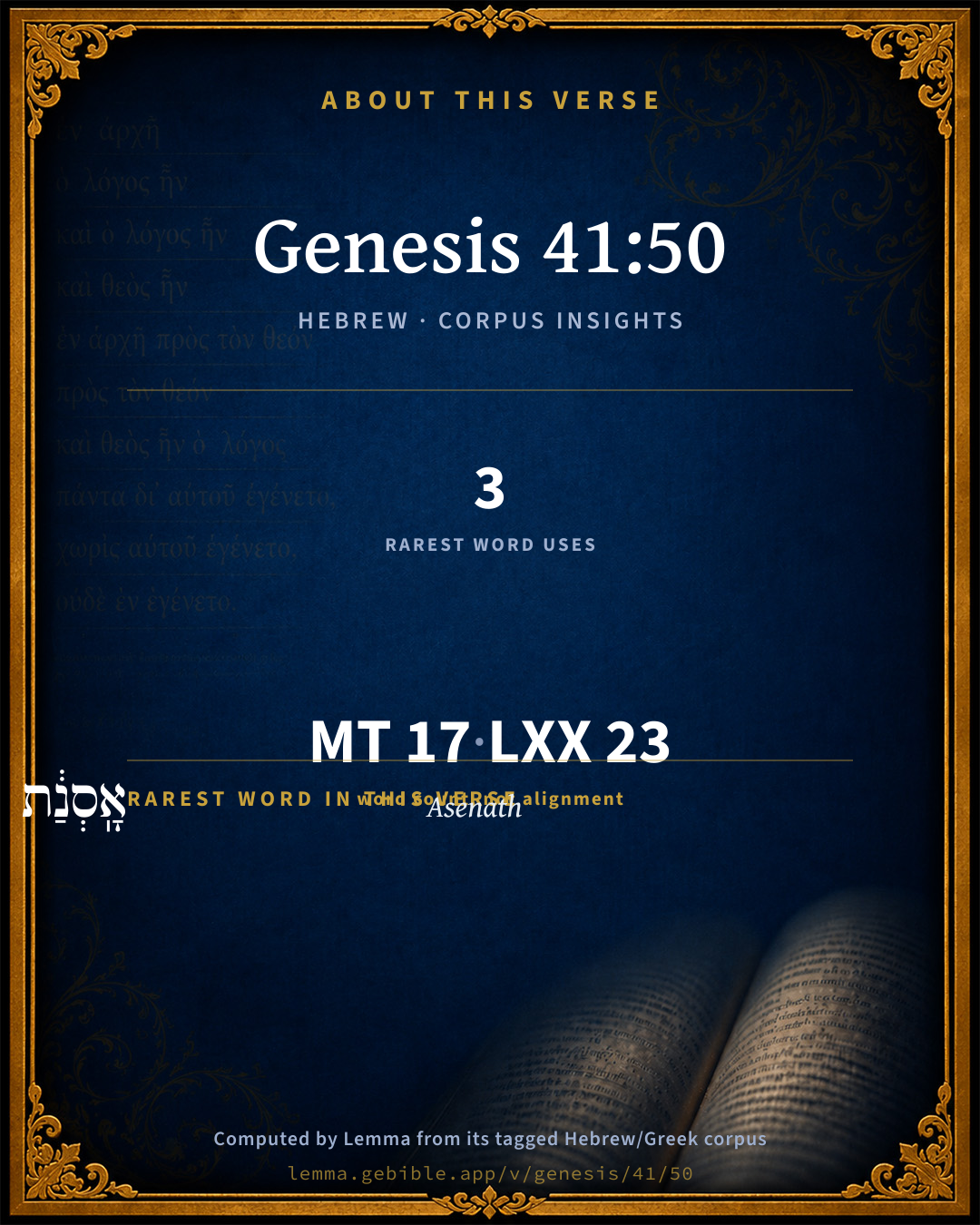
The rarest word here is אָֽסְנַ֔ת Asenath H621 — appearing just 3 times in the whole Hebrew Bible.

Shared distinctive vocabulary

אָֽסְנַ֔ת Asenath H621 occurs in 3 verses of the Hebrew Bible. Also found in:

Grammatical profile

  • 3 verbs
  • 10 nouns
  • 1 adjective
  • 1 preposition
  • 1 adverb
  • 1 particle

Verb forms

  • יֻלַּד֙ Pual · Perfect
  • תָּב֖וֹא Qal · Imperfect
  • יָֽלְדָה Qal · Perfect

Repetition

Words recur within this verse — often emphatic in Hebrew:

  • יֻלַּד֙ to bear H3205 ×2
  • פּ֥וֹטִי Poti-pherah H6319 ×2

Hebrew & Septuagint length

In English translation the verse runs 24 words from the Hebrew and 26 from the Septuagint (LXX English) — closely comparable.

A rough comparison of the two English renderings, which tokenize alike — not a word-level alignment.

Word counts can differ between the Hebrew and the Greek without any difference in meaning — e.g. the Hebrew direct-object marker אֵת has no separate Greek word, and Greek often adds the article ὁ.

In the original languages it is 17 Hebrew tokens and 23 Greek tokens — but the two are counted differently (Hebrew bundles its prefixes and suffixes into one token; the Greek is in lemma form), so that isn’t a like-for-like length.

Cross-references

4

Topical passages linked to Genesis 41:50 in the Treasury of Scripture Knowledge — connected by theme and wording, ordered by reader-vote popularity; previews shown in the World English Bible.

  • Genesis 46:20 To Joseph in the land of Egypt were born Manasseh and Ephraim, whom Asenath, the daughter of Potiphera, priest of On, bore to him.
  • Genesis 48:5 Now your two sons, who were born to you in the land of Egypt before I came to you into Egypt, are mine; Ephraim and Manasseh, even as Reuben and Simeon, will be mine.
  • Genesis 41:45 Pharaoh called Joseph's name Zaphenath-paneah; and he gave him Asenath, the daughter of Potiphera priest of On as a wife. Joseph went out over the land of Egypt.
  • 2 Samuel 8:18 and Benaiah the son of Jehoiada [was over] the Cherethites and the Pelethites; and David's sons were chief ministers.

Cross-references courtesy of OpenBible.info (CC BY 4.0).

Hebrew and Greek witnesses Masoretic Hebrew ↔ Greek Septuagint

The same verse in the two great witnesses to the Old Testament, shown verse-for-verse.

These are two independent witnesses, not word-aligned to each other, and the Septuagint is shown in lemma (dictionary) form.

Hebrew Genesis 41:50 Masoretic · Westminster Leningrad Codex

וּלְיוֹסֵ֤ף יֻלַּד֙ שְׁנֵ֣י בָנִ֔ים בְּטֶ֥רֶם תָּב֖וֹא שְׁנַ֣ת הָרָעָ֑ב אֲשֶׁ֤ר יָֽלְדָה לּוֹ֙ אָֽסְנַ֔ת בַּת פּ֥וֹטִי פֶ֖רַע כֹּהֵ֥ן אֽוֹן

To Joseph were born two sons before the year of famine came, whom Asenath, the daughter of Potiphera priest of On, bore to him.

World English Bible · Public Domain

Greek LXX Genesis 41:50 Septuagint · lemma form

ὁ δέ ιωσηφ γίγνομαι υἱός δύο πρό ὁ ἔρχομαι ὁ ἑπτά ἔτος ὁ λιμός ὅς τίκτω αὐτός ασεννεθ θυγάτηρ πετεφρης ἱερεύς ἥλιος πόλις

And to Joseph were born two sons, before the seven years of famine came, which Aseneth, the daughter of Petephres, priest of Heliopolis, bore to him.

LXX2012 (modern English Septuagint) · Public Domain

Hebrew: Westminster Leningrad Codex (CC BY 4.0). Greek: Septuagint (public domain); English from LXX2012 (modern English Septuagint) (Public Domain). How the Septuagint differs from the Hebrew →

Targum (Aramaic paraphrase)

2

The Targum is the ancient Jewish Aramaic paraphrase of the Hebrew Scriptures — an interpretive translation, not the Hebrew text itself. Onkelos (literal) and Pseudo-Jonathan (expansive) render the Torah, and Jonathan the Prophets. Coverage is partial: where no permissively-licensed English translation exists for a verse, only the Aramaic is shown. This is verse-level text, not a word-by-word alignment to the Hebrew.

  1. Targum Onkelos Torah (Genesis–Deuteronomy)
    וּלְיוֹסֵף אִתְיְלִיד תַּרְתֵּין בְּנִין עַד לָא עַלַּת שַׁתָּא דְכַפְנָא דִּילִידַת לֵהּ אָסְנַת בַּת פּוֹטִי פֶרַע רַבָּא דְאוֹן

    (no public-domain English translation for this verse)

    Targum Onkelos — Aramaic: “Onkelos Genesis” (public domain); “Onkelos Exodus” (public domain); “Onkelos Leviticus” (public domain); “Onkelos Numbers” (public domain); “Onkelos Deuteronomy” (public domain). English: “Sefaria Community Translation” (CC0 1.0 (public-domain dedication)); “J.W. Etheridge. The Targums of Onkelos and Jonathan Ben Uzziel on the Pentateuch. London: Longmans, Green, 1862” (public domain). Text via Sefaria.

  2. Targum Pseudo-Jonathan Torah (Genesis–Deuteronomy)
    וּלְיוֹסֵף אִתְיְלִידוּ תְּרֵין בְּנִין עַד לָא עָלַת שַׁתָּא דְכַפְנָא דִילִידַת לֵיהּ אָסְנַת דְרִיבַת בְּבֵית פּוֹטִיפֶרַע רַבָּא דְטָנִיס

    And to Joseph were born two sons before the year of famine arose, which Asenath who had been brought up in the house of Potipliera prince of Tanis bare to him.

    Targum Pseudo-Jonathan — Aramaic: “Targum Jonathan on Genesis” (public domain); “Targum Jonathan on Exodus” (public domain); “Targum Jonathan on Leviticus” (public domain); “Targum Jonathan on Numbers” (public domain); “Targum Jonathan on Deuteronomy” (public domain). English: “The Targum of Jonathan ben Uzziel, trans. J. W. Etheridge, London, 1862” (public domain). Text via Sefaria.

Commentary

Notes on Genesis 41:50 from classic Christian and Jewish commentators (each source and its license shown beneath its notes). The classic Christian expositions comment on the surrounding passage and are grouped to its opening verse, so a note may address several verses; the Jewish commentaries on the Tanakh (Rashi and others) are per-verse, so they appear only where the commentator wrote on this verse.

Lemma curates 59 commentaries, every one of them public domain or Creative Commons licensed, each selected and text-cleaned for this edition rather than reprinted as found. About our sources →

Trapp's Complete Commentary

John Trapp

Gen 41:50 And unto Joseph were born two sons before the years of famine came, which Asenath the daughter of Potipherah priest of On bare unto him.

Ver. 50. Asenath the daughter of Potipherah.] This was not Potiphar, Joseph’s master. Joseph would not marry the daughter of such a housewife. Partus fere siquitur ventrem. Ingenlum ipsum atque indoles (veluti conclusio sequitur inferiorem partem) plerumque matrissat.

But what a jest is that of Jonathan the Chaldee Paraphrast, Asenath quam pepererat Dina Sichemo, &c. Asenath was Sichem’s daughter by Dinah, but adopted and bred up by the wife of Potiphar! Audi hoc et ride, saith Drusius.

John Trapp, A Commentary or Exposition upon All the Books of the Old and New Testament (1647–1656) — public domain. Text from a community e-Sword module.

Joseph Benson's Commentary

Gen 41:50. Two sons — In the names he gave them, he owned the divine providence giving this happy turn to his affairs. He was made to forget his misery, but could he be so unnatural as to forget all his father’s house? And he was made fruitful in the land of his affliction. It had been the land of his affliction, and, in some sense, it was still so, for his distance from his father was still his affliction. Ephraim signifies fruitfulness, and Manasseh, forgetfulness.

Joseph Benson's Commentary on the Old and New Testaments (1811–1818) — public domain. Text from a community e-Sword module.

F. W. Grant's Numerical Bible

Section 4. (Gen 41:50-57; Gen 42:1-38; Gen 43:1-34; Gen 44:1-34; Gen 45:1-28; Gen 46:1-34; Gen 47:1-26.)

The Days of Famine.

Now comes the time of famine; and when God’s judgments are in the earth, the inhabitants of the world shall learn righteousness. Not in the plenteous times of Christianity will the world as a whole turn to God; and therefore come drought and famine from the same hand which, unknown, bestowed the blessing. The present dispensation closed by the removal of the Church to be with her Lord, the times of the Gentiles will close, as the Lord Himself predicts (Luk 21:25-27): "And there shall be signs in the sun and in the moon, and upon the earth distress of nations with perplexity, the sea and the waves roaring; men’s hearts failing them for fear, and for looking after those things which are coming on the earth; for the powers of the heavens shall be shaken: and then shall they see the Son of Man coming in a cloud, with power and great glory."

Before He appears, and amid all the trial of a time such as the world has never seen, Israel will be preparing to recognize and receive her rejected Lord. And this is what we find typified in the chapters to which we have now come. The way in which it is expounded here shows surely the divine interest in their recovery, full of touching pathos as they are known to be.

The famine in all lands reaches Canaan also, and Joseph’s ten brethren come down to buy corn in Egypt. We are all familiar with what follows, and how their hearts and consciences are probed by one who knows and loves them well, but whom they know not. They obtain, indeed, a temporary supply for their necessities, but leave Simeon in prison, and are bidden not to appear again except they bring Benjamin with them. Famine again forces them to come down; and this time, Judah having undertaken for Benjamin with his father, they bring him also. They are feasted by Joseph, still unknown; are sent away with the cup in Benjamin’s sack; pursued, and brought back under the charge of theft; Benjamin is to remain as Joseph’s slave, but Judah, his heart fully reached, offers himself in his stead: then Joseph’s love bursts out; he makes himself known to them; they own their sin, are reconciled and comforted with his love.

In all this, it is plain how all turns upon Benjamin and their state toward him. This is made the test of their condition. The power for their deliverance lies in Joseph’s hand alone, however, and their exercises as to Benjamin all tend to awakening conscience and heart as to their sin against Joseph. The key of the typical interpretation is to be found in this: —

Joseph is Christ as we know Him, once rejected and suffering, now exalted: this is He whom Israel does not know. A Christ triumphant simply, and reigning upon the earth, is the Benjamin who is found among them, whether in the days of the Lord’s rejection or the latter days. The Conqueror they were prepared for; the Sufferer who must go before Him -not knowing their own deep need, -they have refused. Yet the two are really one, and for them the Conqueror cannot be till they receive the Sufferer: not the faith of a Sufferer merely, but the One who has been this. Power lies with Joseph, not with Benjamin.

But Joseph’s heart longs after Benjamin, -that is, Christ longs to display this character of power for them; but for this they must be brought to repentance, and He uses their ideal, prophetical Messiah to bring their hearts back to Himself the true one.

Amid the sorrows of the last days, this will be accomplished for them. He who, unknown, is seeking them will make them realize their Benjamin as Benoni -"the son of my sorrow," and that as the fruit of their own sin. (Gen 44:16.) Benjamin is taken from them: they have lost their part in Messiah as having rejected Him. All the depths of Judah’s heart are stirred; and in his agony for Benjamin, he is met and overwhelmed by the revelation of Joseph. They look upon Him whom they have pierced, and mourn for Him as one mourneth for his only son, and a fountain for sin and for uncleanness is opened to them. But this brings the whole nation into blessing under Christ.

After this, we read of the reduction of Egypt itself under the immediate authority of the throne. The people, bankrupt through the famine, receive back their lands from the bounty of the king, returning him one fifth of the produce as the token of their indebtedness to the grace from which they have received. It is thus that the world, under Christ, will find its place in true blessing before God. In the one fifth rendered, we are reminded once more of the Abrahamic 5, -the impotence of the creature and the omnipotence of God, -the one part a recognition of divine sovereignty. If we take it as two tenths, it may remind us of the double claim of God upon us -by creation and by redemption. This the world will acknowledge in the day to come.

F. W. Grant, The Numerical Bible (4th ed., 1903) — public domain. Text from a community e-Sword module.

Tyndale Open Study Notes

Tyndale Open Resources

41:50-52 In spite of his position and authority, Joseph never abandoned his heritage; he gave Hebrew names to his two sons. • Manasseh: Joseph’s prosperity and success made him “forget” the misery of separation from his family. • Ephraim: In so naming him, Joseph proclaimed his gratitude to God for making him “fruitful” in Egypt.

Tyndale Open Study Notes — © Tyndale Open Resources, licensed CC BY-SA 4.0. Text via the HelloAO Bible API.

Jamieson, Fausset & Brown

Robert Jamieson, A. R. Fausset & David Brown

unto Joseph were born two sons--These domestic events, which increased his temporal happiness, develop the piety of his character in the names conferred upon his children.

Jamieson, Fausset & Brown — Commentary Critical and Explanatory on the Whole Bible (1871) — public domain (CC PDM 1.0). Text via the HelloAO Bible API.

Adam Clarke's Commentary

Verse 50. Two sons] Whom he called by names expressive of God's particular and bountiful providence towards him. MANASSEH, מנשה menashsheh, signifies forgetfulness, from נשה nashah, to forget; and EPHRAIM, אפרים ephrayim, fruitfulness, from פרה parah, to be fruitful; and he called his sons by these names, because God had enabled him to forget all his toil, disgrace, and affliction, and had made him fruitful in the very land in which he had suffered the greatest misfortune and indignities.

Adam Clarke's Commentary on the Bible (1810–1826) — public domain. Text from a community e-Sword/MySword module.

John Calvin's Commentaries

50. And unto Joseph were born two sons. Although the names which Joseph gave his sons in consequence of the issue of his affairs, breathe somewhat of piety, because in them he celebrates the kindness of God: yet the oblivion of his father’s house, which, he says, had been brought upon him, can scarcely be altogether excused. It was a pious and holy motive to gratitude, that God had caused him to “forget” all his former miseries; but no honor ought to have been so highly valued, as to displace from his mind the desire and the remembrance of his father’s house. Granted that he is Viceroy of Egypt, yet his condition is unhappy, as long as he is an exile from the Church. Some, in order to exculpate the holy man, explain the passage as meaning that he so rejoiced in the present favor of God, as to make him afterwards forgetful of the injuries inflicted upon him by his brethren; but this (in my judgment) is far too forced. And truly, we must not anxiously labor to excuse the sin of Joseph; but rather, I think, we are admonished how greatly we ought to be on our guard against the attractions of the world, lest our minds should be unduly gratified by them. Behold Joseph, although he purely worships God, is yet so captivated by the sweetness of honor, and has his mind so clouded, that he becomes indifferent to his father’s house, and pleases himself in Egypt. But this was almost to wander from the fold of God. It was, indeed, a becoming modesty, that from a desire of proclaiming the Divine goodness towards him, he was not ashamed to perpetuate a memorial of his depressed condition in the names of his sons. They who are raised on high, from an obscure and ignoble position, desire to extinguish the knowledge of their origin, because they deem it disgraceful to themselves. Joseph, however, regarded the commendation of Divine grace more highly than an ostentatious future nobility.

John Calvin's Commentaries (1540-1563) — public domain. Text from the Calvin Translation Society English edition (1840s-50s) via the Christian Classics Ethereal Library (ccel.org). Calvin's coverage is partial (roughly two-thirds of the Bible); uncommented books and verses are honest gaps, never fabricated. The 19th-century editor's footnotes and remarks are omitted so the notes are faithfully Calvin's own voice.

John Gill's Exposition

And when all the land of Egypt was famished,.... Their old stock and store eaten up, and the inhabitants ready to starve with hunger:

the people cried to Pharaoh for bread; as their common father, and knowing that he had stores of provision laid up in all cities against this time:

and Pharaoh said to the Egyptians, go unto Joseph; whom he had appointed over this business of providing and laying up corn against this time, and of distributing it:

what he saith to you, do; give the price for the corn he fixes or requires; for this was the principal thing they had to do with him, to get corn for their money.

John Gill's Exposition of the Whole Bible (1746–1763) — public domain (CC PDM 1.0). Text via the HelloAO Bible API.

The Pulpit Commentary

Vers. 50, 51. And unto Joseph wore born two sons before the years of famine came, (literally, before the coming of the gears of famine), which Asenath the daughter of Poti-pherah priest of On bare unto him. And Joseph called, the name of the firstborn Manasseh ("Forgetting," from nashah, to forget): For God (Elohim; Joseph not at the moment thinking of his son"s birth in its relations to the theocratic kingdom, but simply in its connection with the overruling providence of God which had been so signally illustrated in his elevation, from a position of obscurity in Canaan to such conspicuous honor in the land of the Pharaohs), said he, hath made me forget all my toil, and all my father"s house. Not absolutely (Calvin, who censures Joseph on this account, vix tamen in totem potest excusari oblivio paternae domus), as events subsequently proved, but relatively, the pressure of his former affliction being relieved by his present happiness, and the loss of his father"s house in some degree compensated by the building of a house for himself.

The Pulpit Commentary (1880–1919), ed. H.D.M. Spence-Jones & Joseph S. Exell — public domain. Text from a community e-Sword module.

John Wesley's Explanatory Notes

Two sons - In the names he gave them, he owned the divine Providence giving this happy turn to his affairs. He was made to forget his misery, but could he be so unnatural as to forget all his father's house? And he was made fruitful in the land of his affliction. It had been the land of his affliction, and, in some sense, it was still so, for his distance from his father was still his affliction. Ephraim signifies fruitfulness, and Manasseh forgetfulness.

John Wesley, Explanatory Notes Upon the Whole Bible (1754–1765) — public domain. Text via the GEBible commentary corpus.

Keil & Delitzsch

C. F. Keil & F. Delitzsch

During the fruitful years two sons were born to Joseph. The first-born he named Manasseh, i.e., causing to forget; "for, he said, God hath made me forget all my toil and all my father's house (נשּׁני, an Aram. Piel form, for נשּׁני, on account of the resemblance in sound to מנשּׁה)." Haec pia est, ac sancta gratiarum actio, quod Deus oblivisci eum fecit pristinas omnes areumnas: sed nullus honor tanti esse debuit, ut desiderium et memoriam paternae domus ex animo deponeret (Calvin). But the true answer to that question, whether it was a Christian boast for him to make, that he had forgotten father and mother, is given by Luther: "I see that God would take away the reliance which I placed upon my father; for God is a jealous God, and will not suffer the heart to have any other foundation to rely upon, but Him alone." This also meets the objection raised by Theodoret, why Joseph did not inform his father of his life and promotion, but allowed so may years to pass away, until he was led to do so at last in consequence of the arrival of his brothers. The reason of this forgetfulness and silence can only be found in the fact, that through the wondrous alteration in his condition he had been led to see, that he was brought to Egypt according to the counsel of God, and was redeemed by God from slavery and prison, and had been exalted by Him to be lord over Egypt; so that, knowing he was in the hand of God, the firmness of his faith led him to renounce all wilful interference with the purposes of God, which pointed to a still broader and more glorious goal (Baumgarten, Delitzsch).

Keil & Delitzsch — Biblical Commentary on the Old Testament (1861–1891) — public domain (CC PDM 1.0). Text via the HelloAO Bible API. (Old Testament only.)

unfoldingWord translationNotes

Door43 World Missions Community

before the years of famine came

This speaks about years as if they are something that travels and comes to a place. AT: "before the seven years of the famine began" (See: Metaphor)

Asenath

a woman's name. See how you translated this in Genesis 41:45. (See: How to Translate Names)

daughter of Potiphera

"Potiphera" is the father of Asenath. See how you translated this in Genesis 41:45. (See: How to Translate Names)

priest of On

On is a city, also called Heliopolis, which was "the City of the Sun" and the center of worship of the sun god Ra. See how you translated this in Genesis 41:45. (See: How to Translate Names)

Manasseh

Translators may also add a footnote that says, "The name 'Manasseh' means 'to cause to forget.'"

father's household

This refers to Joseph's father Jacob and his family.

Ephraim

Translators may also add a footnote that says, "The name 'Ephraim' means 'to be fruitful' or 'to have children.'"

made me fruitful

Here "fruitful" means to prosper or to have children. (See: Idiom)

in the land of my affliction

The abstract noun "affliction" can be stated as "I have suffered." AT: "in this land where I have suffered" (See: Abstract Nouns)

translationWords

Joseph (OT)

son

famine

priest

name

firstborn

Manasseh

God

ancestor

household

Ephraim

fruit

afflicted

unfoldingWord translationNotes — © Distant Shores Media and the Door43 World Missions Community, licensed CC BY-SA 4.0. Source: git.door43.org/Door43/en_tn.

Rashi

Rabbi Shlomo Yitzchaki (Rashi)

בטרם תבא שנת הרעב BEFORE THE YEAR OF FAMINE CAME — from here we learn that a man must practise continence during times of famine (cf. Taanit 11a).

Rashi on the Tanakh — English translations: “The Judaica Press complete Tanach with Rashi, translated by A. J. Rosenberg” (CC BY 4.0); “Pentateuch with Rashi's commentary by M. Rosenbaum and A.M. Silbermann, 1929-1934” (public domain); “The Metsudah Tanach series, Lakewood, N.J” (CC BY 4.0); and “The Book of Joshua, Metsudah Publications, 1997” (CC BY 4.0). Text via Sefaria.

Radak

Rabbi David Kimhi (Radak)

וליוסף יולד, the singular mode used by the Torah in describing the birth of these two sons of Joseph suggests that they were twins. At least they were presumably born during the same night.

שנת הרעב, the first year of the famine; the Torah adds: בטרם תבא, for they were born during the last year of the 7 years of plenty. Joseph was 37 years old when they were born. They were therefore 19 years old when Yaakov died. My teachers (Taanit 11) explained that the wording “before the onset of the famine,” is meant to teach that a person must not engage in marital intercourse during years of famine.

אשר ילדה לו אסנת, this is to teach that Joseph did not have any additional wives, i.e. both of his sons were born by the same mother.

Radak on the Tanakh — English translations: “Sefaria Community Translation” (CC0 1.0 (public-domain dedication)); “Eliyahu Munk, HaChut Hameshulash” (CC BY 4.0); “Rabbi Mike Feuer, Jerusalem Anthology” (CC BY 4.0); and “R. David Kimhi on the first book of Psalms, Translated by R.G. Finch, London, 1919” (public domain). Text via Sefaria.

Lesson kit

Teaching starters — assembled from the data on this page, not authored interpretation. Every prompt links to the verse data it draws on. Edit before teaching.

Genesis, in the Pentateuch, opens this verse with 17 words (14 distinct Hebrew lemmas). Its most distinctive word is ʼÂçᵉnath (“Asenath”). A historical commentator’s framing appears above. Read the whole chapter for the surrounding context.

Discussion questions

  1. What does “Asenath” (ʼÂçᵉnath) contribute to the verse as a whole?
  2. Genesis 41:45 shares the word «Asenath» with this verse. How do the two illuminate each other?
  3. “to bear” occurs 2× in this one verse. What is the effect of the repetition?
  4. The translations on this page render this verse differently — a whole-verse word diff, not a word-by-word alignment. What might account for the different wordings?
  5. The verb «יֻלַּד֙» is Pual Perfect. How does its form color the action?
  6. Reading how Trapp's Complete Commentary and Joseph Benson's Commentary read this verse, where do the two commentators agree and where do they part?

Things to notice

Reading settings

Reading text

Shown beneath each verse's original-language words.

Old Testament
Old Testament edition

Read the OT as the Masoretic Hebrew (MT) or the Greek Septuagint (LXX).

English shown for the Greek Septuagint (in the Hebrew ↔ Greek comparison).

Comparing translations? Open the Compare panel on any verse page to stack up to four side by side.