
Ecclesiastes 6:4

Hebrew (Westminster Leningrad Codex) Ecclesiastes 6:4 appears in the Hebrew Old Testament. The text above is from the Westminster Leningrad Codex. Each word links to its Strong’s number, a concise gloss, and parsing drawn from the Open Scriptures Hebrew Bible morphology. Click any word for its full Brown-Driver-Briggs (BDB) entry.
Download image
Cite this verse

Ecclesiastes 6:4 (World English Bible). Public Domain. Lemma interlinear Bible study tool, https://lemma.gebible.app/v/ecclesiastes/6/4.

Show BibTeX & RIS
BibTeX
RIS
English Translation
for it comes in vanity, and departs in darkness, and its name is covered with darkness.
World English Bible · Public Domain
Download a study sheet

One document with this verse’s original text, its word-by-word gloss line, the meaning frame, cross-references with their text, attributed commentary, and full source and license credits — printable, and it pastes into notes with its structure intact.

This verse Autodidact and up

Study sheet (.html) Plain text (.txt)

A passage Seminary Student

Up to 50 verses in one chapter. A passage sheet keeps up to 6 commentary sources and 12 cross-references per verse, in the order this page ranks them, and says so on the sheet whenever that leaves anything out. Ask for a single verse and you get the Autodidact verse sheet above.

Everything on this page stays free to read, with no account — the sheet is a download of what is already on screen, not access to it.

Want to remove ads? Support Godless Engineer
Compare translations 3

The same verse in 3 English versions, stacked beneath the original-language interlinear above. Click any original word for its lexicon entry.

Each is an independent rendering of the whole verse — the interlinear is not word-aligned to these translations.

Highlighted words mark where these versions differ — a whole-verse word diff, not a word-by-word alignment.

  • World English Bible Public Domain
    for it comes in vanity, and departs in darkness, and its name is covered with darkness.
  • King James Version Public Domain
    For he cometh in with vanity, and departeth in darkness, and his name shall be covered with darkness.
  • unfoldingWord Literal Text CC BY-SA 4.0
    For, in vapor it came, and in the darkness it will go, and in the darkness its name will be covered.

unfoldingWord Literal Text — © unfoldingWord, licensed CC BY-SA 4.0. Word-aligned USFM3 via Door43 (git.door43.org/unfoldingWord/en_ult).

Versions to compare (up to 4)

3 of 4 selected

Show all 18 translations

Every available English version of this verse, each an independent rendering of the whole verse.

  • World English Bible Public Domain
    for it comes in vanity, and departs in darkness, and its name is covered with darkness.
  • Berean Standard Bible Public Domain
    For a stillborn child enters in futility and departs in darkness, and his name is shrouded in obscurity.
  • Majority Standard Bible Public Domain
    For a stillborn child enters in futility and departs in darkness, and his name is shrouded in obscurity.
  • King James Version Public Domain
    For he cometh in with vanity, and departeth in darkness, and his name shall be covered with darkness.
  • American Standard Version (1901) Public Domain
    for it cometh in vanity, and departeth in darkness, and the name thereof is covered with darkness;
  • Revised Version (1885) Public Domain
    for it cometh in vanity, and departeth in darkness, and the name thereof is covered with darkness;
  • Geneva Bible (1599) Public Domain
    For he commeth into vanitie and goeth into darkenesse: and his name shall be couered with darkenesse.
  • Douay-Rheims (1899) Public Domain
    For he came in vain, and goeth to darkness, and his name shall be wholly forgotten.
  • Young's Literal Translation Public Domain
    For in vanity he came in, and in darkness he goeth, and in darkness his name is covered,
  • Literal Standard Version CC BY-SA 4.0
    For in vanity he came in, and in darkness he goes, and in darkness his name is covered,
  • Unlocked Literal Bible CC BY-SA 4.0
    Even such a baby is born in futility and passes away in darkness, and its name remains hidden.
  • unfoldingWord Literal Text CC BY-SA 4.0
    For, in vapor it came, and in the darkness it will go, and in the darkness its name will be covered.
  • Darby Bible Public Domain
    For it cometh in vanity, and departeth in darkness, and its name is covered with darkness;
  • World Messianic Bible Public Domain
    for it comes in vanity, and departs in darkness, and its name is covered with darkness.
  • Webster's Bible Public Domain
    For he cometh with vanity, and departeth in darkness, and his name shall be covered with darkness.
  • Free Bible Version CC BY-SA 4.0
    The way a stillborn child comes into the world and then leaves is painfully hard to understand—arriving and departing in darkness—and who he would have been is never known.
  • Bible in Basic English Public Domain
    In wind it came and to the dark it will go, and with the dark will its name be covered.
  • JPS Tanakh (1917) Public Domain
    for it cometh in vanity, and departeth in darkness, and the name thereof is covered with darkness;

Literal Standard Version (2020), Covenant Press — licensed CC BY-SA 4.0. Text via the HelloAO Bible API (eBible.org). Unlocked Literal Bible (unfoldingWord) — licensed CC BY-SA 4.0. Text via the HelloAO Bible API (eBible.org). unfoldingWord Literal Text — © unfoldingWord, licensed CC BY-SA 4.0. Word-aligned USFM3 via Door43 (git.door43.org/unfoldingWord/en_ult). Free Bible Version, Dr. Jonathan Gallagher — licensed CC BY-SA 4.0. Text via the HelloAO Bible API (eBible.org).

Word by word

More ways to search: Search by grammar → Find every occurrence → Compare this word →

Practice this passage: Drill this verse → Learn its vocabulary →

בַהֶ֥בֶל
hebel
H1892
“in/at the · vapor”
Preposition, Determined + Noun, Common, Masculine, Singular, Absolute
Part of Speech
Preposition + Noun
Type
Common
Gender
Masculine
Number
Singular
State
Absolute
Full BDB Definition

Origin: from H1891

TWOT: 463a

vapour, breath - breath, vapour - vanity (figuratively) - vainly
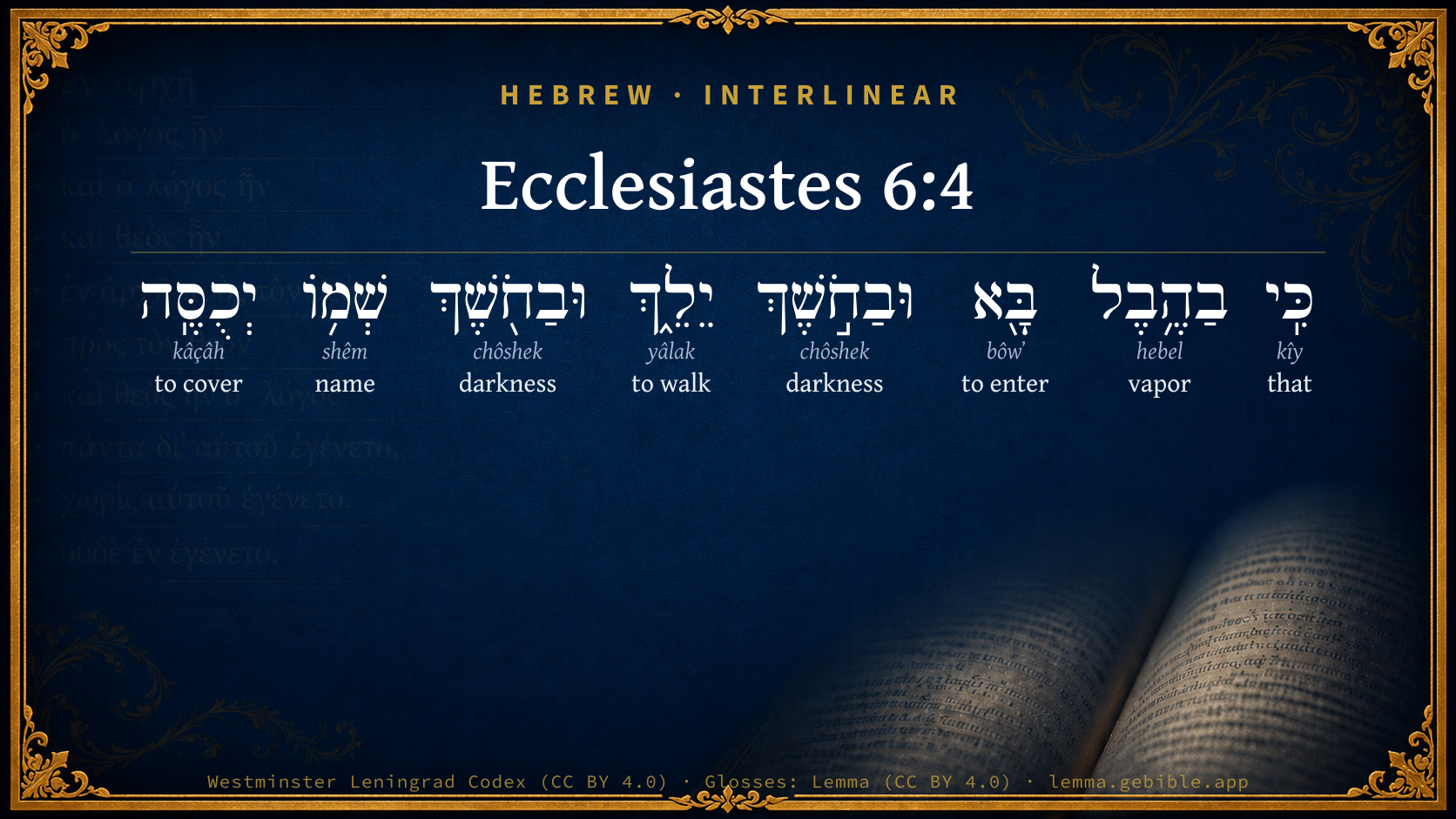
  1. כִּֽי kîy H3588 “that” Conjunction
  2. בָּ֖א bôwʼ H935 “to enter” Verb, Qal, Perfect, 3rd Person, Masculine, Singular
  3. וּבַחֹ֣שֶׁךְ chôshek H2822 “and · in/at the · darkness” Conjunction + Preposition, Determined + Noun, Common, Masculine, Singular, Absolute
  4. יֵלֵ֑ךְ yâlak H3212 “to walk” Verb, Qal, Imperfect, 3rd Person, Masculine, Singular
  5. וּבַחֹ֖שֶׁךְ chôshek H2822 “and · in/at the · darkness” Conjunction + Preposition, Determined + Noun, Common, Masculine, Singular, Absolute
  6. שְׁמ֥וֹ shêm H8034 “name · his” Noun, Common, Masculine, Singular, Construct + Suffix, Personal, 3rd Person, Masculine, Singular
  7. יְכֻסֶּֽה kâçâh H3680 “to cover” Verb, Pual, Imperfect, 3rd Person, Masculine, Singular

About this verse

These counts appear in no published source. They are computed here, from the morphology-tagged text and Lemma’s own curated glosses. What Lemma adds →

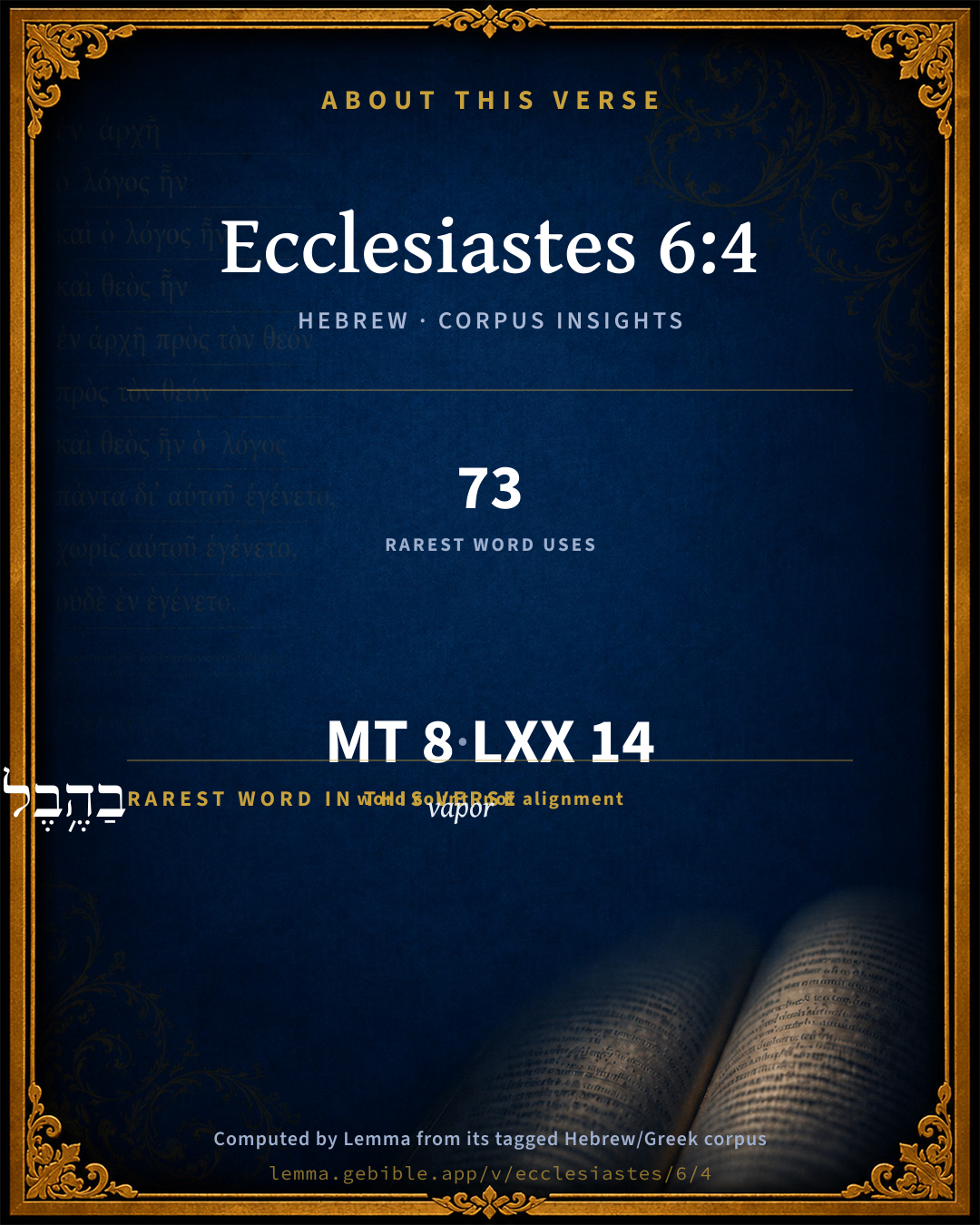
8
words
7
distinct lemmas
Wisdom
section

Grammatical profile

  • 3 verbs
  • 4 nouns
  • 1 conjunction

Verb forms

  • בָּ֖א Qal · Perfect
  • יֵלֵ֑ךְ Qal · Imperfect
  • יְכֻסֶּֽה Pual · Imperfect

Repetition

A word recurs within this verse — often emphatic in Hebrew:

  • וּבַחֹ֣שֶׁךְ darkness H2822 ×2

Hebrew & Septuagint length

In English translation the verse runs 16 words from the Hebrew and 17 from the Septuagint (LXX English) — closely comparable.

A rough comparison of the two English renderings, which tokenize alike — not a word-level alignment.

Word counts can differ between the Hebrew and the Greek without any difference in meaning — e.g. the Hebrew direct-object marker אֵת has no separate Greek word, and Greek often adds the article ὁ.

In the original languages it is 8 Hebrew tokens and 14 Greek tokens — but the two are counted differently (Hebrew bundles its prefixes and suffixes into one token; the Greek is in lemma form), so that isn’t a like-for-like length.

Cross-references

1

Topical passages linked to Ecclesiastes 6:4 in the Treasury of Scripture Knowledge — connected by theme and wording, ordered by reader-vote popularity; previews shown in the World English Bible.

  • Psalms 109:13 Let his posterity be cut off. In the generation following let their name be blotted out.

Cross-references courtesy of OpenBible.info (CC BY 4.0).

Hebrew and Greek witnesses Masoretic Hebrew ↔ Greek Septuagint

The same verse in the two great witnesses to the Old Testament, shown verse-for-verse.

These are two independent witnesses, not word-aligned to each other, and the Septuagint is shown in lemma (dictionary) form.

Hebrew Ecclesiastes 6:4 Masoretic · Westminster Leningrad Codex

כִּֽי בַהֶ֥בֶל בָּ֖א וּבַחֹ֣שֶׁךְ יֵלֵ֑ךְ וּבַחֹ֖שֶׁךְ שְׁמ֥וֹ יְכֻסֶּֽה

for it comes in vanity, and departs in darkness, and its name is covered with darkness.

World English Bible · Public Domain

Greek LXX Ecclesiastes 6:4 Septuagint · lemma form

ὅτι ἐν ματαιότης ἔρχομαι καί ἐν σκότος πορεύομαι καί ἐν σκότος ὄνομα αὐτός καλύπτω

For he came in vanity, and departs in darkness, and his name shall be covered in darkness.

LXX2012 (modern English Septuagint) · Public Domain

Hebrew: Westminster Leningrad Codex (CC BY 4.0). Greek: Septuagint (public domain); English from LXX2012 (modern English Septuagint) (Public Domain). How the Septuagint differs from the Hebrew →

Commentary

Notes on Ecclesiastes 6:4 from classic Christian and Jewish commentators (each source and its license shown beneath its notes). The classic Christian expositions comment on the surrounding passage and are grouped to its opening verse, so a note may address several verses; the Jewish commentaries on the Tanakh (Rashi and others) are per-verse, so they appear only where the commentator wrote on this verse.

Lemma curates 59 commentaries, every one of them public domain or Creative Commons licensed, each selected and text-cleaned for this edition rather than reprinted as found. About our sources →

The Cambridge Bible for Schools and Colleges

gen. ed. J. J. S. Perowne

4. he cometh in with vanity] The pronoun in the English Version refers the clause to the man who has heaped up riches, and had a long life with no real enjoyment. Probably, however, the words describe, in harmony with the thought of the preceding verse, the portion of the still-born child. It comes and goes, and is forgotten, and never sees the sun, and tastes not the misery of life. The last clause of Ecc_6:5, there is rest to this rather than to that (“rest” idealised, as in Job_3:13, as in itself all but the supreme good that man can strive after), seems to make this construction certain. Possibly, however, the description of Ecc_6:4 is made to apply in part to both terms of the comparison, so that it may be seen, on which side, both having so much in common, the balance of advantage lies. On “seeing the sun” as an equivalent for living, see chs. Ecc_7:11, Ecc_11:7; Job_3:16; Psa_49:20.

The Cambridge Bible for Schools and Colleges (gen. ed. J. J. S. Perowne; Cambridge University Press, 1878–1918) — public domain. Text from a community e-Sword module.

Trapp's Complete Commentary

John Trapp

Ecc 6:4 For he cometh in with vanity, and departeth in darkness, and his name shall be covered with darkness.

Ver. 4. For he cometh in with vanity, &c.] As nothing, being senseless of good or evil. "And departeth in darkness," and is buried in hugger mugger. And his "name shall be covered," &c., that is, there is no more talk of this abortive.

John Trapp, A Commentary or Exposition upon All the Books of the Old and New Testament (1647–1656) — public domain. Text from a community e-Sword module.

Geneva Bible (1599)

Geneva Bible translators

Meaning, the untimely fruit whose life did neither profit or hurt any.

Geneva Bible (1599) marginal notes — public domain. Text via Bolls.life.

Jamieson, Fausset & Brown

Robert Jamieson, A. R. Fausset & David Brown

he--rather "it," "the untimely birth." So "its," not "his name."

with vanity--to no purpose; a type of the driftless existence of him who makes riches the chief good.

darkness--of the abortive; a type of the unhonored death and dark future beyond the grave of the avaricious.

Jamieson, Fausset & Brown — Commentary Critical and Explanatory on the Whole Bible (1871) — public domain (CC PDM 1.0). Text via the HelloAO Bible API.

Ellicott's Commentary for English Readers

(4) He.—Rather, it—viz., the untimely birth.

A Bible Commentary for English Readers, edited by Charles John Ellicott (1878–1897) — public domain. Text from a community e-Sword module.

John Gill's Exposition

For he cometh in with vanity,.... The Targum adds, "into this world." Some understand this of the abortive, and render it, "though he cometh in with vanity" (x), yet is to be preferred to the covetous man: others interpret it of the covetous man himself; and scrape of both: or, however, they may be compared together in these instances; the abortive comes into the world in vain, for nothing, and answers no purpose, as can well be observed; and the same may be said of a covetous rich man; he walks in a vain show, and is altogether vanity, in his coming in, in his life, and going out;

and departeth in darkness; or, "into darkness" (y); goes out of the world without any notice taken of him; and goes down to the dark grave, where he lies in obscurity;

and his name shall be covered with darkness; the abortive has no name, and is never spoken of; and so the name and memory of such a man as is here described rot and perish: and in this respect the abortive has the preference to him; for though he is covered with darkness, yet no ill is ever spoken of him; whereas the name of the wicked covetous man is cursed.

(x) "quamvis venit", Drusius. (y) "in tenebrositatem", Montanus; "in tenebras", Tigurine version, Mercerus, so Broughton.

John Gill's Exposition of the Whole Bible (1746–1763) — public domain (CC PDM 1.0). Text via the HelloAO Bible API.

Albert Barnes' Notes on the Bible

He ... his - Rather, it ... its. The untimely birth is spoken of.

Albert Barnes' Notes on the Bible (1834–1885) — public domain. Text from a community e-Sword/MySword module.

Haydock's Catholic Bible Commentary

He. The infant, though some explain it of the miser. (Calmet)

George Leo Haydock (1774–1849), Haydock's Catholic Family Bible and Commentary, 1859 edition — public domain. Excludes Psalms (Douay-Rheims chapter numbering differs from Protestant) and Deuterocanonical books (Catholic canon only).

Matthew Poole's English Annotations

For; or rather, although, as this particle is frequently rendered. For this verse seems to contain not so much a reason of what he last said, that an untimely birth is better than he, as an answer to an exception which might be made against it. Although all that is here said be true of the abortive, yet it is better than he. He; either,

1. The covetous man. Or rather,

2. The abortive; of whom alone, and not of the former, that passage is true, he hath not seen the sun, Ecc 6:5. Cometh in; into the world, this word being oft put for a man’s being born, as Job 1:21; Ecc 5:15. With vanity; or, in vain, to no purpose; without any comfort or benefit by it, which also is in a great measure the case of the covetous wretch.

Departeth in darkness; dieth obscurely, without any observation or regard of men.

Shall be covered with darkness; shall be speedily and utterly forgotten; whereas the name of such wicked men shall rot, and be remembered to their shame.

Matthew Poole's English Annotations on the Holy Bible (1683–1685) — public domain. Text from a community e-Sword/MySword module.

Whedon's Commentary on the Bible

Daniel D. Whedon

4. He cometh in with vanity — The abortion is further described. The “vanity” in which he comes is the disappointment of parental hope. The darkness in which he goes, is the quietness with which the little remains are put away. The darkness upon his name is the blank upon the family record, and the concealment of his existence in the utmost privacy of grief and mortification.

Daniel D. Whedon (gen. ed.), Commentary on the Old and New Testaments (1874–1909) — public domain. Text from a community e-Sword module.

The Pulpit Commentary

For he cometh in with vanity; rather, for it came into nothingness. The reference is to the fetus, or still-born child, not to the rich man, as is implied by the Authorized Version. This, when it appeared, had no independent life or being, was a mere nothing. And departeth in darkness; and goeth into the darkness. It is taken away and put out of sight. And his (its) name shall be covered with darkness. It is a nameless thing, unrecorded, unremembered.

The Pulpit Commentary (1880–1919), ed. H.D.M. Spence-Jones & Joseph S. Exell — public domain. Text from a community e-Sword module.

John Wesley's Explanatory Notes

He - The abortive; of whom alone, that passage is true, hath not seen the sun, ver. 5. Cometh - Into the world. In vain - To no purpose; without any comfort or benefit by it. Departeth - Without any observation or regard of men. His name - Shall be speedily and utterly forgotten.

John Wesley, Explanatory Notes Upon the Whole Bible (1754–1765) — public domain. Text via the GEBible commentary corpus.

Keil & Delitzsch

C. F. Keil & F. Delitzsch

The comparison of an untimely birth with such a man is in favour of the former: "For it cometh in nothingness and departeth in darkness; and with darkness its name is covered. Moreover, it hath not seen the sun, and hath not known: it is better with it than with that other." It has entered into existence, בּהבל, because it was a lifeless existence into which it entered when its independent life should have begun; and בּהשׁך, it departeth, for it is carried away in all quietness, without noise or ceremony, and "with darkness" its name is covered, for it receives no name and remains a nameless existence, and is forgotten as if it had never been. Not having entered into a living existence, it is also (gam) thus happy to have neither seen the sun nor known and named it, and thus it is spared the sight and the knowledge of all the vanities and evils, the deceptions and sorrows, that are under the sun. When we compare its fate with the long joyless life of that man, the conclusion is apparent: מ ... נחת, plus quietis est huic quam illi, which, with the generalization of the idea of rest (Job 3:13) in a wider sense, is = melius est huic quam illi (זה ... זה, as at Ecc 3:19). The generalization of the idea proceeds yet further in the Mishn. נוח לו, e.g.: "It is better (נוח לו לאדם) for a man that he throw himself into a lime-kiln than that (ואל), etc." From this usage Symm. renders מ ... נחת as obj. to ידע לא, and translates: οὐδὲ ἐπειράθη διαφορᾶς ἑτέρου πράγματος πρὸς ἓτερον ; and Jerome: neque cognovit distantiam boni et mali, - a rendering which is to be rejected, because thus the point of the comparison in which it terminates is broken, for 5b draws the facit. It is true that this contains a thought to which it is not easy to reconcile oneself. For supposing that life were not in itself, as over against non-existence, a good, there is yet scarcely any life that is absolutely joyless; and a man who has become the father of an hundred children, has, as it appears, sought the enjoyment of life principally in sexual love, and then also has found it richly. But also, if we consider his life less as relating to sense: his children, though not all, yet partly, will have been a joy to him; and has a family life, so lengthened and rich in blessings, only thorns, and no roses at all? And, moreover, how can anything be said of the rest of an untimely birth, which has been without motion and without life, as of a rest excelling the termination of the life of him who has lived long, since rest without a subjective reflection, a rest not felt, certainly does not fall under the point of view of more or less, good or evil? The saying of the author on no side bears the probe of exact thinking. In the main he designs to say: Better, certainly, is no life than a joyless life, and, moreover, one ending dishonourably. And this is only a speciality of the general clause, Ecc 4:2., that death is better than life, and not being born is better than both. The author misunderstands the fact that the earthly life has its chief end beyond itself; and his false eudaemonism, failing to penetrate to the inward fountain of true happiness, which is independent of the outward lot, makes exaggerated and ungrateful demands on the earthly life.

Keil & Delitzsch — Biblical Commentary on the Old Testament (1861–1891) — public domain (CC PDM 1.0). Text via the HelloAO Bible API. (Old Testament only.)

Lesson kit

Teaching starters — assembled from the data on this page, not authored interpretation. Every prompt links to the verse data it draws on. Edit before teaching.

Ecclesiastes, in the Wisdom, opens this verse with 8 words (7 distinct Hebrew lemmas). Its most distinctive word is hebel (“vapor”). A historical commentator’s framing appears above. Read the whole chapter for the surrounding context.

Discussion questions

  1. The word hebel carries the sense “vapor.” How does it shape the verse?
  2. Psalms 109:13 shares this passage’s theme. How do the two illuminate each other?
  3. “darkness” occurs 2× in this one verse. What is the effect of the repetition?
  4. These translations render this verse differently. What is at stake in choosing one wording over another?
  5. The verb «בָּ֖א» is Qal Perfect. How does its form color the action?
  6. Reading how The Cambridge Bible for Schools and Colleges and Trapp's Complete Commentary read this verse, where do the two commentators agree and where do they part?

Things to notice

Reading settings

Reading text

Shown beneath each verse's original-language words.

Old Testament
Old Testament edition

Read the OT as the Masoretic Hebrew (MT) or the Greek Septuagint (LXX).

English shown for the Greek Septuagint (in the Hebrew ↔ Greek comparison).

Comparing translations? Open the Compare panel on any verse page to stack up to four side by side.