Genesis 35:27

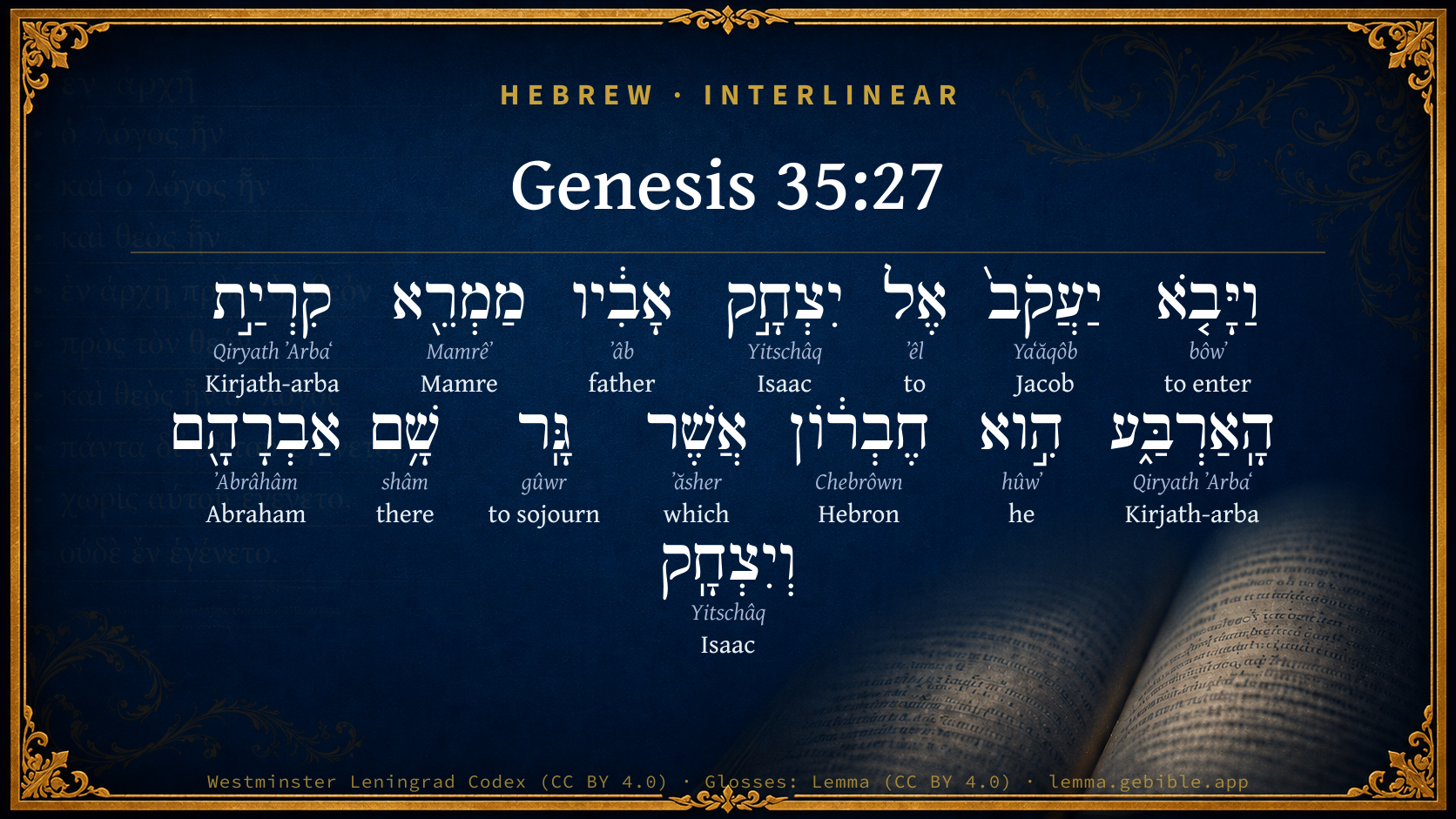
Hebrew (Westminster Leningrad Codex) Genesis 35:27 appears in the Hebrew Old Testament. The text above is from the Westminster Leningrad Codex. Each word links to its Strong’s number, a concise gloss, and parsing drawn from the Open Scriptures Hebrew Bible morphology. Click any word for its full Brown-Driver-Briggs (BDB) entry.
Download image
Cite this verse

Genesis 35:27 (World English Bible). Public Domain. Lemma interlinear Bible study tool, https://lemma.gebible.app/v/genesis/35/27.

Show BibTeX & RIS
BibTeX
RIS
English Translation
Jacob came to Isaac his father, to Mamre, to Kiriath Arba (the same is Hebron), where Abraham and Isaac lived as foreigners.
World English Bible · Public Domain
Download a study sheet

One document with this verse’s original text, its word-by-word gloss line, the meaning frame, cross-references with their text, attributed commentary, and full source and license credits — printable, and it pastes into notes with its structure intact.

This verse Autodidact and up

Study sheet (.html) Plain text (.txt)

A passage Seminary Student

Up to 50 verses in one chapter. A passage sheet keeps up to 6 commentary sources and 12 cross-references per verse, in the order this page ranks them, and says so on the sheet whenever that leaves anything out. Ask for a single verse and you get the Autodidact verse sheet above.

Everything on this page stays free to read, with no account — the sheet is a download of what is already on screen, not access to it.

Want to remove ads? Support Godless Engineer
Compare translations 3

The same verse in 3 English versions, stacked beneath the original-language interlinear above. Click any original word for its lexicon entry.

Each is an independent rendering of the whole verse — the interlinear is not word-aligned to these translations.

Highlighted words mark where these versions differ — a whole-verse word diff, not a word-by-word alignment.

  • World English Bible Public Domain
    Jacob came to Isaac his father, to Mamre, to Kiriath Arba (the same is Hebron), where Abraham and Isaac lived as foreigners.
  • King James Version Public Domain
    And Jacob came unto Isaac his father unto Mamre, unto the city of Arba, which is Hebron, where Abraham and Isaac sojourned.
  • unfoldingWord Literal Text CC BY-SA 4.0
    Then Jacob came to Isaac his father in Mamre, Kiriath Arba, which Hebron, where Abraham and Isaac had sojourned.

unfoldingWord Literal Text — © unfoldingWord, licensed CC BY-SA 4.0. Word-aligned USFM3 via Door43 (git.door43.org/unfoldingWord/en_ult).

Versions to compare (up to 4)

3 of 4 selected

Show all 18 translations

Every available English version of this verse, each an independent rendering of the whole verse.

  • World English Bible Public Domain
    Jacob came to Isaac his father, to Mamre, to Kiriath Arba (the same is Hebron), where Abraham and Isaac lived as foreigners.
  • Berean Standard Bible Public Domain
    Jacob returned to his father Isaac at Mamre, near Kiriath-arba (that is, Hebron), where Abraham and Isaac had stayed.
  • Majority Standard Bible Public Domain
    Jacob returned to his father Isaac at Mamre, near Kiriath-arba (that is, Hebron), where Abraham and Isaac had stayed.
  • King James Version Public Domain
    And Jacob came unto Isaac his father unto Mamre, unto the city of Arba, which is Hebron, where Abraham and Isaac sojourned.
  • American Standard Version (1901) Public Domain
    And Jacob came unto Isaac his father to Mamre, to Kiriath-arba (the same is Hebron), where Abraham and Isaac sojourned.
  • Revised Version (1885) Public Domain
    And Jacob came unto Isaac his father to Mamre, to Kiriath-arba (the same is Hebron), where Abraham and Isaac sojourned.
  • Geneva Bible (1599) Public Domain
    Then Iaakob came vnto Izhak his father to Mamre a citie of Arbah: this is Hebron, where Abraham and Izhak were strangers.
  • Douay-Rheims (1899) Public Domain
    And he came to Isaac his father in Mambre, the city of Arbee, this is Hebron: Wherein Abraham and Isaac sojourned.
  • Young's Literal Translation Public Domain
    And Jacob cometh unto Isaac his father, at Mamre, the city of Arba (which `is' Hebron), where Abraham and Isaac have sojourned.
  • Literal Standard Version CC BY-SA 4.0
    And Jacob comes to his father Isaac, at Mamre, the city of Arba (which [is] Hebron), where Abraham and Isaac have sojourned.
  • Unlocked Literal Bible CC BY-SA 4.0
    Jacob came to Isaac, his father, in Mamre in Kiriath Arba (the same as Hebron), where Abraham and Isaac had lived.
  • unfoldingWord Literal Text CC BY-SA 4.0
    Then Jacob came to Isaac his father in Mamre, Kiriath Arba, which Hebron, where Abraham and Isaac had sojourned.
  • Darby Bible Public Domain
    And Jacob came to Isaac his father to Mamre -- to Kirjath-Arba, which is Hebron; where Abraham had sojourned, and Isaac.
  • World Messianic Bible Public Domain
    Jacob came to Isaac his father, to Mamre, to Kiriath Arba (which is Hebron), where Abraham and Isaac lived as foreigners.
  • Webster's Bible Public Domain
    And Jacob came to Isaac his father to Mamre, to the city of Arbah (which is Hebron) where Abraham and Isaac sojourned.
  • Free Bible Version CC BY-SA 4.0
    Jacob returned home to his father Isaac at Mamre, near Kiriath-arba (also known as Hebron), where Abraham and Isaac had lived.
  • Bible in Basic English Public Domain
    And Jacob came to his father Isaac at Mamre, at Kiriath-arba, that is, Hebron, where Abraham and Isaac had been living.
  • JPS Tanakh (1917) Public Domain
    And Jacob came unto Isaac his father to Mamre, to Kiriatharba — the same is Hebron — where Abraham and Isaac sojourned.

Literal Standard Version (2020), Covenant Press — licensed CC BY-SA 4.0. Text via the HelloAO Bible API (eBible.org). Unlocked Literal Bible (unfoldingWord) — licensed CC BY-SA 4.0. Text via the HelloAO Bible API (eBible.org). unfoldingWord Literal Text — © unfoldingWord, licensed CC BY-SA 4.0. Word-aligned USFM3 via Door43 (git.door43.org/unfoldingWord/en_ult). Free Bible Version, Dr. Jonathan Gallagher — licensed CC BY-SA 4.0. Text via the HelloAO Bible API (eBible.org).

Word by word

More ways to search: Search by grammar → Find every occurrence → Compare this word →

Practice this passage: Drill this verse → Learn its vocabulary →

מַמְרֵ֖א
Mamrêʼ
H4471
“Mamre”
Noun, Proper
Part of Speech
Noun
Type
Proper
Full BDB Definition

Origin: from H4754 (in the sense of vigour)

TWOT: 1208

Mamre = "strength" or " fatness" - an Amorite who allied himself with Abram (noun proper masculine) - an oak grove on Mamre's land in Palestine where Abraham dwelt (noun proper locative) - a place near Abraham's burial place, apparently identified with Hebron (noun proper locative)
  1. וַיָּבֹ֤א bôwʼ H935 “and · to enter” Conjunction + Verb, Qal, Sequential Imperfect, 3rd Person, Masculine, Singular
  2. יַעֲקֹב֙ Yaʻăqôb H3290 “Jacob” Noun, Proper
  3. אֶל ʼêl H413 “to” Preposition
  4. יִצְחָ֣ק Yitschâq H3327 “Isaac” Noun, Proper
  5. אָבִ֔יו ʼâb H1 “father · his” Noun, Common, Masculine, Singular, Construct + Suffix, Personal, 3rd Person, Masculine, Singular
  6. קִרְיַ֣ת Qiryath ʼArbaʻ H7153 “Kirjath-arba” Noun, Proper
  7. הָֽאַרְבַּ֑ע Qiryath ʼArbaʻ H7153 “Kirjath-arba” Noun, Proper
  8. הִ֣וא hûwʼ H1931 “he” Pronoun, Personal, 3rd Person, Feminine, Singular
  9. חֶבְר֔וֹן Chebrôwn H2275 “Hebron” Noun, Proper
  10. אֲשֶׁר ʼăsher H834 “which” Particle, Relative
  11. גָּֽר gûwr H1481 “to sojourn” Verb, Qal, Perfect, 3rd Person, Masculine, Singular
  12. שָׁ֥ם shâm H8033 “there” Adverb
  13. אַבְרָהָ֖ם ʼAbrâhâm H85 “Abraham” Noun, Proper
  14. וְיִצְחָֽק Yitschâq H3327 “and · Isaac” Conjunction + Noun, Proper

About this verse

These counts appear in no published source. They are computed here, from the morphology-tagged text and Lemma’s own curated glosses. What Lemma adds →

15
words
13
distinct lemmas
Pentateuch
section

Notable vocabulary

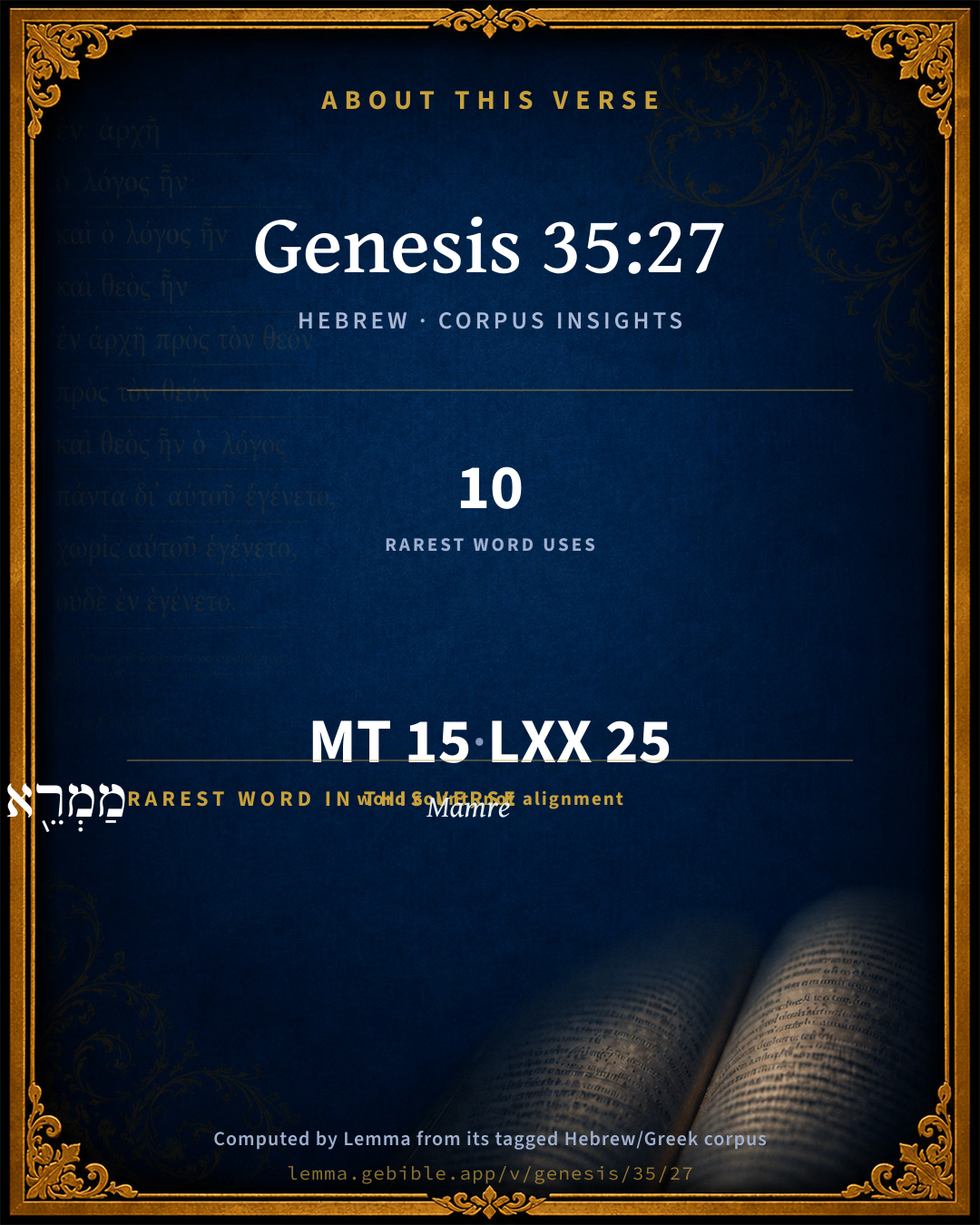
The rarest word here is מַמְרֵ֖א Mamre H4471 — appearing just 10 times in the whole Hebrew Bible.

Shared distinctive vocabulary

מַמְרֵ֖א Mamre H4471 occurs in 10 verses of the Hebrew Bible. Also found in:

Grammatical profile

  • 2 verbs
  • 9 nouns
  • 1 pronoun
  • 1 preposition
  • 1 adverb
  • 1 particle

Verb forms

  • וַיָּבֹ֤א Qal · Sequential Imperfect
  • גָּֽר Qal · Perfect

Repetition

Words recur within this verse — often emphatic in Hebrew:

  • יִצְחָ֣ק Isaac H3327 ×2
  • קִרְיַ֣ת Kirjath-arba H7153 ×2

Hebrew & Septuagint length

In English translation the verse runs 22 words from the Hebrew and 28 from the Septuagint (LXX English) — closely comparable.

A rough comparison of the two English renderings, which tokenize alike — not a word-level alignment.

Word counts can differ between the Hebrew and the Greek without any difference in meaning — e.g. the Hebrew direct-object marker אֵת has no separate Greek word, and Greek often adds the article ὁ.

In the original languages it is 15 Hebrew tokens and 25 Greek tokens — but the two are counted differently (Hebrew bundles its prefixes and suffixes into one token; the Greek is in lemma form), so that isn’t a like-for-like length.

Cross-references

16

Topical passages linked to Genesis 35:27 in the Treasury of Scripture Knowledge — connected by theme and wording, ordered by reader-vote popularity; previews shown in the World English Bible.

  • Genesis 13:18 Abram moved his tent, and came and lived by the oaks of Mamre, which are in Hebron, and built an altar there to Yahweh.
  • Genesis 23:19 After this, Abraham buried Sarah his wife in the cave of the field of Machpelah before Mamre (the same is Hebron), in the land of Canaan.
  • Genesis 18:1 Yahweh appeared to him by the oaks of Mamre, as he sat in the tent door in the heat of the day.
  • Genesis 23:2 Sarah died in Kiriath Arba (the same is Hebron), in the land of Canaan. Abraham came to mourn for Sarah, and to weep for her.
  • Joshua 15:13 To Caleb the son of Jephunneh he gave a portion among the children of Judah, according to the commandment of Yahweh to Joshua, even Kiriath Arba, [which Arba was] the father of Anak (the same is Hebron).
  • Genesis 14:13 One who had escaped came and told Abram, the Hebrew. Now he lived by the oaks of Mamre, the Amorite, brother of Eshcol, and brother of Aner; and these were allies of Abram.
  • Genesis 27:43–45 Now therefore, my son, obey my voice. Arise, flee to Laban, my brother, in Haran.
  • Genesis 28:5 Isaac sent Jacob away. He went to Paddan Aram to Laban, son of Bethuel the Syrian, Rebekah's brother, Jacob's and Esau's mother.
  • Joshua 14:12–15 Now therefore give me this hill-country, of which Yahweh spoke in that day; for you heard in that day how the Anakim were there, and cities great and fortified: it may be that Yahweh will be with me, and I shall drive them out, as Yahweh spoke.
  • Joshua 21:11 They gave them Kiriath Arba, [which Arba was] the father of Anak (the same is Hebron), in the hill-country of Judah, with the suburbs of it round about it.
  • 2 Samuel 2:1 It happened after this, that David inquired of Yahweh, saying, Shall I go up into any of the cities of Judah? Yahweh said to him, Go up. David said, Where shall I go up? He said, To Hebron.
  • 2 Samuel 2:3 His men who were with him did David bring up, every man with his household: and they lived in the cities of Hebron.
  • 2 Samuel 2:11 The time that David was king in Hebron over the house of Judah was seven years and six months.
  • 2 Samuel 5:1 Then came all the tribes of Israel to David to Hebron, and spoke, saying, Behold, we are your bone and your flesh.
  • 2 Samuel 5:3 So all the elders of Israel came to the king to Hebron; and king David made a covenant with them in Hebron before Yahweh: and they anointed David king over Israel.
  • 2 Samuel 5:5 In Hebron he reigned over Judah seven years and six months; and in Jerusalem he reigned thirty-three years over all Israel and Judah.

Cross-references courtesy of OpenBible.info (CC BY 4.0).

Hebrew and Greek witnesses Masoretic Hebrew ↔ Greek Septuagint

The same verse in the two great witnesses to the Old Testament, shown verse-for-verse.

These are two independent witnesses, not word-aligned to each other, and the Septuagint is shown in lemma (dictionary) form.

Hebrew Genesis 35:27 Masoretic · Westminster Leningrad Codex

וַיָּבֹ֤א יַעֲקֹב֙ אֶל יִצְחָ֣ק אָבִ֔יו מַמְרֵ֖א קִרְיַ֣ת הָֽאַרְבַּ֑ע הִ֣וא חֶבְר֔וֹן אֲשֶׁר גָּֽר שָׁ֥ם אַבְרָהָ֖ם וְיִצְחָֽק

Jacob came to Isaac his father, to Mamre, to Kiriath Arba (the same is Hebron), where Abraham and Isaac lived as foreigners.

World English Bible · Public Domain

Greek LXX Genesis 35:27 Septuagint · lemma form

ἔρχομαι δέ ἰακώβ πρός ισαακ ὁ πατήρ αὐτός εἰς μαμβρη εἰς πόλις ὁ πεδίον οὗτος εἰμί χεβρων ἐν γῆ χανααν οὗ παραοἰκέω αβρααμ καί ισαακ

And Jacob came to Isaac his father to Mambre, to a city of the plain; this is Chebron in the land of Chanaan, where Abraam and Isaac sojourned.

LXX2012 (modern English Septuagint) · Public Domain

Hebrew: Westminster Leningrad Codex (CC BY 4.0). Greek: Septuagint (public domain); English from LXX2012 (modern English Septuagint) (Public Domain). How the Septuagint differs from the Hebrew →

Targum (Aramaic paraphrase)

2

The Targum is the ancient Jewish Aramaic paraphrase of the Hebrew Scriptures — an interpretive translation, not the Hebrew text itself. Onkelos (literal) and Pseudo-Jonathan (expansive) render the Torah, and Jonathan the Prophets. Coverage is partial: where no permissively-licensed English translation exists for a verse, only the Aramaic is shown. This is verse-level text, not a word-by-word alignment to the Hebrew.

  1. Targum Onkelos Torah (Genesis–Deuteronomy)
    וַאֲתָא יַעֲקֹב לְוַת יִצְחָק אֲבוּהִי מַמְרֵא קִרְיַת אַרְבַּע הִיא חֶבְרוֹן דִּי דָר תַּמָּן אַבְרָהָם וְיִצְחָק

    (no public-domain English translation for this verse)

    Targum Onkelos — Aramaic: “Onkelos Genesis” (public domain); “Onkelos Exodus” (public domain); “Onkelos Leviticus” (public domain); “Onkelos Numbers” (public domain); “Onkelos Deuteronomy” (public domain). English: “Sefaria Community Translation” (CC0 1.0 (public-domain dedication)); “J.W. Etheridge. The Targums of Onkelos and Jonathan Ben Uzziel on the Pentateuch. London: Longmans, Green, 1862” (public domain). Text via Sefaria.

  2. Targum Pseudo-Jonathan Torah (Genesis–Deuteronomy)
    וְאָתָא יַעֲקב לְוַת יִצְחָק אָבוֹי לְמַמְרֵא קִרְיַת אַרְבַּע הוּא חֶבְרוֹן דְדַר תַּמָן אַבְרָהָם וְיִצְחָק

    And Jakob came to Izhak his father, at Mamre the city of Arba, which is Hebron, for there Abraham and Izhak had dwelt.

    Targum Pseudo-Jonathan — Aramaic: “Targum Jonathan on Genesis” (public domain); “Targum Jonathan on Exodus” (public domain); “Targum Jonathan on Leviticus” (public domain); “Targum Jonathan on Numbers” (public domain); “Targum Jonathan on Deuteronomy” (public domain). English: “The Targum of Jonathan ben Uzziel, trans. J. W. Etheridge, London, 1862” (public domain). Text via Sefaria.

Commentary

Notes on Genesis 35:27 from classic Christian and Jewish commentators (each source and its license shown beneath its notes). The classic Christian expositions comment on the surrounding passage and are grouped to its opening verse, so a note may address several verses; the Jewish commentaries on the Tanakh (Rashi and others) are per-verse, so they appear only where the commentator wrote on this verse.

Lemma curates 59 commentaries, every one of them public domain or Creative Commons licensed, each selected and text-cleaned for this edition rather than reprinted as found. About our sources →

Joseph Benson's Commentary

Gen 35:27. Jacob came unto Isaac his father — Probably to dwell with or near him; bringing, it seems, his family with him. We can hardly suppose that this was the first visit he paid him since his return from Mesopotamia.

Without question he had often visited him, though the Scripture be silent as to this particular.

Joseph Benson's Commentary on the Old and New Testaments (1811–1818) — public domain. Text from a community e-Sword module.

Whedon's Commentary on the Bible

Daniel D. Whedon

ISAAC’S DEATH AND BURIAL, Gen_35:27-29.

27. Jacob came unto Isaac — This appears to have been some twelve years previous to the death of Isaac, and therefore long enough to communicate often to his father his varied experiences, and to receive the counsels of the aged patriarch. Jacob was living at Hebron when Joseph was sold, (Gen_37:14,) and the latter was at that time 17 years old. Gen_37:2. Twenty-two years later Jacob went down into Egypt. He was then 130 years old; (Gen_47:9;) consequently he was now 108, and Isaac 168, (Gen_25:26;) and Isaac lived at least twelve years after this. So he must have lived to know of the loss of Joseph, and almost up to the beginning of the great famine which led Israel into Egypt.

Daniel D. Whedon (gen. ed.), Commentary on the Old and New Testaments (1874–1909) — public domain. Text from a community e-Sword module.

The Preacher's Complete Homiletical Commentary

Joseph S. Exell (gen. ed.)

MAIN HOMILETICS OF THE PARAGRAPH.—Gen_35:27-29

THE DEATH AND BURIAL OF ISAAC

Isaac was “an hundred and fourscore years” when he died. He must, therefore, have lived in a state of blindness and inactivity for fifty-seven years. His life was greatly prolonged beyond the time when he could be, in any full sense, useful to his fellow men. But when that life reached its close the solemn lessons of it would come home to the survivors.

I. It was the occasion of family re-union. The quarrel between Jacob and Esau had ended in a reconciliation. (Genesis 33) Again they meet in peace for the burial of their father. It was in similar circumstances that Isaac himself and Ishmael had met many years before to bury their father, Abraham. The grave ought to silence all enmities. These two brothers met after many years of separation, each pursuing a different course of life. The marks of time are upon each of them—the impressions of long labours, cares and sorrows. Esau is still the man of the field, renowned in chase and war. Jacob is still devoted to peaceful and domestic pursuits, acquiring wealth slowly by the raising of cattle. He is now chastened and subdued by many a sorrow, his soul humbled by the open visions of God. And now, in the death of his beloved Rachel, the sin of Reuben, and the cruel wrath of Simeon and Levi, his cup of sorrow is full. We have here types of the afflictions, struggles, and enmities of the world; but we have also types of reconciliation, forgiveness and peace, and the great consolations of God.

II. It was at the time of revival for memories of the past. The two brothers, as they stood by his grave, would re-live their old life. Esau would naturally think of the fortresses he had built, of his wives and children—those who had been a grief of mind to Isaac and Rebekah, and of her whom he married to please and reconcile them, Bashemath the daughter of Ishmael. Jacob would think upon the birthright, upon the promises of God renewed to him at Bethel, and now fulfilled in some degree at the death of his father. He would think of blessings yet to come when the glory and greatness of his posterity should increase, and they should have dominion and kingly power. The death of friends forces us to review our associated histories.

III. It was the beginning of another and a higher life. We are told that Isaac “was gathered unto his people.” This surely signifies more than that he was joined to them in the grave. The expression suggests—

1. The idea of rest. The toils and labours of human life end with the grave. Man goeth forth to his labour and to his work until the evening, and then the night of death comes when he can no longer work. The great end for which Isaac lived had now been gained. He had seen his two sons reconciled. He had been at length brought to the belief, though sore against his will, that the blessing of Abraham would descend along the line of Jacob. He had submitted to God. And having attained to this firm belief and resignation, the great work of his life was ended. Rest is welcome when the powers of life are failing and the work of life is done.

2. The idea of re-union in another world. We are told of Abraham that “he looked for a city which hath foundations, whose Builder and Maker is God;” and further, that “Isaac and Jacob” were “heirs with Him of the same promise.” (Heb_11:9-10.) Surely Isaac died with the thought of meeting the beloved ones who had gone before, in a better country.

SUGGESTIVE COMMENTS ON THE VERSES

Gen_35:27-29. Three special friends Jacob buries, in this chapter. Crosses come thick; be patient.—(Trapp).

We have no clue to his thoughts but the hopes and aspirations of that common nature which are called forth by trials and circumstances, which we have still in common with those who have gone before us in the generations. But this is a clue which we may surely follow, if we let it lead us onward from a more faithful and earnest discharge of our daily duties, especially of filial and paternal duty, to the day when whatsoever good thing any man doth the same shall he receive of the Lord; when the son who honoured his father and mother, either by paying them all deference and respect, or by supporting them in poverty, or by upholding them in their infirmity, or by paying the last tribute of affection and respect to their remains, shall so also himself receive of the Lord.—(Robertson).

The Preacher's Complete Homiletical Commentary (gen. ed. Joseph S. Exell; Funk & Wagnalls, c. 1892) — public domain (pre-1929). A full-Bible homiletical/sermon-outline anthology covering 65 of 66 books (2 John is absent from the source module). Text from a community e-Sword module.

Tyndale Open Study Notes

Tyndale Open Resources

35:27-29 Esau and Jacob (listed here in ordinary birth order) came together—probably for the first time since they had reconciled (33:16-17)—to bury Isaac in Hebron (see 13:18; 23:1-2, 17-19).

Tyndale Open Study Notes — © Tyndale Open Resources, licensed CC BY-SA 4.0. Text via the HelloAO Bible API.

Adam Clarke's Commentary

Verse 27. The city of Arbah, (which is Hebron)] See Ge 23:2. It has been conjectured that Jacob must have paid a visit to his father before this time, as previously to this he had been some years in Canaan; but now, as he was approaching to his end, Jacob is supposed to have gone to live with and comfort him in his declining days.

Adam Clarke's Commentary on the Bible (1810–1826) — public domain. Text from a community e-Sword/MySword module.

Ellicott's Commentary for English Readers

(27) The city of Arbah, which is Hebron.—Better rendered Kirjath-arba in Gen_23:2, where see Note.

A Bible Commentary for English Readers, edited by Charles John Ellicott (1878–1897) — public domain. Text from a community e-Sword module.

The Cambridge Bible for Schools and Colleges

gen. ed. J. J. S. Perowne

27. Isaac] The mention of Isaac, after so long an interval, is surprising. But the P narrative carefully records the death and age of each patriarch. According to J, Isaac was living at Beer-sheba, when Jacob left his home (Gen_28:10). According to P, Isaac died 80 years later at Mamre in close proximity to the burial-place of his father. Isaac was 40 years old when he married Rebekah (Gen_25:20); 60 years old at the birth of Esau and Jacob (Gen_25:26); at least 100 years old when Jacob went to Haran (Gen_27:46, cf. Gen_26:34), and, therefore, over 120 when Jacob returned from Haran.

Mamre] Cf. Gen_13:18, Gen_23:19.

Kiriath-arba] Cf. Gen_23:2.

The Cambridge Bible for Schools and Colleges (gen. ed. J. J. S. Perowne; Cambridge University Press, 1878–1918) — public domain. Text from a community e-Sword module.

Matthew Poole's English Annotations

Jacob came; either with his wives, and children, and estate, to dwell with Isaac; or rather in person, to visit his sick and dying father; for otherwise Jacob having been ten years near his father, no doubt he had oft visited him, and carried his wives and children thither, though Scripture be silent in this particular: but they could not live together because of the greatness of their estates, as it happened with others. See Gen 13:6; 36:7.

Matthew Poole's English Annotations on the Holy Bible (1683–1685) — public domain. Text from a community e-Sword/MySword module.

The Pulpit Commentary

And Jacob came unto Isaac his father, unto Mature (on the probability of Jacob s having previously visited his father, vide ver. 8), unto the city of Arbah (Gen_13:18 Gen_23:2, Gen_23:19; Jos_14:15 Jos_15:13) which is Hebron, where Abraham and Isaac sojourned.

The Pulpit Commentary (1880–1919), ed. H.D.M. Spence-Jones & Joseph S. Exell — public domain. Text from a community e-Sword module.

John Wesley's Explanatory Notes

And Jacob came unto Isaac his father - We may suppose he had visited him before since his return, for he sore longed after his father's house, but never 'till now brought his family to settle with him, or near him. Probably he did this now upon the death of Rebekah, by which Isaac was left solitary.

John Wesley, Explanatory Notes Upon the Whole Bible (1754–1765) — public domain. Text via the GEBible commentary corpus.

Keil & Delitzsch

C. F. Keil & F. Delitzsch

Jacob's arrival in "Mamre Kirjath-Arbah," i.e., in the terebinth-grove of Mamre (Gen 13:18) by Kirjath-Arbah or Hebron (vid., Gen 23:2), constituted his entrance into his father's house, to remain there as Isaac's heir. He had probably visited his father during the ten years that had elapsed since his return from Mesopotamia, though no allusion is made to this, since such visits would have no importance, either in themselves or their consequences, in connection with the sacred history. This was not the case, however, with his return to enter upon the family inheritance. With this, therefore, the history of Isaac's life is brought to a close. Isaac died at the age of 180, and was buried by his two sons in the cave of Machpelah (Gen 49:31), Abraham's family grave, Esau having come from Seir to Hebron to attend the funeral of his father. But Isaac's death did not actually take place for 12 years after Jacob's return to Hebron. For as Joseph was 17 years old when he was sold by his brethren (Gen 37:2), and Jacob was then living at Hebron (Gen 37:14), it cannot have been more than 31 years after his flight from Esau when Jacob returned home (cf. Gen 34:1). Now since, according to our calculation at Gen 27:1, he was 77 years old when he fled, he must have been 108 when he returned home; and Isaac would only have reached his 168th year, as he was 60 years old when Jacob was born (Gen 25:26). Consequently Isaac lived to witness the grief of Jacob at the loss of Joseph, and died but a short time before his promotion in Egypt, which occurred 13 years after he was sold (Gen 41:46), and only 10 years before Jacob's removal with his family to Egypt, as Jacob was 130 years old when he was presented to Pharaoh (Gen 47:9). But the historical significance of his life was at an end, when Jacob returned home with his twelve sons.

Keil & Delitzsch — Biblical Commentary on the Old Testament (1861–1891) — public domain (CC PDM 1.0). Text via the HelloAO Bible API. (Old Testament only.)

Rashi

Rabbi Shlomo Yitzchaki (Rashi)

ממרא MAMRE — the name of the plain.

קרית הארבע KIRIATH-ARBA— the name of the city.

ממרא קרית הארבע therefore means “to the plain of Kiriath-arba”. If you say that it should have written ממרא הקרית ארבע (that Kirjath-arba being one name the definite article should be placed in front of it) then I reply that this is the rule in Biblical Hebrew: in every case of a name compounded of two words, such as this, and such as בית לחם and אבי עזר and בית אל, when it is necessary to prefix the definite article (in order to determine the name) it is prefixed to the second element of the name — thus (1 Samuel 16:1)בית הלחמי the Bethlehemite; (Judges 6:24) “in Ophrah (אבי העזרי) of the Abiezrites”; (1 Kings 16:34) “did Hiel the Bethelite (בית האלי) build”.

Rashi on the Tanakh — English translations: “The Judaica Press complete Tanach with Rashi, translated by A. J. Rosenberg” (CC BY 4.0); “Pentateuch with Rashi's commentary by M. Rosenbaum and A.M. Silbermann, 1929-1934” (public domain); “The Metsudah Tanach series, Lakewood, N.J” (CC BY 4.0); and “The Book of Joshua, Metsudah Publications, 1997” (CC BY 4.0). Text via Sefaria.

Sforno

Rabbi Ovadia Sforno

Where Avraham and Yitzchok lived. Righteous forebears stand a person in good stead among his neighbors.

Sforno on the Tanakh — English translation: “Yalkut, Sifsei Chachomim Chumash, Metsudah Publications, 2009” (CC BY 4.0). Text via Sefaria.

Radak

Rabbi David Kimhi (Radak)

ויבא..קרית הארבע, we explained the meaning of this on 23,2. The reason for the definitive article in front of the word ארבע, i.e. הארבע, something strange seeing that it refers to the name of a human being, is justified as the name itself is symbolic, i.e. is in reality an attribute, describing the “foursome,” the father and his three sons, all of whom giants.

אשר גר שם אברהם ויצחק, this is mentioned seeing that now Yaakov also sojourned there. It teaches that it is appropriate for a person to be buried in the town where his ancestors had lived as it is a sign of honour for his ancestors who were also buried there. Nechemyah speaks repeatedly of “the city where my fathers have been buried;” he attributed the significance to the fact that several generations of his ancestors had been buried in the same place. (Nechemyah 2,3 and 2,5)

Radak on the Tanakh — English translations: “Sefaria Community Translation” (CC0 1.0 (public-domain dedication)); “Eliyahu Munk, HaChut Hameshulash” (CC BY 4.0); “Rabbi Mike Feuer, Jerusalem Anthology” (CC BY 4.0); and “R. David Kimhi on the first book of Psalms, Translated by R.G. Finch, London, 1919” (public domain). Text via Sefaria.

Lesson kit

Teaching starters — assembled from the data on this page, not authored interpretation. Every prompt links to the verse data it draws on. Edit before teaching.

Genesis, in the Pentateuch, opens this verse with 15 words (13 distinct Hebrew lemmas). Its most distinctive word is Mamrêʼ (“Mamre”). A historical commentator’s framing appears above. Read the whole chapter for the surrounding context.

Discussion questions

  1. The word Mamrêʼ carries the sense “Mamre.” How does it shape the verse?
  2. How does Genesis 13:18, which shares the word «Mamre», read alongside this verse?
  3. What does the repetition of “Isaac” (2× in this one verse) do in this verse?
  4. These translations render this verse differently. What is at stake in choosing one wording over another?
  5. «וַיָּבֹ֤א» is a Qal Sequential Imperfect verb. How does that grammatical form shape the action described?
  6. Compare how Joseph Benson's Commentary and Whedon's Commentary on the Bible read this verse. Where do they agree or differ?

Things to notice

Reading settings

Reading text

Shown beneath each verse's original-language words.

Old Testament
Old Testament edition

Read the OT as the Masoretic Hebrew (MT) or the Greek Septuagint (LXX).

English shown for the Greek Septuagint (in the Hebrew ↔ Greek comparison).

Comparing translations? Open the Compare panel on any verse page to stack up to four side by side.