
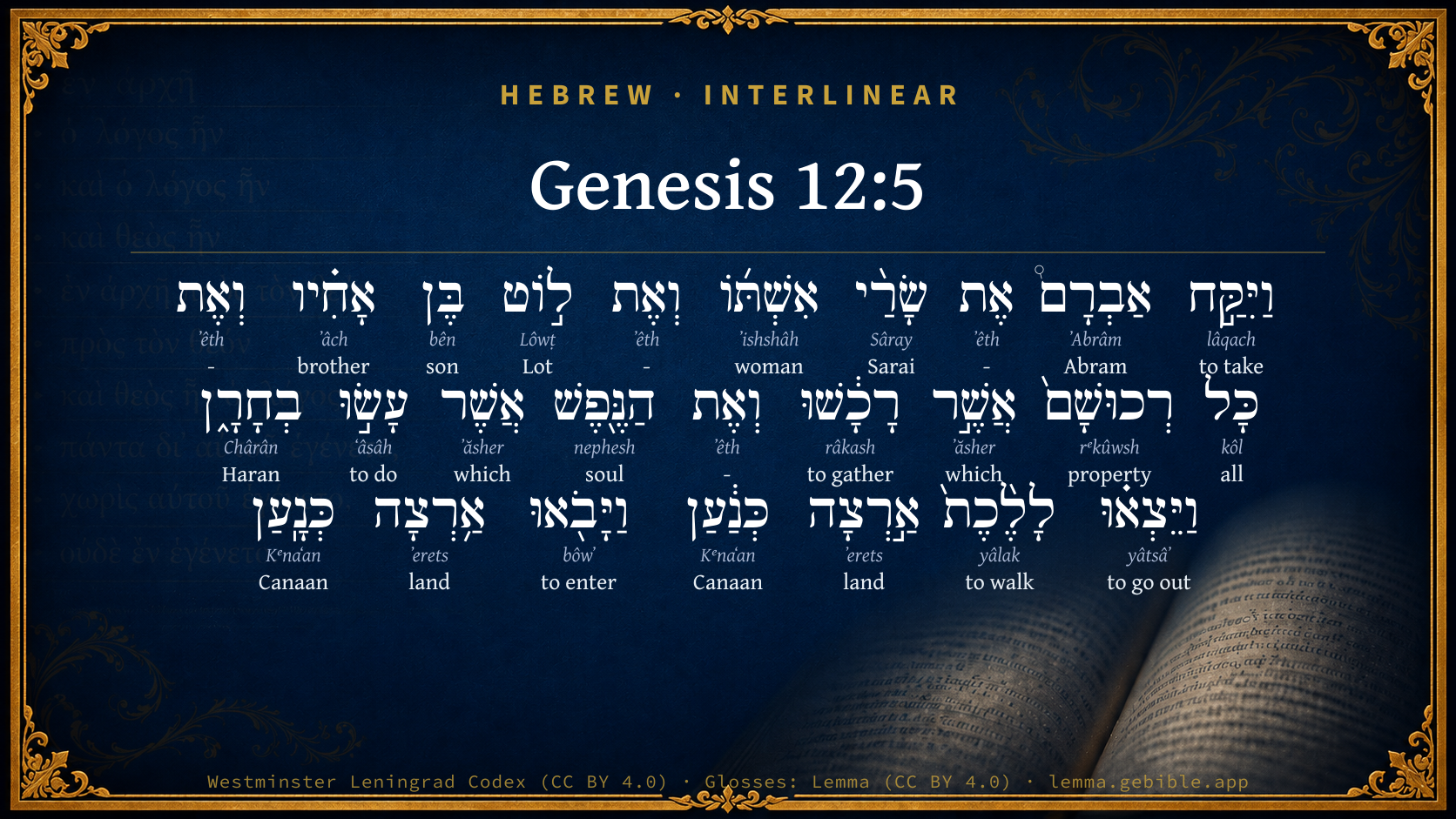
Genesis 12:5

Hebrew (Westminster Leningrad Codex) Genesis 12:5 appears in the Hebrew Old Testament. The text above is from the Westminster Leningrad Codex. Each word links to its Strong’s number, a concise gloss, and parsing drawn from the Open Scriptures Hebrew Bible morphology. Click any word for its full Brown-Driver-Briggs (BDB) entry.
Download image
Cite this verse

Genesis 12:5 (World English Bible). Public Domain. Lemma interlinear Bible study tool, https://lemma.gebible.app/v/genesis/12/5.

Show BibTeX & RIS
BibTeX
RIS
English Translation
Abram took Sarai his wife, Lot his brother's son, all their substance that they had gathered, and the souls who they had gotten in Haran; and they went forth to go into the land of Canaan. Into the land of Canaan they came.
World English Bible · Public Domain
Highlights
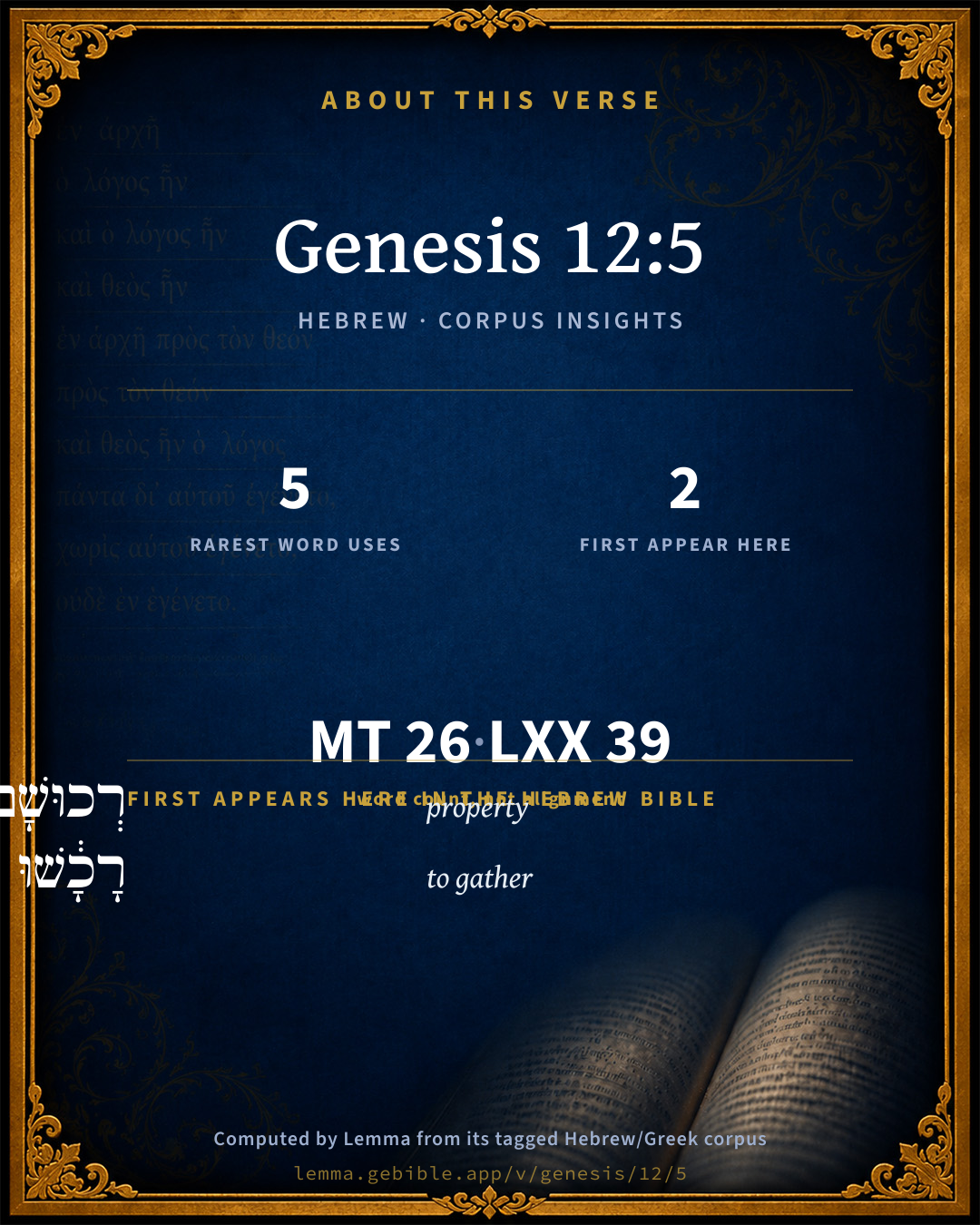
  • 2 first appearances in the Hebrew Bible
Full analysis ↓
Download a study sheet

One document with this verse’s original text, its word-by-word gloss line, the meaning frame, cross-references with their text, attributed commentary, and full source and license credits — printable, and it pastes into notes with its structure intact.

This verse Autodidact and up

Study sheet (.html) Plain text (.txt)

A passage Seminary Student

Up to 50 verses in one chapter. A passage sheet keeps up to 6 commentary sources and 12 cross-references per verse, in the order this page ranks them, and says so on the sheet whenever that leaves anything out. Ask for a single verse and you get the Autodidact verse sheet above.

Everything on this page stays free to read, with no account — the sheet is a download of what is already on screen, not access to it.

Want to remove ads? Support Godless Engineer
Compare translations 3

The same verse in 3 English versions, stacked beneath the original-language interlinear above. Click any original word for its lexicon entry.

Each is an independent rendering of the whole verse — the interlinear is not word-aligned to these translations.

Highlighted words mark where these versions differ — a whole-verse word diff, not a word-by-word alignment.

  • World English Bible Public Domain
    Abram took Sarai his wife, Lot his brother's son, all their substance that they had gathered, and the souls who they had gotten in Haran; and they went forth to go into the land of Canaan. Into the land of Canaan they came.
  • King James Version Public Domain
    And Abram took Sarai his wife, and Lot his brother's son, and all their substance that they had gathered, and the souls that they had gotten in Haran; and they went forth to go into the land of Canaan; and into the land of Canaan they came.
  • unfoldingWord Literal Text CC BY-SA 4.0
    And Abram took Sarai his wife and Lot the son of his brother and all their possessions that they had accumulated and the people whom they had acquired in Haran, and they set out to go to the land of Canaan. Then they came to the land of Canaan.

unfoldingWord Literal Text — © unfoldingWord, licensed CC BY-SA 4.0. Word-aligned USFM3 via Door43 (git.door43.org/unfoldingWord/en_ult).

Versions to compare (up to 4)

3 of 4 selected

Show all 18 translations

Every available English version of this verse, each an independent rendering of the whole verse.

  • World English Bible Public Domain
    Abram took Sarai his wife, Lot his brother's son, all their substance that they had gathered, and the souls who they had gotten in Haran; and they went forth to go into the land of Canaan. Into the land of Canaan they came.
  • Berean Standard Bible Public Domain
    And Abram took his wife Sarai, his nephew Lot, and all the possessions and people they had acquired in Haran, and set out for the land of Canaan. When they came to the land of Canaan,
  • Majority Standard Bible Public Domain
    And Abram took his wife Sarai, his nephew Lot, and all the possessions and people they had acquired in Haran, and set out for the land of Canaan. When they came to the land of Canaan,
  • King James Version Public Domain
    And Abram took Sarai his wife, and Lot his brother's son, and all their substance that they had gathered, and the souls that they had gotten in Haran; and they went forth to go into the land of Canaan; and into the land of Canaan they came.
  • American Standard Version (1901) Public Domain
    And Abram took Sarai his wife, and Lot his brother's son, and all their substance that they had gathered, and the souls that they had gotten in Haran; and they went forth to go into the land of Canaan; and into the land of Canaan they came.
  • Revised Version (1885) Public Domain
    And Abram took Sarai his wife, and Lot his brother’s son, and all their substance that they had gathered, and the souls that they had gotten in Haran; and they went forth to go into the land of Canaan; and into the land of Canaan they came.
  • Geneva Bible (1599) Public Domain
    Then Abram tooke Sarai his wife, and Lot his brothers sonne, and all their substance that they possessed, and the soules that they had gotten in Haran, and they departed, to goe to the land of Canaan: and to the land of Canaan they came.
  • Douay-Rheims (1899) Public Domain
    And he took Sarai his wife, and Lot his brother's son, and all the substance which they had gathered, and the souls which they had gotten in Haran: and they went out to go into the land of Chanaan. And when they were come into it,
  • Young's Literal Translation Public Domain
    And Abram taketh Sarai his wife, and Lot his brother's son, and all their substance that they have gained, and the persons that they have obtained in Charan; and they go out to go towards the land of Canaan; and they come in to the land of Canaan.
  • Literal Standard Version CC BY-SA 4.0
    And Abram takes his wife Sarai, and his brother’s son Lot, and all their substance that they have gained, and the persons that they have obtained in Haran; and they go out to go toward the land of Canaan; and they come to the land of Canaan.
  • Unlocked Literal Bible CC BY-SA 4.0
    Abram took Sarai, his wife, Lot, his brother's son, all their possessions that they had accumulated, and the people that they had acquired in Haran. They left to go into the land of Canaan, and came to the land of Canaan.
  • unfoldingWord Literal Text CC BY-SA 4.0
    And Abram took Sarai his wife and Lot the son of his brother and all their possessions that they had accumulated and the people whom they had acquired in Haran, and they set out to go to the land of Canaan. Then they came to the land of Canaan.
  • Darby Bible Public Domain
    And Abram took Sarai his wife, and Lot his brother's son, and all their possessions that they had acquired, and the souls that they had obtained in Haran, and they went out to go into the land of Canaan; and into the land of Canaan they came.
  • World Messianic Bible Public Domain
    Abram took Sarai his wife, Lot his brother’s son, all their possessions that they had gathered, and the people whom they had acquired in Haran, and they went to go into the land of Canaan. They entered into the land of Canaan.
  • Webster's Bible Public Domain
    And Abram took Sarai his wife, and Lot his brother's son, and all their substance that they had gathered, and the souls that they had gotten in Haran; and they went to go forth into the land of Canaan; and into the land of Canaan they came.
  • Free Bible Version CC BY-SA 4.0
    With him went his wife Sarai, his nephew Lot, together with all the possessions they had collected and the people that had joined them in Haran. They left for the land of Canaan. When they arrived there,
  • Bible in Basic English Public Domain
    And Abram took Sarai, his wife, and Lot, his brother's son, and all their goods and the servants which they had got in Haran, and they went out to go to the land of Canaan.
  • JPS Tanakh (1917) Public Domain
    And Abram took Sarai his wife, and Lot his brother's son, and all their substance that they had gathered, and the souls that they had gotten in Haran; and they went forth to go into the land of Canaan; and into the land of Canaan they came.

Literal Standard Version (2020), Covenant Press — licensed CC BY-SA 4.0. Text via the HelloAO Bible API (eBible.org). Unlocked Literal Bible (unfoldingWord) — licensed CC BY-SA 4.0. Text via the HelloAO Bible API (eBible.org). unfoldingWord Literal Text — © unfoldingWord, licensed CC BY-SA 4.0. Word-aligned USFM3 via Door43 (git.door43.org/unfoldingWord/en_ult). Free Bible Version, Dr. Jonathan Gallagher — licensed CC BY-SA 4.0. Text via the HelloAO Bible API (eBible.org).

Word by word

More ways to search: Search by grammar → Find every occurrence → Compare this word →

Practice this passage: Drill this verse → Learn its vocabulary →

רָכָ֔שׁוּ
râkash
H7408
“to gather”
Verb, Qal, Perfect, 3rd Person, Common, Plural
Part of Speech
Verb
Stem
Qal
Form
Perfect
Person
3rd Person
Gender
Common
Number
Plural
Full BDB Definition

Origin: a primitive root

TWOT: 2167

(Qal) to collect or gather property
  1. וַיִּקַּ֣ח lâqach H3947 “and · to take” Conjunction + Verb, Qal, Sequential Imperfect, 3rd Person, Masculine, Singular
  2. אַבְרָם֩ ʼAbrâm H87 “Abram” Noun, Proper
  3. אֶת ʼêth H853 “-” Particle, Direct Object
  4. שָׂרַ֨י Sâray H8297 “Sarai” Noun, Proper
  5. אִשְׁתּ֜וֹ ʼishshâh H802 “woman · his” Noun, Common, Feminine, Singular, Construct + Suffix, Personal, 3rd Person, Masculine, Singular
  6. וְאֶת ʼêth H853 “and · -” Conjunction + Particle, Direct Object
  7. ל֣וֹט Lôwṭ H3876 “Lot” Noun, Proper
  8. בֶּן bên H1121 “son of” Noun, Common, Masculine, Singular, Construct
  9. אָחִ֗יו ʼâch H251 “brother · his” Noun, Common, Masculine, Singular, Construct + Suffix, Personal, 3rd Person, Masculine, Singular
  10. וְאֶת ʼêth H853 “and · -” Conjunction + Particle, Direct Object
  11. כָּל kôl H3605 “all of” Noun, Common, Masculine, Singular, Construct
  12. רְכוּשָׁם֙ rᵉkûwsh H7399 “property · their” Noun, Common, Masculine, Singular, Construct + Suffix, Personal, 3rd Person, Masculine, Plural
  13. אֲשֶׁ֣ר ʼăsher H834 “which” Particle, Relative
  14. וְאֶת ʼêth H853 “and · -” Conjunction + Particle, Direct Object
  15. הַנֶּ֖פֶשׁ nephesh H5315 “the · soul” Particle, Definite Article + Noun, Common, Both, Singular, Absolute
  16. אֲשֶׁר ʼăsher H834 “which” Particle, Relative
  17. עָשׂ֣וּ ʻâsâh H6213 “to do” Verb, Qal, Perfect, 3rd Person, Common, Plural
  18. בְחָרָ֑ן Chârân H2771 “in/at · Haran” Preposition + Noun, Proper
  19. וַיֵּצְא֗וּ yâtsâʼ H3318 “and · to go out” Conjunction + Verb, Qal, Sequential Imperfect, 3rd Person, Masculine, Plural
  20. לָלֶ֨כֶת֙ yâlak H3212 “to walk” Preposition + Verb, Qal, Infinitive Construct
  21. אַ֣רְצָה ʼerets H776 “land · toward” Noun, Common, Both, Singular, Construct + Suffix, Demonstrative
  22. כְּנַ֔עַן Kᵉnaʻan H3667 “Canaan” Noun, Proper
  23. וַיָּבֹ֖אוּ bôwʼ H935 “and · to enter” Conjunction + Verb, Qal, Sequential Imperfect, 3rd Person, Masculine, Plural
  24. אַ֥רְצָה ʼerets H776 “land · toward” Noun, Common, Both, Singular, Construct + Suffix, Demonstrative
  25. כְּנָֽעַן Kᵉnaʻan H3667 “Canaan” Noun, Proper

About this verse

These counts appear in no published source. They are computed here, from the morphology-tagged text and Lemma’s own curated glosses. What Lemma adds →

26
words
20
distinct lemmas
Pentateuch
section

Notable vocabulary

The rarest word here is רָכָ֔שׁוּ to gather H7408 — appearing just 5 times in the whole Hebrew Bible.

First appearance in Scripture

These words make their first canonical appearance in the Hebrew Bible here:

  • רְכוּשָׁם֙ property H7399
  • רָכָ֔שׁוּ to gather H7408

Shared distinctive vocabulary

רָכָ֔שׁוּ to gather H7408 occurs in 4 verses of the Hebrew Bible. Also found in:

Grammatical profile

  • 6 verbs
  • 14 nouns
  • 6 particles

Verb forms

  • וַיִּקַּ֣ח Qal · Sequential Imperfect
  • רָכָ֔שׁוּ Qal · Perfect
  • עָשׂ֣וּ Qal · Perfect
  • וַיֵּצְא֗וּ Qal · Sequential Imperfect
  • לָלֶ֨כֶת֙ Qal · Infinitive Construct
  • וַיָּבֹ֖אוּ Qal · Sequential Imperfect

Repetition

Words recur within this verse — often emphatic in Hebrew:

  • אַ֣רְצָה land H776 ×2
  • כְּנַ֔עַן Canaan H3667 ×2
  • אֲשֶׁ֣ר which H834 ×2

Hebrew & Septuagint length

In English translation the verse runs 43 words from the Hebrew and 43 from the Septuagint (LXX English) — the same length.

A rough comparison of the two English renderings, which tokenize alike — not a word-level alignment.

Word counts can differ between the Hebrew and the Greek without any difference in meaning — e.g. the Hebrew direct-object marker אֵת has no separate Greek word, and Greek often adds the article ὁ.

In the original languages it is 26 Hebrew tokens and 39 Greek tokens — but the two are counted differently (Hebrew bundles its prefixes and suffixes into one token; the Greek is in lemma form), so that isn’t a like-for-like length.

Cross-references

7

Topical passages linked to Genesis 12:5 in the Treasury of Scripture Knowledge — connected by theme and wording, ordered by reader-vote popularity; previews shown in the World English Bible.

  • Genesis 14:14 When Abram heard that his relative was taken captive, he led forth his trained men, born in his house, three hundred and eighteen, and pursued as far as Dan.
  • Genesis 11:31 Terah took Abram his son, Lot the son of Haran, his son's son, and Sarai his daughter-in-law, his son Abram's wife. They went forth from Ur of the Chaldees, to go into the land of Canaan. They came to Haran, and lived there.
  • Acts 7:4 Then he came out of the land of the Chaldaeans, and lived in Haran. From there, when his father was dead, God moved him into this land, where you are now living.
  • Hebrews 11:8–9 By faith, Abraham, when he was called, obeyed to go out to the place which he was to receive for an inheritance. He went out, not knowing where he went.
  • Genesis 10:19 The border of the Canaanites was from Sidon, as you go toward Gerar, to Gaza; as you go toward Sodom, Gomorrah, Admah, and Zeboiim, to Lasha.
  • Genesis 14:21 The king of Sodom said to Abram, "Give me the people, and take the goods to yourself."
  • Genesis 46:5–26 Jacob rose up from Beersheba, and the sons of Israel carried Jacob, their father, their little ones, and their wives, in the wagons which Pharaoh had sent to carry him.

Cross-references courtesy of OpenBible.info (CC BY 4.0).

Hebrew and Greek witnesses Masoretic Hebrew ↔ Greek Septuagint

The same verse in the two great witnesses to the Old Testament, shown verse-for-verse.

These are two independent witnesses, not word-aligned to each other, and the Septuagint is shown in lemma (dictionary) form.

Hebrew Genesis 12:5 Masoretic · Westminster Leningrad Codex

וַיִּקַּ֣ח אַבְרָם֩ אֶת שָׂרַ֨י אִשְׁתּ֜וֹ וְאֶת ל֣וֹט בֶּן אָחִ֗יו וְאֶת כָּל רְכוּשָׁם֙ אֲשֶׁ֣ר רָכָ֔שׁוּ וְאֶת הַנֶּ֖פֶשׁ אֲשֶׁר עָשׂ֣וּ בְחָרָ֑ן וַיֵּצְא֗וּ לָלֶ֨כֶת֙ אַ֣רְצָה כְּנַ֔עַן וַיָּבֹ֖אוּ אַ֥רְצָה כְּנָֽעַן

Abram took Sarai his wife, Lot his brother's son, all their substance that they had gathered, and the souls who they had gotten in Haran; and they went forth to go into the land of Canaan. Into the land of Canaan they came.

World English Bible · Public Domain

Greek LXX Genesis 12:5 Septuagint · lemma form

καί λαμβάνω αβραμ ὁ σαρα γυνή αὐτός καί ὁ λωτ υἱός ὁ ἀδελφός αὐτός καί πᾶς ὁ ὑποἄρχω αὐτός ὅσος κτάομαι καί πᾶς ψυχή ὅς κτάομαι ἐν χαρραν καί ἐκἔρχομαι πορεύομαι εἰς γῆ χανααν καί ἔρχομαι εἰς γῆ χανααν

And Abram took Sara his wife, and Lot the son of his brother, and all their possessions, as many as they had got, and every soul which they had got in Charrhan, and they went forth to go into the land of Chanaan.

LXX2012 (modern English Septuagint) · Public Domain

Hebrew: Westminster Leningrad Codex (CC BY 4.0). Greek: Septuagint (public domain); English from LXX2012 (modern English Septuagint) (Public Domain). How the Septuagint differs from the Hebrew →

Targum (Aramaic paraphrase)

2

The Targum is the ancient Jewish Aramaic paraphrase of the Hebrew Scriptures — an interpretive translation, not the Hebrew text itself. Onkelos (literal) and Pseudo-Jonathan (expansive) render the Torah, and Jonathan the Prophets. Coverage is partial: where no permissively-licensed English translation exists for a verse, only the Aramaic is shown. This is verse-level text, not a word-by-word alignment to the Hebrew.

  1. Targum Onkelos Torah (Genesis–Deuteronomy)
    וּדְבַר אַבְרָם יָת שָׂרַי אִתְּתֵהּ וְיָת לוֹט בַר אֲחוּהִי וְיָת כָּל קִנְיָנְהוֹן דִּי קְנוֹ וְיָת נַפְשָׁתָא דְּשַׁעֲבִּידוּ לְאוֹרַיְתָא בְחָרָן וּנְפָקוּ לְמֵיזַל לְאַרְעָא דִּכְנַעַן וַאֲתוֹ לְאַרְעָא דִּכְנָעַן

    And Abram took Sara his wife, and Lot his brother's son, and all the possessions which they possessed, and the souls whom they had made subject to the law in Charan, and went forth to go into the land of Kenaan; and they came unto the land of Kenaan.

    Targum Onkelos — Aramaic: “Onkelos Genesis” (public domain); “Onkelos Exodus” (public domain); “Onkelos Leviticus” (public domain); “Onkelos Numbers” (public domain); “Onkelos Deuteronomy” (public domain). English: “Sefaria Community Translation” (CC0 1.0 (public-domain dedication)); “J.W. Etheridge. The Targums of Onkelos and Jonathan Ben Uzziel on the Pentateuch. London: Longmans, Green, 1862” (public domain). Text via Sefaria.

  2. Targum Pseudo-Jonathan Torah (Genesis–Deuteronomy)
    וּדְבַר אַבְרָם יַת שָרַי אִנְתְּתֵיהּ וְיַת לוֹט בַּר אָחוֹי וְיַת כָּל קִנְיָנֵיהוֹן דִי קְנוֹ וְיַת נַפְשָׁתָא דִי גַיְירוּ בְּחָרָן וּנְפָקוּ לְמֵיזַל לְאַרְעָא דִכְנָעַן וַאֲתוֹ לְאַרְעָא דִכְנָעַן

    And Abram took Sara his wife, and Lot his brother's son, and all the substance which they had acquired, and the souls whom they had proselyted in Haran, and went forth to go to the land of Kenaan. And they came to the land of Kenaan.

    Targum Pseudo-Jonathan — Aramaic: “Targum Jonathan on Genesis” (public domain); “Targum Jonathan on Exodus” (public domain); “Targum Jonathan on Leviticus” (public domain); “Targum Jonathan on Numbers” (public domain); “Targum Jonathan on Deuteronomy” (public domain). English: “The Targum of Jonathan ben Uzziel, trans. J. W. Etheridge, London, 1862” (public domain). Text via Sefaria.

Commentary

Notes on Genesis 12:5 from classic Christian and Jewish commentators (each source and its license shown beneath its notes). The classic Christian expositions comment on the surrounding passage and are grouped to its opening verse, so a note may address several verses; the Jewish commentaries on the Tanakh (Rashi and others) are per-verse, so they appear only where the commentator wrote on this verse.

Lemma curates 59 commentaries, every one of them public domain or Creative Commons licensed, each selected and text-cleaned for this edition rather than reprinted as found. About our sources →

Trapp's Complete Commentary

John Trapp

Gen 12:5 And Abram took Sarai his wife, and Lot his brother’s son, and all their substance that they had gathered, and the souls that they had gotten in Haran; and they went forth to go into the land of Canaan; and into the land of Canaan they came.

Ver. 5. And Abram took Sarai his wife.] The faithful companion of all his travels and troubles - one that "did him good, and not evil all her days". {Pro 31:12} And although she suffered much hardship with him, and for his sake, and was oft put to it, yet she was "not afraid with any amazement," as many a woman would have been. {1Pe 3:6} A valiant woman she was, and no less violent than he for God’s kingdom, whereof Canaan was but a type.

John Trapp, A Commentary or Exposition upon All the Books of the Old and New Testament (1647–1656) — public domain. Text from a community e-Sword module.

The Biblical Illustrator

Joseph S. Exell

Gen_12:5

They went forth to go into the land of Canaan, and into the land of Canaan they came

Right beginnings

This is one of the most comforting verses in the Bible.

It is so simple and yet so sure. It tells us that the end is certain if the beginning is right.

I. The text is WRITTEN FROM HEAVENS SIDE OF THE QUESTION. It is the history--put in short--of all the saints who ever went to glory. They took a long journey, and at last they got safely home. The rest--how it was, why it was, all that makes up the interval--is the grace of God.

II. THERE WERE DIFFICULTIES BY THE WAY: why are we not told of them? Because from the mountain top the way by which we have travelled looks level and easy. Things that were great at the time seem so small from that height that we do not care to see them.

III. WHAT IS IT REALLY TO SET OUT? It is to recognize and answer Gods call. The great secret of life is to have a strong aim. All through his life Abraham had one single object in view. It was Canaan. The record of each antediluvian patriarch was, He lived so many years, and he died. That is one side of the picture, but there is another: They went forth to go into the land of Canaan, and into the land of Canaan they came. (J. Vaughan, M. A.)

The obedience of faith

I. IT WAS PROMPT.

II. IT WAS CONSIDERATE OF THE INTERESTS OF OTHERS.

III. IT WAS MAINTAINED IN THE MIDST OF DIFFICULTIES.

1. He was a wanderer in the land which God had promised to give him.

2. He was beset by enemies. The Canaanite was then in the land.

3. The Divine promise opened up for him no splendid prospect in this world.

IV. IT RESPECTED THE OUTWARD FORMS OF PIETY.

1. It was unworldly. The action of Abraham in building an altar amounted to the taking possession of the land for God. Thus the believer holds the gifts of Providence as the steward of them, and not as their possessor.

2. It satisfied a pious instinct which meets some of the difficulties of devotion. It is difficult for man to realize the invisible without the aid of the visible. Hence the pious in all ages have built places in which to worship God. This arises from no desire to limit God in space; but in order that men might feel that He is present everywhere, they must feel that He is specially present somewhere. God meets man by coming down to his necessity.

3. It was a public profession of his faith. Abraham was not one of those who hid the righteousness of God in his heart. He made it known to all around him by outward acts of devotion. Such conduct glorifies God, and gives religion the advantage that is derived from the corporate life of those who profess it.

4. It was an acknowledgment of the claims of God. By building an altar and calling upon the name of the Lord, Abraham confessed that all claims were on the side of God, and not on that of man. He confessed that sin requires expiation, and that all true help and reward must come to man from above. The only religion possible to man is that of penitence and faith. (T. H. Leale.)

The journey of Abram into the land of Canaan

1. Observe here the gradual revelation and accomplishment of Abrams destiny. And this is the history of every one of us: gradually and slowly our destiny opens to us. Our Redeemer and Master teaches us not to be over anxious for the morrow, for we cannot discern its duties; all that belongs to us is to do the duty that lies before us today, and we may be sure of this, that when we have done the duty that is close before us we shall understand and see clearly the duties that lie beyond.

2. Observe again the number of the ties that were rent asunder when Abram left for Canaan. We must learn to live alone, not with regard to external things, but in our inward spirits. Let us not be anxious to hear the hum of applauding voices round us, but be content to travel in silence the way which our Master travelled before.

3. Observe again the two-fold nature of the promise given by God to Abram; it was partly temporal, partly spiritual. The temporal promise was that he should have a numerous posterity, and that they should inherit

Canaan; and the spiritual promise was that he should be blessed (Gen_12:2). Now this record was of great importance to Moses, who gave it to the people of Israel. He was about to take Israel away from Egypt, and therefore he had to make them understand that the land they were going to was their own land, from which they were unlawfully kept out. In proof of this he could refer to this promise of God to Abram. Observe once more the manner of Abrams journey through Canaan. As he went along he erected altars to commemorate the mercies of God and to remind his posterity that this was really their own land. Here we have that strange feeling of human nature, the utter impossibility of realizing the invisible except through the visible. (F. W. Robertson, M. A.)

Effectual calling--illustrated by the call of Abram

I. EFFECTUAL CALLING IS ILLUSTRATED IN THE CALL OF ABRAM.

1. Abrams call was the result of the sovereign grace of God.

2. Abrams call was divinely applied and enforced.

3. Abrams call was personal, and it grew more personal as it proceeded.

4. This call to Abram was a call for separation.

5. Abram was obedient to the call.

6. It must have required in Abrams case much faith to be so obedient.

7. Abrams obedience was based on a very great promise.

8. Abram may be held up as an example to us in obeying the Divine call, because he went at once.

9. Abram did his work very thoroughly. He set out for Canaan, and to Canaan he came.

10. The difference between the Lords effectual call, and those common calls which so many receive.

Perhaps some of us who are professors have been called not by the grace of God, but by the eloquence of a speaker, or by the excitement of a revival meeting. Beware, I pray you, of that river whose source lies not at the foot of the throne of God. Take care of that salvation which does not take its rise in the work of God the Holy Ghost, for only that which comes from Him will lead to Him. The work which does not spring from eternal love will never land us in eternal life.

II. If our text may very well illustrate effectual calling, so may it PICTURE FINAL PERSEVERANCE. They went forth to go into the land of Canaan; and to the land of Canaan they came. That is true of every child of God who is really converted and receives the faith of Gods elect. God has purposed it. He purposes that the many sons should all be brought to glory by the Captain of their salvation; and hath He said it and shall He not do it? The way shall not weary us: He shall give us shoes of iron and brass, and as our days so shall our strength be. The roughness of the road shall not cast us down; He will bear us as upon eagles wings; He will give His angels charge over us, lest we dash our foot against a stone. In conclusion--Think of these three things:

1. We have set forth for the land of Canaan; we know where we are going. Think much of your haven of rest. Study that precious Scripture which reveals the new Jerusalem.

2. In the next place, we know why we are going. We are going to Canaan because God has called us to go. He gives us strength to go, puts the life force within us that makes us tend upward towards the eternal dwelling place, the happy harbour of the saints.

3. And we know that we are going; that is another mercy. (C. H.Spurgeon.)

The Christians journey to Canaan

There can be no impropriety in applying the passage before us to Christian pilgrims going forth from the city of destruction, through the wilderness, to the heavenly Canaan. It gives us a short and comprehensive view of it, which will be interesting, and I trust profitable, for us to consider.

I. IN ITS COMMENCEMENT. And they went forth. This is descriptive of the period when the sinner, having felt in some measure the importance of Divine things, is resolved to give himself up to God, and, acting under His guidance and direction, leave the broad road of destruction, and enter into the way of life eternal.

1. The scenes they have to abandon. From what do they go forth?

(1) From the world to God. They are to be separated from it. In it, but not of it.

(2) They go forth from a state of nature to a state of grace--from that spiritual darkness in which the mind of every unconverted man is enveloped, to that heavenly light which is imparted by the Spirit--from all that is degrading, and that tends to debase the soul, to the highest honours and dignities that can ennoble our nature.

(3) They go forth from all vulgar prejudices against religion, and mistaken notions which in ignorance they have formed, and rejoice to come to the true light, that their deeds may be made manifest that they are wrought in God.

(4) They go forth from the practice of sin to the pursuit of holiness.

(5) They go forth from self to Christ, renouncing all human merit, and pleading the all-sufficient atonement of Him who is the Lamb slain before the foundation of the world, and bled on Calvary.

2. The principles on which they act. Abram went not of his own accord, but as he was directed by the Almighty. It is so here. Believers are influenced by a Divine power, in going forth and seeking a better country. If left to themselves, they would still remain satisfied while at a distance from God. But He influences them by His Spirit; He shows them the vileness of sin, the deceitfulness of the human heart, and gives them another spirit, by which they are enabled to follow Him fully and serve Him joyfully. They go forth in Gods strength--they go forth relying on His power. They now act from conviction: they are assured that nothing can supply the place of religion. They go forth as the result of deliberation: they have weighed both worlds, and the future preponderates. They are led to form their estimate by faith, and not by feeble sense. This was the principle on which Moses acted (Heb_11:24-26).

3. The opposition they have to overcome. It is not an easy thing to break forth from the world, and pursue the Christian course. All that will live godly in Christ Jesus shall suffer persecution. Our course must be marked by firmness and decision, so that we shall neither be laughed nor threatened out of our religion.

II. IN ITS PROGRESS. They went forth to go into the land of Canaan. When the pilgrim leaves the Egypt of a natural state, he enters on a journey, and his way lies through a wilderness. His course is of a most peculiar nature, and is diametrically opposed to the course of this world. The way in which he goes is divine--marked out by God; it is the right way--the way of truth, and peace, and pleasure. But there are three things in particular we may mention about it:--

1. It is identified with all that is important. For what do they go forth? Oh! it is not to secure the fleeting, transitory pleasures of a vain world--it is not to obtain worldly aggrandizement. They go forth for an object infinitely superior to every other pursued by mankind.

2. It is connected with much that is trying. We have alluded to the opposition the heavenly pilgrim meets with at She commencement of his journey. Let it be remembered that his way runs through a desert, filled with thorns and briars, and not a garden of roses. There is no going to Canaan but through the wilderness--a dangerous and tiresome place. The way to the kingdom is by the cross, and it is through much tribulation we must enter into the joy of our Lord. There are privations to be endured, trials to be encountered, sorrows to disturb us in our Christian course; but still we must go forth.

3. It is associated with pleasures that are divine. God has not left us without provision in the wilderness. My presence shall go with thee, and I will give thee rest. There remaineth a rest--yes, and it is not only future, but present. We which have believed do enter into rest. You rest in His grace, His love, His righteousness, His bosom, His Spirit, His promises.

III. IN ITS TERMINATION. And into the land of Canaan they came. The end crowns all. And what a consummation is here! He who delivers His people from the world, and leads them through the wilderness, will land them safe on Canaans shore. This termination is a joyful one--it is an honourable one--it is a peaceful one. Let us here--

1. Draw a comparison between the land of Canaan and heaven. There are many points of resemblance.

(1) It was a promised country. So is heaven.

(2) It was a land of plenty--a land flowing with milk and honey. In heaven there is everything that can possibly contribute to the joy and happiness of His people.

(3) It was a land of peace. So is heaven. There is nothing to annoy and disturb there.

(4) Jordan must be crossed before Canaan could be entered. So it is here--Flesh and blood cannot inherit the kingdom of God; neither dothcorruption inherit incorruption. We must die to live with God above. We must die to go home. We fall to rise--we die to live again.

2. Show the superiority of the one to the other. The earthly Canaan was only a temporary possession; but the heavenly Canaan is to be enjoyed forever. The one excels the other, inasmuch as the antitype surpasses the type. (E. Temple.)

Half-and-half Christians

Compare this singular expression with Gen_11:31, where we have Terahs emigration from Ur described in the same terms, with the all-important difference in the end, they came not into Canaan, but unto Haran, and dwelt there. Many begin the course; one finishes it. Terahs journeying was only in search of pasture and an abode. So he dropped his wider scheme when the narrower served his purpose. It was an easy matter to go from Ur to Haran. Both were on the same bank of the Euphrates. But to cross the broad, deep, rapid river was a different thing, and meant an irrevocable cutting loose from the past life. Only the man of faith did that. There are plenty of half-and-half Christians, who go along merrily from Ur to Haran; but when they see the wide stream in front, and realize how completely the other side is separated from all that is familiar, they take another thought, and conclude they have come far enough, and Haran will serve their turn. Again, the phrase teaches us the certain issue of patient pilgrimage and persistent purpose. There is no mystery in getting to the journeys end. One foot up, and the other foot down, continued long enough, will bring to the goal of the longest march. It looks a very weary journey, and we wonder if we shall ever get thither. But the magic of one step at a time does it. The Guide is also the upholder of our way. (H. C. Trumbull.)

They went forth

1. Energetic action! Men are not saved while they are asleep. No riding to heaven on feather beds. They went forth to the land of Canaan.

2. Intelligent perception! They knew what they were doing. They did not go to work in a blundering manner, not understanding their drift. We must know Christ if we would be found in Him. Men are not to be saved through the blindness of an ignorant superstition. They went forth to the land of Canaan, and to the land of Canaan they came.

3. Firm resolution! They could put up with rebuffs, but they would not put off from their resolves. They meant Canaan, and Canaan they would get. He that would be saved, must take heaven by violence. To the land of Canaan they came.

4. Perfect perseverance! He that endureth to the end, the same shall be saved. Not a spurt and a rest, but constant running wins the race. All these thoughts cluster around the one idea of final perseverance, which the text brings out. (C. H. Spurgeon.)

The Biblical Illustrator, edited by Joseph S. Exell (c. 1880s–1900s) — public domain. Text from a community e-Sword module.

Joseph Benson's Commentary

Gen 12:5. They took with them the souls that they had gotten — That is, the proselytes they had made, and persuaded to worship the true God, and to go with them to Canaan; the souls which (as one of the rabbis expresseth it) they had “gathered under the wings of the Divine Majesty.”

Joseph Benson's Commentary on the Old and New Testaments (1811–1818) — public domain. Text from a community e-Sword module.

MacLaren's Expositions of Holy Scripture

Alexander MacLaren

Genesis

AN EXAMPLE OF FAITH

GOING FORTH

Gen 12:5.

I

The reference of these words is to Abram’s act of faith in leaving Haran and setting out on his pilgrimage. It is a strange narrative of a journey, which omits the journey altogether, with its weary marches, privations, and perils, and notes but its beginning and its end. Are not these the main points in every life, its direction and its attainment? There are-

‘Two points in the adventure of the diver,

One-when, a beggar, he prepares to plunge,

One-when, a prince, he rises with his pearl.’

Abram and his company had a clear aim. But does not the Epistle to the Hebrews magnify him precisely because he ‘went out, not knowing whither he went’? Both statements are true, for Abram had the same combination of knowledge and ignorance as we all have. He knew that he was to go to a land that he should afterwards inherit, and he knew that, in the first place, Canaan was to be his ‘objective point,’ but he did not know, till long after he had crossed the Euphrates and pitched his tent by Bethel, that it was the land. The ultimate goal was clear, and the first step towards it was plain, but how that first step was related to the goal was not plain, and all the steps between were unknown. He went forth with sealed orders, to go to a certain place, where he would have further instructions. He knew that he was to go to Canaan, and beyond that point all was dark, except for the sparkle of the great hope that gleamed on the horizon in front, as a sunlit summit rises above a sea of mist between it and the traveller. Like such a traveller, Abram could not accurately tell how far off the shining peak was, nor where, in the intervening gorges full of mist, the path lay; but he plunged into the darkness with a good heart, because he had caught a glimpse of his journey’s end. So with us. We may have clear before us the ultimate aim and goal of our lives, and also the step which we have to take now, in pressing towards it, while between these two there stretches a valley full of mist, the breadth of which may be measured by years or by hours, for all that we know, and the rough places and green pastures of which are equally hidden from us. We have to be sure that the mountain peak far ahead, with the sunshine bathing it, is not delusive cloud but solid reality, and we have to make sure that God has bid us step out on the yard of path which we can see, and, having secured these two certainties, we are to cast ourselves into the obscurity before us, and to bear in our hearts the vision of the end, to cheer us amid the difficulties of the road.

Life is strenuous, fruitful, and noble, in the measure in which its ultimate aim is kept clearly visible throughout it all. Nearer aims, prescribed by physical necessities, tastes, circumstances, and the like, are clear enough, but a melancholy multitude of us have never reflected on the further question: ‘What then?’ Suppose I have made my fortune, or won my wife, or established my position, or achieved a reputation, behind all these successes lies the larger question. These are not ends but means, and it is fatal to treat them as being the goal of our efforts or the chief end of our being. There would be fewer wrecked lives, and fewer bitter and disappointed old men, if there were more young ones who, at starting, put clearly before themselves the question: ‘What am I living for? and what am I going to do when I have secured the nearer aims necessarily prescribed to me?’

What that aim should be is not doubtful. The only worthy end befitting creatures with hearts, minds, consciences, and wills like ours is God Himself. Abram’s ‘Canaan’ is usually regarded as an emblem of heaven, and that is correct, but the land of our inheritance is not wholly beyond the river, for God is the portion of our hearts. He is heaven. To dwell with Him, to have all the current of our being running towards Him, to set Him before us in the strenuous hours of effort and in the quiet moments of repose, in the bright and in the dark days, are the conditions of blessedness, strength, and peace.

That aim clearly apprehended and persistently pursued gives continuity to life, such as nothing else can do. How many of the things that drew us to themselves, and were for a while the objects of desire and effort, have sunk below the horizon! The lives that are not directed to God as their chief end are like the voyages of old-time sailors, who had to creep from one headland to another, and steer for points which, one after another, were reached, left behind, and forgotten. There is only one aim so great, so far in advance that we can never reach, and therefore can never pass and drop it. Life then becomes a chain, not a heap of unrelated fragments. That aim made ours, stimulates effort to its highest point, and therefore secures blessedness. It emancipates from many bonds, and takes the poison out of the mosquito bites of small annoyances, and the stings of great sorrows. It gleams ever before a man, sufficiently attained to make him at rest, sufficiently unattained to give the joy of progress. The pilgrims who had but one single aim, ‘to go to the land of Canaan,’ were delivered from the miseries of conflicting desires, and with simplicity of aim came concentration of force and calm of spirit.

COMING IN

II

If life has a clear, definite aim, and especially if its aim is the highest, there will be detachment from, and abandonment of, many lower ones. Nothing worth doing is done, and nothing worth being is realised in ourselves, except on condition of resolutely ignoring much that attracts. ‘They went forth’; Haran must be given up if Canaan is to be reached. Artists are content to pay the price for mastery in their art, students think it no hardship to remain ignorant of much in order to know their own subject thoroughly; men of business feel it no sacrifice to give up culture, leisure, and sometimes still higher things, such as love and purity, to win wealth. And we shall not be Christians after Christ’s heart unless we practise similar restrictions. The stream that is to flow with impetus sufficient to scour its bed clear of obstructions must not be allowed to meander in side branches, but be banked up in one channel. Sometimes there must be actual surrender and outward withdrawal from lower aims which, by our weakness, have become rival aims; always there must be subordination and detachment in heart and mind. The compass in an iron ship is disturbed by the iron, unless it has been adjusted; the golden apples arrest the runner, and there are clogs and weights in every life, which have to be laid aside if the race is to be won. The old pilgrim fashion is still the only way. We must do as Abram did: leave Haran and its idols behind us, and go forth, ready to dwell, if need be, in deserts, and as sojourners even when among cities, or we shall not reach the ‘land that is very far off.’ It is near us if we forsake self and the ‘things seen and temporal,’ but it recedes when we turn our hearts to these.

‘Into the land of Canaan they came.’ No man honestly and rightly seeks God and fails to find Him. No man has less goodness and Christ-likeness than he truly desires and earnestly pursues. Nearer aims are often missed, and it is well that they should be. We should thank God for disappointments, for hopes unfulfilled, or proving still greater disappointments when fulfilled. It is mercy that often makes the harvest from our sowing a scanty one, for so we are being taught to turn from the quest in which searching has no assurance of finding, to that in which to seek is to find. ‘I have never said to any of the seed of Jacob, Seek ye me in vain.’ We may not reach other lands which seem to us to be lands of promise, or when we do, may find that the land is ‘evil and naughty,’ but this land we shall reach, if we desire it, and if, desiring it, we go forth from this vain world. The Christian life is the only one which has no failures, no balked efforts, no frustrated aims, no brave settings out and defeated returnings. The literal meaning of one of the Old Testament words for sin is missing the mark, and that embodies the truth that no man wins what he seeks who seeks satisfaction elsewhere than in God. Like the rivers in Asiatic deserts, which are lost in the sand and never reach the sea, all lives which flow towards anything but God are dissipated and vain.

But the supreme realisation of an experience like Abram’s is reserved for another life. No pilgrim Zion-ward perishes in the wilderness, or loses his way or fails to come to ‘the city of habitation.’ ‘They go from strength to strength, every one of them in Zion appeareth before God.’ And when they appear there, they will think no more, just as this narrative says nothing, of the sandy, salt, waterless wildernesses, or the wearinesses, dangers, and toils of the road. The experience of the happy travellers, who have found all which they sought and are at home for ever in the fatherland towards which they journeyed, will all be summed up in this, that ‘they went forth to go into the land of Canaan, and into the land of Canaan they came.’

Alexander MacLaren, Expositions of Holy Scripture (1904–1910) — public domain. Text from a community e-Sword module.

Tyndale Open Study Notes

Tyndale Open Resources

12:5 The people (Hebrew hannepesh, “the lives”) he had taken into his household were probably converts; Abram first became a blessing by influencing people in his household to join him in following the Lord.

Tyndale Open Study Notes — © Tyndale Open Resources, licensed CC BY-SA 4.0. Text via the HelloAO Bible API.

Geneva Bible (1599)

Geneva Bible translators

Meaning, as well servants as cattle.

Geneva Bible (1599) marginal notes — public domain. Text via Bolls.life.

Jamieson, Fausset & Brown

Robert Jamieson, A. R. Fausset & David Brown

into the land of Canaan . . . they came--with his wife and an orphan nephew. Abram reached his destination in safety, and thus the first promise was made good.

Jamieson, Fausset & Brown — Commentary Critical and Explanatory on the Whole Bible (1871) — public domain (CC PDM 1.0). Text via the HelloAO Bible API.

Adam Clarke's Commentary

Verse 5. The souls that they had gotten in Haran] This may apply either to the persons who were employed in the service of Abram, or to the persons he had been the instrument of converting to the knowledge of the true God; and in this latter sense the Chaldee paraphrasts understood the passage, translating it, The souls of those whom they proselyted in Haran.

They went forth to go into the land of Canaan] A good land, possessed by a bad people, who for their iniquities were to be expelled, see Le 18:25. And this land was made a type of the kingdom of God. Probably the whole of this transaction may have a farther meaning than that which appears in the letter. As Abram left his own country, father's house, and kindred, took at the command of God a journey to this promised land, nor ceased till be arrived in it; so should we cast aside every weight, come out from among the workers of iniquity, set out for the kingdom of God, nor ever rest till we reach the heavenly country. How many set out for the kingdom of heaven, make good progress for a time in their journey, but halt before the race is finished! Not so Abram; he went forth to go into the land of Canaan, and into the land of Canaan he came. Reader, go thou and do likewise.

Adam Clarke's Commentary on the Bible (1810–1826) — public domain. Text from a community e-Sword/MySword module.

John Calvin's Commentaries

5. The souls that they had gotten in Haran. Souls signify male and female servants. And this is the first mention of servitude; whence it appears, that not long after the deluge the wickedness of man caused liberty which by nature, was common to all, to perish with respect to a great part of mankind. Whence servitude originated is not easy to determine, unless according to the opinion which has commonly prevailed it arose from wars; because the conquerors compelled those whom they took in battle to serve them; and hence the name of bondman is derived. But whether they who were first slaves had been subjugated by the laws of war, or had been reduced to this state by want, it is indeed certain, that the order of nature was violently infringed; because men were created for the purpose of cultivating mutual society between each other. And although it is advantageous that some should preside over others, yet an equality, as among brethren ought to have been retained. However, although slavery is contrary to that right government which is most desirable, and in its commencement was not without fault; it does not, on this account, follow, that the use of it, which was afterwards received by custom, and excused by necessity, is unlawful. Abram therefore might possess both servants bought with money, and slaves born in his house. For that common saying, ‘What has not prevailed from the beginning cannot be rendered valid by length of time,’ admits (as is well known) of some exceptions; and we shall have an example in point in the forty-eighth chapter Genesis 48:1

John Calvin's Commentaries (1540-1563) — public domain. Text from the Calvin Translation Society English edition (1840s-50s) via the Christian Classics Ethereal Library (ccel.org). Calvin's coverage is partial (roughly two-thirds of the Bible); uncommented books and verses are honest gaps, never fabricated. The 19th-century editor's footnotes and remarks are omitted so the notes are faithfully Calvin's own voice.

Ellicott's Commentary for English Readers

(5) Their substance that they had gathered.—Not cattle only, but wealth of every kind. As we have no data about the migration of Terah, except that it was after the death of Haran, and that Haran left children, we cannot tell how long the family rested at their first halting place, but it was probably a period of several years; and as Abram was “very rich in silver and in gold,” he had apparently engaged there in trade, and thus possibly knew the course which the caravans took.

The souls that they had gotten.—Heb., had made. Onkelos and the Jewish interpreters explain this of proselytes, and persons whom they had converted to the faith in one God. Such might probably be in Abram’s company; but the most part were his dependents and slaves (comp. Gen_14:14,), though the word “slave” suggests a very different relation to us than that which existed between Abram and his household. Their descendants were most certainly incorporated into the Israelitish nation, and we have direct testimony that Abram gave them careful religious training (Gen_18:19). Thus the Jewish traditions record a fact, and by acknowledging Abram’s household as proselytes admit their claim to incorporation with the race.

Into the land of Canaan they came.—Slowly and leisurely as the cattle with their young and the women and children could travel, Abram would take his way along the 300 miles which separated him from Canaan. The ford by which he crossed the Euphrates was probably that at Jerabolus, the ancient Carchemish, as the route this way is both more direct and more fertile than either that which leads to the ferry of Bir or that by Thapsacus. The difficulty of passing so great a river with so much substance, and people, and cattle would give fresh importance to his title of “the Hebrew,” the passer over, already his by right of descent from Eber, so named from the passage of the Tigris. More correctly, these names are ‘Eber and ‘Ebrew, and have nothing in common with “Heber the Kenite” (Jdg_4:11). From Carchemish Abram’s route would lie to the south-west, by Tadmor and Damascus; and Josephus (Antiq., i. 7) has preserved the legend that “Abram came with an army from the country beyond Babylon, and conquered Damascus, and reigned there for a short time, after which he migrated into the land of Canaan.” In Eliezer of Damascus we have a reminiscence of Abram’s halt there (Gen_15:2). But it could not have been long, for Mr. Malan (Philosophy or Truth, pp. 98-143) has conclusively shown by the dates in Holy Scripture that only about a year elapsed between Abram’s departure from Kharan and his settlement in Canaan.

A Bible Commentary for English Readers, edited by Charles John Ellicott (1878–1897) — public domain. Text from a community e-Sword module.

The Cambridge Bible for Schools and Colleges

gen. ed. J. J. S. Perowne

5. substance] or goods. A characteristic word in P (cf. Gen_13:6, Gen_31:18, Gen_36:7, Gen_46:6).

souls] i.e. the slaves and retainers. The movement of Abram out of Haran was evidently on the scale of a large migration, such as was not infrequent among the nomad peoples of Western Asia.

into the land of Canaan] The journey from Haran to Canaan would entail (1) the crossing of the river Euphrates, (2) the traversing of Hamath and Syria, (3) the entrance into N. Palestine. On an ancient tradition that, on the way, Abram conquered Damascus, see Josephus who quotes Nicolaus of Damascus: “Abraham reigned in Damascus, having come with an army from the country beyond Babylon, called the land of the Chaldaeans.”

The Cambridge Bible for Schools and Colleges (gen. ed. J. J. S. Perowne; Cambridge University Press, 1878–1918) — public domain. Text from a community e-Sword module.

John Gill's Exposition

And Abram took Sarai his wife, and Lot his brother's son,.... The son of Haran his brother, not against their wills, but with their full consent: Sarai went readily with him, not only as being his wife, and so obliged by the law of marriage and tie of relation, but on the score of religion; and Lot as being a good man, and so willing to go with him, as his near relation too, for the sake of religion.

And all their substance that they had gathered; either in Ur of the Chaldees, or in Haran, and indeed in both; which, as it was their own property, they had a right to take with them, and it was their wisdom so to do, both for the support of their families, and for the service of religion; and it appears from hence that they were not slothful, but industrious persons, and by the blessing of God were succeeded in their employments:

and the souls that they had gotten in Haran; the more excellent part of man being put for the whole; and the meaning is, either that were procreated (a), as some render it, or begotten by them; for, though Abram had no children, Lot had, and possibly some that might be begotten while there; and their servants might have children by their fellow servants, and to which Abram and Lot had a right, and therefore took them with them; or rather it means servants which they had bought with their money there, and so had gotten or obtained them as their own property: some understand it of the proselytes made during their stay there; and no doubt they were as industrious in spreading and propagating the true religion, as in acquiring substance and servants; and to this sense are the several Chaldee paraphrases; that of Onkelos is,"and the souls which they made subject to the law in Haran;''the Targums of Jerusalem and Jonathan are,"and the souls of the proselytes, or which they proselyted in Haran;''and with this agrees the note of Jarchi,"which they brought under the wings of the Shechinah; Abram proselyted the men, and Sarai the women;''though in the literal sense he takes it to be the acquiring of servants and handmaids; there might be of both sorts, both proselytes and servants bought with money, which made up the number of three hundred and eighteen trained servants, Gen 14:14 how long Abram stayed in Haran is not certain, it must be some time, to gather more substance, increase servants, and make proselytes; the Jews (b) generally say he was there five years.

And they went forth to go into the land of Canaan, and into the land of Canaan they came: which last clause is very fitly added, since, when they came out of Ur, they went forth to go into the land of Canaan, Gen 11:31 but they did not then come into it, but stopped by the way at Haran; but now, when they went out from thence, they proceeded on in their journey, and made no stay any where of any length, until they came into the land of Canaan; which is reckoned to be three hundred miles from the one to the other, and by some four hundred to Sichem, and a troublesome way through the deserts of Palmyrene, and over the mountains of Lebanon and Hermon (c): of Ura, Pliny says (d), which seems to be the same with Ur, it is a place where, turning to the east, we leave the Palmyrene deserts of Syria, which belong to the city Petra, and the country called Arabia Felix; and, as it was at the northern part of Canaan they entered, they must come over Lebanon, which was the northern border of it.

(a) "procreaverant", Piscator. (b) Seder Olam Rabba, Ganz. Tzemach David, par. 1. fol. 5. 2. (c) See Sir Walter Raleigh's History of the World, par. 1. b. 2. sect. 3. p. 130. and Bunting's Travels, p. 56. (d) Nat. Hist. l. 5. c. 24.

John Gill's Exposition of the Whole Bible (1746–1763) — public domain (CC PDM 1.0). Text via the HelloAO Bible API.

Haydock's Catholic Bible Commentary

Gotten, (fecerant): made or acquired, either by birth or purchase, &c. (Menochius)

George Leo Haydock (1774–1849), Haydock's Catholic Family Bible and Commentary, 1859 edition — public domain. Excludes Psalms (Douay-Rheims chapter numbering differs from Protestant) and Deuterocanonical books (Catholic canon only).

Matthew Poole's English Annotations

The souls, i.e. the persons, as the word souls is oft used, as Gen 14:21; 17:14; Exo 12:15; Lev 5:1; Num 23:10; Deu 24:7; Mar 3:4, &c.

That they had gotten; Heb. made, i.e. either.

1. Begotten; for though Abram had yet no children, Lot had, and both their servants had children by their fellow servants born in their house, which might well be numbered among Abram's and Lot's persons, because they had an absolute dominion over them. Or,

2. Instructed, i.e. turned from idolatry, and taught in the true religion, as the Chaldee expounds it; for such were most proper for Abram to take along with him out of his father's house in this expedition. Or,

3. Gotten, i.e. procured either by conquest or purchase, or any other lawful and usual way.

Matthew Poole's English Annotations on the Holy Bible (1683–1685) — public domain. Text from a community e-Sword/MySword module.

Whedon's Commentary on the Bible

Daniel D. Whedon

5. Substance — Literally, possessions which they had gained possession of — flocks and herds.

Souls — Persons, which they had acquired, the dependent followers of the household establishment. We find afterwards that Abram has three hundred and eighteen trained servants whom he leads forth in a warlike expedition, to rescue Lot. Gen_14:14.

Daniel D. Whedon (gen. ed.), Commentary on the Old and New Testaments (1874–1909) — public domain. Text from a community e-Sword module.

The Pulpit Commentary

And Abram took (an important addition to the foregoing statement, intimating that Abram did not go forth as a lonely wanderer, but accompanied by) Sarai his wife, and Lot his brother"s son, and all the substance recush, acquired wealth, from racash, to gain, (cf. Gen_14:11, Gen_14:16, 21 15:14) which consisted chiefly in cattle, Lot and Abram being nomadsthat they had gathered (not necessarily implying a protracted stay, as some allege), and the souls here slaves and their children (cf. Eze_27:13) that they had gotten only as secular property for themselves, but as brethren to themselves, and as children of the one heavenly Father" (Wordsworth); that they had converted to the law (Onkelos); that they had proselyted (Raschi, Targam Jonathan, and Jerusalem Targum)in Haran; and they went forth to go into the land of Canaan; a prolepsis (cf. Gen_11:31, q.v.) and into the land of Canaan they came a distance of 300 miles from Haran, from which their course must have been across the Euphrates in one of its higher affluent, over the Syrian desert, southwards to Lebanon and Damascus, (cf. Gen_15:2) where, according to Josephus, the patriarch reigned for some considerable time, "being come with an army from the land of the Chaldaeans" ("Ant.," 1:7), and a village survived to his day called "Abraham"s habitation." According to the partitionists (Tuch, Bleek, Colenso, Davidson) this verse belongs to the Elohist or fundamental document; but if so, then the Jehovist represents Abram (ver. 6) as journeying through the land without having previously mentioned what land (cf. Quarry, p. 420).

The Pulpit Commentary (1880–1919), ed. H.D.M. Spence-Jones & Joseph S. Exell — public domain. Text from a community e-Sword module.

John Wesley's Explanatory Notes

They took with them the souls that they had gotten - That is, the proselytes they had made, and persuaded to worship the true God, and to go with them to Canaan; the souls which (as one of the Rabbins expresseth it) they had gathered under the wings of the divine Majesty.

John Wesley, Explanatory Notes Upon the Whole Bible (1754–1765) — public domain. Text via the GEBible commentary corpus.

Rashi

Rabbi Shlomo Yitzchaki (Rashi)

אשר עשו בחרן [THE SOULS] THAT THEY HAD GOTTEN (literally, made) IN HARAN — The souls which he had brought beneath the sheltering wings of the Shechinah. Abraham converted the men and Sarah converted the women and Scripture accounts it unto them as if they had made them (Genesis Rabbah 39:14). However, the real sense of the text is that it refers to the men-servants and to the maidservants whom they had acquired for themselves. The word “עשה” is used here as (in Genesis 31:1), “he has acquired (עשה) all this wealth”, and (Numbers 24:8), “And Israel acquires (עושה) wealth” — an expression for acquiring and amassing.

Rashi on the Tanakh — English translations: “The Judaica Press complete Tanach with Rashi, translated by A. J. Rosenberg” (CC BY 4.0); “Pentateuch with Rashi's commentary by M. Rosenbaum and A.M. Silbermann, 1929-1934” (public domain); “The Metsudah Tanach series, Lakewood, N.J” (CC BY 4.0); and “The Book of Joshua, Metsudah Publications, 1997” (CC BY 4.0). Text via Sefaria.

Radak

Rabbi David Kimhi (Radak)

ויקח...ואת לוט בן אחיו, seeing that Lot was amenable to his uncle’s invitation, Lot left his grandfather behind, preferring the company of his uncle.

אשר רכשו, the plural ending refers to both Avram’s and Lot’s possessions.

ואת הנפש אשר עשו בחרן, the male and female servants they had acquired in Charan. The word עשו must be understood as similar to Deuteronomy 8,17 עשה לי את כל החיל הזה, “has gotten me this wealth.” According to Onkelos, the word עשו refers to the people whom Avram and Lot had succeeded in bringing back to monotheism, i.e. the same religion as that professed by Avram. Lot too, professed the belief in the one and only invisible G’d, the Creator of the universe Lot did not merely join Avram because he was his uncle and much younger than his grandfather, but he shared his religious beliefs and was active as an evangelist for that faith himself. This is the reason why the Torah wrote the word עשו in the plural mode instead of the singular. According to our sages (Bereshit Rabbah 39,14) the plural mode of the word עשו is meant to prove that both Avram and Sarai, each were active in converting their respective friends to monotheism. The use of the root עשה to describe such “brainwashing,” is also found in Samuel I 12,6 אשר עשה משה את משה ואת אהרן, where it refers to G’d having been the mentor of both Moses and Aaron.

ויצאו ללכת, they were all ready to go to the land of Canaan with Avram and they carried out their intention.

Radak on the Tanakh — English translations: “Sefaria Community Translation” (CC0 1.0 (public-domain dedication)); “Eliyahu Munk, HaChut Hameshulash” (CC BY 4.0); “Rabbi Mike Feuer, Jerusalem Anthology” (CC BY 4.0); and “R. David Kimhi on the first book of Psalms, Translated by R.G. Finch, London, 1919” (public domain). Text via Sefaria.

Lesson kit

Teaching starters — assembled from the data on this page, not authored interpretation. Every prompt links to the verse data it draws on. Edit before teaching.

Genesis, in the Pentateuch, opens this verse with 26 words (20 distinct Hebrew lemmas). Its most distinctive word is râkash (“to gather”). A historical commentator’s framing appears above. Read the whole chapter for the surrounding context.

Discussion questions

  1. The word râkash carries the sense “to gather.” How does it shape the verse?
  2. 2 words here appear for the first time in Scripture. What is being introduced at this debut?
  3. Genesis 31:18 shares the word «to gather» with this verse. How do the two illuminate each other?
  4. “land” occurs 2× in this one verse. What is the effect of the repetition?
  5. These translations render this verse differently; the difference is in the English rendering, not the original. What questions does that raise?
  6. The verb «וַיִּקַּ֣ח» is Qal Sequential Imperfect. How does its form color the action?
  7. Reading how Trapp's Complete Commentary and The Biblical Illustrator read this verse, where do the two commentators agree and where do they part?

Things to notice

Reading settings

Reading text

Shown beneath each verse's original-language words.

Old Testament
Old Testament edition

Read the OT as the Masoretic Hebrew (MT) or the Greek Septuagint (LXX).

English shown for the Greek Septuagint (in the Hebrew ↔ Greek comparison).

Comparing translations? Open the Compare panel on any verse page to stack up to four side by side.