Genesis 41:35

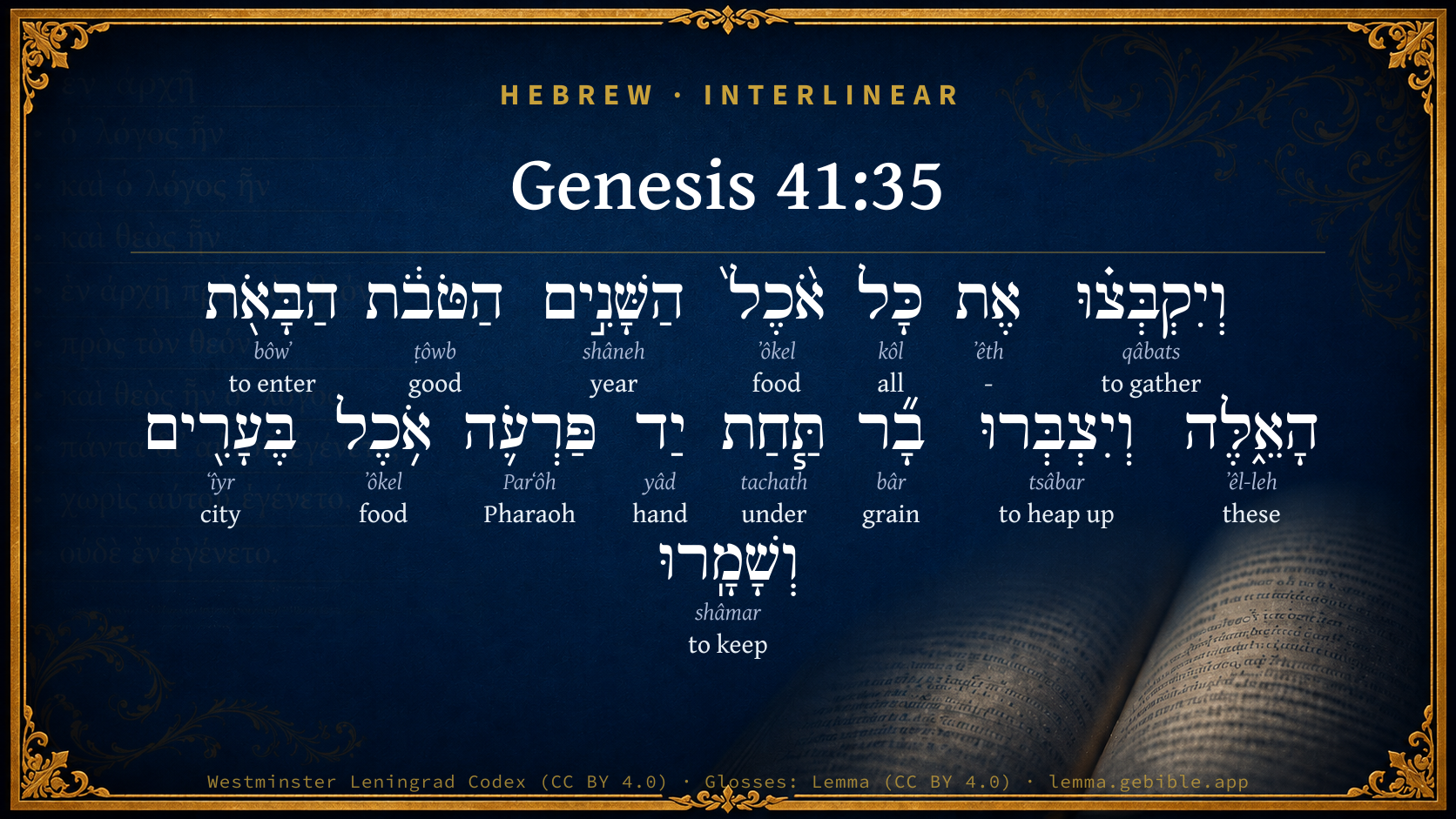
Hebrew (Westminster Leningrad Codex) Genesis 41:35 appears in the Hebrew Old Testament. The text above is from the Westminster Leningrad Codex. Each word links to its Strong’s number, a concise gloss, and parsing drawn from the Open Scriptures Hebrew Bible morphology. Click any word for its full Brown-Driver-Briggs (BDB) entry.
Download image
Cite this verse

Genesis 41:35 (World English Bible). Public Domain. Lemma interlinear Bible study tool, https://lemma.gebible.app/v/genesis/41/35.

Show BibTeX & RIS
BibTeX
RIS
English Translation
Let them gather all the food of these good years that come, and lay up grain under the hand of Pharaoh for food in the cities, and let them keep it.
World English Bible · Public Domain
Highlights
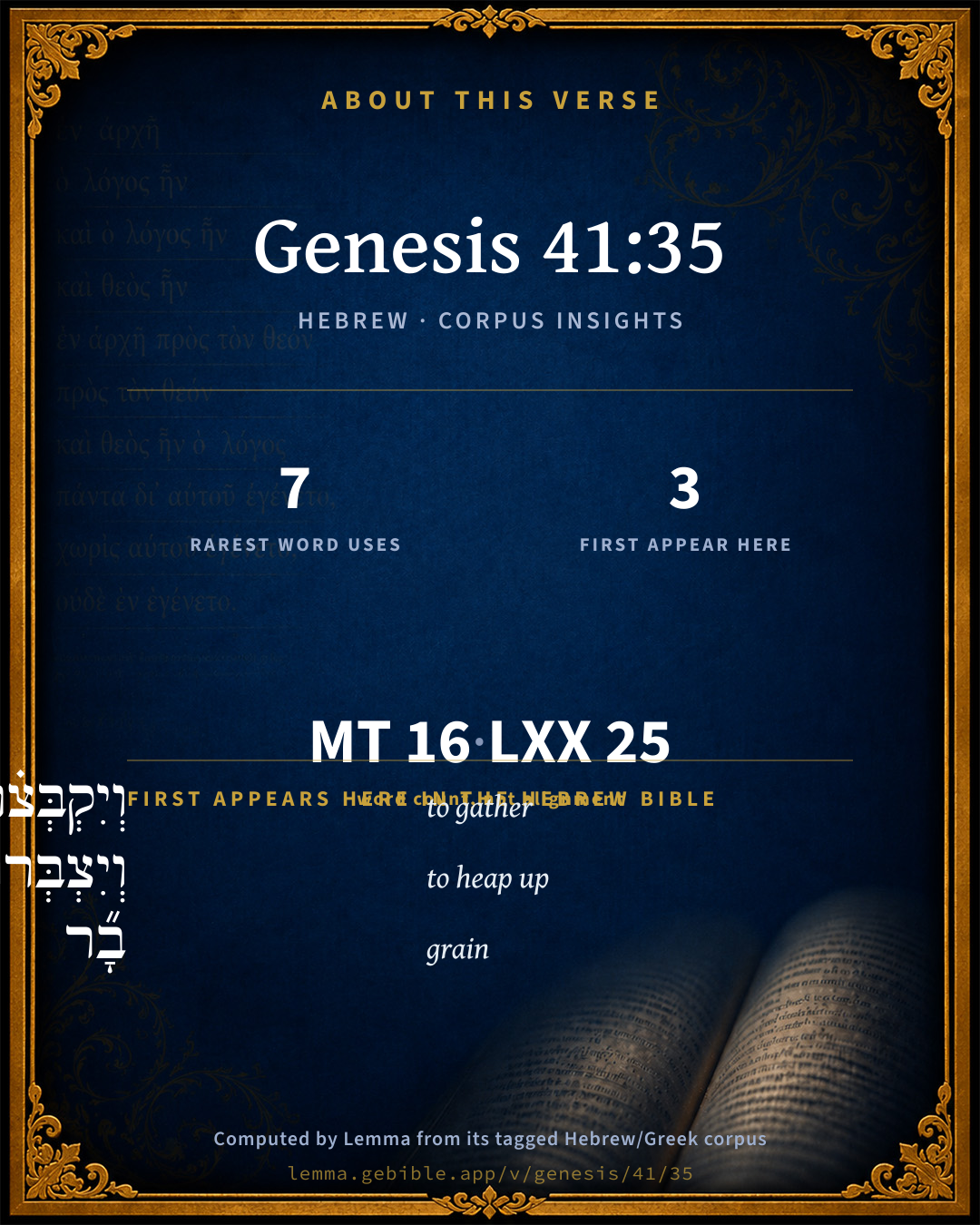
  • 3 first appearances in the Hebrew Bible
Full analysis ↓
Download a study sheet

One document with this verse’s original text, its word-by-word gloss line, the meaning frame, cross-references with their text, attributed commentary, and full source and license credits — printable, and it pastes into notes with its structure intact.

This verse Autodidact and up

Study sheet (.html) Plain text (.txt)

A passage Seminary Student

Up to 50 verses in one chapter. A passage sheet keeps up to 6 commentary sources and 12 cross-references per verse, in the order this page ranks them, and says so on the sheet whenever that leaves anything out. Ask for a single verse and you get the Autodidact verse sheet above.

Everything on this page stays free to read, with no account — the sheet is a download of what is already on screen, not access to it.

Want to remove ads? Support Godless Engineer
Compare translations 3

The same verse in 3 English versions, stacked beneath the original-language interlinear above. Click any original word for its lexicon entry.

Each is an independent rendering of the whole verse — the interlinear is not word-aligned to these translations.

Highlighted words mark where these versions differ — a whole-verse word diff, not a word-by-word alignment.

  • World English Bible Public Domain
    Let them gather all the food of these good years that come, and lay up grain under the hand of Pharaoh for food in the cities, and let them keep it.
  • King James Version Public Domain
    And let them gather all the food of those good years that come, and lay up corn under the hand of Pharaoh, and let them keep food in the cities.
  • unfoldingWord Literal Text CC BY-SA 4.0
    And they should gather all the food of the good years that are coming. And they should store grain under Pharaoh’s hand food in the cities and guard.

unfoldingWord Literal Text — © unfoldingWord, licensed CC BY-SA 4.0. Word-aligned USFM3 via Door43 (git.door43.org/unfoldingWord/en_ult).

Versions to compare (up to 4)

3 of 4 selected

Show all 18 translations

Every available English version of this verse, each an independent rendering of the whole verse.

  • World English Bible Public Domain
    Let them gather all the food of these good years that come, and lay up grain under the hand of Pharaoh for food in the cities, and let them keep it.
  • Berean Standard Bible Public Domain
    Under the authority of Pharaoh, let them collect all the excess food from these good years, that they may come and lay up the grain to be preserved as food in the cities.
  • Majority Standard Bible Public Domain
    Under the authority of Pharaoh, let them collect all the excess food from these good years, that they may come and lay up the grain to be preserved as food in the cities.
  • King James Version Public Domain
    And let them gather all the food of those good years that come, and lay up corn under the hand of Pharaoh, and let them keep food in the cities.
  • American Standard Version (1901) Public Domain
    And let them gather all the food of these good years that come, and lay up grain under the hand of Pharaoh for food in the cities, and let them keep it.
  • Revised Version (1885) Public Domain
    And let them gather all the food of these good years that come, and lay up corn under the hand of Pharaoh for food in the cities, and let them keep it.
  • Geneva Bible (1599) Public Domain
    Also let them gather all the foode of these good yeeres that come, and lay vp corne vnder the hand of Pharaoh for foode, in the cities, and let them keepe it.
  • Douay-Rheims (1899) Public Domain
    Now therefore let the king provide a wise and industrious man, and make him ruler over the land of Egypt:
  • Young's Literal Translation Public Domain
    and they gather all the food of these good years that are coming, and heap up corn under the hand of Pharaoh -- food in the cities; and they have kept `it',
  • Literal Standard Version CC BY-SA 4.0
    and they gather all the food of these good years that are coming, and heap up grain under the hand of Pharaoh—food in the cities; and they have kept [it],
  • Unlocked Literal Bible CC BY-SA 4.0
    Let them gather all the food of these good years that are coming and store up grain under the authority of Pharaoh, for food to be used in the cities. They should preserve it.
  • unfoldingWord Literal Text CC BY-SA 4.0
    And they should gather all the food of the good years that are coming. And they should store grain under Pharaoh’s hand food in the cities and guard.
  • Darby Bible Public Domain
    and let them gather all the food of these coming good years, and lay up corn under the hand of Pharaoh, for food in the cities, and keep [it].
  • World Messianic Bible Public Domain
    Let them gather all the food of these good years that come, and store grain under the hand of Pharaoh for food in the cities, and let them keep it.
  • Webster's Bible Public Domain
    And let them gather all the food of those good years that come, and lay up corn under the hand of Pharaoh; and let them keep food in the cities.
  • Free Bible Version CC BY-SA 4.0
    They should collect all the food during the good years that are soon coming, and store the grain under Pharaoh's authority, keeping it under guard to provide food for the towns.
  • Bible in Basic English Public Domain
    And let them get together all the food in those good years and make a store of grain under Pharaoh's control for the use of the towns, and let them keep it.
  • JPS Tanakh (1917) Public Domain
    And let them gather all the food of these good years that come, and lay up corn under the hand of Pharaoh for food in the cities, and let them keep it.

Literal Standard Version (2020), Covenant Press — licensed CC BY-SA 4.0. Text via the HelloAO Bible API (eBible.org). Unlocked Literal Bible (unfoldingWord) — licensed CC BY-SA 4.0. Text via the HelloAO Bible API (eBible.org). unfoldingWord Literal Text — © unfoldingWord, licensed CC BY-SA 4.0. Word-aligned USFM3 via Door43 (git.door43.org/unfoldingWord/en_ult). Free Bible Version, Dr. Jonathan Gallagher — licensed CC BY-SA 4.0. Text via the HelloAO Bible API (eBible.org).

Word by word

More ways to search: Search by grammar → Find every occurrence → Compare this word →

Practice this passage: Drill this verse → Learn its vocabulary →

וְיִצְבְּרוּ
tsâbar
H6651
“and · to heap up”
Conjunction + Verb, Qal, Imperfect, 3rd Person, Masculine, Plural
Part of Speech
Conjunction + Verb
Stem
Qal
Form
Imperfect
Person
3rd Person
Gender
Masculine
Number
Plural
Full BDB Definition

Origin: a primitive root

TWOT: 1874

(Qal) to heap up, pile up - of grain, dust, silver
  1. וְיִקְבְּצ֗וּ qâbats H6908 “and · to gather” Conjunction + Verb, Qal, Imperfect, 3rd Person, Masculine, Plural
  2. אֶת ʼêth H853 “-” Particle, Direct Object
  3. כָּל kôl H3605 “all of” Noun, Common, Masculine, Singular, Construct
  4. אֹ֨כֶל֙ ʼôkel H400 “food of” Noun, Common, Masculine, Singular, Construct
  5. הַשָּׁנִ֣ים shâneh H8141 “the · years” Particle, Definite Article + Noun, Common, Feminine, Plural, Absolute
  6. הַטֹּבֹ֔ת ṭôwb H2896 “the · good” Particle, Definite Article + Adjective, Adjective, Feminine, Plural, Absolute
  7. הַבָּאֹ֖ת bôwʼ H935 “the · entering” Particle, Definite Article + Verb, Qal, Participle Active, Feminine, Plural, Absolute
  8. הָאֵ֑לֶּה ʼêl-leh H428 “the · these” Particle, Definite Article + Pronoun, Demonstrative, Common, Plural
  9. בָ֞ר bâr H1250 “grain” Noun, Common, Masculine, Singular, Absolute
  10. תַּ֧חַת tachath H8478 “under” Preposition
  11. יַד yâd H3027 “hand of” Noun, Common, Both, Singular, Construct
  12. פַּרְעֹ֛ה Parʻôh H6547 “Pharaoh” Noun, Proper
  13. אֹ֥כֶל ʼôkel H400 “food” Noun, Common, Masculine, Singular, Absolute
  14. בֶּעָרִ֖ים ʻîyr H5892 “in/at the · cities” Preposition, Determined + Noun, Common, Feminine, Plural, Absolute
  15. וְשָׁמָֽרוּ shâmar H8104 “and · to keep” Conjunction + Verb, Qal, Sequential Perfect, 3rd Person, Common, Plural

About this verse

These counts appear in no published source. They are computed here, from the morphology-tagged text and Lemma’s own curated glosses. What Lemma adds →

16
words
15
distinct lemmas
Pentateuch
section

Notable vocabulary

The rarest word here is וְיִצְבְּרוּ to heap up H6651 — appearing just 7 times in the whole Hebrew Bible.

First appearance in Scripture

These words make their first canonical appearance in the Hebrew Bible here:

  • וְיִקְבְּצ֗וּ to gather H6908
  • וְיִצְבְּרוּ to heap up H6651
  • בָ֞ר grain H1250

Shared distinctive vocabulary

וְיִצְבְּרוּ to heap up H6651 occurs in 7 verses of the Hebrew Bible. Also found in:

Grammatical profile

  • 4 verbs
  • 8 nouns
  • 1 adjective
  • 1 pronoun
  • 1 preposition
  • 1 particle

Verb forms

  • וְיִקְבְּצ֗וּ Qal · Imperfect
  • הַבָּאֹ֖ת Qal · Participle Active
  • וְיִצְבְּרוּ Qal · Imperfect
  • וְשָׁמָֽרוּ Qal · Sequential Perfect

Repetition

A word recurs within this verse — often emphatic in Hebrew:

  • אֹ֨כֶל֙ food H400 ×2

Hebrew & Septuagint length

In English translation the verse runs 31 words from the Hebrew and 33 from the Septuagint (LXX English) — closely comparable.

A rough comparison of the two English renderings, which tokenize alike — not a word-level alignment.

Word counts can differ between the Hebrew and the Greek without any difference in meaning — e.g. the Hebrew direct-object marker אֵת has no separate Greek word, and Greek often adds the article ὁ.

In the original languages it is 16 Hebrew tokens and 25 Greek tokens — but the two are counted differently (Hebrew bundles its prefixes and suffixes into one token; the Greek is in lemma form), so that isn’t a like-for-like length.

Cross-references

4

Topical passages linked to Genesis 41:35 in the Treasury of Scripture Knowledge — connected by theme and wording, ordered by reader-vote popularity; previews shown in the World English Bible.

  • Genesis 41:48–49 He gathered up all the food of the seven years which were in the land of Egypt, and laid up the food in the cities: the food of the field, which was round about every city, he laid up in the same.
  • Genesis 41:56 The famine was over all the surface of the earth. Joseph opened all the store-houses, and sold to the Egyptians. The famine was severe in the land of Egypt.
  • Genesis 45:6–7 For these two years the famine has been in the land, and there are yet five years, in which there will be neither plowing nor harvest.
  • Exodus 4:13 He said, "Oh, Lord, please send someone else."

Cross-references courtesy of OpenBible.info (CC BY 4.0).

Hebrew and Greek witnesses Masoretic Hebrew ↔ Greek Septuagint

The same verse in the two great witnesses to the Old Testament, shown verse-for-verse.

These are two independent witnesses, not word-aligned to each other, and the Septuagint is shown in lemma (dictionary) form.

Hebrew Genesis 41:35 Masoretic · Westminster Leningrad Codex

וְיִקְבְּצ֗וּ אֶת כָּל אֹ֨כֶל֙ הַשָּׁנִ֣ים הַטֹּבֹ֔ת הַבָּאֹ֖ת הָאֵ֑לֶּה וְיִצְבְּרוּ בָ֞ר תַּ֧חַת יַד פַּרְעֹ֛ה אֹ֥כֶל בֶּעָרִ֖ים וְשָׁמָֽרוּ

Let them gather all the food of these good years that come, and lay up grain under the hand of Pharaoh for food in the cities, and let them keep it.

World English Bible · Public Domain

Greek LXX Genesis 41:35 Septuagint · lemma form

καί συνἄγω πᾶς ὁ βρῶμα ὁ ἑπτά ἔτος ὁ ἔρχομαι ὁ καλός οὗτος καί συνἄγω ὁ σῖτος ὑπό χείρ φαραώ βρῶμα ἐν ὁ πόλις φυλάσσω

And let them gather all the food of these seven good years that are coming, and let the corn be gathered under the hand of Pharao; let food be kept in the cities.

LXX2012 (modern English Septuagint) · Public Domain

Hebrew: Westminster Leningrad Codex (CC BY 4.0). Greek: Septuagint (public domain); English from LXX2012 (modern English Septuagint) (Public Domain). How the Septuagint differs from the Hebrew →

Targum (Aramaic paraphrase)

2

The Targum is the ancient Jewish Aramaic paraphrase of the Hebrew Scriptures — an interpretive translation, not the Hebrew text itself. Onkelos (literal) and Pseudo-Jonathan (expansive) render the Torah, and Jonathan the Prophets. Coverage is partial: where no permissively-licensed English translation exists for a verse, only the Aramaic is shown. This is verse-level text, not a word-by-word alignment to the Hebrew.

  1. Targum Onkelos Torah (Genesis–Deuteronomy)
    וְיִכְנְשׁוּן יָת כָּל עִיבוּר שְׁנַיָּא טָבָן דְּאָתְיָן הָאִלֵּין וְיִצְבְּרוּן עִיבוּרָא תְּחוֹת יְדָא מְהֵימְנֵי דְפַרְעֹה עִיבוּרָא בְּקִירְוַיָּא וְיִטְּרוּן

    (no public-domain English translation for this verse)

    Targum Onkelos — Aramaic: “Onkelos Genesis” (public domain); “Onkelos Exodus” (public domain); “Onkelos Leviticus” (public domain); “Onkelos Numbers” (public domain); “Onkelos Deuteronomy” (public domain). English: “Sefaria Community Translation” (CC0 1.0 (public-domain dedication)); “J.W. Etheridge. The Targums of Onkelos and Jonathan Ben Uzziel on the Pentateuch. London: Longmans, Green, 1862” (public domain). Text via Sefaria.

  2. Targum Pseudo-Jonathan Torah (Genesis–Deuteronomy)
    וְיִכְנְשׁוּן יַת כָּל עִיבּוּר שְׁנַיָא טַבְתָא דְאַתְיַין אִלֵין וְיִצְבְּרוּן עִיבּוּרָא תְּחוֹת אַפִּיטְרוֹפִּין דְפַּרְעה וִישַׁווּן עִבּוּרָא בְּקִרְוַיָיא וְיִנְטְרוּן

    And let them collect all the produce of those good years that are coming, and gather together the produce under the hand of Pharoh's superintendents, and set the produce in the cities to be kept;

    Targum Pseudo-Jonathan — Aramaic: “Targum Jonathan on Genesis” (public domain); “Targum Jonathan on Exodus” (public domain); “Targum Jonathan on Leviticus” (public domain); “Targum Jonathan on Numbers” (public domain); “Targum Jonathan on Deuteronomy” (public domain). English: “The Targum of Jonathan ben Uzziel, trans. J. W. Etheridge, London, 1862” (public domain). Text via Sefaria.

Commentary

Notes on Genesis 41:35 from classic Christian and Jewish commentators (each source and its license shown beneath its notes). The classic Christian expositions comment on the surrounding passage and are grouped to its opening verse, so a note may address several verses; the Jewish commentaries on the Tanakh (Rashi and others) are per-verse, so they appear only where the commentator wrote on this verse.

Lemma curates 59 commentaries, every one of them public domain or Creative Commons licensed, each selected and text-cleaned for this edition rather than reprinted as found. About our sources →

Trapp's Complete Commentary

John Trapp

Gen 41:35 And let them gather all the food of those good years that come, and lay up corn under the hand of Pharaoh, and let them keep food in the cities.

Ver. 35. And let them gather all the food.] This text warranteth providence in laying up for a rainy day. Solomon sends us to school to the ant to learn this lesson. {Pro 6:6} And it is well observed, that our Saviour had a purse for common store for himself and those about him. Neither was this a penny pouch, but a bag so big as needed a bearer. God would have us to be good husbands, and see that Condus be fortior promo, our comings in more than our layings out. "Parents" must "lay up for their children," {2Co 12:14} yea, "leave inheritance to children’s children," {Pro 13:22} playing the good husbands abroad and at home. {Pro 27:26-27}

John Trapp, A Commentary or Exposition upon All the Books of the Old and New Testament (1647–1656) — public domain. Text from a community e-Sword module.

Adam Clarke's Commentary

Verse 35. Under the hand of Pharaoh] To be completely at the disposal of the king.

Adam Clarke's Commentary on the Bible (1810–1826) — public domain. Text from a community e-Sword/MySword module.

John Calvin's Commentaries

35. Under the hand of Pharaoh. Whereas prosperity so intoxicates men, that the greater part make no provision for themselves against the future, but absorb the present abundance by intemperance; Joseph advises the king to take care that the country may have its produce laid up in store. Besides, the common people would also form themselves to habits of frugality, when they understood that this great quantity of corn was not collected in vain by the king, but that a remedy was hereby sought for some unwonted calamity. In short, because luxury generally prevails in prosperity, and wastes the blessings of God, the bridle of authority was necessary. This is the reason why Joseph directed that garners should be established under the power of the king, and that corn should be gathered into them. He concludes at length, that the dream was useful, although at first sight, it would seem sad and inauspicious: because, immediately after the wound had been shown, the means of cure were suggested.

John Calvin's Commentaries (1540-1563) — public domain. Text from the Calvin Translation Society English edition (1840s-50s) via the Christian Classics Ethereal Library (ccel.org). Calvin's coverage is partial (roughly two-thirds of the Bible); uncommented books and verses are honest gaps, never fabricated. The 19th-century editor's footnotes and remarks are omitted so the notes are faithfully Calvin's own voice.

The Cambridge Bible for Schools and Colleges

gen. ed. J. J. S. Perowne

35. let them gather all the food] This is rhetorical, and need not be pressed as contradicting the exaction of the one-fifth in Gen_41:34. But see Gen_41:48.

lay up corn] i.e. store up the grain in the keeping of the king’s officers. The establishment of state granaries appears here for the first time in history.

under the hand of Pharaoh] The king’s authority is never to be relaxed. The measures proposed will enhance the monarchy.

The Cambridge Bible for Schools and Colleges (gen. ed. J. J. S. Perowne; Cambridge University Press, 1878–1918) — public domain. Text from a community e-Sword module.

John Gill's Exposition

And Pharaoh said unto his servants,.... That were about him, and with whom he was consulting about a proper person to be over this affair of gathering in the fruits of the earth in the time of plenty, and laying them up against a time of famine:

can we find such an one as this is, in whom the Spirit of God is? if we search among all the ranks and degrees of men throughout the kingdom, let them be of what character they will, we shall never find a man like this, who appears to have the Spirit of God, or "of the gods", as he in his Heathenish way spoke, and which he concluded from his vast knowledge of things; and especially of things future: hence the Targums of Onkelos and Jonathan interpret it, the spirit of prophecy from the Lord.

John Gill's Exposition of the Whole Bible (1746–1763) — public domain (CC PDM 1.0). Text via the HelloAO Bible API.

unfoldingWord translationNotes

Door43 World Missions Community

General Information:

Joseph continues to counsel Pharaoh

Let them gather

"Allow the overseers to gather"

of these good years that are coming

This speaks of years as if they are something that travels and comes to a place. AT: "during the good years that will soon happen" (See: Metaphor)

store up grain under the authority of Pharaoh

The phrase "under the authority of Pharaoh" means Pharaoh gives them authority. AT: "use the authority of Pharaoh to store the grain" (See: Idiom)

They should preserve it

The word "they" refers to the overseers and represents the soldiers that they should command to guard the grain. AT: "The overseers should leave soldiers there to guard the grain" (See: Metonymy)

The food will be a supply for the land

Here "land" refers to the people. AT: "This food will be for the people" (See: Metonymy)

In this way the land will not be devastated by the famine

Here "land" stands for the people. This can be stated in active form. AT: "This way the people will not starve during the famine" (See: Metonymy and Active or Passive)

translationWords

good

grain

authority

Pharaoh

famine

Egypt

devastate

unfoldingWord translationNotes — © Distant Shores Media and the Door43 World Missions Community, licensed CC BY-SA 4.0. Source: git.door43.org/Door43/en_tn.

Rashi

Rabbi Shlomo Yitzchaki (Rashi)

את כל אֹכֶל ALL THE FOOD — The word אֹכֶל is a noun and therefore the accent is on the א and the last syllable has the vowel Patach Katan (a name Rashi uses for our Segol), whilst אוֹכֵל — which is a participle, as for instance, (Leviticus 7:25) “For whosoever eateth (אוֹכֵל) the fat” — has the accent on the ultimate syllable, on the כ, and has the vowel Kametz Katan (Zéré).

תחת יד פרעה UNDER THE HAND OF PHARAOH — under his control and in his storehouses.

Rashi on the Tanakh — English translations: “The Judaica Press complete Tanach with Rashi, translated by A. J. Rosenberg” (CC BY 4.0); “Pentateuch with Rashi's commentary by M. Rosenbaum and A.M. Silbermann, 1929-1934” (public domain); “The Metsudah Tanach series, Lakewood, N.J” (CC BY 4.0); and “The Book of Joshua, Metsudah Publications, 1997” (CC BY 4.0). Text via Sefaria.

Radak

Rabbi David Kimhi (Radak)

ויקבצו את כל אוכל השנים, concerning this tax of twenty percent of the harvest, Joseph suggested that the appointed officials should collect the food thus set aside by Pharaoh during the seven years of plenty and store it near various cities under Pharaoh’s direct supervision so that it would be at hand when the years of famine would commence. This would be independent of what private individuals would put in storage on their own account. If this advice were followed, each city would have a substantial hoard of grain near at hand when the famine would break out and there would not be any panic or undue profiteering.

Radak on the Tanakh — English translations: “Sefaria Community Translation” (CC0 1.0 (public-domain dedication)); “Eliyahu Munk, HaChut Hameshulash” (CC BY 4.0); “Rabbi Mike Feuer, Jerusalem Anthology” (CC BY 4.0); and “R. David Kimhi on the first book of Psalms, Translated by R.G. Finch, London, 1919” (public domain). Text via Sefaria.

Lesson kit

Teaching starters — assembled from the data on this page, not authored interpretation. Every prompt links to the verse data it draws on. Edit before teaching.

Genesis, in the Pentateuch, opens this verse with 16 words (15 distinct Hebrew lemmas). Its most distinctive word is tsâbar (“to heap up”). A historical commentator’s framing appears above. Read the whole chapter for the surrounding context.

Discussion questions

  1. The word tsâbar carries the sense “to heap up.” How does it shape the verse?
  2. 3 words make their first appearance in Scripture here. What does this debut establish?
  3. How does Genesis 41:49, which shares the word «to heap up», read alongside this verse?
  4. What does the repetition of “food” (2× in this one verse) do in this verse?
  5. These translations render this verse differently. What is at stake in choosing one wording over another?
  6. «וְיִקְבְּצ֗וּ» is a Qal Imperfect verb. How does that grammatical form shape the action described?
  7. Compare how Trapp's Complete Commentary and Adam Clarke's Commentary read this verse. Where do they agree or differ?

Things to notice

Reading settings

Reading text

Shown beneath each verse's original-language words.

Old Testament
Old Testament edition

Read the OT as the Masoretic Hebrew (MT) or the Greek Septuagint (LXX).

English shown for the Greek Septuagint (in the Hebrew ↔ Greek comparison).

Comparing translations? Open the Compare panel on any verse page to stack up to four side by side.