
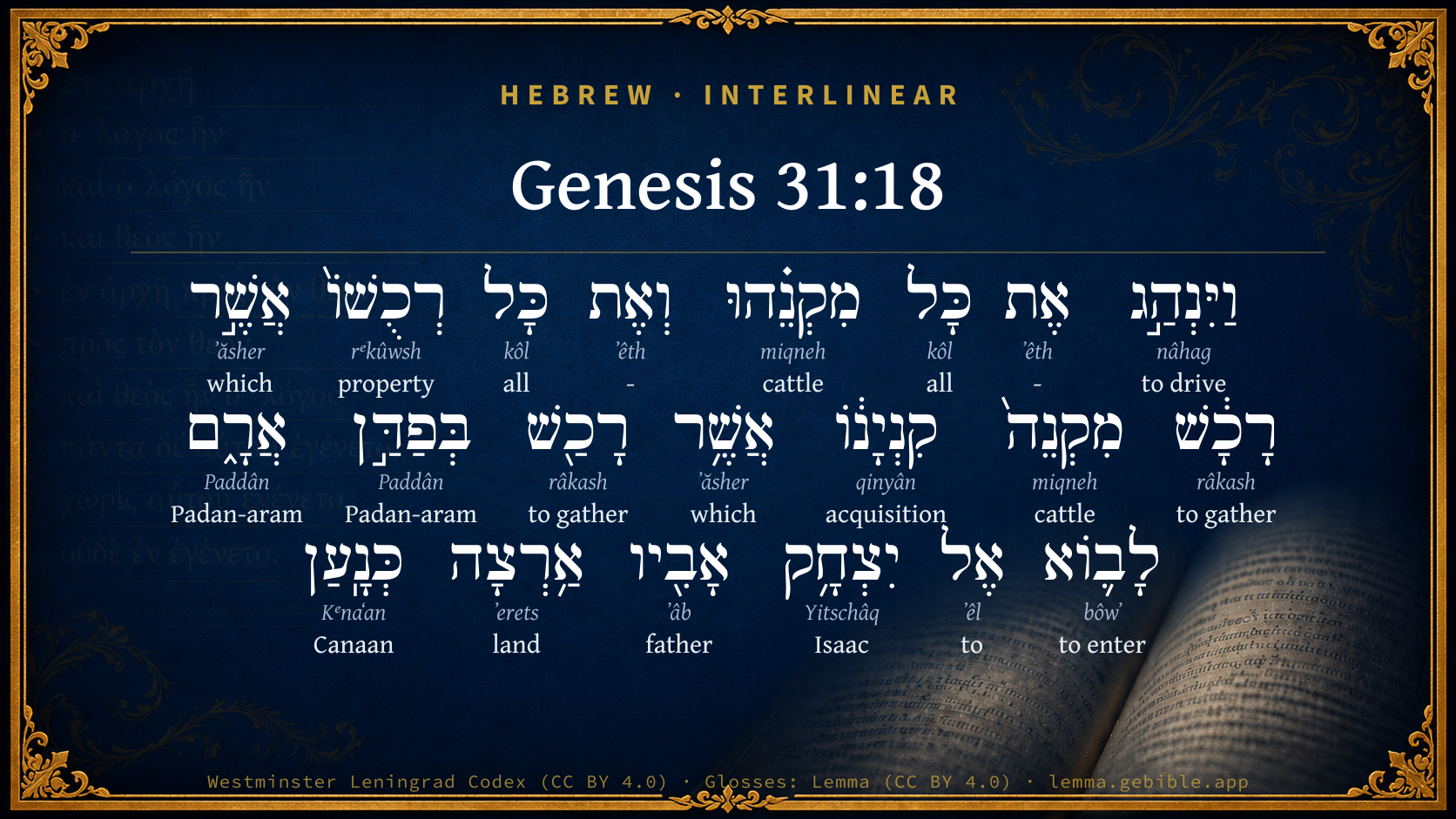
Genesis 31:18

Hebrew (Westminster Leningrad Codex) Genesis 31:18 appears in the Hebrew Old Testament. The text above is from the Westminster Leningrad Codex. Each word links to its Strong’s number, a concise gloss, and parsing drawn from the Open Scriptures Hebrew Bible morphology. Click any word for its full Brown-Driver-Briggs (BDB) entry.
Download image
Cite this verse

Genesis 31:18 (World English Bible). Public Domain. Lemma interlinear Bible study tool, https://lemma.gebible.app/v/genesis/31/18.

Show BibTeX & RIS
BibTeX
RIS
English Translation
and he carried away all his cattle, and all his substance which he had gathered, the cattle of his getting, which he had gathered in Paddan Aram, to go to Isaac his father to the land of Canaan.
World English Bible · Public Domain
Highlights
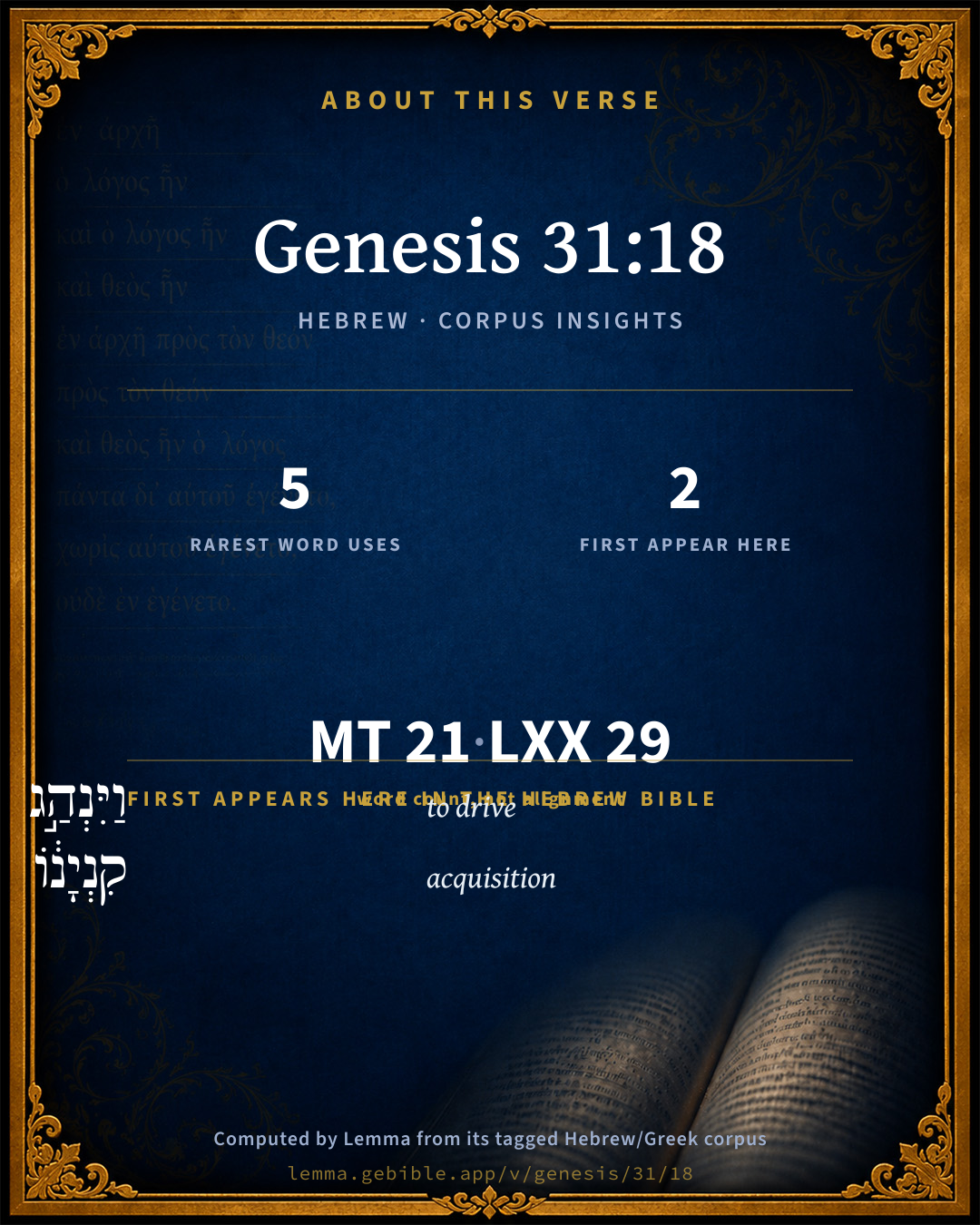
  • 2 first appearances in the Hebrew Bible
Full analysis ↓
Download a study sheet

One document with this verse’s original text, its word-by-word gloss line, the meaning frame, cross-references with their text, attributed commentary, and full source and license credits — printable, and it pastes into notes with its structure intact.

This verse Autodidact and up

Study sheet (.html) Plain text (.txt)

A passage Seminary Student

Up to 50 verses in one chapter. A passage sheet keeps up to 6 commentary sources and 12 cross-references per verse, in the order this page ranks them, and says so on the sheet whenever that leaves anything out. Ask for a single verse and you get the Autodidact verse sheet above.

Everything on this page stays free to read, with no account — the sheet is a download of what is already on screen, not access to it.

Want to remove ads? Support Godless Engineer
Compare translations 3

The same verse in 3 English versions, stacked beneath the original-language interlinear above. Click any original word for its lexicon entry.

Each is an independent rendering of the whole verse — the interlinear is not word-aligned to these translations.

Highlighted words mark where these versions differ — a whole-verse word diff, not a word-by-word alignment.

  • World English Bible Public Domain
    and he carried away all his cattle, and all his substance which he had gathered, the cattle of his getting, which he had gathered in Paddan Aram, to go to Isaac his father to the land of Canaan.
  • King James Version Public Domain
    And he carried away all his cattle, and all his goods which he had gotten, the cattle of his getting, which he had gotten in Padanaram, for to go to Isaac his father in the land of Canaan.
  • unfoldingWord Literal Text CC BY-SA 4.0
    Then he drove all his livestock and all his property that he had acquired, the livestock in his possession that he had acquired in Paddan Aram, to go to Isaac his father, to the land of Canaan.

unfoldingWord Literal Text — © unfoldingWord, licensed CC BY-SA 4.0. Word-aligned USFM3 via Door43 (git.door43.org/unfoldingWord/en_ult).

Versions to compare (up to 4)

3 of 4 selected

Show all 18 translations

Every available English version of this verse, each an independent rendering of the whole verse.

  • World English Bible Public Domain
    and he carried away all his cattle, and all his substance which he had gathered, the cattle of his getting, which he had gathered in Paddan Aram, to go to Isaac his father to the land of Canaan.
  • Berean Standard Bible Public Domain
    and he drove all his livestock before him, along with all the possessions he had acquired in Paddan-aram, to go to his father Isaac in the land in Canaan.
  • Majority Standard Bible Public Domain
    and he drove all his livestock before him, along with all the possessions he had acquired in Paddan-aram, to go to his father Isaac in the land in Canaan.
  • King James Version Public Domain
    And he carried away all his cattle, and all his goods which he had gotten, the cattle of his getting, which he had gotten in Padanaram, for to go to Isaac his father in the land of Canaan.
  • American Standard Version (1901) Public Domain
    and he carried away all his cattle, and all his substance which he had gathered, the cattle of his getting, which he had gathered in Paddan-aram, to go to Isaac his father unto the land of Canaan.
  • Revised Version (1885) Public Domain
    and he carried away all his cattle, and all his substance which he had gathered, the cattle of his getting, which he had gathered in Paddan-aram, for to go to Isaac his father unto the land of Canaan.
  • Geneva Bible (1599) Public Domain
    And he caried away all his flockes, and al his substance which he had gotten, to wit, his riches, which he had gotten in Padan Aram, to goe to Izhak his father vnto the land of Canaan.
  • Douay-Rheims (1899) Public Domain
    And he took all his substance, and flocks, and whatsoever he had gotten in Mesopotamia, and went forward to Isaac his father to the land of Chanaan.
  • Young's Literal Translation Public Domain
    and leadeth all his cattle, and all his substance which he hath acquired, the cattle of his getting, which he hath acquired in Padan-Aram, to go unto Isaac his father, to the land of Canaan.
  • Literal Standard Version CC BY-SA 4.0
    and leads all his livestock, and all his substance which he has acquired, the livestock of his getting, which he has acquired in Padan-Aram, to go to his father Isaac, to the land of Canaan.
  • Unlocked Literal Bible CC BY-SA 4.0
    He drove all his livestock ahead of him, along with all his property, including the livestock he had acquired in Paddan Aram. Then he set out to go to his father Isaac in the land of Canaan.
  • unfoldingWord Literal Text CC BY-SA 4.0
    Then he drove all his livestock and all his property that he had acquired, the livestock in his possession that he had acquired in Paddan Aram, to go to Isaac his father, to the land of Canaan.
  • Darby Bible Public Domain
    and carried away all his cattle, and all his property that he had acquired -- the cattle of his possessions that he had acquired in Padan-Aram, to go to Isaac his father, into the land of Canaan.
  • World Messianic Bible Public Domain
    and he took away all his livestock, and all his possessions which he had gathered, including the livestock which he had gained in Paddan Aram, to go to Isaac his father, to the land of Canaan.
  • Webster's Bible Public Domain
    And he carried away all his cattle, and all his goods which he had gained, the cattle of his getting, which he had gained in Padan-aram; to go to Isaac, his father, in the land of Canaan.
  • Free Bible Version CC BY-SA 4.0
    and drove all his livestock in front of him. He took with him all his possessions and livestock he'd gained during his time in Paddan-aram, and left to go back to his father in the country of Canaan.
  • Bible in Basic English Public Domain
    And sending on before him all his cattle and his property which he had got together in Paddan-aram, he made ready to go to Isaac his father in the land of Canaan.
  • JPS Tanakh (1917) Public Domain
    and he carried away all his cattle, and all his substance which he had gathered, the cattle of his getting, which he had gathered in Paddan-aram, to go to Isaac his father unto the land of Canaan.

Literal Standard Version (2020), Covenant Press — licensed CC BY-SA 4.0. Text via the HelloAO Bible API (eBible.org). Unlocked Literal Bible (unfoldingWord) — licensed CC BY-SA 4.0. Text via the HelloAO Bible API (eBible.org). unfoldingWord Literal Text — © unfoldingWord, licensed CC BY-SA 4.0. Word-aligned USFM3 via Door43 (git.door43.org/unfoldingWord/en_ult). Free Bible Version, Dr. Jonathan Gallagher — licensed CC BY-SA 4.0. Text via the HelloAO Bible API (eBible.org).

Word by word

More ways to search: Search by grammar → Find every occurrence → Compare this word →

Practice this passage: Drill this verse → Learn its vocabulary →

רָכָ֔שׁ
râkash
H7408
“to gather”
Verb, Qal, Perfect, 3rd Person, Masculine, Singular
Part of Speech
Verb
Stem
Qal
Form
Perfect
Person
3rd Person
Gender
Masculine
Number
Singular
Full BDB Definition

Origin: a primitive root

TWOT: 2167

(Qal) to collect or gather property
  1. וַיִּנְהַ֣ג nâhag H5090 “and · to drive” Conjunction + Verb, Qal, Sequential Imperfect, 3rd Person, Masculine, Singular
  2. אֶת ʼêth H853 “-” Particle, Direct Object
  3. כָּל kôl H3605 “all of” Noun, Common, Masculine, Singular, Construct
  4. מִקְנֵ֗הוּ miqneh H4735 “cattle · his” Noun, Common, Masculine, Singular, Construct + Suffix, Personal, 3rd Person, Masculine, Singular
  5. וְאֶת ʼêth H853 “and · -” Conjunction + Particle, Direct Object
  6. כָּל kôl H3605 “all of” Noun, Common, Masculine, Singular, Construct
  7. רְכֻשׁוֹ֙ rᵉkûwsh H7399 “property · his” Noun, Common, Masculine, Singular, Construct + Suffix, Personal, 3rd Person, Masculine, Singular
  8. אֲשֶׁ֣ר ʼăsher H834 “which” Particle, Relative
  9. מִקְנֵה֙ miqneh H4735 “cattle of” Noun, Common, Masculine, Singular, Construct
  10. קִנְיָנ֔וֹ qinyân H7075 “acquisition · his” Noun, Common, Masculine, Singular, Construct + Suffix, Personal, 3rd Person, Masculine, Singular
  11. אֲשֶׁ֥ר ʼăsher H834 “which” Particle, Relative
  12. רָכַ֖שׁ râkash H7408 “to gather” Verb, Qal, Perfect, 3rd Person, Masculine, Singular
  13. בְּפַדַּ֣ן Paddân H6307 “in/at · Padan-aram” Preposition + Noun, Proper
  14. אֲרָ֑ם Paddân H6307 “Padan-aram” Noun, Proper
  15. לָב֛וֹא bôwʼ H935 “to enter” Preposition + Verb, Qal, Infinitive Construct
  16. אֶל ʼêl H413 “to” Preposition
  17. יִצְחָ֥ק Yitschâq H3327 “Isaac” Noun, Proper
  18. אָבִ֖יו ʼâb H1 “father · his” Noun, Common, Masculine, Singular, Construct + Suffix, Personal, 3rd Person, Masculine, Singular
  19. אַ֥רְצָה ʼerets H776 “land · toward” Noun, Common, Both, Singular, Construct + Suffix, Demonstrative
  20. כְּנָֽעַן Kᵉnaʻan H3667 “Canaan” Noun, Proper

About this verse

These counts appear in no published source. They are computed here, from the morphology-tagged text and Lemma’s own curated glosses. What Lemma adds →

21
words
15
distinct lemmas
Pentateuch
section

Notable vocabulary

The rarest word here is רָכָ֔שׁ to gather H7408 — appearing just 5 times in the whole Hebrew Bible.

First appearance in Scripture

These words make their first canonical appearance in the Hebrew Bible here:

  • וַיִּנְהַ֣ג to drive H5090
  • קִנְיָנ֔וֹ acquisition H7075

Shared distinctive vocabulary

רָכָ֔שׁ to gather H7408 occurs in 4 verses of the Hebrew Bible. Also found in:

Grammatical profile

  • 4 verbs
  • 12 nouns
  • 1 preposition
  • 4 particles

Verb forms

  • וַיִּנְהַ֣ג Qal · Sequential Imperfect
  • רָכָ֔שׁ Qal · Perfect
  • רָכַ֖שׁ Qal · Perfect
  • לָב֛וֹא Qal · Infinitive Construct

Repetition

Words recur within this verse — often emphatic in Hebrew:

  • כָּל all H3605 ×2
  • מִקְנֵ֗הוּ cattle H4735 ×2
  • רָכָ֔שׁ to gather H7408 ×2
  • בְּפַדַּ֣ן Padan-aram H6307 ×2
  • אֲשֶׁ֣ר which H834 ×2

Hebrew & Septuagint length

In English translation the verse runs 38 words from the Hebrew and 34 from the Septuagint (LXX English) — closely comparable.

A rough comparison of the two English renderings, which tokenize alike — not a word-level alignment.

Word counts can differ between the Hebrew and the Greek without any difference in meaning — e.g. the Hebrew direct-object marker אֵת has no separate Greek word, and Greek often adds the article ὁ.

In the original languages it is 21 Hebrew tokens and 29 Greek tokens — but the two are counted differently (Hebrew bundles its prefixes and suffixes into one token; the Greek is in lemma form), so that isn’t a like-for-like length.

Cross-references

4

Topical passages linked to Genesis 31:18 in the Treasury of Scripture Knowledge — connected by theme and wording, ordered by reader-vote popularity; previews shown in the World English Bible.

  • Genesis 27:1–2 It happened, that when Isaac was old, and his eyes were dim, so that he could not see, he called Esau his elder son, and said to him, "My son?" He said to him, "Here I am."
  • Genesis 27:41 Esau hated Jacob because of the blessing with which his father blessed him. Esau said in his heart, "The days of mourning for my father are at hand. Then I will kill my brother Jacob."
  • Genesis 28:21 so that I come again to my father's house in peace, and Yahweh will be my God,
  • Genesis 35:27–29 Jacob came to Isaac his father, to Mamre, to Kiriath Arba (the same is Hebron), where Abraham and Isaac lived as foreigners.

Cross-references courtesy of OpenBible.info (CC BY 4.0).

Hebrew and Greek witnesses Masoretic Hebrew ↔ Greek Septuagint

The same verse in the two great witnesses to the Old Testament, shown verse-for-verse.

These are two independent witnesses, not word-aligned to each other, and the Septuagint is shown in lemma (dictionary) form.

Hebrew Genesis 31:18 Masoretic · Westminster Leningrad Codex

וַיִּנְהַ֣ג אֶת כָּל מִקְנֵ֗הוּ וְאֶת כָּל רְכֻשׁוֹ֙ אֲשֶׁ֣ר רָכָ֔שׁ מִקְנֵה֙ קִנְיָנ֔וֹ אֲשֶׁ֥ר רָכַ֖שׁ בְּפַדַּ֣ן אֲרָ֑ם לָב֛וֹא אֶל יִצְחָ֥ק אָבִ֖יו אַ֥רְצָה כְּנָֽעַן

and he carried away all his cattle, and all his substance which he had gathered, the cattle of his getting, which he had gathered in Paddan Aram, to go to Isaac his father to the land of Canaan.

World English Bible · Public Domain

Greek LXX Genesis 31:18 Septuagint · lemma form

καί ἀποἄγω πᾶς ὁ ὑποἄρχω αὐτός καί πᾶς ὁ ἀποσκευή αὐτός ὅς περιποιέω ἐν ὁ μεσοποταμία καί πᾶς ὁ αὐτός ἀποἔρχομαι πρός ισαακ ὁ πατήρ αὐτός εἰς γῆ χανααν

and he took away all his possessions and all his store, which he had gotten in Mesopotamia, and all that belonged to him, to depart to Isaac his father in the land of Chanaan.

LXX2012 (modern English Septuagint) · Public Domain

On this verse, Haydock's Catholic Bible Commentary discusses the Septuagint’s reading. Read the note in Commentary ↓

Hebrew: Westminster Leningrad Codex (CC BY 4.0). Greek: Septuagint (public domain); English from LXX2012 (modern English Septuagint) (Public Domain). How the Septuagint differs from the Hebrew →

Targum (Aramaic paraphrase)

2

The Targum is the ancient Jewish Aramaic paraphrase of the Hebrew Scriptures — an interpretive translation, not the Hebrew text itself. Onkelos (literal) and Pseudo-Jonathan (expansive) render the Torah, and Jonathan the Prophets. Coverage is partial: where no permissively-licensed English translation exists for a verse, only the Aramaic is shown. This is verse-level text, not a word-by-word alignment to the Hebrew.

  1. Targum Onkelos Torah (Genesis–Deuteronomy)
    וּדְבַר יָת כָּל גֵּיתוֹהִי וְיָת כָּל קִנְיָנֵהּ דִּקְנָא גֵּיתֵי קִנְיָנֵהּ דִּי קְנָא בְּפַדַּן אֲרָם לְמֵיתֵי לְוַת יִצְחָק אֲבוּהִי לְאַרְעָא כְנָעַן

    (no public-domain English translation for this verse)

    Targum Onkelos — Aramaic: “Onkelos Genesis” (public domain); “Onkelos Exodus” (public domain); “Onkelos Leviticus” (public domain); “Onkelos Numbers” (public domain); “Onkelos Deuteronomy” (public domain). English: “Sefaria Community Translation” (CC0 1.0 (public-domain dedication)); “J.W. Etheridge. The Targums of Onkelos and Jonathan Ben Uzziel on the Pentateuch. London: Longmans, Green, 1862” (public domain). Text via Sefaria.

  2. Targum Pseudo-Jonathan Torah (Genesis–Deuteronomy)
    וּדְבַר יַת כָּל בְּעִירָא וְיַת כָּל נִכְסוֹי דִי קָנָא גֵיתוֹ וְנִכְסוֹי דִי קְנָא בְּפַדַן אֲרַם לְמֵיתֵי לְוַת יִצְחָק אָבוּי לְאַרְעָא דִכְנָעַן

    And he led all his herds and his substance which he had obtained in Padan Aram to go unto Izhak his father in the land of Kenaan.

    Targum Pseudo-Jonathan — Aramaic: “Targum Jonathan on Genesis” (public domain); “Targum Jonathan on Exodus” (public domain); “Targum Jonathan on Leviticus” (public domain); “Targum Jonathan on Numbers” (public domain); “Targum Jonathan on Deuteronomy” (public domain). English: “The Targum of Jonathan ben Uzziel, trans. J. W. Etheridge, London, 1862” (public domain). Text via Sefaria.

Commentary

Notes on Genesis 31:18 from classic Christian and Jewish commentators (each source and its license shown beneath its notes). The classic Christian expositions comment on the surrounding passage and are grouped to its opening verse, so a note may address several verses; the Jewish commentaries on the Tanakh (Rashi and others) are per-verse, so they appear only where the commentator wrote on this verse.

Lemma curates 59 commentaries, every one of them public domain or Creative Commons licensed, each selected and text-cleaned for this edition rather than reprinted as found. About our sources →

Trapp's Complete Commentary

John Trapp

Gen 31:18 And he carried away all his cattle, and all his goods which he had gotten, the cattle of his getting, which he had gotten in Padanaram, for to go to Isaac his father in the land of Canaan.

Ver. 18. To go to Isaac.] But was long in going; about ten years.

John Trapp, A Commentary or Exposition upon All the Books of the Old and New Testament (1647–1656) — public domain. Text from a community e-Sword module.

Jamieson, Fausset & Brown

Robert Jamieson, A. R. Fausset & David Brown

he carried the cattle of his getting--that is, his own and nothing more. He did not indemnify himself for his many losses by carrying off any thing of Laban's, but was content with what Providence had given him. Some may think that due notice should have been given; but when a man feels himself in danger--the law of self-preservation prescribes the duty of immediate flight, if it can be done consistently with conscience.

Jamieson, Fausset & Brown — Commentary Critical and Explanatory on the Whole Bible (1871) — public domain (CC PDM 1.0). Text via the HelloAO Bible API.

John Gill's Exposition

And Laban went to shear his sheep,.... Which were under the care of his sons, and were three days' distance from Jacob's flocks; this gave Jacob a fair opportunity to depart with his family and substance, since Laban and his sons were at such a distance, and their servants with them also:

and Rachel had stolen the images that were her father's; afterwards called gods, which he made use of in an idolatrous and superstitious manner, one way or other: they seem to be a kind of "penates", or household gods; in the Hebrew they are called "teraphim"; and which De Dieu thinks were the same with "seraphim" (z); and were images of angels, consulted on occasion, and placed in the house for the protection of it, and to increase the substance thereof: some take them to be plates of brass describing the hours of the day, a sort of sundials; or were such forms, that at certain times were made to speak, and show things to come: but they rather seem to be images of an human form, as say the Jewish writers, and as seems from Sa1 19:13; and which it is supposed were made under certain constellations, and were a sort of talismans, and were consulted as oracles, and in high esteem with the Chaldeans and Syrians, a people given to astrology, and by which they made their divinations; See Gill on Hos 3:4 and also See Gill on Zac 10:2; and therefore Rachel took them away, that her father might not consult them, and know which way Jacob fled, as Aben Ezra; but this looks as if she had an opinion of them, and that they had such a power of discovering persons and things that were attributed to them: and indeed some think she took them away from an affection and veneration for them, supposing she should not be able to meet with such in Canaan in Isaac's family; and what is observed in Gen 35:2 seems to countenance this; but one would think she had been better instructed by Jacob during his twenty years' conversation with her; and besides, had she been tinctured with such sort of superstition and idolatry, she would never have used them so indecently, as to have sat upon them in the circumstances in which she was, Gen 31:34; it is more to her credit and character to say with Jarchi, that she did this to take off her father from the idolatrous worship of them, and to convince him that they were no gods; since they could not inform him of the designs of Jacob, and of his flight, nor secure themselves from being carried away by her; unless it can be thought that she took them because of the metal of which they were made, gold or silver, being willing to have something of her father's goods as her portion, which she thought she had a right unto, or in recompence of her husband's service. Dr. Lightfoot (a) thinks she took them for a civil use, to preserve the memory of some of her ancestors, of which these were the pictures, and Laban had idolized; but whether pictures were so early is questionable.

(z) So Hyde, Hist. Relig. Ver. Pers. c. 20. p. 272. (a) Works, vol. 1. p. 696.

John Gill's Exposition of the Whole Bible (1746–1763) — public domain (CC PDM 1.0). Text via the HelloAO Bible API.

Haydock's Catholic Bible Commentary

Gotten. Hebrew expresses over again, the cattle of his getting, &c., which is omitted in one manuscript, as well as in the Septuagint, Syriac, and Arabic versions, though yet used in the Samaritan copy. (Kennicott) --- To Isaac, who was still living, though he had apprehended death was at hand 20 years before. He continued to live other 20 years after. (Salien.) --- Jacob spent about 10 years at Sichem and at Bethel, before he went to dwell with Isaac. (Menochius)

George Leo Haydock (1774–1849), Haydock's Catholic Family Bible and Commentary, 1859 edition — public domain. Excludes Psalms (Douay-Rheims chapter numbering differs from Protestant) and Deuterocanonical books (Catholic canon only).

Rashi

Rabbi Shlomo Yitzchaki (Rashi)

מקנה קנינו means — what he had purchased by means of קנינו his own property i.e. his sheep, viz., menservants, maidservants, camels and asses (Genesis Rabbah 74:5; cf. Rashi on Genesis 30:43).

Rashi on the Tanakh — English translations: “The Judaica Press complete Tanach with Rashi, translated by A. J. Rosenberg” (CC BY 4.0); “Pentateuch with Rashi's commentary by M. Rosenbaum and A.M. Silbermann, 1929-1934” (public domain); “The Metsudah Tanach series, Lakewood, N.J” (CC BY 4.0); and “The Book of Joshua, Metsudah Publications, 1997” (CC BY 4.0). Text via Sefaria.

Radak

Rabbi David Kimhi (Radak)

וינהג...מקנה קנינו, the first time the word מקנהו appears in our verse it refers to cattle Yaakov had acquired as a result of his activities as shepherd. The expression מקנה קנינו on the other hand, refers to livestock he had purchased. Whenever the word מקנה is spelled with the vowel tzeyreh under the letter נ this indicates that it is in the construct mode.

Radak on the Tanakh — English translations: “Sefaria Community Translation” (CC0 1.0 (public-domain dedication)); “Eliyahu Munk, HaChut Hameshulash” (CC BY 4.0); “Rabbi Mike Feuer, Jerusalem Anthology” (CC BY 4.0); and “R. David Kimhi on the first book of Psalms, Translated by R.G. Finch, London, 1919” (public domain). Text via Sefaria.

Lesson kit

Teaching starters — assembled from the data on this page, not authored interpretation. Every prompt links to the verse data it draws on. Edit before teaching.

Genesis, in the Pentateuch, opens this verse with 21 words (15 distinct Hebrew lemmas). Its most distinctive word is râkash (“to gather”). A historical commentator’s framing appears above. Read the whole chapter for the surrounding context.

Discussion questions

  1. How does “to gather” (râkash) shape what this verse is saying?
  2. 2 words make their first appearance in Scripture here. What does this debut establish?
  3. How does Genesis 12:5, which shares the word «to gather», read alongside this verse?
  4. What does the repetition of “all” (2× in this one verse) do in this verse?
  5. These translations render this verse differently; the difference is in the English rendering, not the original. What questions does that raise?
  6. «וַיִּנְהַ֣ג» is a Qal Sequential Imperfect verb. How does that grammatical form shape the action described?
  7. Compare how Trapp's Complete Commentary and Jamieson, Fausset & Brown read this verse. Where do they agree or differ?

Things to notice

Reading settings

Reading text

Shown beneath each verse's original-language words.

Old Testament
Old Testament edition

Read the OT as the Masoretic Hebrew (MT) or the Greek Septuagint (LXX).

English shown for the Greek Septuagint (in the Hebrew ↔ Greek comparison).

Comparing translations? Open the Compare panel on any verse page to stack up to four side by side.