
Genesis 22:9

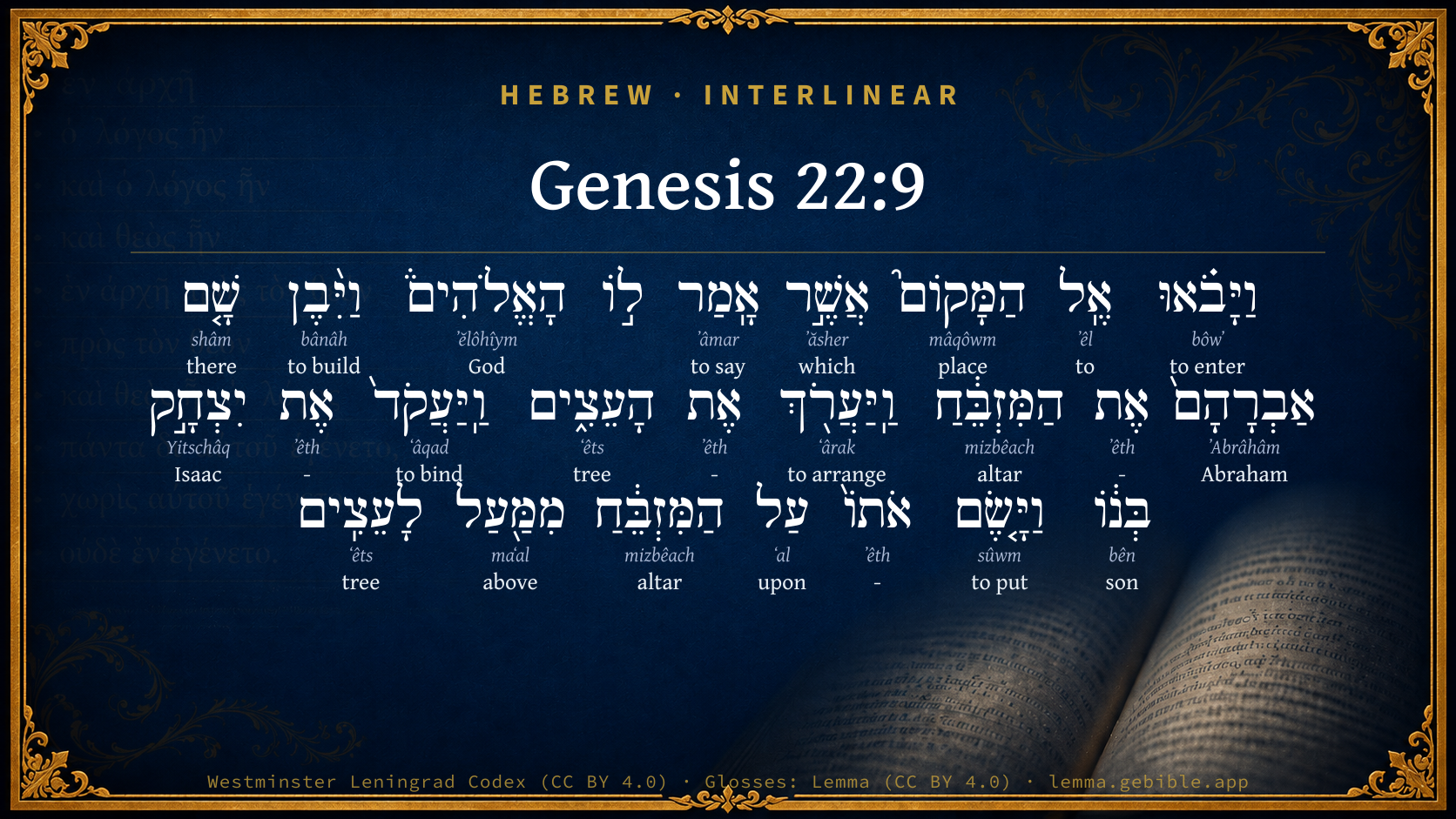
Hebrew (Westminster Leningrad Codex) Genesis 22:9 appears in the Hebrew Old Testament. The text above is from the Westminster Leningrad Codex. Each word links to its Strong’s number, a concise gloss, and parsing drawn from the Open Scriptures Hebrew Bible morphology. Click any word for its full Brown-Driver-Briggs (BDB) entry.
Download image
Cite this verse

Genesis 22:9 (World English Bible). Public Domain. Lemma interlinear Bible study tool, https://lemma.gebible.app/v/genesis/22/9.

Show BibTeX & RIS
BibTeX
RIS
English Translation
They came to the place which God had told him of. Abraham built the altar there, and laid the wood in order, bound Isaac his son, and laid him on the altar, on the wood.
World English Bible · Public Domain
Highlights
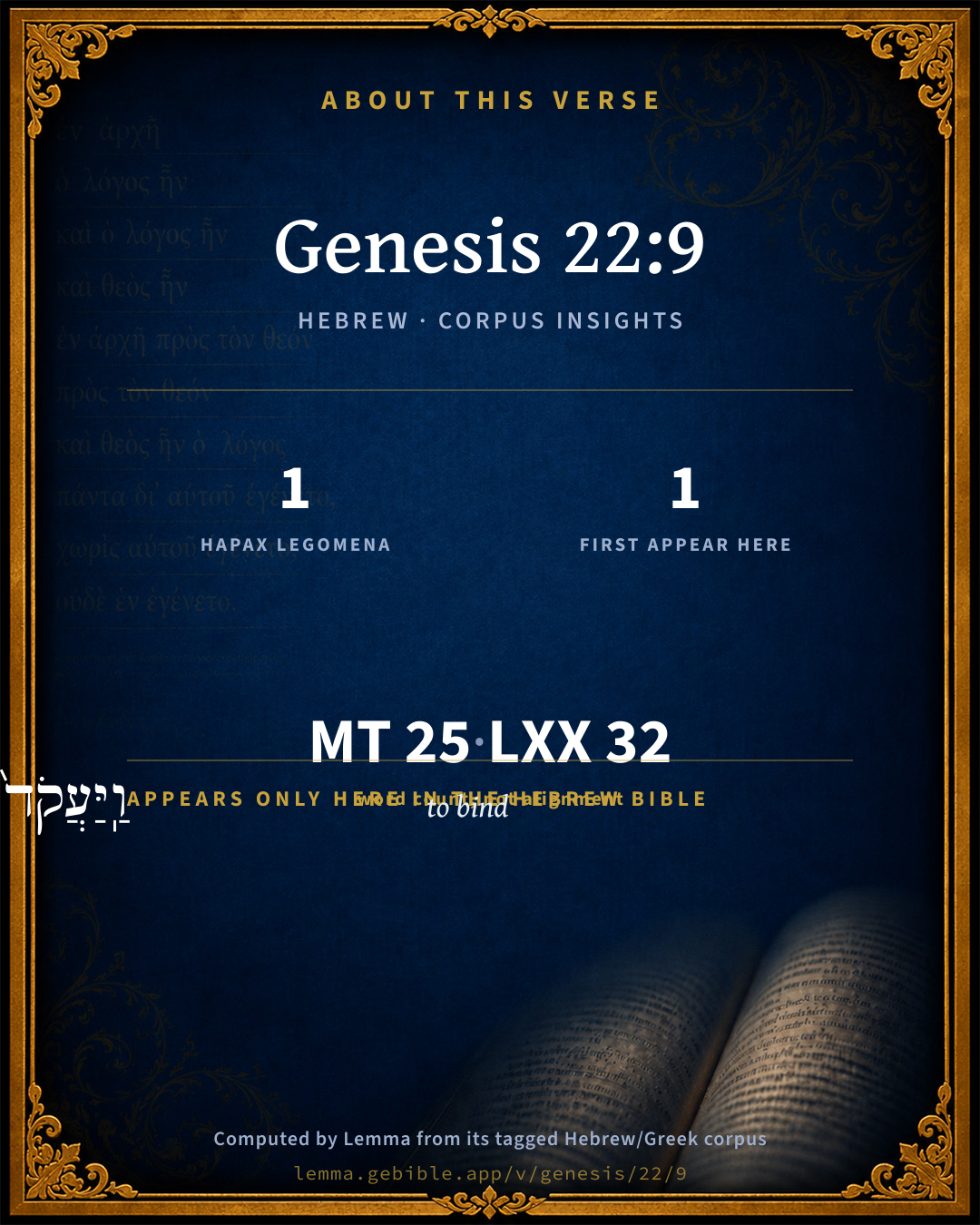
  • 1 hapax legomenon — only here in the Hebrew Bible
  • 1 first appearance in the Hebrew Bible
Full analysis ↓
Download a study sheet

One document with this verse’s original text, its word-by-word gloss line, the meaning frame, cross-references with their text, attributed commentary, and full source and license credits — printable, and it pastes into notes with its structure intact.

This verse Autodidact and up

Study sheet (.html) Plain text (.txt)

A passage Seminary Student

Up to 50 verses in one chapter. A passage sheet keeps up to 6 commentary sources and 12 cross-references per verse, in the order this page ranks them, and says so on the sheet whenever that leaves anything out. Ask for a single verse and you get the Autodidact verse sheet above.

Everything on this page stays free to read, with no account — the sheet is a download of what is already on screen, not access to it.

Want to remove ads? Support Godless Engineer
Compare translations 3

The same verse in 3 English versions, stacked beneath the original-language interlinear above. Click any original word for its lexicon entry.

Each is an independent rendering of the whole verse — the interlinear is not word-aligned to these translations.

Highlighted words mark where these versions differ — a whole-verse word diff, not a word-by-word alignment.

  • World English Bible Public Domain
    They came to the place which God had told him of. Abraham built the altar there, and laid the wood in order, bound Isaac his son, and laid him on the altar, on the wood.
  • King James Version Public Domain
    And they came to the place which God had told him of; and Abraham built an altar there, and laid the wood in order, and bound Isaac his son, and laid him on the altar upon the wood.
  • unfoldingWord Literal Text CC BY-SA 4.0
    Then they came to the place that God had told to him, and there Abraham built the altar and arranged the wood. Then he bound Isaac his son and laid him on the altar, on top of the wood.

unfoldingWord Literal Text — © unfoldingWord, licensed CC BY-SA 4.0. Word-aligned USFM3 via Door43 (git.door43.org/unfoldingWord/en_ult).

Versions to compare (up to 4)

3 of 4 selected

Show all 18 translations

Every available English version of this verse, each an independent rendering of the whole verse.

  • World English Bible Public Domain
    They came to the place which God had told him of. Abraham built the altar there, and laid the wood in order, bound Isaac his son, and laid him on the altar, on the wood.
  • Berean Standard Bible Public Domain
    When they arrived at the place God had designated, Abraham built the altar there and arranged the wood. He bound his son Isaac and placed him on the altar, atop the wood.
  • Majority Standard Bible Public Domain
    When they arrived at the place God had designated, Abraham built the altar there and arranged the wood. He bound his son Isaac and placed him on the altar, atop the wood.
  • King James Version Public Domain
    And they came to the place which God had told him of; and Abraham built an altar there, and laid the wood in order, and bound Isaac his son, and laid him on the altar upon the wood.
  • American Standard Version (1901) Public Domain
    And they came to the place which God had told him of. And Abraham built the altar there, and laid the wood in order, and bound Isaac his son, and laid him on the altar, upon the wood.
  • Revised Version (1885) Public Domain
    And they came to the place which God had told him of; and Abraham built the altar there, and laid the wood in order, and bound Isaac his son, and laid him on the altar, upon the wood.
  • Geneva Bible (1599) Public Domain
    And when they came to the place which God had shewed him, Abraham builded an altar there, and couched ye wood, and bound Izhak his sonne and laid him on the altar vpon the wood.
  • Douay-Rheims (1899) Public Domain
    And they came to the place which God had shown him, where he built an altar, and laid the wood in order upon it: and when he had bound Isaac his son, he laid him on the altar upon the pile of wood.
  • Young's Literal Translation Public Domain
    And they come in unto the place of which God hath spoken to him, and there Abraham buildeth the altar, and arrangeth the wood, and bindeth Isaac his son, and placeth him upon the altar above the wood;
  • Literal Standard Version CC BY-SA 4.0
    And they come to the place of which God has spoken to him, and there Abraham builds the altar, and arranges the wood, and binds his son Isaac, and places him on the altar above the wood;
  • Unlocked Literal Bible CC BY-SA 4.0
    When they came to the place that God had told him about, Abraham built an altar there and laid the wood on it. Then he bound Isaac his son, and laid him on the altar, on top of the wood.
  • unfoldingWord Literal Text CC BY-SA 4.0
    Then they came to the place that God had told to him, and there Abraham built the altar and arranged the wood. Then he bound Isaac his son and laid him on the altar, on top of the wood.
  • Darby Bible Public Domain
    And they came to the place of which God had told him. And Abraham built the altar there, and piled the wood; and he bound Isaac his son, and laid him on the altar upon the wood.
  • World Messianic Bible Public Domain
    They came to the place which God had told him of. Abraham built the altar there, and laid the wood in order, bound Isaac his son, and laid him on the altar, on the wood.
  • Webster's Bible Public Domain
    And they came to the place which God had named to him; and Abraham built an altar there, and laid the wood in order; and bound Isaac his son, and laid him on the altar upon the wood.
  • Free Bible Version CC BY-SA 4.0
    When they arrived at the place where God had told him to go, Abraham built an altar and placed the wood on it. Then he bound his son Isaac and placed him on the altar on top of the wood.
  • Bible in Basic English Public Domain
    And they came to the place of which God had given him knowledge; and there Abraham made the altar and put the wood in place on it, and having made tight the bands round Isaac his son, he put him on the wood on the altar.
  • JPS Tanakh (1917) Public Domain
    And they came to the place which God had told him of; and Abraham built the altar there, and laid the wood in order, and bound Isaac his son, and laid him on the altar, upon the wood.

Literal Standard Version (2020), Covenant Press — licensed CC BY-SA 4.0. Text via the HelloAO Bible API (eBible.org). Unlocked Literal Bible (unfoldingWord) — licensed CC BY-SA 4.0. Text via the HelloAO Bible API (eBible.org). unfoldingWord Literal Text — © unfoldingWord, licensed CC BY-SA 4.0. Word-aligned USFM3 via Door43 (git.door43.org/unfoldingWord/en_ult). Free Bible Version, Dr. Jonathan Gallagher — licensed CC BY-SA 4.0. Text via the HelloAO Bible API (eBible.org).

Word by word

More ways to search: Search by grammar → Find every occurrence → Compare this word →

Practice this passage: Drill this verse → Learn its vocabulary →

וַֽיַּעֲקֹד֙
ʻâqad
H6123
“and · to bind”
Conjunction + Verb, Qal, Sequential Imperfect, 3rd Person, Masculine, Singular
Part of Speech
Conjunction + Verb
Stem
Qal
Form
Sequential Imperfect
Person
3rd Person
Gender
Masculine
Number
Singular
Full BDB Definition

Origin: a primitive root

TWOT: 1677

(Qal) to bind, tie
  1. וַיָּבֹ֗אוּ bôwʼ H935 “and · to enter” Conjunction + Verb, Qal, Sequential Imperfect, 3rd Person, Masculine, Plural
  2. אֶֽל ʼêl H413 “to” Preposition
  3. הַמָּקוֹם֮ mâqôwm H4725 “the · place” Particle, Definite Article + Noun, Common, Masculine, Singular, Absolute
  4. אֲשֶׁ֣ר ʼăsher H834 “which” Particle, Relative
  5. אָֽמַר ʼâmar H559 “to say” Verb, Qal, Perfect, 3rd Person, Masculine, Singular
  6. הָאֱלֹהִים֒ ʼĕlôhîym H430 “the · God(s)” Particle, Definite Article + Noun, Common, Masculine, Plural, Absolute
  7. וַיִּ֨בֶן bânâh H1129 “and · to build” Conjunction + Verb, Qal, Sequential Imperfect, 3rd Person, Masculine, Singular
  8. שָׁ֤ם shâm H8033 “there” Adverb
  9. אַבְרָהָם֙ ʼAbrâhâm H85 “Abraham” Noun, Proper
  10. אֶת ʼêth H853 “-” Particle, Direct Object
  11. הַמִּזְבֵּ֔חַ mizbêach H4196 “the · altar” Particle, Definite Article + Noun, Common, Masculine, Singular, Absolute
  12. וַֽיַּעֲרֹ֖ךְ ʻârak H6186 “and · to arrange” Conjunction + Verb, Qal, Sequential Imperfect, 3rd Person, Masculine, Singular
  13. אֶת ʼêth H853 “-” Particle, Direct Object
  14. הָעֵצִ֑ים ʻêts H6086 “the · trees” Particle, Definite Article + Noun, Common, Masculine, Plural, Absolute
  15. אֶת ʼêth H853 “-” Particle, Direct Object
  16. יִצְחָ֣ק Yitschâq H3327 “Isaac” Noun, Proper
  17. בְּנ֔וֹ bên H1121 “son · his” Noun, Common, Masculine, Singular, Construct + Suffix, Personal, 3rd Person, Masculine, Singular
  18. וַיָּ֤שֶׂם sûwm H7760 “and · to put” Conjunction + Verb, Qal, Sequential Imperfect, 3rd Person, Masculine, Singular
  19. אֹתוֹ֙ ʼêth H853 “- · him” Particle, Direct Object + Suffix, Personal, 3rd Person, Masculine, Singular
  20. עַל ʻal H5921 “upon” Preposition
  21. הַמִּזְבֵּ֔חַ mizbêach H4196 “the · altar” Particle, Definite Article + Noun, Common, Masculine, Singular, Absolute
  22. מִמַּ֖עַל maʻal H4605 “from · above” Preposition + Adverb
  23. לָעֵצִֽים ʻêts H6086 “to/for the · trees” Preposition, Determined + Noun, Common, Masculine, Plural, Absolute

About this verse

These counts appear in no published source. They are computed here, from the morphology-tagged text and Lemma’s own curated glosses. What Lemma adds →

25
words
19
distinct lemmas
Pentateuch
section

Notable vocabulary

1 hapax legomenon — a word that appears only here in the entire Hebrew Bible:

  • וַֽיַּעֲקֹד֙ to bind H6123

First appearance in Scripture

This word makes its first canonical appearance in the Hebrew Bible here:

  • וַֽיַּעֲקֹד֙ to bind H6123

Grammatical profile

  • 6 verbs
  • 9 nouns
  • 3 prepositions
  • 2 adverbs
  • 5 particles

Verb forms

  • וַיָּבֹ֗אוּ Qal · Sequential Imperfect
  • אָֽמַר Qal · Perfect
  • וַיִּ֨בֶן Qal · Sequential Imperfect
  • וַֽיַּעֲרֹ֖ךְ Qal · Sequential Imperfect
  • וַֽיַּעֲקֹד֙ Qal · Sequential Imperfect
  • וַיָּ֤שֶׂם Qal · Sequential Imperfect

Repetition

Words recur within this verse — often emphatic in Hebrew:

  • הַמִּזְבֵּ֔חַ altar H4196 ×2
  • הָעֵצִ֑ים tree H6086 ×2

Hebrew & Septuagint length

In English translation the verse runs 35 words from the Hebrew and 41 from the Septuagint (LXX English) — closely comparable.

A rough comparison of the two English renderings, which tokenize alike — not a word-level alignment.

Word counts can differ between the Hebrew and the Greek without any difference in meaning — e.g. the Hebrew direct-object marker אֵת has no separate Greek word, and Greek often adds the article ὁ.

In the original languages it is 25 Hebrew tokens and 32 Greek tokens — but the two are counted differently (Hebrew bundles its prefixes and suffixes into one token; the Greek is in lemma form), so that isn’t a like-for-like length.

Cross-references

18

Topical passages linked to Genesis 22:9 in the Treasury of Scripture Knowledge — connected by theme and wording, ordered by reader-vote popularity; previews shown in the World English Bible.

  • James 2:21 Wasn't Abraham our father justified by works, in that he offered up Isaac his son on the altar?
  • Hebrews 11:17–19 By faith, Abraham, being tested, offered up Isaac. Yes, he who had gladly received the promises was offering up his one and only son;
  • Philippians 2:7–8 but emptied himself, taking the form of a servant, being made in the likeness of men.
  • Genesis 8:20 Noah built an altar to Yahweh, and took of every clean animal, and of every clean bird, and offered burnt offerings on the altar.
  • Genesis 12:7 Yahweh appeared to Abram, and said, "I will give this land to your seed." He built an altar there to Yahweh, who appeared to him.
  • Genesis 22:2–4 He said, "Now take your son, your only son, whom you love, even Isaac, and go into the land of Moriah. Offer him there for a burnt offering on one of the mountains which I will tell you of."
  • Psalms 118:27 Yahweh is God, and he has given us light. Bind the sacrifice with cords, even to the horns of the altar.
  • Isaiah 53:4–10 Surely he has borne our sickness, and carried our suffering; yet we considered him plagued, struck by God, and afflicted.
  • Matthew 21:1–46 When they drew near to Jerusalem, and came to Bethsphage, to the Mount of Olives, then Jesus sent two disciples,
  • Matthew 26:1–27 It happened, when Jesus had finished all these words, that he said to his disciples,
  • Matthew 27:2 and they bound him, and led him away, and delivered him up to Pontius Pilate, the governor.
  • Mark 15:1 Immediately in the morning the chief priests, with the elders and scribes, and the whole council, held a consultation, and bound Jesus, and carried him away, and delivered him up to Pilate.
  • John 10:17–18 Therefore the Father loves me, because I lay down my life, that I may take it again.
  • Acts 8:32 Now the passage of the Scripture which he was reading was this, "He was led as a sheep to the slaughter. As a lamb before his shearer is silent, So he doesn't open his mouth.
  • Galatians 3:13 Christ redeemed us from the curse of the law, having become a curse for us. For it is written, "Cursed is everyone who hangs on a tree,"
  • Ephesians 5:2 Walk in love, even as Christ also loved you, and gave himself up for us, an offering and a sacrifice to God for a sweet-smelling fragrance.
  • Hebrews 9:28 so Christ also, having been once offered to bear the sins of many, will appear a second time, without sin, to those who are eagerly waiting for him for salvation.
  • 1 Peter 2:24 who his own self bore our sins in his body on the tree, that we, having died to sins, might live to righteousness; by whose stripes you were healed.

Cross-references courtesy of OpenBible.info (CC BY 4.0).

Hebrew and Greek witnesses Masoretic Hebrew ↔ Greek Septuagint

The same verse in the two great witnesses to the Old Testament, shown verse-for-verse.

These are two independent witnesses, not word-aligned to each other, and the Septuagint is shown in lemma (dictionary) form.

Hebrew Genesis 22:9 Masoretic · Westminster Leningrad Codex

וַיָּבֹ֗אוּ אֶֽל הַמָּקוֹם֮ אֲשֶׁ֣ר אָֽמַר ל֣וֹ הָאֱלֹהִים֒ וַיִּ֨בֶן שָׁ֤ם אַבְרָהָם֙ אֶת הַמִּזְבֵּ֔חַ וַֽיַּעֲרֹ֖ךְ אֶת הָעֵצִ֑ים וַֽיַּעֲקֹד֙ אֶת יִצְחָ֣ק בְּנ֔וֹ וַיָּ֤שֶׂם אֹתוֹ֙ עַל הַמִּזְבֵּ֔חַ מִמַּ֖עַל לָעֵצִֽים

They came to the place which God had told him of. Abraham built the altar there, and laid the wood in order, bound Isaac his son, and laid him on the altar, on the wood.

World English Bible · Public Domain

Greek LXX Genesis 22:9 Septuagint · lemma form

ἔρχομαι ἐπί ὁ τόπος ὅς εἶπον αὐτός ὁ θεός καί οἰκοδομέω ἐκεῖ αβρααμ θυσιαστήριον καί ἐπιτίθημι ὁ ξύλον καί συνποδίζω ισαακ ὁ υἱός αὐτός ἐπιτίθημι αὐτός ἐπί ὁ θυσιαστήριον ἐπάνω ὁ ξύλον

came to the place which God spoke of to him; and there Abraam built the altar, and laid the wood on it, and having bound the feet of Isaac his son together, he laid him on the altar upon the wood.

LXX2012 (modern English Septuagint) · Public Domain

On this verse, The Cambridge Bible for Schools and Colleges discusses the Septuagint’s reading. Read the note in Commentary ↓

Hebrew: Westminster Leningrad Codex (CC BY 4.0). Greek: Septuagint (public domain); English from LXX2012 (modern English Septuagint) (Public Domain). How the Septuagint differs from the Hebrew →

Targum (Aramaic paraphrase)

2

The Targum is the ancient Jewish Aramaic paraphrase of the Hebrew Scriptures — an interpretive translation, not the Hebrew text itself. Onkelos (literal) and Pseudo-Jonathan (expansive) render the Torah, and Jonathan the Prophets. Coverage is partial: where no permissively-licensed English translation exists for a verse, only the Aramaic is shown. This is verse-level text, not a word-by-word alignment to the Hebrew.

  1. Targum Onkelos Torah (Genesis–Deuteronomy)
    וְאָתוּ לְאַתְרָא דִּי אֲמַר לֵהּ יְיָ וּבְנָא תַמָּן אַבְרָהָם יָת מַדְבְּחָא וְסַדַּר יָת אָעַיָּא וַעֲקַד יָת יִצְחָק בְּרֵהּ וְשַׁוֵּי יָתֵהּ עַל מַדְבְּחָא עֵיל מִן אָעַיָּא

    (no public-domain English translation for this verse)

    Targum Onkelos — Aramaic: “Onkelos Genesis” (public domain); “Onkelos Exodus” (public domain); “Onkelos Leviticus” (public domain); “Onkelos Numbers” (public domain); “Onkelos Deuteronomy” (public domain). English: “Sefaria Community Translation” (CC0 1.0 (public-domain dedication)); “J.W. Etheridge. The Targums of Onkelos and Jonathan Ben Uzziel on the Pentateuch. London: Longmans, Green, 1862” (public domain). Text via Sefaria.

  2. Targum Pseudo-Jonathan Torah (Genesis–Deuteronomy)
    וְאָתוּ לְאַתְרָא דְאָמַר לֵיהּ יְיָ וּבְנָא תַמָן אַבְרָהָם יַת מַדְבְּחָא דִבְנָא אָדָם וְאִיתְפְּכַר בְּמוֹי דְטוּבְעָנָא וְתַב נח וּבַנְיֵיה וְאִתְפְּכַר בְּדָרָא דְפַלְגוּתָא וְסָדַר עִילוֹי יַת קִיסַיָא וְכָפַת יַת יִצְחָק בְּרֵיה וְשַׁוֵי יָתֵיהּ עַל מַדְבְּחָא לְעֵיל מִן קִיסִין

    And they came to the place of which the Lord had told him. And Abraham builded there the altar which Adam had built, which had been destroyed by the waters of the deluge, which Noah has again builded, and which had been destroyed in the age of divisions; and he set the wood in order upon it, and bound Izhak his son, and laid him on the altar upon the wood.

    Targum Pseudo-Jonathan — Aramaic: “Targum Jonathan on Genesis” (public domain); “Targum Jonathan on Exodus” (public domain); “Targum Jonathan on Leviticus” (public domain); “Targum Jonathan on Numbers” (public domain); “Targum Jonathan on Deuteronomy” (public domain). English: “The Targum of Jonathan ben Uzziel, trans. J. W. Etheridge, London, 1862” (public domain). Text via Sefaria.

Commentary

Notes on Genesis 22:9 from classic Christian and Jewish commentators (each source and its license shown beneath its notes). The classic Christian expositions comment on the surrounding passage and are grouped to its opening verse, so a note may address several verses; the Jewish commentaries on the Tanakh (Rashi and others) are per-verse, so they appear only where the commentator wrote on this verse.

Lemma curates 59 commentaries, every one of them public domain or Creative Commons licensed, each selected and text-cleaned for this edition rather than reprinted as found. About our sources →

Trapp's Complete Commentary

John Trapp

Gen 22:9 And they came to the place which God had told him of; and Abraham built an altar there, and laid the wood in order, and bound Isaac his son, and laid him on the altar upon the wood.

Ver 9. And they came to the place.] Mount Moriah; where the temple was afterwards built. {2Ch 3:1} This was a little from Salem, as Mount Calvary also was a little from Jerusalem.

And bound Isaac his son.] Who struggled not, neither resisted, though able for his age (being twenty-five years old, as Josephus makes him; others thirty-three) to have overpowered his old father. He was acquainted with God’s counsel, saith Luther, wherein he rested. Yet he was bound, (1.) For that the rite of sacrifices so required; {Psa 118:27} (2.) Lest any involuntary motion, by pangs of death, should be procured. Whence various of the martyrs, as Ridley, Rawlins, &c, desired to be bound fast to the stake, lest the flesh should play its part. Rawlins, when the smith cast a chain about him at the stake, "I pray you, good friend," said he, "knock in the chain fast; for it may be, that the flesh would strive mightily. But, God, of thy great mercy, give me strength and patience to abide the extremity." {a} Nature at death will have a bout with the best, whether he die as Elisha, slowly, or as Elijah, suddenly.

{a} Act. and Mon., fol 1415

John Trapp, A Commentary or Exposition upon All the Books of the Old and New Testament (1647–1656) — public domain. Text from a community e-Sword module.

The Biblical Illustrator

Joseph S. Exell

Gen_22:9

Bound Isaac his son, and laid him on the altar

The love of the Father

Of all the many parts of the great truths concerning our redemption, which stand out in the history of Abraham and his son, there is one which seems to need especial consideration.

We have a very striking view, not only of the love of God the Son in consenting to go through, as man, the suffering of death, but also of the exceeding tender love of the Father towards us, who could consent to give His Son to death. We know, indeed, that, according to the mysterious decrees of God, it was the Son who suffered on the Cross, not the Father, though one with Him; that the Son died for our sins, that the Son came down from heaven, that the Son was nailed to the wood, that the Son went through the sorrows of death, that the Son gave Himself for us all. But can it have cost the Father nothing, to have sent the Son down from heaven, to have bidden Him go forth from His sight, and to tarry in this evil, wicked world? Can it have cost the Father nothing to have consented to that great task of suffering which the Son undertook? Can He have looked unmoved on the shame and scorn which fell on Him, even in the hour of His birth? Can He have looked unmoved on the Holy Child in the manger, and in His after scenes of reproach, When He was spoken against, blasphemed, hated, disbelieved? Can He, above all, have seen Him, unmoved, in those still more sorrowful acts, when He flung Himself down upon the ground in the garden, in the anguish of His soul, when His sweat was as it were great drops of blood, when He was dragged to prison and to death, when the crown of thorns was bound around His head, when He was scourged and spit upon, when He trembled beneath the weight of His cross, when He was lifted thereon, when the sharp nails were driven into His hands and feet, when the great thirst came upon Him, when the blood streamed down the Cross? Could an earthly father, with an earthly fathers love, have watched his son through such acts as these, without the keenest, sharpest grief, without the deepest sorrow, even though no hand was laid upon him, and he had no such acts of suffering to go through himself? And so does the Holy Ghost design, we must suppose, in picturing to ourselves Abrahams sorrow as he walked by his sons side, as he gazed upon him along that bitter road, as his heart swelled with grief, as he bound him with trembling fingers to the wood, as in an agony he lifted up the knife, that we should see in these things the grief of our heavenly Father in giving His Son to die. And so in seeing His grief, we see also His exceeding tender love towards us; and without lessening one jot or tittle--which God forbid--the love of our Saviour, love which is unspeakable, unfathomable, past knowing, past finding out, we yet get to raise the love of the Father to a greater height than we have ever been wont to give it. And in truth, as we get to observe more truly the proportion of faith, and to know the love of the Father, so shall we also get to learn more deeply the love of the Son. Instead of contrasting the love of the one with that of the other, we shall get to combine them in our minds without confusing them. All our thoughts will be of love; the love of God, of the one true God, of the Father, of the Son, of the Holy Ghost, in their separate persons and offices, will engross our souls, and thus, our hearts being stirred within us in gazing on the mystery of Divine love, we shall, I trust, learn and show forth more and more of love ourselves; for this is the highest grace of all, this outlasts the world, this never faileth, this is the bond of perfectness, this is the very joy and occupation of heaven itself. (Bishop Armstrong.)

The Biblical Illustrator, edited by Joseph S. Exell (c. 1880s–1900s) — public domain. Text from a community e-Sword module.

Joseph Benson's Commentary

Gen 22:9. After many a weary step, and with a heavy heart, he arrives at length at the fatal place; builds the altar, an altar of earth, we may suppose, the saddest that ever he built; lays the wood in order for Isaac’s funeral pile; and now tells him the amazing news. Isaac, for aught that appears, is as willing as Abraham; we do not find that he made any objection against it. God commands it to be done, and Isaac has learned to submit. Yet it was necessary that a sacrifice should be bound; the great Sacrifice, which, in the fulness of time, was to be offered up, must be bound, and therefore so must Isaac. Having bound him, he lays him upon the altar, and his hand upon the head of the sacrifice. Be astonished, O heavens, at this, and wonder, O earth! here is an act of faith and obedience which deserves to be a spectacle to God, angels, and men; Abraham’s darling, the church’s hope, the heir of promise, lies ready to bleed and die by his own father’s hands! Now this obedience of Abraham in offering up Isaac is a lively representation, 1st, Of the love of God to us, in delivering up his only begotten Son to suffer and die for us, as a sacrifice. Abraham was obliged, both in duty and gratitude, to part with Isaac, and parted with him to a friend, but God was under no obligations to us, for we were enemies. 2d, Of our duty to God in return for that love; we must tread in the steps of this faith of Abraham. God, by his word, calls us to part with all for Christ, all our sins, though they have been as a right hand, or a right eye, or an Isaac; all those things that are rivals with Christ for the sovereignty of our hearts; and we must cheerfully let them all go. God, by his providence, which is truly the voice of God, calls us to part with an Isaac sometimes, and we must do it by a cheerful resignation and submission to his holy will.

Joseph Benson's Commentary on the Old and New Testaments (1811–1818) — public domain. Text from a community e-Sword module.

Tyndale Open Study Notes

Tyndale Open Resources

22:9-19 God’s intervention was dramatic and instructive, confirming that he never intended for Isaac to be sacrificed. God later made it clear that child sacrifice was an abomination to him (see Lev 18:21; 20:1-5; Deut 18:10; 2 Kgs 16:2-3; Isa 57:5; Jer 32:35). God wanted Abraham to sacrifice his own will and surrender it to God, and when he did, God intervened. This passage sets a pattern for all sacrificial worshipers. Like Abraham, true worshipers of God know that everything belongs to God—it all came from God and must therefore be acknowledged as God’s possession. A true worshiper holds nothing back but obediently gives God what he asks, trusting that God will provide for all needs, and then discovering through experience that God always does so.

Tyndale Open Study Notes — © Tyndale Open Resources, licensed CC BY-SA 4.0. Text via the HelloAO Bible API.

Geneva Bible (1599)

Geneva Bible translators

For it is like that his father had declared to him God’s commandment, whereunto he showed himself obedient.

Geneva Bible (1599) marginal notes — public domain. Text via Bolls.life.

Jamieson, Fausset & Brown

Robert Jamieson, A. R. Fausset & David Brown

Abraham built an altar, &c.--Had not the patriarch been sustained by the full consciousness of acting in obedience to God's will, the effort would have been too great for human endurance; and had not Isaac, then upwards of twenty years of age displayed equal faith in submitting, this great trial could not have gone through.

Jamieson, Fausset & Brown — Commentary Critical and Explanatory on the Whole Bible (1871) — public domain (CC PDM 1.0). Text via the HelloAO Bible API.

Adam Clarke's Commentary

Verse 9. And bound Isaac his son] If the patriarch had not been upheld by the conviction that he was doing the will of God, and had he not felt the most perfect confidence that his son should be restored even from the dead, what agony must his heart have felt at every step of the journey, and through all the circumstances of this extraordinary business? What must his affectionate heart have felt at the questions asked by his innocent and amiable son? What must he have suffered while building the altar, laying on the wood, binding his lovely son, placing him on the wood, taking the knife, and stretching out his hand to slay the child of his hopes? Every view we take of the subject interests the heart, and exalts the character of this father of the faithful. But has the character of Isaac been duly considered? Is not the consideration of his excellence lost in the supposition that he was too young to enter particularly into a sense of his danger, and too feeble to have made any resistance, had he been unwilling to submit? Josephus supposes that Isaac was now twenty-five, (see the chronology on Ge 22:1;) some rabbins that he was thirty-six; but it is more probable that he was now about thirty-three, the age at which his great Antitype was offered up; and on this medium I have ventured to construct the chronology, of which I think it necessary to give this notice to the reader. Allowing him to be only twenty-five, he might have easily resisted; for can it be supposed that an old man of at least one hundred and twenty-five years of age could have bound, without his consent, a young man in the very prime and vigour of life? In this case we cannot say that the superior strength of the father prevailed, but the piety, filial affection, and obedience of the son yielded. All this was most illustriously typical of Christ. In both cases the father himself offers up his only-begotten son, and the father himself binds him on the wood or to the cross; in neither case is the son forced to yield, but yields of his own accord; in neither case is the life taken away by the hand of violence; Isaac yields himself to the knife, Jesus lays down his life for the sheep.

Adam Clarke's Commentary on the Bible (1810–1826) — public domain. Text from a community e-Sword/MySword module.

John Calvin's Commentaries

9. And they came to the place. Moses purposely passes over many things, which, nevertheless, the reader ought to consider. When he has mentioned the building of the altar, he immediately afterwards adds, that Isaac was bound. But we know that he was then of middle age, so that he might either be more powerful than his father, or, at least, equal to resist him, if they had to contend by force; wherefore, I do not think that force was employed against the youth, as against one struggling and unwilling to die: but rather, that he voluntarily surrendered himself. It was, however, scarcely possible that he would offer himself to death, unless he had been already made acquainted with the divine oracle: but Moses, passing by this, only recites that he was bound. Should any one object, that there was no necessity to bind one who willingly offered himself to death; I answer, that the holy man anticipated, in this way, a possible danger; lest any thing might happen in the midst of the act to interrupt it. The simplicity of the narrative of Moses is wonderful; but it has greater force than the most exaggerated tragical description. The sum of the whole turns on this point; that Abraham, when he had to slay his son, remained always like himself; and that the fortitude of his mind was such as to render his aged hand equal to the task of offering a sacrifice, the very sight of which was enough to dissolve and to destroy his whole body.

John Calvin's Commentaries (1540-1563) — public domain. Text from the Calvin Translation Society English edition (1840s-50s) via the Christian Classics Ethereal Library (ccel.org). Calvin's coverage is partial (roughly two-thirds of the Bible); uncommented books and verses are honest gaps, never fabricated. The 19th-century editor's footnotes and remarks are omitted so the notes are faithfully Calvin's own voice.

Ellicott's Commentary for English Readers

(9) Abraham . . . bound Isaac.—Jewish commentators agree that this was done with Isaac’s consent, nor could it well have been otherwise. Thus his youthful faith was tried equally with that of his father, his future life sanctified, and himself ennobled by being made a type of Christ (1Pe_2:23).

A Bible Commentary for English Readers, edited by Charles John Ellicott (1878–1897) — public domain. Text from a community e-Sword module.

The Cambridge Bible for Schools and Colleges

gen. ed. J. J. S. Perowne

9. which God had told him of] See Gen_22:1-2.

built the altar there] Possibly referring to the altar of some well-known spot. Cf. note on the word “place,” Gen_22:3, Gen_12:6. For the definite article, see Gen_8:7. The altar needed rebuilding.

laid the wood in order] The technical phrase for arranging the wood on an altar of sacrifice. See Num_23:4; 1Ki_18:33.

bound] LXX συμποδίσας. Another technical word, for binding the limbs of the sacrificial animal, only found here in O.T. Amongst the Jews the sacrifice of Isaac was known as “the binding (‘akêdah) of Isaac.” See Special Note at Gen_1:19. The submission of Isaac is not expressed, but implied. Isaac’s age, according to the narrative of E in this chapter, appears to be that of a mere lad. Without the necessary recognition of the different sources from which the patriarchal narrative is derived, it has been supposed, on the strength of Gen_21:34 and Gen_22:1, that Isaac was now a young man. The note of Calvin, to whom the analysis of Genesis was unknown, is therefore justified: “atqui scimus tunc fuisse mediae aetatis, ut vel patre esset robustior, vel saltem par ad resistendum si viribus certandum esset.… Mira quidem est Mosis in narrando simplicitas, sed quae plus vehementiae continet quam si tragice omnia exaggeret.”

The Cambridge Bible for Schools and Colleges (gen. ed. J. J. S. Perowne; Cambridge University Press, 1878–1918) — public domain. Text from a community e-Sword module.

John Gill's Exposition

And they came to the place which God had told him of,.... Mount Moriah. Maimonides (f) says,"it is a tradition in or by the hands of all, that this is the place where David and Solomon built an altar in the threshing floor of Araunah, the Jebusite, and where Abraham built an altar, and bound Isaac on it; and where Noah built one when he came out of the ark, and is the altar on which Cain and Abel offered; and where the first man offered when he was created, and from whence he was created.''And so the Targum of Jonathan, and other Jewish writers (g). The Mahometans say (h), that Meena or Muna, a place about two or three miles from Mecca, is the place where Abraham went to offer up his son Isaac, and therefore in this place they sacrifice their sheep.

And Abraham built an altar there; of the earth, and turf upon it he found on the mount, erected an altar for sacrifice, even for the sacrifice of his own son: he had built many before, but none for such a purpose as this, and yet went about it readily, and finished it. But if there was one before, Abraham could not with any propriety be said to build it, at most only to repair it; but there is no doubt to be made of it that he built it anew, and perhaps there never was an altar here before:

and laid on the wood in order: for the sacrifice to be put upon it:

and bound Isaac his son: with his hands and feet behind him, as Jarchi says; not lest he should flee from him, and make his escape, as Aben Ezra suggests, but as it was the usual manner to bind sacrifices when offered; and especially this was so ordered, that Isaac might be a type of the Messiah, who was bound by the Jews, Joh 18:12; as well as he was bound and fastened to the cross:

and laid him on the altar upon the wood; it is highly probable with his own consent; for if he was twenty five, and as some say thirty seven years of age, he was able to have resisted his father, and had he been reluctant could have cleared himself from the hands of his aged parent: but it is very likely, that previous to this Abraham opened the whole affair to him, urged the divine command, persuaded him to submit to it; and perhaps might suggest to him what he himself had faith in, that God would either revoke the precept, or prevent by some providence or another the fatal blow, or raise him again from the dead; however, that obedience to the will of God should be yielded, since disobedience might be attended with sad consequences to them both; and with such like things the mind of Isaac might be reconciled to this affair, and he willingly submitted to it; in which he also was a type of Christ, who acquiesced in the will of his Father, freely surrendered himself into the hands of justice, and meekly and willingly gave himself an offering for his people.

(f) Hilchot Beth Habechirah, c. 2. sect. 1. 2. (g) In Pirke, ut supra. (c. 31.) (h) See Pitts's Account of the Mahometans, c. 7. p. 97.

John Gill's Exposition of the Whole Bible (1746–1763) — public domain (CC PDM 1.0). Text via the HelloAO Bible API.

Haydock's Catholic Bible Commentary

The place. Mount Moria, on part of which the temple was built afterwards; and on another part, called Calvary, our Saviour was crucified, having carried his cross, as Isaac did the wood for sacrifice. --- His son: having first explained to him the will of God, to which Isaac gave his free consent; otherwise, being in the vigour of his youth, he might easily have hindered his aged father, who was 125 years old, from binding him. But in this willingness to die, as in many other particulars, he was a noble figure of Jesus Christ, who was offered because it was His will. (Haydock)

George Leo Haydock (1774–1849), Haydock's Catholic Family Bible and Commentary, 1859 edition — public domain. Excludes Psalms (Douay-Rheims chapter numbering differs from Protestant) and Deuterocanonical books (Catholic canon only).

Matthew Poole's English Annotations

Abraham built an altar, made of earth slightly put together, as God afterwards prescribed, Exo 20:24;

and bound Isaac his son, partly, because burnt-offerings were to be bound to the altar; of which see Poole on "Psa 118:27"; partly, to represent Christ, who was bound to the cross. And that Isaac might be the more exact type of Christ, he was bound by his own consent, otherwise his age and strength seem sufficient to have made an effectual resistance. It is therefore highly reasonable to think that Abraham, having in the whole journey prepared Isaac for such a work by general but pertinent discourses, did upon the mount particularly instruct him concerning the plain and peremptory command of God, the absolute necessity of complying with it, the glorious reward of his obedience, and the dismal consequences of his disobedience; the power and faithfulness of God either to prevent the fatal blow, or to restore his life lost with infinite advantage. Upon these, and such-like reasons, doubtless he readily laid himself down at his father’s feet, and yielded up himself to the Divine will.

Matthew Poole's English Annotations on the Holy Bible (1683–1685) — public domain. Text from a community e-Sword/MySword module.

Whedon's Commentary on the Bible

Daniel D. Whedon

9. The place which God had told — How, when, and where God revealed to him the exact spot for his offering, we are nowhere informed. The rabbins have a tradition that on this same spot Adam, Abel, and Noah had offered sacrifice.

Built… laid… bound… laid — The four different Hebrew words graphically describe the successive acts in the work of preparation. These are followed in the next verse by three words which paint the final tableau — stretched forth… took… to slay. All the efforts of sculptors and painters to present this scene have never equalled this word-picture.

Daniel D. Whedon (gen. ed.), Commentary on the Old and New Testaments (1874–1909) — public domain. Text from a community e-Sword module.

The Pulpit Commentary

And they came to the place which God had told him of; and Abraham built an altar there, i.e. upon the mountain summit or slope (Ver. 2)and laid the wood in order (it is scarcely likely that Isaac was permitted to assist in these affecting preparations), and bound Isaac his son, who must have acquiesced in his father"s purpose, and thereby evinced his faith in the Divine commandment. The term "bound," though seeming to convey the idea of violence, derives its significance from the binding of the sacrificial victimand laid him on the altar on the wood. The feelings of the patriarch throughout this transaction are simply inconceivable.

The Pulpit Commentary (1880–1919), ed. H.D.M. Spence-Jones & Joseph S. Exell — public domain. Text from a community e-Sword module.

John Wesley's Explanatory Notes

With the same resolution and composedness of mind, he applies himself to the compleating of this sacrifice. After many a weary step, and with a heavy heart, he arrives at length at the fatal place; builds the altar, an altar of earth, we may suppose, the saddest that ever be built; lays the wood in order for Isaac's funeral pile; and now tells him the amazing news. Isaac, for ought appears, is as willing as Abraham; we do not find that he made any objection against it. God commands it to be done, and Isaac has learned to submit. Yet it is necessary that a sacrifice be bound; the great Sacrifice, which, in the fulness of time, was to be offered up, must be bound, and therefore so must Isaac. Having bound him he lays him upon the altar, and his hand upon the head of the sacrifice. Be astonished, O heavens, at this, and wonder, O earth! here is an act of faith and obedience which deserves to be a spectacle to God, angels and men; Abraham's darling, the church's hope, the heir of promise, lies ready to bleed and die by his own father's hands! Now this obedience of Abraham in offering up Isaac is a lively representation,

1. Of the love of God to us, in delivering up his only begotten Son to suffer and die for us, as a sacrifice. Abraham was obliged both in duty and gratitude to part with Isaac and parted with him to a friend, but God was under no obligations to us, for we were enemies.

2. Of our duty to God in return of that love we must tread in the steps of this faith of Abraham. God, by his word, calls us to part with all for Christ, all our sins, tho' they have been as a right hand, or a right eye, or an Isaac; all those things that are rivals with Christ for the sovereignity of our heart; and we must cheerfully let them all go. God, by his providence, which is truly the voice of God, calls us to part with an Isaac sometimes, and we must do it by a chearful resignation and submission to his holy will.

John Wesley, Explanatory Notes Upon the Whole Bible (1754–1765) — public domain. Text via the GEBible commentary corpus.

Keil & Delitzsch

C. F. Keil & F. Delitzsch

Having arrived at the appointed place, Abraham built an altar, arranged the wood upon it, bound his son and laid him upon the wood of the altar, and then stretched out his hand and took the knife to slay his son.

Keil & Delitzsch — Biblical Commentary on the Old Testament (1861–1891) — public domain (CC PDM 1.0). Text via the HelloAO Bible API. (Old Testament only.)

Scofield Reference Notes

C. I. Scofield

laid

The typical lessons here are:

(1) Isaac, type of Christ "obedient unto death" Php 2:5-8.

(2) Abraham, type of the Father, who "spared not His own son, but delivered Him up for us all" Joh 3:16; Rom 8:32.

(3) the ram, type of substitution--Christ offered as a burnt-offering in our stead, Heb 10:5-10.

(4) cf. resurrection Heb 11:17-19; Jas 2:21-23.

The Scofield Reference Bible (1917 edition), notes by C. I. Scofield — public domain. Text from a community e-Sword module.

Kretzmann's Popular Commentary

Paul E. Kretzmann

The Interference of God

v. 9. And they came to the place which God had told him of; and Abraham built an altar there, and laid the wood in order, and bound Isaac, his son, and laid him on the altar upon the wood. The detailed narrative again calls attention to the strict obedience of Abraham: the building of the altar, the laying in order of the proper amount of wood for consuming the offering, the binding of Isaac, who is here again designated as his son, and the placing of him on the altar.

v. 10. And Abraham stretched forth his hand, and took the knife to slay his son. This is the climax, the most dramatic moment of the story: Isaac as a patient sacrifice, knowing himself to be the burnt offering which the Lord had provided, and the father ready to slaughter his son.

v. 11. And the Angel of the Lord called unto him out of heaven and said, Abraham, Abraham! And he said, Here am I.

v. 12. And he said, Lay not thine hand upon the lad, neither do thou anything unto him; for now I know that thou fearest God, seeing thou hast not withheld thy son, thine only son, from Me. The Angel of the Lord in the special sense of the word, the Son of God, is here again in evidence, interfering just in time to save the life of Isaac. God had now, by the most severe test which could have been devised, obtained evidence, made manifest by evident proof, discovered by actual experiment, that fearing God Abraham was, that this was the attitude of his mind and heart, since he had not spared even his only son for the sake of his obedience to God. Here also the type of Isaac as foreshadowing the greater sacrifice of the New Testament is emphasized, Rom 8:32.

v. 13. And Abraham lifted up his eyes and looked, and, behold, behind him a ram caught in a thicket by his horns. And Abraham went and took the ram, and offered him up for a burnt offering in the stead of his son. God here directed the attention of Abraham to the ram in the background, overlooked by him till now, caught in the thicket on the mountainside with his long, crooked horns. Acting upon the suggestion, he made the ram the sacrificial animal in the stead of his son Isaac, the ram thus, as in many of the later sacrifices, being the symbolical representation, taking the place of him who was destined to die. That fact also gave the great value to the sacrifice of Christ, for it was made for us, in our stead.

v. 14. And Abraham called the name of that place Jehovah-jireh, as it is said to this day, In the mount of the Lord it shall be seen. As Abraham applied to the place of his sacrifice a name which means "the Lord will see or provide," so men afterward had a proverbial saying based upon this happening, "on the hill where Jehovah is manifested, or revealed," from which the name Moriah originated.

Paul E. Kretzmann, Popular Commentary of the Bible (1921–1924) — public domain. Text from a community e-Sword module.

unfoldingWord translationNotes

Door43 World Missions Community

When they came to the place

"When Abraham and Isaac arrived at the place"

he bound

"he tied up"

on the altar, on top of the wood

"on top of the wood that was on the altar"

reached out with his hand and took up the knife

"picked up the knife"

translationWords

God

Abraham

altar

bind

Isaac

unfoldingWord translationNotes — © Distant Shores Media and the Door43 World Missions Community, licensed CC BY-SA 4.0. Source: git.door43.org/Door43/en_tn.

Rashi

Rabbi Shlomo Yitzchaki (Rashi)

ויעקד AND HE BOUND his hands and feet behind him. Hands and feet tied together is what is meant by עקידה “binding”. It is associated in meaning with עקודים in (Genesis 30:35) “[she-goats] that were streaked” — whose ankles were streaked white so that the place where they are bound could be plainly seen.

Rashi on the Tanakh — English translations: “The Judaica Press complete Tanach with Rashi, translated by A. J. Rosenberg” (CC BY 4.0); “Pentateuch with Rashi's commentary by M. Rosenbaum and A.M. Silbermann, 1929-1934” (public domain); “The Metsudah Tanach series, Lakewood, N.J” (CC BY 4.0); and “The Book of Joshua, Metsudah Publications, 1997” (CC BY 4.0). Text via Sefaria.

Ramban (Nachmanides)

Rabbi Moshe ben Nachman (Ramban / Nachmanides)

AND THEY CAME TO THE PLACE WHICH G-D TOLD HIM OF — now, from a distance as he was acquainted with that whole land, and when he came near the mountain, G-d told him, “This is the place which I had designated to you.” All this is in line with the plain meaning of Scripture, as Ramban mentioned above. “This is mount Moriah,” for He told him, “Behold, this is the mountain of which I told you.”

Ramban (Nachmanides) on the Tanakh — English translation: “Commentary on the Torah by Ramban (Nachmanides). Translated and annotated by Charles B. Chavel. New York, Shilo Pub. House, 1971-1976” (CC BY 4.0). Text via Sefaria.

Radak

Rabbi David Kimhi (Radak)

ויבאו אל המקום, this refers to Mount Moriah.

אשר אמר לו האלוקים, when Avraham and Yitzchok had been walking together (after leaving the lads behind) G’d told Avraham the exact location, showing it to him in a prophetic vision. According to Bereshit Rabbah 56,2 He showed him either a column of fire over that mountain or a localised pillar of cloud, as we mentioned earlier. According to this aggadic interpretation the words אשר אמר לו refer to the moment when he became aware of this phenomenon and his awareness was the equivalent of what is described in our verses as an אמירה, a verbal communication.

ויערוך את העצים, he arranged them above the fire to kindle them.

ויעקד את יצחק, he bound both his hands and his feet so he should not involuntarily kick when the knife would strike him. This was in spite of the fact that Yitzchok was perfectly willing to be the offering. He was afraid that at the last moment he would rebel; this was why he asked his father to tie him securely. (Bereshit Rabbah 56,8)

Radak on the Tanakh — English translations: “Sefaria Community Translation” (CC0 1.0 (public-domain dedication)); “Eliyahu Munk, HaChut Hameshulash” (CC BY 4.0); “Rabbi Mike Feuer, Jerusalem Anthology” (CC BY 4.0); and “R. David Kimhi on the first book of Psalms, Translated by R.G. Finch, London, 1919” (public domain). Text via Sefaria.

Lesson kit

Teaching starters — assembled from the data on this page, not authored interpretation. Every prompt links to the verse data it draws on. Edit before teaching.

Genesis, in the Pentateuch, opens this verse with 25 words (19 distinct Hebrew lemmas). Its most distinctive word is ʻâqad (“to bind”). A historical commentator’s framing appears above. Read the whole chapter for the surrounding context.

Discussion questions

  1. The word ʻâqad carries the sense “to bind.” How does it shape the verse?
  2. 1 word here appears nowhere else in the Hebrew Bible. Why might the author reach for such rare wording?
  3. This is the first place “to bind” appears in Scripture (first appears here). What does its debut here establish?
  4. How does James 2:21, which shares this passage’s theme, read alongside this verse?
  5. What does the repetition of “altar” (2× in this one verse) do in this verse?
  6. These translations render this verse differently; the difference is in the English rendering, not the original. What questions does that raise?
  7. «וַיָּבֹ֗אוּ» is a Qal Sequential Imperfect verb. How does that grammatical form shape the action described?
  8. Compare how Trapp's Complete Commentary and The Biblical Illustrator read this verse. Where do they agree or differ?

Things to notice

  • 1 word in this verse appears nowhere else in the Hebrew Bible.
  • 1 word makes its first canonical appearance in Scripture here.
  • This verse counts 25 Hebrew ↔ 32 Greek words.
  • These translations choose different wording for 5 words in this verse.
  • “altar” occurs 2× in this single verse.

Reading settings

Reading text

Shown beneath each verse's original-language words.

Old Testament
Old Testament edition

Read the OT as the Masoretic Hebrew (MT) or the Greek Septuagint (LXX).

English shown for the Greek Septuagint (in the Hebrew ↔ Greek comparison).

Comparing translations? Open the Compare panel on any verse page to stack up to four side by side.