
Genesis 33:14

Hebrew (Westminster Leningrad Codex) Genesis 33:14 appears in the Hebrew Old Testament. The text above is from the Westminster Leningrad Codex. Each word links to its Strong’s number, a concise gloss, and parsing drawn from the Open Scriptures Hebrew Bible morphology. Click any word for its full Brown-Driver-Briggs (BDB) entry.
Download image
Cite this verse

Genesis 33:14 (World English Bible). Public Domain. Lemma interlinear Bible study tool, https://lemma.gebible.app/v/genesis/33/14.

Show BibTeX & RIS
BibTeX
RIS
English Translation
Please let my lord pass over before his servant: and I will lead on gently, according to the pace of the cattle that are before me and according to the pace of the children, until I come to my lord to Seir."
World English Bible · Public Domain
Highlights
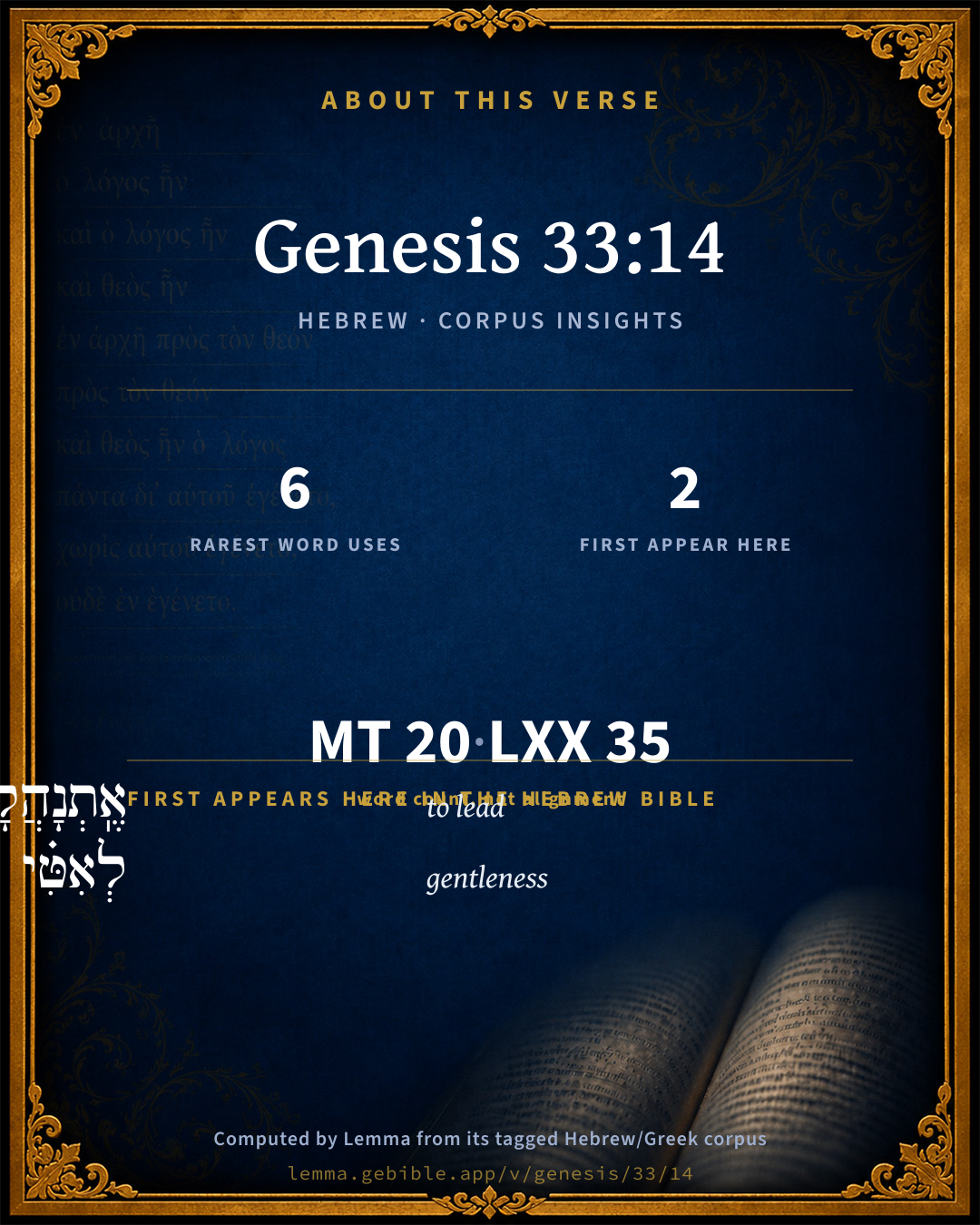
  • 2 first appearances in the Hebrew Bible
Full analysis ↓
Download a study sheet

One document with this verse’s original text, its word-by-word gloss line, the meaning frame, cross-references with their text, attributed commentary, and full source and license credits — printable, and it pastes into notes with its structure intact.

This verse Autodidact and up

Study sheet (.html) Plain text (.txt)

A passage Seminary Student

Up to 50 verses in one chapter. A passage sheet keeps up to 6 commentary sources and 12 cross-references per verse, in the order this page ranks them, and says so on the sheet whenever that leaves anything out. Ask for a single verse and you get the Autodidact verse sheet above.

Everything on this page stays free to read, with no account — the sheet is a download of what is already on screen, not access to it.

Want to remove ads? Support Godless Engineer
Compare translations 3

The same verse in 3 English versions, stacked beneath the original-language interlinear above. Click any original word for its lexicon entry.

Each is an independent rendering of the whole verse — the interlinear is not word-aligned to these translations.

Highlighted words mark where these versions differ — a whole-verse word diff, not a word-by-word alignment.

  • World English Bible Public Domain
    Please let my lord pass over before his servant: and I will lead on gently, according to the pace of the cattle that are before me and according to the pace of the children, until I come to my lord to Seir."
  • King James Version Public Domain
    Let my lord, I pray thee, pass over before his servant: and I will lead on softly, according as the cattle that goeth before me and the children be able to endure, until I come unto my lord unto Seir.
  • unfoldingWord Literal Text CC BY-SA 4.0
    Please let my lord go on before his servant, and I will lead them on at my gentle pace, at the pace of the livestock that ahead of me and at the pace of the children, until I come to my lord in Seir.”

unfoldingWord Literal Text — © unfoldingWord, licensed CC BY-SA 4.0. Word-aligned USFM3 via Door43 (git.door43.org/unfoldingWord/en_ult).

Versions to compare (up to 4)

3 of 4 selected

Show all 18 translations

Every available English version of this verse, each an independent rendering of the whole verse.

  • World English Bible Public Domain
    Please let my lord pass over before his servant: and I will lead on gently, according to the pace of the cattle that are before me and according to the pace of the children, until I come to my lord to Seir."
  • Berean Standard Bible Public Domain
    Please let my lord go ahead of his servant. I will continue on slowly, at a comfortable pace for the livestock and children, until I come to my lord at Seir.”
  • Majority Standard Bible Public Domain
    Please let my lord go ahead of his servant. I will continue on slowly, at a comfortable pace for the livestock and children, until I come to my lord at Seir.”
  • King James Version Public Domain
    Let my lord, I pray thee, pass over before his servant: and I will lead on softly, according as the cattle that goeth before me and the children be able to endure, until I come unto my lord unto Seir.
  • American Standard Version (1901) Public Domain
    Let my lord, I pray thee, pass over before his servant: and I will lead on gently, according to the pace of the cattle that are before me and according to the pace of the children, until I come unto my lord unto Seir.
  • Revised Version (1885) Public Domain
    Let my lord, I pray thee, pass over before his servant: and I will lead on softly, according to the pace of the cattle that is before me and according to the pace of the children, until I come unto my lord unto Seir.
  • Geneva Bible (1599) Public Domain
    Let now my lord go before his seruant, and I will driue softly, according to ye pase of ye cattel, which is before me, and as the children be able to endure, vntill I come to my lord vnto Seir.
  • Douay-Rheims (1899) Public Domain
    May it please my lord to go before his servant: and I will follow softly after him, as I shall see my children to be able, until I come to my lord in Seir.
  • Young's Literal Translation Public Domain
    Let my lord, I pray thee, pass over before his servant, and I -- I lead on gently, according to the foot of the work which `is' before me, and to the foot of the children, until that I come unto my lord, to Seir.'
  • Literal Standard Version CC BY-SA 4.0
    Please let my lord pass over before his servant, and I lead on gently, according to the foot of the work which [is] before me, and to the foot of the children, until I come to my lord, to Seir.”
  • Unlocked Literal Bible CC BY-SA 4.0
    Please let my master go on ahead of his servant. I will travel more slowly, at the pace of the livestock that are before me, and at the pace of the children, until I come to my master in Seir.”
  • unfoldingWord Literal Text CC BY-SA 4.0
    Please let my lord go on before his servant, and I will lead them on at my gentle pace, at the pace of the livestock that ahead of me and at the pace of the children, until I come to my lord in Seir.”
  • Darby Bible Public Domain
    Let my lord, I pray thee, pass on before his servant, and I will drive on at my ease according to the pace of the cattle that is before me, and according to the pace of the children, until I come to my lord, to Seir.
  • World Messianic Bible Public Domain
    Please let my lord pass over before his servant, and I will lead on gently, according to the pace of the livestock that are before me and according to the pace of the children, until I come to my lord to Seir.”
  • Webster's Bible Public Domain
    Let my lord, I pray thee, pass over before his servant: and I will lead on slowly, according as the cattle that go before me, and the children are able to endure; until I come to my lord to Seir.
  • Free Bible Version CC BY-SA 4.0
    You go on, my lord, and your servant will come along slowly, walking with the children, and I'll meet you at Seir.”
  • Bible in Basic English Public Domain
    Do you, my lord, go on before your servant; I will come on slowly, at the rate at which the cattle and the children are able to go, till I come to my lord at Seir.
  • JPS Tanakh (1917) Public Domain
    Let my lord, I pray thee, pass over before his servant; and I will journey on gently, according to the pace of the cattle that are before me and according to the pace of the children, until I come unto my lord unto Seir.'

Literal Standard Version (2020), Covenant Press — licensed CC BY-SA 4.0. Text via the HelloAO Bible API (eBible.org). Unlocked Literal Bible (unfoldingWord) — licensed CC BY-SA 4.0. Text via the HelloAO Bible API (eBible.org). unfoldingWord Literal Text — © unfoldingWord, licensed CC BY-SA 4.0. Word-aligned USFM3 via Door43 (git.door43.org/unfoldingWord/en_ult). Free Bible Version, Dr. Jonathan Gallagher — licensed CC BY-SA 4.0. Text via the HelloAO Bible API (eBible.org).

Word by word

More ways to search: Search by grammar → Find every occurrence → Compare this word →

Practice this passage: Drill this verse → Learn its vocabulary →

לְאִטִּ֗י
ʼaṭ
H328
“to/for · gentleness · my”
Preposition + Noun, Common, Masculine, Singular, Construct + Suffix, Personal, 1st Person, Common, Singular
Part of Speech
Preposition + Noun
Type
Common
Gender
Masculine
Number
Singular
State
Construct
Full BDB Definition

Origin: from an unused root perhaps meaning to move softly

TWOT: 72b

gentleness, softness - gently - flowing - softly - enchanter, necromancer (substantive)
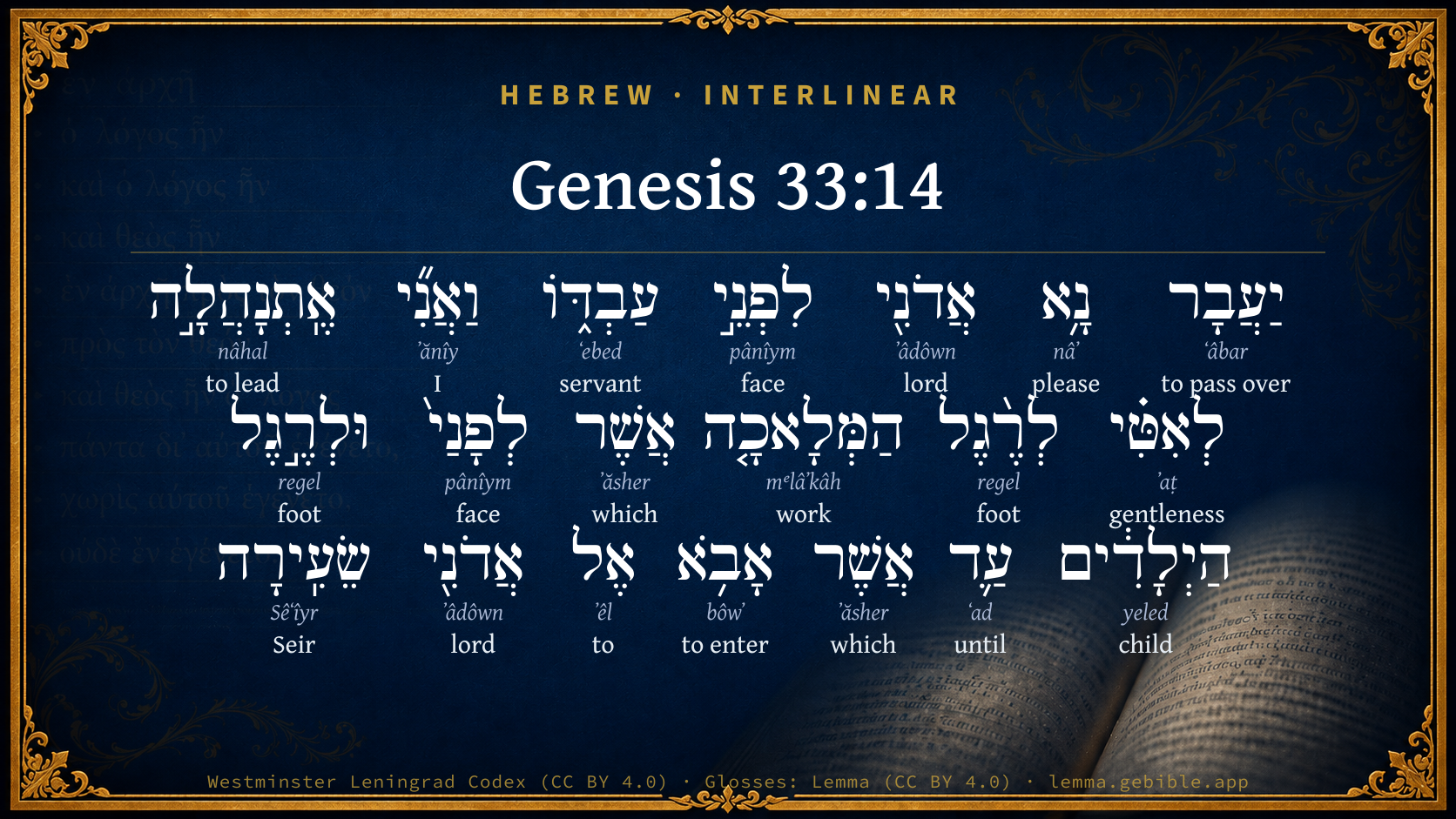
  1. יַעֲבָר ʻâbar H5674 “to pass over” Verb, Qal, Jussive, 3rd Person, Masculine, Singular
  2. נָ֥א nâʼ H4994 “please” Particle, Exhortation
  3. אֲדֹנִ֖י ʼâdôwn H113 “lord · my” Noun, Common, Masculine, Singular, Construct + Suffix, Personal, 1st Person, Common, Singular
  4. לִפְנֵ֣י pânîym H6440 “to/for · face(s) of” Preposition + Noun, Common, Both, Plural, Construct
  5. עַבְדּ֑וֹ ʻebed H5650 “servant · his” Noun, Common, Masculine, Singular, Construct + Suffix, Personal, 3rd Person, Masculine, Singular
  6. וַאֲנִ֞י ʼănîy H589 “and · I” Conjunction + Pronoun, Personal, 1st Person, Common, Singular
  7. אֶֽתְנָהֲלָ֣ה nâhal H5095 “to lead” Verb, Hithpael, Cohortative, 1st Person, Common, Singular
  8. לְרֶ֨גֶל regel H7272 “to/for · foot of” Preposition + Noun, Common, Feminine, Singular, Construct
  9. הַמְּלָאכָ֤ה mᵉlâʼkâh H4399 “the · work” Particle, Definite Article + Noun, Common, Feminine, Singular, Absolute
  10. אֲשֶׁר ʼăsher H834 “which” Particle, Relative
  11. לְפָנַי֙ pânîym H6440 “to/for · face(s) · my” Preposition + Noun, Common, Both, Plural, Construct + Suffix, Personal, 1st Person, Common, Singular
  12. וּלְרֶ֣גֶל regel H7272 “and · to/for · foot of” Conjunction + Preposition + Noun, Common, Feminine, Singular, Construct
  13. הַיְלָדִ֔ים yeled H3206 “the · children” Particle, Definite Article + Noun, Common, Masculine, Plural, Absolute
  14. עַ֛ד ʻad H5704 “until” Preposition
  15. אֲשֶׁר ʼăsher H834 “which” Particle, Relative
  16. אָבֹ֥א bôwʼ H935 “to enter” Verb, Qal, Imperfect, 1st Person, Common, Singular
  17. אֶל ʼêl H413 “to” Preposition
  18. אֲדֹנִ֖י ʼâdôwn H113 “lord · my” Noun, Common, Masculine, Singular, Construct + Suffix, Personal, 1st Person, Common, Singular
  19. שֵׂעִֽירָה Sêʻîyr H8165 “Seir · toward” Noun, Proper + Suffix, Demonstrative

About this verse

These counts appear in no published source. They are computed here, from the morphology-tagged text and Lemma’s own curated glosses. What Lemma adds →

20
words
16
distinct lemmas
Pentateuch
section

Notable vocabulary

The rarest word here is לְאִטִּ֗י gentleness H328 — appearing just 6 times in the whole Hebrew Bible.

First appearance in Scripture

These words make their first canonical appearance in the Hebrew Bible here:

  • אֶֽתְנָהֲלָ֣ה to lead H5095
  • לְאִטִּ֗י gentleness H328

Shared distinctive vocabulary

לְאִטִּ֗י gentleness H328 occurs in 6 verses of the Hebrew Bible. Also found in:

Grammatical profile

  • 3 verbs
  • 11 nouns
  • 1 pronoun
  • 2 prepositions
  • 3 particles

Verb forms

  • יַעֲבָר Qal · Jussive
  • אֶֽתְנָהֲלָ֣ה Hithpael · Cohortative
  • אָבֹ֥א Qal · Imperfect

Repetition

Words recur within this verse — often emphatic in Hebrew:

  • אֲדֹנִ֖י lord H113 ×2
  • לִפְנֵ֣י face H6440 ×2
  • לְרֶ֨גֶל foot H7272 ×2
  • אֲשֶׁר which H834 ×2

Hebrew & Septuagint length

In English translation the verse runs 42 words from the Hebrew and 41 from the Septuagint (LXX English) — closely comparable.

A rough comparison of the two English renderings, which tokenize alike — not a word-level alignment.

Word counts can differ between the Hebrew and the Greek without any difference in meaning — e.g. the Hebrew direct-object marker אֵת has no separate Greek word, and Greek often adds the article ὁ.

In the original languages it is 20 Hebrew tokens and 35 Greek tokens — but the two are counted differently (Hebrew bundles its prefixes and suffixes into one token; the Greek is in lemma form), so that isn’t a like-for-like length.

Cross-references

11

Topical passages linked to Genesis 33:14 in the Treasury of Scripture Knowledge — connected by theme and wording, ordered by reader-vote popularity; previews shown in the World English Bible.

  • Genesis 32:3 Jacob sent messengers in front of him to Esau, his brother, to the land of Seir, the field of Edom.
  • Isaiah 40:11 He will feed his flock like a shepherd, he will gather the lambs in his arm, and carry them in his bosom, [and] will gently lead those who have their young.
  • Romans 15:1 Now we who are strong ought to bear the weaknesses of the weak, and not to please ourselves.
  • Deuteronomy 2:1 Then we turned, and took our journey into the wilderness by the way to the Red Sea, as Yahweh spoke to me; and we compassed Mount Seir many days.
  • Judges 5:4 Yahweh, when you went forth out of Seir, When you marched out of the field of Edom, The earth trembled, the sky also dropped, Yes, the clouds dropped water.
  • 2 Chronicles 20:10 Now, behold, the children of Ammon and Moab and Mount Seir, whom you would not let Israel invade, when they came out of the land of Egypt, but they turned aside from them, and didn't destroy them;
  • Ezekiel 25:8 Thus says the Lord Yahweh: Because Moab and Seir say, Behold, the house of Judah is like all the nations;
  • Ezekiel 35:2–3 Son of man, set your face against Mount Seir, and prophesy against it,
  • Mark 4:33 With many such parables he spoke the word to them, as they were able to hear it.
  • 1 Corinthians 3:2 I fed you with milk, not with meat; for you weren't yet ready. Indeed, not even now are you ready,
  • 1 Corinthians 9:19–22 For though I was free from all, I brought myself under bondage to all, that I might gain the more.

Cross-references courtesy of OpenBible.info (CC BY 4.0).

Hebrew and Greek witnesses Masoretic Hebrew ↔ Greek Septuagint

The same verse in the two great witnesses to the Old Testament, shown verse-for-verse.

These are two independent witnesses, not word-aligned to each other, and the Septuagint is shown in lemma (dictionary) form.

Hebrew Genesis 33:14 Masoretic · Westminster Leningrad Codex

יַעֲבָר נָ֥א אֲדֹנִ֖י לִפְנֵ֣י עַבְדּ֑וֹ וַאֲנִ֞י אֶֽתְנָהֲלָ֣ה לְאִטִּ֗י לְרֶ֨גֶל הַמְּלָאכָ֤ה אֲשֶׁר לְפָנַי֙ וּלְרֶ֣גֶל הַיְלָדִ֔ים עַ֛ד אֲשֶׁר אָבֹ֥א אֶל אֲדֹנִ֖י שֵׂעִֽירָה

Please let my lord pass over before his servant: and I will lead on gently, according to the pace of the cattle that are before me and according to the pace of the children, until I come to my lord to Seir."

World English Bible · Public Domain

Greek LXX Genesis 33:14 Septuagint · lemma form

προἔρχομαι ὁ κύριος ἐγώ ἔμπροσθεν ὁ παῖς ἐγώ δέ ἐνἰσχύω ἐν ὁ ὁδός κατά σχολή ὁ πορεύσις ὁ ἐναντίον ἐγώ καί κατά πούς ὁ παιδάριον ἕως ὁ ἐγώ ἔρχομαι πρός ὁ κύριος ἐγώ εἰς σηιρ

Let my lord go on before his servant, and I shall have strength on the road according to the ease of the journey before me, and according to the strength of the children, until I come to my lord to Seir.

LXX2012 (modern English Septuagint) · Public Domain

Hebrew: Westminster Leningrad Codex (CC BY 4.0). Greek: Septuagint (public domain); English from LXX2012 (modern English Septuagint) (Public Domain). How the Septuagint differs from the Hebrew →

Targum (Aramaic paraphrase)

2

The Targum is the ancient Jewish Aramaic paraphrase of the Hebrew Scriptures — an interpretive translation, not the Hebrew text itself. Onkelos (literal) and Pseudo-Jonathan (expansive) render the Torah, and Jonathan the Prophets. Coverage is partial: where no permissively-licensed English translation exists for a verse, only the Aramaic is shown. This is verse-level text, not a word-by-word alignment to the Hebrew.

  1. Targum Onkelos Torah (Genesis–Deuteronomy)
    יְעִבַּר כְּעַן רִבּוֹנִי קֳדָם עַבְדֵּהּ וַאֲנָא אֱדַבֵּר בְּנִיחַ לְרֶגֶל עוֹבַדְתָּא דִּי קֳדָמַי וּלְרֶגֶל יָנְקַיָּא עַד דִּי אֵעוֹל לְוַת רִבּוֹנִי לְשֵׂעִיר

    (no public-domain English translation for this verse)

    Targum Onkelos — Aramaic: “Onkelos Genesis” (public domain); “Onkelos Exodus” (public domain); “Onkelos Leviticus” (public domain); “Onkelos Numbers” (public domain); “Onkelos Deuteronomy” (public domain). English: “Sefaria Community Translation” (CC0 1.0 (public-domain dedication)); “J.W. Etheridge. The Targums of Onkelos and Jonathan Ben Uzziel on the Pentateuch. London: Longmans, Green, 1862” (public domain). Text via Sefaria.

  2. Targum Pseudo-Jonathan Torah (Genesis–Deuteronomy)
    יְעִיבַּר בְּבָעוּ רִבּוֹנִי וִיטַיֵיל קֳדָם עַבְדֵיהּ וַאֲנָא אִידְבַּר בִּנְיָיחָא לְבִלְחוֹדוֹי לְרֶגֶל עִיבִדְתָּא דְאִית קֳדָמָי וּלְרֶגֶל אוּלְפַן טַלְיָא עַד זְמַן דְאֵיתֵי לְוַת רִיבּוֹנִי לְגַבְלָא

    Let me beseech my lord to pass over and journey before thy servant, and I will lead oil quietly alone, according to the foot of the work which is before me, and according to the foot of the instruction of the children; until the time that I come to my lord at Gabla.

    Targum Pseudo-Jonathan — Aramaic: “Targum Jonathan on Genesis” (public domain); “Targum Jonathan on Exodus” (public domain); “Targum Jonathan on Leviticus” (public domain); “Targum Jonathan on Numbers” (public domain); “Targum Jonathan on Deuteronomy” (public domain). English: “The Targum of Jonathan ben Uzziel, trans. J. W. Etheridge, London, 1862” (public domain). Text via Sefaria.

Commentary

Notes on Genesis 33:14 from classic Christian and Jewish commentators (each source and its license shown beneath its notes). The classic Christian expositions comment on the surrounding passage and are grouped to its opening verse, so a note may address several verses; the Jewish commentaries on the Tanakh (Rashi and others) are per-verse, so they appear only where the commentator wrote on this verse.

Lemma curates 59 commentaries, every one of them public domain or Creative Commons licensed, each selected and text-cleaned for this edition rather than reprinted as found. About our sources →

Trapp's Complete Commentary

John Trapp

Gen 33:14 Let my lord, I pray thee, pass over before his servant: and I will lead on softly, according as the cattle that goeth before me and the children be able to endure, until I come unto my lord unto Seir.

Ver. 14. Until I come unto my lord, unto Seir.] Which yet he never meant, say some: it was but an officious lie, saith Tostatus. Others think that he did go to Seir, though it he not recorded. It is like he purposed to go, but was otherwise warned by God; as the wise men were, {Mat 2:12} or necessarily hindered, as St Paul was in many of his intended journeys.

John Trapp, A Commentary or Exposition upon All the Books of the Old and New Testament (1647–1656) — public domain. Text from a community e-Sword module.

Joseph Benson's Commentary

Gen 33:14. Until I come unto my lord, to mount Seir — As no mention is made of it, many writers think, that, for some reasons, Jacob never went to mount Seir to see Esau. Certainly it is very doubtful whether he ever did. It cannot be supposed however, that he would delay so long as the time mentioned in the twenty-fifth chapter before he went to see his father.

Joseph Benson's Commentary on the Old and New Testaments (1811–1818) — public domain. Text from a community e-Sword module.

Geneva Bible (1599)

Geneva Bible translators

He promised that which (as seemeth) his mind was not to perform.

Geneva Bible (1599) marginal notes — public domain. Text via Bolls.life.

Jamieson, Fausset & Brown

Robert Jamieson, A. R. Fausset & David Brown

until I come unto my lord--It seems to have been Jacob's intention, passing round the Dead Sea, to visit his brother in Seir, and thus, without crossing the Jordan, go to Beer-sheba to Isaac; but he changed his plan, and whether the intention was carried out then or at a future period has not been recorded.

Jamieson, Fausset & Brown — Commentary Critical and Explanatory on the Whole Bible (1871) — public domain (CC PDM 1.0). Text via the HelloAO Bible API.

Adam Clarke's Commentary

Verse 14. Until I come unto my lord unto Seir.] It is very likely that Jacob was perfectly sincere in his expressed purpose of visiting Esau at Seir, but it is as likely that circumstances afterwards occurred that rendered it either improper or impracticable; and we find that Esau afterwards removed to Canaan, and he and Jacob dwelt there together for several years. See Ge 36:6.

Adam Clarke's Commentary on the Bible (1810–1826) — public domain. Text from a community e-Sword/MySword module.

Ellicott's Commentary for English Readers

(14) According as the cattle . . . —Rather, according to the pace—Heb., foot—of the cattle that is before me, and according to the pace of the children. Joseph was only six or seven years old; and Leah’s two younger sons, and probably Zilpah’s, were too tender to endure much fatigue.

Unto Seir.—This implies a purpose of visiting Esau in his new acquisition, not carried out probably because Esau did not as yet settle there, but returned to Hebron to his father.

A Bible Commentary for English Readers, edited by Charles John Ellicott (1878–1897) — public domain. Text from a community e-Sword module.

The Cambridge Bible for Schools and Colleges

gen. ed. J. J. S. Perowne

14. softly] Lit. “according to my gentleness,” i.e. at a quiet and leisurely rate.

according to the pace of the cattle] Lit. “of the property” in herds and flocks (m’lâ’cah, as in Exo_22:7; Exo_22:10; 1Sa_15:9).

unto Seir] Jacob here implies that he was intending to visit his brother in Seir. He has no intention of settling there, and at the most he expresses a courteous hope of a temporary sojourn.

The Cambridge Bible for Schools and Colleges (gen. ed. J. J. S. Perowne; Cambridge University Press, 1878–1918) — public domain. Text from a community e-Sword module.

John Gill's Exposition

Let my lord, I pray thee, pass over before his servant,.... He desired in a very respectable manner that he would not keep his pace in complaisance to him, but proceed on in his journey, and go on with his men, and he with his family and flocks would follow after as fast as he could, and their circumstances would admit of:

and I will lead on softly; slowly, gently, easily, step by step:

according as the cattle that goeth before me, and the children be able to endure; or "according to the foot" (s) of them; of the cattle, whom he calls the "work" (t), because his business lay in the care of them, and these were the chief of his substance; and of the children, as the feet of each of them were able to travel; or because of them, for the sake of them, as Aben Ezra, consulting their strength, he proposed to move on gently, like both a wise, careful, and tender father of his family, and shepherd of his flock:

until I come unto my lord unto Seir; whither, no doubt, he intended to come when he parted with Esau; but for reasons which after appeared to him he declined it: or more probably he did go thither then, or quickly after; though the Scripture makes no mention of it, he might go with some of his servants directly, and send his family, flocks, and herds, under the care of other servants, forward on their journey, and quickly come up to them again; for that he should tell a lie is not likely, nor does he seem to be under any temptation to it: and besides, it would have been dangerous to have disobliged his brother when on his borders, who could easily have come upon him again with four hundred men, and picked a quarrel with him for breach of promise, and destroyed him and his at once.

(s) "ad pedem", Pagninus, Montanus, Vatablus, Drusius, Cartwright. (t) "operis", Montanus, Munster, Fagius, Drusius, Cartwright, Schmidt.

John Gill's Exposition of the Whole Bible (1746–1763) — public domain (CC PDM 1.0). Text via the HelloAO Bible API.

Haydock's Catholic Bible Commentary

In Seir; not immediately, but as soon as it might be convenient. This time perhaps never arrived. (St. Augustine, q. 106.)

George Leo Haydock (1774–1849), Haydock's Catholic Family Bible and Commentary, 1859 edition — public domain. Excludes Psalms (Douay-Rheims chapter numbering differs from Protestant) and Deuterocanonical books (Catholic canon only).

Matthew Poole's English Annotations

We do not read that Jacob did according to this promise or insinuation go to Seir; either therefore he changed his first intentions for some weighty reasons, or upon warning from God; or he used this only as a pretence, which we should not too easily believe of so good a man, especially after such dangers and deliverances; or rather he did perform this promise, though the Scripture be silent of it, as it is of many other historical passages, and as it is here concerning Jacob’s visiting of his father Isaac, which is not mentioned till ten years after this time; and yet it is utterly incredible that Jacob should be so near to his dear and worthy father for so long a time together, and not once give him a visit.

Matthew Poole's English Annotations on the Holy Bible (1683–1685) — public domain. Text from a community e-Sword/MySword module.

Whedon's Commentary on the Bible

Daniel D. Whedon

14. I will lead on softly — That is, I will proceed gently.

According as the cattle — Hebrews, according to the foot of the work; that is, the possessions acquired by my work. The English version, though not literal, gives the real meaning.

Until I come… unto Seir — These words naturally give the impression that Jacob promises to move steadily along until he should reach Mt. Seir; but as soon as Esau departs, he proceeds to Shechem, and never went to Seir at all. But a little reflection will show the impropriety of construing his action thus. Esau was probably not yet settled in Mount Seir, (see note on Gen_32:3,) but, during this interview, had told Jacob of his acquisitions and of his purpose to remove thither; and Jacob’s promise to visit him there was necessarily indefinite as to time. The brothers met again at the burial of their father Isaac. Gen_35:29.

Daniel D. Whedon (gen. ed.), Commentary on the Old and New Testaments (1874–1909) — public domain. Text from a community e-Sword module.

The Pulpit Commentary

Let my lord, I pray thee, it is perhaps too much to explain Jacob"s obsequious and deferential address to his brother (my lord) as the sign of a guilty conscience (Kalisch, Alford), when possibly politeness and humility will sufficepass over not cross the Jordan (Afford), since Esau was not journeying to Canaan; but simply pass on, as in ver. 3before his servant: and I will lead on softly (literally, I will go on at my slow pace), according as the cattle that goeth before me and the children be able to endure, literally, according to the foot, i.e. the pace, of the property (here, cattle), and according to the foot of the children; i.e. as fast as flocks and children can be made with safety to traveluntil I come unto my lord unto Seir. It is apparent that Jacob at first intended to accept Esau"s invitation to visit him at Seir, either immediately (Clericus, Kalisch), or, as is more probable, afterwards (Keil, Murphy, "Speaker"s Commentary"), though, if afterwards, the historian has preserved no record of any such journey, while, if presently such was his intention, he must have been providentially led, from some cause not mentioned, to alter his determination (Bush, Inglis, Clarke), unless we either think that he really went to Seir, though it is not here stated (Patrick), or entertain the, in the circumstances, almost incredible hypothesis that Jacob practiced a deception on his generous brother in order to get rid of him, by promising what he never meant to fulfill, viz., to visit him at Mount Seir (Calvin), or leave it doubtful whether it is the old Jacob or the new Israel who speaks (Lange).

The Pulpit Commentary (1880–1919), ed. H.D.M. Spence-Jones & Joseph S. Exell — public domain. Text from a community e-Sword module.

Rashi

Rabbi Shlomo Yitzchaki (Rashi)

יעבר נא אדני LET MY LORD, I PRAY THEE, PASS — do not prolong the time of your journey: pass on at your usual speed even though you thereby get far away from me.

אתנהלה is the same as אתנהל I WILL LEAD ON. The ה at the end of the word is redundant as in (8:21) ארדה “I will go down”, and in (Psalms 85:9) אשמעה “I will hear”.

לאטי SLOWLY — the word means “my slowness", לאט having the meaning of ease, gentleness. Examples are: (Isaiah 8:6) “that go (לאט) softly”; (2 Samuel 18:6) “Deal (לאט) gently for my sake with the young man.” In לאטי the ל is a root-letter and not a prefix, so that the meaning is, “I will lead on at my slow rate”.

לרגל המלאכה ACCORDING TO THE PACE OF THE DROVE — according to the requirements made by the pace of the feet of the cattle which is incumbent on me to drive.

ולרגל הילדים AND ACCORDING TO THE PACE OF THE CHILDREN — according to the speed (רגל) which they are able to keep up.

עד אשר אבא אל אדני שעירה UNTIL I COME UNTO MY LORD UNTO SEIR — He mentioned a much longer journey, for he really intended to go only as far as Succoth (Avodah Zarah 25b). He said, “If he means to do me harm let him wait to do so until I reach his abode at Seir.” Therefore he did not go to Seir. But when will he go? In the days of the Messiah, as it is said (Obadiah 1:21) “And saviours shall go up on Mount Zion to judge the mount of Esau”. There are many Midrashic explanations of this section.

Rashi on the Tanakh — English translations: “The Judaica Press complete Tanach with Rashi, translated by A. J. Rosenberg” (CC BY 4.0); “Pentateuch with Rashi's commentary by M. Rosenbaum and A.M. Silbermann, 1929-1934” (public domain); “The Metsudah Tanach series, Lakewood, N.J” (CC BY 4.0); and “The Book of Joshua, Metsudah Publications, 1997” (CC BY 4.0). Text via Sefaria.

Ramban (Nachmanides)

Rabbi Moshe ben Nachman (Ramban / Nachmanides)

UNTIL I COME UNTO MY LORD UNTO SE’IR. In returning to his land Jacob could have gone by way of the land of Se’ir. Now Esau told him, And I will go before thee, meaning that he will not be separated from him until Jacob returns to his father in order to honor him when he comes into his land. But Jacob said, “I will proceed slowly and let my lord return to the city of his rule, and if I will return by way of his city, he will honor me and go with me as he desires.” This was not a vow on the part of Jacob that he will come to him, for Esau did not need him. Our Rabbis have further said that Jacob had no intention of returning by way of Se’ir, and his desire was to remove himself from him as much as possible, but he mentioned until I come … unto Se’ir in order to extend the length of his journey [so that if Esau meant to do him harm he would wait until Jacob reached his abode at Se’ir]. This also was wise counsel. The Rabbis have yet another Midrash, which states that Jacob will fulfill his word in the days of the Messiah, as it is said, And saviours shall come up on mount Zion to judge the mount of Esau. Scripture is saying that the saviors [i.e., the judges of Israel] who are on Mount Zion shall come up to judge the mount of Esau.

Ramban (Nachmanides) on the Tanakh — English translation: “Commentary on the Torah by Ramban (Nachmanides). Translated and annotated by Charles B. Chavel. New York, Shilo Pub. House, 1971-1976” (CC BY 4.0). Text via Sefaria.

Radak

Rabbi David Kimhi (Radak)

יעבר נא...לרגל המלאכה, the cattle is referred to as מלאכה, because cattle are the instruments by means of which most basic agricultural work is performed. We find a similar usage of the word מלאכה in Samuel I 15,9 וכל המלאכה נמבזה ונמס, “and all the inferior cattle (those they killed).”

Radak on the Tanakh — English translations: “Sefaria Community Translation” (CC0 1.0 (public-domain dedication)); “Eliyahu Munk, HaChut Hameshulash” (CC BY 4.0); “Rabbi Mike Feuer, Jerusalem Anthology” (CC BY 4.0); and “R. David Kimhi on the first book of Psalms, Translated by R.G. Finch, London, 1919” (public domain). Text via Sefaria.

Lesson kit

Teaching starters — assembled from the data on this page, not authored interpretation. Every prompt links to the verse data it draws on. Edit before teaching.

Genesis, in the Pentateuch, opens this verse with 20 words (16 distinct Hebrew lemmas). Its most distinctive word is ʼaṭ (“gentleness”). A historical commentator’s framing appears above. Read the whole chapter for the surrounding context.

Discussion questions

  1. The word ʼaṭ carries the sense “gentleness.” How does it shape the verse?
  2. 2 words make their first appearance in Scripture here. What does this debut establish?
  3. How does 2 Samuel 18:5, which shares the word «gentleness», read alongside this verse?
  4. What does the repetition of “lord” (2× in this one verse) do in this verse?
  5. These translations render this verse differently; the difference is in the English rendering, not the original. What questions does that raise?
  6. «יַעֲבָר» is a Qal Jussive verb. How does that grammatical form shape the action described?
  7. Compare how Trapp's Complete Commentary and Joseph Benson's Commentary read this verse. Where do they agree or differ?

Things to notice

Reading settings

Reading text

Shown beneath each verse's original-language words.

Old Testament
Old Testament edition

Read the OT as the Masoretic Hebrew (MT) or the Greek Septuagint (LXX).

English shown for the Greek Septuagint (in the Hebrew ↔ Greek comparison).

Comparing translations? Open the Compare panel on any verse page to stack up to four side by side.