Genesis 34:5

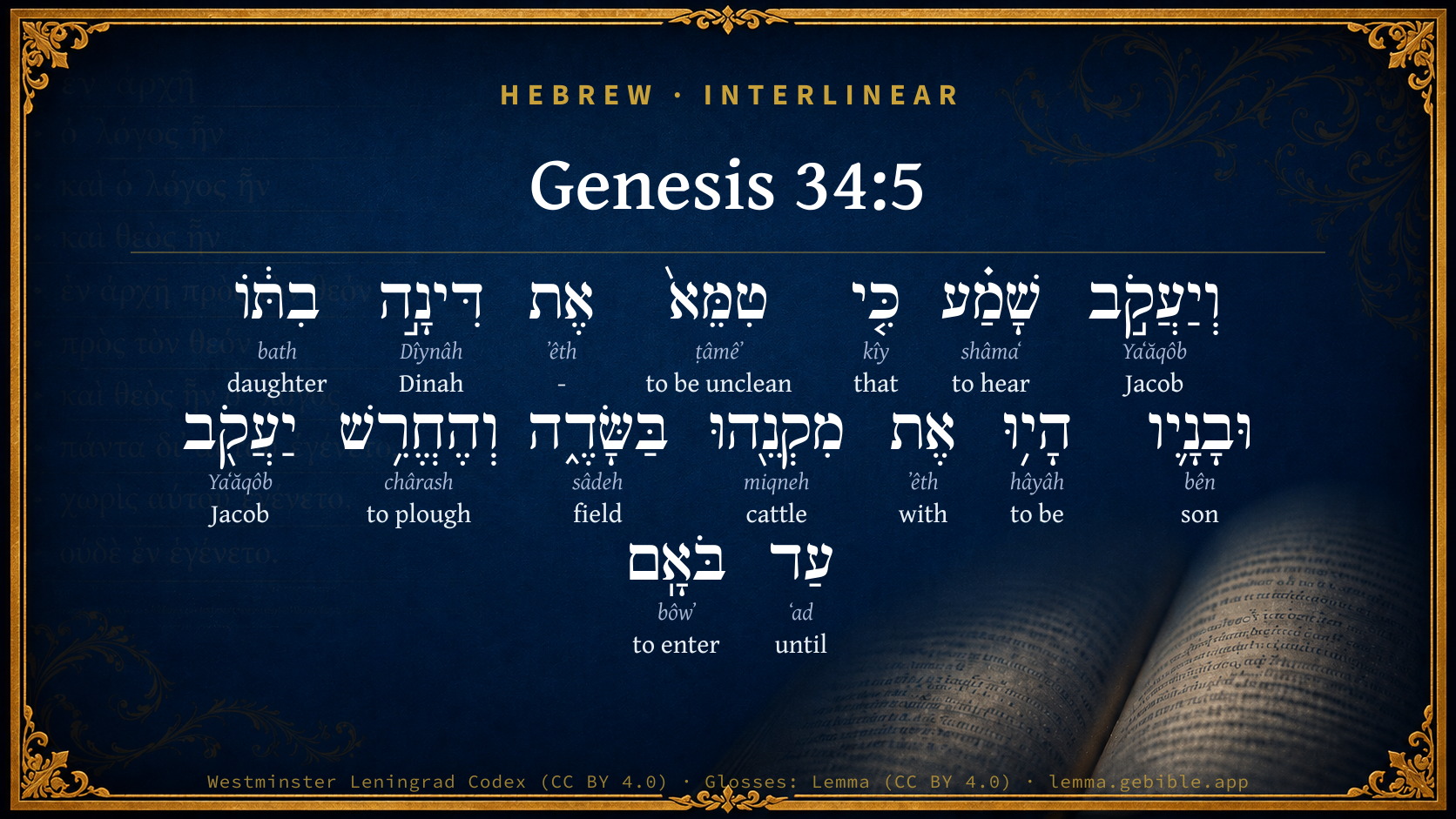
Hebrew (Westminster Leningrad Codex) Genesis 34:5 appears in the Hebrew Old Testament. The text above is from the Westminster Leningrad Codex. Each word links to its Strong’s number, a concise gloss, and parsing drawn from the Open Scriptures Hebrew Bible morphology. Click any word for its full Brown-Driver-Briggs (BDB) entry.
Download image
Cite this verse

Genesis 34:5 (World English Bible). Public Domain. Lemma interlinear Bible study tool, https://lemma.gebible.app/v/genesis/34/5.

Show BibTeX & RIS
BibTeX
RIS
English Translation
Now Jacob heard that he had defiled Dinah, his daughter; and his sons were with his cattle in the field. Jacob held his peace until they came.
World English Bible · Public Domain
Highlights
  • 1 first appearance in the Hebrew Bible
Full analysis ↓
Download a study sheet

One document with this verse’s original text, its word-by-word gloss line, the meaning frame, cross-references with their text, attributed commentary, and full source and license credits — printable, and it pastes into notes with its structure intact.

This verse Autodidact and up

Study sheet (.html) Plain text (.txt)

A passage Seminary Student

Up to 50 verses in one chapter. A passage sheet keeps up to 6 commentary sources and 12 cross-references per verse, in the order this page ranks them, and says so on the sheet whenever that leaves anything out. Ask for a single verse and you get the Autodidact verse sheet above.

Everything on this page stays free to read, with no account — the sheet is a download of what is already on screen, not access to it.

Want to remove ads? Support Godless Engineer
Compare translations 3

The same verse in 3 English versions, stacked beneath the original-language interlinear above. Click any original word for its lexicon entry.

Each is an independent rendering of the whole verse — the interlinear is not word-aligned to these translations.

Highlighted words mark where these versions differ — a whole-verse word diff, not a word-by-word alignment.

  • World English Bible Public Domain
    Now Jacob heard that he had defiled Dinah, his daughter; and his sons were with his cattle in the field. Jacob held his peace until they came.
  • King James Version Public Domain
    And Jacob heard that he had defiled Dinah his daughter: now his sons were with his cattle in the field: and Jacob held his peace until they were come.
  • unfoldingWord Literal Text CC BY-SA 4.0
    Then Jacob heard that he had defiled Dinah his daughter, and his sons were with his livestock in the fields, so Jacob kept quiet until they came.

unfoldingWord Literal Text — © unfoldingWord, licensed CC BY-SA 4.0. Word-aligned USFM3 via Door43 (git.door43.org/unfoldingWord/en_ult).

Versions to compare (up to 4)

3 of 4 selected

Show all 18 translations

Every available English version of this verse, each an independent rendering of the whole verse.

  • World English Bible Public Domain
    Now Jacob heard that he had defiled Dinah, his daughter; and his sons were with his cattle in the field. Jacob held his peace until they came.
  • Berean Standard Bible Public Domain
    Jacob heard that Shechem had defiled his daughter Dinah, but since his sons were with his livestock in the field, he remained silent about it until they returned.
  • Majority Standard Bible Public Domain
    Jacob heard that Shechem had defiled his daughter Dinah, but since his sons were with his livestock in the field, he remained silent about it until they returned.
  • King James Version Public Domain
    And Jacob heard that he had defiled Dinah his daughter: now his sons were with his cattle in the field: and Jacob held his peace until they were come.
  • American Standard Version (1901) Public Domain
    Now Jacob heard that he had defiled Dinah his daughter; and his sons were with his cattle in the field: and Jacob held his peace until they came.
  • Revised Version (1885) Public Domain
    Now Jacob heard that he had defiled Dinah his daughter; and his sons were with his cattle in the field: and Jacob held his peace until they came.
  • Geneva Bible (1599) Public Domain
    (Nowe Iaakob heard that he had defiled Dinah his daughter, and his sonnes were with his cattell in the fielde: therefore Iaakob helde his peace, vntill they were come.)
  • Douay-Rheims (1899) Public Domain
    But when Jacob had heard this, his sons being absent, and employed in feeding the cattle, he held his peace till they came back.
  • Young's Literal Translation Public Domain
    And Jacob hath heard that he hath defiled Dinah his daughter, and his sons were with his cattle in the field, and Jacob kept silent till their coming.
  • Literal Standard Version CC BY-SA 4.0
    And Jacob has heard that he has defiled his daughter Dinah, and his sons were with his livestock in the field, and Jacob kept silent until their coming.
  • Unlocked Literal Bible CC BY-SA 4.0
    Now Jacob heard that he had defiled Dinah his daughter. His sons were with his livestock in the field, so Jacob held his peace until they came.
  • unfoldingWord Literal Text CC BY-SA 4.0
    Then Jacob heard that he had defiled Dinah his daughter, and his sons were with his livestock in the fields, so Jacob kept quiet until they came.
  • Darby Bible Public Domain
    And Jacob heard that he had defiled Dinah his daughter; but his sons were with his cattle in the fields, and Jacob said nothing until they came.
  • World Messianic Bible Public Domain
    Now Jacob heard that he had defiled Dinah, his daughter; and his sons were with his livestock in the field. Jacob held his peace until they came.
  • Webster's Bible Public Domain
    And Jacob heard that he had defiled Dinah his daughter (now his sons were with his cattle in the field:) and Jacob held his peace till they had come.
  • Free Bible Version CC BY-SA 4.0
    Jacob found out that Shechem had violated his daughter Dinah, but as his sons were away looking after the flocks in the fields he didn't say anything until they came home.
  • Bible in Basic English Public Domain
    Now Jacob had word of what Shechem had done to his daughter; but his sons were in the fields with the cattle, and Jacob said nothing till they came.
  • JPS Tanakh (1917) Public Domain
    Now Jacob heard that he had defiled Dinah his daughter; and his sons were with his cattle in the field; and Jacob held his peace until they came.

Literal Standard Version (2020), Covenant Press — licensed CC BY-SA 4.0. Text via the HelloAO Bible API (eBible.org). Unlocked Literal Bible (unfoldingWord) — licensed CC BY-SA 4.0. Text via the HelloAO Bible API (eBible.org). unfoldingWord Literal Text — © unfoldingWord, licensed CC BY-SA 4.0. Word-aligned USFM3 via Door43 (git.door43.org/unfoldingWord/en_ult). Free Bible Version, Dr. Jonathan Gallagher — licensed CC BY-SA 4.0. Text via the HelloAO Bible API (eBible.org).

Word by word

More ways to search: Search by grammar → Find every occurrence → Compare this word →

Practice this passage: Drill this verse → Learn its vocabulary →

דִּינָ֣ה
Dîynâh
H1783
“Dinah”
Noun, Proper
Part of Speech
Noun
Type
Proper
Full BDB Definition

Origin: from H1779

TWOT: None

Dinah = "judgment" - daughter of Jacob by Leah, full sister of Simeon and Levi
  1. וְיַעֲקֹ֣ב Yaʻăqôb H3290 “and · Jacob” Conjunction + Noun, Proper
  2. שָׁמַ֗ע shâmaʻ H8085 “to hear” Verb, Qal, Perfect, 3rd Person, Masculine, Singular
  3. כִּ֤י kîy H3588 “that” Conjunction
  4. טִמֵּא֙ ṭâmêʼ H2930 “to be unclean” Verb, Piel, Perfect, 3rd Person, Masculine, Singular
  5. אֶת ʼêth H853 “-” Particle, Direct Object
  6. בִתּ֔וֹ bath H1323 “daughter · his” Noun, Common, Feminine, Singular, Construct + Suffix, Personal, 3rd Person, Masculine, Singular
  7. וּבָנָ֛יו bên H1121 “and · sons · his” Conjunction + Noun, Common, Masculine, Plural, Construct + Suffix, Personal, 3rd Person, Masculine, Singular
  8. הָי֥וּ hâyâh H1961 “to be” Verb, Qal, Perfect, 3rd Person, Common, Plural
  9. אֶת ʼêth H854 “with” Preposition
  10. מִקְנֵ֖הוּ miqneh H4735 “cattle · his” Noun, Common, Masculine, Singular, Construct + Suffix, Personal, 3rd Person, Masculine, Singular
  11. בַּשָּׂדֶ֑ה sâdeh H7704 “in/at the · field” Preposition, Determined + Noun, Common, Masculine, Singular, Absolute
  12. וְהֶחֱרִ֥שׁ chârash H2790 “and · to plough” Conjunction + Verb, Hiphil, Perfect, 3rd Person, Masculine, Singular
  13. יַעֲקֹ֖ב Yaʻăqôb H3290 “Jacob” Noun, Proper
  14. עַד ʻad H5704 “until” Preposition
  15. בֹּאָֽם bôwʼ H935 “to enter · them” Verb, Qal, Infinitive Construct + Suffix, Personal, 3rd Person, Masculine, Plural

About this verse

These counts appear in no published source. They are computed here, from the morphology-tagged text and Lemma’s own curated glosses. What Lemma adds →

16
words
15
distinct lemmas
Pentateuch
section

Notable vocabulary

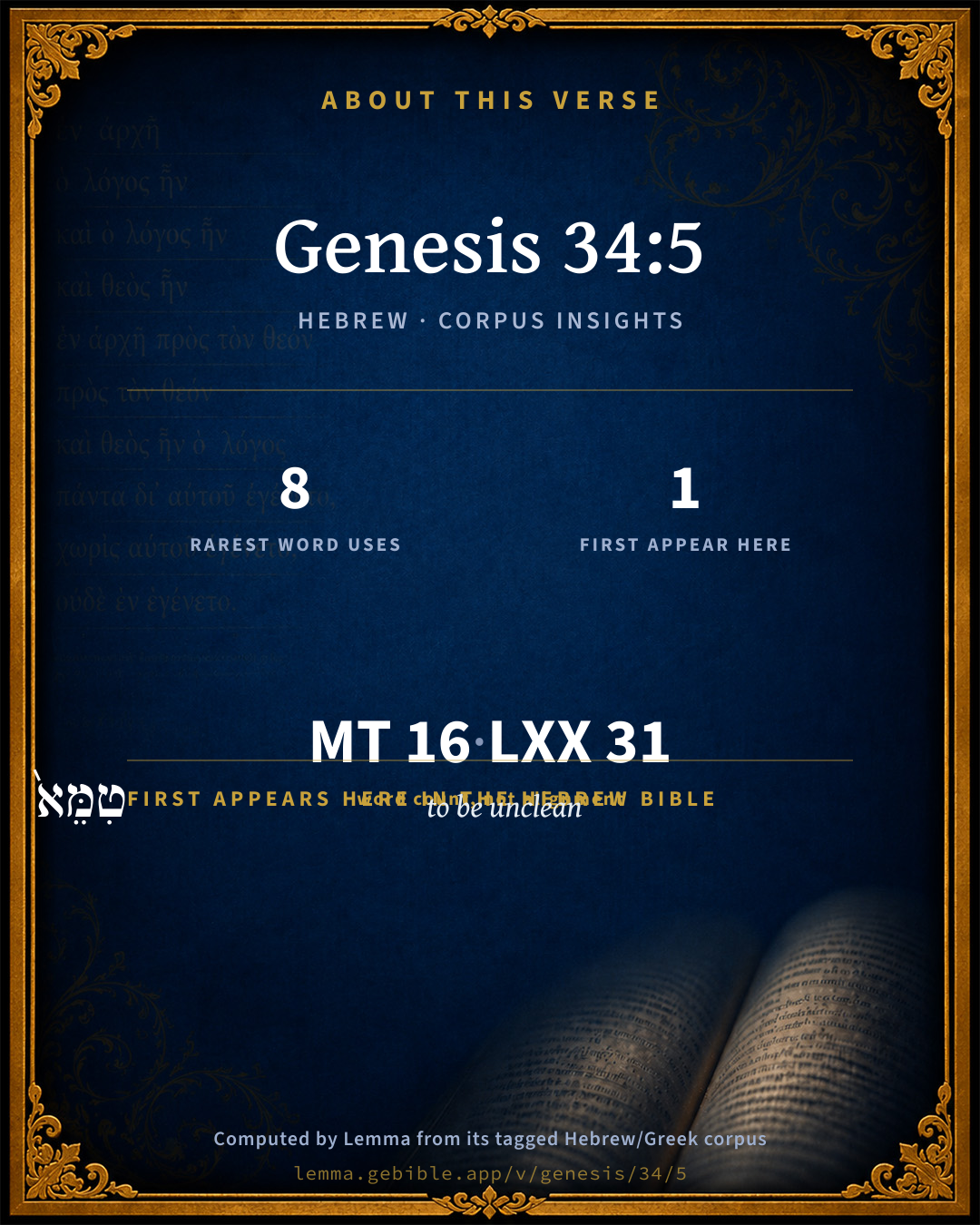
The rarest word here is דִּינָ֣ה Dinah H1783 — appearing just 8 times in the whole Hebrew Bible.

First appearance in Scripture

This word makes its first canonical appearance in the Hebrew Bible here:

  • טִמֵּא֙ to be unclean H2930

Shared distinctive vocabulary

דִּינָ֣ה Dinah H1783 occurs in 8 verses of the Hebrew Bible. Also found in:

Grammatical profile

  • 5 verbs
  • 7 nouns
  • 2 prepositions
  • 1 conjunction
  • 1 particle

Verb forms

  • שָׁמַ֗ע Qal · Perfect
  • טִמֵּא֙ Piel · Perfect
  • הָי֥וּ Qal · Perfect
  • וְהֶחֱרִ֥שׁ Hiphil · Perfect
  • בֹּאָֽם Qal · Infinitive Construct

Repetition

A word recurs within this verse — often emphatic in Hebrew:

  • וְיַעֲקֹ֣ב Jacob H3290 ×2

Hebrew & Septuagint length

In English translation the verse runs 27 words from the Hebrew and 30 from the Septuagint (LXX English) — closely comparable.

A rough comparison of the two English renderings, which tokenize alike — not a word-level alignment.

Word counts can differ between the Hebrew and the Greek without any difference in meaning — e.g. the Hebrew direct-object marker אֵת has no separate Greek word, and Greek often adds the article ὁ.

In the original languages it is 16 Hebrew tokens and 31 Greek tokens — but the two are counted differently (Hebrew bundles its prefixes and suffixes into one token; the Greek is in lemma form), so that isn’t a like-for-like length.

Cross-references

9

Topical passages linked to Genesis 34:5 in the Treasury of Scripture Knowledge — connected by theme and wording, ordered by reader-vote popularity; previews shown in the World English Bible.

  • 2 Samuel 13:22 Absalom spoke to Amnon neither good nor bad; for Absalom hated Amnon, because he had forced his sister Tamar.
  • Genesis 30:35 That day, he removed the male goats that were streaked and spotted, and all the female goats that were speckled and spotted, every one that had white in it, and all the black ones among the sheep, and gave them into the hand of his sons.
  • Genesis 37:13–14 Israel said to Joseph, "Aren't your brothers feeding the flock in Shechem? Come, and I will send you to them." He said to him, "Here I am."
  • Leviticus 10:3 Then Moses said to Aaron, "This is what Yahweh spoke of, saying, "'I will show myself holy to those who come near me, And before all the people I will be glorified.'" Aaron held his peace.
  • 1 Samuel 10:27 But certain worthless fellows said, How shall this man save us? They despised him, and brought him no present. But he held his peace.
  • 1 Samuel 16:11 Samuel said to Jesse, Are here all your children? He said, There remains yet the youngest, and, behold, he is keeping the sheep. Samuel said to Jesse, Send and get him; for we will not sit down until he come here.
  • 1 Samuel 17:15 Now David went back and forth from Saul to feed his father's sheep at Bethlehem.
  • Luke 15:25 "Now his elder son was in the field. As he came near to the house, he heard music and dancing.
  • Luke 15:29 But he answered his father, 'Behold, these many years I have served you, and I never disobeyed a commandment of yours, but you never gave me a goat, that I might celebrate with my friends.

Cross-references courtesy of OpenBible.info (CC BY 4.0).

Hebrew and Greek witnesses Masoretic Hebrew ↔ Greek Septuagint

The same verse in the two great witnesses to the Old Testament, shown verse-for-verse.

These are two independent witnesses, not word-aligned to each other, and the Septuagint is shown in lemma (dictionary) form.

Hebrew Genesis 34:5 Masoretic · Westminster Leningrad Codex

וְיַעֲקֹ֣ב שָׁמַ֗ע כִּ֤י טִמֵּא֙ אֶת דִּינָ֣ה בִתּ֔וֹ וּבָנָ֛יו הָי֥וּ אֶת מִקְנֵ֖הוּ בַּשָּׂדֶ֑ה וְהֶחֱרִ֥שׁ יַעֲקֹ֖ב עַד בֹּאָֽם

Now Jacob heard that he had defiled Dinah, his daughter; and his sons were with his cattle in the field. Jacob held his peace until they came.

World English Bible · Public Domain

Greek LXX Genesis 34:5 Septuagint · lemma form

ἰακώβ δέ ἀκούω ὅτι μιαίνω ὁ υἱός εμμωρ δινα ὁ θυγάτηρ αὐτός ὁ δέ υἱός αὐτός εἰμί μετά ὁ κτῆνος αὐτός ἐν ὁ πεδίον παρασιωπάω δέ ἰακώβ ἕως ὁ ἔρχομαι αὐτός

And Jacob heard that the son of Emmor had defiled Dina his daughter (now his sons were with his cattle in the plain). And Jacob was silent until they came.

LXX2012 (modern English Septuagint) · Public Domain

Hebrew: Westminster Leningrad Codex (CC BY 4.0). Greek: Septuagint (public domain); English from LXX2012 (modern English Septuagint) (Public Domain). How the Septuagint differs from the Hebrew →

Targum (Aramaic paraphrase)

2

The Targum is the ancient Jewish Aramaic paraphrase of the Hebrew Scriptures — an interpretive translation, not the Hebrew text itself. Onkelos (literal) and Pseudo-Jonathan (expansive) render the Torah, and Jonathan the Prophets. Coverage is partial: where no permissively-licensed English translation exists for a verse, only the Aramaic is shown. This is verse-level text, not a word-by-word alignment to the Hebrew.

  1. Targum Onkelos Torah (Genesis–Deuteronomy)
    וְיַעֲקֹב שְׁמַע אֲרֵי סָאֵיב יָת דִּינָה בְרַתֵּהּ וּבְנוֹהִי הֲווֹ עִם גֵּיתוֹהִי בְּחַקְלָא וְשָׁתִיק יַעֲקֹב עַד מֵיתֵיהוֹן

    (no public-domain English translation for this verse)

    Targum Onkelos — Aramaic: “Onkelos Genesis” (public domain); “Onkelos Exodus” (public domain); “Onkelos Leviticus” (public domain); “Onkelos Numbers” (public domain); “Onkelos Deuteronomy” (public domain). English: “Sefaria Community Translation” (CC0 1.0 (public-domain dedication)); “J.W. Etheridge. The Targums of Onkelos and Jonathan Ben Uzziel on the Pentateuch. London: Longmans, Green, 1862” (public domain). Text via Sefaria.

  2. Targum Pseudo-Jonathan Torah (Genesis–Deuteronomy)
    וְיַעֲקב שְׁמַע אֲרוּם סָאִיב יַת דִינָה בְּרַתֵּיהּ וּבְנוֹי הֲווֹ עִם גֵיתוֹי בְּחַקְלָא וּשְׁתִיק יַעֲקב עַד מֵיתֵיהוֹן

    But Jakob had heard that he had polluted Dinah his daughter, And his sons were with the flocks in the field, and Jakob was silent until they came.

    Targum Pseudo-Jonathan — Aramaic: “Targum Jonathan on Genesis” (public domain); “Targum Jonathan on Exodus” (public domain); “Targum Jonathan on Leviticus” (public domain); “Targum Jonathan on Numbers” (public domain); “Targum Jonathan on Deuteronomy” (public domain). English: “The Targum of Jonathan ben Uzziel, trans. J. W. Etheridge, London, 1862” (public domain). Text via Sefaria.

Commentary

Notes on Genesis 34:5 from classic Christian and Jewish commentators (each source and its license shown beneath its notes). The classic Christian expositions comment on the surrounding passage and are grouped to its opening verse, so a note may address several verses; the Jewish commentaries on the Tanakh (Rashi and others) are per-verse, so they appear only where the commentator wrote on this verse.

Lemma curates 59 commentaries, every one of them public domain or Creative Commons licensed, each selected and text-cleaned for this edition rather than reprinted as found. About our sources →

Trapp's Complete Commentary

John Trapp

Gen 34:5 And Jacob heard that he had defiled Dinah his daughter: now his sons were with his cattle in the field: and Jacob held his peace until they were come.

Ver. 5. And Jacob heard.] To his very great grief and regret: for she was his only daughter; a damsel of not more than fifteen years of age. The Hebrews say she was afterwards given to Job in marriage; but that is not likely; for she is reckoned anong those that went down to Egypt. {Gen 46:15}

And Jacob held his peace.] He felt God’s hand upon his back; he therefore lays his own hand upon his mouth. And herein he did better in "ruling his own spirit," than his sons did, that "took the city." {Pro 16:32} "He sitteth alone, and is silent," {Lam 3:28} saith the prophet of the afflicted person. So was Aaron; {Lev 10:3} so was David; {Psa 39:9} so was the Lord Christ, as a sheep dumb before the shearer. The Romans placed the image of their goddess Angeronia upon the altar of Volupia, with her mouth shut, and sealed up; to signify, saith Macrobius, {a} that they that bridle their grief, and say nothing, shall, by their patience, soon attain to greatest pleasure. Patience in the soul, as the town clerk at Ephesus, {Act 19:35-36} sends away mutinous thoughts, as he did the many headed multitude; it quiets the boiling spirit, as Christ becalmed the raging sea, with ‘"Peace," and "Be still"; it makes a David dumb - a dumb show, but a very good one; it says, Cedamus: leve fit, quod bene fertur onus.

{a} Macrob., lib. i., in Som. Scip .

John Trapp, A Commentary or Exposition upon All the Books of the Old and New Testament (1647–1656) — public domain. Text from a community e-Sword module.

Joseph Benson's Commentary

Gen 34:5. His (Jacob’s) sons were in the field — Probably at a very considerable distance; for it was usual to drive their flocks many miles for pasture. Jacob held his peace till they were come — Oppressed with grief and shame, on account of his daughter’s disgrace, and being unable to determine himself what steps it would be best to take, he waits for their coming and advice.

Joseph Benson's Commentary on the Old and New Testaments (1811–1818) — public domain. Text from a community e-Sword module.

Tyndale Open Study Notes

Tyndale Open Resources

34:5-7 Jacob’s response to this crime is surprising. When he heard that Dinah had been defiled, he said nothing about it until his sons came home. Because Jacob did not act, his sons did, though without the wisdom and integrity necessary for justice. Dinah’s full brothers were shocked and furious that Shechem had done such a disgraceful thing to Jacob’s family (literally in Israel; this is the first use of the name Israel to describe the family). This sexual crime was an outrage against the community of God’s people and deserved punishment, but the leader of the clan did nothing.

Tyndale Open Study Notes — © Tyndale Open Resources, licensed CC BY-SA 4.0. Text via the HelloAO Bible API.

Jamieson, Fausset & Brown

Robert Jamieson, A. R. Fausset & David Brown

Jacob held his peace--Jacob, as a father and a good man, must have been deeply distressed. But he could do little. In the case of a family by different wives, it is not the father, but the full brothers, on whom the protection of the daughters devolves--they are the guardians of a sister's welfare and the avengers of her wrongs. It was for this reason that Simeon and Levi, the two brothers of Dinah by Leah [Gen 34:25], appear the chief actors in this episode; and though the two fathers would have probably brought about an amicable arrangement of the affair, the hasty arrival of these enraged brothers introduced a new element into the negotiations.

Jamieson, Fausset & Brown — Commentary Critical and Explanatory on the Whole Bible (1871) — public domain (CC PDM 1.0). Text via the HelloAO Bible API.

John Calvin's Commentaries

5. And Jacob heard. Moses inserts a single verse concerning the silent sorrow of Jacob. We know that they who have not been accustomed to reproaches, are the more grievously affected when any dishonor happens to them. Therefore the more this prudent man had endeavored to keep his family pure from every stain, chaste and well-ordered, the more deeply is he wounded. But since he is at home alone, he dissembles, and keeps his grief to himself, till his sons return from the field. Moreover, by this word, Moses does not mean that Jacob deferred vengeance till their return; but that, being alone and devoid of counsel and of consolation, he lay prostrate as one disheartened. The sense then is, that he was so oppressed with insupportable grief, that he held his peace. By using the word “defiled,” Moses teaches us what is the true purity of man; namely, when chastity is religiously cultivated, and every one possesses his vessel in honor. But whoever prostitutes his body to fornication, filthily defiles himself. If then Dinah is said to have been polluted, whom Shechem had forcibly violated, what must be said of voluntary adulterers and fornicators?

John Calvin's Commentaries (1540-1563) — public domain. Text from the Calvin Translation Society English edition (1840s-50s) via the Christian Classics Ethereal Library (ccel.org). Calvin's coverage is partial (roughly two-thirds of the Bible); uncommented books and verses are honest gaps, never fabricated. The 19th-century editor's footnotes and remarks are omitted so the notes are faithfully Calvin's own voice.

Ellicott's Commentary for English Readers

(5) Jacob heard.—As Dinah did not return home (Gen_34:26), her father probably learned her dishonour from the maidservants who had gone out with her. But “he held his peace,” chiefly from his usual cautiousness, as being no match for the Hivites, but partly because Leah’s sons had the right to be the upholders of their sister’s honour.

A Bible Commentary for English Readers, edited by Charles John Ellicott (1878–1897) — public domain. Text from a community e-Sword module.

John Gill's Exposition

And Jacob heard that he had defiled Dinah his daughter,.... That is, that Shechem had defiled her; the report of this was brought him very probably by one of the maids which attended her to the city; for it was hardly to be thought that she should go thither alone, and which must be very distressing to Jacob to hear of: this was his first affliction in his own family, but it was not the only one, nor the last, others quickly followed:

now his sons were with his cattle in the field; he had bought, or in some other hired by him for his cattle, feeding and keeping them, being arrived to an age fit for such service; here they were when the above report was brought to Jacob:

and Jacob held his peace until they were come; neither murmuring at the providence, but patiently bearing the chastisement; nor reflecting upon Leah for letting Dinah go out, or not keeping a proper watch over her; nor saying anything of it to any in the family; nor expressing his displeasure at Shechem, nor vowing revenge on him for it, nor taking any step towards it until his sons were come home from the field; with whom he chose to advise, and whose assistance he would want, if it was judged necessary to use force to get Dinah out of the hands of Shechem, or to avenge the injury done her.

John Gill's Exposition of the Whole Bible (1746–1763) — public domain (CC PDM 1.0). Text via the HelloAO Bible API.

Haydock's Catholic Bible Commentary

Heard this, perhaps, from Dina’s companion. (Menochius)

George Leo Haydock (1774–1849), Haydock's Catholic Family Bible and Commentary, 1859 edition — public domain. Excludes Psalms (Douay-Rheims chapter numbering differs from Protestant) and Deuterocanonical books (Catholic canon only).

Matthew Poole's English Annotations

Being unable to punish the delinquent, and not knowing what to do, he waits for his sons’ coming and advice.

Matthew Poole's English Annotations on the Holy Bible (1683–1685) — public domain. Text from a community e-Sword/MySword module.

The Pulpit Commentary

And Jacob heard most likely from some of Dinah"s companions (Patrick), since she herself was still detained in She-chore"s house (ver. 26)that he (Hamor"s son) had defiled the verb here employed conveys the idea of rendering unclean (cf. vers. 13, 27; Num_19:13 2Ki_23:10; Psa_79:1; that in ver. 2 expresses the notion of violence) Dinah his daughter. It was an aggravation of Shechem"s wickedness that it was perpetrated not against any of Jacob"s handmaids, but against his daughter. Now (literally, and) his sons were with his cattle in the field perhaps that which he had lately purchased, (Gen_33:19) or in some pasture ground more remote from the city. And Jacob held his peace literally, acted as one dumb, i.e. maintained silence upon the painful subject, and took no measures to avenge Shechem s crime (cf. Gen_24:21; 1Sa_10:27; 2Sa_13:22) either through sorrow (Ainsworth, Calvin), or through caution (Murphy, Lange), or through perplexity, as not knowing how to act (Kalisch), or as recognizing the right of his sons by the same mother to have a voice in the settlement of so important a question (Kurtz, Gerlach), to which undoubtedly the next clause pointsuntil they were come literally, until their coming.

The Pulpit Commentary (1880–1919), ed. H.D.M. Spence-Jones & Joseph S. Exell — public domain. Text from a community e-Sword module.

Keil & Delitzsch

C. F. Keil & F. Delitzsch

When Jacob heard of the seduction of his daughter, "he was silent," i.e., he remained quiet, without taking any active proceedings (ex. Gen 14:14; Sa2 19:11) until his sons came from the field. When they heard of it, they were grieved and burned with wrath at the disgrace. טמּא to defile = to dishonour, disgrace, because it was an uncircumcised man who had seduced her. "Because he had wrought folly in Israel, by lying with Jacob's daughter." "To work folly" was a standing phrase for crimes against the honour and calling of Israel as the people of God, especially for shameful sins of the flesh (Deu 22:21; Jdg 20:10; Sa2 13:2, etc.); but it was also applied to other great sins (Jos 7:15). As Jacob had become Israel, the seduction of his daughter was a crime against Israel, which is called folly, inasmuch as the relation of Israel to God was thereby ignored (Psa 14:1). "And this ought not to be done:" יעשׂה potentialis as in Gen 20:9. - Hamor went to Jacob to ask for his daughter (Gen 34:6); but Jacob's sons reached home at the same time (Gen 34:7), so that Hamor spoke to them (Jacob and his sons). To attain his object Hamor proposed a further intermarriage, unrestricted movement on their part in the land, and that they should dwell there, trade (ἐμπορεύεσθαι), and secure possessions (נאחז settle down securely, as in Gen 47:27). Shechem also offered (Gen 34:11, Gen 34:12) to give anything they might ask in the form of dowry (מהר not purchase-money, but the usual gift made to the bride, vid., Gen 24:53) and presents (for the brothers and mother), if they would only give him the damsel.

Keil & Delitzsch — Biblical Commentary on the Old Testament (1861–1891) — public domain (CC PDM 1.0). Text via the HelloAO Bible API. (Old Testament only.)

Radak

Rabbi David Kimhi (Radak)

ויעקב שמע כי טמא, Shechem, who had already been mentioned (hence his name does not need to be repeated here and a pronoun will do) and that as a result of what he did, Dinah had been defiled by an uncircumcised person who had been intimate with her.

והחריש יעקב, he did not raise a fuss in the town but waited until his sons would come home from the field. Similarly, when Chamor came to speak to him, Yaakov waited with answering him by telling him that he preferred to wait until his sons were present.

Radak on the Tanakh — English translations: “Sefaria Community Translation” (CC0 1.0 (public-domain dedication)); “Eliyahu Munk, HaChut Hameshulash” (CC BY 4.0); “Rabbi Mike Feuer, Jerusalem Anthology” (CC BY 4.0); and “R. David Kimhi on the first book of Psalms, Translated by R.G. Finch, London, 1919” (public domain). Text via Sefaria.

Lesson kit

Teaching starters — assembled from the data on this page, not authored interpretation. Every prompt links to the verse data it draws on. Edit before teaching.

Genesis, in the Pentateuch, opens this verse with 16 words (15 distinct Hebrew lemmas). Its most distinctive word is Dîynâh (“Dinah”). A historical commentator’s framing appears above. Read the whole chapter for the surrounding context.

Discussion questions

  1. The word Dîynâh carries the sense “Dinah.” How does it shape the verse?
  2. The word “to be unclean” first appears here in Scripture. What is being introduced at this debut?
  3. Genesis 30:21 shares the word «Dinah» with this verse. How do the two illuminate each other?
  4. “Jacob” occurs 2× in this one verse. What is the effect of the repetition?
  5. These translations render this verse differently. What is at stake in choosing one wording over another?
  6. The verb «שָׁמַ֗ע» is Qal Perfect. How does its form color the action?
  7. Reading how Trapp's Complete Commentary and Joseph Benson's Commentary read this verse, where do the two commentators agree and where do they part?

Things to notice

Reading settings

Reading text

Shown beneath each verse's original-language words.

Old Testament
Old Testament edition

Read the OT as the Masoretic Hebrew (MT) or the Greek Septuagint (LXX).

English shown for the Greek Septuagint (in the Hebrew ↔ Greek comparison).

Comparing translations? Open the Compare panel on any verse page to stack up to four side by side.