
Deuteronomy 13:3

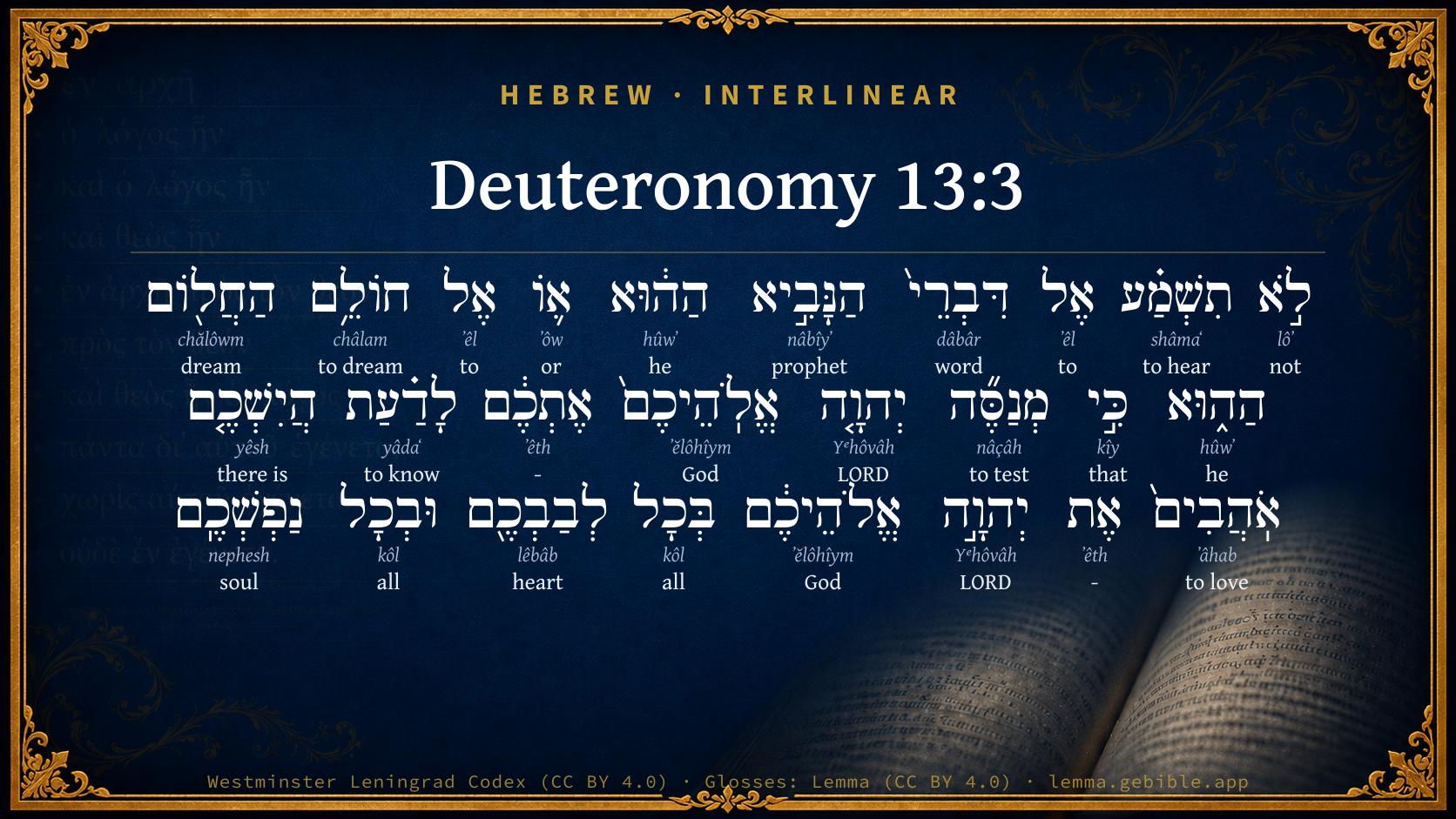
Hebrew (Westminster Leningrad Codex) Deuteronomy 13:3 appears in the Hebrew Old Testament. The text above is from the Westminster Leningrad Codex. Each word links to its Strong’s number, a concise gloss, and parsing drawn from the Open Scriptures Hebrew Bible morphology. Click any word for its full Brown-Driver-Briggs (BDB) entry.
Download image
Cite this verse

Deuteronomy 13:3 (World English Bible). Public Domain. Lemma interlinear Bible study tool, https://lemma.gebible.app/v/deuteronomy/13/3.

Show BibTeX & RIS
BibTeX
RIS
English Translation
you shall not listen to the words of that prophet, or to that dreamer of dreams: for Yahweh your God proves you, to know whether you love Yahweh your God with all your heart and with all your soul.
World English Bible · Public Domain
Download a study sheet

One document with this verse’s original text, its word-by-word gloss line, the meaning frame, cross-references with their text, attributed commentary, and full source and license credits — printable, and it pastes into notes with its structure intact.

This verse Autodidact and up

Study sheet (.html) Plain text (.txt)

A passage Seminary Student

Up to 50 verses in one chapter. A passage sheet keeps up to 6 commentary sources and 12 cross-references per verse, in the order this page ranks them, and says so on the sheet whenever that leaves anything out. Ask for a single verse and you get the Autodidact verse sheet above.

Everything on this page stays free to read, with no account — the sheet is a download of what is already on screen, not access to it.

Want to remove ads? Support Godless Engineer
Compare translations 3

The same verse in 3 English versions, stacked beneath the original-language interlinear above. Click any original word for its lexicon entry.

Each is an independent rendering of the whole verse — the interlinear is not word-aligned to these translations.

Highlighted words mark where these versions differ — a whole-verse word diff, not a word-by-word alignment.

  • World English Bible Public Domain
    you shall not listen to the words of that prophet, or to that dreamer of dreams: for Yahweh your God proves you, to know whether you love Yahweh your God with all your heart and with all your soul.
  • King James Version Public Domain
    Thou shalt not hearken unto the words of that prophet, or that dreamer of dreams: for the LORD your God proveth you, to know whether ye love the LORD your God with all your heart and with all your soul.
  • unfoldingWord Literal Text CC BY-SA 4.0
    do not listen to the words of that prophet or to that dreamer of dreams; for Yahweh your God is testing you to know whether you love Yahweh your God with all your heart and with all your soul.

unfoldingWord Literal Text — © unfoldingWord, licensed CC BY-SA 4.0. Word-aligned USFM3 via Door43 (git.door43.org/unfoldingWord/en_ult).

Versions to compare (up to 4)

3 of 4 selected

Show all 18 translations

Every available English version of this verse, each an independent rendering of the whole verse.

  • World English Bible Public Domain
    you shall not listen to the words of that prophet, or to that dreamer of dreams: for Yahweh your God proves you, to know whether you love Yahweh your God with all your heart and with all your soul.
  • Berean Standard Bible Public Domain
    you must not listen to the words of that prophet or dreamer. For the LORD your God is testing you to find out whether you love Him with all your heart and with all your soul.
  • Majority Standard Bible Public Domain
    you must not listen to the words of that prophet or dreamer. For the LORD your God is testing you to find out whether you love Him with all your heart and with all your soul.
  • King James Version Public Domain
    Thou shalt not hearken unto the words of that prophet, or that dreamer of dreams: for the LORD your God proveth you, to know whether ye love the LORD your God with all your heart and with all your soul.
  • American Standard Version (1901) Public Domain
    thou shalt not hearken unto the words of that prophet, or unto that dreamer of dreams: for Jehovah your God proveth you, to know whether ye love Jehovah your God with all your heart and with all your soul.
  • Revised Version (1885) Public Domain
    thou shalt not hearken unto the words of that prophet, or unto that dreamer of dreams: for the LORD your God proveth you, to know whether ye love the LORD your God with all your heart and with all your soul.
  • Geneva Bible (1599) Public Domain
    Thou shalt not hearken vnto the wordes of the prophet, or vnto that dreamer of dreames: for the Lord your God prooueth you, to knowe whether ye loue the Lord your God with al your heart, and with all your soule.
  • Douay-Rheims (1899) Public Domain
    Thou shalt not hear the words of that prophet or dreamer: for the Lord your God trieth you, that it may appear whether you love him with all your heart, and with all your soul, or not.
  • Young's Literal Translation Public Domain
    thou dost not hearken unto the words of that prophet, or unto that dreamer of the dream, for Jehovah your God is trying you, to know whether ye are loving Jehovah your God with all your heart, and with all your soul;
  • Literal Standard Version CC BY-SA 4.0
    you do not listen to the words of that prophet or to that dreamer of the dream, for your God YHWH is trying you to know whether you are loving your God YHWH with all your heart and with all your soul;
  • Unlocked Literal Bible CC BY-SA 4.0
    do not listen to the words of that prophet, or to that dreamer of dreams; for Yahweh your God is testing you to know whether you love Yahweh your God with all your heart and with all your soul.
  • unfoldingWord Literal Text CC BY-SA 4.0
    do not listen to the words of that prophet or to that dreamer of dreams; for Yahweh your God is testing you to know whether you love Yahweh your God with all your heart and with all your soul.
  • Darby Bible Public Domain
    -- thou shalt not hearken unto the words of that prophet, or that dreamer of dreams; for Jehovah your God proveth you, to know whether ye love Jehovah your God with all your heart and with all your soul.
  • World Messianic Bible Public Domain
    you shall not listen to the words of that prophet, or to that dreamer of dreams; for the LORD your God is testing you, to know whether you love the LORD your God with all your heart and with all your soul.
  • Webster's Bible Public Domain
    Thou shalt not hearken to the words of that prophet, or that dreamer of dreams: for the LORD your God proveth you, to know whether ye love the LORD your God with all your heart and with all your soul.
  • Free Bible Version CC BY-SA 4.0
    then you must not listen to what that prophet or dreamer has to say because the Lord your God is trying to find out whether you really love him with all your mind and with all your being.
  • Bible in Basic English Public Domain
    Then give no attention to the words of that prophet or that dreamer of dreams: for the Lord your God is testing you, to see if all the love of your heart and soul is given to him.
  • JPS Tanakh (1917) Public Domain
    (13-4) thou shalt not hearken unto the words of that prophet, or unto that dreamer of dreams; for the LORD your God putteth you to proof, to know whether ye do love the LORD your God with all your heart and with all your soul.

Literal Standard Version (2020), Covenant Press — licensed CC BY-SA 4.0. Text via the HelloAO Bible API (eBible.org). Unlocked Literal Bible (unfoldingWord) — licensed CC BY-SA 4.0. Text via the HelloAO Bible API (eBible.org). unfoldingWord Literal Text — © unfoldingWord, licensed CC BY-SA 4.0. Word-aligned USFM3 via Door43 (git.door43.org/unfoldingWord/en_ult). Free Bible Version, Dr. Jonathan Gallagher — licensed CC BY-SA 4.0. Text via the HelloAO Bible API (eBible.org).

Word by word

More ways to search: Search by grammar → Find every occurrence → Compare this word →

Practice this passage: Drill this verse → Learn its vocabulary →

חוֹלֵ֥ם
châlam
H2492
“dreaming”
Verb, Qal, Participle Active, Masculine, Singular, Construct
Part of Speech
Verb
Stem
Qal
Form
Participle Active
Gender
Masculine
Number
Singular
State
Construct
Full BDB Definition

Origin: a primitive root

TWOT: 662 , 663

to dream - (Qal) - to dream (ordinary) - to dream (prophetic) - to dream (of false prophets) - (Hiphil) to dream - to be healthy, be strong - (Qal) to be healthy - (Hiphil) to restore to health
  1. לֹ֣א lôʼ H3808 “not” Particle, Negative
  2. תִשְׁמַ֗ע shâmaʻ H8085 “to hear” Verb, Qal, Imperfect, 2nd Person, Masculine, Singular
  3. אֶל ʼêl H413 “to” Preposition
  4. דִּבְרֵי֙ dâbâr H1697 “words of” Noun, Common, Masculine, Plural, Construct
  5. הַנָּבִ֣יא nâbîyʼ H5030 “the · prophet” Particle, Definite Article + Noun, Common, Masculine, Singular, Absolute
  6. הַה֔וּא hûwʼ H1931 “the · he” Particle, Definite Article + Pronoun, Personal, 3rd Person, Masculine, Singular
  7. א֛וֹ ʼôw H176 “or” Conjunction
  8. אֶל ʼêl H413 “to” Preposition
  9. הַחֲל֖וֹם chălôwm H2472 “the · dream” Particle, Definite Article + Noun, Common, Masculine, Singular, Absolute
  10. הַה֑וּא hûwʼ H1931 “the · he” Particle, Definite Article + Pronoun, Personal, 3rd Person, Masculine, Singular
  11. כִּ֣י kîy H3588 “that” Conjunction
  12. מְנַסֶּ֞ה nâçâh H5254 “testing” Verb, Piel, Participle Active, Masculine, Singular, Absolute
  13. יְהוָ֤ה Yᵉhôvâh H3068 “LORD” Noun, Proper
  14. אֱלֹֽהֵיכֶם֙ ʼĕlôhîym H430 “God(s) · your” Noun, Common, Masculine, Plural, Construct + Suffix, Personal, 2nd Person, Masculine, Plural
  15. אֶתְכֶ֔ם ʼêth H853 “- · you” Particle, Direct Object + Suffix, Personal, 2nd Person, Masculine, Plural
  16. לָדַ֗עַת yâdaʻ H3045 “to know” Preposition + Verb, Qal, Infinitive Construct
  17. הֲיִשְׁכֶ֤ם yêsh H3426 “there is · you” Particle, Interrogative + Particle, Demonstrative + Suffix, Personal, 2nd Person, Masculine, Plural
  18. אֹֽהֲבִים֙ ʼâhab H157 “loving” Verb, Qal, Participle Active, Masculine, Plural, Absolute
  19. אֶת ʼêth H853 “-” Particle, Direct Object
  20. יְהוָ֣ה Yᵉhôvâh H3068 “LORD” Noun, Proper
  21. אֱלֹהֵיכֶ֔ם ʼĕlôhîym H430 “God(s) · your” Noun, Common, Masculine, Plural, Construct + Suffix, Personal, 2nd Person, Masculine, Plural
  22. בְּכָל kôl H3605 “in/at · all of” Preposition + Noun, Common, Masculine, Singular, Construct
  23. לְבַבְכֶ֖ם lêbâb H3824 “heart · your” Noun, Common, Masculine, Singular, Construct + Suffix, Personal, 2nd Person, Masculine, Plural
  24. וּבְכָל kôl H3605 “and · in/at · all of” Conjunction + Preposition + Noun, Common, Masculine, Singular, Construct
  25. נַפְשְׁכֶֽם nephesh H5315 “soul · your” Noun, Common, Both, Singular, Construct + Suffix, Personal, 2nd Person, Masculine, Plural

About this verse

These counts appear in no published source. They are computed here, from the morphology-tagged text and Lemma’s own curated glosses. What Lemma adds →

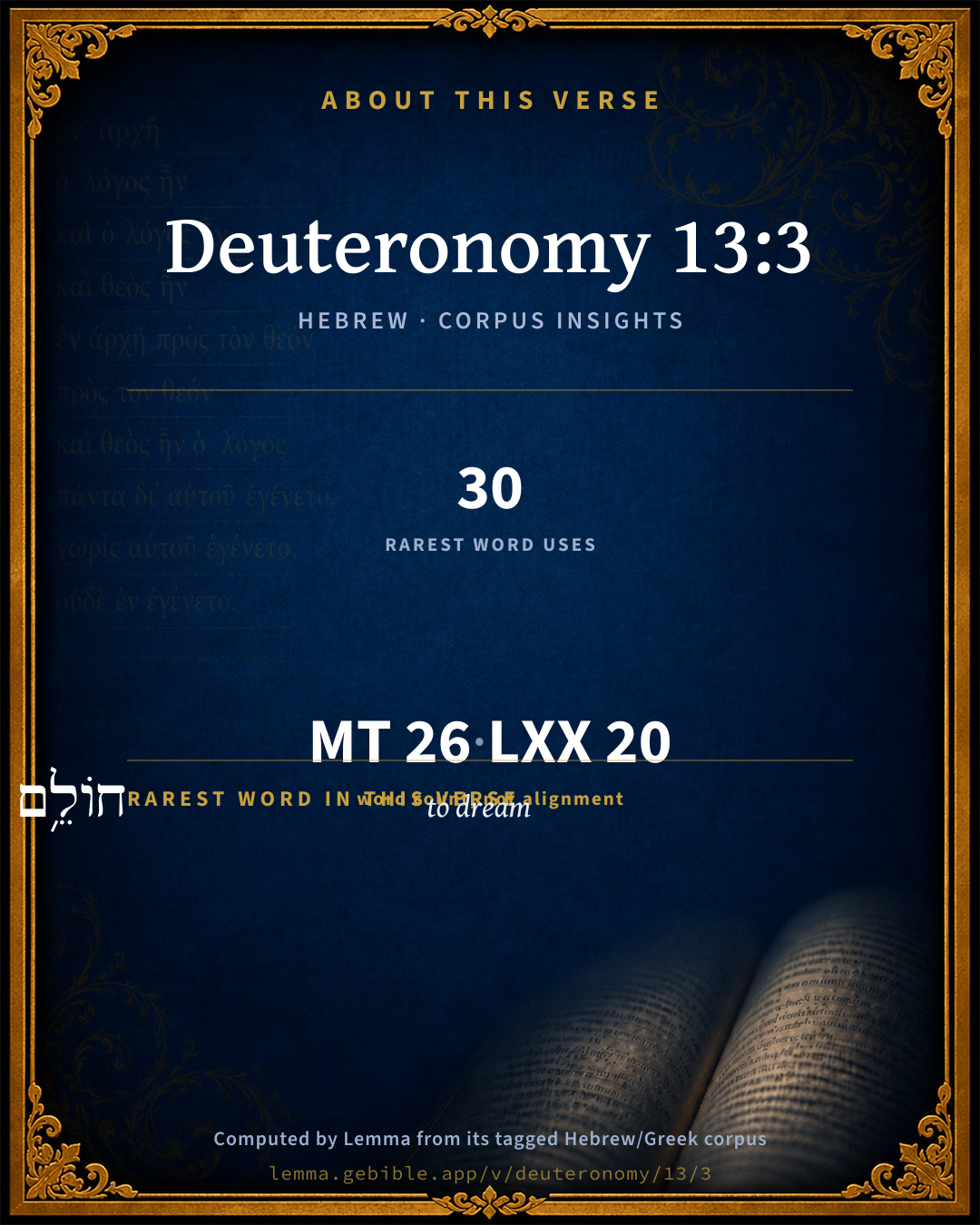
26
words
20
distinct lemmas
Pentateuch
section

Shared distinctive vocabulary

חוֹלֵ֥ם to dream H2492 occurs in 25 verses of the Hebrew Bible. Also found in:

Grammatical profile

  • 5 verbs
  • 11 nouns
  • 2 pronouns
  • 2 prepositions
  • 2 conjunctions
  • 4 particles

Verb forms

  • תִשְׁמַ֗ע Qal · Imperfect
  • חוֹלֵ֥ם Qal · Participle Active
  • מְנַסֶּ֞ה Piel · Participle Active
  • לָדַ֗עַת Qal · Infinitive Construct
  • אֹֽהֲבִים֙ Qal · Participle Active

Repetition

Words recur within this verse — often emphatic in Hebrew:

  • יְהוָ֤ה LORD H3068 ×2
  • אֱלֹֽהֵיכֶם֙ God H430 ×2
  • בְּכָל all H3605 ×2
  • אֶל to H413 ×2
  • הַה֔וּא he H1931 ×2

Hebrew & Septuagint length

In English translation the verse runs 39 words from the Hebrew and 39 from the Septuagint (LXX English) — the same length.

A rough comparison of the two English renderings, which tokenize alike — not a word-level alignment.

Word counts can differ between the Hebrew and the Greek without any difference in meaning — e.g. the Hebrew direct-object marker אֵת has no separate Greek word, and Greek often adds the article ὁ.

In the original languages it is 26 Hebrew tokens and 20 Greek tokens — but the two are counted differently (Hebrew bundles its prefixes and suffixes into one token; the Greek is in lemma form), so that isn’t a like-for-like length.

Cross-references

16

Topical passages linked to Deuteronomy 13:3 in the Treasury of Scripture Knowledge — connected by theme and wording, ordered by reader-vote popularity; previews shown in the World English Bible.

  • Deuteronomy 8:2 You shall remember all the way which Yahweh your God has led you these forty years in the wilderness, that he might humble you, to prove you, to know what was in your heart, whether you would keep his commandments, or not.
  • Psalms 66:10 For you, God, have tested us. You have refined us, as silver is refined.
  • 1 Corinthians 11:19 For there also must be factions among you, that those who are approved may be revealed among you.
  • Deuteronomy 6:5 and you shall love Yahweh your God with all your heart, and with all your soul, and with all your might.
  • 1 John 4:1 Beloved, don't believe every spirit, but test the spirits, whether they are of God, because many false prophets have gone out into the world.
  • Isaiah 8:20 To the law and to the testimony! if they don't speak according to this word, surely there is no morning for them.
  • Matthew 24:24 For there will arise false christs, and false prophets, and they will show great signs and wonders, so as to lead astray, if possible, even the chosen ones.
  • 2 Thessalonians 2:11 Because of this, God sends them a working of error, that they should believe a lie;
  • Revelation 13:14 He deceives my own people who dwell on the earth because of the signs he was granted to do in front of the beast; saying to those who dwell on the earth, that they should make an image to the beast who had the sword wound and lived.
  • Deuteronomy 8:16 who fed you in the wilderness with manna, which your fathers didn't know; that he might humble you, and that he might prove you, to do you good at your latter end:
  • Psalms 81:7 You called in trouble, and I delivered you. I answered you in the secret place of thunder. I tested you at the waters of Meribah." Selah.
  • Acts 17:11 Now these were more noble than those in Thessalonica, in that they received the word with all readiness of the mind, examining the Scriptures daily to see whether these things were so.
  • 2 Corinthians 8:8 I speak not by way of commandment, but as proving through the earnestness of others the sincerity also of your love.
  • Ephesians 4:14 that we may no longer be children, tossed back and forth and carried about with every wind of doctrine, by the trickery of men, in craftiness, after the wiles of error;
  • 1 John 2:19 They went out from us, but they didn't belong to us; for if they had belonged to us, they would have continued with us. But they left, that they might be revealed that none of them belong to us.
  • 1 John 4:4 You are of God, little children, and have overcome them; because greater is he who is in you than he who is in the world.

Cross-references courtesy of OpenBible.info (CC BY 4.0).

Hebrew and Greek witnesses Masoretic Hebrew ↔ Greek Septuagint

The same verse in the two great witnesses to the Old Testament, shown verse-for-verse.

These are two independent witnesses, not word-aligned to each other, and the Septuagint is shown in lemma (dictionary) form.

Hebrew Deuteronomy 13:3 Masoretic · Westminster Leningrad Codex

לֹ֣א תִשְׁמַ֗ע אֶל דִּבְרֵי֙ הַנָּבִ֣יא הַה֔וּא א֛וֹ אֶל חוֹלֵ֥ם הַחֲל֖וֹם הַה֑וּא כִּ֣י מְנַסֶּ֞ה יְהוָ֤ה אֱלֹֽהֵיכֶם֙ אֶתְכֶ֔ם לָדַ֗עַת הֲיִשְׁכֶ֤ם אֹֽהֲבִים֙ אֶת יְהוָ֣ה אֱלֹהֵיכֶ֔ם בְּכָל לְבַבְכֶ֖ם וּבְכָל נַפְשְׁכֶֽם

you shall not listen to the words of that prophet, or to that dreamer of dreams: for Yahweh your God proves you, to know whether you love Yahweh your God with all your heart and with all your soul.

World English Bible · Public Domain

Greek LXX Deuteronomy 13:3 Septuagint · lemma form

καί ἔρχομαι ὁ σημεῖον ἤ ὁ τέρας ὅς λαλέω πρός σύ λέγω πορεύομαι καί λατρεύω θεός ἕτερος ὅς οὐ οἶδα

you⌃ shall not listen to the words of that prophet, or the dreamer of that dream, because the Lord your God tries you, to know whether you⌃ love your God with all your heart and with all your soul.

LXX2012 (modern English Septuagint) · Public Domain

Hebrew: Westminster Leningrad Codex (CC BY 4.0). Greek: Septuagint (public domain); English from LXX2012 (modern English Septuagint) (Public Domain). How the Septuagint differs from the Hebrew →

Targum (Aramaic paraphrase)

2

The Targum is the ancient Jewish Aramaic paraphrase of the Hebrew Scriptures — an interpretive translation, not the Hebrew text itself. Onkelos (literal) and Pseudo-Jonathan (expansive) render the Torah, and Jonathan the Prophets. Coverage is partial: where no permissively-licensed English translation exists for a verse, only the Aramaic is shown. This is verse-level text, not a word-by-word alignment to the Hebrew.

  1. Targum Onkelos Torah (Genesis–Deuteronomy)
    וְיֵיתֵי אָתָא וּמוֹפְתָא דִי מַלִיל עִמָךְ לְמֵימָר נְהַךְ בָּתַר טַעֲוַת עַמְמַיָא דִי לָא יְדַעְתָּנוּן וְנִפְלְחִנוּן

    (no public-domain English translation for this verse)

    Targum Onkelos — Aramaic: “Onkelos Genesis” (public domain); “Onkelos Exodus” (public domain); “Onkelos Leviticus” (public domain); “Onkelos Numbers” (public domain); “Onkelos Deuteronomy” (public domain). English: “Sefaria Community Translation” (CC0 1.0 (public-domain dedication)); “J.W. Etheridge. The Targums of Onkelos and Jonathan Ben Uzziel on the Pentateuch. London: Longmans, Green, 1862” (public domain). Text via Sefaria.

  2. Targum Pseudo-Jonathan Torah (Genesis–Deuteronomy)
    וְיֵיתִי אָתָא אוֹ תִמְהָא דְמַלֵּיל עִמְכוֹן לְמֵימָר נְהַךְ בָּתַר טַעֲוַות עַמְמַיָא דְלָא חַכִּימְתְּנוּן וְנִפְלוֹחַ קֳדָמֵיכוֹן

    and the sign or the miracle come to pass, (yet) because he spake with you, saying, Let us go after the gods of the peoples whom thou hast not known, and worship them,

    Targum Pseudo-Jonathan — Aramaic: “Targum Jonathan on Genesis” (public domain); “Targum Jonathan on Exodus” (public domain); “Targum Jonathan on Leviticus” (public domain); “Targum Jonathan on Numbers” (public domain); “Targum Jonathan on Deuteronomy” (public domain). English: “The Targum of Jonathan ben Uzziel, trans. J. W. Etheridge, London, 1862” (public domain). Text via Sefaria.

Commentary

Notes on Deuteronomy 13:3 from classic Christian and Jewish commentators (each source and its license shown beneath its notes). The classic Christian expositions comment on the surrounding passage and are grouped to its opening verse, so a note may address several verses; the Jewish commentaries on the Tanakh (Rashi and others) are per-verse, so they appear only where the commentator wrote on this verse.

Lemma curates 59 commentaries, every one of them public domain or Creative Commons licensed, each selected and text-cleaned for this edition rather than reprinted as found. About our sources →

Trapp's Complete Commentary

John Trapp

Deu 13:3 Thou shalt not hearken unto the words of that prophet, or that dreamer of dreams: for the LORD your God proveth you, to know whether ye love the LORD your God with all your heart and with all your soul.

Ver. 3. Thou shalt not hearken.] Heretics have their pythanology, their good words and fair speeches, wherein they can vent a spittle of diseased opinions, and whereby they deceive the hearts of the simple. {Rom 16:18} It is not safe, therefore, to hear them, or hold discourse with such, lest they insinuate and infect us, as the Montanists did Tertullian; as the Valentinians did various well-affected Christians; as Acacius the heretic did Anastasius, second Bishop of Rome, A.D., 497, who sought to rectify him. It is reported of Placilla the good Empress, that when Theodosius, senior, desired to confer with Eunomius, she dissuaded her husband very earnestly, lest being perverted by his speeches he might fall into heresy {a} "Keep thee far from an evil matter," saith Solomon. "Mark those that make divisions, and avoid them," saith Paul. {Rom 16:17} And again, "There are many unruly and vain talkers and deceivers, … , whose mouths must be stopped," &c. {Tit 1:11}

{a} Sozomen, lib. vii. cap. 7.

John Trapp, A Commentary or Exposition upon All the Books of the Old and New Testament (1647–1656) — public domain. Text from a community e-Sword module.

Geneva Bible (1599)

Geneva Bible translators

God ordaineth all these things that his may be known.

Geneva Bible (1599) marginal notes — public domain. Text via Bolls.life.

Adam Clarke's Commentary

Verse 3. The Lord your God proveth you] God permits such impostors to arise to try the faith of his followers, and to put their religious experience to the test; for he who experimentally knows God cannot be drawn away after idols. He who has no experimental knowledge of God, may believe any thing. Experience of the truths contained in the word of God can alone preserve any man from Deism, or a false religion. They who have not this are a prey to the pretended prophet, and to the dreamer of dreams.

Adam Clarke's Commentary on the Bible (1810–1826) — public domain. Text from a community e-Sword/MySword module.

John Gill's Exposition

Thou shall not hearken to the words of that prophet, or that dreamer of dreams,.... Even though he does give the sign, and work the wonder; for it might be reasonably concluded there must be fallacy in him, and that neither he nor his miraculous sign could come from God, who would never send a person to enable him to do signs and wonders, to persuade men to believe and act contrary to a former declaration of his mind and will; to break a plain law of his, as in Deu 5:7, this would be to contradict and deny himself; whatever therefore is contrary to a known law or established doctrine, either of law or Gospel, let it come from whom it will, or pretend to be confirmed by miracles, is not to be received; see Gal 1:8,

for the Lord your God proveth you, whether you love the Lord your God with all your heart, and with all your soul; for should they be prevailed upon by such a prophet to hearken to his doctrine, and embrace it, and act according to it, it would be a plain case that they did not cordially love the Lord, since they could so easily, and by such pretences, be drawn aside from the true worship of him, and serve other gods; on the other hand, it would be a proof of their sincere affection for God, and of their close and strict attachment to him, that notwithstanding such specious pretences made, and such miracles wrought, yet abode by him and his worship, and could not be wrought upon to forsake him and follow other gods and serve them; see Co1 11:19.

John Gill's Exposition of the Whole Bible (1746–1763) — public domain (CC PDM 1.0). Text via the HelloAO Bible API.

Haydock's Catholic Bible Commentary

Trieth you, not in order to induce you to embrace evil, (James i. 13,) nor to discover your real dispositions, but to lay open your hearts to yourselves and to the world, (Haydock) that, if you continue steadfast, others may be encouraged to imitate you; but if you fall, they may take warning, and stand with all humility and circumspection. (Calmet) --- Appear. Hebrew, "to know, or to disclose." (Menochius)

George Leo Haydock (1774–1849), Haydock's Catholic Family Bible and Commentary, 1859 edition — public domain. Excludes Psalms (Douay-Rheims chapter numbering differs from Protestant) and Deuterocanonical books (Catholic canon only).

Matthew Poole's English Annotations

Thou shalt not hearken unto the words of that prophet; not receive his doctrine, though the sign come to pass. For although when such a sign or wonder foretold did not follow or come to pass, it was a sign of a false prophet, as is said, Deu 18:22, yet when it did come to pass, it was no sufficient or infallible sign of a true one, especially in such a case when he brings in new gods. The reason of the difference is, because many causes must concur to make a thing good and true, but any one failure is sufficient to make a thing bad or false. And particularly there are many signs, yea, such as men may think to be wonders, which may be wrought by evil spirits, God so permitting it for divers wise and just reasons, not only for the trial of the good, as it here follows, but also for the punishment of ungodly men, who would not receive Divine truths, though attested by many evident and unquestionable miracles, and therefore are most justly exposed to these temptations to believe lies.

Proveth you, i.e. trieth your faith, and love, and obedience, examineth your sincerity by your constancy. See Mat 24:24; 2Th 2:11; Rev 13:14. See Poole on "Gen 21:1"; See Poole on "Deu 8:2,7".

To know; that he may know it, to wit, judicially, or in a public manner, so as both you and others may know and see it, that so the justice of his judgments upon you may be more evident and glorious.

Matthew Poole's English Annotations on the Holy Bible (1683–1685) — public domain. Text from a community e-Sword/MySword module.

Whedon's Commentary on the Bible

Daniel D. Whedon

3. The Lord your God proveth you — These false prophets with their lying wonders would test the sincerity of the obedience of the people. Comp. Deu_8:2.

Daniel D. Whedon (gen. ed.), Commentary on the Old and New Testaments (1874–1909) — public domain. Text from a community e-Sword module.

John Wesley's Explanatory Notes

Thou shalt not hearken to that prophet - Not receive his doctrine, though the sign come to pass. For although when such a sign or wonder foretold did not follow or come to pass, it was a sign of a false prophet, yet when it did come to pass, it was no sufficient sign of a true one, especially, in such a case. There are many things, which may be wrought by evil spirits, God so permitting it for wise and just reasons, not only for the trial of the good, but also for the punishment of ungodly men. Proveth you - That is, trieth your faith and love and obedience. To know - Namely, judicially, or in a publick manner, so as both you and others may know and see it, that so the justice of his judgments upon you may be more evident and glorious.

John Wesley, Explanatory Notes Upon the Whole Bible (1754–1765) — public domain. Text via the GEBible commentary corpus.

Lesson kit

Teaching starters — assembled from the data on this page, not authored interpretation. Every prompt links to the verse data it draws on. Edit before teaching.

Deuteronomy, in the Pentateuch, opens this verse with 26 words (20 distinct Hebrew lemmas). Its most distinctive word is châlam (“to dream”). A historical commentator’s framing appears above. Read the whole chapter for the surrounding context.

Discussion questions

  1. How does “to dream” (châlam) shape what this verse is saying?
  2. Genesis 28:12 shares the word «to dream» with this verse. How do the two illuminate each other?
  3. “LORD” occurs 2× in this one verse. What is the effect of the repetition?
  4. These translations render this verse differently; the difference is in the English rendering, not the original. What questions does that raise?
  5. The verb «תִשְׁמַ֗ע» is Qal Imperfect. How does its form color the action?
  6. Reading how Trapp's Complete Commentary and Geneva Bible (1599) read this verse, where do the two commentators agree and where do they part?

Things to notice

Reading settings

Reading text

Shown beneath each verse's original-language words.

Old Testament
Old Testament edition

Read the OT as the Masoretic Hebrew (MT) or the Greek Septuagint (LXX).

English shown for the Greek Septuagint (in the Hebrew ↔ Greek comparison).

Comparing translations? Open the Compare panel on any verse page to stack up to four side by side.