Genesis 2:22

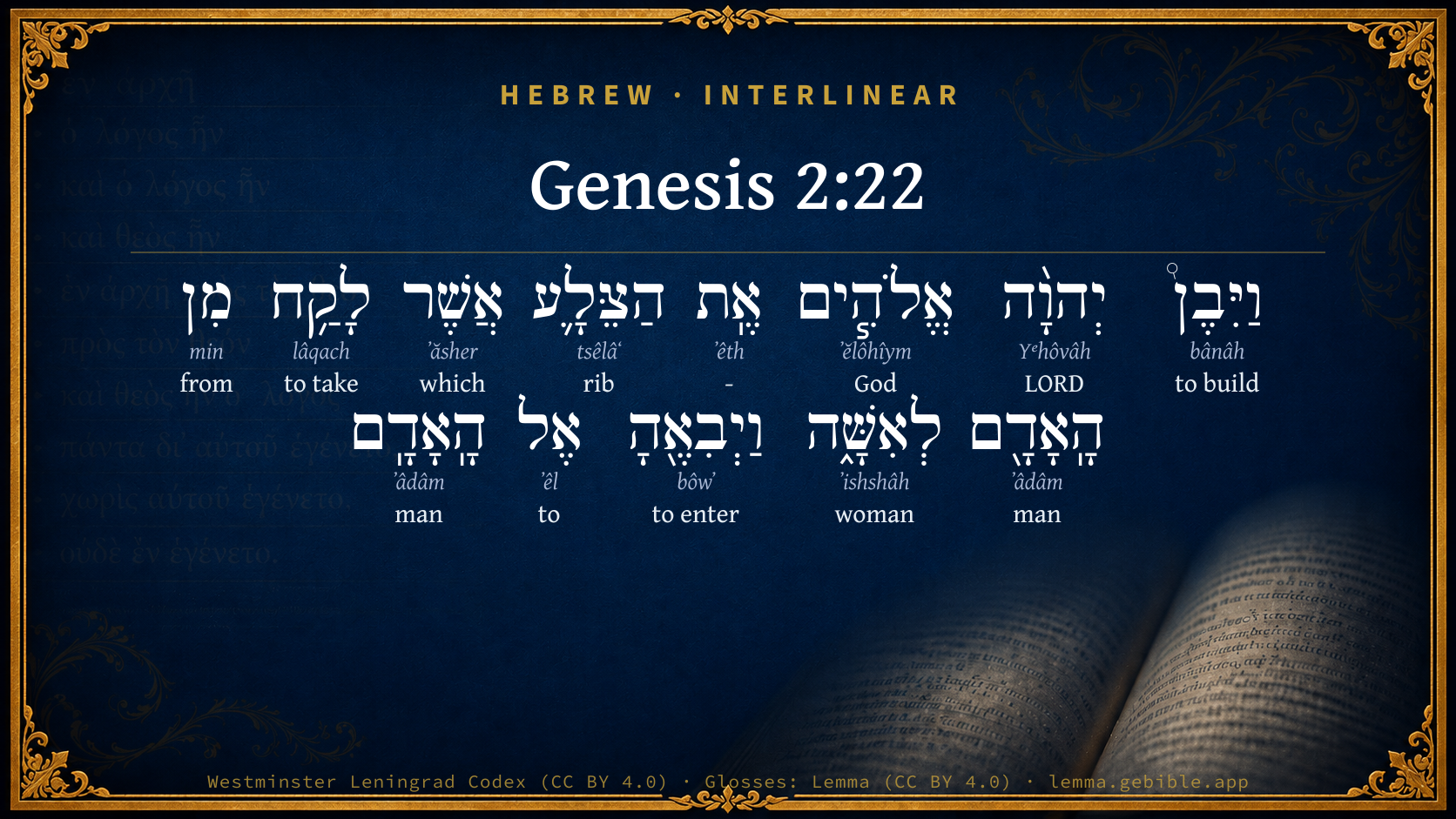
Hebrew (Westminster Leningrad Codex) Genesis 2:22 appears in the Hebrew Old Testament. The text above is from the Westminster Leningrad Codex. Each word links to its Strong’s number, a concise gloss, and parsing drawn from the Open Scriptures Hebrew Bible morphology. Click any word for its full Brown-Driver-Briggs (BDB) entry.
Download image
Cite this verse

Genesis 2:22 (World English Bible). Public Domain. Lemma interlinear Bible study tool, https://lemma.gebible.app/v/genesis/2/22.

Show BibTeX & RIS
BibTeX
RIS
English Translation
He made the rib, which Yahweh God had taken from the man, into a woman, and brought her to the man.
World English Bible · Public Domain
Highlights
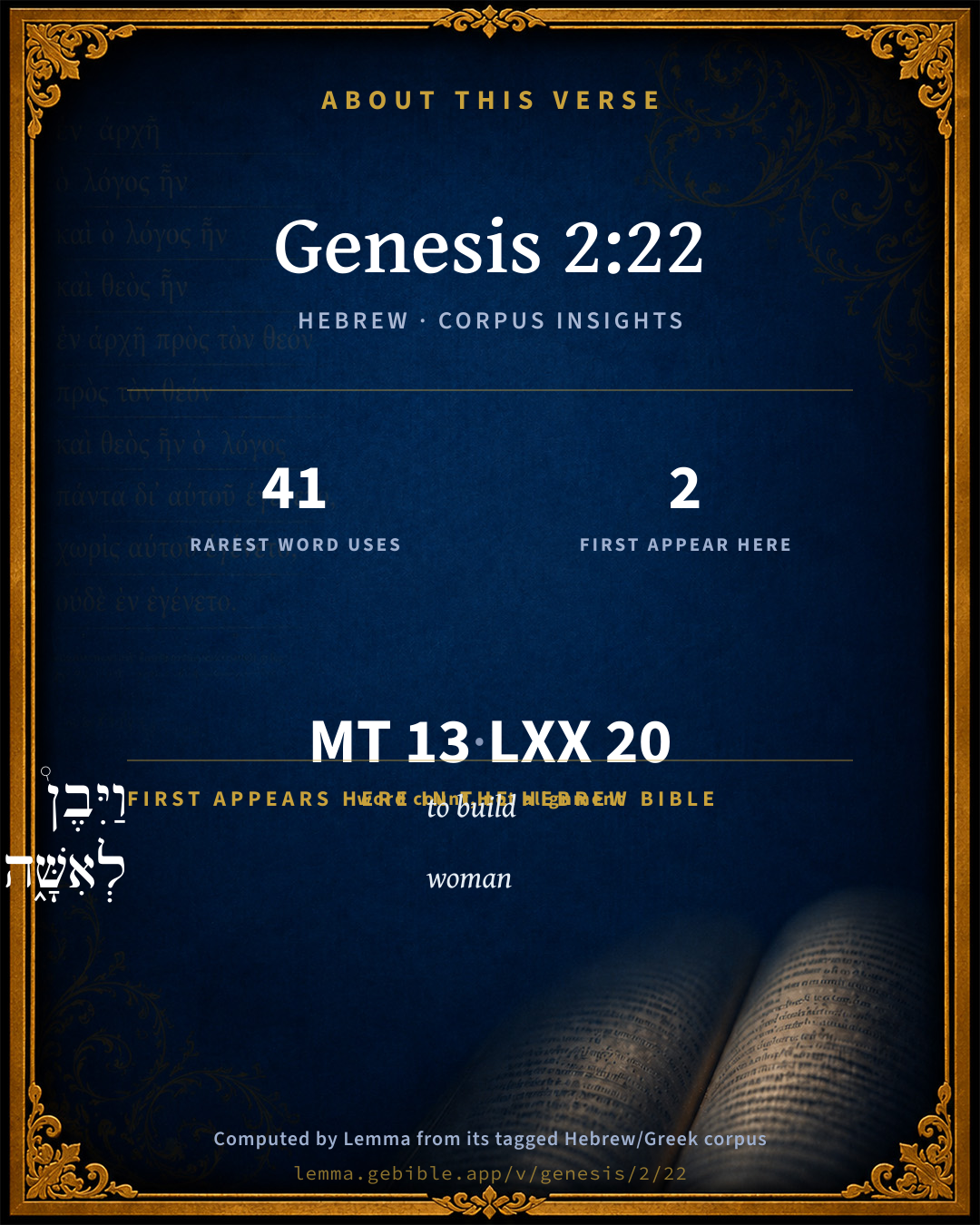
  • 2 first appearances in the Hebrew Bible
Full analysis ↓
Download a study sheet

One document with this verse’s original text, its word-by-word gloss line, the meaning frame, cross-references with their text, attributed commentary, and full source and license credits — printable, and it pastes into notes with its structure intact.

This verse Autodidact and up

Study sheet (.html) Plain text (.txt)

A passage Seminary Student

Up to 50 verses in one chapter. A passage sheet keeps up to 6 commentary sources and 12 cross-references per verse, in the order this page ranks them, and says so on the sheet whenever that leaves anything out. Ask for a single verse and you get the Autodidact verse sheet above.

Everything on this page stays free to read, with no account — the sheet is a download of what is already on screen, not access to it.

Want to remove ads? Support Godless Engineer
Compare translations 3

The same verse in 3 English versions, stacked beneath the original-language interlinear above. Click any original word for its lexicon entry.

Each is an independent rendering of the whole verse — the interlinear is not word-aligned to these translations.

Highlighted words mark where these versions differ — a whole-verse word diff, not a word-by-word alignment.

  • World English Bible Public Domain
    He made the rib, which Yahweh God had taken from the man, into a woman, and brought her to the man.
  • King James Version Public Domain
    And the rib, which the LORD God had taken from man, made he a woman, and brought her unto the man.
  • unfoldingWord Literal Text CC BY-SA 4.0
    Then Yahweh God built the rib which he had taken from the man into a woman, and he brought her to the man.

unfoldingWord Literal Text — © unfoldingWord, licensed CC BY-SA 4.0. Word-aligned USFM3 via Door43 (git.door43.org/unfoldingWord/en_ult).

Versions to compare (up to 4)

3 of 4 selected

Show all 18 translations

Every available English version of this verse, each an independent rendering of the whole verse.

  • World English Bible Public Domain
    He made the rib, which Yahweh God had taken from the man, into a woman, and brought her to the man.
  • Berean Standard Bible Public Domain
    And from the rib that the LORD God had taken from the man, He made a woman and brought her to him.
  • Majority Standard Bible Public Domain
    And from the rib that the LORD God had taken from the man, He made a woman and brought her to him.
  • King James Version Public Domain
    And the rib, which the LORD God had taken from man, made he a woman, and brought her unto the man.
  • American Standard Version (1901) Public Domain
    and the rib, which Jehovah God had taken from the man, made he a woman, and brought her unto the man.
  • Revised Version (1885) Public Domain
    and the rib, which the LORD God had taken from the man, made he a woman, and brought her unto the man.
  • Geneva Bible (1599) Public Domain
    And the ribbe which the Lord God had taken from the man, made he a woman, and brought her to the man.
  • Douay-Rheims (1899) Public Domain
    And the Lord God built the rib which he took from Adam into a woman: and brought her to Adam.
  • Young's Literal Translation Public Domain
    And Jehovah God buildeth up the rib which He hath taken out of the man into a woman, and bringeth her in unto the man;
  • Literal Standard Version CC BY-SA 4.0
    And YHWH God builds up the rib which He has taken out of the man into a woman, and brings her to the man;
  • Unlocked Literal Bible CC BY-SA 4.0
    With the rib that Yahweh God had taken from the man, he made a woman and brought her to the man.
  • unfoldingWord Literal Text CC BY-SA 4.0
    Then Yahweh God built the rib which he had taken from the man into a woman, and he brought her to the man.
  • Darby Bible Public Domain
    And Jehovah Elohim built the rib that he had taken from Man into a woman; and brought her to Man.
  • World Messianic Bible Public Domain
    The LORD God made a woman from the rib which he had taken from the man, and brought her to the man.
  • Webster's Bible Public Domain
    And the rib, which the LORD God had taken from man, he made woman, and brought her to the man.
  • Free Bible Version CC BY-SA 4.0
    The Lord God made a woman, using the rib he'd taken from Adam, and presented her to Adam.
  • Bible in Basic English Public Domain
    And the bone which the Lord God had taken from the man he made into a woman, and took her to the man.
  • JPS Tanakh (1917) Public Domain
    And the rib, which the LORD God had taken from the man, made He a woman, and brought her unto the man.

Literal Standard Version (2020), Covenant Press — licensed CC BY-SA 4.0. Text via the HelloAO Bible API (eBible.org). Unlocked Literal Bible (unfoldingWord) — licensed CC BY-SA 4.0. Text via the HelloAO Bible API (eBible.org). unfoldingWord Literal Text — © unfoldingWord, licensed CC BY-SA 4.0. Word-aligned USFM3 via Door43 (git.door43.org/unfoldingWord/en_ult). Free Bible Version, Dr. Jonathan Gallagher — licensed CC BY-SA 4.0. Text via the HelloAO Bible API (eBible.org).

Word by word

More ways to search: Search by grammar → Find every occurrence → Compare this word →

Practice this passage: Drill this verse → Learn its vocabulary →

הַצֵּלָ֛ע
tsêlâʻ
H6763
“the · rib”
Particle, Definite Article + Noun, Common, Both, Singular, Absolute
Part of Speech
Particle + Noun
Type
Common
Gender
Both
Number
Singular
State
Absolute
Full BDB Definition

Origin: from H6760

TWOT: 1924a

side, rib, beam - rib (of man) - rib (of hill, ridge, etc) - side-chambers or cells (of temple structure) - rib, plank, board (of cedar or fir) - leaves (of door) - side (of ark)
  1. וַיִּבֶן֩ bânâh H1129 “and · to build” Conjunction + Verb, Qal, Sequential Imperfect, 3rd Person, Masculine, Singular
  2. יְהוָ֨ה Yᵉhôvâh H3068 “LORD” Noun, Proper
  3. אֱלֹהִ֧ים ʼĕlôhîym H430 “God(s)” Noun, Common, Masculine, Plural, Absolute
  4. אֶֽת ʼêth H853 “-” Particle, Direct Object
  5. אֲשֶׁר ʼăsher H834 “which” Particle, Relative
  6. לָקַ֥ח lâqach H3947 “to take” Verb, Qal, Perfect, 3rd Person, Masculine, Singular
  7. מִן min H4480 “from” Preposition
  8. הָֽאָדָ֖ם ʼâdâm H120 “the · man” Particle, Definite Article + Noun, Common, Masculine, Singular, Absolute
  9. לְאִשָּׁ֑ה ʼishshâh H802 “to/for · woman” Preposition + Noun, Common, Feminine, Singular, Absolute
  10. וַיְבִאֶ֖הָ bôwʼ H935 “and · to enter · her” Conjunction + Verb, Hiphil, Sequential Imperfect, 3rd Person, Masculine, Singular + Suffix, Personal, 3rd Person, Feminine, Singular
  11. אֶל ʼêl H413 “to” Preposition
  12. הָֽאָדָֽם ʼâdâm H120 “the · man” Particle, Definite Article + Noun, Common, Masculine, Singular, Absolute

About this verse

These counts appear in no published source. They are computed here, from the morphology-tagged text and Lemma’s own curated glosses. What Lemma adds →

13
words
12
distinct lemmas
Pentateuch
section

First appearance in Scripture

These words make their first canonical appearance in the Hebrew Bible here:

  • וַיִּבֶן֩ to build H1129
  • לְאִשָּׁ֑ה woman H802

Shared distinctive vocabulary

הַצֵּלָ֛ע rib H6763 occurs in 32 verses of the Hebrew Bible. Also found in:

Grammatical profile

  • 3 verbs
  • 6 nouns
  • 2 prepositions
  • 2 particles

Verb forms

  • וַיִּבֶן֩ Qal · Sequential Imperfect
  • לָקַ֥ח Qal · Perfect
  • וַיְבִאֶ֖הָ Hiphil · Sequential Imperfect

Repetition

A word recurs within this verse — often emphatic in Hebrew:

  • הָֽאָדָ֖ם man H120 ×2

Hebrew & Septuagint length

In English translation the verse runs 21 words from the Hebrew and 18 from the Septuagint (LXX English) — closely comparable.

A rough comparison of the two English renderings, which tokenize alike — not a word-level alignment.

Word counts can differ between the Hebrew and the Greek without any difference in meaning — e.g. the Hebrew direct-object marker אֵת has no separate Greek word, and Greek often adds the article ὁ.

In the original languages it is 13 Hebrew tokens and 20 Greek tokens — but the two are counted differently (Hebrew bundles its prefixes and suffixes into one token; the Greek is in lemma form), so that isn’t a like-for-like length.

Cross-references

7

Topical passages linked to Genesis 2:22 in the Treasury of Scripture Knowledge — connected by theme and wording, ordered by reader-vote popularity; previews shown in the World English Bible.

  • 1 Corinthians 11:8–9 For man is not from woman, but woman from man;
  • 1 Timothy 2:13 For Adam was first formed, then Eve.
  • Hebrews 13:4 Let marriage be held in honor among all, and let the bed be undefiled: but God will judge the sexually immoral and adulterers.
  • Proverbs 18:22 Whoever finds a wife finds a good thing, And obtains favor of Yahweh.
  • Proverbs 19:14 House and riches are an inheritance from fathers, But a prudent wife is from Yahweh.
  • Genesis 2:19 Out of the ground Yahweh God formed every animal of the field, and every bird of the sky, and brought them to the man to see what he would call them. Whatever the man called every living creature, that was its name.
  • Psalms 127:1 Unless Yahweh builds the house, They labor in vain who build it. Unless Yahweh watches over the city, The watchman guards it in vain.

Cross-references courtesy of OpenBible.info (CC BY 4.0).

Hebrew and Greek witnesses Masoretic Hebrew ↔ Greek Septuagint

The same verse in the two great witnesses to the Old Testament, shown verse-for-verse.

These are two independent witnesses, not word-aligned to each other, and the Septuagint is shown in lemma (dictionary) form.

Hebrew Genesis 2:22 Masoretic · Westminster Leningrad Codex

וַיִּבֶן֩ יְהוָ֨ה אֱלֹהִ֧ים אֶֽת הַצֵּלָ֛ע אֲשֶׁר לָקַ֥ח מִן הָֽאָדָ֖ם לְאִשָּׁ֑ה וַיְבִאֶ֖הָ אֶל הָֽאָדָֽם

He made the rib, which Yahweh God had taken from the man, into a woman, and brought her to the man.

World English Bible · Public Domain

Greek LXX Genesis 2:22 Septuagint · lemma form

καί οἰκοδομέω κύριος ὁ θεός ὁ πλευρά ὅς λαμβάνω ἀπό ὁ αδαμ εἰς γυνή καί ἄγω αὐτός πρός ὁ αδαμ

And God formed the rib which he took from Adam into a woman, and brought her to Adam.

LXX2012 (modern English Septuagint) · Public Domain

On this verse, The Cambridge Bible for Schools and Colleges discusses the Septuagint’s reading. Read the note in Commentary ↓

Hebrew: Westminster Leningrad Codex (CC BY 4.0). Greek: Septuagint (public domain); English from LXX2012 (modern English Septuagint) (Public Domain). How the Septuagint differs from the Hebrew →

Targum (Aramaic paraphrase)

2

The Targum is the ancient Jewish Aramaic paraphrase of the Hebrew Scriptures — an interpretive translation, not the Hebrew text itself. Onkelos (literal) and Pseudo-Jonathan (expansive) render the Torah, and Jonathan the Prophets. Coverage is partial: where no permissively-licensed English translation exists for a verse, only the Aramaic is shown. This is verse-level text, not a word-by-word alignment to the Hebrew.

  1. Targum Onkelos Torah (Genesis–Deuteronomy)
    וּבְנָא יְיָ אֱלֹהִים יָת עִלְעָא דִּנְסִיב מִן אָדָם לְאִתְּתָא וְאַיְתַהּ לְוַת אָדָם

    (no public-domain English translation for this verse)

    Targum Onkelos — Aramaic: “Onkelos Genesis” (public domain); “Onkelos Exodus” (public domain); “Onkelos Leviticus” (public domain); “Onkelos Numbers” (public domain); “Onkelos Deuteronomy” (public domain). English: “Sefaria Community Translation” (CC0 1.0 (public-domain dedication)); “J.W. Etheridge. The Targums of Onkelos and Jonathan Ben Uzziel on the Pentateuch. London: Longmans, Green, 1862” (public domain). Text via Sefaria.

  2. Targum Pseudo-Jonathan Torah (Genesis–Deuteronomy)
    וּבְנָא יְיָ אֱלֹהִים יַת עִלָאָה דְנָסַב מִן אָדָם לְאִיתְּתָא וְאַתְיָהּ לְוַת אָדָם

    And the Lord God builded the rib which he had taken from Adam into a woman; and He brought her to Adam.

    Targum Pseudo-Jonathan — Aramaic: “Targum Jonathan on Genesis” (public domain); “Targum Jonathan on Exodus” (public domain); “Targum Jonathan on Leviticus” (public domain); “Targum Jonathan on Numbers” (public domain); “Targum Jonathan on Deuteronomy” (public domain). English: “The Targum of Jonathan ben Uzziel, trans. J. W. Etheridge, London, 1862” (public domain). Text via Sefaria.

Commentary

Notes on Genesis 2:22 from classic Christian and Jewish commentators (each source and its license shown beneath its notes). The classic Christian expositions comment on the surrounding passage and are grouped to its opening verse, so a note may address several verses; the Jewish commentaries on the Tanakh (Rashi and others) are per-verse, so they appear only where the commentator wrote on this verse.

Lemma curates 59 commentaries, every one of them public domain or Creative Commons licensed, each selected and text-cleaned for this edition rather than reprinted as found. About our sources →

Trapp's Complete Commentary

John Trapp

Gen 2:22 And the rib, which the LORD God had taken from man, made he a woman, and brought her unto the man.

Ver. 22. And the rib which the Lord God had taken.] Matter, in the beginning of time, was taken from man to make a woman. And matter, in the fulness of time, was taken from a woman to make a man, even "the man Christ Jesus". {1Ti 2:5} And as out of the side of sleeping Adam Eve was formed; so, from the blood issuing out of the side and flesh of dying Christ, came his spouse the Church. His chief care therein was to "sanctify and cleanse" {Eph 5:26} his Church, and therefore he "came by water and blood". {1Jn 5:6} So should it be every husband’s; then would not the devil so oft break his head with his own rib; or, as St Gregory hath it, climb so oft by his rib to his heart, as by a ladder. {a} A good wife doth him good, and not evil, all her days. But this is not every man’s happiness. Lucky Sulla, if he should not have had a wife. {Sulla faellx, si non habuisset uxorem!} So Job and Moses, for whom marriage caused problems. {quorum conjugium, conjurgium} There is in most a propension to the nuptial conjunction. The man misseth his rib, say the Rabbins; {b} the woman would be in her old place again, under the man’s arm or wing. "Then Naomi her mother-in-law said unto her, My daughter, shall I not seek rest for thee, that it may be well with thee?" {Rth 3:1}

Made he a woman.] Heb., builded, that is, created with special care, art, and fit proportion, in the manner of a house. A body hath God given the woman more capacious and roomy, both for the conceiving and containing of her young babe, which dwells in her womb, as in its house, and hath all its household stuff, as it were, about it, till time produce it into the light of life. Adam was formed, Eve built; her frame consists of rarer rooms, of a more exact composition than his doth. And if place be any privilege, we find, saith one, hers built in Paradise, when his was made out of it.

And brought her unto the man.] Marriage, then, is of Divine institution. The Saturnalian heretics sinfully said, that it was of the devil. And the blemish will never be wiped off from some of the ancients, who, to establish their own idol, of, I know not what virginity, have written most wickedly and basely against marriage. Three things we have here out of Moses to say for it against whatsoever opposite - viz., God’s (1.) Spoke; (2.) Led; (3.) Blessed. {Gen 1:28} {Dixit, Duxit, Benedixit} God the Father ordained it; God the Son honoured it with His first miracle; God the Holy Ghost did the like, by overshadowing the betrothed Virgin. Papists and others that disgrace it appear herein more like devils than divines, if Paul may be judge; {1Ti 4:2-3} or Ignatius, who saith, If any call marriage a defilement, he hath the devil dwelling in him, and speaking by him. {c}

{a} Diabolus per costam tanquam per scalam, ad cor Adami ascendit. - Mor, lib. iii. e. 5. Sic Phoroneus, apud Bruson, l. vii. c. 22.

{b} Requirit vir costam suam, requirit femina sedem suam. Hinc Rth 3:1; Rth 3:9. Annon quaererem tibi requiem? - Aben- ezra.

{c} Habet inhabitatorem Draconem Apostatam. - Ignat. Epist. ad Philad.

John Trapp, A Commentary or Exposition upon All the Books of the Old and New Testament (1647–1656) — public domain. Text from a community e-Sword module.

Geneva Bible (1599)

Geneva Bible translators

Hebrew, built.

Signifying that mankind was perfect, when the woman was created, which before was like an imperfect building.

Geneva Bible (1599) marginal notes — public domain. Text via Bolls.life.

John Calvin's Commentaries

22. And brought her, etc Moses now relates that marriage was divinely instituted, which is especially useful to be known; for since Adam did not take a wife to himself at his own will, but received her as offered and appropriated to him by God, the sanctity of marriage hence more clearly appears, because we recognize God as its Author. The more Satan has endeavored to dishonor marriage, the more should we vindicate it from all reproach and abuse, that it may receive its due reverence. Thence it will follow that the children of God may embrace a conjugal life with a good and tranquil conscience, and husbands and wives may live together in chastity and honor. The artifice of Satan in attempting the defamation of marriage was twofold: first, that by means of the odium attached to it he might introduce the pestilential law of celibacy; and, secondly, that married persons might indulge themselves in whatever license they pleased. Therefore, by showing the dignity of marriage, we must remove superstition, lest it should in the slightest degree hinder the faithful from chastely using the lawful and pure ordinance of God; and further, we must oppose the lasciviousness of the flesh, in order that men may live modestly with their wives. But if no other reason influenced us, yet this alone ought to be abundantly sufficient, that unless we think and speak honorably of marriage, reproach is attached to its Author and Patron, for such God is here described as being by Moses.

John Calvin's Commentaries (1540-1563) — public domain. Text from the Calvin Translation Society English edition (1840s-50s) via the Christian Classics Ethereal Library (ccel.org). Calvin's coverage is partial (roughly two-thirds of the Bible); uncommented books and verses are honest gaps, never fabricated. The 19th-century editor's footnotes and remarks are omitted so the notes are faithfully Calvin's own voice.

Ellicott's Commentary for English Readers

(22) Made he a woman.—Heb., he built up into a woman. Her formation is described as requiring both time and care on the heavenly artificer’s part. Thus woman is no casual or hasty production of nature, but is the finished result of labour and skill. Finally, she is brought with special honour to the man as the Creator’s last and most perfect work. Every step and stage in this description is intended for the ennoblement of marriage. Woman is not made from the adâmâh, but from the adam. She is something that he once had, but has lost; and while for Adam there is simply the closing of the cavity caused by her withdrawal, she is moulded and re-fashioned, and built up into man’s counterpart. She brings back more than the man parted with, and the Creator Himself leads her by the hand to her husband. The anthropomorphic language of these early chapters is part of that condescension to human weakness which makes it the rule everywhere for inspiration to use popular language. He who made heaven and earth by the fiat of His will must not be understood as having literally moulded the side taken from Adam as a sculptor would the plastic clay; nor did He assume human form that He might place her at man’s side. Much of this may indeed have been represented to Adam’s mind in the trance into which he had fallen; but the whole narrative has a nobler meaning, and the practical result of its teaching was that neither woman nor marriage ever sank into that utter degradation among the Jews which elsewhere aided so greatly in corrupting morals and men.

A Bible Commentary for English Readers, edited by Charles John Ellicott (1878–1897) — public domain. Text from a community e-Sword module.

The Cambridge Bible for Schools and Colleges

gen. ed. J. J. S. Perowne

22. made he] Heb. “builded He,” so LXX ᾠκοδόμησεν, Lat. aedificavit: a different word from that in Gen_2:7-19.

The Cambridge Bible for Schools and Colleges (gen. ed. J. J. S. Perowne; Cambridge University Press, 1878–1918) — public domain. Text from a community e-Sword module.

John Gill's Exposition

And the rib, which the Lord God had taken from man, made he woman,.... It is commonly observed, and pertinently enough, that the woman was not made from the superior part of man, that she might not be thought to be above him, and have power over him; nor from any inferior part, as being below him, and to be trampled on by him; but out of his side, and from one of his ribs, that she might appear to be equal to him; and from a part near his heart, and under his arms, to show that she should be affectionately loved by him, and be always under his care and protection: and she was not "created" as things were, out of nothing, nor "formed" as Adam was, out of the dust of the earth, being in the same form as man; but "made" out of refined and quickened dust, or the flesh and bones of man, and so in her make and constitution fine and lovely; or "built" (n), as the word signifies, which is used, because she is the foundation of the house or family, and the means of building it up: or rather to denote the singular care and art used, and fit proportion observed in the make of her:

and brought her unto the man: from the place where the rib had been carried, and she was made of it; or he brought her, as the parent of her, at whose dispose she was, and presented her to Adam as his spouse, to be taken into a conjugal relation with him, and to be loved and cherished by him; which, as it affords a rule and example to be followed by parents and children, the one to dispose of their children in marriage, and the other to have the consent of their parents in it; as well as it is a recommendation of marriage, as agreeable to the divine will, and to be esteemed honourable, being of God: so it was a type of the marriage of Christ, the second Adam, between him and his church, which sprung from him, from his side; and is of the same nature with him, and was presented by his divine Father to him, who gave her to him; and he received her to himself as his spouse and bride; see Eph 5:29.

(n) "et aedificavit", Pagninus, Montanus, Vatablus, Piscator, &c.

John Gill's Exposition of the Whole Bible (1746–1763) — public domain (CC PDM 1.0). Text via the HelloAO Bible API.

Matthew Poole's English Annotations

From some place at a little distance, whither he first carried her, that for the decency of the action he might bring her thence; a bride to a bridegroom to be married to him: the great God being pleased to act the part of a father to give his daughter and workmanship to him, thereby both teaching parents their duty of providing marriages for their children, and children their duty of expecting their parents’ consent in marriage.

Matthew Poole's English Annotations on the Holy Bible (1683–1685) — public domain. Text from a community e-Sword/MySword module.

Whedon's Commentary on the Bible

Daniel D. Whedon

22. Made he a woman — Hebrews, Built… the rib which he had taken from the man into a woman. This is a simple statement of fact, and skeptical speculation and jest respecting it are idle and absurd. “The woman was created, not of the dust of the earth, but from a rib of Adam, because she was formed for an inseparable unity and fellowship of life with the man, and the mode of her creation was to lay the actual foundation for the moral ordinance of marriage.” — Keil.

Brought her — Not that she was formed at a great distance from him, but as soon as he awoke from his deep sleep, she was brought to his notice, that is, stood before him.

Daniel D. Whedon (gen. ed.), Commentary on the Old and New Testaments (1874–1909) — public domain. Text from a community e-Sword module.

The Pulpit Commentary

And the rib, which the Lord God had taken from man, made he (literally, builded into; aedificavit, Vulgate; wjkodomhsen, LXX) a woman. The peculiar phraseology employed to describe the formation of Adam s partner has been understood as referring to the physical configuration of woman s body, which is broadest towards the middle (Lyra); to the incompleteness of Adam"s being, which was like an unfinished building until Eve was formed (Calvin); to the part of the female in building up the family (Delitzsch, Macdonald), to the building up of the Church, of which she was designed to be a type (Bonar); yet it may be doubted if there is not as much truth in the remark that "by the many words used in the generation of mankind, as creating, (Gen_1:27) making, (Gen_1:26) forming and inspiring, (Gen_2:7) and now building, Moses would set forth this wondrous workmanship for which the Psalmist so laudeth God,". (Psa_139:14) (Ainsworth) And brought her unto the man. Ie. led, conducted, and presented her to Adam. "The word implies the solemn bestowment of her in the bonds of the marriage covenant, which is hence called the covenant of God; (Pro_2:17) implying that he is the Author of this sacred institution" (Bush). On awaking from his slumber Adam at once recognized the Divine intention, and joyfully welcomed his bride.

Ver. 22.

The first marriage.

I THE LONELY MAN.

1. Nobly born. Sprung from the soil, yet descended from above. Fashioned of the dust, yet inspired by a celestial breath. Allied to the beasts, yet the offspring of God.

2. Comfortably placed. His native country a sunny region of delights; (Gen_2:8) his home a beautiful and fertile garden; (Gen_3:5) his supplies of the amplest possible description; (Gen_1:30 Gen_2:16) his occupation light and pleasant; (Gen_2:15) his restrictions slight and trivial; (Gen_2:17) his privileges. (Gen_2:16)

3. Richly endowed. With immortality, (Gen_2:17) intelligence, (Gen_2:19) social capacities and instincts, (Gen_2:18) the faculty of speech. (Gen_2:20)

4. Highly exalted. As God"s offspring, he was invested with world-dominion (Gen_1:28; Psa_8:6) symbolized in his naming of the creatures. (Gen_2:20)

Yet5. Essentially alone. Not as entirely bereft of companionship, having on the one hand the society of Jehovah Elohim, and on the other the presence of the animals; but in neither the Creator nor the creatures could he find his other self his counterpart and complement, his consort and companion. On the one hand Jehovah Elohim was too high, while on the other the creatures were too low, for such partnership as Adam"s nature craved. And so Adam dwelt in solitude apart from both. "But for Adam there was not found a help meet for him.

II THE PROVIDED PARTNER.

1. Divinely fashioned (ver. 22).

(1) Woman was the last of God"s creative works; presumably, therefore, she was the best. "Eve"s being made after Adam puts an honor upon that sex as the glory of the man. (1Co_11:7) If man is the head, she is the crown a crown to her husband, the crown of the visible creation" (M. Henry).

(2) Woman was not made till everything was in the highest state of readiness for her reception. Before her creation, not only must there be a home for her reception, provision for her maintenance, and servants to attend upon her bidding; there must likewise be a husband that feels the need of her sweet society, that longs for her coming, and that can appreciate her worth. Hence he who seeks a partner should first find a house in which to lodge her, the means to support her, but specially the love wherewith to cherish her.

(3) Woman was formed out of finer and more precious material than man, being constructed of a rib taken from his side. "The man was dust refined, but the woman was dust double refined, one remove further from the earth" (M. Henry). This was not because of any supposed excellence residing in the matter of a human body. It was designed to indicate woman"s unity with man as part of himself, and woman"s claim upon man for affection and protection. She was made of a rib taken from his side made out of his head, to rule over him; nor out of his feet, to be trampled on by him; but out of his side, to be equal with him; under his arm, to be protected; and near his heart, to be beloved" (Henry).

(4) Woman was constructed with the greatest possible care. The entire operation was carried through, not only under God"s immediate superintendence, but exclusively by God"s own hand. Adam neither saw, knew, nor took part in the work. God cast him into a deep sleep, "that no room might be left to imagine that he had herein directed the Spirit of the Lord, or been his counselor" (Henry). Then by God"s own hand Adam"s side was opened, a rib extracted, the flesh closed in its stead, and finally, the rib thus removed from Adam"s side

Under his forming hands a creature grew, Man like, but different sex; so lovely fair, That what seemed fair in all the world, seemed now Mean, or in her summed up, in her contained, And in her looks; ...

Grace was in all her steps, heaven in her eye, In every gesture dignity and love". (Milton, "Par. Lost," Bin 8:469)

2. Divinely presented (ver. 22). "The Lord brought her unto the man." "Wherein we have exemplified the three great causes of marriage.

(1) The father"s consent, in God"s giving.

(2) The woman"s consent, in Eve"s coming. This was no forced marriage; the woman comes freely.

(3) The man"s consent, in Adam"s receiving. "And Adam said, This is at last bone of my bone (Hughes). And without these human marriages are sinfully contracted. Love for the bride is one of the signs which God vouchsafes of his approval of a marriage; the bride"s affection for the bridegroom is another; while a third is the approbation and the blessing of the parents of both.

III THE WEDDED PAIR.

1. Married by God. "God is the best maker of marriages" (Shakespeare). Nay, unless God unites there is no real marriage, but only an unhallowed connection, legitimized by man"s laws, it may be, but not sanctioned by God"s. As this wedding was of God"s arranging, so likewise was it of his celebrating. What celestial benedictions were outbreathed upon the young and innocent pair, as they stood there before their Maker, radiant in beauty, tremulous with joy, full of adoration, we are left to imagine. Happy they whose nuptials are first sanctioned and then celebrated by the living God!

2. United in love. This first marriage was certainly something more than a social or a civil contract; something other than a union of convenience or a diplomatic alliance; something vastly different from a legalized coenobium. It was the realization of what our Laureate pictures as the ideal marriage:

Each fulfils Defect in each, and always thought in thought, Purpose in purpose, will in will, they grow, The single, pure, and perfect animal; The two-cell d heart beating, with one full stroke, Life". ( "Princess," 7. )

1. Clothed in innocence. Never had bridal pair so beautiful and radiant apparel. The unclothed bodies of our first parents we can imagine were enswathed in ethereal and transfiguring light; in their case the outshining of their holy souls, which, as yet, were the undimmed and unmarred image of their Maker, capable of receiving and reflecting his glory. Alas, never bridal pair has stood in robes so fair! The beauty of holiness, the luster of innocence, the radiance of purity have departed from the souls of men. Never till we stand in the celestial Eden, where they neither marry nor are given in marriage, will garments of such incomparable splendor be ours. Meantime, let us thank God there is a spotless raiment in which our guilty souls may be arrayed, and in which it were well that every bridal pair were decked. Happy they who, when they enter into married life, can say, "I will greatly rejoice in the Lord, my soul shall be joyful in my God; for he hath clothed me with the garments of salvation, he hath covered me with the robe of righteousness, as a bridegroom decketh himself with ornaments, and as a bride adorneth herself with jewels.

2. Housed in paradise. United by the hand of God, they began their married life in Eden.

And there these twain upon the skirts of time Sat side by side, full summ"d in all their powers, Dispensing harvest, sowing the to-be. Self-reverent each, and reverencing each; Distinct in individualities, But like each other, ev"n as those who love". (Tennyson"s "Princess," 7. )

And so may any wedded pair be housed in Eden who, putting on the Lord Jesus Christ, fill their home, however humble, with the light of love.

The Pulpit Commentary (1880–1919), ed. H.D.M. Spence-Jones & Joseph S. Exell — public domain. Text from a community e-Sword module.

Rashi

Rabbi Shlomo Yitzchaki (Rashi)

ויבן AND HE FORMED (literally, He built) — as a structure, wide below and narrower above for bearing the child, just as a wheat-store is wide below and narrower above so that its weight should not strain the walls (Berakhot 61a).

ויבן את הצלע לאשה AND HE MADE THE RIB INTO A WOMAN — לאשה means that is should become a woman, like (Judges 8:21) “and Gideon made it לאפוד ” i. e., that it should become an ephod.

Rashi on the Tanakh — English translations: “The Judaica Press complete Tanach with Rashi, translated by A. J. Rosenberg” (CC BY 4.0); “Pentateuch with Rashi's commentary by M. Rosenbaum and A.M. Silbermann, 1929-1934” (public domain); “The Metsudah Tanach series, Lakewood, N.J” (CC BY 4.0); and “The Book of Joshua, Metsudah Publications, 1997” (CC BY 4.0). Text via Sefaria.

Radak

Rabbi David Kimhi (Radak)

ויבן ה' אלוקים את הצלע, the word צלע here has to be pronounced on the last syllable. The Torah says, in effect, that G’d “integrated” this צלע to be an integral indistinguishable part of Chavah’s other limbs and organs. She became basically a creature similar in all respects to Adam himself, except for her specifically female features.

ויביאה אל האדם, after Adam had woken up G’d brought Chavah to him to be his mate. In other words, when Adam awoke he saw her standing upright facing him.

Radak on the Tanakh — English translations: “Sefaria Community Translation” (CC0 1.0 (public-domain dedication)); “Eliyahu Munk, HaChut Hameshulash” (CC BY 4.0); “Rabbi Mike Feuer, Jerusalem Anthology” (CC BY 4.0); and “R. David Kimhi on the first book of Psalms, Translated by R.G. Finch, London, 1919” (public domain). Text via Sefaria.

Lesson kit

Teaching starters — assembled from the data on this page, not authored interpretation. Every prompt links to the verse data it draws on. Edit before teaching.

Genesis, in the Pentateuch, opens this verse with 13 words (12 distinct Hebrew lemmas). Its most distinctive word is tsêlâʻ (“rib”). A historical commentator’s framing appears above. Read the whole chapter for the surrounding context.

Discussion questions

  1. The word tsêlâʻ carries the sense “rib.” How does it shape the verse?
  2. 2 words here appear for the first time in Scripture. What is being introduced at this debut?
  3. Genesis 2:21 shares the word «rib» with this verse. How do the two illuminate each other?
  4. “man” occurs 2× in this one verse. What is the effect of the repetition?
  5. These translations render this verse differently. What is at stake in choosing one wording over another?
  6. The verb «וַיִּבֶן֩» is Qal Sequential Imperfect. How does its form color the action?
  7. Reading how Trapp's Complete Commentary and Geneva Bible (1599) read this verse, where do the two commentators agree and where do they part?

Things to notice

Reading settings

Reading text

Shown beneath each verse's original-language words.

Old Testament
Old Testament edition

Read the OT as the Masoretic Hebrew (MT) or the Greek Septuagint (LXX).

English shown for the Greek Septuagint (in the Hebrew ↔ Greek comparison).

Comparing translations? Open the Compare panel on any verse page to stack up to four side by side.