
Genesis 20:9

Hebrew (Westminster Leningrad Codex) Genesis 20:9 appears in the Hebrew Old Testament. The text above is from the Westminster Leningrad Codex. Each word links to its Strong’s number, a concise gloss, and parsing drawn from the Open Scriptures Hebrew Bible morphology. Click any word for its full Brown-Driver-Briggs (BDB) entry.
Download image
Cite this verse

Genesis 20:9 (World English Bible). Public Domain. Lemma interlinear Bible study tool, https://lemma.gebible.app/v/genesis/20/9.

Show BibTeX & RIS
BibTeX
RIS
English Translation
Then Abimelech called Abraham, and said to him, "What have you done to us? How have I sinned against you, that you have brought on me and on my kingdom a great sin? You have done deeds to me that ought not to be done!"
World English Bible · Public Domain
Highlights
  • 1 first appearance in the Hebrew Bible
Full analysis ↓
Download a study sheet

One document with this verse’s original text, its word-by-word gloss line, the meaning frame, cross-references with their text, attributed commentary, and full source and license credits — printable, and it pastes into notes with its structure intact.

This verse Autodidact and up

Study sheet (.html) Plain text (.txt)

A passage Seminary Student

Up to 50 verses in one chapter. A passage sheet keeps up to 6 commentary sources and 12 cross-references per verse, in the order this page ranks them, and says so on the sheet whenever that leaves anything out. Ask for a single verse and you get the Autodidact verse sheet above.

Everything on this page stays free to read, with no account — the sheet is a download of what is already on screen, not access to it.

Want to remove ads? Support Godless Engineer
Compare translations 3

The same verse in 3 English versions, stacked beneath the original-language interlinear above. Click any original word for its lexicon entry.

Each is an independent rendering of the whole verse — the interlinear is not word-aligned to these translations.

Highlighted words mark where these versions differ — a whole-verse word diff, not a word-by-word alignment.

  • World English Bible Public Domain
    Then Abimelech called Abraham, and said to him, "What have you done to us? How have I sinned against you, that you have brought on me and on my kingdom a great sin? You have done deeds to me that ought not to be done!"
  • King James Version Public Domain
    Then Abimelech called Abraham, and said unto him, What hast thou done unto us? and what have I offended thee, that thou hast brought on me and on my kingdom a great sin? thou hast done deeds unto me that ought not to be done.
  • unfoldingWord Literal Text CC BY-SA 4.0
    Then Abimelech called for Abraham and said to him, “What have you done to us? And how have I sinned against you so that you brought a great sin on me and on my kingdom? You have done deeds to me that should not be done!”

unfoldingWord Literal Text — © unfoldingWord, licensed CC BY-SA 4.0. Word-aligned USFM3 via Door43 (git.door43.org/unfoldingWord/en_ult).

Versions to compare (up to 4)

3 of 4 selected

Show all 18 translations

Every available English version of this verse, each an independent rendering of the whole verse.

  • World English Bible Public Domain
    Then Abimelech called Abraham, and said to him, "What have you done to us? How have I sinned against you, that you have brought on me and on my kingdom a great sin? You have done deeds to me that ought not to be done!"
  • Berean Standard Bible Public Domain
    Then Abimelech called Abraham and asked, “What have you done to us? How have I sinned against you, that you have brought such tremendous guilt upon me and my kingdom? You have done things to me that should not be done.”
  • Majority Standard Bible Public Domain
    Then Abimelech called Abraham and asked, “What have you done to us? How have I sinned against you, that you have brought such tremendous guilt upon me and my kingdom? You have done things to me that should not be done.”
  • King James Version Public Domain
    Then Abimelech called Abraham, and said unto him, What hast thou done unto us? and what have I offended thee, that thou hast brought on me and on my kingdom a great sin? thou hast done deeds unto me that ought not to be done.
  • American Standard Version (1901) Public Domain
    Then Abimelech called Abraham, and said unto him, What hast thou done unto us? And wherein have I sinned against thee, that thou hast brought on me and on my kingdom a great sin? Thou hast done deeds unto me that ought not to be done.
  • Revised Version (1885) Public Domain
    Then Abimelech called Abraham, and said unto him, What hast thou done unto us? and wherein have I sinned against thee, that thou hast brought on me and on my kingdom a great sin? thou hast done deeds unto me that ought not to be done.
  • Geneva Bible (1599) Public Domain
    Afterward Abimelech called Abraham, and said vnto him, What hast thou done vnto vs? and what haue I offeded thee, that thou hast brought on me and on my kingdome this great sinne? thou hast done things vnto me that ought not to be done.
  • Douay-Rheims (1899) Public Domain
    And Abimelech called also for Abraham, and said to him: What hast thou done to us? what have we offended thee in, that thou hast brought upon me and upon my kingdom a great sin? thou hast done to us what thou oughtest not to do.
  • Young's Literal Translation Public Domain
    and Abimelech calleth for Abraham, and saith to him, `What hast thou done to us? and what have I sinned against thee, that thou hast brought upon me, and upon my kingdom, a great sin? works which are not done thou hast done with me.'
  • Literal Standard Version CC BY-SA 4.0
    and Abimelech calls for Abraham and says to him, “What have you done to us? And what have I sinned against you, that you have brought on me, and on my kingdom, a great sin? Works which are not done you have done with me.”
  • Unlocked Literal Bible CC BY-SA 4.0
    Then Abimelech called for Abraham and said to him, “What have you done to us? How have I sinned against you, that you have brought on me and on my kingdom a great sin? You have done to me that which ought not to be done.”
  • unfoldingWord Literal Text CC BY-SA 4.0
    Then Abimelech called for Abraham and said to him, “What have you done to us? And how have I sinned against you so that you brought a great sin on me and on my kingdom? You have done deeds to me that should not be done!”
  • Darby Bible Public Domain
    And Abimelech called Abraham and said to him, What hast thou done to us? And in what have I sinned against thee, that thou hast brought on me, and on my kingdom, a great sin? Thou hast done to me deeds that ought not to be done.
  • World Messianic Bible Public Domain
    Then Abimelech called Abraham, and said to him, “What have you done to us? How have I sinned against you, that you have brought on me and on my kingdom a great sin? You have done deeds to me that ought not to be done!”
  • Webster's Bible Public Domain
    Then Abimelech called Abraham, and said to him, What has thou done to us? and in what have I offended thee, that thou hast brought on me and on my kingdom a great sin? thou hast done deeds to me that ought not to be done.
  • Free Bible Version CC BY-SA 4.0
    Then Abimelech summoned Abraham and asked him “What have you done to us? How have I wronged you that you should treat me like this, bringing this terrible sin on me and my kingdom? You've done things to me that no one should ever do!”
  • Bible in Basic English Public Domain
    Then Abimelech sent for Abraham, and said, What have you done to us? what wrong have I done you that you have put on me and on my kingdom so great a sin? You have done to me things which are not to be done.
  • JPS Tanakh (1917) Public Domain
    Then Abimelech called Abraham, and said unto him: 'What hast thou done unto us? and wherein have I sinned against thee, that thou hast brought on me and on my kingdom a great sin? thou hast done deeds unto me that ought not to be done.'

Literal Standard Version (2020), Covenant Press — licensed CC BY-SA 4.0. Text via the HelloAO Bible API (eBible.org). Unlocked Literal Bible (unfoldingWord) — licensed CC BY-SA 4.0. Text via the HelloAO Bible API (eBible.org). unfoldingWord Literal Text — © unfoldingWord, licensed CC BY-SA 4.0. Word-aligned USFM3 via Door43 (git.door43.org/unfoldingWord/en_ult). Free Bible Version, Dr. Jonathan Gallagher — licensed CC BY-SA 4.0. Text via the HelloAO Bible API (eBible.org).

Word by word

More ways to search: Search by grammar → Find every occurrence → Compare this word →

Practice this passage: Drill this verse → Learn its vocabulary →

חֲטָאָ֣ה
chăṭâʼâh
H2401
“sin offering”
Noun, Common, Feminine, Singular, Absolute
Part of Speech
Noun
Type
Common
Gender
Feminine
Number
Singular
State
Absolute
Full BDB Definition

Origin: from H2399

TWOT: 638d

sin, sin offering - sin - sin offering
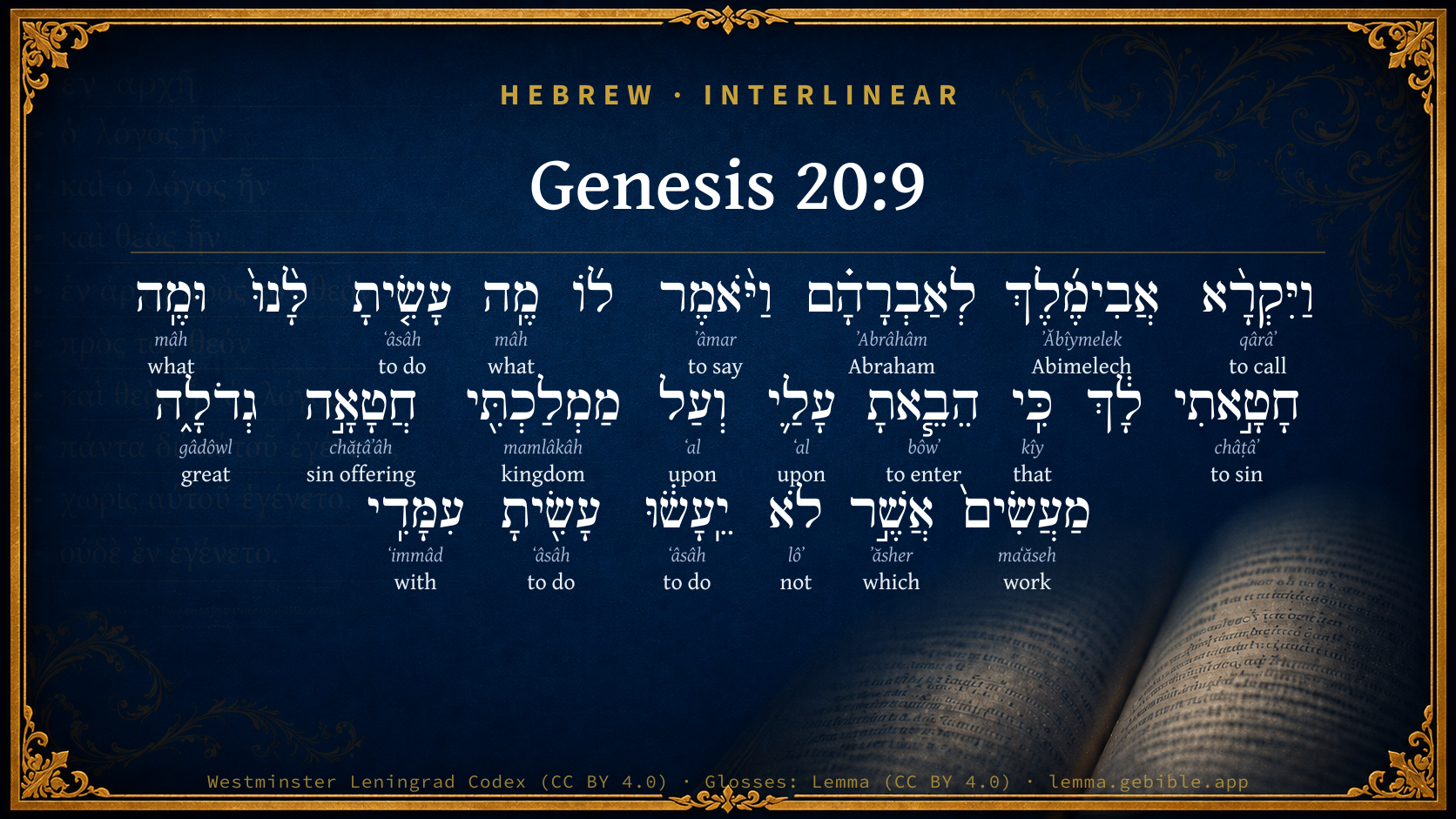
  1. וַיִּקְרָ֨א qârâʼ H7121 “and · to call” Conjunction + Verb, Qal, Sequential Imperfect, 3rd Person, Masculine, Singular
  2. אֲבִימֶ֜לֶךְ ʼĂbîymelek H40 “Abimelech” Noun, Proper
  3. לְאַבְרָהָ֗ם ʼAbrâhâm H85 “to/for · Abraham” Preposition + Noun, Proper
  4. וַיֹּ֨אמֶר ʼâmar H559 “and · to say” Conjunction + Verb, Qal, Sequential Imperfect, 3rd Person, Masculine, Singular
  5. מֶֽה mâh H4100 “what” Particle, Interrogative
  6. עָשִׂ֤יתָ ʻâsâh H6213 “to do” Verb, Qal, Perfect, 2nd Person, Masculine, Singular
  7. וּמֶֽה mâh H4100 “and · what” Conjunction + Particle, Interrogative
  8. חָטָ֣אתִי châṭâʼ H2398 “to sin” Verb, Qal, Perfect, 1st Person, Common, Singular
  9. כִּֽי kîy H3588 “that” Conjunction
  10. הֵבֵ֧אתָ bôwʼ H935 “to enter” Verb, Hiphil, Perfect, 2nd Person, Masculine, Singular
  11. עָלַ֛י ʻal H5921 “upon · me” Preposition + Suffix, Personal, 1st Person, Common, Singular
  12. וְעַל ʻal H5921 “and · upon” Conjunction + Preposition
  13. מַמְלַכְתִּ֖י mamlâkâh H4467 “kingdom · my” Noun, Common, Feminine, Singular, Construct + Suffix, Personal, 1st Person, Common, Singular
  14. גְדֹלָ֑ה gâdôwl H1419 “great” Adjective, Adjective, Feminine, Singular, Absolute
  15. מַעֲשִׂים֙ maʻăseh H4639 “works” Noun, Common, Masculine, Plural, Absolute
  16. אֲשֶׁ֣ר ʼăsher H834 “which” Particle, Relative
  17. לֹא lôʼ H3808 “not” Particle, Negative
  18. יֵֽעָשׂ֔וּ ʻâsâh H6213 “to do” Verb, Niphal, Imperfect, 3rd Person, Masculine, Plural
  19. עָשִׂ֖יתָ ʻâsâh H6213 “to do” Verb, Qal, Perfect, 2nd Person, Masculine, Singular
  20. עִמָּדִֽי ʻimmâd H5978 “with · me” Preposition + Suffix, Personal, 1st Person, Common, Singular

About this verse

These counts appear in no published source. They are computed here, from the morphology-tagged text and Lemma’s own curated glosses. What Lemma adds →

24
words
17
distinct lemmas
Pentateuch
section

Notable vocabulary

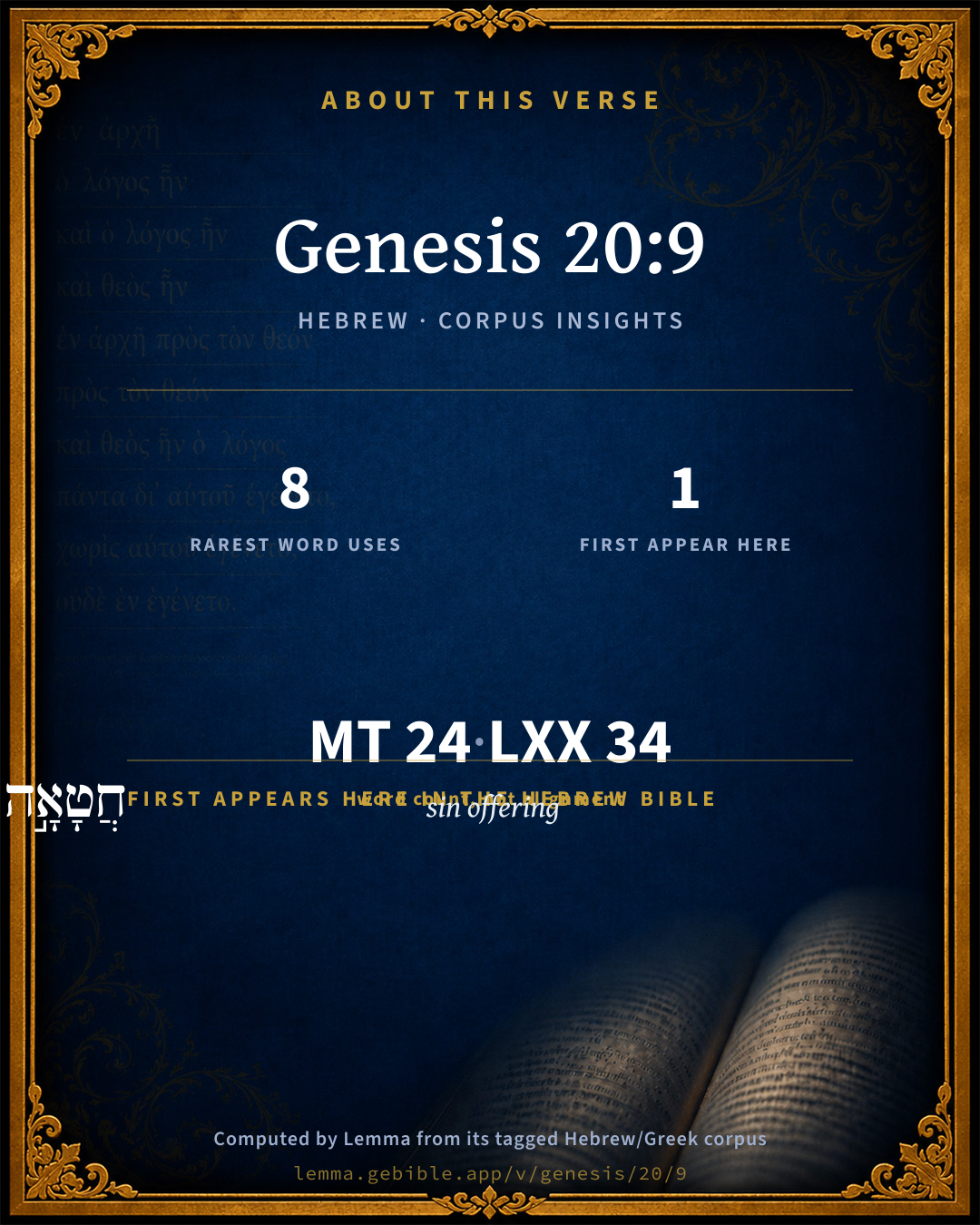
The rarest word here is חֲטָאָ֣ה sin offering H2401 — appearing just 8 times in the whole Hebrew Bible.

First appearance in Scripture

This word makes its first canonical appearance in the Hebrew Bible here:

  • חֲטָאָ֣ה sin offering H2401

Shared distinctive vocabulary

חֲטָאָ֣ה sin offering H2401 occurs in 8 verses of the Hebrew Bible. Also found in:

Grammatical profile

  • 7 verbs
  • 5 nouns
  • 1 adjective
  • 6 prepositions
  • 1 conjunction
  • 4 particles

Verb forms

  • וַיִּקְרָ֨א Qal · Sequential Imperfect
  • וַיֹּ֨אמֶר Qal · Sequential Imperfect
  • עָשִׂ֤יתָ Qal · Perfect
  • חָטָ֣אתִי Qal · Perfect
  • הֵבֵ֧אתָ Hiphil · Perfect
  • יֵֽעָשׂ֔וּ Niphal · Imperfect
  • עָשִׂ֖יתָ Qal · Perfect

Repetition

Words recur within this verse — often emphatic in Hebrew:

  • עָשִׂ֤יתָ to do H6213 ×3
  • עָלַ֛י upon H5921 ×2
  • מֶֽה what H4100 ×2

Hebrew & Septuagint length

In English translation the verse runs 45 words from the Hebrew and 48 from the Septuagint (LXX English) — closely comparable.

A rough comparison of the two English renderings, which tokenize alike — not a word-level alignment.

Word counts can differ between the Hebrew and the Greek without any difference in meaning — e.g. the Hebrew direct-object marker אֵת has no separate Greek word, and Greek often adds the article ὁ.

In the original languages it is 24 Hebrew tokens and 34 Greek tokens — but the two are counted differently (Hebrew bundles its prefixes and suffixes into one token; the Greek is in lemma form), so that isn’t a like-for-like length.

Cross-references

17

Topical passages linked to Genesis 20:9 in the Treasury of Scripture Knowledge — connected by theme and wording, ordered by reader-vote popularity; previews shown in the World English Bible.

  • Genesis 12:18 Pharaoh called Abram, and said, "What is this that you have done to me? Why didn't you tell me that she was your wife?
  • Genesis 26:10 Abimelech said, "What is this you have done to us? One of the people might easily have lain with your wife, and you would have brought guilt on us!"
  • Genesis 39:9 He isn't greater in this house than I, neither has he kept back anything from me but you, because you are his wife. How then can I do this great wickedness, and sin against God?"
  • Genesis 34:7 The sons of Jacob came in from the field when they heard it. The men were grieved, and they were very angry, because he had done folly in Israel in lying with Jacob's daughter; which thing ought not to be done.
  • Genesis 38:24 It happened about three months later, that it was told Judah, saying, "Tamar, your daughter-in-law, has played the prostitute; and moreover, behold, she is with child by prostitution." Judah said, "Bring her forth, and let her be burnt."
  • Exodus 32:21 Moses said to Aaron, "What did these people do to you, that you have brought a great sin on them?"
  • Exodus 32:35 Yahweh struck the people, because they made the calf, which Aaron made.
  • Leviticus 20:10 "'The man who commits adultery with another man's wife, even he who commits adultery with his neighbor's wife, the adulterer and the adulteress shall surely be put to death.
  • Joshua 7:25 Joshua said, Why have you troubled us? Yahweh shall trouble you this day. All Israel stoned him with stones; and they burned them with fire, and stoned them with stones.
  • 1 Samuel 26:18–19 He said, Why does my lord pursue after his servant? for what have I done? or what evil is in my hand?
  • 2 Samuel 12:5 David's anger was greatly kindled against the man, and he said to Nathan, "As Yahweh lives, the man who has done this is worthy to die!
  • 2 Samuel 12:10–11 Now therefore the sword will never depart from your house, because you have despised me, and have taken the wife of Uriah the Hittite to be your wife.'
  • 2 Samuel 13:12 She answered him, No, my brother, do not force me; for no such thing ought to be done in Israel. Don't you do this folly.
  • Proverbs 28:10 Whoever causes the upright to go astray in an evil way, He will fall into his own trap; But the blameless will inherit good.
  • Romans 2:11 For there is no partiality with God.
  • Titus 1:11 whose mouths must be stopped; men who overthrow whole houses, teaching things which they ought not, for dishonest gain's sake.
  • Hebrews 13:4 Let marriage be held in honor among all, and let the bed be undefiled: but God will judge the sexually immoral and adulterers.

Cross-references courtesy of OpenBible.info (CC BY 4.0).

Hebrew and Greek witnesses Masoretic Hebrew ↔ Greek Septuagint

The same verse in the two great witnesses to the Old Testament, shown verse-for-verse.

These are two independent witnesses, not word-aligned to each other, and the Septuagint is shown in lemma (dictionary) form.

Hebrew Genesis 20:9 Masoretic · Westminster Leningrad Codex

וַיִּקְרָ֨א אֲבִימֶ֜לֶךְ לְאַבְרָהָ֗ם וַיֹּ֨אמֶר ל֜וֹ מֶֽה עָשִׂ֤יתָ לָּ֨נוּ֙ וּמֶֽה חָטָ֣אתִי לָ֔ךְ כִּֽי הֵבֵ֧אתָ עָלַ֛י וְעַל מַמְלַכְתִּ֖י חֲטָאָ֣ה גְדֹלָ֑ה מַעֲשִׂים֙ אֲשֶׁ֣ר לֹא יֵֽעָשׂ֔וּ עָשִׂ֖יתָ עִמָּדִֽי

Then Abimelech called Abraham, and said to him, "What have you done to us? How have I sinned against you, that you have brought on me and on my kingdom a great sin? You have done deeds to me that ought not to be done!"

World English Bible · Public Domain

Greek LXX Genesis 20:9 Septuagint · lemma form

καί καλέω αβιμελεχ ὁ αβρααμ καί εἶπον αὐτός τίς οὗτος ποιέω ἐγώ μή τις ἁμαρτάνω εἰς σύ ὅτι ἐπιἄγω ἐπί ἐγώ καί ἐπί ὁ βασιλεία ἐγώ ἁμαρτία μέγας ἔργον ὅς οὐδείς ποιέω ποιέω ἐγώ

And Abimelech called Abraam and said to him, What is this that you have done to us? Have we sinned against you, that you have brought upon me and upon my kingdom a great sin? You have done to me a deed, which no one ought to do.

LXX2012 (modern English Septuagint) · Public Domain

Hebrew: Westminster Leningrad Codex (CC BY 4.0). Greek: Septuagint (public domain); English from LXX2012 (modern English Septuagint) (Public Domain). How the Septuagint differs from the Hebrew →

Targum (Aramaic paraphrase)

2

The Targum is the ancient Jewish Aramaic paraphrase of the Hebrew Scriptures — an interpretive translation, not the Hebrew text itself. Onkelos (literal) and Pseudo-Jonathan (expansive) render the Torah, and Jonathan the Prophets. Coverage is partial: where no permissively-licensed English translation exists for a verse, only the Aramaic is shown. This is verse-level text, not a word-by-word alignment to the Hebrew.

  1. Targum Onkelos Torah (Genesis–Deuteronomy)
    וּקְרָא אֲבִימֶלֶךְ לְאַבְרָהָם וַאֲמַר לֵהּ מָה עֲבַדְתָּ לָנָא וּמָה חָבִית (נ''י חָטֵית) לָךְ אֲרֵי אַיְתֵיתָא עֲלַי וְעַל מַלְכוּתִי חוֹבָא רַבָּא עוֹבָדִין דִּי לָא כָשְׁרִין לְאִתְעֲבָדָא עֲבַדְתָּ עִמִּי

    (no public-domain English translation for this verse)

    Targum Onkelos — Aramaic: “Onkelos Genesis” (public domain); “Onkelos Exodus” (public domain); “Onkelos Leviticus” (public domain); “Onkelos Numbers” (public domain); “Onkelos Deuteronomy” (public domain). English: “Sefaria Community Translation” (CC0 1.0 (public-domain dedication)); “J.W. Etheridge. The Targums of Onkelos and Jonathan Ben Uzziel on the Pentateuch. London: Longmans, Green, 1862” (public domain). Text via Sefaria.

  2. Targum Pseudo-Jonathan Torah (Genesis–Deuteronomy)
    וּקְרָא אֲבִימֶלֶךְ לְאַבְרָהָם וְאָמַר מַה עָבַדְתְּ לָנָא וּמַה חָבִית לָךְ אֲרוּם אָתֵיתָא עָלַי וְעַל מַלְכוּתִי חוֹבָא רַבָּא עוּבְדִין דְלָא כַשְׁרִין לְאִתְעַבְדָא עָבַדְתְּ עִמִי

    And Abimelek called Abraham, and said, What hast thou done to us? And in what have I sinned against thee? For thou hast brought upon me and upon my kingdom a great sin. Thou hast wrought with me works that are not right.

    Targum Pseudo-Jonathan — Aramaic: “Targum Jonathan on Genesis” (public domain); “Targum Jonathan on Exodus” (public domain); “Targum Jonathan on Leviticus” (public domain); “Targum Jonathan on Numbers” (public domain); “Targum Jonathan on Deuteronomy” (public domain). English: “The Targum of Jonathan ben Uzziel, trans. J. W. Etheridge, London, 1862” (public domain). Text via Sefaria.

Commentary

Notes on Genesis 20:9 from classic Christian and Jewish commentators (each source and its license shown beneath its notes). The classic Christian expositions comment on the surrounding passage and are grouped to its opening verse, so a note may address several verses; the Jewish commentaries on the Tanakh (Rashi and others) are per-verse, so they appear only where the commentator wrote on this verse.

Lemma curates 59 commentaries, every one of them public domain or Creative Commons licensed, each selected and text-cleaned for this edition rather than reprinted as found. About our sources →

Trapp's Complete Commentary

John Trapp

Gen 20:9 Then Abimelech called Abraham, and said unto him, What hast thou done unto us? and what have I offended thee, that thou hast brought on me and on my kingdom a great sin? thou hast done deeds unto me that ought not to be done.

Ver. 9. What hast thou done unto us? &c.] Some warmth must be in a reproof, but it must not be scalding hot. Words of reviling and disgrace, they scald, as it were; but words that tend to stir up the conscience to a due consideration of the fault (as here) they be duly warm, and tend to make the physic work more kindly. {a} How could Abraham resist this sweet and sovereign reprehension? How could he but be much ashamed, that he should give occasion to it? No oratory is so powerful with good natures as that of mildness. Remember to reprove with modesty and moderation.

{a} Aegros, quos potus fortis non curavit, ad salutem pristinam aqua tepens revocavit . - Greg.

John Trapp, A Commentary or Exposition upon All the Books of the Old and New Testament (1647–1656) — public domain. Text from a community e-Sword module.

Geneva Bible (1599)

Geneva Bible translators

The wickedness of the King bringeth God’s wrath upon the whole realm.

Geneva Bible (1599) marginal notes — public domain. Text via Bolls.life.

Jamieson, Fausset & Brown

Robert Jamieson, A. R. Fausset & David Brown

Then Abimelech called Abraham, and said . . . What hast thou done?--In what a humiliating plight does the patriarch now appear--he, a servant of the true God, rebuked by a heathen prince. Who would not rather be in the place of Abimelech than of the honored but sadly offending patriarch! What a dignified attitude is that of the king--calmly and justly reproving the sin of the patriarch, but respecting his person and heaping coals of fire on his head by the liberal presents made to him.

Jamieson, Fausset & Brown — Commentary Critical and Explanatory on the Whole Bible (1871) — public domain (CC PDM 1.0). Text via the HelloAO Bible API.

John Calvin's Commentaries

9. Then Abimelech called Abraham. There are those who suppose that the king of Gerar did not make a complaint against Abraham; but rather declared his own repentance. If, however we fairly weigh his words we find confession mixed with expostulation. Although he complains that Abraham had acted unjustly, he yet does not so transfer the blame to him, as to free himself from all fault. And he may, with justice, impute part of the blame to Abraham, as he does; provided he also acknowledges his own sin. Let we therefore know, that this king did not act as hypocrites are in the habit of doing. For, as soon as ever a pretext is furnished for inculpating others, they confidently absolve themselves: they even esteem it a lawful purgation for themselves, if they can draw others into a participation of their crime. But Abimelech, while he complains that he had been deceived, and had fallen through impudence, yet does not, meanwhile, scruple to condemn himself as guilty of a great sin, ‘It is not,’ he says, ‘through thee, that I and my whole kingdom have been prevented from falling into the greatest wickedness.’ No one therefore may exonerate himself from blame, under the pretense that he had been induced by others to sin. It is, however to be noted, that adultery is here called a great sin; because it binds not one man only, but a whole people, as in a common crime. The king of Gerar could not indeed have spoken thus, had he not acknowledged the sacred right of marriage. But, at the present time, Christians — at least they who boast of the name — are not ashamed jocularly to extenuate so great a crime, from which even a heathen shrinks with the greatest horror. Let us however know, that Abimelech was a true herald of that divine judgment, which miserable men in vain endeavor to elude by their cavils. And let that expression of Paul ever recur to our memory, ‘Be not deceived; because of those things cometh the wrath of God upon the disobedient.’ (1 Corinthians 5:9; Ephesians 5:6.) It is not without reason, that he makes this sin common to the whole nation; for when crimes are committed with impunity, a whole region is, in a certain sense, polluted. And it is especially notorious, that the anger of God is provoked against the whole body of the people, in the person of the king. Hence, with so much the greater earnestness and care, must we beseech God to govern, by his Spirit, those whom he has placed in authority over us; and then, to preserve the country, in which he has granted us a dwelling-place, exempt and pure from all iniquity.

John Calvin's Commentaries (1540-1563) — public domain. Text from the Calvin Translation Society English edition (1840s-50s) via the Christian Classics Ethereal Library (ccel.org). Calvin's coverage is partial (roughly two-thirds of the Bible); uncommented books and verses are honest gaps, never fabricated. The 19th-century editor's footnotes and remarks are omitted so the notes are faithfully Calvin's own voice.

The Cambridge Bible for Schools and Colleges

gen. ed. J. J. S. Perowne

9. What hast thou done unto us] Syriac Peshitto “what have I done unto thee,” which suits the second clause rather better.

deeds … that ought not to be done] Cf. Gen_34:7; 2Sa_13:12. The moral standard of the heathen king here stands higher than that of Abraham the prophet. There were at Gerar, presumably, no written laws; but the custom of the people, with which was bound up its religion, was more powerful than law. The Code of Hammurabi reflects the moral standard of the most civilized community of the time.

The Cambridge Bible for Schools and Colleges (gen. ed. J. J. S. Perowne; Cambridge University Press, 1878–1918) — public domain. Text from a community e-Sword module.

John Gill's Exposition

Then Abimelech called Abraham,.... Who might be in the king's palace, being taken into it caressed by the king for the sake of Sarah:

and said unto him; not in a passion, as might have been expected, but in a mild and gentle manner, yet with great strength of reasoning, and making very just expostulations with him:

what hast thou done unto us? what evil to him, his family, and his subjects? this was very probably said in the presence of his servants he had called, and therefore the plural number is used:

and what have I offended thee, that thou hast brought on me, and on my kingdom, a great sin? the sin of adultery, he had been in danger of committing, which by the light of nature was known and acknowledged to be a great sin, and therefore was avoided by Heathens, and prohibited and punished by them; or else a "great punishment" (d), as death to him, and all his subjects: and now Abimelech expostulates with him, and desires to know what he had done to incur his displeasure, that he should take such a method as this to avenge himself of him; he plainly intimates that he was not conscious to himself that he had done any thing to offend him; he had suffered him to come into his kingdom, and sojourn in it, and used him well, and in no instance, as he knew of, had done anything to affront him:

thou hast done deeds unto me that ought not to be done; in saying Sarah was his sister, and persuading her to say the same, and so virtually disowning his marriage with her, equivocating in this affair, and dissembling truth, and thereby exposing the chastity of his wife, and the king to the commission of sin with her; things that ought not to be done by any man, and much less by a man professing religion and godliness.

(d) "noxam magnam", Junius & Tremellius; "poenam peccati", Menochius; so Abendana.

John Gill's Exposition of the Whole Bible (1746–1763) — public domain (CC PDM 1.0). Text via the HelloAO Bible API.

Haydock's Catholic Bible Commentary

Why, &c. He expostulates with him in a friendly but earnest manner. --- A great sin, or punishment, (Menochius) ver. 18, and exposed me to the danger of committing adultery. Abraham might have answered, this would have been his own fault, as he could not have done it without offering violence to Sara, in whose chastity he could confide. Having an opportunity here to vindicate himself, Abraham speaks freely, which he was not allowed to do in Egypt, chap. xii. 20.

George Leo Haydock (1774–1849), Haydock's Catholic Family Bible and Commentary, 1859 edition — public domain. Excludes Psalms (Douay-Rheims chapter numbering differs from Protestant) and Deuterocanonical books (Catholic canon only).

Matthew Poole's English Annotations

What hast thou done unto us? How great a danger hast thou exposed us to!

A great sin: even the heathens, who thought fornication harmless, judge adultery to be a very great and heinous crime. See Gen 38:24; Lev 20:10; Eze 16:38; 23:45,47. Or, a great punishment, as this word is oft used; which seems better to answer to his offending Abraham now mentioned.

Matthew Poole's English Annotations on the Holy Bible (1683–1685) — public domain. Text from a community e-Sword/MySword module.

Whedon's Commentary on the Bible

Daniel D. Whedon

9. Abimelech called Abraham — The king remonstrated with Abraham “publicly, in the presence of his servants, partly for his own justification in the sight of his dependents, and partly to put Abraham to shame.” — Keil. Mark again the poetic fervour of his words:

What hast thou done to us?

And what have I sinned against thee?

That thou bringest upon me and upon my kingdom

A great sin?

Deeds which should not be done

Hast thou done with me.

Abraham seems to have been stunned and confused by this sharp rebuke, and after some silence Abimelech asks again:

Daniel D. Whedon (gen. ed.), Commentary on the Old and New Testaments (1874–1909) — public domain. Text from a community e-Sword module.

The Pulpit Commentary

Then Abimelech called Abraham, and said unto him (in the presence of his people), What hast thou done unto us? identifying himself once more with his people, as he had already done in responding to God (Ver. 4)and what have I offended thee (thus modestly allowing that he may himself have unwittingly occasioned the sin of Abraham), that thou hast brought on me and on my kingdom a great sin? The gravamen of Abimelech"s accusation was that Abraham had led him and his to offend against God, and so to lay themselves open to the penalties of wrong-doing. Thou hast done deeds unto me that ought not to be done. Literally, deeds which ought not to be done thou hast done with me. (cf. Gen_34:7; Lev_4:2, Lev_4:13; vide Glass, "Philol. Tract., 1. 3. t. 3. 100. 6.) The king"s words were unquestionably designed to convey asevere reproach.

The Pulpit Commentary (1880–1919), ed. H.D.M. Spence-Jones & Joseph S. Exell — public domain. Text from a community e-Sword module.

John Wesley's Explanatory Notes

Thou hast done deeds that ought not to be done - Equivocation and dissimulation, however they may be palliated, are very ill things, and by no means to be admitted in any case. He takes it as a very great injury to himself and his family, that Abraham had thus exposed them to sin, What have I offended thee? - If I had been thy worst enemy, thou couldst not have done me a worse turn, nor taken a more effectual course to be avenged on me. Note, We ought to reckon, that those do us the greatest dislikedness in the world, that any way tempt us or expose us to sin, though they may pretend friendship, and offer that which is grateful enough to the corrupt nature. He challenges him to assign any just cause he had to suspect them as a dangerous people for an honest man to live among.

John Wesley, Explanatory Notes Upon the Whole Bible (1754–1765) — public domain. Text via the GEBible commentary corpus.

Rashi

Rabbi Shlomo Yitzchaki (Rashi)

מעשים אשר לא יעשו THINGS THAT OUGHT NOT TO BE DONE — A plague such as does not ordinarily fall upon human beings has come upon us through you, viz, the closing up of all the secretory channels — those of semen, urine, excrement, of the ears and the nose (cf. Bava Kamma 92a).

Rashi on the Tanakh — English translations: “The Judaica Press complete Tanach with Rashi, translated by A. J. Rosenberg” (CC BY 4.0); “Pentateuch with Rashi's commentary by M. Rosenbaum and A.M. Silbermann, 1929-1934” (public domain); “The Metsudah Tanach series, Lakewood, N.J” (CC BY 4.0); and “The Book of Joshua, Metsudah Publications, 1997” (CC BY 4.0). Text via Sefaria.

Sforno

Rabbi Ovadia Sforno

Deeds that ought not to be done. You brought harm to a stranger with whom you had no prior relationship of enmity, and without profit to yourself.

Sforno on the Tanakh — English translation: “Yalkut, Sifsei Chachomim Chumash, Metsudah Publications, 2009” (CC BY 4.0). Text via Sefaria.

Radak

Rabbi David Kimhi (Radak)

ויקרא, he wanted to hear Avraham’s arguments and to appease him so that he would forgive him and pray on his behalf.

?מה עשית לנו, by saying that she is your sister, thereby placing traps for me and my servants.

ומה חטאתי לך, how did I sin against you that you repaid me with evil making me guilty of death?

?והבאתי עלי ועל ממלכתי חטאה גדולה, if I had been killed by G’d my kingdom would have been lost, as he said “are You going to a righteous nation also?”

אשר לא יעשו, it is not fitting for a man of your stature to be the cause of your fellowmen becoming guilty of mortal sin.

Radak on the Tanakh — English translations: “Sefaria Community Translation” (CC0 1.0 (public-domain dedication)); “Eliyahu Munk, HaChut Hameshulash” (CC BY 4.0); “Rabbi Mike Feuer, Jerusalem Anthology” (CC BY 4.0); and “R. David Kimhi on the first book of Psalms, Translated by R.G. Finch, London, 1919” (public domain). Text via Sefaria.

Lesson kit

Teaching starters — assembled from the data on this page, not authored interpretation. Every prompt links to the verse data it draws on. Edit before teaching.

Genesis, in the Pentateuch, opens this verse with 24 words (17 distinct Hebrew lemmas). Its most distinctive word is chăṭâʼâh (“sin offering”). A historical commentator’s framing appears above. Read the whole chapter for the surrounding context.

Discussion questions

  1. How does “sin offering” (chăṭâʼâh) shape what this verse is saying?
  2. This is the first place “sin offering” appears in Scripture (first appears here). What does its debut here establish?
  3. How does Exodus 32:21, which shares the word «sin offering», read alongside this verse?
  4. What does the repetition of “to do” (3× in this one verse) do in this verse?
  5. The translations on this page render this verse differently — a whole-verse word diff, not a word-by-word alignment. What might account for the different wordings?
  6. «וַיִּקְרָ֨א» is a Qal Sequential Imperfect verb. How does that grammatical form shape the action described?
  7. Compare how Trapp's Complete Commentary and Geneva Bible (1599) read this verse. Where do they agree or differ?

Things to notice

Reading settings

Reading text

Shown beneath each verse's original-language words.

Old Testament
Old Testament edition

Read the OT as the Masoretic Hebrew (MT) or the Greek Septuagint (LXX).

English shown for the Greek Septuagint (in the Hebrew ↔ Greek comparison).

Comparing translations? Open the Compare panel on any verse page to stack up to four side by side.