Genesis 42:5

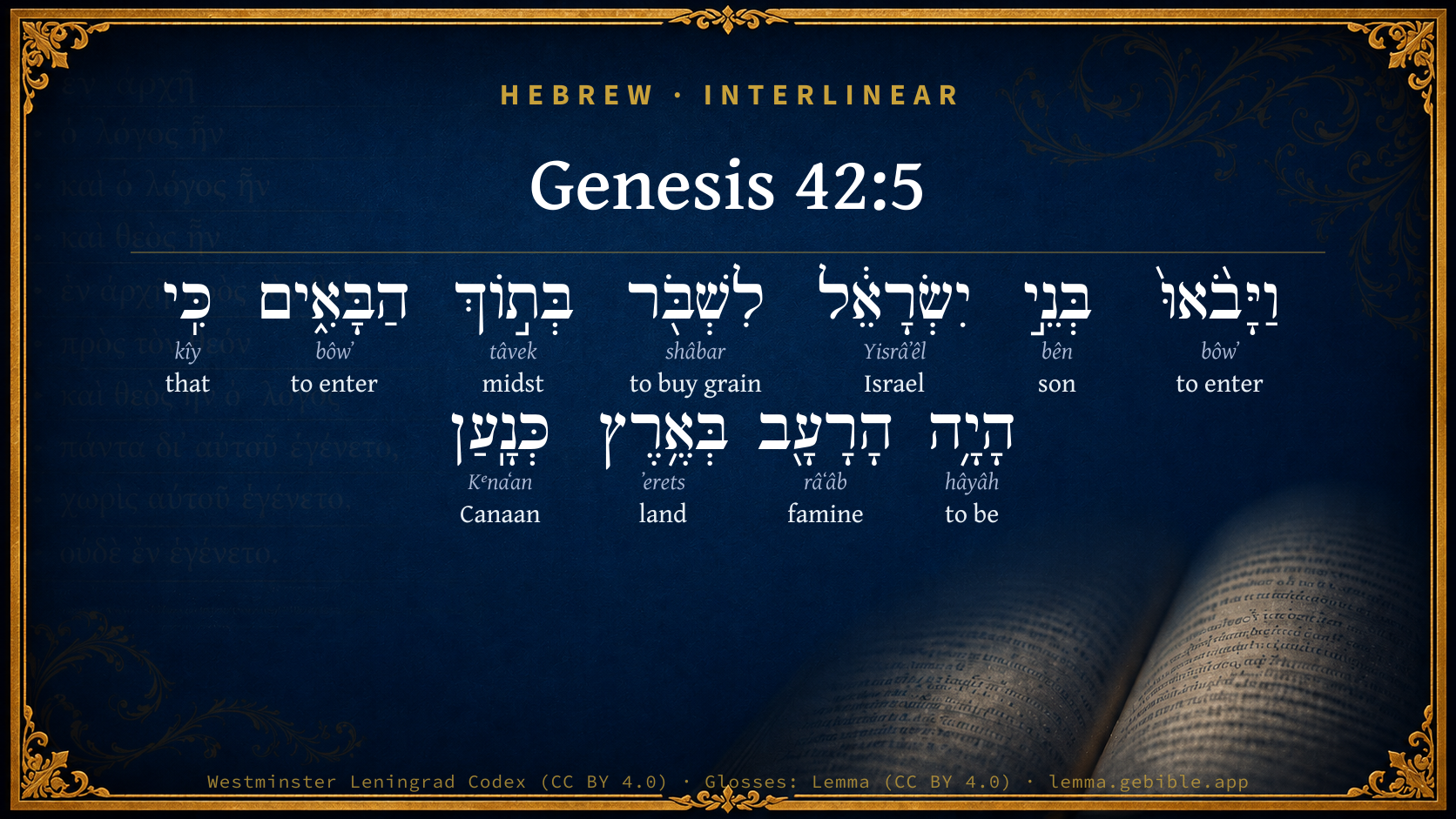
Hebrew (Westminster Leningrad Codex) Genesis 42:5 appears in the Hebrew Old Testament. The text above is from the Westminster Leningrad Codex. Each word links to its Strong’s number, a concise gloss, and parsing drawn from the Open Scriptures Hebrew Bible morphology. Click any word for its full Brown-Driver-Briggs (BDB) entry.
Download image
Cite this verse

Genesis 42:5 (World English Bible). Public Domain. Lemma interlinear Bible study tool, https://lemma.gebible.app/v/genesis/42/5.

Show BibTeX & RIS
BibTeX
RIS
English Translation
The sons of Israel came to buy among those who came, for the famine was in the land of Canaan.
World English Bible · Public Domain
Download a study sheet

One document with this verse’s original text, its word-by-word gloss line, the meaning frame, cross-references with their text, attributed commentary, and full source and license credits — printable, and it pastes into notes with its structure intact.

This verse Autodidact and up

Study sheet (.html) Plain text (.txt)

A passage Seminary Student

Up to 50 verses in one chapter. A passage sheet keeps up to 6 commentary sources and 12 cross-references per verse, in the order this page ranks them, and says so on the sheet whenever that leaves anything out. Ask for a single verse and you get the Autodidact verse sheet above.

Everything on this page stays free to read, with no account — the sheet is a download of what is already on screen, not access to it.

Want to remove ads? Support Godless Engineer
Compare translations 3

The same verse in 3 English versions, stacked beneath the original-language interlinear above. Click any original word for its lexicon entry.

Each is an independent rendering of the whole verse — the interlinear is not word-aligned to these translations.

Highlighted words mark where these versions differ — a whole-verse word diff, not a word-by-word alignment.

  • World English Bible Public Domain
    The sons of Israel came to buy among those who came, for the famine was in the land of Canaan.
  • King James Version Public Domain
    And the sons of Israel came to buy corn among those that came: for the famine was in the land of Canaan.
  • unfoldingWord Literal Text CC BY-SA 4.0
    And the sons of Israel came among who came to buy, because the famine was in the land of Canaan.

unfoldingWord Literal Text — © unfoldingWord, licensed CC BY-SA 4.0. Word-aligned USFM3 via Door43 (git.door43.org/unfoldingWord/en_ult).

Versions to compare (up to 4)

3 of 4 selected

Show all 18 translations

Every available English version of this verse, each an independent rendering of the whole verse.

  • World English Bible Public Domain
    The sons of Israel came to buy among those who came, for the famine was in the land of Canaan.
  • Berean Standard Bible Public Domain
    So the sons of Israel were among those who came to buy grain, since the famine had also spread to the land of Canaan.
  • Majority Standard Bible Public Domain
    So the sons of Israel were among those who came to buy grain, since the famine had also spread to the land of Canaan.
  • King James Version Public Domain
    And the sons of Israel came to buy corn among those that came: for the famine was in the land of Canaan.
  • American Standard Version (1901) Public Domain
    And the sons of Israel came to buy among those that came: for the famine was in the land of Canaan.
  • Revised Version (1885) Public Domain
    And the sons of Israel came to buy among those that came: for the famine was in the land of Canaan.
  • Geneva Bible (1599) Public Domain
    And the sonnes of Israel came to bye foode among them that came: for there was famine in the land of Canaan.
  • Douay-Rheims (1899) Public Domain
    And they entered into the land of Egypt with others that went to buy. For the famine was in the land of Chanaan.
  • Young's Literal Translation Public Domain
    And the sons of Israel come to buy in the midst of those coming, for the famine hath been in the land of Canaan,
  • Literal Standard Version CC BY-SA 4.0
    And the sons of Israel come to buy in the midst of those coming, for the famine has been in the land of Canaan,
  • Unlocked Literal Bible CC BY-SA 4.0
    The sons of Israel came to buy among those who came, for the famine was in the land of Canaan.
  • unfoldingWord Literal Text CC BY-SA 4.0
    And the sons of Israel came among who came to buy, because the famine was in the land of Canaan.
  • Darby Bible Public Domain
    So the sons of Israel came to buy [grain] among those that came; for the famine was in the land of Canaan.
  • World Messianic Bible Public Domain
    The sons of Israel came to buy among those who came, for the famine was in the land of Canaan.
  • Webster's Bible Public Domain
    And the sons of Israel came to buy corn among those that came: for the famine was in the land of Canaan.
  • Free Bible Version CC BY-SA 4.0
    So Israel's sons went to buy grain along with everyone else, because there was famine in Canaan too.
  • Bible in Basic English Public Domain
    And the sons of Israel came with all the others to get grain: for they were very short of food in the land of Canaan.
  • JPS Tanakh (1917) Public Domain
    And the sons of Israel came to buy among those that came; for the famine was in the land of Caanan.

Literal Standard Version (2020), Covenant Press — licensed CC BY-SA 4.0. Text via the HelloAO Bible API (eBible.org). Unlocked Literal Bible (unfoldingWord) — licensed CC BY-SA 4.0. Text via the HelloAO Bible API (eBible.org). unfoldingWord Literal Text — © unfoldingWord, licensed CC BY-SA 4.0. Word-aligned USFM3 via Door43 (git.door43.org/unfoldingWord/en_ult). Free Bible Version, Dr. Jonathan Gallagher — licensed CC BY-SA 4.0. Text via the HelloAO Bible API (eBible.org).

Word by word

More ways to search: Search by grammar → Find every occurrence → Compare this word →

Practice this passage: Drill this verse → Learn its vocabulary →

לִשְׁבֹּ֖ר
shâbar
H7666
“to buy grain”
Preposition + Verb, Qal, Infinitive Construct
Part of Speech
Preposition + Verb
Stem
Qal
Form
Infinitive Construct
Full BDB Definition

Origin: denominative from H7668

TWOT: 2322

to buy or purchase grain - (Qal) to buy grain - (Hiphil) to sell grain
  1. וַיָּבֹ֨אוּ֙ bôwʼ H935 “and · to enter” Conjunction + Verb, Qal, Sequential Imperfect, 3rd Person, Masculine, Plural
  2. בְּנֵ֣י bên H1121 “sons of” Noun, Common, Masculine, Plural, Construct
  3. יִשְׂרָאֵ֔ל Yisrâʼêl H3478 “Israel” Noun, Proper
  4. בְּת֣וֹךְ tâvek H8432 “in/at · midst of” Preposition + Noun, Common, Masculine, Singular, Construct
  5. הַבָּאִ֑ים bôwʼ H935 “the · entering” Particle, Definite Article + Verb, Qal, Participle Active, Masculine, Plural, Absolute
  6. כִּֽי kîy H3588 “that” Conjunction
  7. הָיָ֥ה hâyâh H1961 “to be” Verb, Qal, Perfect, 3rd Person, Masculine, Singular
  8. הָרָעָ֖ב râʻâb H7458 “the · famine” Particle, Definite Article + Noun, Common, Masculine, Singular, Absolute
  9. בְּאֶ֥רֶץ ʼerets H776 “in/at · land of” Preposition + Noun, Common, Both, Singular, Construct
  10. כְּנָֽעַן Kᵉnaʻan H3667 “Canaan” Noun, Proper

About this verse

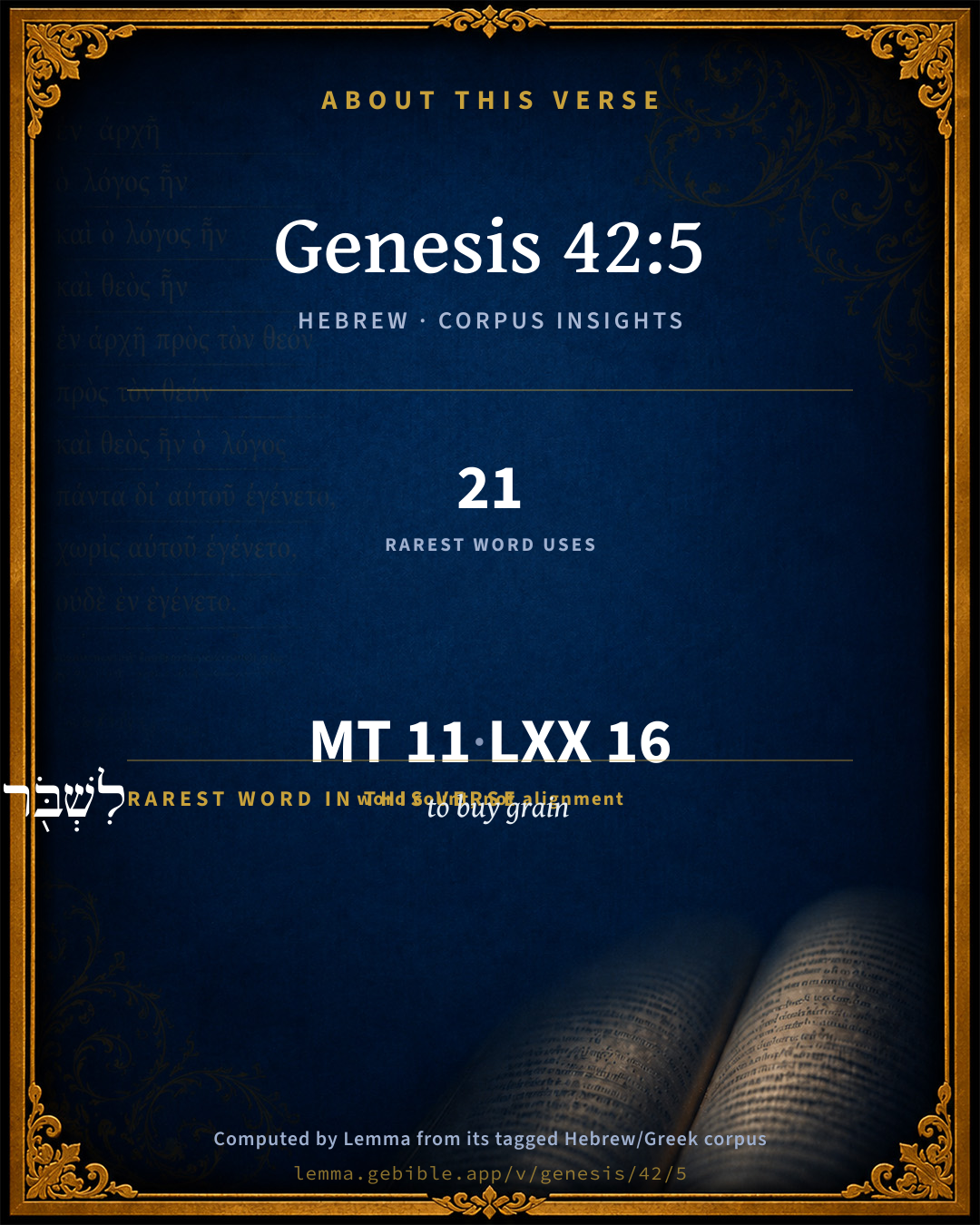
These counts appear in no published source. They are computed here, from the morphology-tagged text and Lemma’s own curated glosses. What Lemma adds →

11
words
10
distinct lemmas
Pentateuch
section

Notable vocabulary

The rarest word here is לִשְׁבֹּ֖ר to buy grain H7666 — appearing just 21 times in the whole Hebrew Bible.

Shared distinctive vocabulary

לִשְׁבֹּ֖ר to buy grain H7666 occurs in 20 verses of the Hebrew Bible. Also found in:

Grammatical profile

  • 4 verbs
  • 6 nouns
  • 1 conjunction

Verb forms

  • וַיָּבֹ֨אוּ֙ Qal · Sequential Imperfect
  • לִשְׁבֹּ֖ר Qal · Infinitive Construct
  • הַבָּאִ֑ים Qal · Participle Active
  • הָיָ֥ה Qal · Perfect

Repetition

A word recurs within this verse — often emphatic in Hebrew:

  • וַיָּבֹ֨אוּ֙ to enter H935 ×2

Hebrew & Septuagint length

In English translation the verse runs 20 words from the Hebrew and 21 from the Septuagint (LXX English) — closely comparable.

A rough comparison of the two English renderings, which tokenize alike — not a word-level alignment.

Word counts can differ between the Hebrew and the Greek without any difference in meaning — e.g. the Hebrew direct-object marker אֵת has no separate Greek word, and Greek often adds the article ὁ.

In the original languages it is 11 Hebrew tokens and 16 Greek tokens — but the two are counted differently (Hebrew bundles its prefixes and suffixes into one token; the Greek is in lemma form), so that isn’t a like-for-like length.

Cross-references

5

Topical passages linked to Genesis 42:5 in the Treasury of Scripture Knowledge — connected by theme and wording, ordered by reader-vote popularity; previews shown in the World English Bible.

  • Genesis 12:10 There was a famine in the land. Abram went down into Egypt to live as a foreigner there, for the famine was sore in the land.
  • Genesis 41:57 All countries came into Egypt, to Joseph, to buy grain, because the famine was severe in all the earth.
  • Acts 7:11 Now a famine came over all the land of Egypt and Canaan, and great affliction. Our fathers found no food.
  • Genesis 26:1 There was a famine in the land, besides the first famine that was in the days of Abraham. Isaac went to Abimelech king of the Philistines, to Gerar.
  • Acts 11:28 One of them named Agabus stood up, and indicated by the Spirit that there should be a great famine all over the world, which also happened in the days of Claudius.

Cross-references courtesy of OpenBible.info (CC BY 4.0).

Hebrew and Greek witnesses Masoretic Hebrew ↔ Greek Septuagint

The same verse in the two great witnesses to the Old Testament, shown verse-for-verse.

These are two independent witnesses, not word-aligned to each other, and the Septuagint is shown in lemma (dictionary) form.

Hebrew Genesis 42:5 Masoretic · Westminster Leningrad Codex

וַיָּבֹ֨אוּ֙ בְּנֵ֣י יִשְׂרָאֵ֔ל לִשְׁבֹּ֖ר בְּת֣וֹךְ הַבָּאִ֑ים כִּֽי הָיָ֥ה הָרָעָ֖ב בְּאֶ֥רֶץ כְּנָֽעַן

The sons of Israel came to buy among those who came, for the famine was in the land of Canaan.

World English Bible · Public Domain

Greek LXX Genesis 42:5 Septuagint · lemma form

ἔρχομαι δέ ὁ υἱός ἰσραήλ ἀγοράζω μετά ὁ ἔρχομαι εἰμί γάρ ὁ λιμός ἐν γῆ χανααν

And the sons of Israel came to buy with those that came, for the famine was in the land of Chanaan.

LXX2012 (modern English Septuagint) · Public Domain

Hebrew: Westminster Leningrad Codex (CC BY 4.0). Greek: Septuagint (public domain); English from LXX2012 (modern English Septuagint) (Public Domain). How the Septuagint differs from the Hebrew →

Targum (Aramaic paraphrase)

2

The Targum is the ancient Jewish Aramaic paraphrase of the Hebrew Scriptures — an interpretive translation, not the Hebrew text itself. Onkelos (literal) and Pseudo-Jonathan (expansive) render the Torah, and Jonathan the Prophets. Coverage is partial: where no permissively-licensed English translation exists for a verse, only the Aramaic is shown. This is verse-level text, not a word-by-word alignment to the Hebrew.

  1. Targum Onkelos Torah (Genesis–Deuteronomy)
    וַאֲתוֹ בְּנֵי יִשְׂרָאֵל לְמִזְבַּן עִיבוּרָא בְּגוֹ עָלַיָּא אֲרֵי הֲוָה כַפְנָא בְּאַרְעָא דִּכְנָעַן

    (no public-domain English translation for this verse)

    Targum Onkelos — Aramaic: “Onkelos Genesis” (public domain); “Onkelos Exodus” (public domain); “Onkelos Leviticus” (public domain); “Onkelos Numbers” (public domain); “Onkelos Deuteronomy” (public domain). English: “Sefaria Community Translation” (CC0 1.0 (public-domain dedication)); “J.W. Etheridge. The Targums of Onkelos and Jonathan Ben Uzziel on the Pentateuch. London: Longmans, Green, 1862” (public domain). Text via Sefaria.

  2. Targum Pseudo-Jonathan Torah (Genesis–Deuteronomy)
    וְאָתוּ בְּנֵי יִשְרָאֵל כָּל חַד בְּתַרְעָא חַד דְלָא יִשְׁלוֹט בְּהוֹן עַיְינָא בִּישָׁא כַּד יַיעֲלוּן כַּחֲדָא לְמִזְבּוּן בֵּינֵי כְנַעֲנָאֵי דְעָאלוֹן לְמִזְבּוּן אֲרוּם הֲוָת כַּפְנָא בְּאַרְעָא דִכְנָעַן

    And the sons of Israel went every one by one door, lest the evil eye should have sway over them, as they went together to buy among the Kenaanites who went also to buy; because the famine was in the land of Kenaan.

    Targum Pseudo-Jonathan — Aramaic: “Targum Jonathan on Genesis” (public domain); “Targum Jonathan on Exodus” (public domain); “Targum Jonathan on Leviticus” (public domain); “Targum Jonathan on Numbers” (public domain); “Targum Jonathan on Deuteronomy” (public domain). English: “The Targum of Jonathan ben Uzziel, trans. J. W. Etheridge, London, 1862” (public domain). Text via Sefaria.

Commentary

Notes on Genesis 42:5 from classic Christian and Jewish commentators (each source and its license shown beneath its notes). The classic Christian expositions comment on the surrounding passage and are grouped to its opening verse, so a note may address several verses; the Jewish commentaries on the Tanakh (Rashi and others) are per-verse, so they appear only where the commentator wrote on this verse.

Lemma curates 59 commentaries, every one of them public domain or Creative Commons licensed, each selected and text-cleaned for this edition rather than reprinted as found. About our sources →

Trapp's Complete Commentary

John Trapp

Gen 42:5 And the sons of Israel came to buy [corn] among those that came: for the famine was in the land of Canaan.

Ver. 5. And the sons of Israel came.] God could have fed them by a miracle, as he did Elijah by the ravens; and Israel in the wilderness, where he rained them down manna, and set the flint abroach; {a} and Merlin, hid in a hay mow in the massacre of Paris, by a hen that came thither, and laid an egg by him every morning. {b} But he worketh ordinarily by means, and will have them used, but not trusted to.

{a} Dedit eis pluviam escatilem, et petram aquatilem. - Tertul.

{b} Dike’s Mich. and the Drag.

John Trapp, A Commentary or Exposition upon All the Books of the Old and New Testament (1647–1656) — public domain. Text from a community e-Sword module.

Jamieson, Fausset & Brown

Robert Jamieson, A. R. Fausset & David Brown

the famine was in the land of Canaan--The tropical rains, which annually falling swell the Nile, are those of Palestine also; and their failure would produce the same disastrous effects in Canaan as in Egypt. Numerous caravans of its people, therefore, poured over the sandy desert of Suez, with their beasts of burden, for the purchase of corn; and among others, "the sons of Israel" were compelled to undertake a journey from which painful associations made them strongly averse.

Jamieson, Fausset & Brown — Commentary Critical and Explanatory on the Whole Bible (1871) — public domain (CC PDM 1.0). Text via the HelloAO Bible API.

John Gill's Exposition

And Joseph was the governor over the land,.... Not the land of Canaan last mentioned, but the land of Egypt; under Pharaoh, he had the chief and sole authority, and especially in the affair of the corn, and the disposal of that:

and he it was that sold to all the people of the land: of Egypt, and also to all that came out of other lands; not that he in person could do all this, but by those that acted under him:

and Joseph's brethren came; to Joseph to buy corn of him:

and bowed down themselves before him, with their faces to the earth; not only bowed the knee as the Egyptians did, but prostrated their whole bodies, stretching out their hands and feet, and touching the ground with their faces, as was the manner of the eastern countries, at least some of them; and so of Canaan; and thus did they submit themselves to him in the most humble manner, and thereby, though without their knowledge, fulfilled his dream of their sheaves making obeisance to his sheaf, Gen 37:7.

John Gill's Exposition of the Whole Bible (1746–1763) — public domain (CC PDM 1.0). Text via the HelloAO Bible API.

Whedon's Commentary on the Bible

Daniel D. Whedon

5. Among those that came — They mingled themselves with the multitudes of some caravan, as if anxious to escape notice.

Daniel D. Whedon (gen. ed.), Commentary on the Old and New Testaments (1874–1909) — public domain. Text from a community e-Sword module.

The Pulpit Commentary

And the sons of Israel came to buy corn among those that came literally, in the midst of the comers; not as being desirous to lose themselves in the multitudes, as if troubled by an alarming presentiment (Lange), which is forced and unnatural; but either as forming a part of a caravan of Canaanites (Lawson), or simply as arriving among ethers who came from the same necessity (Keil). For the famine was in the land of Canaan. The statements in this verse concerning the descent of Joseph"s brethren to Egypt, and the prevalence of the famine in the land of Canaan, both of which have already been sufficiently announced; (vide ver. 3 Gen_41:57 Gen_42:2) are neither useless repetitions nor proofs of different authorship, but simply the customary recapitulations which mark the commencement of a new paragraph or section of the history, viz., that in which Joseph"s first interview with his brethren is described (cf. "Quarry on Genesis," pp. 556, 557).

The Pulpit Commentary (1880–1919), ed. H.D.M. Spence-Jones & Joseph S. Exell — public domain. Text from a community e-Sword module.

Scofield Reference Notes

C. I. Scofield

famine

See note, (See Scofield "Gen 12:10").

The Scofield Reference Bible (1917 edition), notes by C. I. Scofield — public domain. Text from a community e-Sword module.

unfoldingWord translationNotes

Door43 World Missions Community

The sons of Israel came to buy among those who came

The word "came" can be translated as "went." Also, the words "grain" and "Egypt" are understood. AT: "The sons of Israel went to by grain along with other people who went to Egypt" (See: Go and Come and Ellipsis)

Now Joseph

"Now" marks a change from the story to background information about Joseph. (See: Background Information)

over the land

Here "land" refers to Egypt. AT: "over Egypt" (See: Assumed Knowledge and Implicit Information)

all the people of the land

Here "land" includes Egypt and other surrounding countries. AT: "all the people of all the nations that came to buy grain" (See: Assumed Knowledge and Implicit Information)

Joseph's brothers came

Here "came" can be translated as "went." (See: Go and Come)

bowed down to him with their faces to the ground

This is a way of showing respect. (See: Symbolic Action)

translationWords

Jacob

famine

Canaan

govern

bow

unfoldingWord translationNotes — © Distant Shores Media and the Door43 World Missions Community, licensed CC BY-SA 4.0. Source: git.door43.org/Door43/en_tn.

Rashi

Rabbi Shlomo Yitzchaki (Rashi)

בתוך הבאים AMONG THOSE THAT CAME — They hid themselves in the crowd that people should not recognize them, for their father had bidden them not to show themselves all at one entrance to the city but that each should enter by a different gate in order that the evil eye should not have power over them (i.e. that they should not attract the envious attention of the people) for they were all handsome and stalwart men (Midrash Tanchuma 1.:10:6).

Rashi on the Tanakh — English translations: “The Judaica Press complete Tanach with Rashi, translated by A. J. Rosenberg” (CC BY 4.0); “Pentateuch with Rashi's commentary by M. Rosenbaum and A.M. Silbermann, 1929-1934” (public domain); “The Metsudah Tanach series, Lakewood, N.J” (CC BY 4.0); and “The Book of Joshua, Metsudah Publications, 1997” (CC BY 4.0). Text via Sefaria.

Radak

Rabbi David Kimhi (Radak)

בתוך הבאים, they did not appear different although they were Hebrews. Seeing that it was a time of danger, i.e. famine, they mingled freely with all the other people traveling to Egypt for the same purpose.

Radak on the Tanakh — English translations: “Sefaria Community Translation” (CC0 1.0 (public-domain dedication)); “Eliyahu Munk, HaChut Hameshulash” (CC BY 4.0); “Rabbi Mike Feuer, Jerusalem Anthology” (CC BY 4.0); and “R. David Kimhi on the first book of Psalms, Translated by R.G. Finch, London, 1919” (public domain). Text via Sefaria.

Lesson kit

Teaching starters — assembled from the data on this page, not authored interpretation. Every prompt links to the verse data it draws on. Edit before teaching.

Genesis, in the Pentateuch, opens this verse with 11 words (10 distinct Hebrew lemmas). Its most distinctive word is shâbar (“to buy grain”). A historical commentator’s framing appears above. Read the whole chapter for the surrounding context.

Discussion questions

  1. How does “to buy grain” (shâbar) shape what this verse is saying?
  2. How does Genesis 41:56, which shares the word «to buy grain», read alongside this verse?
  3. What does the repetition of “to enter” (2× in this one verse) do in this verse?
  4. These translations render this verse differently; the difference is in the English rendering, not the original. What questions does that raise?
  5. «וַיָּבֹ֨אוּ֙» is a Qal Sequential Imperfect verb. How does that grammatical form shape the action described?
  6. Compare how Trapp's Complete Commentary and Jamieson, Fausset & Brown read this verse. Where do they agree or differ?

Things to notice

Reading settings

Reading text

Shown beneath each verse's original-language words.

Old Testament
Old Testament edition

Read the OT as the Masoretic Hebrew (MT) or the Greek Septuagint (LXX).

English shown for the Greek Septuagint (in the Hebrew ↔ Greek comparison).

Comparing translations? Open the Compare panel on any verse page to stack up to four side by side.