
Genesis 47:4

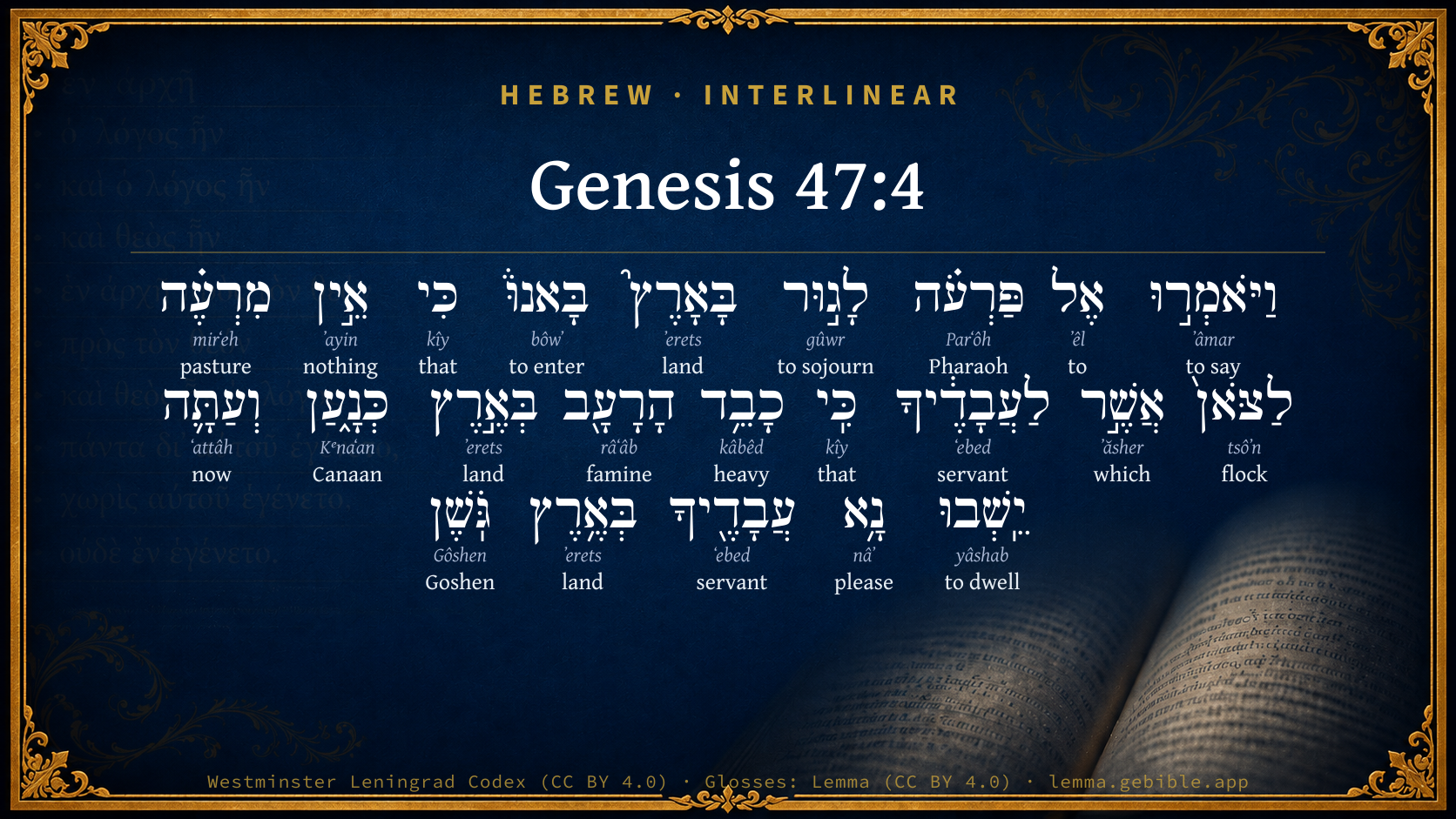
Hebrew (Westminster Leningrad Codex) Genesis 47:4 appears in the Hebrew Old Testament. The text above is from the Westminster Leningrad Codex. Each word links to its Strong’s number, a concise gloss, and parsing drawn from the Open Scriptures Hebrew Bible morphology. Click any word for its full Brown-Driver-Briggs (BDB) entry.
Download image
Cite this verse

Genesis 47:4 (World English Bible). Public Domain. Lemma interlinear Bible study tool, https://lemma.gebible.app/v/genesis/47/4.

Show BibTeX & RIS
BibTeX
RIS
English Translation
They said to Pharaoh, "We have come to live as foreigners in the land, for there is no pasture for your servants' flocks. For the famine is severe in the land of Canaan. Now therefore, please let your servants dwell in the land of Goshen."
World English Bible · Public Domain
Highlights Full analysis ↓
Download a study sheet

One document with this verse’s original text, its word-by-word gloss line, the meaning frame, cross-references with their text, attributed commentary, and full source and license credits — printable, and it pastes into notes with its structure intact.

This verse Autodidact and up

Study sheet (.html) Plain text (.txt)

A passage Seminary Student

Up to 50 verses in one chapter. A passage sheet keeps up to 6 commentary sources and 12 cross-references per verse, in the order this page ranks them, and says so on the sheet whenever that leaves anything out. Ask for a single verse and you get the Autodidact verse sheet above.

Everything on this page stays free to read, with no account — the sheet is a download of what is already on screen, not access to it.

Want to remove ads? Support Godless Engineer
Compare translations 3

The same verse in 3 English versions, stacked beneath the original-language interlinear above. Click any original word for its lexicon entry.

Each is an independent rendering of the whole verse — the interlinear is not word-aligned to these translations.

Highlighted words mark where these versions differ — a whole-verse word diff, not a word-by-word alignment.

  • World English Bible Public Domain
    They said to Pharaoh, "We have come to live as foreigners in the land, for there is no pasture for your servants' flocks. For the famine is severe in the land of Canaan. Now therefore, please let your servants dwell in the land of Goshen."
  • King James Version Public Domain
    They said moreover unto Pharaoh, For to sojourn in the land are we come; for thy servants have no pasture for their flocks; for the famine is sore in the land of Canaan: now therefore, we pray thee, let thy servants dwell in the land of Goshen.
  • unfoldingWord Literal Text CC BY-SA 4.0
    Then they said to Pharaoh, “We have come to sojourn in the land, because there is not pasture for the flock that to your servants, because the famine heavy in the land of Canaan. So now, please let your servants settle in the land of Goshen.”

unfoldingWord Literal Text — © unfoldingWord, licensed CC BY-SA 4.0. Word-aligned USFM3 via Door43 (git.door43.org/unfoldingWord/en_ult).

Versions to compare (up to 4)

3 of 4 selected

Show all 18 translations

Every available English version of this verse, each an independent rendering of the whole verse.

  • World English Bible Public Domain
    They said to Pharaoh, "We have come to live as foreigners in the land, for there is no pasture for your servants' flocks. For the famine is severe in the land of Canaan. Now therefore, please let your servants dwell in the land of Goshen."
  • Berean Standard Bible Public Domain
    Then they said to Pharaoh, “We have come to live in the land for a time, because there is no pasture for the flocks of your servants, since the famine in the land of Canaan has been severe. So now, please allow your servants to settle in the land of Goshen.”
  • Majority Standard Bible Public Domain
    Then they said to Pharaoh, “We have come to live in the land for a time, because there is no pasture for the flocks of your servants, since the famine in the land of Canaan has been severe. So now, please allow your servants to settle in the land of Goshen.”
  • King James Version Public Domain
    They said moreover unto Pharaoh, For to sojourn in the land are we come; for thy servants have no pasture for their flocks; for the famine is sore in the land of Canaan: now therefore, we pray thee, let thy servants dwell in the land of Goshen.
  • American Standard Version (1901) Public Domain
    And they said unto Pharaoh, To sojourn in the land are we come; for there is no pasture for thy servants' flocks; for the famine is sore in the land of Canaan: now therefore, we pray thee, let thy servants dwell in the land of Goshen.
  • Revised Version (1885) Public Domain
    And they said unto Pharaoh, To sojourn in the land are we come; for there is no pasture for thy servants’ flocks; for the famine is sore in the land of Canaan: now therefore, we pray thee, let thy servants dwell in the land of Goshen.
  • Geneva Bible (1599) Public Domain
    They sayde moreouer vnto Pharaoh, For to soiourne in ye lande are we come: for thy seruants haue no pasture for their sheepe, so sore is ye famine in the lande of Canaan. Nowe therefore, we pray thee, let thy seruants dwel in the land of Goshen.
  • Douay-Rheims (1899) Public Domain
    We are come to sojourn in thy land, because there is no grass for the flocks of thy servants, the famine being very grievous in the land of Chanaan: and we pray thee to give orders that we thy servants may be in the land of Gessen.
  • Young's Literal Translation Public Domain
    and they say unto Pharaoh, `To sojourn in the land we have come, for there is no pasture for the flock which thy servants have, for grievous `is' the famine in the land of Canaan; and now, let thy servants, we pray thee, dwell in the land of Goshen.'
  • Literal Standard Version CC BY-SA 4.0
    and they say to Pharaoh, “We have come to sojourn in the land, for there is no pasture for the flock which your servants have, for the famine in the land of Canaan [is] grievous; and now, please let your servants dwell in the land of Goshen.”
  • Unlocked Literal Bible CC BY-SA 4.0
    Then they said to Pharaoh, “We come as temporary residents in the land. There is no pasture for your servants' flocks, because the famine is severe in the land of Canaan. So now, please let your servants live in the land of Goshen.”
  • unfoldingWord Literal Text CC BY-SA 4.0
    Then they said to Pharaoh, “We have come to sojourn in the land, because there is not pasture for the flock that to your servants, because the famine heavy in the land of Canaan. So now, please let your servants settle in the land of Goshen.”
  • Darby Bible Public Domain
    And they said to Pharaoh, To sojourn in the land are we come; for there is no pasture for the sheep that thy servants have, for the famine is grievous in the land of Canaan; and now, we pray thee, let thy servants dwell in the land of Goshen.
  • World Messianic Bible Public Domain
    They also said to Pharaoh, “We have come to live as foreigners in the land, for there is no pasture for your servants’ flocks. For the famine is severe in the land of Canaan. Now therefore, please let your servants dwell in the land of Goshen.”
  • Webster's Bible Public Domain
    They said moreover to Pharaoh, We have come to sojourn in the land: for thy servants have no pasture for their flocks, for the famine is severe in the land of Canaan: now therefore, we pray thee, let thy servants dwell in the land of Goshen.
  • Free Bible Version CC BY-SA 4.0
    “We have come to live in Egypt because there's no grass left in Canaan for our flocks to eat,” they explained. “The famine is really bad in Canaan. So we would like to please ask permission to live in Goshen.”
  • Bible in Basic English Public Domain
    And they said to Pharaoh, We have come to make a living in this land, because we have no grass for our flocks in the land of Canaan; so now let your servants make a place for themselves in the land of Goshen.
  • JPS Tanakh (1917) Public Domain
    And they said unto Pharaoh: 'To sojourn in the land are we come; for there is no pasture for thy servants' flocks; for the famine is sore in the land of Canaan. Now therefore, we pray thee, let thy servants dwell in the land of Goshen.'

Literal Standard Version (2020), Covenant Press — licensed CC BY-SA 4.0. Text via the HelloAO Bible API (eBible.org). Unlocked Literal Bible (unfoldingWord) — licensed CC BY-SA 4.0. Text via the HelloAO Bible API (eBible.org). unfoldingWord Literal Text — © unfoldingWord, licensed CC BY-SA 4.0. Word-aligned USFM3 via Door43 (git.door43.org/unfoldingWord/en_ult). Free Bible Version, Dr. Jonathan Gallagher — licensed CC BY-SA 4.0. Text via the HelloAO Bible API (eBible.org).

Word by word

More ways to search: Search by grammar → Find every occurrence → Compare this word →

Practice this passage: Drill this verse → Learn its vocabulary →

מִרְעֶ֗ה
mirʻeh
H4829
“pasture”
Noun, Common, Masculine, Singular, Absolute
Part of Speech
Noun
Type
Common
Gender
Masculine
Number
Singular
State
Absolute
Full BDB Definition

Origin: from H7462 in the sense of feeding

TWOT: 2185b

pasture, pasturage
  1. וַיֹּאמְר֣וּ ʼâmar H559 “and · to say” Conjunction + Verb, Qal, Sequential Imperfect, 3rd Person, Masculine, Plural
  2. אֶל ʼêl H413 “to” Preposition
  3. פַּרְעֹ֗ה Parʻôh H6547 “Pharaoh” Noun, Proper
  4. לָג֣וּר gûwr H1481 “to sojourn” Preposition + Verb, Qal, Infinitive Construct
  5. בָּאָרֶץ֮ ʼerets H776 “in/at the · land” Preposition, Determined + Noun, Common, Both, Singular, Absolute
  6. בָּאנוּ֒ bôwʼ H935 “to enter” Verb, Qal, Perfect, 1st Person, Common, Plural
  7. כִּי kîy H3588 “that” Conjunction
  8. אֵ֣ין ʼayin H369 “nothing” Particle, Negative
  9. לַצֹּאן֙ tsôʼn H6629 “to/for the · flock” Preposition, Determined + Noun, Common, Both, Singular, Absolute
  10. אֲשֶׁ֣ר ʼăsher H834 “which” Particle, Relative
  11. לַעֲבָדֶ֔יךָ ʻebed H5650 “to/for · servants · your” Preposition + Noun, Common, Masculine, Plural, Construct + Suffix, Personal, 2nd Person, Masculine, Singular
  12. כִּֽי kîy H3588 “that” Conjunction
  13. כָבֵ֥ד kâbêd H3515 “heavy” Adjective, Adjective, Masculine, Singular, Absolute
  14. הָרָעָ֖ב râʻâb H7458 “the · famine” Particle, Definite Article + Noun, Common, Masculine, Singular, Absolute
  15. בְּאֶ֣רֶץ ʼerets H776 “in/at · land of” Preposition + Noun, Common, Both, Singular, Construct
  16. כְּנָ֑עַן Kᵉnaʻan H3667 “Canaan” Noun, Proper
  17. וְעַתָּ֛ה ʻattâh H6258 “and · now” Conjunction + Adverb
  18. יֵֽשְׁבוּ yâshab H3427 “to dwell” Verb, Qal, Jussive, 3rd Person, Masculine, Plural
  19. נָ֥א nâʼ H4994 “please” Particle, Exhortation
  20. עֲבָדֶ֖יךָ ʻebed H5650 “servants · your” Noun, Common, Masculine, Plural, Construct + Suffix, Personal, 2nd Person, Masculine, Singular
  21. בְּאֶ֥רֶץ ʼerets H776 “in/at · land of” Preposition + Noun, Common, Both, Singular, Construct
  22. גֹּֽשֶׁן Gôshen H1657 “Goshen” Noun, Proper

About this verse

These counts appear in no published source. They are computed here, from the morphology-tagged text and Lemma’s own curated glosses. What Lemma adds →

23
words
19
distinct lemmas
Pentateuch
section

Notable vocabulary

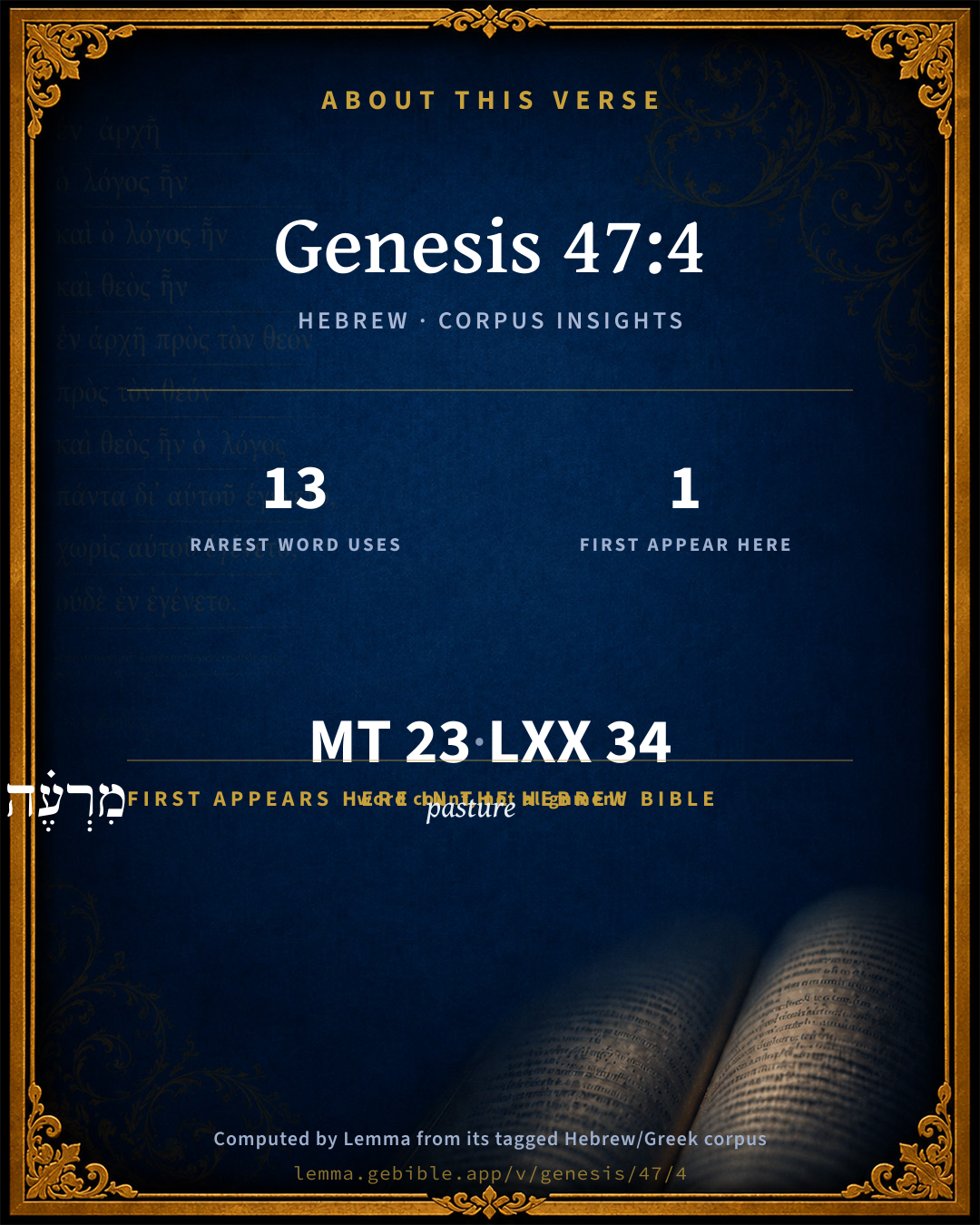
The rarest word here is מִרְעֶ֗ה pasture H4829 — appearing just 13 times in the whole Hebrew Bible.

First appearance in Scripture

This word makes its first canonical appearance in the Hebrew Bible here:

  • מִרְעֶ֗ה pasture H4829

Shared distinctive vocabulary

מִרְעֶ֗ה pasture H4829 occurs in 11 verses of the Hebrew Bible. Also found in:

Grammatical profile

  • 4 verbs
  • 11 nouns
  • 1 adjective
  • 1 preposition
  • 2 conjunctions
  • 1 adverb
  • 3 particles

Verb forms

  • וַיֹּאמְר֣וּ Qal · Sequential Imperfect
  • לָג֣וּר Qal · Infinitive Construct
  • בָּאנוּ֒ Qal · Perfect
  • יֵֽשְׁבוּ Qal · Jussive

Repetition

Words recur within this verse — often emphatic in Hebrew:

  • בָּאָרֶץ֮ land H776 ×3
  • לַעֲבָדֶ֔יךָ servant H5650 ×2
  • כִּי that H3588 ×2

Hebrew & Septuagint length

In English translation the verse runs 45 words from the Hebrew and 92 from the Septuagint (LXX English) — the Septuagint runs noticeably longer here. See the side-by-side →

A rough comparison of the two English renderings, which tokenize alike — not a word-level alignment.

Word counts can differ between the Hebrew and the Greek without any difference in meaning — e.g. the Hebrew direct-object marker אֵת has no separate Greek word, and Greek often adds the article ὁ.

In the original languages it is 23 Hebrew tokens and 34 Greek tokens — but the two are counted differently (Hebrew bundles its prefixes and suffixes into one token; the Greek is in lemma form), so that isn’t a like-for-like length.

Cross-references

9

Topical passages linked to Genesis 47:4 in the Treasury of Scripture Knowledge — connected by theme and wording, ordered by reader-vote popularity; previews shown in the World English Bible.

  • Genesis 46:34 that you shall say, 'Your servants have been keepers of cattle from our youth even until now, both we, and our fathers:' that you may dwell in the land of Goshen; for every shepherd is an abomination to the Egyptians."
  • Genesis 15:13 He said to Abram, "Know for sure that your seed will live as foreigners in a land that is not theirs, and will serve them. They will afflict them four hundred years.
  • Deuteronomy 26:5 You shall answer and say before Yahweh your God, A Syrian ready to perish was my father; and he went down into Egypt, and sojourned there, few in number; and he became there a nation, great, mighty, and populous.
  • Genesis 43:1 The famine was severe in the land.
  • Psalms 105:23 Israel also came into Egypt. Jacob sojourned in the land of Ham.
  • Acts 7:11 Now a famine came over all the land of Egypt and Canaan, and great affliction. Our fathers found no food.
  • Genesis 12:10 There was a famine in the land. Abram went down into Egypt to live as a foreigner there, for the famine was sore in the land.
  • Isaiah 52:4 For thus says the Lord Yahweh, My people went down at the first into Egypt to sojourn there: and the Assyrian has oppressed them without cause.
  • Acts 7:6 God spoke in this way: that his seed would live as aliens in a strange land, and that they would be enslaved and mistreated for four hundred years.

Cross-references courtesy of OpenBible.info (CC BY 4.0).

Hebrew and Greek witnesses Masoretic Hebrew ↔ Greek Septuagint

The same verse in the two great witnesses to the Old Testament, shown verse-for-verse.

Here the Septuagint runs noticeably longer than the Hebrew — LXX2012 (modern English Septuagint) 92 words vs World English Bible 45. A rough length comparison of the two English translations, not a word-level alignment — read both below.

These are two independent witnesses, not word-aligned to each other, and the Septuagint is shown in lemma (dictionary) form.

Hebrew Genesis 47:4 Masoretic · Westminster Leningrad Codex

וַיֹּאמְר֣וּ אֶל פַּרְעֹ֗ה לָג֣וּר בָּאָרֶץ֮ בָּאנוּ֒ כִּי אֵ֣ין מִרְעֶ֗ה לַצֹּאן֙ אֲשֶׁ֣ר לַעֲבָדֶ֔יךָ כִּֽי כָבֵ֥ד הָרָעָ֖ב בְּאֶ֣רֶץ כְּנָ֑עַן וְעַתָּ֛ה יֵֽשְׁבוּ נָ֥א עֲבָדֶ֖יךָ בְּאֶ֥רֶץ גֹּֽשֶׁן

They said to Pharaoh, "We have come to live as foreigners in the land, for there is no pasture for your servants' flocks. For the famine is severe in the land of Canaan. Now therefore, please let your servants dwell in the land of Goshen."

World English Bible · Public Domain

Greek LXX Genesis 47:4 Septuagint · lemma form

εἶπον δέ ὁ φαραώ παραοἰκέω ἐν ὁ γῆ ἥκω οὐ γάρ εἰμί νομή ὁ κτῆνος ὁ παῖς σύ ἐνἰσχύω γάρ ὁ λιμός ἐν γῆ χανααν νῦν οὖν καταοἰκέω ὁ παῖς σύ ἐν γῆ γεσεμ

And they said to Pharao, We are come to sojourn in the land, for there is no pasture for the flocks of your servants, for the famine has prevailed in the land of Chanaan; now then, we will dwell in the land of Gesem. And Pharao said to Joseph, Let them dwell in the land of Gesem; and if you know that there are among them able men, make them overseers of my cattle. So Jacob and his sons came into Egypt, to Joseph; and Pharao, king of Egypt, heard of it.

LXX2012 (modern English Septuagint) · Public Domain

On this verse, The Cambridge Bible for Schools and Colleges discusses the Septuagint’s reading. Read the note in Commentary ↓

Hebrew: Westminster Leningrad Codex (CC BY 4.0). Greek: Septuagint (public domain); English from LXX2012 (modern English Septuagint) (Public Domain). How the Septuagint differs from the Hebrew →

Targum (Aramaic paraphrase)

2

The Targum is the ancient Jewish Aramaic paraphrase of the Hebrew Scriptures — an interpretive translation, not the Hebrew text itself. Onkelos (literal) and Pseudo-Jonathan (expansive) render the Torah, and Jonathan the Prophets. Coverage is partial: where no permissively-licensed English translation exists for a verse, only the Aramaic is shown. This is verse-level text, not a word-by-word alignment to the Hebrew.

  1. Targum Onkelos Torah (Genesis–Deuteronomy)
    וַאֲמָרוּ לְוַת פַּרְעֹה לְאִתּוֹתָבָא בְאַרְעָא אֲתֵינָא אֲרֵי לֵית רַעֲיָא לְעָנָא דִּי לְעַבְדָּיךְ אֲרֵי תַקִּיף כַּפְנָא בְּאַרְעָא דִּכְנָעַן וּכְעַן יֵתְבוּן כְּעַן עַבְדָּיךְ בְּאַרְעָא דְגשֶׁן

    (no public-domain English translation for this verse)

    Targum Onkelos — Aramaic: “Onkelos Genesis” (public domain); “Onkelos Exodus” (public domain); “Onkelos Leviticus” (public domain); “Onkelos Numbers” (public domain); “Onkelos Deuteronomy” (public domain). English: “Sefaria Community Translation” (CC0 1.0 (public-domain dedication)); “J.W. Etheridge. The Targums of Onkelos and Jonathan Ben Uzziel on the Pentateuch. London: Longmans, Green, 1862” (public domain). Text via Sefaria.

  2. Targum Pseudo-Jonathan Torah (Genesis–Deuteronomy)
    וַאֲמָרוּ לְפַרְעה לְאִיתוֹתָבָא בְּאַרְעָא אָתֵינָא אֲרוּם לֵית אַתַר בֵּית רַעֲיָא לְעָנָא דִלְעַבְדָךְ אֲרוּם תְּקֵיף כַּפְנָא בְּאַרְעָא דִכְנָעַן וּכְדוּן יֵתְבוּן כְּעַן עַבְדָךְ בְּאַרְעָא דְגשֶׁן

    And they said to Pharoh, Thy servants are pastors of sheep, both we and our fathers. And they said to Pharoh, To dwell in the land are we come, because there is no place of pasture for thy servants' sheep, for the famine hath prevailed in the land of Kenaan; let thy servants therefore now dwell in the land of Goshen.

    Targum Pseudo-Jonathan — Aramaic: “Targum Jonathan on Genesis” (public domain); “Targum Jonathan on Exodus” (public domain); “Targum Jonathan on Leviticus” (public domain); “Targum Jonathan on Numbers” (public domain); “Targum Jonathan on Deuteronomy” (public domain). English: “The Targum of Jonathan ben Uzziel, trans. J. W. Etheridge, London, 1862” (public domain). Text via Sefaria.

Commentary

Notes on Genesis 47:4 from classic Christian and Jewish commentators (each source and its license shown beneath its notes). The classic Christian expositions comment on the surrounding passage and are grouped to its opening verse, so a note may address several verses; the Jewish commentaries on the Tanakh (Rashi and others) are per-verse, so they appear only where the commentator wrote on this verse.

Lemma curates 59 commentaries, every one of them public domain or Creative Commons licensed, each selected and text-cleaned for this edition rather than reprinted as found. About our sources →

Trapp's Complete Commentary

John Trapp

Gen 47:4 They said moreover unto Pharaoh, For to sojourn in the land are we come; for thy servants have no pasture for their flocks; for the famine [is] sore in the land of Canaan: now therefore, we pray thee, let thy servants dwell in the land of Goshen.

Ver. 4. For to sojourn in the land are we come.] And had they returned home again after the death of Joseph, they had taken a right course for themselves. But as God had otherwise decreed it, so they thought it best being there; and, therefore, not without their own fault, they fell into servitude.

John Trapp, A Commentary or Exposition upon All the Books of the Old and New Testament (1647–1656) — public domain. Text from a community e-Sword module.

Joseph Benson's Commentary

Gen 47:4. To sojourn in the land are we come — Not to settle there for ever; only to sojourn, while the famine prevailed so in Canaan, which lay high, that it was not habitable for shepherds, the grass being burned up much more than in Egypt, which lay low, and where the corn chiefly failed, but there was tolerably good pasture. But although Jacob and his sons intended only to sojourn in Goshen or Egypt till the famine should be over, yet first the kindness they received encouraged them to continue, and at last the Egyptians rendered their posterity slaves, and compelled them to stay.

Joseph Benson's Commentary on the Old and New Testaments (1811–1818) — public domain. Text from a community e-Sword module.

Jamieson, Fausset & Brown

Robert Jamieson, A. R. Fausset & David Brown

For to sojourn . . . are we come--The royal conversation took the course which Joseph had anticipated (Gen 46:33), and they answered according to previous instructions--manifesting, however, in their determination to return to Canaan, a faith and piety which affords a hopeful symptom of their having become all, or most of them, religious men.

Jamieson, Fausset & Brown — Commentary Critical and Explanatory on the Whole Bible (1871) — public domain (CC PDM 1.0). Text via the HelloAO Bible API.

Ellicott's Commentary for English Readers

(4) To sojourn.—Joseph’s brethren ask for permission only for a temporary stay. Apparently, too, in spite of the famine, there was pasture for cattle in Goshen. They had been able hitherto to keep them alive even in Canaan; and probably the Nile, though it did not overflow, yet on reaching the delta lost itself in swamps, which produced a great quantity of the marsh grass described in Gen_41:2. We find in this chapter that not only were Pharaoh’s herds intact, but also those of the people.

A Bible Commentary for English Readers, edited by Charles John Ellicott (1878–1897) — public domain. Text from a community e-Sword module.

The Cambridge Bible for Schools and Colleges

gen. ed. J. J. S. Perowne

4. And they said unto Pharaoh] Joseph’s brethren were the speakers in the last clause of Gen_47:3 : it is natural to suppose that a question from Pharaoh has dropped out, to which they now give answer. They would hardly make the request in this verse without some invitation.

5, 6 (P). These verses interrupt the sequence of the narrative. They represent the account in P of the occupation of Goshen. The structure of the verses is a little different in LXX, where 5a is followed by 6b. 5a (J) “And Pharaoh said unto Joseph, Let them dwell in the land of Goshen, 6b and if thou knowest any able men among them, then make them rulers over my cattle. 5b (P) And Jacob and his sons came into Egypt unto Joseph. And Pharaoh king of Egypt heard of it. And Pharaoh spake unto Joseph, saying, Thy father and thy brethren are come unto thee … to dwell. 7 And Joseph brought in Jacob, &c.” This probably represents an earlier text, combining J and P; and the obvious discrepancy between the accounts was subsequently modified.

The Cambridge Bible for Schools and Colleges (gen. ed. J. J. S. Perowne; Cambridge University Press, 1878–1918) — public domain. Text from a community e-Sword module.

John Gill's Exposition

They said moreover unto Pharaoh, for to sojourn in the land are we come,.... Not to obtain possessions and inheritances, as if natives, and to abide there always, but to continue for a little time; for they kept in mind that the land of Canaan was given to them as an inheritance, and would be possessed by then, in due time, and therefore had no thought for the present of continuing here long:

for thy servants have no pasture for their flocks, for the famine is sore in the land of Canaan: they say nothing of the want of corn for themselves, because they could have it from Egypt, fetching it, and paying a price for it, but of pasture for their cattle; for the land of Canaan lying higher, was so scorched with the heat of the sun, and parched with drought, that scarce any grass grew upon it; whereas Egypt, and especially the land of Goshen, lying lower, and being marshy and fenny places, near the Nile, had some grass growing on it, even when the Nile did not overflow to make it so fruitful as it sometimes was:

now therefore, we pray thee, let thy servants dwell in the land of Goshen: which request Joseph, no doubt, directed them to make, it being the spot he had chosen for them in his own mind, and even had promised it to his father; and which his brethren, by their short stay in it as they came along, saw would be very convenient for them, and was the true reason why Joseph instructed them to be particular in the account of their trade and business, that Pharaoh might be inclined of himself to propose it to them or however to grant it when requested.

John Gill's Exposition of the Whole Bible (1746–1763) — public domain (CC PDM 1.0). Text via the HelloAO Bible API.

Matthew Poole's English Annotations

To sojourn in the land are we come; not to defraud thy people of their lands and habitations, but only to be here for a season, as strangers and sojourners, till we can conveniently return to our own land.

Canaan being a higher ground than Egypt, and watered in a manner only by rain from heaven, must needs sooner and sorer feel the effects of a drought and scarcity than Egypt, which had relief from Nilus in that kind.

Matthew Poole's English Annotations on the Holy Bible (1683–1685) — public domain. Text from a community e-Sword/MySword module.

Whedon's Commentary on the Bible

Daniel D. Whedon

4. To sojourn in the land are we come — “Not to dwell there, for Canaan was ever their home, the land of promise. Yet this ‘sojourning’ lasted more than two, if not more than four, centuries.” — Newhall.

Daniel D. Whedon (gen. ed.), Commentary on the Old and New Testaments (1874–1909) — public domain. Text from a community e-Sword module.

The Pulpit Commentary

They said moreover (literally, and they said) unto Pharaoh, For to sojourn in the land are we come; an unconscious fulfillment of an ancient prophecy (Gen_15:13) for thy servants have no pasture for their flocks (it was solely the extreme drought that had caused them for a season to vacate their own land); for the famine is sore (literally, heavy) in the land of Canaan: now therefore, we pray thee, let thy servants dwell (literally, and now might thy servants dwell, we pray, the future having here the force of an optative) in the land of Goshen.

The Pulpit Commentary (1880–1919), ed. H.D.M. Spence-Jones & Joseph S. Exell — public domain. Text from a community e-Sword module.

John Wesley's Explanatory Notes

To sojourn in the land are we cane - Not to settle there forever; only to sojourn, while the famine prevailed so in Canaan, which lay high, that it was not habitable for shepherds, the grass being burnt up much more than in Egypt, which lay low, and where the corn chiefly failed, but there was tolerable good pasture.

John Wesley, Explanatory Notes Upon the Whole Bible (1754–1765) — public domain. Text via the GEBible commentary corpus.

Ramban (Nachmanides)

Rabbi Moshe ben Nachman (Ramban / Nachmanides)

TO SOJOURN IN THE LAND ARE WE COME; FOR THERE IS NO PASTURE FOR THY SERVANTS’ FLOCKS. I wonder about this reason which they told to Pharaoh, for there was also no pasture in Egypt; the famine was as severe in the land of Egypt as it was in the land of Canaan, or even more so, for it was against Egypt that the main decree was directed. Perhaps they said that in the land of Canaan, due to the severity of the famine, people were eating the grass of the field and were not leaving any sustenance for the cattle. However, in the land of Egypt where there is corn, people subsist on that, and thus in Egypt there is a little pasture left. It is possible that in the land of Egypt there was a little pasture in the reedgrass on account of the rivers and the ponds.

Ramban (Nachmanides) on the Tanakh — English translation: “Commentary on the Torah by Ramban (Nachmanides). Translated and annotated by Charles B. Chavel. New York, Shilo Pub. House, 1971-1976” (CC BY 4.0). Text via Sefaria.

Lesson kit

Teaching starters — assembled from the data on this page, not authored interpretation. Every prompt links to the verse data it draws on. Edit before teaching.

Genesis, in the Pentateuch, opens this verse with 23 words (19 distinct Hebrew lemmas). Its most distinctive word is mirʻeh (“pasture”). The Greek Septuagint runs longer here. A historical commentator’s framing appears above. Read the whole chapter for the surrounding context.

Discussion questions

  1. How does “pasture” (mirʻeh) shape what this verse is saying?
  2. This is the first place “pasture” appears in Scripture (first appears here). What does its debut here establish?
  3. How does 1 Chronicles 4:39, which shares the word «pasture», read alongside this verse?
  4. What does the repetition of “land” (3× in this one verse) do in this verse?
  5. The Septuagint runs longer here than the Hebrew. What might account for the difference?
  6. These translations render this verse differently; the difference is in the English rendering, not the original. What questions does that raise?
  7. «וַיֹּאמְר֣וּ» is a Qal Sequential Imperfect verb. How does that grammatical form shape the action described?
  8. Compare how Trapp's Complete Commentary and Joseph Benson's Commentary read this verse. Where do they agree or differ?

Things to notice

Reading settings

Reading text

Shown beneath each verse's original-language words.

Old Testament
Old Testament edition

Read the OT as the Masoretic Hebrew (MT) or the Greek Septuagint (LXX).

English shown for the Greek Septuagint (in the Hebrew ↔ Greek comparison).

Comparing translations? Open the Compare panel on any verse page to stack up to four side by side.