
Exodus 14:20

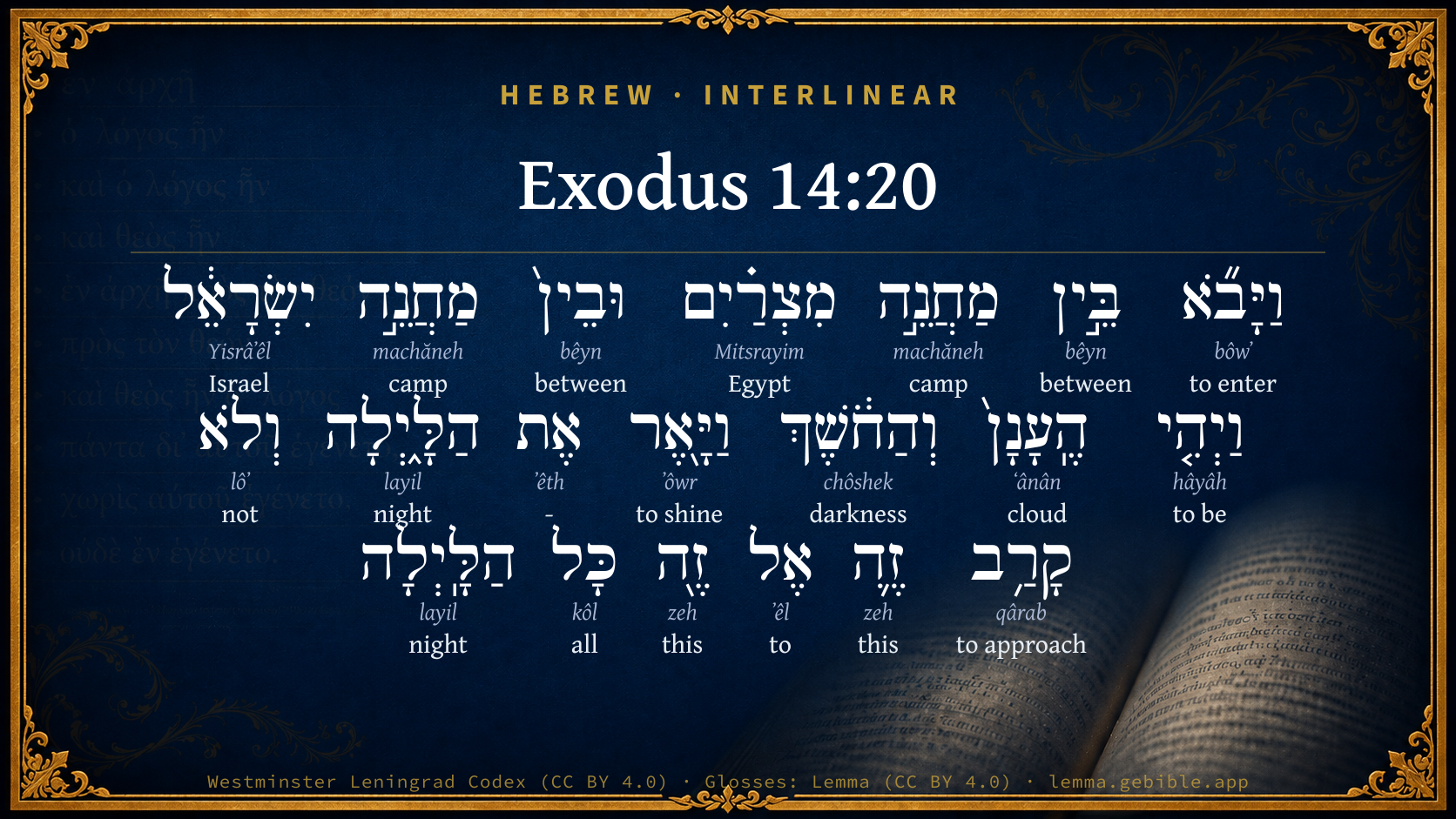
Hebrew (Westminster Leningrad Codex) Exodus 14:20 appears in the Hebrew Old Testament. The text above is from the Westminster Leningrad Codex. Each word links to its Strong’s number, a concise gloss, and parsing drawn from the Open Scriptures Hebrew Bible morphology. Click any word for its full Brown-Driver-Briggs (BDB) entry.
Download image
Cite this verse

Exodus 14:20 (World English Bible). Public Domain. Lemma interlinear Bible study tool, https://lemma.gebible.app/v/exodus/14/20.

Show BibTeX & RIS
BibTeX
RIS
English Translation
It came between the camp of Egypt and the camp of Israel; and there was the cloud and the darkness, yet gave it light by night: and the one didn't come near the other all the night.
World English Bible · Public Domain
Download a study sheet

One document with this verse’s original text, its word-by-word gloss line, the meaning frame, cross-references with their text, attributed commentary, and full source and license credits — printable, and it pastes into notes with its structure intact.

This verse Autodidact and up

Study sheet (.html) Plain text (.txt)

A passage Seminary Student

Up to 50 verses in one chapter. A passage sheet keeps up to 6 commentary sources and 12 cross-references per verse, in the order this page ranks them, and says so on the sheet whenever that leaves anything out. Ask for a single verse and you get the Autodidact verse sheet above.

Everything on this page stays free to read, with no account — the sheet is a download of what is already on screen, not access to it.

Want to remove ads? Support Godless Engineer
Compare translations 3

The same verse in 3 English versions, stacked beneath the original-language interlinear above. Click any original word for its lexicon entry.

Each is an independent rendering of the whole verse — the interlinear is not word-aligned to these translations.

Highlighted words mark where these versions differ — a whole-verse word diff, not a word-by-word alignment.

  • World English Bible Public Domain
    It came between the camp of Egypt and the camp of Israel; and there was the cloud and the darkness, yet gave it light by night: and the one didn't come near the other all the night.
  • King James Version Public Domain
    And it came between the camp of the Egyptians and the camp of Israel; and it was a cloud and darkness to them, but it gave light by night to these: so that the one came not near the other all the night.
  • unfoldingWord Literal Text CC BY-SA 4.0
    And it came between the camp of Egypt and the camp of Israel. And it became a cloud, and darkness, and it lit up the night, and one did not come near to the other all night.

unfoldingWord Literal Text — © unfoldingWord, licensed CC BY-SA 4.0. Word-aligned USFM3 via Door43 (git.door43.org/unfoldingWord/en_ult).

Versions to compare (up to 4)

3 of 4 selected

Show all 18 translations

Every available English version of this verse, each an independent rendering of the whole verse.

  • World English Bible Public Domain
    It came between the camp of Egypt and the camp of Israel; and there was the cloud and the darkness, yet gave it light by night: and the one didn't come near the other all the night.
  • Berean Standard Bible Public Domain
    so that it came between the camps of Egypt and Israel. The cloud was there in the darkness, but it lit up the night. So all night long neither camp went near the other.
  • Majority Standard Bible Public Domain
    so that it came between the camps of Egypt and Israel. The cloud was there in the darkness, but it lit up the night. So all night long neither camp went near the other.
  • King James Version Public Domain
    And it came between the camp of the Egyptians and the camp of Israel; and it was a cloud and darkness to them, but it gave light by night to these: so that the one came not near the other all the night.
  • American Standard Version (1901) Public Domain
    and it came between the camp of Egypt and the camp of Israel; and there was the cloud and the darkness, yet gave it light by night: and the one came not near the other all the night.
  • Revised Version (1885) Public Domain
    and it came between the camp of Egypt and the camp of Israel; and there was the cloud and the darkness, yet gave it light by night: and the one came not near the other all the night.
  • Geneva Bible (1599) Public Domain
    And came betweene the campe of the Egyptians and the campe of Israel: it was both a cloude and darkenes, yet gaue it light by night, so that all the night long the one came not at the other)
  • Douay-Rheims (1899) Public Domain
    Stood behind, between the Egyptians' camp and the camp of Israel: and it was a dark cloud, and enlightening the night, so that they could not come at one another all the night.
  • Young's Literal Translation Public Domain
    and cometh in between the camp of the Egyptians and the camp of Israel, and the cloud and the darkness are, and he enlighteneth the night, and the one hath not drawn near unto the other all the night.
  • Literal Standard Version CC BY-SA 4.0
    and comes in between the camp of the Egyptians and the camp of Israel, and the cloud and the darkness are, and he enlightens the night, and the one has not drawn near to the other all the night.
  • Unlocked Literal Bible CC BY-SA 4.0
    The cloud came between the camp of Egypt and the camp of Israel. It was a dark cloud to the Egyptians, but it lit the night for the Israelites, so one side did not come near the other all night.
  • unfoldingWord Literal Text CC BY-SA 4.0
    And it came between the camp of Egypt and the camp of Israel. And it became a cloud, and darkness, and it lit up the night, and one did not come near to the other all night.
  • Darby Bible Public Domain
    And it came between the camp of the Egyptians and the camp of Israel; and was a cloud and darkness, and lit up the night; and the one did not come near the other all the night.
  • World Messianic Bible Public Domain
    It came between the camp of Egypt and the camp of Israel. There was the cloud and the darkness, yet it gave light by night. One didn’t come near the other all night.
  • Webster's Bible Public Domain
    And it came between the camp of the Egyptians and the camp of Israel; and it was a cloud and darkness to them, but it gave light by night to these: so that the one came not near the other all the night.
  • Free Bible Version CC BY-SA 4.0
    so that it was positioned between the Egyptian and Israelite camps. The cloud was in darkness on one side, but it lit up the night on the other. No one from either camp went near the other during the night.
  • Bible in Basic English Public Domain
    And it came between the army of Egypt and the army of Israel; and there was a dark cloud between them, and they went on through the night; but the one army came no nearer to the other all the night.
  • JPS Tanakh (1917) Public Domain
    and it came between the camp of Egypt and the camp of Israel; and there was the cloud and the darkness here, yet gave it light by night there; and the one came not near the other all the night.

Literal Standard Version (2020), Covenant Press — licensed CC BY-SA 4.0. Text via the HelloAO Bible API (eBible.org). Unlocked Literal Bible (unfoldingWord) — licensed CC BY-SA 4.0. Text via the HelloAO Bible API (eBible.org). unfoldingWord Literal Text — © unfoldingWord, licensed CC BY-SA 4.0. Word-aligned USFM3 via Door43 (git.door43.org/unfoldingWord/en_ult). Free Bible Version, Dr. Jonathan Gallagher — licensed CC BY-SA 4.0. Text via the HelloAO Bible API (eBible.org).

Word by word

More ways to search: Search by grammar → Find every occurrence → Compare this word →

Practice this passage: Drill this verse → Learn its vocabulary →

וַיָּ֖אֶר
ʼôwr
H215
“and · to shine”
Conjunction + Verb, Hiphil, Sequential Imperfect, 3rd Person, Masculine, Singular
Part of Speech
Conjunction + Verb
Stem
Hiphil
Form
Sequential Imperfect
Person
3rd Person
Gender
Masculine
Number
Singular
Full BDB Definition

Origin: a primitive root

TWOT: 52

to be or become light, shine - (Qal) - to become light (day) - to shine (of the sun) - to become bright - (Niphal) - to be illuminated - to become lighted up - (Hiphil) - to give light, shine (of sun, moon, and stars) - to illumine, light up, cause to shine, shine - to kindle, light (candle, wood) - lighten (of the eyes, his law, etc) - to make shine (of the face)
  1. וַיָּבֹ֞א bôwʼ H935 “and · to enter” Conjunction + Verb, Qal, Sequential Imperfect, 3rd Person, Masculine, Singular
  2. בֵּ֣ין bêyn H996 “between” Preposition
  3. מַחֲנֵ֣ה machăneh H4264 “camp of” Noun, Common, Both, Singular, Construct
  4. מִצְרַ֗יִם Mitsrayim H4714 “Egypt” Noun, Proper
  5. וּבֵין֙ bêyn H996 “and · between” Conjunction + Preposition
  6. מַחֲנֵ֣ה machăneh H4264 “camp of” Noun, Common, Both, Singular, Construct
  7. יִשְׂרָאֵ֔ל Yisrâʼêl H3478 “Israel” Noun, Proper
  8. וַיְהִ֤י hâyâh H1961 “and · to be” Conjunction + Verb, Qal, Sequential Imperfect, 3rd Person, Masculine, Singular
  9. הֶֽעָנָן֙ ʻânân H6051 “the · cloud” Particle, Definite Article + Noun, Common, Masculine, Singular, Absolute
  10. וְהַחֹ֔שֶׁךְ chôshek H2822 “and · the · darkness” Conjunction + Particle, Definite Article + Noun, Common, Masculine, Singular, Absolute
  11. אֶת ʼêth H853 “-” Particle, Direct Object
  12. הַלָּ֑יְלָה layil H3915 “the · night” Particle, Definite Article + Noun, Common, Masculine, Singular, Absolute
  13. וְלֹא lôʼ H3808 “and · not” Conjunction + Particle, Negative
  14. קָרַ֥ב qârab H7126 “to approach” Verb, Qal, Perfect, 3rd Person, Masculine, Singular
  15. זֶ֛ה zeh H2088 “this” Pronoun, Demonstrative, Masculine, Singular
  16. אֶל ʼêl H413 “to” Preposition
  17. זֶ֖ה zeh H2088 “this” Pronoun, Demonstrative, Masculine, Singular
  18. כָּל kôl H3605 “all of” Noun, Common, Masculine, Singular, Construct
  19. הַלָּֽיְלָה layil H3915 “the · night” Particle, Definite Article + Noun, Common, Masculine, Singular, Absolute

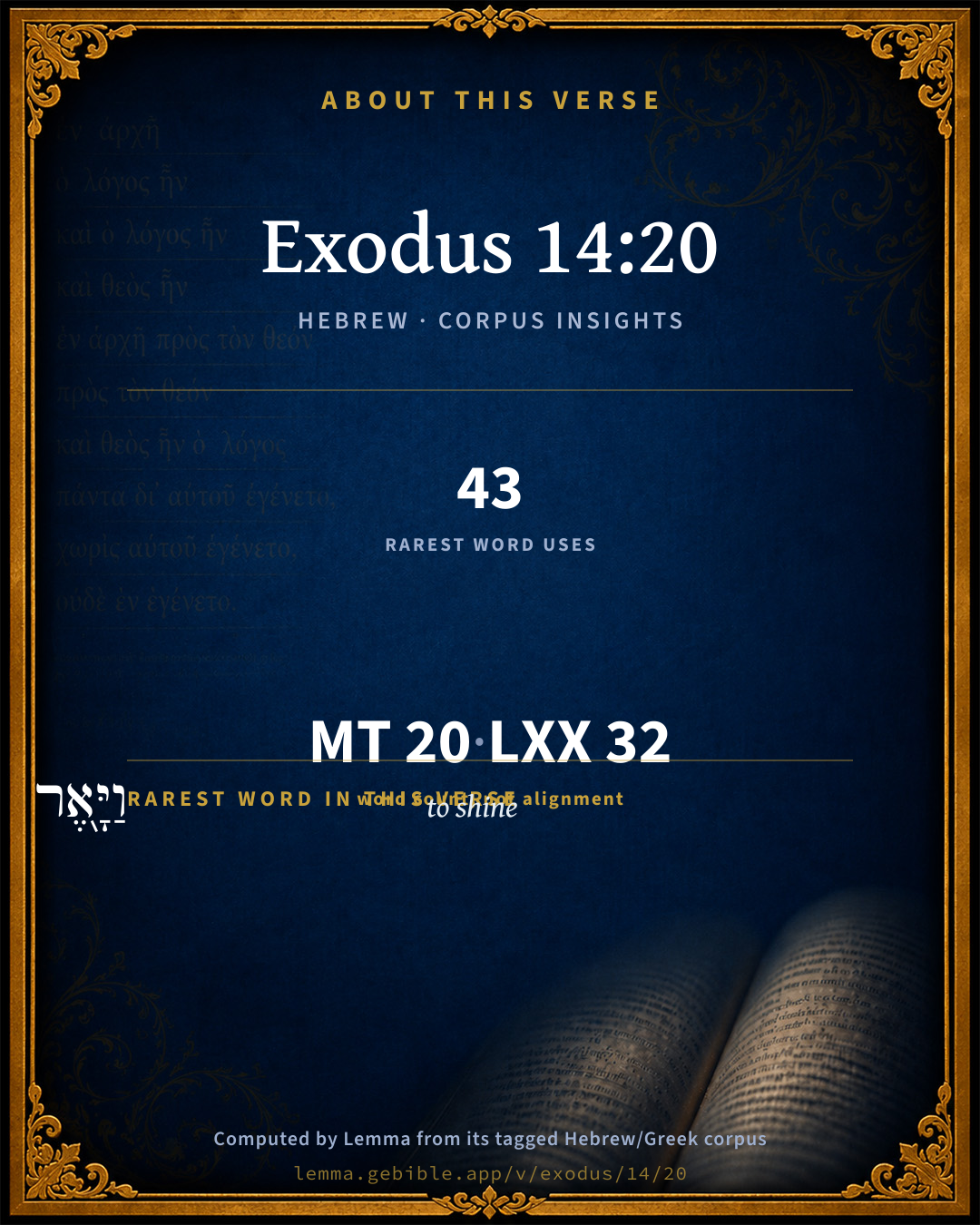
About this verse

These counts appear in no published source. They are computed here, from the morphology-tagged text and Lemma’s own curated glosses. What Lemma adds →

20
words
16
distinct lemmas
Pentateuch
section

Shared distinctive vocabulary

וַיָּ֖אֶר to shine H215 occurs in 43 verses of the Hebrew Bible. Also found in:

Grammatical profile

  • 4 verbs
  • 9 nouns
  • 2 pronouns
  • 3 prepositions
  • 2 particles

Verb forms

  • וַיָּבֹ֞א Qal · Sequential Imperfect
  • וַיְהִ֤י Qal · Sequential Imperfect
  • וַיָּ֖אֶר Hiphil · Sequential Imperfect
  • קָרַ֥ב Qal · Perfect

Repetition

Words recur within this verse — often emphatic in Hebrew:

  • בֵּ֣ין between H996 ×2
  • מַחֲנֵ֣ה camp H4264 ×2
  • הַלָּ֑יְלָה night H3915 ×2
  • זֶ֛ה this H2088 ×2

Hebrew & Septuagint length

In English translation the verse runs 37 words from the Hebrew and 38 from the Septuagint (LXX English) — closely comparable.

A rough comparison of the two English renderings, which tokenize alike — not a word-level alignment.

Word counts can differ between the Hebrew and the Greek without any difference in meaning — e.g. the Hebrew direct-object marker אֵת has no separate Greek word, and Greek often adds the article ὁ.

In the original languages it is 20 Hebrew tokens and 32 Greek tokens — but the two are counted differently (Hebrew bundles its prefixes and suffixes into one token; the Greek is in lemma form), so that isn’t a like-for-like length.

Cross-references

4

Topical passages linked to Exodus 14:20 in the Treasury of Scripture Knowledge — connected by theme and wording, ordered by reader-vote popularity; previews shown in the World English Bible.

  • Isaiah 8:14 He shall be for a sanctuary; but for a stone of stumbling and for a rock of offense to both the houses of Israel, for a gin and for a snare to the inhabitants of Jerusalem.
  • 2 Corinthians 2:15–16 For we are a sweet aroma of Christ to God, in those who are saved, and in those who perish;
  • Proverbs 4:18–19 But the path of the righteous is like the dawning light, That shines more and more until the perfect day.
  • Psalms 18:11 He made darkness his hiding-place, his pavilion around him, Darkness of waters, thick clouds of the skies.

Cross-references courtesy of OpenBible.info (CC BY 4.0).

Hebrew and Greek witnesses Masoretic Hebrew ↔ Greek Septuagint

The same verse in the two great witnesses to the Old Testament, shown verse-for-verse.

These are two independent witnesses, not word-aligned to each other, and the Septuagint is shown in lemma (dictionary) form.

Hebrew Exodus 14:20 Masoretic · Westminster Leningrad Codex

וַיָּבֹ֞א בֵּ֣ין מַחֲנֵ֣ה מִצְרַ֗יִם וּבֵין֙ מַחֲנֵ֣ה יִשְׂרָאֵ֔ל וַיְהִ֤י הֶֽעָנָן֙ וְהַחֹ֔שֶׁךְ וַיָּ֖אֶר אֶת הַלָּ֑יְלָה וְלֹא קָרַ֥ב זֶ֛ה אֶל זֶ֖ה כָּל הַלָּֽיְלָה

It came between the camp of Egypt and the camp of Israel; and there was the cloud and the darkness, yet gave it light by night: and the one didn't come near the other all the night.

World English Bible · Public Domain

Greek LXX Exodus 14:20 Septuagint · lemma form

καί εἰςἔρχομαι ἀνά μέσος ὁ παρεμβολή ὁ αἰγύπτιος καί ἀνά μέσος ὁ παρεμβολή ἰσραήλ καί ἵστημι καί γίγνομαι σκότος καί γνόφος καί διαἔρχομαι ὁ νύξ καί οὐ συνμίγνυμι ἀλλήλω ὅλος ὁ νύξ

And it went between the camp of the Egyptians and the camp of Israel, and stood; and there was darkness and blackness; and the night passed, and they came not near to one another during the whole night.

LXX2012 (modern English Septuagint) · Public Domain

On this verse, Keil & Delitzsch discusses the Septuagint’s reading. Read the note in Commentary ↓

Hebrew: Westminster Leningrad Codex (CC BY 4.0). Greek: Septuagint (public domain); English from LXX2012 (modern English Septuagint) (Public Domain). How the Septuagint differs from the Hebrew →

Targum (Aramaic paraphrase)

2

The Targum is the ancient Jewish Aramaic paraphrase of the Hebrew Scriptures — an interpretive translation, not the Hebrew text itself. Onkelos (literal) and Pseudo-Jonathan (expansive) render the Torah, and Jonathan the Prophets. Coverage is partial: where no permissively-licensed English translation exists for a verse, only the Aramaic is shown. This is verse-level text, not a word-by-word alignment to the Hebrew.

  1. Targum Onkelos Torah (Genesis–Deuteronomy)
    וְעַל בֵּין מַשְׁרִיתָא דְמִצְרָאֵי וּבֵין מַשְׁרִיתָא דְיִשְׂרָאֵל וַהֲוָה עֲנָנָא וְקַבְלָא לְמִצְרָאֵי וּלְיִשְׂרָאֵל נְהַר כָּל לֵילְיָא וְלָא אִתְקְרִיבוּ דֵין לְוָת דֵין כָּל לֵילְיָא:

    (no public-domain English translation for this verse)

    Targum Onkelos — Aramaic: “Onkelos Genesis” (public domain); “Onkelos Exodus” (public domain); “Onkelos Leviticus” (public domain); “Onkelos Numbers” (public domain); “Onkelos Deuteronomy” (public domain). English: “Sefaria Community Translation” (CC0 1.0 (public-domain dedication)); “J.W. Etheridge. The Targums of Onkelos and Jonathan Ben Uzziel on the Pentateuch. London: Longmans, Green, 1862” (public domain). Text via Sefaria.

  2. Targum Pseudo-Jonathan Torah (Genesis–Deuteronomy)
    וְאָעֵיל בֵּין מַשִׁירְיָתָא דְיִשְרָאֵל וּבֵין מַשִּׁירְיָתָא דְמִצְרָאֵי וַהֲוָה עֲנָנָא פַּלְגֵיהּ נְהוֹרָא וּפַלְגֵיהּ חֲשׁוֹכָא מִסִּטְרֵיהּ חָד מַחֲשָׁךְ עַל מִצְרָאֵי וּמִסִּטְרֵיהּ חָד אַנְהַר עַל יִשְרָאֵל כָּל לֵילְיָא וְלָא קְרָבָא מַשְׁרֵי כָּל קְבֵיל מַשְׁרֵי לִמְסַדְרָא סִדְרֵי קְרָבָא כָּל לֵילְיָא

    and it came between the host of Israel and the host of the Mizraee; a cloud, one half of which was light and one half darkness. On the one side it darkened upon the Mizraee, and on the other side it shined upon Israel all night; and one host did not attack the other all the night.

    Targum Pseudo-Jonathan — Aramaic: “Targum Jonathan on Genesis” (public domain); “Targum Jonathan on Exodus” (public domain); “Targum Jonathan on Leviticus” (public domain); “Targum Jonathan on Numbers” (public domain); “Targum Jonathan on Deuteronomy” (public domain). English: “The Targum of Jonathan ben Uzziel, trans. J. W. Etheridge, London, 1862” (public domain). Text via Sefaria.

Commentary

Notes on Exodus 14:20 from classic Christian and Jewish commentators (each source and its license shown beneath its notes). The classic Christian expositions comment on the surrounding passage and are grouped to its opening verse, so a note may address several verses; the Jewish commentaries on the Tanakh (Rashi and others) are per-verse, so they appear only where the commentator wrote on this verse.

Lemma curates 59 commentaries, every one of them public domain or Creative Commons licensed, each selected and text-cleaned for this edition rather than reprinted as found. About our sources →

Trapp's Complete Commentary

John Trapp

Exo 14:20 And it came between the camp of the Egyptians and the camp of Israel; and it was a cloud and darkness [to them], but it gave light by night [to these]: so that the one came not near the other all the night.

Ver. 20. A cloud and darkness to them.] {See Trapp on "Heb 12:2"}

John Trapp, A Commentary or Exposition upon All the Books of the Old and New Testament (1647–1656) — public domain. Text from a community e-Sword module.

Geneva Bible (1599)

Geneva Bible translators

The cloud showeth light to the Israelites, but to the Egyptians it was darkness, so that their two hosts could not join together.

Geneva Bible (1599) marginal notes — public domain. Text via Bolls.life.

Adam Clarke's Commentary

Verse 20. It was a cloud and darkness to them, c.] That the Israelites might not be dismayed at the appearance of their enemies, and that these might not be able to discern the object of their pursuit, the pillar of cloud moved from the front to the rear of the Israelitish camp, so as perfectly to separate between them and the Egyptians. It appears also that this cloud had two sides, one dark and the other luminous: the luminous side gave light to the whole camp of Israel during the night of passage and the dark side, turned towards the pursuing Egyptians, prevented them from receiving any benefit from that light. How easily can God make the same thing an instrument of destruction or salvation, as seems best to his godly wisdom! He alone can work by all agents, and produce any kind of effect even by the same instrument; for all things serve the purposes of his will.

Adam Clarke's Commentary on the Bible (1810–1826) — public domain. Text from a community e-Sword/MySword module.

The Cambridge Bible for Schools and Colleges

gen. ed. J. J. S. Perowne

20. and he came] viz. the ‘angel of God’ (v. 19a). ‘Came’ follows ‘went’ (v. 19a) better than ‘stood’ (v. 19b).

and there was, &c.] The rend. (in ‘yet’) is forced; the Heb. would naturally be rendered, and it lit up the night, viz. so as to deter the Egyptians from approaching the Israelites. There must be some error in the text. ‘And when it was dark, the cloud lit up the night’ (We.) would in itself yield a suitable sense: but the existing Heb. text is not an easy corruption of it. According to Jos_24:7 (E) Jehovah ‘put thick darkness [ma’ǎphçl] between’ the Egyptians and the Israelites.

The Cambridge Bible for Schools and Colleges (gen. ed. J. J. S. Perowne; Cambridge University Press, 1878–1918) — public domain. Text from a community e-Sword module.

John Gill's Exposition

And it came between the camp of the Egyptians and the camp of Israel,.... That is, the pillar of cloud, and the Angel of God, or Jehovah, in it, whereby the camp of Israel was secured from being annoyed by the camp of the Egyptians; and was an emblem of the gracious interposition of Christ between his spiritual Israel, whom he has redeemed by his blood, and their spiritual enemies, the Egyptians, the men of the world that hate them, from whose rage and malice Christ is their protection and safeguard:

and it was a cloud and darkness to them; to the Egyptians; it cast a shade upon them, and made the darkness of the night still greater to them, so that they could not see their way, and knew not where they were:

but it gave light by night to these; to the Israelites, so that they could see their way, and walk on in the midst of the sea, as on dry land; and such a light and guide they needed; for it was now the twenty first day of the month, seven days after the full of the moon, when the passover began, and therefore could have no benefit from the moon. The Targums of Jonathan and Jerusalem say, that half the cloud was light, and half darkness; and it seems plain from the account, that that side of it which was towards the Egyptians was dark, and that which was towards the Israelites was light, and so an hinderance to the one and a benefit to the other: thus Christ is set for the rising of some, and the fall of others; and his Gospel is to some the savour of death unto death, and to others the savour of life unto life; to the one it is a hidden Gospel, and lies in darkness and obscurity, and to others a great and glorious light:

so that one came not near the other all the night; an emblem of that division and separation which the grace of God, the blood of Christ, and the light of the Gospel, make between the true Israel of God, and the men of the world; and which will continue throughout time, and to all eternity, so that they will never come near to each other; see Luk 16:26.

John Gill's Exposition of the Whole Bible (1746–1763) — public domain (CC PDM 1.0). Text via the HelloAO Bible API.

Haydock's Catholic Bible Commentary

A dark cloud, and enlightening the night. It was a dark cloud to the Egyptians; but enlightened the night to the Israelites, by giving them a great light.

George Leo Haydock (1774–1849), Haydock's Catholic Family Bible and Commentary, 1859 edition — public domain. Excludes Psalms (Douay-Rheims chapter numbering differs from Protestant) and Deuterocanonical books (Catholic canon only).

Matthew Poole's English Annotations

It was a cloud and darkness to the Egyptians, to whom it brought their former horrible darkness to mind, and did both exceedingly affright them, and altogether hinder them from motion or action, as that also did for three days.

But it gave light by night to the Israelites, as the opposition showeth.

Matthew Poole's English Annotations on the Holy Bible (1683–1685) — public domain. Text from a community e-Sword/MySword module.

The Pulpit Commentary

It was a cloud and darkness to them, but it gave light by night to these. Though there is nothing in the Hebrew correspondent to the expressions to them," to these," yet the meaning seems to have been rightly apprehended By our translators. (See the Targums of Onkelos and Jonathan, the Syriac version, and among moderns, Knobel, Maurer, Rosenmuller, and Kalisch.)

The Pulpit Commentary (1880–1919), ed. H.D.M. Spence-Jones & Joseph S. Exell — public domain. Text from a community e-Sword module.

Keil & Delitzsch

C. F. Keil & F. Delitzsch

"And it was the cloud and the darkness (sc., to the Egyptians), and lighted up the night (sc., to the Israelites)." Fuit nubes partim lucida et partim tenebricosa, ex una parte tenebricosa fuit Aegyptiis, ex altera lucida Israelitis (Jonathan). Although the article is striking in והחשׁך, the difficulty is not to be removed, as Ewald proposes, by substituting והחשׁך, "and as for the cloud, it caused darkness;" for in that case the grammar would require the imperfect with ו consec. This alteration of the text is also rendered suspicious from the fact that both Onkelos and the lxx read and render the word as a substantive.

Keil & Delitzsch — Biblical Commentary on the Old Testament (1861–1891) — public domain (CC PDM 1.0). Text via the HelloAO Bible API. (Old Testament only.)

Rashi

Rabbi Shlomo Yitzchaki (Rashi)

ויבא בין מחנה מצרים AND IT CAME BETWEEN THE CAMP OF EGYPT — A parable: it may be compared to one who is proceeding on a journey, his son walking in front of him. If, now, brigands come to capture him (the son), he takes him away from in front of him and places him behind himself. If a wolf then comes behind him he places him again in front. If brigands come in front of him and wolves behind him, he places him on his arm and fights against them. Thus did God do for Israel, as it says, (Hosea 11:3) “I led Ephraim — He took them upon His arms” (Mekhilta).

ויהי הענן והחשך AND THERE WAS CLOUD AND DARKNESS to the Egyptians.

ויאר AND IT — the pillar of fire — ILLUMINATED the night for the Israelites, and went before them as was its way to go every night, whilst the darkness of the cloud was turned towards the Egyptians.

ולא קרב זה אל זה SO THAT ONE APPROACHED NOT ANOTHER — [This does not mean that one person did not approach another but]: this camp did not approach that camp (Mekhilta).

Rashi on the Tanakh — English translations: “The Judaica Press complete Tanach with Rashi, translated by A. J. Rosenberg” (CC BY 4.0); “Pentateuch with Rashi's commentary by M. Rosenbaum and A.M. Silbermann, 1929-1934” (public domain); “The Metsudah Tanach series, Lakewood, N.J” (CC BY 4.0); and “The Book of Joshua, Metsudah Publications, 1997” (CC BY 4.0). Text via Sefaria.

Lesson kit

Teaching starters — assembled from the data on this page, not authored interpretation. Every prompt links to the verse data it draws on. Edit before teaching.

Exodus, in the Pentateuch, opens this verse with 20 words (16 distinct Hebrew lemmas). Its most distinctive word is ʼôwr (“to shine”). A historical commentator’s framing appears above. Read the whole chapter for the surrounding context.

Discussion questions

  1. What does “to shine” (ʼôwr) contribute to the verse as a whole?
  2. How does Genesis 1:15, which shares the word «to shine», read alongside this verse?
  3. What does the repetition of “between” (2× in this one verse) do in this verse?
  4. These translations render this verse differently; the difference is in the English rendering, not the original. What questions does that raise?
  5. «וַיָּבֹ֞א» is a Qal Sequential Imperfect verb. How does that grammatical form shape the action described?
  6. Compare how Trapp's Complete Commentary and Geneva Bible (1599) read this verse. Where do they agree or differ?

Things to notice

Reading settings

Reading text

Shown beneath each verse's original-language words.

Old Testament
Old Testament edition

Read the OT as the Masoretic Hebrew (MT) or the Greek Septuagint (LXX).

English shown for the Greek Septuagint (in the Hebrew ↔ Greek comparison).

Comparing translations? Open the Compare panel on any verse page to stack up to four side by side.