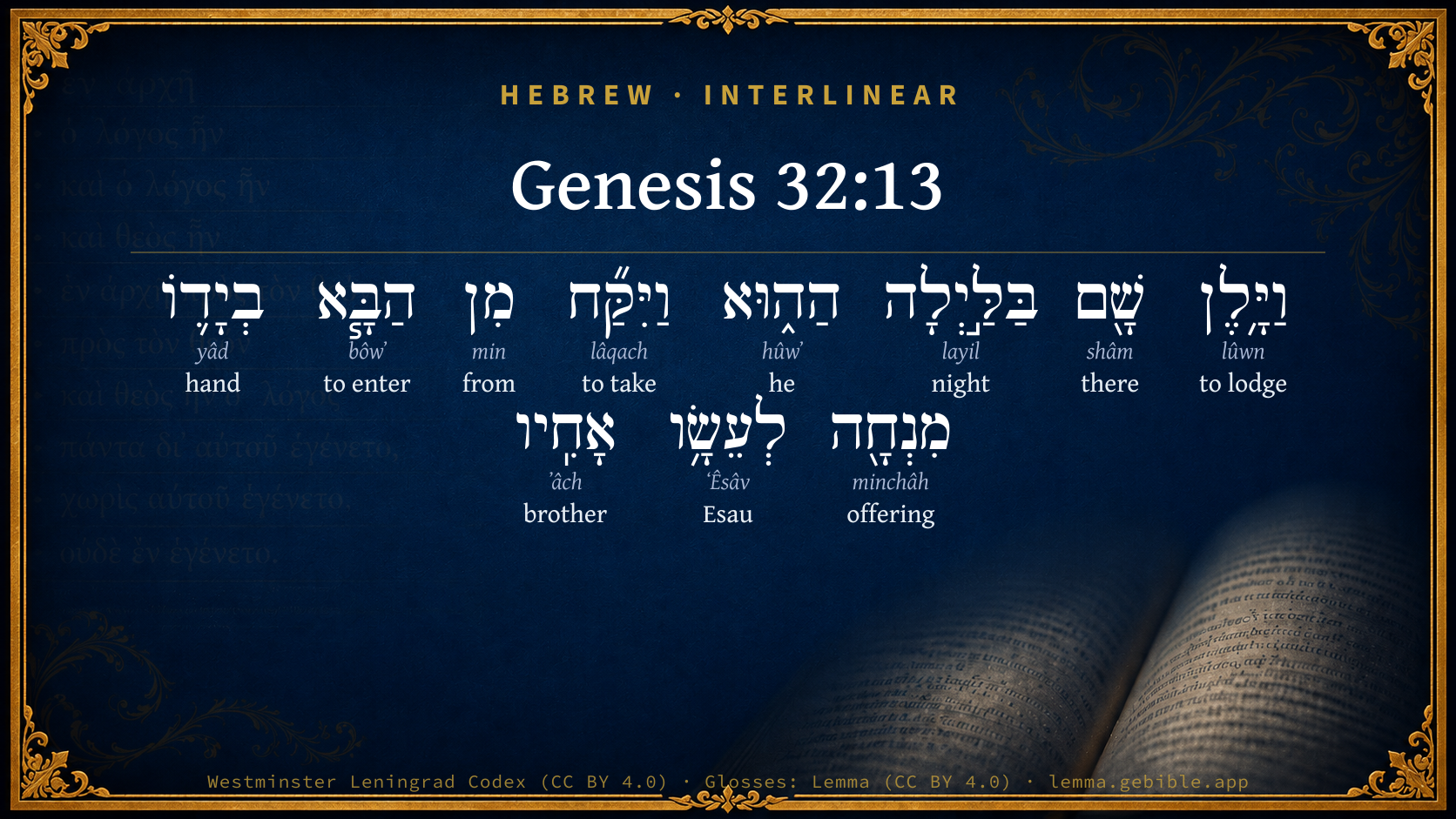
Genesis 32:13

Hebrew (Westminster Leningrad Codex) Genesis 32:13 appears in the Hebrew Old Testament. The text above is from the Westminster Leningrad Codex. Each word links to its Strong’s number, a concise gloss, and parsing drawn from the Open Scriptures Hebrew Bible morphology. Click any word for its full Brown-Driver-Briggs (BDB) entry.
Download image
Cite this verse

Genesis 32:13 (World English Bible). Public Domain. Lemma interlinear Bible study tool, https://lemma.gebible.app/v/genesis/32/13.

Show BibTeX & RIS
BibTeX
RIS
English Translation
He lodged there that night, and took from that which he had with him, a present for Esau, his brother:
World English Bible · Public Domain
Download a study sheet

One document with this verse’s original text, its word-by-word gloss line, the meaning frame, cross-references with their text, attributed commentary, and full source and license credits — printable, and it pastes into notes with its structure intact.

This verse Autodidact and up

Study sheet (.html) Plain text (.txt)

A passage Seminary Student

Up to 50 verses in one chapter. A passage sheet keeps up to 6 commentary sources and 12 cross-references per verse, in the order this page ranks them, and says so on the sheet whenever that leaves anything out. Ask for a single verse and you get the Autodidact verse sheet above.

Everything on this page stays free to read, with no account — the sheet is a download of what is already on screen, not access to it.

Want to remove ads? Support Godless Engineer
Compare translations 3

The same verse in 3 English versions, stacked beneath the original-language interlinear above. Click any original word for its lexicon entry.

Each is an independent rendering of the whole verse — the interlinear is not word-aligned to these translations.

Highlighted words mark where these versions differ — a whole-verse word diff, not a word-by-word alignment.

  • World English Bible Public Domain
    He lodged there that night, and took from that which he had with him, a present for Esau, his brother:
  • King James Version Public Domain
    And he lodged there that same night; and took of that which came to his hand a present for Esau his brother;
  • unfoldingWord Literal Text CC BY-SA 4.0
    Then he stayed there for that night, and he took gifts from what was in his hand for Esau his brother:

unfoldingWord Literal Text — © unfoldingWord, licensed CC BY-SA 4.0. Word-aligned USFM3 via Door43 (git.door43.org/unfoldingWord/en_ult).

Versions to compare (up to 4)

3 of 4 selected

Show all 18 translations

Every available English version of this verse, each an independent rendering of the whole verse.

  • World English Bible Public Domain
    He lodged there that night, and took from that which he had with him, a present for Esau, his brother:
  • Berean Standard Bible Public Domain
    Jacob spent the night there, and from what he had brought with him, he selected a gift for his brother Esau:
  • Majority Standard Bible Public Domain
    Jacob spent the night there, and from what he had brought with him, he selected a gift for his brother Esau:
  • King James Version Public Domain
    And he lodged there that same night; and took of that which came to his hand a present for Esau his brother;
  • American Standard Version (1901) Public Domain
    And he lodged there that night, and took of that which he had with him a present for Esau his brother:
  • Revised Version (1885) Public Domain
    And he lodged there that night; and took of that which he had with him a present for Esau his brother;
  • Geneva Bible (1599) Public Domain
    And he taryed there the same night, and tooke of that which came to had, a present for Esau his brother:
  • Douay-Rheims (1899) Public Domain
    And when he had slept there that night, he set apart, of the things which he had, presents for his brother Esau.
  • Young's Literal Translation Public Domain
    And he lodgeth there during that night, and taketh from that which is coming into his hand, a present for Esau his brother:
  • Literal Standard Version CC BY-SA 4.0
    And he lodges there during that night, and takes from that which is coming into his hand, a present for his brother Esau:
  • Unlocked Literal Bible CC BY-SA 4.0
    Jacob stayed there that night. He took some of what he had with him as a gift for Esau, his brother:
  • unfoldingWord Literal Text CC BY-SA 4.0
    Then he stayed there for that night, and he took gifts from what was in his hand for Esau his brother:
  • Darby Bible Public Domain
    And he lodged there that night; and took of what came to his hand a gift for Esau his brother --
  • World Messianic Bible Public Domain
    He stayed there that night, and took from that which he had with him a present for Esau, his brother:
  • Webster's Bible Public Domain
    And he lodged there that same night; and took of that which came to his hand a present for Esau, his brother;
  • Free Bible Version CC BY-SA 4.0
    Jacob stayed the night there. Then he picked out animals as a gift to his brother Esau:
  • Bible in Basic English Public Domain
    Then he put up his tent there for the night; and from among his goods he took, as an offering for his brother Esau,
  • JPS Tanakh (1917) Public Domain
    (32-14) And he lodged there that night; and took of that which he had with him a present for Esau his brother:

Literal Standard Version (2020), Covenant Press — licensed CC BY-SA 4.0. Text via the HelloAO Bible API (eBible.org). Unlocked Literal Bible (unfoldingWord) — licensed CC BY-SA 4.0. Text via the HelloAO Bible API (eBible.org). unfoldingWord Literal Text — © unfoldingWord, licensed CC BY-SA 4.0. Word-aligned USFM3 via Door43 (git.door43.org/unfoldingWord/en_ult). Free Bible Version, Dr. Jonathan Gallagher — licensed CC BY-SA 4.0. Text via the HelloAO Bible API (eBible.org).

Word by word

More ways to search: Search by grammar → Find every occurrence → Compare this word →

Practice this passage: Drill this verse → Learn its vocabulary →

וַיָּ֥לֶן
lûwn
H3885
“and · to lodge”
Conjunction + Verb, Qal, Sequential Imperfect, 3rd Person, Masculine, Singular
Part of Speech
Conjunction + Verb
Stem
Qal
Form
Sequential Imperfect
Person
3rd Person
Gender
Masculine
Number
Singular
Full BDB Definition

Origin: a primitive root

TWOT: 1096 , 1097

to lodge, stop over, pass the night, abide - (Qal) - to lodge, pass the night - to abide, remain (figuratively) - (Hiphil) to cause to rest or lodge - (Hithpalpel) to dwell, abide - to grumble, complain, murmur - (Niphal) to grumble - (Hiphil) to complain, cause to grumble
  1. שָׁ֖ם shâm H8033 “there” Adverb
  2. בַּלַּ֣יְלָה layil H3915 “in/at the · night” Preposition, Determined + Noun, Common, Masculine, Singular, Absolute
  3. הַה֑וּא hûwʼ H1931 “the · he” Particle, Definite Article + Pronoun, Personal, 3rd Person, Masculine, Singular
  4. וַיִּקַּ֞ח lâqach H3947 “and · to take” Conjunction + Verb, Qal, Sequential Imperfect, 3rd Person, Masculine, Singular
  5. מִן min H4480 “from” Preposition
  6. הַבָּ֧א bôwʼ H935 “the · entering” Particle, Definite Article + Verb, Qal, Participle Active, Masculine, Singular, Absolute
  7. בְיָד֛וֹ yâd H3027 “in/at · hand · his” Preposition + Noun, Common, Both, Singular, Construct + Suffix, Personal, 3rd Person, Masculine, Singular
  8. מִנְחָ֖ה minchâh H4503 “offering” Noun, Common, Feminine, Singular, Absolute
  9. לְעֵשָׂ֥ו ʻÊsâv H6215 “to/for · Esau” Preposition + Noun, Proper
  10. אָחִֽיו ʼâch H251 “brother · his” Noun, Common, Masculine, Singular, Construct + Suffix, Personal, 3rd Person, Masculine, Singular

About this verse

These counts appear in no published source. They are computed here, from the morphology-tagged text and Lemma’s own curated glosses. What Lemma adds →

11
words
11
distinct lemmas
Pentateuch
section

Grammatical profile

  • 3 verbs
  • 5 nouns
  • 1 pronoun
  • 1 preposition
  • 1 adverb

Verb forms

  • וַיָּ֥לֶן Qal · Sequential Imperfect
  • וַיִּקַּ֞ח Qal · Sequential Imperfect
  • הַבָּ֧א Qal · Participle Active

Hebrew & Septuagint length

In English translation the verse runs 20 words from the Hebrew and 23 from the Septuagint (LXX English) — closely comparable.

A rough comparison of the two English renderings, which tokenize alike — not a word-level alignment.

Word counts can differ between the Hebrew and the Greek without any difference in meaning — e.g. the Hebrew direct-object marker אֵת has no separate Greek word, and Greek often adds the article ὁ.

Cross-references

12

Topical passages linked to Genesis 32:13 in the Treasury of Scripture Knowledge — connected by theme and wording, ordered by reader-vote popularity; previews shown in the World English Bible.

  • Proverbs 18:16 A man's gift makes room for him, And brings him before great men.
  • Genesis 43:11 Their father, Israel, said to them, "If it be so now, do this. Take from the choice fruits of the land in your bags, and carry down a present for the man, a little balm, a little honey, spices and myrrh, nuts, and almonds;
  • Genesis 43:26 When Joseph came home, they brought him the present which was in their hand into the house, and bowed down themselves to him to the earth.
  • Proverbs 17:8 A bribe is a precious stone in the eyes of him who gives it; Wherever he turns, he prospers.
  • Proverbs 19:6 Many will entreat the favor of a ruler, And everyone is a friend to a man who gives gifts.
  • Proverbs 21:14 A gift in secret pacifies anger; And a bribe in the cloak, strong wrath.
  • Genesis 18:2 He lifted up his eyes and looked, and saw that three men stood opposite him. When he saw them, he ran to meet them from the tent door, and bowed himself to the earth,
  • Genesis 32:20–21 You shall say, 'Not only that, but behold, your servant, Jacob, is behind us.'" For, he said, "I will appease him with the present that goes before me, and afterward I will see his face. Perhaps he will accept me."
  • Genesis 33:10 Jacob said, "Please, no, if I have now found favor in your sight, then receive my present at my hand, because I have seen your face, as one sees the face of God, and you were pleased with me.
  • Genesis 42:6 Joseph was the governor over the land. It was he who sold to all the people of the land. Joseph's brothers came, and bowed themselves down to him with their faces to the earth.
  • 1 Samuel 25:8 Ask your young men, and they will tell you: therefore let the young men find favor in your eyes; for we come in a good day. Please give whatever comes to your hand, to your servants, and to your son David.
  • 1 Samuel 25:27 Now this present which your servant has brought to my lord, let it be given to the young men who follow my lord.

Cross-references courtesy of OpenBible.info (CC BY 4.0).

Hebrew and Greek witnesses Masoretic Hebrew ↔ Greek Septuagint

The same verse in the two great witnesses to the Old Testament, shown verse-for-verse.

These are two independent witnesses, not word-aligned to each other, and the Septuagint is shown in lemma (dictionary) form.

Hebrew Genesis 32:13 Masoretic · Westminster Leningrad Codex

וַיָּ֥לֶן שָׁ֖ם בַּלַּ֣יְלָה הַה֑וּא וַיִּקַּ֞ח מִן הַבָּ֧א בְיָד֛וֹ מִנְחָ֖ה לְעֵשָׂ֥ו אָחִֽיו

He lodged there that night, and took from that which he had with him, a present for Esau, his brother:

World English Bible · Public Domain

Greek LXX Genesis 32:13 Septuagint · lemma form

σύ δέ εἶπον καλῶς εὖ σύ ποιέω καί τίθημι ὁ σπέρμα σύ ὡς ὁ ἄμμος ὁ θάλασσα ὅς οὐ ἀριθμέω ἀπό ὁ πλῆθος

And he slept there that night, and took of the gifts which he carried with him, and sent out to Esau his brother,

LXX2012 (modern English Septuagint) · Public Domain

On this verse, The Pulpit Commentary discusses the Septuagint’s reading. Read the note in Commentary ↓

Hebrew: Westminster Leningrad Codex (CC BY 4.0). Greek: Septuagint (public domain); English from LXX2012 (modern English Septuagint) (Public Domain). How the Septuagint differs from the Hebrew →

Targum (Aramaic paraphrase)

2

The Targum is the ancient Jewish Aramaic paraphrase of the Hebrew Scriptures — an interpretive translation, not the Hebrew text itself. Onkelos (literal) and Pseudo-Jonathan (expansive) render the Torah, and Jonathan the Prophets. Coverage is partial: where no permissively-licensed English translation exists for a verse, only the Aramaic is shown. This is verse-level text, not a word-by-word alignment to the Hebrew.

  1. Targum Onkelos Torah (Genesis–Deuteronomy)
    וְאַתְּ אֲמַרְתָּ אוֹטָבָא אוֹטִיב עִמָּךְ וֶאֱשַׁוֵּי יָת בְּנָיךְ סַגִּיאִין כְּחַלָּא דְיַמָּא דִּי לָא יִתִּמְנוּן מִסַּגִּי

    (no public-domain English translation for this verse)

    Targum Onkelos — Aramaic: “Onkelos Genesis” (public domain); “Onkelos Exodus” (public domain); “Onkelos Leviticus” (public domain); “Onkelos Numbers” (public domain); “Onkelos Deuteronomy” (public domain). English: “Sefaria Community Translation” (CC0 1.0 (public-domain dedication)); “J.W. Etheridge. The Targums of Onkelos and Jonathan Ben Uzziel on the Pentateuch. London: Longmans, Green, 1862” (public domain). Text via Sefaria.

  2. Targum Pseudo-Jonathan Torah (Genesis–Deuteronomy)
    וְאַנְתְּ אַבְטַחְתָּנִי אוֹטָבָא אוֹטֵב עִמָךְ וַאֲשַׁוֵי יַת בְּנָךְ סַגִיאִין הֵי כְּחָלָא דְיַמָא דְלָא מִתְמְנֵי מִסְגֵי

    But Thou hast promised, I will surely do thee good, and will make thy sons many as the sand of the sea be numbered for that cannot be numbered for multitude.

    Targum Pseudo-Jonathan — Aramaic: “Targum Jonathan on Genesis” (public domain); “Targum Jonathan on Exodus” (public domain); “Targum Jonathan on Leviticus” (public domain); “Targum Jonathan on Numbers” (public domain); “Targum Jonathan on Deuteronomy” (public domain). English: “The Targum of Jonathan ben Uzziel, trans. J. W. Etheridge, London, 1862” (public domain). Text via Sefaria.

Commentary

Notes on Genesis 32:13 from classic Christian and Jewish commentators (each source and its license shown beneath its notes). The classic Christian expositions comment on the surrounding passage and are grouped to its opening verse, so a note may address several verses; the Jewish commentaries on the Tanakh (Rashi and others) are per-verse, so they appear only where the commentator wrote on this verse.

Lemma curates 59 commentaries, every one of them public domain or Creative Commons licensed, each selected and text-cleaned for this edition rather than reprinted as found. About our sources →

Matthew Henry's Commentary

Jacob, having piously made God his friend by a prayer, is here prudently endeavouring to make Esau his friend by a present. He had prayed to God to deliver him from the had of Esau, for he feared him; but neither did his fear sink into such a despair as dispirits for the use of means, nor did his prayer make him presume upon God's mercy, without the use of means. Note, When we have prayed to God for any mercy, we must second our prayers with our endeavours; else, instead of trusting god, we tempt him; we must so depend upon God's providence as to make use of our own prudence. "Help thyself, and God will help thee;" God answers our prayers by teaching us to order our affairs with discretion. To pacify Esau,

I. Jacob sent him a very noble present, not of jewels or fine garments (he had them not), but of cattle, to the number of 580 in all, Gen 32:13-15. Now, 1. It was an evidence of the great increase with which God had blessed Jacob that he could spare such a number of cattle out of his stock. 2. It was an evidence of his wisdom that he would willingly part with some, to secure the rest; some men's covetousness loses them more than ever it gained them, and, by grudging a little damage; skin for skin, and all that a man has, if he be a wise man, he will give for his life. 3. It was a present that he thought would be acceptable to Esau, who had traded so much in hunting wild beasts that perhaps he was but ill furnished with tame cattle with which to stock his new conquests. And we may suppose that the mixed colours of Jacob's cattle, ring-straked, speckled, and spotted, would please Esau's fancy. 4. He promised himself that by this present he should gain Esau's favour; for a gift commonly prospers, which way soever it turns (Pro 17:8), and makes room for a man (Pro 18:16); nay, it pacifies anger and strong wrath, Pro 21:14. Note, [1.] We must not despair of reconciling ourselves even to those that have been most exasperated against us; we ought not to judge men unappeasable, till we have tried to appease them. [2.] Peace and love, though purchased dearly, will prove a good bargain to the purchaser. Many a morose ill-natured man would have said, in Jacob's case, "Esau has vowed my death without cause, and he shall never be a farthing the better for me; I will see him far enough before I will send him a present:" but Jacob forgives and forgets.

II. He sent him a very humble message, which he ordered his servants to deliver in the best manner, Gen 32:17, Gen 32:18. They must call Esau their lord, and Jacob his servant; they must tell him the cattle they had was a small present which Jacob had sent him, as a specimen of his acquisitions while he was abroad. The cattle he sent were to be disposed of in several droves, and the servants that attended each drove were to deliver the same message, that the present might appear the more valuable, and his submission, so often repeated, might be the more likely to influence Esau. They must especially take care to tell him that Jacob was coming after (Gen 32:18-20), that he might not suspect he had fled through fear. Note, A friendly confidence in men's goodness may help to prevent the mischief designed us by their badness: if Jacob will seem not to be afraid of Esau, Esau, it may be hoped, will not be a terror to Jacob.

Matthew Henry's Commentary on the Whole Bible (1708–1710) — public domain (CC PDM 1.0). Text via the HelloAO Bible API.

Trapp's Complete Commentary

John Trapp

Gen 32:13 And he lodged there that same night; and took of that which came to his hand a present for Esau his brother;

Ver. 13. And took of that which came to his hand, &c.] Or, that was in his power. Such as he had, he sent. Silver and gold he had none; cattle he had, and of these he made no spare: for he knew that "a gift" (such a rich gift, especially) "maketh room for a man, and bringeth him before great ones". {Pro 18:16} And here Jacob, for our instruction, takes a right course, observes a right method; which is, to pray, and use means; to use means, and pray. Ora et labora, was the Emperor’s symbol; and, Admota manu invocanda est Minerva, the heathen’s proverb. "Why criest thou unto me?" saith God to Moses; {Exo 14:15} "speak unto the children of Israel, that they go forward." There was a fault: Moses craved help, but was not forward in the course whereby to make way for God’s help. So, "get thee up," saith God to praying Joshua; "wherefore liest thou thus upon thy face?" Israel hath sinned, and thou must go search, &c. {Jos 7:10-11} So, he that would have knowledge, must not only beg for it, but "dig for it," saith Solomon, out of his own experience. {Pro 2:3-5}

John Trapp, A Commentary or Exposition upon All the Books of the Old and New Testament (1647–1656) — public domain. Text from a community e-Sword module.

The Biblical Illustrator

Joseph S. Exell

Gen_32:13-20

A present for Esau.

Jacobs offering to Esau

1. Prudent disposition of presents must follow the preparation of them.

2. Good servants are fit helps unto good masters for ordering their affairs.

3. Order is as needful as matter unto prudence to pacifiy enraged enemies.

4. Wise masters must give instructions to servants for the prosperity of their own affairs.

5. Lawful instructions from masters must be strictly observed by servants.

6. Humble presentations of saints to lords of the world is comely to procure peace.

7. Frequent and gradual expressions of such goodness and humility is most likely to overcome them.

8. Faces of cruel men are hard to be reconciled unto the faces of the righteous.

9. By foregoing gifts and preventing grace from God, saints may gel a good look from such men.

10. Jacob and Jacobs children are forced so to seek peace in the world. (G. Hughes, B. D.)

The Biblical Illustrator, edited by Joseph S. Exell (c. 1880s–1900s) — public domain. Text from a community e-Sword module.

Joseph Benson's Commentary

Gen 32:13-16. A present for Esau his brother — As he prays and trusts in God, so he uses the means; and having piously made God his friend by prayer, prudently endeavours to make Esau his friend by a present. Put a space between drove and drove — To mitigate his displeasure by degrees.

Joseph Benson's Commentary on the Old and New Testaments (1811–1818) — public domain. Text from a community e-Sword module.

Tyndale Open Study Notes

Tyndale Open Resources

32:13-21 Taking a large portion of the wealth God had blessed him with (some 550 animals), Jacob prepared a gift to appease Esau’s anger and gain his favor.

Tyndale Open Study Notes — © Tyndale Open Resources, licensed CC BY-SA 4.0. Text via the HelloAO Bible API.

Geneva Bible (1599)

Geneva Bible translators

Not distrusting God’s assistance, but using such means as God had given him.

Geneva Bible (1599) marginal notes — public domain. Text via Bolls.life.

Jamieson, Fausset & Brown

Robert Jamieson, A. R. Fausset & David Brown

took . . . a present for Esau--Jacob combined active exertions with earnest prayer; and this teaches us that we must not depend upon the aid and interposition of God in such a way as to supersede the exercise of prudence and foresight. Superiors are always approached with presents, and the respect expressed is estimated by the quality and amount of the gift. The present of Jacob consisted of five hundred fifty head of cattle, of different kinds, such as would be most prized by Esau. It was a most magnificent present, skilfully arranged and proportioned. The milch camels alone were of immense value; for the she camels form the principal part of Arab wealth; their milk is a chief article of diet; and in many other respects they are of the greatest use.

Jamieson, Fausset & Brown — Commentary Critical and Explanatory on the Whole Bible (1871) — public domain (CC PDM 1.0). Text via the HelloAO Bible API.

Adam Clarke's Commentary

Verse 13. And took of that which came to his hand] הבא בידו habba beyado, which came under his hand, i.e., what, in the course of God's providence, came under his power.

Adam Clarke's Commentary on the Bible (1810–1826) — public domain. Text from a community e-Sword/MySword module.

John Calvin's Commentaries

13. And took of that which came to his hand. In endeavoring to appease his brother by presents, he does not act distrustfully, as if he doubted whether he should be safe under the protection of God. This, indeed, is a fault too common among men, that when they have prayed to God, they turn themselves hither and thither, and contrive vain subterfuges for themselves: whereas the principal advantage of prayer is, to wait for the Lord in silence and quietness. But the design of the holy man was not to busy and to vex himself, as one discontented with the sole help of God. For although he was certainly persuaded that to have God propitious to him would alone be sufficient, yet he did not omit the use of the means which were in his power, while leaving success in the hand of God. For though by prayer we cast our cares upon God, that we may have peaceful and tranquil minds; yet this security ought not to render us indolent. For the Lord will have all the aids which he affords us applied to use. But the diligence of the pious differs greatly from the restless activity of the world; because the world, relying on its own industry, independently of the blessing of God, does not consider what is right or lawful; moreover it is always in trepidation, and by its bustling, increases more and more its own disquietude. The pious, however, hoping for the success of their labor, only from the mercy of God, apply their minds in seeking out means, for this sole reason, that they may not bury the gifts of God by their own torpor. When they have discharged their duty, they still depend on the same grace of God; and when nothing remains which they can attempt, they nevertheless are at rest.

John Calvin's Commentaries (1540-1563) — public domain. Text from the Calvin Translation Society English edition (1840s-50s) via the Christian Classics Ethereal Library (ccel.org). Calvin's coverage is partial (roughly two-thirds of the Bible); uncommented books and verses are honest gaps, never fabricated. The 19th-century editor's footnotes and remarks are omitted so the notes are faithfully Calvin's own voice.

Ellicott's Commentary for English Readers

(13) He lodged there.—That is, at Mahanaim. On the first news of Esau’s approach in so hostile a manner, Jacob had divided his possessions into two main divisions, in the hope of saving at least one. He now, quieted by his prayer, makes more exact arrangements, selects a present for Esau of five hundred and fifty head of cattle, sends them forward with intervals between, that repeated impressions might soften his brother’s fierce mood, sees all his followers safely across the Jabbok, and remains alone behind to pray. As he thus placed everything in Esau’s power, faith seems to have regained the ascendancy over his fears, though he still takes every prudent measure for the safety of those whom he loved.

Of that which came to his hand.—Heb., of that which came in his hand. Some Jewish interpreters take the phrase literally, and suppose that it was precious stones; more truly it means “what he possessed,” or what he had with him. The phrase “which came to his hand” would imply that he made no selection, but took what came first in his way.

A Bible Commentary for English Readers, edited by Charles John Ellicott (1878–1897) — public domain. Text from a community e-Sword module.

The Cambridge Bible for Schools and Colleges

gen. ed. J. J. S. Perowne

13–21. Jacob’s Present to Esau

13. a present] Heb. minḥah. Cf. Gen_43:11; Gen_43:15. See note on Gen_4:3. Jacob hopes that a substantial present will turn away the resentment of his brother. Pro_18:16, “a man’s gift maketh room for him”; Gen_21:14, “a gift in secret pacifieth anger”; cf. Abigail’s present to David, 1Sa_25:18; 1Sa_25:27.

The Cambridge Bible for Schools and Colleges (gen. ed. J. J. S. Perowne; Cambridge University Press, 1878–1918) — public domain. Text from a community e-Sword module.

John Gill's Exposition

And he lodged there that same night,.... At Mahanaim, or some place near it:

and took of that which came to his hand; not what came next to hand, for what he did was with great deliberation, judgment, and prudence; wherefore the phrase signifies what he was possessed of, or was in his power, as Jarchi rightly interprets it:

a present for Esau his brother: in order to pacify him, gain his good will, and avert his wrath and displeasure, see Pro 18:16; though Jacob had prayed to God, committed himself and family to him, and left all with him, yet he thought it proper to make use of all prudential means and methods for his safety: God frequently works in and by means made use of: the account of the present follows.

John Gill's Exposition of the Whole Bible (1746–1763) — public domain (CC PDM 1.0). Text via the HelloAO Bible API.

Matthew Poole's English Annotations

Either that which was in his hand and power; or rather, that which was nearest at hand, and most ready for him, because the approaching night, and his own great fear, gave him not leave to make so scrupulous a choice as otherwise he would have made.

Matthew Poole's English Annotations on the Holy Bible (1683–1685) — public domain. Text from a community e-Sword/MySword module.

Whedon's Commentary on the Bible

Daniel D. Whedon

13. Of that which came to his hand — The present was a large and princely one, probably a very large proportion of all that he possessed. He would fain give all to be reconciled to his warlike brother, and will spare no pains or sacrifice on his part that his prayer may be answered. The skilful arrangement of this present, which was to go over before him, is thus noticed by Lange: “Observe: 1) The climax; goats, sheep, camels, cattle, asses. 2) The spaces (breathing places) between the droves. Each impression must be made, and its force felt by Esau, before the next comes on. 3) The ever-repeated form of homage; thy servant Jacob; a present; my lord Esau. 4) The final aim: friendly treatment; thy servant, Jacob himself, is behind us.”

Daniel D. Whedon (gen. ed.), Commentary on the Old and New Testaments (1874–1909) — public domain. Text from a community e-Sword module.

The Pulpit Commentary

And he lodged there that same night; and took not by random, but after careful selection; separavit (Vulgate)of that which came to his hand not of those things which were in his hand, wn eferen (LXX), such as he had (Ainsworth), quae in mann erant (Rosenm but of such things as had come into his hand, i.e. as he had acquired (Keil, Alford, "Speaker"s Commentary," Inglis)a present (Minchah; used in Gen_4:3, Gen_4:4, Gen_4:5, as a sacrifice to Jehovah, q.v.) for Esau his brother.

Vers. 13-23.

The crisis at hand.

Jacob understood the human heart.

I KINDNESS WILL WORK WONDERS. "I will appease him with the present that goeth before me, and afterward I will see his face." It gave Esau time to think of an altered state of things, a changed brother, and his own brotherly affection, not entirely destroyed.

II IMPORTUNITY IN DOING GOOD. The repeated strokes upon the iron changes its nature. We may learn a lesson from Jacob to prepare human hearts for the reception of the gospel by the same importunity. Kind deeds and kind words will often open the way for a more direct face-to-face pleading for God.

III EXPERIENCE SANCTIFIES. The trials of Jacob"s life were working a deeper and more loving wisdom working out the more selfish craft, and transmuting the natural features of a character, far from pure and simple at first, into such as blended more really with the work of grace. So in the course of pro vide nce family cares and anxieties deliver us from lower thoughts, or may do so, if we serve God, and help us to walk steadfastly in the way of faith.

IV THE TRUE LOVE PROVIDES FOR ITS OBJECTS. The shepherd with his flocks, and family, with his little bands of precious ones, fearing for them, and yet working for them, and putting them before him in the hands of God, is a type of the great Shepherd of the sheep, who was "not ashamed to call them brethren;" and saying, as he stood in their midst, partaker of their infirmities, representative of their wants and sorrows, guardian of their safety, will put my trust in him. Behold I and the children which God hath given me". (Heb_2:13)

V THE TWO WORLDS. If Esau be taken as a type of the kingdoms of this world threatening the kingdom of God, Jacob represents the little flock to whom the promise of victory and peace has been given. The true mediator must be left alone by the ford Jabbok. The place of his intercession and prevailing is where none of the people is with him, can be with him. R.

The Pulpit Commentary (1880–1919), ed. H.D.M. Spence-Jones & Joseph S. Exell — public domain. Text from a community e-Sword module.

John Wesley's Explanatory Notes

Jacob having piously made God his friend by a prayer, is here prudently endeavouring to make Esau his friend by a present. He had prayed to God to deliver him from the hand of Esau - His prayer did not make him presume upon God's mercy, without the use of means.

John Wesley, Explanatory Notes Upon the Whole Bible (1754–1765) — public domain. Text via the GEBible commentary corpus.

Kretzmann's Popular Commentary

Paul E. Kretzmann

The Presents to Esau

v. 13. And he lodged there that same night, he encamped in that place for the night; and took of that which came to his hand a present for Esau, his brother;

v. 14. two hundred she-goats, and twenty he-goats, two hundred ewes, and twenty rams,

v. 15. thirty milch camels with their colts, forty-nine, and ten bulls, twenty she-asses, and ten foals. The prayer had calmed the excited mind of Jacob to such an extent that he now took measures, not to flee, but to meet Esau, and to overcome him with love. The selection and the apportionment of the animals showed Jacob’s experience in cattle-raising, just as the arrangement of each small caravan indicated his wisdom, for he placed the smallest and least valuable animals first, and the more valuable in the rear.

v. 16. And he delivered them in to the hand of his servants, every drove by themselves; and said unto his servants, Pass over before me, and put a space betwixt drove and drove. There was literally a breathing space between the various small bands as they traveled along, just enough room to make a new impression every time, and thus to increase the force, the effect of the offered present.

v. 17. And he commanded the foremost, saying, When Esau, my brother, meeteth thee, and asketh thee, saying, Whose art thou? And whither goest thou? And whose are these before thee?

v. 18. then thou shalt say, They be thy servant Jacob’s; it is a present sent unto my lord Esau; and, behold, also he is behind us. The careful instruction of each servant as to the form of homage which he was to show to Esau, the repetition of the formula which called Jacob a servant and Esau lord, together with the offering of the presents all these were calculated to overcome Esau’s anger gradually.

v. 19. And so commanded he the second, and the third, and all that followed the droves, saying, On this manner shall ye speak unto Esau when ye find him.

v. 20. And say ye moreover, Behold, thy servant Jacob is behind us. It was the cumulative effect of the atoning presents that Jacob counted on to make the impression on Esau, the humble mention of the servant Jacob being very effective as the climax. For he said, I will appease him with the present that goeth before me, and afterward I will see his face; peradventure he will accept of me. Jacob called his presents gifts of atonement, for they were intended to cover the face of Esau so that he would no longer see the offense which Jacob had committed against him. Esau’s mind being taken up by the presents, he would no longer think of Jacob’s guilt, but would lift up his face in kindness and receive him with his favor.

v. 21. So went the present over before him; and himself lodged that night in the company. Night travel was nothing unusual in the East, so Jacob sent the small bands of presents off to the south at once, probably before nightfall, while he himself remained in camp for a while.

v. 22. And he rose up that night, and took his two wives, and his two women-servants, and his eleven sons, and passed over the ford Jabbok. Jacob’s anxiety did not permit him to rest very long. Before the night had advanced very far, he took the members of his family and transferred them to the south side of the Jabbok, at the ford which is about eighteen miles from the Jordan.

v. 23. And he took them, and sent them over the brook, and sent over that he had. So the tents were struck, and the entire caravan was on its way toward the south. Thus Jacob had made all the necessary arrangements, had done what he could to appease his brother, and could await the outcome of his plans with a more confident heart. It is nothing but a matter of simple wisdom to agree with adversaries as soon as possible, to offer them the hand of reconciliation, to appease them with kindness.

Paul E. Kretzmann, Popular Commentary of the Bible (1921–1924) — public domain. Text from a community e-Sword module.

unfoldingWord translationNotes

Door43 World Missions Community

two hundred

"200" (See: Numbers)

twenty ... thirty ... forty ... ten

"20 ... 30 ... 40 ... 10" (See: Numbers)

their colts

"their young"

These he gave these into the hand of his servants, every herd by itself

Here "into the hand" means to give control over them. AT: "He divided them into small herds, and gave each of his servants control over one herd" (See: Idiom)

put a space between each of the herds

"let each herd travel at a distance from the other herds"

translationWords

Jacob

gift

goat

ewe

camel

cow

servant

flocks

unfoldingWord translationNotes — © Distant Shores Media and the Door43 World Missions Community, licensed CC BY-SA 4.0. Source: git.door43.org/Door43/en_tn.

Rashi

Rabbi Shlomo Yitzchaki (Rashi)

היטב איטיב I WILL SURELY DO [THEE] GOOD — The use of two words denoting “doing good” is intended to signify: היטב doing good to thee on account of your own merits, איטיב I will also do good to thee on account of your father’s merits (Genesis Rabbah 76:7).

ושמתי את זרעך כחול הים AND I WILL MAKE THY SEED AS THE SAND OF THE SEA — Where, indeed, did God promise him this? Did he not promise him only (Genesis 28:14) “And thy seed shall be as the dust of the earth"? But the explanation is that He had at the same time promised him (Genesis 28:15) “for I will not leave thee until I have done that which I have spoken about thee”, and to Abraham he had promised (Genesis 22:17) “and I will greatly multiply thy seed as the stars of heaven and as the sand which is upon the seashore”.

Rashi on the Tanakh — English translations: “The Judaica Press complete Tanach with Rashi, translated by A. J. Rosenberg” (CC BY 4.0); “Pentateuch with Rashi's commentary by M. Rosenbaum and A.M. Silbermann, 1929-1934” (public domain); “The Metsudah Tanach series, Lakewood, N.J” (CC BY 4.0); and “The Book of Joshua, Metsudah Publications, 1997” (CC BY 4.0). Text via Sefaria.

Ramban (Nachmanides)

Rabbi Moshe ben Nachman (Ramban / Nachmanides)

AND THOU SAIDST: I WILL SURELY DO THEE GOOD. Even though he was afraid lest the sin cause him to lose that which he was promised, Jacob said: “You have done great kindnesses for me even though I was unworthy of them. Certainly You will do for me this undeserved kindness which You have promised me, namely, that You will bestow good upon me and increase my seed. My sin should not withhold from me the good You have promised me, for in the beginning I was also unworthy of it had You marked against me mine iniquities. And You did not promise it to me on account of my deeds, but only out of Your abundant mercies.”And some commentators say that Jacob had compassion for his children and household lest Esau smite them, because he did not know whether the promise, And thy seed shall be as the dust of the earth, applied to these or to others, it being possible that he himself would escape and have additional children. But in my opinion this is not correct, for if this was his thought, how did he say in his prayer, And Thou saidst: I will surely do thee good and make thy seed as the sand of the sea? Moreover, it was told to him in Beth-el, And behold, I am with thee, and will keep thee whithersoever thou goest, and I will bring thee back into this land. If his children were to fall before his brother’s sword, this promise would not be fulfilled, and it is to this promise that Jacob alluded when he said, And Thou saidst: I will surely do thee good. Similarly with the promise, And I will do thee good: all this Jacob said on the basis of it having been said to him, And I will be with thee., 31:3. But all his misgivings were on account of the fear of sin, for it is the way of the righteous to be always fearful. Thus Jacob was fearful that perhaps even after he left Haran, he sinned by entering into a covenant with Laban, who was an idol-worshipper, or in some other matter, and Who can discern errors?

Ramban (Nachmanides) on the Tanakh — English translation: “Commentary on the Torah by Ramban (Nachmanides). Translated and annotated by Charles B. Chavel. New York, Shilo Pub. House, 1971-1976” (CC BY 4.0). Text via Sefaria.

Radak

Rabbi David Kimhi (Radak)

ואתה אמרת, Yaakov’s formulation is reminiscent of that of David in Psalms 119,49 “remember Your word to Your servant through which You have given me hope.”

היטב אטיב עמך, it is the custom for Scripture to write the verb in the infinitive mode together with the appropriate mode of the verb in order to reinforce what the verb expresses. According to Bereshit Rabbah 76,7 the word היטב refers to G’d’s support for Yaakov based on his merits, whereas the word איטיב refers to G’d’s support for him based on the merit of his father and grandfather.

כחול הים, an inaccuracy, as in the verse Yaakov referred to G’d had promised that his descendents would be as numerous as the “dust of the earth,” not like the sand on the beaches of the sea. (28,14) The change in syntax is irrelevant, as we explained repeatedly that when the Torah repeats the same theme with different words, the reason is not to alert the reader to an additional dimension of the message, but only to stress the message, to draw attention to its importance.

Radak on the Tanakh — English translations: “Sefaria Community Translation” (CC0 1.0 (public-domain dedication)); “Eliyahu Munk, HaChut Hameshulash” (CC BY 4.0); “Rabbi Mike Feuer, Jerusalem Anthology” (CC BY 4.0); and “R. David Kimhi on the first book of Psalms, Translated by R.G. Finch, London, 1919” (public domain). Text via Sefaria.

Lesson kit

Teaching starters — assembled from the data on this page, not authored interpretation. Every prompt links to the verse data it draws on. Edit before teaching.

Genesis, in the Pentateuch, opens this verse with 11 words (11 distinct Hebrew lemmas). Its most distinctive word is lûwn (“to lodge”). A historical commentator’s framing appears above. Read the whole chapter for the surrounding context.

Discussion questions

  1. The word lûwn carries the sense “to lodge.” How does it shape the verse?
  2. How does Proverbs 18:16, which shares this passage’s theme, read alongside this verse?
  3. These translations render this verse differently; the difference is in the English rendering, not the original. What questions does that raise?
  4. «וַיָּ֥לֶן» is a Qal Sequential Imperfect verb. How does that grammatical form shape the action described?
  5. Compare how Matthew Henry's Commentary and Trapp's Complete Commentary read this verse. Where do they agree or differ?

Things to notice

Reading settings

Reading text

Shown beneath each verse's original-language words.

Old Testament
Old Testament edition

Read the OT as the Masoretic Hebrew (MT) or the Greek Septuagint (LXX).

English shown for the Greek Septuagint (in the Hebrew ↔ Greek comparison).

Comparing translations? Open the Compare panel on any verse page to stack up to four side by side.