Genesis 15:12

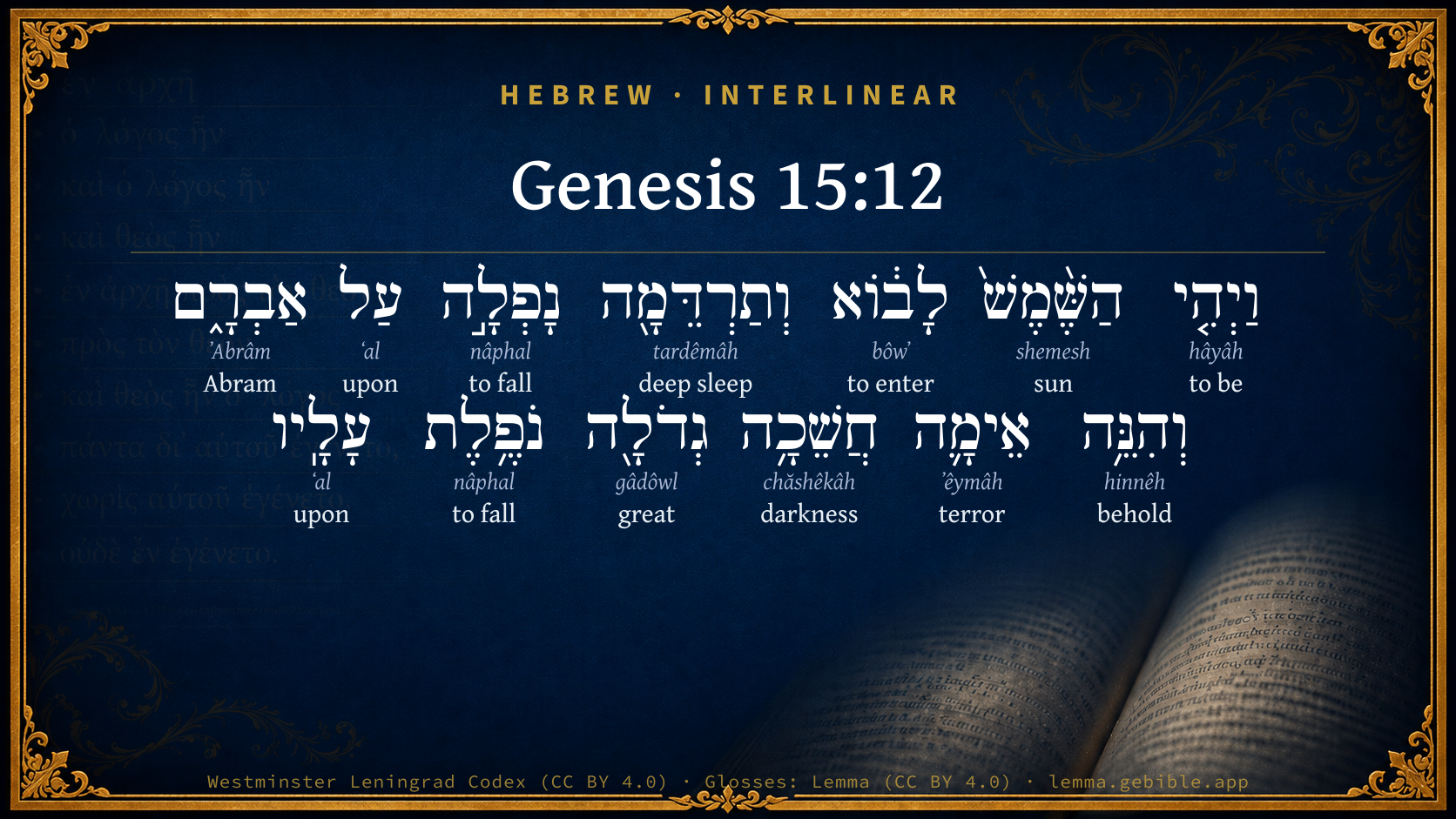
Hebrew (Westminster Leningrad Codex) Genesis 15:12 appears in the Hebrew Old Testament. The text above is from the Westminster Leningrad Codex. Each word links to its Strong’s number, a concise gloss, and parsing drawn from the Open Scriptures Hebrew Bible morphology. Click any word for its full Brown-Driver-Briggs (BDB) entry.
Download image
Cite this verse

Genesis 15:12 (World English Bible). Public Domain. Lemma interlinear Bible study tool, https://lemma.gebible.app/v/genesis/15/12.

Show BibTeX & RIS
BibTeX
RIS
English Translation
When the sun was going down, a deep sleep fell on Abram. Now terror and great darkness fell on him.
World English Bible · Public Domain
Highlights
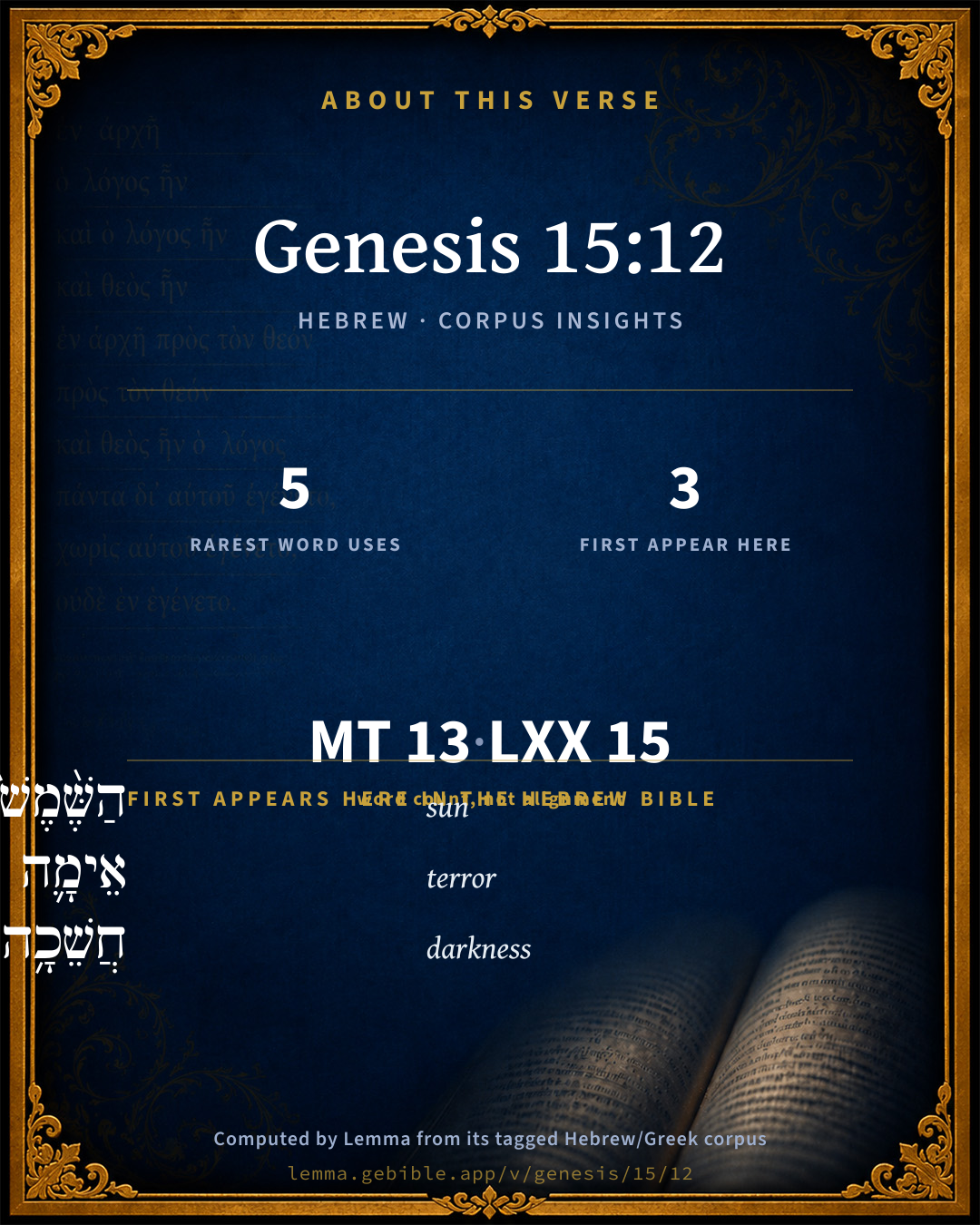
  • 3 first appearances in the Hebrew Bible
Full analysis ↓
Download a study sheet

One document with this verse’s original text, its word-by-word gloss line, the meaning frame, cross-references with their text, attributed commentary, and full source and license credits — printable, and it pastes into notes with its structure intact.

This verse Autodidact and up

Study sheet (.html) Plain text (.txt)

A passage Seminary Student

Up to 50 verses in one chapter. A passage sheet keeps up to 6 commentary sources and 12 cross-references per verse, in the order this page ranks them, and says so on the sheet whenever that leaves anything out. Ask for a single verse and you get the Autodidact verse sheet above.

Everything on this page stays free to read, with no account — the sheet is a download of what is already on screen, not access to it.

Want to remove ads? Support Godless Engineer
Compare translations 3

The same verse in 3 English versions, stacked beneath the original-language interlinear above. Click any original word for its lexicon entry.

Each is an independent rendering of the whole verse — the interlinear is not word-aligned to these translations.

Highlighted words mark where these versions differ — a whole-verse word diff, not a word-by-word alignment.

  • World English Bible Public Domain
    When the sun was going down, a deep sleep fell on Abram. Now terror and great darkness fell on him.
  • King James Version Public Domain
    And when the sun was going down, a deep sleep fell upon Abram; and, lo, an horror of great darkness fell upon him.
  • unfoldingWord Literal Text CC BY-SA 4.0
    And it happened, the sun was setting and a deep sleep fell on Abram, and behold, terror great darkness fell on him.

unfoldingWord Literal Text — © unfoldingWord, licensed CC BY-SA 4.0. Word-aligned USFM3 via Door43 (git.door43.org/unfoldingWord/en_ult).

Versions to compare (up to 4)

3 of 4 selected

Show all 18 translations

Every available English version of this verse, each an independent rendering of the whole verse.

  • World English Bible Public Domain
    When the sun was going down, a deep sleep fell on Abram. Now terror and great darkness fell on him.
  • Berean Standard Bible Public Domain
    As the sun was setting, Abram fell into a deep sleep, and suddenly great terror and darkness overwhelmed him.
  • Majority Standard Bible Public Domain
    As the sun was setting, Abram fell into a deep sleep, and suddenly great terror and darkness overwhelmed him.
  • King James Version Public Domain
    And when the sun was going down, a deep sleep fell upon Abram; and, lo, an horror of great darkness fell upon him.
  • American Standard Version (1901) Public Domain
    And when the sun was going down, a deep sleep fell upon Abram; and, lo, a horror of great darkness fell upon him.
  • Revised Version (1885) Public Domain
    And when the sun was going down, a deep sleep fell upon Abram; and, lo, an horror of great darkness fell upon him.
  • Geneva Bible (1599) Public Domain
    And when the sunne went downe, there fell an heauie sleepe vpon Abram: and loe, a very fearefull darkenes fell vpon him.
  • Douay-Rheims (1899) Public Domain
    And when the sun was setting, a deep sleep fell upon Abram, and a great and darksome horror seized upon him.
  • Young's Literal Translation Public Domain
    And the sun is about to go in, and deep sleep hath fallen upon Abram, and lo, a terror of great darkness is falling upon him;
  • Literal Standard Version CC BY-SA 4.0
    And the sun is about to go in, and deep sleep has fallen on Abram, and behold, a terror of great darkness is falling on him;
  • Unlocked Literal Bible CC BY-SA 4.0
    Then when the sun was going down, Abram fell sound asleep and, behold, a deep and terrifying darkness overwhelmed him.
  • unfoldingWord Literal Text CC BY-SA 4.0
    And it happened, the sun was setting and a deep sleep fell on Abram, and behold, terror great darkness fell on him.
  • Darby Bible Public Domain
    And as the sun was just going down, a deep sleep fell upon Abram; and behold, a horror, a great darkness, fell upon him.
  • World Messianic Bible Public Domain
    When the sun was going down, a deep sleep fell on Abram. Now terror and great darkness fell on him.
  • Webster's Bible Public Domain
    And when the sun was going down, a deep sleep fell upon Abram; and lo, a horror of great darkness fell upon him.
  • Free Bible Version CC BY-SA 4.0
    As the sun went down, a deep sleep came over Abram, and at the same time a dense and terrifying darkness fell on him.
  • Bible in Basic English Public Domain
    Now when the sun was going down, a deep sleep came on Abram, and a dark cloud of fear.
  • JPS Tanakh (1917) Public Domain
    And it came to pass, that, when the sun was going down, a deep sleep fell upon Abram; and, lo, a dread, even a great darkness, fell upon him.

Literal Standard Version (2020), Covenant Press — licensed CC BY-SA 4.0. Text via the HelloAO Bible API (eBible.org). Unlocked Literal Bible (unfoldingWord) — licensed CC BY-SA 4.0. Text via the HelloAO Bible API (eBible.org). unfoldingWord Literal Text — © unfoldingWord, licensed CC BY-SA 4.0. Word-aligned USFM3 via Door43 (git.door43.org/unfoldingWord/en_ult). Free Bible Version, Dr. Jonathan Gallagher — licensed CC BY-SA 4.0. Text via the HelloAO Bible API (eBible.org).

Word by word

More ways to search: Search by grammar → Find every occurrence → Compare this word →

Practice this passage: Drill this verse → Learn its vocabulary →

חֲשֵׁכָ֥ה
chăshêkâh
H2825
“darkness”
Noun, Common, Feminine, Singular, Absolute
Part of Speech
Noun
Type
Common
Gender
Feminine
Number
Singular
State
Absolute
Full BDB Definition

Origin: from H2821

TWOT: 769c

darkness
  1. וַיְהִ֤י hâyâh H1961 “and · to be” Conjunction + Verb, Qal, Sequential Imperfect, 3rd Person, Masculine, Singular
  2. הַשֶּׁ֨מֶשׁ֙ shemesh H8121 “the · sun” Particle, Definite Article + Noun, Common, Both, Singular, Absolute
  3. לָב֔וֹא bôwʼ H935 “to enter” Preposition + Verb, Qal, Infinitive Construct
  4. וְתַרְדֵּמָ֖ה tardêmâh H8639 “and · deep sleep” Conjunction + Noun, Common, Feminine, Singular, Absolute
  5. נָפְלָ֣ה nâphal H5307 “to fall” Verb, Qal, Perfect, 3rd Person, Feminine, Singular
  6. עַל ʻal H5921 “upon” Preposition
  7. אַבְרָ֑ם ʼAbrâm H87 “Abram” Noun, Proper
  8. וְהִנֵּ֥ה hinnêh H2009 “and · behold” Conjunction + Particle, Demonstrative
  9. אֵימָ֛ה ʼêymâh H367 “terror” Noun, Common, Feminine, Singular, Absolute
  10. גְדֹלָ֖ה gâdôwl H1419 “great” Adjective, Adjective, Feminine, Singular, Absolute
  11. נֹפֶ֥לֶת nâphal H5307 “falling” Verb, Qal, Participle Active, Feminine, Singular, Absolute
  12. עָלָֽיו ʻal H5921 “upon · him” Preposition + Suffix, Personal, 3rd Person, Masculine, Singular

About this verse

These counts appear in no published source. They are computed here, from the morphology-tagged text and Lemma’s own curated glosses. What Lemma adds →

13
words
11
distinct lemmas
Pentateuch
section

Notable vocabulary

The rarest word here is חֲשֵׁכָ֥ה darkness H2825 — appearing just 5 times in the whole Hebrew Bible.

First appearance in Scripture

These words make their first canonical appearance in the Hebrew Bible here:

  • הַשֶּׁ֨מֶשׁ֙ sun H8121
  • אֵימָ֛ה terror H367
  • חֲשֵׁכָ֥ה darkness H2825

Shared distinctive vocabulary

חֲשֵׁכָ֥ה darkness H2825 occurs in 5 verses of the Hebrew Bible. Also found in:

Grammatical profile

  • 4 verbs
  • 5 nouns
  • 1 adjective
  • 2 prepositions
  • 1 particle

Verb forms

  • וַיְהִ֤י Qal · Sequential Imperfect
  • לָב֔וֹא Qal · Infinitive Construct
  • נָפְלָ֣ה Qal · Perfect
  • נֹפֶ֥לֶת Qal · Participle Active

Repetition

Words recur within this verse — often emphatic in Hebrew:

  • נָפְלָ֣ה to fall H5307 ×2
  • עַל upon H5921 ×2

Hebrew & Septuagint length

In English translation the verse runs 20 words from the Hebrew and 17 from the Septuagint (LXX English) — closely comparable.

A rough comparison of the two English renderings, which tokenize alike — not a word-level alignment.

Word counts can differ between the Hebrew and the Greek without any difference in meaning — e.g. the Hebrew direct-object marker אֵת has no separate Greek word, and Greek often adds the article ὁ.

In the original languages it is 13 Hebrew tokens and 15 Greek tokens — but the two are counted differently (Hebrew bundles its prefixes and suffixes into one token; the Greek is in lemma form), so that isn’t a like-for-like length.

Cross-references

7

Topical passages linked to Genesis 15:12 in the Treasury of Scripture Knowledge — connected by theme and wording, ordered by reader-vote popularity; previews shown in the World English Bible.

  • Genesis 2:21 Yahweh God caused a deep sleep to fall on the man, and he slept; and he took one of his ribs, and closed up the flesh in its place.
  • Job 33:15 In a dream, in a vision of the night, When deep sleep falls on men, In slumbering on the bed;
  • Daniel 10:8–9 So I was left alone, and saw this great vision, and there remained no strength in me; for my comeliness was turned in me into corruption, and I retained no strength.
  • 1 Samuel 26:12 So David took the spear and the jar of water from Saul's head; and they got them away: and no man saw it, nor knew it, neither did any awake; for they were all asleep, because a deep sleep from Yahweh was fallen on them.
  • Job 4:13–14 In thoughts from the visions of the night, When deep sleep falls on men,
  • Psalms 4:3–5 But know that Yahweh has set apart for himself him who is godly: Yahweh will hear when I call to him.
  • Acts 9:8–9 Saul arose from the ground, and when his eyes were opened, he saw no one. They led him by the hand, and brought him into Damascus.

Cross-references courtesy of OpenBible.info (CC BY 4.0).

Hebrew and Greek witnesses Masoretic Hebrew ↔ Greek Septuagint

The same verse in the two great witnesses to the Old Testament, shown verse-for-verse.

These are two independent witnesses, not word-aligned to each other, and the Septuagint is shown in lemma (dictionary) form.

Hebrew Genesis 15:12 Masoretic · Westminster Leningrad Codex

וַיְהִ֤י הַשֶּׁ֨מֶשׁ֙ לָב֔וֹא וְתַרְדֵּמָ֖ה נָפְלָ֣ה עַל אַבְרָ֑ם וְהִנֵּ֥ה אֵימָ֛ה חֲשֵׁכָ֥ה גְדֹלָ֖ה נֹפֶ֥לֶת עָלָֽיו

When the sun was going down, a deep sleep fell on Abram. Now terror and great darkness fell on him.

World English Bible · Public Domain

Greek LXX Genesis 15:12 Septuagint · lemma form

περί δέ ἥλιος δυσμή ἔκστασις ἐπιπίπτω ὁ αβραμ καί ἰδού φόβος σκοτεινός μέγας ἐπιπίπτω αὐτός

And about sunset a trance fell upon Abram, and behold! a great gloomy terror falls upon him.

LXX2012 (modern English Septuagint) · Public Domain

On this verse, The Cambridge Bible for Schools and Colleges discusses the Septuagint’s reading. Read the note in Commentary ↓

Hebrew: Westminster Leningrad Codex (CC BY 4.0). Greek: Septuagint (public domain); English from LXX2012 (modern English Septuagint) (Public Domain). How the Septuagint differs from the Hebrew →

Targum (Aramaic paraphrase)

2

The Targum is the ancient Jewish Aramaic paraphrase of the Hebrew Scriptures — an interpretive translation, not the Hebrew text itself. Onkelos (literal) and Pseudo-Jonathan (expansive) render the Torah, and Jonathan the Prophets. Coverage is partial: where no permissively-licensed English translation exists for a verse, only the Aramaic is shown. This is verse-level text, not a word-by-word alignment to the Hebrew.

  1. Targum Onkelos Torah (Genesis–Deuteronomy)
    וַהֲוָה שִׁמְשָׁא לְמֵיעַל וְשִׁינְתָא נְפָלַת עַל אַבְרָם וְהָא אֵימָתָא קְבֵל סַגִי נְפָלַת עֲלוֹהִי

    (no public-domain English translation for this verse)

    Targum Onkelos — Aramaic: “Onkelos Genesis” (public domain); “Onkelos Exodus” (public domain); “Onkelos Leviticus” (public domain); “Onkelos Numbers” (public domain); “Onkelos Deuteronomy” (public domain). English: “Sefaria Community Translation” (CC0 1.0 (public-domain dedication)); “J.W. Etheridge. The Targums of Onkelos and Jonathan Ben Uzziel on the Pentateuch. London: Longmans, Green, 1862” (public domain). Text via Sefaria.

  2. Targum Pseudo-Jonathan Torah (Genesis–Deuteronomy)
    וַהֲוָה שִׁמְשָׁא קָרִיבָא לְמִיטְמוֹעַ וְשִׁינְתָא עֲמִיקְתָא מִתְרַמְיַית עַל אַבְרָם וְהָא אַרְבַּע מַלְכְּוָון קַיְימִין לְמִשַׁעֲבְּדָא יַת בְּנוֹי אֵימְתָא דָא הוּא בָּבֶל קַבָּלָא דָא הוּא מָדַי סַגִיאָה דָא הוּא יָוָן נָפְלָה דָא הוּא פָרָס דַעֲתִידָא לְמֵיפַּל וְלֵית לֵיהּ זְקִיפָא וּמִתַּמָן עֲתִידִין לְמֵיסַק עַמָא בֵּית יִשְרָאֵל

    And when the sun was nearing to set, a deep sleep was thrown upon Abram: and, behold, four kingdoms arose to enslave his children: Terror, which is Bavel; Darkness, which is Madai; Greatness, which is Javan; Decline, which is Pheras, which is to fall, and to have no uplifting, and from whence it is to be that the children of Israel will come up.

    Targum Pseudo-Jonathan — Aramaic: “Targum Jonathan on Genesis” (public domain); “Targum Jonathan on Exodus” (public domain); “Targum Jonathan on Leviticus” (public domain); “Targum Jonathan on Numbers” (public domain); “Targum Jonathan on Deuteronomy” (public domain). English: “The Targum of Jonathan ben Uzziel, trans. J. W. Etheridge, London, 1862” (public domain). Text via Sefaria.

Commentary

Notes on Genesis 15:12 from classic Christian and Jewish commentators (each source and its license shown beneath its notes). The classic Christian expositions comment on the surrounding passage and are grouped to its opening verse, so a note may address several verses; the Jewish commentaries on the Tanakh (Rashi and others) are per-verse, so they appear only where the commentator wrote on this verse.

Lemma curates 59 commentaries, every one of them public domain or Creative Commons licensed, each selected and text-cleaned for this edition rather than reprinted as found. About our sources →

Trapp's Complete Commentary

John Trapp

Gen 15:12 And when the sun was going down, a deep sleep fell upon Abram; and, lo, an horror of great darkness fell upon him.

Ver. 12. And when the sun was going down] Heb., When he was ready to enter, to wit, into his "bride chamber". {Psa 19:6}

John Trapp, A Commentary or Exposition upon All the Books of the Old and New Testament (1647–1656) — public domain. Text from a community e-Sword module.

The Biblical Illustrator

Joseph S. Exell

Gen_15:12

An horror of great darkness fell upon him

Abrams horror in the night

Abrams condition here may be looked upon in two aspects.

1. As indicating the chequered experience of the good.

2. As suggesting solemn facts in mans existence.

I. MAN HAS A SOUL.

II. MANS SOUL IS IN A FALLEN CONDITION.

III. MANS SOUL, THOUGH IN A FALLEN CONDITION, IS STILL ACCESSIBLE TO ITS MAKER. In His communication now to Abram, God must have impressed the patriarch with four things concerning Himself.

1. His infinite intelligence.

2. His righteous control.

3. His special regard for His people.

4. That he, individually, should be taken care of. (Homilist.)

Watching and visions

What was the meaning of that vision of fire?

I. IT INDICATED THE ACCEPTANCE OF THE OFFERINGS.

II. The furnace may be taken also as referring to PURIFICATION, and the lamp to DIVINE LIGHT AND GUIDANCE.

1. Significant of the Divine treatment of the descendants of Abraham.

2. Illustrating the course of the spiritual descendants of Abraham--the true Israel--the Christian Church.

3. The life and work of Christ were shadowed forth in that smoking furnace and burning lamp. Abraham rejoiced to see Christs day.

4. An illustration of the character of the life of individual believers. In life, trial and joy must be intermingled. (F. Hastings.)

I. WHAT ABRAM HEARD.

1. The word of the Lord. Revelation, commandment

2. Mode of communication. In a vision. The word of the Lord needs now no vision. How little of the word of the Lord Abram had. But here was a word addressed to him personally.

3. Time. Immediately after the record of Abrahams courage, etc.

4. Subject of the communication.

(1) Encouragement: Fear not, shield, reward.

(2) Promise: A son. Numerous posterity, Fulfilled in the Jews, but more particularly in believers--the spiritual seed of Abram. Though not addressed to us by name, as this word to Abram, the word of the Lord is for us. Of salvation, comfort, precept, promise, doctrine. A more sure word of prophecy. Do we prize the word of the Lord? seek to understand? practise it?

II. WHAT ABRAM DID.

1. He believed God. Some men need much evidence and argument before they give mental assent to the word they hear. Abram had little evidence. God spoke, and Abram believed.

2. He prepared the animals and birds (see Jer_34:18-20). Thepassing between the divided parts of sacrificial offerings, the most solemn confirmation of words and covenants (see especially Heb_6:13-17).

3. He watched and guarded the victims thus dedicated. Would not suffer unclean birds to alight near them. The profound reverence with which he regarded this act and command of God. His faith thoroughly practical.

4. He slept. It was in a vision he had heard the word, now in a vision he should behold its solemn ratification. Did not sleep until he had discharged his duty.

III. WHAT ABRAM SAW. A horror of great darkness had fallen upon him. The hour, the work the circumstances, filled him with awe. He expected he hardly knew what. The profound darkness would make the light that appeared more visible.

1. He saw a lamp of fire. The sacred symbol of the Divine presence. The Shekinah.

2. He saw the fire pass between the victims. He knew no more solemn confirmation of words than this. God in His infinite condescension adopted the method of ratifying His word, which Abram, adopting to confirm his own promise, would have regarded as a most solemn oath.

3. This solemn assurance was combined with the repetition of the promise not only as previously given, but with detail and enlargement (15-21). Learn--

I. To regard with thankfulness this record of the Divine word which has come to us.

II. Christ is the true and final sin offering. The Divine presence was in that sacrifice.

III. God was in Christ, as the lamp was among these victims. And speaking merciful words of promise and pardon to us.

IV. Christ Jesus is the Word of God. Henceforth we hear no man, save Jesus only. (J. C. Gray.)

The Biblical Illustrator, edited by Joseph S. Exell (c. 1880s–1900s) — public domain. Text from a community e-Sword module.

Joseph Benson's Commentary

Gen 15:12. And when the sun was going down — About the time of the evening oblation; for, he abode by them, praying and waiting till toward evening; a deep sleep fell upon Abram — Not a common sloop through weariness or carelessness, but a divine ecstasy, that, being wholly taken off from things sensible, he might be wholly taken up with the contemplation of things spiritual. And lo, a horror of great darkness fell upon him — This was designed to strike an awe upon the spirit of Abram, and to possess him with a holy reverence. Holy fear prepares the soul for holy joy; God humbles first, and then lifts up.

Joseph Benson's Commentary on the Old and New Testaments (1811–1818) — public domain. Text from a community e-Sword module.

Geneva Bible (1599)

Geneva Bible translators

Hebrew, a fear of great darkness.

Geneva Bible (1599) marginal notes — public domain. Text via Bolls.life.

Matthew Henry's Commentary

We have here a full and particular discovery made to Abram of God's purposes concerning his seed. Observe,

I. The time when God came to him with this discovery: When the sun was going down, or declining, about the time of the evening oblation, Kg1 18:36; Dan 9:21. Early in the morning, before day, while the stars were yet to be seen, God had given him orders concerning the sacrifices (Gen 15:5), and we may suppose it was, at least, his morning's work to prepare them and set them in order; when he had done this, he abode by them, praying and waiting till towards evening. Note, God often keeps his people long in expectation of the comforts he designs them, for the confirmation of their faith; but though the answers of prayer, and the performance of promises, come slowly, yet they come surely. At evening time it shall be light.

II. The preparatives for this discovery. 1. A deep sleep fell upon Abram, not a common sleep through weariness or carelessness, but a divine ecstasy, like that which the Lord God caused to fall upon Adam (Gen 2:21), that, being hereby wholly taken off from the view of things sensible, he might be wholly taken up with the contemplation of things spiritual. The doors of the body were locked up, that the soul might be private and retired, and might act the more freely and like itself. 2. With this sleep, a horror of great darkness fell upon him. How sudden a change! But just before we had him solacing himself in the comforts of God's covenant, and in communion with him; and here a horror of great darkness falls upon him. Note, The children of light do not always walk in the light, but sometimes clouds and darkness are round about them. This great darkness, which brought horror with it, was designed, (1.) To strike an awe upon the spirit of Abram, and to possess him with a holy reverence, that the familiarity to which God was pleased to admit him might not breed contempt. Note, Holy fear prepares the soul for holy joy; the spirit of bondage makes way for the spirit of adoption. God wounds first, and then heals; humbles first, and they lifts up, Isa 6:5, Isa 6:6, etc. (2.) To be a specimen of the methods of God's dealings with his seed. They must first be in the horror and darkness of Egyptian slavery, and then enter with joy into the good land; and therefore he must have the foretaste of their sufferings, before he had the foresight of their happiness. (3.) To be an indication of the nature of that covenant of peculiarity which God was now about to make with Abram. The Old Testament dispensation, which was founded on that covenant, was a dispensation, [1.] Of darkness and obscurity, Co2 3:13, Co2 3:14. [2.] Of dread and horror, Heb 12:18, etc.

III. The prediction itself. Several things are here foretold.

1. The suffering state of Abram's seed for a long time, Gen 15:13. Let not Abram flatter himself with the hopes of nothing but honour and prosperity in his family; no, he must know, of a surety, that which he was loth to believe, that the promised seed should be a persecuted seed. Note, God sends the worst first; we must first suffer, and then reign. He also lets us know the worst before it comes, that when it comes it may not be a surprise to us, Joh 16:4. Now we have here,

(1.) The particulars of their sufferings. [1.] They shall be strangers; so they were, first in Canaan (Psa 105:12) and afterwards in Egypt; before they were lords of their own land they were strangers in a strange land. The inconveniences of an unsettled state make a happy settlement the more welcome. Thus the heirs of heaven are first strangers on earth, a land that is not theirs. [2.] They shall be servants; so they were to the Egyptians, Exo 1:13. See how that which was the doom of the Canaanites (Gen 9:25) proves the distress of Abram's seed: they are made to serve, but with this difference, the Canaanites serve under a curse, the Hebrews under a blessing; and the upright shall have dominion in the morning, Psa 49:14. [3.] They shall be suffers. Those whom they serve shall afflict them; see Exo 1:11. Note, Those that are blessed and beloved of God are often sorely afflicted by wicked men; and God foresees it, and takes cognizance of it.

(2.) The continuance of their sufferings - four hundred years. This persecution began with mocking, when Ishmael, the son of an Egyptian, persecuted Isaac, who was born after the Spirit, Gen 21:9; Gal 4:29. It continued in loathing; for it was an abomination to the Egyptians to eat bread with the Hebrews, Gen 43:32; and it came at last to murder, the basest of murders, that of their new-born children; so that, more or less, it continued 400 years, though, in extremity, not so many. This was a long time, but a limited time.

2. The judgment of the enemies of Abram's seed: That nation whom they shall serve, even the Egyptians, will I judge, Gen 15:14. This points at the plagues of Egypt, by which God not only constrained the Egyptians to release Israel, but punished them for all the hardships they had put upon them. Note, (1.) Though God may suffer persecutors and oppressors to trample upon his people a great while, yet he will certainly reckon with them at last; for his day is coming, Psa 37:12, Psa 37:13. (2.) The punishing of persecutors is the judging of them: it is a righteous thing with God, and a particular act of justice, to recompense tribulations to those that trouble his people. The judging of the church's enemies is God's work: I will judge. God can do it, for he is the Lord; he will do it, for he is his people's God, and he has said, Vengeance is mine, I will repay. To him therefore we must leave it, to be done in his way and time.

3. The deliverance of Abram's seed out of Egypt. That great event is here foretold: Afterwards shall they come out with great substance. It is here promised, (1.) That they should be enlarged: Afterwards they shall come out; that is, either after they have been afflicted 400 years, when the days of their servitude are fulfilled, or after the Egyptians are judged and plagued, then they may expect deliverance. Note, The destruction of oppressors is the redemption of the oppressed; they will not let God's people go till they are forced to it. (2.) That they should be enriched: They shall come out with great substance; this was fulfilled, Exo 12:35, Exo 12:36. God took care they should have, not only a good land to go to, but a good stock to carry with them.

4. Their happy settlement in Canaan, Gen 15:16. They shall not only come out of Egypt, but they shall come hither again, hither to the land of Canaan, wherein thou now art. The discontinuance of their possession shall be no defeasance of their right: we must not reckon those comforts lost for ever that are intermitted for a time. The reason why they must not have the land of promise in possession till the fourth generation was because the iniquity of the Amorites was not yet full. Israel cannot be possessed of Canaan till the Amorites be dispossessed; and they are not yet ripe for ruin. The righteous God has determined that they shall not be cut off till they have persisted in sin so long, and arrived at such a pitch of wickedness, that there may appear some equitable proportion between their sin and their ruin; and therefore, till it come to that, the seed of Abram must be kept out of possession. Note, (1.) The measure of sin fills gradually. Those that continue impenitent in wicked ways are treasuring up unto themselves wrath. (2.) Some people's measure of sin fills slowly. The Sodomites, who were sinners before the Lord exceedingly, soon filled their measure; so did the Jews, who were, in profession, near to God. But the iniquity of the Amorites was long in the filling up. (3.) That this is the reason of the prosperity of wicked people; the measure of their sins is not yet full. The wicked live, become old, and are mighty in power, while God is laying up their iniquity for their children, Job 21:7, Job 21:19. See Mat 23:32; Deu 32:34.

5. Abram's peaceful quiet death and burial, before these things should come to pass, Gen 15:15. As he should not live to see that good land in the possession of his family, but must die, as he lived, a stranger in it, so, to balance this, he should not live to see the troubles that should come upon his seed, much less to share in them. This is promised to Josiah, Kg2 22:20. Note, Good men are sometimes greatly favoured by being taken away from the evil to come, Isa 57:1. Let this satisfy Abram, that, for his part,

(1.) He shall go to his fathers in peace. Note, [1.] Even the friends and favourites of Heaven are not exempted from the stroke of death. Are we greater than our father Abram, who is dead? Joh 8:53. [2.] Good men die willingly; they are not fetched, they are not forced, but they go; their soul is not required, as the rich fool's (Luk 12:20), but cheerfully resigned: they would not live always. [3.] At death we go to our fathers, to all our fathers that have gone before us to the state of the dead (Job 21:32, Job 21:33), to our godly fathers that have gone before us to the state of the blessed, Heb 12:23. The former thought helps to take off the terror of death, the latter puts comfort into it. [4.] Whenever a godly man dies, he dies in peace. If the way be piety, the end is peace, Psa 37:37. Outward peace, to the last, is promised to Abram, peace and truth is his days, whatever should come afterwards (Kg2 20:19); peace with God, and everlasting peace, are sure to all the seed.

(2.) He shall be buried in a good old age. Perhaps mention is made of his burial here, where the land of Canaan is promised him, because a burying place was the first possession he had in it. He shall not only die in peace, but die in honour, die, and be buried decently; not only die in peace, but die in season, Job 5:26. Note, [1.] Old age is a blessing. It is promised in the firth commandment; it is pleasing to nature; and it affords a great opportunity for usefulness. [2.] Especially, if it be a good old age. Theirs may be called a good old age, First, That are old and healthful, not loaded with such distempers as make them weary of life. Secondly, That are old and holy, old disciples (Act 21:16), whose hoary head is found in the way of righteousness (Pro 16:31), old and useful, old and exemplary for godliness; theirs is indeed a good old age.

Matthew Henry's Commentary on the Whole Bible (1708–1710) — public domain (CC PDM 1.0). Text via the HelloAO Bible API.

Adam Clarke's Commentary

Verse 12. A deep sleep] תרדמה tardemah, the same word which is used to express the sleep into which Adam was cast, previous to the formation of Eve; Ge 2:21.

A horror of great darkness] Which God designed to be expressive of the affliction and misery into which his posterity should be brought during the four hundred years of their bondage in Egypt; as the next verse particularly states.

Adam Clarke's Commentary on the Bible (1810–1826) — public domain. Text from a community e-Sword/MySword module.

John Calvin's Commentaries

12. A deep sleep fell upon Abram. The vision is now mingled with a dream. Thus the Lord here joins those two kinds of communication together, which I have before related from Numbers 12:6, where it is said,

‘When I appear unto my servants the prophets, I speak to them in a vision or a dream.’

mention has already been made of a vision: Moses now relates, that a dream was superadded. A horrible darkness intervened, that Abram might know that the dream is not a common one, but that the whole is divinely conducted; it has, nevertheless, a correspondence with the oracle then present, as God immediately afterwards explains in his own words, “Thou shalt surely know that thy seed shall be a stranger,” etc. We have elsewhere said, that God was not wont to dazzle the eyes of his people with bare and empty spectres; but that in visions, the principal parts always belonged to the word. Thus here, not a mute apparition is presented to the eyes of Abram, but he is taught by an oracle annexed, what the external and visible symbol meant. It is, however, to be observed, that before one son is given to Abram, he hears that his seed shall be, for a long time, in captivity and slavery. For thus does the Lord deal with his own people; he always makes a beginning from death, so that by quickening the dead, he the more abundantly manifests his power. It was necessary, in part, on Abram’s account, that this should have been declared; but the Lord chiefly had regard to his posterity, lest they should faint in their sufferings, of which, however, the Lord had promised a joyful and happy issue; especially since their long continuance would produce great weariness. And three things are, step by step, brought before them; first, that the sons of Abram must wander four hundred years, before they should attain the promised inheritance; secondly, that they should be slaves; thirdly that they were to be inhumanly and tyrannically treated. Wherefore the faith of Abram was admirable and singular, seeing that he acquiesced in an oracle so sorrowful, and felt assured, that God would be his Deliverer, after his miseries had proceeded to their greatest height.

It is, however, asked, how the number of years here given agrees with the subsequent history? Some begin the computation from the time of his departure out of Charran. But it seems more probable that the intermediate time only is denoted; as if he would say, ‘It behoves thy posterity to wait patiently; because I have not decreed to grant what I now promise, until the four hundredth year: yea, up to that very time their servitude will continue.’ According to this mode of reckoning, Moses says, (Exodus 12:40,) that the children of Israel dwelt in Egypt four hundred and thirty years: while yet, from the sixth chapter (Genesis 6:1,) we may easily gather, that not more than two hundred and thirty years, or thereabouts, elapsed from the time that Jacob went down thither, to their deliverance. Where then, shall we find the remaining two hundred years, but by referring to the oracle? Of this matter all doubt is removed by Paul, who (Galatians 3:17) reckons the years from the gratuitous covenant of life, to the promulgation of the Law. In short, God does not indicate how long the servitude of the people should be from its commencement to its close, but how long he intended to suspend, or to defer his promise. As to his omitting the thirty years, it is neither a new nor unfrequent thing, where years are not accurately computed, to mention only the larger sums. But we see here, that for the sake of brevity, the whole of that period is divided into four centuries. Therefore, there is no absurdity in omitting the short space of time: this is chiefly to be considered, that the Lord, for the purpose of exercising the patience of his people, suspends his promise more than four centuries.

John Calvin's Commentaries (1540-1563) — public domain. Text from the Calvin Translation Society English edition (1840s-50s) via the Christian Classics Ethereal Library (ccel.org). Calvin's coverage is partial (roughly two-thirds of the Bible); uncommented books and verses are honest gaps, never fabricated. The 19th-century editor's footnotes and remarks are omitted so the notes are faithfully Calvin's own voice.

Ellicott's Commentary for English Readers

(12) When the sun was going down.—The time described was the evening following the night on which he had received the assurance that his seed should be countless as the stars. He had then, in his trance, also asked for some security that Canaan should be the heritage of his posterity, and in answer had received the command to arrange, upon a large scale, the ceremonial of a solemn treaty-making. The morning had been spent in the performance of the command, and after wards he had watched, probably for several hours, by the side of the divided bodies, uncertain what would happen, but occupied in driving away the vultures, which gathered from all quarters round the abundant feast. At sunset the revelation came to him, not in a waking trance, as on the previous night, but in “a deep sleep,” and with those accompaniments of terror so powerfully described in Job_4:12-16, and which the creature cannot but feel when brought near to the manifest presence of the Creator (Dan_10:8).

Lo, an horror of great darkness fell upon him.—Heb., lo, a terror, even great darkness, falling upon him. The terror was not mental so much as bodily, caused by a deep gloom settling round him, such as would be the effect of an eclipse of the setting sun, and shutting all mortal things away from his view.

A Bible Commentary for English Readers, edited by Charles John Ellicott (1878–1897) — public domain. Text from a community e-Sword module.

The Cambridge Bible for Schools and Colleges

gen. ed. J. J. S. Perowne

12. a deep sleep] See note on the same word in Gen_2:21. LXX ἔκστασις.

an horror of great darkness fell] Lit. “an horror, even great darkness was falling.” A vivid description of the sensation of terror, preliminary to the revelation he was to receive.

The Cambridge Bible for Schools and Colleges (gen. ed. J. J. S. Perowne; Cambridge University Press, 1878–1918) — public domain. Text from a community e-Sword module.

John Gill's Exposition

And he said unto Abram,.... While he was in a deep sleep; this he said to him in a vision of prophecy:

know of a surety, or "in knowing thou shall or mayest know" (n); and be assured of it, being now told it by the Lord himself, who foreknows all things that ever come to pass; many of which he acquaints his people with beforehand, nor would he hide from Abram his friend what should befall his posterity, as follows:

that thy seed shall be a stranger in a land that is not theirs; this prophecy could not take place at this time, since Abram had then no seed; but at the birth of Isaac, in whom his seed was called, who sojourned, or was a stranger in Gerar, a part of the land of Canaan, as Jacob also in the same land, Gen 36:3; as well as he and his posterity sojourned or lived as strangers in the land of Ham, in Egypt, Psa 105:23; and neither of these countries were theirs; for though there was a grant of Canaan to Abram and his seed, yet it was not in possession; though a land of promise, it was a strange land, a land of their pilgrimage, and where all the patriarchs lived in it as such, see Exo 6:4,

and shall serve them; the inhabitants of the land not theirs, that is, the Canaanites and the Egyptians, especially the latter; and these they served after the death of Joseph, by whom their lives were made bitter with hard bondage:

and they shall afflict them four hundred years; this term "four hundred years" is not to be joined either with the word "afflict" or "serve"; for their hard servitude and severe affliction did not last long, but a few years at most; but with the phrase, "a stranger in a land not theirs"; and the rest is to be included in a parenthesis thus, and "thy seed shall be a stranger in the land not theirs (and shall serve them, and they shall afflict them) four hundred years"; so long they should be strangers and sojourners, as they were partly in the land of Canaan, and partly in the land of Egypt, neither of which were in their own land, however not in possession; within which space of time they would be in a state of subjection and servitude, and be greatly afflicted and oppressed, as they were particularly by the Egyptians before their deliverance from them, see Exo 1:11. These four hundred years, as before observed, are to be reckoned from the birth of Isaac to the Israelites going out of Egypt, and are counted by Jarchi thus; Isaac was sixty years of age when Jacob was born, and Jacob when he went down into Egypt was one hundred and thirty, which make one hundred and ninety; and the Israelites were in Egypt two hundred and ten years, which complete the sum of four hundred: according to Eusebius, there were four hundred and five years from the birth of Isaac to the Exodus of Israel; but the round number is only given, as is very usual; and though the sojourning of the Israelites is said to be four hundred and thirty years, Exo 12:40, this takes in the sojourning of Abram in that land, who entered into it sixty five years before the birth of Isaac, which added to four hundred and five, the sum total is four hundred and thirty; for Abram was seventy five years of age when he left Haran and went to Canaan, and Isaac was born when he was an hundred years old, see Gen 12:4.

(n) "cognoscendo cognosces", Pagninus, Montanus; so Schmidt.

John Gill's Exposition of the Whole Bible (1746–1763) — public domain (CC PDM 1.0). Text via the HelloAO Bible API.

Haydock's Catholic Bible Commentary

A deep sleep, or ecstasy, like that of Adam, chap. ii. 21, wherein God revealed to him the oppression of his posterity in Egypt, which filled him with such horror (Menochius) as we experience when something frightful comes upon us suddenly in the dark. This darkness represents the dismal situation of Joseph, confined in a dungeon; and of the Hebrews condemned to hard labour, in making bricks, and obliged to hide their male children, for fear of their being discovered, and slain. Before these unhappy days commenced, the posterity of Abram were exposed to great oppression among the Chanaanites, nor could they in any sense be said to possess the land of promise, for above 400 years after this prophetic sleep. (Haydock)

George Leo Haydock (1774–1849), Haydock's Catholic Family Bible and Commentary, 1859 edition — public domain. Excludes Psalms (Douay-Rheims chapter numbering differs from Protestant) and Deuterocanonical books (Catholic canon only).

Matthew Poole's English Annotations

A deep sleep fell upon Abram; partly natural, from his labour in killing and sacrificing those creatures; and partly sent upon him from God, to make way for the following representation. He seemed to be covered with a dreadful darkness, which was either,

1. A token of God's special presence: compare 1Ki 8:12. Or,

2. A signification of the distressed and doleful condition of Abram's seed; for darkness in Scripture is frequently mentioned as an emblem or sign of great misery, as Psa 88:6; 107:14, &c.

Matthew Poole's English Annotations on the Holy Bible (1683–1685) — public domain. Text from a community e-Sword/MySword module.

Whedon's Commentary on the Bible

Daniel D. Whedon

12. When the sun was going down — Hebrews, was about to go down. All day long had Abram been busy selecting the victims, slaying them, and placing them in order. See introductory note to the chapter. Now night comes on again, and a deep sleep fell upon Abram — A profound slumber, like that which fell on Adam when Jehovah God would take one of his ribs. Gen_2:21. This sleep was superinduced by divine agency, and is called in the Sept. an ecstasy. It doubtless served a special purpose in conveying or impressing the word of God upon his soul.

And, lo, a horror of great darkness fell upon him — Both the horror and the darkness seem to have been a deepening effect of the manner of the vision. The language used cannot legitimately mean that “when he awoke he was terrified by the dense darkness which surrounded him.” — Kalisch. The horror and darkness were rather a part of the vision of his sleep.

Daniel D. Whedon (gen. ed.), Commentary on the Old and New Testaments (1874–1909) — public domain. Text from a community e-Sword module.

The Pulpit Commentary

And when the sun was going down. Literally, was about to go down (cf. Gesenius, The vision having commenced the previous evening, an entire day has already passed, the interval being designed to typify the time between the pro-raise and its fulfillment (Kalisch). A deep sleeptardemah (cf. Adam s sleep; Gen_2:21) ekstasiv (LXX); a supernatural slumber, as the darkness following was not solely due to natural causesfell upon Abram; and, lo, a horror of great darkness literally, a horror, a great darkness, i.e. an overwhelming dread occasioned by the dense gloom with which he was encircled, and which, besides Being designed to conceal the working of the Deity from mortal vision (Knobel), was meant to symbolize the Egyptian bondage (Grotius, Calvin, Rosenm Keil, Aalisch), and perhaps also, since Abram"s faith embraced a larger sphere than Canaan, (Heb_11:10, Heb_11:14, Heb_11:16) and a nobler seed than Sarah"s son, (Joh_8:56) the sufferings of Christ (Wordsworth, Inglis)fell upon him.

HOMILIES BY F. HASTINGS Vers. 12-17.

Abraham"s watch and vision.

when the sun was going down, a deep sleep," &c. The great blessings promised are still afar off. As yet Abraham has no son to hand down his name to posterity. By means of a vision God strengthened his faith. Weird is the picture in this fifteenth chapter. See the solitary sheik in the desert offering his varied sacrifice, then watching until the sun goes down to drive off the vultures from the slain offerings. His arms become weary with waving and his eyes with their vigils. As the sun sinks below the widespread horizon, and night quickly steals over the desert, a horror of great darkness creeps over his spirit. Then a deep sleep falls upon him, and in that sleep come visions and a voice. The vision was of a furnace and a shining lamp moving steadily between the divided emblems. Look at the meaning of that vision. ;

I It indicated the ACCEPTANCE OF THE OFFERINGS. Fire in the East is generally understood to be a solemn witness to any engagement. To confirm an oath some Orientals will point to the lamp and say, "It is witness." Nuptial ceremonies are sometimes solemnized by walking round a fire three times, and the parties uttering certain words meanwhile.

II The furnace may have referred to THE NEED FOR PURIFICATION, AND THE LAMP TO THE CERTAINTY OF DIVINE GUIDANCE.

1. Both the Israel after the flesh and that after the spirit had to pass through the fire of persecution; but the lamp of truth had always been kept alight by the prophets, apostles, martyrs, and confessors of the Church.

2. The life and work of Christ may also have been shadowed forth in that furnace and lamp. Christ knew the bitterness of betrayal, denial, and death; but he knew also the joy of conscious sinlessness, complete self-sacrifice, and unending power of salvation.

3. They illustrated the character of the life of many believers. Trial and joy must be intermingled. As Abraham saw the vision in connection with sacrifice, so on Calvary shall we best learn the meaning of the smoking furnace and burning lamp. H.

The Pulpit Commentary (1880–1919), ed. H.D.M. Spence-Jones & Joseph S. Exell — public domain. Text from a community e-Sword module.

John Wesley's Explanatory Notes

And when the sun was going down - About the time of the evening oblation. Early in the morning, while the stars were yet to be seen, God had given him orders concerning the sacrifices, ver. 5, and we may suppose it was at least his morning's work to prepare them, and set them in order; which when he had done, he abode by them praying and waiting 'till towards evening. A deep sleep fell upon Abram - Not a common sleep through weariness or carelessness, but a divine extasy, that being wholly taken off from things sensible, he might be wholly taken up with the contemplation of things spiritual. The doors of the body were locked up, that the soul might be private and retired, and might act the more freely. And lo, a horror of great darkness fell upon him - This was designed to strike an awe upon the spirit of Abram, and to possess him with a holy reverence. Holy fear prepares the soul for holy joy; God humbles first, and then lifts up.

John Wesley, Explanatory Notes Upon the Whole Bible (1754–1765) — public domain. Text via the GEBible commentary corpus.

Keil & Delitzsch

C. F. Keil & F. Delitzsch

"And when the sun was just about to go down (on the construction, see Ges. 132), and deep sleep (תּרדּמה, as in Gen 2:21, a deep sleep produced by God) had fallen upon Abram, behold there fell upon him terror, great darkness." The vision here passes into a prophetic sleep produced by God. In this sleep there fell upon Abram dread and darkness; this is shown by the interchange of the perfect נפלה and the participle נפלת. The reference to the time is intended to show "the supernatural character of the darkness and sleep, and the distinction between the vision and a dream" (O. v. Gerlach). It also possesses a symbolical meaning. The setting of the sun prefigured to Abram the departure of the sun of grace, which shone upon Israel, and the commencement of a dark and dreadful period of suffering for his posterity, the very anticipation of which involved Abram in darkness. For the words which he heard in the darkness were these (Gen 15:13.): "Know of a surety, that thy seed shall be a stranger in a land that is not theirs, and shall serve them (the lords of the strange land), and they (the foreigners) shall oppress them 400 years." That these words had reference to the sojourn of the children of Israel in Egypt, is placed beyond all doubt by the fulfilment. The 400 years were, according to prophetic language, a round number for the 430 years that Israel spent in Egypt (Exo 12:40). "Also that nation whom they shall serve will I judge (see the fulfilment, Exo 6:11); and afterward shall they come out with great substance (the actual fact according to Exo 12:31-36). And thou shalt go to thy fathers in peace, and be buried in a good old age (cf. Gen 25:7-8); and in the fourth generation they shall come hither again." The calculations are made here on the basis of a hundred years to a generation: not too much for those times, when the average duration of life was above 150 years, and Isaac was born in the hundredth year of Abraham's life. "For the iniquity of the Amorites is not yet full." Amorite, the name of the most powerful tribe of the Canaanites, is used here as the common name of all the inhabitants of Canaan, just as in Jos 24:15 (cf. Gen 10:5), Jdg 6:10, etc.).

By this revelation Abram had the future history of his seed pointed out to him in general outlines, and was informed at the same time why neither he nor his descendants could obtain immediate possession of the promised land, viz., because the Canaanites were not yet ripe for the sentence of extermination.

Keil & Delitzsch — Biblical Commentary on the Old Testament (1861–1891) — public domain (CC PDM 1.0). Text via the HelloAO Bible API. (Old Testament only.)

unfoldingWord translationNotes

Door43 World Missions Community

Abram fell sound asleep

This is an idiom. AT: "Abraham slept deeply" (See: Idiom)

a deep and terrifying darkness

"an extreme darkness that terrified him"

overwhelmed him

"surrounded him"

strangers

people who are at home in one place but have to live in another place

will be enslaved and oppressed

This can be stated in active form. AT: "the owners of that land will enslave your descendants and oppress them" (See: Active or Passive)

translationWords

Abraham

descend

enslave

oppress

unfoldingWord translationNotes — © Distant Shores Media and the Door43 World Missions Community, licensed CC BY-SA 4.0. Source: git.door43.org/Door43/en_tn.

Rashi

Rabbi Shlomo Yitzchaki (Rashi)

'והנה אימה וגו AND, LO, AN HORROR etc. — This is symbolic of the woes and the gloom of the Jews in Exile (Genesis Rabbah 44:17).

Rashi on the Tanakh — English translations: “The Judaica Press complete Tanach with Rashi, translated by A. J. Rosenberg” (CC BY 4.0); “Pentateuch with Rashi's commentary by M. Rosenbaum and A.M. Silbermann, 1929-1934” (public domain); “The Metsudah Tanach series, Lakewood, N.J” (CC BY 4.0); and “The Book of Joshua, Metsudah Publications, 1997” (CC BY 4.0). Text via Sefaria.

Ramban (Nachmanides)

Rabbi Moshe ben Nachman (Ramban / Nachmanides)

AND LO, A DREAD, EVEN A GREAT DARKNESS FELL UPON HIM. The Rabbis in the Midrash have interpreted this fourfold expression to be an allusion to the servitude of the four exiles, for the prophet Abraham found his soul overtaken by “a dread,” followed by “darkness,” which in turn became “a great darkness,” and then he felt as if an overwhelmingly heavy load “fell” upon him. Thus the Rabbis have said: “A dread, this is Babylon. Darkness, this is Media that darkened the eyes of Israel with fasting and affliction. Great, this is the kingdom of Antiochus. Fell upon him, this is Edom. This experience came to Abraham because when the Holy One, blessed be He, made a covenant with him to give the land to his children as an everlasting possession, He said to him, by way of a residuary of His gift, that during the four exiles the nations will subjugate his children and rule in their land, subject to the condition that they sin before Him. Following this general allusion, He then informed him explicitly concerning another exile into which they will first go, namely, the Egyptian exile with which he had already been punished, as I have explained.

Ramban (Nachmanides) on the Tanakh — English translation: “Commentary on the Torah by Ramban (Nachmanides). Translated and annotated by Charles B. Chavel. New York, Shilo Pub. House, 1971-1976” (CC BY 4.0). Text via Sefaria.

Radak

Rabbi David Kimhi (Radak)

ויהי השמש לבא, this verse proves that this whole paragraph describes a prophetic vision, that the entire sequence is a continuous vision, uninterrupted. Both the story about G’d taking Avraham out of his tent to gaze at the stars (did not have to have occurred at night) and the time frame mentioned here, i.e. the sun setting, did not have to refer to 12 hours having elapsed since the earlier reported part of this vision. The Torah reports matters in the sequence in which they appeared to Avram in the vision. The reason why “evening” “night” and, by implication, the preceding “daylight” is mentioned, is because they symbolise periods in Jewish history. Daylight symbolises when the fortune smiled on the Jewish people, whereas “sunset” symbolises the decline of the fortunes of the Jewish people, and “night, darkness” symbolises the periods during which the Jewish people are in exile. The approaching evening mentioned in our verse refers to the first Jewish exile in Egypt.

ותרדמה נפלה על אברם, this exhaustion was due to the marshalling of all of Avram’s spiritual resources to receive these prophetic visions. We have evidence of these reactions in Daniel 8,18 who describes these physically debilitating reactions when he involuntarily went to sleep on the very ground on which he had been standing. (he did not have time to lie down on a bed) He had to be revived by the angel. He referred to such weakness also in verse 17 of that same chapter. Avram, at least at the beginning of his prophetic vision, did not experience such a weakness. The reason was that at the beginning of the visions G’d showed him there were only positive developments. Now when G’d showed him the downside, he was overcome with the impact of what G’d showed him.

אימה חשכה, as if the Torah had written אימה וחשכה, fear and darkness. We have similar constructions where the conjunctive letter ו is simply omitted in Chabakuk 3,11 שמש ירח, and in Exodus 1,2 ראובן שמעון, and many others like it.

Radak on the Tanakh — English translations: “Sefaria Community Translation” (CC0 1.0 (public-domain dedication)); “Eliyahu Munk, HaChut Hameshulash” (CC BY 4.0); “Rabbi Mike Feuer, Jerusalem Anthology” (CC BY 4.0); and “R. David Kimhi on the first book of Psalms, Translated by R.G. Finch, London, 1919” (public domain). Text via Sefaria.

Lesson kit

Teaching starters — assembled from the data on this page, not authored interpretation. Every prompt links to the verse data it draws on. Edit before teaching.

Genesis, in the Pentateuch, opens this verse with 13 words (11 distinct Hebrew lemmas). Its most distinctive word is chăshêkâh (“darkness”). A historical commentator’s framing appears above. Read the whole chapter for the surrounding context.

Discussion questions

  1. What does “darkness” (chăshêkâh) contribute to the verse as a whole?
  2. 3 words make their first appearance in Scripture here. What does this debut establish?
  3. How does Psalms 82:5, which shares the word «darkness», read alongside this verse?
  4. What does the repetition of “to fall” (2× in this one verse) do in this verse?
  5. These translations render this verse differently; the difference is in the English rendering, not the original. What questions does that raise?
  6. «וַיְהִ֤י» is a Qal Sequential Imperfect verb. How does that grammatical form shape the action described?
  7. Compare how Trapp's Complete Commentary and The Biblical Illustrator read this verse. Where do they agree or differ?

Things to notice

Reading settings

Reading text

Shown beneath each verse's original-language words.

Old Testament
Old Testament edition

Read the OT as the Masoretic Hebrew (MT) or the Greek Septuagint (LXX).

English shown for the Greek Septuagint (in the Hebrew ↔ Greek comparison).

Comparing translations? Open the Compare panel on any verse page to stack up to four side by side.