
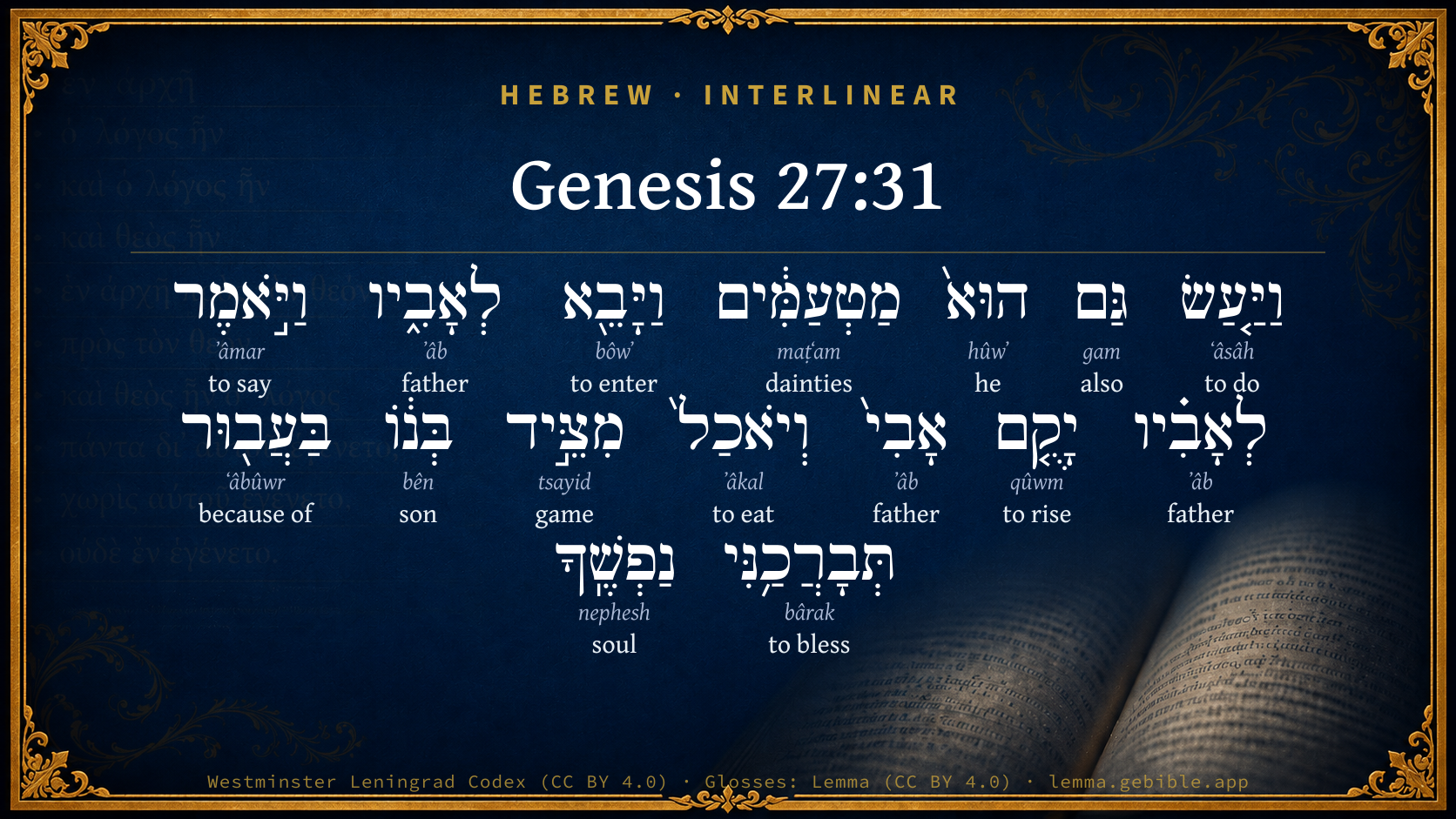
Genesis 27:31

Hebrew (Westminster Leningrad Codex) Genesis 27:31 appears in the Hebrew Old Testament. The text above is from the Westminster Leningrad Codex. Each word links to its Strong’s number, a concise gloss, and parsing drawn from the Open Scriptures Hebrew Bible morphology. Click any word for its full Brown-Driver-Briggs (BDB) entry.
Download image
Cite this verse

Genesis 27:31 (World English Bible). Public Domain. Lemma interlinear Bible study tool, https://lemma.gebible.app/v/genesis/27/31.

Show BibTeX & RIS
BibTeX
RIS
English Translation
He also made savory food, and brought it to his father. He said to his father, "Let my father arise, and eat of his son's venison, that your soul may bless me."
World English Bible · Public Domain
Download a study sheet

One document with this verse’s original text, its word-by-word gloss line, the meaning frame, cross-references with their text, attributed commentary, and full source and license credits — printable, and it pastes into notes with its structure intact.

This verse Autodidact and up

Study sheet (.html) Plain text (.txt)

A passage Seminary Student

Up to 50 verses in one chapter. A passage sheet keeps up to 6 commentary sources and 12 cross-references per verse, in the order this page ranks them, and says so on the sheet whenever that leaves anything out. Ask for a single verse and you get the Autodidact verse sheet above.

Everything on this page stays free to read, with no account — the sheet is a download of what is already on screen, not access to it.

Want to remove ads? Support Godless Engineer
Compare translations 3

The same verse in 3 English versions, stacked beneath the original-language interlinear above. Click any original word for its lexicon entry.

Each is an independent rendering of the whole verse — the interlinear is not word-aligned to these translations.

Highlighted words mark where these versions differ — a whole-verse word diff, not a word-by-word alignment.

  • World English Bible Public Domain
    He also made savory food, and brought it to his father. He said to his father, "Let my father arise, and eat of his son's venison, that your soul may bless me."
  • King James Version Public Domain
    And he also had made savory meat, and brought it unto his father, and said unto his father, Let my father arise, and eat of his son's venison, that thy soul may bless me.
  • unfoldingWord Literal Text CC BY-SA 4.0
    Then he too prepared tasty food, and he brought to his father and said to his father, “Let my father get up and eat from his son’s game so that your soul can bless me.”

unfoldingWord Literal Text — © unfoldingWord, licensed CC BY-SA 4.0. Word-aligned USFM3 via Door43 (git.door43.org/unfoldingWord/en_ult).

Versions to compare (up to 4)

3 of 4 selected

Show all 18 translations

Every available English version of this verse, each an independent rendering of the whole verse.

  • World English Bible Public Domain
    He also made savory food, and brought it to his father. He said to his father, "Let my father arise, and eat of his son's venison, that your soul may bless me."
  • Berean Standard Bible Public Domain
    He too made some tasty food, brought it to his father, and said to him, “My father, sit up and eat of your son’s game, so that you may bless me.”
  • Majority Standard Bible Public Domain
    He too made some tasty food, brought it to his father, and said to him, “My father, sit up and eat of your son’s game, so that you may bless me.”
  • King James Version Public Domain
    And he also had made savory meat, and brought it unto his father, and said unto his father, Let my father arise, and eat of his son's venison, that thy soul may bless me.
  • American Standard Version (1901) Public Domain
    And he also made savory food, and brought it unto his father. And he said unto his father, Let my father arise, and eat of his son's venison, that thy soul may bless me.
  • Revised Version (1885) Public Domain
    And he also made savoury meat, and brought it unto his father; and he said unto his father, Let my father arise, and eat of his son’s venison, that thy soul may bless me.
  • Geneva Bible (1599) Public Domain
    And hee also prepared sauourie meate and brought it to his father, and sayd vnto his father, Let my father arise, and eat of his sonnes venison, that thy soule may blesse me.
  • Douay-Rheims (1899) Public Domain
    And brought in to his father meats made of what he had taken in hunting, saying: Arise, my father, and eat of thy son's venison; that thy soul may bless me.
  • Young's Literal Translation Public Domain
    and he also maketh tasteful things, and bringeth to his father, and saith to his father, `Let my father arise, and eat of his son's provision, so that thy soul doth bless me.'
  • Literal Standard Version CC BY-SA 4.0
    and he also makes tasteful things, and brings to his father, and says to his father, “Let my father arise, and eat of his son’s game, so that your soul blesses me.”
  • Unlocked Literal Bible CC BY-SA 4.0
    He also made delicious food and brought it to his father. He said to his father, “Father, get up and eat some of your son's game, so that you may bless me.”
  • unfoldingWord Literal Text CC BY-SA 4.0
    Then he too prepared tasty food, and he brought to his father and said to his father, “Let my father get up and eat from his son’s game so that your soul can bless me.”
  • Darby Bible Public Domain
    And he also had prepared savoury dishes, and he brought [them] in to his father, and said to his father, Let my father arise and eat of his son's venison, in order that thy soul may bless me.
  • World Messianic Bible Public Domain
    He also made savory food, and brought it to his father. He said to his father, “Let my father arise, and eat of his son’s venison, that your soul may bless me.”
  • Webster's Bible Public Domain
    And he also had made savory meat, and brought it to his father; and said to his father, Let my father arise, and eat of his son's venison, that thy soul may bless me.
  • Free Bible Version CC BY-SA 4.0
    He had also made some tasty food, and took it to his father. Esau said to Isaac, “Sit up, my father, and eat some of my wild game so you can bless me.”
  • Bible in Basic English Public Domain
    And he made ready a meal, good to the taste, and took it to his father, and said to him, Let my father get up and take of his son's meat, so that you may give me a blessing.
  • JPS Tanakh (1917) Public Domain
    And he also made savoury food, and brought it unto his father; and he said unto his father: 'Let my father arise, and eat of his son's venison, that thy soul may bless me.'

Literal Standard Version (2020), Covenant Press — licensed CC BY-SA 4.0. Text via the HelloAO Bible API (eBible.org). Unlocked Literal Bible (unfoldingWord) — licensed CC BY-SA 4.0. Text via the HelloAO Bible API (eBible.org). unfoldingWord Literal Text — © unfoldingWord, licensed CC BY-SA 4.0. Word-aligned USFM3 via Door43 (git.door43.org/unfoldingWord/en_ult). Free Bible Version, Dr. Jonathan Gallagher — licensed CC BY-SA 4.0. Text via the HelloAO Bible API (eBible.org).

Word by word

More ways to search: Search by grammar → Find every occurrence → Compare this word →

Practice this passage: Drill this verse → Learn its vocabulary →

מַטְעַמִּ֔ים
maṭʻam
H4303
“dainties”
Noun, Common, Masculine, Plural, Absolute
Part of Speech
Noun
Type
Common
Gender
Masculine
Number
Plural
State
Absolute
Full BDB Definition

Origin: from H2938

TWOT: 815b

tasty or savory food, delectable food, dainties
  1. וַיַּ֤עַשׂ ʻâsâh H6213 “and · to do” Conjunction + Verb, Qal, Sequential Imperfect, 3rd Person, Masculine, Singular
  2. גַּם gam H1571 “also” Particle, Accusative
  3. הוּא֙ hûwʼ H1931 “he” Pronoun, Personal, 3rd Person, Masculine, Singular
  4. וַיָּבֵ֖א bôwʼ H935 “and · to enter” Conjunction + Verb, Hiphil, Sequential Imperfect, 3rd Person, Masculine, Singular
  5. לְאָבִ֑יו ʼâb H1 “to/for · father · his” Preposition + Noun, Common, Masculine, Singular, Construct + Suffix, Personal, 3rd Person, Masculine, Singular
  6. וַיֹּ֣אמֶר ʼâmar H559 “and · to say” Conjunction + Verb, Qal, Sequential Imperfect, 3rd Person, Masculine, Singular
  7. לְאָבִ֗יו ʼâb H1 “to/for · father · his” Preposition + Noun, Common, Masculine, Singular, Construct + Suffix, Personal, 3rd Person, Masculine, Singular
  8. יָקֻ֤ם qûwm H6965 “to rise” Verb, Qal, Jussive, 3rd Person, Masculine, Singular
  9. אָבִי֙ ʼâb H1 “father · my” Noun, Common, Masculine, Singular, Construct + Suffix, Personal, 1st Person, Common, Singular
  10. וְיֹאכַל֙ ʼâkal H398 “and · to eat” Conjunction + Verb, Qal, Imperfect, 3rd Person, Masculine, Singular
  11. מִצֵּ֣יד tsayid H6718 “from · game of” Preposition + Noun, Common, Masculine, Singular, Construct
  12. בְּנ֔וֹ bên H1121 “son · his” Noun, Common, Masculine, Singular, Construct + Suffix, Personal, 3rd Person, Masculine, Singular
  13. בַּעֲב֖וּר ʻâbûwr H5668 “in/at · because of of” Preposition + Noun, Common, Masculine, Singular, Construct
  14. תְּבָרֲכַ֥נִּי bârak H1288 “to bless · me” Verb, Piel, Imperfect, 3rd Person, Feminine, Singular + Suffix, Personal, 1st Person, Common, Singular
  15. נַפְשֶֽׁךָ nephesh H5315 “soul · your” Noun, Common, Both, Singular, Construct + Suffix, Personal, 2nd Person, Masculine, Singular

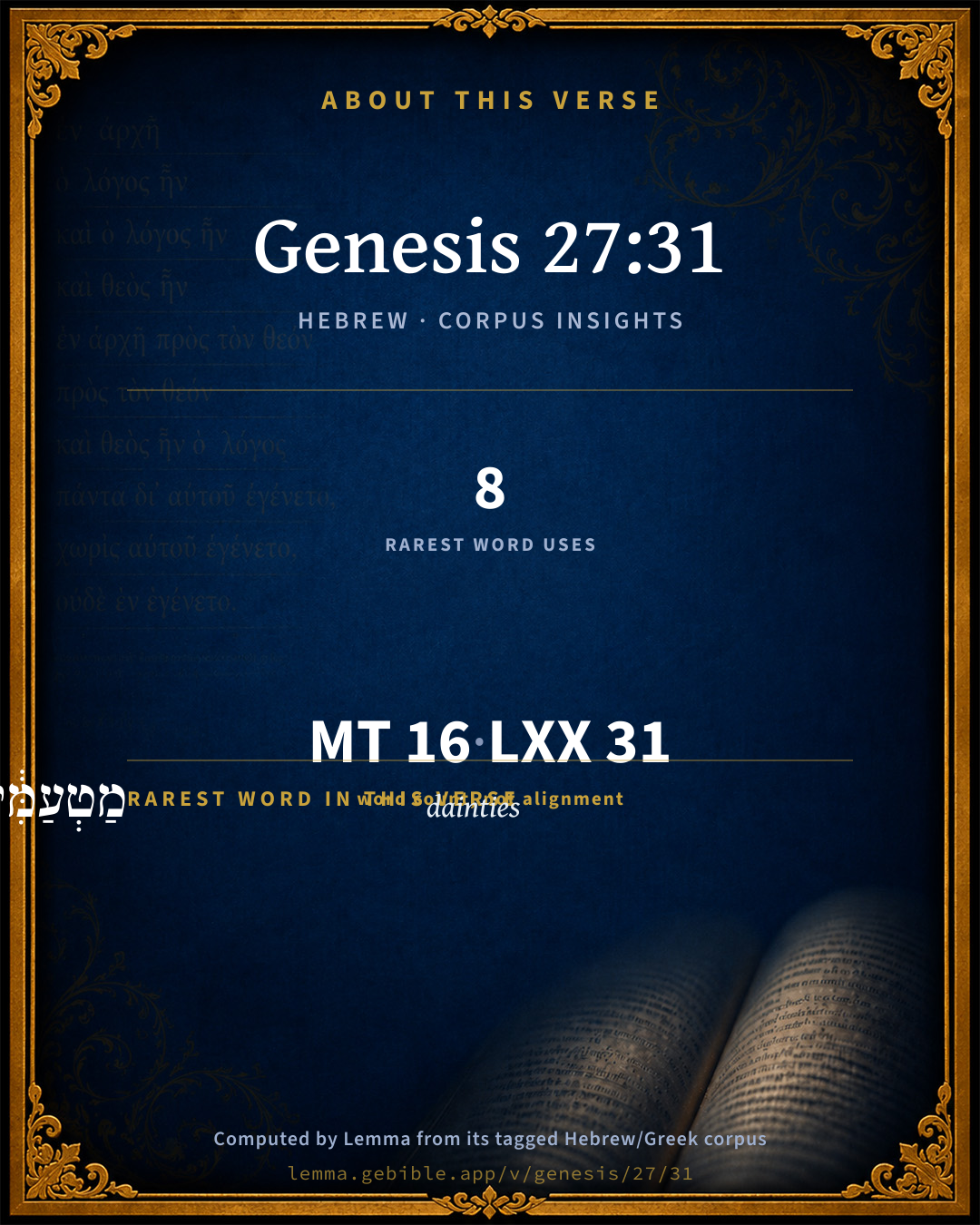
About this verse

These counts appear in no published source. They are computed here, from the morphology-tagged text and Lemma’s own curated glosses. What Lemma adds →

16
words
14
distinct lemmas
Pentateuch
section

Notable vocabulary

The rarest word here is מַטְעַמִּ֔ים dainties H4303 — appearing just 8 times in the whole Hebrew Bible.

Shared distinctive vocabulary

מַטְעַמִּ֔ים dainties H4303 occurs in 8 verses of the Hebrew Bible. Also found in:

Grammatical profile

  • 6 verbs
  • 8 nouns
  • 1 pronoun
  • 1 particle

Verb forms

  • וַיַּ֤עַשׂ Qal · Sequential Imperfect
  • וַיָּבֵ֖א Hiphil · Sequential Imperfect
  • וַיֹּ֣אמֶר Qal · Sequential Imperfect
  • יָקֻ֤ם Qal · Jussive
  • וְיֹאכַל֙ Qal · Imperfect
  • תְּבָרֲכַ֥נִּי Piel · Imperfect

Repetition

A word recurs within this verse — often emphatic in Hebrew:

  • לְאָבִ֑יו father H1 ×3

Hebrew & Septuagint length

In English translation the verse runs 32 words from the Hebrew and 34 from the Septuagint (LXX English) — closely comparable.

A rough comparison of the two English renderings, which tokenize alike — not a word-level alignment.

Word counts can differ between the Hebrew and the Greek without any difference in meaning — e.g. the Hebrew direct-object marker אֵת has no separate Greek word, and Greek often adds the article ὁ.

In the original languages it is 16 Hebrew tokens and 31 Greek tokens — but the two are counted differently (Hebrew bundles its prefixes and suffixes into one token; the Greek is in lemma form), so that isn’t a like-for-like length.

Cross-references

1

Topical passages linked to Genesis 27:31 in the Treasury of Scripture Knowledge — connected by theme and wording, ordered by reader-vote popularity; previews shown in the World English Bible.

  • Genesis 27:4 Make me savory food, such as I love, and bring it to me, that I may eat, and that my soul may bless you before I die."

Cross-references courtesy of OpenBible.info (CC BY 4.0).

Hebrew and Greek witnesses Masoretic Hebrew ↔ Greek Septuagint

The same verse in the two great witnesses to the Old Testament, shown verse-for-verse.

These are two independent witnesses, not word-aligned to each other, and the Septuagint is shown in lemma (dictionary) form.

Hebrew Genesis 27:31 Masoretic · Westminster Leningrad Codex

וַיַּ֤עַשׂ גַּם הוּא֙ מַטְעַמִּ֔ים וַיָּבֵ֖א לְאָבִ֑יו וַיֹּ֣אמֶר לְאָבִ֗יו יָקֻ֤ם אָבִי֙ וְיֹאכַל֙ מִצֵּ֣יד בְּנ֔וֹ בַּעֲב֖וּר תְּבָרֲכַ֥נִּי נַפְשֶֽׁךָ

He also made savory food, and brought it to his father. He said to his father, "Let my father arise, and eat of his son's venison, that your soul may bless me."

World English Bible · Public Domain

Greek LXX Genesis 27:31 Septuagint · lemma form

καί ποιέω καί αὐτός ἔδεσμα καί προςφέρω ὁ πατήρ αὐτός καί εἶπον ὁ πατήρ ἀναἵστημι ὁ πατήρ ἐγώ καί ἐσθίω ὁ θήρα ὁ υἱός αὐτός ὅπως εὐλογέω ἐγώ ὁ ψυχή σύ

And he also had made meats and brought them to his father; and he said to his father, Let my father arise and eat of his son's venison, that your soul may bless me.

LXX2012 (modern English Septuagint) · Public Domain

Hebrew: Westminster Leningrad Codex (CC BY 4.0). Greek: Septuagint (public domain); English from LXX2012 (modern English Septuagint) (Public Domain). How the Septuagint differs from the Hebrew →

Targum (Aramaic paraphrase)

2

The Targum is the ancient Jewish Aramaic paraphrase of the Hebrew Scriptures — an interpretive translation, not the Hebrew text itself. Onkelos (literal) and Pseudo-Jonathan (expansive) render the Torah, and Jonathan the Prophets. Coverage is partial: where no permissively-licensed English translation exists for a verse, only the Aramaic is shown. This is verse-level text, not a word-by-word alignment to the Hebrew.

  1. Targum Onkelos Torah (Genesis–Deuteronomy)
    וַעֲבַד אַף הוּא תַּבְשִׁילִין וְאָעֵיל לְוַת אֲבוּהִי וַאֲמַר לַאֲבוּהִי יָקוּם אַבָּא וְיֵכוּל מִצֵידָא דִּבְרֵהּ בְּדִיל דִּי תְבָרְכִנַּנִּי נַפְשָׁךְ

    (no public-domain English translation for this verse)

    Targum Onkelos — Aramaic: “Onkelos Genesis” (public domain); “Onkelos Exodus” (public domain); “Onkelos Leviticus” (public domain); “Onkelos Numbers” (public domain); “Onkelos Deuteronomy” (public domain). English: “Sefaria Community Translation” (CC0 1.0 (public-domain dedication)); “J.W. Etheridge. The Targums of Onkelos and Jonathan Ben Uzziel on the Pentateuch. London: Longmans, Green, 1862” (public domain). Text via Sefaria.

  2. Targum Pseudo-Jonathan Torah (Genesis–Deuteronomy)
    וְעִכֵּיב מֵימְרָא דַיְיָ מִנֵיהּ צֵידָא דַכְיָא וְאַשְׁכַּח כַּלְבָּא חָדָא וְקַטְלֵיהּ וְעָבַד אַף הוּא מִנֵיהּ תַּבְשִׁילִין וְאַיְיתֵי לְאָבוֹי וַאֲמַר לְאָבוֹי יְקוּם אַבָּא וְיֵיכוּל מִצֵידָא דִבְרֵיהּ בְּדִיל דְיִתְבָרְכִינַנִי נַפְשָׁךְ

    And the Word of the Lord had impeded him from taking clean venison; but he had found a certain dog, and killed him, and made food of him, and brought to his father, and said to his father, Arise, my father, and eat of my venison, that thy soul may bless me.

    Targum Pseudo-Jonathan — Aramaic: “Targum Jonathan on Genesis” (public domain); “Targum Jonathan on Exodus” (public domain); “Targum Jonathan on Leviticus” (public domain); “Targum Jonathan on Numbers” (public domain); “Targum Jonathan on Deuteronomy” (public domain). English: “The Targum of Jonathan ben Uzziel, trans. J. W. Etheridge, London, 1862” (public domain). Text via Sefaria.

Commentary

Notes on Genesis 27:31 from classic Christian and Jewish commentators (each source and its license shown beneath its notes). The classic Christian expositions comment on the surrounding passage and are grouped to its opening verse, so a note may address several verses; the Jewish commentaries on the Tanakh (Rashi and others) are per-verse, so they appear only where the commentator wrote on this verse.

Lemma curates 59 commentaries, every one of them public domain or Creative Commons licensed, each selected and text-cleaned for this edition rather than reprinted as found. About our sources →

Trapp's Complete Commentary

John Trapp

Gen 27:31 And he also had made savoury meat, and brought it unto his father, and said unto his father, Let my father arise, and eat of his son’s venison, that thy soul may bless me.

Ver. 31. And he also had made savoury meat.] Esau’s works here are better than Jacob’s. Election is not of works, but of grace. {Rom 9:11} Quis te discernit? saith the apostle. {1Co 4:7} Grevinchovius, the Arminian, saucily answers, Ego meipsum dicerno. And surely, had the cause of our election been either by our faith, or good works foreseen, as the Papists and Arminians would have it, St Paul might have spared his question, or soon received a ready answer.

John Trapp, A Commentary or Exposition upon All the Books of the Old and New Testament (1647–1656) — public domain. Text from a community e-Sword module.

Ellicott's Commentary for English Readers

(31) He also had made.—Heb., he also made, Esau returned just as Jacob was leaving Isaac’s presence. There would still be some considerable delay before the captured game was made into savoury meat

A Bible Commentary for English Readers, edited by Charles John Ellicott (1878–1897) — public domain. Text from a community e-Sword module.

The Cambridge Bible for Schools and Colleges

gen. ed. J. J. S. Perowne

31. Let my father arise] Cf. 19. The effect of this scene is heightened by the use of almost identical language.

The Cambridge Bible for Schools and Colleges (gen. ed. J. J. S. Perowne; Cambridge University Press, 1878–1918) — public domain. Text from a community e-Sword module.

John Gill's Exposition

And he also made savoury meat, and brought it unto his father,.... Which was made of real venison, or of creatures taken in hunting, and not like Jacob's, made of other flesh, in imitation of it; for what the Jewish writers (a) say is not to be regarded, that he was hindered from getting true venison, by angels loosing the deer he bound; still less what the Targum of Jonathan says, that he killed a dog, made savoury meat of it, and brought it to his father:

and said unto his father, let my father arise, and eat of his son's venison, that thy soul may bless me; this address is made by Esau to his father in a very respectful manner, as became a dutiful son to an aged and honoured parent; who in obedience to his command had prepared agreeable food for him, and now brought it to him, in order to receive his blessing, which he had himself proposed to give him upon it.

(a) Bereshit Rabba, sect. 67. fol. 59. 3.

John Gill's Exposition of the Whole Bible (1746–1763) — public domain (CC PDM 1.0). Text via the HelloAO Bible API.

Matthew Poole's English Annotations

That Esau did not come to his father till the meat was dressed, may be ascribed partly to his own choice, that he might come with more acceptance; and partly to Rebekah, who could easily hinder his coming sooner by specious pretences and artifices.

Matthew Poole's English Annotations on the Holy Bible (1683–1685) — public domain. Text from a community e-Sword/MySword module.

The Pulpit Commentary

And he also had made savory meat (vide ver. 4), and brought it unto his father, and said unto him, Let my father arise, and eat of his son"s venison compared with Jacob"s exhortation to his aged parent (ver. 19), the language of Esau has, if anything, more affection in its tonesthat thy soul may bless me. Esau was at this time a man of mature age, being either fifty-seven or seventy-seven years old, and must have been acquainted with the heavenly oracle (Gen_25:23) that assigned the precedence in the theocratic line to Jacob. Zither, therefore, he must have supposed that his claim to the blessing was not thereby affected, or he was guilty of conniving at Isaac"s scheme for resisting the Divine will. Indignation at Jacob"s duplicity and baseness, combined with sympathy for Esau in his supposed wrongs, sometimes prevents a just appreciation of the exact position occupied by the latter in this extraordinary transaction. Instead of branding Jacob as a shameless deceiver, and hurling against his fair fame the most opprobrious epithets, may it not be that, remembering the previously-expressed will of Heaven, the real supplanter was Esau, who as an accomplice of his father was seeking secretly, unlawfully, and feloniously to appropriate to himself a blessing which had already been, not obscurely, designated as Jacob"s? On this hypothesis the miserable craft of Jacob and Rebekah was a lighter crime than that of Isaac and Esau.

The Pulpit Commentary (1880–1919), ed. H.D.M. Spence-Jones & Joseph S. Exell — public domain. Text from a community e-Sword module.

Radak

Rabbi David Kimhi (Radak)

ויעש...ויאמר, this is quite clear.

Radak on the Tanakh — English translations: “Sefaria Community Translation” (CC0 1.0 (public-domain dedication)); “Eliyahu Munk, HaChut Hameshulash” (CC BY 4.0); “Rabbi Mike Feuer, Jerusalem Anthology” (CC BY 4.0); and “R. David Kimhi on the first book of Psalms, Translated by R.G. Finch, London, 1919” (public domain). Text via Sefaria.

Lesson kit

Teaching starters — assembled from the data on this page, not authored interpretation. Every prompt links to the verse data it draws on. Edit before teaching.

Genesis, in the Pentateuch, opens this verse with 16 words (14 distinct Hebrew lemmas). Its most distinctive word is maṭʻam (“dainties”). A historical commentator’s framing appears above. Read the whole chapter for the surrounding context.

Discussion questions

  1. The word maṭʻam carries the sense “dainties.” How does it shape the verse?
  2. How does Genesis 27:4, which shares the word «dainties», read alongside this verse?
  3. What does the repetition of “father” (3× in this one verse) do in this verse?
  4. The translations on this page render this verse differently — a whole-verse word diff, not a word-by-word alignment. What might account for the different wordings?
  5. «וַיַּ֤עַשׂ» is a Qal Sequential Imperfect verb. How does that grammatical form shape the action described?
  6. Compare how Trapp's Complete Commentary and Ellicott's Commentary for English Readers read this verse. Where do they agree or differ?

Things to notice

Reading settings

Reading text

Shown beneath each verse's original-language words.

Old Testament
Old Testament edition

Read the OT as the Masoretic Hebrew (MT) or the Greek Septuagint (LXX).

English shown for the Greek Septuagint (in the Hebrew ↔ Greek comparison).

Comparing translations? Open the Compare panel on any verse page to stack up to four side by side.