
Genesis 44:30

Hebrew (Westminster Leningrad Codex) Genesis 44:30 appears in the Hebrew Old Testament. The text above is from the Westminster Leningrad Codex. Each word links to its Strong’s number, a concise gloss, and parsing drawn from the Open Scriptures Hebrew Bible morphology. Click any word for its full Brown-Driver-Briggs (BDB) entry.
Download image
Cite this verse

Genesis 44:30 (World English Bible). Public Domain. Lemma interlinear Bible study tool, https://lemma.gebible.app/v/genesis/44/30.

Show BibTeX & RIS
BibTeX
RIS
English Translation
Now therefore when I come to your servant my father, and the boy is not with us; seeing that his life is bound up in the boy's life;
World English Bible · Public Domain
Download a study sheet

One document with this verse’s original text, its word-by-word gloss line, the meaning frame, cross-references with their text, attributed commentary, and full source and license credits — printable, and it pastes into notes with its structure intact.

This verse Autodidact and up

Study sheet (.html) Plain text (.txt)

A passage Seminary Student

Up to 50 verses in one chapter. A passage sheet keeps up to 6 commentary sources and 12 cross-references per verse, in the order this page ranks them, and says so on the sheet whenever that leaves anything out. Ask for a single verse and you get the Autodidact verse sheet above.

Everything on this page stays free to read, with no account — the sheet is a download of what is already on screen, not access to it.

Want to remove ads? Support Godless Engineer
Compare translations 3

The same verse in 3 English versions, stacked beneath the original-language interlinear above. Click any original word for its lexicon entry.

Each is an independent rendering of the whole verse — the interlinear is not word-aligned to these translations.

Highlighted words mark where these versions differ — a whole-verse word diff, not a word-by-word alignment.

  • World English Bible Public Domain
    Now therefore when I come to your servant my father, and the boy is not with us; seeing that his life is bound up in the boy's life;
  • King James Version Public Domain
    Now therefore when I come to thy servant my father, and the lad be not with us; seeing that his life is bound up in the lad's life;
  • unfoldingWord Literal Text CC BY-SA 4.0
    And now, when I go to your servant my father and the young man is not with us, since his soul is bound to his soul,

unfoldingWord Literal Text — © unfoldingWord, licensed CC BY-SA 4.0. Word-aligned USFM3 via Door43 (git.door43.org/unfoldingWord/en_ult).

Versions to compare (up to 4)

3 of 4 selected

Show all 18 translations

Every available English version of this verse, each an independent rendering of the whole verse.

  • World English Bible Public Domain
    Now therefore when I come to your servant my father, and the boy is not with us; seeing that his life is bound up in the boy's life;
  • Berean Standard Bible Public Domain
    So if the boy is not with us when I return to your servant, and if my father, whose life is wrapped up in the boy’s life,
  • Majority Standard Bible Public Domain
    So if the boy is not with us when I return to your servant, and if my father, whose life is wrapped up in the boy’s life,
  • King James Version Public Domain
    Now therefore when I come to thy servant my father, and the lad be not with us; seeing that his life is bound up in the lad's life;
  • American Standard Version (1901) Public Domain
    Now therefore when I come to thy servant my father, and the lad is not with us; seeing that his life is bound up in the lad's life;
  • Revised Version (1885) Public Domain
    Now therefore when I come to thy servant my father, and the lad be not with us; seeing that his life is bound up in the lad’s life;
  • Geneva Bible (1599) Public Domain
    Nowe therefore, when I come to thy seruant my father, and the childe be not with vs (seeing that his life dependeth on the childes life)
  • Douay-Rheims (1899) Public Domain
    Therefore if I shall go to thy servant our father, and the boy be wanting, (whereas his life dependeth upon the life of him,)
  • Young's Literal Translation Public Domain
    `And now, at my coming in unto thy servant my father, and the youth not with us (and his soul is bound up in his soul),
  • Literal Standard Version CC BY-SA 4.0
    And now, at my coming to your servant my father, and the youth not with us (and his soul is bound up in his soul),
  • Unlocked Literal Bible CC BY-SA 4.0
    Now, therefore, when I come to your servant my father, and the lad is not with us, since his life is bound up in the boy's life,
  • unfoldingWord Literal Text CC BY-SA 4.0
    And now, when I go to your servant my father and the young man is not with us, since his soul is bound to his soul,
  • Darby Bible Public Domain
    And now, when I come to thy servant my father, and the lad is not with us, -- seeing that his life is bound up with his life,
  • World Messianic Bible Public Domain
    Now therefore when I come to your servant my father, and the boy is not with us; since his life is bound up in the boy’s life;
  • Webster's Bible Public Domain
    Now therefore, when I come to thy servant my father, and the lad is not with us; (seeing that his life is bound up in the lad's life)
  • Free Bible Version CC BY-SA 4.0
    So if the boy isn't with us when I go back to my father, whose life depends on the life of the boy,
  • Bible in Basic English Public Domain
    If then I go back to your servant, my father, without the boy, because his life and the boy's life are one,
  • JPS Tanakh (1917) Public Domain
    Now therefore when I come to thy servant my father, and the lad is not with us; seeing that his soul is bound up with the lad's soul;

Literal Standard Version (2020), Covenant Press — licensed CC BY-SA 4.0. Text via the HelloAO Bible API (eBible.org). Unlocked Literal Bible (unfoldingWord) — licensed CC BY-SA 4.0. Text via the HelloAO Bible API (eBible.org). unfoldingWord Literal Text — © unfoldingWord, licensed CC BY-SA 4.0. Word-aligned USFM3 via Door43 (git.door43.org/unfoldingWord/en_ult). Free Bible Version, Dr. Jonathan Gallagher — licensed CC BY-SA 4.0. Text via the HelloAO Bible API (eBible.org).

Word by word

More ways to search: Search by grammar → Find every occurrence → Compare this word →

Practice this passage: Drill this verse → Learn its vocabulary →

קְשׁוּרָ֥ה
qâshar
H7194
“bound”
Verb, Qal, Participle Passive, Feminine, Singular, Absolute
Part of Speech
Verb
Stem
Qal
Form
Participle Passive
Gender
Feminine
Number
Singular
State
Absolute
Full BDB Definition

Origin: a primitive root: to tie, physically (gird, confine, compact) or mentally (in love, league)

TWOT: 2090

to bind, tie, bind together, league together, conspire - (Qal) - to bind, confine - to league together, conspire - (Niphal) to be bound, be bound up - (Piel) - to bind on - to bind fast - to bind, tie - to bind to oneself - (Pual) robust, vigorous (participle) - (Hithpael) to conspire
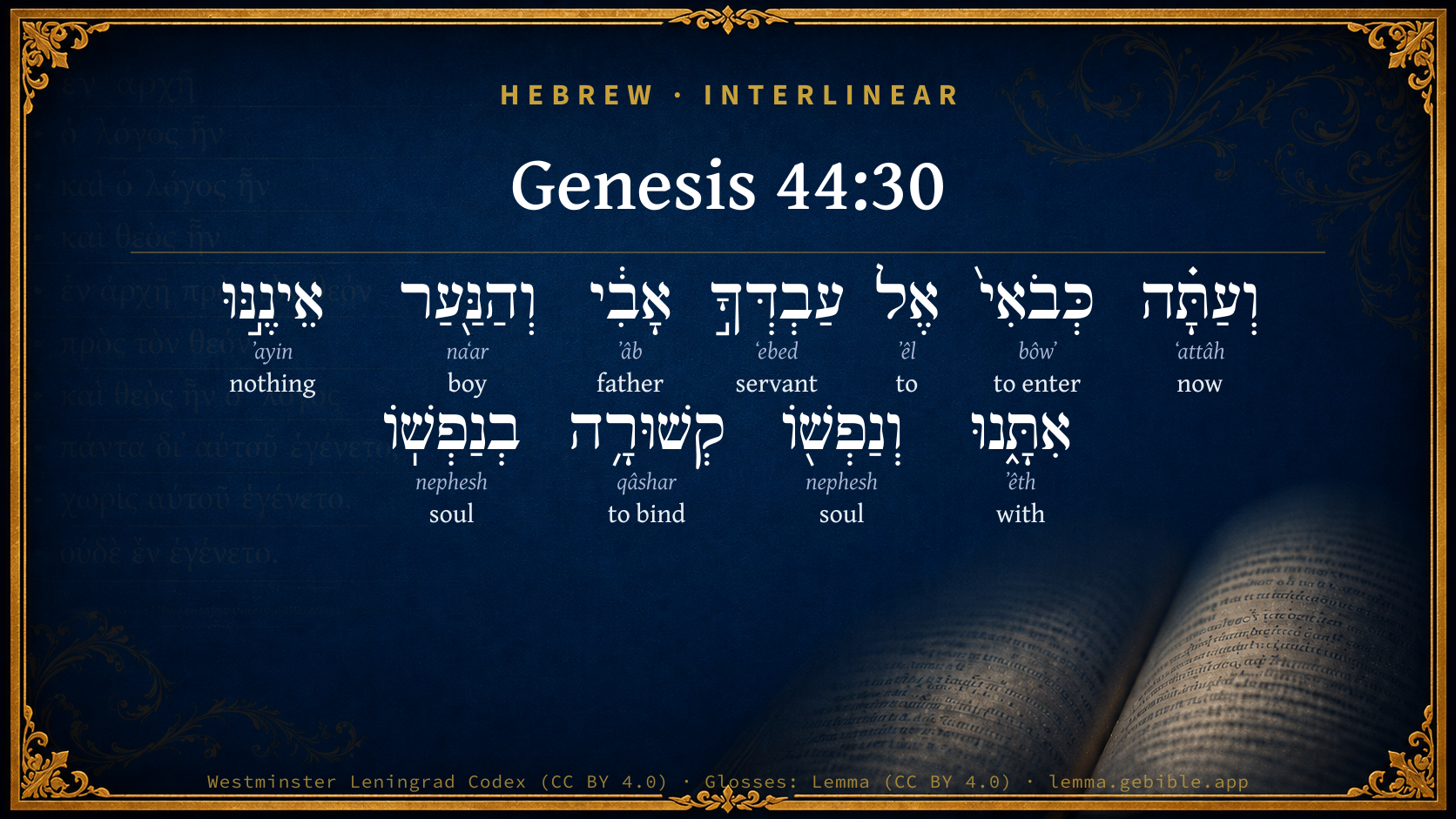
  1. וְעַתָּ֗ה ʻattâh H6258 “and · now” Conjunction + Adverb
  2. כְּבֹאִי֙ bôwʼ H935 “like/as · to enter · me” Preposition + Verb, Qal, Infinitive Construct + Suffix, Personal, 1st Person, Common, Singular
  3. אֶל ʼêl H413 “to” Preposition
  4. עַבְדְּךָ֣ ʻebed H5650 “servant · your” Noun, Common, Masculine, Singular, Construct + Suffix, Personal, 2nd Person, Masculine, Singular
  5. אָבִ֔י ʼâb H1 “father · my” Noun, Common, Masculine, Singular, Construct + Suffix, Personal, 1st Person, Common, Singular
  6. וְהַנַּ֖עַר naʻar H5288 “and · the · boy” Conjunction + Particle, Definite Article + Noun, Common, Masculine, Singular, Absolute
  7. אֵינֶ֣נּוּ ʼayin H369 “nothing · him” Particle, Negative + Suffix, Personal, 3rd Person, Masculine, Singular
  8. אִתָּ֑נוּ ʼêth H854 “with · us” Preposition + Suffix, Personal, 1st Person, Common, Plural
  9. וְנַפְשׁ֖וֹ nephesh H5315 “and · soul · his” Conjunction + Noun, Common, Both, Singular, Construct + Suffix, Personal, 3rd Person, Masculine, Singular
  10. בְנַפְשֽׁוֹ nephesh H5315 “in/at · soul · his” Preposition + Noun, Common, Both, Singular, Construct + Suffix, Personal, 3rd Person, Masculine, Singular

About this verse

These counts appear in no published source. They are computed here, from the morphology-tagged text and Lemma’s own curated glosses. What Lemma adds →

11
words
10
distinct lemmas
Pentateuch
section

Shared distinctive vocabulary

קְשׁוּרָ֥ה to bind H7194 occurs in 44 verses of the Hebrew Bible. Also found in:

Grammatical profile

  • 2 verbs
  • 5 nouns
  • 2 prepositions
  • 1 adverb
  • 1 particle

Verb forms

  • כְּבֹאִי֙ Qal · Infinitive Construct
  • קְשׁוּרָ֥ה Qal · Participle Passive

Repetition

A word recurs within this verse — often emphatic in Hebrew:

  • וְנַפְשׁ֖וֹ soul H5315 ×2

Hebrew & Septuagint length

In English translation the verse runs 28 words from the Hebrew and 29 from the Septuagint (LXX English) — closely comparable.

A rough comparison of the two English renderings, which tokenize alike — not a word-level alignment.

Word counts can differ between the Hebrew and the Greek without any difference in meaning — e.g. the Hebrew direct-object marker אֵת has no separate Greek word, and Greek often adds the article ὁ.

Cross-references

6

Topical passages linked to Genesis 44:30 in the Treasury of Scripture Knowledge — connected by theme and wording, ordered by reader-vote popularity; previews shown in the World English Bible.

  • 1 Samuel 18:1 It happened, when he had made an end of speaking to Saul, that the soul of Jonathan was knit with the soul of David, and Jonathan loved him as his own soul.
  • Genesis 44:17 He said, "Far be it from me that I should do so. The man in whose hand the cup is found, he will be my bondservant; but as for you, go up in peace to your father."
  • Genesis 44:31 it will happen, when he sees that the boy is no more, that he will die. Your servants will bring down the gray hairs of your servant, our father, with sorrow to Sheol.
  • Genesis 44:34 For how will I go up to my father, if the boy isn't with me? Lest I see the evil that will come on my father."
  • 1 Samuel 25:29 Though men be risen up to pursue you, and to seek your soul, yet the soul of my lord shall be bound in the bundle of life with Yahweh your God; and the souls of your enemies, them shall he sling out, as from the hollow of a sling.
  • 2 Samuel 18:33 The king was much moved, and went up to the chamber over the gate, and wept: and as he went, thus he said, my son Absalom, my son, my son Absalom! would I had died for you, Absalom, my son, my son!

Cross-references courtesy of OpenBible.info (CC BY 4.0).

Hebrew and Greek witnesses Masoretic Hebrew ↔ Greek Septuagint

The same verse in the two great witnesses to the Old Testament, shown verse-for-verse.

These are two independent witnesses, not word-aligned to each other, and the Septuagint is shown in lemma (dictionary) form.

Hebrew Genesis 44:30 Masoretic · Westminster Leningrad Codex

וְעַתָּ֗ה כְּבֹאִי֙ אֶל עַבְדְּךָ֣ אָבִ֔י וְהַנַּ֖עַר אֵינֶ֣נּוּ אִתָּ֑נוּ וְנַפְשׁ֖וֹ קְשׁוּרָ֥ה בְנַפְשֽׁוֹ

Now therefore when I come to your servant my father, and the boy is not with us; seeing that his life is bound up in the boy's life;

World English Bible · Public Domain

Greek LXX Genesis 44:30 Septuagint · lemma form

νῦν οὖν ἐάν εἰςπορεύομαι πρός ὁ παῖς σύ πατήρ δέ ἐγώ καί ὁ παιδάριον μή εἰμί μετά ἐγώ ὁ δέ ψυχή αὐτός ἐκκρεμάννυμι ἐκ ὁ οὗτος ψυχή

Now then, if I should go in to your servant, and our father, and the boy should not be with us, (and his life depends on this lad's life)

LXX2012 (modern English Septuagint) · Public Domain

Hebrew: Westminster Leningrad Codex (CC BY 4.0). Greek: Septuagint (public domain); English from LXX2012 (modern English Septuagint) (Public Domain). How the Septuagint differs from the Hebrew →

Targum (Aramaic paraphrase)

2

The Targum is the ancient Jewish Aramaic paraphrase of the Hebrew Scriptures — an interpretive translation, not the Hebrew text itself. Onkelos (literal) and Pseudo-Jonathan (expansive) render the Torah, and Jonathan the Prophets. Coverage is partial: where no permissively-licensed English translation exists for a verse, only the Aramaic is shown. This is verse-level text, not a word-by-word alignment to the Hebrew.

  1. Targum Onkelos Torah (Genesis–Deuteronomy)
    וּכְעַן כְּמֵיתִי לְוַת עַבְדָּךְ אַבָּא וְעוּלֵימָא לֵיתוֹהִי עִמָּנָא וְנַפְשֵׁהּ חֲבִיבָא לֵהּ כְּנַפְשֵׁהּ

    (no public-domain English translation for this verse)

    Targum Onkelos — Aramaic: “Onkelos Genesis” (public domain); “Onkelos Exodus” (public domain); “Onkelos Leviticus” (public domain); “Onkelos Numbers” (public domain); “Onkelos Deuteronomy” (public domain). English: “Sefaria Community Translation” (CC0 1.0 (public-domain dedication)); “J.W. Etheridge. The Targums of Onkelos and Jonathan Ben Uzziel on the Pentateuch. London: Longmans, Green, 1862” (public domain). Text via Sefaria.

  2. Targum Pseudo-Jonathan Torah (Genesis–Deuteronomy)
    וּכְעַן בְּמֵיתִי לְוַת עַבְדָךְ אַבָּא וְטַלְיָא לֵיתוֹהִי עִמָנָא וְנַפְשֵׁיהּ חֲבִיבָא לֵיהּ כְּנַפְשֵׁיהּ

    (no public-domain English translation for this verse)

    Targum Pseudo-Jonathan — Aramaic: “Targum Jonathan on Genesis” (public domain); “Targum Jonathan on Exodus” (public domain); “Targum Jonathan on Leviticus” (public domain); “Targum Jonathan on Numbers” (public domain); “Targum Jonathan on Deuteronomy” (public domain). English: “The Targum of Jonathan ben Uzziel, trans. J. W. Etheridge, London, 1862” (public domain). Text via Sefaria.

Commentary

Notes on Genesis 44:30 from classic Christian and Jewish commentators (each source and its license shown beneath its notes). The classic Christian expositions comment on the surrounding passage and are grouped to its opening verse, so a note may address several verses; the Jewish commentaries on the Tanakh (Rashi and others) are per-verse, so they appear only where the commentator wrote on this verse.

Lemma curates 59 commentaries, every one of them public domain or Creative Commons licensed, each selected and text-cleaned for this edition rather than reprinted as found. About our sources →

Trapp's Complete Commentary

John Trapp

Gen 44:30 Now therefore when I come to thy servant my father, and the lad [be] not with us; seeing that his life is bound up in the lad’s life;

Ver. 30. Seeing that his life is bound up.] God loved his Son Jesus infinitely more than Jacob did Benjamin; he exalts his love far above that of any earthly parent; which is but a spark of his flame, a drop of his ocean. And yet be freely parted with him, to certain and shameful death, for our sakes. "God so loved the world, that he gave his only begotten Son," &c. This is a Sic without a Sicut; there is nothing in nature whereby to resemble it.

John Trapp, A Commentary or Exposition upon All the Books of the Old and New Testament (1647–1656) — public domain. Text from a community e-Sword module.

The Biblical Illustrator

Joseph S. Exell

Gen_44:30

His life is bound up in the lads life

The life of the lad

These words were spoken by Judah as descriptive of the tenderness and affection which Jacob felt towards Benjamin, the youngest son of that patriarchal family; but they are words just as appropriate to hundreds of parents in this house--since his life is bound up in the lads life.

The fowl in the barnyard, clumsy-footed and heavy-winged, flies fiercely at you if you come too near the little group, and God intended every father and mother to be the protection and the help of the child. Jesus comes into every dwelling, and says to the father or mother: You have been looking after this childs body and mind; the time has come when you ought to be looking after its immortal soul. I read of a vessel that foundered. The boats were launched; many of the passengers were struggling in the water. A mother with one band beat the wave, and with the other hand lifted up her little child towards the lifeboat, crying: Save my child! save my child! The impassioned outcry of that mother is the prayer of hundreds of Christian people who sit listening this morning while I speak.

I. I propose to show SOME OF THE CAUSES OF PARENTAL ANXIETY.

1. I find the first cause of parental anxiety in the inefficiency and imperfection of parents themselves. We have a slight hope, all of us, that our children may escape our faults. We hide our imperfections and think they will steer clear of them. Alas, there is a poor prospect of that. There is more probability that they will choose our vices than choose our virtues.

2. Again, parental anxiety often arises from an early exhibition of sinfulness in the child. It is especially sad if the parent sees his own faults copied by the child. It is very hard work to pull up a nettle that we ourselves planted. We remember that the greatest frauds that ever shook the banking-houses of the country started from a boys deception a good many years ago; and the gleaming blade of the murderer is only another blade of the knife with which the boy struck at his comrade. The cedar of Lebanon that wrestles with the blast, started from seed lodged in the side of the mountain, and the most tremendous dishonesties of the world once toddled out from a cradle. All these things make parents anxious.

3. Anxiety on the part of parents, also, arises from a consciousness that there are so many temptations thrown all around our young people. It may be almost impossible to take a castle by siege--straightforward siege--but suppose in the night there is a traitor within, and he goes down and draws the bolt, and swings open the great door, and then the castle falls immediately. That is the trouble with the hearts of the young; they have foes without and foes within.

II. I shall devote the rest of my remarks to ALLEVIATION OF PARENTAL ANXIETY. Let me say to you as parents, that a great deal of that anxiety will be lifted if you will begin early with your children. Tom Paine said: The first five years of my life I became an infidel. A vessel goes out to sea; it has been five days out; a storm comes on it; it springs a leak; the helm will not work; everything is out of order. What is the matter? The ship is not seaworthy, and never was. It is a poor time to find it out now. Under the fury of the storm, the vessel goes down, with two hundred and fifty passengers, to a watery grave. The time to make the ship seaworthy was in the dry-dock, before it started. Alas for us, if we wait until our children get out into the world before we try to bring upon them the influence of Christs religion. I tell you, the dry-dock of the Christian home is the place where we are to fit them for usefulness and for heaven. In this world, under the storm of vice and temptation, it will be too late. In the domestic circle you decide whether your child shall be truthful or false--whether it shall be generous or penurious. You cannot begin too early. You stand on the bank of a river floating by. You cannot stop that river, but you travel days and days towards the source of it, and you find, after awhile, where it comes down, dropping from the rock, and with your knife you make a course in this or that direction for the dropping to take, and you decide the course of the river. You stand and see your childrens character rolling on with great impetuosity and passion, and you cannot affect them. Go up towards the source where the character first starts, and decide that it shall take the right direction, and it will follow the path you give it. But I want you to remember, O father, O mother, that it is what you do that is going to affect your children, and not what you say. You tell your children to become Christians while you are not, and they will not. Above all, pray. I do not mean mere formal prayer, that amounts to nothing. Often go before God and say: Here are my dear children. Oh save them. Put their feet on the road to heaven. Thou knowest how imperfectly I am training them; make up what I lack. Lord Jesus Christ, better than anything Thou canst give, give them Jesus. God will hear such a prayer. He said He would: I will be a God to thee and thy seed after thee. (Dr. Talmage.)

.

The Biblical Illustrator, edited by Joseph S. Exell (c. 1880s–1900s) — public domain. Text from a community e-Sword module.

Geneva Bible (1599)

Geneva Bible translators

Hebrew, his soul is bound to his soul.

Geneva Bible (1599) marginal notes — public domain. Text via Bolls.life.

The Cambridge Bible for Schools and Colleges

gen. ed. J. J. S. Perowne

30. his life … the lad’s life] Better, as R.V. marg., his soul is knit with the lad’s soul. See 1Sa_18:1, “the soul of Jonathan was knit with the soul of David, and Jonathan loved him as his own soul.” It is the affections, not the lives, of two loving persons which are intertwined.

The Cambridge Bible for Schools and Colleges (gen. ed. J. J. S. Perowne; Cambridge University Press, 1878–1918) — public domain. Text from a community e-Sword module.

John Gill's Exposition

Now therefore, when I come to thy servant my father,.... That is, should he return to him in the land of Canaan with the rest of his brethren:

and the lad be not with us; his brother Benjamin, so called here, and in the following verses, though thirty years of age and upwards, see Gen 43:8,

seeing that his life is bound up in the lad's life; he is as closely united to him in affection, and is as dear to him as his own soul; quite wrapped up in him, and cannot live without him; should he die, he must die too; see Sa1 18:1; so it follows:

John Gill's Exposition of the Whole Bible (1746–1763) — public domain (CC PDM 1.0). Text via the HelloAO Bible API.

Matthew Poole's English Annotations

The death of the child, which upon this occasion he will firmly believe, will unavoidably procure his death also.

Matthew Poole's English Annotations on the Holy Bible (1683–1685) — public domain. Text from a community e-Sword/MySword module.

Keil & Delitzsch

C. F. Keil & F. Delitzsch

"His soul is bound to his soul:" equivalent to, "he clings to him with all his soul."

Keil & Delitzsch — Biblical Commentary on the Old Testament (1861–1891) — public domain (CC PDM 1.0). Text via the HelloAO Bible API. (Old Testament only.)

unfoldingWord translationNotes

Door43 World Missions Community

Now

This does not mean "at this moment," but is used to draw attention to the important point that follows.

therefore, when I come ... sorrow to Sheol

Judah is describing to Joseph a realistic but hypothetical case of what he will expect will happen to Jacob when he returns without Benjamin. (See: Hypothetical Situations)

when I come to your servant

Here "come" can be translated as "go" or "return."

the lad is not with us

"the boy is not with us"

since his life is bound up in the boy's life

The father saying he would die if his son died is spoken of as if their two lives were physically bound together. AT: "since he said he would die if the boy did not come back" (See: Metaphor)

it will come about

Judah is speaking about a hypothetical case in the future as if it would certainly happen. (See: Hypothetical Situations)

Your servants will bring down the gray hair of your servant our father with sorrow to Sheol

To "bring down ... to Sheol" is way of saying they will cause him to die and go to Sheol. He uses the word "down" because it was commonly believed Sheol is somewhere underground. AT: "And we will have caused our old father to die of sorrow" (See: Idiom)

Your servants

Judah refers to himself and his brothers as "your servants." This is a formal way of speaking to someone with greater authority. AT: "And we, your servants" or "And we" (See: First, Second, or Third Person)

the gray hair of your servant our father

Here "gray hair" stands for Jacob and emphasizes his old age. AT: "our old father" (See: Synecdoche)

For your servant became a guarantee for the boy to my father

The abstract noun "guarantee" can be stated with the verb "promised." AT: "For I promised my father concerning the boy" (See: Abstract Nouns)

For your servant

Judah refers to himself as "your servant." AT: "For I, your servant" or "For I" (See: First, Second, or Third Person)

then I will bear the guilt to my father

Being considered guilty is spoken of as if "guilt" were something that a person carries. AT: "then my father may blame me" (See: Metaphor)

translationWords

servant

bind

eternity

unfoldingWord translationNotes — © Distant Shores Media and the Door43 World Missions Community, licensed CC BY-SA 4.0. Source: git.door43.org/Door43/en_tn.

Radak

Rabbi David Kimhi (Radak)

ונפשו קשורה בנפשו; due to the intense love he has for this son. If he will not return with us, my father will die and both we and you will be guilty of having brought about his death. If you claim that he has sinned against you, consider against this the fact that you had claimed you merely wanted to see him, i.e. to convince yourself of his existence, not of his being a righteous individual. We fulfilled this request by bringing him with us. We are faced with the dilemma that he says he has not taken the goblet, whereas you claim he has sinned against you seeing the goblet has been found in his bag, which may be circumstantial evidence hard to refute, but it is still his word against yours. If you were now to forgive his presumed guilt this would constitute the תשומת עין, “setting your eye on him,” which is what you requested in the first place. If you were to ask why I of all my brothers have chosen to be the spokesman,

Radak on the Tanakh — English translations: “Sefaria Community Translation” (CC0 1.0 (public-domain dedication)); “Eliyahu Munk, HaChut Hameshulash” (CC BY 4.0); “Rabbi Mike Feuer, Jerusalem Anthology” (CC BY 4.0); and “R. David Kimhi on the first book of Psalms, Translated by R.G. Finch, London, 1919” (public domain). Text via Sefaria.

Lesson kit

Teaching starters — assembled from the data on this page, not authored interpretation. Every prompt links to the verse data it draws on. Edit before teaching.

Genesis, in the Pentateuch, opens this verse with 11 words (10 distinct Hebrew lemmas). Its most distinctive word is qâshar (“to bind”). A historical commentator’s framing appears above. Read the whole chapter for the surrounding context.

Discussion questions

  1. What does “to bind” (qâshar) contribute to the verse as a whole?
  2. How does Genesis 30:41, which shares the word «to bind», read alongside this verse?
  3. What does the repetition of “soul” (2× in this one verse) do in this verse?
  4. These translations render this verse differently; the difference is in the English rendering, not the original. What questions does that raise?
  5. «כְּבֹאִי֙» is a Qal Infinitive Construct verb. How does that grammatical form shape the action described?
  6. Compare how Trapp's Complete Commentary and The Biblical Illustrator read this verse. Where do they agree or differ?

Things to notice

Reading settings

Reading text

Shown beneath each verse's original-language words.

Old Testament
Old Testament edition

Read the OT as the Masoretic Hebrew (MT) or the Greek Septuagint (LXX).

English shown for the Greek Septuagint (in the Hebrew ↔ Greek comparison).

Comparing translations? Open the Compare panel on any verse page to stack up to four side by side.