
Deuteronomy 18:22

Hebrew (Westminster Leningrad Codex) Deuteronomy 18:22 appears in the Hebrew Old Testament. The text above is from the Westminster Leningrad Codex. Each word links to its Strong’s number, a concise gloss, and parsing drawn from the Open Scriptures Hebrew Bible morphology. Click any word for its full Brown-Driver-Briggs (BDB) entry.
Download image
Cite this verse

Deuteronomy 18:22 (World English Bible). Public Domain. Lemma interlinear Bible study tool, https://lemma.gebible.app/v/deuteronomy/18/22.

Show BibTeX & RIS
BibTeX
RIS
English Translation
when a prophet speaks in the name of Yahweh, if the thing doesn't follow, nor happen, that is the thing which Yahweh has not spoken: the prophet has spoken it presumptuously, you shall not be afraid of him.
World English Bible · Public Domain
Download a study sheet

One document with this verse’s original text, its word-by-word gloss line, the meaning frame, cross-references with their text, attributed commentary, and full source and license credits — printable, and it pastes into notes with its structure intact.

This verse Autodidact and up

Study sheet (.html) Plain text (.txt)

A passage Seminary Student

Up to 50 verses in one chapter. A passage sheet keeps up to 6 commentary sources and 12 cross-references per verse, in the order this page ranks them, and says so on the sheet whenever that leaves anything out. Ask for a single verse and you get the Autodidact verse sheet above.

Everything on this page stays free to read, with no account — the sheet is a download of what is already on screen, not access to it.

Want to remove ads? Support Godless Engineer
Compare translations 3

The same verse in 3 English versions, stacked beneath the original-language interlinear above. Click any original word for its lexicon entry.

Each is an independent rendering of the whole verse — the interlinear is not word-aligned to these translations.

Highlighted words mark where these versions differ — a whole-verse word diff, not a word-by-word alignment.

  • World English Bible Public Domain
    when a prophet speaks in the name of Yahweh, if the thing doesn't follow, nor happen, that is the thing which Yahweh has not spoken: the prophet has spoken it presumptuously, you shall not be afraid of him.
  • King James Version Public Domain
    When a prophet speaketh in the name of the LORD, if the thing follow not, nor come to pass, that is the thing which the LORD hath not spoken, but the prophet hath spoken it presumptuously: thou shalt not be afraid of him.
  • unfoldingWord Literal Text CC BY-SA 4.0
    When a prophet speaks in the name of Yahweh, and the thing does not happen and does not come to pass, it a word that Yahweh has not spoken. The prophet has spoken it in presumption; you shall not be afraid of him.

unfoldingWord Literal Text — © unfoldingWord, licensed CC BY-SA 4.0. Word-aligned USFM3 via Door43 (git.door43.org/unfoldingWord/en_ult).

Versions to compare (up to 4)

3 of 4 selected

Show all 18 translations

Every available English version of this verse, each an independent rendering of the whole verse.

  • World English Bible Public Domain
    when a prophet speaks in the name of Yahweh, if the thing doesn't follow, nor happen, that is the thing which Yahweh has not spoken: the prophet has spoken it presumptuously, you shall not be afraid of him.
  • Berean Standard Bible Public Domain
    When a prophet speaks in the name of the LORD and the message does not come to pass or come true, that is a message the LORD has not spoken. The prophet has spoken presumptuously. Do not be afraid of him.
  • Majority Standard Bible Public Domain
    When a prophet speaks in the name of the LORD and the message does not come to pass or come true, that is a message the LORD has not spoken. The prophet has spoken presumptuously. Do not be afraid of him.
  • King James Version Public Domain
    When a prophet speaketh in the name of the LORD, if the thing follow not, nor come to pass, that is the thing which the LORD hath not spoken, but the prophet hath spoken it presumptuously: thou shalt not be afraid of him.
  • American Standard Version (1901) Public Domain
    when a prophet speaketh in the name of Jehovah, if the thing follow not, nor come to pass, that is the thing which Jehovah hath not spoken: the prophet hath spoken it presumptuously, thou shalt not be afraid of him.
  • Revised Version (1885) Public Domain
    when a prophet speaketh in the name of the LORD, if the thing follow not, nor come to pass, that is the thing which the LORD hath not spoken: the prophet hath spoken it presumptuously, thou shalt not be afraid of him.
  • Geneva Bible (1599) Public Domain
    When a prophet speaketh in the Name of the Lord, if the thing follow not nor come to passe, that is the thing which the Lord hath not spoken, but the prophet hath spoken it presumptuously: thou shalt not therefore be afraid of him.
  • Douay-Rheims (1899) Public Domain
    Thou shalt have this sign: Whatsoever that same prophet foretelleth in the name of the Lord, and it cometh not to pass: that thing the Lord hath not spoken, but the prophet hath forged it by the pride of his mind: and therefore thou shalt not fear him.
  • Young's Literal Translation Public Domain
    that which the prophet speaketh in the name of Jehovah, and the thing is not, and cometh not -- it `is' the word which Jehovah hath not spoken; in presumption hath the prophet spoken it; -- thou art not afraid of him.
  • Literal Standard Version CC BY-SA 4.0
    That which the prophet speaks in the Name of YHWH, and the thing is not, and does not come—it [is] the word which YHWH has not spoken; the prophet has spoken it in presumption; you are not afraid of him.”
  • Unlocked Literal Bible CC BY-SA 4.0
    You will recognize a message that Yahweh has spoken when a prophet speaks in the name of Yahweh. If that thing does not occur nor happen, then that is something that Yahweh has not spoken and the prophet has spoken it arrogantly, and you must not be afraid of him.
  • unfoldingWord Literal Text CC BY-SA 4.0
    When a prophet speaks in the name of Yahweh, and the thing does not happen and does not come to pass, it a word that Yahweh has not spoken. The prophet has spoken it in presumption; you shall not be afraid of him.
  • Darby Bible Public Domain
    When a prophet speaketh in the name of Jehovah, and the thing followeth not, nor cometh to pass, that is the word which Jehovah hath not spoken; the prophet hath spoken it presumptuously: be not afraid of him.
  • World Messianic Bible Public Domain
    When a prophet speaks in the LORD’s name, if the thing doesn’t follow, nor happen, that is the thing which the LORD has not spoken. The prophet has spoken it presumptuously. You shall not be afraid of him.
  • Webster's Bible Public Domain
    When a prophet speaketh in the name of the LORD, if the thing doth not follow, nor come to pass, that is the thing which the LORD hath not spoken, but the prophet hath spoken it presumptuously: thou shalt not be afraid of him.
  • Free Bible Version CC BY-SA 4.0
    When a prophet speaks in the Lord's name and what he says doesn't happen or come true, then that is a not a message from the Lord. The prophet has spoken with contempt for the Lord. Don't be intimidated by him.
  • Bible in Basic English Public Domain
    When a prophet makes a statement in the name of the Lord, if what he says does not take place and his words do not come true, then his word is not the word of the Lord: the words of the prophet were said in the pride of his heart, and you are to have no fear of him.
  • JPS Tanakh (1917) Public Domain
    When a prophet speaketh in the name of the LORD, if the thing follow not, nor come to pass, that is the thing which the LORD hath not spoken; the prophet hath spoken it presumptuously, thou shalt not be afraid of him.

Literal Standard Version (2020), Covenant Press — licensed CC BY-SA 4.0. Text via the HelloAO Bible API (eBible.org). Unlocked Literal Bible (unfoldingWord) — licensed CC BY-SA 4.0. Text via the HelloAO Bible API (eBible.org). unfoldingWord Literal Text — © unfoldingWord, licensed CC BY-SA 4.0. Word-aligned USFM3 via Door43 (git.door43.org/unfoldingWord/en_ult). Free Bible Version, Dr. Jonathan Gallagher — licensed CC BY-SA 4.0. Text via the HelloAO Bible API (eBible.org).

Word by word

More ways to search: Search by grammar → Find every occurrence → Compare this word →

Practice this passage: Drill this verse → Learn its vocabulary →

בְּזָדוֹן֙
zâdôwn
H2087
“in/at · arrogance”
Preposition + Noun, Common, Masculine, Singular, Absolute
Part of Speech
Preposition + Noun
Type
Common
Gender
Masculine
Number
Singular
State
Absolute
Full BDB Definition

Origin: from H2102

TWOT: 547b

pride, insolence, presumptuousness, arrogance
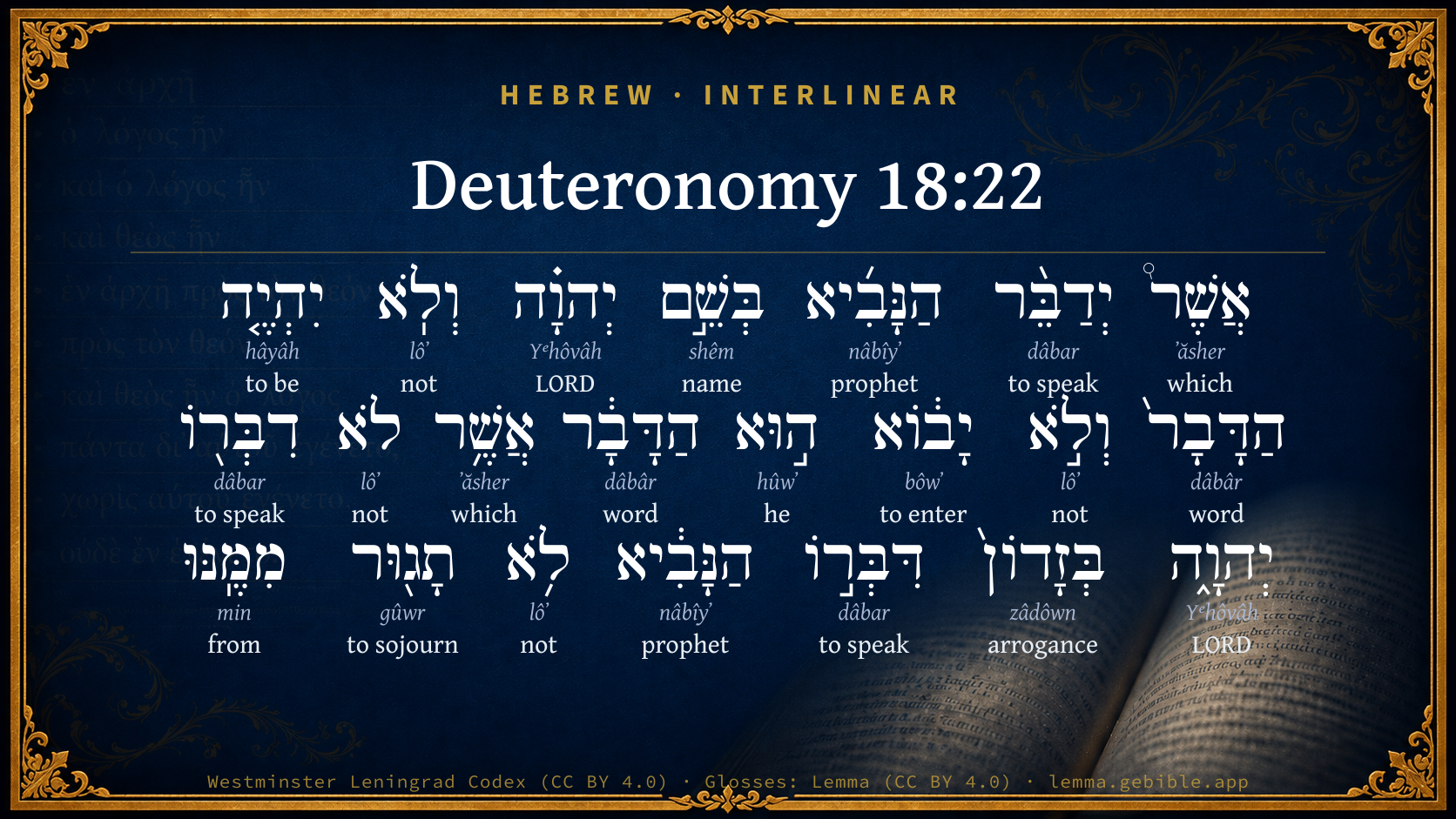
  1. אֲשֶׁר֩ ʼăsher H834 “which” Particle, Relative
  2. יְדַבֵּ֨ר dâbar H1696 “to speak” Verb, Piel, Imperfect, 3rd Person, Masculine, Singular
  3. הַנָּבִ֜יא nâbîyʼ H5030 “the · prophet” Particle, Definite Article + Noun, Common, Masculine, Singular, Absolute
  4. בְּשֵׁ֣ם shêm H8034 “in/at · name of” Preposition + Noun, Common, Masculine, Singular, Construct
  5. יְהוָ֗ה Yᵉhôvâh H3068 “LORD” Noun, Proper
  6. וְלֹֽא lôʼ H3808 “and · not” Conjunction + Particle, Negative
  7. יִהְיֶ֤ה hâyâh H1961 “to be” Verb, Qal, Imperfect, 3rd Person, Masculine, Singular
  8. הַדָּבָר֙ dâbâr H1697 “the · word” Particle, Definite Article + Noun, Common, Masculine, Singular, Absolute
  9. וְלֹ֣א lôʼ H3808 “and · not” Conjunction + Particle, Negative
  10. יָב֔וֹא bôwʼ H935 “to enter” Verb, Qal, Imperfect, 3rd Person, Masculine, Singular
  11. ה֣וּא hûwʼ H1931 “he” Pronoun, Personal, 3rd Person, Masculine, Singular
  12. הַדָּבָ֔ר dâbâr H1697 “the · word” Particle, Definite Article + Noun, Common, Masculine, Singular, Absolute
  13. אֲשֶׁ֥ר ʼăsher H834 “which” Particle, Relative
  14. לֹא lôʼ H3808 “not” Particle, Negative
  15. דִבְּר֖וֹ dâbar H1696 “to speak · him” Verb, Piel, Perfect, 3rd Person, Masculine, Singular + Suffix, Personal, 3rd Person, Masculine, Singular
  16. יְהוָ֑ה Yᵉhôvâh H3068 “LORD” Noun, Proper
  17. דִּבְּר֣וֹ dâbar H1696 “to speak · him” Verb, Piel, Perfect, 3rd Person, Masculine, Singular + Suffix, Personal, 3rd Person, Masculine, Singular
  18. הַנָּבִ֔יא nâbîyʼ H5030 “the · prophet” Particle, Definite Article + Noun, Common, Masculine, Singular, Absolute
  19. לֹ֥א lôʼ H3808 “not” Particle, Negative
  20. תָג֖וּר gûwr H1481 “to sojourn” Verb, Qal, Imperfect, 2nd Person, Masculine, Singular
  21. מִמֶּֽנּוּ min H4480 “from · him” Preposition + Suffix, Personal, 3rd Person, Masculine, Singular

About this verse

These counts appear in no published source. They are computed here, from the morphology-tagged text and Lemma’s own curated glosses. What Lemma adds →

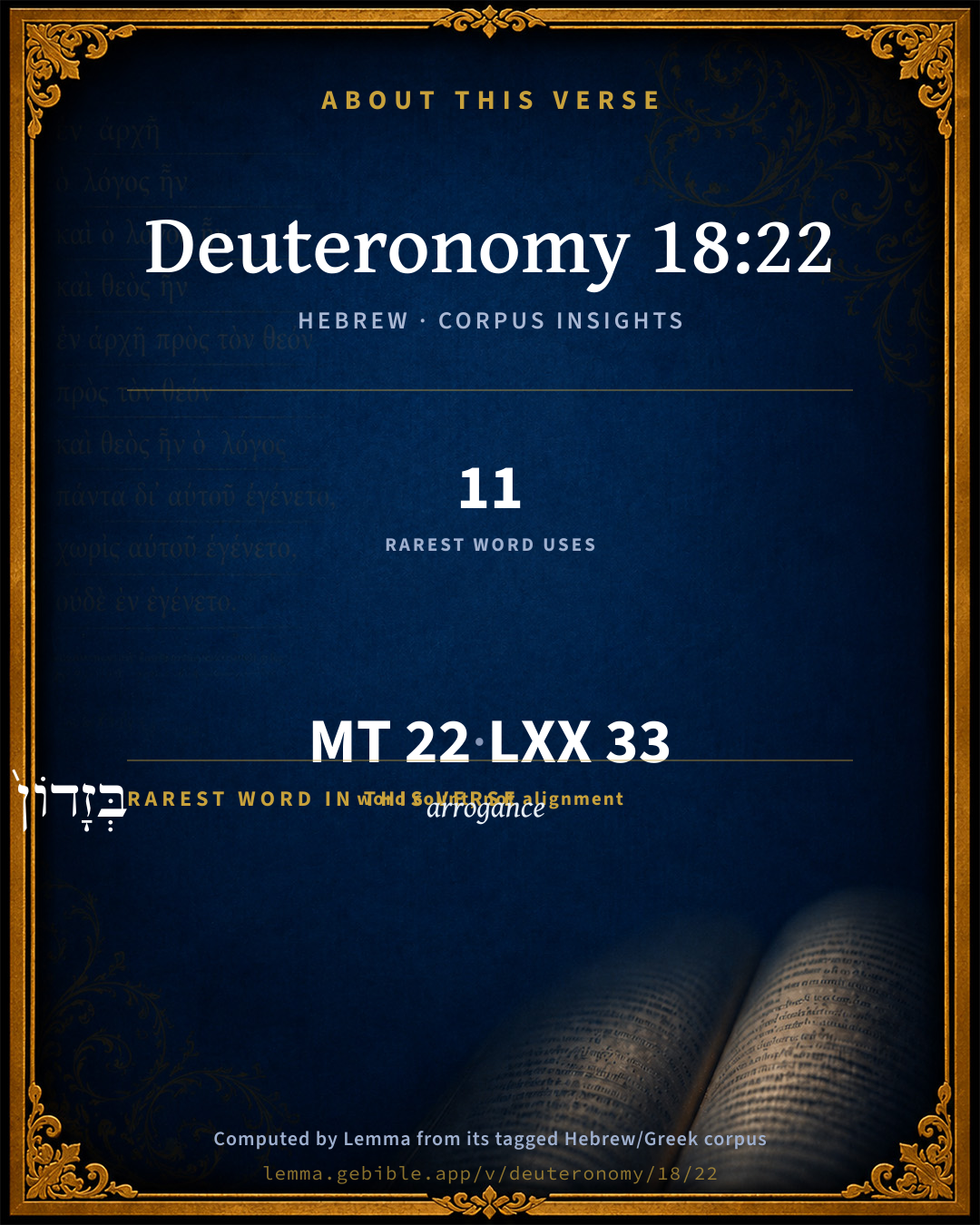
22
words
13
distinct lemmas
Pentateuch
section

Notable vocabulary

The rarest word here is בְּזָדוֹן֙ arrogance H2087 — appearing just 11 times in the whole Hebrew Bible.

Shared distinctive vocabulary

בְּזָדוֹן֙ arrogance H2087 occurs in 11 verses of the Hebrew Bible. Also found in:

Grammatical profile

  • 6 verbs
  • 8 nouns
  • 1 pronoun
  • 1 preposition
  • 6 particles

Verb forms

  • יְדַבֵּ֨ר Piel · Imperfect
  • יִהְיֶ֤ה Qal · Imperfect
  • יָב֔וֹא Qal · Imperfect
  • דִבְּר֖וֹ Piel · Perfect
  • דִּבְּר֣וֹ Piel · Perfect
  • תָג֖וּר Qal · Imperfect

Repetition

Words recur within this verse — often emphatic in Hebrew:

  • יְדַבֵּ֨ר to speak H1696 ×3
  • הַנָּבִ֜יא prophet H5030 ×2
  • יְהוָ֗ה LORD H3068 ×2
  • הַדָּבָר֙ word H1697 ×2
  • וְלֹֽא not H3808 ×4
  • אֲשֶׁר֩ which H834 ×2

Hebrew & Septuagint length

In English translation the verse runs 38 words from the Hebrew and 43 from the Septuagint (LXX English) — closely comparable.

A rough comparison of the two English renderings, which tokenize alike — not a word-level alignment.

Word counts can differ between the Hebrew and the Greek without any difference in meaning — e.g. the Hebrew direct-object marker אֵת has no separate Greek word, and Greek often adds the article ὁ.

In the original languages it is 22 Hebrew tokens and 33 Greek tokens — but the two are counted differently (Hebrew bundles its prefixes and suffixes into one token; the Greek is in lemma form), so that isn’t a like-for-like length.

Cross-references

9

Topical passages linked to Deuteronomy 18:22 in the Treasury of Scripture Knowledge — connected by theme and wording, ordered by reader-vote popularity; previews shown in the World English Bible.

  • Deuteronomy 18:20 But the prophet, who shall speak a word presumptuously in my name, which I have not commanded him to speak, or who shall speak in the name of other gods, that same prophet shall die.
  • 2 Kings 20:1 In those days was Hezekiah sick to death. Isaiah the prophet the son of Amoz came to him, and said to him, Thus says Yahweh, Set your house in order: for you shall die, and not live.
  • Jeremiah 28:1–17 It happened the same year, in the beginning of the reign of Zedekiah king of Judah, in the fourth year, in the fifth month, that Hananiah the son of Azzur, the prophet, who was of Gibeon, spoke to me in the house of Yahweh, in the presence of the priests and of all the people, saying,
  • Deuteronomy 13:1–2 If there arise in the midst of you a prophet, or a dreamer of dreams, and he give you a sign or a wonder,
  • Jonah 4:2 He prayed to Yahweh, and said, "Please, Yahweh, wasn't this what I said when I was still in my own country? Therefore I hurried to flee to Tarshish, for I knew that you are a gracious God, and merciful, slow to anger, and abundant in loving kindness, and you repent of the evil.
  • Zechariah 1:5–6 Your fathers, where are they? And the prophets, do they live forever?
  • Proverbs 26:2 Like a fluttering sparrow, Like a darting swallow, So the undeserved curse doesn't come to rest.
  • Isaiah 41:22 Let them bring forth, and declare to us what shall happen: declare you the former things, what they are, that we may consider them, and know the latter end of them; or show us things to come.
  • Jonah 3:4 Jonah began to enter into the city a day's journey, and he cried out, and said, "Yet forty days, and Nineveh shall be overthrown!"

Cross-references courtesy of OpenBible.info (CC BY 4.0).

Hebrew and Greek witnesses Masoretic Hebrew ↔ Greek Septuagint

The same verse in the two great witnesses to the Old Testament, shown verse-for-verse.

These are two independent witnesses, not word-aligned to each other, and the Septuagint is shown in lemma (dictionary) form.

Hebrew Deuteronomy 18:22 Masoretic · Westminster Leningrad Codex

אֲשֶׁר֩ יְדַבֵּ֨ר הַנָּבִ֜יא בְּשֵׁ֣ם יְהוָ֗ה וְלֹֽא יִהְיֶ֤ה הַדָּבָר֙ וְלֹ֣א יָב֔וֹא ה֣וּא הַדָּבָ֔ר אֲשֶׁ֥ר לֹא דִבְּר֖וֹ יְהוָ֑ה בְּזָדוֹן֙ דִּבְּר֣וֹ הַנָּבִ֔יא לֹ֥א תָג֖וּר מִמֶּֽנּוּ

when a prophet speaks in the name of Yahweh, if the thing doesn't follow, nor happen, that is the thing which Yahweh has not spoken: the prophet has spoken it presumptuously, you shall not be afraid of him.

World English Bible · Public Domain

Greek LXX Deuteronomy 18:22 Septuagint · lemma form

ὅσος ἐάν λαλέω ὁ προφήτης ἐπί ὁ ὄνομα κύριος καί μή γίγνομαι ὁ ῥῆμα καί μή συνβαίνω οὗτος ὁ ῥῆμα ὅς οὐ λαλέω κύριος ἐν ἀσέβεια λαλέω ὁ προφήτης ἐκεῖνος οὐ ἀποἔχω αὐτός

Whatsoever words that prophet shall speak in the name of the Lord, and they shall not come true, and not come to pass, this is the thing which the Lord has not spoken; that prophet has spoken wickedly: you⌃ shall not spare him.

LXX2012 (modern English Septuagint) · Public Domain

On this verse, Haydock's Catholic Bible Commentary discusses the Septuagint’s reading. Read the note in Commentary ↓

Hebrew: Westminster Leningrad Codex (CC BY 4.0). Greek: Septuagint (public domain); English from LXX2012 (modern English Septuagint) (Public Domain). How the Septuagint differs from the Hebrew →

Targum (Aramaic paraphrase)

2

The Targum is the ancient Jewish Aramaic paraphrase of the Hebrew Scriptures — an interpretive translation, not the Hebrew text itself. Onkelos (literal) and Pseudo-Jonathan (expansive) render the Torah, and Jonathan the Prophets. Coverage is partial: where no permissively-licensed English translation exists for a verse, only the Aramaic is shown. This is verse-level text, not a word-by-word alignment to the Hebrew.

  1. Targum Onkelos Torah (Genesis–Deuteronomy)
    דִי יְמַלֵל נְבִיָא בִּשְׁמָא דַיְיָ וְלָא יְהֵי פִתְגָמָא וְלָא יִתְקַיַם הוּא פִתְגָמָא דִי לָא מַלְלֵהּ יְיָ בִּרְשַׁע מַלְלֵהּ נְבִיָא לָא תִדְחַלּ מִנֵהּ

    (no public-domain English translation for this verse)

    Targum Onkelos — Aramaic: “Onkelos Genesis” (public domain); “Onkelos Exodus” (public domain); “Onkelos Leviticus” (public domain); “Onkelos Numbers” (public domain); “Onkelos Deuteronomy” (public domain). English: “Sefaria Community Translation” (CC0 1.0 (public-domain dedication)); “J.W. Etheridge. The Targums of Onkelos and Jonathan Ben Uzziel on the Pentateuch. London: Longmans, Green, 1862” (public domain). Text via Sefaria.

  2. Targum Pseudo-Jonathan Torah (Genesis–Deuteronomy)
    מַה דִּימַלֵּיל נְבִי שִׁקְרָא בִּשְׁמָא דַיְיָ וְלָא יֵיתֵי פִּתְגָּמָא וְלָא יִתְקַיֵּים הוּא פִּתְגָּמָא דְּלָא מַלְלֵיהּ יְיָ בִּזְדָנוּתָא מַלְלֵיהּ נְבִי שִׁקְרָא לָא תִדַחֲלוּן מִנֵּיהּ

    When a false prophet speaketh in the Name of the Lord, and the thing doth not come to pass, or be not confirmed, it is a word which the Lord hath not spoken; the false prophet spake it in presumption; fear him not.

    Targum Pseudo-Jonathan — Aramaic: “Targum Jonathan on Genesis” (public domain); “Targum Jonathan on Exodus” (public domain); “Targum Jonathan on Leviticus” (public domain); “Targum Jonathan on Numbers” (public domain); “Targum Jonathan on Deuteronomy” (public domain). English: “The Targum of Jonathan ben Uzziel, trans. J. W. Etheridge, London, 1862” (public domain). Text via Sefaria.

Commentary

Notes on Deuteronomy 18:22 from classic Christian and Jewish commentators (each source and its license shown beneath its notes). The classic Christian expositions comment on the surrounding passage and are grouped to its opening verse, so a note may address several verses; the Jewish commentaries on the Tanakh (Rashi and others) are per-verse, so they appear only where the commentator wrote on this verse.

Lemma curates 59 commentaries, every one of them public domain or Creative Commons licensed, each selected and text-cleaned for this edition rather than reprinted as found. About our sources →

Trapp's Complete Commentary

John Trapp

Deu 18:22 When a prophet speaketh in the name of the LORD, if the thing follow not, nor come to pass, that [is] the thing which the LORD hath not spoken, [but] the prophet hath spoken it presumptuously: thou shalt not be afraid of him.

Ver. 22. Thou shalt not be afraid.] Though he speak "great swelling words of vanity," {2Pe 2:18} millstones and thunderbolts, as Hacket here did. {a}

{a} Camden’s Elisab., fol. 403.

John Trapp, A Commentary or Exposition upon All the Books of the Old and New Testament (1647–1656) — public domain. Text from a community e-Sword module.

Joseph Benson's Commentary

Deu 18:22. If the thing follow not — Which he gives as a sign of the truth of his prophecy. That is the thing which the Lord hath not spoken — The falsehood of his prediction shows him to be a false prophet. He hath spoken it presumptuously — Impudently ascribing his own vain and lying fancies to the God of truth. For though the mere fulfilling of a sign, or working of a bare miracle, was not to be considered as sufficient of itself to establish a false and wicked doctrine, as is stated Deu 13:1-3; yet, on the other hand, a man that pretended to work a miracle, or predict a future event, in confirmation of a message said to be received from Jehovah, or from some other god, and who failed in the performance of the miracle, or the thing foretold not coming to pass, evidently proved himself to be an impostor. Thou shalt not be afraid of him — That is, of his predictions or threatenings, so as to be deterred thereby from doing thy duty in bringing him to deserved punishment.

Joseph Benson's Commentary on the Old and New Testaments (1811–1818) — public domain. Text from a community e-Sword module.

Tyndale Open Study Notes

Tyndale Open Resources

18:22 Any prophet whose prediction fails must be branded as false, even if he claims to speak for God. The mere claim is insufficient if it goes unfulfilled.

Tyndale Open Study Notes — © Tyndale Open Resources, licensed CC BY-SA 4.0. Text via the HelloAO Bible API.

Geneva Bible (1599)

Geneva Bible translators

Under this sure note he compriseth all the other tokens.

Geneva Bible (1599) marginal notes — public domain. Text via Bolls.life.

Adam Clarke's Commentary

Verse 22. If the thing follow not] It is worthy of remark that the prophets in general predicted those things which were shortly to come to pass, that the people might have the fullest proof of their Divine mission, and of the existence of God's providence in the administration of the affairs of men.

THE promise contained in the 15th and 18th verses of this chapter has long been considered of the first importance in the controversies between the Christians and Jews. "Christ," says Ainsworth, "was to be a man, and of the stock of the Jews, by promise, because the people could not endure to hear the voice of GOD, De 18:16. And as in respect of his prophecy, so of the priesthood: for every high priest is taken from among men, Heb 5:1; and also of his kingdom, as in De 17:15: From among thy brethren shalt thou set a king over thee like unto me.

"1. Christ alone was like unto Moses as a PROPHET; for it is written, There arose not a prophet in Israel like unto Moses, whom the Lord knew face to face, in all the signs and wonders which the Lord sent him to do, De 34:10-12. This therefore cannot be understood of the ordinary prophets which were raised up in Israel, but of Christ only, as the apostles expound it Ac 2:22-26.

2. Christ was like unto Moses in respect to his office of mediation between God and his people, De 5:5; 1Ti 2:5; but greater than Moses as being the mediator of a better covenant, (or testament,) which was established upon better promises, Heb 8:6.

3. Christ was like unto Moses in excellency; for as Moses excelled all the prophets in speaking to God mouth to mouth, Nu 12:6-8, so Christ excelled him and all men in that being in the bosom of the Father, he hath come down from heaven and declared God unto us, Joh 1:18; Joh 3:13.

4. Christ was like to Moses in faithfulness, but therein also excelling; for Moses was faithful in God's house as a servant, but Christ as the son over his own house, Heb 3:2; Heb 3:5-6.

5. Christ was like to Moses in signs and wonders, wherein he also excelled Moses, as the history of the Gospel shows; for he was a prophet mighty in deed and word before God and all the people, Lu 24:19. A man approved of God among them, by miracles, signs, and wonders, which God did by him in the midst of them, Ac 2:22. For he did among them the works which no other man did, Joh 15:24. Unto him, that is, not unto the diviners, wizards, or any such like, but unto him, and him only; as Him thou shalt serve, De 6:13, is expounded, Him only, Mt 4:10. And though this is principally meant of Christ in person, of whom God said, Hear him, Mt 17:5; yet it implies also his ministers, as himself said, He that heareth you heareth me, Lu 10:16." To these may be added,

6. As Moses was king among his people, in this respect Christ is like to him, but infinitely greater; for he is King of kings and Lord of lords, Re 19:16; 1Ti 6:15. And,

7. He was like to Moses as a legislator. Moses gave laws to Israel by the authority and commandment of God, which the Jews have ever acknowledged as coming from the immediate inspiration of the Almighty: these are contained in the Pentateuch. Christ gave a new law, the Gospel contained in the four Evangelists and Acts of the Apostles, on which the Christian Church is founded, and by which all genuine Christians are governed both in heart and life. To all which may be added,

8. That God never commissioned any human beings to give laws to mankind but Moses and Christ; and therefore, as a lawgiver, Christ alone resembles Moses; for to the present hour none but themselves have given laws in the name of God, which he has ratified and confirmed by the most indubitable and infallible signs, proofs, and miracles.

Dr. Jortin, in his Remarks on Ecclesiastical History, has drawn a parallel between Moses and Christ in a great number of particulars, which he concludes thus: "Let us search all the records of universal history, and see if we can find a man who was so like to Moses as Christ was, and so like to Christ as Moses was. If we cannot find such a one, then have we found HIM of whom Moses in the law and the prophets did write to be Jesus of Nazareth, the Son of God." On this subject see Ainsworth, Calmet, and Dodd, who have all marked this striking correspondence between Moses and Christ.

Adam Clarke's Commentary on the Bible (1810–1826) — public domain. Text from a community e-Sword/MySword module.

Ellicott's Commentary for English Readers

(22) If the thing follow not, nor come to pass.—This is one form of our Lord’s test for all prophets, “By their fruits (i.e., the ‘results,’ of their teaching, not its first impressions) ye shall know them.”

A Bible Commentary for English Readers, edited by Charles John Ellicott (1878–1897) — public domain. Text from a community e-Sword module.

The Cambridge Bible for Schools and Colleges

gen. ed. J. J. S. Perowne

22. The falseness of such a prophet is exposed by the non-fulfilment of his predictions. Jeremiah states the converse: if any prophet prophesy peace (which in the seventh century the false prophets usually did) and his word come to pass, then shall the prophet be known that the Lord hath truly sent him (Jer_28:9).

It is true that ‘this test is explicitly rejected for the prophets of other gods (Deu_13:1-5); nor is the higher Hebrew prophecy nearly so much predictive as interpretative’ (Wheeler Robinson in loco). Yet we must remember that though the main burden of the prophets consisted of truths of morality and religion (the unity and righteousness of God and the ethical character of His demands) they were also concerned with the vindication of these in the actual experience of the people. To them truth was never merely abstract, they looked for its fulfilment by God in history. Prof. A. B. Davidson once said to the present writer: ‘The prophets were terribly one-idea’d men. Yet their one idea was the greatest of all, that God was going to do something.’ So Amo_3:4-8. The two most spiritual of the prophets staked their credit as the bearers of God’s word on certain historical issues. Isaiah was sure of the inviolableness of Jerusalem and the survival of a remnant of the people (on this see Rev. of Theol. & Phil. iii. 7 by the present writer in answer to Guthe’s Jesaia in Religionsgeschichtlicke Volksbücher); and Jeremiah was content to wait on events for the decision whether he or Hananiah had the word of the LORD (Jeremiah 28 esp. 11b, see Duhm’s fine remarks on this chapter in the Kurzer Hand-Commentar). Again after reporting the word of the LORD, that his uncle should come to him asking him to buy his field, he adds when the uncle came and did so, then knew I that this was the word of the LORD (Deu_32:6 ff.). Of course, behind all this was the faith that God had a future for Israel in the land, though the Babylonians had overrun it and Jerusalem must fall to them. If then Jeremiah himself so much depended for the proof of his message upon the issue of events, we cannot be surprised that D proposes to the popular mind the same test of a prophet’s word.—Though beyond our immediate subject we may note that the word of the Lord by the true prophet was not always fulfilled. This is explained in Jeremiah 18 and Jonah 4 as due to a change in the moral situation. Such, however, is not a full explanation. Sometimes, as in the case of the non-fulfilment of Jeremiah’s own early predictions about the Scythians, and his slow arrival (only after the battle of Carchemish) at the conviction that Babylon was to be the executioner of God’s judgements on Israel, the change in the prophet’s word was due to altered political circumstances.

The Cambridge Bible for Schools and Colleges (gen. ed. J. J. S. Perowne; Cambridge University Press, 1878–1918) — public domain. Text from a community e-Sword module.

Haydock's Catholic Bible Commentary

Fear him. Septuagint, "you shall not spare him," but cut him off by death. (Haydock) --- Though the completion of what has been foretold be not a sure sign of a true prophecy, (chap. xiii. 2,) yet when the thing does not come to pass which the prophet had spoken unconditionally, he must undoubtedly be rejected; as also when he speaks in the name of false gods. No miracles can then establish his credit. The prophecy of Jonas, and many of the other prophecies, were conditional. (Calmet)

George Leo Haydock (1774–1849), Haydock's Catholic Family Bible and Commentary, 1859 edition — public domain. Excludes Psalms (Douay-Rheims chapter numbering differs from Protestant) and Deuterocanonical books (Catholic canon only).

Matthew Poole's English Annotations

If the thing follow not; which he gives as a sign of the truth of his prophecy. He means the prediction of some strange and wonderful event, as appears by comparing this with Deu 13:1,2.

The Lord hath not spoken: the falsehood of his prediction shows him to be a false prophet, though the truth and accomplishment of his prediction had not proved him to be a true prophet, as is evident from Deu 13:2,3.

Presumptuously; impudently ascribing his own vain and lying fancies to the God of truth.

Thou shalt not be afraid of him, i.e. of his predictions or threatenings, so as to be scared from doing thy duty in bringing him to deserved punishment.

Matthew Poole's English Annotations on the Holy Bible (1683–1685) — public domain. Text from a community e-Sword/MySword module.

Whedon's Commentary on the Bible

Daniel D. Whedon

22. When a prophet speaketh — The prophecy was tested by the result. Signs and wonders were not the criterion by which the people were to decide.

Daniel D. Whedon (gen. ed.), Commentary on the Old and New Testaments (1874–1909) — public domain. Text from a community e-Sword module.

John Wesley's Explanatory Notes

If the thing - Which he gives as a sign of the truth of his prophecy. The falsehood of his prediction shews him to be a false prophet. Presumptuously - Impudently ascribing his own vain and lying fancies to the God of truth.

John Wesley, Explanatory Notes Upon the Whole Bible (1754–1765) — public domain. Text via the GEBible commentary corpus.

unfoldingWord translationNotes

Door43 World Missions Community

General Information:

Yahweh continues speaking.

a prophet speaks in the name of Yahweh

Here "name of Yahweh" refers to Yahweh himself and his authority. AT: "a prophet claims to speak for me" or "a prophet claims to speak with my authority" (See: Metonymy)

the prophet has spoken it arrogantly

"the prophet has spoken this message without my authority"

translationWords

name

Yahweh

arrogant

fear

unfoldingWord translationNotes — © Distant Shores Media and the Door43 World Missions Community, licensed CC BY-SA 4.0. Source: git.door43.org/Door43/en_tn.

Rashi

Rabbi Shlomo Yitzchaki (Rashi)

אשר ידבר הנביא WHEN THE PROPHET SPEAKETH [IN THE NAME OF THE LORD] and says, “This thing will once happen to you”, and you will see that it did not happen, הוא הדבר אשר לא דברו ה׳ THAT IS THE THING WHICH THE LORD HATH NOT SPOKEN — and, therefore, slay him. If, however, you say, “But this refers to one who will prophesy about the future. But suppose one comes and says, ‘Do so and so, and I say this by the command of the Holy One blessed be He’? How, then, can we know whether God has spoken this or not?” The reply is: As regards such a case they have already been commanded that if one comes to thrust thee away from one of the divine commandments, לא תשמע לו “then thou shalt not hearken unto him” (Deuteronomy 13:12), unless you are certain that he is a perfectly righteous man, as, for instance. Elijah at the incident on Mount Carmel, who offered sacrifices on a Bamah (an improvised altar) at a time when offering on Bamoth was forbidden, but who did so in order to fence Israel in against idolatry. Thus all depends on the needs of the time and the necessity of taking preventive measures (סיג) against a breach. With reference to such a case it states, (v. 15) “unto him ye shall hearken” (Sanhedrin 89b; Yevamot 90b).

לא תגור ממנו THOU SHALT NOT BE AFRAID OF HIM — i.e. do not refrain from advocating his guilt (Sifrei Devarim 178:3) and do not fear that you may incur punishment on his account (because you have contributed to his death).

Rashi on the Tanakh — English translations: “The Judaica Press complete Tanach with Rashi, translated by A. J. Rosenberg” (CC BY 4.0); “Pentateuch with Rashi's commentary by M. Rosenbaum and A.M. Silbermann, 1929-1934” (public domain); “The Metsudah Tanach series, Lakewood, N.J” (CC BY 4.0); and “The Book of Joshua, Metsudah Publications, 1997” (CC BY 4.0). Text via Sefaria.

Lesson kit

Teaching starters — assembled from the data on this page, not authored interpretation. Every prompt links to the verse data it draws on. Edit before teaching.

Deuteronomy, in the Pentateuch, opens this verse with 22 words (13 distinct Hebrew lemmas). Its most distinctive word is zâdôwn (“arrogance”). A historical commentator’s framing appears above. Read the whole chapter for the surrounding context.

Discussion questions

  1. The word zâdôwn carries the sense “arrogance.” How does it shape the verse?
  2. Deuteronomy 17:12 shares the word «arrogance» with this verse. How do the two illuminate each other?
  3. “to speak” occurs 3× in this one verse. What is the effect of the repetition?
  4. The translations on this page render this verse differently — a whole-verse word diff, not a word-by-word alignment. What might account for the different wordings?
  5. The verb «יְדַבֵּ֨ר» is Piel Imperfect. How does its form color the action?
  6. Reading how Trapp's Complete Commentary and Joseph Benson's Commentary read this verse, where do the two commentators agree and where do they part?

Things to notice

Reading settings

Reading text

Shown beneath each verse's original-language words.

Old Testament
Old Testament edition

Read the OT as the Masoretic Hebrew (MT) or the Greek Septuagint (LXX).

English shown for the Greek Septuagint (in the Hebrew ↔ Greek comparison).

Comparing translations? Open the Compare panel on any verse page to stack up to four side by side.