
Genesis 30:33

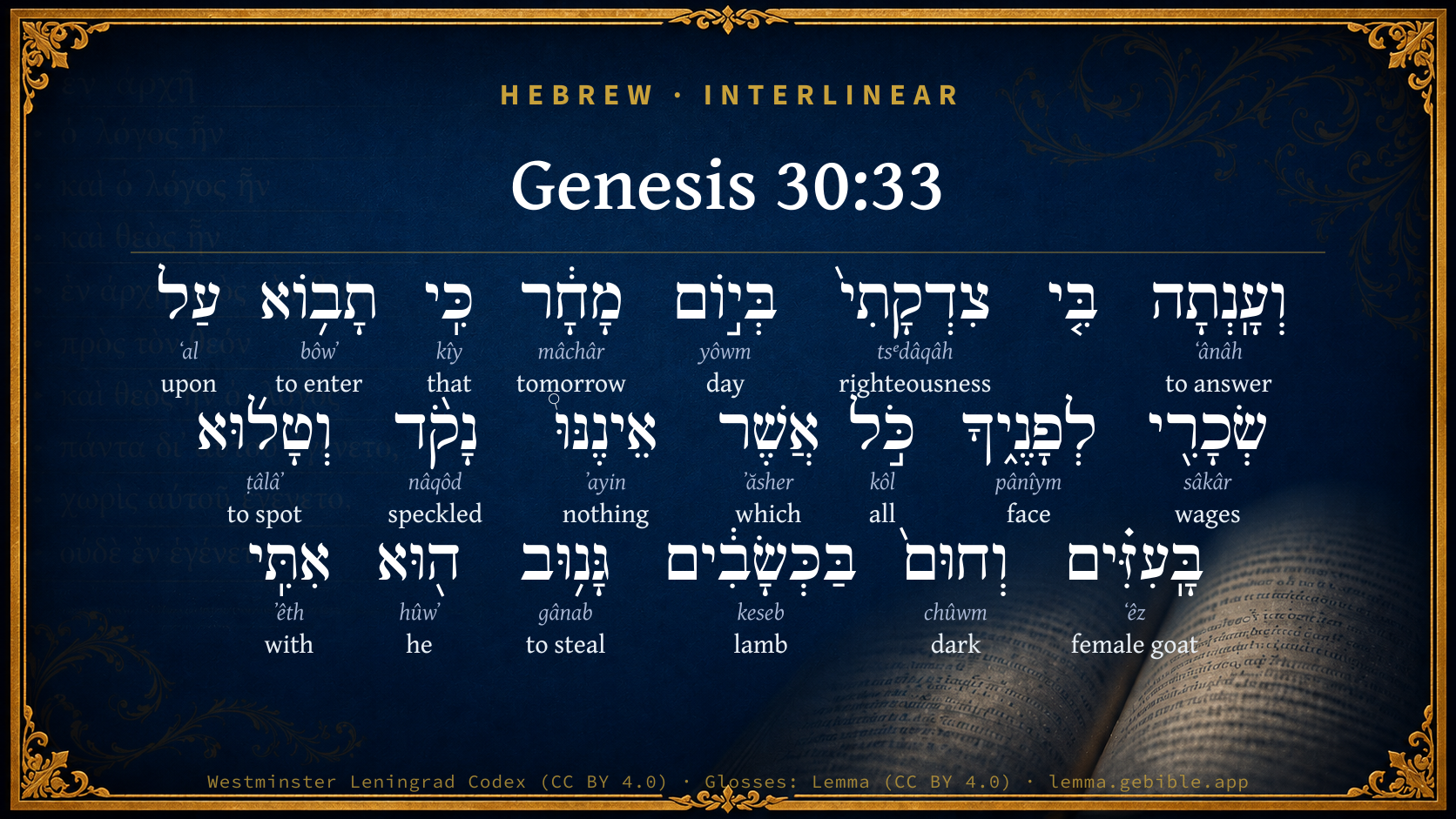
Hebrew (Westminster Leningrad Codex) Genesis 30:33 appears in the Hebrew Old Testament. The text above is from the Westminster Leningrad Codex. Each word links to its Strong’s number, a concise gloss, and parsing drawn from the Open Scriptures Hebrew Bible morphology. Click any word for its full Brown-Driver-Briggs (BDB) entry.
Download image
Cite this verse

Genesis 30:33 (World English Bible). Public Domain. Lemma interlinear Bible study tool, https://lemma.gebible.app/v/genesis/30/33.

Show BibTeX & RIS
BibTeX
RIS
English Translation
So my righteousness will answer for me hereafter, when you come concerning my hire that is before you. Everyone that is not speckled and spotted among the goats, and black among the sheep, that might be with me, will be counted stolen."
World English Bible · Public Domain
Highlights
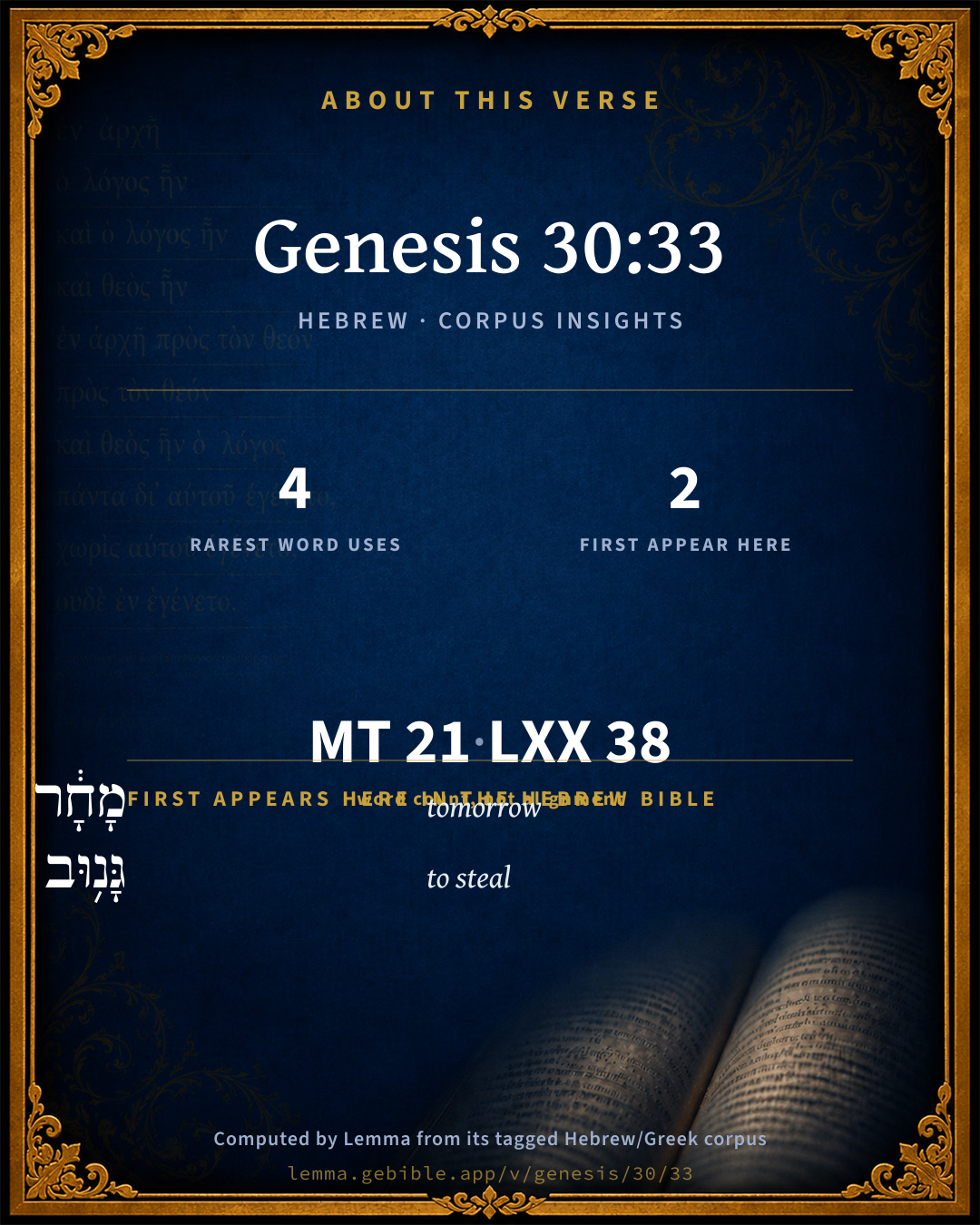
  • 2 first appearances in the Hebrew Bible
Full analysis ↓
Download a study sheet

One document with this verse’s original text, its word-by-word gloss line, the meaning frame, cross-references with their text, attributed commentary, and full source and license credits — printable, and it pastes into notes with its structure intact.

This verse Autodidact and up

Study sheet (.html) Plain text (.txt)

A passage Seminary Student

Up to 50 verses in one chapter. A passage sheet keeps up to 6 commentary sources and 12 cross-references per verse, in the order this page ranks them, and says so on the sheet whenever that leaves anything out. Ask for a single verse and you get the Autodidact verse sheet above.

Everything on this page stays free to read, with no account — the sheet is a download of what is already on screen, not access to it.

Want to remove ads? Support Godless Engineer
Compare translations 3

The same verse in 3 English versions, stacked beneath the original-language interlinear above. Click any original word for its lexicon entry.

Each is an independent rendering of the whole verse — the interlinear is not word-aligned to these translations.

Highlighted words mark where these versions differ — a whole-verse word diff, not a word-by-word alignment.

  • World English Bible Public Domain
    So my righteousness will answer for me hereafter, when you come concerning my hire that is before you. Everyone that is not speckled and spotted among the goats, and black among the sheep, that might be with me, will be counted stolen."
  • King James Version Public Domain
    So shall my righteousness answer for me in time to come, when it shall come for my hire before thy face: every one that is not speckled and spotted among the goats, and brown among the sheep, that shall be counted stolen with me.
  • unfoldingWord Literal Text CC BY-SA 4.0
    So my righteousness will testify for me in future days when you go over my wages in front of you: any that is not speckled and spotted among the goats and dark-colored among the sheep, it was stolen with me.”

unfoldingWord Literal Text — © unfoldingWord, licensed CC BY-SA 4.0. Word-aligned USFM3 via Door43 (git.door43.org/unfoldingWord/en_ult).

Versions to compare (up to 4)

3 of 4 selected

Show all 18 translations

Every available English version of this verse, each an independent rendering of the whole verse.

  • World English Bible Public Domain
    So my righteousness will answer for me hereafter, when you come concerning my hire that is before you. Everyone that is not speckled and spotted among the goats, and black among the sheep, that might be with me, will be counted stolen."
  • Berean Standard Bible Public Domain
    So my honesty will testify for me when you come to check on my wages in the future. If I have any goats that are not speckled or spotted, or any lambs that are not dark-colored, they will be considered stolen.”
  • Majority Standard Bible Public Domain
    So my honesty will testify for me when you come to check on my wages in the future. If I have any goats that are not speckled or spotted, or any lambs that are not dark-colored, they will be considered stolen.”
  • King James Version Public Domain
    So shall my righteousness answer for me in time to come, when it shall come for my hire before thy face: every one that is not speckled and spotted among the goats, and brown among the sheep, that shall be counted stolen with me.
  • American Standard Version (1901) Public Domain
    So shall my righteousness answer for me hereafter, when thou shalt come concerning my hire that is before thee: every one that is not speckled and spotted among the goats, and black among the sheep, that `if found' with me, shall be counted stolen.
  • Revised Version (1885) Public Domain
    So shall my righteousness answer for me hereafter, when thou shalt come concerning my hire that is before thee: every one that is not speckled and spotted among the goats, and black among the sheep, that if found with me shall be counted stolen.
  • Geneva Bible (1599) Public Domain
    So shall my righteousnesse answere for me hereafter, when it shall come for my rewarde before thy face, and euery one that hath not litle or great spots among the goates, and blacke among the sheepe, the same shalbe theft with me.
  • Douay-Rheims (1899) Public Domain
    And my justice shall answer for me to morrow before thee when the time of the bargain shall come: and all that is not of divers colours, and spotted, and brown, as well among the sheep as among the goats, shall accuse me of theft.
  • Young's Literal Translation Public Domain
    and my righteousness hath answered for me in the day to come, when it cometh in for my hire before thy face; -- every one which is not speckled and spotted among `my' goats, and brown among `my' lambs -- it is stolen with me.'
  • Literal Standard Version CC BY-SA 4.0
    and my righteousness has answered for me in the day to come, when it comes in for my hire before your face—everyone which is not speckled and spotted among [my] goats, and brown among [my] lambs—it is stolen with me.”
  • Unlocked Literal Bible CC BY-SA 4.0
    My integrity will testify for me later on, when you come to check on my wages. Every one that is not speckled and spotted among the goats, and black among the sheep, if any are found with me, will be considered to be stolen.”
  • unfoldingWord Literal Text CC BY-SA 4.0
    So my righteousness will testify for me in future days when you go over my wages in front of you: any that is not speckled and spotted among the goats and dark-colored among the sheep, it was stolen with me.”
  • Darby Bible Public Domain
    And my righteousness shall answer for me hereafter, when thou comest about my hire, before thy face: all that is not speckled and spotted among the goats, and brown among the lambs, let that be stolen with me.
  • World Messianic Bible Public Domain
    So my righteousness will answer for me hereafter, when you come concerning my hire that is before you. Every one that is not speckled and spotted among the goats, and black among the sheep, that might be with me, will be considered stolen.”
  • Webster's Bible Public Domain
    So shall my righteousness answer for me in time to come, when it shall come for my hire before thy face: every one that is not speckled and spotted among the goats, and brown among the sheep, that shall be accounted stolen with me.
  • Free Bible Version CC BY-SA 4.0
    In the future you'll be able to prove that I've been honest. When you check my flock, any goats that don't have speckles or spots, or any sheep that aren't dark will be considered stolen from you.”
  • Bible in Basic English Public Domain
    And so you will be able to put my honour to the test in time to come; if you see among my flocks any goats which are not marked or coloured, or any sheep which is not black, you may take me for a thief.
  • JPS Tanakh (1917) Public Domain
    So shall my righteousness witness against me hereafter, when thou shalt come to look over my hire that is before thee: every one that is not speckled and spotted among the goats, and dark among the sheep, that if found with me shall be counted stolen.'

Literal Standard Version (2020), Covenant Press — licensed CC BY-SA 4.0. Text via the HelloAO Bible API (eBible.org). Unlocked Literal Bible (unfoldingWord) — licensed CC BY-SA 4.0. Text via the HelloAO Bible API (eBible.org). unfoldingWord Literal Text — © unfoldingWord, licensed CC BY-SA 4.0. Word-aligned USFM3 via Door43 (git.door43.org/unfoldingWord/en_ult). Free Bible Version, Dr. Jonathan Gallagher — licensed CC BY-SA 4.0. Text via the HelloAO Bible API (eBible.org).

Word by word

More ways to search: Search by grammar → Find every occurrence → Compare this word →

Practice this passage: Drill this verse → Learn its vocabulary →

וְחוּם֙
chûwm
H2345
“and · dark”
Conjunction + Adjective, Adjective, Masculine, Singular, Absolute
Part of Speech
Conjunction + Adjective
Type
Adjective
Gender
Masculine
Number
Singular
State
Absolute
Full BDB Definition

Origin: from an unused root meaning to be warm

TWOT: 625a

dark colour, darkened, dark brown or black
  1. וְעָֽנְתָה ʻânâh H6030 “and · to answer” Conjunction + Verb, Qal, Sequential Perfect, 3rd Person, Feminine, Singular
  2. צִדְקָתִי֙ tsᵉdâqâh H6666 “righteousness · my” Noun, Common, Feminine, Singular, Construct + Suffix, Personal, 1st Person, Common, Singular
  3. בְּי֣וֹם yôwm H3117 “in/at · day of” Preposition + Noun, Common, Masculine, Singular, Construct
  4. מָחָ֔ר mâchâr H4279 “tomorrow” Noun, Common, Masculine, Singular, Absolute
  5. כִּֽי kîy H3588 “that” Conjunction
  6. תָב֥וֹא bôwʼ H935 “to enter” Verb, Qal, Imperfect, 2nd Person, Masculine, Singular
  7. עַל ʻal H5921 “upon” Preposition
  8. שְׂכָרִ֖י sâkâr H7939 “wages · my” Noun, Common, Masculine, Singular, Construct + Suffix, Personal, 1st Person, Common, Singular
  9. לְפָנֶ֑יךָ pânîym H6440 “to/for · face(s) · your” Preposition + Noun, Common, Both, Plural, Construct + Suffix, Personal, 2nd Person, Masculine, Singular
  10. כֹּ֣ל kôl H3605 “all” Noun, Common, Masculine, Singular, Absolute
  11. אֲשֶׁר ʼăsher H834 “which” Particle, Relative
  12. אֵינֶנּוּ֩ ʼayin H369 “nothing · him” Particle, Negative + Suffix, Personal, 3rd Person, Masculine, Singular
  13. נָקֹ֨ד nâqôd H5348 “speckled” Adjective, Adjective, Masculine, Singular, Absolute
  14. וְטָל֜וּא ṭâlâʼ H2921 “and · spotted” Conjunction + Verb, Qal, Participle Passive, Masculine, Singular, Absolute
  15. בָּֽעִזִּ֗ים ʻêz H5795 “in/at the · female goats” Preposition, Determined + Noun, Common, Feminine, Plural, Absolute
  16. בַּכְּשָׂבִ֔ים keseb H3775 “in/at the · lambs” Preposition, Determined + Noun, Common, Masculine, Plural, Absolute
  17. גָּנ֥וּב gânab H1589 “stolen” Verb, Qal, Participle Passive, Masculine, Singular, Absolute
  18. ה֖וּא hûwʼ H1931 “he” Pronoun, Personal, 3rd Person, Masculine, Singular
  19. אִתִּֽי ʼêth H854 “with · me” Preposition + Suffix, Personal, 1st Person, Common, Singular

About this verse

These counts appear in no published source. They are computed here, from the morphology-tagged text and Lemma’s own curated glosses. What Lemma adds →

21
words
20
distinct lemmas
Pentateuch
section

Notable vocabulary

The rarest word here is וְחוּם֙ dark H2345 — appearing just 4 times in the whole Hebrew Bible.

First appearance in Scripture

These words make their first canonical appearance in the Hebrew Bible here:

  • מָחָ֔ר tomorrow H4279
  • גָּנ֥וּב to steal H1589

Shared distinctive vocabulary

וְחוּם֙ dark H2345 occurs in 4 verses of the Hebrew Bible. Also found in:

Grammatical profile

  • 4 verbs
  • 8 nouns
  • 2 adjectives
  • 1 pronoun
  • 3 prepositions
  • 1 conjunction
  • 2 particles

Verb forms

  • וְעָֽנְתָה Qal · Sequential Perfect
  • תָב֥וֹא Qal · Imperfect
  • וְטָל֜וּא Qal · Participle Passive
  • גָּנ֥וּב Qal · Participle Passive

Hebrew & Septuagint length

In English translation the verse runs 42 words from the Hebrew and 37 from the Septuagint (LXX English) — closely comparable.

A rough comparison of the two English renderings, which tokenize alike — not a word-level alignment.

Word counts can differ between the Hebrew and the Greek without any difference in meaning — e.g. the Hebrew direct-object marker אֵת has no separate Greek word, and Greek often adds the article ὁ.

In the original languages it is 21 Hebrew tokens and 38 Greek tokens — but the two are counted differently (Hebrew bundles its prefixes and suffixes into one token; the Greek is in lemma form), so that isn’t a like-for-like length.

Cross-references

6

Topical passages linked to Genesis 30:33 in the Treasury of Scripture Knowledge — connected by theme and wording, ordered by reader-vote popularity; previews shown in the World English Bible.

  • 1 Samuel 26:23 Yahweh will render to every man his righteousness and his faithfulness; because Yahweh delivered you into my hand today, and I wouldn't put forth my hand against Yahweh's anointed.
  • Genesis 31:37 Now that you have felt around in all my stuff, what have you found of all your household stuff? Set it here before my relatives and your relatives, that they may judge between us two.
  • Exodus 13:14 It shall be, when your son asks you in time to come, saying, 'What is this?' that you shall tell him, 'By strength of hand Yahweh brought us out from Egypt, from the house of bondage;
  • 2 Samuel 22:21 Yahweh rewarded me according to my righteousness; According to the cleanness of my hands has he recompensed me.
  • Psalms 37:6 He will make your righteousness go forth as the light, And your justice as the noon day sun.
  • Isaiah 59:12 For our transgressions are multiplied before you, and our sins testify against us; for our transgressions are with us, and as for our iniquities, we know them:

Cross-references courtesy of OpenBible.info (CC BY 4.0).

Hebrew and Greek witnesses Masoretic Hebrew ↔ Greek Septuagint

The same verse in the two great witnesses to the Old Testament, shown verse-for-verse.

These are two independent witnesses, not word-aligned to each other, and the Septuagint is shown in lemma (dictionary) form.

Hebrew Genesis 30:33 Masoretic · Westminster Leningrad Codex

וְעָֽנְתָה בִּ֤י צִדְקָתִי֙ בְּי֣וֹם מָחָ֔ר כִּֽי תָב֥וֹא עַל שְׂכָרִ֖י לְפָנֶ֑יךָ כֹּ֣ל אֲשֶׁר אֵינֶנּוּ֩ נָקֹ֨ד וְטָל֜וּא בָּֽעִזִּ֗ים וְחוּם֙ בַּכְּשָׂבִ֔ים גָּנ֥וּב ה֖וּא אִתִּֽי

So my righteousness will answer for me hereafter, when you come concerning my hire that is before you. Everyone that is not speckled and spotted among the goats, and black among the sheep, that might be with me, will be counted stolen."

World English Bible · Public Domain

Greek LXX Genesis 30:33 Septuagint · lemma form

καί ἐπιἀκούω ἐγώ ὁ δικαιοσύνη ἐγώ ἐν ὁ ἡμέρα ὁ αὔριον ὅτι εἰμί ὁ μισθός ἐγώ ἐνώπιον σύ πᾶς ὅς ἐάν μή εἰμί ῥαντός καί διάλευκος ἐν ὁ αἴξ καί φαιός ἐν ὁ ἀρνός κλέπτω εἰμί παρά ἐγώ

And my righteousness shall answer for me on the morrow, for it is my reward before you: whatever shall not be spotted and speckled among the goats, and grey among the rams, shall be stolen with me.

LXX2012 (modern English Septuagint) · Public Domain

Hebrew: Westminster Leningrad Codex (CC BY 4.0). Greek: Septuagint (public domain); English from LXX2012 (modern English Septuagint) (Public Domain). How the Septuagint differs from the Hebrew →

Targum (Aramaic paraphrase)

2

The Targum is the ancient Jewish Aramaic paraphrase of the Hebrew Scriptures — an interpretive translation, not the Hebrew text itself. Onkelos (literal) and Pseudo-Jonathan (expansive) render the Torah, and Jonathan the Prophets. Coverage is partial: where no permissively-licensed English translation exists for a verse, only the Aramaic is shown. This is verse-level text, not a word-by-word alignment to the Hebrew.

  1. Targum Onkelos Torah (Genesis–Deuteronomy)
    וְתַסְהֵד בִּי זָכוּתִי בְּיוֹם דִּמְחָר אֲרֵי תֵיעוֹל עַל אַגְרִי קֳדָמָךְ כֹּל דִּי לֵיתוֹהִי נְמוֹר וּרְקוֹעַ בְּעִזַּיָּא וּשְׁחוּם בְּאִמְרַיָא גְּנוּבָא הוּא עִמִּי

    (no public-domain English translation for this verse)

    Targum Onkelos — Aramaic: “Onkelos Genesis” (public domain); “Onkelos Exodus” (public domain); “Onkelos Leviticus” (public domain); “Onkelos Numbers” (public domain); “Onkelos Deuteronomy” (public domain). English: “Sefaria Community Translation” (CC0 1.0 (public-domain dedication)); “J.W. Etheridge. The Targums of Onkelos and Jonathan Ben Uzziel on the Pentateuch. London: Longmans, Green, 1862” (public domain). Text via Sefaria.

  2. Targum Pseudo-Jonathan Torah (Genesis–Deuteronomy)
    וְתִיסְהַד בִּי זַכְוָותִי לְיוֹם מָחְרָא אֲרוּם תֶּהֱוֵי עַל אַגְרִי לְקַמָךְ כָּל דְלֵיתוֹהִי נְמוֹר וְקִירוֹחַ בְּעִזַיָא וּלְחוּשׁ בְּאִימְרַיָא גְנִיבָא הוּא לְמֶהֱוֵי דִילִי

    And my righteousness shall testify for me tomorrow, when my wages shall be brought before thee. Every one which is not streaked or spotted among the goats, or black among the lambs, shall be as if it had been a theft of mine.

    Targum Pseudo-Jonathan — Aramaic: “Targum Jonathan on Genesis” (public domain); “Targum Jonathan on Exodus” (public domain); “Targum Jonathan on Leviticus” (public domain); “Targum Jonathan on Numbers” (public domain); “Targum Jonathan on Deuteronomy” (public domain). English: “The Targum of Jonathan ben Uzziel, trans. J. W. Etheridge, London, 1862” (public domain). Text via Sefaria.

Commentary

Notes on Genesis 30:33 from classic Christian and Jewish commentators (each source and its license shown beneath its notes). The classic Christian expositions comment on the surrounding passage and are grouped to its opening verse, so a note may address several verses; the Jewish commentaries on the Tanakh (Rashi and others) are per-verse, so they appear only where the commentator wrote on this verse.

Lemma curates 59 commentaries, every one of them public domain or Creative Commons licensed, each selected and text-cleaned for this edition rather than reprinted as found. About our sources →

Trapp's Complete Commentary

John Trapp

Gen 30:33 So shall my righteousness answer for me in time to come, when it shall come for my hire before thy face: every one that [is] not speckled and spotted among the goats, and brown among the sheep, that shall be counted stolen with me.

Ver. 33. So shall my righteousness, &c.] A good conscience fears no judge; no, not God himself, in some particulars. {as Psa 7:3-4} That which Jacob did here was of God. {Gen 31:10} It was also a plain bargain between them, and Laban was handled in his kind. Besides, the means Jacob used was not fraudulent, but natural; not depending on man’s skill, but God’s blessing: and all to recover out of the wretch’s hands that which was but due to him for his hard service, and for his wives’ dowry.

John Trapp, A Commentary or Exposition upon All the Books of the Old and New Testament (1647–1656) — public domain. Text from a community e-Sword module.

Geneva Bible (1599)

Geneva Bible translators

God shall testify for my righteous dealing by rewarding my labors.

Or, counted theft.

Geneva Bible (1599) marginal notes — public domain. Text via Bolls.life.

John Calvin's Commentaries

33. So shall my righteousness answer for me. Literally it is, “My righteousness shall answer in me.” But the particle בי (bi) signifies to me or for me The sense, however, is clear, that Jacob does not expect success, except through his faith and integrity. Respecting the next clause, interpreters differ. For some read, “When thou shalt come to my reward.” But others, translating in the third person, explain it of righteousness, which shall come to the reward, or to the remunerating of Jacob. Although either sense will suit the passage, I rather refer it to righteousness; because it is immediately added, “before thee.” For it would be an improper form of expression, “Thou wilt come before thine own eyes to my reward.” It now sufficiently appears what Jacob meant. For he declares that he hoped for a testimony of his faith and uprightness from the Lord, in the happy result of his labors, as if he had said, “The Lord who is the best judge and vindicator of my righteousness, will indeed show with what sincerity and faithfulness I have hitherto conducted myself.” And though the Lord often permits sinners to be enriched by wicked arts, and suffers them to acquire abundant gain by seizing the goods of others as their own: this proves no exception to the rule, that his blessing is the ordinary attendant on good faith and equity. Wherefore, Jacob justly gave this token of his fidelity, that he committed the success of his labors to the Lord, in order that his integrity might hence be made manifest. The sense of the words is now clear, “My righteousness shall openly testify for me, because it will voluntarily come to remunerate me; and that so obviously, that it shall not he hidden even from thee.” A tacit reproof is couched in this language, intimating that Laban should feel how unjustly he had withheld the wages of the holy man, and that God would shortly show, by the result, how wickedly he had dissembled respecting his own obligation to him. For there is an antithesis to be understood between the future and the past time, when he says, “Tomorrow (or in time to come) it will answer for me,” since indeed, yesterday and the day before, he could extort no justice from Laban.

Every one that is not speckled and spotted. Jacob binds himself to the crime and punishment of theft, if he should take away any unspotted sheep from the flock: as if he would say, “Shouldst thou find with me anything unspotted, I am willing to be charged as a thief; because I require nothing to be given to me but the spotted lambs.” Some expound the words otherwise, “Whatsoever thou shalt find deficient in thy flock, require of me, as if I had stolen it;” but this appears to me a forced interpretation.

John Calvin's Commentaries (1540-1563) — public domain. Text from the Calvin Translation Society English edition (1840s-50s) via the Christian Classics Ethereal Library (ccel.org). Calvin's coverage is partial (roughly two-thirds of the Bible); uncommented books and verses are honest gaps, never fabricated. The 19th-century editor's footnotes and remarks are omitted so the notes are faithfully Calvin's own voice.

The Cambridge Bible for Schools and Colleges

gen. ed. J. J. S. Perowne

33. my righteousness] i.e. my uprightness, honesty, and straightness of dealing.

answer for me] i.e. “testify with regard to me”; or, better, as in 1Sa_12:3, 2Sa_1:16, “witness against me.”

every one that is not] Jacob promises that, when Laban visits his flocks, if he shall find among them any quite black goats or white sheep, he is at liberty to regard them as having been stolen by Jacob. He might at once seize them.

The compact was all in Laban’s favour; but neither of the men trusts the other.

The Cambridge Bible for Schools and Colleges (gen. ed. J. J. S. Perowne; Cambridge University Press, 1878–1918) — public domain. Text from a community e-Sword module.

John Gill's Exposition

And Jacob took him rods of green poplar,.... Of the white poplar tree, called green, not from the colour, but from the moisture, being such as were cut off of the tree:

and of the hazel and chestnut tree; the former some take to be the almond tree, as Saadiah Gaon, and others; and the latter to be the plantain or plane tree, so Ainsworth, and others:

and pilled white strakes in them; took off the bark of them in some places, and left it on in others, which made white strakes:

and made the white appear which was in the rods; that part of the rods which was stripped of the bark appeared white; and it appeared the whiter for the bark that was left on in other parts; and both made the rods to appear to have various colours, which was the design of Jacob in pilling them.

John Gill's Exposition of the Whole Bible (1746–1763) — public domain (CC PDM 1.0). Text via the HelloAO Bible API.

Haydock's Catholic Bible Commentary

Of theft, if they be found in my possession. I am so well convinced that God will reward my justice, that, even contrary to what might naturally be expected, he will enable me to have plenty of spotted sheep and goats, though their mothers be all of one colour. It is not certain, that Jacob agreed to have the flocks parted till the end of the year. (Menochius)

George Leo Haydock (1774–1849), Haydock's Catholic Family Bible and Commentary, 1859 edition — public domain. Excludes Psalms (Douay-Rheims chapter numbering differs from Protestant) and Deuterocanonical books (Catholic canon only).

Matthew Poole's English Annotations

When the cattle shall, contrary to their natural and usual course, bring forth young ones of a contrary colour to their own, it will hereby be evident that this is the work of God, who hereby pleads my righteous cause against a cruel and unjust master. Or thus, When thou shall accuse me of doing thee injury, I shall have this manifest and undeniable evidence of my righteousness or innocency, that I have no cattle but of that colour which is by agreement appropriated to me.

When it shall come for my hire before thy face. When it, i.e. my righteousness, shall come to, or upon my reward, i.e. when my righteousness shall appear in the very colour of that cattle which is allotted to me for my reward or hire;

before thy face, i.e. thou being present and diligently observing whether I have any cattle of another colour. But the Hebrew word tabo is also of the second person, and so the sense seems to be this, When thou shalt come upon my hire or reward, to wit, to observe and see whether I have any other cattle than what belongs to me. And so these words come in by way of parenthesis; and the following words, before my face, are to be joined to the former words, thus, so shall righteousness answer for me in time to come (when thou shalt come upon my hire) before thy face. This I prefer before the other, because the phrase of coming upon his hire seems more properly to agree to a person than to his righteousness.

Matthew Poole's English Annotations on the Holy Bible (1683–1685) — public domain. Text from a community e-Sword/MySword module.

Whedon's Commentary on the Bible

Daniel D. Whedon

33. My righteousness — My uprightness in the whole business.

In time to come — Hebrews, in the day of to-morrow; meaning, any and every to-morrow. From that day forward there would be no dispute over rights in the cattle, for the colour would decide.

When it shall come — Rather, when thou shalt come (תבוא,) upon my wages before thee; that is, when thou comest to inspect my wages or share in the flock.

Stolen with me — That is, Laban will be welcome to look upon all the white sheep and black or brown goats which he finds with Jacob as stolen, and claim them for himself.

Daniel D. Whedon (gen. ed.), Commentary on the Old and New Testaments (1874–1909) — public domain. Text from a community e-Sword module.

The Pulpit Commentary

So shall my righteousness (literally, and my righteousness) answer for me (or bear testimony in my behalf) in time to come, literally, in the day, tomorrow; meaning in the future (Gesenius) rather than the day following (Delitzsch)when it shall come for my hire before thy face. Either,

(1) for it (my righteousness) shall come, concerning my wages, before thy face, sc. for consideration (Calvin); or,

(2) when thou shalt come to my reward, connecting "before thy face" with the previous clause (Chaldee, Rosenm Ainsworth, Lange); or,

(3) when thou shalt come to my wages before thee (Murphy), or to inspect it (Kalisch). Every one that is not speckled and spotted among the goats, and brown among the sheep, that shall be counted stolen with me and therefore to be delivered up to thee.

The Pulpit Commentary (1880–1919), ed. H.D.M. Spence-Jones & Joseph S. Exell — public domain. Text from a community e-Sword module.

unfoldingWord translationNotes

Door43 World Missions Community

My integrity will testify for me later on

The word "integrity" means "honesty." This speaks about integrity as if it were a person who could testify for or against another person. AT: "And later you will know if I have been honest with you or not" (See: Personification)

Every one that is not speckled and spotted among the goats, and black among the sheep, if any are found with me, will be considered to be stolen

This can be stated in active form. AT: "If you find any goats without spots or any sheep that are not black, you can consider them stolen" (See: Active or Passive)

Let it be according to your word

"Let it be as you say" or "We will do what you have said"

translationWords

testimony

goat

ewe

word

unfoldingWord translationNotes — © Distant Shores Media and the Door43 World Missions Community, licensed CC BY-SA 4.0. Source: git.door43.org/Door43/en_tn.

Rashi

Rabbi Shlomo Yitzchaki (Rashi)

'וענתה בי וגו AND MY RIGHTEOUSNESS SHALL ANSWER FOR ME etc. — Should you suspect me of taking any animals that are yours my righteousness will answer for me, — for my righteousness will come and bear witness before thee as to my hire that you will find in my herd only speckled and spotted ones. Whatever, however, you find amongst them (amongst the animals) that is not speckled or spotted or brownish it will be certain that I have stolen it from your flocks and that it is in my possession by way of theft.

Rashi on the Tanakh — English translations: “The Judaica Press complete Tanach with Rashi, translated by A. J. Rosenberg” (CC BY 4.0); “Pentateuch with Rashi's commentary by M. Rosenbaum and A.M. Silbermann, 1929-1934” (public domain); “The Metsudah Tanach series, Lakewood, N.J” (CC BY 4.0); and “The Book of Joshua, Metsudah Publications, 1997” (CC BY 4.0). Text via Sefaria.

Sforno

Rabbi Ovadia Sforno

My righteousness … when it comes before you. Or, “When my righteousness shall go to show my wage, it will testify before you” — i.e., Hashem will reveal what Yaakov deserves for his faithful service by altering the coloration of the lambs.

Sforno on the Tanakh — English translation: “Yalkut, Sifsei Chachomim Chumash, Metsudah Publications, 2009” (CC BY 4.0). Text via Sefaria.

Radak

Rabbi David Kimhi (Radak)

וענתה בי צדקתי, this will prove that I dealt fairly with you, and will continue to deal fairly with you. My righteousness will be proved by the fact that animals with such skin patterns will be born though their mother animals or their fathers did not possess these skin patterns, so that I did not benefit by genetic factors contributed by your animals. Not only had Lavan removed all animals with traces of such skin patterns from the flocks entrusted to Yaakov for tending, but even animals which had displayed such skin patterns only on their legs had been removed by him, not to speak of animals which had displayed such spots on other parts of their bodies.

Radak on the Tanakh — English translations: “Sefaria Community Translation” (CC0 1.0 (public-domain dedication)); “Eliyahu Munk, HaChut Hameshulash” (CC BY 4.0); “Rabbi Mike Feuer, Jerusalem Anthology” (CC BY 4.0); and “R. David Kimhi on the first book of Psalms, Translated by R.G. Finch, London, 1919” (public domain). Text via Sefaria.

Lesson kit

Teaching starters — assembled from the data on this page, not authored interpretation. Every prompt links to the verse data it draws on. Edit before teaching.

Genesis, in the Pentateuch, opens this verse with 21 words (20 distinct Hebrew lemmas). Its most distinctive word is chûwm (“dark”). A historical commentator’s framing appears above. Read the whole chapter for the surrounding context.

Discussion questions

  1. How does “dark” (chûwm) shape what this verse is saying?
  2. 2 words make their first appearance in Scripture here. What does this debut establish?
  3. How does Genesis 30:32, which shares the word «dark», read alongside this verse?
  4. The translations on this page render this verse differently — a whole-verse word diff, not a word-by-word alignment. What might account for the different wordings?
  5. «וְעָֽנְתָה» is a Qal Sequential Perfect verb. How does that grammatical form shape the action described?
  6. Compare how Trapp's Complete Commentary and Geneva Bible (1599) read this verse. Where do they agree or differ?

Things to notice

Reading settings

Reading text

Shown beneath each verse's original-language words.

Old Testament
Old Testament edition

Read the OT as the Masoretic Hebrew (MT) or the Greek Septuagint (LXX).

English shown for the Greek Septuagint (in the Hebrew ↔ Greek comparison).

Comparing translations? Open the Compare panel on any verse page to stack up to four side by side.