
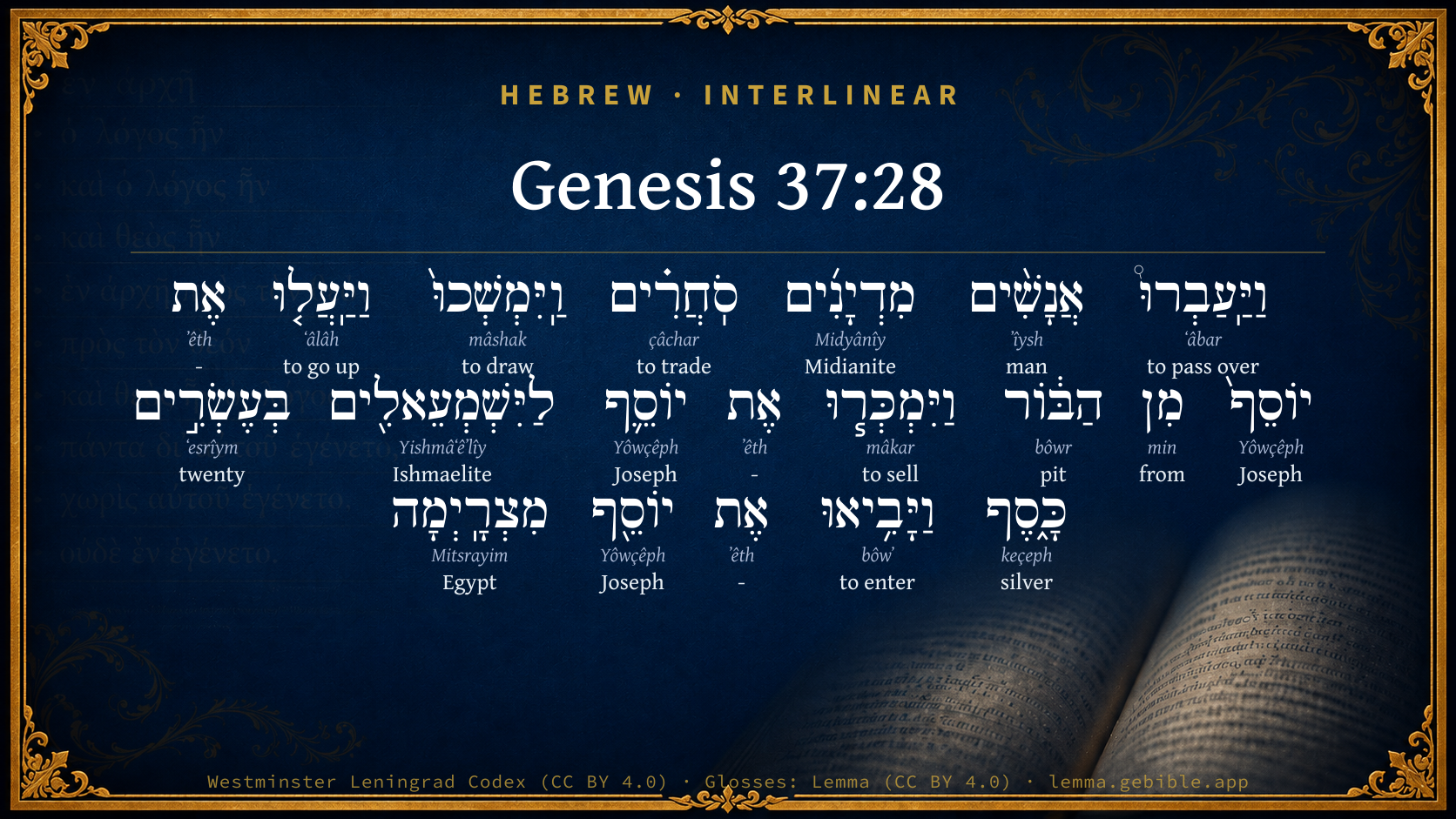
Genesis 37:28

Hebrew (Westminster Leningrad Codex) Genesis 37:28 appears in the Hebrew Old Testament. The text above is from the Westminster Leningrad Codex. Each word links to its Strong’s number, a concise gloss, and parsing drawn from the Open Scriptures Hebrew Bible morphology. Click any word for its full Brown-Driver-Briggs (BDB) entry.
Download image
Cite this verse

Genesis 37:28 (World English Bible). Public Domain. Lemma interlinear Bible study tool, https://lemma.gebible.app/v/genesis/37/28.

Show BibTeX & RIS
BibTeX
RIS
English Translation
Midianites who were merchants passed by, and they drew and lifted up Joseph out of the pit, and sold Joseph to the Ishmaelites for twenty pieces of silver. They brought Joseph into Egypt.
World English Bible · Public Domain
Highlights
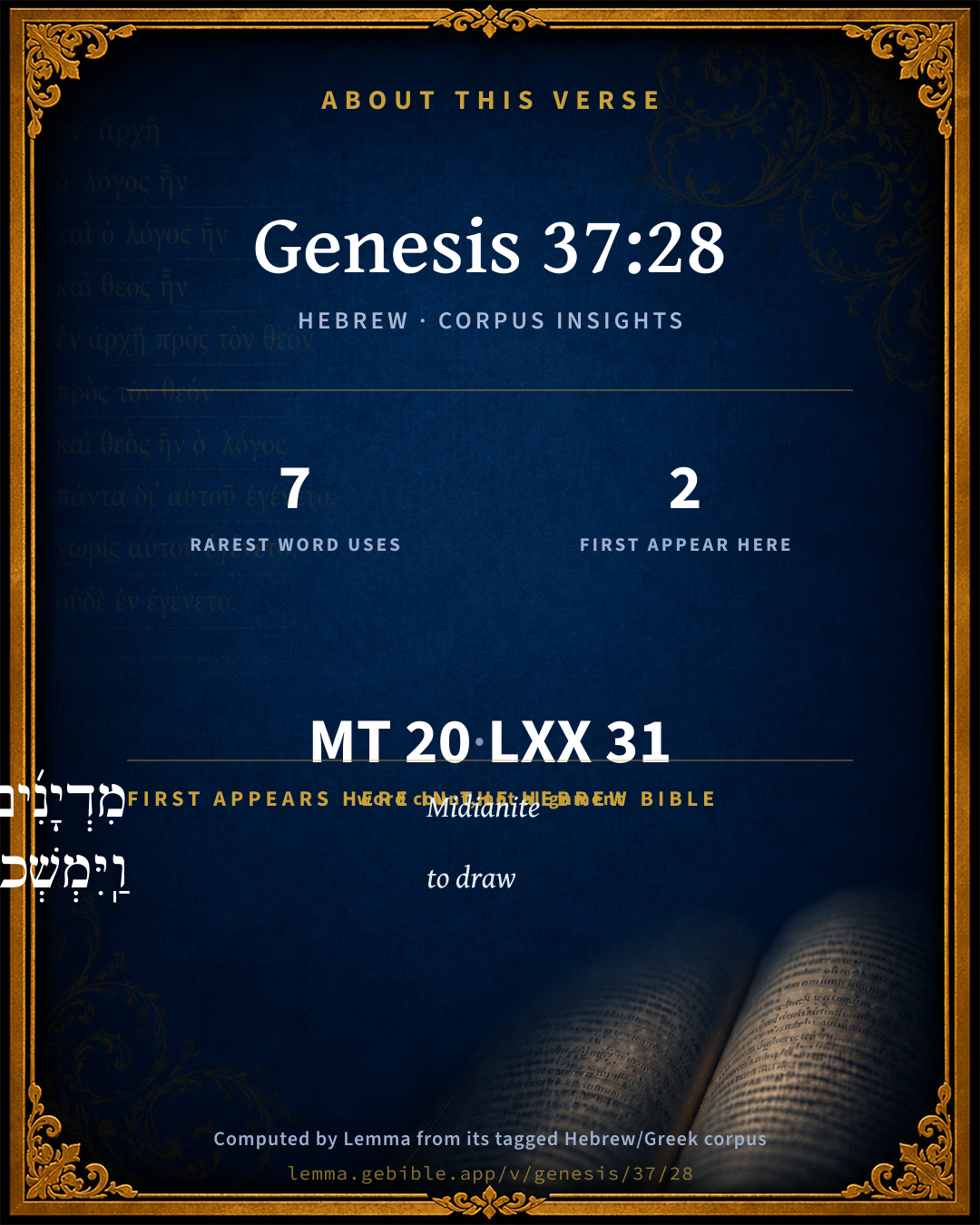
  • 2 first appearances in the Hebrew Bible
Full analysis ↓
Download a study sheet

One document with this verse’s original text, its word-by-word gloss line, the meaning frame, cross-references with their text, attributed commentary, and full source and license credits — printable, and it pastes into notes with its structure intact.

This verse Autodidact and up

Study sheet (.html) Plain text (.txt)

A passage Seminary Student

Up to 50 verses in one chapter. A passage sheet keeps up to 6 commentary sources and 12 cross-references per verse, in the order this page ranks them, and says so on the sheet whenever that leaves anything out. Ask for a single verse and you get the Autodidact verse sheet above.

Everything on this page stays free to read, with no account — the sheet is a download of what is already on screen, not access to it.

Want to remove ads? Support Godless Engineer
Compare translations 3

The same verse in 3 English versions, stacked beneath the original-language interlinear above. Click any original word for its lexicon entry.

Each is an independent rendering of the whole verse — the interlinear is not word-aligned to these translations.

Highlighted words mark where these versions differ — a whole-verse word diff, not a word-by-word alignment.

  • World English Bible Public Domain
    Midianites who were merchants passed by, and they drew and lifted up Joseph out of the pit, and sold Joseph to the Ishmaelites for twenty pieces of silver. They brought Joseph into Egypt.
  • King James Version Public Domain
    Then there passed by Midianites merchantmen; and they drew and lifted up Joseph out of the pit, and sold Joseph to the Ishmaelites for twenty pieces of silver: and they brought Joseph into Egypt.
  • unfoldingWord Literal Text CC BY-SA 4.0
    Then the Midianite men, traders, passed by, and they drew Joseph up and lifted him out of the cistern and sold Joseph to the Ishmaelites for twenty silver. Then they brought Joseph to Egypt.

unfoldingWord Literal Text — © unfoldingWord, licensed CC BY-SA 4.0. Word-aligned USFM3 via Door43 (git.door43.org/unfoldingWord/en_ult).

Versions to compare (up to 4)

3 of 4 selected

Show all 18 translations

Every available English version of this verse, each an independent rendering of the whole verse.

  • World English Bible Public Domain
    Midianites who were merchants passed by, and they drew and lifted up Joseph out of the pit, and sold Joseph to the Ishmaelites for twenty pieces of silver. They brought Joseph into Egypt.
  • Berean Standard Bible Public Domain
    So when the Midianite traders passed by, his brothers pulled Joseph out of the pit and sold him for twenty shekels of silver to the Ishmaelites, who took him to Egypt.
  • Majority Standard Bible Public Domain
    So when the Midianite traders passed by, his brothers pulled Joseph out of the pit and sold him for twenty shekels of silver to the Ishmaelites, who took him to Egypt.
  • King James Version Public Domain
    Then there passed by Midianites merchantmen; and they drew and lifted up Joseph out of the pit, and sold Joseph to the Ishmaelites for twenty pieces of silver: and they brought Joseph into Egypt.
  • American Standard Version (1901) Public Domain
    And there passed by Midianites, merchantmen; and they drew and lifted up Joseph out of the pit, and sold Joseph to the Ishmaelites for twenty pieces of silver. And they brought Joseph into Egypt.
  • Revised Version (1885) Public Domain
    And there passed by Midianites, merchantmen; and they drew and lifted up Joseph out of the pit, and sold Joseph to the Ishmaelites for twenty pieces of silver. And they brought Joseph into Egypt.
  • Geneva Bible (1599) Public Domain
    Then the Midianites marchant men passed by, and they drewe foorth, and lift Ioseph out of the pit, and solde Ioseph vnto the Ishmeelites for twentie pieces of siluer: who brought Ioseph into Egypt.
  • Douay-Rheims (1899) Public Domain
    And when the Madianite merchants passed by, they drew him out of the pit, and sold him to the Ismaelites, for twenty pieces of silver: and they led him into Egypt.
  • Young's Literal Translation Public Domain
    And Midianite merchantmen pass by and they draw out and bring up Joseph out of the pit, and sell Joseph to the Ishmaelites for twenty silverlings, and they bring Joseph into Egypt.
  • Literal Standard Version CC BY-SA 4.0
    And Midianite merchantmen pass by and they draw out and bring up Joseph out of the pit, and sell Joseph to the Ishmaelites for twenty pieces of silver, and they bring Joseph into Egypt.
  • Unlocked Literal Bible CC BY-SA 4.0
    The Midianite merchants passed by. His brothers drew Joseph up and lifted him up out of the pit. They sold Joseph to the Ishmaelites for twenty pieces of silver. The Ishmaelites carried Joseph into Egypt.
  • unfoldingWord Literal Text CC BY-SA 4.0
    Then the Midianite men, traders, passed by, and they drew Joseph up and lifted him out of the cistern and sold Joseph to the Ishmaelites for twenty silver. Then they brought Joseph to Egypt.
  • Darby Bible Public Domain
    And Midianitish men, merchants, passed by; and they drew and lifted up Joseph out of the pit, and sold Joseph to the Ishmaelites for twenty silver-pieces; and they brought Joseph to Egypt.
  • World Messianic Bible Public Domain
    Midianites who were merchants passed by, and they drew and lifted up Joseph out of the pit, and sold Joseph to the Ishmaelites for twenty pieces of silver. The merchants brought Joseph into Egypt.
  • Webster's Bible Public Domain
    Then there passed by Midianites, merchants; and they drew and lifted Joseph out of the pit, and sold Joseph to the Ishmaelites for twenty pieces of silver: and they brought Joseph into Egypt.
  • Free Bible Version CC BY-SA 4.0
    So when the Ishmaelites (who were traders from Midian) came by, they pulled Joseph out of the pit and sold him to them for twenty pieces of silver. The Ishmaelites took him to Egypt.
  • Bible in Basic English Public Domain
    And some traders from Midian went by; so pulling Joseph up out of the hole, they gave him to the Ishmaelites for twenty bits of silver, and they took him to Egypt.
  • JPS Tanakh (1917) Public Domain
    And there passed by Midianites, merchantmen; and they drew and lifted up Joseph out of the pit, and sold Joseph to the Ishmaelites for twenty shekels of silver. And they brought Joseph into Egypt.

Literal Standard Version (2020), Covenant Press — licensed CC BY-SA 4.0. Text via the HelloAO Bible API (eBible.org). Unlocked Literal Bible (unfoldingWord) — licensed CC BY-SA 4.0. Text via the HelloAO Bible API (eBible.org). unfoldingWord Literal Text — © unfoldingWord, licensed CC BY-SA 4.0. Word-aligned USFM3 via Door43 (git.door43.org/unfoldingWord/en_ult). Free Bible Version, Dr. Jonathan Gallagher — licensed CC BY-SA 4.0. Text via the HelloAO Bible API (eBible.org).

Word by word

More ways to search: Search by grammar → Find every occurrence → Compare this word →

Practice this passage: Drill this verse → Learn its vocabulary →

מִדְיָנִ֜ים
Midyânîy
H4084
“Midianites”
Noun, Gentilic, Masculine, Plural, Absolute
Part of Speech
Noun
Type
Gentilic
Gender
Masculine
Number
Plural
State
Absolute
Full BDB Definition

Origin: patronymical or patrial from H4080

TWOT: None

Midianite = see Midian " strife" - a member of the tribe of Midian - an inhabitant of the land of Midian
  1. וַיַּֽעַבְרוּ֩ ʻâbar H5674 “and · to pass over” Conjunction + Verb, Qal, Sequential Imperfect, 3rd Person, Masculine, Plural
  2. אֲנָשִׁ֨ים ʼîysh H376 “men” Noun, Common, Masculine, Plural, Absolute
  3. סֹֽחֲרִ֗ים çâchar H5503 “trading” Verb, Qal, Participle Active, Masculine, Plural, Absolute
  4. וַֽיִּמְשְׁכוּ֙ mâshak H4900 “and · to draw” Conjunction + Verb, Qal, Sequential Imperfect, 3rd Person, Masculine, Plural
  5. וַיַּֽעֲל֤וּ ʻâlâh H5927 “and · to go up” Conjunction + Verb, Hiphil, Sequential Imperfect, 3rd Person, Masculine, Plural
  6. אֶת ʼêth H853 “-” Particle, Direct Object
  7. יוֹסֵף֙ Yôwçêph H3130 “Joseph” Noun, Proper
  8. מִן min H4480 “from” Preposition
  9. הַבּ֔וֹר bôwr H953 “the · pit” Particle, Definite Article + Noun, Common, Masculine, Singular, Absolute
  10. וַיִּמְכְּר֧וּ mâkar H4376 “and · to sell” Conjunction + Verb, Qal, Sequential Imperfect, 3rd Person, Masculine, Plural
  11. אֶת ʼêth H853 “-” Particle, Direct Object
  12. יוֹסֵ֛ף Yôwçêph H3130 “Joseph” Noun, Proper
  13. לַיִּשְׁמְעֵאלִ֖ים Yishmâʻêʼlîy H3459 “to/for the · Ishmaelites” Preposition, Determined + Noun, Gentilic, Masculine, Plural, Absolute
  14. בְּעֶשְׂרִ֣ים ʻesrîym H6242 “in/at · twenty” Preposition + Adjective, Cardinal number, Both, Plural, Absolute
  15. כָּ֑סֶף keçeph H3701 “silver” Noun, Common, Masculine, Singular, Absolute
  16. וַיָּבִ֥יאוּ bôwʼ H935 “and · to enter” Conjunction + Verb, Hiphil, Sequential Imperfect, 3rd Person, Masculine, Plural
  17. אֶת ʼêth H853 “-” Particle, Direct Object
  18. יוֹסֵ֖ף Yôwçêph H3130 “Joseph” Noun, Proper
  19. מִצְרָֽיְמָה Mitsrayim H4714 “Egypt · toward” Noun, Proper + Suffix, Demonstrative

About this verse

These counts appear in no published source. They are computed here, from the morphology-tagged text and Lemma’s own curated glosses. What Lemma adds →

20
words
16
distinct lemmas
Pentateuch
section

Notable vocabulary

The rarest word here is מִדְיָנִ֜ים Midianite H4084 — appearing just 7 times in the whole Hebrew Bible.

First appearance in Scripture

These words make their first canonical appearance in the Hebrew Bible here:

  • מִדְיָנִ֜ים Midianite H4084
  • וַֽיִּמְשְׁכוּ֙ to draw H4900

Shared distinctive vocabulary

מִדְיָנִ֜ים Midianite H4084 occurs in 7 verses of the Hebrew Bible. Also found in:

Grammatical profile

  • 6 verbs
  • 9 nouns
  • 1 adjective
  • 1 preposition
  • 3 particles

Verb forms

  • וַיַּֽעַבְרוּ֩ Qal · Sequential Imperfect
  • סֹֽחֲרִ֗ים Qal · Participle Active
  • וַֽיִּמְשְׁכוּ֙ Qal · Sequential Imperfect
  • וַיַּֽעֲל֤וּ Hiphil · Sequential Imperfect
  • וַיִּמְכְּר֧וּ Qal · Sequential Imperfect
  • וַיָּבִ֥יאוּ Hiphil · Sequential Imperfect

Repetition

A word recurs within this verse — often emphatic in Hebrew:

  • יוֹסֵף֙ Joseph H3130 ×3

Hebrew & Septuagint length

In English translation the verse runs 33 words from the Hebrew and 37 from the Septuagint (LXX English) — closely comparable.

A rough comparison of the two English renderings, which tokenize alike — not a word-level alignment.

Word counts can differ between the Hebrew and the Greek without any difference in meaning — e.g. the Hebrew direct-object marker אֵת has no separate Greek word, and Greek often adds the article ὁ.

In the original languages it is 20 Hebrew tokens and 31 Greek tokens — but the two are counted differently (Hebrew bundles its prefixes and suffixes into one token; the Greek is in lemma form), so that isn’t a like-for-like length.

Cross-references

19

Topical passages linked to Genesis 37:28 in the Treasury of Scripture Knowledge — connected by theme and wording, ordered by reader-vote popularity; previews shown in the World English Bible.

  • Acts 7:9 "The patriarchs, moved with jealousy against Joseph, sold him into Egypt. God was with him,
  • Psalms 105:17 He sent a man before them. Joseph was sold for a slave.
  • Genesis 25:2 She bore him Zimran, Jokshan, Medan, Midian, Ishbak, and Shuah.
  • Genesis 45:4–5 Joseph said to his brothers, "Come near to me, please." They came near. "He said, I am Joseph, your brother, whom you sold into Egypt.
  • Genesis 37:25 They sat down to eat bread, and they lifted up their eyes and looked, and saw a caravan of Ishmaelites was coming from Gilead, with their camels bearing spices and balm and myrrh, going to carry it down to Egypt.
  • Genesis 37:36 The Midianites sold him into Egypt to Potiphar, an officer of Pharaoh's, the captain of the guard.
  • Judges 6:1–3 The children of Israel did that which was evil in the sight of Yahweh: and Yahweh delivered them into the hand of Midian seven years.
  • Matthew 26:15 and said, "What are you willing to give me, that I should deliver him to you?" They weighed out for him thirty pieces of silver.
  • Exodus 2:16 Now the priest of Midian had seven daughters. They came and drew water, and filled the troughs to water their father's flock.
  • Numbers 25:15 The name of the Midianite woman who was slain was Cozbi, the daughter of Zur; he was head of the people of a fathers' house in Midian.
  • Numbers 25:17 Vex the Midianites, and strike them;
  • Numbers 31:2–3 Avenge the children of Israel of the Midianites: afterward you shall be gathered to your people.
  • Judges 8:22 Then the men of Israel said to Gideon, Rule you over us, both you, and your son, and your son's son also; for you have saved us out of the hand of Midian.
  • Judges 8:24 Gideon said to them, I would make a request of you, that you would give me every man the ear-rings of his spoil. (For they had golden ear-rings, because they were Ishmaelites.)
  • Psalms 83:9 Do to them as you did to Midian, As to Sisera, as to Jabin, at the river Kishon;
  • Isaiah 60:6 The multitude of camels shall cover you, the dromedaries of Midian and Ephah; all they from Sheba shall come; they shall bring gold and frankincense, and shall proclaim the praises of Yahweh.
  • Zechariah 11:12–13 I said to them, "If you think it best, give me my wages; and if not, keep them." So they weighed for my wages thirty pieces of silver.
  • Matthew 27:9 Then that which was spoken through Jeremiah the prophet was fulfilled, saying, "They took the thirty pieces of silver, The price of him upon whom a price had been set, Whom some of the children of Israel priced,
  • Numbers 31:8–9 They killed the kings of Midian with the rest of their slain: Evi, and Rekem, and Zur, and Hur, and Reba, the five kings of Midian: Balaam also the son of Beor they killed with the sword.

Cross-references courtesy of OpenBible.info (CC BY 4.0).

Hebrew and Greek witnesses Masoretic Hebrew ↔ Greek Septuagint

The same verse in the two great witnesses to the Old Testament, shown verse-for-verse.

These are two independent witnesses, not word-aligned to each other, and the Septuagint is shown in lemma (dictionary) form.

Hebrew Genesis 37:28 Masoretic · Westminster Leningrad Codex

וַיַּֽעַבְרוּ֩ אֲנָשִׁ֨ים מִדְיָנִ֜ים סֹֽחֲרִ֗ים וַֽיִּמְשְׁכוּ֙ וַיַּֽעֲל֤וּ אֶת יוֹסֵף֙ מִן הַבּ֔וֹר וַיִּמְכְּר֧וּ אֶת יוֹסֵ֛ף לַיִּשְׁמְעֵאלִ֖ים בְּעֶשְׂרִ֣ים כָּ֑סֶף וַיָּבִ֥יאוּ אֶת יוֹסֵ֖ף מִצְרָֽיְמָה

Midianites who were merchants passed by, and they drew and lifted up Joseph out of the pit, and sold Joseph to the Ishmaelites for twenty pieces of silver. They brought Joseph into Egypt.

World English Bible · Public Domain

Greek LXX Genesis 37:28 Septuagint · lemma form

καί παραπορεύομαι ὁ ἄνθρωπος ὁ μαδιηναῖος ὁ ἔμπορος καί ἐκεἰλκω καί ἀναβιβάζω ὁ ιωσηφ ἐκ ὁ λάκκος καί ἀποδίδωμι ὁ ιωσηφ ὁ ισμαηλίτης εἴκοσι χρυσοῦς καί καταἄγω ὁ ιωσηφ εἰς αἴγυπτος

And the men, the merchants of Madian, went by, and they drew and lifted Joseph out of the pit, and sold Joseph to the Ismaelites for twenty pieces of gold; and they brought Joseph down into Egypt.

LXX2012 (modern English Septuagint) · Public Domain

On this verse, The Cambridge Bible for Schools and Colleges discusses the Septuagint’s reading. Read the note in Commentary ↓

Hebrew: Westminster Leningrad Codex (CC BY 4.0). Greek: Septuagint (public domain); English from LXX2012 (modern English Septuagint) (Public Domain). How the Septuagint differs from the Hebrew →

Targum (Aramaic paraphrase)

2

The Targum is the ancient Jewish Aramaic paraphrase of the Hebrew Scriptures — an interpretive translation, not the Hebrew text itself. Onkelos (literal) and Pseudo-Jonathan (expansive) render the Torah, and Jonathan the Prophets. Coverage is partial: where no permissively-licensed English translation exists for a verse, only the Aramaic is shown. This is verse-level text, not a word-by-word alignment to the Hebrew.

  1. Targum Onkelos Torah (Genesis–Deuteronomy)
    וַעֲבָרוּ גַבְרֵי מִדְיָנָאֵי תַּגָּרֵי וּנְגִידוּ וְאַסִּיקוּ יָת יוֹסֵף מִן גֻּבָּא וְזַבִּינוּ יָת יוֹסֵף לַעֲרָבָאֵי בְּעֶסְרִין כְּסָף וְאַיְתִיוּ יָת יוֹסֵף לְמִצְרָיִם

    (no public-domain English translation for this verse)

    Targum Onkelos — Aramaic: “Onkelos Genesis” (public domain); “Onkelos Exodus” (public domain); “Onkelos Leviticus” (public domain); “Onkelos Numbers” (public domain); “Onkelos Deuteronomy” (public domain). English: “Sefaria Community Translation” (CC0 1.0 (public-domain dedication)); “J.W. Etheridge. The Targums of Onkelos and Jonathan Ben Uzziel on the Pentateuch. London: Longmans, Green, 1862” (public domain). Text via Sefaria.

  2. Targum Pseudo-Jonathan Torah (Genesis–Deuteronomy)
    וְעָבָרוּ גַבְרֵי מִדְיָנָאֵי מָרֵי פְּרַקְמַטְיָא וּנְגִידוּ וְאַסִיקוּ יַת יוֹסֵף מִן גוּבָא וְזַבִּינוּ יַת יוֹסֵף לַעֲרָבָאִין בְּעֶשְרִין מָעִין דִכְסַף וְזַבְּנוּ מִנְהוֹן סַנְדְלִין וְאַיְיתִיוּ יַת יוֹסֵף לְמִצְרָיִם

    And the Midianite men, masters of business, passed by; and they drew and brought up Joseph out of the pit, and sold Joseph to the Arabians for twenty mahin of silver; and they bought sandals of them. And they brought Joseph to Mizraim.

    Targum Pseudo-Jonathan — Aramaic: “Targum Jonathan on Genesis” (public domain); “Targum Jonathan on Exodus” (public domain); “Targum Jonathan on Leviticus” (public domain); “Targum Jonathan on Numbers” (public domain); “Targum Jonathan on Deuteronomy” (public domain). English: “The Targum of Jonathan ben Uzziel, trans. J. W. Etheridge, London, 1862” (public domain). Text via Sefaria.

Commentary

Notes on Genesis 37:28 from classic Christian and Jewish commentators (each source and its license shown beneath its notes). The classic Christian expositions comment on the surrounding passage and are grouped to its opening verse, so a note may address several verses; the Jewish commentaries on the Tanakh (Rashi and others) are per-verse, so they appear only where the commentator wrote on this verse.

Lemma curates 59 commentaries, every one of them public domain or Creative Commons licensed, each selected and text-cleaned for this edition rather than reprinted as found. About our sources →

Trapp's Complete Commentary

John Trapp

Gen 37:28 Then there passed by Midianites merchantmen; and they drew and lifted up Joseph out of the pit, and sold Joseph to the Ishmeelites for twenty [pieces] of silver: and they brought Joseph into Egypt.

Ver. 28. For twenty pieces of silver.] A goodly price! not all out the price of a slave. {Exo 21:32} Here "they sold the just one for silver, and the poor for a pair of shoes." {Amo 2:6} The Hebrews tell us, that of these twenty shekels, every of the ten brethren had two, to buy shoes for their feet {a}

And they brought Joseph into Egypt.] Little knowing what a prize they had in their hand, even the jewel of the world, and him that should one day be lord of Egypt. The saints, for their worth, are called "princes in all lands"; {Psa 45:16} kings in righteousness, {b} though somewhat obscure ones, - as Melchisedec. {Heb 7:1-28} They are called "God’s portion"; {Deu 32:9} "the dearly beloved of his soul"; {Jer 12:7} "a royal diadem in the hands of Jehovah." {Isa 62:3} This the cock on the dunghill, the Midianitish muckworms take no notice of. They could see no comeliness in Christ, though the fairest of ten thousand; nothing more than a despicable man. "How can this man give us his flesh to eat?." {Joh 6:52} God had hid him ("in whom all the treasures of" worth and "wisdom were hid," Col 2:3) under the carpenter’s son: this pearl was covered with a shellfish; so are all God’s precious people, for most part, abjects in the world’s eye; their glory is within; "their life is hid": they are great heirs, but as yet in their non-age; kings, but in a strange country; heads destinated to the diadem; but this "the world knows not." {1Jn 3:1} Let it suffice us that God, and all that can spiritually discern, know it; and so shall others: as Joseph’s brethren did him, in his bravery. For "when Christ, our life, appear, we shall appear with him in glory." {Col 3:4}

{a} Pirke R. Eliez, cap. 38.

{b} "Many righteous," are "many kings." Compare Mat 13:17 with Luk 10:24.

John Trapp, A Commentary or Exposition upon All the Books of the Old and New Testament (1647–1656) — public domain. Text from a community e-Sword module.

Matthew Poole's English Annotations

This story seems a little involved, and the persons to whom he was sold doubtful. Here seem to be two, if not three, sorts of merchants mentioned,

Ishmeelites and

Midianites here, and Medanites, as it is in the Hebrew, Gen 37:36, which were a distinct people from the Midianites, as descended from Medan, when the Midianites descended from Midian, both Abraham’s sons, Gen 25:2. The business may be accommodated divers ways; either,

1. The same persons or people are promiscuously called both Ishmeelites and Midianites, as they also are Jdg 8:1,24,28; either because they were mixed together in their dwellings, and by marriages; or because they were here joined together, and made one caravan or company of merchants. And the text may be read thus, And the Midianite merchantmen (either the same who were called Ishmeelites, Gen 37:27, or others being in the same company with them) passed by, and they (i.e. not the merchantmen, but Joseph’s brethren, spoken of Gen 37:27; the relative being referred to the remoter antecedent, as it is frequently in the Scripture)

lift up Joseph, and sold him to the Ishmeelites or Midianites, &c. Or,

2. The persons may be distinguished, and the story may very well be conceived thus: The Ishmeelites are going to Egypt, and are discerned at some distance by Joseph’s brethren, while they were discoursing about their brother. In the time of their discourse, the Midianites, who seem to be coming from Egypt, coming by the pit, and hearing Joseph’s cries there, pull him out of the pit, and sell him to the Ishmeelites, who carry him with them into Egypt. There they sell him to the Medanites, though that, as many other historical passages, be omitted in the sacred story. And the Medanites, or Midianites, if you please, only supposing them to be other persons than those mentioned Gen 37:28, which is but a fair and reasonable supposition, sell him to Potiphar.

Matthew Poole's English Annotations on the Holy Bible (1683–1685) — public domain. Text from a community e-Sword/MySword module.

The Biblical Illustrator

Joseph S. Exell

Gen_37:28

Sold Joseph to the Ishmaelites for twenty pieces of silver; and they brought Joseph into Egypt

Joseph sold into Egypt

I.

A FAMILY FEUD THE FOUNDATION OF A NATIONAL CALAMITY. Bondage for four hundred years.

II. A DESPISED CLASS BECOMES THE INSTRUMENT OF GODS PROVIDENCES AND JUDGMENTS. Ishmaelites: the slave-traders of their day.

III. THE COMFORT OF DEATH FOR PERSONAL LOSS AND AWAKENED JUDGMENTS (Gen_37:35). (W. R. Campbell.)

Joseph sold into Egypt

1. The narrative shows one of the not uncommon ways which God takes to prepare men for usefulness and blessing. The pathway to any eminence in usefulness, virtue, or joy, is commonly rugged. Muscular strength comes of abundant toil, mental vigour of hard study, moral force of temptation and discipline. It is by fire that gold is separated from its dross, and iron hardened into steel. Even the Captain of our salvation was made perfect through suffering. One cannot guess of how many noble lives the secret, if disclosed, would be found in some great trial. An Arab once bemoaned his fate thus: Alas, I fear that God doth not remember me. I have no trials, nothing but ease and enjoyment. You cannot make a great life out of sunshine alone. Nor need one lose heart if his whole earthly course seems to be under a cloud. As the discipline of youth may be for riper years, so that of ones whole earthly career is for the ages beyond.

2. Again, the narrative shows how responsible parents are for the conduct and welfare of their children. One of the gravest errors in family training is that favouritism of which Jacob was guilty. On the one hand it engenders weak and offensive pride; on the other, angry and bitter resentment. Dissension is inevitable.

3. Here, again, we are impressed with the danger of sin in thought and feeling. Apparently, the criminal deed of Josephs brethren was wholly unpremeditated. It was an unhappy moments impulse. It has been said that with one bound a soul sometimes overleaps all blessed restraints; we flee into crime as if the dogs of sinful desire were upon us. We rush to deeds of which at other moments we thought ourselves incapable. The petted feeling grows to be so completely master, that we obey it when obedience has ceased to be a pleasure. Some of the worlds greatest criminals were not only sweet in childhood, but apparently amiable in youth. Let us never forget the tendency of sin to grow, and that as imperceptibly as does the plant or tree. It is also to be remembered that the guilt centres in the disposition rather than in the act. God sees hearts as we do faces. The powder that is explosive and the powder that explodes do not differ. He that hateth his brother is a murderer.

4. Yet again, we here learn something of the unmixed wickedness of the particular sin of envy. It is the opposite of that charity out of a pure heart, which, while it rejoices over a brothers or sisters good fortune, is itself thereby enriched; of that spirit which makes all anothers gains its own, which is the richer for its neighbours riches, the gladder for its brothers gladness. As love is of heaven, envy is of hell.

5. Briefly, at least, we must notice the illustration we here have of the bitter outcome of sin.

(1) One part of this is a sort of necessity for more sin. No sooner is the heartless deed of Josephs brethren done than they begin to add other sins for its concealment.

(2) But the full outcome of sin in-eludes also much sorrrow. Witness the entreaties and tears of the lad Joseph; the distress of Reuben; the perplexity and fears of all. The comfortless, bereaved father is overwhelmed.

6. For Gods children, the culminating lesson of this fragment of history is one of patience and trust in lifes darkest hours. (H. M. Grout, D. D.)

Sold to the Ishmaelites

I. This narrative may remind us of THE UNCERTAINTIES THAT CHARACTERIZE OUR HUMAN EXISTENCE. It is the unexpected that happens. The lesson is, that we should be ever ready to respond to the call of God, and should take short views of things by living, as nearly as possible, a day at a time.

II. We may see from this narrative that THE BEGINNING OF SIN IS LIKE THE LETTING OUT OF WATER. What began in envy leads to murder, and that again gives birth to falsehood. Sin thus multiplies as rapidly as the Colorado beetle, and no matter what may be the first one, you may always call its name Gad, for you may surely say, a troop cometh. Therefore, if we would successfully resist it, we must withstand its beginnings. Especially is this true of envy, which is purely soul-sin--the hatred of a man for the good that is in him. Envy must be supplanted by the love of Christ.

III. We may learn that IN SEEKING TO DEFEAT GODS PURPOSES WE ARE ALL THE WHILE UNCONSCIOUSLY HELPING ON THEIR FULFILMENT. We cannot explain the law of it, but we clearly see the fact. Oh the marvellous wisdom of that providence of God which thus, without doing violence to the will of any human being, lays all their actions under tribute for the furtherance of its designs! And what is the use of a man trying to thwart Gods purposes when, whether he will or not, everything he does only helps them forward? Surely it is better far to acquiesce in them, and find our happiness in the doing of His will!

IV. I note from this narrative that WE NO NOT GET RID OF A RESPONSIBILITY BY PUTTING IT OUT OF SIGHT.

V. THERE IS A RETRIBUTIVE ELEMENT IN OUR TROUBLES. Jacob, who deceived his father Isaac, is now deceived by his own children. One of his chickens came home to roost, and very bitter was the experience. (W. M. Taylor, D. D.)

Lesson analysis

I. JOSEPH ABUSED.

1. Stripped of his raiment (Gen_37:23).

2. Taken by force (Gen_37:24).

3. Cast into a pit (Gen_37:24).

(1) Separated from the presence of men.

(2) Protected by the presence of God.

II. JOSEPH SOLE.

1. The ready purchasers (Gen_37:25).

2. The mercenary plea (Gen_37:26-27).

3. The paltry price.

III. JOSEPH MOURNED.

1. Cruel deception (Gen_37:33).

2. Pitiable woe (Gen_37:34).

3. Inconsolable sorrow (Gen_37:35). (American Sunday School Times.)

Mans passions and Gods purpose

I. THE BROAD TEACHING OF THE WHOLE STORY IS, THAT GOD WORKS OUT HIS GREAT PURPOSES THROUGH EVEN THE CRIMES OF UNCONSCIOUS As. As coral insects work, not knowing the plan of their reef, still less the fair vegetation and smiling homes which it will one day carry, but blindly building from the material supplied by the ocean a barrier against it; so even evildoers are carrying on Gods plan, and sin is made to counterwork itself, and be the black channel through which the flashing water of life pours.

II. THE POISONOUS FRUIT OF BROTHERLY HATRED. The swift passage of the purely spiritual sin of jealous envy into the murderous act, as soon as opportunity offered, teaches the short path which connects the inmost passions with the grossest outward deeds. Like Jonahs gourd, the smallest seed of hate needs bat an hour or two of favouring weather to become a great tree, with all obscene and blood-seeking birds croaking in its branches. Whosoever hateth his brother is a murderer. Therefore the solemn need for guarding the heart from the beginnings of envy, and for walking in love. The clumsy contrivance for murder without criminality, which Reuben suggested, is an instance of the shallow pretexts with which the sophistry of sin fools men before they have done the wrong thing. The mask generally tumbles off very soon after. The bait is useless when the hook is well in the fishs gills. Dont let us kill him. Let us put him into a cistern. He cannot climb up its bottle-shaped, smooth sides. But that is not our fault. Nobody will ever hear his muffled cries from its depths. But there will be no blood on our hands. It was not the first time, nor is it the last, that men have tried to blink their responsibility for the consequences which they hoped would come of their crimes. Such excuses seem sound when we are being tempted; but, as soon as the rush of passion is past, they are found to be worthless. Like some cheap castings, they are only meant to be seen in front, where they are rounded and burnished. Get behind them, and you find them hollow. They sat down to eat bread. Thomas Fuller pithily says: With what heart could they say grace, either before or after meat? What a grim meal! And what an indication of their rude natures, seared consciences, and deadened affections!

III. The ill-omened meal is interrupted by the sudden appearance, so picturesquely described, of THE CARAVAN OF ISHMAELITES WITH THEIR LOANED CAMELS. Dothan was on or near the great trade route to Egypt, where luxury, as well as the custom of embalming, opened a profitable market for spices. The traders would probably not be particular as to the sort of merchandize they picked up on their road, and such an unconsidered trifle as a slave or two would be neither here nor there. This opportune advent of the caravan sets a thought buzzing in Judahs brain, which brings out a new phase of the crime. Hatred darkening to murder is bad enough; but hatred which has also aa eye to business, and makes a profit out of a brother, is a shade or two blacker, because it means cold-blooded calculation and selfish advantage instead of raging passion.

IV. Leaving Joseph to pursue his sad journey, our narrative introduces for the first time REUBEN, whose counsel, as the verses before our lesson tell us, it had been to cast the poor lad into the cistern. His motive had been altogether good; he wished to save life, and, as soon as the others were out of the way, to bring Joseph up again and get him safely back to Jacob Gen_42:22). Well meant and kindly motived as his action was--and self-sacrificing too, if, as is probable, Joseph was his destined successor in the forfeited birthright--his scheme breaks down, as attempts to mitigate evil by compliance and to make compromises with sinners usually do. The only one of the whole family who had some virtue in him, was too timid to take up a position of uncompromising condemnation. He thought it more politic to go part of the way, and to trust to being able to prevent the worst. That is always a dangerous experiment. It is often tried still; it never answers. Let a man stand to his guns, and speak out the condemnation that is in his heart; otherwise he will be sure to go farther than he meant, he will lose all right of remonstrance, and will generally find that the more daring sinners have made his well-meant schemes to avert the mischief impossible.

V. THE CRUEL TRICK BY WHICH JACOB WAS DECEIVED is perhaps the most heartless bit of the whole heartless crime. It canto as near an insult as possible. It was maliciously meant. The snarl about the coat, the studied use of thy son as if they disowned the brotherhood, the unfeeling harshness of choosing such a way of telling their lie--all were meant to give the maximum of pain, and betray their savage hatred of father and son, and its causes.

VI. AND WHAT OF THE POOR OLD FATHER? His grief is unworthy of Gods wrestler. It is not the part of a devout believer in Gods providence to refuse to be comforted. There was no religious submission in his passionate sorrow. How unlike the quiet resignation which should have marked the recognition that the God who had been his guide was working here too! No doubt the hypocritical condolences of his children were as vinegar upon nitre. No doubt the loss of Joseph had taken away the one gentle and true son on whom his loneliness rested since his Rachels death, while he found no solace in the wild, passionate men who called him father, and brought him no honour. But still his grief is beyond the measure which a true faith in God would have warranted; and we cannot but see that the dark picture which we have just been looking at gets no lighter or brighter tints from the demeanour of Jacob. (A. Maclaren, D. D.)

Joseph sold into Egypt

I. A BEAUTIFUL IDEAL OF WHAT A YOUNG CHRISTIAN SHOULD BE.

1. Having no fellowship with that which is evil.

2. As loved of the good.

II. THE SAD EXPERIENCES THROUGH WHICH MANY A CONSISTENT YOUNG CHRISTIAN PASSES.

1. Joseph was hated of his brothers because their father loved him.

2. Joseph was cruelly treated by his brothers.

3. There are lighter and darker shades among the wicked.

III. THE SORROW WHICH CRUEL TREATMENT CAUSES,

IV. THE TENDER PROVIDENCE OF GOD IS SEEN IN THE DISPOSAL OF JOSEPH IN EGYPT.

1. His promotion in Potiphars house proves this.

2. That he reached the rulership of Egypt through his experiences in Potiphars house, proves it. Lessons: The permissions of God are full of mystery, but also full of grace.

2. The story of Joseph proves the possibility of youthful piety, and that Christian character may glow in adversity. (D. C. Hughes, M. A.)

Apparent disaster often real advancement

The chief peril which threatened Joseph was the foolish partiality of his father. Under this unwholesome influence he was likely enough to become vain, insolent, overbearing. So it was best that he should be removed from this mischievous hot-house of favouritism into a more bracing climate; where, under biting winds and nipping frosts, his virtues would be well rooted. Fortunes frowns serve our well-being, as much--perhaps more--than fortunes smiles. If friends of God, no harm can ever befall us.

I. WE SEE HERE INNOCENCE PROVOKING MALICE TO VILER DEEDS. Without question, the presence of a righteous man brings to light the baseness of the wicked. Just as the summer sun quickens the growth of noxious weeds, and makes the stench of a foetid sewer still more odious; so the influence of a saintly character exasperates base men to do their worst. The presence of the Son of God on earth provoked Satan to put out prodigious efforts of malice. To a vitiated palate even food will produce vomiting. The beneficent errand of Joseph obtained only opprobrium and ill.nature. Behold, said they, this dreamer cometh. Then this was the worst thing malice could lay to his charge. In this respect also Joseph was a type of Jesus Christ. The only accusation men could prefer against either was that he had aspired to be a king. Yet this was not merely a prophetic assertion; it was a divinely appointed office; it was a certain destiny. The righteous man must inevitably rule.

II. WE SEE HERE WICKEDNESS RAPIDLY MATURING ITS FRUITS.

1. Sin is a hardening and a blinding process. It treats its victims as the Philistines treated Samson--puts out their eyes. They saw not Joseph as a brother; they saw him only as a dreamer. They saw only the gain of twenty dollars--about a dollar a piece; they were blind to the tremendous loss.

2. Under favourable circumstances sin speedily develops. Hatred soon grew into murderous conspiracy, into rude violence, into lying, deceit, avarice, fraud; into base traffic of a brothers flesh--the sum of all villainies. In the fields of nature some plants will bear ten thousand seeds; but this plant of sin is yet more prolific in effects.

3. Yet sin is temporarily checked by a sense of responsibility. Reuben alone of the eleven sought the deliverance of Joseph.

4. Sin defeats its own ends. When the innocent lad was led away an abject slave, had they baffled his dreams? They had helped the business forward.

III. WE SEE HERE THAT HARD SERVICE IS THE WAY TO SOVEREIGNTY. There is great truth in the maxim that he would rule, must first learn to serve. Napoleon I. rose to sovereignty because he served well in the lowest ranks of the French army. Jesus Christ is enthroned in the hearts of myriads because He has served them so faithfully and so generously. It is a law in mechanics that in proportion as a free body is forced downward, will it rise upward when the force is withdrawn. Nature helps a rebound. (J. Dickerson Davies,M. A.)

Anything better than confinement in the dry pit

To be brought out of a pit wherein there is no water, is in Scripture represented as a great deliverance. Joseph would learn in this pit to bear those other sufferings that were allotted to him. He was sold to foreign merchants. He was carried into a strange land, to be again sold as a slave. He was cast into a prison, where he lay for several years. But the remembrance of the pit wherein was no water, and of his fruitless cries for relief, would make him think that his condition, under all these circumstances of distress, was not so bad as it might have been, and as it once actually was. (G. Lawson, D. D.)

Joseph betrayed and sold for twenty pieces of silver

Joseph, in his betrayal into the hands of the Ishmaelites, was a distinct type of the Redeemer betrayed into the hands of the Gentiles. The name of the betrayer was the same. In the case of Joseph it was a brother who lifted up his heel against him; in the case of Christ, it was His own familiar friend in whom He trusted, which did eat of His bread (Psa_41:9) that betrayed Him. In both eases it was covetousness which prompted the betrayer to the dark deed of treachery. In both cases the betrayer dissembled, and accomplished his wicked design under the mask of friendship. Do you observe how Judah speaks? How subtle is his argument, and yet how transparently hollow and treacherous and insincere! As hollow and as insincere as the kiss of Judas! Look at his speech. Come, said he, and let us sell him to the Ishmaelites, and let not our hand be upon him; for he is our brother and our flesh. Oh what a contemptible vice is covetousness! The rest of his brethren readily consented to this proposal. The proposal itself, and their acquiescing in it, gives us a very painful view of the deceitfulness of the human heart. The proposal was a monstrous one; it was most cruel; and yet they ignorantly imagined that by adopting it they would be washing their hands of bloodguiltiness. They appear to have viewed it as an admirable contrivance, by which they would get rid of Joseph effectually, without loading their consciences with his death, just as though they would not be quite as responsible in the sight of God for the mischief done him by the Ishmaelites, as though their own hands bad wrought it. It is very melancholy to see the conscience of man thus deceiving him. And are there not other practices amongst us in which this same principle of drugging our consciences deceitfully can be traced? Is there no such thing as servants being employed to do what we would be ashamed to do ourselves? But perhaps we may discover something more than a practical lesson in this conduct of the patriarchs. May not their Let not our hand be upon Him remind us of the Jews? When Pilate said to them, Take ye Him and crucify Him, for I find no fault in Him, what did they say? Oh no! let not our hand be upon Him; do you crucify Him; yes, crucify Him, by all means; but as for us, it is not lawful for us to put any man to death. There are two other points in the text in which Joseph was a type of Christ. He was sold as a slave; Jesus was born under the law--a slave to perform all the rigid requirements of a law without mercy. Not one jot, not one tittle of that rigid law was ever relaxed for Him. Joseph was sold for twenty pieces of silver, Jesus was sold for thirty. At what price do you value the Lord Jesus Christ? Is He, in your estimation, the pearl of great price? (E. Dalton.)

Joseph sold to Arabs

The passage of an Arab caravan towards Egypt, and its purchase of Joseph, is equally true to early times, and to the unchanging Eastern life of to-day. Sir Samuel Bakers boy, Saat, had, in the same way as Joseph, been carried off while he was tending goats, by an Arab caravan; hidden in a gum sack, and finally taken to Cairo and sold as a slave. All the world may perish, so far as we care, said an Arab to Niebuhr, if only Egypt remains. And it was left to them even more in Josephs day than now, from the dislike of Egyptians to leave their country even for purposes of gain. The trade in spices was exceptionally great between the valley of the Nile and neighbouring countries; from the quantity used for embalming mummies, for burning as incense, or as disinfectants; for which they were in great repute. Even the names of the first and second of the three spices named--gum tragacanth, from Lebanon and Palestine generally, Armenia and Persia; balsam from the balsam-tree of Gilead; and lauda-num the gum collected still from the leaves of the cistus-rose--from Syria and Arabia, have been found in the list of two hundred drugs named in the temple-laboratory of Edfu; for each temple had its laboratory and apothecary. Even the twenty pieces of silver given for Joseph are exactly the price fixed under Moses as that of a male slave between five and twenty years of age (Lev_27:5); so nearly had human beings kept the same value for centuries. (C. Geikie, D. D.)

Sold into slavery

Mr. H. M. Stanley told an awful story of African slavery, in the Manchester Free Trade Hall. He said: A slave trade was a great blight, which clung to Africa like an aggravated pest, destroying men faster than children could be born. He overtook a party of Arab marauders on the Congo in November, 1883, over 1,200 miles from the sea. They had utterly desolated a number of villages, massacred all the adult males who had not at once fled, and carried off the women and children. He never saw such a sight before. In a small camp 300 fighting men kept in manacles and fetters, 2,300 naked women and children, their poor bodies entrusted with dirt, all emaciated and weary through much misery. Here was the net result of the burning of 118 villages, and the devastation of forty-three districts, to glut the avaricious soul of a man who had constituted himself chief of a district some 200 miles higher up. Though over seventy-five years old, here he was prosecuting his murderous business, having shed as much human blood in three months as, if collected into a tank, might have sufficed to drown him and all his thirty wives and concubines. Those 2,300 slaves would have to be transported over 200 miles in canoes, and such as could not be fed would die, and perhaps 800--perhaps 900--of all the number would ever reach their destination.

From the pit to slavery

In Josephs being lifted out of the pit only to pass into slavery, many a man of Josephs years has seen a picture of what has happened to himself. From a position in which they have been as if buried alive, young men not uncommonly emerge into a position preferable certainly to that out of which they have been brought, but in which they are compelled to work beyond their strength, and that for some superior in whom they have no special interest. Grinding toil, and often cruel insult, are their portion; and no necklace heavy with tokens of honour that afterwards may be allotted them can ever quite hide the scars made by the iron collar of the slave. One need not pity them over much, for they are young and have a whole life-time of energy and power of resistance in their spirit. And yet they will often call themselves slaves, and complain that all the fruit of their labour passes over to others and away from themselves, and all prospect of the fulfilment of their former dreams is quite cut off. That which haunts their heart by day and by night, that which they seem destined and fit for, they never get time nor liberty to work out and attain. They are never viewed as proprietors of themselves, who may possibly have interests of their own and hopes of their own. In Josephs case there were many aggravations of the soreness of such a condition. He had not one friend in the country. He had no knowledge of the language, no knowledge of any trade that could make him valuable in Egypt--nothing, in short, but his own manhood and his faith in God. His introduction to Egypt was of the most dispiriting kind. What could he expect from strangers, if his own brothers had found him so obnoxious? Now, when a man is thus galled and stung by injury, and has learned how little he can depend upon finding good faith and common justice in the world, his character will show itself in the attitude he assumes towards men and towards life generally. A weak nature, when it finds itself thus deceived and injured, will sullenly surrender all expectation of good, and will vent its spleen on the world by angry denunciations of the heartless and ungrateful ways of men. A proud nature will gather itself up from every blow, and determinedly work its way to an adequate revenge. A mean nature will accept its fate, anal while it indulges in cynical and spiteful observations on human life, will greedily accept the paltriest rewards it can secure. But the supreme healthiness of Josephs nature resists all the infectious influences that emanate from the world around him, and preserves him from every kind of morbid attitude towards the world and life. So easily did he throw off all vain regrets and stifle all vindictive and morbid feelings, so readily did he adjust himself to and so heartly enter into life as it presented itself to him, that he speedily rose to be overseer in the house of Potiphar. (M. Dods, D. D.)

The Biblical Illustrator, edited by Joseph S. Exell (c. 1880s–1900s) — public domain. Text from a community e-Sword module.

Tyndale Open Study Notes

Tyndale Open Resources

37:28 the Ishmaelites, who were Midianite traders (literally the Midianite traders): Ishmaelites were descendants of Abraham through Hagar (16:5), while Midianites were descendants of Abraham through Keturah (25:1-2). The term Ishmaelite may have described bedouin tribes generally. The Midianites might also have been traveling with a separate caravan of Ishmaelite traders (37:27). • Kidnapping (see 40:15) would become a capital offense (see Exod 21:16) in Jewish law.

Tyndale Open Study Notes — © Tyndale Open Resources, licensed CC BY-SA 4.0. Text via the HelloAO Bible API.

Geneva Bible (1599)

Geneva Bible translators

Moses writing according to the opinion of them which took the Midianites and Ishmaelites to be both one, doth here confound their names: as also appeareth, verse 36 and Gen. 39:1, or else he was first offered to the Midianites, but sold to the Ishmaelites.

Geneva Bible (1599) marginal notes — public domain. Text via Bolls.life.

Adam Clarke's Commentary

Verse 28. For twenty pieces of silver] In the Anglo-Saxon it is [Anglo-Saxon] thirty pence. This, I think, is the first instance on record of selling a man for a slave; but the practice certainly did not commence now, it had doubtless been in use long before. Instead of pieces, which our translators supply, the Persian has [Persian] miskal, which was probably intended to signify a shekel; and if shekels be intended, taking them at three shillings each, Joseph was sold for about three pounds sterling. I have known a whole cargo of slaves, amounting to eight hundred and thirteen, bought by a slave captain in Bonny river, in Africa, on an average, for six pounds each; and this payment was made in guns, gunpowder, and trinkets! As there were only nine of the brethren present, and they sold Joseph for twenty shekels, each had more than two shekels as his share in this most infamous transaction.

Adam Clarke's Commentary on the Bible (1810–1826) — public domain. Text from a community e-Sword/MySword module.

John Calvin's Commentaries

28. Then there passed by Midianites. Some think that Joseph was twice sold in the same place. For it is certain, since Median was the son of Abraham and Keturah, that his sons were distinct from the sons of Ishmael: and Moses has not thoughtlessly put down these different names. But I thus interpret the passage: that Joseph was exposed for sale to any one who chose, and seeing the purchase of him was declined by the Midianites, he was sold to the Ishmaelites. Moreover, though they might justly suspect the sellers of having stolen him, yet the desire of gain prevents them from making inquiry. We may also add, what is probable, that, on the journey, they inquired who Joseph was. But they did not set such a value on their common origin as to prevent them from eagerly making gain. This passage, however, teaches us how far the sons of Abraham, after the flesh, were preferred to the elect offspring, in which, nevertheless, the hope of the future Church was included. We see that, of the two sons of Abraham, a posterity so great was propagated, that from both proceeded merchants in various places: while that part of his seed which the Lord had chosen to himself was yet small. But so the children of this world, like premature fruit, quickly arrive at the greatest wealth and at the summit of happiness; whereas the Church, slowly creeping through the greatest difficulties, scarcely attains, during a long period, to the condition of mediocrity.

John Calvin's Commentaries (1540-1563) — public domain. Text from the Calvin Translation Society English edition (1840s-50s) via the Christian Classics Ethereal Library (ccel.org). Calvin's coverage is partial (roughly two-thirds of the Bible); uncommented books and verses are honest gaps, never fabricated. The 19th-century editor's footnotes and remarks are omitted so the notes are faithfully Calvin's own voice.

Ellicott's Commentary for English Readers

(28) Twenty pieces of silver.—Twenty shekels of silver were computed, in Lev_27:5, as the average worth of a male slave under twenty. It would be about £2 10s. of our money, but silver was of far greater value then than it is now.

A Bible Commentary for English Readers, edited by Charles John Ellicott (1878–1897) — public domain. Text from a community e-Sword module.

The Cambridge Bible for Schools and Colleges

gen. ed. J. J. S. Perowne

28. Midianites] The first part of this verse resumes E’s narrative from Gen_37:25. According to E, “Midianites,” merchantmen, pass by, traders from the desert on the east of Jordan. The term is descriptive, and not genealogical: for Midian, like Ishmael, was a son of Abraham (Gen_25:2). The suggestion that “Midianites” is a name representing the North Arabian Minaeans seems to ignore the Heb. character of the story. The name is without the definite article; it cannot, therefore, refer to “the Ishmaelites” of Gen_37:27, whose description, though similar, is quite distinct. LXX οἱ Μαδιηναῖοι ἔμποροι. Lat. Madianitae negotiators.

they drew and lifted up] According to E, the Midianites did this, and carried off Joseph, while his brothers were engaged in their meal. According to this account, Joseph was kidnapped, or, as he himself says (Gen_40:15), “stolen away,” not sold.

28b. and sold] This is from J. Joseph’s brethren, by Judah’s advice, sell him to the Ishmaelites. This clause follows upon Gen_37:27.

twenty pieces of silver] i.e. shekels, as Gen_20:16. In Lev_27:5; Lev_27:20 shekels is the price for a slave between the ages of 5 and 20. 30 shekels is the price for a slave in Exo_21:32. On the value of a shekel, see Gen_23:15.

The Cambridge Bible for Schools and Colleges (gen. ed. J. J. S. Perowne; Cambridge University Press, 1878–1918) — public domain. Text from a community e-Sword module.

John Gill's Exposition

And Reuben returned unto the pit,.... It is very probable he had pretended to go somewhere on business, with an intention to take a circuit, and come to the pit and deliver his brother, and go home with him to his father. The Jews say (b) he departed from his brethren, and sat down on a certain mountain, that he might descend in the night and take Joseph out of the pit, and accordingly he came down in the night, and found him not. So Josephus (c) says, it was in the night when Reuben came to the pit, who calling to Joseph, and he not answering, suspected he was killed:

and, behold, Joseph was not in the pit; for neither by looking down into it could he see him, nor by calling be answered by him, which made it a clear case to him he was not there:

and he rent his clothes; as a token of distress and anguish of mind, of sorrow and mourning, as was usual in such cases; Jacob afterwards did the same, Gen 37:34.

(b) Pirke Eliezer, ut supra. (c. 38.) (c) Antiqu. l. 2. c. 3. sect. 3.

John Gill's Exposition of the Whole Bible (1746–1763) — public domain (CC PDM 1.0). Text via the HelloAO Bible API.

Haydock's Catholic Bible Commentary

Of silver. Some have read, thirty pieces of gold or silver. (St. Ambrose, c. 3.) --- The price was trifling: twenty sicles would be about £2 5s. 7½d. English. The Madianites and Ismaelites jointly purchased Joseph. (Haydock)

George Leo Haydock (1774–1849), Haydock's Catholic Family Bible and Commentary, 1859 edition — public domain. Excludes Psalms (Douay-Rheims chapter numbering differs from Protestant) and Deuterocanonical books (Catholic canon only).

Whedon's Commentary on the Bible

Daniel D. Whedon

28. Sold Joseph… for twenty pieces of silver — “The future deliverer of Israel is sold as a slave. One of the great caravan routes from Damascus through the land of Gilead to Egypt, by the way of the maritime plain, Ramleh and Gaza, ran near the pasture ground, and a side route from the East, crossing the fords of the Jordan opposite Bethshan, passed through the valley of Jezreel, and turning southwest, crossed the pastures of Dothan, joining the main route south of the point where it descends from Carmel. Had the caravan been moving to Egypt by the easterly route, through Hebron, past Jacob’s tents, Joseph’s brethren would not have dared to sell him. The Ishmaelites, (descendants of Ishmael, Abraham’s son by Hagar,) called Arabians in the Chaldee, and Midianites, (descendants of Midian, Abraham’s son by Keturah,) were mingled in the same caravan, the ‘east Abrahamic peoples,’ who now as then are sons of the desert, going down to Egypt with the spices and gums of Arabia and India. The caravan was laden with precious gums, for which there was always a market in Egypt, created to a great extent, probably, by the demand for such articles in embalming. The word rendered spicery (Gen_37:25) most probably is gum-tragacanth; balm is the precious aromatic balsam for which Gilead was famous, distilling from a shrub for which the plain of Jericho was once celebrated, and now found in the gardens of Tiberias, while the substance, incorrectly rendered in A.V. myrrh, is the odorous greenish resin ladanum, which exudes from the branches of the cistus, a shrub of the rock-rose family, with white or rose-coloured flowers. Judah, influenced by compassion, with which probably cupidity was mingled, proposes to sell Joseph as a slave, rather than take his life. This is the first historic instance of the sale of a man, though slavery is, probably, as ancient as war, being a substitute for the murder of captives. ‘And they sold Joseph to the Ishmaelites for twenty (shekels of) silver,’ that is, about ten ounces of silver in weight, about twelve dollars and a half at the present valuation!” — Newhall.

Daniel D. Whedon (gen. ed.), Commentary on the Old and New Testaments (1874–1909) — public domain. Text from a community e-Sword module.

The Pulpit Commentary

Then there passed by Midianites merchantmen; literally, and passed by the men, Midianites (by country), merchants (by profession). On the different appellations given to the traders vide infra, ver. 36 and they not the Midianites (Davidson), but Joseph"s brethrendrew and lifted up Joseph out of the pit, and sold Joseph to the Ishmaelites for twenty pieces of silver literally, for twenty (sc. shekels) of silver the price afterwards fixed for a boy between five and twenty, (Lev_27:5) the average price of a slave being thirty shekels, (Eze_21:32) and Joseph only bringing twenty because he was a lad (Kurtz), because the Midianites desired to make money by the transaction (Keil), perhaps because-his brethren wished to avoid the reproach of having acted from love of gain (Gerlach), but most probably because Joseph"s brethren cared little what they had for him, if so be they were rid of him (Lawson). On the term keseph vide Gen_20:16. And they brought Joseph into Egypt where they in turn disposed of their purchase, doubtless at a profit (ver. 36).

HOMILIES BY F. HASTINGS Ver. 28.

Drawn from the pit.

they drew and lifted up Joseph out of the pit." As a compromise Joseph had been thrown into a pit. His brothers at first intended to murder him. Their intention was almost as bad as a murder. The Scriptures tell us that "he that hateth his brother is a murderer." And one writer says, "Many a man who has not taken a brother"s life, by indulgence of malevolence, is in the sight of God a more sinful man than many who have expiated their guilt on a scaffold." Joseph only was the gainer in that life was spared. To the brothers deep guilt appertained. They threw him into a pit to perish, thinking possibly to lessen guilt by avoiding the actual shedding of blood.

I WE MUST EXPECT TO FIND PITFALLS IN LIFE. To Joseph the snare came suddenly. He was forced in. He had acted as he believed rightly in revealing the wicked deeds of his brethren, and he suffers for it. His brothers seize the first opportunity of bringing reprisals upon him for what they considered his officiousness. When alone they seized him. They were ten men to one stripling. Coward brothers! "In with him," they say. In the pit"s depth is security, in its dryness speedy death. The pitfalls into which many stumble or into which they are drawn are such as these: circumstances being altogether unfavorable in life; or severe and overpowering temptations to some special sin, as intemperance, passion, or lust; or greed, or ambition, or spiritual pride. Debt, loss of character, and despondency are also deep pitfalls. If we come to love evil for itself, that is a very deep pit, and it adjoins that state which is hopeless. Many are drawn into these pits by carelessness, indifference, and neglect, while others are so entangled by circumstances and conditions of birth that the wonder is that they ever escape.

II THERE IS OFTEN DELIVERANCE FROM THE DEEPEST PITFALLS. To Joseph it came at the right moment. It came in response to earnest desire. The brothers thought to make a profit by his deliverance, but God was saving him through their avarice and timidity. Joseph was helpless. His brothers had to lift him out. We must feel our helplessness, and then Christ is sure to deliver us from the pit of sin and despair. The brothers of Joseph had low and mercenary aims in lifting up their brother; Jesus is all love and self-sacrifice in the effort to save us. Nothing but the long line of his finished work and fervent love could reach souls. When brought up from the pit we shall not be inclined to praise ourselves. We shall ascribe all the glory to him who "brought us up out of the deep pit and fairy clay, and placed our feet upon a rock, and established our goings. H.

The Pulpit Commentary (1880–1919), ed. H.D.M. Spence-Jones & Joseph S. Exell — public domain. Text from a community e-Sword module.

Rashi

Rabbi Shlomo Yitzchaki (Rashi)

ויעברו אנשים מדינים AND THERE PASSED BY MIDIANITES — This was another caravan: Scripture indicates that he was sold several times.

וימשכו AND THEY DREW UP — the sons of Jacob drew up את יוסף מן הבור JOSEPH FROM THE PIT, and they sold him to the Ishmaelites, and the Ishmaelites to the Midianites and the Midianites into Egypt (Midrash Tanchuma 1:9:13).

Rashi on the Tanakh — English translations: “The Judaica Press complete Tanach with Rashi, translated by A. J. Rosenberg” (CC BY 4.0); “Pentateuch with Rashi's commentary by M. Rosenbaum and A.M. Silbermann, 1929-1934” (public domain); “The Metsudah Tanach series, Lakewood, N.J” (CC BY 4.0); and “The Book of Joshua, Metsudah Publications, 1997” (CC BY 4.0). Text via Sefaria.

Radak

Rabbi David Kimhi (Radak)

ויעברו אנשים מדינים, these were the Ishmaelites mentioned previously, seeing that both Midianites and Medanites are descendants of Keturah. [Keturah is understood to be Hagar who had her name changed after Sarah’s death when Avraham took her as a wife. Seeing that she gave birth to both Medan and to Midian, (25,2) this made both these sons full brothers to her earlier son Ishmael by the same father. Ed.] Even assuming that Keturah and Hagar were not identical, the three were at least sons of Avraham and therefore half brothers. Their respective families had intermarried so that they could be considered as brothers in the real sense of the word. The close relationship between their respective descendants comes to the fore in Judges 8,24 where after Gideon’s campaign against the Midianites they are described as Ishmaelites, the kind of jewelry they wore identifying them as members of that tribe.

וימשכו, Joseph’s brothers pulled him out of the pit prior to the sale to the Ishmaelites. All this occurred when Reuven was not present. Perhaps, in the interval he had returned to his father. [a distance of 120 km, hardly likely, as Reuven would have had to come back another 120 km. to retrieve Joseph who would have died from thirst in the interval if not from other causes. Ed.] It is more likely that Reuven had a flock of his own to look after in that general region.

Radak on the Tanakh — English translations: “Sefaria Community Translation” (CC0 1.0 (public-domain dedication)); “Eliyahu Munk, HaChut Hameshulash” (CC BY 4.0); “Rabbi Mike Feuer, Jerusalem Anthology” (CC BY 4.0); and “R. David Kimhi on the first book of Psalms, Translated by R.G. Finch, London, 1919” (public domain). Text via Sefaria.

Lesson kit

Teaching starters — assembled from the data on this page, not authored interpretation. Every prompt links to the verse data it draws on. Edit before teaching.

Genesis, in the Pentateuch, opens this verse with 20 words (16 distinct Hebrew lemmas). Its most distinctive word is Midyânîy (“Midianite”). A historical commentator’s framing appears above. Read the whole chapter for the surrounding context.

Discussion questions

  1. What does “Midianite” (Midyânîy) contribute to the verse as a whole?
  2. 2 words here appear for the first time in Scripture. What is being introduced at this debut?
  3. Numbers 10:29 shares the word «Midianite» with this verse. How do the two illuminate each other?
  4. “Joseph” occurs 3× in this one verse. What is the effect of the repetition?
  5. These translations render this verse differently; the difference is in the English rendering, not the original. What questions does that raise?
  6. The verb «וַיַּֽעַבְרוּ֩» is Qal Sequential Imperfect. How does its form color the action?
  7. Reading how Trapp's Complete Commentary and Matthew Poole's English Annotations read this verse, where do the two commentators agree and where do they part?

Things to notice

Reading settings

Reading text

Shown beneath each verse's original-language words.

Old Testament
Old Testament edition

Read the OT as the Masoretic Hebrew (MT) or the Greek Septuagint (LXX).

English shown for the Greek Septuagint (in the Hebrew ↔ Greek comparison).

Comparing translations? Open the Compare panel on any verse page to stack up to four side by side.