
Genesis 6:13

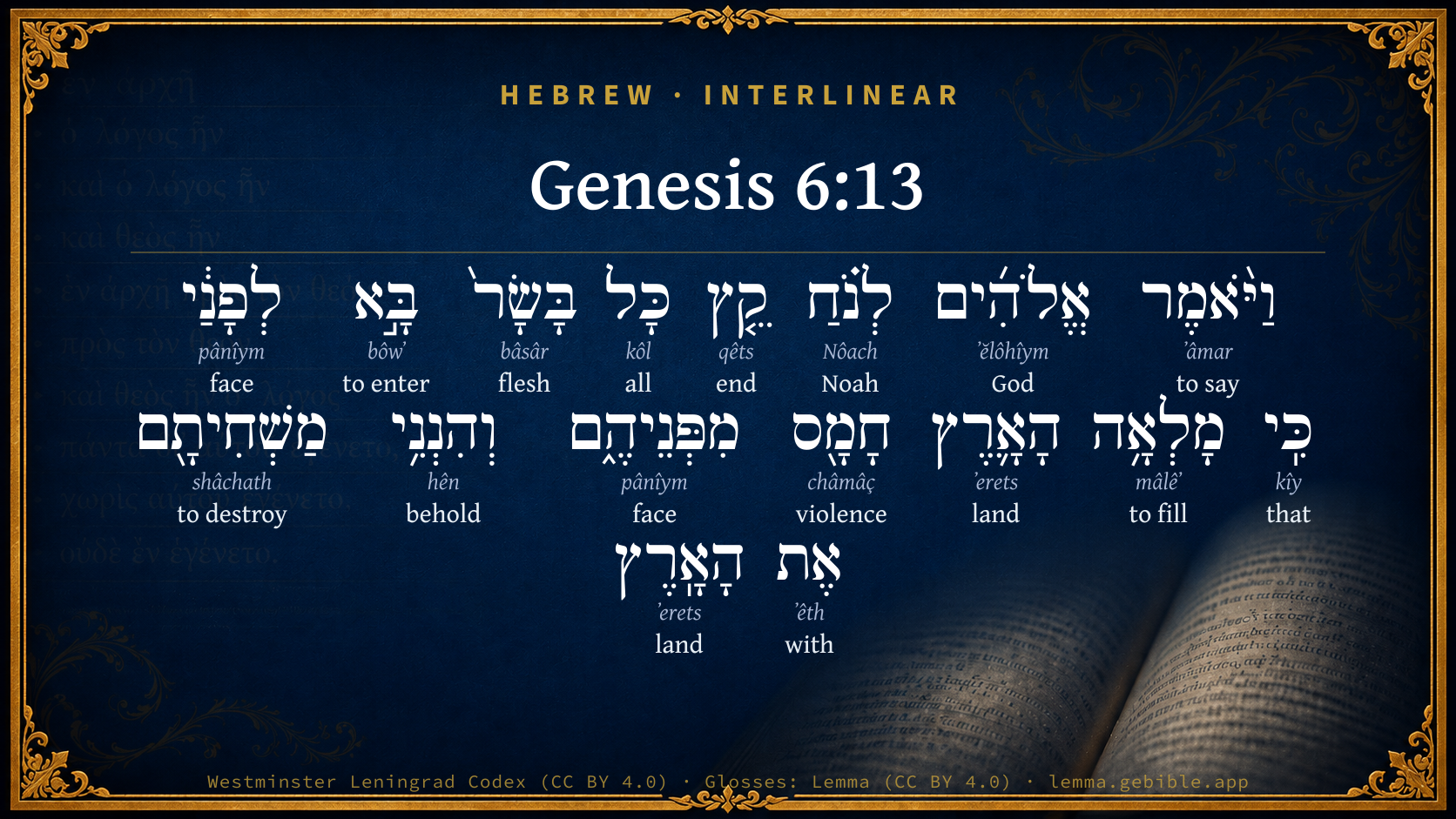
Hebrew (Westminster Leningrad Codex) Genesis 6:13 appears in the Hebrew Old Testament. The text above is from the Westminster Leningrad Codex. Each word links to its Strong’s number, a concise gloss, and parsing drawn from the Open Scriptures Hebrew Bible morphology. Click any word for its full Brown-Driver-Briggs (BDB) entry.
Download image
Cite this verse

Genesis 6:13 (World English Bible). Public Domain. Lemma interlinear Bible study tool, https://lemma.gebible.app/v/genesis/6/13.

Show BibTeX & RIS
BibTeX
RIS
English Translation
God said to Noah, "The end of all flesh has come before me, for the earth is filled with violence through them. Behold, I will destroy them with the earth.
World English Bible · Public Domain
Download a study sheet

One document with this verse’s original text, its word-by-word gloss line, the meaning frame, cross-references with their text, attributed commentary, and full source and license credits — printable, and it pastes into notes with its structure intact.

This verse Autodidact and up

Study sheet (.html) Plain text (.txt)

A passage Seminary Student

Up to 50 verses in one chapter. A passage sheet keeps up to 6 commentary sources and 12 cross-references per verse, in the order this page ranks them, and says so on the sheet whenever that leaves anything out. Ask for a single verse and you get the Autodidact verse sheet above.

Everything on this page stays free to read, with no account — the sheet is a download of what is already on screen, not access to it.

Want to remove ads? Support Godless Engineer
Compare translations 3

The same verse in 3 English versions, stacked beneath the original-language interlinear above. Click any original word for its lexicon entry.

Each is an independent rendering of the whole verse — the interlinear is not word-aligned to these translations.

Highlighted words mark where these versions differ — a whole-verse word diff, not a word-by-word alignment.

  • World English Bible Public Domain
    God said to Noah, "The end of all flesh has come before me, for the earth is filled with violence through them. Behold, I will destroy them with the earth.
  • King James Version Public Domain
    And God said unto Noah, The end of all flesh is come before me; for the earth is filled with violence through them; and, behold, I will destroy them with the earth.
  • unfoldingWord Literal Text CC BY-SA 4.0
    So God said to Noah, “The end of all flesh has come before me, because the earth is filled violence because of them. So behold, I am destroying them with the earth.

unfoldingWord Literal Text — © unfoldingWord, licensed CC BY-SA 4.0. Word-aligned USFM3 via Door43 (git.door43.org/unfoldingWord/en_ult).

Versions to compare (up to 4)

3 of 4 selected

Show all 18 translations

Every available English version of this verse, each an independent rendering of the whole verse.

  • World English Bible Public Domain
    God said to Noah, "The end of all flesh has come before me, for the earth is filled with violence through them. Behold, I will destroy them with the earth.
  • Berean Standard Bible Public Domain
    Then God said to Noah, “The end of all living creatures has come before Me, because through them the earth is full of violence. Now behold, I will destroy both them and the earth.
  • Majority Standard Bible Public Domain
    Then God said to Noah, “The end of all living creatures has come before Me, because through them the earth is full of violence. Now behold, I will destroy both them and the earth.
  • King James Version Public Domain
    And God said unto Noah, The end of all flesh is come before me; for the earth is filled with violence through them; and, behold, I will destroy them with the earth.
  • American Standard Version (1901) Public Domain
    And God said unto Noah, The end of all flesh is come before me; for the earth is filled with violence through them; and, behold, I will destroy them with the earth.
  • Revised Version (1885) Public Domain
    And God said unto Noah, The end of all flesh is come before me; for the earth is filled with violence through them; and, behold, I will destroy them with the earth.
  • Geneva Bible (1599) Public Domain
    And God said vnto Noah, An ende of all flesh is come before me: for the earth is filled with crueltie through them: and beholde, I wil destroy them with the earth.
  • Douay-Rheims (1899) Public Domain
    He said to Noe: The end of all flesh is come before me, the earth is filled with iniquity through them, and I will destroy them with the earth.
  • Young's Literal Translation Public Domain
    And God said to Noah, `An end of all flesh hath come before Me, for the earth hath been full of violence from their presence; and lo, I am destroying them with the earth.
  • Literal Standard Version CC BY-SA 4.0
    And God said to Noah, “An end of all flesh has come before Me, for the earth has been full of violence from their presence; and behold, I am destroying them with the earth.
  • Unlocked Literal Bible CC BY-SA 4.0
    God said to Noah, “I can see that it is time to put an end to all flesh, for the earth is filled with violence through them. Indeed, I will destroy them with the earth.
  • unfoldingWord Literal Text CC BY-SA 4.0
    So God said to Noah, “The end of all flesh has come before me, because the earth is filled violence because of them. So behold, I am destroying them with the earth.
  • Darby Bible Public Domain
    And God said to Noah, The end of all flesh is come before me, for the earth is full of violence through them; and behold, I will destroy them with the earth.
  • World Messianic Bible Public Domain
    God said to Noah, “I will bring an end to all flesh, for the earth is filled with violence through them. Behold, I will destroy them and the earth.
  • Webster's Bible Public Domain
    And God said to Noah, The end of all flesh is come before me; for the earth is filled with violence through them: and behold, I will destroy them with the earth.
  • Free Bible Version CC BY-SA 4.0
    So God told Noah, “I have decided to put an end to all people on earth because they are all violent and lawless. I myself am going to destroy all of them, along with the earth.
  • Bible in Basic English Public Domain
    And God said to Noah, The end of all flesh has come; the earth is full of their violent doings, and now I will put an end to them with the earth.
  • JPS Tanakh (1917) Public Domain
    And God said unto Noah: 'The end of all flesh is come before Me; for the earth is filled with violence through them; and, behold, I will destroy them with the earth.

Literal Standard Version (2020), Covenant Press — licensed CC BY-SA 4.0. Text via the HelloAO Bible API (eBible.org). Unlocked Literal Bible (unfoldingWord) — licensed CC BY-SA 4.0. Text via the HelloAO Bible API (eBible.org). unfoldingWord Literal Text — © unfoldingWord, licensed CC BY-SA 4.0. Word-aligned USFM3 via Door43 (git.door43.org/unfoldingWord/en_ult). Free Bible Version, Dr. Jonathan Gallagher — licensed CC BY-SA 4.0. Text via the HelloAO Bible API (eBible.org).

Word by word

More ways to search: Search by grammar → Find every occurrence → Compare this word →

Practice this passage: Drill this verse → Learn its vocabulary →

לְנֹ֗חַ
Nôach
H5146
“to/for · Noah”
Preposition + Noun, Proper
Part of Speech
Preposition + Noun
Type
Proper
Full BDB Definition

Origin: the same as H5118

TWOT: 1323b

Noah = "rest" - son of Lamech, father of Shem, Ham, and Japheth; builder of the ark which saved his family from the destruction of the world which God sent on the world by the flood; became the new seminal head of mankind because his family were the only survivors of the flood
  1. וַיֹּ֨אמֶר ʼâmar H559 “and · to say” Conjunction + Verb, Qal, Sequential Imperfect, 3rd Person, Masculine, Singular
  2. אֱלֹהִ֜ים ʼĕlôhîym H430 “God(s)” Noun, Common, Masculine, Plural, Absolute
  3. קֵ֤ץ qêts H7093 “end of” Noun, Common, Masculine, Singular, Construct
  4. כָּל kôl H3605 “all of” Noun, Common, Masculine, Singular, Construct
  5. בָּשָׂר֙ bâsâr H1320 “flesh” Noun, Common, Masculine, Singular, Absolute
  6. בָּ֣א bôwʼ H935 “to enter” Verb, Qal, Perfect, 3rd Person, Masculine, Singular
  7. לְפָנַ֔י pânîym H6440 “to/for · face(s) · my” Preposition + Noun, Common, Both, Plural, Construct + Suffix, Personal, 1st Person, Common, Singular
  8. כִּֽי kîy H3588 “that” Conjunction
  9. מָלְאָ֥ה mâlêʼ H4390 “to fill” Verb, Qal, Perfect, 3rd Person, Feminine, Singular
  10. הָאָ֛רֶץ ʼerets H776 “the · land” Particle, Definite Article + Noun, Common, Both, Singular, Absolute
  11. חָמָ֖ס châmâç H2555 “violence” Noun, Common, Masculine, Singular, Absolute
  12. מִפְּנֵיהֶ֑ם pânîym H6440 “from · face(s) · their” Preposition + Noun, Common, Both, Plural, Construct + Suffix, Personal, 3rd Person, Masculine, Plural
  13. וְהִנְנִ֥י hên H2005 “and · behold · me” Conjunction + Particle, Interjection + Suffix, Personal, 1st Person, Common, Singular
  14. מַשְׁחִיתָ֖ם shâchath H7843 “destroying · them” Verb, Hiphil, Participle Active, Masculine, Singular, Construct + Suffix, Personal, 3rd Person, Masculine, Plural
  15. אֶת ʼêth H854 “with” Preposition
  16. הָאָֽרֶץ ʼerets H776 “the · land” Particle, Definite Article + Noun, Common, Both, Singular, Absolute

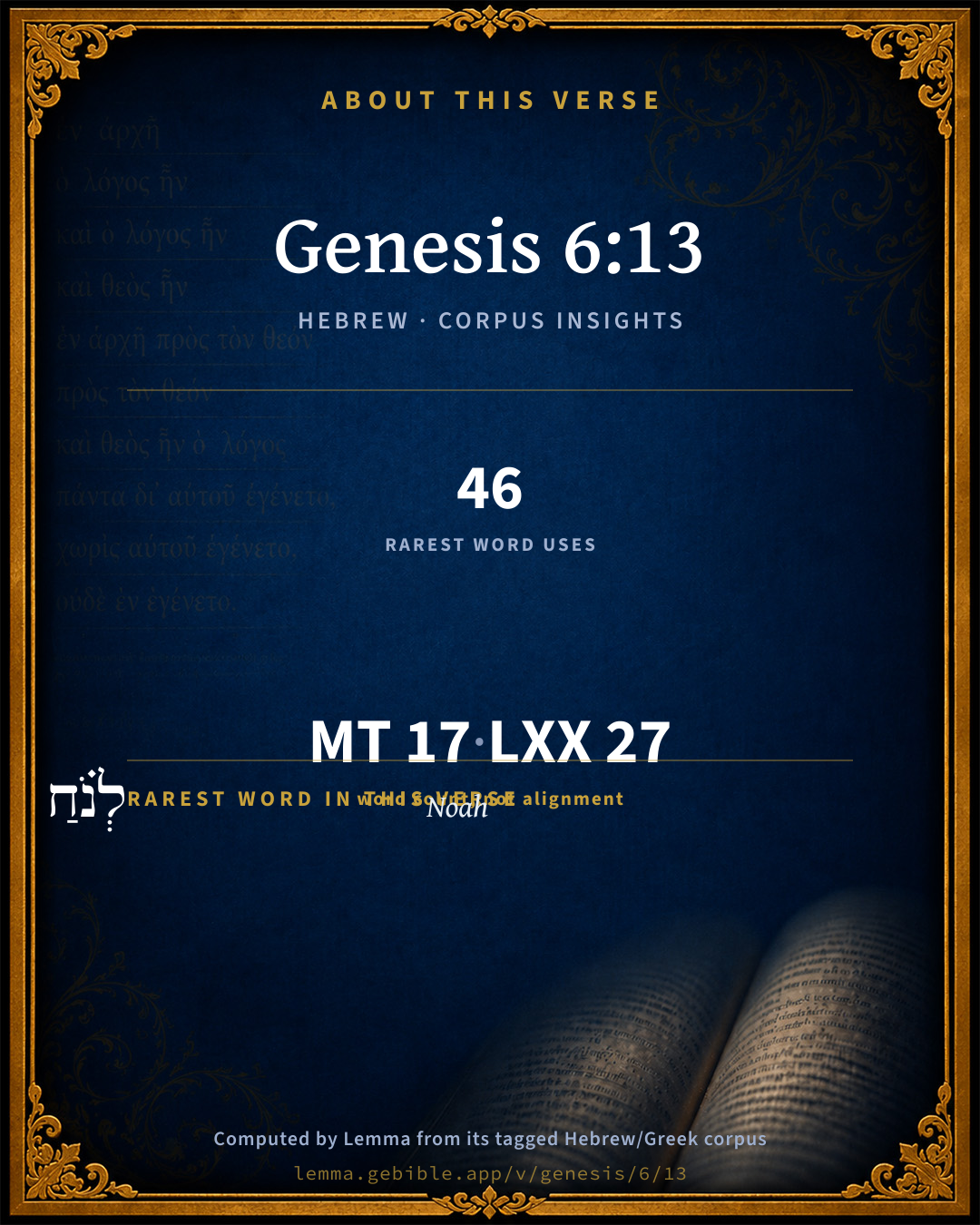
About this verse

These counts appear in no published source. They are computed here, from the morphology-tagged text and Lemma’s own curated glosses. What Lemma adds →

17
words
15
distinct lemmas
Pentateuch
section

Shared distinctive vocabulary

לְנֹ֗חַ Noah H5146 occurs in 39 verses of the Hebrew Bible. Also found in:

Grammatical profile

  • 4 verbs
  • 10 nouns
  • 1 preposition
  • 1 conjunction
  • 1 particle

Verb forms

  • וַיֹּ֨אמֶר Qal · Sequential Imperfect
  • בָּ֣א Qal · Perfect
  • מָלְאָ֥ה Qal · Perfect
  • מַשְׁחִיתָ֖ם Hiphil · Participle Active

Repetition

Words recur within this verse — often emphatic in Hebrew:

  • לְפָנַ֔י face H6440 ×2
  • הָאָ֛רֶץ land H776 ×2

Hebrew & Septuagint length

In English translation the verse runs 30 words from the Hebrew and 34 from the Septuagint (LXX English) — closely comparable.

A rough comparison of the two English renderings, which tokenize alike — not a word-level alignment.

Word counts can differ between the Hebrew and the Greek without any difference in meaning — e.g. the Hebrew direct-object marker אֵת has no separate Greek word, and Greek often adds the article ὁ.

In the original languages it is 17 Hebrew tokens and 27 Greek tokens — but the two are counted differently (Hebrew bundles its prefixes and suffixes into one token; the Greek is in lemma form), so that isn’t a like-for-like length.

Cross-references

13

Topical passages linked to Genesis 6:13 in the Treasury of Scripture Knowledge — connected by theme and wording, ordered by reader-vote popularity; previews shown in the World English Bible.

  • Hosea 4:1–2 Hear the word of Yahweh, you children of Israel; For Yahweh has a charge against the inhabitants of the land: "Indeed there is no truth, Nor goodness, Nor knowledge of God in the land.
  • 1 Peter 4:7 But the end of all things is near. Therefore be of sound mind, self-controlled, and sober in prayer.
  • Genesis 6:11–12 The earth was corrupt before God, and the earth was filled with violence.
  • Ezekiel 7:2–6 You, son of man, thus says the Lord Yahweh to the land of Israel, An end: the end is come on the four corners of the land.
  • 2 Peter 3:6–7 by which means the world that then was, being overflowed with water, perished.
  • 2 Peter 3:10–12 But the day of the Lord will come as a thief in the night; in which the heavens will pass away with a great noise, and the elements will be dissolved with fervent heat, and the earth and the works that are in it will be burned up.
  • Genesis 6:4 The Nephilim were in the earth in those days, and also after that, when God's sons came to men's daughters. They bore children to them: the same were the mighty men who were of old, men of renown.
  • Genesis 7:23 Every living thing was destroyed that was on the surface of the ground, including man, cattle, creeping things, and birds of the sky. They were destroyed from the earth. Only Noah was left, and those who were with him in the ark.
  • Amos 8:2 He said, "Amos, what do you see?" I said, "A basket of summer fruit." Then Yahweh said to me, "The end has come on my people Israel. I will not again pass by them any more.
  • Genesis 49:5 "Simeon and Levi are brothers; Weapons of violence are their swords.
  • Jeremiah 4:23–28 I saw the earth, and, behold, it was waste and void; and the heavens, and they had no light.
  • Jeremiah 51:13 You who dwell on many waters, abundant in treasures, your end is come, the measure of your covetousness.
  • Hebrews 11:7 By faith, Noah, being warned about things not yet seen, moved with godly fear, prepared an ark for the saving of his house, through which he condemned the world, and became heir of the righteousness which is according to faith.

Cross-references courtesy of OpenBible.info (CC BY 4.0).

Hebrew and Greek witnesses Masoretic Hebrew ↔ Greek Septuagint

The same verse in the two great witnesses to the Old Testament, shown verse-for-verse.

These are two independent witnesses, not word-aligned to each other, and the Septuagint is shown in lemma (dictionary) form.

Hebrew Genesis 6:13 Masoretic · Westminster Leningrad Codex

וַיֹּ֨אמֶר אֱלֹהִ֜ים לְנֹ֗חַ קֵ֤ץ כָּל בָּשָׂר֙ בָּ֣א לְפָנַ֔י כִּֽי מָלְאָ֥ה הָאָ֛רֶץ חָמָ֖ס מִפְּנֵיהֶ֑ם וְהִנְנִ֥י מַשְׁחִיתָ֖ם אֶת הָאָֽרֶץ

God said to Noah, "The end of all flesh has come before me, for the earth is filled with violence through them. Behold, I will destroy them with the earth.

World English Bible · Public Domain

Greek LXX Genesis 6:13 Septuagint · lemma form

καί εἶπον ὁ θεός πρός νωε καιρός πᾶς ἄνθρωπος ἥκω ἐναντίον ἐγώ ὅτι πίμπλημι ὁ γῆ ἀδικία ἀπό αὐτός καί ἰδού ἐγώ καταφθείρω αὐτός καί ὁ γῆ

And the Lord God said to Noe, A period of all men is come before me; because the earth has been filled with iniquity by them, and, behold, I destroy them and the earth.

LXX2012 (modern English Septuagint) · Public Domain

On this verse, The Pulpit Commentary discusses the Septuagint’s reading. Read the note in Commentary ↓

Hebrew: Westminster Leningrad Codex (CC BY 4.0). Greek: Septuagint (public domain); English from LXX2012 (modern English Septuagint) (Public Domain). How the Septuagint differs from the Hebrew →

Targum (Aramaic paraphrase)

2

The Targum is the ancient Jewish Aramaic paraphrase of the Hebrew Scriptures — an interpretive translation, not the Hebrew text itself. Onkelos (literal) and Pseudo-Jonathan (expansive) render the Torah, and Jonathan the Prophets. Coverage is partial: where no permissively-licensed English translation exists for a verse, only the Aramaic is shown. This is verse-level text, not a word-by-word alignment to the Hebrew.

  1. Targum Onkelos Torah (Genesis–Deuteronomy)
    וַאֲמַר יְיָ לְנֹחַ קִצָא דְכָל בִּסְרָא עַלַּת לִקֳדָמַי אֲרֵי אִתְמְלִיאַת אַרְעָא חֲטוֹפִין מִן קֳדָם עוֹבָדֵיהוֹן בִּישַׁיָּא וְהָא אֲנָא מְחַבֶּלְהוֹן עִם אַרְעָא

    And the Lord said to Noach, The end of all flesh cometh before Me, because the earth is filled with violences from the face of their wicked works; and, behold, I will destroy them with the earth.

    Targum Onkelos — Aramaic: “Onkelos Genesis” (public domain); “Onkelos Exodus” (public domain); “Onkelos Leviticus” (public domain); “Onkelos Numbers” (public domain); “Onkelos Deuteronomy” (public domain). English: “Sefaria Community Translation” (CC0 1.0 (public-domain dedication)); “J.W. Etheridge. The Targums of Onkelos and Jonathan Ben Uzziel on the Pentateuch. London: Longmans, Green, 1862” (public domain). Text via Sefaria.

  2. Targum Pseudo-Jonathan Torah (Genesis–Deuteronomy)
    וַאֲמַר יְיָ לְנחַ סוֹפָא דְכָל בִּשְרָא מָטָא מִן קֳדָמַי אֲרוּם אִתְמְלִיאַת אַרְעָא חֲטוּפִין מִן עוֹבְדֵיהוֹן בִּישַׁיָא וְהָא אֲנָא מְחַבֵּלְהוֹן עִם אַרְעָא

    And the Lord said to Noah, The end of all flesh cometh before Me, because the earth is filled with rapine by their evil works; and, behold, I will destroy them with the earth.

    Targum Pseudo-Jonathan — Aramaic: “Targum Jonathan on Genesis” (public domain); “Targum Jonathan on Exodus” (public domain); “Targum Jonathan on Leviticus” (public domain); “Targum Jonathan on Numbers” (public domain); “Targum Jonathan on Deuteronomy” (public domain). English: “The Targum of Jonathan ben Uzziel, trans. J. W. Etheridge, London, 1862” (public domain). Text via Sefaria.

Commentary

Notes on Genesis 6:13 from classic Christian and Jewish commentators (each source and its license shown beneath its notes). The classic Christian expositions comment on the surrounding passage and are grouped to its opening verse, so a note may address several verses; the Jewish commentaries on the Tanakh (Rashi and others) are per-verse, so they appear only where the commentator wrote on this verse.

Lemma curates 59 commentaries, every one of them public domain or Creative Commons licensed, each selected and text-cleaned for this edition rather than reprinted as found. About our sources →

Matthew Henry's Commentary

Here it appears indeed that Noah found grace in the eyes of the Lord. God's favour to him was plainly intimated in what he said of him, Gen 6:8-10, where his name is mentioned five times in five lines, when once might have served to make the sense clear, as if the Holy Ghost took a pleasure in perpetuating his memory; but it appears much more in what he says to him in these verses - the informations and instructions here given him.

I. God here makes Noah the man of his counsel, communicating to him his purpose to destroy this wicked world by water. As, afterwards, he told Abraham his resolution concerning Sodom (Gen 18:17, Shall I hide from Abraham?) so here "Shall I hide from Noah the thing that I do, seeing that he shall become a great nation?" Note, The secret of the Lord is with those that fear him (Psa 25:14); it was with his servants the prophets (Amo 3:7), by a spirit of revelation, informing them particularly of his purposes; it is with all believers by a spirit of wisdom and faith, enabling them to understand and apply the general declarations of the written word, and the warnings there given. Now,

1. God told Noah, in general, that he would destroy the world (Gen 6:13): The end of all flesh has come before me; I will destroy them; that is, the ruin of this wicked world is decreed and determined; it has come, that is, it will come surely, and come quickly. Noah, it is likely, in preaching to his neighbours, had warned them, in general, of the wrath of God that they would bring upon themselves by their wickedness, and now God seconds his endeavours by a particular denunciation of wrath, that Noah might try whether this would work upon them. Hence observe, (1.) That God confirmeth the words of his messengers, Isa 44:26. (2.) That to him that has, and uses what he has for the good of others, more shall be given, more full instructions.

2. He told him, particularly, that he would destroy the world by a flood of waters: And behold, I, even I, do bring a flood of waters upon the earth, Gen 6:17. God could have destroyed all mankind by the sword of an angel, a flaming sword turning every way, as he destroyed all the first-born of the Egyptians and the camp of the Assyrians; and then there needed no more than to set a mark upon Noah and his family for their preservation. But God chose to do it by a flood of waters, which should drown the world. The reasons, we may be sure, were wise and just, though to us unknown. God has many arrows in his quiver, and he may use which he please: as he chooses the rod with which he will correct his children, so he chooses the sword with which he will cut off his enemies. Observe the manner of expression: "I, even I, do bring a flood; I that am infinite in power, and therefore can do it, infinite in justice, and therefore will do it." (1.) It intimates the certainty of the judgment: I, even I, will do it. That cannot but be done effectually which God himself undertakes the doing of. See Job 11:10. (2.) It intimates the tendency of it to God's glory and the honour of his justice. Thus he will be magnified and exalted in the earth, and all the world shall be made to know that he is the God to whom vengeance belongs; methinks the expression here is somewhat like that, Isa 1:24, Ah, I will ease me of mine adversaries.

II. God here makes Noah the man of his covenant, another Hebrew periphrasis of a friend (Gen 6:18): But with thee will I establish my covenant. 1. The covenant of providence, that the course of nature shall be continued to the end of time, notwithstanding the interruption which the flood would give to it. This promise was immediately made to Noah and his sons, Gen 9:8, etc. They were as trustees for all this part of the creation, and a great honour was thereby put upon him and his. 2. The covenant of grace, that God would be to him a God and that out of his seed God would take to himself a people. Note, (1.) When God makes a covenant, he establishes it, he makes it sure, he makes it good; his are everlasting covenants. (2.) The covenant of grace has in it the recompence of singular services, and the fountain and foundation of all distinguishing favours; we need desire no more, either to make up our losses for God or to make up a happiness for us in God, than to have his covenant established with us.

III. God here makes Noah a monument of sparing mercy, by putting him in a way to secure himself in the approaching deluge, that he might not perish with the rest of the world: I will destroy them, says God, with the earth, Gen 6:13. "But make thee an ark; I will take care to preserve thee alive." Note, Singular piety shall be recompensed with distinguishing salvations, which are in a special manner obliging. This will add much to the honour and happiness of glorified saints, that they shall be saved when the greatest part of the world is left to perish. Now,

1. God directs Noah to make an ark, Gen 6:14-15. This ark was like the hulk of a ship, fitted not to sail upon the waters (there was no occasion for that, when there should be no shore to sail to), but to float upon the waters, waiting for their fall. God could have secured Noah by the ministration of angels, without putting him to any care, or pains, or trouble, himself; but he chose to employ him in making that which was to be the means of his preservation, both for the trial of his faith and obedience and to teach us that none shall be saved by Christ but those only that work out their salvation. We cannot do it without God, and he will not without us. Both the providence of God, and the grace of God, own and crown the endeavours of the obedient and diligent. God gave him very particular instructions concerning this building, which could not but be admirably well fitted for the purpose when Infinite Wisdom itself was the architect. (1.) It must be made of gopher-wood. Noah, doubtless, knew what sort of wood that was, though we now do not, whether cedar, or cypress, or what other. (2.) He must make it three stories high within. (3.) He must divide it into cabins, with partitions, places fitted for the several sorts of creatures, so as to lose no room. (4.) Exact dimensions were given him, that he might make it proportionable, and might have room enough in it to answer the intention and no more. Note, Those that work for God must take their measures from him and carefully observe them. Note, further, It is fit that he who appoints us our habitation should fix the bounds and limits of it. (5.) He must pitch it within and without - without, to shed off the rain, and to prevent the water from soaking in - within, to take away the bad smell of the beasts when kept close. Observe, God does not bid him paint it, but pitch it. If God gives us habitations that are safe, and warm, and wholesome, we are bound to be thankful, though they are not magnificent or nice. (6.) He must make a little window towards the top, to let in light, and (some think) that through that window he might behold the desolations to be made in the earth. (7.) He must make a door in the side of it, by which to go in and out.

2. God promises Noah that he and his shall be preserved alive in the ark (Gen 6:18): Thou shalt come into the ark. Note, What we do in obedience to God, we ourselves are likely to have the comfort and benefit of. If thou be wise, thou shalt be wise for thyself. Nor was he himself only saved in the ark, but his wife, and his sons, and his sons' wives. Observe, (1.) The care of good parents; they are solicitous not only for their own salvation, but for the salvation of their families, and especially their children. (2.) The happiness of those children that have godly parents. Their parents' piety often procures them temporal salvation, as here; and it furthers them in the way to eternal salvation, if they improve the benefit of it.

IV. God here makes Noah a great blessing to the world, and herein makes him an eminent type of the Messiah, though not the Messiah himself, as his parents expected, Gen 5:29. 1. God made him a preacher to the men of that generation. As a watchman, he received the word from God's mouth, that he might give them warning, Eze 3:17. Thus, while the long-suffering of God waited, by his Spirit in Noah, he preached to the old world, who, when Peter wrote, were spirits in prison (Pe1 3:18-20), and herein he was a type of Christ, who, in a land and age wherein all flesh had corrupted their way, went about preaching repentance and warning men of a deluge of wrath coming. 2. God made him a saviour to the inferior creatures, to keep the several kinds of them from perishing and being lost in the deluge, Gen 6:19-21. This was a great honour put upon him, that not only in him the race of mankind should be kept up, and that from him should proceed a new world, the church, the soul of the world, and Messiah, the head of that church, but that he should be instrumental to preserve the inferior creatures, and so mankind should in him acquire a new title to them and their service. (1.) He was to provide shelter for them, that they might not be drowned. Two of every sort, male and female, he must take with him into the ark; and lest he should make any difficulty of gathering them together, and getting them in, God promises (Gen 6:20) that they shall of their own accord come to him. He that makes the ox to know his owner and his crib then made him know his preserver and his ark. (2.) He was to provide sustenance for them, that they might not be starved, Gen 6:21. He must victual his ship according to the number of his crew, that great family which he had now the charge of, and according to the time appointed for his confinement. Herein also he was a type of Christ, to whom it is owing that the world stands, by whom all things consist, and who preserves mankind from being totally cut off and ruined by sin; in him the holy seed is saved alive, and the creation rescued from the vanity under which it groans. Noah saved those whom he was to rule, so does Christ, Heb 5:9.

Matthew Henry's Commentary on the Whole Bible (1708–1710) — public domain (CC PDM 1.0). Text via the HelloAO Bible API.

Trapp's Complete Commentary

John Trapp

Gen 6:13 And God said unto Noah, The end of all flesh is come before me; for the earth is filled with violence through them; and, behold, I will destroy them with the earth.

Ver. 13. The end of all flesh is come before me.] I will surely, and swiftly ( certissime citissimeque) destroy them. A like threatening there is used in Eze 7:2-3; Eze 7:6, against Israel, when once their sins were full ripe, and "hanged but for mowing," as we say: "The end is come," "is come," "is come," and so some ten or twelve times, "Is come, is come," q.d., destruction is at next door by, and Noah must know it too. Not by his skill in astrology, as Berosus belies him, but by divine premonition. For "shall I hide from" Noah, from "Abraham," "that thing which I do"? {Gen 18:17} No surely, they shall know all: they shall be both of God’s court and counsel For "the secret of the Lord is with them that fear him" {Psa 25:14} And "the Lord will do nothing" of this nature, "but he will first reveal it unto his servants the prophets". {Amo 3:7} And even to this day, the more faithful and familiar we are with God, so much the sooner and better do we foresee his judgments, and can foreshow them to others; as those that are well acquainted with men, know by their looks and gestures that which strangers understand not, but by their actions: As finer tempers are more sensible of the changes of weather, &c.

I will destroy them.] I will corrupt them, - so the Hebrew hath it, - I will punish them in kind; pay them in their own coin; corrupt them from the earth, as they have corrupted themselves in the earth, which also now is burdened with them, and cries to me for a vomit to spue them out.

John Trapp, A Commentary or Exposition upon All the Books of the Old and New Testament (1647–1656) — public domain. Text from a community e-Sword module.

Joseph Benson's Commentary

Gen 6:13. The end, or ruin, of all flesh is come before me — Is approaching, is at the very door. It is come in my purpose and decree, and shall as certainly take place, as if it were come already, in what manner soever vain men may flatter themselves with hopes of longer impunity. I will destroy them with the earth; but make thee an ark — I will take care to preserve thee alive. This ark was like the hulk of a ship, fitted not to sail upon the waters, but to float, waiting for their fall. God could have secured Noah by the ministration of angels, without putting him to any care or pains; but he chose to employ him in making that which was to be the means of his preservation, both for the trial of his faith and obedience, and to teach us that none shall be saved by Christ, but those only that work out their salvation; we cannot do it without God, and he will not without us: both the providence of God, and the grace of God, crown the endeavours of the obedient and diligent.

Joseph Benson's Commentary on the Old and New Testaments (1811–1818) — public domain. Text from a community e-Sword module.

Geneva Bible (1599)

Geneva Bible translators

Hebrew, from the face of them.

Or, I will destroy mankind.

Or, oppression and wickedness.

Geneva Bible (1599) marginal notes — public domain. Text via Bolls.life.

Jamieson, Fausset & Brown

Robert Jamieson, A. R. Fausset & David Brown

And God said unto Noah--How startling must have been the announcement of the threatened destruction! There was no outward indication of it. The course of nature and experience seemed against the probability of its occurrence. The public opinion of mankind would ridicule it. The whole world would be ranged against him. Yet, persuaded the communication was from God, through faith (Heb 11:7), he set about preparing the means for preserving himself and family from the impending calamity.

Jamieson, Fausset & Brown — Commentary Critical and Explanatory on the Whole Bible (1871) — public domain (CC PDM 1.0). Text via the HelloAO Bible API.

Adam Clarke's Commentary

Verse 13. I will destroy them with the earth.] Not only the human race was to he destroyed, but all terrestrial animals, i.e. those which could not live in the waters. These must necessarily be destroyed when the whole surface of the earth was drowned. But destroying the earth may probably mean the alteration of its constitution. Dr. Woodward, in his natural history of the earth, has rendered it exceedingly probable that the whole terrestrial substance was amalgamated with the waters, after which the different materials of its composition settled in beds or strata according to their respective gravities. This theory, however, is disputed by others.

Adam Clarke's Commentary on the Bible (1810–1826) — public domain. Text from a community e-Sword/MySword module.

John Calvin's Commentaries

13. And God said unto Noah. Here Moses begins to relate how Noah would be preserved. And first, he says, that the counsel of God respecting the destruction of the world was revealed to him. Secondly, that the command to build the ark was given. Thirdly, that safety was promised him, if, in obedience to God, he would take refuge in the ark. These chief points are to be distinctly noted; even as the Apostle, when he proclaims the faith of Noah, joins fear and obedience with confidence, (Hebrews 11:7.) And it is certain that Noah was admonished of the dreadful vengeance which was approaching; not only in order that he might be confirmed in his holy purpose, but that, being constrained by fear, he might the more ardently seek for the favor offered to him. We know that the impunity of the wicked is sometimes the occasion of alluring even the good to sin: the denunciation, therefore, of future punishment ought to be effectual in restraining the mind of a holy man; lest, by gradual declension, he should at length relax to the same lasciviousness. Yet God had special reference to the other point; namely, that by keeping continually in view the terrible destruction of the world, Noah might be more and more excited to fear and solicitude. For it was necessary, that in utter despair of help from any other quarter, he should seek his safety, by faith, in the ark. For so long as life was promised to him on earth, never would he have been so intent as he ought, in the building of the ark; but, being alarmed by the judgment of God, he earnestly embraces the promise of life given unto him. He no longer relies upon the natural causes or means of life; but rests exclusively on the covenant of God, by which he was to be miraculously preserved. No labor is now troublesome or difficult to him; nor is he broken down by long fatigue. For the spur of God’s anger pierces him too sharply to allow him to sleep in carnal delights, or to faint under temptations, or to be delayed in his course by vain hope: he rather stirs himself up, both to flee from sin, and to seek a remedy. And the Apostle teaches, that it was not the least part of his faith, that through the fear of those things which were not seen he prepared an ark. When faith is treated of simply, mercy and the gratuitous promise come into the account; but when we wish to express all its parts, and to canvass its entire force and nature, it is necessary that fear also should be joined with it. And, truly no one will ever seriously resort to the mercy of God, but he who, having been touched with the threatening of God, shall dread that judgment of eternal death which they denounce, shall abhor himself on account of his own sins, shall not carelessly indulge his vices, nor slumber in his pollution; but shall anxiously sigh for the remedy of his evils. This was, truly, a peculiar privilege of grace, that God warned Noah of the future deluge. Indeed, he frequently commands his threatening to be proposed to the elect, and reprobate, in common; that by inviting both to repentance, he may humble the former, and render the latter inexcusable. But while the greater part of mankind, with deaf ears, reject whatever is spoken, he especially turns his discourse to his own people, who are still curable, that by the fear of his judgment he may train them to piety. The condition of the wicked might at that time seem desirable, in comparison with the anxiety of holy Noah. They were securely flattering themselves in their own delights; for we know what Christ declares concerning the luxury of that period, (Luke 17:26.) Meanwhile, the holy man, as if the world were every moment going to ruin, groaned anxiously and sorrowfully. But if we consider the end; God granted an inestimable benefit to his servant, in denouncing to him a danger, of which he must beware.

The earth is filled with violence through them. God intimates that men were to be taken away, in order that the earth, which had been polluted by the presence of beings so wicked, might be purified. Moreover, in speaking only of the iniquity and violence, of the frauds and rapines, of which they were guilty towards each other; he does it, not as if he were intending to remit his own claims upon them, but because this was a more gross and palpable demonstration of their wickedness.

John Calvin's Commentaries (1540-1563) — public domain. Text from the Calvin Translation Society English edition (1840s-50s) via the Christian Classics Ethereal Library (ccel.org). Calvin's coverage is partial (roughly two-thirds of the Bible); uncommented books and verses are honest gaps, never fabricated. The 19th-century editor's footnotes and remarks are omitted so the notes are faithfully Calvin's own voice.

Ellicott's Commentary for English Readers

(13) The end of all flesh is come before me.—A metaphor taken from the customs of earthly kings. Before an order is executed the decree is presented to the sovereign, that it may finally be examined, and if approved, receive the sign manual, upon which it becomes law.

I will destroy them.—Not the verb used in Gen_6:7, but that translated had corrupted in Gen_6:12. It means “to bring to ruin, devastate.”

With the earth.—Rather, even the earth: eth, as in Gen_4:1. The meaning is, “I will bring them to nought, even the whole present constitution of earthly things.”

A Bible Commentary for English Readers, edited by Charles John Ellicott (1878–1897) — public domain. Text from a community e-Sword module.

The Cambridge Bible for Schools and Colleges

gen. ed. J. J. S. Perowne

13–17. Noah is commanded to build the Ark

13. is come before me] viz. mentally. The intention to destroy all flesh has entered the mind of God.

The Cambridge Bible for Schools and Colleges (gen. ed. J. J. S. Perowne; Cambridge University Press, 1878–1918) — public domain. Text from a community e-Sword module.

John Gill's Exposition

And this is the fashion which thou shall make it of,.... The form and size of it, its length, breadth, and height, as follows:

the length of the ark shall be three hundred cubits, the breadth of it fifty cubits, and the height of it thirty cubits; which some interpret of geometrical cubits, each of which contained six ordinary cubits; others of sacred cubits, which were larger by an hand's breadth than the common cubit; but the general opinion of learned men now is, that they were common cubits of eighteen inches long; and by the geometrical calculations made by them it is found, that the ark of such dimensions was abundantly sufficient to contain Noah, and his family, and the various creatures, and all necessary provisions for them (q). But if the Jewish and Egyptian cubit, the cubit of the Scriptures, as Dr. Cumberland (r) has shown it to be, consisted of twenty one inches and upwards, the ark according to them must be very near twice as great, and so more convenient for all the ends to which it was designed; for, as he observes, the cube of such a cubit is very near double to the cube of eighteen inches, and therefore so must the capacity be. (Noah's Ark was the largest sea-going vessel ever built, until, the late nineteenth century when giant metal ships were first constructed. The Ark was approximately 450 feet by seventy five feet; but as late as 1858"the largest vessel of her type in the world was the P&O liner, "Himalaya", 240 feet by thirty five feet...''In that year, Isambard K. Brunel produced the "Great Eastern", 692 feet by 83 feet by 30 feet of approximately 19000 tons ... five times the tonnage of any ship then afloat. So vast was Brunel's leap that even forty years later in an age of fierce competition the largest liners being built were still smaller than the "Great Eastern" ... (s). Editor.)

(q) Vid. Buteonem de Area Noe, Hostum in fabricam Areae Noc, & Poli Synopsin. Scheuchzer, ut supra, (Physic. Sacr. vol. 1.) pp. 37, 38. (r) Of Scripture Weights and Measures, ch. 2. p. 56, 57. (s) The World that Perished, John C. Witcomb, published by Baker Book House, 1988, p. 22.

John Gill's Exposition of the Whole Bible (1746–1763) — public domain (CC PDM 1.0). Text via the HelloAO Bible API.

Haydock's Catholic Bible Commentary

All flesh. I will destroy all these carnal and wicked people, and, because all other creatures were made only for man’s use, and will be useless, I will involve them in the common ruin, reserving only what will be necessary for the support of the few who shall be preserved, and for the repeopling of the earth. (Haydock)

George Leo Haydock (1774–1849), Haydock's Catholic Family Bible and Commentary, 1859 edition — public domain. Excludes Psalms (Douay-Rheims chapter numbering differs from Protestant) and Deuterocanonical books (Catholic canon only).

Matthew Poole's English Annotations

i.e. The time of ruin, as this word is used, Eze 7:2-3, 6; Amos 8:2,

of all flesh, to all men, as Gen 6:12, though the beasts also were involved in the same destruction,

is come, i.e. is approaching, and at the very door, and shall as certainly come as if it were actually come.

Before me, i.e. in my purpose and decree, howsoever vain men flatter themselves with hopes of longer impunity.

Through them, i.e. By their means; so that the earth even groans under them.

With the earth, i.e. with the fruits and beauty, though not the substance of the earth. Or, from the earth, as Gen 6:7; the Hebrew eth being oft put for min or meeth, as Gen 44:4; Deu 34:1; 1Ki 8:43, compared with 2Ch 6:33.

Matthew Poole's English Annotations on the Holy Bible (1683–1685) — public domain. Text from a community e-Sword/MySword module.

The Pulpit Commentary

And God said unto Noah, The end. xqe (from Hophal of xxq; to cut off) that which is cut off, the end of a time (Gen_4:3) or of a space; (Isa_37:24) specially the end or destruction of a people (Eze_7:2; Amo_8:2) in which sense it is to be here understood (Gesenius, Rosenm The rendering which regards ketz as, like telov the completion, consummation, fullness of a thing (here of humanfleshliness or wickedness), and the following clause as epexegetic of the present (Bush), though admissible in respect of Scriptural usage (cf. Jer_51:13; Ecc_12:13; Rom_10:4) and contextual harmony, is scarcely so obvious; while a third, that the end spoken of is the issue to which the moral corruption of the world was inevitably tending (Keil, Lange), does not materially differ from the first. Of all flesh, Ie. of the human race, of course with the exception of Noah and his family, which "teaches us to beware of applying an inflexible literality to such terms as all, when used in the sense of ordinary conversation" (Murphy). Is come before me. Literally, before my face. Not "a me constitutus est" (Gesenius), "is decreed before my throne" (Kalisch); but, "is in the contemplation of my mind as an event soon to be realized" (Murphy), with perhaps a glance at the circumstance that man s ruin had not been sought by God, but, as it were, had thrust itself upon his notice as a thing that could no longer be delayed. If ynp; l aB; = the similar expression la, aB; which, when applied to rumors, signifies to reach the ear (cf. Gen_18:21; Exo_3:9 1Ki_2:28; Est_9:11) it may likewise indicate the closeness or near approach of the impending calamity. For the earth is filled with violence through them. More correctly, from their faces; a facie eorum" (Vulgate). That is, "the flood of wickedness which comes up before God"s face goes out from their face" in the sense of being perpetrated openly (Lange), and "by their conscious agency" (Alford). And, behold, I will destroy them. Literally, and behold me destroying them. The verb is the same as is translated "corrupt" in ver. 12, q.v., as if to convey the idea of fitting retribution. (cf. 1Co_3:17: eitiv ton naorei fqerei touton oJ qeov; Rev_11:18: kai diafqeirai tourontav thn ghn) Whether this destruction which was threatened against the antediluvian sinners ex tended to the loss of their souls throughout eternity may be reasoned (pro and con) from other Scriptures, but cannot be determined from this place, which refers solely to the-extinction of their bodily lives. With the earth. Not from the earth (Samaritan), or on the earth (Syriac, Rosenm or even the earth, "thus identifying the earth with its inhabitants" (Bush), but, together with the earth. (Kalisch, Keil, Alford; cf. Gen_9:11; kai thn ghn, LXX) The universality of representation which characterizes this section (vers. 9-13) is regarded by Davidson, Colenso, and others as contradictory of Gen_6:5, which depicts the corruption as only human, and limits the destruction to the race of man. But as the two accounts belong to different subdivisions of the book, they cannot properly be viewed as contradictory (cf. "Quarry on Genesis," pp. 370, 371)

The Pulpit Commentary (1880–1919), ed. H.D.M. Spence-Jones & Joseph S. Exell — public domain. Text from a community e-Sword module.

John Wesley's Explanatory Notes

The end of all flesh is come before me; I will destroy them - The ruin of this wicked world is decreed; it is come, that is, it will come surely, and come quickly.

John Wesley, Explanatory Notes Upon the Whole Bible (1754–1765) — public domain. Text via the GEBible commentary corpus.

unfoldingWord translationNotes

Door43 World Missions Community

all flesh

See how you translated these words in Genesis 6:12.

the earth is filled with violence through them

"people everywhere on earth are violent"

I will destroy them with the earth

"I will destroy both them and the earth" or "I will destroy them when I destroy the earth"

an ark

This refers to a very large box that would be able to float on water even in a very bad storm. "a large boat" or "a ship" or "a barge"

cypress wood

People do not know exactly what kind of tree this was. "wood used for building boats" or "good wood"

cover it with pitch

The reason for doing this can be made explicit. AT: "spread pitch on it" or "paint tar on it" or "cover it with pitch to make it waterproof" (See: Assumed Knowledge and Implicit Information)

pitch

This is a thick, sticky or oily liquid that people put on the outside of a boat to stop water from going through gaps in the wood into the boat.

cubits

A cubit was a unit of measure, a little less than half a meter long. (See: Biblical Distance)

three hundred cubits

"138 meters." You may use the Hebrew measuring units from the ULB or the metric units from the UDB or your own culture's units if you know how they compare to the metric units. You may also write a footnote that says: "Three hundred cubits is about 138 meters." (See: Biblical Distance)

fifty cubits

"twenty-three meters" (See: Biblical Distance)

thirty cubits

"fourteen meters" (See: Biblical Distance)

translationWords

God

ark

cypress

unfoldingWord translationNotes — © Distant Shores Media and the Door43 World Missions Community, licensed CC BY-SA 4.0. Source: git.door43.org/Door43/en_tn.

Rashi

Rabbi Shlomo Yitzchaki (Rashi)

קץ כל בשר THE END OF ALL FLESH — Wherever you find lewdness and idolatry, punishment of an indiscriminate character comes upon the world killing good and bad alike (Genesis Rabbah 26:5).

כי מלאה הארץ חמס FOR THE EARTH IS FILLED WITH VIOLENCE — Their fate was sealed only on account of their sin of robbery (Sanhedrin 108a).

את הארץ [I WILL DESTROY THEM] WITH THE EARTH — It is similar to מן הארץ "from the earth”; other examples of this use of את are: (Exodus 9:29) בצאתי ‘‘when I go forth” את העיר which means מן העיר “from the city” and (1 Kings 15:23) חלה ‘‘he suffered” את רגליו which means מן רגליו ‘‘from his feet”. Another explanation of את הארץ is: “together with the earth” — for the earth was blotted out and washed away to the depth of a furrow of three handbreadths (Genesis Rabbah 31:7).

Rashi on the Tanakh — English translations: “The Judaica Press complete Tanach with Rashi, translated by A. J. Rosenberg” (CC BY 4.0); “Pentateuch with Rashi's commentary by M. Rosenbaum and A.M. Silbermann, 1929-1934” (public domain); “The Metsudah Tanach series, Lakewood, N.J” (CC BY 4.0); and “The Book of Joshua, Metsudah Publications, 1997” (CC BY 4.0). Text via Sefaria.

Ramban (Nachmanides)

Rabbi Moshe ben Nachman (Ramban / Nachmanides)

VIOLENCE, that is, robbery and oppression. Now G-d gave Noah the explanation [that the flood was due to the fact that the “the earth is filled with] violence” and did not mention “the corruption of the way” [recorded in the preceding verse] because violence is a sin that is known and widely publicized. Our Rabbis have said that it was on account of the sin of violence that their fate was sealed. The reason for it is that the prohibition against violence is a rational commandment, there being no need for a prophet to admonish them against it. Besides, it is evil committed against both heaven and mankind. Thus He informed Noah of the sin for which the end is come — the doom is reached.

AND BEHOLD, I WILL DESTROY THEM ‘ETH’ THE EARTH. This is similar to saying “from the earth.” So also: When I go forth ‘eth’ the city, [meaning “from the city”]; he suffered ‘eth’ his feet, [meaning “from his feet”]. Another interpretation is that eth ha’aretz means “with the earth” for even the land was blotted out to the depth of a furrow of three handbreadths. Thus the language of Rashi quoting Bereshith Rabbah. And Rabbi Abraham ibn Ezra said that the word mashchitham (destroy them) draws along with it a similar word, [meaning it is as if the verb “destroy” appears twice in the verse], thus stating, “And behold, I will destroy them and destroy the earth.”By way of the truth [the mystic teaching of the Cabala], this is like the verse, eth hashamayim ve’eth ha’aretz (the heaven and the earth), thus intimating that “the earth” will be destroyed, and with the destruction of the earth they too will be destroyed and thus they will be blotted out from the World to Come, just as is intimated in the verse: and it grieved Him at His heart. It is to this that the Rabbis alluded in Bereshith Rabbah: “This is like a master’s son who had a wet-nurse; whenever he would commit an offense the wet-nurse would be punished.”

Ramban (Nachmanides) on the Tanakh — English translation: “Commentary on the Torah by Ramban (Nachmanides). Translated and annotated by Charles B. Chavel. New York, Shilo Pub. House, 1971-1976” (CC BY 4.0). Text via Sefaria.

Sforno

Rabbi Ovadia Sforno

The end of all flesh. That is, the end of their 120 year reprieve.

The earth is filled with violent crime. A landlord would steal openly from his tenant farmer while the tenant farmer stole surreptitiously from the landlord in return. Thus all the earth’s bounty went to thieves.

Sforno on the Tanakh — English translation: “Yalkut, Sifsei Chachomim Chumash, Metsudah Publications, 2009” (CC BY 4.0). Text via Sefaria.

Radak

Rabbi David Kimhi (Radak)

ויאמר...קץ כל בשר, the time had arrived for their destruction from the world. The destruction which G’d had threatened before allowing for the 120 years grace period. Not only had they not mended their ways, but they had become ever more corrupt.

בא לפני, we have explained the word בא already elsewhere as meaning “that the time had arrived before Me.” The same expression is used in Jonah 1,2 when G’d describes the impending fate of the people of Nineveh in the words כי עלתה רעתם לפני, meaning that the effect of the wickedness had reached Him. The קץ described in our verse is the natural reaction to the effect the wickedness of the people had on G’d when it confronted Him.

כי מלאה הארץ חמס, the word מפניהם belongs next to the words בא לפני, i.e. on account of the violence they have perpetrated. Our sages (Sanhedrin 108) say behold how powerful is the sin of violence seeing that the generation of the deluge was not wiped out in spite of all their other sins until they had become guilty of indiscriminate violence. Iit was only then that the decree of their destruction was sealed.

משחיתם, seeing that the people had deliberately corrupted their way of life, G’d matches the punishment to the crime by depriving them of the control they used to exert over nature inasmuch as it effected their habitat, earth.

את, in this instance it means the same as מן, “from.” A parallel verse in which the word את is used in this sense is Exodus 9,29 כצאתי את העיר, “as soon as I leave the city.” Another such example is found in Genesis 44,4 הם יצאו את העיר “they had just departed from the city.”

Radak on the Tanakh — English translations: “Sefaria Community Translation” (CC0 1.0 (public-domain dedication)); “Eliyahu Munk, HaChut Hameshulash” (CC BY 4.0); “Rabbi Mike Feuer, Jerusalem Anthology” (CC BY 4.0); and “R. David Kimhi on the first book of Psalms, Translated by R.G. Finch, London, 1919” (public domain). Text via Sefaria.

Lesson kit

Teaching starters — assembled from the data on this page, not authored interpretation. Every prompt links to the verse data it draws on. Edit before teaching.

Genesis, in the Pentateuch, opens this verse with 17 words (15 distinct Hebrew lemmas). Its most distinctive word is Nôach (“Noah”). A historical commentator’s framing appears above. Read the whole chapter for the surrounding context.

Discussion questions

  1. The word Nôach carries the sense “Noah.” How does it shape the verse?
  2. Genesis 5:29 shares the word «Noah» with this verse. How do the two illuminate each other?
  3. “face” occurs 2× in this one verse. What is the effect of the repetition?
  4. These translations render this verse differently. What is at stake in choosing one wording over another?
  5. The verb «וַיֹּ֨אמֶר» is Qal Sequential Imperfect. How does its form color the action?
  6. Reading how Matthew Henry's Commentary and Trapp's Complete Commentary read this verse, where do the two commentators agree and where do they part?

Things to notice

Reading settings

Reading text

Shown beneath each verse's original-language words.

Old Testament
Old Testament edition

Read the OT as the Masoretic Hebrew (MT) or the Greek Septuagint (LXX).

English shown for the Greek Septuagint (in the Hebrew ↔ Greek comparison).

Comparing translations? Open the Compare panel on any verse page to stack up to four side by side.