Genesis 46:27

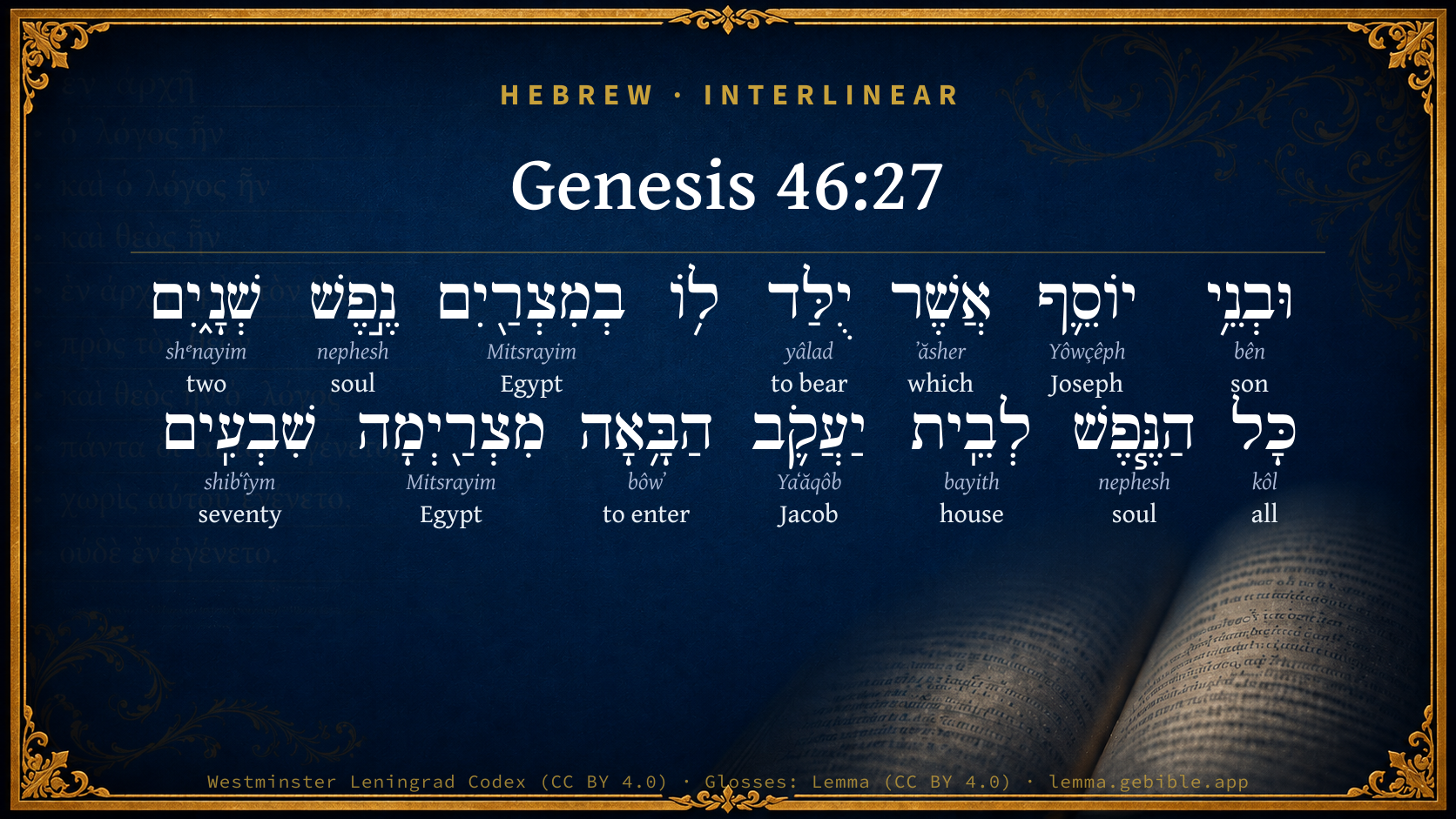
Hebrew (Westminster Leningrad Codex) Genesis 46:27 appears in the Hebrew Old Testament. The text above is from the Westminster Leningrad Codex. Each word links to its Strong’s number, a concise gloss, and parsing drawn from the Open Scriptures Hebrew Bible morphology. Click any word for its full Brown-Driver-Briggs (BDB) entry.
Download image
Cite this verse

Genesis 46:27 (World English Bible). Public Domain. Lemma interlinear Bible study tool, https://lemma.gebible.app/v/genesis/46/27.

Show BibTeX & RIS
BibTeX
RIS
English Translation
The sons of Joseph, who were born to him in Egypt, were two souls. All the souls of the house of Jacob, who came into Egypt, were seventy.
World English Bible · Public Domain
Download a study sheet

One document with this verse’s original text, its word-by-word gloss line, the meaning frame, cross-references with their text, attributed commentary, and full source and license credits — printable, and it pastes into notes with its structure intact.

This verse Autodidact and up

Study sheet (.html) Plain text (.txt)

A passage Seminary Student

Up to 50 verses in one chapter. A passage sheet keeps up to 6 commentary sources and 12 cross-references per verse, in the order this page ranks them, and says so on the sheet whenever that leaves anything out. Ask for a single verse and you get the Autodidact verse sheet above.

Everything on this page stays free to read, with no account — the sheet is a download of what is already on screen, not access to it.

Want to remove ads? Support Godless Engineer
Compare translations 3

The same verse in 3 English versions, stacked beneath the original-language interlinear above. Click any original word for its lexicon entry.

Each is an independent rendering of the whole verse — the interlinear is not word-aligned to these translations.

Highlighted words mark where these versions differ — a whole-verse word diff, not a word-by-word alignment.

  • World English Bible Public Domain
    The sons of Joseph, who were born to him in Egypt, were two souls. All the souls of the house of Jacob, who came into Egypt, were seventy.
  • King James Version Public Domain
    And the sons of Joseph, which were born him in Egypt, were two souls: all the souls of the house of Jacob, which came into Egypt, were threescore and ten.
  • unfoldingWord Literal Text CC BY-SA 4.0
    And the sons of Joseph who were born for him in Egypt two souls. All the souls to the house of Jacob who went to Egypt seventy. Jacob Reunites with His Son Joseph and Meets Pharaoh 46:28-47:12

unfoldingWord Literal Text — © unfoldingWord, licensed CC BY-SA 4.0. Word-aligned USFM3 via Door43 (git.door43.org/unfoldingWord/en_ult).

Versions to compare (up to 4)

3 of 4 selected

Show all 18 translations

Every available English version of this verse, each an independent rendering of the whole verse.

  • World English Bible Public Domain
    The sons of Joseph, who were born to him in Egypt, were two souls. All the souls of the house of Jacob, who came into Egypt, were seventy.
  • Berean Standard Bible Public Domain
    And with the two sons who had been born to Joseph in Egypt, the members of Jacob’s family who went to Egypt were seventy in all.
  • Majority Standard Bible Public Domain
    And with the two sons who had been born to Joseph in Egypt, the members of Jacob’s family who went to Egypt were seventy in all.
  • King James Version Public Domain
    And the sons of Joseph, which were born him in Egypt, were two souls: all the souls of the house of Jacob, which came into Egypt, were threescore and ten.
  • American Standard Version (1901) Public Domain
    and the sons of Joseph, who were born to him in Egypt, were two souls: all the souls of the house of Jacob, that came into Egypt, were threescore and ten.
  • Revised Version (1885) Public Domain
    and the sons of Joseph, which were born to him in Egypt, were two souls: all the souls of the house of Jacob, which came into Egypt, were threescore and ten.
  • Geneva Bible (1599) Public Domain
    Also the sonnes of Ioseph, which were borne him in Egypt, were two soules: so that al the soules of the house of Iaakob, which came into Egypt, are seuentie.
  • Douay-Rheims (1899) Public Domain
    And the sons of Joseph, that were born to him in the land of Egypt, two souls. All the souls of the house of Jacob, that entered into Egypt, were seventy.
  • Young's Literal Translation Public Domain
    And the sons of Joseph who have been born to him in Egypt `are' two persons. All the persons of the house of Jacob who are coming into Egypt `are' seventy.
  • Literal Standard Version CC BY-SA 4.0
    And the sons of Joseph who have been born to him in Egypt [are] two persons. All the persons of the house of Jacob who are coming into Egypt [are] seventy.
  • Unlocked Literal Bible CC BY-SA 4.0
    With the two sons of Joseph who were born to him in Egypt, the members of his family who went to Egypt were seventy in all.
  • unfoldingWord Literal Text CC BY-SA 4.0
    And the sons of Joseph who were born for him in Egypt two souls. All the souls to the house of Jacob who went to Egypt seventy. Jacob Reunites with His Son Joseph and Meets Pharaoh 46:28-47:12
  • Darby Bible Public Domain
    And the sons of Joseph who were born to him in Egypt, were two souls. All the souls of the house of Jacob that came to Egypt were seventy.
  • World Messianic Bible Public Domain
    The sons of Joseph, who were born to him in Egypt, were two souls. All the souls of the house of Jacob, who came into Egypt, were seventy.
  • Webster's Bible Public Domain
    And the sons of Joseph who were born to him in Egypt, were two souls: all the souls of the house of Jacob, who came into Egypt, were seventy.
  • Free Bible Version CC BY-SA 4.0
    Including the two sons Joseph had in Egypt, the total number of Jacob's family who were in Egypt was seventy.
  • Bible in Basic English Public Domain
    And the sons of Joseph whom he had in Egypt were two. Seventy persons of the family of Jacob came into Egypt.
  • JPS Tanakh (1917) Public Domain
    And the sons of Joseph, who were born to him in Egypt, were two souls; all the souls of the house of Jacob, that came into Egypt, were threescore and ten.

Literal Standard Version (2020), Covenant Press — licensed CC BY-SA 4.0. Text via the HelloAO Bible API (eBible.org). Unlocked Literal Bible (unfoldingWord) — licensed CC BY-SA 4.0. Text via the HelloAO Bible API (eBible.org). unfoldingWord Literal Text — © unfoldingWord, licensed CC BY-SA 4.0. Word-aligned USFM3 via Door43 (git.door43.org/unfoldingWord/en_ult). Free Bible Version, Dr. Jonathan Gallagher — licensed CC BY-SA 4.0. Text via the HelloAO Bible API (eBible.org).

Word by word

More ways to search: Search by grammar → Find every occurrence → Compare this word →

Practice this passage: Drill this verse → Learn its vocabulary →

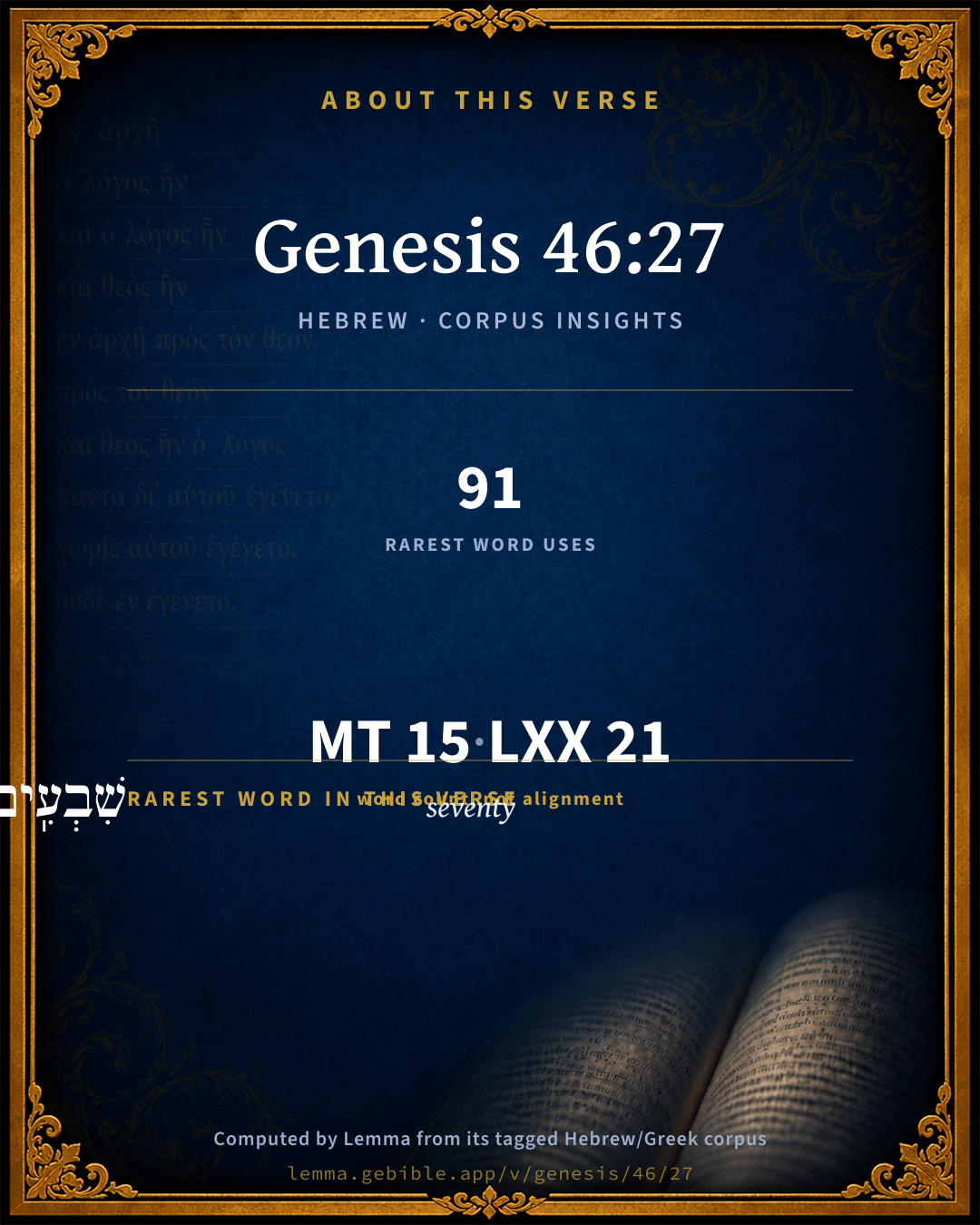
שִׁבְעִֽים
shibʻîym
H7657
“seventy”
Adjective, Cardinal number, Both, Plural, Absolute
Part of Speech
Adjective
Type
Cardinal number
Gender
Both
Number
Plural
State
Absolute
Full BDB Definition

Origin: multiple of H7651

TWOT: 2318b

seventy
  1. וּבְנֵ֥י bên H1121 “and · sons of” Conjunction + Noun, Common, Masculine, Plural, Construct
  2. יוֹסֵ֛ף Yôwçêph H3130 “Joseph” Noun, Proper
  3. אֲשֶׁר ʼăsher H834 “which” Particle, Relative
  4. יֻלַּד yâlad H3205 “to bear” Verb, Pual, Perfect, 3rd Person, Masculine, Singular
  5. בְמִצְרַ֖יִם Mitsrayim H4714 “in/at · Egypt” Preposition + Noun, Proper
  6. נֶ֣פֶשׁ nephesh H5315 “soul” Noun, Common, Both, Singular, Absolute
  7. שְׁנָ֑יִם shᵉnayim H8147 “two” Adjective, Cardinal number, Masculine, Dual, Absolute
  8. כָּל kôl H3605 “all of” Noun, Common, Masculine, Singular, Construct
  9. הַנֶּ֧פֶשׁ nephesh H5315 “the · soul” Particle, Definite Article + Noun, Common, Both, Singular, Absolute
  10. לְבֵֽית bayith H1004 “to/for · house of” Preposition + Noun, Common, Masculine, Singular, Construct
  11. יַעֲקֹ֛ב Yaʻăqôb H3290 “Jacob” Noun, Proper
  12. הַבָּ֥אָה bôwʼ H935 “the · to enter” Particle, Definite Article + Verb, Qal, Perfect, 3rd Person, Feminine, Singular
  13. מִצְרַ֖יְמָה Mitsrayim H4714 “Egypt · toward” Noun, Proper + Suffix, Demonstrative

About this verse

These counts appear in no published source. They are computed here, from the morphology-tagged text and Lemma’s own curated glosses. What Lemma adds →

15
words
12
distinct lemmas
Pentateuch
section

Grammatical profile

  • 2 verbs
  • 9 nouns
  • 2 adjectives
  • 1 preposition
  • 1 particle

Verb forms

  • יֻלַּד Pual · Perfect
  • הַבָּ֥אָה Qal · Perfect

Repetition

Words recur within this verse — often emphatic in Hebrew:

  • בְמִצְרַ֖יִם Egypt H4714 ×2
  • נֶ֣פֶשׁ soul H5315 ×2

Hebrew & Septuagint length

In English translation the verse runs 28 words from the Hebrew and 35 from the Septuagint (LXX English) — closely comparable.

A rough comparison of the two English renderings, which tokenize alike — not a word-level alignment.

Word counts can differ between the Hebrew and the Greek without any difference in meaning — e.g. the Hebrew direct-object marker אֵת has no separate Greek word, and Greek often adds the article ὁ.

In the original languages it is 15 Hebrew tokens and 21 Greek tokens — but the two are counted differently (Hebrew bundles its prefixes and suffixes into one token; the Greek is in lemma form), so that isn’t a like-for-like length.

Cross-references

4

Topical passages linked to Genesis 46:27 in the Treasury of Scripture Knowledge — connected by theme and wording, ordered by reader-vote popularity; previews shown in the World English Bible.

  • Deuteronomy 10:22 Your fathers went down into Egypt with seventy persons; and now Yahweh your God has made you as the stars of the sky for multitude.
  • Acts 7:14 Joseph sent, and summoned Jacob, his father, and all his relatives, seventy-five souls.
  • Exodus 1:5 All the souls who came out of the Jacob's body were seventy souls, and Joseph was in Egypt already.
  • Exodus 24:1 He said to Moses, "Come up to Yahweh, you, and Aaron, Nadab, and Abihu, and seventy of the elders of Israel; and worship from a distance.

Cross-references courtesy of OpenBible.info (CC BY 4.0).

Hebrew and Greek witnesses Masoretic Hebrew ↔ Greek Septuagint

The same verse in the two great witnesses to the Old Testament, shown verse-for-verse.

These are two independent witnesses, not word-aligned to each other, and the Septuagint is shown in lemma (dictionary) form.

Hebrew Genesis 46:27 Masoretic · Westminster Leningrad Codex

וּבְנֵ֥י יוֹסֵ֛ף אֲשֶׁר יֻלַּד ל֥וֹ בְמִצְרַ֖יִם נֶ֣פֶשׁ שְׁנָ֑יִם כָּל הַנֶּ֧פֶשׁ לְבֵֽית יַעֲקֹ֛ב הַבָּ֥אָה מִצְרַ֖יְמָה שִׁבְעִֽים

The sons of Joseph, who were born to him in Egypt, were two souls. All the souls of the house of Jacob, who came into Egypt, were seventy.

World English Bible · Public Domain

Greek LXX Genesis 46:27 Septuagint · lemma form

υἱός δέ ιωσηφ ὁ γίγνομαι αὐτός ἐν γῆ αἴγυπτος ψυχή ἐννέα πᾶς ψυχή οἶκος ἰακώβ ὁ εἰςἔρχομαι εἰς αἴγυπτος ἑβδομήκοντα πέντε

And the sons of Joseph, who were born to him in the land of Egypt, were nine souls; all the souls of the house of Jacob who came with Joseph into Egypt, were seventy-five souls.

LXX2012 (modern English Septuagint) · Public Domain

On this verse, The Cambridge Bible for Schools and Colleges discusses the Septuagint’s reading. Read the note in Commentary ↓

Hebrew: Westminster Leningrad Codex (CC BY 4.0). Greek: Septuagint (public domain); English from LXX2012 (modern English Septuagint) (Public Domain). How the Septuagint differs from the Hebrew →

Targum (Aramaic paraphrase)

2

The Targum is the ancient Jewish Aramaic paraphrase of the Hebrew Scriptures — an interpretive translation, not the Hebrew text itself. Onkelos (literal) and Pseudo-Jonathan (expansive) render the Torah, and Jonathan the Prophets. Coverage is partial: where no permissively-licensed English translation exists for a verse, only the Aramaic is shown. This is verse-level text, not a word-by-word alignment to the Hebrew.

  1. Targum Onkelos Torah (Genesis–Deuteronomy)
    וּבְנֵי יוֹסֵף דִּי אִתְיְלִידוּ לֵהּ בְּמִצְרַיִם נַפְשָׁתָא תְרֵין כָּל נַפְשָׁתָא לְבֵית יַעֲקֹב דְּעַלּוּ לְמִצְרַיִם שִׁבְעִין

    (no public-domain English translation for this verse)

    Targum Onkelos — Aramaic: “Onkelos Genesis” (public domain); “Onkelos Exodus” (public domain); “Onkelos Leviticus” (public domain); “Onkelos Numbers” (public domain); “Onkelos Deuteronomy” (public domain). English: “Sefaria Community Translation” (CC0 1.0 (public-domain dedication)); “J.W. Etheridge. The Targums of Onkelos and Jonathan Ben Uzziel on the Pentateuch. London: Longmans, Green, 1862” (public domain). Text via Sefaria.

  2. Targum Pseudo-Jonathan Torah (Genesis–Deuteronomy)
    וּבְנוֹי דְיוֹסֵף דְאִתְיְלִידוּ לֵיהּ בְּמִצְרַיִם נַפְשָׁתָא תְּרֵין וְיוֹסֵף דַהֲוָה בְמִצְרַיִם וְיוֹכֶבֶד בְּרַת לֵוִי דְאִתְיְלִידַת בְּמִעַלְהוֹן לְמִצְרַיִם בֵּינֵי טוּרַיָא סְכוּם כָּל נַפְשָׁתָא לְבֵית יַעֲקב דְעָלָא לְמִצְרַיִם שׁוּבְעִין

    But the sons of Joseph who were born to him in Mizraim were two souls; and Joseph who was in Mizraim, and Jokebed the daughter of Levi, who was born among the hills in their journey to Mizraim, the sum of all the souls of the house of Jakob who came into Mizraim, seventy.

    Targum Pseudo-Jonathan — Aramaic: “Targum Jonathan on Genesis” (public domain); “Targum Jonathan on Exodus” (public domain); “Targum Jonathan on Leviticus” (public domain); “Targum Jonathan on Numbers” (public domain); “Targum Jonathan on Deuteronomy” (public domain). English: “The Targum of Jonathan ben Uzziel, trans. J. W. Etheridge, London, 1862” (public domain). Text via Sefaria.

Commentary

Notes on Genesis 46:27 from classic Christian and Jewish commentators (each source and its license shown beneath its notes). The classic Christian expositions comment on the surrounding passage and are grouped to its opening verse, so a note may address several verses; the Jewish commentaries on the Tanakh (Rashi and others) are per-verse, so they appear only where the commentator wrote on this verse.

Lemma curates 59 commentaries, every one of them public domain or Creative Commons licensed, each selected and text-cleaned for this edition rather than reprinted as found. About our sources →

Trapp's Complete Commentary

John Trapp

Gen 46:27 And the sons of Joseph, which were born him in Egypt, [were] two souls: all the souls of the house of Jacob, which came into Egypt, [were] threescore and ten.

Ver. 27. Threescore and ten.] St Stephen reckons seventy-five. {Act 7:14} And so the Greek translateth here, which Stephen seemeth to follow; as doth likewise St Luke for Cainan; {Luk 3:36} that translation being then received, and they not willing to alter it. The Jews say, that these seventy souls were as much as all the seventy nations of the world. And Moses tells them, that whereas their fathers went down into Egypt with seventy souls, now Jehovah had made them "as the stars of heaven for multitude." {Deu 10:22}

John Trapp, A Commentary or Exposition upon All the Books of the Old and New Testament (1647–1656) — public domain. Text from a community e-Sword module.

Tyndale Open Study Notes

Tyndale Open Resources

46:27 The total seventy includes Joseph, Ephraim, Manasseh, and Jacob. Seventy is also a symbolic number for perfection or completion (see “Symbolic Numbers” Theme Note). From these seventy (i.e., all Israel) would grow the nation of Israel that would bless the seventy nations (i.e., all the nations) of the world (see study note on Gen 10:2-32; cp. 12:3).

Tyndale Open Study Notes — © Tyndale Open Resources, licensed CC BY-SA 4.0. Text via the HelloAO Bible API.

The Cambridge Bible for Schools and Colleges

gen. ed. J. J. S. Perowne

27. threescore and ten] LXX gives “threescore and fifteen,” which is followed in Act_7:14. The additional five persons were the three grandsons and two great-grandsons born to Joseph in Egypt. Cf. Gen_50:23; Num_26:28 ff.

The number “seventy” being a sacred number is secured, though at the cost of some adjustment.

The Cambridge Bible for Schools and Colleges (gen. ed. J. J. S. Perowne; Cambridge University Press, 1878–1918) — public domain. Text from a community e-Sword module.

John Gill's Exposition

And Joseph said unto his brethren, and to his father's house,.... To them and their families, after he had paid his filial respects to his father, in honour, reverence, and affection:

I will go up and shew Pharaoh; acquaint him that his father and all his family were come to Egypt; he says, "I will go up"; which same phrase is used of him, Gen 46:29; when he came, and carries some difficulty in it how to account for it, that he should be said to go up when he came, and to go up when he returned. Some have thought of upper Egypt, others of the upper part of the Nile, and others, that Pharaoh's palace was situated on an eminence; but then, as it is to be supposed he went the same road he came, it would have been said, that when he came, he came down; what Ben Melech suggests seems most agreeable, I will go up to my chariot, mount that, and return to Pharaoh, and give him an account of his father's arrival, which it was very proper, prudent, and politic to do:

and say unto him, my brethren, and my father's house, which were in the land of Canaan, are come unto me; not merely to pay him a visit, but to continue there.

John Gill's Exposition of the Whole Bible (1746–1763) — public domain (CC PDM 1.0). Text via the HelloAO Bible API.

Haydock's Catholic Bible Commentary

CHAPTER XLVI.

George Leo Haydock (1774–1849), Haydock's Catholic Family Bible and Commentary, 1859 edition — public domain. Excludes Psalms (Douay-Rheims chapter numbering differs from Protestant) and Deuterocanonical books (Catholic canon only).

Matthew Poole's English Annotations

He doth not say,

which came with Jacob into Egypt, because some of them came thither before him, and others with him, some in their persons, and some in their parents. As for the difficulty arising from comparing this place with Act 7:14, it will be more fit to speak of it when we come to that place.

Matthew Poole's English Annotations on the Holy Bible (1683–1685) — public domain. Text from a community e-Sword/MySword module.

Whedon's Commentary on the Bible

Daniel D. Whedon

27. All the souls… threescore and ten — It accorded with Hebrew spirit and custom to so frame a register of honoured names as to have them sum up a definite and significant number. So Matthew’s genealogy of our Lord is arranged into three groups of fourteen names each, (Mat_1:17,) and yet this could be done only by omitting several important names. The compiler of this list of Jacob’s sons might, by another process equally correct, have made it number sixty-nine by omitting Jacob himself, or a lesser number by omitting some of the grandchildren, or have made it exceed seventy by adding the names of Jacob’s wives: he purposely arranged it so as to make it number seventy souls. The descendants of Noah, as registered in chap. 10, amount to seventy. The seventy elders of Israel (Num_11:16) and the seventy disciples chosen by Jesus (Luk_10:1) show a peculiar regard for this mystic number. It is not improbable that the arrangement of genealogical lists was made up to round numbers, and, where possible, to a sacred number, that the whole might be the more easily and correctly transmitted by oral tradition.

Daniel D. Whedon (gen. ed.), Commentary on the Old and New Testaments (1874–1909) — public domain. Text from a community e-Sword module.

Radak

Rabbi David Kimhi (Radak)

הבאה, the stress is on the second to last syllable, seeing that the verb is in the past tense. The meaning of the word is the same as if the Torah had written אשר באה, “who had arrived,”

מצרימה, an inaccuracy, as the family did not arrive in Egypt, but in Goshen, a border province. The word is used as an “umbrella,” i.e. a description of the entire state.

Radak on the Tanakh — English translations: “Sefaria Community Translation” (CC0 1.0 (public-domain dedication)); “Eliyahu Munk, HaChut Hameshulash” (CC BY 4.0); “Rabbi Mike Feuer, Jerusalem Anthology” (CC BY 4.0); and “R. David Kimhi on the first book of Psalms, Translated by R.G. Finch, London, 1919” (public domain). Text via Sefaria.

Lesson kit

Teaching starters — assembled from the data on this page, not authored interpretation. Every prompt links to the verse data it draws on. Edit before teaching.

Genesis, in the Pentateuch, opens this verse with 15 words (12 distinct Hebrew lemmas). Its most distinctive word is shibʻîym (“seventy”). A historical commentator’s framing appears above. Read the whole chapter for the surrounding context.

Discussion questions

  1. The word shibʻîym carries the sense “seventy.” How does it shape the verse?
  2. How does Deuteronomy 10:22, which shares this passage’s theme, read alongside this verse?
  3. What does the repetition of “Egypt” (2× in this one verse) do in this verse?
  4. The translations on this page render this verse differently — a whole-verse word diff, not a word-by-word alignment. What might account for the different wordings?
  5. «יֻלַּד» is a Pual Perfect verb. How does that grammatical form shape the action described?
  6. Compare how Trapp's Complete Commentary and Tyndale Open Study Notes read this verse. Where do they agree or differ?

Things to notice

Reading settings

Reading text

Shown beneath each verse's original-language words.

Old Testament
Old Testament edition

Read the OT as the Masoretic Hebrew (MT) or the Greek Septuagint (LXX).

English shown for the Greek Septuagint (in the Hebrew ↔ Greek comparison).

Comparing translations? Open the Compare panel on any verse page to stack up to four side by side.