
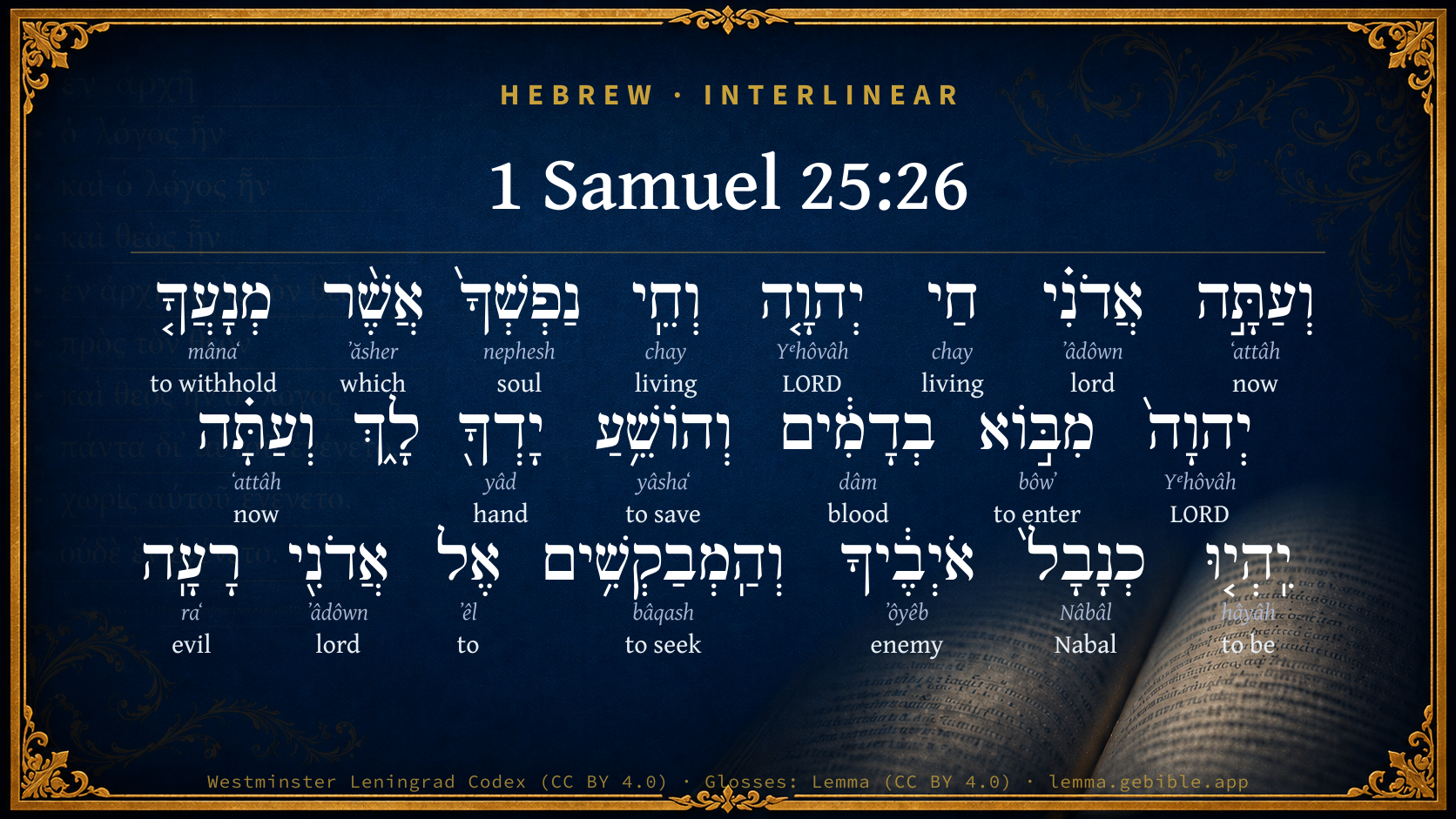
1 Samuel 25:26

Hebrew (Westminster Leningrad Codex) 1 Samuel 25:26 appears in the Hebrew Old Testament. The text above is from the Westminster Leningrad Codex. Each word links to its Strong’s number, a concise gloss, and parsing drawn from the Open Scriptures Hebrew Bible morphology. Click any word for its full Brown-Driver-Briggs (BDB) entry.
Download image
Cite this verse

1 Samuel 25:26 (World English Bible). Public Domain. Lemma interlinear Bible study tool, https://lemma.gebible.app/v/1-samuel/25/26.

Show BibTeX & RIS
BibTeX
RIS
English Translation
Now therefore, my lord, as Yahweh lives, and as your soul lives, seeing Yahweh has withheld you from blood guiltiness, and from avenging yourself with your own hand, now therefore let your enemies, and those who seek evil to my lord, be as Nabal.
World English Bible · Public Domain
Download a study sheet

One document with this verse’s original text, its word-by-word gloss line, the meaning frame, cross-references with their text, attributed commentary, and full source and license credits — printable, and it pastes into notes with its structure intact.

This verse Autodidact and up

Study sheet (.html) Plain text (.txt)

A passage Seminary Student

Up to 50 verses in one chapter. A passage sheet keeps up to 6 commentary sources and 12 cross-references per verse, in the order this page ranks them, and says so on the sheet whenever that leaves anything out. Ask for a single verse and you get the Autodidact verse sheet above.

Everything on this page stays free to read, with no account — the sheet is a download of what is already on screen, not access to it.

Want to remove ads? Support Godless Engineer
Compare translations 3

The same verse in 3 English versions, stacked beneath the original-language interlinear above. Click any original word for its lexicon entry.

Each is an independent rendering of the whole verse — the interlinear is not word-aligned to these translations.

Highlighted words mark where these versions differ — a whole-verse word diff, not a word-by-word alignment.

  • World English Bible Public Domain
    Now therefore, my lord, as Yahweh lives, and as your soul lives, seeing Yahweh has withheld you from blood guiltiness, and from avenging yourself with your own hand, now therefore let your enemies, and those who seek evil to my lord, be as Nabal.
  • King James Version Public Domain
    Now therefore, my lord, as the LORD liveth, and as thy soul liveth, seeing the LORD hath withholden thee from coming to shed blood, and from avenging thyself with thine own hand, now let thine enemies, and they that seek evil to my lord, be as Nabal.
  • unfoldingWord Literal Text CC BY-SA 4.0
    And now, my master, the life of Yahweh, and the life of your soul, Yahweh who has restrained you from entering into bloodshed and your hand saving for yourself. And now, may your enemies and the ones seeking harm against my master be like Nabal.

unfoldingWord Literal Text — © unfoldingWord, licensed CC BY-SA 4.0. Word-aligned USFM3 via Door43 (git.door43.org/unfoldingWord/en_ult).

Versions to compare (up to 4)

3 of 4 selected

Show all 18 translations

Every available English version of this verse, each an independent rendering of the whole verse.

  • World English Bible Public Domain
    Now therefore, my lord, as Yahweh lives, and as your soul lives, seeing Yahweh has withheld you from blood guiltiness, and from avenging yourself with your own hand, now therefore let your enemies, and those who seek evil to my lord, be as Nabal.
  • Berean Standard Bible Public Domain
    Now, my lord, as surely as the LORD lives and you yourself live, the LORD has held you back from coming to bloodshed and avenging yourself with your own hand. May your enemies and those who seek harm for my lord be like Nabal.
  • Majority Standard Bible Public Domain
    Now, my lord, as surely as the LORD lives and you yourself live, since the LORD has held you back from bloodshed and from avenging yourself with your own hand, may your enemies and those who seek harm for my lord be like Nabal.
  • King James Version Public Domain
    Now therefore, my lord, as the LORD liveth, and as thy soul liveth, seeing the LORD hath withholden thee from coming to shed blood, and from avenging thyself with thine own hand, now let thine enemies, and they that seek evil to my lord, be as Nabal.
  • American Standard Version (1901) Public Domain
    Now therefore, my lord, as Jehovah liveth, and as thy soul liveth, seeing Jehovah hath withholden thee from bloodguiltiness, and from avenging thyself with thine own hand, now therefore let thine enemies, and them that seek evil to my lord, be as Nabal.
  • Revised Version (1885) Public Domain
    Now therefore, my lord, as the LORD liveth, and as thy soul liveth, seeing the LORD hath withholden thee from bloodguiltiness, and from avenging thyself with thine own hand, now therefore let thine enemies, and them that seek evil to my lord, be as Nabal.
  • Geneva Bible (1599) Public Domain
    Now therefore my lord, as the Lord liueth, and as thy soule liueth (the Lord, I say, that hath withholden thee from comming to shedde blood, and that thine hand should not saue thee) so now thine enemies shall be as Nabal, and they that intend to doe my lord euill.
  • Douay-Rheims (1899) Public Domain
    Now therefore, my lord, the Lord liveth, and thy soul liveth, who hath withholden thee from coming to blood, and hath saved thy hand to thee: and now let thy enemies be as Nabal, and all they that seek evil to my lord.
  • Young's Literal Translation Public Domain
    and now, my lord, Jehovah liveth, and thy soul liveth, in that Jehovah hath withheld thee from coming in with blood, and to save thy hand to thee -- now let thine enemies be as Nabal, even those seeking evil unto my lord.
  • Literal Standard Version CC BY-SA 4.0
    and now, my lord, YHWH lives, and your soul lives, in that YHWH has withheld you from coming in with blood, and to save your hand from yourself—now let your enemies be as Nabal, even those seeking evil toward my lord.
  • Unlocked Literal Bible CC BY-SA 4.0
    Now then, my master, as Yahweh lives, and as you live, since Yahweh has restrained you from bloodshed, and from avenging yourself with your own hand, now let your enemies, and those who seek to do evil to my master, be like Nabal.
  • unfoldingWord Literal Text CC BY-SA 4.0
    And now, my master, the life of Yahweh, and the life of your soul, Yahweh who has restrained you from entering into bloodshed and your hand saving for yourself. And now, may your enemies and the ones seeking harm against my master be like Nabal.
  • Darby Bible Public Domain
    And now, my lord, [as] Jehovah liveth, and [as] thy soul liveth, seeing Jehovah has restrained thee from coming with bloodshed, and from avenging thyself with thine own hand, now let thine enemies, and they that seek evil to my lord, be as Nabal.
  • World Messianic Bible Public Domain
    Now therefore, my lord, as the LORD lives and as your soul lives, since the LORD has withheld you from blood guiltiness and from avenging yourself with your own hand, now therefore let your enemies and those who seek evil to my lord be as Nabal.
  • Webster's Bible Public Domain
    Now therefore, my lord, as the LORD liveth, and as thy soul liveth, seeing the LORD hath withheld thee from coming to shed blood, and from avenging thyself with thy own hand, now let thy enemies, and they that seek evil to my lord, be as Nabal.
  • Free Bible Version CC BY-SA 4.0
    Now, sir, as the Lord lives and as you live, the Lord has kept you from shedding blood and from taking your own revenge. Sir, may your enemies and those who want to do you harm be like Nabal.
  • Bible in Basic English Public Domain
    So now, my lord, by the living God and by your living soul, seeing that the Lord has kept you from the crime of blood and from taking into your hands the punishment for your wrongs, may all your haters, and those who would do evil to my lord, be like Nabal.
  • JPS Tanakh (1917) Public Domain
    Now therefore, my lord, as the LORD liveth, and as thy soul liveth, seeing the LORD hath withholden thee from bloodguiltiness, and from finding redress for thyself with thine own hand, now therefore let thine enemies, and them that seek evil to my lord, be as Nabal.

Literal Standard Version (2020), Covenant Press — licensed CC BY-SA 4.0. Text via the HelloAO Bible API (eBible.org). Unlocked Literal Bible (unfoldingWord) — licensed CC BY-SA 4.0. Text via the HelloAO Bible API (eBible.org). unfoldingWord Literal Text — © unfoldingWord, licensed CC BY-SA 4.0. Word-aligned USFM3 via Door43 (git.door43.org/unfoldingWord/en_ult). Free Bible Version, Dr. Jonathan Gallagher — licensed CC BY-SA 4.0. Text via the HelloAO Bible API (eBible.org).

Word by word

More ways to search: Search by grammar → Find every occurrence → Compare this word →

Practice this passage: Drill this verse → Learn its vocabulary →

כְנָבָל֙
Nâbâl
H5037
“like/as · Nabal”
Preposition + Noun, Proper
Part of Speech
Preposition + Noun
Type
Proper
Full BDB Definition

Origin: the same as H5036

TWOT: None

Nabhal or Nabal = "fool" - a man of Carmel who spurned David's messengers, then died of shock when he realised it might cause his death; his case was pleaded by his wife Abigail who became David's wife after his death
  1. וְעַתָּ֣ה ʻattâh H6258 “and · now” Conjunction + Adverb
  2. אֲדֹנִ֗י ʼâdôwn H113 “lord · my” Noun, Common, Masculine, Singular, Construct + Suffix, Personal, 1st Person, Common, Singular
  3. חַי chay H2416 “living” Adjective, Adjective, Masculine, Singular, Absolute
  4. יְהוָ֤ה Yᵉhôvâh H3068 “LORD” Noun, Proper
  5. וְחֵֽי chay H2416 “and · living” Conjunction + Adjective, Adjective, Masculine, Singular, Absolute
  6. נַפְשְׁךָ֙ nephesh H5315 “soul · your” Noun, Common, Both, Singular, Construct + Suffix, Personal, 2nd Person, Masculine, Singular
  7. אֲשֶׁ֨ר ʼăsher H834 “which” Particle, Relative
  8. מְנָעֲךָ֤ mânaʻ H4513 “to withhold · you” Verb, Qal, Perfect, 3rd Person, Masculine, Singular + Suffix, Personal, 2nd Person, Masculine, Singular
  9. יְהוָה֙ Yᵉhôvâh H3068 “LORD” Noun, Proper
  10. מִבּ֣וֹא bôwʼ H935 “from · to enter” Preposition + Verb, Qal, Infinitive Construct
  11. בְדָמִ֔ים dâm H1818 “in/at · blood” Preposition + Noun, Common, Masculine, Plural, Absolute
  12. וְהוֹשֵׁ֥עַ yâshaʻ H3467 “and · to save” Conjunction + Verb, Hiphil, Infinitive Absolute
  13. יָדְךָ֖ yâd H3027 “hand · your” Noun, Common, Both, Singular, Construct + Suffix, Personal, 2nd Person, Masculine, Singular
  14. וְעַתָּ֗ה ʻattâh H6258 “and · now” Conjunction + Adverb
  15. יִֽהְי֤וּ hâyâh H1961 “to be” Verb, Qal, Jussive, 3rd Person, Masculine, Plural
  16. אֹיְבֶ֔יךָ ʼôyêb H341 “enemy · you” Verb, Qal, Participle Active, Masculine, Plural, Construct + Suffix, Personal, 2nd Person, Masculine, Singular
  17. וְהַֽמְבַקְשִׁ֥ים bâqash H1245 “and · the · seeking” Conjunction + Particle, Definite Article + Verb, Piel, Participle Active, Masculine, Plural, Absolute
  18. אֶל ʼêl H413 “to” Preposition
  19. אֲדֹנִ֖י ʼâdôwn H113 “lord · my” Noun, Common, Masculine, Singular, Construct + Suffix, Personal, 1st Person, Common, Singular
  20. רָעָֽה raʻ H7451 “evil” Noun, Common, Feminine, Singular, Absolute

About this verse

These counts appear in no published source. They are computed here, from the morphology-tagged text and Lemma’s own curated glosses. What Lemma adds →

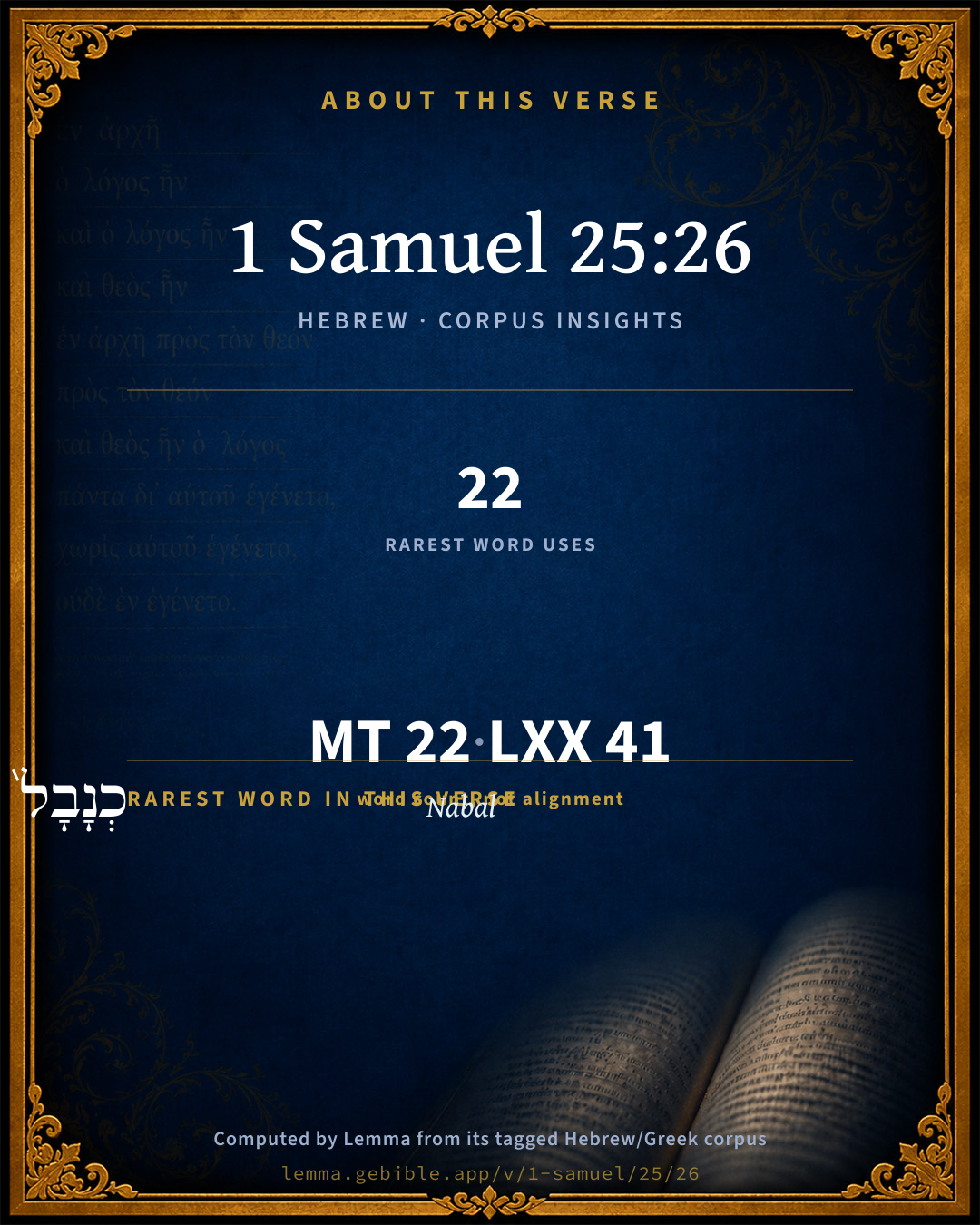
22
words
17
distinct lemmas
Historical
section

Notable vocabulary

The rarest word here is כְנָבָל֙ Nabal H5037 — appearing just 22 times in the whole Hebrew Bible.

Shared distinctive vocabulary

כְנָבָל֙ Nabal H5037 occurs in 18 verses of the Hebrew Bible. Also found in:

Grammatical profile

  • 6 verbs
  • 9 nouns
  • 2 adjectives
  • 2 prepositions
  • 2 adverbs
  • 1 particle

Verb forms

  • מְנָעֲךָ֤ Qal · Perfect
  • מִבּ֣וֹא Qal · Infinitive Construct
  • וְהוֹשֵׁ֥עַ Hiphil · Infinitive Absolute
  • יִֽהְי֤וּ Qal · Jussive
  • אֹיְבֶ֔יךָ Qal · Participle Active
  • וְהַֽמְבַקְשִׁ֥ים Piel · Participle Active

Repetition

Words recur within this verse — often emphatic in Hebrew:

  • וְעַתָּ֣ה now H6258 ×2
  • אֲדֹנִ֗י lord H113 ×2
  • חַי living H2416 ×2
  • יְהוָ֤ה LORD H3068 ×2

Hebrew & Septuagint length

In English translation the verse runs 44 words from the Hebrew and 45 from the Septuagint (LXX English) — closely comparable.

A rough comparison of the two English renderings, which tokenize alike — not a word-level alignment.

Word counts can differ between the Hebrew and the Greek without any difference in meaning — e.g. the Hebrew direct-object marker אֵת has no separate Greek word, and Greek often adds the article ὁ.

In the original languages it is 22 Hebrew tokens and 41 Greek tokens — but the two are counted differently (Hebrew bundles its prefixes and suffixes into one token; the Greek is in lemma form), so that isn’t a like-for-like length.

Cross-references

13

Topical passages linked to 1 Samuel 25:26 in the Treasury of Scripture Knowledge — connected by theme and wording, ordered by reader-vote popularity; previews shown in the World English Bible.

  • 2 Samuel 18:32 The king said to the Cushite, Is it well with the young man Absalom? The Cushite answered, The enemies of my lord the king, and all who rise up against you to do you hurt, be as that young man is.
  • Romans 12:19–20 Don't seek revenge yourselves, beloved, but give place to God's wrath. For it is written, "Vengeance belongs to me; I will repay, says the Lord."
  • Genesis 20:6 God said to him in the dream, "Yes, I know that in the integrity of your heart you have done this, and I also withheld you from sinning against me. Therefore I didn't allow you to touch her.
  • 1 Samuel 25:33–34 and blessed be your discretion, and blessed be you, that have kept me this day from blood guiltiness, and from avenging myself with my own hand.
  • Psalms 18:47–48 Even the God who executes vengeance for me, And subdues peoples under me.
  • Daniel 4:19 Then Daniel, whose name was Belteshazzar, was stricken mute for a while, and his thoughts troubled him. The king answered, Belteshazzar, don't let the dream, or the interpretation, trouble you. Belteshazzar answered, My lord, the dream be to those who hate you, and the interpretation of it to your adversaries.
  • Hebrews 10:30 For we know him who said, "Vengeance belongs to me," says the Lord, "I will repay." Again, "The Lord will judge his people."
  • Psalms 44:3 For they didn't get the land in possession by their own sword, Neither did their own arm save them; But your right hand, and your arm, and the light of your face, Because you were favorable to them.
  • 1 Samuel 1:26 She said, Oh, my lord, as your soul lives, my lord, I am the woman who stood by you here, praying to Yahweh.
  • 1 Samuel 22:3 David went there to Mizpeh of Moab: and he said to the king of Moab, Please let my father and my mother come forth, [and be] with you, until I know what God will do for me.
  • 2 Kings 2:2 Elijah said to Elisha, Please wait here, for Yahweh has sent me as far as Bethel. Elisha said, As Yahweh lives, and as your soul lives, I will not leave you. So they went down to Bethel.
  • 2 Kings 4:6 It happened, when the vessels were full, that she said to her son, Bring me yet a vessel. He said to her, There isn't another vessel. The oil stayed.
  • Jeremiah 29:22 and of them shall be taken up a curse by all the captives of Judah who are in Babylon, saying, Yahweh make you like Zedekiah and like Ahab, whom the king of Babylon roasted in the fire;

Cross-references courtesy of OpenBible.info (CC BY 4.0).

Hebrew and Greek witnesses Masoretic Hebrew ↔ Greek Septuagint

The same verse in the two great witnesses to the Old Testament, shown verse-for-verse.

These are two independent witnesses, not word-aligned to each other, and the Septuagint is shown in lemma (dictionary) form.

Hebrew 1 Samuel 25:26 Masoretic · Westminster Leningrad Codex

וְעַתָּ֣ה אֲדֹנִ֗י חַי יְהוָ֤ה וְחֵֽי נַפְשְׁךָ֙ אֲשֶׁ֨ר מְנָעֲךָ֤ יְהוָה֙ מִבּ֣וֹא בְדָמִ֔ים וְהוֹשֵׁ֥עַ יָדְךָ֖ לָ֑ךְ וְעַתָּ֗ה יִֽהְי֤וּ כְנָבָל֙ אֹיְבֶ֔יךָ וְהַֽמְבַקְשִׁ֥ים אֶל אֲדֹנִ֖י רָעָֽה

Now therefore, my lord, as Yahweh lives, and as your soul lives, seeing Yahweh has withheld you from blood guiltiness, and from avenging yourself with your own hand, now therefore let your enemies, and those who seek evil to my lord, be as Nabal.

World English Bible · Public Domain

Greek LXX 1 Samuel 25:26 Septuagint · lemma form

καί νῦν κύριος ζάω κύριος καί ζάω ὁ ψυχή σύ καθώς κωλύω σύ κύριος ὁ μή ἔρχομαι εἰς αἷμα ἀθῷος καί σώζω ὁ χείρ σύ σύ καί νῦν γίγνομαι ὡς ναβαλ ὁ ἐχθρός σύ καί ὁ ζητέω ὁ κύριος ἐγώ κακός

And now, my lord, as the Lord lives, and your soul lives, as the Lord has kept you from coming against innocent blood, and from executing vengeance for yourself, now therefore let your enemies, and those that seek evil against my lord, become as Nabal.

LXX2012 (modern English Septuagint) · Public Domain

Hebrew: Westminster Leningrad Codex (CC BY 4.0). Greek: Septuagint (public domain); English from LXX2012 (modern English Septuagint) (Public Domain). How the Septuagint differs from the Hebrew →

Targum (Aramaic paraphrase)

1

The Targum is the ancient Jewish Aramaic paraphrase of the Hebrew Scriptures — an interpretive translation, not the Hebrew text itself. Onkelos (literal) and Pseudo-Jonathan (expansive) render the Torah, and Jonathan the Prophets. Coverage is partial: where no permissively-licensed English translation exists for a verse, only the Aramaic is shown. This is verse-level text, not a word-by-word alignment to the Hebrew.

  1. Targum Jonathan Prophets (Joshua–Malachi)
    וּכְעַן רִבּוֹנִי קַיָם הוּא יְיָ וְחַיֵי נַפְשָׁךְ דִי מְנָעָךְ יְיָ מִלְמִשְׁפַּךְ דַם זַכַּאי וּלְמִפְרַק יְדָךְ לָךְ וּכְעַן יְהוֹן כְּנָבָל סַנְאָךְ וּדְתָבְעִין עַל רִבּוֹנִי בִישְׁתָא:

    (no public-domain English translation for this verse)

    Targum Jonathan — Aramaic: “Mikraot Gedolot” (public domain). English: “Sefaria Community Translation” (CC0 1.0 (public-domain dedication)); “London "Chaldee Paraphrase," 1871” (public domain). Text via Sefaria.

Commentary

Notes on 1 Samuel 25:26 from classic Christian and Jewish commentators (each source and its license shown beneath its notes). The classic Christian expositions comment on the surrounding passage and are grouped to its opening verse, so a note may address several verses; the Jewish commentaries on the Tanakh (Rashi and others) are per-verse, so they appear only where the commentator wrote on this verse.

Lemma curates 59 commentaries, every one of them public domain or Creative Commons licensed, each selected and text-cleaned for this edition rather than reprinted as found. About our sources →

Trapp's Complete Commentary

John Trapp

1Sa 25:26 Now therefore, my lord, [as] the LORD liveth, and [as] thy soul liveth, seeing the LORD hath withholden thee from coming to [shed] blood, and from avenging thyself with thine own hand, now let thine enemies, and they that seek evil to my lord, be as Nabal.

Ver. 26. As the Lord liveth, and as thy soul liveth.] This latter part is not an oath, but an asseveration, or obtestation only, conjoined with the oath.

Seeing the Lord hath withholden thee.] David saw not God in this matter of Nabal’s vile dealing with him, as he did afterwards in Shimei’s reviling him, and bore it the more patiently. Abigail therefore immindeth him of God - to whom vengeance belongeth - to very good purpose.

Now let thine enemies … be as Nabal.] As little able to hurt thee, as much also in thy power, and at thy pleasure, as he is at this present, - since thou canst as easily undo him, as bid it be done, and as sure to be punished by God. But why should I and my family, who wish thee well, be the subjects of thy wrath?

John Trapp, A Commentary or Exposition upon All the Books of the Old and New Testament (1647–1656) — public domain. Text from a community e-Sword module.

Joseph Benson's Commentary

1Sa 25:26. Seeing the Lord hath withholden thee from coming to shed blood — Nothing could possibly be spoken to David with more effect, to turn away his wrath, than thus to insinuate such an opinion of his goodness and clemency, as already to conclude she had diverted him from his purpose; or, rather, that God had interposed by his good providence to hinder him from shedding blood. Now let thine enemies be as Nabal — Let them be as contemptible as Nabal is, and will be for this odious action; let them be as unable to do thee any hurt as he is; let them be forced to yield to thee, and implore thy pardon, as Nabal now doth by my mouth; let the vengeance thou didst design upon Nabal and his family fall upon their heads, who, by their inveterate malice against thee, do more deserve it than this fool for this miscarriage; and much more than all the rest of our family, who, as they are none of thine enemies, so they were no way guilty of this wicked action. And therefore spare these, and execute thy vengeance upon more proper objects.

Joseph Benson's Commentary on the Old and New Testaments (1811–1818) — public domain. Text from a community e-Sword module.

Tyndale Open Study Notes

Tyndale Open Resources

25:26 Abigail began and ended (25:31) her plea by declaring that God had kept you from murdering and taking vengeance: David could have killed Nabal (and Saul), but he didn’t.

Tyndale Open Study Notes — © Tyndale Open Resources, licensed CC BY-SA 4.0. Text via the HelloAO Bible API.

Geneva Bible (1599)

Geneva Bible translators

That is, that thou shouldest not be revenged of thine enemy.

Geneva Bible (1599) marginal notes — public domain. Text via Bolls.life.

Jamieson, Fausset & Brown

Robert Jamieson, A. R. Fausset & David Brown

let thine enemies . . . be as Nabal--be as foolish and contemptible as he.

Jamieson, Fausset & Brown — Commentary Critical and Explanatory on the Whole Bible (1871) — public domain (CC PDM 1.0). Text via the HelloAO Bible API.

Ellicott's Commentary for English Readers

(26) Seeing the Lord hath withholden.—This passage, as the Speaker’s Commentary rightly observes, “since the oath affirmed nothing, should be rendered, ‘And now my lord, as the Lord liveth, and as thy soul liveth, it is the Lord that hath withholden thee.’ Literally, As true as that the Lord liveth, so true is it that the Lord hath withholden thee, &c., from coming into blood-guiltiness.” So confident is this pious and wise woman that she is doing the Lord’s work, and that He is standing by her, that, in presence of the armed band and their angry leader, she speaks as though the danger to her husband’s house was a thing of the past, and that David had real cause for thankfulness in that he had been prevented from doing a wanton, wicked act.

Now let thine enemies . . . be as Nabal.—Nabal, the insulter of David, she dismisses as too insignificant to be considered; she regards him as utterly powerless to harm one like David; and her prayer is that his other enemies may only be like him—equally harmless.

A Bible Commentary for English Readers, edited by Charles John Ellicott (1878–1897) — public domain. Text from a community e-Sword module.

The Cambridge Bible for Schools and Colleges

gen. ed. J. J. S. Perowne

26. Now therefore, &c.] Render, And now, my lord, as Jehovah liveth, and by the life of thy soul, surely Jehovah hath withholden thee from coming into blood-guiltiness, and saving thyself with thine own hand. And now let thine enemies, &c. Abigail solemnly affirms that it is God who by her means has restrained David from committing a great crime. She feels at once that she has gained her point, and clenches the matter by putting the whole question in the most solemn light.

let thine enemies … be as Nabal] As foolish, and consequently as little able to injure thee. In view of Nabal’s fate, the words are almost prophetic.

The Cambridge Bible for Schools and Colleges (gen. ed. J. J. S. Perowne; Cambridge University Press, 1878–1918) — public domain. Text from a community e-Sword module.

John Gill's Exposition

Now therefore, my lord, as the Lord liveth, and as thy soul liveth,.... Which is an oath, and respects either what goes before, that she never saw the young men that were sent to Nabal, or to what follows, the providence of God in preventing David from shedding blood, which she was sure of by an impulse on her own mind, and by observing a change in David's countenance:

seeing the Lord hath withholden thee from coming to shed blood, and from avenging thyself with thine own hand; she does not impute this to her prudence, and the provision she made to appease David, and prevent him from shedding the blood he intended, and taking the vengeance he had resolved on; but to the Lord, and the interposition of his providence, which she knew would have its weight on the mind of so good a man as David was; who upon reflection would be thankful that he had been prevented from shedding innocent blood, as the Targum calls it:

now let thine enemies, and they that seek evil to my lord, be as Nabal; meaning Saul and those with him, wishing they might be as inconsiderable as Nabal; as unable, as weak, and impotent as he to do him any hurt, and as short lived, and cut off by the hand God, as he would be; for, according to Jarchi, she prophesied under the direction of the Holy Spirit. It may be observed that in Sa1 25:24, she frequently gives David the title of "my lord", in reverence of him, and to atone for the rudeness and insolence of her husband, in speaking of him as a runaway servant, Sa1 25:10.

John Gill's Exposition of the Whole Bible (1746–1763) — public domain (CC PDM 1.0). Text via the HelloAO Bible API.

Albert Barnes' Notes on the Bible

The passage should be rendered as follows: “And now my lord, as the Lord liveth, and as thy soul liveth,” it is “the Lord” that “hath withholden thee from coming” into blood-guiltiness (as in 1Sa 25:33), “and from saving thyself with thine own hand;” and “now” all “thine enemies” shall be as Nabal (whom she considers as utterly impotent to hurt David, and as already thoroughly humbled before him), and (so shall be) all “that seek evil to my Lord.”

Albert Barnes' Notes on the Bible (1834–1885) — public domain. Text from a community e-Sword/MySword module.

Haydock's Catholic Bible Commentary

To thee. She felicitates David on not having put his design in execution. (Calmet) --- Theodoret thinks he might lawfully have done it; but others believe that the fault bore no proportion with the intended punishment. (Tirinus) --- As Nabal, devoid of sense. Abigail displays the eloquence of nature. (Calmet)

George Leo Haydock (1774–1849), Haydock's Catholic Family Bible and Commentary, 1859 edition — public domain. Excludes Psalms (Douay-Rheims chapter numbering differs from Protestant) and Deuterocanonical books (Catholic canon only).

Matthew Poole's English Annotations

Seeing the Lord hath withholden thee from coming to shed blood; seeing God hath so ordered this business by his wise and wonderful providence, that I should accidentally and unexpectedly come to the knowledge of my husband’s vile and sordid carriage; and that I should come to meet thee, and find thee so gracious, as to give a favourable audience; and all this, that hereby he might withhold thee from the sin of blood-guiltiness.

Be as Nabal; let them be as contemptible and hateful as Nabal is and will be for this odious action; let them be as unable to do thee any hurt as he is; let them be forced to yield to thee, and implore thy pardon and favour, as Nabal now doth by my mouth; let the vengeance thou didst design upon Nabal and his family fall upon their heads, who by their constant and inveterate malice against thee, do more deserve it than this silly fool for this one miscarriage; and much more than all the rest of our family, who, as they are none of thine enemies, nor such as seek time evil, so they were no way guilty of this wicked action. And therefore spare these, and execute thy vengeance upon more proper objects.

Matthew Poole's English Annotations on the Holy Bible (1683–1685) — public domain. Text from a community e-Sword/MySword module.

Whedon's Commentary on the Bible

Daniel D. Whedon

26. The Lord hath withholden thee from coming to shed blood — By providentially bringing Abigail in his way to appease him with presents and words of prudent counsel. David’s dark purpose against Nabal was rash and unjustifiable; for, though certainly treated with contempt, he had suffered no wrongs sufficient to demand such bloody vengeance as he had purposed in his heart.

Be as Nabal — Be such a fool as he is, for that is sufficient punishment in itself.

Daniel D. Whedon (gen. ed.), Commentary on the Old and New Testaments (1874–1909) — public domain. Text from a community e-Sword module.

The Pulpit Commentary

Vers. 26, 27. Abigail begins her appeal by affirming that it was Jehovah who thus made her come to prevent bloodshed; she next propitiates David with the prayer that his enemies may be as Nabal, insignificant fools; and finally asks him to accept her present, not for himself, that would be too great an honour, but as good enough only for his followers. The first of these affirmations is obscured by the rendering in the A.V, and should be translated, "And now, my lord (an ordinary title of respect, like our sir), as Jehovah liveth, and as thy soul liveth, so true is it that Jehovah hath withholden thee from blood guiltiness, and from saving thyself with thine own hand; and now let thine enemies," etc. The same words recur in vers. 31, 33. Blessing. Ie. gift, present. (see 1Sa_30:26) This beautiful term shows the deep religiousness of the Hebrew mind. The gift is something that comes not from the donor, but from God, in answer to the donor"s prayer.

The Pulpit Commentary (1880–1919), ed. H.D.M. Spence-Jones & Joseph S. Exell — public domain. Text from a community e-Sword module.

John Wesley's Explanatory Notes

As Nabal - Let them be as contemptible as Nabal is, and will be for this odious action; let them be as unable to do thee any hurt as he is; let them be forced to yield to thee, and implore thy pardon, as Nabal now doth by my mouth: let the vengeance thou didst design upon Nabal and his family fall upon their heads, who, by their inveterate malice against thee, do more deserve it than this fool for this miscarriage; and much more than all the rest of our family, who, as they are none of thine enemies, so they were in way guilty of this wicked action. And therefore spare these, and execute thy vengeance upon more proper objects.

John Wesley, Explanatory Notes Upon the Whole Bible (1754–1765) — public domain. Text via the GEBible commentary corpus.

Rashi

Rabbi Shlomo Yitzchaki (Rashi)

[Adonoy] has prevented you. Who sent me toward you to refrain you from committing bloodshed.

And from avenging yourself by your own hand. From personally avenging yourself and being punished.

May all your enemies be like Novol. She prophesied with the Divine Spirit that Novol will not live long.

Rashi on the Tanakh — English translations: “The Judaica Press complete Tanach with Rashi, translated by A. J. Rosenberg” (CC BY 4.0); “Pentateuch with Rashi's commentary by M. Rosenbaum and A.M. Silbermann, 1929-1934” (public domain); “The Metsudah Tanach series, Lakewood, N.J” (CC BY 4.0); and “The Book of Joshua, Metsudah Publications, 1997” (CC BY 4.0). Text via Sefaria.

Lesson kit

Teaching starters — assembled from the data on this page, not authored interpretation. Every prompt links to the verse data it draws on. Edit before teaching.

1 Samuel, in the Historical, opens this verse with 22 words (17 distinct Hebrew lemmas). Its most distinctive word is Nâbâl (“Nabal”). A historical commentator’s framing appears above. Read the whole chapter for the surrounding context.

Discussion questions

  1. What does “Nabal” (Nâbâl) contribute to the verse as a whole?
  2. How does 1 Samuel 25:3, which shares the word «Nabal», read alongside this verse?
  3. What does the repetition of “now” (2× in this one verse) do in this verse?
  4. These translations render this verse differently; the difference is in the English rendering, not the original. What questions does that raise?
  5. «מְנָעֲךָ֤» is a Qal Perfect verb. How does that grammatical form shape the action described?
  6. Compare how Trapp's Complete Commentary and Joseph Benson's Commentary read this verse. Where do they agree or differ?

Things to notice

Reading settings

Reading text

Shown beneath each verse's original-language words.

Old Testament
Old Testament edition

Read the OT as the Masoretic Hebrew (MT) or the Greek Septuagint (LXX).

English shown for the Greek Septuagint (in the Hebrew ↔ Greek comparison).

Comparing translations? Open the Compare panel on any verse page to stack up to four side by side.