Genesis 19:3

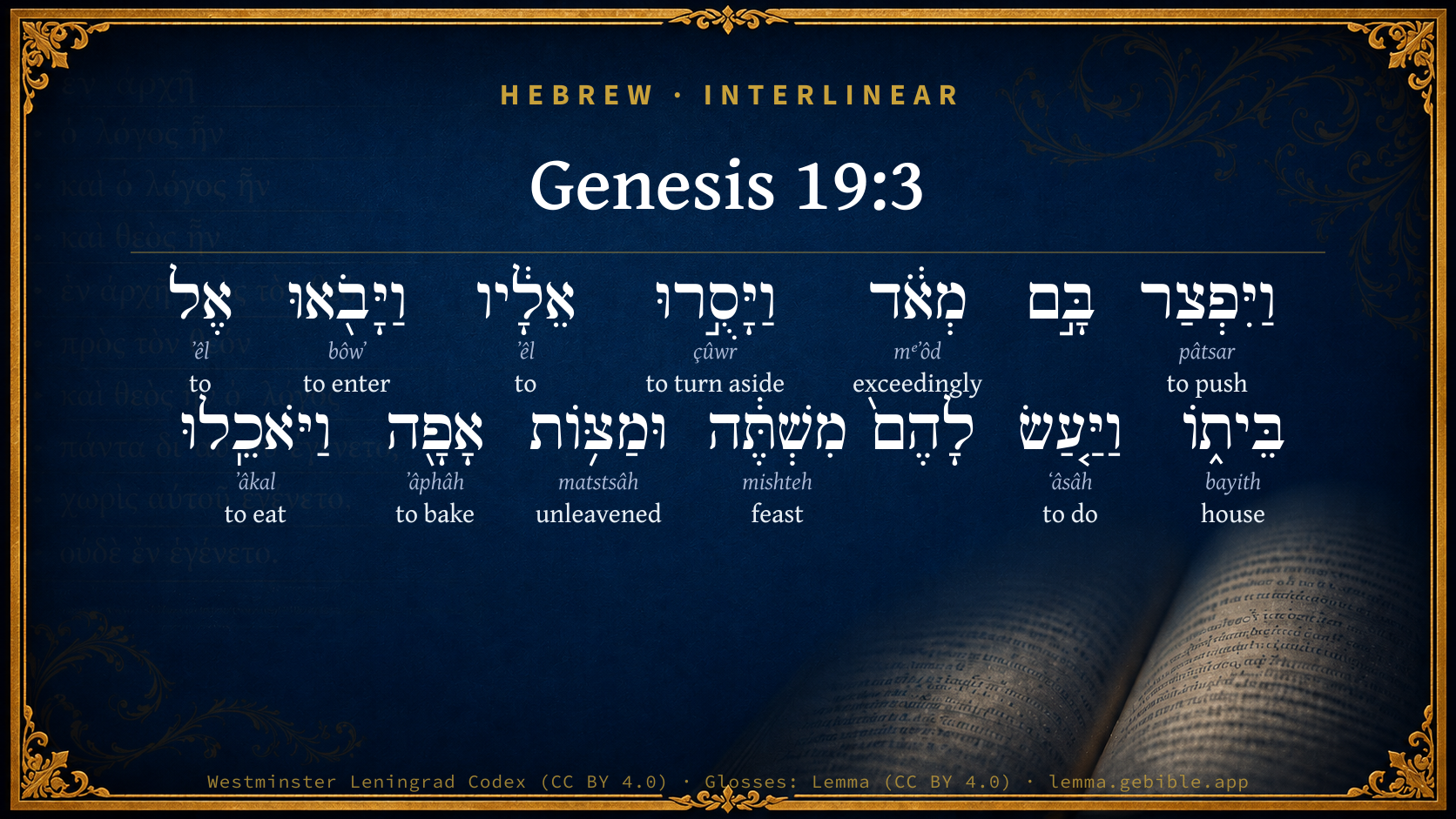
Hebrew (Westminster Leningrad Codex) Genesis 19:3 appears in the Hebrew Old Testament. The text above is from the Westminster Leningrad Codex. Each word links to its Strong’s number, a concise gloss, and parsing drawn from the Open Scriptures Hebrew Bible morphology. Click any word for its full Brown-Driver-Briggs (BDB) entry.
Download image
Cite this verse

Genesis 19:3 (World English Bible). Public Domain. Lemma interlinear Bible study tool, https://lemma.gebible.app/v/genesis/19/3.

Show BibTeX & RIS
BibTeX
RIS
English Translation
He urged them greatly, and they came in with him, and entered into his house. He made them a feast, and baked unleavened bread, and they ate.
World English Bible · Public Domain
Highlights
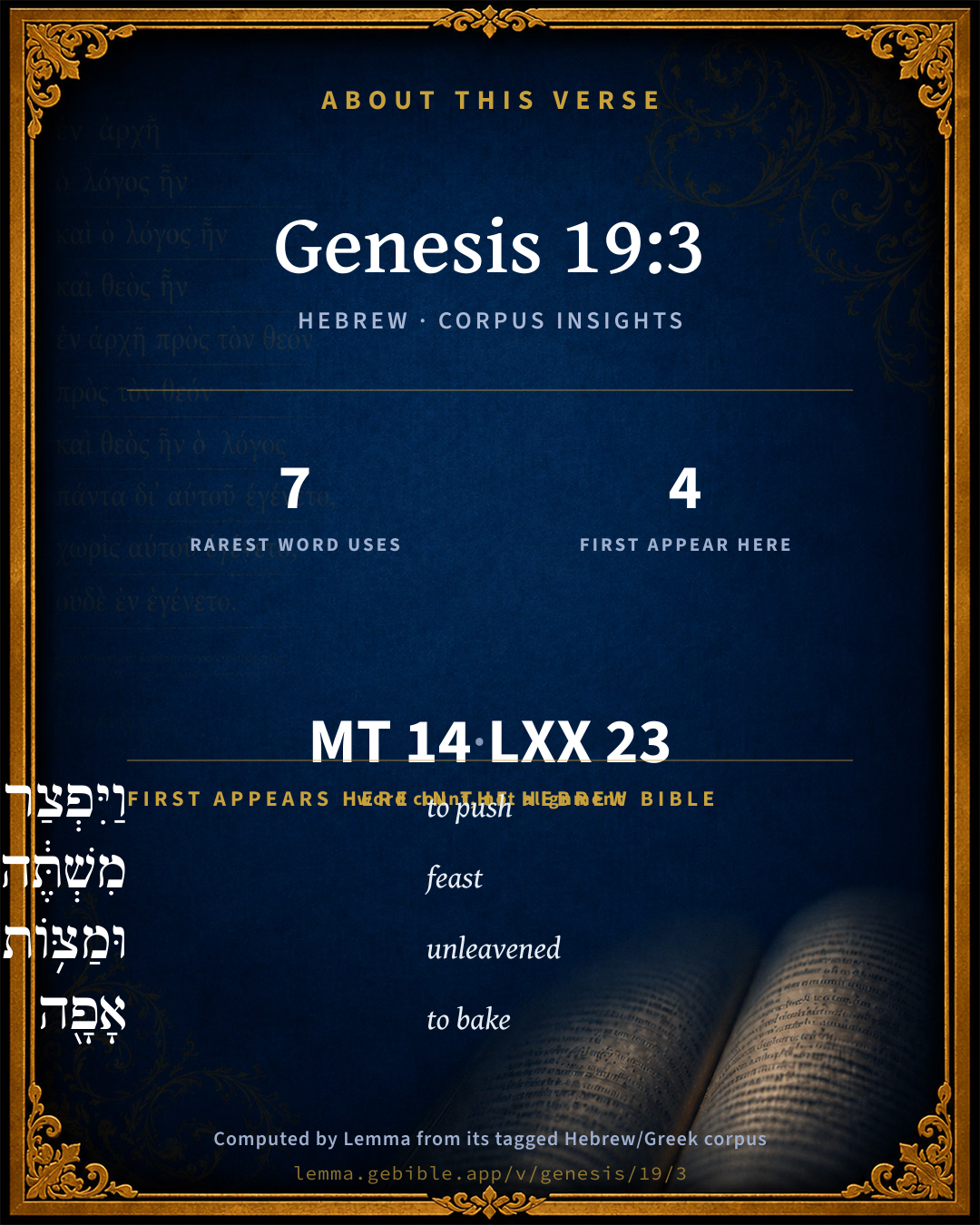
  • 4 first appearances in the Hebrew Bible
Full analysis ↓
Download a study sheet

One document with this verse’s original text, its word-by-word gloss line, the meaning frame, cross-references with their text, attributed commentary, and full source and license credits — printable, and it pastes into notes with its structure intact.

This verse Autodidact and up

Study sheet (.html) Plain text (.txt)

A passage Seminary Student

Up to 50 verses in one chapter. A passage sheet keeps up to 6 commentary sources and 12 cross-references per verse, in the order this page ranks them, and says so on the sheet whenever that leaves anything out. Ask for a single verse and you get the Autodidact verse sheet above.

Everything on this page stays free to read, with no account — the sheet is a download of what is already on screen, not access to it.

Want to remove ads? Support Godless Engineer
Compare translations 3

The same verse in 3 English versions, stacked beneath the original-language interlinear above. Click any original word for its lexicon entry.

Each is an independent rendering of the whole verse — the interlinear is not word-aligned to these translations.

Highlighted words mark where these versions differ — a whole-verse word diff, not a word-by-word alignment.

  • World English Bible Public Domain
    He urged them greatly, and they came in with him, and entered into his house. He made them a feast, and baked unleavened bread, and they ate.
  • King James Version Public Domain
    And he pressed upon them greatly; and they turned in unto him, and entered into his house; and he made them a feast, and did bake unleavened bread, and they did eat.
  • unfoldingWord Literal Text CC BY-SA 4.0
    But he urged them strongly, so that they turned aside with him and entered into his house. Then he prepared a feast for them, and he baked unleavened bread, and they ate.

unfoldingWord Literal Text — © unfoldingWord, licensed CC BY-SA 4.0. Word-aligned USFM3 via Door43 (git.door43.org/unfoldingWord/en_ult).

Versions to compare (up to 4)

3 of 4 selected

Show all 18 translations

Every available English version of this verse, each an independent rendering of the whole verse.

  • World English Bible Public Domain
    He urged them greatly, and they came in with him, and entered into his house. He made them a feast, and baked unleavened bread, and they ate.
  • Berean Standard Bible Public Domain
    But Lot insisted so strongly that they followed him into his house. He prepared a feast for them and baked unleavened bread, and they ate.
  • Majority Standard Bible Public Domain
    But Lot insisted so strongly that they followed him into his house. He prepared a feast for them and baked unleavened bread, and they ate.
  • King James Version Public Domain
    And he pressed upon them greatly; and they turned in unto him, and entered into his house; and he made them a feast, and did bake unleavened bread, and they did eat.
  • American Standard Version (1901) Public Domain
    And he urged them greatly; and they turned in unto him, and entered into his house; and he made them a feast, and did bake unleavened bread, and they did eat.
  • Revised Version (1885) Public Domain
    And he urged them greatly; and they turned in unto him, and entered into his house; and he made them a feast, and did bake unleavened bread, and they did eat.
  • Geneva Bible (1599) Public Domain
    Then he preassed vpon them earnestly, and they turned in to him, and came to his house, and he made them a feast, and did bake vnleauened bread, and they did eate.
  • Douay-Rheims (1899) Public Domain
    He pressed them very much to turn in unto him: and when they were come in to his house, he made them a feast, and baked unleavened bread and they ate:
  • Young's Literal Translation Public Domain
    And he presseth on them greatly, and they turn aside unto him, and come in unto his house; and he maketh for them a banquet, and hath baked unleavened things; and they do eat.
  • Literal Standard Version CC BY-SA 4.0
    And he presses on them greatly, and they turn aside to him, and come into his house; and he makes a banquet for them, and has baked unleavened things; and they eat.
  • Unlocked Literal Bible CC BY-SA 4.0
    But he urged them strongly, so they went with him, and entered into his house. He prepared a meal and baked unleavened bread, and they ate.
  • unfoldingWord Literal Text CC BY-SA 4.0
    But he urged them strongly, so that they turned aside with him and entered into his house. Then he prepared a feast for them, and he baked unleavened bread, and they ate.
  • Darby Bible Public Domain
    And he urged them greatly; and they turned in unto him, and entered into his house. And he made them a repast, and baked unleavened cakes; and they ate.
  • World Messianic Bible Public Domain
    He urged them greatly, and they came in with him, and entered into his house. He made them a feast, and baked unleavened bread, and they ate.
  • Webster's Bible Public Domain
    And he urged them greatly; and they turned in to him, and entered into his house; and he made them a feast, and baked unleavened bread, and they ate.
  • Free Bible Version CC BY-SA 4.0
    But Lot insisted, and they went with him to his house. He made them a meal and baked bread for them to eat.
  • Bible in Basic English Public Domain
    But he made his request more strongly, so they went with him into his house; and he got food ready for them, and made unleavened bread, of which they took.
  • JPS Tanakh (1917) Public Domain
    And he urged them greatly; and they turned in unto him, and entered into his house; and he made them a feast, and did bake unleavened bread, and they did eat.

Literal Standard Version (2020), Covenant Press — licensed CC BY-SA 4.0. Text via the HelloAO Bible API (eBible.org). Unlocked Literal Bible (unfoldingWord) — licensed CC BY-SA 4.0. Text via the HelloAO Bible API (eBible.org). unfoldingWord Literal Text — © unfoldingWord, licensed CC BY-SA 4.0. Word-aligned USFM3 via Door43 (git.door43.org/unfoldingWord/en_ult). Free Bible Version, Dr. Jonathan Gallagher — licensed CC BY-SA 4.0. Text via the HelloAO Bible API (eBible.org).

Word by word

More ways to search: Search by grammar → Find every occurrence → Compare this word →

Practice this passage: Drill this verse → Learn its vocabulary →

וַיִּפְצַר
pâtsar
H6484
“and · to push”
Conjunction + Verb, Qal, Sequential Imperfect, 3rd Person, Masculine, Singular
Part of Speech
Conjunction + Verb
Stem
Qal
Form
Sequential Imperfect
Person
3rd Person
Gender
Masculine
Number
Singular
Full BDB Definition

Origin: a primitive root

TWOT: 1801

to press, push - (Qal) to push, press - (Hiphil) be insolent, display pushing (arrogance, presumption)
  1. מְאֹ֔ד mᵉʼôd H3966 “exceedingly” Adverb
  2. וַיָּסֻ֣רוּ çûwr H5493 “and · to turn aside” Conjunction + Verb, Qal, Sequential Imperfect, 3rd Person, Masculine, Plural
  3. אֵלָ֔יו ʼêl H413 “to · him” Preposition + Suffix, Personal, 3rd Person, Masculine, Singular
  4. וַיָּבֹ֖אוּ bôwʼ H935 “and · to enter” Conjunction + Verb, Qal, Sequential Imperfect, 3rd Person, Masculine, Plural
  5. אֶל ʼêl H413 “to” Preposition
  6. בֵּית֑וֹ bayith H1004 “house · his” Noun, Common, Masculine, Singular, Construct + Suffix, Personal, 3rd Person, Masculine, Singular
  7. וַיַּ֤עַשׂ ʻâsâh H6213 “and · to do” Conjunction + Verb, Qal, Sequential Imperfect, 3rd Person, Masculine, Singular
  8. מִשְׁתֶּ֔ה mishteh H4960 “feast” Noun, Common, Masculine, Singular, Absolute
  9. וּמַצּ֥וֹת matstsâh H4682 “and · unleavened bread” Conjunction + Noun, Common, Feminine, Plural, Absolute
  10. אָפָ֖ה ʼâphâh H644 “to bake” Verb, Qal, Perfect, 3rd Person, Masculine, Singular
  11. וַיֹּאכֵֽלוּ ʼâkal H398 “and · to eat” Conjunction + Verb, Qal, Sequential Imperfect, 3rd Person, Masculine, Plural

About this verse

These counts appear in no published source. They are computed here, from the morphology-tagged text and Lemma’s own curated glosses. What Lemma adds →

14
words
11
distinct lemmas
Pentateuch
section

Notable vocabulary

The rarest word here is וַיִּפְצַר to push H6484 — appearing just 7 times in the whole Hebrew Bible.

First appearance in Scripture

These words make their first canonical appearance in the Hebrew Bible here:

  • וַיִּפְצַר to push H6484
  • מִשְׁתֶּ֔ה feast H4960
  • וּמַצּ֥וֹת unleavened H4682
  • אָפָ֖ה to bake H644

Shared distinctive vocabulary

וַיִּפְצַר to push H6484 occurs in 7 verses of the Hebrew Bible. Also found in:

Grammatical profile

  • 6 verbs
  • 3 nouns
  • 4 prepositions
  • 1 adverb

Verb forms

  • וַיִּפְצַר Qal · Sequential Imperfect
  • וַיָּסֻ֣רוּ Qal · Sequential Imperfect
  • וַיָּבֹ֖אוּ Qal · Sequential Imperfect
  • וַיַּ֤עַשׂ Qal · Sequential Imperfect
  • אָפָ֖ה Qal · Perfect
  • וַיֹּאכֵֽלוּ Qal · Sequential Imperfect

Repetition

A word recurs within this verse — often emphatic in Hebrew:

  • אֵלָ֔יו to H413 ×2

Hebrew & Septuagint length

In English translation the verse runs 27 words from the Hebrew and 33 from the Septuagint (LXX English) — closely comparable.

A rough comparison of the two English renderings, which tokenize alike — not a word-level alignment.

Word counts can differ between the Hebrew and the Greek without any difference in meaning — e.g. the Hebrew direct-object marker אֵת has no separate Greek word, and Greek often adds the article ὁ.

In the original languages it is 14 Hebrew tokens and 23 Greek tokens — but the two are counted differently (Hebrew bundles its prefixes and suffixes into one token; the Greek is in lemma form), so that isn’t a like-for-like length.

Cross-references

15

Topical passages linked to Genesis 19:3 in the Treasury of Scripture Knowledge — connected by theme and wording, ordered by reader-vote popularity; previews shown in the World English Bible.

  • Genesis 18:6–8 Abraham hurried into the tent to Sarah, and said, "Quickly make ready three measures of fine meal, knead it, and make cakes."
  • Judges 6:19 Gideon went in, and made ready a kid, and unleavened cakes of an ephah of meal: the flesh he put in a basket, and he put the broth in a pot, and brought it out to him under the oak, and presented it.
  • 1 Samuel 28:24 The woman had a fattened calf in the house; and she hurried, and killed it; and she took flour, and kneaded it, and did bake unleavened bread of it:
  • Exodus 12:39 They baked unleavened cakes of the dough which they brought forth out of Egypt; for it wasn't leavened, because they were thrust out of Egypt, and couldn't wait, neither had they prepared for themselves any food.
  • 1 Corinthians 5:8 Therefore let us keep the feast, not with old yeast, neither with the yeast of malice and wickedness, but with the unleavened bread of sincerity and truth.
  • Hebrews 13:2 Don't forget to show hospitality to strangers, for in doing so, some have entertained angels without knowing it.
  • Genesis 21:8 The child grew, and was weaned. Abraham made a great feast on the day that Isaac was weaned.
  • Exodus 12:15 Seven days shall you eat unleavened bread; even the first day you shall put away yeast out of your houses, for whoever eats leavened bread from the first day until the seventh day, that soul shall be cut off from Israel.
  • 2 Kings 4:8 It fell on a day, that Elisha passed to Shunem, where was a great woman; and she constrained him to eat bread. So it was, that as often as he passed by, he turned in there to eat bread.
  • Luke 5:29 Levi made a great feast for him in his house. There was a great crowd of tax collectors and others who were reclining with them.
  • Luke 11:8 I tell you, although he will not rise and give it to him because he is his friend, yet because of his persistence, he will get up and give him as many as he needs.
  • Luke 14:23 "The lord said to the servant, 'Go out into the highways and hedges, and compel them to come in, that my house may be filled.
  • Luke 24:28–29 They drew near to the village, where they were going, and he acted like he would go further.
  • John 12:2 So they made him a supper there. Martha served, but Lazarus was one of those who sat at the table with him.
  • 2 Corinthians 5:14 For the love of Christ constrains us; because we judge thus, that one died for all, therefore all died.

Cross-references courtesy of OpenBible.info (CC BY 4.0).

Hebrew and Greek witnesses Masoretic Hebrew ↔ Greek Septuagint

The same verse in the two great witnesses to the Old Testament, shown verse-for-verse.

These are two independent witnesses, not word-aligned to each other, and the Septuagint is shown in lemma (dictionary) form.

Hebrew Genesis 19:3 Masoretic · Westminster Leningrad Codex

וַיִּפְצַר בָּ֣ם מְאֹ֔ד וַיָּסֻ֣רוּ אֵלָ֔יו וַיָּבֹ֖אוּ אֶל בֵּית֑וֹ וַיַּ֤עַשׂ לָהֶם֙ מִשְׁתֶּ֔ה וּמַצּ֥וֹת אָפָ֖ה וַיֹּאכֵֽלוּ

He urged them greatly, and they came in with him, and entered into his house. He made them a feast, and baked unleavened bread, and they ate.

World English Bible · Public Domain

Greek LXX Genesis 19:3 Septuagint · lemma form

καί καταβιάζομαι αὐτός καί ἐκκλίνω πρός αὐτός καί εἰςἔρχομαι εἰς ὁ οἰκία αὐτός καί ποιέω αὐτός πότος καί ἄζυμος πέσσω αὐτός καί ἐσθίω

And he constrained them, and they turned aside to him, and they entered into his house, and he made a feast for them, and baked unleavened cakes for them, and they did eat.

LXX2012 (modern English Septuagint) · Public Domain

On this verse, The Pulpit Commentary discusses the Septuagint’s reading. Read the note in Commentary ↓

Hebrew: Westminster Leningrad Codex (CC BY 4.0). Greek: Septuagint (public domain); English from LXX2012 (modern English Septuagint) (Public Domain). How the Septuagint differs from the Hebrew →

Targum (Aramaic paraphrase)

2

The Targum is the ancient Jewish Aramaic paraphrase of the Hebrew Scriptures — an interpretive translation, not the Hebrew text itself. Onkelos (literal) and Pseudo-Jonathan (expansive) render the Torah, and Jonathan the Prophets. Coverage is partial: where no permissively-licensed English translation exists for a verse, only the Aramaic is shown. This is verse-level text, not a word-by-word alignment to the Hebrew.

  1. Targum Onkelos Torah (Genesis–Deuteronomy)
    וְאַתְקַף בְּהוֹן לַחֲדָא וְזָרוּ לְוָתֵהּ וְעַלּוּ לְבֵיתֵהּ וַעֲבַד לְהוֹן מִשְׁתְּיָא וּפַטִּיר אֲפָא לְהוֹן וְאֲכָלוּ

    (no public-domain English translation for this verse)

    Targum Onkelos — Aramaic: “Onkelos Genesis” (public domain); “Onkelos Exodus” (public domain); “Onkelos Leviticus” (public domain); “Onkelos Numbers” (public domain); “Onkelos Deuteronomy” (public domain). English: “Sefaria Community Translation” (CC0 1.0 (public-domain dedication)); “J.W. Etheridge. The Targums of Onkelos and Jonathan Ben Uzziel on the Pentateuch. London: Longmans, Green, 1862” (public domain). Text via Sefaria.

  2. Targum Pseudo-Jonathan Torah (Genesis–Deuteronomy)
    וּפַיֵיס בְּהוֹם לַחֲדָא וְזָרוּ לְוָותֵיהּ וְעָלוּ לְבֵיתֵיהּ וְעָבַד לְהוֹם מִשְׁתַּיָא וּפַטִירֵי אָפָא לְהוֹם וְדָמֵי לֵיהּ כְּאִילוּ אָכְלִין

    And he persuaded them earnestly, and they turned aside to be with him; and they entered his house, and he made a repast for them, and prepared unleavened cakes. And it seemed to him as if they did eat.

    Targum Pseudo-Jonathan — Aramaic: “Targum Jonathan on Genesis” (public domain); “Targum Jonathan on Exodus” (public domain); “Targum Jonathan on Leviticus” (public domain); “Targum Jonathan on Numbers” (public domain); “Targum Jonathan on Deuteronomy” (public domain). English: “The Targum of Jonathan ben Uzziel, trans. J. W. Etheridge, London, 1862” (public domain). Text via Sefaria.

Commentary

Notes on Genesis 19:3 from classic Christian and Jewish commentators (each source and its license shown beneath its notes). The classic Christian expositions comment on the surrounding passage and are grouped to its opening verse, so a note may address several verses; the Jewish commentaries on the Tanakh (Rashi and others) are per-verse, so they appear only where the commentator wrote on this verse.

Lemma curates 59 commentaries, every one of them public domain or Creative Commons licensed, each selected and text-cleaned for this edition rather than reprinted as found. About our sources →

Trapp's Complete Commentary

John Trapp

Gen 19:3 And he pressed upon them greatly; and they turned in unto him, and entered into his house; and he made them a feast, and did bake unleavened bread, and they did eat.

Ver. 3. And they did eat.] They made as if they did eat and drink, saith the Hierosolymi-Targum, but not well. {See Trapp on "Gen 18:8"}

John Trapp, A Commentary or Exposition upon All the Books of the Old and New Testament (1647–1656) — public domain. Text from a community e-Sword module.

Joseph Benson's Commentary

Gen 19:3. He pressed upon them greatly — Partly because he would by no means have them to expose themselves to the perils and insults which he was aware awaited their lodging in the street of Sodom, and partly because he was desirous of their converse.

Joseph Benson's Commentary on the Old and New Testaments (1811–1818) — public domain. Text from a community e-Sword module.

Geneva Bible (1599)

Geneva Bible translators

Not for that they had necessity, but because the time was not yet come that they would reveal themselves.

That is, he prayed them so instantly.

Geneva Bible (1599) marginal notes — public domain. Text via Bolls.life.

Jamieson, Fausset & Brown

Robert Jamieson, A. R. Fausset & David Brown

entered into his house--On removing to the plain, Lot intended at first to live in his tent apart from the people [Gen 13:12]. But he was gradually drawn in, dwelt in the city, and he and his family were connected with the citizens by marriage ties.

Jamieson, Fausset & Brown — Commentary Critical and Explanatory on the Whole Bible (1871) — public domain (CC PDM 1.0). Text via the HelloAO Bible API.

John Calvin's Commentaries

3. And he made them a feast. By these words, and others following, Moses shows that the angels were more sumptuously entertained than was customary: for Lot did not act thus, indiscriminately, with all. But, when he conceived, from the dignity of their mien and dress, that they were not common men, he baked cakes, and prepared a plentiful feast. Again, Moses says that the angels did eat: not that they had any need to do so; but because the time was not yet come, for the manifestation of their celestial nature.

John Calvin's Commentaries (1540-1563) — public domain. Text from the Calvin Translation Society English edition (1840s-50s) via the Christian Classics Ethereal Library (ccel.org). Calvin's coverage is partial (roughly two-thirds of the Bible); uncommented books and verses are honest gaps, never fabricated. The 19th-century editor's footnotes and remarks are omitted so the notes are faithfully Calvin's own voice.

Ellicott's Commentary for English Readers

(3) He pressed upon them greatly.—This he did as knowing the licentiousness of the people; but the angels do not readily accept his hospitality, as they had done that of Abraham, because his character had deteriorated.

Unleavened bread.—Heb., thin cakes, like those now eaten by the Jews at the Passover. They took little time in preparation, for which reason we find them also used by the witch of Endor (1Sa_28:24).

A Bible Commentary for English Readers, edited by Charles John Ellicott (1878–1897) — public domain. Text from a community e-Sword module.

The Cambridge Bible for Schools and Colleges

gen. ed. J. J. S. Perowne

3. he urged them greatly] The gentle compulsion of Oriental courtesy. To let a stranger sleep out at night would be contrary to all canons of civility, cf. Jdg_19:16-22.

a feast] Lit. “a drinking feast,” and thence “a banquet.” Perhaps we may assume that the Angels appeared as poor men needing food and shelter. The neglect of the poor and needy is part of the prophet’s reproach against Sodom in Eze_16:49.

unleavened bread] Cakes baked hastily without leaven or yeast; the “unleavened cakes” of Jdg_6:19.

The Cambridge Bible for Schools and Colleges (gen. ed. J. J. S. Perowne; Cambridge University Press, 1878–1918) — public domain. Text from a community e-Sword module.

John Gill's Exposition

And he pressed them greatly,.... He prayed, he entreated, he persuaded, he made use of a multitude of words, and of all the arguments he could think of, to prevail upon them; and might not only press them with words, but make use of gestures, as taking them by the hand, or by their clothes, and as it were forcing them into his house, whereby it plainly appeared he was cordial and hearty in his invitation:

and they turned in unto him, and entered into his house: went along with him to it, and instead of proceeding forward, or continuing where they were, or steering their course to a street in the city, they turned in to Lot's house:

and he made them a feast; a large, liberal, and generous entertainment, as Abraham did, consisting of a variety of eatables and drinkables; indeed it has its name only from drinking, wine being a principal part of a banquet:

and did bake unleavened bread; not because it was the time of the passover, as Jarchi suggests, for as yet that was not instituted; but for quicker dispatch, that his guests might have their supper the sooner, and get to bed the earlier, and rest themselves; bread without leaven in it being sooner baked than that which is made with it:

and they did eat; the Targums of Jonathan and Jerusalem are,"they seemed as if they ate.''See Gill on Gen 18:8;

John Gill's Exposition of the Whole Bible (1746–1763) — public domain (CC PDM 1.0). Text via the HelloAO Bible API.

Matthew Poole's English Annotations

He did bake unleavened bread, because that was sooner prepared, that so they might eat it, and after that go to bed in due time.

Matthew Poole's English Annotations on the Holy Bible (1683–1685) — public domain. Text from a community e-Sword/MySword module.

Whedon's Commentary on the Bible

Daniel D. Whedon

3. Made them a feast — משׁתה, a feast, is the name usually given to a great feast or banquet. Comp. Gen_21:8; Gen_26:30; Gen_40:20; 1Sa_25:36.

Unleavened bread — This is the first occurrence of the word מצות, found nearly always in the plural, and translated unleavened bread. It means sweetness, (Gesenius, Lex.,) and denotes bread not made sour by leaven — not allowed time to ferment.

Daniel D. Whedon (gen. ed.), Commentary on the Old and New Testaments (1874–1909) — public domain. Text from a community e-Sword module.

The Pulpit Commentary

And he pressed upon them greatly. Being himself sincerely desirous to extend to them hospitality, and knowing well the danger to which they would be exposed from the violence and licentiousness of the townsmen. And they turned in unto him, and entered into his house; and he made them a toast,mishteh, from shathah, to drink, is rightly rendered poton (LXX), a drink, or refreshing beverage (cf. Est_5:6 Est_7:7) and did bake unleavened broad literally, bread of sweetness, that is, bread not soured by leaven. The banquet was thus of the simplest kind, chiefly, it may be hoped, for the sake of dispatch. And they did eat.

The Pulpit Commentary (1880–1919), ed. H.D.M. Spence-Jones & Joseph S. Exell — public domain. Text from a community e-Sword module.

John Wesley's Explanatory Notes

And he pressed upon them greatly - Partly because he would by no means have them to expose themselves to the perils of lodging in the streets of Sodom, and partly because he was desirous of their converse.

John Wesley, Explanatory Notes Upon the Whole Bible (1754–1765) — public domain. Text via the GEBible commentary corpus.

Rashi

Rabbi Shlomo Yitzchaki (Rashi)

ויסרו אליו AND THEY TURNED ASIDE UNTO HIM — They took a circuitous route towards his house (Genesis Rabbah 50:4).

ומצות אפה AND HE BAKED UNLEAVENED BREAD —It was Passover (Genesis Rabbah 48:12).

Rashi on the Tanakh — English translations: “The Judaica Press complete Tanach with Rashi, translated by A. J. Rosenberg” (CC BY 4.0); “Pentateuch with Rashi's commentary by M. Rosenbaum and A.M. Silbermann, 1929-1934” (public domain); “The Metsudah Tanach series, Lakewood, N.J” (CC BY 4.0); and “The Book of Joshua, Metsudah Publications, 1997” (CC BY 4.0). Text via Sefaria.

Ramban (Nachmanides)

Rabbi Moshe ben Nachman (Ramban / Nachmanides)

AND HE URGED THEM GREATLY. His urging them was meritorious on the part of Lot, and he indeed had a sincere desire to welcome wayfarers. They, however, at first refused in order to increase his merit, and therefore they finally listened to him; but originally they did not want to come into his house as he was not a perfectly righteous man. But our Rabbis have said [in order to explain their original refusal]: “One may decline an offer from an inferior person, but not from a superior person.”, (above, 18:5), but with Lot, they at first declined. If so, their declining his offer at first was merely an act of ethical conduct.

Ramban (Nachmanides) on the Tanakh — English translation: “Commentary on the Torah by Ramban (Nachmanides). Translated and annotated by Charles B. Chavel. New York, Shilo Pub. House, 1971-1976” (CC BY 4.0). Text via Sefaria.

Sforno

Rabbi Ovadia Sforno

A feast. Literally, “a drinking feast.” Lot offered them wine because he was fond of it himself.

Sforno on the Tanakh — English translation: “Yalkut, Sifsei Chachomim Chumash, Metsudah Publications, 2009” (CC BY 4.0). Text via Sefaria.

Radak

Rabbi David Kimhi (Radak)

ויפצר בם מאד, he spoke to them intently on the subject, urging them to accept his invitation, until eventually, they did come to his house. Onkelos writes ותקיף בהם, that he actually took hold of these men until they concurred to spend the night with him.

ויעש להם משתה, seeing it was night he did not have time to slaughter an animal in their honour, but he prepared something at short notice, served them drinks, and unleavened bread which can be prepared at short notice. It is good manners to prepare something at short notice for guests who arrived unexpectedly. The guest arriving at such a time is usually tired and does not care to wait until an elaborate meal can be prepared in his honour. The story has been recorded for all times in order to teach us how to serve unexpected guests arriving at night.

ויאכלו. If the whole sequence is a vision which Lot did not actually experience, the meaning of the word ויאכלו must be understood literally; if the Torah describes actual events, the word means that Lot had the impression as if the angels ate and drank his food. The food and drink, which are composed of different components, simply dissolved into their basic ingredients so that they were not visible as such. [imagine water, i.e. H20, being dissolved into the gases oxygen and hydrogen, becoming invisible in the process. Ed.] This, of course, would occur miraculously.

Radak on the Tanakh — English translations: “Sefaria Community Translation” (CC0 1.0 (public-domain dedication)); “Eliyahu Munk, HaChut Hameshulash” (CC BY 4.0); “Rabbi Mike Feuer, Jerusalem Anthology” (CC BY 4.0); and “R. David Kimhi on the first book of Psalms, Translated by R.G. Finch, London, 1919” (public domain). Text via Sefaria.

Lesson kit

Teaching starters — assembled from the data on this page, not authored interpretation. Every prompt links to the verse data it draws on. Edit before teaching.

Genesis, in the Pentateuch, opens this verse with 14 words (11 distinct Hebrew lemmas). Its most distinctive word is pâtsar (“to push”). A historical commentator’s framing appears above. Read the whole chapter for the surrounding context.

Discussion questions

  1. The word pâtsar carries the sense “to push.” How does it shape the verse?
  2. 4 words make their first appearance in Scripture here. What does this debut establish?
  3. How does Genesis 19:9, which shares the word «to push», read alongside this verse?
  4. What does the repetition of “to” (2× in this one verse) do in this verse?
  5. The translations on this page render this verse differently — a whole-verse word diff, not a word-by-word alignment. What might account for the different wordings?
  6. «וַיִּפְצַר» is a Qal Sequential Imperfect verb. How does that grammatical form shape the action described?
  7. Compare how Trapp's Complete Commentary and Joseph Benson's Commentary read this verse. Where do they agree or differ?

Things to notice

Reading settings

Reading text

Shown beneath each verse's original-language words.

Old Testament
Old Testament edition

Read the OT as the Masoretic Hebrew (MT) or the Greek Septuagint (LXX).

English shown for the Greek Septuagint (in the Hebrew ↔ Greek comparison).

Comparing translations? Open the Compare panel on any verse page to stack up to four side by side.