
Genesis 43:2

Hebrew (Westminster Leningrad Codex) Genesis 43:2 appears in the Hebrew Old Testament. The text above is from the Westminster Leningrad Codex. Each word links to its Strong’s number, a concise gloss, and parsing drawn from the Open Scriptures Hebrew Bible morphology. Click any word for its full Brown-Driver-Briggs (BDB) entry.
Download image
Cite this verse

Genesis 43:2 (World English Bible). Public Domain. Lemma interlinear Bible study tool, https://lemma.gebible.app/v/genesis/43/2.

Show BibTeX & RIS
BibTeX
RIS
English Translation
It happened, when they had eaten up the grain which they had brought out of Egypt, their father said to them, "Go again, buy us a little more food."
World English Bible · Public Domain
Download a study sheet

One document with this verse’s original text, its word-by-word gloss line, the meaning frame, cross-references with their text, attributed commentary, and full source and license credits — printable, and it pastes into notes with its structure intact.

This verse Autodidact and up

Study sheet (.html) Plain text (.txt)

A passage Seminary Student

Up to 50 verses in one chapter. A passage sheet keeps up to 6 commentary sources and 12 cross-references per verse, in the order this page ranks them, and says so on the sheet whenever that leaves anything out. Ask for a single verse and you get the Autodidact verse sheet above.

Everything on this page stays free to read, with no account — the sheet is a download of what is already on screen, not access to it.

Want to remove ads? Support Godless Engineer
Compare translations 3

The same verse in 3 English versions, stacked beneath the original-language interlinear above. Click any original word for its lexicon entry.

Each is an independent rendering of the whole verse — the interlinear is not word-aligned to these translations.

Highlighted words mark where these versions differ — a whole-verse word diff, not a word-by-word alignment.

  • World English Bible Public Domain
    It happened, when they had eaten up the grain which they had brought out of Egypt, their father said to them, "Go again, buy us a little more food."
  • King James Version Public Domain
    And it came to pass, when they had eaten up the corn which they had brought out of Egypt, their father said unto them, Go again, buy us a little food.
  • unfoldingWord Literal Text CC BY-SA 4.0
    So it happened when they finished eating the grain that they had brought from Egypt, then their father said to them, “Return, buy a little food for us.”

unfoldingWord Literal Text — © unfoldingWord, licensed CC BY-SA 4.0. Word-aligned USFM3 via Door43 (git.door43.org/unfoldingWord/en_ult).

Versions to compare (up to 4)

3 of 4 selected

Show all 18 translations

Every available English version of this verse, each an independent rendering of the whole verse.

  • World English Bible Public Domain
    It happened, when they had eaten up the grain which they had brought out of Egypt, their father said to them, "Go again, buy us a little more food."
  • Berean Standard Bible Public Domain
    So when Jacob’s sons had eaten all the grain they had brought from Egypt, their father said to them, “Go back and buy us a little more food.”
  • Majority Standard Bible Public Domain
    So when Jacob’s sons had eaten all the grain they had brought from Egypt, their father said to them, “Go back and buy us a little more food.”
  • King James Version Public Domain
    And it came to pass, when they had eaten up the corn which they had brought out of Egypt, their father said unto them, Go again, buy us a little food.
  • American Standard Version (1901) Public Domain
    And it came to pass, when they had eaten up the grain which they had brought out of Egypt, their father said unto them, Go again, buy us a little food.
  • Revised Version (1885) Public Domain
    And it came to pass, when they had eaten up the corn which they had brought out of Egypt, their father said unto them, Go again, buy us a little food.
  • Geneva Bible (1599) Public Domain
    And when they had eaten vp the vitaile, which they had brought from Egypt, their father sayd vnto them, Turne againe, and bye vs a little foode.
  • Douay-Rheims (1899) Public Domain
    And when they had eaten up all the corn, which they had brought out of Egypt, Jacob said to his sons: Go again and buy us a little food.
  • Young's Literal Translation Public Domain
    and it cometh to pass, when they have finished eating the corn which they brought from Egypt, that their father saith unto them, `Turn back, buy for us a little food.'
  • Literal Standard Version CC BY-SA 4.0
    and it comes to pass, when they have finished eating the grain which they brought from Egypt, that their father says to them, “Return, buy for us a little food.”
  • Unlocked Literal Bible CC BY-SA 4.0
    It came about when they had eaten the grain that they had brought out of Egypt, their father said to them, “Go again; buy us some food.”
  • unfoldingWord Literal Text CC BY-SA 4.0
    So it happened when they finished eating the grain that they had brought from Egypt, then their father said to them, “Return, buy a little food for us.”
  • Darby Bible Public Domain
    And it came to pass, when they had finished eating the grain which they had brought from Egypt, that their father said to them, Go again, buy us a little food.
  • World Messianic Bible Public Domain
    When they had eaten up the grain which they had brought out of Egypt, their father said to them, “Go again, buy us a little more food.”
  • Webster's Bible Public Domain
    \\43:3\\And Judah spoke to him, saying, The man did solemnly protest to us, saying, Ye shall not see my face, except your brother be with you.
  • Free Bible Version CC BY-SA 4.0
    so once they had finished the grain they'd brought from Egypt, their father told them, “You have to go back and buy some more grain for us.”
  • Bible in Basic English Public Domain
    And Judah said to him, The man said to us with an oath, You are not to come before me again without your brother.
  • JPS Tanakh (1917) Public Domain
    And it came to pass, when they had eaten up the corn which they had brought out of Egypt, that their father said unto them: 'Go again, buy us a little food.'

Literal Standard Version (2020), Covenant Press — licensed CC BY-SA 4.0. Text via the HelloAO Bible API (eBible.org). Unlocked Literal Bible (unfoldingWord) — licensed CC BY-SA 4.0. Text via the HelloAO Bible API (eBible.org). unfoldingWord Literal Text — © unfoldingWord, licensed CC BY-SA 4.0. Word-aligned USFM3 via Door43 (git.door43.org/unfoldingWord/en_ult). Free Bible Version, Dr. Jonathan Gallagher — licensed CC BY-SA 4.0. Text via the HelloAO Bible API (eBible.org).

Word by word

More ways to search: Search by grammar → Find every occurrence → Compare this word →

Practice this passage: Drill this verse → Learn its vocabulary →

הַשֶּׁ֔בֶר
sheber
H7668
“the · grain”
Particle, Definite Article + Noun, Common, Masculine, Singular, Absolute
Part of Speech
Particle + Noun
Type
Common
Gender
Masculine
Number
Singular
State
Absolute
Full BDB Definition

Origin: the same as H7667

TWOT: 2322a

grain, corn (as foodstuff)
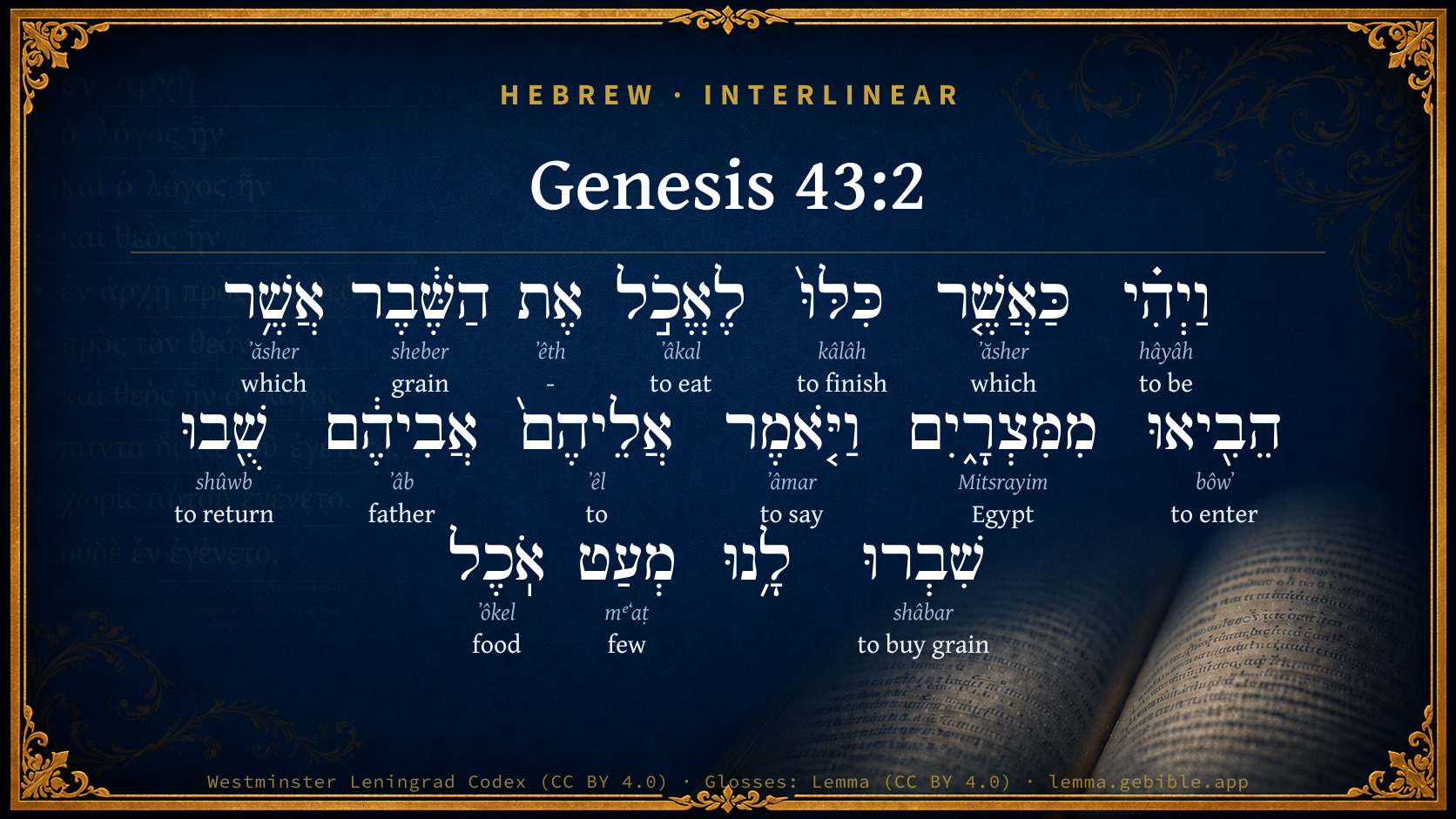
  1. וַיְהִ֗י hâyâh H1961 “and · to be” Conjunction + Verb, Qal, Sequential Imperfect, 3rd Person, Masculine, Singular
  2. כַּאֲשֶׁ֤ר ʼăsher H834 “like/as · which” Preposition + Particle, Relative
  3. כִּלּוּ֙ kâlâh H3615 “to finish” Verb, Piel, Perfect, 3rd Person, Common, Plural
  4. לֶאֱכֹ֣ל ʼâkal H398 “to eat” Preposition + Verb, Qal, Infinitive Construct
  5. אֶת ʼêth H853 “-” Particle, Direct Object
  6. אֲשֶׁ֥ר ʼăsher H834 “which” Particle, Relative
  7. הֵבִ֖יאוּ bôwʼ H935 “to enter” Verb, Hiphil, Perfect, 3rd Person, Common, Plural
  8. מִמִּצְרָ֑יִם Mitsrayim H4714 “from · Egypt” Preposition + Noun, Proper
  9. וַיֹּ֤אמֶר ʼâmar H559 “and · to say” Conjunction + Verb, Qal, Sequential Imperfect, 3rd Person, Masculine, Singular
  10. אֲלֵיהֶם֙ ʼêl H413 “to · them” Preposition + Suffix, Personal, 3rd Person, Masculine, Plural
  11. אֲבִיהֶ֔ם ʼâb H1 “father · their” Noun, Common, Masculine, Singular, Construct + Suffix, Personal, 3rd Person, Masculine, Plural
  12. שֻׁ֖בוּ shûwb H7725 “return” Verb, Qal, Imperative, 2nd Person, Masculine, Plural
  13. שִׁבְרוּ shâbar H7666 “buy grain” Verb, Qal, Imperative, 2nd Person, Masculine, Plural
  14. מְעַט mᵉʻaṭ H4592 “few of” Noun, Common, Masculine, Singular, Construct
  15. אֹֽכֶל ʼôkel H400 “food” Noun, Common, Masculine, Singular, Absolute

About this verse

These counts appear in no published source. They are computed here, from the morphology-tagged text and Lemma’s own curated glosses. What Lemma adds →

17
words
15
distinct lemmas
Pentateuch
section

Notable vocabulary

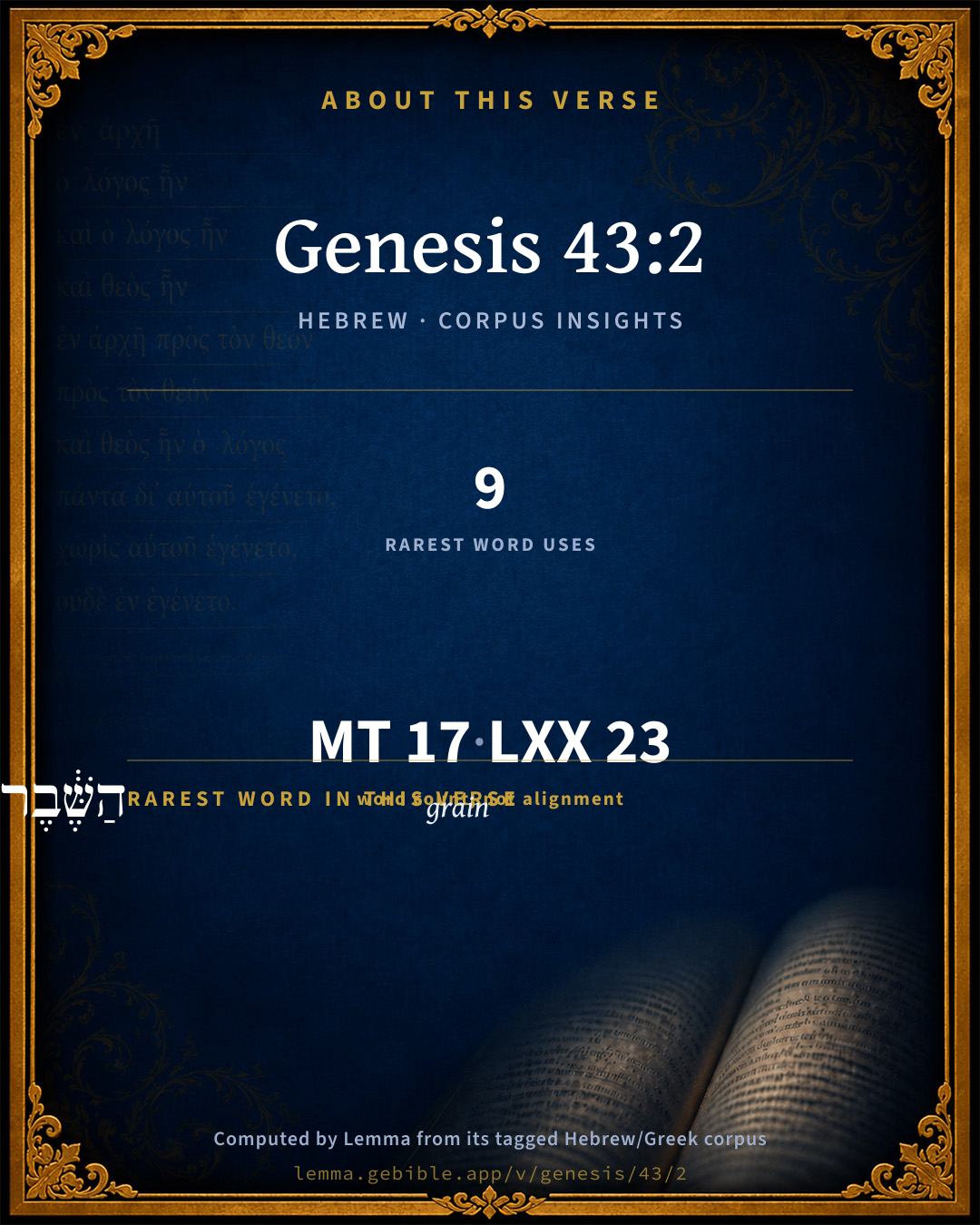
The rarest word here is הַשֶּׁ֔בֶר grain H7668 — appearing just 9 times in the whole Hebrew Bible.

Shared distinctive vocabulary

הַשֶּׁ֔בֶר grain H7668 occurs in 9 verses of the Hebrew Bible. Also found in:

Grammatical profile

  • 7 verbs
  • 5 nouns
  • 2 prepositions
  • 3 particles

Verb forms

  • וַיְהִ֗י Qal · Sequential Imperfect
  • כִּלּוּ֙ Piel · Perfect
  • לֶאֱכֹ֣ל Qal · Infinitive Construct
  • הֵבִ֖יאוּ Hiphil · Perfect
  • וַיֹּ֤אמֶר Qal · Sequential Imperfect
  • שֻׁ֖בוּ Qal · Imperative
  • שִׁבְרוּ Qal · Imperative

Repetition

A word recurs within this verse — often emphatic in Hebrew:

  • כַּאֲשֶׁ֤ר which H834 ×2

Hebrew & Septuagint length

In English translation the verse runs 29 words from the Hebrew and 32 from the Septuagint (LXX English) — closely comparable.

A rough comparison of the two English renderings, which tokenize alike — not a word-level alignment.

Word counts can differ between the Hebrew and the Greek without any difference in meaning — e.g. the Hebrew direct-object marker אֵת has no separate Greek word, and Greek often adds the article ὁ.

In the original languages it is 17 Hebrew tokens and 23 Greek tokens — but the two are counted differently (Hebrew bundles its prefixes and suffixes into one token; the Greek is in lemma form), so that isn’t a like-for-like length.

Cross-references

8

Topical passages linked to Genesis 43:2 in the Treasury of Scripture Knowledge — connected by theme and wording, ordered by reader-vote popularity; previews shown in the World English Bible.

  • Genesis 42:1–2 Now Jacob saw that there was grain in Egypt, and Jacob said to his sons, "Why do you look at one another?"
  • Genesis 43:4 If you will send our brother with us, we will go down and buy you food,
  • Genesis 43:20 and said, "Oh, my lord, we came indeed down at the first time to buy food:
  • Proverbs 15:16 Better is little, with the fear of Yahweh, Than great treasure with trouble.
  • Proverbs 16:18 Pride goes before destruction, And a haughty spirit before a fall.
  • Proverbs 31:16 She considers a field, and buys it. With the fruit of her hands, she plants a vineyard.
  • 1 Timothy 5:8 But if anyone doesn't provide for his own, and especially his own household, he has denied the faith, and is worse than an unbeliever.
  • 1 Timothy 6:6–8 But godliness with contentment is great gain.

Cross-references courtesy of OpenBible.info (CC BY 4.0).

Hebrew and Greek witnesses Masoretic Hebrew ↔ Greek Septuagint

The same verse in the two great witnesses to the Old Testament, shown verse-for-verse.

These are two independent witnesses, not word-aligned to each other, and the Septuagint is shown in lemma (dictionary) form.

Hebrew Genesis 43:2 Masoretic · Westminster Leningrad Codex

וַיְהִ֗י כַּאֲשֶׁ֤ר כִּלּוּ֙ לֶאֱכֹ֣ל אֶת הַשֶּׁ֔בֶר אֲשֶׁ֥ר הֵבִ֖יאוּ מִמִּצְרָ֑יִם וַיֹּ֤אמֶר אֲלֵיהֶם֙ אֲבִיהֶ֔ם שֻׁ֖בוּ שִׁבְרוּ לָ֥נוּ מְעַט אֹֽכֶל

It happened, when they had eaten up the grain which they had brought out of Egypt, their father said to them, "Go again, buy us a little more food."

World English Bible · Public Domain

Greek LXX Genesis 43:2 Septuagint · lemma form

γίγνομαι δέ ἡνίκα συντελέω καταἐσθίω ὁ σῖτος ὅς φέρω ἐκ αἴγυπτος καί εἶπον αὐτός ὁ πατήρ αὐτός πάλιν πορεύομαι πρίαμαι ἐγώ μικρός βρῶμα

And it came to pass, when they had finished eating the corn which they had brought out of Egypt, that their father said to them, Go again; buy us a little food.

LXX2012 (modern English Septuagint) · Public Domain

On this verse, John Gill's Exposition discusses the Septuagint’s reading. Read the note in Commentary ↓

Hebrew: Westminster Leningrad Codex (CC BY 4.0). Greek: Septuagint (public domain); English from LXX2012 (modern English Septuagint) (Public Domain). How the Septuagint differs from the Hebrew →

Targum (Aramaic paraphrase)

2

The Targum is the ancient Jewish Aramaic paraphrase of the Hebrew Scriptures — an interpretive translation, not the Hebrew text itself. Onkelos (literal) and Pseudo-Jonathan (expansive) render the Torah, and Jonathan the Prophets. Coverage is partial: where no permissively-licensed English translation exists for a verse, only the Aramaic is shown. This is verse-level text, not a word-by-word alignment to the Hebrew.

  1. Targum Onkelos Torah (Genesis–Deuteronomy)
    וַהֲוָה כַּד שֵׁיצִיאוּ לְמֵיכַל יָת עִיבוּרָא דְּאַיְתִיאוּ מִמִּצְרָיִם וַאֲמַר לְהוֹן אֲבוּהוֹן תּוּבוּ זְבוּנוּ לָנָא זְעֵיר עִיבוּרָא

    (no public-domain English translation for this verse)

    Targum Onkelos — Aramaic: “Onkelos Genesis” (public domain); “Onkelos Exodus” (public domain); “Onkelos Leviticus” (public domain); “Onkelos Numbers” (public domain); “Onkelos Deuteronomy” (public domain). English: “Sefaria Community Translation” (CC0 1.0 (public-domain dedication)); “J.W. Etheridge. The Targums of Onkelos and Jonathan Ben Uzziel on the Pentateuch. London: Longmans, Green, 1862” (public domain). Text via Sefaria.

  2. Targum Pseudo-Jonathan Torah (Genesis–Deuteronomy)
    וַהֲוָה כַּד פָּסְקוּ לְמֵיכוּל יַת עִיבּוּרָא דְאַיְיתוּ מִמִצְרַיִם וַאֲמַר לְהוֹן אֲבוּהוֹן תּוּבוּ זַבִּינוּ לָנָא קַלִילוּ עִיבּוּרָא

    And it was when they had finished eating the corn they had brought from Mizraim, their father said to them, Return and buy us a little corn.

    Targum Pseudo-Jonathan — Aramaic: “Targum Jonathan on Genesis” (public domain); “Targum Jonathan on Exodus” (public domain); “Targum Jonathan on Leviticus” (public domain); “Targum Jonathan on Numbers” (public domain); “Targum Jonathan on Deuteronomy” (public domain). English: “The Targum of Jonathan ben Uzziel, trans. J. W. Etheridge, London, 1862” (public domain). Text via Sefaria.

Commentary

Notes on Genesis 43:2 from classic Christian and Jewish commentators (each source and its license shown beneath its notes). The classic Christian expositions comment on the surrounding passage and are grouped to its opening verse, so a note may address several verses; the Jewish commentaries on the Tanakh (Rashi and others) are per-verse, so they appear only where the commentator wrote on this verse.

Lemma curates 59 commentaries, every one of them public domain or Creative Commons licensed, each selected and text-cleaned for this edition rather than reprinted as found. About our sources →

Trapp's Complete Commentary

John Trapp

Gen 43:2 And it came to pass, when they had eaten up the corn which they had brought out of Egypt, their father said unto them, Go again, buy us a little food.

Ver. 2. Buy us a little food.] They had learned to live with a little, which is a great skill; nature is content with a little, grace with less. Epicurus himself was wont to say, if he might have but aquam et offam, a draught of water, and a morsel of meat, he could live happily. {a}

{a} Paratum se esse cum Iove de faelicitate contendere, si aquam haberet et offam. - Aelian.

John Trapp, A Commentary or Exposition upon All the Books of the Old and New Testament (1647–1656) — public domain. Text from a community e-Sword module.

John Gill's Exposition

And Judah spake unto him,.... Reuben the eldest son had met with a repulse already, Gen 42:36; Simeon the next was now in Egypt, Gen 42:24, and Levi, perhaps on account of the affair of Shechem, Gen 34:25, did not yet stand well in his father's favour and affection; wherefore Judah being next, with the consent of his brethren, undertakes to manage the affair with him, who had doubtless an interest in him, as well as authority among his brethren, and was a prudent man, and could speak well:

saying, the man did solemnly protest unto us; meaning Joseph, though he then knew not that it was he; whom he calls "the man", not by way of contempt, or as thinking and speaking meanly of him, but the reverse, the great man, the honourable man, the governor of Egypt; and so the Septuagint version adds, "the man, the lord of the land"; he in the strongest terms, and in the most solemn manner, protested by the life of Pharaoh:

saying, ye shall not see my face; with acceptance, should not be admitted to come near him, or treat with him, and purchase any corn of him:

except your brother be with you; their youngest brother Benjamin.

John Gill's Exposition of the Whole Bible (1746–1763) — public domain (CC PDM 1.0). Text via the HelloAO Bible API.

Matthew Poole's English Annotations

He saith a

little, either to show that he took no thought to satisfy his or their curiosity or luxury, but only their necessity, for which a little would suffice, and that they must all moderate their appetites, especially in a time of such scarcity; or to encourage them to the journey, by suggesting to them that they needed not bring great stores, but only what was sufficient for that year, and that God would provide better for them hereafter, so as they should not need to go so far for corn any more.

Matthew Poole's English Annotations on the Holy Bible (1683–1685) — public domain. Text from a community e-Sword/MySword module.

Rashi

Rabbi Shlomo Yitzchaki (Rashi)

כאשר כלו לאכל WHEN THEY HAD EATEN UP — Judah said to them: Leave the old man alone until the house will run short of bread (Midrash Tanchuma, Miketz 8).

כאשר כלו WHEN THEY HAD FINISHED [EATING THE GRAIN] — The Targum renders it by כד שציאו which means “when they finished” in the sense of making an end of doing an action. He who has the reading in the Targum כד ספיקו “when they had enough” is in error. The words (24:22) כאשר כלו הגמלים לשתות “when the camels had finished drinking” are rightly rendered in the Targum כד ספיקו which means “when they had drunk sufficient for their needs”, for that was the end of their drinking. Here, however, this phrase “when they had finished eating” refers to the time when the food came to an end, and we should render it in the Targum by כד שציאו when they had finished (which means finishing in the sense of nothing being left over).

Rashi on the Tanakh — English translations: “The Judaica Press complete Tanach with Rashi, translated by A. J. Rosenberg” (CC BY 4.0); “Pentateuch with Rashi's commentary by M. Rosenbaum and A.M. Silbermann, 1929-1934” (public domain); “The Metsudah Tanach series, Lakewood, N.J” (CC BY 4.0); and “The Book of Joshua, Metsudah Publications, 1997” (CC BY 4.0). Text via Sefaria.

Lesson kit

Teaching starters — assembled from the data on this page, not authored interpretation. Every prompt links to the verse data it draws on. Edit before teaching.

Genesis, in the Pentateuch, opens this verse with 17 words (15 distinct Hebrew lemmas). Its most distinctive word is sheber (“grain”). A historical commentator’s framing appears above. Read the whole chapter for the surrounding context.

Discussion questions

  1. The word sheber carries the sense “grain.” How does it shape the verse?
  2. How does Genesis 42:1, which shares the word «grain», read alongside this verse?
  3. What does the repetition of “which” (2× in this one verse) do in this verse?
  4. These translations render this verse differently; the difference is in the English rendering, not the original. What questions does that raise?
  5. «וַיְהִ֗י» is a Qal Sequential Imperfect verb. How does that grammatical form shape the action described?
  6. Compare how Trapp's Complete Commentary and John Gill's Exposition read this verse. Where do they agree or differ?

Things to notice

Reading settings

Reading text

Shown beneath each verse's original-language words.

Old Testament
Old Testament edition

Read the OT as the Masoretic Hebrew (MT) or the Greek Septuagint (LXX).

English shown for the Greek Septuagint (in the Hebrew ↔ Greek comparison).

Comparing translations? Open the Compare panel on any verse page to stack up to four side by side.