
Daniel 9:13

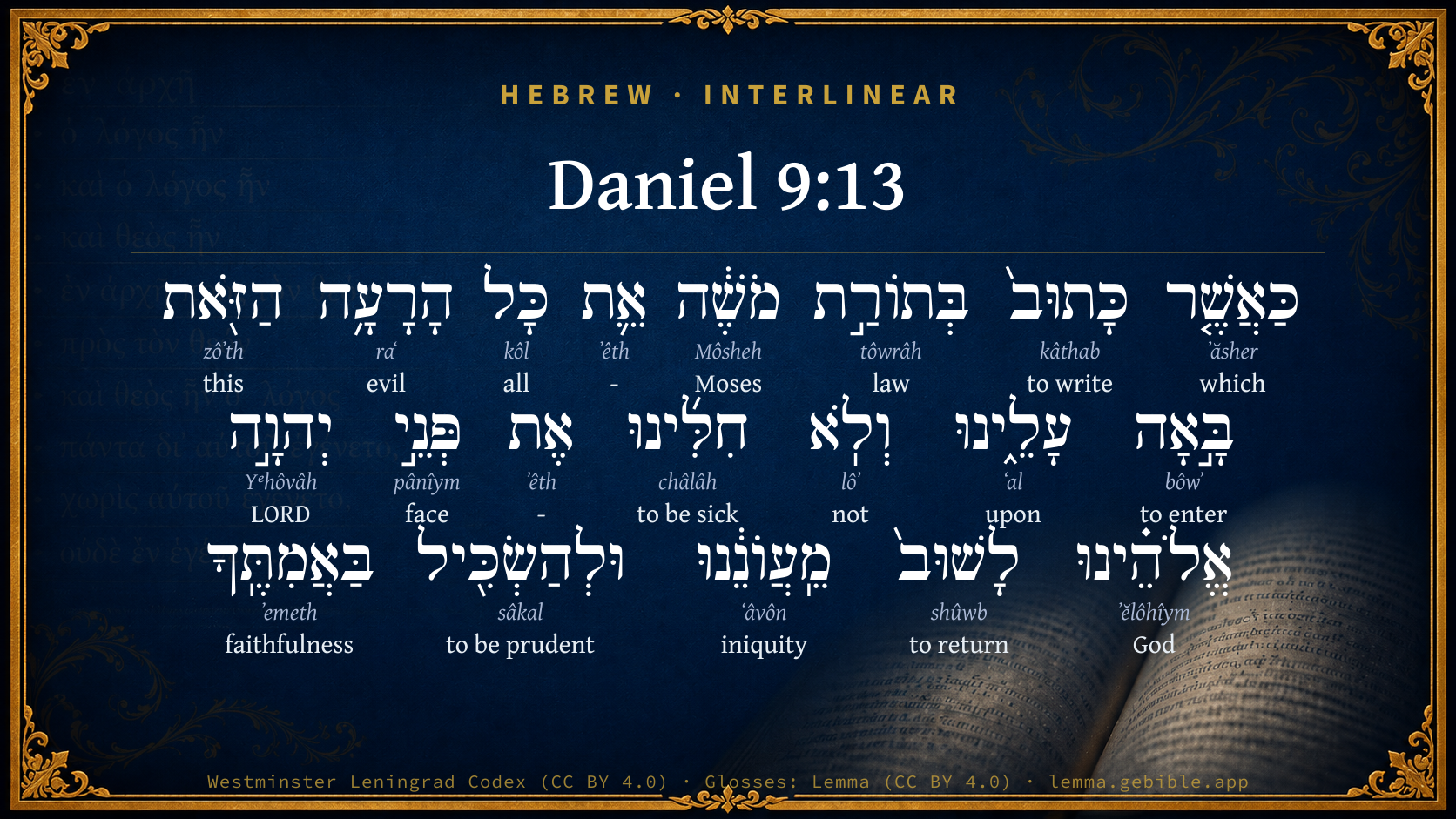
Hebrew (Westminster Leningrad Codex) Daniel 9:13 appears in the Hebrew Old Testament. The text above is from the Westminster Leningrad Codex. Each word links to its Strong’s number, a concise gloss, and parsing drawn from the Open Scriptures Hebrew Bible morphology. Click any word for its full Brown-Driver-Briggs (BDB) entry.
Download image
Cite this verse

Daniel 9:13 (World English Bible). Public Domain. Lemma interlinear Bible study tool, https://lemma.gebible.app/v/daniel/9/13.

Show BibTeX & RIS
BibTeX
RIS
English Translation
As it is written in the law of Moses, all this evil is come on us: yet have we not entreated the favor of Yahweh our God, that we should turn from our iniquities, and have discernment in your truth.
World English Bible · Public Domain
Download a study sheet

One document with this verse’s original text, its word-by-word gloss line, the meaning frame, cross-references with their text, attributed commentary, and full source and license credits — printable, and it pastes into notes with its structure intact.

This verse Autodidact and up

Study sheet (.html) Plain text (.txt)

A passage Seminary Student

Up to 50 verses in one chapter. A passage sheet keeps up to 6 commentary sources and 12 cross-references per verse, in the order this page ranks them, and says so on the sheet whenever that leaves anything out. Ask for a single verse and you get the Autodidact verse sheet above.

Everything on this page stays free to read, with no account — the sheet is a download of what is already on screen, not access to it.

Want to remove ads? Support Godless Engineer
Compare translations 3

The same verse in 3 English versions, stacked beneath the original-language interlinear above. Click any original word for its lexicon entry.

Each is an independent rendering of the whole verse — the interlinear is not word-aligned to these translations.

Highlighted words mark where these versions differ — a whole-verse word diff, not a word-by-word alignment.

  • World English Bible Public Domain
    As it is written in the law of Moses, all this evil is come on us: yet have we not entreated the favor of Yahweh our God, that we should turn from our iniquities, and have discernment in your truth.
  • King James Version Public Domain
    As it is written in the law of Moses, all this evil is come upon us: yet made we not our prayer before the LORD our God, that we might turn from our iniquities, and understand thy truth.
  • unfoldingWord Literal Text CC BY-SA 4.0
    As it is written in the law of Moses, all this calamity has come on us, yet we have not entreated the favor of Yahweh our God, turning away from our iniquities and giving attention to your truth.

unfoldingWord Literal Text — © unfoldingWord, licensed CC BY-SA 4.0. Word-aligned USFM3 via Door43 (git.door43.org/unfoldingWord/en_ult).

Versions to compare (up to 4)

3 of 4 selected

Show all 18 translations

Every available English version of this verse, each an independent rendering of the whole verse.

  • World English Bible Public Domain
    As it is written in the law of Moses, all this evil is come on us: yet have we not entreated the favor of Yahweh our God, that we should turn from our iniquities, and have discernment in your truth.
  • Berean Standard Bible Public Domain
    Just as it is written in the Law of Moses, all this disaster has come upon us, yet we have not sought the favor of the LORD our God by turning from our iniquities and giving attention to Your truth.
  • Majority Standard Bible Public Domain
    Just as it is written in the Law of Moses, all this disaster has come upon us, yet we have not sought the favor of the LORD our God by turning from our iniquities and giving attention to Your truth.
  • King James Version Public Domain
    As it is written in the law of Moses, all this evil is come upon us: yet made we not our prayer before the LORD our God, that we might turn from our iniquities, and understand thy truth.
  • American Standard Version (1901) Public Domain
    As it is written in the law of Moses, all this evil is come upon us: yet have we not entreated the favor of Jehovah our God, that we should turn from our iniquities, and have discernment in thy truth.
  • Revised Version (1885) Public Domain
    As it is written in the law of Moses, all this evil is come upon us: yet have we not entreated the favour of the LORD our God, that we should turn from our iniquities, and have discernment in thy truth.
  • Geneva Bible (1599) Public Domain
    All this plague is come vpon vs, as it is written in the Lawe of Moses: yet made we not our prayer before the Lord our God, that we might turne from our iniquities and vnderstand thy trueth.
  • Douay-Rheims (1899) Public Domain
    As it is written in the law of Moses, all this evil is come upon us: and we entreated not thy face, O Lord our God, that we might turn from our iniquities, and think on thy truth.
  • Young's Literal Translation Public Domain
    as it is written in the law of Moses, all this evil hath come upon us, and we have not appeased the face of Jehovah our God to turn back from our iniquities, and to act wisely in Thy truth.
  • Literal Standard Version CC BY-SA 4.0
    as it is written in the Law of Moses, all this evil has come on us, and we have not appeased the face of our God YHWH to turn back from our iniquities, and to act wisely in Your truth.
  • Unlocked Literal Bible CC BY-SA 4.0
    As it is written in the law of Moses, all this disaster has come on us, yet we have not begged for mercy from Yahweh our God by turning away from our iniquities and paying attention to your truth.
  • unfoldingWord Literal Text CC BY-SA 4.0
    As it is written in the law of Moses, all this calamity has come on us, yet we have not entreated the favor of Yahweh our God, turning away from our iniquities and giving attention to your truth.
  • Darby Bible Public Domain
    As it is written in the law of Moses, all this evil is come upon us; yet we besought not Jehovah our God, that we might turn from our iniquities, and understand thy truth.
  • World Messianic Bible Public Domain
    As it is written in the Torah of Moses, all this evil has come on us. Yet we have not entreated the favor of the LORD our God, that we should turn from our iniquities and have discernment in your truth.
  • Webster's Bible Public Domain
    As it is written in the law of Moses, all this evil is come upon us: yet we have not made our prayer before the LORD our God, that we might turn from our iniquities, and understand thy truth.
  • Free Bible Version CC BY-SA 4.0
    Just as the Law of Moses said, all this punishment has fallen on us, but we still have not asked you, the Lord our God, to be favorable to us, turning away from our sins and paying attention to your truth.
  • Bible in Basic English Public Domain
    As it was recorded in the law of Moses, all this evil has come on us: but we have made no prayer for grace from the Lord our God that we might be turned from our evil doings and come to true wisdom.
  • JPS Tanakh (1917) Public Domain
    As it is written in the Law of Moses, all this evil is come upon us; yet have we not entreated the favour of the LORD our God, that we might turn from our iniquities, and have discernment in Thy truth.

Literal Standard Version (2020), Covenant Press — licensed CC BY-SA 4.0. Text via the HelloAO Bible API (eBible.org). Unlocked Literal Bible (unfoldingWord) — licensed CC BY-SA 4.0. Text via the HelloAO Bible API (eBible.org). unfoldingWord Literal Text — © unfoldingWord, licensed CC BY-SA 4.0. Word-aligned USFM3 via Door43 (git.door43.org/unfoldingWord/en_ult). Free Bible Version, Dr. Jonathan Gallagher — licensed CC BY-SA 4.0. Text via the HelloAO Bible API (eBible.org).

Word by word

More ways to search: Search by grammar → Find every occurrence → Compare this word →

Practice this passage: Drill this verse → Learn its vocabulary →

וּלְהַשְׂכִּ֖יל
sâkal
H7919
“and · to be prudent”
Conjunction + Preposition + Verb, Hiphil, Infinitive Construct
Part of Speech
Conjunction + Preposition + Verb
Stem
Hiphil
Form
Infinitive Construct
Full BDB Definition

Origin: a primitive root

TWOT: 2263 , 2264

to be prudent, be circumspect, wisely understand, prosper - (Qal) to be prudent, be circumspect - (Hiphil) - to look at or upon, have insight - to give attention to, consider, ponder, be prudent - to have insight, have comprehension - insight, comprehension (substantive) - to cause to consider, give insight, teach - the teachers, the wise - to act circumspectly, act prudently, act wisely - to prosper, have success - to cause to prosper - (Piel) to lay crosswise, cross (hands)
  1. כַּאֲשֶׁ֤ר ʼăsher H834 “like/as · which” Preposition + Particle, Relative
  2. כָּתוּב֙ kâthab H3789 “written” Verb, Qal, Participle Passive, Masculine, Singular, Absolute
  3. בְּתוֹרַ֣ת tôwrâh H8451 “in/at · law of” Preposition + Noun, Common, Feminine, Singular, Construct
  4. מֹשֶׁ֔ה Môsheh H4872 “Moses” Noun, Proper
  5. אֵ֛ת ʼêth H853 “-” Particle, Direct Object
  6. כָּל kôl H3605 “all of” Noun, Common, Masculine, Singular, Construct
  7. הָרָעָ֥ה raʻ H7451 “the · evil” Particle, Definite Article + Noun, Common, Feminine, Singular, Absolute
  8. הַזֹּ֖את zôʼth H2063 “the · this” Particle, Definite Article + Pronoun, Demonstrative, Feminine, Singular
  9. בָּ֣אָה bôwʼ H935 “to enter” Verb, Qal, Perfect, 3rd Person, Feminine, Singular
  10. עָלֵ֑ינוּ ʻal H5921 “upon · us” Preposition + Suffix, Personal, 1st Person, Common, Plural
  11. וְלֹֽא lôʼ H3808 “and · not” Conjunction + Particle, Negative
  12. חִלִּ֜ינוּ châlâh H2470 “to be sick” Verb, Piel, Perfect, 1st Person, Common, Plural
  13. אֶת ʼêth H853 “-” Particle, Direct Object
  14. פְּנֵ֣י pânîym H6440 “face(s) of” Noun, Common, Both, Plural, Construct
  15. יְהוָ֣ה Yᵉhôvâh H3068 “LORD” Noun, Proper
  16. אֱלֹהֵ֗ינוּ ʼĕlôhîym H430 “God(s) · our” Noun, Common, Masculine, Plural, Construct + Suffix, Personal, 1st Person, Common, Plural
  17. לָשׁוּב֙ shûwb H7725 “to return” Preposition + Verb, Qal, Infinitive Construct
  18. מֵֽעֲוֺנֵ֔נוּ ʻâvôn H5771 “from · iniquity · our” Preposition + Noun, Common, Both, Singular, Construct + Suffix, Personal, 1st Person, Common, Plural
  19. בַּאֲמִתֶּֽךָ ʼemeth H571 “in/at · faithfulness · your” Preposition + Noun, Common, Feminine, Singular, Construct + Suffix, Personal, 2nd Person, Masculine, Singular

About this verse

These counts appear in no published source. They are computed here, from the morphology-tagged text and Lemma’s own curated glosses. What Lemma adds →

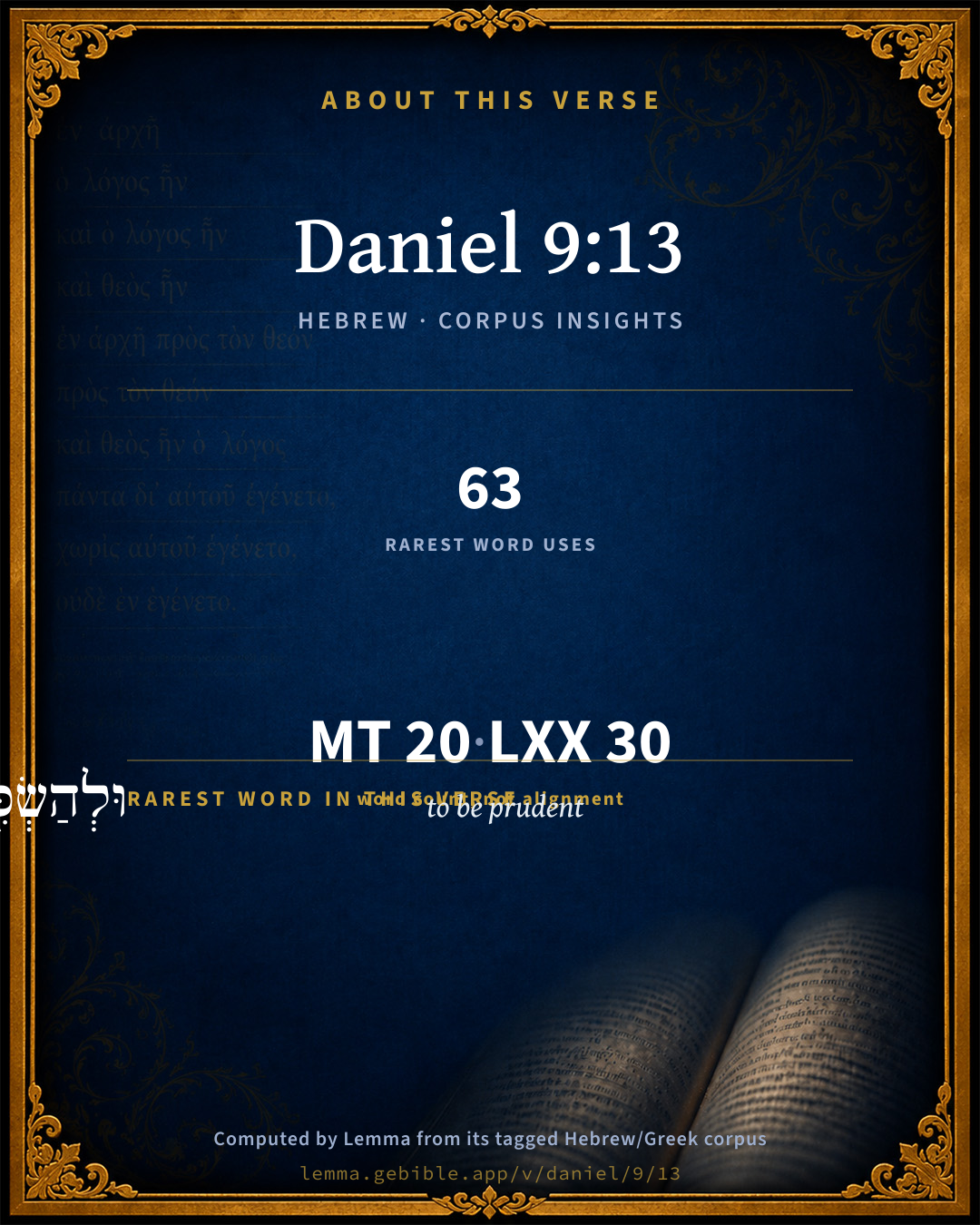
20
words
19
distinct lemmas
Prophets
section

Grammatical profile

  • 5 verbs
  • 9 nouns
  • 1 pronoun
  • 1 preposition
  • 4 particles

Verb forms

  • כָּתוּב֙ Qal · Participle Passive
  • בָּ֣אָה Qal · Perfect
  • חִלִּ֜ינוּ Piel · Perfect
  • לָשׁוּב֙ Qal · Infinitive Construct
  • וּלְהַשְׂכִּ֖יל Hiphil · Infinitive Construct

Hebrew & Septuagint length

In English translation the verse runs 40 words from the Hebrew and 40 from the Septuagint (LXX English) — the same length.

A rough comparison of the two English renderings, which tokenize alike — not a word-level alignment.

Word counts can differ between the Hebrew and the Greek without any difference in meaning — e.g. the Hebrew direct-object marker אֵת has no separate Greek word, and Greek often adds the article ὁ.

In the original languages it is 20 Hebrew tokens and 30 Greek tokens — but the two are counted differently (Hebrew bundles its prefixes and suffixes into one token; the Greek is in lemma form), so that isn’t a like-for-like length.

Cross-references

28

Topical passages linked to Daniel 9:13 in the Treasury of Scripture Knowledge — connected by theme and wording, ordered by reader-vote popularity; previews shown in the World English Bible.

  • Deuteronomy 28:15–68 But it shall come to pass, if you will not listen to the voice of Yahweh your God, to observe to do all his commandments and his statutes which I command you this day, that all these curses shall come on you, and overtake you.
  • Isaiah 9:13 Yet the people have not turned to him who struck them, neither have they sought Yahweh of Hosts.
  • Leviticus 26:14–46 "'But if you will not listen to me, and will not do all these commandments;
  • Jeremiah 2:30 In vain have I struck your children; they received no correction: your own sword has devoured your prophets, like a destroying lion.
  • Daniel 9:11 Yes, all Israel have transgressed your law, even turning aside, that they should not obey your voice: therefore has the curse been poured out on us, and the oath that is written in the law of Moses the servant of God; for we have sinned against him.
  • Hosea 7:10 The pride of Israel testifies to his face; Yet they haven't returned to Yahweh their God, Nor sought him, for all this.
  • Job 36:13 "But those who are godless in heart lay up anger. They don't cry for help when he binds them.
  • Psalms 119:27 Let me understand the teaching of your precepts! Then I will meditate on your wondrous works.
  • Jeremiah 5:3 O Yahweh, don't your eyes look on truth? you have stricken them, but they were not grieved; you have consumed them, but they have refused to receive correction: they have made their faces harder than a rock; they have refused to return.
  • Jeremiah 31:18 I have surely heard Ephraim bemoaning himself [thus], You have chastised me, and I was chastised, as a calf unaccustomed [to the yoke]: turn you me, and I shall be turned; for you are Yahweh my God.
  • Hosea 7:14 They haven't cried to me with their heart, But they howl on their beds. They assemble themselves for grain and new wine. They turn away from me.
  • Luke 24:45 Then he opened their minds, that they might understand the Scriptures.
  • John 6:45 It is written in the prophets, 'They will all be taught by God.' Therefore everyone who hears from the Father, and has learned, comes to me.
  • John 8:32 You will know the truth, and the truth will make you free."
  • John 10:35 If he called them gods, to whom the word of God came (and the Scripture can't be broken),
  • Deuteronomy 29:4 but Yahweh has not given you a heart to know, and eyes to see, and ears to hear, to this day.
  • Psalms 85:4 Turn us, God of our salvation, And cause your indignation toward us to cease.
  • Psalms 119:18 Open my eyes, That I may see wondrous things out of your law.
  • Psalms 119:73 Your hands have made me and formed me. Give me understanding, that I may learn your commandments.
  • Isaiah 42:9 Behold, the former things have happened, and new things do I declare. Before they spring forth I tell you of them.
  • Isaiah 64:7 There is none who calls on your name, who stirs up himself to take hold of you; for you have hid your face from us, and have consumed us by means of our iniquities.
  • Jeremiah 44:27 Behold, I watch over them for evil, and not for good; and all the men of Judah who are in the land of Egypt shall be consumed by the sword and by the famine, until there be an end of them.
  • Lamentations 2:15–17 All that pass by clap their hands at you; They hiss and wag their head at the daughter of Jerusalem, [saying], Is this the city that men called The perfection of beauty, The joy of the whole earth?
  • Lamentations 5:21 Turn you us to you, Yahweh, and we shall be turned; Renew our days as of old.
  • Hosea 7:7 They are all hot as an oven, And devour their judges. All their kings have fallen. There is no one among them who calls to me.
  • Ephesians 1:17–18 that the God of our Lord Jesus Christ, the Father of glory, may give to you a spirit of wisdom and revelation in the knowledge of him;
  • Ephesians 4:21 if indeed you heard him, and were taught in him, even as truth is in Jesus:
  • James 1:5 But if any of you lacks wisdom, let him ask of God, who gives to all liberally and without reproach; and it will be given to him.

Cross-references courtesy of OpenBible.info (CC BY 4.0).

Hebrew and Greek witnesses Masoretic Hebrew ↔ Greek Septuagint

The same verse in the two great witnesses to the Old Testament, shown verse-for-verse.

These are two independent witnesses, not word-aligned to each other, and the Septuagint is shown in lemma (dictionary) form.

Hebrew Daniel 9:13 Masoretic · Westminster Leningrad Codex

כַּאֲשֶׁ֤ר כָּתוּב֙ בְּתוֹרַ֣ת מֹשֶׁ֔ה אֵ֛ת כָּל הָרָעָ֥ה הַזֹּ֖את בָּ֣אָה עָלֵ֑ינוּ וְלֹֽא חִלִּ֜ינוּ אֶת פְּנֵ֣י יְהוָ֣ה אֱלֹהֵ֗ינוּ לָשׁוּב֙ מֵֽעֲוֺנֵ֔נוּ וּלְהַשְׂכִּ֖יל בַּאֲמִתֶּֽךָ

As it is written in the law of Moses, all this evil is come on us: yet have we not entreated the favor of Yahweh our God, that we should turn from our iniquities, and have discernment in your truth.

World English Bible · Public Domain

Greek LXX Daniel 9:13 Septuagint · lemma form

κατά ὁ γράφω ἐν διαθήκη μωσῆς πᾶς ὁ κακός ἐπιἔρχομαι ἐγώ καί οὐ ἐκζητέω ὁ πρόσωπον κύριος θεός ἐγώ ἀποἵστημι ἀπό ὁ ἁμαρτία ἐγώ καί διανοέομαι ὁ δικαιοσύνη σύ κύριος

As it is written in the law of Moses, all these evils have come upon us: yet we have not implored the Lord our God, that we might turn away from our iniquities, and have understanding in all your truth.

LXX2012 (modern English Septuagint) · Public Domain

On this verse, The Pulpit Commentary discusses the Septuagint’s reading. Read the note in Commentary ↓

Hebrew: Westminster Leningrad Codex (CC BY 4.0). Greek: Septuagint (public domain); English from LXX2012 (modern English Septuagint) (Public Domain). How the Septuagint differs from the Hebrew →

Commentary

Notes on Daniel 9:13 from classic Christian and Jewish commentators (each source and its license shown beneath its notes). The classic Christian expositions comment on the surrounding passage and are grouped to its opening verse, so a note may address several verses; the Jewish commentaries on the Tanakh (Rashi and others) are per-verse, so they appear only where the commentator wrote on this verse.

Lemma curates 59 commentaries, every one of them public domain or Creative Commons licensed, each selected and text-cleaned for this edition rather than reprinted as found. About our sources →

Jamieson, Fausset & Brown

Robert Jamieson, A. R. Fausset & David Brown

yet made we not our prayer before--literally, "soothed not the face of." Not even our chastisement has taught us penitence (Isa 9:13; Jer 5:3; Hos 7:10). Diseased, we spurn the healing medicine.

that we might turn, &c.--Prayer can only be accepted when joined with the desire to turn from sin to God (Psa 66:18; Pro 28:9).

understand thy truth--"attentively regard Thy faithfulness" in fulfilling Thy promises, and also Thy threats [CALVIN]. Thy law (Dan 8:12), [MAURER].

Jamieson, Fausset & Brown — Commentary Critical and Explanatory on the Whole Bible (1871) — public domain (CC PDM 1.0). Text via the HelloAO Bible API.

Trapp's Complete Commentary

John Trapp

Dan 9:13 As [it is] written in the law of Moses, all this evil is come upon us: yet made we not our prayer before the LORD our God, that we might turn from our iniquities, and understand thy truth.

Ver. 13. All this evil is come upon us.] But unless God set in and sanctify, his hammers (afflictions) do but beat upon cold iron. {Jer 2:30}

Yet made we not our prayer.] Little or no right prayer was made by the captives all those seventy years (and yet they had their set yearly fasts, Zec 7:1-5), because they failed therein both quoad fontem et quoad finem. {See Trapp on "Zec 7:5"}

That we might turn from our iniquities.] This they had no mind to, therefore they lost those prayers they made; they fasted to themselves and not to God (Zec 7:5. See on Joh 3:10).

And understand thy truth.] Those that turn from their iniquities shall know more of God’s truth. The pure in heart shall see God. {Mat 5:8}

John Trapp, A Commentary or Exposition upon All the Books of the Old and New Testament (1647–1656) — public domain. Text from a community e-Sword module.

Tyndale Open Study Notes

Tyndale Open Resources

9:13 Every curse written against us in the Law of Moses is summarized in Lev 26 and Deut 27–28. When the people entered into the covenant they swore to be obedient, calling down curses on themselves if they failed (see Exod 24:7-8; Josh 8:34-35).

Tyndale Open Study Notes — © Tyndale Open Resources, licensed CC BY-SA 4.0. Text via the HelloAO Bible API.

John Calvin's Commentaries

He repeats what he had already said, without any superfluity, shewing how God’s judgments are proved by their effects, as the law of Moses contains within it all the penalties which the Israelites endured. As, therefore, so manifest an agreement existed between the law of God and the people’s experience, they ought not to become restive and to have sought every kind of subterfuge without profit. By this alone God sufficiently proved himself a just avenger of their crimes, because he had predicted many ages before what he had afterwards fully carried out. This is the object of the repetition, when Daniel says the people felt the justice of the penalties denounced against them in the law of Moses, for in the meantime he adds, we have not deprecated the face of God. Here he severely blames the people’s hardness, because even when beaten with stripes they never grew wise. It is said — fools require calamities to teach them wisdom. This, therefore, was the height of madness in the people to remain thus stubborn under the rod of the Almighty, even when he inflicted the severest blows. As the people were so obstinate in their wickedness, who does not perceive how sincerely this conduct was to be deplored? We have not deprecated, therefore, the face of our God This passage teaches us how the Lord exercises his judgments by not utterly destroying men, but holding his final sentence in suspense, as by these means he wishes to impel men to repentance. First of all, he gently and mercifully invites both bad and good by his word, and adds also promises, with the view of enticing them; and then, when he observes them either slow or refractory, he uses threatenings with the view of arousing them from their slumber; and should threats produce no effect, he goes forth in arms and chastises the sluggishness of mankind. Should these stripes produce no improvement, the desperate character of the people becomes apparent. In this way, God complains in Isaiah of their want of soundness; the whole body of the people is subject to ulcers from the head to the sole of the foot, (Isaiah 1:6;) and yet he would lose all his labor, through their being utterly unmanageable. Daniel now asserts the existence of the same failing in the people, while he states the Israelites to be so untouched by a sense of their calamities, as never to supplicate for pardon. I cannot complete the remainder today.

John Calvin's Commentaries (1540-1563) — public domain. Text from the Calvin Translation Society English edition (1840s-50s) via the Christian Classics Ethereal Library (ccel.org). Calvin's coverage is partial (roughly two-thirds of the Bible); uncommented books and verses are honest gaps, never fabricated. The 19th-century editor's footnotes and remarks are omitted so the notes are faithfully Calvin's own voice.

Ellicott's Commentary for English Readers

(13) Made we not our prayer.—The reference is, as in Dan_9:6, to the conduct of the nation from the first. There had been plenty of external show of praying, as appears from Isaiah 1 and elsewhere, but these prayers were of no effect on account of their formalism. The conditions of acceptable prayer are implied in the closing words of the verse “turning from iniquity, and wisdom in the truth,” i.e., in the revelation of God. On the phrase “make prayer,” see Exo_32:11.

A Bible Commentary for English Readers, edited by Charles John Ellicott (1878–1897) — public domain. Text from a community e-Sword module.

The Cambridge Bible for Schools and Colleges

gen. ed. J. J. S. Perowne

13. As it is written, &c.] Cf. Deu_28:15 b, Deu_30:1.

yet have we not intreated the favour of (R.V.)] lit. made the face sweet (i.e. gracious), the idiom used with reference to a human object in Job_11:19; Psa_45:12; Pro_19:6, and frequently with reference to God, as Exo_32:11; 1Sa_13:12; Jer_26:19, al. Cf. Bar_2:8.

understand thy truth] better (R.V.), have discernment in thy truth, ‘truth’ being used in the objective sense which it has in Dan_8:12, and the meaning being (Keil, Prince) to acquire insight into God’s revealed will, and to think and act in accordance with it. The words might, however, also be rendered (R.V. marg.) deal wisely (viz. in amending our ways) through[332] thy truth (v. Lengerke, Behrm.), i.e. through Thy revealed word. The verb has the former meaning (understand, discern) in Dan_9:25; and the latter in Dan_11:33; Dan_11:35, Dan_12:3; Dan_12:10.

[332] There is a similar ambiguity in the verb and accompanying prep. in Psa_101:2.

The Cambridge Bible for Schools and Colleges (gen. ed. J. J. S. Perowne; Cambridge University Press, 1878–1918) — public domain. Text from a community e-Sword module.

John Gill's Exposition

As it is written in the law of Moses, all this evil is come upon us,.... As it is there threatened it should, and as it is there foretold it would come upon them, so it has; even the selfsame things, in the same manner, and with the same circumstances, as there foretold; which is a proof of the omniscience, omnipotence, and faithfulness of God, and an evidence of the truth of divine revelation; see Lev 26:1,

yet made we not our prayer before the Lord our God; during the seventy years captivity, they might have prayed, and doubtless did, in a lifeless, formal manner; but not sincerely and heartily, in faith and with fervency, under a sense of sin, with confession of it, and true repentance for it, and so as to forsake it, as follows:

that we might turn from our iniquities; for since they did not pray against sin, and entreat the Lord to enable them to turn from it, and forsake it, but continued in a course of disobedience, their prayer was not reckoned prayer:

and understand thy truth; either the truth and faithfulness of God, in fulfilling both his promises and his threatenings; or his law, which is truth, as Jacchiades interprets it; for, had they prayed aright, they would have had an understanding given them of divine truths, both with respect to doctrine and practice; of which they were ignorant, as prayerless persons usually are.

John Gill's Exposition of the Whole Bible (1746–1763) — public domain (CC PDM 1.0). Text via the HelloAO Bible API.

Albert Barnes' Notes on the Bible

As it is written in the law of Moses - The word law was given to all the writings of Moses. See the notes at Luk 24:44.

Yet made we not our prayer before the Lord our God - Margin, “entreated we not the face of.” The Hebrew word used here (חלה châlâh) means, properly, “to be polished;” then to be worn down in strength, to be weak; then to be sick, or diseased; then in Piel (the form used here), to rub or stroke the face of anyone, to soothe or caress, and hence, to beseech, or supplicate. See Gesenius, “Lexicon” Here it means, that, as a people, they had failed, when they had sinned, to call upon God for pardon; to confess their sins; to implore his mercy; to deprecate his wrath. It would have been easy to turn aside his threatened judgments if they had been penitent, and had sought his mercy, but they had not done it. What is here said of them can and will be said of all sinners when the Divine judgment comes upon them.

That we might turn from, our iniquities - That we might seek grace to turn from our transgressions. “And understand thy truth.” The truth which God had revealed; equivalent to saying that they might be righteous.

Albert Barnes' Notes on the Bible (1834–1885) — public domain. Text from a community e-Sword/MySword module.

Haydock's Catholic Bible Commentary

Truth, in executing thy promises and menaces.

George Leo Haydock (1774–1849), Haydock's Catholic Family Bible and Commentary, 1859 edition — public domain. Excludes Psalms (Douay-Rheims chapter numbering differs from Protestant) and Deuterocanonical books (Catholic canon only).

Matthew Poole's English Annotations

As it is written in the law of Moses: see Lev 26:14-39. The sum of all is, As the Lord threatened and forewarned us long ago, so it is come to pass this day upon us, because we took no warning, we understood not, but sinned and returned not. The Lord is true and just in all that is come upon us; chiefly because we have not made our prayer unto God to prevent our misery before it came upon us, nor to remove it when it lay heavy on us. See it in Ezekiel, who prophesied in the captivity, and how they received him; and though they kept a formal fast, yet what did that signify? Zec 7:5-7.

Matthew Poole's English Annotations on the Holy Bible (1683–1685) — public domain. Text from a community e-Sword/MySword module.

The Pulpit Commentary

As it is written in the Law of Moses, all this evil is come upon us: yet made we not our prayer before the Lord our God, that we might turn from our iniquities, and understand thy truth. The LXX renders "laws," diaqhkh, "covenant," which is applied to the "Law" Heb_9:20, quoting from Exo_24:8; Deu_29:1. Theodotion agrees in the main with the Massoretic text. The Peshitta differs only in joining the first clause of the next verse to this. Ewald makes the prenominal suffix at the end of the verse third person, not second. The very awkwardness of the construction is an evidence in favour of the received reading, "As it is written in the Law of Moses." The passages referred to are those denoted previously. (Le 26 De 28) All this evil is come upon us the curses referred to there. Yet made we not our prayer before the Lord our God; literally, entreat the face. The face being the sign of favour, "entreated not the favour of the Lord" would be really what is meant; therefore not quite as Ewald renders, "appeased not Jahve." Understand thy truth. Hitzig thinks here the reference is to God"s faithfulness, either in promises or in threats. Keil objects to this, contending that baamitheka with the preposition be cannot mean "faithfulness," but" truth." This is a mistake; the preposition might alter the significance of the verb it follows, but not that of the noun it governs. The truth is that the word here is extended to its fullest meaning, "God"s supreme reality." God"s being God implies necessarily that every word he utters of promise or threatening is true; veracity and faithfulness are equally involved in Jehovah being God. At the same time, from the connection it is the evil the judgments he had threatened that bulk most largely in the prophet"s mind.

The Pulpit Commentary (1880–1919), ed. H.D.M. Spence-Jones & Joseph S. Exell — public domain. Text from a community e-Sword module.

Rashi

Rabbi Shlomo Yitzchaki (Rashi)

As is written in the Law of Moses a hint that He warned us that if we transgress the oath, all this evil will befall us.

Rashi on the Tanakh — English translations: “The Judaica Press complete Tanach with Rashi, translated by A. J. Rosenberg” (CC BY 4.0); “Pentateuch with Rashi's commentary by M. Rosenbaum and A.M. Silbermann, 1929-1934” (public domain); “The Metsudah Tanach series, Lakewood, N.J” (CC BY 4.0); and “The Book of Joshua, Metsudah Publications, 1997” (CC BY 4.0). Text via Sefaria.

Lesson kit

Teaching starters — assembled from the data on this page, not authored interpretation. Every prompt links to the verse data it draws on. Edit before teaching.

Daniel, in the Prophets, opens this verse with 20 words (19 distinct Hebrew lemmas). Its most distinctive word is sâkal (“to be prudent”). A historical commentator’s framing appears above. Read the whole chapter for the surrounding context.

Discussion questions

  1. The word sâkal carries the sense “to be prudent.” How does it shape the verse?
  2. Deuteronomy 28:15–68 shares this passage’s theme. How do the two illuminate each other?
  3. These translations render this verse differently; the difference is in the English rendering, not the original. What questions does that raise?
  4. The verb «כָּתוּב֙» is Qal Participle Passive. How does its form color the action?
  5. Reading how Jamieson, Fausset & Brown and Trapp's Complete Commentary read this verse, where do the two commentators agree and where do they part?

Things to notice

Reading settings

Reading text

Shown beneath each verse's original-language words.

Old Testament
Old Testament edition

Read the OT as the Masoretic Hebrew (MT) or the Greek Septuagint (LXX).

English shown for the Greek Septuagint (in the Hebrew ↔ Greek comparison).

Comparing translations? Open the Compare panel on any verse page to stack up to four side by side.