
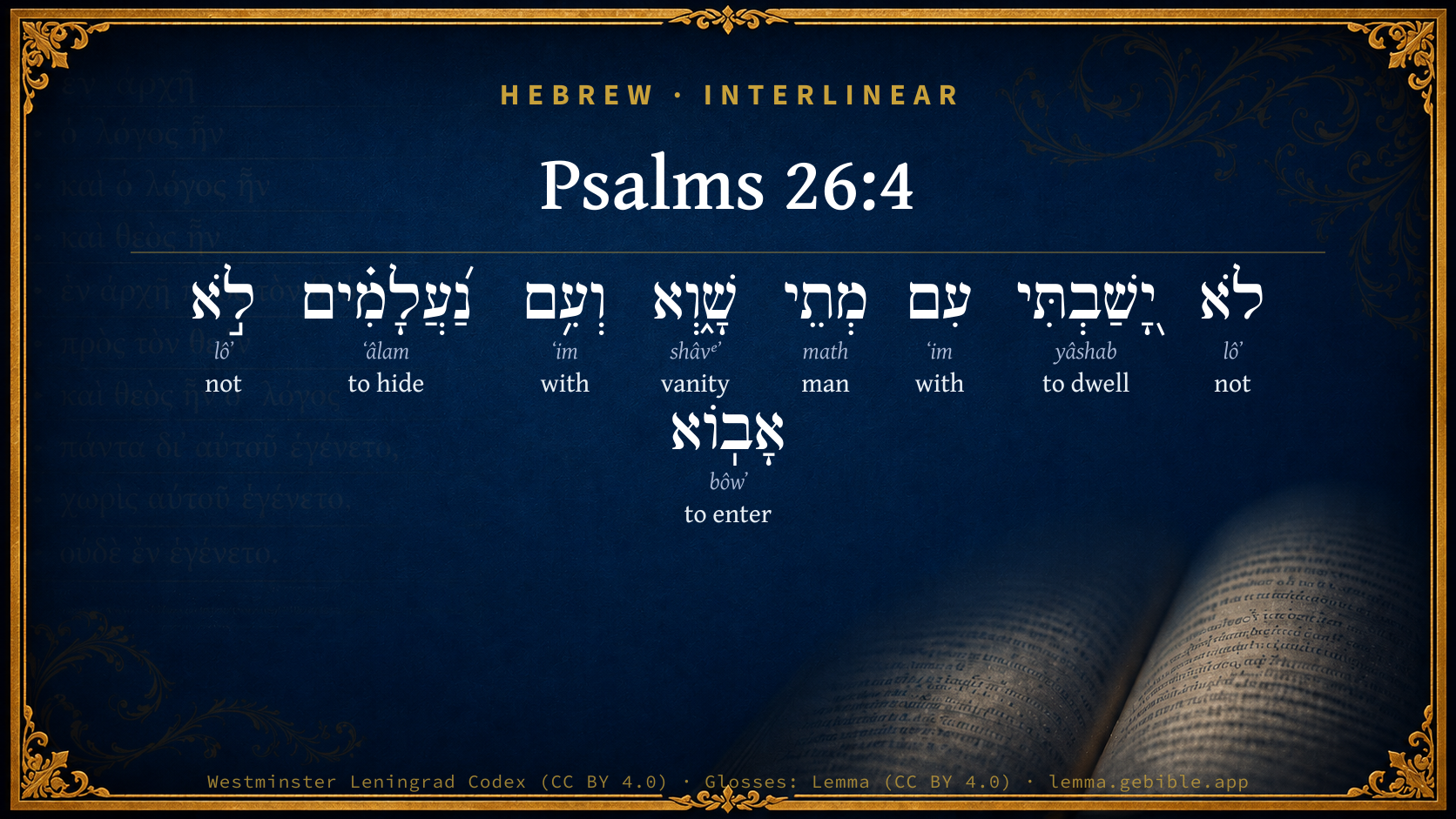
Psalms 26:4

Hebrew (Westminster Leningrad Codex) Psalms 26:4 appears in the Hebrew Old Testament. The text above is from the Westminster Leningrad Codex. Each word links to its Strong’s number, a concise gloss, and parsing drawn from the Open Scriptures Hebrew Bible morphology. Click any word for its full Brown-Driver-Briggs (BDB) entry.
Download image
Cite this verse

Psalms 26:4 (World English Bible). Public Domain. Lemma interlinear Bible study tool, https://lemma.gebible.app/v/psalms/26/4.

Show BibTeX & RIS
BibTeX
RIS
English Translation
I have not sat with deceitful men, Neither will I go in with hypocrites.
World English Bible · Public Domain
Download a study sheet

One document with this verse’s original text, its word-by-word gloss line, the meaning frame, cross-references with their text, attributed commentary, and full source and license credits — printable, and it pastes into notes with its structure intact.

This verse Autodidact and up

Study sheet (.html) Plain text (.txt)

A passage Seminary Student

Up to 50 verses in one chapter. A passage sheet keeps up to 6 commentary sources and 12 cross-references per verse, in the order this page ranks them, and says so on the sheet whenever that leaves anything out. Ask for a single verse and you get the Autodidact verse sheet above.

Everything on this page stays free to read, with no account — the sheet is a download of what is already on screen, not access to it.

Want to remove ads? Support Godless Engineer
Compare translations 3

The same verse in 3 English versions, stacked beneath the original-language interlinear above. Click any original word for its lexicon entry.

Each is an independent rendering of the whole verse — the interlinear is not word-aligned to these translations.

Highlighted words mark where these versions differ — a whole-verse word diff, not a word-by-word alignment.

  • World English Bible Public Domain
    I have not sat with deceitful men, Neither will I go in with hypocrites.
  • King James Version Public Domain
    I have not sat with vain persons, neither will I go in with dissemblers.
  • unfoldingWord Literal Text CC BY-SA 4.0
    I do not sit with men of falsehood, and I will not go with the ones concealing themselves.

unfoldingWord Literal Text — © unfoldingWord, licensed CC BY-SA 4.0. Word-aligned USFM3 via Door43 (git.door43.org/unfoldingWord/en_ult).

Versions to compare (up to 4)

3 of 4 selected

Show all 18 translations

Every available English version of this verse, each an independent rendering of the whole verse.

  • World English Bible Public Domain
    I have not sat with deceitful men, Neither will I go in with hypocrites.
  • Berean Standard Bible Public Domain
    I do not sit with deceitful men, nor keep company with hypocrites.
  • Majority Standard Bible Public Domain
    I do not sit with deceitful men, nor keep company with hypocrites.
  • King James Version Public Domain
    I have not sat with vain persons, neither will I go in with dissemblers.
  • American Standard Version (1901) Public Domain
    I have not sat with men of falsehood; Neither will I go in with dissemblers.
  • Revised Version (1885) Public Domain
    I have not sat with vain persons; neither will I go in with dissemblers.
  • Geneva Bible (1599) Public Domain
    I haue not hanted with vaine persons, neither kept companie with the dissemblers.
  • Douay-Rheims (1899) Public Domain
    I have not sat with the council of vanity: neither will I go in with the doers of unjust things.
  • Young's Literal Translation Public Domain
    I have not sat with vain men, And with dissemblers I enter not.
  • Literal Standard Version CC BY-SA 4.0
    I have not sat with vain men, || And I do not enter with pretenders.
  • Unlocked Literal Bible CC BY-SA 4.0
    I do not associate with deceitful people, nor do I mingle with dishonest people.
  • unfoldingWord Literal Text CC BY-SA 4.0
    I do not sit with men of falsehood, and I will not go with the ones concealing themselves.
  • Darby Bible Public Domain
    I have not sat with vain persons, neither have I gone in with dissemblers;
  • World Messianic Bible Public Domain
    I have not sat with deceitful men, neither will I go in with hypocrites.
  • Webster's Bible Public Domain
    I have not sat with vain persons, neither will I go in with dissemblers.
  • Free Bible Version CC BY-SA 4.0
    I don't join in with liars and I don't associate with hypocrites.
  • Bible in Basic English Public Domain
    I have not taken my seat with foolish persons, and I do not go with false men.
  • JPS Tanakh (1917) Public Domain
    I have not sat with men of falsehood; neither will I go in with dissemblers.

Literal Standard Version (2020), Covenant Press — licensed CC BY-SA 4.0. Text via the HelloAO Bible API (eBible.org). Unlocked Literal Bible (unfoldingWord) — licensed CC BY-SA 4.0. Text via the HelloAO Bible API (eBible.org). unfoldingWord Literal Text — © unfoldingWord, licensed CC BY-SA 4.0. Word-aligned USFM3 via Door43 (git.door43.org/unfoldingWord/en_ult). Free Bible Version, Dr. Jonathan Gallagher — licensed CC BY-SA 4.0. Text via the HelloAO Bible API (eBible.org).

Word by word

More ways to search: Search by grammar → Find every occurrence → Compare this word →

Practice this passage: Drill this verse → Learn its vocabulary →

About this verse

These counts appear in no published source. They are computed here, from the morphology-tagged text and Lemma’s own curated glosses. What Lemma adds →

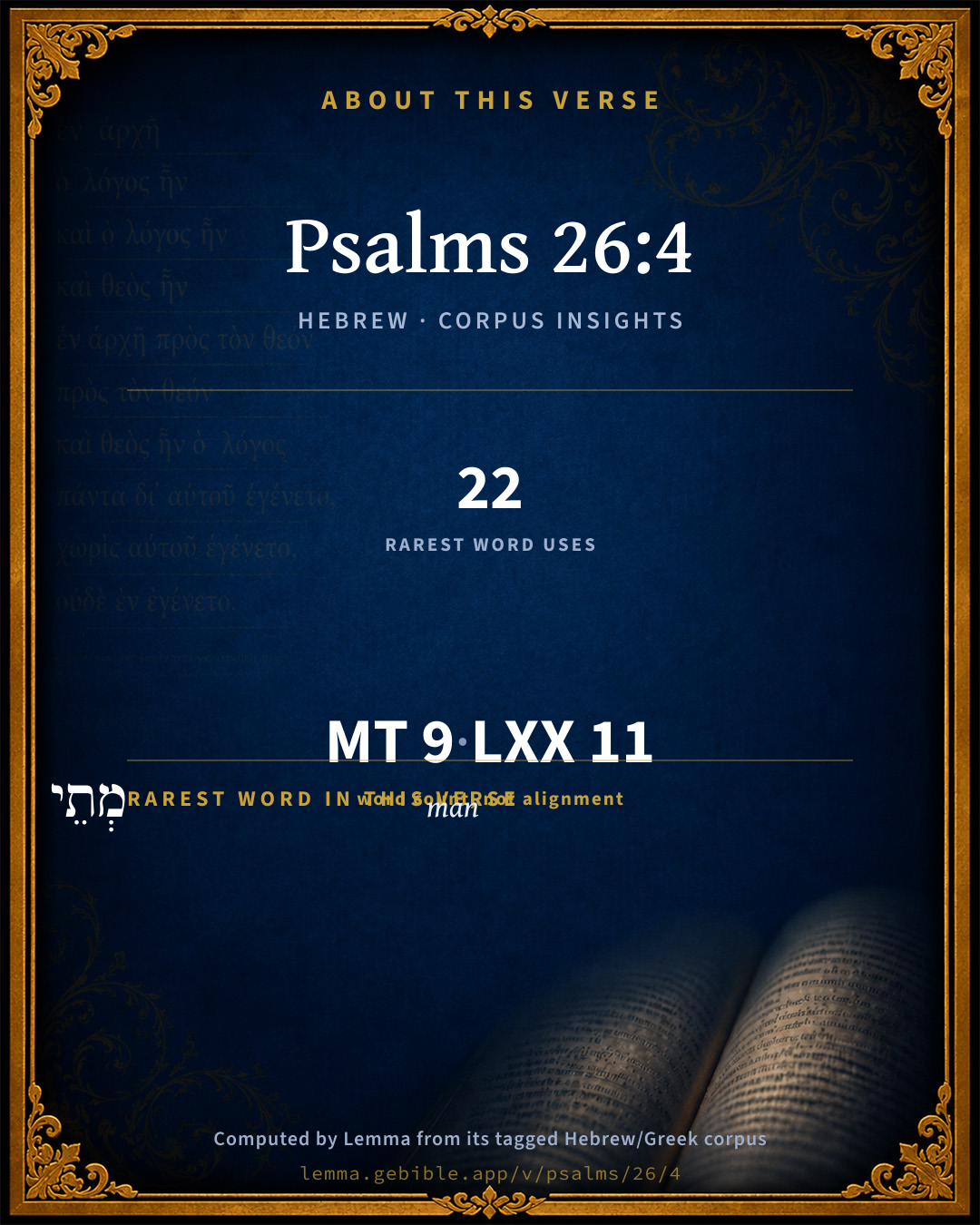
9
words
7
distinct lemmas
Wisdom
section

Notable vocabulary

The rarest word here is מְתֵי man H4962 — appearing just 22 times in the whole Hebrew Bible.

Shared distinctive vocabulary

מְתֵי man H4962 occurs in 21 verses of the Hebrew Bible. Also found in:

Grammatical profile

  • 3 verbs
  • 2 nouns
  • 2 prepositions
  • 2 particles

Verb forms

  • יָ֭שַׁבְתִּי Qal · Perfect
  • נַ֝עֲלָמִ֗ים Niphal · Participle Active
  • אָבֽוֹא Qal · Imperfect

Repetition

Words recur within this verse — often emphatic in Hebrew:

Hebrew & Septuagint length

In English translation the verse runs 14 words from the Hebrew and 17 from the Septuagint (LXX English) — closely comparable.

A rough comparison of the two English renderings, which tokenize alike — not a word-level alignment.

Word counts can differ between the Hebrew and the Greek without any difference in meaning — e.g. the Hebrew direct-object marker אֵת has no separate Greek word, and Greek often adds the article ὁ.

In the original languages it is 9 Hebrew tokens and 11 Greek tokens — but the two are counted differently (Hebrew bundles its prefixes and suffixes into one token; the Greek is in lemma form), so that isn’t a like-for-like length.

Cross-references

9

Topical passages linked to Psalms 26:4 in the Treasury of Scripture Knowledge — connected by theme and wording, ordered by reader-vote popularity; previews shown in the World English Bible.

  • Jeremiah 15:17 I didn't sit in the assembly of those who make merry, nor rejoiced; I sat alone because of your hand; for you have filled me with indignation.
  • Psalms 1:1 Blessed is the man who doesn't walk in the counsel of the wicked, Nor stand in the way of sinners, Nor sit in the seat of scoffers;
  • Proverbs 13:20 One who walks with wise men grows wise, But a companion of fools suffers harm.
  • Psalms 119:115 Depart from me, you evildoers, That I may keep the commandments of my God.
  • 2 Corinthians 6:17 Therefore, "'Come out from among them, And be separate,' says the Lord, 'Touch no unclean thing. I will receive you.
  • Psalms 119:63 I am a friend of all those who fear you, Of those who observe your precepts.
  • 1 Corinthians 15:33 Don't be deceived! "Evil companionships corrupt good morals."
  • Proverbs 9:6 Leave your simple ways, and live. Walk in the way of understanding."
  • Proverbs 12:11 He who tills his land shall have plenty of bread, But he who chases fantasies is void of understanding.

Cross-references courtesy of OpenBible.info (CC BY 4.0).

Hebrew and Greek witnesses Masoretic Hebrew ↔ Greek Septuagint

The same verse in the two great witnesses to the Old Testament, shown verse-for-verse.

You’re reading Greek Psalm 25 (Hebrew Psalm 26). The Septuagint counts the superscription, so verse numbers can differ from the Hebrew — chapter-level alignment, not verse-by-verse. Numbering follows Rahlfs.

These are two independent witnesses, not word-aligned to each other, and the Septuagint is shown in lemma (dictionary) form.

Hebrew Psalms 26:4 Masoretic · Westminster Leningrad Codex

לֹא יָ֭שַׁבְתִּי עִם מְתֵי שָׁ֑וְא וְעִ֥ם נַ֝עֲלָמִ֗ים לֹ֣א אָבֽוֹא

I have not sat with deceitful men, Neither will I go in with hypocrites.

World English Bible · Public Domain

Greek LXX Greek Psalm 25:4 Septuagint · lemma form

οὐ καταἵζω μετά συνέδριον ματαιότης καί μετά παρανομέω οὐ μή εἰςἔρχομαι

I have not sat with the council of vanity, and will in nowise enter in with transgressors.

LXX2012 (modern English Septuagint) · Public Domain

Hebrew: Westminster Leningrad Codex (CC BY 4.0). Greek: Septuagint (public domain); English from LXX2012 (modern English Septuagint) (Public Domain). How the Septuagint differs from the Hebrew →

Commentary

Notes on Psalms 26:4 from classic Christian and Jewish commentators (each source and its license shown beneath its notes). The classic Christian expositions comment on the surrounding passage and are grouped to its opening verse, so a note may address several verses; the Jewish commentaries on the Tanakh (Rashi and others) are per-verse, so they appear only where the commentator wrote on this verse.

Lemma curates 59 commentaries, every one of them public domain or Creative Commons licensed, each selected and text-cleaned for this edition rather than reprinted as found. About our sources →

Trapp's Complete Commentary

John Trapp

Psa 26:4 I have not sat with vain persons, neither will I go in with dissemblers.

Ver. 4. I have not sat with vain persons] Who are void of God’s holy fear, but filled with all unrighteousness, wickedness, covetousness, maliciousness, &c., Rom 1:29. Courtiers are such for most part, and David never delighted in such company, to sit with them, especially when they were acting mischief; which while Cromwell did at the condemnation of Lambert, martyr, and Sir John Cheek at other such like meetings, they were cast upon no small snares and inconveniences. See Jer 15:17.

Neither will I go in with dissemblers] Heb. close workers of iniquity, secret and sly sirs, such as hide themselves to do evil, as the Chaldee hath it, Qui secreto male agunt, and can carry their wickedness cleanly and closely, so as that the world shall be little the wiser, versatiles et versutili, multiplices, Protei; such as can serve the times, and shift their sails to the setting of every wind, Machiavellians, Ahithophels, Jonadabs, 2Sa 13:3. These men’s wisdom may serve them, as the ostrich’s wings, to make them outrun others upon earth, though it be into hell’s mouth, but help them never a whit toward heaven. David, therefore, would have nothing to do with them, he would neither enter, walk, nor sit with any such, {confer Psa 1:1} they should not sprinkle him with their court holy water.

John Trapp, A Commentary or Exposition upon All the Books of the Old and New Testament (1647–1656) — public domain. Text from a community e-Sword module.

The Biblical Illustrator

Joseph S. Exell

Psa_26:4-5

I have not sat with vain persons.

Separate, yet near

The eyes which have Gods loving kindness ever before them are endowed with penetrative clearness of vision into the true hollowness of most of the objects pursued by men, and with a terrible sagacity which detects hypocrisy and shame. Association with such men is necessary, and leaven must be in contact with dough in order to do its transforming work; but it is impossible for a man whose heart is truly in touch with God not to feel ill at ease when brought into contact with those who have no share in his deepest convictions and emotions No doubt separateness from evil-doers is but part of a godly mans duty, and has often been exaggerated into selfish withdrawal front a world which needs good mens presence all the more the worse it is; but it is a part of his duty: Come out from among them and be separate is not yet an abrogated command No man will ever mingle with men of vanity so as to draw them from the shadows of earth to the substance in God, unless his loving association with them rests on profound revulsion from their principles of action. None comes so near to sinful men as the sinless Christ; and if He had not been ever separate from sinners He would never have been near enough to redeem them. We may safely imitate His free companionship, which earned Hint the glorious name of their Friend, if we imitate His remoteness from their evil. (A. Maclaren, D. D.)

I have hated the congregation of evil-doers.--

With wicked men, but not of them

Although, when driven into exile, everyone that was in distress, in debt, etc., gathered themselves unto David, and he became a captain over them,--he never led them against his king and country, but only against their enemies; and in time changed the most reckless and turbulent of men into the best of soldiers and citizens. There is no place where the sincere Christian cannot make his influence felt for good: in the army, in the navy, in trade, at the bar, on the bench, in the halls of legislation, and everywhere; not by sacrificing, but by maintaining and exhibiting his principles in his spirit and conduct. (D. Caldwell, M. A.)

The Biblical Illustrator, edited by Joseph S. Exell (c. 1880s–1900s) — public domain. Text from a community e-Sword module.

The Treasury of David

Charles H. Spurgeon

Ver. 4-5. So far from being himself an open offender against the laws of God, the psalmist had not even associated with the lovers of evil. He had kept aloof from the men of Belial. A man is known by his company, and if we have kept ourselves apart from the wicked, it will always be evidence in our favour should our character be impugned. He who was never in the parish is not likely to have stolen the corn. He who never went to sea is clearly not the man who scuttled the ship.

Ver. 4. I have not sat with vain persons. True citizens have no dealings with traitors. David had no seat in the parliament of triflers. They were not his boon companions at feasts, nor his advisers in council, nor his associates in conversation. We must needs see, and speak, and trade, with men of the world, but we must on no account take our rest and solace in their empty society. Not only the profane, but the vain are to be shunned by us. All those who live for this life only are vain, chaffy, frothy men, quite unworthy of a Christian's friendship. Moreover as this vanity is often allied with falsehood, it is well to save ourselves altogether from this untoward generation, lest we should be led from bad to worse and from tolerating the vain should come to admire the wicked. Neither will I go in with dissemblers. Since I know that hypocritical piety is double iniquity, I will cease all acquaintance with pretenders. If I must need walk the same street, I will not enter the same door and spend my time in their society. The congregation of the hypocrites is not one with which we should cultivate communion; their ultimate rendezvous will be the lowest pit of hell, let us drop their acquaintance now! for we shall not desire it soon. They hang their beads around their necks and carry the devil in their hearts. This clause is in the future tense, to indicate that the writer felt no desire to begin an acquaintance with the characters whom up till then he had shunned. We must maintain the separated path with more and more circumspection as we see the great redemption day approaching. Those who would be transfigured with Jesus, must not be disfigured by conformity to the world. The resolution of the psalmist suggests, that even among professed followers of truth we must make distinctions, for as there are vain persons out of the church, so there are dissemblers in it and both are to be shunned with scrupulous decision.

Ver. 4. I have not sat with vain persons. There is a necessary commerce with men in buying and selling, or as the apostle says, "We must needs go out of the world, "but do not voluntarily choose the company of the wicked. 1Co 5:10. "I have written unto you not to keep company, "etc. 1Co 5:11. Do not be too familiar with them. What do Christ's doves among birds of prey? What do virgins among harlots? The company of the wicked is very defiling, it is like going among them that have the plague. "They were mingled among the heathen and learned their works." If you mingle bright armour with rusty, the bright armour will not brighten the rusty, but the rusty armour will spoil the bright. Pharaoh taught Joseph to swear, but Joseph did not teach Pharaoh to pray. Thomas Watson.

Ver. 4. Neither will I go with dissemblers. Chaldee: "I will not go in with those that hide themselves to do evil." Wickedness is not candid, and loves concealment, while truth and righteousness are open, and seek scrutiny. Job 24:13-17 Joh 3:20-21. None will deny that the candid man has far fewer troubles with his own conduct than the tortuous and deceitful. The righteous shun the wicked both for the sin and for the misery that are in their ways. William S. Plumer.

Ver. 4. Dissemblers. The hypocrite has much angel without, more devil within. He fries in words, freezes in works; speaks by ells, doth good by inches. He is a stinking dunghill, covered over with snow; a loose hung mill that keeps great clacking, but grinds no grist; a lying hen that cackles when she hath not laid. Thomas Adams.

Ver. 4. Dissemblers. Perhaps when the bright sunbeams of an early spring have robed all nature in a smiling garb, you have taken your little baskets, and gone in quest of a bank of sweet smelling modest violets, and you may have found flowers so like them, in form and colour, that you have been deceived, and eagerly grasped you prize; but alas! the sweet odour which should have scented the gale, was found wanting, and betrayed the dog violet. An apt emblem this of those, who, "having the form of godliness, deny the power thereof." 2Ti 3:5. Mrs. Rogers, in "The Shepherd King."

Ver. 4-5. As rotten apples corrupt those sound ones that do touch them and lie close to them, even so the evil manners and bad conditions of the ungodly do infect those that keep them company. Robert Cawdray.

Ver. 4-5. "It is difficult (saith a late ingenious writer) even to a miracle to keep God's commandments and evil company too." How suddenly after your soul refreshments in your closet communion have you lost all your heats and spiritual fervencies, which you had in secret, and have instantly cooled by going forth into cold and corrupt air! When a saint hath been in private ravished with the love of God and the joys of heaven, and afterwards meets with company, which neither doth nor can speak one word of such matters, what a damp it is to him! What a quenching, as it were, of the Spirit of God in him! Nay, is not that true which one saith, that "the people of God do generally lose more by worldly men, that are of a blameless conversation before men, than they lose by wicked and profane men"? Lewis Stuckley.

Ver. 4-5,9. He that would not be found among sinners in the other world, must take heed that he do not frequent their company in this. Those whom the constable finds wandering with vagrants, may be sent with them to the house of correction. "Lord, "said a good woman, on her death bed, when in doubt of her salvation, "send me not to hell amongst wicked men, for thou knowest I never loved their company all my life long." David deprecates their future doom upon the like ground, and argues it as a sign of his sincerity: I have not sat with vain persons, neither will I go in with dissemblers. I have hated the congregation of evil doers; and will not sit with the wicked...O gather not my soul with sinner. Lord, I have not loved the wicked so well as to sit with them for a little time, and shall I live with them forever? I have not lain amongst them rotting on the earth; and wilt thou gather my soul with those sticks for the unquenchable fire of hell? Lord, I have been so far from liking, that thou knowest I have loathed the congregation of evil doers. Do not I hate them that hate thee? Yea, I hate them with perfect hatred; and shall thy friends fare as thy foes? I appeal to thy Majesty, that my great comfort is in thy chosen. I rejoice only to be amongst thy children here, and shall I be excluded their company hereafter? "O do not gather my soul with sinners, "for the wine press of thine eternal anger! Marcion, the heretic, seeing Polycarp, wondered that he would not own him. Do you not know me, Polycarp? Yes, saith Polycarp, "Scio te esse primogenitum diaboli; " "I know thee to be the firstborn of the devil, "and so despised him. George Swinnock.

Ver. 4. Vain persons. Who they are. Why they are to be avoided. What will become of them. Dissemblers. Describe this numerous family. Show what their objects are. The mischief done to believers by their craftiness. The need of shunning them, and their fearful end.

Psalms 26:5*

Ver. 4-5. See Psalms on "Ps 26:4" for further information.

Ver. 4-5. See Psalms on "Ps 26:4" for further information.

Ver. 4-5. See Psalms on "Ps 26:4" for further information.

Ver. 4-5,9. See Psalms on "Ps 26:4" for further information.

Charles H. Spurgeon's The Treasury of David (1869–1885) — public domain. Psalms only. Text from a community e-Sword/MySword module.

Joseph Benson's Commentary

Psa 26:4-5. I have not sat with vain persons — That is, chosen or used to converse with them. I have been so far from an approbation or imitation of their wicked courses, that I have avoided even their company; and, if I accidentally came into it, yet I would not continue in it; neither will I go in with dissemblers — That is, into their company, or with design to join in their counsels or courses. The word נעלמים, nagnalamim, here rendered dissemblers, signifies those that hide themselves; that is, cover their crafty and wicked designs with fair pretences. I have hated the congregation of evil-doers — I have a dislike to all such persons, and avoid meeting and joining with them in their assemblies and consultations.

Joseph Benson's Commentary on the Old and New Testaments (1811–1818) — public domain. Text from a community e-Sword module.

Whedon's Commentary on the Bible

Daniel D. Whedon

4. Hitherto David has based his prayer upon his relation to God; in Psa_26:4-5 he pleads his discreet and pure associations with men.

Vain persons— Literally, mortals of vanity, or emptiness. “Vanity” is here used generically for evil or wickedness of all sorts, especially falsehood and deceit.

Go in with dissemblers—To “go in” is to join, unite with, have familiar intercourse with. “Dissemblers” are, literally, the veiled men, the concealed, hidden men, men who cover up their real motives.

Daniel D. Whedon (gen. ed.), Commentary on the Old and New Testaments (1874–1909) — public domain. Text from a community e-Sword module.

Keil & Delitzsch

C. F. Keil & F. Delitzsch

He still further bases his petition upon his comportment towards the men of this world; how he has always observed a certain line of conduct and continues still to keep to it. With Psa 26:4 compare Jer 15:17. מתי שׁוא (Job 11:11, cf. Psa 31:5, where the parallel word is מרמה) are "not-real," unreal men, but in a deeper stronger sense than we are accustomed to use this word. שׁוא (= שׁוא, from שׁוא) is aridity, hollowness, worthlessness, and therefore badness (Arab. su') of disposition; the chaotic void of alienation from God; untruth white-washed over with the lie of dissimulation (Psa 12:3), and therefore nothingness: it is the very opposite of being filled with the fulness of God and with that which is good, which is the morally real (its synonym is און, e.g., Job 22:15). נעלמים, the veiled, are those who know how to keep their worthlessness and their mischievous designs secret and to mask them by hypocrisy; post-biblical צבוּעים, dyed (cf. ἀνυπόκριτος, Luther "ungefδrbt," undyed). (את) בּוא עם, to go in with any one, is a short expression for: to go in and out with, i.e., to have intercourse with him, as in Pro 22:24, cf. Gen 23:10. מרע (from רעע) is the name for one who plots that which is evil and puts it into execution. On רשׁע see Psa 1:1.

Keil & Delitzsch — Biblical Commentary on the Old Testament (1861–1891) — public domain (CC PDM 1.0). Text via the HelloAO Bible API. (Old Testament only.)

J. A. Alexander on Psalms

Joseph Addison Alexander

4. (Psa 26:4) I have not sat with men of falsehood, and with hidden (men) I will not go. He is further encouraged to believe that he will be sustained because he has not hitherto espoused the cause of those who hate God.—Men of falsehood, liars or deceivers, which appears to suit the context better than the wider sense of vain men, i.e. destitute of all moral goodness, good for nothing, worthless. See above; on Psa 5:7 (6), Psa 24:4. The same class of persons are described in the last clause as masked, disguised, or hypocritical.—Sat, not merely in their company, but in their councils, taking part in their unlawful machinations. The change of tense is anything rather than unmeaning. "I have not sat with them in time past, and I will not go with them in time to come." The form of expression is borrowed from Gen 49:6.

Joseph Addison Alexander, The Psalms Translated and Explained (1850) — public domain. Text from a community e-Sword module.

Tyndale Open Study Notes

Tyndale Open Resources

26:4-5 Because of his devotion to the Lord (26:1-3), the psalmist dissociates himself from evil people (see 1:1).

Tyndale Open Study Notes — © Tyndale Open Resources, licensed CC BY-SA 4.0. Text via the HelloAO Bible API.

Geneva Bible (1599)

Geneva Bible translators

He declareth that they cannot walk in simplicity before God, that delight in the company of the ungodly.

Geneva Bible (1599) marginal notes — public domain. Text via Bolls.life.

Jamieson, Fausset & Brown

Robert Jamieson, A. R. Fausset & David Brown

As exemplified by the fruits of divine grace, presented in his life, especially in his avoiding the wicked and his purposes of cleaving to God's worship.

Jamieson, Fausset & Brown — Commentary Critical and Explanatory on the Whole Bible (1871) — public domain (CC PDM 1.0). Text via the HelloAO Bible API.

Adam Clarke's Commentary

Verse 4. I have not sat with vain persons] מתי שוא methey shav, men of lies, dissemblers, backbiters, &c.

Neither will I go in with dissemblers] נעלמים naalamim, the hidden ones, the dark designers, the secret plotters and conspirators in the state.

Adam Clarke's Commentary on the Bible (1810–1826) — public domain. Text from a community e-Sword/MySword module.

John Calvin's Commentaries

4. I have not sat with vain men. He again declares the very great dissimilarity which existed between him and his adversaries. For the contrast is always to be observed, that wicked men, by all the harm and mischief they wrought against him, could never drive him from the path of rectitude. This verse might likewise be joined with the former, as if completing the sentence, in this way, That David, by confiding in the favor of God, had withdrawn himself from deceivers. The words, sitting and walking, denote sharing in counsel and fellowship in working, according to what is said in the first psalm. David denies that he had any intercourse with vain and deceitful men. And certainly the best remedy to recall and save us from the assembly of the wicked is to fix our eyes upon God’s goodness; for he who walks in the confidence of God’s protection, committing all events to his providence, will never imitate their deceitfulness. Those whom he denominates in the first clause, men of vanity, he soon after terms נעלמים, naälamim, that is, close and wrapped up in craftiness. Horsley renders the word, “Those who seek concealment.” In like manner, the Chaldee paraphrases it, “They that hide themselves that they may do evil.”

John Calvin's Commentaries (1540-1563) — public domain. Text from the Calvin Translation Society English edition (1840s-50s) via the Christian Classics Ethereal Library (ccel.org). Calvin's coverage is partial (roughly two-thirds of the Bible); uncommented books and verses are honest gaps, never fabricated. The 19th-century editor's footnotes and remarks are omitted so the notes are faithfully Calvin's own voice.

Ellicott's Commentary for English Readers

(4) Dissemblers—i.e., hypocrites.

A Bible Commentary for English Readers, edited by Charles John Ellicott (1878–1897) — public domain. Text from a community e-Sword module.

The Cambridge Bible for Schools and Colleges

gen. ed. J. J. S. Perowne

4. I have not sat] Of deliberate and prolonged intercourse, implying community of tastes and interests. Cp. Psa_1:1; Jer_15:17.

vain persons] Lit. men of vanity; hollowness, falsehood, unreality: the opposite of truth and righteousness. See Psa_12:2; Psa_24:4.

neither will I go in] To their houses: or an abbreviation for go in and out, associate with.

dissemblers] Lit. those who hide themselves; hypocrites who disguise their real thoughts and purposes (Psa_28:3).

4–7. The proof of his integrity in his conduct in the past, and his purpose for the future.

The Cambridge Bible for Schools and Colleges (gen. ed. J. J. S. Perowne; Cambridge University Press, 1878–1918) — public domain. Text from a community e-Sword module.

John Gill's Exposition

I have not sat with vain persons,.... Or "men of vanity" (t); who are full of it; who are addicted to the vanities of the world; who pursue the riches, honours, pleasures, and profits of it; which is no other than walking in a vain show: whose thoughts, words, and actions are vain; who are vainly puffed up in their fleshly mind, and walk in the vanity of it; who take the name of God in vain, and whose common discourse is foolish, frothy, light, and empty; and who are men of a vain conversation, and are rash, imprudent, and deceitful: men of bad principles may very well go by this name, who are vain and unruly talkers, and whose doctrines are doctrines of vanity, and no other than vain babbling; and also men guilty of idolatrous practices, who observe lying vanities, and worship them, and lift up their souls unto them; with such vain men, in any of these senses, the psalmist would have nothing to do; he would not keep company with them, nor have any communion, consultation, and conversation with them; it may be, he may have some respect to the men that were about Saul, to whom such a character agreed; or he may say this, and what follows, to remove a calumny cast upon him and his friends; as if they that were with him were such men as here described, and in Psa 26:5;

neither will I go in with dissemblers: or "hidden" or "unknown" persons (u), who lie in private lurking places, to murder the innocent, or secretly take away the good names and characters of men, and it is not known who they are; or who commit sin secretly; go into secret places to do their works in the dark, and hide themselves to do evil; as the Targum, Jarchi, Kimchi, and Ben Melech, interpret it; who love darkness rather than light, because their deeds are evil; or who cover themselves with lying and flattering words, that it is not known what their real intentions be; they speak one thing, and mean another; are an assembly of treacherous men: such are all deceitful workers, who lie in wait to deceive, and walk in craftiness; and hypocrites, who have the form of religion, but are strangers to the power of it; and who are to be turned away from, and avoided; the houses, assemblies, cabals, and company of such, are to be shunned; see Gen 49:6; or such as are "signed", or "marked"; that is, infamous persons (w).

(t) "cum hominibus vanitatis", Gejerus, Michaelis. (u) "cum occultis", Vatablus, Michaelis; "absconditis", Gejerus; so Ainsworth. (w) Vide Schultens de def. Hod. ling. Heb. s. 188.

John Gill's Exposition of the Whole Bible (1746–1763) — public domain (CC PDM 1.0). Text via the HelloAO Bible API.

Albert Barnes' Notes on the Bible

I have not sat with vain persons - That is, I have not been found among them; I have not made them my companions. See the notes at Psa 1:1. The word “vain” here is in contrast with those who are sincere and true. The expression would be applied to people who are false and hollow; to those who have no sincerity or solidity of character; to those who are hypocrites and pretenders. The psalmist urges it as one evidence of his attachment to God that he had not been found among that class of persons, either as making them his companions, or as taking part with them in their counsels.

Neither will I go in with dissemblers - Neither will I walk with them; neither will I be found in their company. The word here rendered “dissemblers” means properly those who are “hidden” or “concealed;” then, those who hide their purposes or designs from others, or who conceal their real character and intentions. Thus used, the word denotes hypocrites, whose real character is “concealed” or “hidden” from the world. The psalmist says that he had not associated with such people, but that His companionship had been with the open, the frank, the sincere. On this he relied as one evidence of his piety; and this is always an evidence of true religion. See the notes at Psa 1:1.

Albert Barnes' Notes on the Bible (1834–1885) — public domain. Text from a community e-Sword/MySword module.

Matthew Poole's English Annotations

I have not sat, i.e. chosen or used to converse with them; for sitting is a posture of ease and of continuance. I have been so far from an approbation or imitation of their wicked courses, (wherewith mine enemies reproach me,) that I have avoided even their company; and if accidentally I came into it, yet I would not abide in it.

With vain persons, i.e. with liars, or false and deceitful persons, as the next clause explains it. And vanity is very frequently put for falsehood or lying.

Neither will I go in; into their company, or with design to join in their counsels or courses, as the same word is used, Jos 23:7. And conversation is oft expressed by going out and coming in.

With dissemblers, Heb. with such as hide themselves, covering their crafty and wicked designs with fair pretences. I abhor such persons and practices, though I am accused to be such a one.

Matthew Poole's English Annotations on the Holy Bible (1683–1685) — public domain. Text from a community e-Sword/MySword module.

The Pulpit Commentary

I have not sat with vain persons. Thirdly, he has not sat with vain persons; literally, with men of vanity; i.e. he has not consorted (Psa_1:1) with light and frivolous persons those whose hearts are set upon vain and worthless things. (see Psa_24:4, and the comment) Neither will I go in with dissemblers. Nor will he go in with (nor has he, we may conclude, gone in with) dissemblers, i.e. hypocrites. He has neither thrown in his lot with the light, vain persons who make no pretence to religion, nor with the pretenders, who "have the form of godliness, but deny the power thereof". (2Ti_3:5)

The Pulpit Commentary (1880–1919), ed. H.D.M. Spence-Jones & Joseph S. Exell — public domain. Text from a community e-Sword module.

John Wesley's Explanatory Notes

Sat - Continued with them. I have been so far from an imitation of their wicked courses, that I have avoided their company. Vain - With false and deceitful persons. Go in - Into their company.

John Wesley, Explanatory Notes Upon the Whole Bible (1754–1765) — public domain. Text via the GEBible commentary corpus.

unfoldingWord translationNotes

Door43 World Missions Community

I do not associate with

"I do not keep company with" or "I do not sit with"

with deceitful people

"with those who deceive others"

nor do I mingle with dishonest people

This means the same as the first part of the sentence. AT: "and I do not join with dishonest people" (See: Parallelism)

dishonest people

"hypocrites" or "those who lie to others"

the assembly of evildoers

"those who gather to do evil"

the wicked

This is a nominal adjective. AT: "wicked people" or "those who are wicked" (See: Nominal Adjectives)

translationWords

deceive

assembly

life

evildoer

unfoldingWord translationNotes — © Distant Shores Media and the Door43 World Missions Community, licensed CC BY-SA 4.0. Source: git.door43.org/Door43/en_tn.

Rashi

Rabbi Shlomo Yitzchaki (Rashi)

and...with hypocrites who go into hidden places to do their deeds in the dark.

neither did I go I am not accustomed to come and enter their assembly.

Rashi on the Tanakh — English translations: “The Judaica Press complete Tanach with Rashi, translated by A. J. Rosenberg” (CC BY 4.0); “Pentateuch with Rashi's commentary by M. Rosenbaum and A.M. Silbermann, 1929-1934” (public domain); “The Metsudah Tanach series, Lakewood, N.J” (CC BY 4.0); and “The Book of Joshua, Metsudah Publications, 1997” (CC BY 4.0). Text via Sefaria.

Lesson kit

Teaching starters — assembled from the data on this page, not authored interpretation. Every prompt links to the verse data it draws on. Edit before teaching.

Psalms, in the Wisdom, opens this verse with 9 words (7 distinct Hebrew lemmas). Its most distinctive word is math (“man”). A historical commentator’s framing appears above. Read the whole chapter for the surrounding context.

Discussion questions

  1. The word math carries the sense “man.” How does it shape the verse?
  2. Genesis 34:30 shares the word «man» with this verse. How do the two illuminate each other?
  3. “not” occurs 2× in this one verse. What is the effect of the repetition?
  4. The translations on this page render this verse differently — a whole-verse word diff, not a word-by-word alignment. What might account for the different wordings?
  5. The verb «יָ֭שַׁבְתִּי» is Qal Perfect. How does its form color the action?
  6. Reading how Trapp's Complete Commentary and The Biblical Illustrator read this verse, where do the two commentators agree and where do they part?

Things to notice

Reading settings

Reading text

Shown beneath each verse's original-language words.

Old Testament
Old Testament edition

Read the OT as the Masoretic Hebrew (MT) or the Greek Septuagint (LXX).

English shown for the Greek Septuagint (in the Hebrew ↔ Greek comparison).

Comparing translations? Open the Compare panel on any verse page to stack up to four side by side.