
Genesis 19:33

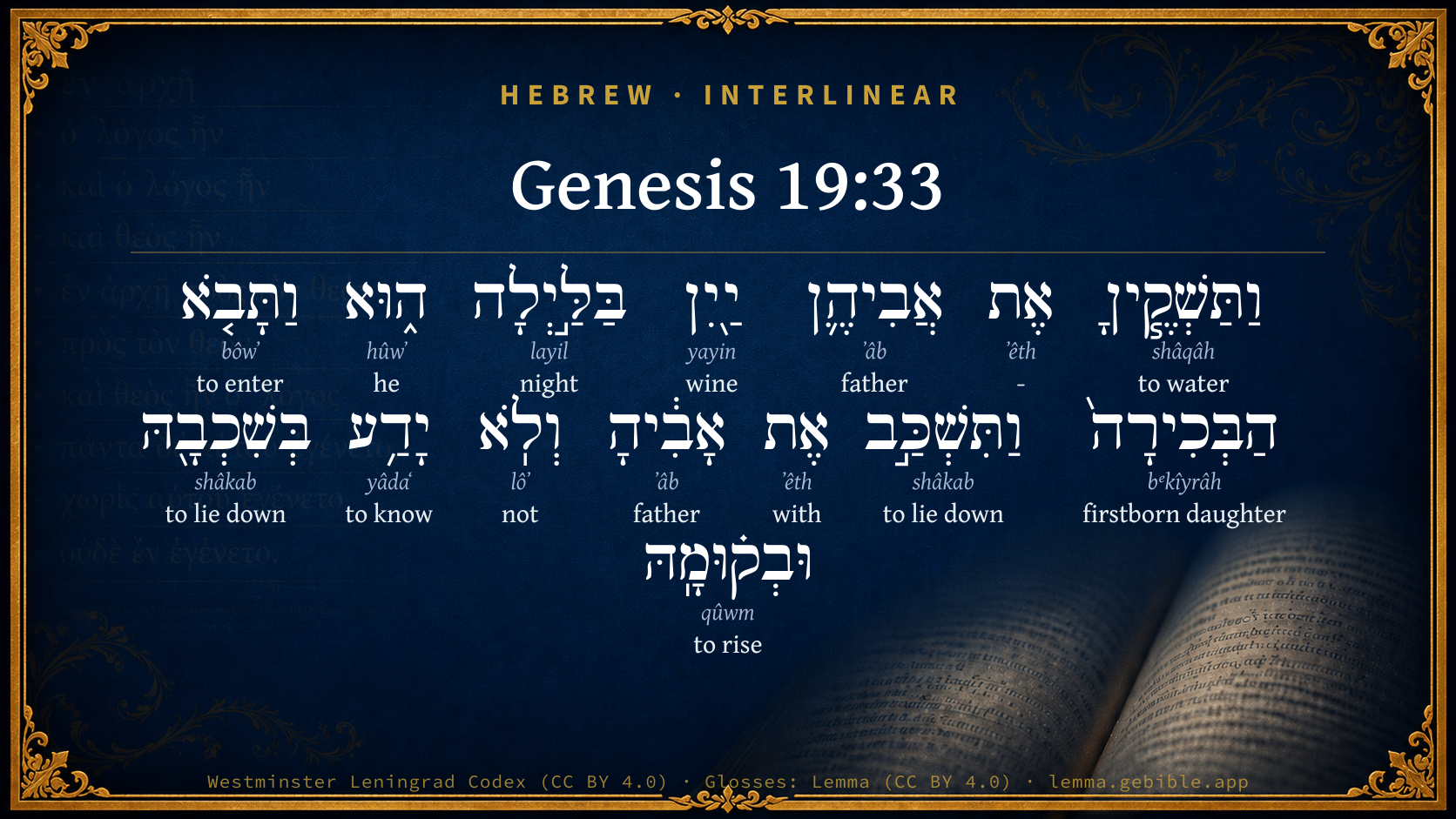
Hebrew (Westminster Leningrad Codex) Genesis 19:33 appears in the Hebrew Old Testament. The text above is from the Westminster Leningrad Codex. Each word links to its Strong’s number, a concise gloss, and parsing drawn from the Open Scriptures Hebrew Bible morphology. Click any word for its full Brown-Driver-Briggs (BDB) entry.
Download image
Cite this verse

Genesis 19:33 (World English Bible). Public Domain. Lemma interlinear Bible study tool, https://lemma.gebible.app/v/genesis/19/33.

Show BibTeX & RIS
BibTeX
RIS
English Translation
They made their father drink wine that night: and the firstborn went in, and lay with her father. He didn't know when she lay down, nor when she arose.
World English Bible · Public Domain
Download a study sheet

One document with this verse’s original text, its word-by-word gloss line, the meaning frame, cross-references with their text, attributed commentary, and full source and license credits — printable, and it pastes into notes with its structure intact.

This verse Autodidact and up

Study sheet (.html) Plain text (.txt)

A passage Seminary Student

Up to 50 verses in one chapter. A passage sheet keeps up to 6 commentary sources and 12 cross-references per verse, in the order this page ranks them, and says so on the sheet whenever that leaves anything out. Ask for a single verse and you get the Autodidact verse sheet above.

Everything on this page stays free to read, with no account — the sheet is a download of what is already on screen, not access to it.

Want to remove ads? Support Godless Engineer
Compare translations 3

The same verse in 3 English versions, stacked beneath the original-language interlinear above. Click any original word for its lexicon entry.

Each is an independent rendering of the whole verse — the interlinear is not word-aligned to these translations.

Highlighted words mark where these versions differ — a whole-verse word diff, not a word-by-word alignment.

  • World English Bible Public Domain
    They made their father drink wine that night: and the firstborn went in, and lay with her father. He didn't know when she lay down, nor when she arose.
  • King James Version Public Domain
    And they made their father drink wine that night: and the firstborn went in, and lay with her father; and he perceived not when she lay down, nor when she arose.
  • unfoldingWord Literal Text CC BY-SA 4.0
    So they got their father to drink wine on that night, and the firstborn went and lay with her father, but he did not know when she lay down or when she got up.

unfoldingWord Literal Text — © unfoldingWord, licensed CC BY-SA 4.0. Word-aligned USFM3 via Door43 (git.door43.org/unfoldingWord/en_ult).

Versions to compare (up to 4)

3 of 4 selected

Show all 18 translations

Every available English version of this verse, each an independent rendering of the whole verse.

  • World English Bible Public Domain
    They made their father drink wine that night: and the firstborn went in, and lay with her father. He didn't know when she lay down, nor when she arose.
  • Berean Standard Bible Public Domain
    So that night they got their father drunk with wine, and the firstborn went in and slept with her father; he was not aware when she lay down or when she got up.
  • Majority Standard Bible Public Domain
    So that night they got their father drunk with wine, and the firstborn went in and slept with her father; he was not aware when she lay down or when she got up.
  • King James Version Public Domain
    And they made their father drink wine that night: and the firstborn went in, and lay with her father; and he perceived not when she lay down, nor when she arose.
  • American Standard Version (1901) Public Domain
    And they made their father drink wine that night: and the first-born went in, and lay with her father; and he knew not when she lay down, nor when she arose.
  • Revised Version (1885) Public Domain
    And they made their father drink wine that night: and the firstborn went in, and lay with her father; and he knew not when she lay down, nor when she arose.
  • Geneva Bible (1599) Public Domain
    So they made their father drinke wine that night, and the elder went and lay with her father: but he perceiued not, neither whe she lay downe, neither when she rose vp.
  • Douay-Rheims (1899) Public Domain
    And they made their father drink wine that night: and the elder went in and lay with her father: but he perceived not neither when his daughter lay down, nor when she rose up.
  • Young's Literal Translation Public Domain
    And they cause their father to drink wine on that night; and the first-born goeth in, and lieth with her father, and he hath not known in her lying down, or in her rising up.
  • Literal Standard Version CC BY-SA 4.0
    And they cause their father to drink wine on that night; and the firstborn goes in and lies with her father, and he has not known in her lying down or in her rising up.
  • Unlocked Literal Bible CC BY-SA 4.0
    So they made their father drink wine that night. Then the firstborn went in and slept with her father; he did not know when she lay down, nor when she arose.
  • unfoldingWord Literal Text CC BY-SA 4.0
    So they got their father to drink wine on that night, and the firstborn went and lay with her father, but he did not know when she lay down or when she got up.
  • Darby Bible Public Domain
    And they gave their father wine to drink that night. And the first-born went in, and lay with her father, and he did not know of her lying down, nor of her rising.
  • World Messianic Bible Public Domain
    They made their father drink wine that night: and the firstborn went in, and lay with her father. He didn’t know when she lay down, nor when she arose.
  • Webster's Bible Public Domain
    And they made their father drink wine that night: and the first-born went in and lay with her father; and he perceived not when she lay down, nor when she arose.
  • Free Bible Version CC BY-SA 4.0
    So they got their father drunk with wine that night. The older daughter went and slept with him, and he didn't notice when she lay down or when she got up.
  • Bible in Basic English Public Domain
    And that night they made their father take much wine; and the older daughter went into his bed; and he had no knowledge of when she went in or when she went away.
  • JPS Tanakh (1917) Public Domain
    And they made their father drink wine that night. And the first-born went in, and lay with her father; and he knew not when she lay down, nor when she arose.

Literal Standard Version (2020), Covenant Press — licensed CC BY-SA 4.0. Text via the HelloAO Bible API (eBible.org). Unlocked Literal Bible (unfoldingWord) — licensed CC BY-SA 4.0. Text via the HelloAO Bible API (eBible.org). unfoldingWord Literal Text — © unfoldingWord, licensed CC BY-SA 4.0. Word-aligned USFM3 via Door43 (git.door43.org/unfoldingWord/en_ult). Free Bible Version, Dr. Jonathan Gallagher — licensed CC BY-SA 4.0. Text via the HelloAO Bible API (eBible.org).

Word by word

More ways to search: Search by grammar → Find every occurrence → Compare this word →

Practice this passage: Drill this verse → Learn its vocabulary →

הַבְּכִירָה֙
bᵉkîyrâh
H1067
“the · firstborn daughter”
Particle, Definite Article + Noun, Common, Feminine, Singular, Absolute
Part of Speech
Particle + Noun
Type
Common
Gender
Feminine
Number
Singular
State
Absolute
Full BDB Definition

Origin: from H1069

TWOT: 244d

firstborn daughter, firstborn (of women) - always used of women
  1. וַתַּשְׁקֶ֧יןָ shâqâh H8248 “and · to water” Conjunction + Verb, Hiphil, Sequential Imperfect, 3rd Person, Feminine, Plural
  2. אֶת ʼêth H853 “-” Particle, Direct Object
  3. אֲבִיהֶ֛ן ʼâb H1 “father · their” Noun, Common, Masculine, Singular, Construct + Suffix, Personal, 3rd Person, Feminine, Plural
  4. יַ֖יִן yayin H3196 “wine” Noun, Common, Masculine, Singular, Absolute
  5. בַּלַּ֣יְלָה layil H3915 “in/at the · night” Preposition, Determined + Noun, Common, Masculine, Singular, Absolute
  6. ה֑וּא hûwʼ H1931 “he” Pronoun, Personal, 3rd Person, Masculine, Singular
  7. וַתָּבֹ֤א bôwʼ H935 “and · to enter” Conjunction + Verb, Qal, Sequential Imperfect, 3rd Person, Feminine, Singular
  8. וַתִּשְׁכַּ֣ב shâkab H7901 “and · to lie down” Conjunction + Verb, Qal, Sequential Imperfect, 3rd Person, Feminine, Singular
  9. אֶת ʼêth H854 “with” Preposition
  10. אָבִ֔יהָ ʼâb H1 “father · her” Noun, Common, Masculine, Singular, Construct + Suffix, Personal, 3rd Person, Feminine, Singular
  11. וְלֹֽא lôʼ H3808 “and · not” Conjunction + Particle, Negative
  12. יָדַ֥ע yâdaʻ H3045 “to know” Verb, Qal, Perfect, 3rd Person, Masculine, Singular
  13. בְּשִׁכְבָ֖הּ shâkab H7901 “in/at · to lie down · her” Preposition + Verb, Qal, Infinitive Construct + Suffix, Personal, 3rd Person, Feminine, Singular
  14. וּבְקׄוּמָֽהּ qûwm H6965 “and · in/at · to rise · her” Conjunction + Preposition + Verb, Qal, Infinitive Construct + Suffix, Personal, 3rd Person, Feminine, Singular

About this verse

These counts appear in no published source. They are computed here, from the morphology-tagged text and Lemma’s own curated glosses. What Lemma adds →

15
words
13
distinct lemmas
Pentateuch
section

Notable vocabulary

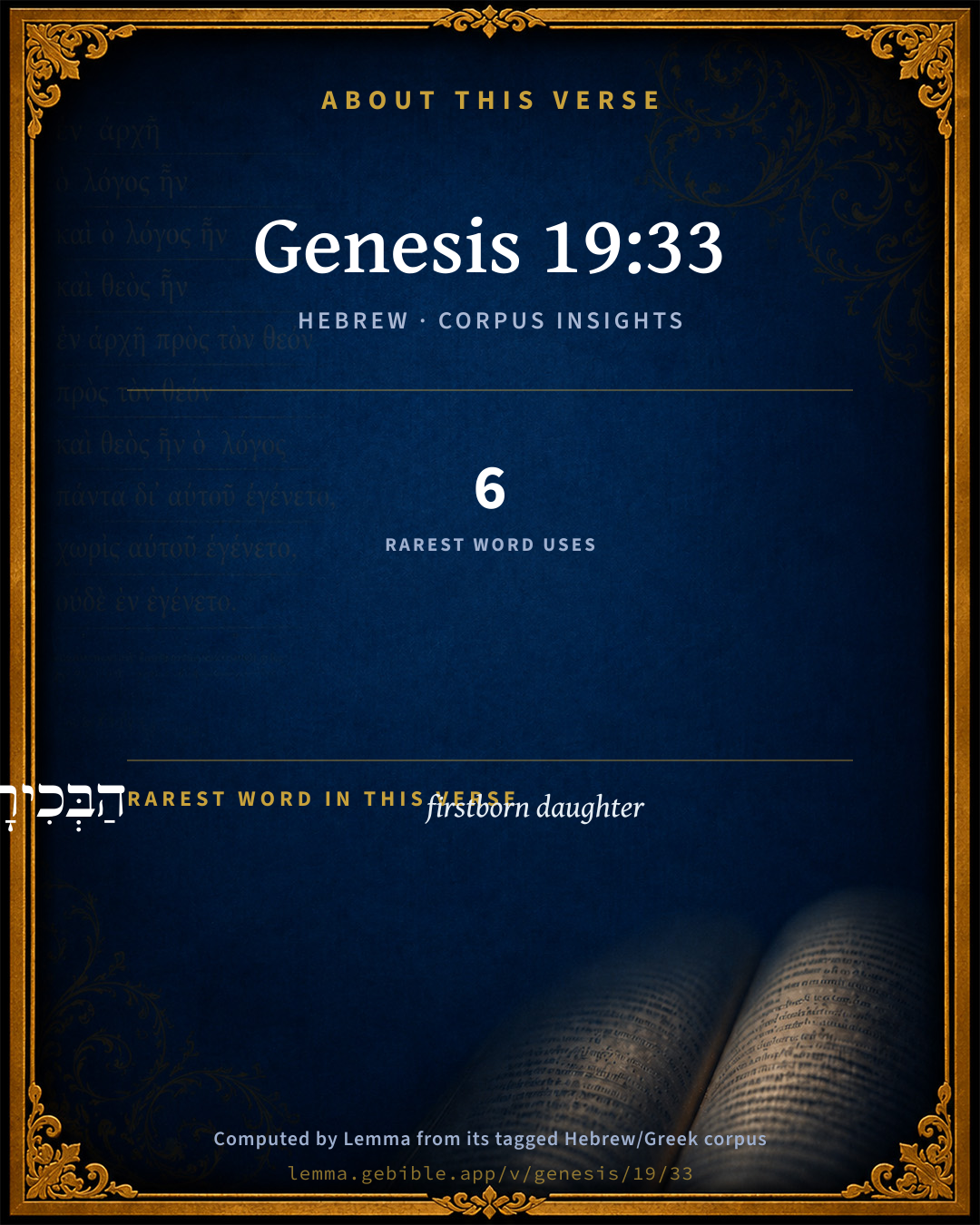
The rarest word here is הַבְּכִירָה֙ firstborn daughter H1067 — appearing just 6 times in the whole Hebrew Bible.

Shared distinctive vocabulary

הַבְּכִירָה֙ firstborn daughter H1067 occurs in 6 verses of the Hebrew Bible. Also found in:

Grammatical profile

  • 6 verbs
  • 5 nouns
  • 1 pronoun
  • 1 preposition
  • 2 particles

Verb forms

  • וַתַּשְׁקֶ֧יןָ Hiphil · Sequential Imperfect
  • וַתָּבֹ֤א Qal · Sequential Imperfect
  • וַתִּשְׁכַּ֣ב Qal · Sequential Imperfect
  • יָדַ֥ע Qal · Perfect
  • בְּשִׁכְבָ֖הּ Qal · Infinitive Construct
  • וּבְקׄוּמָֽהּ Qal · Infinitive Construct

Repetition

Words recur within this verse — often emphatic in Hebrew:

  • אֲבִיהֶ֛ן father H1 ×2
  • וַתִּשְׁכַּ֣ב to lie down H7901 ×2

Hebrew & Septuagint length

In English translation the verse runs 29 words from the Hebrew and 34 from the Septuagint (LXX English) — closely comparable.

A rough comparison of the two English renderings, which tokenize alike — not a word-level alignment.

Word counts can differ between the Hebrew and the Greek without any difference in meaning — e.g. the Hebrew direct-object marker אֵת has no separate Greek word, and Greek often adds the article ὁ.

Cross-references

4

Topical passages linked to Genesis 19:33 in the Treasury of Scripture Knowledge — connected by theme and wording, ordered by reader-vote popularity; previews shown in the World English Bible.

  • Leviticus 18:6–7 "'None of you shall approach anyone who are his close relatives, to uncover their nakedness: I am Yahweh.
  • Proverbs 20:1 Wine is a mocker, and beer is a brawler; Whoever is led astray by them is not wise.
  • Proverbs 23:29–35 Who has woe? Who has sorrow? Who has strife? Who has complaints? Who has needless bruises? Who has bloodshot eyes?
  • Habakkuk 2:15–16 "Woe to him who gives his neighbor drink, pouring your inflaming wine until they are drunk, so that you may gaze at their naked bodies!

Cross-references courtesy of OpenBible.info (CC BY 4.0).

Hebrew and Greek witnesses Masoretic Hebrew ↔ Greek Septuagint

The same verse in the two great witnesses to the Old Testament, shown verse-for-verse.

These are two independent witnesses, not word-aligned to each other, and the Septuagint is shown in lemma (dictionary) form.

Hebrew Genesis 19:33 Masoretic · Westminster Leningrad Codex

וַתַּשְׁקֶ֧יןָ אֶת אֲבִיהֶ֛ן יַ֖יִן בַּלַּ֣יְלָה ה֑וּא וַתָּבֹ֤א הַבְּכִירָה֙ וַתִּשְׁכַּ֣ב אֶת אָבִ֔יהָ וְלֹֽא יָדַ֥ע בְּשִׁכְבָ֖הּ וּבְקׄוּמָֽהּ

They made their father drink wine that night: and the firstborn went in, and lay with her father. He didn't know when she lay down, nor when she arose.

World English Bible · Public Domain

Greek LXX Genesis 19:33 Septuagint · lemma form

ποτίζω δέ ὁ πατήρ αὐτός οἶνος ἐν ὁ νύξ οὗτος καί εἰςἔρχομαι ὁ πρεσβύτερος κοιμάω μετά ὁ πατήρ αὐτός ὁ νύξ ἐκεῖνος καί οὐ οἶδα ἐν ὁ κοιμάω αὐτός καί ἀναἵστημι

So they made their father drink wine in that night, and the elder went in and lay with her father that night, and he knew not when he slept and when he rose up.

LXX2012 (modern English Septuagint) · Public Domain

On this verse, The Pulpit Commentary discusses the Septuagint’s reading. Read the note in Commentary ↓

Hebrew: Westminster Leningrad Codex (CC BY 4.0). Greek: Septuagint (public domain); English from LXX2012 (modern English Septuagint) (Public Domain). How the Septuagint differs from the Hebrew →

Targum (Aramaic paraphrase)

2

The Targum is the ancient Jewish Aramaic paraphrase of the Hebrew Scriptures — an interpretive translation, not the Hebrew text itself. Onkelos (literal) and Pseudo-Jonathan (expansive) render the Torah, and Jonathan the Prophets. Coverage is partial: where no permissively-licensed English translation exists for a verse, only the Aramaic is shown. This is verse-level text, not a word-by-word alignment to the Hebrew.

  1. Targum Onkelos Torah (Genesis–Deuteronomy)
    וְאַשְׁקִיאָה יָת אֲבוּהֶן חַמְרָא בְּלֵילְיָא הוּא וְעַלַּת רַבְּתָא וּשְׁכִיבָא עִם אֲבוּהָא וְלָא יְדַע בְּמִשְׁכְּבַהּ וּבְקִימַהּ

    (no public-domain English translation for this verse)

    Targum Onkelos — Aramaic: “Onkelos Genesis” (public domain); “Onkelos Exodus” (public domain); “Onkelos Leviticus” (public domain); “Onkelos Numbers” (public domain); “Onkelos Deuteronomy” (public domain). English: “Sefaria Community Translation” (CC0 1.0 (public-domain dedication)); “J.W. Etheridge. The Targums of Onkelos and Jonathan Ben Uzziel on the Pentateuch. London: Longmans, Green, 1862” (public domain). Text via Sefaria.

  2. Targum Pseudo-Jonathan Torah (Genesis–Deuteronomy)
    וְאַשְׁקִיאָן יַת אֲבוּהוֹן חֲמַר בְּלֵילָא הַהוּא וְרָוָא וְקָמַת רַבְּתָא וְשַׁמֵישַׁת עִם אֲבוּהָא וְלָא יְדַע בְּמִשְׁכָּבָהּ וְלָא יְדַע בְּמִיקְמָהּ

    And they made their father drink wine that night, and he was drunk. And the elder arose, and lay with her father, nor did he know when she lay down, nor when she arose.

    Targum Pseudo-Jonathan — Aramaic: “Targum Jonathan on Genesis” (public domain); “Targum Jonathan on Exodus” (public domain); “Targum Jonathan on Leviticus” (public domain); “Targum Jonathan on Numbers” (public domain); “Targum Jonathan on Deuteronomy” (public domain). English: “The Targum of Jonathan ben Uzziel, trans. J. W. Etheridge, London, 1862” (public domain). Text via Sefaria.

Commentary

Notes on Genesis 19:33 from classic Christian and Jewish commentators (each source and its license shown beneath its notes). The classic Christian expositions comment on the surrounding passage and are grouped to its opening verse, so a note may address several verses; the Jewish commentaries on the Tanakh (Rashi and others) are per-verse, so they appear only where the commentator wrote on this verse.

Lemma curates 59 commentaries, every one of them public domain or Creative Commons licensed, each selected and text-cleaned for this edition rather than reprinted as found. About our sources →

Trapp's Complete Commentary

John Trapp

Gen 19:33 And they made their father drink wine that night: and the firstborn went in, and lay with her father; and he perceived not when she lay down, nor when she arose.

Ver. 33. Nor when she arose.] There is a tittle extraordinary in the Hebrew, to note that this is a thing incredible, {a} Coire quempiam nescientem . Cajetan and Pererius conclude it possible, and give reasons for it. Calvin saith best, that it was not so much his wine, as a spirit of slumber sent upon him from God, for a scourge of his intemperance. Luther adds, Ne nos abeamus in securitatem , that we may watch against security.

{a} Appungunt desuper quasi incredibile . - Quaest. in Genes.

John Trapp, A Commentary or Exposition upon All the Books of the Old and New Testament (1647–1656) — public domain. Text from a community e-Sword module.

Rashi

Rabbi Shlomo Yitzchaki (Rashi)

'ותשקין וגו AND THEY MADE THEIR FATHER DRINK [WINE] etc. — Wine was at hand for them in the cave out of a set purpose that they might bring forth two nations (Midrash Tanchuma, Beshalach 12).

ותשכב את אביה AND SHE LAY WITH HER FATHER — In the case of the younger daughter it is written (Genesis 19:35) “and she lay with him”, and it does not state “she lay with her father”. But because the younger did not originate this unchaste conduct but her sister taught it to her, Scripture glosses over her sin and does not explicitly make mention of her shame; but since the elder originated this unchaste conduct Scripture exposes her fully (Numbers Rabbah 20:23).

ובקומה NOR WHEN SHE AROSE — This word where it occurs with reference to the elder sister (Genesis 19:33) has dots above it (as though it is not written at all), implying that when she arose, he (Lot) was aware of it, and yet he did not take care on the second night to abstain from wine. (Horayot 10b.) R. Levi said, Whoever is inflamed by sexual desire will, in the end, be made to eat his own flesh (Genesis Rabbah 51:9).

Rashi on the Tanakh — English translations: “The Judaica Press complete Tanach with Rashi, translated by A. J. Rosenberg” (CC BY 4.0); “Pentateuch with Rashi's commentary by M. Rosenbaum and A.M. Silbermann, 1929-1934” (public domain); “The Metsudah Tanach series, Lakewood, N.J” (CC BY 4.0); and “The Book of Joshua, Metsudah Publications, 1997” (CC BY 4.0). Text via Sefaria.

Adam Clarke's Commentary

Verse 33. And he perceived not when she lay down, nor when, c.] That is, he did not perceive the time she came to his bed, nor the time she quitted it consequently did not know who it was that had lain with him. In this transaction Lot appears to me to be in many respects excusable.

1. He had no accurate knowledge of what took place either on the first or second night, therefore he cannot be supposed to have been drawn away by his own lust, and enticed. That he must have been sensible that some person had been in his bed, it would be ridiculous to deny; but he might have judged it to have been some of his female domestics, which it is reasonable to suppose he might have brought from Zoar.

2. It is very likely that he was deceived in the wine, as well as in the consequences; either he knew not the strength of the wine, or wine of a superior power had been given to him on this occasion. As he had in general followed the simple pastoral life, it is not to be wondered at if he did not know the intoxicating power of wine, and being an old man, and unused to it, a small portion would be sufficient to overcome him; sound sleep would soon, at his time of life, be the effect of taking the liquor to which he was unaccustomed, and cause him to forget the effects of his intoxication.

Except in this case, his moral conduct stands unblemished in the sacred writings; and as the whole transaction, especially as it relates to him, is capable of an interpretation not wholly injurious to his piety, both reason and religion conjoin to recommend that explanation. As to his daughters, let their ignorance of the real state of the case plead for them, as far as that can go; and let it be remembered that their sin was of that very peculiar nature as never to be capable of becoming a precedent. For it is scarcely possible that any should ever be able to plead similar circumstances in vindication of a similar line of conduct.

Adam Clarke's Commentary on the Bible (1810–1826) — public domain. Text from a community e-Sword/MySword module.

John Calvin's Commentaries

33. And he perceived not. Though Lot not sinned knowingly, yet, because his drunkenness was the cause of his sin, his guilt is diminished, but not annulled. Without doubt the Lord has chastised his dissatisfaction in this manner. This is something rare and strange, that his senses are so under influence of the wine, that he, like a dead man pours out his lust. Therefore I assume that he not so much is fuddled through the wine, but that his excessiveness is beat by God through the spirit of ignorance. And when God has not spared the holy Patriarch, how can we then think to be unpunished, when we do the same excessiveness? Let we therefore realize through this example, that the law of modesty is prescribed us, in order that we eat modestly and moderately. Yet, there are some unholy people, who consider Lot as the protector of their wickedness.

Why do we not rather think to which horrible scandal he has decayed, because he excessively used wine? We must, as I already have said, not simply consider what the drunkenness drags along with it, and with which other vices it is connected, but we must consider the punishment of God. Therefore he willed openly spread this tragic crime, in order that the drunkenness will be abhorred. Daily the Lord testifies by heavy punishments, how much this vice displeases Him. When we see that Abraham’s nephew, the host of Angels, a man adored with extraordinary fame of holiness, is defiled by unchaste intercourse, because he has drunk too much, what will then happen to the guzzlers and the whores, who daily drink themselves drunken? But we have at great length spoken about this in the ninth chapter Genesis 9:1, what men can reread. Concerning the words, when Moses says, that Lot did not perceive it, that his daughter lay down and arose — some explain it thus that he saw no difference between a stranger and his own daughter. But when he was not totally blinded, he could in the morning, having slept out his intoxication, know that he has had intercourse with his daughter. Some say, to diminish his guilt, that he not so much is fuddled through much drinking, but that he was depressed through sadness. But I retain this, that he, as he was endowed with more splendid gifts, also deserved the more punishment, and that therefore his reason was taken away from him, so that he, like a unreasonable beast, lost himself in sensual lust.

John Calvin's Commentaries (1540-1563) — public domain. Text from the Calvin Translation Society English edition (1840s-50s) via the Christian Classics Ethereal Library (ccel.org). Calvin's coverage is partial (roughly two-thirds of the Bible); uncommented books and verses are honest gaps, never fabricated. The 19th-century editor's footnotes and remarks are omitted so the notes are faithfully Calvin's own voice.

John Gill's Exposition

And it came to pass on the morrow,.... The day following the night, in which the above was transacted:

that the firstborn said to the younger, behold, I lay yesternight with my father; informed her, that what they had contrived succeeded according to their wish, and therefore, for her encouragement to go on, proposes to take the same method again:

let us make him drink wine this night also, and go thou in and lie with him, that we may preserve seed of our father; may have children by him, and so our family be kept up, from whence it may be hoped the Messiah will spring; see Gill on Gen 19:32.

John Gill's Exposition of the Whole Bible (1746–1763) — public domain (CC PDM 1.0). Text via the HelloAO Bible API.

Matthew Poole's English Annotations

They made their father drink wine, to wit, in excess, so as to deprive him of the use of his reason and grace, which was likely to frustrate their project: this was a great sin, not only in them, but also in Lot himself, not to be excused by ignorance of the virtue of wine, which being known to both the daughters, certainly their father could not be ignorant of it. Thus he who kept his integrity in the midst of all the temptations of Sodom, falls into a grievous sin in a place where he might seem most remote from all temptations; God permitting this, to teach all following ages how weak even the best men are when they are left to themselves, and what absolute need they have of Divine assistance.

He perceived not; wherein there is nothing strange, it being usual with drunken men to do many things in that condition, which, when they come to themselves, they perfectly forget. And so might Lot, when under the power of wine, forget that his wife was turned into a pillar of salt, and might mistake his daughter for his wife.

Matthew Poole's English Annotations on the Holy Bible (1683–1685) — public domain. Text from a community e-Sword/MySword module.

Whedon's Commentary on the Bible

Daniel D. Whedon

33. He perceived not — “These words do not affirm that he was in an unconscious state; they merely mean that in his intoxicated state, though not entirely unconscious, yet he lay with his daughters without clearly knowing what he was doing.… But Lot’s daughters had so little feeling of shame in connexion with their conduct, that they gave names to the sons they bore which have immortalized their paternity.” — Keil.

Daniel D. Whedon (gen. ed.), Commentary on the Old and New Testaments (1874–1909) — public domain. Text from a community e-Sword module.

The Pulpit Commentary

And they made their father drink wine that night which was sinful both in them and him (vide Isa_5:11; Pro_20:1; Hab_2:15) and the firstborn went in, and lay with her father; and he perceived not when she lay down, nor when she arose.

That it was his own daughter quacum concumberet (Rosenm being so intoxicated that he could not discern who it was to whom he had approached, or even what he was doing (Keil). The reading, "when he lay down and when he arose (LXX) is incorrect, and the explanations that Lot was a mere unconscious instrument in this disgraceful transaction (Kalisch), that he was-entirely ignorant of all that had taken place (Chrysostom, Cajetan), that he was struck on account of his intemperance with a spirit of stupor (Calvin), are not warranted by the text.

The Pulpit Commentary (1880–1919), ed. H.D.M. Spence-Jones & Joseph S. Exell — public domain. Text from a community e-Sword module.

Radak

Rabbi David Kimhi (Radak)

ותשקין...בלילה הוא, the letter ה at the beginning of the word which would have served as the definitive article for the adjective is missing here, as it is also Samuel II 6,2 את העגלה חדשה, [which should have beenהחדשה Ed.] just as it is also missing in Numbers 28,4 את הכבש אחד, instead of האחד.

ולא ידע, even when his daughter broke off the physical contact with her father, Lot remained totally unaware of this. [this is why we speak of “drunk as Lot,” when referring to someone’s drunken stupor. Ed.] The Torah mentions this detail to hint that had he noticed any of this Lot would have resisted the sexual union with his daughter and would have severely remonstrated with her for performing such a despicable act. According to an allegorical approach, (quoted by Rashi,) the dot over the letter ו in this word suggests that Lot did notice when his daughter broke the contact, and therefore he can be faulted for not ensuring that the same did not happen to him on any of the following nights.

Radak on the Tanakh — English translations: “Sefaria Community Translation” (CC0 1.0 (public-domain dedication)); “Eliyahu Munk, HaChut Hameshulash” (CC BY 4.0); “Rabbi Mike Feuer, Jerusalem Anthology” (CC BY 4.0); and “R. David Kimhi on the first book of Psalms, Translated by R.G. Finch, London, 1919” (public domain). Text via Sefaria.

Lesson kit

Teaching starters — assembled from the data on this page, not authored interpretation. Every prompt links to the verse data it draws on. Edit before teaching.

Genesis, in the Pentateuch, opens this verse with 15 words (13 distinct Hebrew lemmas). Its most distinctive word is bᵉkîyrâh (“firstborn daughter”). A historical commentator’s framing appears above. Read the whole chapter for the surrounding context.

Discussion questions

  1. How does “firstborn daughter” (bᵉkîyrâh) shape what this verse is saying?
  2. Genesis 19:31 shares the word «firstborn daughter» with this verse. How do the two illuminate each other?
  3. “father” occurs 2× in this one verse. What is the effect of the repetition?
  4. These translations render this verse differently; the difference is in the English rendering, not the original. What questions does that raise?
  5. The verb «וַתַּשְׁקֶ֧יןָ» is Hiphil Sequential Imperfect. How does its form color the action?
  6. Reading how Trapp's Complete Commentary and Rashi read this verse, where do the two commentators agree and where do they part?

Things to notice

Reading settings

Reading text

Shown beneath each verse's original-language words.

Old Testament
Old Testament edition

Read the OT as the Masoretic Hebrew (MT) or the Greek Septuagint (LXX).

English shown for the Greek Septuagint (in the Hebrew ↔ Greek comparison).

Comparing translations? Open the Compare panel on any verse page to stack up to four side by side.