
Genesis 43:18

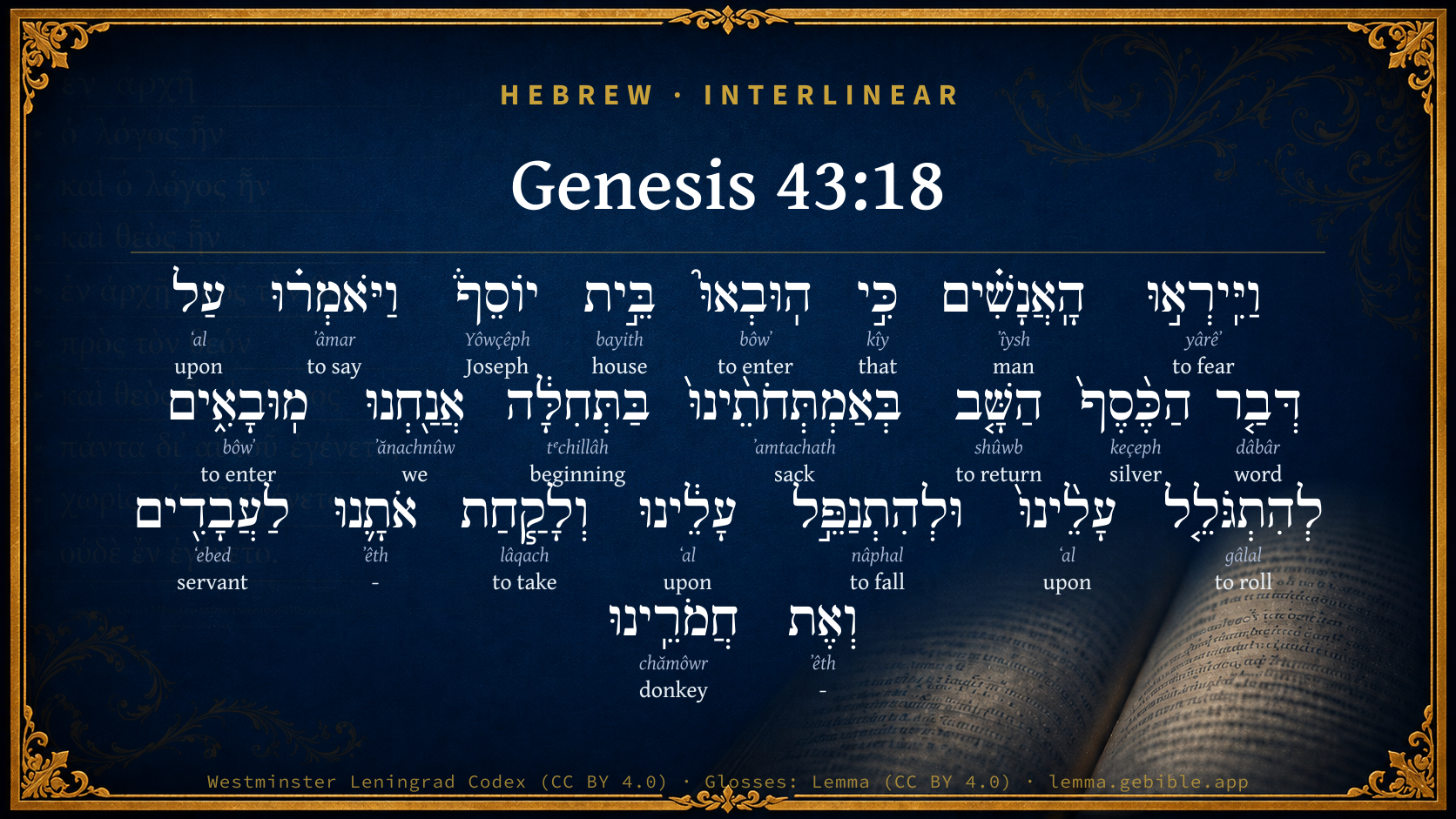
Hebrew (Westminster Leningrad Codex) Genesis 43:18 appears in the Hebrew Old Testament. The text above is from the Westminster Leningrad Codex. Each word links to its Strong’s number, a concise gloss, and parsing drawn from the Open Scriptures Hebrew Bible morphology. Click any word for its full Brown-Driver-Briggs (BDB) entry.
Download image
Cite this verse

Genesis 43:18 (World English Bible). Public Domain. Lemma interlinear Bible study tool, https://lemma.gebible.app/v/genesis/43/18.

Show BibTeX & RIS
BibTeX
RIS
English Translation
The men were afraid, because they were brought to Joseph's house; and they said, "Because of the money that was returned in our sacks at the first time are we brought in; that he may seek occasion against us, and fall on us, and take us for bondservants, along with our donkeys."
World English Bible · Public Domain
Download a study sheet

One document with this verse’s original text, its word-by-word gloss line, the meaning frame, cross-references with their text, attributed commentary, and full source and license credits — printable, and it pastes into notes with its structure intact.

This verse Autodidact and up

Study sheet (.html) Plain text (.txt)

A passage Seminary Student

Up to 50 verses in one chapter. A passage sheet keeps up to 6 commentary sources and 12 cross-references per verse, in the order this page ranks them, and says so on the sheet whenever that leaves anything out. Ask for a single verse and you get the Autodidact verse sheet above.

Everything on this page stays free to read, with no account — the sheet is a download of what is already on screen, not access to it.

Want to remove ads? Support Godless Engineer
Compare translations 3

The same verse in 3 English versions, stacked beneath the original-language interlinear above. Click any original word for its lexicon entry.

Each is an independent rendering of the whole verse — the interlinear is not word-aligned to these translations.

Highlighted words mark where these versions differ — a whole-verse word diff, not a word-by-word alignment.

  • World English Bible Public Domain
    The men were afraid, because they were brought to Joseph's house; and they said, "Because of the money that was returned in our sacks at the first time are we brought in; that he may seek occasion against us, and fall on us, and take us for bondservants, along with our donkeys."
  • King James Version Public Domain
    And the men were afraid, because they were brought into Joseph's house; and they said, Because of the money that was returned in our sacks at the first time are we brought in; that he may seek occasion against us, and fall upon us, and take us for bondmen, and our asses.
  • unfoldingWord Literal Text CC BY-SA 4.0
    And the men were afraid when they were brought Joseph’s house, and they said, “Because of the matter of the silver that was returned in our sacks the first time, we have been brought. to roll himself over us and throw himself on us and take us as slaves, and our donkeys!”

unfoldingWord Literal Text — © unfoldingWord, licensed CC BY-SA 4.0. Word-aligned USFM3 via Door43 (git.door43.org/unfoldingWord/en_ult).

Versions to compare (up to 4)

3 of 4 selected

Show all 18 translations

Every available English version of this verse, each an independent rendering of the whole verse.

  • World English Bible Public Domain
    The men were afraid, because they were brought to Joseph's house; and they said, "Because of the money that was returned in our sacks at the first time are we brought in; that he may seek occasion against us, and fall on us, and take us for bondservants, along with our donkeys."
  • Berean Standard Bible Public Domain
    But the brothers were frightened that they had been taken to Joseph’s house. “We have been brought here because of the silver that was returned in our bags the first time,” they said. “They intend to overpower us and take us as slaves, along with our donkeys.”
  • Majority Standard Bible Public Domain
    But the brothers were frightened that they had been taken to Joseph’s house. “We have been brought here because of the silver that was returned in our bags the first time,” they said. “They intend to overpower us and take us as slaves, along with our donkeys.”
  • King James Version Public Domain
    And the men were afraid, because they were brought into Joseph's house; and they said, Because of the money that was returned in our sacks at the first time are we brought in; that he may seek occasion against us, and fall upon us, and take us for bondmen, and our asses.
  • American Standard Version (1901) Public Domain
    And the men were afraid, because they were brought to Joseph's house; and they said, Because of the money that was returned in our sacks at the first time are we brought in; that he may seek occasion against us, and fall upon us, and take us for bondmen, and our asses.
  • Revised Version (1885) Public Domain
    And the men were afraid, because they were brought into Joseph’s house; and they said, Because of the money that was returned in our sacks at the first time are we brought in; that he may seek occasion against us, and fall upon us, and take us for bondmen, and our asses.
  • Geneva Bible (1599) Public Domain
    Nowe when the men were brought into Iosephs house, they were afrayd, and sayd, Because of the money, that came in our sackes mouthes at the first time, are we brought, that hee may picke a quarrell against vs, and lay some thing to our charge, and bring vs in bondage and our asses.
  • Douay-Rheims (1899) Public Domain
    And they being much afraid, said there one to another: Because of the money, which we carried back the first time in our sacks, we are brought in: that he may bring upon us a false accusation, and by violence make slaves of us and our asses.
  • Young's Literal Translation Public Domain
    and the men are afraid because they have been brought into the house of Joseph, and they say, `For the matter of the money which was put back in our bags at the commencement are we brought in -- to roll himself upon us, and to throw himself on us, and to take us for servants -- our asses also.'
  • Literal Standard Version CC BY-SA 4.0
    and the men are afraid because they have been brought into the house of Joseph, and they say, “For the matter of the money which was put back in our bags at the commencement are we brought in—to roll himself on us, and to throw himself on us, and to take us for servants—our donkeys also.”
  • Unlocked Literal Bible CC BY-SA 4.0
    The men were afraid because they were brought to Joseph's house. They said, “It is because of the money that was returned in our sacks the first time we were brought in, that he may seek an opportunity against us. He might arrest us and take us as slaves, and take our donkeys.”
  • unfoldingWord Literal Text CC BY-SA 4.0
    And the men were afraid when they were brought Joseph’s house, and they said, “Because of the matter of the silver that was returned in our sacks the first time, we have been brought. to roll himself over us and throw himself on us and take us as slaves, and our donkeys!”
  • Darby Bible Public Domain
    And the men were afraid because they were brought into Joseph's house, and said, Because of the money that was returned to us in our sacks at the beginning are we brought in, that he may turn against us, and fall upon us and take us for bondmen, and our asses.
  • World Messianic Bible Public Domain
    The men were afraid, because they were brought to Joseph’s house; and they said, “Because of the money that was returned in our sacks the first time, we’re brought in; that he may seek occasion against us, attack us, and seize us as slaves, along with our donkeys.”
  • Webster's Bible Public Domain
    \\43:19\\And they came near to the steward of Joseph's house, and they communed with him at the door of the house,
  • Free Bible Version CC BY-SA 4.0
    They were really worried that they were being taken to Joseph's house. “It's because of the money that was put in our sacks the first time we came,” they said to each other. “That's why we're being brought in—so he can accuse us and attack us! He'll make us his slaves and take our donkeys!”
  • Bible in Basic English Public Domain
    So they went up to Joseph's chief servant at the door of the house,
  • JPS Tanakh (1917) Public Domain
    And the men were afraid, because they were brought into Joseph's house; and they said: 'Because of the money that was returned in our sacks at the first time are we brought in; that he may seek occasion against us, and fall upon us, and take us for bondmen, and our asses.'

Literal Standard Version (2020), Covenant Press — licensed CC BY-SA 4.0. Text via the HelloAO Bible API (eBible.org). Unlocked Literal Bible (unfoldingWord) — licensed CC BY-SA 4.0. Text via the HelloAO Bible API (eBible.org). unfoldingWord Literal Text — © unfoldingWord, licensed CC BY-SA 4.0. Word-aligned USFM3 via Door43 (git.door43.org/unfoldingWord/en_ult). Free Bible Version, Dr. Jonathan Gallagher — licensed CC BY-SA 4.0. Text via the HelloAO Bible API (eBible.org).

Word by word

More ways to search: Search by grammar → Find every occurrence → Compare this word →

Practice this passage: Drill this verse → Learn its vocabulary →

בְּאַמְתְּחֹתֵ֨ינוּ֙
ʼamtachath
H572
“in/at · sacks · our”
Preposition + Noun, Common, Feminine, Plural, Construct + Suffix, Personal, 1st Person, Common, Plural
Part of Speech
Preposition + Noun
Type
Common
Gender
Feminine
Number
Plural
State
Construct
Full BDB Definition

Origin: from H4969

TWOT: 1265a

sack, flexible container (for grain) - (TWOT) spread out
  1. וַיִּֽירְא֣וּ yârêʼ H3372 “and · to fear” Conjunction + Verb, Qal, Sequential Imperfect, 3rd Person, Masculine, Plural
  2. הָֽאֲנָשִׁ֗ים ʼîysh H376 “the · men” Particle, Definite Article + Noun, Common, Masculine, Plural, Absolute
  3. כִּ֣י kîy H3588 “that” Conjunction
  4. הֽוּבְאוּ֮ bôwʼ H935 “to enter” Verb, Hophal, Perfect, 3rd Person, Common, Plural
  5. בֵּ֣ית bayith H1004 “house of” Noun, Common, Masculine, Singular, Construct
  6. יוֹסֵף֒ Yôwçêph H3130 “Joseph” Noun, Proper
  7. וַיֹּאמְר֗וּ ʼâmar H559 “and · to say” Conjunction + Verb, Qal, Sequential Imperfect, 3rd Person, Masculine, Plural
  8. עַל ʻal H5921 “upon” Preposition
  9. דְּבַ֤ר dâbâr H1697 “word of” Noun, Common, Masculine, Singular, Construct
  10. הַכֶּ֨סֶף֙ keçeph H3701 “the · silver” Particle, Definite Article + Noun, Common, Masculine, Singular, Absolute
  11. הַשָּׁ֤ב shûwb H7725 “the · returning” Particle, Definite Article + Verb, Qal, Participle Active, Masculine, Singular, Absolute
  12. בַּתְּחִלָּ֔ה tᵉchillâh H8462 “in/at the · beginning” Preposition, Determined + Noun, Common, Feminine, Singular, Absolute
  13. אֲנַ֖חְנוּ ʼănachnûw H587 “we” Pronoun, Personal, 1st Person, Common, Plural
  14. מֽוּבָאִ֑ים bôwʼ H935 “entered” Verb, Hophal, Participle Passive, Masculine, Plural, Absolute
  15. לְהִתְגֹּלֵ֤ל gâlal H1556 “to roll” Preposition + Verb, Hithpolel, Infinitive Construct
  16. עָלֵ֨ינוּ֙ ʻal H5921 “upon · us” Preposition + Suffix, Personal, 1st Person, Common, Plural
  17. וּלְהִתְנַפֵּ֣ל nâphal H5307 “and · to fall” Conjunction + Preposition + Verb, Hithpael, Infinitive Construct
  18. עָלֵ֔ינוּ ʻal H5921 “upon · us” Preposition + Suffix, Personal, 1st Person, Common, Plural
  19. וְלָקַ֧חַת lâqach H3947 “and · to take” Conjunction + Preposition + Verb, Qal, Infinitive Construct
  20. אֹתָ֛נוּ ʼêth H853 “- · us” Particle, Direct Object + Suffix, Personal, 1st Person, Common, Plural
  21. לַעֲבָדִ֖ים ʻebed H5650 “to/for · servants” Preposition + Noun, Common, Masculine, Plural, Absolute
  22. וְאֶת ʼêth H853 “and · -” Conjunction + Particle, Direct Object
  23. חֲמֹרֵֽינוּ chămôwr H2543 “donkeys · our” Noun, Common, Both, Plural, Construct + Suffix, Personal, 1st Person, Common, Plural

About this verse

These counts appear in no published source. They are computed here, from the morphology-tagged text and Lemma’s own curated glosses. What Lemma adds →

24
words
20
distinct lemmas
Pentateuch
section

Notable vocabulary

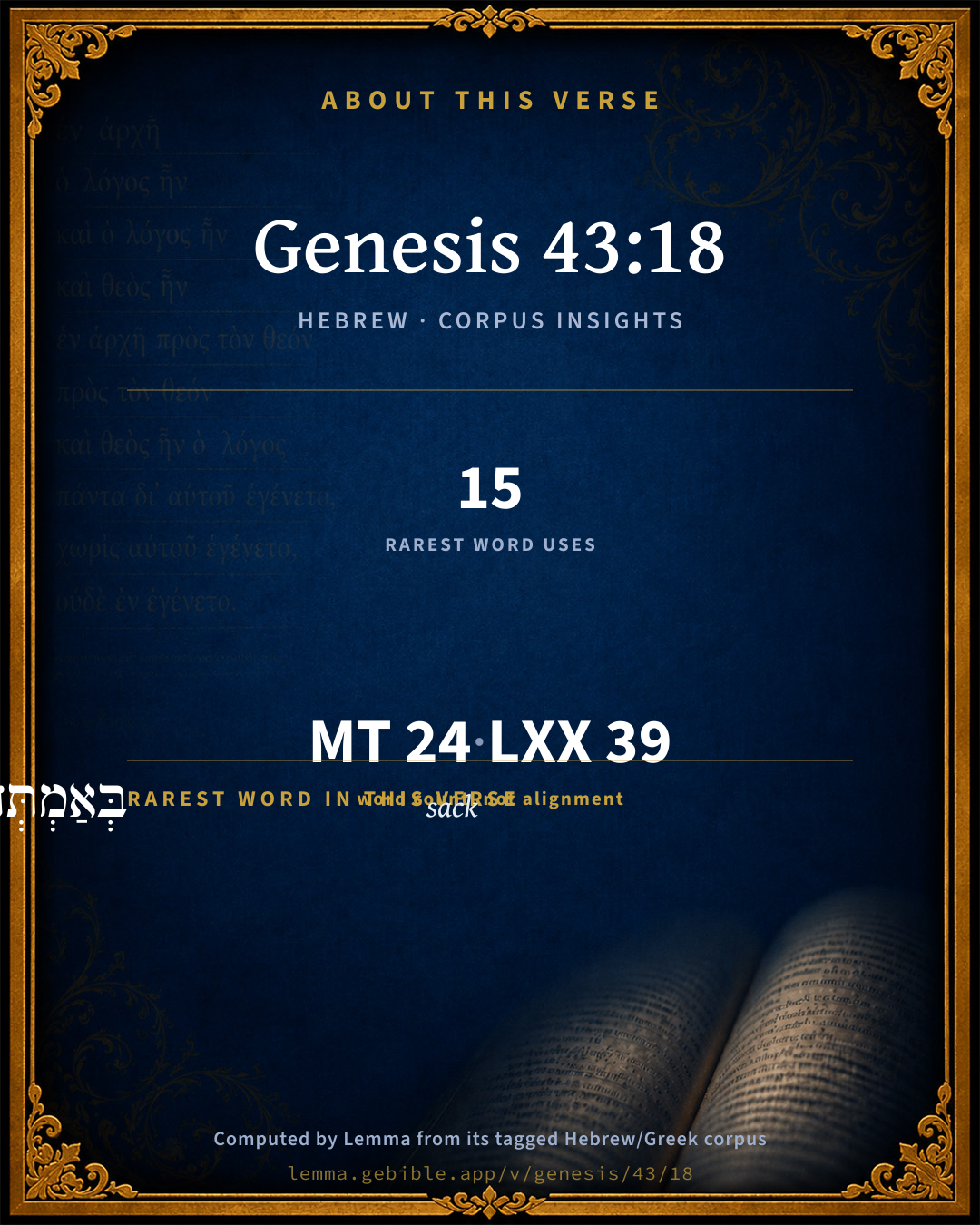
The rarest word here is בְּאַמְתְּחֹתֵ֨ינוּ֙ sack H572 — appearing just 15 times in the whole Hebrew Bible.

Shared distinctive vocabulary

בְּאַמְתְּחֹתֵ֨ינוּ֙ sack H572 occurs in 12 verses of the Hebrew Bible. Also found in:

Grammatical profile

  • 8 verbs
  • 9 nouns
  • 1 pronoun
  • 3 prepositions
  • 1 conjunction
  • 2 particles

Verb forms

  • וַיִּֽירְא֣וּ Qal · Sequential Imperfect
  • הֽוּבְאוּ֮ Hophal · Perfect
  • וַיֹּאמְר֗וּ Qal · Sequential Imperfect
  • הַשָּׁ֤ב Qal · Participle Active
  • מֽוּבָאִ֑ים Hophal · Participle Passive
  • לְהִתְגֹּלֵ֤ל Hithpolel · Infinitive Construct
  • וּלְהִתְנַפֵּ֣ל Hithpael · Infinitive Construct
  • וְלָקַ֧חַת Qal · Infinitive Construct

Repetition

Words recur within this verse — often emphatic in Hebrew:

  • עַל upon H5921 ×3
  • הֽוּבְאוּ֮ to enter H935 ×2

Hebrew & Septuagint length

In English translation the verse runs 52 words from the Hebrew and 54 from the Septuagint (LXX English) — closely comparable.

A rough comparison of the two English renderings, which tokenize alike — not a word-level alignment.

Word counts can differ between the Hebrew and the Greek without any difference in meaning — e.g. the Hebrew direct-object marker אֵת has no separate Greek word, and Greek often adds the article ὁ.

In the original languages it is 24 Hebrew tokens and 39 Greek tokens — but the two are counted differently (Hebrew bundles its prefixes and suffixes into one token; the Greek is in lemma form), so that isn’t a like-for-like length.

Cross-references

15

Topical passages linked to Genesis 43:18 in the Treasury of Scripture Knowledge — connected by theme and wording, ordered by reader-vote popularity; previews shown in the World English Bible.

  • Genesis 42:35 It happened as they emptied their sacks, that behold, every man's bundle of money was in his sack. When they and their father saw their bundles of money, they were afraid.
  • Genesis 42:21 They said one to another, "We are most assuredly guilty concerning our brother, in that we saw the distress of his soul, when he begged us, and we wouldn't listen. Therefore this distress has come on us."
  • Genesis 42:28 He said to his brothers, "My money is restored! Behold, it is even in my sack." Their hearts failed them, and they turned trembling one to another, saying, "What is this that God has done to us?"
  • Deuteronomy 22:14 and lay shameful things to her charge, and bring up an evil name on her, and say, I took this woman, and when I came near to her, I didn't find in her the tokens of virginity;
  • Deuteronomy 22:17 and, behold, he has laid shameful things [to her charge], saying, I didn't find in your daughter the tokens of virginity; and yet these are the tokens of my daughter's virginity. They shall spread the garment before the elders of the city.
  • Judges 13:22 Manoah said to his wife, We shall surely die, because we have seen God.
  • Judges 14:4 But his father and his mother didn't know that it was of Yahweh; for he sought an occasion against the Philistines. Now at that time the Philistines had rule over Israel.
  • Job 15:21 A sound of terrors is in his ears; In prosperity the destroyer shall come on him.
  • Job 30:14 As through a wide breach they come, In the midst of the ruin they roll themselves in.
  • Psalms 73:16 When I tried to understand this, It was too painful for me;
  • Isaiah 7:2 It was told the house of David, saying, "Syria is allied with Ephraim." His heart trembled, and the heart of his people, as the trees of the forest tremble with the wind.
  • Matthew 14:26–27 When the disciples saw him walking on the sea, they were troubled, saying, "It's a ghost!" and they cried out for fear.
  • Mark 6:16 But Herod, when he heard this, said, "This is John, whom I beheaded. He has risen from the dead."
  • Romans 7:8 But sin, finding occasion through the commandment, produced in me all kinds of coveting. For apart from the law, sin is dead.
  • Psalms 53:5 There they were in great fear, where no fear was, For God has scattered the bones of him who encamps against you. You have put them to shame, Because God has rejected them.

Cross-references courtesy of OpenBible.info (CC BY 4.0).

Hebrew and Greek witnesses Masoretic Hebrew ↔ Greek Septuagint

The same verse in the two great witnesses to the Old Testament, shown verse-for-verse.

These are two independent witnesses, not word-aligned to each other, and the Septuagint is shown in lemma (dictionary) form.

Hebrew Genesis 43:18 Masoretic · Westminster Leningrad Codex

וַיִּֽירְא֣וּ הָֽאֲנָשִׁ֗ים כִּ֣י הֽוּבְאוּ֮ בֵּ֣ית יוֹסֵף֒ וַיֹּאמְר֗וּ עַל דְּבַ֤ר הַכֶּ֨סֶף֙ הַשָּׁ֤ב בְּאַמְתְּחֹתֵ֨ינוּ֙ בַּתְּחִלָּ֔ה אֲנַ֖חְנוּ מֽוּבָאִ֑ים לְהִתְגֹּלֵ֤ל עָלֵ֨ינוּ֙ וּלְהִתְנַפֵּ֣ל עָלֵ֔ינוּ וְלָקַ֧חַת אֹתָ֛נוּ לַעֲבָדִ֖ים וְאֶת חֲמֹרֵֽינוּ

The men were afraid, because they were brought to Joseph's house; and they said, "Because of the money that was returned in our sacks at the first time are we brought in; that he may seek occasion against us, and fall on us, and take us for bondservants, along with our donkeys."

World English Bible · Public Domain

Greek LXX Genesis 43:18 Septuagint · lemma form

ὁράω δέ ὁ ἄνθρωπος ὅτι εἰςἄγω εἰς ὁ οἶκος ιωσηφ εἶπον διά ὁ ἀργύριον ὁ ἀποστρέφω ἐν ὁ μάρσιππος ἐγώ ὁ ἀρχή ἐγώ εἰςἄγω ὁ συκοφαντέω ἐγώ καί ἐπιτίθημι ἐγώ ὁ λαμβάνω ἐγώ εἰς παῖς καί ὁ ὄνος ἐγώ

And the men, when they perceived that they were brought into the house of Joseph, said, We are brought in because of the money that was returned in our sacks at the first; even in order to inform against us, and lay it to our charge; to take us for servants, and our asses.

LXX2012 (modern English Septuagint) · Public Domain

On this verse, The Cambridge Bible for Schools and Colleges discusses the Septuagint’s reading. Read the note in Commentary ↓

Hebrew: Westminster Leningrad Codex (CC BY 4.0). Greek: Septuagint (public domain); English from LXX2012 (modern English Septuagint) (Public Domain). How the Septuagint differs from the Hebrew →

Targum (Aramaic paraphrase)

2

The Targum is the ancient Jewish Aramaic paraphrase of the Hebrew Scriptures — an interpretive translation, not the Hebrew text itself. Onkelos (literal) and Pseudo-Jonathan (expansive) render the Torah, and Jonathan the Prophets. Coverage is partial: where no permissively-licensed English translation exists for a verse, only the Aramaic is shown. This is verse-level text, not a word-by-word alignment to the Hebrew.

  1. Targum Onkelos Torah (Genesis–Deuteronomy)
    וּדְחִילוּ גֻּבְרַיָּא אֲרֵי אִתַּעֲלוּ לְבֵית יוֹסֵף וַאֲמָרוּ עַל עֵסַק כַּסְפָּא דְּאִתּוֹתַב בְּטוֹעֲנָנָא בְּקַדְמֵיתָא אֲנַחְנָא מִתַּעֲלִין לְאִתְרַבְרָבָא עֲלָנָא וּלְאִסְתַּקָּפָא עֲלָנָא וּלְמִקְנֵי יָתָנָא לְעַבְדִּין וּלְמִדְבַּר יָת חֲמָרָנָא

    (no public-domain English translation for this verse)

    Targum Onkelos — Aramaic: “Onkelos Genesis” (public domain); “Onkelos Exodus” (public domain); “Onkelos Leviticus” (public domain); “Onkelos Numbers” (public domain); “Onkelos Deuteronomy” (public domain). English: “Sefaria Community Translation” (CC0 1.0 (public-domain dedication)); “J.W. Etheridge. The Targums of Onkelos and Jonathan Ben Uzziel on the Pentateuch. London: Longmans, Green, 1862” (public domain). Text via Sefaria.

  2. Targum Pseudo-Jonathan Torah (Genesis–Deuteronomy)
    וּדְחִילוּ גוּבְרַיָא אֲרוּם אִיתְעֲלוּ לְבֵית יוֹסֵף וַאֲמָרוּ עַל עֵיסַק כַּסְפָּא דְתַב לְטוֹנָנָא בְּקַדְמֵיתָא אֲנַן מִתְעֲלִין לְמִתְעַקְפָא עֲלָן וּלְמִדְיָינָא עֲלָן וּלְמִקְנֵי יָתָן לְעַבְדִין וּלְמֵיסַב יַת חַמְרָנָא

    The men feared when they were brought into Joseph's house, and said, For the money that was returned in our sacks at the first are we brought in, that be may find occasion against us and condemn us, and sell us for slaves, and take our asses.

    Targum Pseudo-Jonathan — Aramaic: “Targum Jonathan on Genesis” (public domain); “Targum Jonathan on Exodus” (public domain); “Targum Jonathan on Leviticus” (public domain); “Targum Jonathan on Numbers” (public domain); “Targum Jonathan on Deuteronomy” (public domain). English: “The Targum of Jonathan ben Uzziel, trans. J. W. Etheridge, London, 1862” (public domain). Text via Sefaria.

Commentary

Notes on Genesis 43:18 from classic Christian and Jewish commentators (each source and its license shown beneath its notes). The classic Christian expositions comment on the surrounding passage and are grouped to its opening verse, so a note may address several verses; the Jewish commentaries on the Tanakh (Rashi and others) are per-verse, so they appear only where the commentator wrote on this verse.

Lemma curates 59 commentaries, every one of them public domain or Creative Commons licensed, each selected and text-cleaned for this edition rather than reprinted as found. About our sources →

Trapp's Complete Commentary

John Trapp

Gen 43:18 And the men were afraid, because they were brought into Joseph’s house; and they said, Because of the money that was returned in our sacks at the first time are we brought in; that he may seek occasion against us, and fall upon us, and take us for bondmen, and our asses.

Ver. 18. And the men were afraid.] Where no fear was; but that an ill conscience haunted them, and so "the sound of a shaken leaf" {Lev 26:36} put them into a fright. As every body hath its shadow, so hath every sin its fear; and fear torment. {1Jn 4:18}

John Trapp, A Commentary or Exposition upon All the Books of the Old and New Testament (1647–1656) — public domain. Text from a community e-Sword module.

Tyndale Open Study Notes

Tyndale Open Resources

43:18 The brothers were terrified: Cp. 32:6-12. Their guilt would not let them see that something good might happen.

Tyndale Open Study Notes — © Tyndale Open Resources, licensed CC BY-SA 4.0. Text via the HelloAO Bible API.

Geneva Bible (1599)

Geneva Bible translators

Hebrew, roll himself upon us.

Hebrew, cast himself upon us.

So the judgment of God pressed their conscience.

Geneva Bible (1599) marginal notes — public domain. Text via Bolls.life.

Jamieson, Fausset & Brown

Robert Jamieson, A. R. Fausset & David Brown

the men were afraid--Their feelings of awe on entering the stately mansion, unaccustomed as they were to houses at all, their anxiety at the reasons of their being taken there, their solicitude about the restored money, their honest simplicity in communicating their distress to the steward and his assurances of having received their money in "full weight," the offering of their fruit present, which would, as usual, be done with some parade, and the Oriental salutations that passed between their host and them--are all described in a graphic and animated manner.

Jamieson, Fausset & Brown — Commentary Critical and Explanatory on the Whole Bible (1871) — public domain (CC PDM 1.0). Text via the HelloAO Bible API.

Adam Clarke's Commentary

Verse 18. And the men were afraid] A guilty conscience needs no accuser. Every thing alarms them; they now feel that God is exacting retribution, and they know not what the degrees shall be, nor where it shall stop.

Fall upon us] התגלל עלינו hithgolel alainu, roll himself upon us. A metaphor taken from wrestlers; when a man has overthrown his antagonist, he rolls himself upon him, in order to keep him down.

And our asses.] Which they probably had in great number with them; and which, if captured, would have been a great loss to the family of Jacob, as such cattle must have constituted a principal part of its riches.

Adam Clarke's Commentary on the Bible (1810–1826) — public domain. Text from a community e-Sword/MySword module.

The Cambridge Bible for Schools and Colleges

gen. ed. J. J. S. Perowne

18. seek occasion] Heb. roll himself upon us. Cf. Job_30:14. Joseph’s brethren suspect that this act of favour is part of a trap to put them off their guard, and then suddenly seize them on a false charge. Cf. LXX τοῦ συκοφαντῆσαι ἡμᾶς = “to bring false charges against us”; Lat. ut devolvat in nos calumniam. The special mention of the “asses” is a lifelike touch.

The Cambridge Bible for Schools and Colleges (gen. ed. J. J. S. Perowne; Cambridge University Press, 1878–1918) — public domain. Text from a community e-Sword module.

John Gill's Exposition

And they came near to the steward of Joseph's house,.... The same person before called the ruler of his house, under whose direction they were; just before they came to the house, as it seems by what follows, they made up to him as having something to say to him:

and they communed with him at the door of the house; before they went into it, being uneasy and eager to know what should be the meaning of their being brought thither, which was unusual.

John Gill's Exposition of the Whole Bible (1746–1763) — public domain (CC PDM 1.0). Text via the HelloAO Bible API.

Matthew Poole's English Annotations

Take us for bondmen, the proper punishment for thieves.

Matthew Poole's English Annotations on the Holy Bible (1683–1685) — public domain. Text from a community e-Sword/MySword module.

Whedon's Commentary on the Bible

Daniel D. Whedon

18. The men were afraid — Their cold and severe treatment on the former occasion filled them with a dread of Joseph, and they were predisposed to construe every thing that looked like danger into a plot against them and their property.

Daniel D. Whedon (gen. ed.), Commentary on the Old and New Testaments (1874–1909) — public domain. Text from a community e-Sword module.

The Pulpit Commentary

HOMILIES BY J.F. MONTGOMERY Ver. 18.

Distrust the fruit of sin.

Why should they be afraid? The invitation was an honor not unusual. Abraham was received at Pharaoh"s court. (Gen_12:15) And the brethren were evidently people of large possessions with a considerable retinue, as they were to carry food for so many; and they had brought the proof required that they were true men. Had Joseph intended to do them harm he might have done it before. It was conscious guilt that made them fear. What they had done to their brother suggested similar treatment being meted to them. Perhaps they had almost forgotten it. But God left not himself without witness to bring their sin to remembrance. The stain of sin on the conscience is indelible. Time cannot remove it. Occupation may turn the thoughts from it, but it returns again and again. The act of wrong may be little thought of at the time. Only afterwards is it felt that it cannot be undone (cf. 1Co_15:9) This explains the attitude of so many toward God. Why is there such slowness to receive the gospel just as it is offered? When men are bidden to their brother"s table; when his will is declared they shall sup with me, (cf. Rev_3:20) why is there such shrinking as if they were being led into danger; as if God were laying some obligation on them which they cannot fulfill, to bring them into bondage for ever? It is because of sin in the heart; perhaps unfelt, unthought of; but it is there, the fact of a self-chosen life. And if these are invited to closer communion with God, straightway they are afraid; suspicious of God. And hence, when the gospel invitation is pressed, and the Lamb of God held up, and the power of the blood of Christ and the welcome for all proclaimed, and they are bidden to trust, to accept salvation, men try to fortify their position: "O sir, we have done this or that, (cf. Mat_18:26) clinging to distrust instead of striving against it.

I THIS DISTRUST AND SUSPICION OF GOD ARISES FROM.THE PRESENCE OF SIN NOT FULLY RECOGNIZED AS SIN; while the man is still trying to set good deeds against bad ones, or to find. excuses for faults. It is the effect of sin before conviction by the Holy Spirit. Real conviction brings to God. (Psa_51:4; Luk_18:13) It is unacknowledged sin that separates.

II DISTRUST IS REMOVED BY A REAL BELIEF IN THE ATONEMENT, (Heb_9:25) God"s plan for reconciling the sinful to himself. (Rom_3:26) Hence this is the turning point of the spiritual life; (Joh_3:18) the great work (Joh_6:29) out of which, as from a germ, the whole Christian life must grow. M.

The Pulpit Commentary (1880–1919), ed. H.D.M. Spence-Jones & Joseph S. Exell — public domain. Text from a community e-Sword module.

unfoldingWord translationNotes

Door43 World Missions Community

The men were afraid

"Joseph's brothers were afraid"

they were brought to Joseph's house

This can be stated in active form. AT: "they were going into Joseph's house" or "the steward was taking them into Joseph's house" (See: Active or Passive)

It is because of the money that was returned in our sacks the first time we were brought in

This can be stated in active form. AT: "The steward is bringing us into the house because of the money that someone put back in our sacks" (See: Active or Passive)

that he may seek an opportunity against us. He might arrest us

This can be translated as a new sentence. AT: "He is waiting for the opportunity to accuse us, so that he might arrest us"

we came down

It is common to use the phrase "came down" when speaking of traveling from Canaan to Egypt.

translationWords

fear

Joseph (OT)

servant

donkey

manager

lord

unfoldingWord translationNotes — © Distant Shores Media and the Door43 World Missions Community, licensed CC BY-SA 4.0. Source: git.door43.org/Door43/en_tn.

Rashi

Rabbi Shlomo Yitzchaki (Rashi)

וייראו האנשים AND THE MEN WERE AFRAID — The word ויראו is written with two yods and its translation in the Targum is ודחילו and they were afraid.

כי הובאו בית יוסף BECAUSE THEY WERE BROUGHT INTO JOSEPH S HOUSE, and it was not usual for other people who came to buy corn to stay overnight in Joseph’s house but in the inns of the city. וייראו AND THEY WERE AFRAID, because this could be only for the purpose of putting them in prison.

אנחנו מובאים WE HAVE BEEN BROUGHT inside this house.

להתגלל means THAT THERE MAY BE ROLLED UPON US an accusation regarding the money AND THAT THIS MAY FALL UPON US. And according to Onkelos who rendered ולהתנפל עלינו by ולאסתקפא עלנא, it signifies seeking an occasion — just as we render in the Targum the words (Deuteronomy 12:17) עלילת דברים, which mean a pretext, by תסקופי מלין “intrigues” — but he did not translate it literally. The word ולהתגלל which he translated by לאתרברבא “to play the lord over us” he takes as connected in meaning with (Ecclesiastes 12:6) “the bowl of (גלת) gold”, and (Nahum 2:8) “And Huzzab the queen (גלתה) is carried away”, where these words from the root גלל denote symbolically royal rank.

Rashi on the Tanakh — English translations: “The Judaica Press complete Tanach with Rashi, translated by A. J. Rosenberg” (CC BY 4.0); “Pentateuch with Rashi's commentary by M. Rosenbaum and A.M. Silbermann, 1929-1934” (public domain); “The Metsudah Tanach series, Lakewood, N.J” (CC BY 4.0); and “The Book of Joshua, Metsudah Publications, 1997” (CC BY 4.0). Text via Sefaria.

Ramban (Nachmanides)

Rabbi Moshe ben Nachman (Ramban / Nachmanides)

THAT HE MAY DEVISE SOME PRETEXT (‘L’HITHGOLEIL’) AGAINST US. The word l’hithgoleil is of the same root as: And Amasa lay wallowing (‘mithgoleil’) in blood? And every cloak rolled (‘m’golalah’) in blood. [Its meaning is] as a man who turns from side to side upon his fellow.

AND TO FALL UPON US. I.e., as a man who intentionally throws his full stature upon his fellow.Now Onkelos translated l’hithgoleil as meaning “to play the lord over us,” meaning that he will elevate himself above us, as the sea raises its waves. Onkelos rendered the expression, and to fall upon us, as le’istakapha, meaning “to accuse us of things which did not occur,” since things which did not occur are expressed by the Hebrew word nopheil (falling), just as it says, Not one thing failed (‘naphal’). Similarly did Onkelos translate Wanton charges (‘aliloth d’varim’) as taskophei milin (intrigues). Jonathan too translated to’einah (pretext) as thuskapha.

AND TO TAKE US FOR SERVANTS, AND OUR ASSES. The reason why they mention their asses in the verse is that they would feel apprehensive about them, saying, “Now they will also take our asses with their sacks, and we will not be able to send grain to our families, and thus they will all perish of famine.”

Ramban (Nachmanides) on the Tanakh — English translation: “Commentary on the Torah by Ramban (Nachmanides). Translated and annotated by Charles B. Chavel. New York, Shilo Pub. House, 1971-1976” (CC BY 4.0). Text via Sefaria.

Radak

Rabbi David Kimhi (Radak)

להתגולל עלינו, the reason he brought us to his private palace was in order to subject us to accusations concerning the money we were supposed to have stolen, something which he will use as a pretext להתנפל עלנו, to attack us seeing that he had been ill disposed against us from the beginning, when he had treated us as suspected spies. Now he will use the trumped up charges in order to keep us as slaves, a traditional punishment for thieves. He probably also wants to confiscate our donkeys What other reason could possibly account for his taking us to his private residence!

Radak on the Tanakh — English translations: “Sefaria Community Translation” (CC0 1.0 (public-domain dedication)); “Eliyahu Munk, HaChut Hameshulash” (CC BY 4.0); “Rabbi Mike Feuer, Jerusalem Anthology” (CC BY 4.0); and “R. David Kimhi on the first book of Psalms, Translated by R.G. Finch, London, 1919” (public domain). Text via Sefaria.

Lesson kit

Teaching starters — assembled from the data on this page, not authored interpretation. Every prompt links to the verse data it draws on. Edit before teaching.

Genesis, in the Pentateuch, opens this verse with 24 words (20 distinct Hebrew lemmas). Its most distinctive word is ʼamtachath (“sack”). A historical commentator’s framing appears above. Read the whole chapter for the surrounding context.

Discussion questions

  1. The word ʼamtachath carries the sense “sack.” How does it shape the verse?
  2. Genesis 42:27 shares the word «sack» with this verse. How do the two illuminate each other?
  3. “upon” occurs 3× in this one verse. What is the effect of the repetition?
  4. These translations render this verse differently. What is at stake in choosing one wording over another?
  5. The verb «וַיִּֽירְא֣וּ» is Qal Sequential Imperfect. How does its form color the action?
  6. Reading how Trapp's Complete Commentary and Tyndale Open Study Notes read this verse, where do the two commentators agree and where do they part?

Things to notice

Reading settings

Reading text

Shown beneath each verse's original-language words.

Old Testament
Old Testament edition

Read the OT as the Masoretic Hebrew (MT) or the Greek Septuagint (LXX).

English shown for the Greek Septuagint (in the Hebrew ↔ Greek comparison).

Comparing translations? Open the Compare panel on any verse page to stack up to four side by side.