Genesis 32:8

Hebrew (Westminster Leningrad Codex) Genesis 32:8 appears in the Hebrew Old Testament. The text above is from the Westminster Leningrad Codex. Each word links to its Strong’s number, a concise gloss, and parsing drawn from the Open Scriptures Hebrew Bible morphology. Click any word for its full Brown-Driver-Briggs (BDB) entry.
Download image
Cite this verse

Genesis 32:8 (World English Bible). Public Domain. Lemma interlinear Bible study tool, https://lemma.gebible.app/v/genesis/32/8.

Show BibTeX & RIS
BibTeX
RIS
English Translation
and he said, "If Esau comes to the one company, and strikes it, then the company which is left will escape."
World English Bible · Public Domain
Highlights
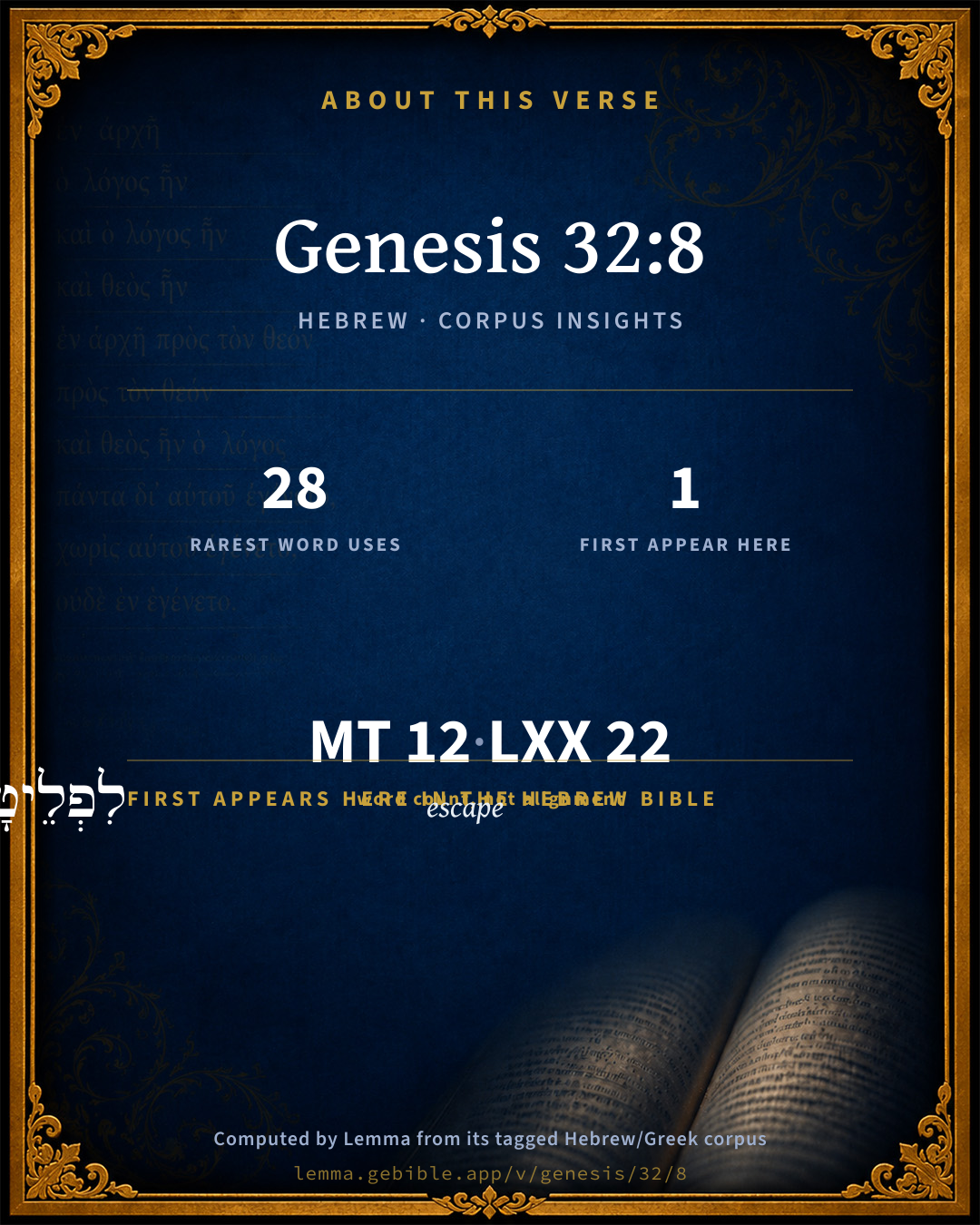
  • 1 first appearance in the Hebrew Bible
Full analysis ↓
Download a study sheet

One document with this verse’s original text, its word-by-word gloss line, the meaning frame, cross-references with their text, attributed commentary, and full source and license credits — printable, and it pastes into notes with its structure intact.

This verse Autodidact and up

Study sheet (.html) Plain text (.txt)

A passage Seminary Student

Up to 50 verses in one chapter. A passage sheet keeps up to 6 commentary sources and 12 cross-references per verse, in the order this page ranks them, and says so on the sheet whenever that leaves anything out. Ask for a single verse and you get the Autodidact verse sheet above.

Everything on this page stays free to read, with no account — the sheet is a download of what is already on screen, not access to it.

Want to remove ads? Support Godless Engineer
Compare translations 3

The same verse in 3 English versions, stacked beneath the original-language interlinear above. Click any original word for its lexicon entry.

Each is an independent rendering of the whole verse — the interlinear is not word-aligned to these translations.

Highlighted words mark where these versions differ — a whole-verse word diff, not a word-by-word alignment.

  • World English Bible Public Domain
    and he said, "If Esau comes to the one company, and strikes it, then the company which is left will escape."
  • King James Version Public Domain
    And said, If Esau come to the one company, and smite it, then the other company which is left shall escape.
  • unfoldingWord Literal Text CC BY-SA 4.0
    And he said, “If Esau comes to one camp and strikes them, then the camp that is left will escape.”

unfoldingWord Literal Text — © unfoldingWord, licensed CC BY-SA 4.0. Word-aligned USFM3 via Door43 (git.door43.org/unfoldingWord/en_ult).

Versions to compare (up to 4)

3 of 4 selected

Show all 18 translations

Every available English version of this verse, each an independent rendering of the whole verse.

  • World English Bible Public Domain
    and he said, "If Esau comes to the one company, and strikes it, then the company which is left will escape."
  • Berean Standard Bible Public Domain
    He thought, “If Esau comes and attacks one camp, then the other camp can escape.”
  • Majority Standard Bible Public Domain
    He thought, “If Esau comes and attacks one camp, then the other camp can escape.”
  • King James Version Public Domain
    And said, If Esau come to the one company, and smite it, then the other company which is left shall escape.
  • American Standard Version (1901) Public Domain
    and he said, If Esau come to the one company, and smite it, then the company which is left shall escape.
  • Revised Version (1885) Public Domain
    and he said, If Esau come to the one company, and smite it, then the company which is left shall escape.
  • Geneva Bible (1599) Public Domain
    For he said, If Esau come to ye one company and smite it, the other companie shall escape.
  • Douay-Rheims (1899) Public Domain
    Saying: If Esau come to one company and destroy it, the other company that is left shall escape.
  • Young's Literal Translation Public Domain
    and saith, `If Esau come in unto the one camp, and have smitten it -- then the camp which is left hath been for an escape.'
  • Literal Standard Version CC BY-SA 4.0
    and says, “If Esau comes to one camp, and has struck it—then the camp which is left has been for an escape.”
  • Unlocked Literal Bible CC BY-SA 4.0
    He said, “If Esau comes to one camp and attacks it, then the camp that is left will escape.”
  • unfoldingWord Literal Text CC BY-SA 4.0
    And he said, “If Esau comes to one camp and strikes them, then the camp that is left will escape.”
  • Darby Bible Public Domain
    And he said, If Esau come to the one troop and smite it, then the other troop which is left shall escape.
  • World Messianic Bible Public Domain
    He said, “If Esau comes to the one company, and strikes it, then the company which is left will escape.”
  • Webster's Bible Public Domain
    And said, If Esau shall come to the one company, and smite it, then the other company which is left, will escape.
  • Free Bible Version CC BY-SA 4.0
    saying to himself, “If Esau comes and destroys one group, the other one can get away.”
  • Bible in Basic English Public Domain
    And said, If Esau, meeting one group, makes an attack on them, the others will get away safely.
  • JPS Tanakh (1917) Public Domain
    (32-9) And he said: 'If Esau come to the one camp, and smite it, then the camp which is left shall escape.'

Literal Standard Version (2020), Covenant Press — licensed CC BY-SA 4.0. Text via the HelloAO Bible API (eBible.org). Unlocked Literal Bible (unfoldingWord) — licensed CC BY-SA 4.0. Text via the HelloAO Bible API (eBible.org). unfoldingWord Literal Text — © unfoldingWord, licensed CC BY-SA 4.0. Word-aligned USFM3 via Door43 (git.door43.org/unfoldingWord/en_ult). Free Bible Version, Dr. Jonathan Gallagher — licensed CC BY-SA 4.0. Text via the HelloAO Bible API (eBible.org).

Word by word

More ways to search: Search by grammar → Find every occurrence → Compare this word →

Practice this passage: Drill this verse → Learn its vocabulary →

לִפְלֵיטָֽה
pᵉlêyṭâh
H6413
“to/for · escape”
Preposition + Noun, Common, Feminine, Singular, Absolute
Part of Speech
Preposition + Noun
Type
Common
Gender
Feminine
Number
Singular
State
Absolute
Full BDB Definition

Origin: from H6412

TWOT: 1774d

escape, deliverance - escape, deliverance - escaped remnant
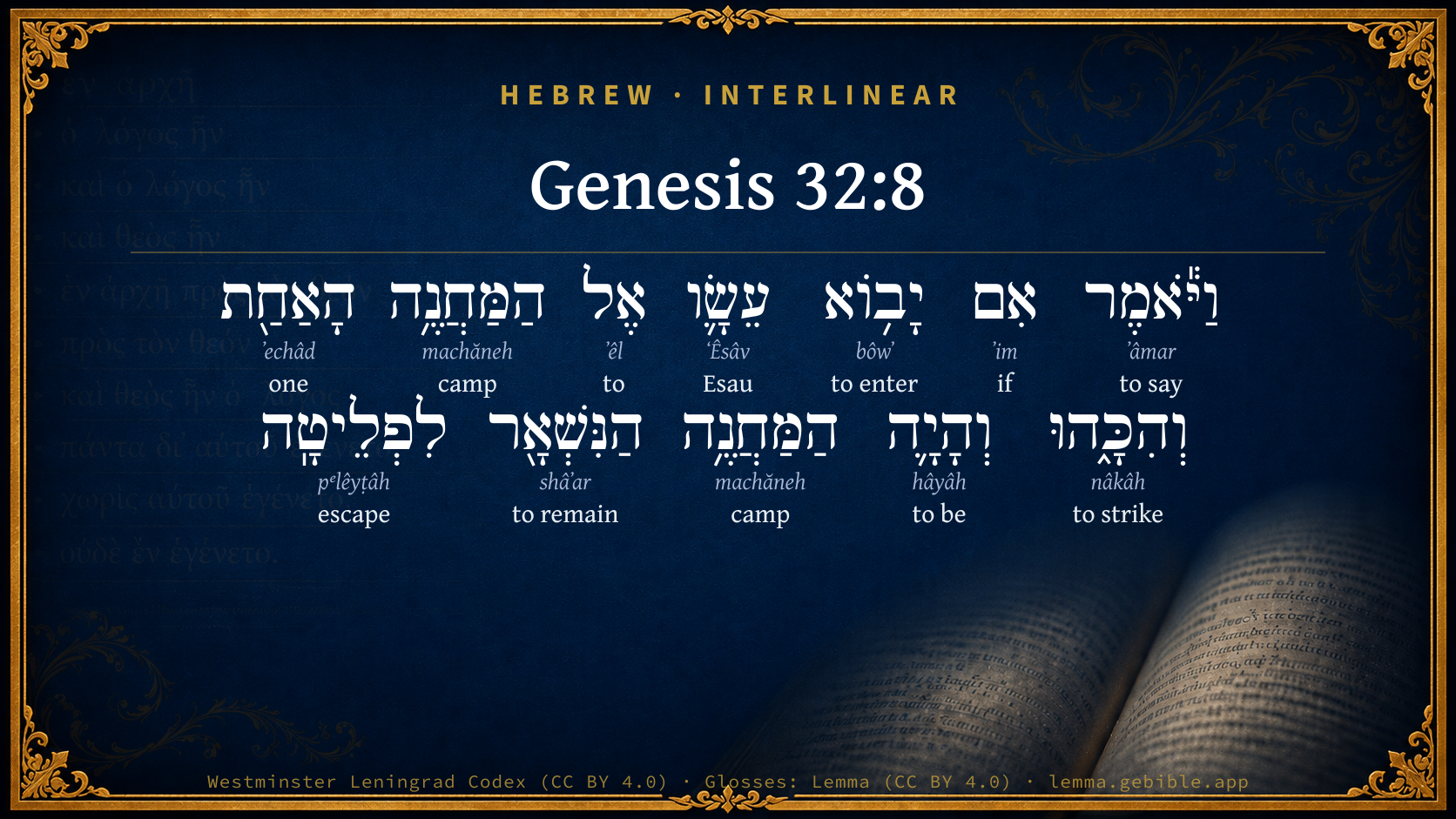
  1. וַיֹּ֕אמֶר ʼâmar H559 “and · to say” Conjunction + Verb, Qal, Sequential Imperfect, 3rd Person, Masculine, Singular
  2. אִם ʼim H518 “if” Conjunction
  3. יָב֥וֹא bôwʼ H935 “to enter” Verb, Qal, Imperfect, 3rd Person, Masculine, Singular
  4. עֵשָׂ֛ו ʻÊsâv H6215 “Esau” Noun, Proper
  5. אֶל ʼêl H413 “to” Preposition
  6. הַמַּחֲנֶ֥ה machăneh H4264 “the · camp” Particle, Definite Article + Noun, Common, Both, Singular, Absolute
  7. הָאַחַ֖ת ʼechâd H259 “the · one” Particle, Definite Article + Adjective, Cardinal number, Feminine, Singular, Absolute
  8. וְהִכָּ֑הוּ nâkâh H5221 “and · to strike · him” Conjunction + Verb, Hiphil, Sequential Perfect, 3rd Person, Masculine, Singular + Suffix, Personal, 3rd Person, Masculine, Singular
  9. וְהָיָ֛ה hâyâh H1961 “and · to be” Conjunction + Verb, Qal, Sequential Perfect, 3rd Person, Masculine, Singular
  10. הַמַּחֲנֶ֥ה machăneh H4264 “the · camp” Particle, Definite Article + Noun, Common, Both, Singular, Absolute
  11. הַנִּשְׁאָ֖ר shâʼar H7604 “the · remaining” Particle, Definite Article + Verb, Niphal, Participle Active, Masculine, Singular, Absolute

About this verse

These counts appear in no published source. They are computed here, from the morphology-tagged text and Lemma’s own curated glosses. What Lemma adds →

12
words
11
distinct lemmas
Pentateuch
section

First appearance in Scripture

This word makes its first canonical appearance in the Hebrew Bible here:

  • לִפְלֵיטָֽה escape H6413

Shared distinctive vocabulary

לִפְלֵיטָֽה escape H6413 occurs in 28 verses of the Hebrew Bible. Also found in:

Grammatical profile

  • 5 verbs
  • 4 nouns
  • 1 adjective
  • 1 preposition
  • 1 conjunction

Verb forms

  • וַיֹּ֕אמֶר Qal · Sequential Imperfect
  • יָב֥וֹא Qal · Imperfect
  • וְהִכָּ֑הוּ Hiphil · Sequential Perfect
  • וְהָיָ֛ה Qal · Sequential Perfect
  • הַנִּשְׁאָ֖ר Niphal · Participle Active

Repetition

A word recurs within this verse — often emphatic in Hebrew:

  • הַמַּחֲנֶ֥ה camp H4264 ×2

Hebrew & Septuagint length

In English translation the verse runs 21 words from the Hebrew and 20 from the Septuagint (LXX English) — closely comparable.

A rough comparison of the two English renderings, which tokenize alike — not a word-level alignment.

Word counts can differ between the Hebrew and the Greek without any difference in meaning — e.g. the Hebrew direct-object marker אֵת has no separate Greek word, and Greek often adds the article ὁ.

In the original languages it is 12 Hebrew tokens and 22 Greek tokens — but the two are counted differently (Hebrew bundles its prefixes and suffixes into one token; the Greek is in lemma form), so that isn’t a like-for-like length.

Cross-references

2

Topical passages linked to Genesis 32:8 in the Treasury of Scripture Knowledge — connected by theme and wording, ordered by reader-vote popularity; previews shown in the World English Bible.

  • Genesis 33:1–3 Jacob lifted up his eyes, and looked, and, behold, Esau was coming, and with him four hundred men. He divided the children between Leah, Rachel, and to the two handmaids.
  • Matthew 10:16 "Behold, I send you out as sheep in the midst of wolves. Therefore be wise as serpents, and harmless as doves.

Cross-references courtesy of OpenBible.info (CC BY 4.0).

Hebrew and Greek witnesses Masoretic Hebrew ↔ Greek Septuagint

The same verse in the two great witnesses to the Old Testament, shown verse-for-verse.

These are two independent witnesses, not word-aligned to each other, and the Septuagint is shown in lemma (dictionary) form.

Hebrew Genesis 32:8 Masoretic · Westminster Leningrad Codex

וַיֹּ֕אמֶר אִם יָב֥וֹא עֵשָׂ֛ו אֶל הַמַּחֲנֶ֥ה הָאַחַ֖ת וְהִכָּ֑הוּ וְהָיָ֛ה הַמַּחֲנֶ֥ה הַנִּשְׁאָ֖ר לִפְלֵיטָֽה

and he said, "If Esau comes to the one company, and strikes it, then the company which is left will escape."

World English Bible · Public Domain

Greek LXX Genesis 32:8 Septuagint · lemma form

φοβέω δέ ἰακώβ σφόδρα καί ἀπορέω καί διααἱρέω ὁ λαός ὁ μετά αὐτός καί ὁ βοῦς καί ὁ πρόβατον εἰς δύο παρεμβολή

And Jacob said, If Esau should come to one camp, and strike it, the other camp shall be in safety.

LXX2012 (modern English Septuagint) · Public Domain

Hebrew: Westminster Leningrad Codex (CC BY 4.0). Greek: Septuagint (public domain); English from LXX2012 (modern English Septuagint) (Public Domain). How the Septuagint differs from the Hebrew →

Targum (Aramaic paraphrase)

2

The Targum is the ancient Jewish Aramaic paraphrase of the Hebrew Scriptures — an interpretive translation, not the Hebrew text itself. Onkelos (literal) and Pseudo-Jonathan (expansive) render the Torah, and Jonathan the Prophets. Coverage is partial: where no permissively-licensed English translation exists for a verse, only the Aramaic is shown. This is verse-level text, not a word-by-word alignment to the Hebrew.

  1. Targum Onkelos Torah (Genesis–Deuteronomy)
    וּדְחִיל יַעֲקֹב לַחֲדָא וַעֲקַת לֵהּ וּפַלִּיג יָת עַמָּא דִּי עִמֵּהּ וְיָת עָנָא וְיָת תּוֹרֵי וְגַמְלַיָּא לִ:תרֵין מַשִּׁירְיָן

    (no public-domain English translation for this verse)

    Targum Onkelos — Aramaic: “Onkelos Genesis” (public domain); “Onkelos Exodus” (public domain); “Onkelos Leviticus” (public domain); “Onkelos Numbers” (public domain); “Onkelos Deuteronomy” (public domain). English: “Sefaria Community Translation” (CC0 1.0 (public-domain dedication)); “J.W. Etheridge. The Targums of Onkelos and Jonathan Ben Uzziel on the Pentateuch. London: Longmans, Green, 1862” (public domain). Text via Sefaria.

  2. Targum Pseudo-Jonathan Torah (Genesis–Deuteronomy)
    וּדְחִיל יַעֲקב לַחֲדָא עַל דְלָא עָסַק עֶשְרִין שְׁנִין בִּיקָרָא דְאָבוֹי וְעָקַת לֵיהּ וּפַלֵיג יַת עַמָא דְעִמֵיהּ וְיַת עָנָא וְיַת תּוֹרֵי וְגַמְלַיָא לִתְרֵין מַשִׁרְיַין לְמוֹהֲבוּת לֵאָה וּלְמוֹהֲבוּת רָחֵל

    And Jakob was greatly afraid, because for twenty years he had not been mindful of the glory of his father: and he had anxiety; and he divided the people who were with him, the sheep, and oxen, and camels, into three troops, for a portion. to Leah, and a portion to Rahel.

    Targum Pseudo-Jonathan — Aramaic: “Targum Jonathan on Genesis” (public domain); “Targum Jonathan on Exodus” (public domain); “Targum Jonathan on Leviticus” (public domain); “Targum Jonathan on Numbers” (public domain); “Targum Jonathan on Deuteronomy” (public domain). English: “The Targum of Jonathan ben Uzziel, trans. J. W. Etheridge, London, 1862” (public domain). Text via Sefaria.

Commentary

Notes on Genesis 32:8 from classic Christian and Jewish commentators (each source and its license shown beneath its notes). The classic Christian expositions comment on the surrounding passage and are grouped to its opening verse, so a note may address several verses; the Jewish commentaries on the Tanakh (Rashi and others) are per-verse, so they appear only where the commentator wrote on this verse.

Lemma curates 59 commentaries, every one of them public domain or Creative Commons licensed, each selected and text-cleaned for this edition rather than reprinted as found. About our sources →

Trapp's Complete Commentary

John Trapp

Gen 32:8 And said, If Esau come to the one company, and smite it, then the other company which is left shall escape.

Ver. 8. If Esau come, &c.] It is a point of prudence, if we cannot keep all, to save what we can.

John Trapp, A Commentary or Exposition upon All the Books of the Old and New Testament (1647–1656) — public domain. Text from a community e-Sword module.

John Gill's Exposition

And said, if Esau come to the one company, and smite it,.... The first, which perhaps consisted only of some servants, with a part of his cattle; so that if Esau should come in an hostile manner, and fall upon that, and slay the servants, and take the cattle as a booty:

then the other company which is left shall escape; by flight, in which most probably were he himself, his wives and children, and the camels to carry them off who would have notice by what should happen to the first band; but one would think, that, notwithstanding all this precaution and wise methods taken, there could be little expectation of escaping the hands of Esau, if he came out on such an ill design; for whither could they flee? or how could they hope to get out of the reach of four hundred men pursuing after them, unless it could be thought, or might be hoped, that the first company falling into his hands, and the revenge on them, and the plunder of them, would satiate him, and he would proceed no further? but Jacob did not trust to these methods he concerted, but betakes himself to God in prayer, as follows.

John Gill's Exposition of the Whole Bible (1746–1763) — public domain (CC PDM 1.0). Text via the HelloAO Bible API.

Matthew Poole's English Annotations

Either by flight, or because he supposed Esau’s revenge would be satisfied with the first slaughter.

Matthew Poole's English Annotations on the Holy Bible (1683–1685) — public domain. Text from a community e-Sword/MySword module.

Keil & Delitzsch

C. F. Keil & F. Delitzsch

Jacob, fearing the worst, divided his people and flocks into two camps, that if Esau smote the one, the other might escape. He then turned to the Great Helper in every time of need, and with an earnest prayer besought the God of his fathers, Abraham and Isaac, who had directed him to return, that, on the ground of the abundant mercies and truth (cf. Gen 24:27) He had shown him thus far, He would deliver him out of the hand of his brother, and from the threatening destruction, and so fulfil His promises.

Keil & Delitzsch — Biblical Commentary on the Old Testament (1861–1891) — public domain (CC PDM 1.0). Text via the HelloAO Bible API. (Old Testament only.)

Rashi

Rabbi Shlomo Yitzchaki (Rashi)

ויירא...ויצר HE FEARED GREATLY AND WAS DISTRESSED — He was afraid lest he be killed, and he was distressed that he might have to kill someone (Genesis Rabbah 76:2).

Rashi on the Tanakh — English translations: “The Judaica Press complete Tanach with Rashi, translated by A. J. Rosenberg” (CC BY 4.0); “Pentateuch with Rashi's commentary by M. Rosenbaum and A.M. Silbermann, 1929-1934” (public domain); “The Metsudah Tanach series, Lakewood, N.J” (CC BY 4.0); and “The Book of Joshua, Metsudah Publications, 1997” (CC BY 4.0). Text via Sefaria.

Ramban (Nachmanides)

Rabbi Moshe ben Nachman (Ramban / Nachmanides)

THEN JACOB WAS GREATLY AFRAID. This was because they told him that Esau had gone forth from his city and was coming to meet Jacob, and moreover, that he took along many men — four hundred. He thus greatly feared for his life, for he said, “He has not taken all these men except for the purpose of waging war against me.”It appears to me in this matter that Esau did not receive the messengers properly and paid them no heed. Perhaps they did not even come before him for he did not at all give permission for them to come before him and speak to him for otherwise, Scripture would have related that Esau questioned them concerning his brother’s welfare and about his circumstances and those of his household and children. [Scripture further would have told how Esau requested] that they convey greetings to Jacob and tell him that he is proceeding towards him to see him, and they would have told it thus to Jacob. Scripture, however, does not narrate that the messengers transmitted a word in Esau’s name. Instead, he [Esau] kept his wrath in his heart, and he came with his army for the purpose of doing Jacob evil. Now the messengers had investigated the matter in the camp, and they knew that he was going to meet Jacob. This is the meaning of the word vegam (and moreover) [in the verse, and moreover he goeth to meet thee], for they said, “We came to thy brother Esau, but he did not answer us a word, and he sent you no greeting, and moreover, he goeth to meet thee with might and an army.” This was why he added fear to his fear, as Scripture says, And Jacob was greatly afraid, and was distressed. And so our Rabbis said that the messengers recognized hatred in him[Esau]. Thus they said: “We came to thy brother Esau. You behave towards him like a brother, but he behaves towards you like Esau the villain.” However, in the end, when Esau saw the great honor that Jacob bestowed upon him and how he prostrated himself before him, bowing to the ground seven times from the distance until he approached him, his mercy was aroused, and he thought that Jacob is recognizing his birthright and his pre-eminence, as I have explained. And with this he was comforted, for the hearts belong to G-d, Who turns them whither He will.

Ramban (Nachmanides) on the Tanakh — English translation: “Commentary on the Torah by Ramban (Nachmanides). Translated and annotated by Charles B. Chavel. New York, Shilo Pub. House, 1971-1976” (CC BY 4.0). Text via Sefaria.

Radak

Rabbi David Kimhi (Radak)

ויירא ויצר, the reason why the Torah repeated the emotions Yaakov experienced twice but in different words was to underline how strongly he felt this fear. In Bereshit Rabbah 76,2 these two expressions are described as basically meaning the same thing, the only difference being that the former is intransitive, Yaakov being afraid of being killed, whereas the latter describes a similar fear, but that of having to kill one’s adversary.

ויחץ, Rabbah Chiyah said that in this part of the verse the Torah teaches us prudence. A man must not place all his eggs in one basket.

Radak on the Tanakh — English translations: “Sefaria Community Translation” (CC0 1.0 (public-domain dedication)); “Eliyahu Munk, HaChut Hameshulash” (CC BY 4.0); “Rabbi Mike Feuer, Jerusalem Anthology” (CC BY 4.0); and “R. David Kimhi on the first book of Psalms, Translated by R.G. Finch, London, 1919” (public domain). Text via Sefaria.

Lesson kit

Teaching starters — assembled from the data on this page, not authored interpretation. Every prompt links to the verse data it draws on. Edit before teaching.

Genesis, in the Pentateuch, opens this verse with 12 words (11 distinct Hebrew lemmas). Its most distinctive word is pᵉlêyṭâh (“escape”). A historical commentator’s framing appears above. Read the whole chapter for the surrounding context.

Discussion questions

  1. What does “escape” (pᵉlêyṭâh) contribute to the verse as a whole?
  2. This is the first place “escape” appears in Scripture (first appears here). What does its debut here establish?
  3. How does Genesis 45:7, which shares the word «escape», read alongside this verse?
  4. What does the repetition of “camp” (2× in this one verse) do in this verse?
  5. The translations on this page render this verse differently — a whole-verse word diff, not a word-by-word alignment. What might account for the different wordings?
  6. «וַיֹּ֕אמֶר» is a Qal Sequential Imperfect verb. How does that grammatical form shape the action described?
  7. Compare how Trapp's Complete Commentary and John Gill's Exposition read this verse. Where do they agree or differ?

Things to notice

Reading settings

Reading text

Shown beneath each verse's original-language words.

Old Testament
Old Testament edition

Read the OT as the Masoretic Hebrew (MT) or the Greek Septuagint (LXX).

English shown for the Greek Septuagint (in the Hebrew ↔ Greek comparison).

Comparing translations? Open the Compare panel on any verse page to stack up to four side by side.