
Genesis 47:15

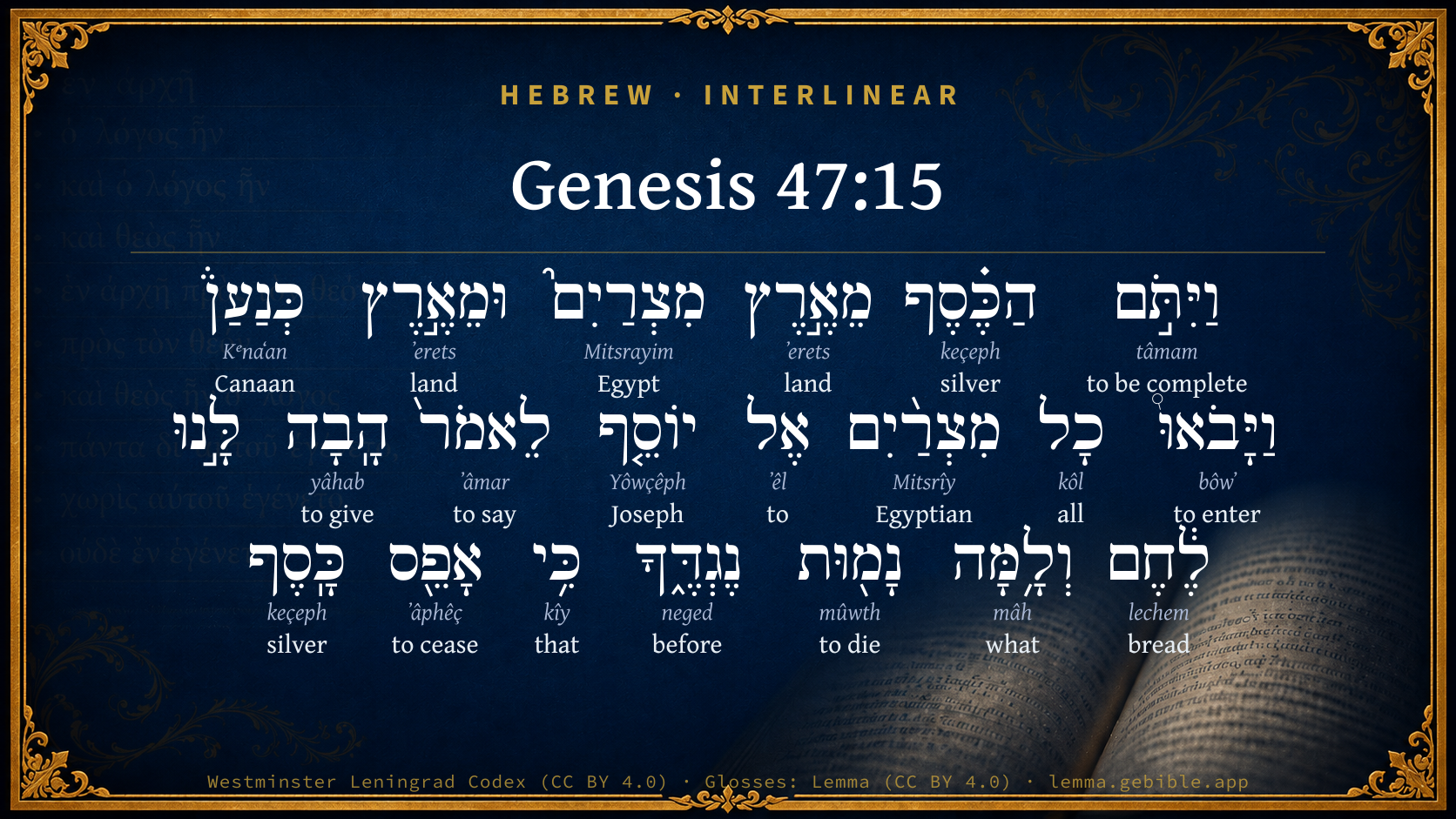
Hebrew (Westminster Leningrad Codex) Genesis 47:15 appears in the Hebrew Old Testament. The text above is from the Westminster Leningrad Codex. Each word links to its Strong’s number, a concise gloss, and parsing drawn from the Open Scriptures Hebrew Bible morphology. Click any word for its full Brown-Driver-Briggs (BDB) entry.
Download image
Cite this verse

Genesis 47:15 (World English Bible). Public Domain. Lemma interlinear Bible study tool, https://lemma.gebible.app/v/genesis/47/15.

Show BibTeX & RIS
BibTeX
RIS
English Translation
When the money was all spent in the land of Egypt, and in the land of Canaan, all the Egyptians came to Joseph, and said, "Give us bread, for why should we die in your presence? For our money fails."
World English Bible · Public Domain
Highlights
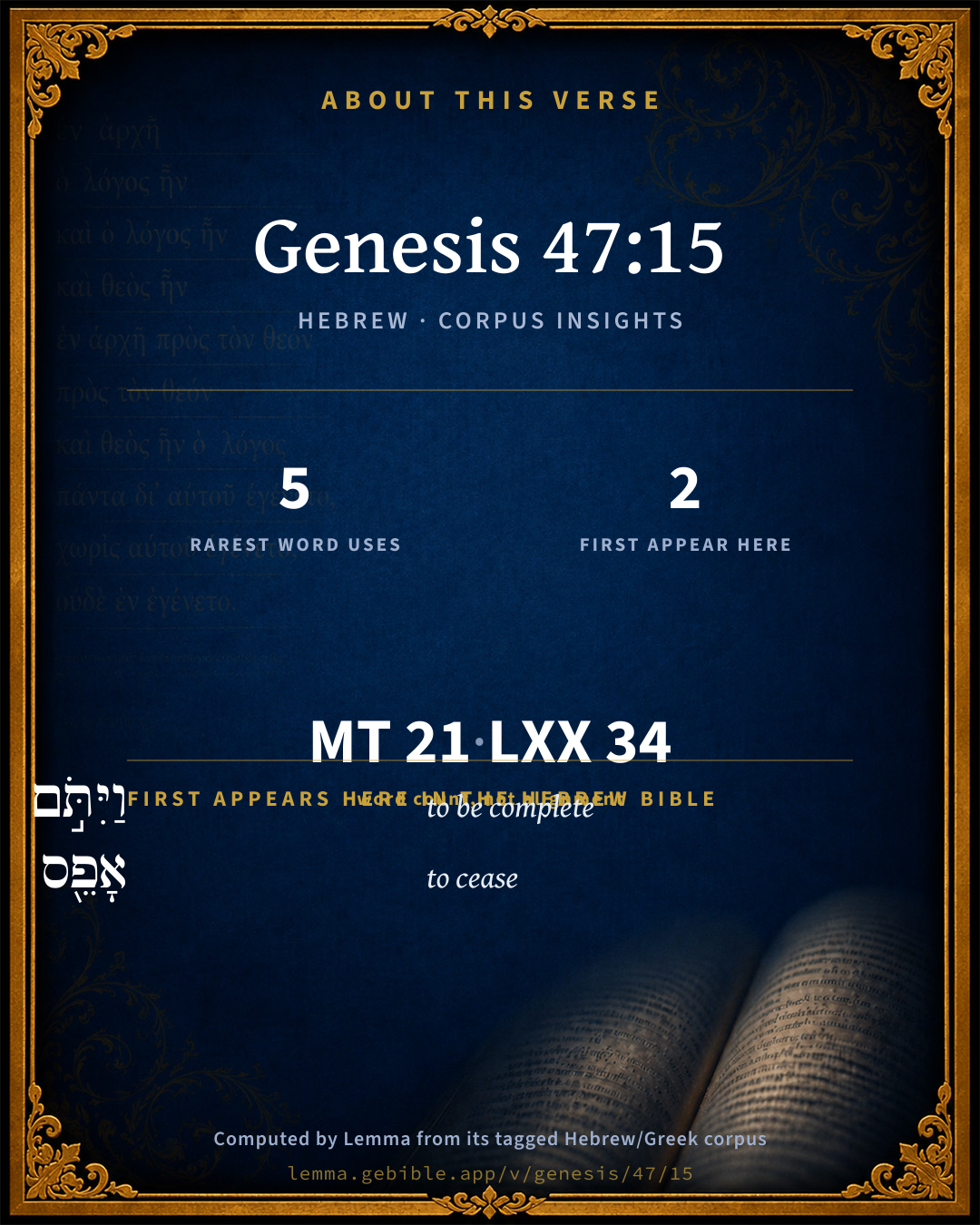
  • 2 first appearances in the Hebrew Bible
Full analysis ↓
Download a study sheet

One document with this verse’s original text, its word-by-word gloss line, the meaning frame, cross-references with their text, attributed commentary, and full source and license credits — printable, and it pastes into notes with its structure intact.

This verse Autodidact and up

Study sheet (.html) Plain text (.txt)

A passage Seminary Student

Up to 50 verses in one chapter. A passage sheet keeps up to 6 commentary sources and 12 cross-references per verse, in the order this page ranks them, and says so on the sheet whenever that leaves anything out. Ask for a single verse and you get the Autodidact verse sheet above.

Everything on this page stays free to read, with no account — the sheet is a download of what is already on screen, not access to it.

Want to remove ads? Support Godless Engineer
Compare translations 3

The same verse in 3 English versions, stacked beneath the original-language interlinear above. Click any original word for its lexicon entry.

Each is an independent rendering of the whole verse — the interlinear is not word-aligned to these translations.

Highlighted words mark where these versions differ — a whole-verse word diff, not a word-by-word alignment.

  • World English Bible Public Domain
    When the money was all spent in the land of Egypt, and in the land of Canaan, all the Egyptians came to Joseph, and said, "Give us bread, for why should we die in your presence? For our money fails."
  • King James Version Public Domain
    And when money failed in the land of Egypt, and in the land of Canaan, all the Egyptians came unto Joseph, and said, Give us bread: for why should we die in thy presence? for the money faileth.
  • unfoldingWord Literal Text CC BY-SA 4.0
    So the silver was consumed from the land of Egypt and from the land of Canaan, and all Egypt came to Joseph, saying, “Give us bread! And why should we die before you? For the silver is gone!”

unfoldingWord Literal Text — © unfoldingWord, licensed CC BY-SA 4.0. Word-aligned USFM3 via Door43 (git.door43.org/unfoldingWord/en_ult).

Versions to compare (up to 4)

3 of 4 selected

Show all 18 translations

Every available English version of this verse, each an independent rendering of the whole verse.

  • World English Bible Public Domain
    When the money was all spent in the land of Egypt, and in the land of Canaan, all the Egyptians came to Joseph, and said, "Give us bread, for why should we die in your presence? For our money fails."
  • Berean Standard Bible Public Domain
    When the money from the lands of Egypt and Canaan was gone, all the Egyptians came to Joseph and said, “Give us food. Why should we die before your eyes? For our funds have run out!”
  • Majority Standard Bible Public Domain
    When the money from the lands of Egypt and Canaan was gone, all the Egyptians came to Joseph and said, “Give us food. Why should we die before your eyes? For our funds have run out!”
  • King James Version Public Domain
    And when money failed in the land of Egypt, and in the land of Canaan, all the Egyptians came unto Joseph, and said, Give us bread: for why should we die in thy presence? for the money faileth.
  • American Standard Version (1901) Public Domain
    And when the money was all spent in the land of Egypt, and in the land of Canaan, all the Egyptians came unto Joseph, and said, Give us bread: for why should we die in thy presence? for `our' money faileth.
  • Revised Version (1885) Public Domain
    And when the money was all spent in the land of Egypt, and in the land of Canaan, all the Egyptians came unto Joseph, and said, Give us bread: for why should we die in thy presence? for our money faileth.
  • Geneva Bible (1599) Public Domain
    So when money fayled in the lande of Egypt, and in the lande of Canaan, then all the Egyptians came vnto Ioseph, and sayde, Giue vs bread: for why should we dye before thee? for our money is spent.
  • Douay-Rheims (1899) Public Domain
    And when the buyers wanted money, all Egypt came to Joseph, saying: Give us bread: why should we die in thy presence, having now net money.
  • Young's Literal Translation Public Domain
    And the silver is consumed out of the land of Egypt, and out of the land of Canaan, and all the Egyptians come in unto Joseph, saying, `Give to us bread -- why do we die before thee, though the money hath ceased?'
  • Literal Standard Version CC BY-SA 4.0
    And the silver is consumed out of the land of Egypt and out of the land of Canaan, and all the Egyptians come to Joseph, saying, “Give bread to us—why do we die before you, though the money has ceased?”
  • Unlocked Literal Bible CC BY-SA 4.0
    When all the money of the lands of Egypt and Canaan was spent, all the Egyptians came to Joseph saying, “Give us food! Why should we die in your presence because our money is gone?”
  • unfoldingWord Literal Text CC BY-SA 4.0
    So the silver was consumed from the land of Egypt and from the land of Canaan, and all Egypt came to Joseph, saying, “Give us bread! And why should we die before you? For the silver is gone!”
  • Darby Bible Public Domain
    And when money came to an end in the land of Egypt and in the land of Canaan, all the Egyptians came to Joseph, saying, Give us bread! for why should we die before thee? for [our] money is all gone.
  • World Messianic Bible Public Domain
    When the money was all spent in the land of Egypt, and in the land of Canaan, all the Egyptians came to Joseph, and said, “Give us bread, for why should we die in your presence? For our money fails.”
  • Webster's Bible Public Domain
    And when money failed in the land of Egypt, and in the land of Canaan, all the Egyptians came to Joseph, and said, Give us bread: for why should we die in thy presence: for the money faileth.
  • Free Bible Version CC BY-SA 4.0
    Once the money from Egypt and Canaan had run out, the Egyptians all came to Joseph and demanded, “Give us food! Do you want us to die right in front of you? All our money is gone!”
  • Bible in Basic English Public Domain
    And when all the money in Egypt and Canaan was gone, the Egyptians came to Joseph, and said, Give us bread; would you have us come to destruction before your eyes? for we have no more money.
  • JPS Tanakh (1917) Public Domain
    And when the money was all spent in the land of Egypt, and in the land of Canaan, all the Egyptians came unto Joseph, and said: 'Give us bread; for why should we die in thy presence? for our money faileth.'

Literal Standard Version (2020), Covenant Press — licensed CC BY-SA 4.0. Text via the HelloAO Bible API (eBible.org). Unlocked Literal Bible (unfoldingWord) — licensed CC BY-SA 4.0. Text via the HelloAO Bible API (eBible.org). unfoldingWord Literal Text — © unfoldingWord, licensed CC BY-SA 4.0. Word-aligned USFM3 via Door43 (git.door43.org/unfoldingWord/en_ult). Free Bible Version, Dr. Jonathan Gallagher — licensed CC BY-SA 4.0. Text via the HelloAO Bible API (eBible.org).

Word by word

More ways to search: Search by grammar → Find every occurrence → Compare this word →

Practice this passage: Drill this verse → Learn its vocabulary →

אָפֵ֖ס
ʼâphêç
H656
“to cease”
Verb, Qal, Perfect, 3rd Person, Masculine, Singular
Part of Speech
Verb
Stem
Qal
Form
Perfect
Person
3rd Person
Gender
Masculine
Number
Singular
Full BDB Definition

Origin: a primitive root

TWOT: 147

(Qal) to cease, break, come to an end
  1. וַיִּתֹּ֣ם tâmam H8552 “and · to be complete” Conjunction + Verb, Qal, Sequential Imperfect, 3rd Person, Masculine, Singular
  2. הַכֶּ֗סֶף keçeph H3701 “the · silver” Particle, Definite Article + Noun, Common, Masculine, Singular, Absolute
  3. מֵאֶ֣רֶץ ʼerets H776 “from · land of” Preposition + Noun, Common, Both, Singular, Construct
  4. מִצְרַיִם֮ Mitsrayim H4714 “Egypt” Noun, Proper
  5. וּמֵאֶ֣רֶץ ʼerets H776 “and · from · land of” Conjunction + Preposition + Noun, Common, Both, Singular, Construct
  6. כְּנַעַן֒ Kᵉnaʻan H3667 “Canaan” Noun, Proper
  7. וַיָּבֹאוּ֩ bôwʼ H935 “and · to enter” Conjunction + Verb, Qal, Sequential Imperfect, 3rd Person, Masculine, Plural
  8. כָל kôl H3605 “all of” Noun, Common, Masculine, Singular, Construct
  9. מִצְרַ֨יִם Mitsrîy H4713 “Egyptian” Noun, Proper
  10. אֶל ʼêl H413 “to” Preposition
  11. יוֹסֵ֤ף Yôwçêph H3130 “Joseph” Noun, Proper
  12. לֵאמֹר֙ ʼâmar H559 “to say” Preposition + Verb, Qal, Infinitive Construct
  13. הָֽבָה yâhab H3051 “give” Verb, Qal, Imperative, 2nd Person, Masculine, Singular + Suffix, h
  14. לֶ֔חֶם lechem H3899 “bread” Noun, Common, Both, Singular, Absolute
  15. וְלָ֥מָּה mâh H4100 “and · to/for · what” Conjunction + Preposition + Particle, Interrogative
  16. נָמ֖וּת mûwth H4191 “to die” Verb, Qal, Imperfect, 1st Person, Common, Plural
  17. נֶגְדֶּ֑ךָ neged H5048 “before · you” Preposition + Suffix, Personal, 2nd Person, Masculine, Singular
  18. כִּ֥י kîy H3588 “that” Conjunction
  19. כָּֽסֶף keçeph H3701 “silver” Noun, Common, Masculine, Singular, Absolute

About this verse

These counts appear in no published source. They are computed here, from the morphology-tagged text and Lemma’s own curated glosses. What Lemma adds →

21
words
18
distinct lemmas
Pentateuch
section

Notable vocabulary

The rarest word here is אָפֵ֖ס to cease H656 — appearing just 5 times in the whole Hebrew Bible.

First appearance in Scripture

These words make their first canonical appearance in the Hebrew Bible here:

  • וַיִּתֹּ֣ם to be complete H8552
  • אָפֵ֖ס to cease H656

Shared distinctive vocabulary

אָפֵ֖ס to cease H656 occurs in 5 verses of the Hebrew Bible. Also found in:

Grammatical profile

  • 6 verbs
  • 10 nouns
  • 3 prepositions
  • 1 conjunction
  • 1 particle

Verb forms

  • וַיִּתֹּ֣ם Qal · Sequential Imperfect
  • וַיָּבֹאוּ֩ Qal · Sequential Imperfect
  • לֵאמֹר֙ Qal · Infinitive Construct
  • הָֽבָה Qal · Imperative
  • נָמ֖וּת Qal · Imperfect
  • אָפֵ֖ס Qal · Perfect

Repetition

Words recur within this verse — often emphatic in Hebrew:

  • הַכֶּ֗סֶף silver H3701 ×2
  • מֵאֶ֣רֶץ land H776 ×2

Hebrew & Septuagint length

In English translation the verse runs 40 words from the Hebrew and 42 from the Septuagint (LXX English) — closely comparable.

A rough comparison of the two English renderings, which tokenize alike — not a word-level alignment.

Word counts can differ between the Hebrew and the Greek without any difference in meaning — e.g. the Hebrew direct-object marker אֵת has no separate Greek word, and Greek often adds the article ὁ.

In the original languages it is 21 Hebrew tokens and 34 Greek tokens — but the two are counted differently (Hebrew bundles its prefixes and suffixes into one token; the Greek is in lemma form), so that isn’t a like-for-like length.

Cross-references

9

Topical passages linked to Genesis 47:15 in the Treasury of Scripture Knowledge — connected by theme and wording, ordered by reader-vote popularity; previews shown in the World English Bible.

  • Genesis 47:18–19 When that year was ended, they came to him the second year, and said to him, "We will not hide from my lord how our money is all spent, and the herds of cattle are my lord's. There is nothing left in the sight of my lord, but our bodies, and our lands.
  • Genesis 47:24 It will happen at the harvests, that you shall give a fifth to Pharaoh, and four parts will be your own, for seed of the field, for your food, for them of your households, and for food for your little ones."
  • Judges 8:5 He said to the men of Succoth, Please give loaves of bread to the people who follow me; for they are faint, and I am pursuing after Zebah and Zalmunna, the kings of Midian.
  • Judges 8:8 He went up there to Penuel, and spoke to them in like manner; and the men of Penuel answered him as the men of Succoth had answered.
  • 1 Samuel 21:3 Now therefore what is under your hand? give me five loaves of bread in my hand, or whatever there is present.
  • 1 Samuel 25:8 Ask your young men, and they will tell you: therefore let the young men find favor in your eyes; for we come in a good day. Please give whatever comes to your hand, to your servants, and to your son David.
  • Psalms 37:3 Trust in Yahweh, and do good. Dwell in the land, and enjoy safe pasture.
  • Matthew 6:11 Give us today our daily bread.
  • Isaiah 33:16 He shall dwell on high; his place of defense shall be the munitions of rocks; his bread shall be given [him]; his waters shall be sure.

Cross-references courtesy of OpenBible.info (CC BY 4.0).

Hebrew and Greek witnesses Masoretic Hebrew ↔ Greek Septuagint

The same verse in the two great witnesses to the Old Testament, shown verse-for-verse.

These are two independent witnesses, not word-aligned to each other, and the Septuagint is shown in lemma (dictionary) form.

Hebrew Genesis 47:15 Masoretic · Westminster Leningrad Codex

וַיִּתֹּ֣ם הַכֶּ֗סֶף מֵאֶ֣רֶץ מִצְרַיִם֮ וּמֵאֶ֣רֶץ כְּנַעַן֒ וַיָּבֹאוּ֩ כָל מִצְרַ֨יִם אֶל יוֹסֵ֤ף לֵאמֹר֙ הָֽבָה לָּ֣נוּ לֶ֔חֶם וְלָ֥מָּה נָמ֖וּת נֶגְדֶּ֑ךָ כִּ֥י אָפֵ֖ס כָּֽסֶף

When the money was all spent in the land of Egypt, and in the land of Canaan, all the Egyptians came to Joseph, and said, "Give us bread, for why should we die in your presence? For our money fails."

World English Bible · Public Domain

Greek LXX Genesis 47:15 Septuagint · lemma form

καί ἐκλείπω πᾶς ὁ ἀργύριον ἐκ γῆ αἴγυπτος καί ἐκ γῆ χανααν ἔρχομαι δέ πᾶς ὁ αἰγύπτιος πρός ιωσηφ λέγω δίδωμι ἐγώ ἄρτος καί ἵνα τίς ἀποθνήσκω ἐναντίον σύ ἐκλείπω γάρ ὁ ἀργύριον ἐγώ

And all the money failed out of the land of Egypt, and out of the land of Chanaan; and all the Egyptians came to Joseph, saying, Give us bread, and why do we die in your presence? for our money is spent.

LXX2012 (modern English Septuagint) · Public Domain

Hebrew: Westminster Leningrad Codex (CC BY 4.0). Greek: Septuagint (public domain); English from LXX2012 (modern English Septuagint) (Public Domain). How the Septuagint differs from the Hebrew →

Targum (Aramaic paraphrase)

2

The Targum is the ancient Jewish Aramaic paraphrase of the Hebrew Scriptures — an interpretive translation, not the Hebrew text itself. Onkelos (literal) and Pseudo-Jonathan (expansive) render the Torah, and Jonathan the Prophets. Coverage is partial: where no permissively-licensed English translation exists for a verse, only the Aramaic is shown. This is verse-level text, not a word-by-word alignment to the Hebrew.

  1. Targum Onkelos Torah (Genesis–Deuteronomy)
    וּשְׁלִים כַּסְפָא מֵאַרְעָא דְמִצְרַיִם וּמֵאַרְעָא דִּכְנַעַן וַאֲתוֹ כָּל מִצְרָאֵי לְוַת יוֹסֵף לְמֵימַר הַב לָנָא לַחֲמָא וּלְמָה נְמוּת לְקִבְלָךְ אֲרֵי שְׁלִים כַּסְפָּא

    (no public-domain English translation for this verse)

    Targum Onkelos — Aramaic: “Onkelos Genesis” (public domain); “Onkelos Exodus” (public domain); “Onkelos Leviticus” (public domain); “Onkelos Numbers” (public domain); “Onkelos Deuteronomy” (public domain). English: “Sefaria Community Translation” (CC0 1.0 (public-domain dedication)); “J.W. Etheridge. The Targums of Onkelos and Jonathan Ben Uzziel on the Pentateuch. London: Longmans, Green, 1862” (public domain). Text via Sefaria.

  2. Targum Pseudo-Jonathan Torah (Genesis–Deuteronomy)
    וּשְׁלִים כַּסְפָּא מֵאַרְעָא דְמִצְרַיִם וּמֵאַרְעָא דִכְנָעַן וְאָתוּ מִצְרָאֵי לְוַת יוֹסֵף לְמֵימָר הַב לָנָא לַחֲמָא וּלְמָא נְמוּת כָּל קִבְלָךְ אֲרוּם שְׁלִים כַּסְפָּא

    And the money was finished from the land of Mizraim, and from the land of Kenaan; and the Mizraee came to Joseph, saying, Give us bread; why should we die before thee? for all our money is finished.

    Targum Pseudo-Jonathan — Aramaic: “Targum Jonathan on Genesis” (public domain); “Targum Jonathan on Exodus” (public domain); “Targum Jonathan on Leviticus” (public domain); “Targum Jonathan on Numbers” (public domain); “Targum Jonathan on Deuteronomy” (public domain). English: “The Targum of Jonathan ben Uzziel, trans. J. W. Etheridge, London, 1862” (public domain). Text via Sefaria.

Commentary

Notes on Genesis 47:15 from classic Christian and Jewish commentators (each source and its license shown beneath its notes). The classic Christian expositions comment on the surrounding passage and are grouped to its opening verse, so a note may address several verses; the Jewish commentaries on the Tanakh (Rashi and others) are per-verse, so they appear only where the commentator wrote on this verse.

Lemma curates 59 commentaries, every one of them public domain or Creative Commons licensed, each selected and text-cleaned for this edition rather than reprinted as found. About our sources →

Trapp's Complete Commentary

John Trapp

Gen 47:15 And when money failed in the land of Egypt, and in the land of Canaan, all the Egyptians came unto Joseph, and said, Give us bread: for why should we die in thy presence? for the money faileth.

Ver. 15. Why should we die in thy presence?] When it is in thy power to save us alive in this our extreme indigency? Qui non cum potest, iuvat, occidit, saith the proverb. And, "Is it lawful on the Sabbath to do good, or to do evil? to save, or to destroy a life?" {Mar 3:4} - intimating that not to save when we may, is to destroy. The Egyptians, therefore, put Joseph to it. Money they had none, but must have answered, if now it had been required of them, as those inhabitants of Andros did Themistocles. He being sent by the Athenians for tribute money, told them that he came on that errand accompanied with two goddesses; eloquence to persuade, and violence to enforce them. Whereunto the Andraeans made this answer; that they had on their side, also, two goddesses as strong; necessity, {a} they had it not, and impossibility, whereby they could not part with that which they possessed not. {b}

{a} Ingens telum, necessitas.

{b} Plutarch.

John Trapp, A Commentary or Exposition upon All the Books of the Old and New Testament (1647–1656) — public domain. Text from a community e-Sword module.

John Calvin's Commentaries

15. And when money failed. Moses does not mean that all the money in Egypt had been brought into the royal treasury; for there were many of the nobles of the court free from the effects of the famine; but the simple meaning of the expression is that nearly all had been exhausted; that now the common people had not money enough to buy corn; and that, at length, extreme necessity had driven the Egyptians to the second remedy of which he is about to speak. Moreover, although, like persons driven to desperation, they might seem arrogantly to rise up against Joseph; yet the context shows that nothing was farther from their minds than to terrify, by their boldness, the man whose compassion they suppliantly implore. Wherefore the question, Why should we die in thy presence? has no other signification than that they felt themselves ruined, unless his clemency should afford them relief. But it may be asked how the Canaanites supported their lives. There is indeed no doubt that a grievous pestilence, the attendant on famine, would carry off many, unless they received assistance from other regions, or were miserally fed on herbs and roots. And perhaps the barrenness was not there so great, but that they might gather half, or a third part of their food, from the fields,

John Calvin's Commentaries (1540-1563) — public domain. Text from the Calvin Translation Society English edition (1840s-50s) via the Christian Classics Ethereal Library (ccel.org). Calvin's coverage is partial (roughly two-thirds of the Bible); uncommented books and verses are honest gaps, never fabricated. The 19th-century editor's footnotes and remarks are omitted so the notes are faithfully Calvin's own voice.

The Cambridge Bible for Schools and Colleges

gen. ed. J. J. S. Perowne

15. And when the money] The inhabitants of Egypt, finding that their money was expended, voluntarily proposed the surrender, firstly, of their cattle, and secondly, in the following year (Gen_47:18-19), of their persons and their land. There is no mention of murmuring or uprising among the people. Private ownership, except in the case of the priests (Gen_47:22), was surrendered. The whole people became Pharaoh’s servants, practically serfs, paying him a land tax of 20 per cent. annually (Gen_47:26).

The Cambridge Bible for Schools and Colleges (gen. ed. J. J. S. Perowne; Cambridge University Press, 1878–1918) — public domain. Text from a community e-Sword module.

John Gill's Exposition

And Joseph said, give your cattle,.... Oxen, sheep, horses, asses, as follows:

and I will give you for your cattle, if money fail; that is, corn for cattle, if they had no money to give.

John Gill's Exposition of the Whole Bible (1746–1763) — public domain (CC PDM 1.0). Text via the HelloAO Bible API.

Haydock's Catholic Bible Commentary

Wanted. Or "failed both in Egypt and Chanaan," as the Hebrew insinuates. (Haydock)

George Leo Haydock (1774–1849), Haydock's Catholic Family Bible and Commentary, 1859 edition — public domain. Excludes Psalms (Douay-Rheims chapter numbering differs from Protestant) and Deuterocanonical books (Catholic canon only).

Matthew Poole's English Annotations

1702

Why shouldst thou see and suffer us to perish for our want of money, when thou canst relieve us?

Matthew Poole's English Annotations on the Holy Bible (1683–1685) — public domain. Text from a community e-Sword/MySword module.

Whedon's Commentary on the Bible

Daniel D. Whedon

15. All the Egyptians came — Came by their representatives. Observe the three stages of impoverishment through which they passed in becoming the dependents of Pharaoh. First they used up all their money; then they delivered up all their cattle for bread; and finally they surrendered all title and claim to their lands, and thus became serfs unto Pharaoh.

Daniel D. Whedon (gen. ed.), Commentary on the Old and New Testaments (1874–1909) — public domain. Text from a community e-Sword module.

The Pulpit Commentary

And when money failed (literally, and the silver was consumed, or spent) in the land of Egypt, and in the land of Canaan, all (literally, and all) the Egyptians came unto Joseph, and said, Give us bread: for why should we die in thy presence? for the money faileth (literally, and why should we die in thy presence because silver faileth? i.e. seeing that thou art able to support us).

The Pulpit Commentary (1880–1919), ed. H.D.M. Spence-Jones & Joseph S. Exell — public domain. Text from a community e-Sword module.

unfoldingWord translationNotes

Door43 World Missions Community

When all the money of the lands of Egypt and Canaan was spent

Here "lands" stands for the people who live in the lands. This can be stated in active form. AT: "When the people of Egypt and Canaan used up all their money" (See: Metonymy and Active or Passive)

of the lands of Egypt and Canaan

"from the land of Egypt and from the land of Canaan"

Why should we die in your presence because our money is gone?

The people used a question to emphasize how desperate they are to buy food. This question can be translated as a statement. AT: "Please, do not let us die because we have used up all of our money!" (See: Rhetorical Question)

He fed them with bread

Here "bread" stands for food in general. AT: "He gave them food" or "He provided them with food" (See: Synecdoche)

translationWords

Egypt

Canaan

livestock

horse

flocks

donkey

bread

year

unfoldingWord translationNotes — © Distant Shores Media and the Door43 World Missions Community, licensed CC BY-SA 4.0. Source: git.door43.org/Door43/en_tn.

Rashi

Rabbi Shlomo Yitzchaki (Rashi)

אפס — Render this as the Targum does: שלים IS AT AN END.

Rashi on the Tanakh — English translations: “The Judaica Press complete Tanach with Rashi, translated by A. J. Rosenberg” (CC BY 4.0); “Pentateuch with Rashi's commentary by M. Rosenbaum and A.M. Silbermann, 1929-1934” (public domain); “The Metsudah Tanach series, Lakewood, N.J” (CC BY 4.0); and “The Book of Joshua, Metsudah Publications, 1997” (CC BY 4.0). Text via Sefaria.

Ramban (Nachmanides)

Rabbi Moshe ben Nachman (Ramban / Nachmanides)

AND WHEN THE MONEY WAS ALL SPENT IN THE LAND OF EGYPT, AND IN THE LAND OF CANAAN, ALL THE EGYPTIANS CAME UNTO JOSEPH, etc. Scripture mentions that the money in the land of Canaan had been exhausted because when the Egyptians came before Joseph they reminded him of this, for they said: “Since the money is also exhausted in the land of Canaan, and since they will no longer come to buy food, why should we die in thy presence? For the money is at an end, and you will cause our death in vain, for the food will remain in your hand, and no man shall buy it.”

Ramban (Nachmanides) on the Tanakh — English translation: “Commentary on the Torah by Ramban (Nachmanides). Translated and annotated by Charles B. Chavel. New York, Shilo Pub. House, 1971-1976” (CC BY 4.0). Text via Sefaria.

Radak

Rabbi David Kimhi (Radak)

ויבאו כל מצרים, the people living in the land of Canaan went elsewhere to secure their food supplies. By now the Torah speaks of conditions during the sixth year of the famine. During that year Joseph distributed food and accepted livestock as payment. In the seventh year he handed over food in return for the local land owners renouncing their title to their land in favour of Pharaoh. He distributed seed so that there would be a harvest during the eight’s year when the famine was supposed to have ended. Our sages, quoted by Rashi, claim that the famine ceased with the arrival of Yaakov in Egypt and his blessing to Pharaoh which resulted in the Nile once again overflowing its banks and providing irrigation for the fields. One can raise serious reservations about this approach. If the famine did indeed stop already in the second year or at the end thereof, when did all the measures Joseph is described as taking in verses 14-22 take place?

Radak on the Tanakh — English translations: “Sefaria Community Translation” (CC0 1.0 (public-domain dedication)); “Eliyahu Munk, HaChut Hameshulash” (CC BY 4.0); “Rabbi Mike Feuer, Jerusalem Anthology” (CC BY 4.0); and “R. David Kimhi on the first book of Psalms, Translated by R.G. Finch, London, 1919” (public domain). Text via Sefaria.

Lesson kit

Teaching starters — assembled from the data on this page, not authored interpretation. Every prompt links to the verse data it draws on. Edit before teaching.

Genesis, in the Pentateuch, opens this verse with 21 words (18 distinct Hebrew lemmas). Its most distinctive word is ʼâphêç (“to cease”). A historical commentator’s framing appears above. Read the whole chapter for the surrounding context.

Discussion questions

  1. The word ʼâphêç carries the sense “to cease.” How does it shape the verse?
  2. 2 words make their first appearance in Scripture here. What does this debut establish?
  3. How does Genesis 47:16, which shares the word «to cease», read alongside this verse?
  4. What does the repetition of “silver” (2× in this one verse) do in this verse?
  5. The translations on this page render this verse differently — a whole-verse word diff, not a word-by-word alignment. What might account for the different wordings?
  6. «וַיִּתֹּ֣ם» is a Qal Sequential Imperfect verb. How does that grammatical form shape the action described?
  7. Compare how Trapp's Complete Commentary and John Calvin's Commentaries read this verse. Where do they agree or differ?

Things to notice

Reading settings

Reading text

Shown beneath each verse's original-language words.

Old Testament
Old Testament edition

Read the OT as the Masoretic Hebrew (MT) or the Greek Septuagint (LXX).

English shown for the Greek Septuagint (in the Hebrew ↔ Greek comparison).

Comparing translations? Open the Compare panel on any verse page to stack up to four side by side.