Leviticus 10:18

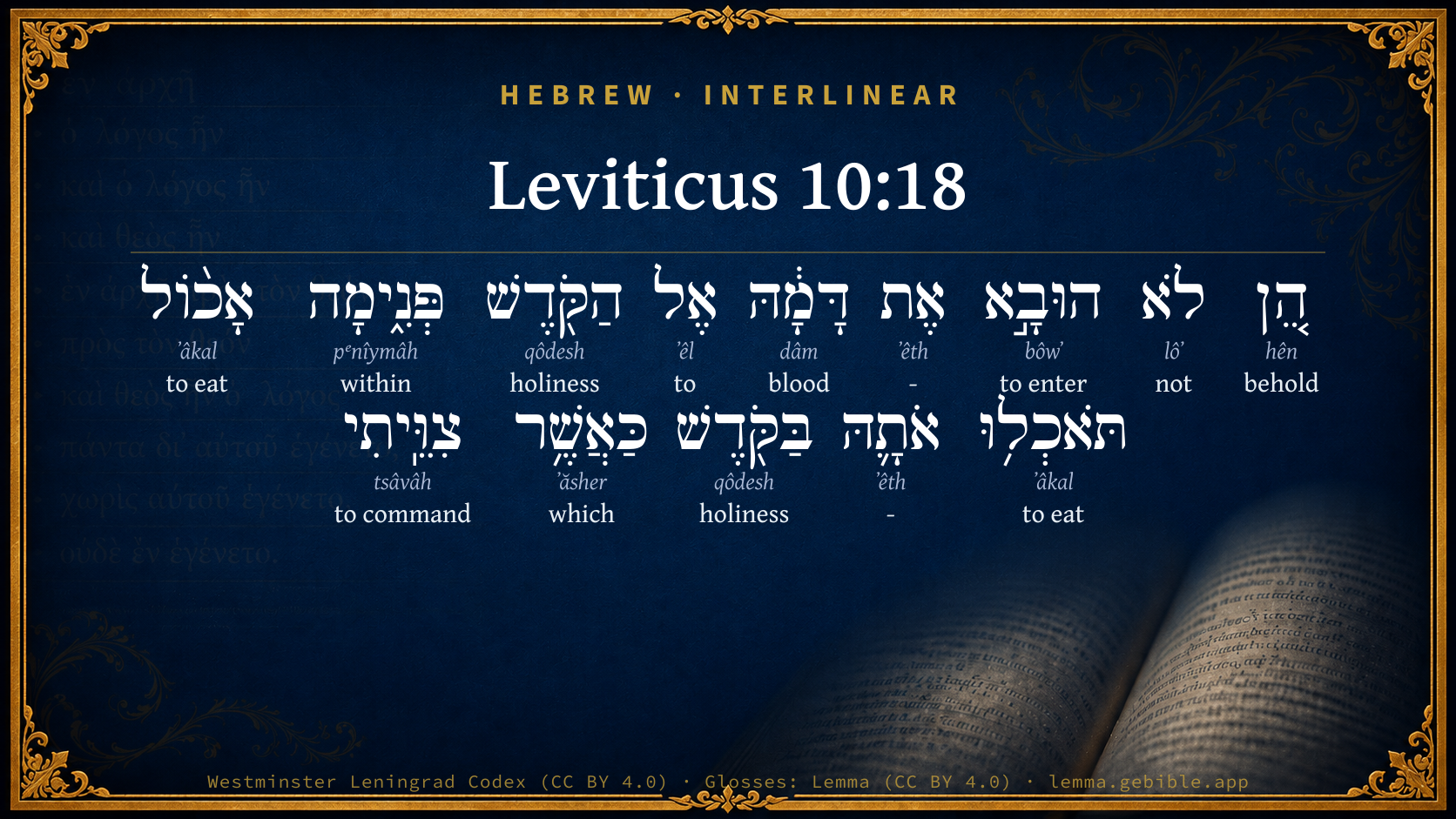
Hebrew (Westminster Leningrad Codex) Leviticus 10:18 appears in the Hebrew Old Testament. The text above is from the Westminster Leningrad Codex. Each word links to its Strong’s number, a concise gloss, and parsing drawn from the Open Scriptures Hebrew Bible morphology. Click any word for its full Brown-Driver-Briggs (BDB) entry.
Download image
Cite this verse

Leviticus 10:18 (World English Bible). Public Domain. Lemma interlinear Bible study tool, https://lemma.gebible.app/v/leviticus/10/18.

Show BibTeX & RIS
BibTeX
RIS
English Translation
Behold, its blood was not brought into the inner part of the sanctuary: you certainly should have eaten it in the sanctuary, as I commanded."
World English Bible · Public Domain
Highlights
  • 1 first appearance in the Hebrew Bible
Full analysis ↓
Download a study sheet

One document with this verse’s original text, its word-by-word gloss line, the meaning frame, cross-references with their text, attributed commentary, and full source and license credits — printable, and it pastes into notes with its structure intact.

This verse Autodidact and up

Study sheet (.html) Plain text (.txt)

A passage Seminary Student

Up to 50 verses in one chapter. A passage sheet keeps up to 6 commentary sources and 12 cross-references per verse, in the order this page ranks them, and says so on the sheet whenever that leaves anything out. Ask for a single verse and you get the Autodidact verse sheet above.

Everything on this page stays free to read, with no account — the sheet is a download of what is already on screen, not access to it.

Want to remove ads? Support Godless Engineer
Compare translations 3

The same verse in 3 English versions, stacked beneath the original-language interlinear above. Click any original word for its lexicon entry.

Each is an independent rendering of the whole verse — the interlinear is not word-aligned to these translations.

Highlighted words mark where these versions differ — a whole-verse word diff, not a word-by-word alignment.

  • World English Bible Public Domain
    Behold, its blood was not brought into the inner part of the sanctuary: you certainly should have eaten it in the sanctuary, as I commanded."
  • King James Version Public Domain
    Behold, the blood of it was not brought in within the holy place: ye should indeed have eaten it in the holy place, as I commanded.
  • unfoldingWord Literal Text CC BY-SA 4.0
    Behold, its blood was not brought into the inner Holy Place. Eating, you shall eat it in the Holy Place, just as I commanded!”

unfoldingWord Literal Text — © unfoldingWord, licensed CC BY-SA 4.0. Word-aligned USFM3 via Door43 (git.door43.org/unfoldingWord/en_ult).

Versions to compare (up to 4)

3 of 4 selected

Show all 18 translations

Every available English version of this verse, each an independent rendering of the whole verse.

  • World English Bible Public Domain
    Behold, its blood was not brought into the inner part of the sanctuary: you certainly should have eaten it in the sanctuary, as I commanded."
  • Berean Standard Bible Public Domain
    Since its blood was not brought inside the holy place, you should have eaten it in the sanctuary area, as I commanded.”
  • Majority Standard Bible Public Domain
    Since its blood was not brought inside the holy place, you should have eaten it in the sanctuary area, as I commanded.”
  • King James Version Public Domain
    Behold, the blood of it was not brought in within the holy place: ye should indeed have eaten it in the holy place, as I commanded.
  • American Standard Version (1901) Public Domain
    Behold, the blood of it was not brought into the sanctuary within: ye should certainly have eaten it in the sanctuary, as I commanded.
  • Revised Version (1885) Public Domain
    Behold, the blood of it was not brought into the sanctuary within: ye should certainly have eaten it in the sanctuary, as I commanded.
  • Geneva Bible (1599) Public Domain
    Beholde, the blood of it was not brought within the holy place: ye should haue eaten it in the holy place, as I commanded.
  • Douay-Rheims (1899) Public Domain
    Especially whereas none of the blood thereof hath been carried within the holy places, and you ought to have eaten it in the sanctuary, as was commanded me?
  • Young's Literal Translation Public Domain
    lo, its blood hath not been brought in unto the holy place within; eating ye do eat it in the holy place, as I have commanded.'
  • Literal Standard Version CC BY-SA 4.0
    Behold, its blood has not been brought into the holy place within; eating you eat it in the holy place, as I have commanded.”
  • Unlocked Literal Bible CC BY-SA 4.0
    Look, its blood was not brought inside the tabernacle, so you should certainly have eaten it in the tabernacle area, as I commanded.”
  • unfoldingWord Literal Text CC BY-SA 4.0
    Behold, its blood was not brought into the inner Holy Place. Eating, you shall eat it in the Holy Place, just as I commanded!”
  • Darby Bible Public Domain
    Lo, its blood was not brought in within the sanctuary: ye should certainly have eaten it in the sanctuary, as I commanded.
  • World Messianic Bible Public Domain
    Behold, its blood was not brought into the inner part of the sanctuary. You certainly should have eaten it in the sanctuary, as I commanded.”
  • Webster's Bible Public Domain
    Behold, the blood of it was not brought within the holy place: ye should indeed have eaten it in the holy place, as I commanded.
  • Free Bible Version CC BY-SA 4.0
    As its blood was not taken into the holy place, you should have eaten it in the sanctuary area, as I ordered.”
  • Bible in Basic English Public Domain
    See, its blood was not taken into the holy place: certainly it was right for you to have taken it as food in the holy place, as I gave orders.
  • JPS Tanakh (1917) Public Domain
    Behold, the blood of it was not brought into the sanctuary within; ye should certainly have eaten it in the sanctuary, as I commanded.'

Literal Standard Version (2020), Covenant Press — licensed CC BY-SA 4.0. Text via the HelloAO Bible API (eBible.org). Unlocked Literal Bible (unfoldingWord) — licensed CC BY-SA 4.0. Text via the HelloAO Bible API (eBible.org). unfoldingWord Literal Text — © unfoldingWord, licensed CC BY-SA 4.0. Word-aligned USFM3 via Door43 (git.door43.org/unfoldingWord/en_ult). Free Bible Version, Dr. Jonathan Gallagher — licensed CC BY-SA 4.0. Text via the HelloAO Bible API (eBible.org).

Word by word

More ways to search: Search by grammar → Find every occurrence → Compare this word →

Practice this passage: Drill this verse → Learn its vocabulary →

פְּנִ֑ימָה
pᵉnîymâh
H6441
“within”
Adverb
Part of Speech
Adverb
Full BDB Definition

Origin: from H6440 with directive enclitic

TWOT: 1782c

toward the inside, within, faceward
  1. הֵ֚ן hên H2005 “behold” Particle, Demonstrative
  2. לֹא lôʼ H3808 “not” Particle, Negative
  3. הוּבָ֣א bôwʼ H935 “to enter” Verb, Hophal, Perfect, 3rd Person, Masculine, Singular
  4. אֶת ʼêth H853 “-” Particle, Direct Object
  5. דָּמָ֔הּ dâm H1818 “blood · her” Noun, Common, Masculine, Singular, Construct + Suffix, Personal, 3rd Person, Feminine, Singular
  6. אֶל ʼêl H413 “to” Preposition
  7. הַקֹּ֖דֶשׁ qôdesh H6944 “the · holiness” Particle, Definite Article + Noun, Common, Masculine, Singular, Absolute
  8. אָכ֨וֹל ʼâkal H398 “to eat” Verb, Qal, Infinitive Absolute
  9. תֹּאכְל֥וּ ʼâkal H398 “to eat” Verb, Qal, Imperfect, 2nd Person, Masculine, Plural
  10. אֹתָ֛הּ ʼêth H853 “- · her” Particle, Direct Object + Suffix, Personal, 3rd Person, Feminine, Singular
  11. בַּקֹּ֖דֶשׁ qôdesh H6944 “in/at the · holiness” Preposition, Determined + Noun, Common, Masculine, Singular, Absolute
  12. כַּאֲשֶׁ֥ר ʼăsher H834 “like/as · which” Preposition + Particle, Relative
  13. צִוֵּֽיתִי tsâvâh H6680 “to command” Verb, Piel, Perfect, 1st Person, Common, Singular

About this verse

These counts appear in no published source. They are computed here, from the morphology-tagged text and Lemma’s own curated glosses. What Lemma adds →

14
words
11
distinct lemmas
Pentateuch
section

Notable vocabulary

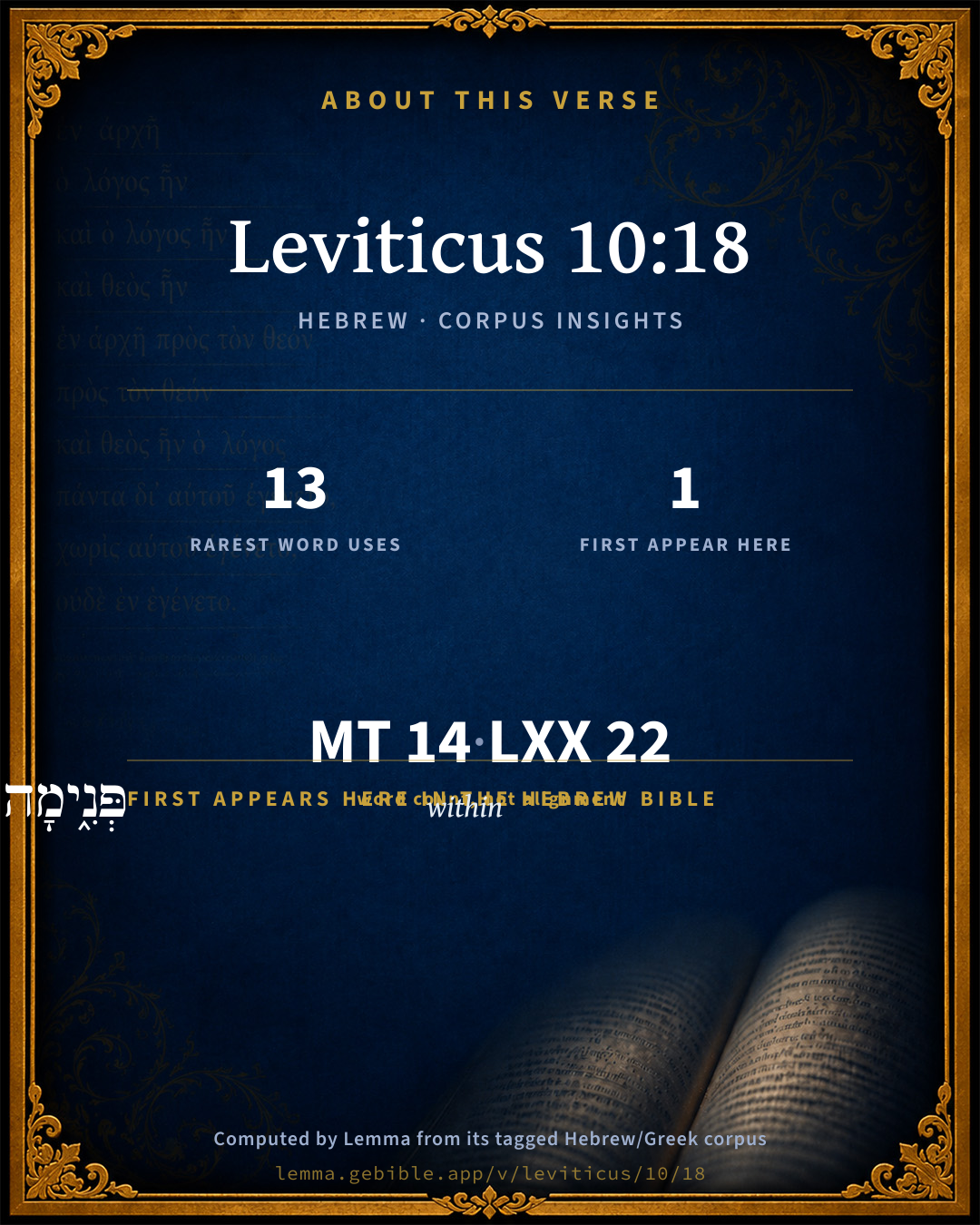
The rarest word here is פְּנִ֑ימָה within H6441 — appearing just 13 times in the whole Hebrew Bible.

First appearance in Scripture

This word makes its first canonical appearance in the Hebrew Bible here:

  • פְּנִ֑ימָה within H6441

Shared distinctive vocabulary

פְּנִ֑ימָה within H6441 occurs in 12 verses of the Hebrew Bible. Also found in:

Grammatical profile

  • 4 verbs
  • 3 nouns
  • 1 preposition
  • 1 adverb
  • 5 particles

Verb forms

  • הוּבָ֣א Hophal · Perfect
  • אָכ֨וֹל Qal · Infinitive Absolute
  • תֹּאכְל֥וּ Qal · Imperfect
  • צִוֵּֽיתִי Piel · Perfect

Repetition

Words recur within this verse — often emphatic in Hebrew:

  • הַקֹּ֖דֶשׁ holiness H6944 ×2
  • אָכ֨וֹל to eat H398 ×2

Hebrew & Septuagint length

In English translation the verse runs 25 words from the Hebrew and 25 from the Septuagint (LXX English) — the same length.

A rough comparison of the two English renderings, which tokenize alike — not a word-level alignment.

Word counts can differ between the Hebrew and the Greek without any difference in meaning — e.g. the Hebrew direct-object marker אֵת has no separate Greek word, and Greek often adds the article ὁ.

In the original languages it is 14 Hebrew tokens and 22 Greek tokens — but the two are counted differently (Hebrew bundles its prefixes and suffixes into one token; the Greek is in lemma form), so that isn’t a like-for-like length.

Cross-references

2

Topical passages linked to Leviticus 10:18 in the Treasury of Scripture Knowledge — connected by theme and wording, ordered by reader-vote popularity; previews shown in the World English Bible.

  • Leviticus 6:30 No sin offering, of which any of the blood is brought into the Tent of Meeting to make atonement in the Holy Place, shall be eaten: it shall be burned with fire.
  • Leviticus 6:26 The priest who offers it for sin shall eat it. It shall be eaten in a holy place, in the court of the Tent of Meeting.

Cross-references courtesy of OpenBible.info (CC BY 4.0).

Hebrew and Greek witnesses Masoretic Hebrew ↔ Greek Septuagint

The same verse in the two great witnesses to the Old Testament, shown verse-for-verse.

These are two independent witnesses, not word-aligned to each other, and the Septuagint is shown in lemma (dictionary) form.

Hebrew Leviticus 10:18 Masoretic · Westminster Leningrad Codex

הֵ֚ן לֹא הוּבָ֣א אֶת דָּמָ֔הּ אֶל הַקֹּ֖דֶשׁ פְּנִ֑ימָה אָכ֨וֹל תֹּאכְל֥וּ אֹתָ֛הּ בַּקֹּ֖דֶשׁ כַּאֲשֶׁ֥ר צִוֵּֽיתִי

Behold, its blood was not brought into the inner part of the sanctuary: you certainly should have eaten it in the sanctuary, as I commanded."

World English Bible · Public Domain

Greek LXX Leviticus 10:18 Septuagint · lemma form

οὐ γάρ εἰςἄγω ὁ αἷμα αὐτός εἰς ὁ ἅγιος κατά πρόσωπον ἔσω ἐσθίω αὐτός ἐν τόπος ἅγιος ὅς τρόπος ἐγώ συντάσσω κύριος

For the blood of it was not brought into the holy place: you⌃ shall eat it within, before the Lord, as the Lord commanded me.

LXX2012 (modern English Septuagint) · Public Domain

Hebrew: Westminster Leningrad Codex (CC BY 4.0). Greek: Septuagint (public domain); English from LXX2012 (modern English Septuagint) (Public Domain). How the Septuagint differs from the Hebrew →

Targum (Aramaic paraphrase)

2

The Targum is the ancient Jewish Aramaic paraphrase of the Hebrew Scriptures — an interpretive translation, not the Hebrew text itself. Onkelos (literal) and Pseudo-Jonathan (expansive) render the Torah, and Jonathan the Prophets. Coverage is partial: where no permissively-licensed English translation exists for a verse, only the Aramaic is shown. This is verse-level text, not a word-by-word alignment to the Hebrew.

  1. Targum Onkelos Torah (Genesis–Deuteronomy)
    הָא לָא אִתָּעַל יָת דְמַהּ לְבֵית קֻדְשָׁא גַוָאָה מֵיכַל תֵּכְלוּן יָתַהּ בְּקֻדְשָׁא כְּמָא דִי פַקֵדִית

    (no public-domain English translation for this verse)

    Targum Onkelos — Aramaic: “Onkelos Genesis” (public domain); “Onkelos Exodus” (public domain); “Onkelos Leviticus” (public domain); “Onkelos Numbers” (public domain); “Onkelos Deuteronomy” (public domain). English: “Sefaria Community Translation” (CC0 1.0 (public-domain dedication)); “J.W. Etheridge. The Targums of Onkelos and Jonathan Ben Uzziel on the Pentateuch. London: Longmans, Green, 1862” (public domain). Text via Sefaria.

  2. Targum Pseudo-Jonathan Torah (Genesis–Deuteronomy)
    הָא לָא אִיתָעַל מִן אַדְמָא לְוַת קוּדְשָׁא גַוָואָה מֵיכַל תֵּיכְלוּן יָתֵיהּ בְּקוּדְשָׁא הֵיכְמָא דְאִתְפַּקֵדִית

    and, behold, none of its blood hath been carried in within the sanctuary. You should have indeed eaten it in the holy place, as I have been instructed.

    Targum Pseudo-Jonathan — Aramaic: “Targum Jonathan on Genesis” (public domain); “Targum Jonathan on Exodus” (public domain); “Targum Jonathan on Leviticus” (public domain); “Targum Jonathan on Numbers” (public domain); “Targum Jonathan on Deuteronomy” (public domain). English: “The Targum of Jonathan ben Uzziel, trans. J. W. Etheridge, London, 1862” (public domain). Text via Sefaria.

Commentary

Notes on Leviticus 10:18 from classic Christian and Jewish commentators (each source and its license shown beneath its notes). The classic Christian expositions comment on the surrounding passage and are grouped to its opening verse, so a note may address several verses; the Jewish commentaries on the Tanakh (Rashi and others) are per-verse, so they appear only where the commentator wrote on this verse.

Lemma curates 59 commentaries, every one of them public domain or Creative Commons licensed, each selected and text-cleaned for this edition rather than reprinted as found. About our sources →

Trapp's Complete Commentary

John Trapp

Lev 10:18 Behold, the blood of it was not brought in within the holy [place]: ye should indeed have eaten it in the holy [place], as I commanded.

Ver. 18. Ye should indeed have eaten it.] Thus, by misreckoning a point, ye have missed the haven, and hazarded yourselves to the rocks of the divine displeasure, against which your brethren so lately split. God is usually most angry when he is about a reformation; as here against Nadab and Abihu: so afterwards against Uzzah, Ananias and Sapphira, &c.

John Trapp, A Commentary or Exposition upon All the Books of the Old and New Testament (1647–1656) — public domain. Text from a community e-Sword module.

Joseph Benson's Commentary

Lev 10:18. Behold the blood was not brought within the holy place — And consequently it was not one of those sacrifices ordered to be burned, (Lev 6:30,) but should have been eaten in the court of the tabernacle, Lev 6:26.

Joseph Benson's Commentary on the Old and New Testaments (1811–1818) — public domain. Text from a community e-Sword module.

Ellicott's Commentary for English Readers

(18) Behold, the blood of it.—According to the sacrificial law, the flesh of the sin offerings (the blood of which was not carried into the sanctuary) had to be eaten by the priests alone, in a holy place, as a part of the expiatory rites. (See Lev_6:25-26; Lev_10:17.) It was the flesh of those sin offerings, the blood of which was carried into the sanctuary, which had to be burnt. (See Lev_4:5; Lev_4:16; Lev_6:23; Lev_6:30.) Now the blood of the people’s sin-offering which was offered on this occasion was not carried into the sanctuary. (See Lev_9:9.)

Ye should indeed have eaten it.—Hence its flesh should have been eaten by Aaron and his two sons in the court-yard of the sanctuary, as Moses commanded in Lev_6:26.

A Bible Commentary for English Readers, edited by Charles John Ellicott (1878–1897) — public domain. Text from a community e-Sword module.

John Gill's Exposition

And Aaron said unto Moses,.... For what Moses had said was said in his presence, though not addressed to him directly, but to his sons; and he was sensible that he was pointed at, and that if there was any blame in this affair, it lay as much or more on him than on his sons; and therefore he takes it upon him to give an answer, and to excuse the fact as well as he could:

behold, this day they have offered their sin offering and their burnt offering before the Lord; that is, the people of Israel had brought a kid of the goats for a sin offering, and a calf and a lamb for burnt offering, and he and his sons assisting him, had offered them for them, even on the very day his two eldest sons were removed by death in an awful manner:

and such things have befallen me; at this very time, soon after the above sacrifices were offered, happened the death of his two sons, which occasioned great anguish and distress, grief and sorrow, so that he could not eat of the sin offering; he had no appetite for it, and if he had, he thought in his present circumstances it would not have been right, as follows:

and if I had eaten the sin offering today, should it have been accepted in the sight of the Lord? he being a mourner. The Jews say (u), an high priest may offer, being a mourner, but not eat; a common priest may neither offer nor eat; and which they illustrate by this passage, that Aaron offered and did not eat, but his sons did neither.

(u) Misn. Horayot, c. 3. sect. 5. Maimon. & Bartenora in ib.

John Gill's Exposition of the Whole Bible (1746–1763) — public domain (CC PDM 1.0). Text via the HelloAO Bible API.

Albert Barnes' Notes on the Bible

“The holy place,” as it is called in our version, within the tabernacle (see Exo 26:33; Exo 28:29, etc.) into which the blood was carried, is regularly called in Hebrew, simply, “the holy” (as the innermost chamber is called “the holy of holies”), the adjective being used substantively; while the precinct in which the flesh of the sin-offering was eaten is generally called in full the holy place, the substantive being expressed Lev 10:13.

Albert Barnes' Notes on the Bible (1834–1885) — public domain. Text from a community e-Sword/MySword module.

Haydock's Catholic Bible Commentary

Places. This is not a victim, the blood of which is to be poured out in the holy place, and the flesh consumed with fire. (Calmet) --- You ought, or might lawfully have eaten it, chap. vi. 25.

George Leo Haydock (1774–1849), Haydock's Catholic Family Bible and Commentary, 1859 edition — public domain. Excludes Psalms (Douay-Rheims chapter numbering differs from Protestant) and Deuterocanonical books (Catholic canon only).

Matthew Poole's English Annotations

The blood of it was not brought in within the holy place; the reason whereof was, because Aaron was not yet admitted into the holy place, whither that blood should have been brought, till he had prepared the way by the sacrifices which were to be offered in the court.

Matthew Poole's English Annotations on the Holy Bible (1683–1685) — public domain. Text from a community e-Sword/MySword module.

Whedon's Commentary on the Bible

Daniel D. Whedon

18. Blood… not brought — See Lev_6:30, note. In the passage referred to it will be seen that it was a law of the sin offering that it should not be eaten when the blood was brought into the tabernacle, for this is the meaning of the holy place in this place. This verse proves the converse to be true, namely, that every sin sacrifice shall be eaten whose blood was not brought into the holy place. In the first case the sprinkled blood expiated, and in the second, the eaten flesh removed, sin.

Daniel D. Whedon (gen. ed.), Commentary on the Old and New Testaments (1874–1909) — public domain. Text from a community e-Sword module.

John Wesley's Explanatory Notes

The blood was not brought in - Because Aaron was not yet admitted into the holy place, whither that blood should have been brought, 'till he had prepared the way by the sacrifices which were to be offered in the court.

John Wesley, Explanatory Notes Upon the Whole Bible (1754–1765) — public domain. Text via the GEBible commentary corpus.

Rashi

Rabbi Shlomo Yitzchaki (Rashi)

'הן לא הובא וגו‎ BEHOLD [THE BLOOD OF IT] WAS NOT BROUGHT [IN WITHIN THE HOLY PLACE] — for if it had been brought,then indeed was it your duty to burn it, as it is said (Leviticus 6:23) “Any sin-offering whereof any of the blood is brought [into the appointed tent, … shall not be eaten; it shall be burnt in the fire]” (Zevachim 101a; Pesachim 82a);

אכל תאכלו אתה YE SHOULD INDEED HAVE EATEN IT although you were Onanim,

כאשר צויתי AS I COMMANDED you in the case of the meal-offering (vv. 12, 13).

Rashi on the Tanakh — English translations: “The Judaica Press complete Tanach with Rashi, translated by A. J. Rosenberg” (CC BY 4.0); “Pentateuch with Rashi's commentary by M. Rosenbaum and A.M. Silbermann, 1929-1934” (public domain); “The Metsudah Tanach series, Lakewood, N.J” (CC BY 4.0); and “The Book of Joshua, Metsudah Publications, 1997” (CC BY 4.0). Text via Sefaria.

Lesson kit

Teaching starters — assembled from the data on this page, not authored interpretation. Every prompt links to the verse data it draws on. Edit before teaching.

Leviticus, in the Pentateuch, opens this verse with 14 words (11 distinct Hebrew lemmas). Its most distinctive word is pᵉnîymâh (“within”). A historical commentator’s framing appears above. Read the whole chapter for the surrounding context.

Discussion questions

  1. What does “within” (pᵉnîymâh) contribute to the verse as a whole?
  2. The word “within” first appears here in Scripture. What is being introduced at this debut?
  3. 1 Kings 6:18 shares the word «within» with this verse. How do the two illuminate each other?
  4. “holiness” occurs 2× in this one verse. What is the effect of the repetition?
  5. The translations on this page render this verse differently — a whole-verse word diff, not a word-by-word alignment. What might account for the different wordings?
  6. The verb «הוּבָ֣א» is Hophal Perfect. How does its form color the action?
  7. Reading how Trapp's Complete Commentary and Joseph Benson's Commentary read this verse, where do the two commentators agree and where do they part?

Things to notice

Reading settings

Reading text

Shown beneath each verse's original-language words.

Old Testament
Old Testament edition

Read the OT as the Masoretic Hebrew (MT) or the Greek Septuagint (LXX).

English shown for the Greek Septuagint (in the Hebrew ↔ Greek comparison).

Comparing translations? Open the Compare panel on any verse page to stack up to four side by side.