Genesis 41:21

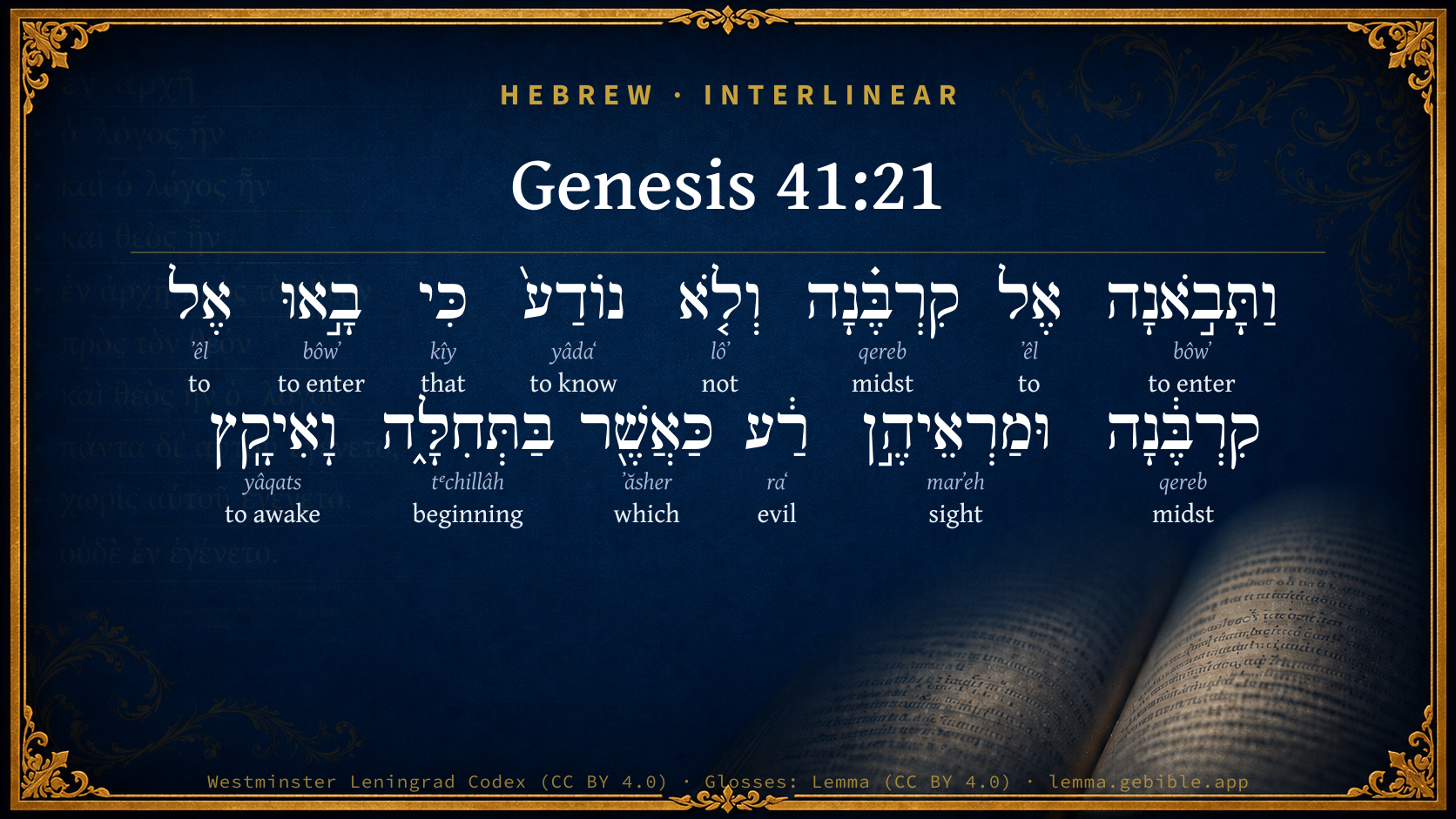
Hebrew (Westminster Leningrad Codex) Genesis 41:21 appears in the Hebrew Old Testament. The text above is from the Westminster Leningrad Codex. Each word links to its Strong’s number, a concise gloss, and parsing drawn from the Open Scriptures Hebrew Bible morphology. Click any word for its full Brown-Driver-Briggs (BDB) entry.
Download image
Cite this verse

Genesis 41:21 (World English Bible). Public Domain. Lemma interlinear Bible study tool, https://lemma.gebible.app/v/genesis/41/21.

Show BibTeX & RIS
BibTeX
RIS
English Translation
and when they had eaten them up, it couldn't be known that they had eaten them, but they were still ill-favored, as at the beginning. So I awoke.
World English Bible · Public Domain
Download a study sheet

One document with this verse’s original text, its word-by-word gloss line, the meaning frame, cross-references with their text, attributed commentary, and full source and license credits — printable, and it pastes into notes with its structure intact.

This verse Autodidact and up

Study sheet (.html) Plain text (.txt)

A passage Seminary Student

Up to 50 verses in one chapter. A passage sheet keeps up to 6 commentary sources and 12 cross-references per verse, in the order this page ranks them, and says so on the sheet whenever that leaves anything out. Ask for a single verse and you get the Autodidact verse sheet above.

Everything on this page stays free to read, with no account — the sheet is a download of what is already on screen, not access to it.

Want to remove ads? Support Godless Engineer
Compare translations 3

The same verse in 3 English versions, stacked beneath the original-language interlinear above. Click any original word for its lexicon entry.

Each is an independent rendering of the whole verse — the interlinear is not word-aligned to these translations.

Highlighted words mark where these versions differ — a whole-verse word diff, not a word-by-word alignment.

  • World English Bible Public Domain
    and when they had eaten them up, it couldn't be known that they had eaten them, but they were still ill-favored, as at the beginning. So I awoke.
  • King James Version Public Domain
    And when they had eaten them up, it could not be known that they had eaten them; but they were still ill favored, as at the beginning. So I awoke.
  • unfoldingWord Literal Text CC BY-SA 4.0
    So they went into their bellies, but it could not be known that they had gone into their bellies, and their appearance just as ugly as at the beginning. Then I woke up.

unfoldingWord Literal Text — © unfoldingWord, licensed CC BY-SA 4.0. Word-aligned USFM3 via Door43 (git.door43.org/unfoldingWord/en_ult).

Versions to compare (up to 4)

3 of 4 selected

Show all 18 translations

Every available English version of this verse, each an independent rendering of the whole verse.

  • World English Bible Public Domain
    and when they had eaten them up, it couldn't be known that they had eaten them, but they were still ill-favored, as at the beginning. So I awoke.
  • Berean Standard Bible Public Domain
    When they had devoured them, however, no one could tell that they had done so; their appearance was as ugly as it had been before. Then I awoke.
  • Majority Standard Bible Public Domain
    When they had devoured them, however, no one could tell that they had done so; their appearance was as ugly as it had been before. Then I awoke.
  • King James Version Public Domain
    And when they had eaten them up, it could not be known that they had eaten them; but they were still ill favored, as at the beginning. So I awoke.
  • American Standard Version (1901) Public Domain
    and when they had eaten them up, it could not be known that they had eaten them; but they were still ill-favored, as at the beginning. So I awoke.
  • Revised Version (1885) Public Domain
    and when they had eaten them up, it could not be known that they had eaten them; but they were still ill favoured, as at the beginning. So I awoke.
  • Geneva Bible (1599) Public Domain
    And when they had eaten them vp, it could not be knowen that they had eaten them, but they were still as euilfauoured, as they were at the beginning: so did I awake.
  • Douay-Rheims (1899) Public Domain
    And behold, there followed these, other seven kine, so very ill favoured and lean, that I never saw the like in the land of Egypt:
  • Young's Literal Translation Public Domain
    and they come in unto their midst, and it hath not been known that they have come in unto their midst, and their appearance `is' bad as at the commencement; and I awake.
  • Literal Standard Version CC BY-SA 4.0
    and they come in to their midst, and it has not been known that they have come in to their midst, and their appearance [is] bad as at the commencement; and I awake.
  • Unlocked Literal Bible CC BY-SA 4.0
    When they had eaten them up, it could not be known that they had eaten them, for they were still as undesirable as before. Then I awoke.
  • unfoldingWord Literal Text CC BY-SA 4.0
    So they went into their bellies, but it could not be known that they had gone into their bellies, and their appearance just as ugly as at the beginning. Then I woke up.
  • Darby Bible Public Domain
    and they came into their belly, and it could not be known that they had come into their belly; and their look was bad, as at the beginning. And I awoke.
  • World Messianic Bible Public Domain
    and when they had eaten them up, it couldn’t be known that they had eaten them, but they were still ugly, as at the beginning. So I awoke.
  • Webster's Bible Public Domain
    And when they had eaten them up, it could not be known that they had eaten them; but they were still ill-favored, as at the beginning. So I awoke.
  • Free Bible Version CC BY-SA 4.0
    But afterwards you couldn't tell they'd eaten them because they looked just as skinny and ugly as before. Then I woke up.
  • Bible in Basic English Public Domain
    And even with the fat cows inside them they seemed as bad as before. And so I came out of my sleep.
  • JPS Tanakh (1917) Public Domain
    And when they had eaten them up, it could not be known that they had eaten them; but they were still ill-favoured as at the beginning. So I awoke.

Literal Standard Version (2020), Covenant Press — licensed CC BY-SA 4.0. Text via the HelloAO Bible API (eBible.org). Unlocked Literal Bible (unfoldingWord) — licensed CC BY-SA 4.0. Text via the HelloAO Bible API (eBible.org). unfoldingWord Literal Text — © unfoldingWord, licensed CC BY-SA 4.0. Word-aligned USFM3 via Door43 (git.door43.org/unfoldingWord/en_ult). Free Bible Version, Dr. Jonathan Gallagher — licensed CC BY-SA 4.0. Text via the HelloAO Bible API (eBible.org).

Word by word

More ways to search: Search by grammar → Find every occurrence → Compare this word →

Practice this passage: Drill this verse → Learn its vocabulary →

וָאִיקָֽץ
yâqats
H3364
“and · to awake”
Conjunction + Verb, Qal, Sequential Imperfect, 1st Person, Common, Singular
Part of Speech
Conjunction + Verb
Stem
Qal
Form
Sequential Imperfect
Person
1st Person
Gender
Common
Number
Singular
Full BDB Definition

Origin: a primitive root

TWOT: 904

(Qal) to awake, awaken, become active
  1. וַתָּבֹ֣אנָה bôwʼ H935 “and · to enter” Conjunction + Verb, Qal, Sequential Imperfect, 3rd Person, Feminine, Plural
  2. אֶל ʼêl H413 “to” Preposition
  3. קִרְבֶּ֗נָה qereb H7130 “midst · their” Noun, Common, Masculine, Singular, Construct + Suffix, Personal, 3rd Person, Feminine, Plural
  4. וְלֹ֤א lôʼ H3808 “and · not” Conjunction + Particle, Negative
  5. נוֹדַע֙ yâdaʻ H3045 “to know” Verb, Niphal, Perfect, 3rd Person, Masculine, Singular
  6. כִּי kîy H3588 “that” Conjunction
  7. בָ֣אוּ bôwʼ H935 “to enter” Verb, Qal, Perfect, 3rd Person, Common, Plural
  8. אֶל ʼêl H413 “to” Preposition
  9. קִרְבֶּ֔נָה qereb H7130 “midst · their” Noun, Common, Masculine, Singular, Construct + Suffix, Personal, 3rd Person, Feminine, Plural
  10. וּמַרְאֵיהֶ֣ן marʼeh H4758 “and · sight · their” Conjunction + Noun, Common, Masculine, Singular, Construct + Suffix, Personal, 3rd Person, Feminine, Plural
  11. רַ֔ע raʻ H7451 “evil” Adjective, Adjective, Masculine, Singular, Absolute
  12. כַּאֲשֶׁ֖ר ʼăsher H834 “like/as · which” Preposition + Particle, Relative
  13. בַּתְּחִלָּ֑ה tᵉchillâh H8462 “in/at the · beginning” Preposition, Determined + Noun, Common, Feminine, Singular, Absolute

About this verse

These counts appear in no published source. They are computed here, from the morphology-tagged text and Lemma’s own curated glosses. What Lemma adds →

14
words
11
distinct lemmas
Pentateuch
section

Notable vocabulary

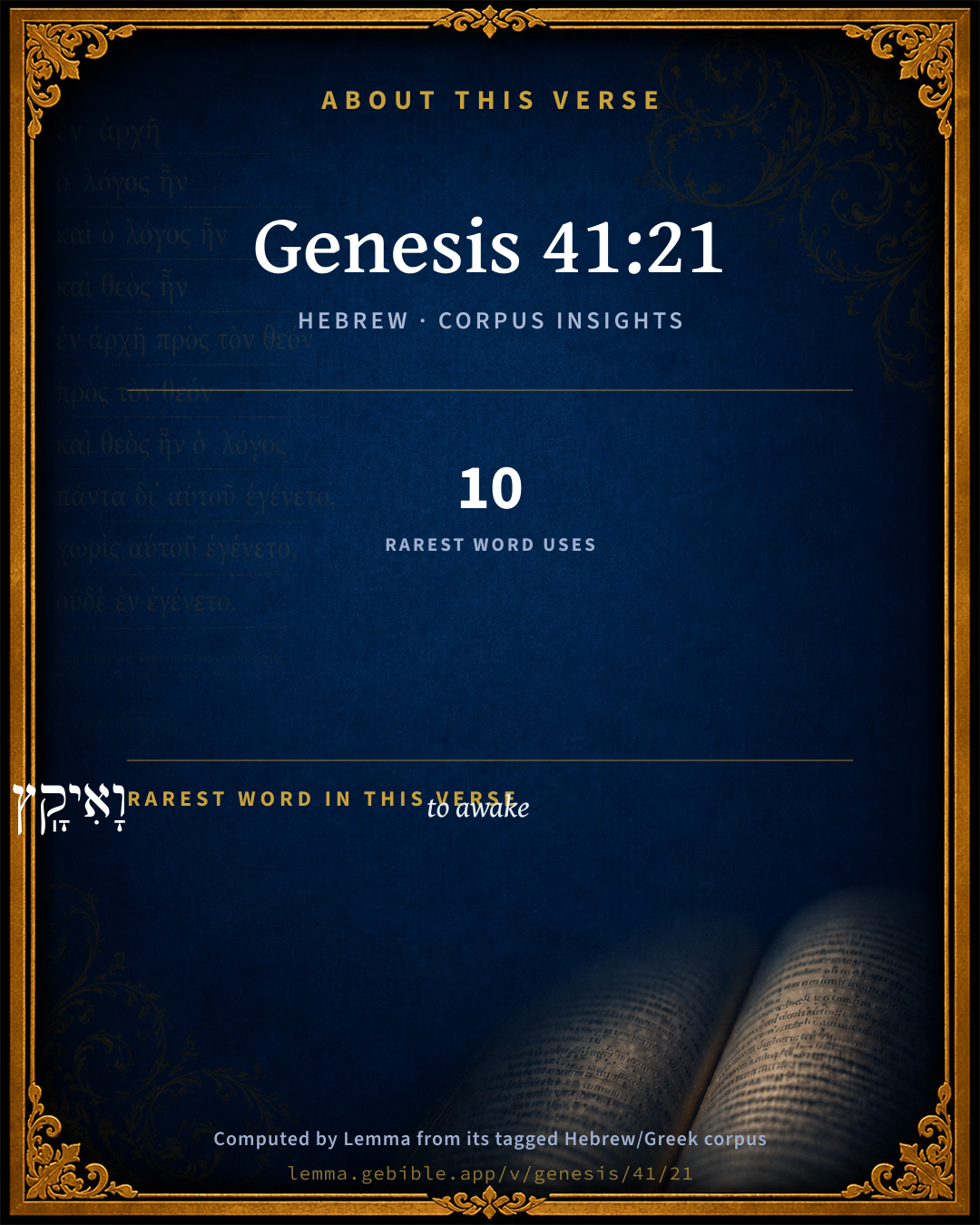
The rarest word here is וָאִיקָֽץ to awake H3364 — appearing just 10 times in the whole Hebrew Bible.

Shared distinctive vocabulary

וָאִיקָֽץ to awake H3364 occurs in 10 verses of the Hebrew Bible. Also found in:

Grammatical profile

  • 4 verbs
  • 4 nouns
  • 1 adjective
  • 2 prepositions
  • 1 conjunction
  • 2 particles

Verb forms

  • וַתָּבֹ֣אנָה Qal · Sequential Imperfect
  • נוֹדַע֙ Niphal · Perfect
  • בָ֣אוּ Qal · Perfect
  • וָאִיקָֽץ Qal · Sequential Imperfect

Repetition

Words recur within this verse — often emphatic in Hebrew:

  • וַתָּבֹ֣אנָה to enter H935 ×2
  • קִרְבֶּ֗נָה midst H7130 ×2
  • אֶל to H413 ×2

Hebrew & Septuagint length

In English translation the verse runs 28 words from the Hebrew and 34 from the Septuagint (LXX English) — closely comparable.

A rough comparison of the two English renderings, which tokenize alike — not a word-level alignment.

Word counts can differ between the Hebrew and the Greek without any difference in meaning — e.g. the Hebrew direct-object marker אֵת has no separate Greek word, and Greek often adds the article ὁ.

Cross-references

4

Topical passages linked to Genesis 41:21 in the Treasury of Scripture Knowledge — connected by theme and wording, ordered by reader-vote popularity; previews shown in the World English Bible.

  • Psalms 37:19 They shall not be disappointed in the time of evil. In the days of famine they shall be satisfied.
  • Isaiah 9:20 One shall snatch on the right hand, and be hungry; and he shall eat on the left hand, and they shall not be satisfied: they shall eat every man the flesh of his own arm:
  • Ezekiel 3:3 He said to me, Son of man, cause your belly to eat, and fill your bowels with this scroll that I give you. Then did I eat it; and it was in my mouth as honey for sweetness.
  • Revelation 10:9–10 I went to the angel, telling him to give me the little book. He said to me, "Take it, and eat it up. It will make your stomach bitter, but in your mouth it will be as sweet as honey."

Cross-references courtesy of OpenBible.info (CC BY 4.0).

Hebrew and Greek witnesses Masoretic Hebrew ↔ Greek Septuagint

The same verse in the two great witnesses to the Old Testament, shown verse-for-verse.

These are two independent witnesses, not word-aligned to each other, and the Septuagint is shown in lemma (dictionary) form.

Hebrew Genesis 41:21 Masoretic · Westminster Leningrad Codex

וַתָּבֹ֣אנָה אֶל קִרְבֶּ֗נָה וְלֹ֤א נוֹדַע֙ כִּי בָ֣אוּ אֶל קִרְבֶּ֔נָה וּמַרְאֵיהֶ֣ן רַ֔ע כַּאֲשֶׁ֖ר בַּתְּחִלָּ֑ה וָאִיקָֽץ

and when they had eaten them up, it couldn't be known that they had eaten them, but they were still ill-favored, as at the beginning. So I awoke.

World English Bible · Public Domain

Greek LXX Genesis 41:21 Septuagint · lemma form

καί εἰςἔρχομαι εἰς ὁ κοιλία αὐτός καί οὐ διάδηλος γίγνομαι ὅτι εἰςἔρχομαι εἰς ὁ κοιλία αὐτός καί ὁ ὄψις αὐτός αἰσχρός καθά καί ὁ ἀρχή ἐκἐγείρω δέ κοιμάω

And they went into their bellies; and it was not perceptible that they had gone into their bellies, and their appearance was ill-favoured, as also at the beginning; and after I awoke I slept,

LXX2012 (modern English Septuagint) · Public Domain

Hebrew: Westminster Leningrad Codex (CC BY 4.0). Greek: Septuagint (public domain); English from LXX2012 (modern English Septuagint) (Public Domain). How the Septuagint differs from the Hebrew →

Targum (Aramaic paraphrase)

2

The Targum is the ancient Jewish Aramaic paraphrase of the Hebrew Scriptures — an interpretive translation, not the Hebrew text itself. Onkelos (literal) and Pseudo-Jonathan (expansive) render the Torah, and Jonathan the Prophets. Coverage is partial: where no permissively-licensed English translation exists for a verse, only the Aramaic is shown. This is verse-level text, not a word-by-word alignment to the Hebrew.

  1. Targum Onkelos Torah (Genesis–Deuteronomy)
    וַעֲלָא לִמְעֵיהֶן וְלָא אִתְיְדַע אֲרֵי עַלּוּ לִמְעֵיהֶן וּמֶחֱזֵיהֶן בִּישׁ כַּד בְּקַדְמֵיתָא וְאִתְּעָרִית

    (no public-domain English translation for this verse)

    Targum Onkelos — Aramaic: “Onkelos Genesis” (public domain); “Onkelos Exodus” (public domain); “Onkelos Leviticus” (public domain); “Onkelos Numbers” (public domain); “Onkelos Deuteronomy” (public domain). English: “Sefaria Community Translation” (CC0 1.0 (public-domain dedication)); “J.W. Etheridge. The Targums of Onkelos and Jonathan Ben Uzziel on the Pentateuch. London: Longmans, Green, 1862” (public domain). Text via Sefaria.

  2. Targum Pseudo-Jonathan Torah (Genesis–Deuteronomy)
    וְעָלָא לִמְעֵהֶן וְלָא אִשְׁתְּמוֹדַע אֲרוּם עָלַן לִמְעֵהֶן וּמֶחְמֵיהֶן בִּישׁ הָא כִּדְבְקַדְמֵיתָא וְאִיתְעָרִית

    And they entered into their stomach, but it could not be known that they had entered into their stomach, for their appearance was evil as before; and I awoke.

    Targum Pseudo-Jonathan — Aramaic: “Targum Jonathan on Genesis” (public domain); “Targum Jonathan on Exodus” (public domain); “Targum Jonathan on Leviticus” (public domain); “Targum Jonathan on Numbers” (public domain); “Targum Jonathan on Deuteronomy” (public domain). English: “The Targum of Jonathan ben Uzziel, trans. J. W. Etheridge, London, 1862” (public domain). Text via Sefaria.

Commentary

Notes on Genesis 41:21 from classic Christian and Jewish commentators (each source and its license shown beneath its notes). The classic Christian expositions comment on the surrounding passage and are grouped to its opening verse, so a note may address several verses; the Jewish commentaries on the Tanakh (Rashi and others) are per-verse, so they appear only where the commentator wrote on this verse.

Lemma curates 59 commentaries, every one of them public domain or Creative Commons licensed, each selected and text-cleaned for this edition rather than reprinted as found. About our sources →

Trapp's Complete Commentary

John Trapp

Gen 41:21 And when they had eaten them up, it could not be known that they had eaten them; but they [were] still ill favoured, as at the beginning. So I awoke.

Ver. 21. {See Trapp on "Gen 41:2"} {See Trapp on "Gen 41:3"} {See Trapp on "Gen 41:4"}

John Trapp, A Commentary or Exposition upon All the Books of the Old and New Testament (1647–1656) — public domain. Text from a community e-Sword module.

Geneva Bible (1599)

Geneva Bible translators

Hebrew, were gone into their inward parts.

Geneva Bible (1599) marginal notes — public domain. Text via Bolls.life.

Adam Clarke's Commentary

Verse 21. And when they had eaten them up, c.] Nothing can more powerfully mark the excess and severity of the famine than creatures of the beeve or of the hippopotamus kind eating each other, and yet without any effect remaining as lean and as wretched as they were before. A sense of want increases the appetite, and stimulates the digestive powers to unusual action; hence the concoction of the food becomes very rapid, and it is hurried through the intestines before its nutritive particles can be sufficiently absorbed; and thus, though much is eaten, very little nourishment is derived from it. And when they had eaten them up, it could not be known that they had eaten them; but they were still ill favoured, as at the beginning. A most nervous and physically correct description.

Adam Clarke's Commentary on the Bible (1810–1826) — public domain. Text from a community e-Sword/MySword module.

John Gill's Exposition

And, behold, seven ears withered,.... Here a new epithet of the bad ears is given, and expressed by a word nowhere else used, which Ben Melech interprets, small, little, according to the use of the word in the Misnah; Aben Ezra, void, empty, such as had no grains of corn in them, nothing but husk or chaff, and observes that some render it images; for the word is so used in the Arabic language, and may signify that these ears were only mere shadows or images of ears, which had no substance in them: Jarchi says, the word, in the Syriac language signifies a rock, and so it denotes that these ears were dry as a rock, and had no moisture in them, laid dried, burnt up, and blasted with the east wind.

And, behold, seven ears withered,.... Here a new epithet of the bad ears is given, and expressed by a word nowhere else used, which Ben Melech interprets, small, little, according to the use of the word in the Misnah; Aben Ezra, void, empty, such as had no grains of corn in them, nothing but husk or chaff, and observes that some render it images; for the word is so used in the Arabic language, and may signify that these ears were only mere shadows or images of ears, which had no substance in them: Jarchi says, the word, in the Syriac language signifies a rock, and so it denotes that these ears were dry as a rock, and had no moisture in them, laid dried, burnt up, and blasted with the east wind.

Genesis 41:24

gen 41:24

gen 41:24

gen 41:24And the thin ears devoured the seven good ears,.... See Gill on Gen 41:7,

and I told this unto the magicians; just in the same manner as he had to Joseph:

but there was none that could declare it unto me; the meaning of it; what all this should signify or portend.

John Gill's Exposition of the Whole Bible (1746–1763) — public domain (CC PDM 1.0). Text via the HelloAO Bible API.

Matthew Poole's English Annotations

They seemed to be neither fatter in the flesh, nor fuller in their bodies. As many times in famine men eat much, but are not satisfied, because God withdraws his blessing from it, by which alone it is that meat nourisheth us.

Matthew Poole's English Annotations on the Holy Bible (1683–1685) — public domain. Text from a community e-Sword/MySword module.

Radak

Rabbi David Kimhi (Radak)

ולא נודע, concerning this comment of Pharaoh’s narrative Joseph said in verse 31 that ולא יודע השבע that during the years of famine the abundance of food during the preceding 7 years will not even be something people could remember.

Radak on the Tanakh — English translations: “Sefaria Community Translation” (CC0 1.0 (public-domain dedication)); “Eliyahu Munk, HaChut Hameshulash” (CC BY 4.0); “Rabbi Mike Feuer, Jerusalem Anthology” (CC BY 4.0); and “R. David Kimhi on the first book of Psalms, Translated by R.G. Finch, London, 1919” (public domain). Text via Sefaria.

Lesson kit

Teaching starters — assembled from the data on this page, not authored interpretation. Every prompt links to the verse data it draws on. Edit before teaching.

Genesis, in the Pentateuch, opens this verse with 14 words (11 distinct Hebrew lemmas). Its most distinctive word is yâqats (“to awake”). A historical commentator’s framing appears above. Read the whole chapter for the surrounding context.

Discussion questions

  1. What does “to awake” (yâqats) contribute to the verse as a whole?
  2. Genesis 9:24 shares the word «to awake» with this verse. How do the two illuminate each other?
  3. “to enter” occurs 2× in this one verse. What is the effect of the repetition?
  4. The translations on this page render this verse differently — a whole-verse word diff, not a word-by-word alignment. What might account for the different wordings?
  5. The verb «וַתָּבֹ֣אנָה» is Qal Sequential Imperfect. How does its form color the action?
  6. Reading how Trapp's Complete Commentary and Geneva Bible (1599) read this verse, where do the two commentators agree and where do they part?

Things to notice

Reading settings

Reading text

Shown beneath each verse's original-language words.

Old Testament
Old Testament edition

Read the OT as the Masoretic Hebrew (MT) or the Greek Septuagint (LXX).

English shown for the Greek Septuagint (in the Hebrew ↔ Greek comparison).

Comparing translations? Open the Compare panel on any verse page to stack up to four side by side.