Amos 5:19

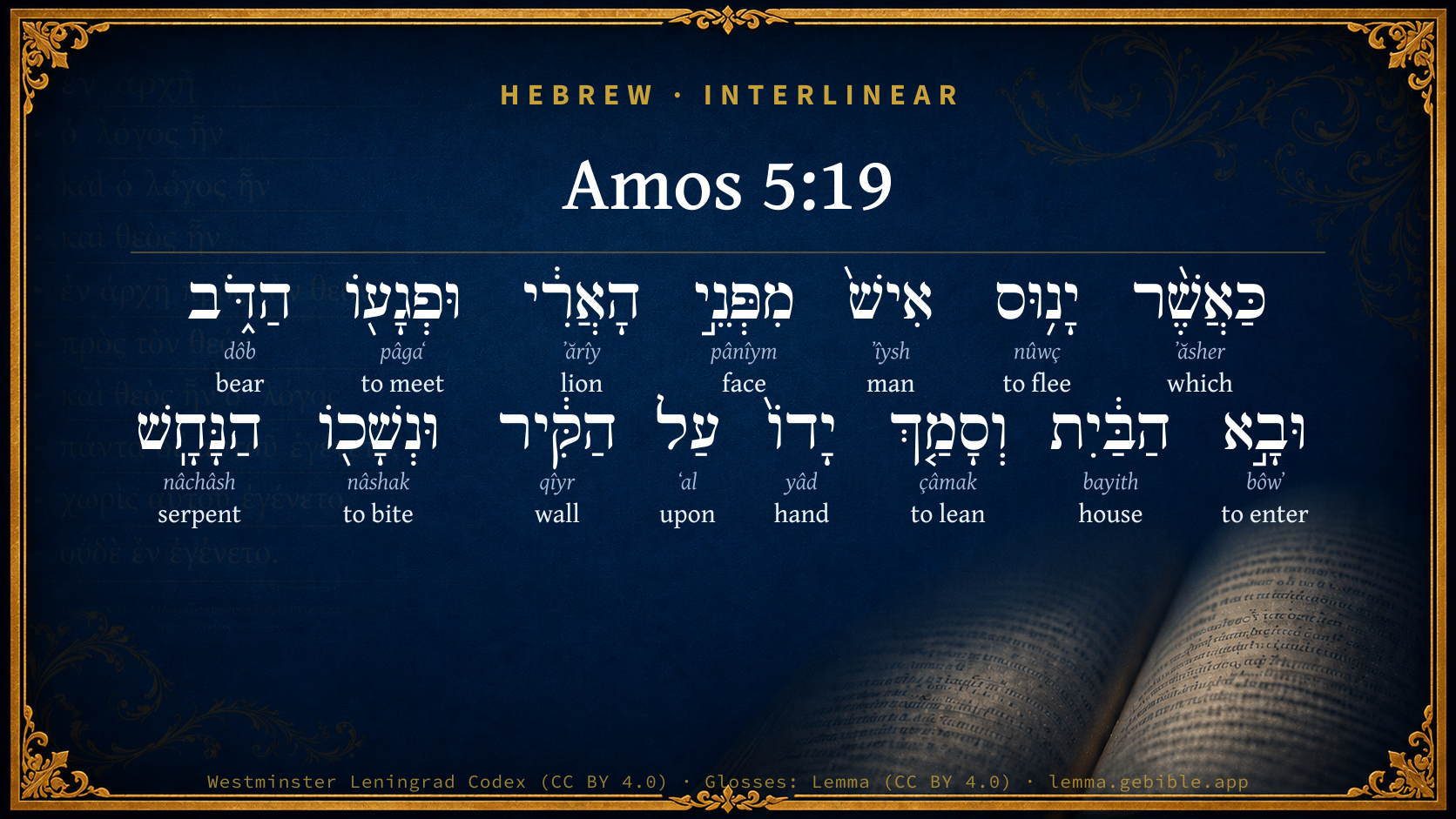
Hebrew (Westminster Leningrad Codex) Amos 5:19 appears in the Hebrew Old Testament. The text above is from the Westminster Leningrad Codex. Each word links to its Strong’s number, a concise gloss, and parsing drawn from the Open Scriptures Hebrew Bible morphology. Click any word for its full Brown-Driver-Briggs (BDB) entry.
Download image
Cite this verse

Amos 5:19 (World English Bible). Public Domain. Lemma interlinear Bible study tool, https://lemma.gebible.app/v/amos/5/19.

Show BibTeX & RIS
BibTeX
RIS
English Translation
As if a man fled from a lion, And a bear met him; Or he went into the house and leaned his hand on the wall, And a snake bit him.
World English Bible · Public Domain
Download a study sheet

One document with this verse’s original text, its word-by-word gloss line, the meaning frame, cross-references with their text, attributed commentary, and full source and license credits — printable, and it pastes into notes with its structure intact.

This verse Autodidact and up

Study sheet (.html) Plain text (.txt)

A passage Seminary Student

Up to 50 verses in one chapter. A passage sheet keeps up to 6 commentary sources and 12 cross-references per verse, in the order this page ranks them, and says so on the sheet whenever that leaves anything out. Ask for a single verse and you get the Autodidact verse sheet above.

Everything on this page stays free to read, with no account — the sheet is a download of what is already on screen, not access to it.

Want to remove ads? Support Godless Engineer
Compare translations 3

The same verse in 3 English versions, stacked beneath the original-language interlinear above. Click any original word for its lexicon entry.

Each is an independent rendering of the whole verse — the interlinear is not word-aligned to these translations.

Highlighted words mark where these versions differ — a whole-verse word diff, not a word-by-word alignment.

  • World English Bible Public Domain
    As if a man fled from a lion, And a bear met him; Or he went into the house and leaned his hand on the wall, And a snake bit him.
  • King James Version Public Domain
    As if a man did flee from a lion, and a bear met him; or went into the house, and leaned his hand on the wall, and a serpent bit him.
  • unfoldingWord Literal Text CC BY-SA 4.0
    as when a man flees from a lion and a bear meets him, or he goes in a house and puts his hand on the wall and a snake bites him.

unfoldingWord Literal Text — © unfoldingWord, licensed CC BY-SA 4.0. Word-aligned USFM3 via Door43 (git.door43.org/unfoldingWord/en_ult).

Versions to compare (up to 4)

3 of 4 selected

Show all 18 translations

Every available English version of this verse, each an independent rendering of the whole verse.

  • World English Bible Public Domain
    As if a man fled from a lion, And a bear met him; Or he went into the house and leaned his hand on the wall, And a snake bit him.
  • Berean Standard Bible Public Domain
    It will be like a man who flees from a lion, only to encounter a bear, or who enters his house and rests his hand against the wall, only to be bitten by a snake.
  • Majority Standard Bible Public Domain
    It will be like a man who flees from a lion, only to encounter a bear, or who enters his house and rests his hand against the wall, only to be bitten by a snake.
  • King James Version Public Domain
    As if a man did flee from a lion, and a bear met him; or went into the house, and leaned his hand on the wall, and a serpent bit him.
  • American Standard Version (1901) Public Domain
    As if a man did flee from a lion, and a bear met him; or went into the house and leaned his hand on the wall, and a serpent bit him.
  • Revised Version (1885) Public Domain
    As if a man did flee from a lion, and a bear met him; or went into the house and leaned his hand on the wall, and a serpent bit him.
  • Geneva Bible (1599) Public Domain
    As if a man did flee from a lyon, and a beare met him: or went into the house, and leaned his hand on the wall, and a serpent bit him.
  • Douay-Rheims (1899) Public Domain
    As if a man should flee from the face of a lion, and a bear should meet him: or enter into the house, and lean with his hand upon the wall, and a serpent should bite him.
  • Young's Literal Translation Public Domain
    As `when' one fleeth from the face of the lion, And the bear hath met him, And he hath come in to the house, And hath leant his hand on the wall, And the serpent hath bitten him.
  • Literal Standard Version CC BY-SA 4.0
    As [when] one flees from the face of the lion, || And the bear has met him, || And he has come into the house, || And has leaned his hand on the wall, || And the serpent has bitten him.
  • Unlocked Literal Bible CC BY-SA 4.0
    as when a man flees from a lion and a bear meets him, or he goes in a house and puts his hand on the wall and a snake bites him.
  • unfoldingWord Literal Text CC BY-SA 4.0
    as when a man flees from a lion and a bear meets him, or he goes in a house and puts his hand on the wall and a snake bites him.
  • Darby Bible Public Domain
    as if a man fled from a lion, and a bear met him; or went into the house and leaned his hand on the wall, and a serpent bit him.
  • World Messianic Bible Public Domain
    As if a man fled from a lion, and a bear met him; or he went into the house and leaned his hand on the wall, and a snake bit him.
  • Webster's Bible Public Domain
    As if a man fled from a lion, and a bear met him; or went into the house, and leaned his hand on the wall, and a serpent bit him.
  • Free Bible Version CC BY-SA 4.0
    It will be like a man running away from a lion only to meet a bear; or a man who goes home and leans his hand on a wall, only to be bitten by a snake.
  • Bible in Basic English Public Domain
    As if a man, running away from a lion, came face to face with a bear; or went into the house and put his hand on the wall and got a bite from a snake.
  • JPS Tanakh (1917) Public Domain
    As if a man did flee from a lion, and a bear met him; and went into the house and leaned his hand on the wall, and a serpent bit him.

Literal Standard Version (2020), Covenant Press — licensed CC BY-SA 4.0. Text via the HelloAO Bible API (eBible.org). Unlocked Literal Bible (unfoldingWord) — licensed CC BY-SA 4.0. Text via the HelloAO Bible API (eBible.org). unfoldingWord Literal Text — © unfoldingWord, licensed CC BY-SA 4.0. Word-aligned USFM3 via Door43 (git.door43.org/unfoldingWord/en_ult). Free Bible Version, Dr. Jonathan Gallagher — licensed CC BY-SA 4.0. Text via the HelloAO Bible API (eBible.org).

Word by word

More ways to search: Search by grammar → Find every occurrence → Compare this word →

Practice this passage: Drill this verse → Learn its vocabulary →

הַדֹּ֑ב
dôb
H1677
“the · bear”
Particle, Definite Article + Noun, Common, Masculine, Singular, Absolute
Part of Speech
Particle + Noun
Type
Common
Gender
Masculine
Number
Singular
State
Absolute
Full BDB Definition

Origin: from H1680

TWOT: 396a

bear
  1. כַּאֲשֶׁ֨ר ʼăsher H834 “like/as · which” Preposition + Particle, Relative
  2. יָנ֥וּס nûwç H5127 “to flee” Verb, Qal, Imperfect, 3rd Person, Masculine, Singular
  3. אִישׁ֙ ʼîysh H376 “man” Noun, Common, Masculine, Singular, Absolute
  4. מִפְּנֵ֣י pânîym H6440 “from · face(s) of” Preposition + Noun, Common, Both, Plural, Construct
  5. הָאֲרִ֔י ʼărîy H738 “the · lion” Particle, Definite Article + Noun, Common, Masculine, Singular, Absolute
  6. וּפְגָע֖וֹ pâgaʻ H6293 “and · to meet · him” Conjunction + Verb, Qal, Sequential Perfect, 3rd Person, Masculine, Singular + Suffix, Personal, 3rd Person, Masculine, Singular
  7. וּבָ֣א bôwʼ H935 “and · to enter” Conjunction + Verb, Qal, Sequential Perfect, 3rd Person, Masculine, Singular
  8. הַבַּ֔יִת bayith H1004 “the · house” Particle, Definite Article + Noun, Common, Masculine, Singular, Absolute
  9. וְסָמַ֤ךְ çâmak H5564 “and · to lean” Conjunction + Verb, Qal, Sequential Perfect, 3rd Person, Masculine, Singular
  10. יָדוֹ֙ yâd H3027 “hand · his” Noun, Common, Both, Singular, Construct + Suffix, Personal, 3rd Person, Masculine, Singular
  11. עַל ʻal H5921 “upon” Preposition
  12. הַקִּ֔יר qîyr H7023 “the · wall” Particle, Definite Article + Noun, Common, Masculine, Singular, Absolute
  13. וּנְשָׁכ֖וֹ nâshak H5391 “and · to bite · him” Conjunction + Verb, Qal, Sequential Perfect, 3rd Person, Masculine, Singular + Suffix, Personal, 3rd Person, Masculine, Singular
  14. הַנָּחָֽשׁ nâchâsh H5175 “the · serpent” Particle, Definite Article + Noun, Common, Masculine, Singular, Absolute

About this verse

These counts appear in no published source. They are computed here, from the morphology-tagged text and Lemma’s own curated glosses. What Lemma adds →

15
words
15
distinct lemmas
Prophets
section

Notable vocabulary

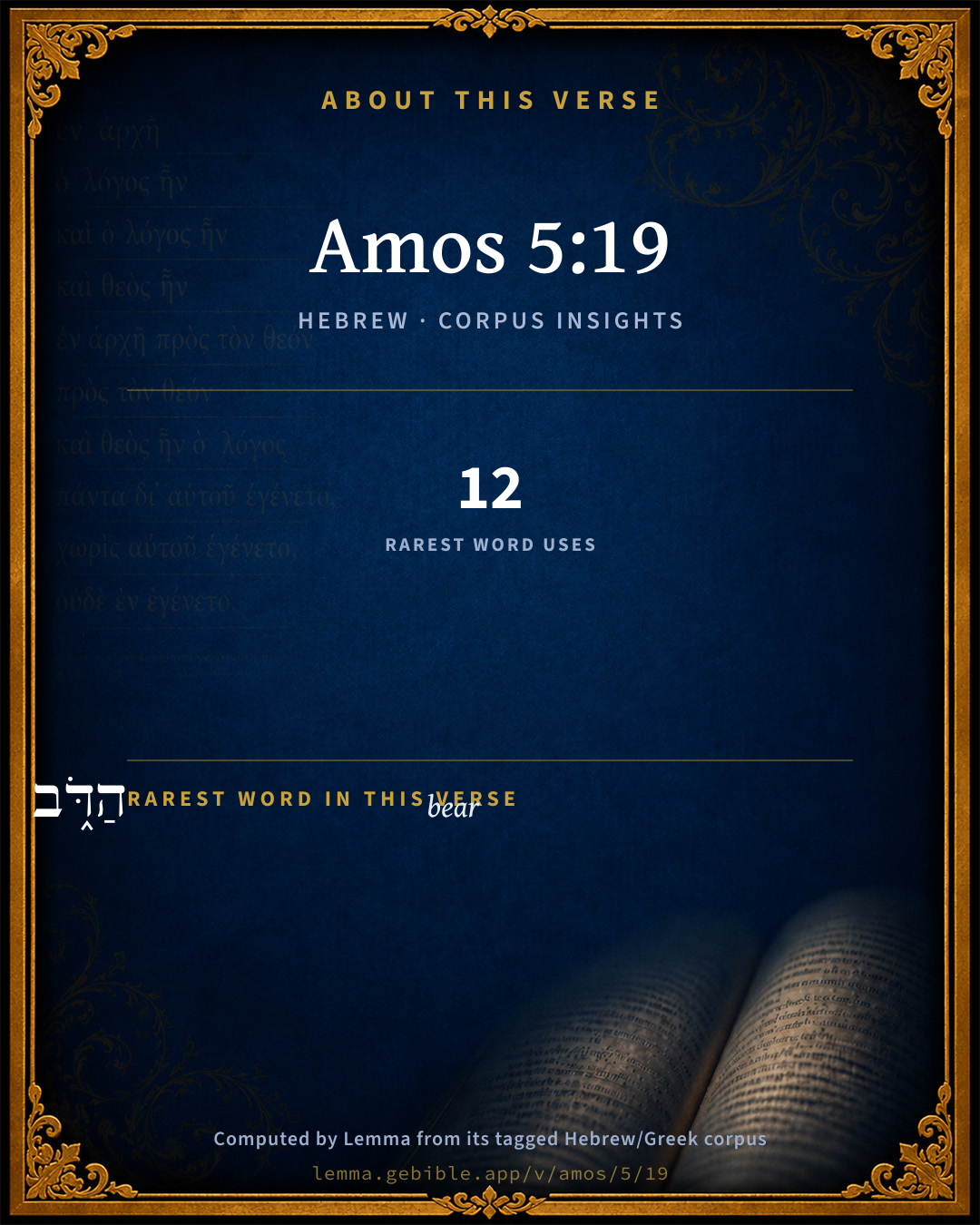
The rarest word here is הַדֹּ֑ב bear H1677 — appearing just 12 times in the whole Hebrew Bible.

Shared distinctive vocabulary

הַדֹּ֑ב bear H1677 occurs in 12 verses of the Hebrew Bible. Also found in:

Grammatical profile

  • 5 verbs
  • 8 nouns
  • 1 preposition
  • 1 particle

Verb forms

  • יָנ֥וּס Qal · Imperfect
  • וּפְגָע֖וֹ Qal · Sequential Perfect
  • וּבָ֣א Qal · Sequential Perfect
  • וְסָמַ֤ךְ Qal · Sequential Perfect
  • וּנְשָׁכ֖וֹ Qal · Sequential Perfect

Hebrew & Septuagint length

In English translation the verse runs 31 words from the Hebrew and 38 from the Septuagint (LXX English) — closely comparable.

A rough comparison of the two English renderings, which tokenize alike — not a word-level alignment.

Word counts can differ between the Hebrew and the Greek without any difference in meaning — e.g. the Hebrew direct-object marker אֵת has no separate Greek word, and Greek often adds the article ὁ.

Cross-references

7

Topical passages linked to Amos 5:19 in the Treasury of Scripture Knowledge — connected by theme and wording, ordered by reader-vote popularity; previews shown in the World English Bible.

  • Isaiah 24:17–18 Fear, and the pit, and the snare, are on you, O inhabitant of the earth.
  • Jeremiah 15:2–3 It shall happen, when they tell you, Where shall we go forth? then you shall tell them, Thus says Yahweh: Such as are for death, to death; and such as are for the sword, to the sword; and such as are for the famine, to the famine; and such as are for captivity, to captivity.
  • Jeremiah 48:43–44 Fear, and the pit, and the snare, are on you, inhabitant of Moab, says Yahweh.
  • Acts 28:4 When the natives saw the creature hanging from his hand, they said one to another, "No doubt this man is a murderer, whom, though he has escaped from the sea, yet Justice has not allowed to live."
  • 1 Kings 20:29–30 They encamped one over against the other seven days. So it was, that in the seventh day the battle was joined; and the children of Israel killed of the Syrians one hundred thousand footmen in one day.
  • Job 20:24–25 He shall flee from the iron weapon. The bronze arrow shall strike him through.
  • Amos 9:1–2 I saw the Lord standing beside the altar, and he said, "Strike the tops of the pillars, that the thresholds may shake; and break them in pieces on the head of all of them; and I will kill the last of them with the sword: there shall not one of them flee away, and there shall not one of them escape.

Cross-references courtesy of OpenBible.info (CC BY 4.0).

Hebrew and Greek witnesses Masoretic Hebrew ↔ Greek Septuagint

The same verse in the two great witnesses to the Old Testament, shown verse-for-verse.

These are two independent witnesses, not word-aligned to each other, and the Septuagint is shown in lemma (dictionary) form.

Hebrew Amos 5:19 Masoretic · Westminster Leningrad Codex

כַּאֲשֶׁ֨ר יָנ֥וּס אִישׁ֙ מִפְּנֵ֣י הָאֲרִ֔י וּפְגָע֖וֹ הַדֹּ֑ב וּבָ֣א הַבַּ֔יִת וְסָמַ֤ךְ יָדוֹ֙ עַל הַקִּ֔יר וּנְשָׁכ֖וֹ הַנָּחָֽשׁ

As if a man fled from a lion, And a bear met him; Or he went into the house and leaned his hand on the wall, And a snake bit him.

World English Bible · Public Domain

Greek LXX Amos 5:19 Septuagint · lemma form

ὅς τρόπος ὅταν φεύγω ἄνθρωπος ἐκ πρόσωπον ὁ λέων καί ἐνπίπτω αὐτός ὁ ἄρκος καί εἰςπηδάω εἰς ὁ οἶκος αὐτός καί ἀποἐρείδω ὁ χείρ αὐτός ἐπί ὁ τοῖχος καί δάκνω αὐτός ὁ ὄφις

As if a man should flee from the face of a lion, and a bear should meet him; and he should spring into his house, and lean his hands upon the wall, and a serpent should bite him.

LXX2012 (modern English Septuagint) · Public Domain

Hebrew: Westminster Leningrad Codex (CC BY 4.0). Greek: Septuagint (public domain); English from LXX2012 (modern English Septuagint) (Public Domain). How the Septuagint differs from the Hebrew →

Targum (Aramaic paraphrase)

1

The Targum is the ancient Jewish Aramaic paraphrase of the Hebrew Scriptures — an interpretive translation, not the Hebrew text itself. Onkelos (literal) and Pseudo-Jonathan (expansive) render the Torah, and Jonathan the Prophets. Coverage is partial: where no permissively-licensed English translation exists for a verse, only the Aramaic is shown. This is verse-level text, not a word-by-word alignment to the Hebrew.

  1. Targum Jonathan Prophets (Joshua–Malachi)
    כְּמָא דִי יַעֲרוֹק גַבְרָא מִן קֳדָם אַרְיָא וִיעַרְעִנֵיהּ דוּבָא וְיֵיעוֹל לְבֵיתָא וְיִסְמוֹךְ יְדֵיהּ עַל כָּתְלָא וְיַכְתִנֵיהּ חִוְיָא:

    (no public-domain English translation for this verse)

    Targum Jonathan — Aramaic: “Mikraot Gedolot” (public domain). English: “Sefaria Community Translation” (CC0 1.0 (public-domain dedication)); “London "Chaldee Paraphrase," 1871” (public domain). Text via Sefaria.

Commentary

Notes on Amos 5:19 from classic Christian and Jewish commentators (each source and its license shown beneath its notes). The classic Christian expositions comment on the surrounding passage and are grouped to its opening verse, so a note may address several verses; the Jewish commentaries on the Tanakh (Rashi and others) are per-verse, so they appear only where the commentator wrote on this verse.

Lemma curates 59 commentaries, every one of them public domain or Creative Commons licensed, each selected and text-cleaned for this edition rather than reprinted as found. About our sources →

Trapp's Complete Commentary

John Trapp

Amo 5:19 As if a man did flee from a lion, and a bear met him; or went into the house, and leaned his hand on the wall, and a serpent bit him.

Ver. 19. As if a man did fly from a lion] And so by running from his death should run to it; by seeking to shun the shelves should split against a rock, Incidit in Scyllam, &c., as Nicodemus Frischline (that famous poet, orator, and philosopher), endeavouring to escape out of close prison, by casting himself out at a window, the rope broke, and he perished by falling headlong upon a rock: so fareth it with those that fear not God. Aliud ex alio malum, one mischief treadeth on the heels of another, as Job’s messengers. The clouds return after the rain, Ecc 12:2, as in April weather one shower is unburdened, another is brewed: "and deep calleth upon deep at the noise of the waterspouts," Psa 42:7. "Evil shall hunt the violent man to destroy him," Psa 140:11, your sins shall find you out as a bloodhound, Num 32:23, as it did that Popish priest in London, who, having escaped the fall of Blackfriars, A.D. 1623 (where Drury had his brains knocked out of his head, together with his sermon), and taking water, with a purpose to sail into Flanders, was cast away (together with some others) under London bridge; the boat being overturned. And as Philip II, King of Spain, who, going from the Low Countries into Spain by sea, fell into a storm in which almost all the fleet was wrecked, his household stuff of very great value lost, and himself hardly escaped. He said he was delivered by the singular providence of God to root out Lutheranism, which he presently began to do. But the hand of God was upon him in an extraordinary manner; for beside the invincible Armada here defeated, to his great heartbreak (for his pretended patience was but as the fever called Epialis, wherein men are cold without but as hot as fire within), he fell into that most loathsome lousy disease, called Phthiriasis, whereof at length he died.

And a bear met him] A bear robbed of her whelps (which she licketh into form, and loveth above measure) is a very fierce and fell creature. To meet her in such a rage is to meet death in the very face; and yet that danger may be sooner shifted and shunned than the heavy wrath of God avoided or averted without true and timely repentance: there is no way to run from him but by running penitently to him; as in a tempest at sea it is very dangerous to strike to the shore; the safest way is to have sea room, and to keep in to keep in the open main still.

Or went into the house] To shelter himself from the bear; as every creature in danger runneth to its harbour, Pro 30:26 Psa 104:18.

And leaned his hand on the walls] As being breathless in running, and glad to stay himself on what he can next lay hold on. Man, like the vine, must have somewhat to lean on, if it be but a broken reed or bulging wall, Psa 62:3; he shifts and shirks in every bycorner for comfort, as the Papists (stung by the friars’ sermons) do by pardons and penances, which are but palliate cures.

For a serpent bites them] The guilt of sin abiding, "biteth like a serpent, and stingeth like an adder," Pro 23:32.

John Trapp, A Commentary or Exposition upon All the Books of the Old and New Testament (1647–1656) — public domain. Text from a community e-Sword module.

Jamieson, Fausset & Brown

Robert Jamieson, A. R. Fausset & David Brown

As if a man did flee . . . a lion, and a bear met him--Trying to escape one calamity, he falls into another. This perhaps implies that in Amo 5:18 their ironical desire for the day of the Lord was as if it would be an escape from existing calamities. The coming of the day of the Lord would be good news to us, if true: for we have served God (that is, the golden calves). So do hypocrites flatter themselves as to death and judgment, as if these would be a relief from existing ills of life. The lion may from generosity spare the prostrate, but the bear spares none (compare Job 20:24; Isa 24:18).

leaned . . . on the wall--on the side wall of the house, to support himself from falling. Snakes often hid themselves in fissures in a wall. Those not reformed by God's judgments will be pursued by them: if they escape one, another is ready to seize them.

Jamieson, Fausset & Brown — Commentary Critical and Explanatory on the Whole Bible (1871) — public domain (CC PDM 1.0). Text via the HelloAO Bible API.

Adam Clarke's Commentary

Verse 19. As if a man did flee from a lion, and a bear met him] They shall go from one evil to another. He who escapes from the lion's mouth shall fall into the bear's paws: -

Incidit in Scyllam, cupiens vitare Charybdim.

The Israelites, under their king Menahem, wishing to avoid a civil war, called in Pul, king of Assyria, to help them. This led to a series of evils inflicted by the Syrian and Assyrian kings, till at last Israel was ravaged by Shalmaneser, and carried into captivity. Thus, in avoiding one evil they fell into another still more grievous.

Leaned his hand on a wall, and a serpent bit him.] Snakes and venomous animals are fond of taking up their lodging in walls of houses, where they can either find or make holes; and it is dangerous to sit near them or lean against them. In the East Indies they keep the faithful mongose, a species of ichneumon, in their houses, for the purpose of destroying the snakes that infest them.

Adam Clarke's Commentary on the Bible (1810–1826) — public domain. Text from a community e-Sword/MySword module.

John Calvin's Commentaries

Here is expressed more clearly what the Prophet had said before, — that hypocrites can have no hope, that the various changes, which may take place, will bring them any alleviation. Hypocrites, while straying in circuitous courses, do indeed promise better things to themselves, when the condition of the times is changed: and as Satan transforms himself into an angel of light, so hypocrites imitate the true servants of God. But it is a false imitation; for these are only fading flowers, no fruit follows; and besides, they proceed not from a living root. When the children of God are at any time pressed down by adverse events, they sustain and patiently nourish their faith with this consolation, — that clouds soon pass away: so also when the Lord chastises them with temporal punishment, he will presently return into favor with them. Hypocrites present the same outward appearance; but they widely differ from the faithful: for when the faithful promise to themselves a prosperous issue, they are at the same time touched with a sense of their own evils, and study to reconcile themselves to God; but hypocrites continue immersed in their vices and boldly despise God; and at the same time they see here and there, and when any change happens they think that they have got rid of all evils. Inasmuch then as they deceived themselves with vain consolation, the Prophet now says, “You have no cause to think that it will be better with you, when one calamity shall pass away; for the same thing will happen to you, as when one flees away from a lion and meets with a bear, as when one escapes from a bear, and betakes himself to his own house, and there a serpent finds him: while he is leaning with his hand on the wall, a serpent bites him. Thus the Lord has in readiness various and many ways, by which he can punish you. When therefore ye shall have sustained one battle, when one enemy departs, the battle will be immediately renewed and that by another enemy: when a foreign power does not rage through the kingdom of Israel, the Lord will consume you either by famine, or by want, or by pestilence.” We then see how well the context of the Prophet harmonizes together.

John Calvin's Commentaries (1540-1563) — public domain. Text from the Calvin Translation Society English edition (1840s-50s) via the Christian Classics Ethereal Library (ccel.org). Calvin's coverage is partial (roughly two-thirds of the Bible); uncommented books and verses are honest gaps, never fabricated. The 19th-century editor's footnotes and remarks are omitted so the notes are faithfully Calvin's own voice.

Ellicott's Commentary for English Readers

(19) Your escape will be impossible. You will avoid one calamity, only to fall into a worse.

A Bible Commentary for English Readers, edited by Charles John Ellicott (1878–1897) — public domain. Text from a community e-Sword module.

The Cambridge Bible for Schools and Colleges

gen. ed. J. J. S. Perowne

19. Examples of a condition beset by perils, in which men escape from one danger, only to fall into another, perhaps worse.

a bear] Bears are now found only in the far north of Palestine, about Mount Hermon, but they were once common in all parts of the country, and were dangerous both to human beings (2Ki_2:24; Lam_3:10) and to sheep (1Sa_17:34): the bear is coupled with the lion, also, in Lam_3:10.

and entered into the house &c.] taking refuge from the bear, and encountered there an unsuspected danger, being bitten by a serpent which had concealed itself in a crevice of the wall.

The Cambridge Bible for Schools and Colleges (gen. ed. J. J. S. Perowne; Cambridge University Press, 1878–1918) — public domain. Text from a community e-Sword module.

John Gill's Exposition

As if a man did flee from a lion, and a bear met him,.... That is, should the day of the Lord come as they desired, they would not be the better for it; it would be only going from one trouble to another, like escaping Scylla, and falling into Charybdis: or as if a man, upon the sight of a lion, and at his yell, should take to his heels, and flee "from the face" of him, as the phrase is (i), and a bear, a less generous, and more cruel and voracious creature, especially when: bereaved of its whelps, should meet him, and seize him: or should: he get clear of them both,

or went into the house, and leaned his hand on the wall, and a serpent bit him; should he get into a house, and so escape the lion and the bear, and lean upon the wall of the house to support and ease him, being out of breath in running from these creatures; yet a serpent lurking in the wall of an old house bites him, and the venom and poison of it issues in his death; so he gains nothing by fleeing from the lion, or escaping the bear. These proverbial expressions signify that the Israelites would be no gainers by the day of the Lord, but rather fall into greater evils, and more distressing calamities. Some Jewish writers interpret the lion and the bear of Laban and Esau; the lion (they say (k)) is Laban, who pursued after Jacob to take away his life; the bear is Esau, who stood in the way to kill all that came, the mother with the children; but are much better interpreted of the Chaldeans, Persians, and Grecians, by Jerom; whose words are,

"fleeing from the face of Nebuchadnezzar the lion, ye will be met by Ahasuerus, under whom, was the history of Esther; or the empire of the Assyrians and Chaldeans being destroyed, the Medes and Persians shall arise; and when upon the reign of Cyrus ye shall have returned, and at the command of, Darius shall have begun to build the house of the Lord, and have confidence in the temple, so as to rest in it, lean your weary hands on its walls; then shall come Alexander king of the Macedonians, or Antiochus, surnamed Epiphanes, who shall abide in the temple, and bite likes serpent, not without in Babylon, and in Susa, but within the borders of the holy land; by which it appears that the day ye desire is not a day of light and joy, but of darkness and sorrow.''

The interpretation is pretty and ingenious enough, since the characters of the lion, bear, and serpent, agree with the respective persons and people mentioned; Nebuchadnezzar is often compared to a lion, Jer 4:7; and the Babylonian and Chaldean monarchy is represented by one in Dan 7:4; and the Persian monarchy by a bear, Dan 7:5; to which the Persians are compared, the Jews say (l), because they eat and drink like a bear, are as fat as bears, and hairy like them, and as restless as they; and so the Persians were noted for their luxury and lust, as well as their cruelty; and, wearing long hair, are called hairy persons in the Delphic oracle, which Herodotus (m) interprets of them; See Gill on Dan 7:5; and Antiochus may not unfitly be compared to a serpent; see See Gill on Dan 8:23; See Gill on Dan 8:24; See Gill on Dan 8:25; See Gill on Dan 11:23; but what is to be objected to this sense is, that the words are spoken to the ten tribes, or Israel, who were carried captive by the Assyrians; and not the two tribes, or the Jews, who fell into the hands, first of the Chaldeans, then the Persians, and then the Grecians, particularly into the hands of Antiochus; see Dan 7:4.

(i) "a facie", V. L. Pagninus; "a faciebus", Montanus; "a conspectu", Mercerus. (k) Pirke Eliezer, c. 37. fol. 41. 1. (l) T. Bab. Kiddushin, fol. 72. 1. & Avoda Zara, fol. 2. 2. (m) Erato, sive l. 6. c. 19. Vid. Calliope, sive l. 9. c. 81.

John Gill's Exposition of the Whole Bible (1746–1763) — public domain (CC PDM 1.0). Text via the HelloAO Bible API.

Albert Barnes' Notes on the Bible

As if a man, did flee from a lion - The Day of the Lord is a day of terror on every side. Before and behind, without and within, abroad under the roof of heaven, or under the shelter of his own, everywhere is terror and death. The Syrian bear is said to have been more fierce and savage than the lion. For its fierceness and voracity Dan 7:5, God made it, in Daniel’s vision, a symbol of the empire of the Medes. From both lion and bear there might be escape by flight. When the man had “leaned his hand” trustfully “on the wall” of his own house, “and the serpent bit him,” there was no escape. He had fled from death to death, from peril to destruction.

Albert Barnes' Notes on the Bible (1834–1885) — public domain. Text from a community e-Sword/MySword module.

Haydock's Catholic Bible Commentary

Serpent. All his attempts would thus proved abortive. The Israelites were not ruined by Phul, or by Theglathphalassar. But the serpent, (Haydock) Salmanasar, came and took them in their own houses, 4 Kings xvii. 7. (Calmet)

George Leo Haydock (1774–1849), Haydock's Catholic Family Bible and Commentary, 1859 edition — public domain. Excludes Psalms (Douay-Rheims chapter numbering differs from Protestant) and Deuterocanonical books (Catholic canon only).

Matthew Poole's English Annotations

As if a man did flee from a lion, and a bear met him: here proverbially is expressed the continuance and succession of evils one after another; it will be a long calamity, when your civil dissensions waste you first, next God’s armies of locusts and palmer-worms, and the Assyrians too, until all ends in final captivity; you may escape one, but shall fall into another calamity, and worse than that you escaped; abroad your miseries shall be like a lion or bear.

Or went into the house; at home you may hope for safety from such open dangers, but there other kind of mischief shall meet you.

And leaned his hand on the wall; weary and faint, shall think to ease and support himself.

And a serpent bit him; whose biting infuseth a deadly poison, which suddenly corrupts the whole mass of blood, and kills the man. If conspirators at home be lions, the Assyrians will be as bears to you.

Matthew Poole's English Annotations on the Holy Bible (1683–1685) — public domain. Text from a community e-Sword/MySword module.

The Pulpit Commentary

Amos explains the dangers of this judgment day by illustrations drawn from pastoral life, equivalent to the rushing from Charybdis into Scylla. Every place is full of danger the open country, the shelter of the house. Jerome applies the passage to the fate of the kingdom in general: "Fugientibus vobis a facie Nabuchodonosor leonis occurrent Medi, Persae, demum Antiochus Epiphanes, qui moretur in templo et vos instar colubri mordeat, nequaquam foris in Babylone, sed intra terminos terrae sanctae.

Selfishness in terror.

if a man did flee from a lion, and a bear met him; or went into the house, and leaned his hand on the wall, and a serpent bit him." The Israelites rested their hope of deliverance from every kind of foreign danger upon their outward connection with the covenant made with their forefathers; hence many put their trust in the days spoken of in the context, when Jehovah would judge all the heathen, expecting that he would then in all probability raise Israel to might and dominion. All this was simple delusion, the delusion of selfishness; for when Jehovah would appear to punish the nations, Amos says they would be so panic-struck as to be confounded in their efforts to escape. Running from the lion, they would fall into the jaws of the bear; or fleeing into a house, they would be met by a serpent that would bite them. The passage illustrates selfishness in terror. Its characteristic is that in seeking protection from one danger it rushes into another. This is often seen

I IN COMMERCIAL LIFE. A selfish man in trade often finds himself running down the hill of insolvency, and ruthless bankruptcy appears before him as a lion ready to destroy him. What does he do? Where does he seek protection? Perhaps in absconscion. But he is apprehended, and he finds he has fled from "a lion" to "a hear," enters the house where the "serpent" of enraged justice fastens on him. Or perhaps he resorts to forgery. Here he is detected, and the same result is experienced. He has fled from the lion only to rush into the jaws of the bear.

II IN SOCIAL LIFE. In few social circles are men not to be found who in some way or other commit a wrong against their members. Indeed, in family life it is so. Children do some injury to their parents, and parents to their children, husbands to their wives, and wives to their husbands. After the commission of the deed, selfish terror is awakened, and they fabricate falsehoods in order to escape the danger. The falsehood is detected, and then it is felt that the man has only fled from the lion to the bear. He has run for protection where he has found the "serpent.

III IN RELIGIOUS LIFE. Men get convinced of sin, their consciences are roused, and hell appears before them as a ravenous lion, which they endeavour to escape; and they fly for protection to what? To selfish prayers, selfish sacrifices, selfish performances; but to attempt to escape from hell by selfish efforts is only running from the lion to the bear. "He that seeketh his life shall lose it.

CONCLUSION. This subject is capable of endless illustrations. It is an eternal truth that he who seeks protection from selfish fear only rushes from one danger into another. There is no protection for a soul but in self-renunciation, in the entire consecration of self to the worship and service of the great God. D.T.

The Pulpit Commentary (1880–1919), ed. H.D.M. Spence-Jones & Joseph S. Exell — public domain. Text from a community e-Sword module.

John Wesley's Explanatory Notes

And a bear - You may escape one, but shall fall in another calamity. Into the house - At home you may hope for safety, but there other kind of mischief shall meet you.

John Wesley, Explanatory Notes Upon the Whole Bible (1754–1765) — public domain. Text via the GEBible commentary corpus.

Lesson kit

Teaching starters — assembled from the data on this page, not authored interpretation. Every prompt links to the verse data it draws on. Edit before teaching.

Amos, in the Prophets, opens this verse with 15 words (15 distinct Hebrew lemmas). Its most distinctive word is dôb (“bear”). A historical commentator’s framing appears above. Read the whole chapter for the surrounding context.

Discussion questions

  1. What does “bear” (dôb) contribute to the verse as a whole?
  2. How does 1 Samuel 17:34, which shares the word «bear», read alongside this verse?
  3. These translations render this verse differently. What is at stake in choosing one wording over another?
  4. «יָנ֥וּס» is a Qal Imperfect verb. How does that grammatical form shape the action described?
  5. Compare how Trapp's Complete Commentary and Jamieson, Fausset & Brown read this verse. Where do they agree or differ?

Things to notice

Reading settings

Reading text

Shown beneath each verse's original-language words.

Old Testament
Old Testament edition

Read the OT as the Masoretic Hebrew (MT) or the Greek Septuagint (LXX).

English shown for the Greek Septuagint (in the Hebrew ↔ Greek comparison).

Comparing translations? Open the Compare panel on any verse page to stack up to four side by side.