
Genesis 8:11

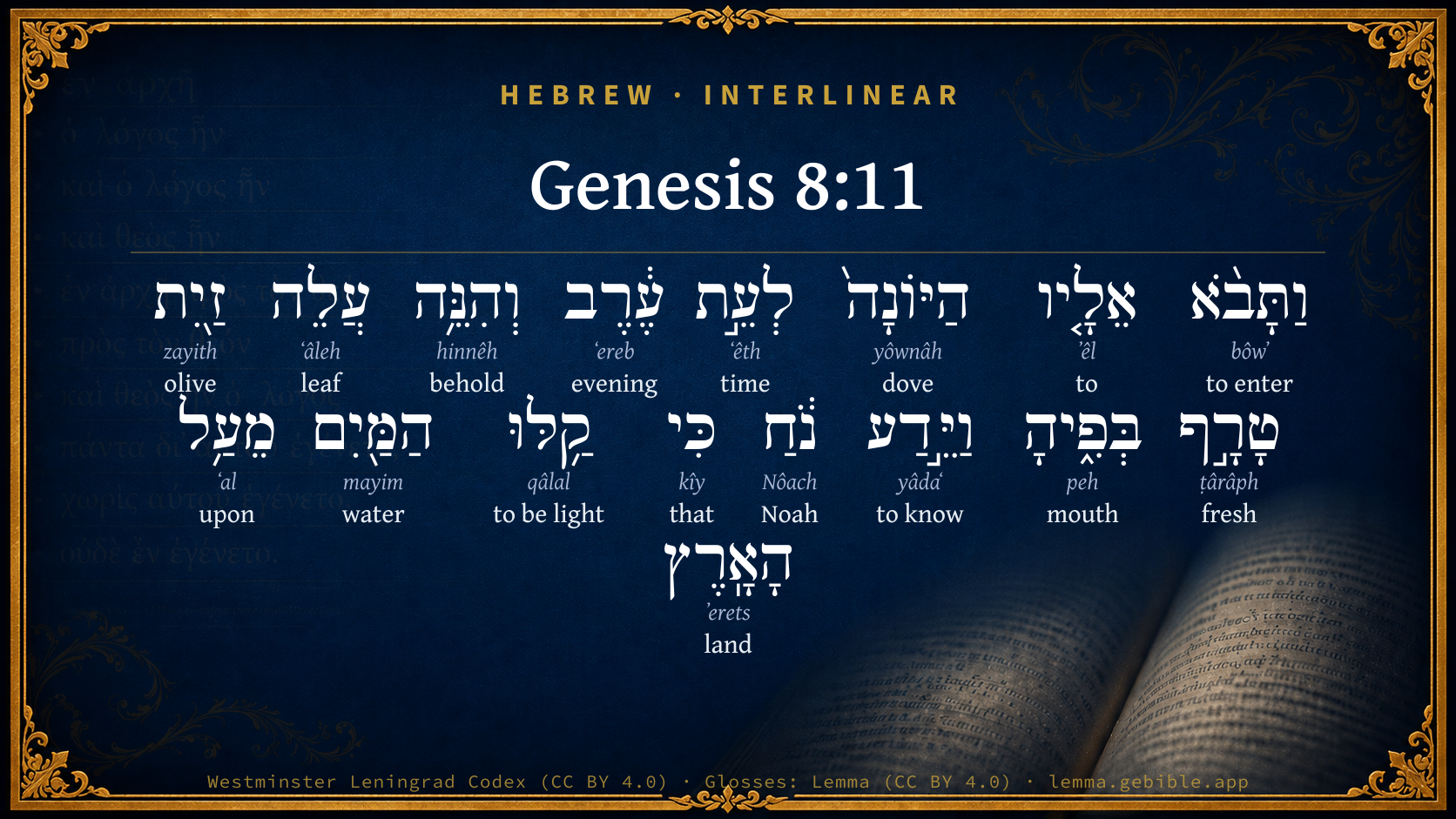
Hebrew (Westminster Leningrad Codex) Genesis 8:11 appears in the Hebrew Old Testament. The text above is from the Westminster Leningrad Codex. Each word links to its Strong’s number, a concise gloss, and parsing drawn from the Open Scriptures Hebrew Bible morphology. Click any word for its full Brown-Driver-Briggs (BDB) entry.
Download image
Cite this verse

Genesis 8:11 (World English Bible). Public Domain. Lemma interlinear Bible study tool, https://lemma.gebible.app/v/genesis/8/11.

Show BibTeX & RIS
BibTeX
RIS
English Translation
The dove came back to him at evening, and, behold, in her mouth was an olive leaf plucked off. So Noah knew that the waters were abated from off the earth.
World English Bible · Public Domain
Highlights
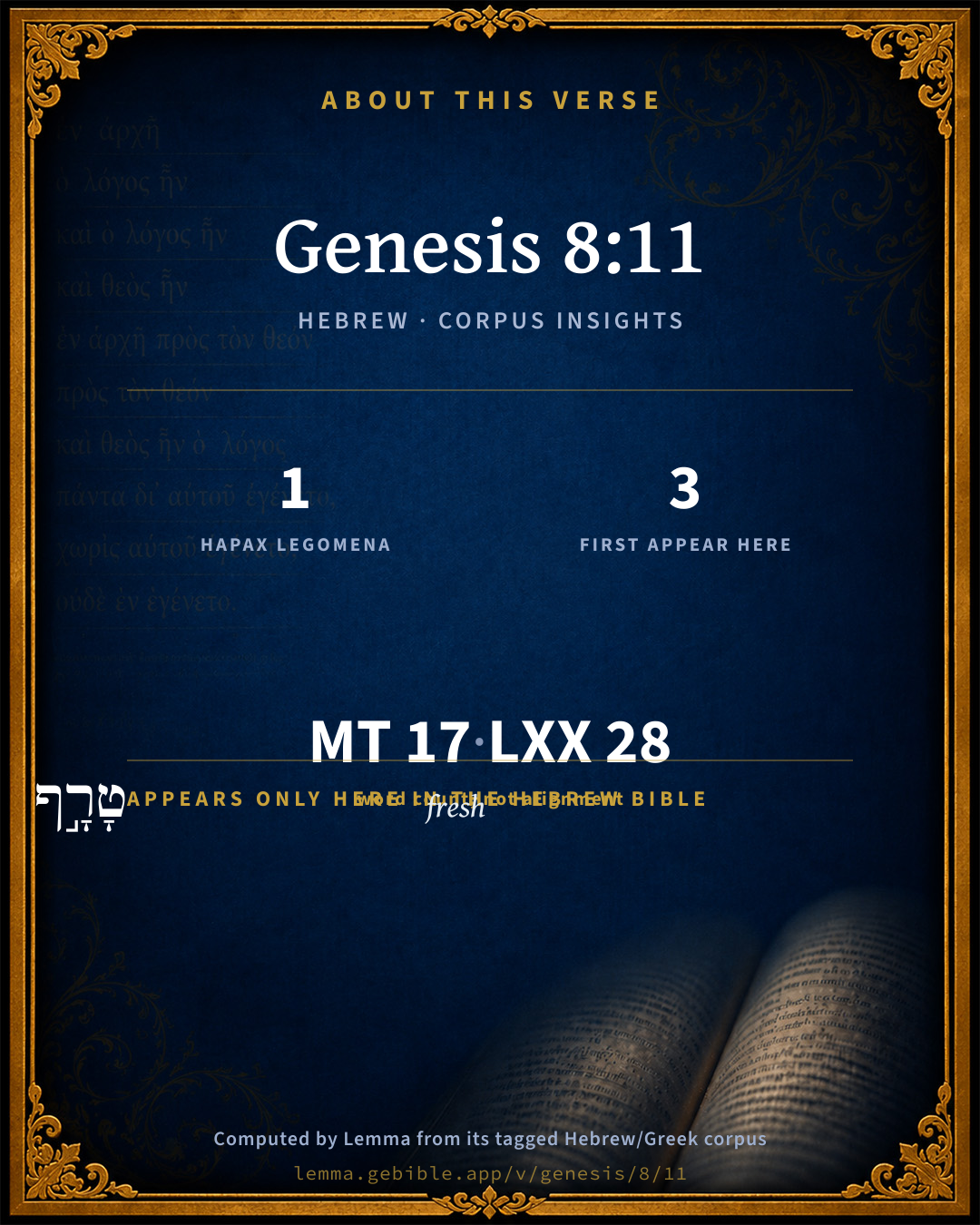
  • 1 hapax legomenon — only here in the Hebrew Bible
  • 3 first appearances in the Hebrew Bible
Full analysis ↓
Download a study sheet

One document with this verse’s original text, its word-by-word gloss line, the meaning frame, cross-references with their text, attributed commentary, and full source and license credits — printable, and it pastes into notes with its structure intact.

This verse Autodidact and up

Study sheet (.html) Plain text (.txt)

A passage Seminary Student

Up to 50 verses in one chapter. A passage sheet keeps up to 6 commentary sources and 12 cross-references per verse, in the order this page ranks them, and says so on the sheet whenever that leaves anything out. Ask for a single verse and you get the Autodidact verse sheet above.

Everything on this page stays free to read, with no account — the sheet is a download of what is already on screen, not access to it.

Want to remove ads? Support Godless Engineer
Compare translations 3

The same verse in 3 English versions, stacked beneath the original-language interlinear above. Click any original word for its lexicon entry.

Each is an independent rendering of the whole verse — the interlinear is not word-aligned to these translations.

Highlighted words mark where these versions differ — a whole-verse word diff, not a word-by-word alignment.

  • World English Bible Public Domain
    The dove came back to him at evening, and, behold, in her mouth was an olive leaf plucked off. So Noah knew that the waters were abated from off the earth.
  • King James Version Public Domain
    And the dove came in to him in the evening; and, lo, in her mouth was an olive leaf plucked off: so Noah knew that the waters were abated from off the earth.
  • unfoldingWord Literal Text CC BY-SA 4.0
    Then the dove returned to him at evening time, and behold, a freshly picked olive leaf in its mouth. So Noah knew that the waters had subsided from the earth.

unfoldingWord Literal Text — © unfoldingWord, licensed CC BY-SA 4.0. Word-aligned USFM3 via Door43 (git.door43.org/unfoldingWord/en_ult).

Versions to compare (up to 4)

3 of 4 selected

Show all 18 translations

Every available English version of this verse, each an independent rendering of the whole verse.

  • World English Bible Public Domain
    The dove came back to him at evening, and, behold, in her mouth was an olive leaf plucked off. So Noah knew that the waters were abated from off the earth.
  • Berean Standard Bible Public Domain
    And behold, the dove returned to him in the evening with a freshly plucked olive leaf in her beak. So Noah knew that the waters had receded from the earth.
  • Majority Standard Bible Public Domain
    And behold, the dove returned to him in the evening with a freshly plucked olive leaf in her beak. So Noah knew that the waters had receded from the earth.
  • King James Version Public Domain
    And the dove came in to him in the evening; and, lo, in her mouth was an olive leaf plucked off: so Noah knew that the waters were abated from off the earth.
  • American Standard Version (1901) Public Domain
    and the dove came in to him at eventide; and, lo, in her mouth an olive-leaf plucked off: so Noah knew that the waters were abated from off the earth.
  • Revised Version (1885) Public Domain
    and the dove came in to him at eventide; and, lo, in her mouth an olive leaf pluckt off: so Noah knew that the waters were abated from off the earth.
  • Geneva Bible (1599) Public Domain
    And the doue came to him in ye euening, and loe, in her mouth was an oliue leafe that she had pluckt: whereby Noah knewe that the waters were abated from off the earth.
  • Douay-Rheims (1899) Public Domain
    And she came to him in the evening, carrying a bough of an olive tree, with green leaves, in her mouth. Noe therefore understood that the waters were ceased upon the earth.
  • Young's Literal Translation Public Domain
    and the dove cometh in unto him at even-time, and lo, an olive leaf torn off in her mouth; and Noah knoweth that the waters have been lightened from off the earth.
  • Literal Standard Version CC BY-SA 4.0
    and the dove comes to him at evening, and behold, an olive leaf [is] torn off in her mouth; and Noah knows that the waters have been lightened from off the earth.
  • Unlocked Literal Bible CC BY-SA 4.0
    The dove returned to him in the evening. Look! In her mouth was a freshly plucked olive leaf. So Noah knew that the waters had gone down from the earth.
  • unfoldingWord Literal Text CC BY-SA 4.0
    Then the dove returned to him at evening time, and behold, a freshly picked olive leaf in its mouth. So Noah knew that the waters had subsided from the earth.
  • Darby Bible Public Domain
    And the dove came to him at eventide; and behold, in her beak was an olive-leaf plucked off; and Noah knew that the waters had become low on the earth.
  • World Messianic Bible Public Domain
    The dove came back to him at evening and, behold, in her mouth was a freshly plucked olive leaf. So Noah knew that the waters were abated from the earth.
  • Webster's Bible Public Domain
    And the dove came in to him in the evening, and lo, in her mouth was an olive-leaf plucked off: So Noah knew that the waters were abated from off the earth.
  • Free Bible Version CC BY-SA 4.0
    When it came back to him in the evening it had a freshly-picked olive leaf in its beak, so Noah knew the floodwaters were mainly gone from the earth.
  • Bible in Basic English Public Domain
    And the dove came back at evening, and in her mouth was an olive-leaf broken off: so Noah was certain that the waters had gone down on the earth.
  • JPS Tanakh (1917) Public Domain
    And the dove came in to him at eventide; and lo in her mouth an olive-leaf freshly plucked; so Noah knew that the waters were abated from off the earth.

Literal Standard Version (2020), Covenant Press — licensed CC BY-SA 4.0. Text via the HelloAO Bible API (eBible.org). Unlocked Literal Bible (unfoldingWord) — licensed CC BY-SA 4.0. Text via the HelloAO Bible API (eBible.org). unfoldingWord Literal Text — © unfoldingWord, licensed CC BY-SA 4.0. Word-aligned USFM3 via Door43 (git.door43.org/unfoldingWord/en_ult). Free Bible Version, Dr. Jonathan Gallagher — licensed CC BY-SA 4.0. Text via the HelloAO Bible API (eBible.org).

Word by word

More ways to search: Search by grammar → Find every occurrence → Compare this word →

Practice this passage: Drill this verse → Learn its vocabulary →

טָרָ֣ף
ṭârâph
H2965
“fresh”
Adjective, Adjective, Masculine, Singular, Absolute
Part of Speech
Adjective
Type
Adjective
Gender
Masculine
Number
Singular
State
Absolute
Full BDB Definition

Origin: from H2963

TWOT: 827a

freshly picked, freshly plucked, fresh-plucked
  1. וַתָּבֹ֨א bôwʼ H935 “and · to enter” Conjunction + Verb, Qal, Sequential Imperfect, 3rd Person, Feminine, Singular
  2. אֵלָ֤יו ʼêl H413 “to · him” Preposition + Suffix, Personal, 3rd Person, Masculine, Singular
  3. הַיּוֹנָה֙ yôwnâh H3123 “the · dove” Particle, Definite Article + Noun, Common, Feminine, Singular, Absolute
  4. לְעֵ֣ת ʻêth H6256 “to/for · time of” Preposition + Noun, Common, Both, Singular, Construct
  5. עֶ֔רֶב ʻereb H6153 “evening” Noun, Common, Masculine, Singular, Absolute
  6. וְהִנֵּ֥ה hinnêh H2009 “and · behold” Conjunction + Particle, Demonstrative
  7. עֲלֵה ʻâleh H5929 “leaf of” Noun, Common, Masculine, Singular, Construct
  8. זַ֖יִת zayith H2132 “olive” Noun, Common, Masculine, Singular, Absolute
  9. בְּפִ֑יהָ peh H6310 “in/at · mouth · her” Preposition + Noun, Common, Masculine, Singular, Construct + Suffix, Personal, 3rd Person, Feminine, Singular
  10. וַיֵּ֣דַע yâdaʻ H3045 “and · to know” Conjunction + Verb, Qal, Sequential Imperfect, 3rd Person, Masculine, Singular
  11. נֹ֔חַ Nôach H5146 “Noah” Noun, Proper
  12. כִּי kîy H3588 “that” Conjunction
  13. קַ֥לּוּ qâlal H7043 “to be light” Verb, Qal, Perfect, 3rd Person, Common, Plural
  14. הַמַּ֖יִם mayim H4325 “the · water(s)” Particle, Definite Article + Noun, Common, Masculine, Plural, Absolute
  15. מֵעַ֥ל ʻal H5921 “from · upon” Preposition + Preposition
  16. הָאָֽרֶץ ʼerets H776 “the · land” Particle, Definite Article + Noun, Common, Both, Singular, Absolute

About this verse

These counts appear in no published source. They are computed here, from the morphology-tagged text and Lemma’s own curated glosses. What Lemma adds →

17
words
17
distinct lemmas
Pentateuch
section

Notable vocabulary

1 hapax legomenon — a word that appears only here in the entire Hebrew Bible:

  • טָרָ֣ף fresh H2965

First appearance in Scripture

These words make their first canonical appearance in the Hebrew Bible here:

Shared distinctive vocabulary

עֲלֵה leaf H5929 occurs in 13 verses of the Hebrew Bible. Also found in:

Grammatical profile

  • 3 verbs
  • 9 nouns
  • 1 adjective
  • 2 prepositions
  • 1 conjunction
  • 1 particle

Verb forms

  • וַתָּבֹ֨א Qal · Sequential Imperfect
  • וַיֵּ֣דַע Qal · Sequential Imperfect
  • קַ֥לּוּ Qal · Perfect

Hebrew & Septuagint length

In English translation the verse runs 31 words from the Hebrew and 32 from the Septuagint (LXX English) — closely comparable.

A rough comparison of the two English renderings, which tokenize alike — not a word-level alignment.

Word counts can differ between the Hebrew and the Greek without any difference in meaning — e.g. the Hebrew direct-object marker אֵת has no separate Greek word, and Greek often adds the article ὁ.

In the original languages it is 17 Hebrew tokens and 28 Greek tokens — but the two are counted differently (Hebrew bundles its prefixes and suffixes into one token; the Greek is in lemma form), so that isn’t a like-for-like length.

Cross-references

3

Topical passages linked to Genesis 8:11 in the Treasury of Scripture Knowledge — connected by theme and wording, ordered by reader-vote popularity; previews shown in the World English Bible.

  • Nehemiah 8:15 and that they should publish and proclaim in all their cities, and in Jerusalem, saying, Go forth to the mountain, and get olive branches, and branches of wild olive, and myrtle branches, and palm branches, and branches of thick trees, to make booths, as it is written.
  • Zechariah 4:12–14 I asked him the second time, "What are these two olive-branches, which are beside the two golden spouts, that pour the golden oil out of themselves?"
  • Romans 10:15 And how will they preach unless they are sent? As it is written: "How beautiful are the feet of those who preach the Gospel of peace, Who bring glad tidings of good things!"

Cross-references courtesy of OpenBible.info (CC BY 4.0).

Hebrew and Greek witnesses Masoretic Hebrew ↔ Greek Septuagint

The same verse in the two great witnesses to the Old Testament, shown verse-for-verse.

These are two independent witnesses, not word-aligned to each other, and the Septuagint is shown in lemma (dictionary) form.

Hebrew Genesis 8:11 Masoretic · Westminster Leningrad Codex

וַתָּבֹ֨א אֵלָ֤יו הַיּוֹנָה֙ לְעֵ֣ת עֶ֔רֶב וְהִנֵּ֥ה עֲלֵה זַ֖יִת טָרָ֣ף בְּפִ֑יהָ וַיֵּ֣דַע נֹ֔חַ כִּי קַ֥לּוּ הַמַּ֖יִם מֵעַ֥ל הָאָֽרֶץ

The dove came back to him at evening, and, behold, in her mouth was an olive leaf plucked off. So Noah knew that the waters were abated from off the earth.

World English Bible · Public Domain

Greek LXX Genesis 8:11 Septuagint · lemma form

καί ἀναστρέφω πρός αὐτός ὁ περιστερά ὁ πρός ἑσπέρα καί ἔχω φύλλον ἐλαία κάρφος ἐν ὁ στόμα αὐτός καί γιγνώσκω νωε ὅτι κοπάζω ὁ ὕδωρ ἀπό ὁ γῆ

And the dove returned to him in the evening, and had a leaf of olive, a sprig in her mouth; and Noe knew that the water had ceased from off the earth.

LXX2012 (modern English Septuagint) · Public Domain

On this verse, The Cambridge Bible for Schools and Colleges discusses the Septuagint’s reading. Read the note in Commentary ↓

Hebrew: Westminster Leningrad Codex (CC BY 4.0). Greek: Septuagint (public domain); English from LXX2012 (modern English Septuagint) (Public Domain). How the Septuagint differs from the Hebrew →

Targum (Aramaic paraphrase)

2

The Targum is the ancient Jewish Aramaic paraphrase of the Hebrew Scriptures — an interpretive translation, not the Hebrew text itself. Onkelos (literal) and Pseudo-Jonathan (expansive) render the Torah, and Jonathan the Prophets. Coverage is partial: where no permissively-licensed English translation exists for a verse, only the Aramaic is shown. This is verse-level text, not a word-by-word alignment to the Hebrew.

  1. Targum Onkelos Torah (Genesis–Deuteronomy)
    וַאֲתַת לְוָתֵהּ יוֹנָה לְעִדַּן רַמְשָׁא וְהָא טְּרַף זֵיתָא תְּבִיר נָחִית בְּפוּמַהּ וִידַע נֹחַ אֲרֵי קַלִּיאוּ מַיָּא מֵעַל אַרְעָא

    And the dove came to him at the time of evening, and, behold, a leaf of olive broken off was in her mouth; and Noach knew that the waters were lightened from upon the earth.

    Targum Onkelos — Aramaic: “Onkelos Genesis” (public domain); “Onkelos Exodus” (public domain); “Onkelos Leviticus” (public domain); “Onkelos Numbers” (public domain); “Onkelos Deuteronomy” (public domain). English: “Sefaria Community Translation” (CC0 1.0 (public-domain dedication)); “J.W. Etheridge. The Targums of Onkelos and Jonathan Ben Uzziel on the Pentateuch. London: Longmans, Green, 1862” (public domain). Text via Sefaria.

  2. Targum Pseudo-Jonathan Torah (Genesis–Deuteronomy)
    וְאָתַת לְוָתֵיהּ יוֹנָתָא לְעִדוּנָא רַמְשָׁא וְהָא טַרְפָא דְזֵיתָא לָקִיט תִּבִיר וּמְחִית בְּפוּמָהּ דִנְסַבְתֵּיהּ מִן טַוָור מִישְׁחָא וִידַע נחַ אֲרוּם אִיתְקוֹלָלוּ מַיָא מֵעִילוֹי אַרְעָא

    And the dove came to him at the evening time, and, behold, a leaf of olive gathered, broken off, she brought in her mouth, and which she had taken from the Mount of the Meshiha. And Noah understood that the waters had lightened from being on the earth.

    Targum Pseudo-Jonathan — Aramaic: “Targum Jonathan on Genesis” (public domain); “Targum Jonathan on Exodus” (public domain); “Targum Jonathan on Leviticus” (public domain); “Targum Jonathan on Numbers” (public domain); “Targum Jonathan on Deuteronomy” (public domain). English: “The Targum of Jonathan ben Uzziel, trans. J. W. Etheridge, London, 1862” (public domain). Text via Sefaria.

Commentary

Notes on Genesis 8:11 from classic Christian and Jewish commentators (each source and its license shown beneath its notes). The classic Christian expositions comment on the surrounding passage and are grouped to its opening verse, so a note may address several verses; the Jewish commentaries on the Tanakh (Rashi and others) are per-verse, so they appear only where the commentator wrote on this verse.

Lemma curates 59 commentaries, every one of them public domain or Creative Commons licensed, each selected and text-cleaned for this edition rather than reprinted as found. About our sources →

Trapp's Complete Commentary

John Trapp

Gen 8:11 And the dove came in to him in the evening; and, lo, in her mouth [was] an olive leaf pluckt off: so Noah knew that the waters were abated from off the earth.

Ver. 11. In her mouth was an olive leaf.] The olive never casteth her leaf, and is greenest in the spring, saith Pliny. It might very well continue so under water during the flood. It may also very well, by an allegory, set forth that grace and peace by Jesus Christ, brought in the mouth of his ministers in this evening of the world. {Rom 10:15} The dove returned at first without her errand; but, sent again, she brought better tidings. The man of God must not only be "apt to teach," but "patient, in meekness instructing those that oppose themselves; proving, if at any time, God will give them repentance." {a} All are not sent into the vineyard at the same hour of the day. Holy Melancthon, being himself newly converted, thought it impossible for his hearers to withstand the evidence of the gospel. But after he had been a preacher a while, ‘tis said he complained, "that old Adam was too hard for young Melancthon." {b} And yet he lacked not afterwards the seal of his ministry. For among many others converted by him, was that sweet saint, George, Prince of Anhalt, whose house was eccelesia, academia, curia , and whose heart was so upright with God, his life so laudable among men, that Melancthon {c} (once publicly defending the certainty of our future felicity by this argument, that godly men must be hereafter rewarded, wicked men punished), he named this pious prince as an unquestionable example of such a man, as might assuredly expect the promised crown of life eternal, which God the righteous Judge will give to all his. {2Ti 4:8}

{a} Dιδακτικον, ανεξικακον. {2Ti 2:24} Aνεχου και απεχου. - Epictet.

{b} Melch. Adam.

{c} Scultet. (ex ore Bucholceri, qui Melancthonis fuit auditor.)

John Trapp, A Commentary or Exposition upon All the Books of the Old and New Testament (1647–1656) — public domain. Text from a community e-Sword module.

Tyndale Open Study Notes

Tyndale Open Resources

8:11 Unlike the raven (8:7), the dove feeds on vegetation. Since olive trees are not tall, Noah could tell that the water was almost gone.

Tyndale Open Study Notes — © Tyndale Open Resources, licensed CC BY-SA 4.0. Text via the HelloAO Bible API.

Geneva Bible (1599)

Geneva Bible translators

Which was a sign that the waters were much diminished: for the olives grow not on the high mountains.

Or, bill.

Geneva Bible (1599) marginal notes — public domain. Text via Bolls.life.

The Cambridge Bible for Schools and Colleges

gen. ed. J. J. S. Perowne

11. at eventide] i.e. at the time when the dove would return to roost; implying a long absence from the ark.

an olive leaf pluckt off] Better, as R.V. marg., a fresh olive leaf. This would shew two things, (1) that the waters had sunk to a level at which the olive would grow, and (2) that life had revived upon the earth. The scene has universally been accepted as symbolical of reconciliation and peace. It finds no counterpart in the Babylonian story. The olive would be the most familiar tree to the dweller in Palestine.

LXX φύλλον ἐλαίας κάρφος, Lat. ramum olivae virentibus foliis.

13 (P). And it came to pass … earth] The disappearance of the waters is dated by P as coinciding with the 1st day of the 1st month of Noah’s 601st year. The 1st month would be Tisri, corresponding to our October. See note on Gen_7:11. Those who assume a reference to the later Heb. reckoning, which was identical with that of the Babylonian calendar, suppose the 1st month to be that of Abib, in the spring time, when the rainy season ended.

(J) and Noah removed] LXX ἀπεκάλυψε τὴν στέγην τῆς κιβωτοῦ, Lat. aperiens tectum arcae.

the covering of the ark] The literal rendering of the Heb. But what it was, and how it was removed, we are not told. The details of the structure of the ark, according to J, were probably left out, in order to make way for the description of P in Gen_6:14-16.

14 (P). And in the second month] We have here the last date in the Flood story. The earth is dry on the 27th day of the 2nd month in the 2nd year. The Flood had begun on the 17th day of the 2nd month in the previous year (Gen_7:11). From first to last we have here a period of one year and 10 days. It has been pointed out that a lunar year consists of 354 days; and that one lunar year and 11 days is exactly a solar year of 365 days. This may be merely a coincidence; and in calculating the months we reckon them as solar months of 30 days each.

The LXX in Gen_7:11 dated the commencement of the Flood from the 27th day of the 2nd month of the 1st year; and, therefore, assigns an exact year to its duration.

dry] Note the successive stages in P: Gen_8:5 waters decreased, tops of mountains visible; Gen_8:13 waters gone; Gen_8:14 soil dry.

The Cambridge Bible for Schools and Colleges (gen. ed. J. J. S. Perowne; Cambridge University Press, 1878–1918) — public domain. Text from a community e-Sword module.

John Gill's Exposition

And the dove came in to him in the evening,.... It having been out all day delighting itself in a free air, and perching upon the trees, but yet not finding sufficient food, or a proper lodging, it returned to Noah at the evening for food and dwelling in the ark:

and, lo, in her mouth was an olive leaf plucked off: which might easily be done, and even an "olive branch", as the word sometimes signifies, and is by some (p) rendered; for it being now the summer season, young branches sprouted out, which being tender, were easily cropped: the Targum of Jonathan adds,"which it had took from the mount of Olives;''but there is no necessity to suppose it went so far from the ark, since Assyria, a country nearer, was a land of olive oil, like that of Judea; Kg2 18:32 and besides, olives grew in Armenia itself, where the ark rested. Gogarene, in Armenia, is said by Strabo (q) to produce olive trees; though a modern author says (r)"I do not see where the dove which was sent out of the ark could find an olive branch, if the ark be supposed to have rested on Mount Ararat, or any of the mountains in Armenia; for this sort of trees is not found hereabout, where the species must be lost, and yet olives are known to be a kind of trees which never die:''but the above accounts show it to be otherwise in ancient times:

so Noah knew the waters were abated from off the earth: by this he perceived not only that they were gone off the mountains, but the lower grounds, at least the hills on which olive trees delight to grow; and yet that they were only abated, and not entirely gone off, since the dove returned to him: this dove sent out the second time, and returning, may be considered as an emblem of a Gospel minister, comparable to a dove, for the dove like gifts of the Spirit of God, by which he is qualified for his work, and for his simplicity, harmlessness, meekness, and humility; and the olive leaf in its mouth may be an emblem of the Gospel, which is from Christ, the good olive; is the Gospel of peace, which an olive branch is a symbol of, proclaiming and publishing peace and reconciliation by Christ; and as that is ever green, the Gospel always continues, and is the everlasting Gospel, and which was brought, and more fully and clearly dispensed in the evening of the world; and by it, it is known that the waters of divine wrath are assuaged, and the people of God may be assured they will never return to come upon them.

(p) "ramum olivae", V. L. so Ainsworth, see Neh. viii. 15. (q) Geograph. l. 11. p. 363. (r) Tournefort's Voyage to the Levant, vol. 3. p. 173.

John Gill's Exposition of the Whole Bible (1746–1763) — public domain (CC PDM 1.0). Text via the HelloAO Bible API.

Haydock's Catholic Bible Commentary

Green leaves. The olive tree preserves its verdure and grows even at the bottom of the Red sea, and other seas in the East. (Pliny, Natural History xii. 25.) --- Many other trees and seeds will live for a long time under the waters. (Calmet) --- This tender branch of the olive seems to agree better with the spring than autumn; whence Tirinus infers, that the deluge began and ended in spring.

George Leo Haydock (1774–1849), Haydock's Catholic Family Bible and Commentary, 1859 edition — public domain. Excludes Psalms (Douay-Rheims chapter numbering differs from Protestant) and Deuterocanonical books (Catholic canon only).

Matthew Poole's English Annotations

The dove came in to him in the evening, as the manner of doves is, partly for better accommodation, both for food and lodging, than yet she could meet with abroad; and partly from her love to her mate.

In her mouth was an olive leaf.

Quest. Whence was this leaf, when trees had been so generally overthrown and rooted up by the deluge?

Answ.

1. Many trees might be preserved by an advantageous situation, between the rocks or hills which broke the force of the waters.

2. It is probable that God, by his powerful providence, preserved the plants and trees for future ages; and therefore there is no mention of any of their roots or seeds preserved in the ark.

3. The olive-tree especially will not only stand, but live and flourish under the waters, as Pliny, 1. 13. c. 25, and 16. 20, and Theophrastus, 4. 8, observe. Add, that the word here rendered leaf signifies also a tender branch.

Matthew Poole's English Annotations on the Holy Bible (1683–1685) — public domain. Text from a community e-Sword/MySword module.

Whedon's Commentary on the Bible

Daniel D. Whedon

11. Olive leaf plucked off — Not picked up. The freshly torn leaf or twig showed that the bird had plucked it from the tree. The olive tree puts out its leaves even if covered with water; and Noah saw by this freshly plucked leaf that the waters had subsided to the plains or slopes where the olive trees grew, and that their tops at least now rose above the surface. This fresh leaf was the first sign of the earth’s resurrection to life. The dove, with the olive branch in her mouth, has thus become the herald of peace and salvation.

Daniel D. Whedon (gen. ed.), Commentary on the Old and New Testaments (1874–1909) — public domain. Text from a community e-Sword module.

The Pulpit Commentary

And the dove came in unto him. Literally, to him. As the manner of doves is, partly for better accommodation both for food and lodging than yet he could meet with abroad, and partly from love to his mate (Peele). In the evening (of the seventh day). And, lo, in her mouth was an olive leaf plucked off. Not as if "Deo jubente, uno die germinavit terra" (Ambrose), but because the olive leaves kept green under water (Chrysostom). Rosenm Lange, and Kalisch quote Pliny (13. 50) and Theophrastus ("Hist. Plant., 4:8) to this effect. That the olive tree grows in Armenia is proved by the testimony of Strabo (11. 575), Horace (Od. I 7. 7), Virgil (Gen_2:3), Diodorus Siculus (1. 17), &c. On this point ;vide Kalisch. The leaf which the dove carried towards the ark was "taraf," freshly plucked; hence rightly translated by "viride (Michaelis, Rosenm rather than by "decerptum" (Chaldee, Arabic) or "raptum" (Calvin). Karfov (LXX) is just the opposite of "fresh," viz., withered. So Noah knew that the waters were abated from off the earth.

The Pulpit Commentary (1880–1919), ed. H.D.M. Spence-Jones & Joseph S. Exell — public domain. Text from a community e-Sword module.

Rashi

Rabbi Shlomo Yitzchaki (Rashi)

טרף בפיה PLUCKED IN HER MOUTH — I am of opinion that it (the dove) was a male and that therefore it (the text) speaks of it sometimes as masculine and sometimes as feminine, because really wherever יונה “dove” occurs in the Scriptures it is spoken of as feminine, as (Song 5:12) “[His eyes] are like those of doves beside the water brooks. that are washing themselves (רוחצות fem.) in milk”; (Ezekiel 7:16) “Like the doves of the valleys, all of them moaning" and as (Hosea 7:11) “Like a silly (פותה fem.) dove”

טרף means IT HAD PLUCKED OFF — The Midrashic explanation takes it as meaning “food”, and interprets בפיה as “speaking” — viz., she said. “Rather that my food be bitter as an olive but from the hand of God, than as sweet as honey and from the hand of mortal men” (Eruvin 18b; Genesis Rabbah 33).

Rashi on the Tanakh — English translations: “The Judaica Press complete Tanach with Rashi, translated by A. J. Rosenberg” (CC BY 4.0); “Pentateuch with Rashi's commentary by M. Rosenbaum and A.M. Silbermann, 1929-1934” (public domain); “The Metsudah Tanach series, Lakewood, N.J” (CC BY 4.0); and “The Book of Joshua, Metsudah Publications, 1997” (CC BY 4.0). Text via Sefaria.

Ramban (Nachmanides)

Rabbi Moshe ben Nachman (Ramban / Nachmanides)

AND LO AN OLIVE LEAF. From the plain meaning of this verse it would appear that the trees were not uprooted or blotted out in the flood because there was there no flooding stream since the whole world became full of water. But in Bereshith Rabbah the Rabbis have said, “From where did the dove bring the olive leaf? Rabbi Levi said, ‘She brought it from the Mount of Olives since the land of Israel was not inundated by the waters of the flood. This is as the Holy One, blessed be He, said to the prophet Ezekiel: Son of man, say unto her: Thou art a land that is not cleansed, nor rained upon in the day of indignation.’ Rabbi Biryei said, ‘The gates of the garden of Eden were opened for the dove and from there she brought the leaf.’” Thus the intent of the Rabbis is that the trees were uprooted and blotted out in those places where the flood was, and surely the leaf faded. Similarly the Rabbis said, “Even the [solid substance of the] lower stationery millstone was blotted out in the flood,” and [to substantiate this statement] they expounded the verse, The waters wore the stones, [as referring to the waters of the flood which wore down stones]. And their saying that “the Land of Israel was not inundated by the flood” is to be understood as meaning that the rain of the flood was not there, as it is written, nor rained upon; the fountains of the great deep were not therein. But the waters did spread over the whole world, and all the high mountains that were under the whole heaven were covered, 19. as it is clearly written, and there is no partition around the Land of Israel to prevent the waters from entering. And so did the Sages say in Pirkei d’Rabbi Eliezer: “The waters of the flood did not come down from heaven upon the land of Israel, but they rolled in from other lands and came there, as it is said, Son of man, say unto her, etc.” Now according to the opinion of Rabbi Levi, [mentioned above, that the dove brought the olive leaf from the Mount of Olives], it was because the torrential rain did not come down upon the land of Israel and the windows of heaven were not opened there that the trees remained there while in the rest of the world they were broken and uprooted by the flood and His mighty rain. But I wonder about their saying that [the olive leaf was brought by the dove] from the garden of Eden. If it were so, then Noah did not know that the waters abated from off the earth for there [in Eden] the waters of the flood did not enter. But perhaps its gates were closed so that the waters did not enter there, but when the waters abated they were opened. [Thus the olive leaf indicated the opening of the gates which in turn indicated that the waters had abated.]It is on the basis of this opinion of theirs [—that the trees were broken and uprooted in the entire world during the flood — that the Rabbis] have said there in Bereshith Rabbah, “And he [Noah] planted a vineyard. And from where did he have a branch? Said Rabbi Abba bar Kahana, ‘When he went into the ark he had taken with him branches of the vine, shoots of fig trees, and stumps of olive trees.’”

‘TARAPH’ (PLUCKED) IN HER MOUTH. Rashi wrote: “I am of the opinion that the dove was a male and that therefore Scripture sometimes speaks of it as masculine (he plucked) rather than tarpha (she plucked). and sometimes as feminine (in her mouth). because where the word yonah (dove) occurs in Scripture it is spoken of as feminine. Taraph however means ‘he plucked.’ But a Midrashic explanation takes it [taraph] as meaning ‘food,’ and the word b’phiha (in her mouth) it explains as meaning ‘speaking.’ Thus she said: ‘Rather that my food be bitter as an olive and come by the hand of the Holy One, blessed be He, than as sweet as honey and from the hand of mortal man.’”All this does not appear to me to be correct for there is no reason why Scripture should change its reference to doves from feminine to masculine in one place in the same section. And if it is proper language to always speak of yonah in Scripture as feminine, why did it change here? Similarly, their Midrashic explanation does not at all make the word b’phiha to mean “speaking.” Instead, their Midrash is based on the fact that she brought this kind of leaf for if we should say that it just happened [that she brought an olive leaf], it cannot be in vain that Scripture mentioned it since it should have said, “And, lo, in her mouth a leaf freshly plucked.” Besides, the olive does not come from the very high trees that the fowl should nest there on account of its long branches. It was for this reason that the Sages said that there was in this a hint that it is more pleasing to the fowl to have their food bitter as wormwood from the hand of the Holy One, blessed be He, and not have it be good and sweet as honey from the hand of mortal man, and surely, all the more, people do not wish to be dependent for their livehood upon one another. In the words of Bereshith Rabbah: “Rabbi Abahu said, ‘If the dove brought the olive leaf from the garden of Eden, could she not have brought something exceptional such as either cinnamon or balsam? But it was a hint which she gave to Noah: rather something even more bitter than this from the hand of the Holy One, blessed be He, than something sweet from your hand.’” But in the Gemara they [the Sages] added: “What evidence is there that the word taraph means food? It is written, ‘Hatripheni’ (Feed me) with mine allotted bread.” It is due to the reason we have stated, [namely, that Scripture mentioned the name of the tree in order to indicate this hint] for which the Rabbis found support in the word hatripheni, implying that it is as if Scripture said, “And, lo, an olive-leaf of tereph (food) (he plucked), as it is actually vocalized. in her mouth.”As for the plain meaning of Scripture, the commentators have explained that the word taraph modifies the word “leaf,” thus stating, “And, lo, a plucked olive leaf was in her mouth.” Proof for this [i.e., that taraph modifies “leaf” rather than acting as a verb] is that taraph is wholly vocalized with the kamatz, as is the rule. followed by a patach. It is, however, found in irregular forms: For ‘taraph’ (He hath torn), and He will heal us;, and yet it is a verb rather than an adjective. And he shall restore that which ‘gazal’ (he took by robbery); The error which ‘shagag’ (he committed);, Verse 18. This too is similar to the above. and many other additional verses.

Ramban (Nachmanides) on the Tanakh — English translation: “Commentary on the Torah by Ramban (Nachmanides). Translated and annotated by Charles B. Chavel. New York, Shilo Pub. House, 1971-1976” (CC BY 4.0). Text via Sefaria.

Radak

Rabbi David Kimhi (Radak)

ותבא...לעת ערב, it came (back) at evening time of the same day it had been dispatched.

טרף, both vowels in this word are kametz, indicating that the word is an adjective similar to having been spelled טרוף, as a participle. The word implies that the pigeon had torn this leaf off an olive tree with its beak in order to bring it back to Noach. This is the reason why the Torah used the word טרף, to show that Noach realised that it had torn it off the tree and broken it from the olive. [not just from a branch. Ed.] This was not a leaf which had been found floating on the surface of the water.

כי קלו המים, that they had decreased in quantity. When something is in short supply it is often referred to as being קל, whereas when something is in ample supply it is called כבד. Examples of this are found in Job 14,21 יכבדו בניו,”his sons become ‘heavyweights’ (important, of consequence) We have the expression מקנה כבד, a great deal of cattle (Exodus 12,38) or חיל כבד, an army of numerous soldiers (Kings II 18,17). Why did the pigeon choose a leaf from an olive tree? Perhaps it was the first tree it encountered after flying away from the ark. Or, seeing that the leaves of the olive tree stay on the tree all year round it was the most likely leaf available. According to Sanhedrin 108 the pigeon reasoned that even a bitter tasting leaf eaten in freedom was preferable to being cooped up in luxurious surroundings. In the final analysis, the pigeon preferred to entrust its future to G’d rather than to man.

Radak on the Tanakh — English translations: “Sefaria Community Translation” (CC0 1.0 (public-domain dedication)); “Eliyahu Munk, HaChut Hameshulash” (CC BY 4.0); “Rabbi Mike Feuer, Jerusalem Anthology” (CC BY 4.0); and “R. David Kimhi on the first book of Psalms, Translated by R.G. Finch, London, 1919” (public domain). Text via Sefaria.

Lesson kit

Teaching starters — assembled from the data on this page, not authored interpretation. Every prompt links to the verse data it draws on. Edit before teaching.

Genesis, in the Pentateuch, opens this verse with 17 words (17 distinct Hebrew lemmas). Its most distinctive word is ṭârâph (“fresh”). A historical commentator’s framing appears above. Read the whole chapter for the surrounding context.

Discussion questions

  1. How does “fresh” (ṭârâph) shape what this verse is saying?
  2. This verse holds 1 word here found nowhere else in the Hebrew Bible. What might the rare word draw attention to?
  3. 3 words here appear for the first time in Scripture. What is being introduced at this debut?
  4. Genesis 3:7 shares the word «leaf» with this verse. How do the two illuminate each other?
  5. These translations render this verse differently. What is at stake in choosing one wording over another?
  6. The verb «וַתָּבֹ֨א» is Qal Sequential Imperfect. How does its form color the action?
  7. Reading how Trapp's Complete Commentary and Tyndale Open Study Notes read this verse, where do the two commentators agree and where do they part?

Things to notice

Reading settings

Reading text

Shown beneath each verse's original-language words.

Old Testament
Old Testament edition

Read the OT as the Masoretic Hebrew (MT) or the Greek Septuagint (LXX).

English shown for the Greek Septuagint (in the Hebrew ↔ Greek comparison).

Comparing translations? Open the Compare panel on any verse page to stack up to four side by side.