
Genesis 11:31

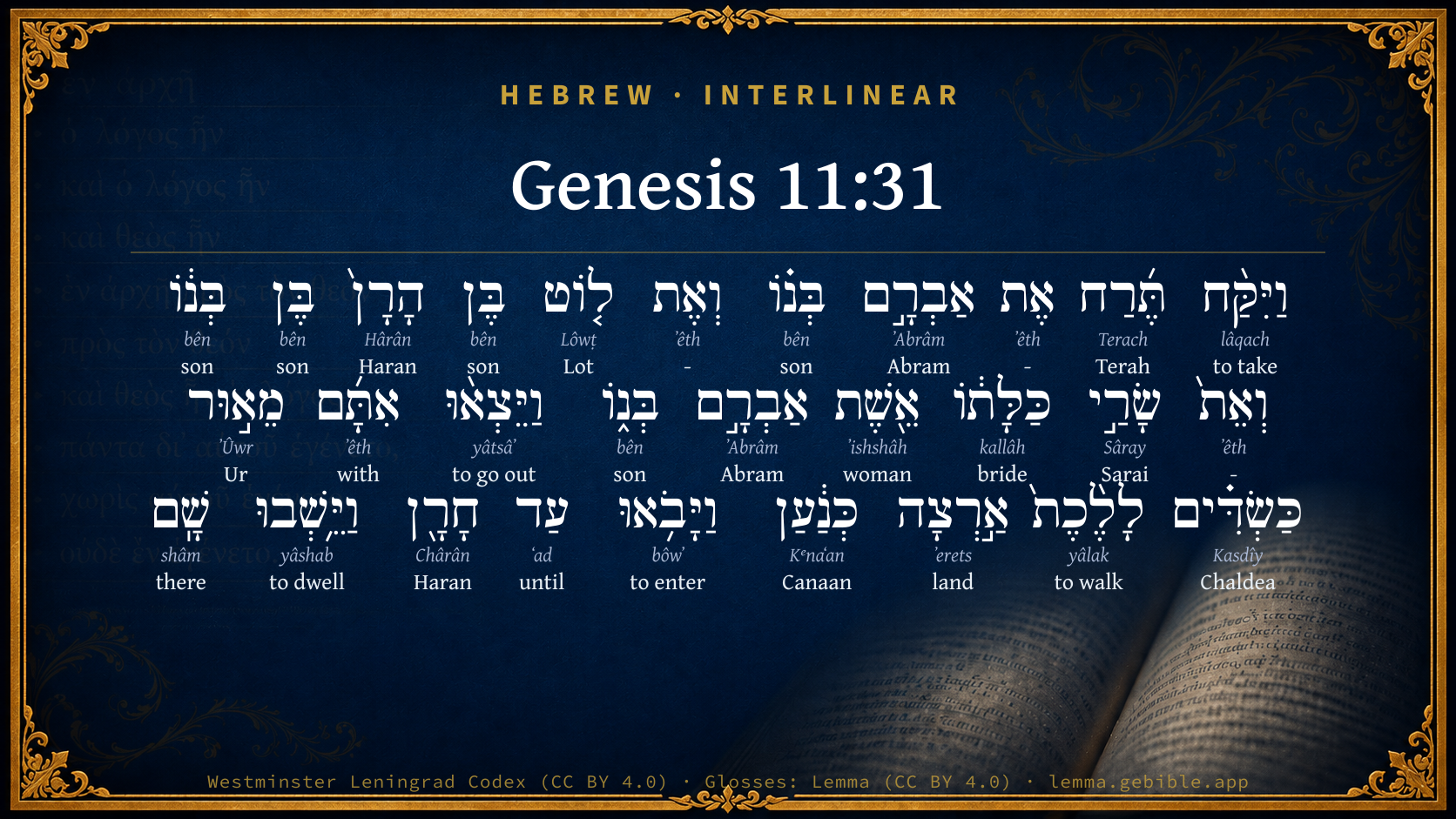
Hebrew (Westminster Leningrad Codex) Genesis 11:31 appears in the Hebrew Old Testament. The text above is from the Westminster Leningrad Codex. Each word links to its Strong’s number, a concise gloss, and parsing drawn from the Open Scriptures Hebrew Bible morphology. Click any word for its full Brown-Driver-Briggs (BDB) entry.
Download image
Cite this verse

Genesis 11:31 (World English Bible). Public Domain. Lemma interlinear Bible study tool, https://lemma.gebible.app/v/genesis/11/31.

Show BibTeX & RIS
BibTeX
RIS
English Translation
Terah took Abram his son, Lot the son of Haran, his son's son, and Sarai his daughter-in-law, his son Abram's wife. They went forth from Ur of the Chaldees, to go into the land of Canaan. They came to Haran, and lived there.
World English Bible · Public Domain
Highlights
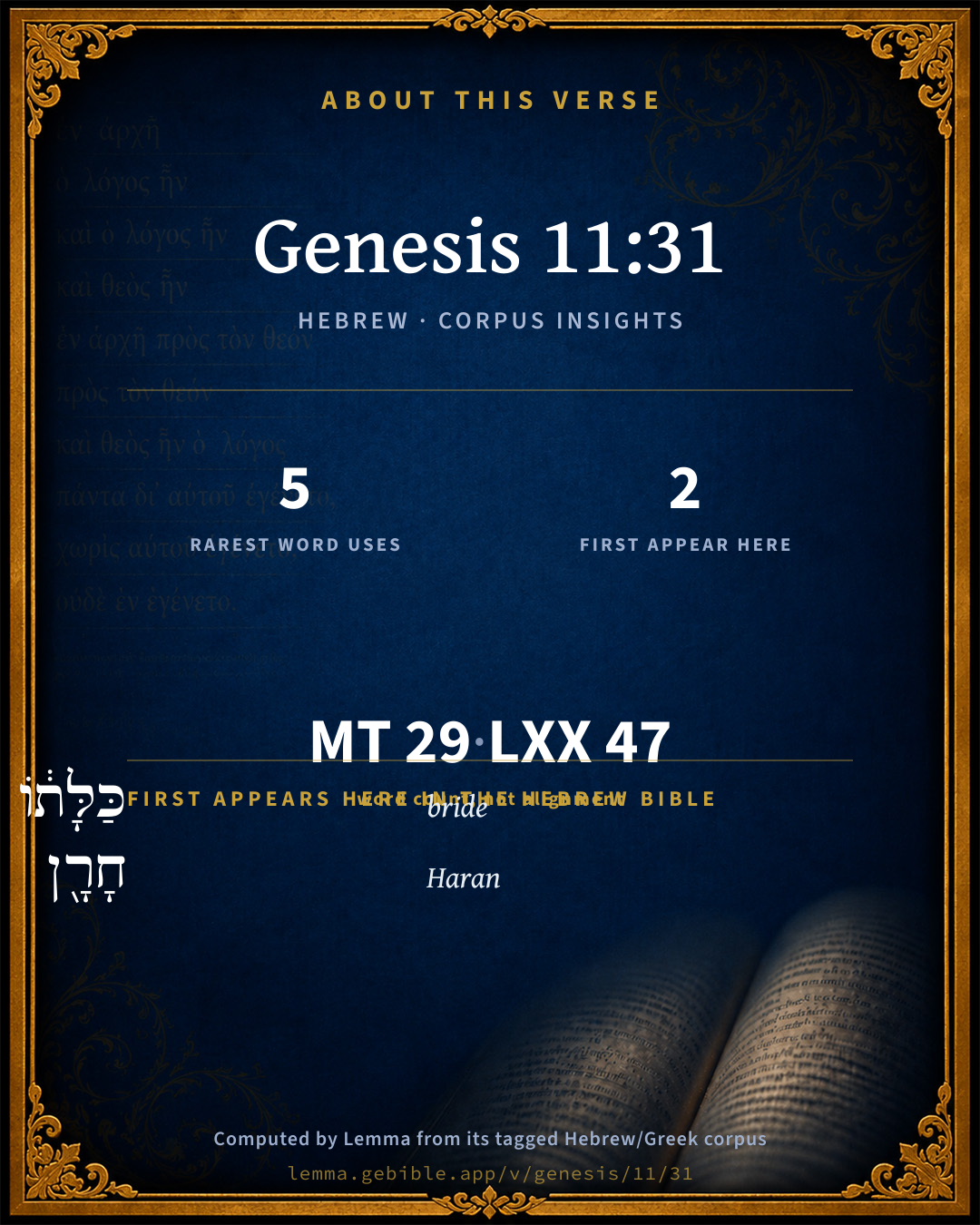
  • 2 first appearances in the Hebrew Bible
Full analysis ↓
Download a study sheet

One document with this verse’s original text, its word-by-word gloss line, the meaning frame, cross-references with their text, attributed commentary, and full source and license credits — printable, and it pastes into notes with its structure intact.

This verse Autodidact and up

Study sheet (.html) Plain text (.txt)

A passage Seminary Student

Up to 50 verses in one chapter. A passage sheet keeps up to 6 commentary sources and 12 cross-references per verse, in the order this page ranks them, and says so on the sheet whenever that leaves anything out. Ask for a single verse and you get the Autodidact verse sheet above.

Everything on this page stays free to read, with no account — the sheet is a download of what is already on screen, not access to it.

Want to remove ads? Support Godless Engineer
Compare translations 3

The same verse in 3 English versions, stacked beneath the original-language interlinear above. Click any original word for its lexicon entry.

Each is an independent rendering of the whole verse — the interlinear is not word-aligned to these translations.

Highlighted words mark where these versions differ — a whole-verse word diff, not a word-by-word alignment.

  • World English Bible Public Domain
    Terah took Abram his son, Lot the son of Haran, his son's son, and Sarai his daughter-in-law, his son Abram's wife. They went forth from Ur of the Chaldees, to go into the land of Canaan. They came to Haran, and lived there.
  • King James Version Public Domain
    And Terah took Abram his son, and Lot the son of Haran his son's son, and Sarai his daughter in law, his son Abram's wife; and they went forth with them from Ur of the Chaldees, to go into the land of Canaan; and they came unto Haran, and dwelt there.
  • unfoldingWord Literal Text CC BY-SA 4.0
    Then Terah took Abram his son, and Lot, Haran’s son, his son’s son, and Sarai his daughter-in-law, the wife of his son Abram, and they went out together from Ur of the Chaldeans to go to the land of Canaan. But they came to Haran, and they settled there.

unfoldingWord Literal Text — © unfoldingWord, licensed CC BY-SA 4.0. Word-aligned USFM3 via Door43 (git.door43.org/unfoldingWord/en_ult).

Versions to compare (up to 4)

3 of 4 selected

Show all 18 translations

Every available English version of this verse, each an independent rendering of the whole verse.

  • World English Bible Public Domain
    Terah took Abram his son, Lot the son of Haran, his son's son, and Sarai his daughter-in-law, his son Abram's wife. They went forth from Ur of the Chaldees, to go into the land of Canaan. They came to Haran, and lived there.
  • Berean Standard Bible Public Domain
    And Terah took his son Abram, his grandson Lot son of Haran, and his daughter-in-law Sarai the wife of Abram, and they set out from Ur of the Chaldeans for the land of Canaan. But when they arrived in Haran, they settled there.
  • Majority Standard Bible Public Domain
    And Terah took his son Abram, his grandson Lot son of Haran, and his daughter-in-law Sarai the wife of Abram, and they set out from Ur of the Chaldeans for the land of Canaan. But when they arrived in Haran, they settled there.
  • King James Version Public Domain
    And Terah took Abram his son, and Lot the son of Haran his son's son, and Sarai his daughter in law, his son Abram's wife; and they went forth with them from Ur of the Chaldees, to go into the land of Canaan; and they came unto Haran, and dwelt there.
  • American Standard Version (1901) Public Domain
    And Terah took Abram his son, and Lot the son of Haran, his son's son, and Sarai his daughter-in-law, his son Abram's wife; and they went forth with them from Ur of the Chaldees, to go into the land of Canaan; and they came unto Haran, and dwelt there.
  • Revised Version (1885) Public Domain
    And Terah took Abram his son, and Lot the son of Haran, his son’s son, and Sarai his daughter in law, his son Abram’s wife; and they went forth with them from Ur of the Chaldees, to go into the land of Canaan; and they came unto Haran, and dwelt there.
  • Geneva Bible (1599) Public Domain
    Then Terah tooke Abram his sonne, and Lot the sonne of Haran, his sonnes sonne, and Sarai his daughter in lawe, his sonne Abrams wife: and they departed together from Vr of the Caldees, to goe into the land of Canaan, and they came to Haran, and dwelt there.
  • Douay-Rheims (1899) Public Domain
    And Thare took Abram, his son, and Lot the son of Aran, his son's son, and Sarai his daughter in law, the wife of Abram his son, and brought them out of Ur of the Chaldees, to go into the land of Chanaan: and they came as far as Haran, and dwelt there.
  • Young's Literal Translation Public Domain
    And Terah taketh Abram his son, and Lot, son of Haran, his son's son, and Sarai his daughter-in-law, wife of Abram his son, and they go out with them from Ur of the Chaldees, to go towards the land of Canaan; and they come unto Charan, and dwell there.
  • Literal Standard Version CC BY-SA 4.0
    And Terah takes his son Abram, and Lot, son of Haran, his son’s son, and his daughter-in-law Sarai, wife of his son Abram, and they go out with them from Ur of the Chaldees, to go toward the land of Canaan; and they come to Haran, and dwell there.
  • Unlocked Literal Bible CC BY-SA 4.0
    Terah took Abram his son, Lot the son of his son Haran, and Sarai his daughter-in-law, his son Abram's wife, and together they left Ur of the Chaldeans, to go into the land of Canaan. But they came to Haran and stayed there.
  • unfoldingWord Literal Text CC BY-SA 4.0
    Then Terah took Abram his son, and Lot, Haran’s son, his son’s son, and Sarai his daughter-in-law, the wife of his son Abram, and they went out together from Ur of the Chaldeans to go to the land of Canaan. But they came to Haran, and they settled there.
  • Darby Bible Public Domain
    And Terah took Abram his son, and Lot the son of Haran his son's son, and Sarai his daughter-in-law, his son Abram's wife; and they went forth together out of Ur of the Chaldeans, to go into the land of Canaan, and came as far as Haran, and dwelt there.
  • World Messianic Bible Public Domain
    Terah took Abram his son, Lot the son of Haran, his son’s son, and Sarai his daughter-in-law, his son Abram’s wife. They went from Ur-Kasdim, to go into the land of Canaan. They came to Haran and lived there.
  • Webster's Bible Public Domain
    And Terah took Abram his son, and Lot the son of Haran his son's son, and Sarai his daughter-in-law, his son Abram's wife; and they went forth with them from Ur of the Chaldees, to go into the land of Canaan; and they came to Haran, and dwelt there.
  • Free Bible Version CC BY-SA 4.0
    Terah took his son Abram, his grandson Lot (who was the son of Haran), his daughter-in-law Sarai (the wife of his son Abram), and left Ur of the Chaldeans to move to the land of Canaan. They got as far as Haran and settled there.
  • Bible in Basic English Public Domain
    And Terah took Abram, his son, and Lot, the son of Haran, and Sarai, his daughter-in-law, the wife of his son Abram and they went out from Ur of the Chaldees, to go to the land of Canaan; and they came to Haran, and were there for some time.
  • JPS Tanakh (1917) Public Domain
    And Terah took Abram his son, and Lot the son of Haran, his son's son, and Sarai his daughter-in-law, his son Abram's wife; and they went forth with them from Ur of the Chaldees, to go into the land of Canaan; and they came unto Haran, and dwelt there.

Literal Standard Version (2020), Covenant Press — licensed CC BY-SA 4.0. Text via the HelloAO Bible API (eBible.org). Unlocked Literal Bible (unfoldingWord) — licensed CC BY-SA 4.0. Text via the HelloAO Bible API (eBible.org). unfoldingWord Literal Text — © unfoldingWord, licensed CC BY-SA 4.0. Word-aligned USFM3 via Door43 (git.door43.org/unfoldingWord/en_ult). Free Bible Version, Dr. Jonathan Gallagher — licensed CC BY-SA 4.0. Text via the HelloAO Bible API (eBible.org).

Word by word

More ways to search: Search by grammar → Find every occurrence → Compare this word →

Practice this passage: Drill this verse → Learn its vocabulary →

מֵא֣וּר
ʼÛwr
H218
“from · Ur”
Preposition + Noun, Proper
Part of Speech
Preposition + Noun
Type
Proper
Full BDB Definition

Origin: the same as H217

TWOT: None

Ur = "flame" - city in southern Babylonia, city of the Chaldeans, centre of moon worship, home of Abraham's father, Terah, and departure point for the Abraham's migration to Mesopotamia and Canaan
  1. וַיִּקַּ֨ח lâqach H3947 “and · to take” Conjunction + Verb, Qal, Sequential Imperfect, 3rd Person, Masculine, Singular
  2. תֶּ֜רַח Terach H8646 “Terah” Noun, Proper
  3. אֶת ʼêth H853 “-” Particle, Direct Object
  4. אַבְרָ֣ם ʼAbrâm H87 “Abram” Noun, Proper
  5. בְּנ֗וֹ bên H1121 “son · his” Noun, Common, Masculine, Singular, Construct + Suffix, Personal, 3rd Person, Masculine, Singular
  6. וְאֶת ʼêth H853 “and · -” Conjunction + Particle, Direct Object
  7. ל֤וֹט Lôwṭ H3876 “Lot” Noun, Proper
  8. בֶּן bên H1121 “son of” Noun, Common, Masculine, Singular, Construct
  9. הָרָן֙ Hârân H2039 “Haran” Noun, Proper
  10. בֶּן bên H1121 “son of” Noun, Common, Masculine, Singular, Construct
  11. בְּנ֔וֹ bên H1121 “son · his” Noun, Common, Masculine, Singular, Construct + Suffix, Personal, 3rd Person, Masculine, Singular
  12. וְאֵת֙ ʼêth H853 “and · -” Conjunction + Particle, Direct Object
  13. שָׂרַ֣י Sâray H8297 “Sarai” Noun, Proper
  14. כַּלָּת֔וֹ kallâh H3618 “bride · his” Noun, Common, Feminine, Singular, Construct + Suffix, Personal, 3rd Person, Masculine, Singular
  15. אֵ֖שֶׁת ʼishshâh H802 “woman of” Noun, Common, Feminine, Singular, Construct
  16. אַבְרָ֣ם ʼAbrâm H87 “Abram” Noun, Proper
  17. בְּנ֑וֹ bên H1121 “son · his” Noun, Common, Masculine, Singular, Construct + Suffix, Personal, 3rd Person, Masculine, Singular
  18. וַיֵּצְא֨וּ yâtsâʼ H3318 “and · to go out” Conjunction + Verb, Qal, Sequential Imperfect, 3rd Person, Masculine, Plural
  19. אִתָּ֜ם ʼêth H854 “with · them” Preposition + Suffix, Personal, 3rd Person, Masculine, Plural
  20. כַּשְׂדִּ֗ים Kasdîy H3778 “Chaldea” Noun, Proper
  21. לָלֶ֨כֶת֙ yâlak H3212 “to walk” Preposition + Verb, Qal, Infinitive Construct
  22. אַ֣רְצָה ʼerets H776 “land · toward” Noun, Common, Both, Singular, Construct + Suffix, Demonstrative
  23. כְּנַ֔עַן Kᵉnaʻan H3667 “Canaan” Noun, Proper
  24. וַיָּבֹ֥אוּ bôwʼ H935 “and · to enter” Conjunction + Verb, Qal, Sequential Imperfect, 3rd Person, Masculine, Plural
  25. עַד ʻad H5704 “until” Preposition
  26. חָרָ֖ן Chârân H2771 “Haran” Noun, Proper
  27. וַיֵּ֥שְׁבוּ yâshab H3427 “and · to dwell” Conjunction + Verb, Qal, Sequential Imperfect, 3rd Person, Masculine, Plural
  28. שָֽׁם shâm H8033 “there” Adverb

About this verse

These counts appear in no published source. They are computed here, from the morphology-tagged text and Lemma’s own curated glosses. What Lemma adds →

29
words
22
distinct lemmas
Pentateuch
section

Notable vocabulary

The rarest word here is מֵא֣וּר Ur H218 — appearing just 5 times in the whole Hebrew Bible.

First appearance in Scripture

These words make their first canonical appearance in the Hebrew Bible here:

  • כַּלָּת֔וֹ bride H3618
  • חָרָ֖ן Haran H2771

Shared distinctive vocabulary

מֵא֣וּר Ur H218 occurs in 5 verses of the Hebrew Bible. Also found in:

Grammatical profile

  • 5 verbs
  • 18 nouns
  • 2 prepositions
  • 1 adverb
  • 3 particles

Verb forms

  • וַיִּקַּ֨ח Qal · Sequential Imperfect
  • וַיֵּצְא֨וּ Qal · Sequential Imperfect
  • לָלֶ֨כֶת֙ Qal · Infinitive Construct
  • וַיָּבֹ֥אוּ Qal · Sequential Imperfect
  • וַיֵּ֥שְׁבוּ Qal · Sequential Imperfect

Repetition

Words recur within this verse — often emphatic in Hebrew:

  • בְּנ֗וֹ son H1121 ×5
  • אַבְרָ֣ם Abram H87 ×2

Hebrew & Septuagint length

In English translation the verse runs 43 words from the Hebrew and 55 from the Septuagint (LXX English) — closely comparable.

A rough comparison of the two English renderings, which tokenize alike — not a word-level alignment.

Word counts can differ between the Hebrew and the Greek without any difference in meaning — e.g. the Hebrew direct-object marker אֵת has no separate Greek word, and Greek often adds the article ὁ.

In the original languages it is 29 Hebrew tokens and 47 Greek tokens — but the two are counted differently (Hebrew bundles its prefixes and suffixes into one token; the Greek is in lemma form), so that isn’t a like-for-like length.

Cross-references

13

Topical passages linked to Genesis 11:31 in the Treasury of Scripture Knowledge — connected by theme and wording, ordered by reader-vote popularity; previews shown in the World English Bible.

  • Nehemiah 9:7 You are Yahweh the God, who did choose Abram, and brought him forth out of Ur of the Chaldees, and gave him the name of Abraham,
  • Acts 7:2–4 He said, "Brothers and fathers, listen. The God of glory appeared to our father Abraham, when he was in Mesopotamia, before he lived in Haran,
  • Genesis 12:4 So Abram went, as Yahweh had spoken to him. Lot went with him. Abram was seventy-five years old when he departed out of Haran.
  • Genesis 15:7 He said to him, "I am Yahweh who brought you out of Ur of the Chaldees, to give you this land to inherit it."
  • Genesis 24:10 The servant took ten camels, of his master's camels, and departed, having all goodly things of his master's in his hand. He arose, and went to Mesopotamia, to the city of Nahor.
  • Joshua 24:2–3 Joshua said to all the people, Thus says Yahweh, the God of Israel, Your fathers lived of old time beyond the River, even Terah, the father of Abraham, and the father of Nahor: and they served other gods.
  • Genesis 11:32–12:1 The days of Terah were two hundred five years. Terah died in Haran.
  • Genesis 10:19 The border of the Canaanites was from Sidon, as you go toward Gerar, to Gaza; as you go toward Sodom, Gomorrah, Admah, and Zeboiim, to Lasha.
  • Genesis 27:43 Now therefore, my son, obey my voice. Arise, flee to Laban, my brother, in Haran.
  • Genesis 11:26–28 Terah lived seventy years, and became the father of Abram, Nahor, and Haran.
  • Genesis 24:15 It happened, before he had done speaking, that behold, Rebekah came out, who was born to Bethuel the son of Milcah, the wife of Nahor, Abraham's brother, with her pitcher on her shoulder.
  • Hebrews 11:8 By faith, Abraham, when he was called, obeyed to go out to the place which he was to receive for an inheritance. He went out, not knowing where he went.
  • Genesis 29:4–5 Jacob said to them, "My relatives, where are you from?" They said, "We are from Haran."

Cross-references courtesy of OpenBible.info (CC BY 4.0).

Hebrew and Greek witnesses Masoretic Hebrew ↔ Greek Septuagint

The same verse in the two great witnesses to the Old Testament, shown verse-for-verse.

These are two independent witnesses, not word-aligned to each other, and the Septuagint is shown in lemma (dictionary) form.

Hebrew Genesis 11:31 Masoretic · Westminster Leningrad Codex

וַיִּקַּ֨ח תֶּ֜רַח אֶת אַבְרָ֣ם בְּנ֗וֹ וְאֶת ל֤וֹט בֶּן הָרָן֙ בֶּן בְּנ֔וֹ וְאֵת֙ שָׂרַ֣י כַּלָּת֔וֹ אֵ֖שֶׁת אַבְרָ֣ם בְּנ֑וֹ וַיֵּצְא֨וּ אִתָּ֜ם מֵא֣וּר כַּשְׂדִּ֗ים לָלֶ֨כֶת֙ אַ֣רְצָה כְּנַ֔עַן וַיָּבֹ֥אוּ עַד חָרָ֖ן וַיֵּ֥שְׁבוּ שָֽׁם

Terah took Abram his son, Lot the son of Haran, his son's son, and Sarai his daughter-in-law, his son Abram's wife. They went forth from Ur of the Chaldees, to go into the land of Canaan. They came to Haran, and lived there.

World English Bible · Public Domain

Greek LXX Genesis 11:31 Septuagint · lemma form

καί λαμβάνω θαρα ὁ αβραμ υἱός αὐτός καί ὁ λωτ υἱός αρραν υἱός ὁ υἱός αὐτός καί ὁ σαρα ὁ νύμφη αὐτός γυνή αβραμ ὁ υἱός αὐτός καί ἐκἄγω αὐτός ἐκ ὁ χώρα ὁ χαλδαῖος πορεύομαι εἰς ὁ γῆ χανααν καί ἔρχομαι ἕως χαρραν καί καταοἰκέω ἐκεῖ

And Tharrha took Abram his son, and Lot the son Arrhan, the son of his son, and Sara his daughter-in-law, the wife of Abram his son, and led them forth out of the land of the Chaldees, to go into the land of Chanaan, and they came as far as Charrhan, and he lived there.

LXX2012 (modern English Septuagint) · Public Domain

On this verse, Adam Clarke's Commentary discusses the Septuagint’s reading. Read the note in Commentary ↓

Hebrew: Westminster Leningrad Codex (CC BY 4.0). Greek: Septuagint (public domain); English from LXX2012 (modern English Septuagint) (Public Domain). How the Septuagint differs from the Hebrew →

Targum (Aramaic paraphrase)

2

The Targum is the ancient Jewish Aramaic paraphrase of the Hebrew Scriptures — an interpretive translation, not the Hebrew text itself. Onkelos (literal) and Pseudo-Jonathan (expansive) render the Torah, and Jonathan the Prophets. Coverage is partial: where no permissively-licensed English translation exists for a verse, only the Aramaic is shown. This is verse-level text, not a word-by-word alignment to the Hebrew.

  1. Targum Onkelos Torah (Genesis–Deuteronomy)
    וּדְבַר תֶּרַח יָת אַבְרָם בְּרֵהּ וְיָת לוֹט בַּר הָרָן בַּר בְּרֵהּ וְיָת שָׂרַי כַּלָּתֵהּ אִתַּת אַבְרָם בְּרֵהּ וּנְפָקוּ עִמְּהוֹן מֵאוּרָא דְּכַסְדָּאֵי לְמֵיזַל לְאַרְעָא דִּכְנָעַן וַאֲתוֹ עַד חָרָן וִיתִיבוּ תַמָּן

    And Terach took Abram his son, and Lot the son of Haran, the son of his son, and Sara his daughter‑in‑law, wife of Abram his son, and went forth with them from Ura of the Kasdaee to go to the land of Kenaan. And they came to Charan, and dwelt there.

    Targum Onkelos — Aramaic: “Onkelos Genesis” (public domain); “Onkelos Exodus” (public domain); “Onkelos Leviticus” (public domain); “Onkelos Numbers” (public domain); “Onkelos Deuteronomy” (public domain). English: “Sefaria Community Translation” (CC0 1.0 (public-domain dedication)); “J.W. Etheridge. The Targums of Onkelos and Jonathan Ben Uzziel on the Pentateuch. London: Longmans, Green, 1862” (public domain). Text via Sefaria.

  2. Targum Pseudo-Jonathan Torah (Genesis–Deuteronomy)
    וּדְבַר תֶּרַח יַת אַבְרָם בְּרֵיהּ וְיַת לוֹט בַּר הָרָן בַּר בְּרֵיהּ וְיַת שָרַי כַּלָתֵיהּ אִתַּת אַבְרָם בְּרֵיהּ וּנְפָקוּ עִמְהוֹן מֵאוּרָא דְכַשְדָאֵי לְמֵיעַל לְאַרְעָא דִכְנָעַן וַאֲתוֹ עַד חָרָן וְיָתִיבוּ תַּמָן

    And Terah took Abram his son, and Lot bar Haran, the son of his son, and his daughter-in-law Sara the wife of Abram his son, and went forth with them from Ura of the Kasdai, to go to the land of Kenaan. And they came unto Haran, and dwelt there.

    Targum Pseudo-Jonathan — Aramaic: “Targum Jonathan on Genesis” (public domain); “Targum Jonathan on Exodus” (public domain); “Targum Jonathan on Leviticus” (public domain); “Targum Jonathan on Numbers” (public domain); “Targum Jonathan on Deuteronomy” (public domain). English: “The Targum of Jonathan ben Uzziel, trans. J. W. Etheridge, London, 1862” (public domain). Text via Sefaria.

Commentary

Notes on Genesis 11:31 from classic Christian and Jewish commentators (each source and its license shown beneath its notes). The classic Christian expositions comment on the surrounding passage and are grouped to its opening verse, so a note may address several verses; the Jewish commentaries on the Tanakh (Rashi and others) are per-verse, so they appear only where the commentator wrote on this verse.

Lemma curates 59 commentaries, every one of them public domain or Creative Commons licensed, each selected and text-cleaned for this edition rather than reprinted as found. About our sources →

Trapp's Complete Commentary

John Trapp

Gen 11:31 And Terah took Abram his son, and Lot the son of Haran his son’s son, and Sarai his daughter in law, his son Abram’s wife; and they went forth with them from Ur of the Chaldees, to go into the land of Canaan; and they came unto Haran, and dwelt there.

Ver. 31. And Terah took, &c.] Being admonished of the Divine oracle, {Act 7:2-3} by his son Abram, he rebuked him not, neither charged him, upon his blessing, to abide in his native country, as many a father would have done (for what was he wiser and better than his forefathers?) but abandoned his idols, and went as far as his old legs could carry him toward the country that God should show them. For as yet they "went forth, not knowing whither they went". {Heb 11:8} But having God by the hand, they knew they could not go amiss. This was a blessed blind obedience, not to dispute, but to despatch; to wink, and put themselves into God’s hand, to be led about at his pleasure, to follow him without sciscitation. {a}

{a} Instar caeci oculos clausit, vocantemque Deum secutus est. - Bucholcer.

John Trapp, A Commentary or Exposition upon All the Books of the Old and New Testament (1647–1656) — public domain. Text from a community e-Sword module.

Tyndale Open Study Notes

Tyndale Open Resources

11:31 Terah took: The text is clear that Abram’s departure from Ur was prompted by God’s calling (see study note on 11:28), but the event is described from Terah’s perspective, in keeping with the patriarchy of ancient Near Eastern culture. This cultural deference to the oldest male is evidently why Abram did not continue on to Canaan by himself at this time (see Acts 7:2-4). • Haran was 550 miles northwest of Ur, near the Syrian-Turkish border. Despite the similar name, there is no connection with Terah’s son Haran, who had died in Ur (11:28). • Haran means “caravan.” Ancient commercial routes converged there, making it a key site for trade. • Haran was also well known for the moon worship to which Terah’s family was apparently devoted (see study note on 11:29).

Tyndale Open Study Notes — © Tyndale Open Resources, licensed CC BY-SA 4.0. Text via the HelloAO Bible API.

Geneva Bible (1599)

Geneva Bible translators

Albeit the oracle of God came to Abram, yet the honor is given to Terah, because he was the father.

Which was a city of Mesopotamia.

Geneva Bible (1599) marginal notes — public domain. Text via Bolls.life.

Jamieson, Fausset & Brown

Robert Jamieson, A. R. Fausset & David Brown

Sarai his daughter-in-law--the same as Iscah [Gen 11:29], granddaughter of Terah, probably by a second wife, and by early usages considered marriageable to her uncle, Abraham.

they came unto Haran--two days' journey south-southeast from Ur, on the direct road to the ford of the Euphrates at Rakka, the nearest and most convenient route to Palestine.

Next: Genesis Chapter 12

Jamieson, Fausset & Brown — Commentary Critical and Explanatory on the Whole Bible (1871) — public domain (CC PDM 1.0). Text via the HelloAO Bible API.

Adam Clarke's Commentary

Verse 31. They went forth - front Ur of the Chaldees] Chaldea is sometimes understood as comprising the whole of Babylonia; at other times, that province towards Arabia Deserta, called in Scripture The land of the Chaldeans. The capital of this place was Babylon, called in Scripture The beauty of the Chaldees' excellency, Isa 13:19.

Ur appears to have been a city of some considerable consequence at that time in Chaldea; but where situated is not well known. It probably had its name Ur אור, which signifies fire, from the worship practised there. The learned are almost unanimously of opinion that the ancient inhabitants of this region were ignicolists or worshippers of fire, and in that place this sort of worship probably originated; and in honour of this element, the symbol of the Supreme Being, the whole country, or a particular city in it, might have had the name Ur. Bochart has observed that there is a place called Ouri, south of the Euphrates, in the way from Nisibis to the river Tigris. The Chaldees mentioned here had not this name in the time of which Moses speaks, but they were called so in the time in which Moses wrote. Chesed was the son of Nahor, the son of Terah, Ge 22:22. From Chesed descended the Chasdim, whose language was the same as that of the Amorites, Da 1:4; Da 2:4. These Chasdim, whence the χαλδαιοι, Chaldeans, of the Septuagint, Vulgate, and all later versions, afterwards settled on the south of the Euphrates. Those who dwelt in Ur were either priests or astronomers, Da 2:10, and also idolaters, Jos 24:2-3; Jos 24:14-15. And because they were much addicted to astronomy, and probably to judicial astrology, hence all astrologers were, in process of time, called Chaldeans, Da 2:2-5.

The building of Babel, the confusion of tongues, and the first call of Abram, are three remarkable particulars in this chapter; and these led to the accomplishment of three grand and important designs:

1. The peopling of the whole earth;

2. The preservation of the true religion by the means of one family; and

3. The preservation of the line uncorrupted by which the Messiah should come.

When God makes a discovery of himself by a particular revelation, it must begin in some particular time, and be given to some particular person, and in some particular place. Where, when, and to whom, are comparatively matters of small importance. It is God's gift; and his own wisdom must determine the time, the person, and the place. But if this be the case, have not others cause to complain because not thus favoured? Not at all, unless the favouring of the one for a time should necessarily cut off the others for ever. But this is not the case. Abram was first favoured; that time, that country, and that person were chosen by infinite wisdom, for there and then God chose to commence these mighty operations of Divine goodness. Isaac and Jacob also received the promises, the twelve patriarchs through their father, and the whole Jewish people through them. Afterwards the designs of God's endless mercy were more particularly unfolded; and the word, which seemed to be confined for two thousand years to the descendants of a single family, bursts forth on all hands, salvation is preached to the Gentiles, and thus in Abram's seed all the nations of the earth are blessed.

Hence none can find fault, and none can have cause to complain; as the salvation which for a time appeared to be restricted to a few, is now on the authority of God, liberally offered to the whole human race!

Adam Clarke's Commentary on the Bible (1810–1826) — public domain. Text from a community e-Sword/MySword module.

John Calvin's Commentaries

31. And Terah took Abram his son. Here the next chapter ought to commence; because Moses begins to treat of one of the principal subjects of his book; namely, the calling of Abram. For he not only relates that Terah changed his country, but he also explains the design and the end of his departure, that he left his native soils and entered on his journey, in order to come to the land of Canaan. Whence the inference is easily drawn, that he was not so much the leader or author of the journey, as the companion of his son.

And it is no obstacle to this inference, that Moses assigns the priority to Terah, as if Abram had departed under his auspices and direction, rather than by the command of God: for this is an honor conferred upon the father’s name. Nor do I doubt that Abram, when he saw his father willingly obeying the calling of God, became in return the more obedient to him. Therefore, it is ascribed to the authority of the father, that he took his son with him. For, that Abram had been called of God before he moved a foot from his native soil, will presently appear too plain to be denied. We do not read that his father had been called. It may therefore be conjectured, that the oracle of God had been made known to Terah by the relation of his son. For the divine command to Abram respecting his departure, did not prohibit him from informing his father, that his only reason for leaving him was, that he preferred the command of God to all human obligations. These two things, indeed without controversy, we gather from the words of Moses; that Abram was divinely called, before Terah left his own country: and that Terah had no other design than that of coming into the land of Canaan; that is, of joining his son as a voluntary companion. Therefore, I conclude, that he had left his country a short time before his death. For it is absurd to suppose, that when he departed from his own country, to go directly to the land of Canaan, he should have remained sixty years a stranger in a foreign land. It is more probable, that being an old man worn out with years he was carried off by disease and weariness. And yet it may be, that God held them a little while in suspense, because Moses says he dwelt in Charran; but from what follows, it appears that the delay was not long: since, in the seventy-fifth year of his age, Abram departed thence; and he had gone thither already advanced in age, and knowing that his wife was barren. Moreover, the town which by the Hebrews is called Charran, is declared by all writers, with one consent, to be Charran, situated in Mesopotamia; although Lucas, poetically rather than truly, places it in Assyria. The place was celebrated for the destruction of Crassus, and the overthrow of the Roman army.

John Calvin's Commentaries (1540-1563) — public domain. Text from the Calvin Translation Society English edition (1840s-50s) via the Christian Classics Ethereal Library (ccel.org). Calvin's coverage is partial (roughly two-thirds of the Bible); uncommented books and verses are honest gaps, never fabricated. The 19th-century editor's footnotes and remarks are omitted so the notes are faithfully Calvin's own voice.

Ellicott's Commentary for English Readers

(31) They went forth with them.—This may possibly mean that they went forth in one body; but the phrase is strange, and the Samaritan, followed by the LXX. and Vulg.,by a slight transposition of the letters reads, “And he (Terah) brought them forth.”

Haran.—The Charran of Act_7:4, that is, Carrhae in North-west Mesopotamia, about twenty geographical miles south-east of Edessa. The name must not be confounded with that of Haran, the father of Lot, as really it is in the Heb. Kharan, and was so called in Accadian times, in which language the word means “road,” being, according to Mr. Sayce, the key of the highway from the east to the west. It was both a very early and a very late outpost of Chaldean power. (Tomkins’ Studies on Times of Abraham, 55ff.)

Terah’s migration was partly perhaps a movement of a tribe of the Semites northwards (see Note on Gen_11:28), made restless by the Elamites, who about this time overran Western Asia; but chiefly it had a religious motive: for Ur was the especial seat of the worship of the moon-god, Sin; and though Terah had not attained to the purity of Abraham’s faith, yet neither was he altogether an idolater. But why did they intend “to go into the land of Canaan?” As Abram subsequently continued this migration in simple dependance upon God’s guidance (Gen_12:1), it was probably the Divine rather than the human purpose that is here expressed. Still, there may have been some tradition in the family, or knowledge handed down from patriarchal times, which made them look upon Canaan as their land of hope; and the expedition of Amraphel, king of Shinar, and others against the south of Palestine, recorded in Gen_14:1-16, and confirmed by our large present knowledge of these popular movements, shows that we must not assume that, far removed from one another as were Babylonia and Canaan, therefore they were lands mutually unknown. We gather also that the Divine summons came to Abram in Ur (see Gen_15:7; Neh_9:7; Act_7:2), but we learn in Gen_12:1 that his final destination was not then definitely told him.

A Bible Commentary for English Readers, edited by Charles John Ellicott (1878–1897) — public domain. Text from a community e-Sword module.

The Cambridge Bible for Schools and Colleges

gen. ed. J. J. S. Perowne

31, 32. The Migration of Terah to Haran, and his Death. (P.)

31. they went forth with them] The words, as they stand, are meaningless. The Syriac reads “and he went forth with them.” Better as LXX, Sam. and Lat. “and he brought them forth,” which only requires the omission of one letter. Another conjectural emendation is “and they went forth with him.”

No reason for the migration is here assigned. Later tradition attributed it to religious causes. Cf. Jdt_5:6-9, “This people are descended of the Chaldeans. And they departed from the way of their parents, and worshipped the God of heaven, the God whom they knew: and they cast them out from the face of their gods, and they fled into Mesopotamia, and sojourned there many days. And their God commanded them to depart from the place where they sojourned.”

Ur of the Chaldees] Heb. Ur Kasdim. “Ur” is the Uru of the inscriptions denoting a town and region. The town is generally believed to have been discovered in the mounds of the modern El-Muḳayyar in S. Babylonia, on the right bank of the Euphrates, more than 100 miles S. E. of Babylon. It was the principal seat of the worship of the moon-god, Sin, in S. Babylonia. Its position enhanced its importance in early times. It stood on the main route between Arabia and Syria; and the river Euphrates in those days must have flowed close to its walls. “Kasdim” = “of the Chaldees,” has been added (evidently for purposes of distinction from other similar names), here and in Gen_11:28, Gen_15:7; Neh_9:7; Jdt_5:6. The Chaldeans, who dwelt in the south of Babylonia, became predominant in the 7th century b.c.; but their name does not appear in the inscriptions until long after the time of Abram.

’Or being the Hebrew word for “light,” the rendering “in the fire of the Chaldees” (Jerome, Quaest., ad loc., in igne Chaldaeorum) gave rise to fantastic legends, which related how Haran perished in, and how Abram was ordered by Nimrod to be cast into, the furnace.

Haran] LXX Χαῤῥάν, Gr. Κάῤῥαι, Lat. Carrhae, where Crassus fell in battle with the Parthians. The name of a town distant 550 miles N., or N.W. from Ur; and one of the principal towns in Mesopotamia, situate on the left bank of the river Belikh, 70 miles N. from its confluence with the Euphrates on its eastern bank. The name is spelt differently from the Haran of Gen_11:26-27. It would be better to pronounce it “Ḥarran,” like the Assyrian Ḥarranu, meaning “a road.” The name implies its strategical importance as the converging point of the commercial routes from Babylon in the south, Nineveh in the east, and Damascus in the west.

Ḥarran, like Ur, was a centre of the worship of the moon-god, Sin. The two traditions, which derive Abram from Ur and from Haran, unite in connecting his home with a shrine of the moon-god, the one in Babylonia, the other in Mesopotamia.

The journey to Canaan from Ur would describe, by the ordinary caravan route, a great curve passing through Babylon N.W. to Ḥarran; thence 60 miles westward to Carchemish on the Euphrates; from Carchemish S.W. to Damascus, and from Damascus south into the land of Canaan. This curve is necessitated by the great desert which separates the river system of the Tigris and Euphrates from the hill country to the east of the Dead Sea and the Jordan.

The Cambridge Bible for Schools and Colleges (gen. ed. J. J. S. Perowne; Cambridge University Press, 1878–1918) — public domain. Text from a community e-Sword module.

Matthew Poole's English Annotations

See Jos 24:2; Neh 9:7; 1Ch 1:26. Being informed by his son of the command of God,

Terah did not despise it, because it came to him by the hands of his inferior, but cheerfully obeyeth it; and therefore he is so honourably mentioned as the head and governor of the action. Terah and Abram went with Lot and Sarai, as their heads and guides.

Haran is called Charran, Act 7:4, and by the Romans Carrae, a place in in Mesopotamia strictly so called, in the way to Canaan, and near to it, well known by Crassus' defeat there: see Gen 24:10; 28:10; 29:4.

Dwelt there; or, rested or abode, being detained there for a season; peradventure by Terah's disease, which begun there, for Gen 11:32 tells us of his death.

Matthew Poole's English Annotations on the Holy Bible (1683–1685) — public domain. Text from a community e-Sword/MySword module.

Whedon's Commentary on the Bible

Daniel D. Whedon

31. Terah took — Terah, the patriarch of the tribe, here appears as the leader of this movement. In this memorable emigration the divine and the human are seen to co-operate and interact, as in the case of all the great movements of Providence. Natural causes, and even selfish human motives, are taken up into the divine plan. So God uses the avarice of Laban (chap. 31) to bring Jacob back again into Canaan; the envy of Joseph’s brethren to plant Israel in Egypt, (Gen_45:8;) and the tyrannical cruelty of Pharaoh to transfer them to their final home. In this history, and in the heathen traditions, we see other traces of westward movements from the Mesopotamian plain and the Asiatic table-land around the desert and down the Jordan valley to the Mediterranean shore. Warlike expeditions from beyond the Tigris. as we see from chapter 14, had already brought the kings of the vale of Siddim under tribute to the king of Elam. Shemitic tribes were at this same time pressing westward and southward into the Arabian peninsula, and the Arameans were ascending the Euphrates and settling in Eastern Syria. The migration of Terah and his tribe was thus a part of a general movement of the Shemitic people, settling towards the Mediterranean from the east, divinely guided so as to rescue a branch of that people from the prevailing idolatry, and bless, in their old age, the nations of the earth.

They went forth with them — That is, Lot and Sarai, the two just previously mentioned, went forth with Terah and Abram.

To go into the land of Canaan — There is no indication that Terah had any other than secular motives, but St. Stephen tells us in Act_7:2, that Abram had already received a divine call. The tribe, with their dependents and cattle, moved slowly up the Mesopotamian plain, intending to advance northward, around the desert, and then south-westerly into the land of Canaan, but arriving in the vicinity of Haran, (Charran of the New Testament, the Carrhae of the Greeks and Romans,) and encamping there, perhaps the advancing infirmities of the aged Terah prevented his moving farther, and so they… dwelt there till Terah was dead. Act_7:4. Then the migration continued, under the leadership of Abram. But more probably we are to understand the text to state that Terah started on the expedition which terminated in Canaan, that is, which Abram continued to Canaan, although Terah himself had not this issue in mind when he left Ur of the Chaldees. This harmonizes better with Gen_12:1, “Unto the land that I will show thee,” implying that the particular land was not then made known to Abram, and also with Paul’s language, in Heb_11:8, “and he went out, not knowing whither he went.” Haran, or Charran, in north-west Mesopotamia, on the stream Belilk, a little affluent of the Euphrates, situated in a large plain surrounded by mountains, was a natural halting-place for caravans, being but a very little out of the direct route to Canaan, and the point whence diverged the great caravan routes to the fords of the Euphrates and Tigris. There was once here a temple of the moon goddess, as in Ur. The city is remarkable in Roman history as the scene of the defeat of Crassus. It had quite a population under the caliphs, but is now a ruined village, inhabited by a few Arabs.

Daniel D. Whedon (gen. ed.), Commentary on the Old and New Testaments (1874–1909) — public domain. Text from a community e-Sword module.

The Pulpit Commentary

And Terah took an act of pure human volition on the part of Terah (Kalisch); under the guidance of God"s ordinary providence (Keil); but more probably, as Abram was called in Ur (vide infra), prompted by a knowledge of his son"s call, and a desire to participate in his son"s inheritance (Lange)Abram his son, and Lot the son of Haran his son"s son, and Sarai his daughter-in-law, his son Abram"s wife.

The Samaritan reads, "and Milcah his daughter-in-law, the wives of Abram and Nahor his sons," with an obvious intention to account for the appearance of Nahor as a settler in Charran; (Gen_24:10) but it is better to understand the migration of Nahor and his family as having taken place subsequent to Terah"s departure. And they went forth with them. Ie. Lot and Sarai with Terah and Abram (Keil); or, better, Terah and Abram with Lot and Sarai (Jarchi, Rosenm Murphy, "Speaker"s Commentary); though best is the interpretation, "and they went forth with each other" (Lange, Kalisch). For the reflexive use of the personal pronoun, (Gen_3:7 Gen_22:3) and cf. Gesenius, "Gram., Other readings are, "and he led them forth" (Samaritan, LXX, Vulgate, Dathius), and "and they (the unnamed members of the family) went forth with those named" (Delitzsch). From Ur of the Chaldees, to go into the land of Canaan. Expressive of the Divine destination, rather than of the conscious intention of the travelers, (Heb_11:8) though Canaan was not at this time unknown to the inhabitants of the Tigris and Euphrates valley. (Gen_14:1-12) And they came into Haran. Charran, KarjrJai, Carrae, in northwest Mesopotamia, about twenty-five miles from Edessa, one of the supposed sites of Ur, and celebrated as the scene of the overthrow of Crassus by the Parthians (B.C. 53). And dwelt there. Probably in consequence of the growing infirmity of Terah, the period of their sojourn being differently computed according as Abram is regarded as having been born in Terah"s 70th or 130th year.

Ver. 31.

The migration of the Terachites.

I THE DEPARTURE OF THE EMIGRANTS. The attendant circumstances of this migration the gathering of the clan, the mustering of the flocks, the farewells and benedictions exchanged with relatives and friends, the hopes and fears of the adventurous pilgrims imagination may depict; the reasons which prompted it may be conjectured to have been

1. The spirit of emigration, which since the dispersion at Babel had been abroad among the primitive populations of mankind. The arms of a Trans-Euphratean state had already penetrated as far west as the circle of the Jordan, and it has been surmised that this Terachite removal from Chaldaea may have been connected with some larger movement in the same direction.

2. The oppression of the Hamites, who, besides being the most powerful and enterprising of the early tribes, and having seized upon the fattest settlements, such as Egypt, Canaan, and Chaldaea, had wandered farthest from the pure Noachic faith, and abandoned themselves to a degraded polytheism, based for the most part upon a study of the heavenly bodies. That the Cushite conquerors of Southern Babylonia were not only idolaters, but, like Nimrod, their leader, destroyers of the liberties of the subject populations, has at least the sanction of tradition.

3. The awakening of religious life in the breasts of the pilgrims. That Abram had by this time been called we are warranted on the authority of Stephen to hold, and though Terah is expressly said to have been an idolater in Ur, it is by no means improbable that he became a sharer in the pure faith of his distinguished son. At least it lends a special interest to this primitive migration to connect it with the call of Abram.

II THE JOURNEY OF THE EMIGRANTS. Though upon the incidents and experiences of the way, as upon the circumstances and reasons of the departure, the inspired record is completely silent, yet the pilgrimage of the Chaldaean wanderers was

1. From an idolatrous land, which could not fail to secure, even had it not already received, the Divine approbation. Not that flight from heathen countries is always the clear path of duty, else how shall the world be converted? But where, as was probably the case with the Terachites, the likelihood of doing good to is less than that of receiving hurt from the inhabitants, it is plainly incumbent to withdraw from polluted and polluting lands.

2. By an unknown way. Almost certainly the road to Canaan was but little understood by the exiles, if even Canaan itself was not entirely a terra incognita. Yet in setting forth upon a path so uncertain they were only doing what mankind in general, and God"s people in particular, have always to do in life"s journey, viz., travel by a way that they know not; while for comfort they had the sweet assurance that their path was steadily conducting them from idols and oppression, and the certain knowledge that they were journeying beneath the watchful and loving superintendence of the invisible Supreme. Happy they whose path in life, though compassed by clouds and darkness, ever tends away from sin and slavery, and never lacks the guidance of Abram"s God!

3. To a better country. In comparison with the rich alluvial soil of Southern Babylonia, the land of Canaan might be only a bleak succession of barren hills; but, in respect of liberty to worship God, anywhere, in the eyes of men whose hearts were throbbing with new-found faith, would seem superior to idolatrous Chaldaea. Without endorsing Luther"s fancy, that Shem and his followers had already withdrawn to Palestine, and that Terah and his family were setting forth to place themselves beneath the patriarch"s rule, we may reasonably suppose that, like the Pilgrim Fathers of a later -age, they were seeking a new land where they might worship God in peace.

III THE HALTING OF THE EMIGRANTS. In the absence of definite information as to the motives which induced it, this sudden stoppage of their journey at Haran is usually ascribed to either

1. The irresolution of Terah, who, having become wearied by the fatigues and perils of the way, and having found a comfortable location for himself and flocks, preferred to bring his wanderings to a close, as many a noble enterprise is wrecked through weak-kneed vacillation, and many a Christian pilgrimage broken short by faint-hearted indecision; or

2. The unbelief of Terah, who, in the first flush of excitement produced by Abram"s call, had started on the outward journey with strong faith and great zeal, but, as enthusiasm subsided and faith declined, was easily persuaded to halt at Haran an emblem of other pilgrims who begin their heavenward journey well, but pause in mid career through the cooling of their ardor and declining of their piety; or

3. The infirmity of Terah, who was now an old man, and unable further to prosecute his journey to the promised land, thus making the delay at Haran a beautiful act of filial piety on the part of Abram, and on that of Terah an imperious necessity.

See in this migration of, the Terachites

1. An emblem of the changefulness of life.

2. An illustration of God s method of distributing mankind.

3. An example of the way in which an overruling Providence disseminates the truth.

4. A picture of many broken journeys on the face of earth.

The Pulpit Commentary (1880–1919), ed. H.D.M. Spence-Jones & Joseph S. Exell — public domain. Text from a community e-Sword module.

Scofield Reference Notes

C. I. Scofield

Terah The name means delay.

The Scofield Reference Bible (1917 edition), notes by C. I. Scofield — public domain. Text from a community e-Sword module.

unfoldingWord translationNotes

Door43 World Missions Community

his

Here the word "his" refers to Terah.

Sarai his daughter-in-law, his son Abram's wife

"his daughter-in-law Sarai, who was the wife of his son Abram"

Haran ... Haran

These are two different names and they are spelled differently in Hebrew. One refers to a person and the other refers to a city. (The "h" sound in the city's name is louder than the "h" sound in the person's name.) You might choose to spell them differently in your language to show this.

205 years

"two hundred and five years" (See: Numbers)

translationWords

Abraham

Sarah

Ur

Chaldea

Canaan

Haran

unfoldingWord translationNotes — © Distant Shores Media and the Door43 World Missions Community, licensed CC BY-SA 4.0. Source: git.door43.org/Door43/en_tn.

Rashi

Rabbi Shlomo Yitzchaki (Rashi)

ויצאו אתם AND THEY WENT FORTH WITH THEM — ויצאו אתם Terah and Abram went forth with Lot and Sarai.

Rashi on the Tanakh — English translations: “The Judaica Press complete Tanach with Rashi, translated by A. J. Rosenberg” (CC BY 4.0); “Pentateuch with Rashi's commentary by M. Rosenbaum and A.M. Silbermann, 1929-1934” (public domain); “The Metsudah Tanach series, Lakewood, N.J” (CC BY 4.0); and “The Book of Joshua, Metsudah Publications, 1997” (CC BY 4.0). Text via Sefaria.

Ramban (Nachmanides)

Rabbi Moshe ben Nachman (Ramban / Nachmanides)

AND THEY WENT FORTH WITH THEM FROM UR OF THE CHALDEES. Because Abram was more important than his father and those that followed his counsel and for whose sake they went, Scripture says, And they went forth, [rather than “he went forth”] even though it says at the beginning of the verse, And Terah took. Lot and Sarai, however, went with them to the land of Canaan on account of Abram, for even after Abram separated from his father they went along with him.,’ that is with Abram. But out of respect to his father, Scripture ascribes it to both of them.”

Ramban (Nachmanides) on the Tanakh — English translation: “Commentary on the Torah by Ramban (Nachmanides). Translated and annotated by Charles B. Chavel. New York, Shilo Pub. House, 1971-1976” (CC BY 4.0). Text via Sefaria.

Radak

Rabbi David Kimhi (Radak)

ויקח תרח, After G’d had told Avram to move to the land of Canaan (12,1) and Avram had told his father about this vision, Terach took him and set out on the journey towards the land of Canaan. Seeing that Terach was willing to accept these instructions Avram had received from G’d, he deserved that the initial stages of this trip be credited to him. After all, he was the father, and the sons were his offspring. Seeing that Lot’s father was no longer alive, and he had to depend on his family, Terach took his whole family with him.

ויצא אתם, this is the first time that the departure from Ur Casdim is portrayed as having been initiated by Avram, his father appearing as traveling with his son. The reason is that the command to migrate was issued to Avram (and wife) and not to Terach. The latter joined Avram and he took his grandson and his livestock with him. This is why the Torah added the word אתם, “with them.”

ללכת ארצה כנען, actually, G’d had not told Avram to go to the land of Canaan, as anyone reading 12,1 will have no difficulty in ascertaining. He had reserved for Himself the right to tell Avram a specific destination at a later stage. The fact was that the first country under a different rule they encountered would be the land of Canaan. Avraham was aware that once in the land of Canaan he could expect further directives from G’d so that it would become clear which country G’d wanted him to settle in.

וישבו שם, they experienced a delay in Charan. Terach, after initially agreeing to move to the land of Canaan, had changed his mind in the interval since leaving Ur Casdim. He simply could not completely sever his links with his birthplace. He felt that by settling in Charan, which was on the border between Ur Casdim and the land of Canaan, he had complied with G’d’s command to Avraham to emigrate. By staying in Charan he felt he would not be too distant from Avraham, while not having severed his ties with his homeland completely. Avraham moved on. When the Torah described Avram’s wife Sarai as Terach’s daughter-in-law, something that appears to be self-evident, this is only meant to convey to us the readers, that Sarai was very willing to uproot herself and to move on with her husband. She was his wife in the first instance, and her relationship to Terach both as daughter-in-law and as granddaughter was of a secondary consideration. She had full faith in the Lord, the G’d of Avram, and was prepared to carry out His will.

Radak on the Tanakh — English translations: “Sefaria Community Translation” (CC0 1.0 (public-domain dedication)); “Eliyahu Munk, HaChut Hameshulash” (CC BY 4.0); “Rabbi Mike Feuer, Jerusalem Anthology” (CC BY 4.0); and “R. David Kimhi on the first book of Psalms, Translated by R.G. Finch, London, 1919” (public domain). Text via Sefaria.

Lesson kit

Teaching starters — assembled from the data on this page, not authored interpretation. Every prompt links to the verse data it draws on. Edit before teaching.

Genesis, in the Pentateuch, opens this verse with 29 words (22 distinct Hebrew lemmas). Its most distinctive word is ʼÛwr (“Ur”). A historical commentator’s framing appears above. Read the whole chapter for the surrounding context.

Discussion questions

  1. How does “Ur” (ʼÛwr) shape what this verse is saying?
  2. 2 words here appear for the first time in Scripture. What is being introduced at this debut?
  3. Genesis 11:28 shares the word «Ur» with this verse. How do the two illuminate each other?
  4. “son” occurs 5× in this one verse. What is the effect of the repetition?
  5. The translations on this page render this verse differently — a whole-verse word diff, not a word-by-word alignment. What might account for the different wordings?
  6. The verb «וַיִּקַּ֨ח» is Qal Sequential Imperfect. How does its form color the action?
  7. Reading how Trapp's Complete Commentary and Tyndale Open Study Notes read this verse, where do the two commentators agree and where do they part?

Things to notice

Reading settings

Reading text

Shown beneath each verse's original-language words.

Old Testament
Old Testament edition

Read the OT as the Masoretic Hebrew (MT) or the Greek Septuagint (LXX).

English shown for the Greek Septuagint (in the Hebrew ↔ Greek comparison).

Comparing translations? Open the Compare panel on any verse page to stack up to four side by side.