Genesis 27:4

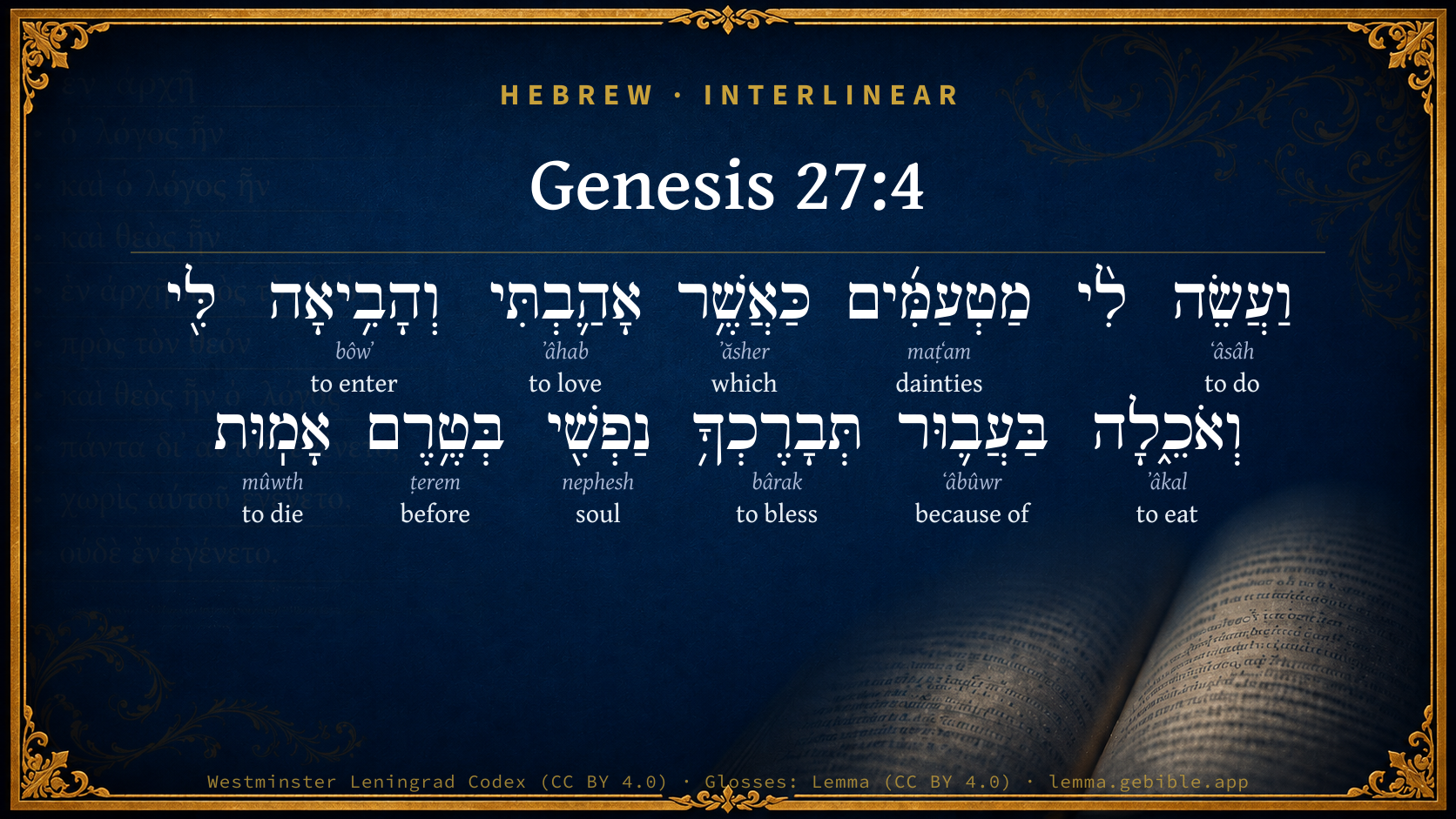
Hebrew (Westminster Leningrad Codex) Genesis 27:4 appears in the Hebrew Old Testament. The text above is from the Westminster Leningrad Codex. Each word links to its Strong’s number, a concise gloss, and parsing drawn from the Open Scriptures Hebrew Bible morphology. Click any word for its full Brown-Driver-Briggs (BDB) entry.
Download image
Cite this verse

Genesis 27:4 (World English Bible). Public Domain. Lemma interlinear Bible study tool, https://lemma.gebible.app/v/genesis/27/4.

Show BibTeX & RIS
BibTeX
RIS
English Translation
Make me savory food, such as I love, and bring it to me, that I may eat, and that my soul may bless you before I die."
World English Bible · Public Domain
Highlights
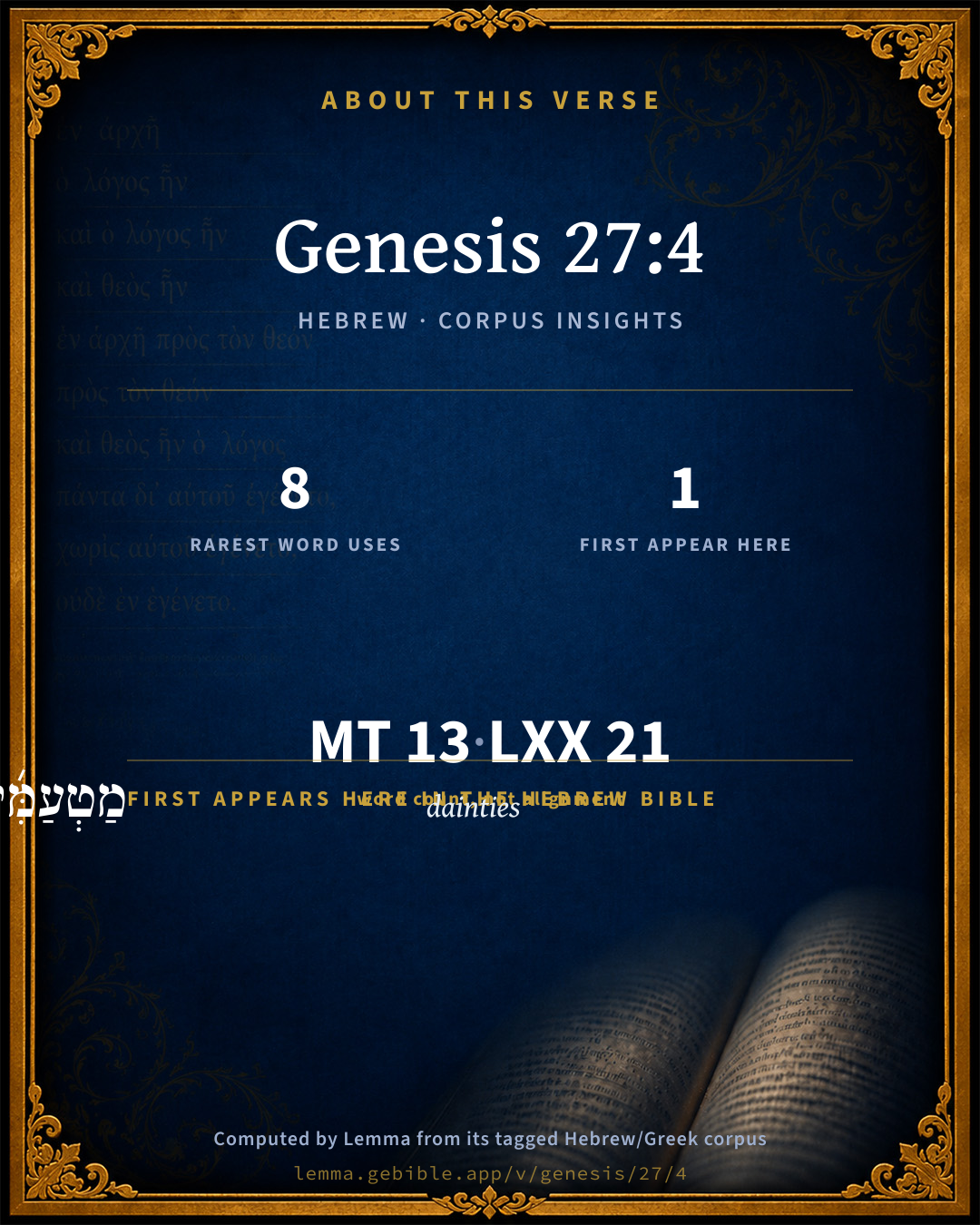
  • 1 first appearance in the Hebrew Bible
Full analysis ↓
Download a study sheet

One document with this verse’s original text, its word-by-word gloss line, the meaning frame, cross-references with their text, attributed commentary, and full source and license credits — printable, and it pastes into notes with its structure intact.

This verse Autodidact and up

Study sheet (.html) Plain text (.txt)

A passage Seminary Student

Up to 50 verses in one chapter. A passage sheet keeps up to 6 commentary sources and 12 cross-references per verse, in the order this page ranks them, and says so on the sheet whenever that leaves anything out. Ask for a single verse and you get the Autodidact verse sheet above.

Everything on this page stays free to read, with no account — the sheet is a download of what is already on screen, not access to it.

Want to remove ads? Support Godless Engineer
Compare translations 3

The same verse in 3 English versions, stacked beneath the original-language interlinear above. Click any original word for its lexicon entry.

Each is an independent rendering of the whole verse — the interlinear is not word-aligned to these translations.

Highlighted words mark where these versions differ — a whole-verse word diff, not a word-by-word alignment.

  • World English Bible Public Domain
    Make me savory food, such as I love, and bring it to me, that I may eat, and that my soul may bless you before I die."
  • King James Version Public Domain
    And make me savory meat, such as I love, and bring it to me, that I may eat; that my soul may bless thee before I die.
  • unfoldingWord Literal Text CC BY-SA 4.0
    Then prepare tasty food for me such as I love, and bring it to me so I can eat it, so that my soul can bless you before I die.”

unfoldingWord Literal Text — © unfoldingWord, licensed CC BY-SA 4.0. Word-aligned USFM3 via Door43 (git.door43.org/unfoldingWord/en_ult).

Versions to compare (up to 4)

3 of 4 selected

Show all 18 translations

Every available English version of this verse, each an independent rendering of the whole verse.

  • World English Bible Public Domain
    Make me savory food, such as I love, and bring it to me, that I may eat, and that my soul may bless you before I die."
  • Berean Standard Bible Public Domain
    Then prepare a tasty dish that I love and bring it to me to eat, so that I may bless you before I die.”
  • Majority Standard Bible Public Domain
    Then prepare a tasty dish that I love and bring it to me to eat, so that I may bless you before I die.”
  • King James Version Public Domain
    And make me savory meat, such as I love, and bring it to me, that I may eat; that my soul may bless thee before I die.
  • American Standard Version (1901) Public Domain
    And make me savory food, such as I love, and bring it to me, that I may eat. That my soul may bless thee before I die.
  • Revised Version (1885) Public Domain
    and make me savoury meat, such as I love, and bring it to me, that I may eat; that my soul may bless thee before I die.
  • Geneva Bible (1599) Public Domain
    Then make mee sauourie meate, such as I loue, and bring it me that I may eat, and that my soule may blesse thee, before I die.
  • Douay-Rheims (1899) Public Domain
    Make me savoury meat thereof, as thou knowest I like, and bring it, that I may eat: and my soul may bless thee before I die.
  • Young's Literal Translation Public Domain
    and make for me tasteful things, `such' as I have loved, and bring in to me, and I do eat, so that my soul doth bless thee before I die.'
  • Literal Standard Version CC BY-SA 4.0
    and make tasteful things for me, [such] as I have loved, and bring [them] to me, and I eat, so that my soul blesses you before I die.”
  • Unlocked Literal Bible CC BY-SA 4.0
    Make delicious food for me, the sort that I love, and bring it to me so I can eat it and bless you before I die.”
  • unfoldingWord Literal Text CC BY-SA 4.0
    Then prepare tasty food for me such as I love, and bring it to me so I can eat it, so that my soul can bless you before I die.”
  • Darby Bible Public Domain
    and prepare me a savoury dish such as I love, and bring it to me that I may eat, in order that my soul may bless thee before I die.
  • World Messianic Bible Public Domain
    Make me savory food, such as I love, and bring it to me, that I may eat, and that my soul may bless you before I die.”
  • Webster's Bible Public Domain
    And make me savory meat, such as I love, and bring it to me, that I may eat; that my soul may bless thee before I die.
  • Free Bible Version CC BY-SA 4.0
    Make me that tasty food that I love and bring it to me to eat, so I can bless you before I die.”
  • Bible in Basic English Public Domain
    And make me food, good to the taste, such as is pleasing to me, and put it before me, so that I may have a meal and give you my blessing before death comes to me.
  • JPS Tanakh (1917) Public Domain
    and make me savoury food, such as I love, and bring it to me, that I may eat; that my soul may bless thee before I die.'

Literal Standard Version (2020), Covenant Press — licensed CC BY-SA 4.0. Text via the HelloAO Bible API (eBible.org). Unlocked Literal Bible (unfoldingWord) — licensed CC BY-SA 4.0. Text via the HelloAO Bible API (eBible.org). unfoldingWord Literal Text — © unfoldingWord, licensed CC BY-SA 4.0. Word-aligned USFM3 via Door43 (git.door43.org/unfoldingWord/en_ult). Free Bible Version, Dr. Jonathan Gallagher — licensed CC BY-SA 4.0. Text via the HelloAO Bible API (eBible.org).

Word by word

More ways to search: Search by grammar → Find every occurrence → Compare this word →

Practice this passage: Drill this verse → Learn its vocabulary →

מַטְעַמִּ֜ים
maṭʻam
H4303
“dainties”
Noun, Common, Masculine, Plural, Absolute
Part of Speech
Noun
Type
Common
Gender
Masculine
Number
Plural
State
Absolute
Full BDB Definition

Origin: from H2938

TWOT: 815b

tasty or savory food, delectable food, dainties
  1. וַעֲשֵׂה ʻâsâh H6213 “and · do” Conjunction + Verb, Qal, Imperative, 2nd Person, Masculine, Singular
  2. כַּאֲשֶׁ֥ר ʼăsher H834 “like/as · which” Preposition + Particle, Relative
  3. אָהַ֛בְתִּי ʼâhab H157 “to love” Verb, Qal, Perfect, 1st Person, Common, Singular
  4. וְהָבִ֥יאָה bôwʼ H935 “and · enter” Conjunction + Verb, Hiphil, Imperative, 2nd Person, Masculine, Singular + Suffix, h
  5. וְאֹכֵ֑לָה ʼâkal H398 “and · to eat” Conjunction + Verb, Qal, Cohortative, 1st Person, Common, Singular
  6. בַּעֲב֛וּר ʻâbûwr H5668 “in/at · because of of” Preposition + Noun, Common, Masculine, Singular, Construct
  7. תְּבָרֶכְךָ֥ bârak H1288 “to bless · you” Verb, Piel, Imperfect, 3rd Person, Feminine, Singular + Suffix, Personal, 2nd Person, Masculine, Singular
  8. נַפְשִׁ֖י nephesh H5315 “soul · my” Noun, Common, Both, Singular, Construct + Suffix, Personal, 1st Person, Common, Singular
  9. בְּטֶ֥רֶם ṭerem H2962 “in/at · before” Preposition + Adverb
  10. אָמֽוּת mûwth H4191 “to die” Verb, Qal, Imperfect, 1st Person, Common, Singular

About this verse

These counts appear in no published source. They are computed here, from the morphology-tagged text and Lemma’s own curated glosses. What Lemma adds →

13
words
11
distinct lemmas
Pentateuch
section

Notable vocabulary

The rarest word here is מַטְעַמִּ֜ים dainties H4303 — appearing just 8 times in the whole Hebrew Bible.

First appearance in Scripture

This word makes its first canonical appearance in the Hebrew Bible here:

  • מַטְעַמִּ֜ים dainties H4303

Shared distinctive vocabulary

מַטְעַמִּ֜ים dainties H4303 occurs in 8 verses of the Hebrew Bible. Also found in:

Grammatical profile

  • 6 verbs
  • 3 nouns
  • 2 prepositions
  • 1 adverb
  • 1 particle

Verb forms

  • וַעֲשֵׂה Qal · Imperative
  • אָהַ֛בְתִּי Qal · Perfect
  • וְהָבִ֥יאָה Hiphil · Imperative
  • וְאֹכֵ֑לָה Qal · Cohortative
  • תְּבָרֶכְךָ֥ Piel · Imperfect
  • אָמֽוּת Qal · Imperfect

Hebrew & Septuagint length

In English translation the verse runs 27 words from the Hebrew and 26 from the Septuagint (LXX English) — closely comparable.

A rough comparison of the two English renderings, which tokenize alike — not a word-level alignment.

Word counts can differ between the Hebrew and the Greek without any difference in meaning — e.g. the Hebrew direct-object marker אֵת has no separate Greek word, and Greek often adds the article ὁ.

In the original languages it is 13 Hebrew tokens and 21 Greek tokens — but the two are counted differently (Hebrew bundles its prefixes and suffixes into one token; the Greek is in lemma form), so that isn’t a like-for-like length.

Cross-references

18

Topical passages linked to Genesis 27:4 in the Treasury of Scripture Knowledge — connected by theme and wording, ordered by reader-vote popularity; previews shown in the World English Bible.

  • Hebrews 11:20 By faith, Isaac blessed Jacob and Esau, even concerning things to come.
  • Genesis 48:9 Joseph said to his father, "They are my sons, whom God has given me here." He said, "Please bring them to me, and I will bless them."
  • Genesis 27:25 He said, "Bring it near to me, and I will eat of my son's venison, that my soul may bless you." He brought it near to him, and he ate. He brought him wine, and he drank.
  • Genesis 49:28 All these are the twelve tribes of Israel, and this is what their father spoke to them and blessed them. He blessed everyone according to his blessing.
  • Luke 24:51 It happened, while he blessed them, that he withdrew from them, and was carried up into heaven.
  • Genesis 27:7 'Bring me venison, and make me savory food, that I may eat, and bless you before Yahweh before my death.'
  • Joshua 14:13 Joshua blessed him; and he gave Hebron to Caleb the son of Jephunneh for an inheritance.
  • Joshua 22:6 So Joshua blessed them, and sent them away; and they went to their tents.
  • Luke 2:34 and Simeon blessed them, and said to Mary, his mother, "Behold, this child is set for the falling and the rising of many in Israel, and for a sign which is spoken against.
  • Genesis 14:19 He blessed him, and said, "Blessed be Abram of God Most High, possessor of heaven and earth:
  • Genesis 24:60 They blessed Rebekah, and said to her, "Our sister, may you be the mother of thousands of ten thousands, and let your seed possess the gate of those who hate them."
  • Genesis 27:23 He didn't recognize him, because his hands were hairy, like his brother, Esau's hands. So he blessed him.
  • Genesis 27:27 He came near, and kissed him. He smelled the smell of his clothing, and blessed him, and said, "Behold, the smell of my son Is as the smell of a field which Yahweh has blessed.
  • Genesis 27:31 He also made savory food, and brought it to his father. He said to his father, "Let my father arise, and eat of his son's venison, that your soul may bless me."
  • Genesis 28:3 May God Almighty bless you, and make you fruitful, and multiply you, that you may be a company of peoples,
  • Genesis 48:15–20 He blessed Joseph, and said, "The God before whom my fathers Abraham and Isaac did walk, the God who has fed me all my life long to this day,
  • Leviticus 9:22–23 Aaron lifted up his hands toward the people, and blessed them; and he came down from offering the sin offering, and the burnt offering, and the peace offerings.
  • Deuteronomy 33:1–29 This is the blessing, with which Moses the man of God blessed the children of Israel before his death.

Cross-references courtesy of OpenBible.info (CC BY 4.0).

Hebrew and Greek witnesses Masoretic Hebrew ↔ Greek Septuagint

The same verse in the two great witnesses to the Old Testament, shown verse-for-verse.

These are two independent witnesses, not word-aligned to each other, and the Septuagint is shown in lemma (dictionary) form.

Hebrew Genesis 27:4 Masoretic · Westminster Leningrad Codex

וַעֲשֵׂה לִ֨י מַטְעַמִּ֜ים כַּאֲשֶׁ֥ר אָהַ֛בְתִּי וְהָבִ֥יאָה לִּ֖י וְאֹכֵ֑לָה בַּעֲב֛וּר תְּבָרֶכְךָ֥ נַפְשִׁ֖י בְּטֶ֥רֶם אָמֽוּת

Make me savory food, such as I love, and bring it to me, that I may eat, and that my soul may bless you before I die."

World English Bible · Public Domain

Greek LXX Genesis 27:4 Septuagint · lemma form

καί ποιέω ἐγώ ἔδεσμα ὡς φιλέω ἐγώ καί φέρω ἐγώ ἵνα ἐσθίω ὅπως εὐλογέω σύ ὁ ψυχή ἐγώ πρίν ἀποθνήσκω ἐγώ

and make me meats, as I like them, and bring them to me that I may eat, that my soul may bless you, before I die.

LXX2012 (modern English Septuagint) · Public Domain

Hebrew: Westminster Leningrad Codex (CC BY 4.0). Greek: Septuagint (public domain); English from LXX2012 (modern English Septuagint) (Public Domain). How the Septuagint differs from the Hebrew →

Targum (Aramaic paraphrase)

2

The Targum is the ancient Jewish Aramaic paraphrase of the Hebrew Scriptures — an interpretive translation, not the Hebrew text itself. Onkelos (literal) and Pseudo-Jonathan (expansive) render the Torah, and Jonathan the Prophets. Coverage is partial: where no permissively-licensed English translation exists for a verse, only the Aramaic is shown. This is verse-level text, not a word-by-word alignment to the Hebrew.

  1. Targum Onkelos Torah (Genesis–Deuteronomy)
    וְעִבֵיד לִי תַבְשִׁילִין כְּמָא דִרְחֵימִית וְאָעֵל לִי וְאֵיכוּל בְּדִיל דִּי תְבָרֵכִנָּךְ נַפְשִׁי עַד לָא אֵימוּת

    (no public-domain English translation for this verse)

    Targum Onkelos — Aramaic: “Onkelos Genesis” (public domain); “Onkelos Exodus” (public domain); “Onkelos Leviticus” (public domain); “Onkelos Numbers” (public domain); “Onkelos Deuteronomy” (public domain). English: “Sefaria Community Translation” (CC0 1.0 (public-domain dedication)); “J.W. Etheridge. The Targums of Onkelos and Jonathan Ben Uzziel on the Pentateuch. London: Longmans, Green, 1862” (public domain). Text via Sefaria.

  2. Targum Pseudo-Jonathan Torah (Genesis–Deuteronomy)
    וְעִיבַד לִי תַּבְשִׁילִין הֵיכְמָא דְרְחֵימִית וְתֵיעוֹל לְוָתִי וְאֵיכוֹל בְּגִין דִתִבָרְכִינָךְ נַפְשִׁי עַד לָא אֵימוּת

    and make me food such as I love, and bring to me, and I will eat, that my sould may bless thee ere I die.

    Targum Pseudo-Jonathan — Aramaic: “Targum Jonathan on Genesis” (public domain); “Targum Jonathan on Exodus” (public domain); “Targum Jonathan on Leviticus” (public domain); “Targum Jonathan on Numbers” (public domain); “Targum Jonathan on Deuteronomy” (public domain). English: “The Targum of Jonathan ben Uzziel, trans. J. W. Etheridge, London, 1862” (public domain). Text via Sefaria.

Commentary

Notes on Genesis 27:4 from classic Christian and Jewish commentators (each source and its license shown beneath its notes). The classic Christian expositions comment on the surrounding passage and are grouped to its opening verse, so a note may address several verses; the Jewish commentaries on the Tanakh (Rashi and others) are per-verse, so they appear only where the commentator wrote on this verse.

Lemma curates 59 commentaries, every one of them public domain or Creative Commons licensed, each selected and text-cleaned for this edition rather than reprinted as found. About our sources →

Trapp's Complete Commentary

John Trapp

Gen 27:4 And make me savoury meat, such as I love, and bring [it] to me, that I may eat; that my soul may bless thee before I die.

Ver. 4. That my soul may bless thee before I die.] The words of dying men are living oracles. It was the patriarch’s care, and must be ours, to leave a blessing behind us; to seek the salvation of our children while we live, and to say something to the same purpose when we die, that may stick by them. So when we are laid in our graves, our stock remains, goes forward, and shall do till the day of doom.

John Trapp, A Commentary or Exposition upon All the Books of the Old and New Testament (1647–1656) — public domain. Text from a community e-Sword module.

Geneva Bible (1599)

Geneva Bible translators

The carnal affection, which he bare to his son made him forget that which God spake to his wife, Gen. 25:23.

Geneva Bible (1599) marginal notes — public domain. Text via Bolls.life.

Jamieson, Fausset & Brown

Robert Jamieson, A. R. Fausset & David Brown

make . . . savory meat--perhaps to revive and strengthen him for the duty; or rather, "as eating and drinking" were used on all religious occasions, he could not convey the right, till he had eaten of the meat provided for the purpose by him who was to receive the blessing [ADAM CLARKE] (compare Gen 18:7).

that my soul may bless thee--It is difficult to imagine him ignorant of the divine purpose (compare Gen 25:23). But natural affection, prevailing through age and infirmity, prompted him to entail the honors and powers of the birthright on his elder son; and perhaps he was not aware of what Esau had done (Gen 25:34).

Jamieson, Fausset & Brown — Commentary Critical and Explanatory on the Whole Bible (1871) — public domain (CC PDM 1.0). Text via the HelloAO Bible API.

Adam Clarke's Commentary

Verse 4. Savoury meat] מטעמים matammim, from טעם taam, to taste or relish; how dressed we know not, but its name declares its nature.

That I may eat] The blessing which Isaac was to confer on his son was a species of Divine right, and must be communicated with appropriate ceremonies. As eating and drinking were used among the Asiatics on almost all religious occasions, and especially in making and confirming covenants, it is reasonable to suppose that something of this kind was essentially necessary on this occasion, and that Isaac could not convey the right till he had eaten of the meat provided for the purpose by him who was to receive the blessing. As Isaac was now old, and in a feeble and languishing condition, it was necessary that the flesh used on this occasion should be prepared so as to invite the appetite, that a sufficiency of it might be taken to revive and recruit his drooping strength, that he might be the better able to go through the whole of this ceremony.

This seems to be the sole reason why savoury meat is so particularly mentioned in the text. When we consider,

1. That no covenant was deemed binding unless the parties had eaten together;

2. That to convey this blessing some rite of this kind was necessary; and,

3. That Isaac's strength was now greatly exhausted, insomuch that he supposed himself to be dying; we shall at once see why meat was required on this occasion, and why that meat was to be prepared so as to deserve the epithet of savoury.

As I believe this to be the true sense of the place, I do not trouble my readers with interpretations which I suppose to be either exceptionable or false.

Adam Clarke's Commentary on the Bible (1810–1826) — public domain. Text from a community e-Sword/MySword module.

John Calvin's Commentaries

4. That my soul may bless thee. Wonderfully was the faith of the holy man blended with a foolish and inconsiderate carnal affection. The general principle of faith flourishes in his mind, when, in blessing his son, he consigns to him, under the direction of the Holy Spirit, the right of the inheritance which had been divinely promised to himself. Meanwhile, he is blindly carried away by the love of his firstborn son, to prefer him to the other; and in this way he contends against the oracle of God. For he could not be ignorant of that which God had pronounced before the children were born. If any one would excuse him, inasmuch as he had received no command from God to change the accustomed order of nature by preferring the younger to the elder; this is easily refuted: because when he knew that the firstborn was rejected, he still persisted in his excessive attachment. Again, in neglecting to inquire respecting his duty, when he had been informed of the heavenly oracle by his wife, his indolence was by no means excusable. For he was not altogether ignorant of his calling; therefore, his obstinate attachment to his son was a kind of blindness, which proved a greater obstacle to him than the external dimness of his eyes. Yet this fault, although deserving of reprehension, did not deprive the holy man of the right of pronouncing a blessing; but plenary authority remained with him, and the force and efficacy of his testimony stood entire, just as if God himself had spoken from heaven; to which subject I shall soon again allude.

John Calvin's Commentaries (1540-1563) — public domain. Text from the Calvin Translation Society English edition (1840s-50s) via the Christian Classics Ethereal Library (ccel.org). Calvin's coverage is partial (roughly two-thirds of the Bible); uncommented books and verses are honest gaps, never fabricated. The 19th-century editor's footnotes and remarks are omitted so the notes are faithfully Calvin's own voice.

Ellicott's Commentary for English Readers

(4) Savoury meat.—On the rare occasions on which an Arab sheik tastes flesh, it is flavoured with almonds, pistachio nuts, and raisins. It would thus not be easy for Isaac to distinguish the taste of the flesh of a kid from that of an antelope. As the Arabs always spare their own flocks and herds, the capture of a wild animal gives them the greater pleasure, and a feast thus provided seemed to the patriarch a proper occasion for the solemn decision which son should inherit the promises made to Abraham.

That my soul may bless thee.—We gather from the solemn blessing given to his sons by Jacob (Genesis 49) that this was a prophetic act, by which the patriarchs, under the influence of the Spirit, and in expectation of death, decided to which son should belong the birthright. Jacob when dying bestowed it on Judah (Gen_27:8-12). But here Isaac resisted the Spirit; for the clear warning had been given that “the elder should serve the younger” (Gen_25:23). Isaac may have been moved to this act by indignation at the manner in which Esau had been induced to sell the birthright, and in annulling that sale he would have been within his rights; but he was not justified in disregarding the voice of prophecy, nor in his indifference to Esau’s violation of the Abrahamic law in marrying heathen women. And thus he becomes the victim of craft and treachery, while Jacob is led on to a deed which was the cause of endless grief to him and Rebekah, and has stained his character for ever. But had Jacob possessed the same high standard of honour as distinguished David afterwards, he would equally have received the blessing, but without the sin of deception practised upon his own father.

A Bible Commentary for English Readers, edited by Charles John Ellicott (1878–1897) — public domain. Text from a community e-Sword module.

The Cambridge Bible for Schools and Colleges

gen. ed. J. J. S. Perowne

4. that my soul may bless thee] Cf. 19, 25, 31. See note on Gen_12:13. A sacrificial meal is not intended. The strengthening food is from the chase, not the flesh of domestic animals.

The Cambridge Bible for Schools and Colleges (gen. ed. J. J. S. Perowne; Cambridge University Press, 1878–1918) — public domain. Text from a community e-Sword module.

John Gill's Exposition

And make me savoury meat, such as I love,.... For, though he had lost his sight, he had not lost his taste, nor his appetite for savoury food:

and bring it to me, that I may eat; this, was enjoined to make trial of his filial affection and duty to him, before he blessed him:

that my soul may bless thee before I die; not only that he might do it with cheerfulness and vivacity, having eaten a comfortable meal, and being refreshed with it, but that having had proof of his son's duty and affection to him, he might confer the blessing on him heartily: this blessing was not an ordinary and common one, but what parents used to bestow upon their children at the time of their death, or a little before it; and good men oftentimes did this under a spirit of prophecy, declaring what would be the case and circumstances of their children in time to come; and particularly the principal part of the blessing of Isaac, which Abraham had entailed upon him by divine direction, and he thought to have entailed on Esau his firstborn, was the promise of the descent of the Messiah from him and his seed, and of the possession of the land of Canaan by them: and this shows that Rebekah had not made known the oracle to Isaac, that the "elder should serve the younger", Gen 25:23, or, if she had, he had forgot, or did not understand it, and might think it respected not the persons of his sons, but their posterity; or however, from a natural affection for Esau his firstborn, and that the blessing and inheritance might go in the common channel, he was desirous he should have it; and he might also be ignorant of Esau's having sold his birthright to Jacob, or that he made no account of it.

John Gill's Exposition of the Whole Bible (1746–1763) — public domain (CC PDM 1.0). Text via the HelloAO Bible API.

Haydock's Catholic Bible Commentary

That, &c. He does not mean, that the meat would induce him to give his blessing. Neither can we suppose, that he intended to pervert the order of God, in making the younger son subject to the elder, if he was informed by Rebecca, of that disposition of providence. (Calmet) --- But of this he seems to have been ignorant, ver. 29, 35. (Worthington)

George Leo Haydock (1774–1849), Haydock's Catholic Family Bible and Commentary, 1859 edition — public domain. Excludes Psalms (Douay-Rheims chapter numbering differs from Protestant) and Deuterocanonical books (Catholic canon only).

Matthew Poole's English Annotations

Quest. Why doth he require that he may eat before he bless him?

Answ.

1. That being refreshed and delighted therewith, his spirit might be more cheerful, and so the fitter for the giving of this prophetical benediction; for which reason also the prophet Elisha called for a minstrel ere he could utter his prophecy, 2Ki 3:15.

2. By the special direction of Divine Providence, that Esau’s absence might give Jacob the advantage of getting the blessing. He speaks not here of a common and customary blessing, which parents may bestow upon any of their children as and when they please; but of the last, solemn, extraordinary, and prophetical benediction, whereby these holy patriarchs did by God’s appointment, and with his concurrence, constitute one of their sons heir, not only of their inheritance, but of Abraham’s covenant, and all the promises, both temporal and spiritual, belonging to it. As for the oracle delivered to Rebekah, which transferred this blessing upon Jacob, Gen 25:23, either Isaac knew not of it, not being sufficiently informed thereof by Rebekah; or he did not thoroughly understand it; or he might apprehend that it was to be accomplished not in the persons of Esau and Jacob, but in their posterity; or at this time it was quite out of his mind; or he was induced to neglect it through his passionate affection to his son Esau.

Matthew Poole's English Annotations on the Holy Bible (1683–1685) — public domain. Text from a community e-Sword/MySword module.

Whedon's Commentary on the Bible

Daniel D. Whedon

4. That I may eat; that my soul may bless thee — “There appears a singular mixture of the carnal and the spiritual in this. Isaac recognises his own character as that of the priestly and prophetic head of his house, privileged to bless as father and priest, and to foretell the fortunes of his family in succession to Abraham in his office of the prophet of God. Yet his carnal affection causes him to forget the response to the inquiry of Rebekah, “the elder shall serve the younger,” and the fact that Esau had sold his birthright and alienated it from him forever by a solemn oath. Moreover, that his heart may be the more warmed to him whom he desires to bless, he seeks to have some of that savoury meat brought to him such as he loved.” — Speaker’s Commentary.

Daniel D. Whedon (gen. ed.), Commentary on the Old and New Testaments (1874–1909) — public domain. Text from a community e-Sword module.

The Pulpit Commentary

And make me savory meat, food," from a root whose primary idea is to taste, or try the flavor, of a thing. Schultens observes that the corresponding Arabic term is specially applied to dishes made of flesh taken in hunting, and highly esteemed by nomad tribes (vide Gesenius, p. 467)such as I love (cf., Gen_25:28, the ground of his partiality for Esau) and bring it to me, that I may eat; Isaac was blind and weak in his eyes, yet it seem-eth his body was of a strong constitution, seeing he was able to eat of wild flesh, which is of harder digestion" (Willet) that the conjunction rWb) followed by a future commonly expresses a purpose (cf. Exo_9:14) my soul may bless thee notwithstanding the oracle (Gen_25:23) uttered so many (fifty-seven or seventy-seven) years ago, Isaac appears to have clung to the belief that Esau was the destined heir of the covenant blessing; quoedam fuit coecitatis species, quae illi magis obstitit quam externa oeulorum caligo (Calvin)before I die.

The Pulpit Commentary (1880–1919), ed. H.D.M. Spence-Jones & Joseph S. Exell — public domain. Text from a community e-Sword module.

Ramban (Nachmanides)

Rabbi Moshe ben Nachman (Ramban / Nachmanides)

THAT MY SOUL MAY BLESS THEE. It was Isaac’s intent to bless Esau that he merit the blessing of Abraham to inherit the land and to become the one with whom G-d would make the covenant since he was the firstborn.It would appear that Rebekah never told Isaac of the prophecy which G-d had related to her, i.e., And the elder shall serve the younger, else how would Isaac transgress the commandment of the Eternal, seeing that it shall not prosper. Now at first she did not tell it to him due to ethical modesty, for the verse, And she went to inquire of the Eternal, suggests that she went without Isaac’s permission. [Perhaps she did not tell him because] she said, “I need not relate a prophecy to a prophet for Isaac is greater than the one who told it to me.” And now she did not want to tell him, “So was it said to me in the name of G-d before I gave birth,” for she reasoned that because of his love for Esau he will not bless Jacob, but he will leave everything in the hands of Heaven. And she further knew that by this arrangement of hers, Jacob will be blessed from Isaac’s mouth by an undivided heart and a willing mind. Perhaps these are causes induced by G-d so that Jacob would be blessed, and Esau as well with the blessing of the sword, And by Him alone actions are weighed.

Ramban (Nachmanides) on the Tanakh — English translation: “Commentary on the Torah by Ramban (Nachmanides). Translated and annotated by Charles B. Chavel. New York, Shilo Pub. House, 1971-1976” (CC BY 4.0). Text via Sefaria.

Sforno

Rabbi Ovadia Sforno

Made it into a tasty dish. Yitzchok knew that Eisov was not worthy of the blessing that he wished to confer upon him. For this reason he instructed him to perform an act of honor towards him to give him merit. By contrast when he blessed Yaakov (28:3) he knew that he needed no additional merit.

Sforno on the Tanakh — English translation: “Yalkut, Sifsei Chachomim Chumash, Metsudah Publications, 2009” (CC BY 4.0). Text via Sefaria.

Radak

Rabbi David Kimhi (Radak)

ועשה, he did not ask for venison because there was shortage of food in his home, for he was exceedingly wealthy. We observe that aged people progressively get tired of the food they are used to, and they crave something new to give them an incentive to eat and enjoy their food. Venison is a different kind of meat, not comparable in taste to the meat of sheep or goats or beef. Therefore Yitzchok asked Esau to bring him something which would put him in a pleasant frame of mind, the kind of good feeling which is a necessary prelude to bestowing a blessing with one’s entire heart. He was well aware that he needed something to put him into the right frame of mind as Esau’s general conduct was not one that commended itself to his father so that he would gladly volunteer such a blessing as he felt he was obligated to dispense. There would be no need to send Yaakov on such an errand prior to blessing him, as his righteousness made blessing him something natural.

Radak on the Tanakh — English translations: “Sefaria Community Translation” (CC0 1.0 (public-domain dedication)); “Eliyahu Munk, HaChut Hameshulash” (CC BY 4.0); “Rabbi Mike Feuer, Jerusalem Anthology” (CC BY 4.0); and “R. David Kimhi on the first book of Psalms, Translated by R.G. Finch, London, 1919” (public domain). Text via Sefaria.

Lesson kit

Teaching starters — assembled from the data on this page, not authored interpretation. Every prompt links to the verse data it draws on. Edit before teaching.

Genesis, in the Pentateuch, opens this verse with 13 words (11 distinct Hebrew lemmas). Its most distinctive word is maṭʻam (“dainties”). A historical commentator’s framing appears above. Read the whole chapter for the surrounding context.

Discussion questions

  1. How does “dainties” (maṭʻam) shape what this verse is saying?
  2. This is the first place “dainties” appears in Scripture (first appears here). What does its debut here establish?
  3. How does Genesis 27:7, which shares the word «dainties», read alongside this verse?
  4. These translations render this verse differently. What is at stake in choosing one wording over another?
  5. «וַעֲשֵׂה» is a Qal Imperative verb. How does that grammatical form shape the action described?
  6. Compare how Trapp's Complete Commentary and Geneva Bible (1599) read this verse. Where do they agree or differ?

Things to notice

Reading settings

Reading text

Shown beneath each verse's original-language words.

Old Testament
Old Testament edition

Read the OT as the Masoretic Hebrew (MT) or the Greek Septuagint (LXX).

English shown for the Greek Septuagint (in the Hebrew ↔ Greek comparison).

Comparing translations? Open the Compare panel on any verse page to stack up to four side by side.