
Jeremiah 25:9

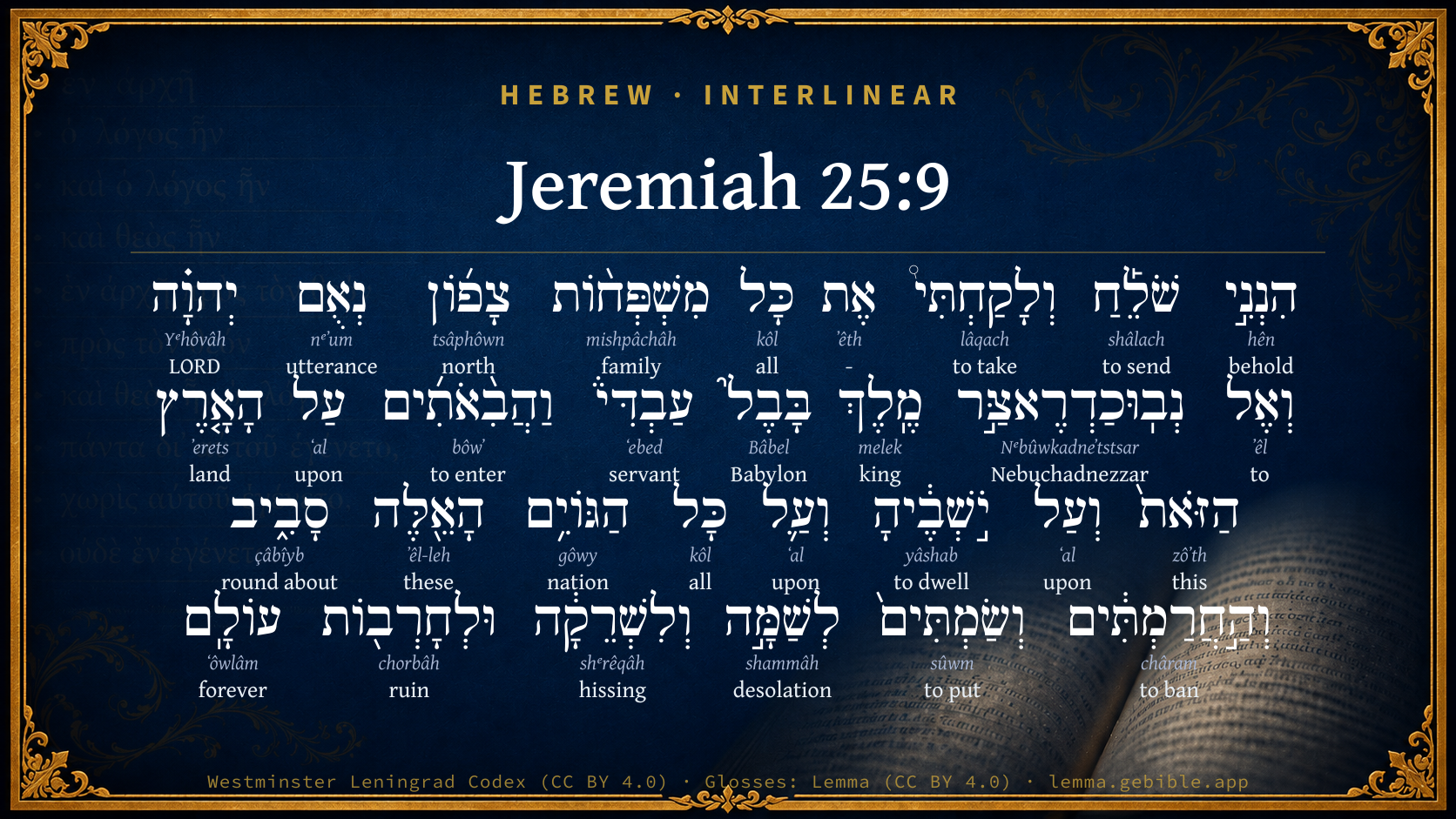
Hebrew (Westminster Leningrad Codex) Jeremiah 25:9 appears in the Hebrew Old Testament. The text above is from the Westminster Leningrad Codex. Each word links to its Strong’s number, a concise gloss, and parsing drawn from the Open Scriptures Hebrew Bible morphology. Click any word for its full Brown-Driver-Briggs (BDB) entry.
Download image
Cite this verse

Jeremiah 25:9 (World English Bible). Public Domain. Lemma interlinear Bible study tool, https://lemma.gebible.app/v/jeremiah/25/9.

Show BibTeX & RIS
BibTeX
RIS
English Translation
behold, I will send and take all the families of the north, says Yahweh, and [I will send] to Nebuchadrezzar the king of Babylon, my servant, and will bring them against this land, and against the inhabitants of it, and against all these nations round about; and I will utterly destroy them, and make them an astonishment, and a hissing, and perpetual desolations.
World English Bible · Public Domain
Download a study sheet

One document with this verse’s original text, its word-by-word gloss line, the meaning frame, cross-references with their text, attributed commentary, and full source and license credits — printable, and it pastes into notes with its structure intact.

This verse Autodidact and up

Study sheet (.html) Plain text (.txt)

A passage Seminary Student

Up to 50 verses in one chapter. A passage sheet keeps up to 6 commentary sources and 12 cross-references per verse, in the order this page ranks them, and says so on the sheet whenever that leaves anything out. Ask for a single verse and you get the Autodidact verse sheet above.

Everything on this page stays free to read, with no account — the sheet is a download of what is already on screen, not access to it.

Want to remove ads? Support Godless Engineer
Compare translations 3

The same verse in 3 English versions, stacked beneath the original-language interlinear above. Click any original word for its lexicon entry.

Each is an independent rendering of the whole verse — the interlinear is not word-aligned to these translations.

Highlighted words mark where these versions differ — a whole-verse word diff, not a word-by-word alignment.

  • World English Bible Public Domain
    behold, I will send and take all the families of the north, says Yahweh, and [I will send] to Nebuchadrezzar the king of Babylon, my servant, and will bring them against this land, and against the inhabitants of it, and against all these nations round about; and I will utterly destroy them, and make them an astonishment, and a hissing, and perpetual desolations.
  • King James Version Public Domain
    Behold, I will send and take all the families of the north, saith the LORD, and Nebuchadrezzar the king of Babylon, my servant, and will bring them against this land, and against the inhabitants thereof, and against all these nations round about, and will utterly destroy them, and make them an astonishment, and an hissing, and perpetual desolations.
  • unfoldingWord Literal Text CC BY-SA 4.0
    behold, I am sending and I will take all of the families of the north”—the declaration of Yahweh—“and to Nebuchadnezzar king of Babylon, my servant, and I will bring them against this land and against its dwellers and against all of these nations all around, and I will devote them to destruction and will make them a horror and a hissing and to an eternal desolation.

unfoldingWord Literal Text — © unfoldingWord, licensed CC BY-SA 4.0. Word-aligned USFM3 via Door43 (git.door43.org/unfoldingWord/en_ult).

Versions to compare (up to 4)

3 of 4 selected

Show all 18 translations

Every available English version of this verse, each an independent rendering of the whole verse.

  • World English Bible Public Domain
    behold, I will send and take all the families of the north, says Yahweh, and [I will send] to Nebuchadrezzar the king of Babylon, my servant, and will bring them against this land, and against the inhabitants of it, and against all these nations round about; and I will utterly destroy them, and make them an astonishment, and a hissing, and perpetual desolations.
  • Berean Standard Bible Public Domain
    behold, I will summon all the families of the north, declares the LORD, and I will send for My servant Nebuchadnezzar king of Babylon, whom I will bring against this land, against its residents, and against all the surrounding nations. So I will devote them to destruction and make them an object of horror and contempt, an everlasting desolation.
  • Majority Standard Bible Public Domain
    behold, I will summon all the families of the north, declares the LORD, and I will send for My servant Nebuchadnezzar king of Babylon, whom I will bring against this land, against its residents, and against all the surrounding nations. So I will devote them to destruction and make them an object of horror and contempt, an everlasting desolation.
  • King James Version Public Domain
    Behold, I will send and take all the families of the north, saith the LORD, and Nebuchadrezzar the king of Babylon, my servant, and will bring them against this land, and against the inhabitants thereof, and against all these nations round about, and will utterly destroy them, and make them an astonishment, and an hissing, and perpetual desolations.
  • American Standard Version (1901) Public Domain
    behold, I will send and take all the families of the north, saith Jehovah, and `I will send' unto Nebuchadrezzar the king of Babylon, my servant, and will bring them against this land, and against the inhabitants thereof, and against all these nations round about; and I will utterly destroy them, and make them an astonishment, and a hissing, and perpetual desolations.
  • Revised Version (1885) Public Domain
    behold, I will send and take all the families of the north, saith the LORD, and I will send unto Nebuchadrezzar the king of Babylon, my servant, and will bring them against this land, and against the inhabitants thereof, and against all these nations round about; and I will utterly destroy them, and make them an astonishment, and an hissing, and perpetual desolations.
  • Geneva Bible (1599) Public Domain
    Beholde, I will send and take to mee all the families of the North, saith the Lord, and Nebuchad-nezzar the King of Babel my seruant, and will bring them against this lande, and against the inhabitantes thereof, and against all these nations rounde about, and will destroy them, and make them an astonishment and an hissing, and a continuall desolation.
  • Douay-Rheims (1899) Public Domain
    Behold I will send, and take all the kindreds of the north, saith the Lord, and Nabuchodonosor the king of Babylon my servant: and I will bring them against this land, and against the inhabitants thereof, and against all the nations that are round about it: and I will destroy them, and make them an astonishment and a hissing, and perpetual desolations.
  • Young's Literal Translation Public Domain
    Lo, I am sending, and have taken all the families of the north -- an affirmation of Jehovah -- even unto Nebuchadrezzar king of Babylon, My servant, and have brought them in against this land, and against its inhabitants, and against all these nations round about, and have devoted them, and appointed them for an astonishment, and for a hissing, and for wastes age-during.
  • Literal Standard Version CC BY-SA 4.0
    behold, I am sending, and have taken all the families of the north—a declaration of YHWH—even to Nebuchadnezzar king of Babylon, My servant, and have brought them in against this land, and against its inhabitants, and against all these surrounding nations, and have devoted them, and appointed them for an astonishment, and for a hissing, and for continuous ruins.
  • Unlocked Literal Bible CC BY-SA 4.0
    see, I am about to send out a command to gather all the peoples of the north—this is Yahweh's declaration—with Nebuchadnezzar my servant, king of Babylon, and bring them against this land and its inhabitants, and against all the nations around you. For I will set them apart for destruction. I will turn them into a horror, an object for hissing, and an unending desolation.
  • unfoldingWord Literal Text CC BY-SA 4.0
    behold, I am sending and I will take all of the families of the north”—the declaration of Yahweh—“and to Nebuchadnezzar king of Babylon, my servant, and I will bring them against this land and against its dwellers and against all of these nations all around, and I will devote them to destruction and will make them a horror and a hissing and to an eternal desolation.
  • Darby Bible Public Domain
    behold, I will send and take all the families of the north, saith Jehovah, and [I will send] to Nebuchadrezzar the king of Babylon, my servant, and will bring them against this land, and against the inhabitants thereof, and against all these nations round about; and I will utterly destroy them, and make them an astonishment, and a hissing, and perpetual wastes.
  • World Messianic Bible Public Domain
    behold, I will send and take all the families of the north,” says the LORD, “and I will send to Nebuchadnezzar the king of Babylon, my servant, and will bring them against this land, and against its inhabitants, and against all these nations around. I will utterly destroy them, and make them an astonishment, and a hissing, and perpetual desolations.
  • Webster's Bible Public Domain
    Behold, I will send and take all the families of the north, saith the LORD, and Nebuchadrezzar the king of Babylon, my servant, and will bring them against this land, and against its inhabitants, and against all these nations around, and will utterly destroy them, and make them an astonishment, and a hissing, and perpetual desolations.
  • Free Bible Version CC BY-SA 4.0
    watch as I summon all the people of the north, declares the Lord. I'm going to send for my servant Nebuchadnezzar, king of Babylon, to attack this country and the people who live here, and all the surrounding nations. I will set them apart for destruction. I'm going to totally destroy you, and people will be horrified at what's happened to you and will mock you.
  • Bible in Basic English Public Domain
    See, I will send and take all the families of the north, says the Lord, and Nebuchadrezzar, king of Babylon, my servant, and make them come against this land, and against its people, and against all these nations on every side; and I will give them up to complete destruction, and make them a cause of fear and surprise and a waste place for ever.
  • JPS Tanakh (1917) Public Domain
    behold, I will send and take all the families of the north, saith the LORD, and I will send unto Nebuchadrezzar the king of Babylon, My servant, and will bring them against this land, and against the inhabitants thereof, and against all these nations round about; and I will utterly destroy them, and make them an astonishment, and a hissing, and perpetual desolations.

Literal Standard Version (2020), Covenant Press — licensed CC BY-SA 4.0. Text via the HelloAO Bible API (eBible.org). Unlocked Literal Bible (unfoldingWord) — licensed CC BY-SA 4.0. Text via the HelloAO Bible API (eBible.org). unfoldingWord Literal Text — © unfoldingWord, licensed CC BY-SA 4.0. Word-aligned USFM3 via Door43 (git.door43.org/unfoldingWord/en_ult). Free Bible Version, Dr. Jonathan Gallagher — licensed CC BY-SA 4.0. Text via the HelloAO Bible API (eBible.org).

Word by word

More ways to search: Search by grammar → Find every occurrence → Compare this word →

Practice this passage: Drill this verse → Learn its vocabulary →

וְלִשְׁרֵקָ֔ה
shᵉrêqâh
H8322
“and · to/for · hissing”
Conjunction + Preposition + Noun, Common, Feminine, Singular, Absolute
Part of Speech
Conjunction + Preposition + Noun
Type
Common
Gender
Feminine
Number
Singular
State
Absolute
Full BDB Definition

Origin: from H8319

TWOT: 2468a

hissing, whistling
  1. הִנְנִ֣י hên H2005 “behold · me” Particle, Demonstrative + Suffix, Personal, 1st Person, Common, Singular
  2. שֹׁלֵ֡חַ shâlach H7971 “sending” Verb, Qal, Participle Active, Masculine, Singular, Absolute
  3. וְלָקַחְתִּי֩ lâqach H3947 “and · to take” Conjunction + Verb, Qal, Sequential Perfect, 1st Person, Common, Singular
  4. אֶת ʼêth H853 “-” Particle, Direct Object
  5. כָּל kôl H3605 “all of” Noun, Common, Masculine, Singular, Construct
  6. מִשְׁפְּח֨וֹת mishpâchâh H4940 “families of” Noun, Common, Feminine, Plural, Construct
  7. צָפ֜וֹן tsâphôwn H6828 “north” Noun, Common, Feminine, Singular, Absolute
  8. נְאֻם nᵉʼum H5002 “utterance of” Noun, Common, Masculine, Singular, Construct
  9. יְהוָ֗ה Yᵉhôvâh H3068 “LORD” Noun, Proper
  10. וְאֶל ʼêl H413 “and · to” Conjunction + Preposition
  11. נְבֽוּכַדְרֶאצַּ֣ר Nᵉbûwkadneʼtstsar H5019 “Nebuchadnezzar” Noun, Proper
  12. מֶֽלֶךְ melek H4428 “king of” Noun, Common, Masculine, Singular, Construct
  13. בָּבֶל֮ Bâbel H894 “Babylon” Noun, Proper
  14. עַבְדִּי֒ ʻebed H5650 “servant · my” Noun, Common, Masculine, Singular, Construct + Suffix, Personal, 1st Person, Common, Singular
  15. וַהֲבִ֨אֹתִ֜ים bôwʼ H935 “and · to enter · them” Conjunction + Verb, Hiphil, Sequential Perfect, 1st Person, Common, Singular + Suffix, Personal, 3rd Person, Masculine, Plural
  16. עַל ʻal H5921 “upon” Preposition
  17. הָאָ֤רֶץ ʼerets H776 “the · land” Particle, Definite Article + Noun, Common, Both, Singular, Absolute
  18. הַזֹּאת֙ zôʼth H2063 “the · this” Particle, Definite Article + Pronoun, Demonstrative, Feminine, Singular
  19. וְעַל ʻal H5921 “and · upon” Conjunction + Preposition
  20. יֹ֣שְׁבֶ֔יהָ yâshab H3427 “dwelling · her” Verb, Qal, Participle Active, Masculine, Plural, Construct + Suffix, Personal, 3rd Person, Feminine, Singular
  21. וְעַ֛ל ʻal H5921 “and · upon” Conjunction + Preposition
  22. כָּל kôl H3605 “all of” Noun, Common, Masculine, Singular, Construct
  23. הַגּוֹיִ֥ם gôwy H1471 “the · nations” Particle, Definite Article + Noun, Common, Masculine, Plural, Absolute
  24. הָאֵ֖לֶּה ʼêl-leh H428 “the · these” Particle, Definite Article + Pronoun, Demonstrative, Common, Plural
  25. סָבִ֑יב çâbîyb H5439 “round about” Noun, Common, Both, Singular, Absolute
  26. וְהַ֣חֲרַמְתִּ֔ים châram H2763 “and · to ban · them” Conjunction + Verb, Hiphil, Sequential Perfect, 1st Person, Common, Singular + Suffix, Personal, 3rd Person, Masculine, Plural
  27. וְשַׂמְתִּים֙ sûwm H7760 “and · to put · them” Conjunction + Verb, Qal, Sequential Perfect, 1st Person, Common, Singular + Suffix, Personal, 3rd Person, Masculine, Plural
  28. לְשַׁמָּ֣ה shammâh H8047 “to/for · desolation” Preposition + Noun, Common, Feminine, Singular, Absolute
  29. וּלְחָרְב֖וֹת chorbâh H2723 “and · to/for · ruins of” Conjunction + Preposition + Noun, Common, Feminine, Plural, Construct
  30. עוֹלָֽם ʻôwlâm H5769 “forever” Noun, Common, Masculine, Singular, Absolute

About this verse

These counts appear in no published source. They are computed here, from the morphology-tagged text and Lemma’s own curated glosses. What Lemma adds →

31
words
28
distinct lemmas
Prophets
section

Notable vocabulary

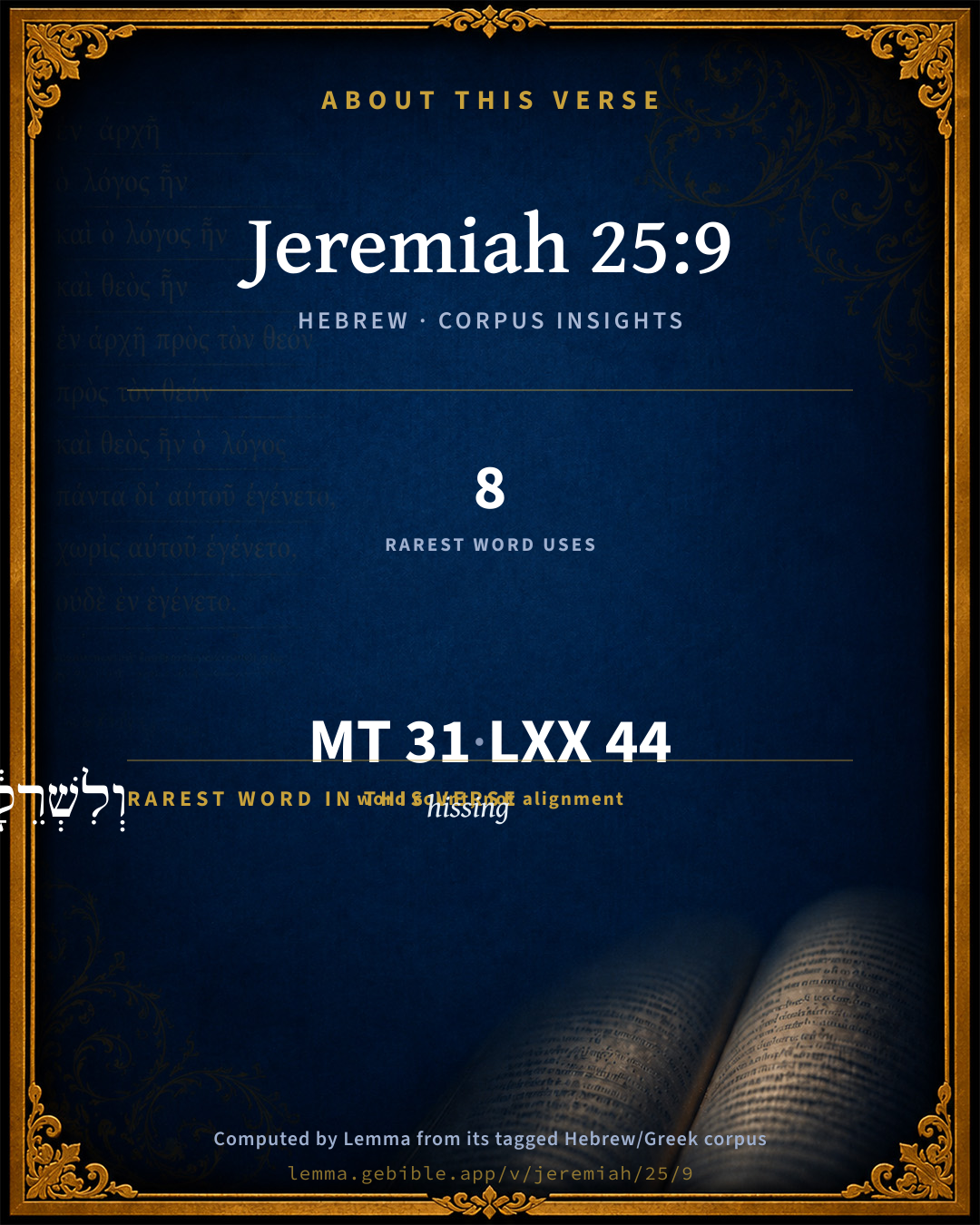
The rarest word here is וְלִשְׁרֵקָ֔ה hissing H8322 — appearing just 8 times in the whole Hebrew Bible.

Shared distinctive vocabulary

וְלִשְׁרֵקָ֔ה hissing H8322 occurs in 8 verses of the Hebrew Bible. Also found in:

Grammatical profile

  • 6 verbs
  • 17 nouns
  • 2 pronouns
  • 4 prepositions
  • 2 particles

Verb forms

  • שֹׁלֵ֡חַ Qal · Participle Active
  • וְלָקַחְתִּי֩ Qal · Sequential Perfect
  • וַהֲבִ֨אֹתִ֜ים Hiphil · Sequential Perfect
  • יֹ֣שְׁבֶ֔יהָ Qal · Participle Active
  • וְהַ֣חֲרַמְתִּ֔ים Hiphil · Sequential Perfect
  • וְשַׂמְתִּים֙ Qal · Sequential Perfect

Repetition

Words recur within this verse — often emphatic in Hebrew:

Hebrew & Septuagint length

In the original languages it is 31 Hebrew tokens and 44 Greek tokens — but the two are counted differently (Hebrew bundles its prefixes and suffixes into one token; the Greek is in lemma form), so that isn’t a like-for-like length.

Cross-references

24

Topical passages linked to Jeremiah 25:9 in the Treasury of Scripture Knowledge — connected by theme and wording, ordered by reader-vote popularity; previews shown in the World English Bible.

  • Isaiah 13:3 I have commanded my consecrated ones, yes, I have called my mighty men for my anger, even my proudly exulting ones.
  • Jeremiah 1:15 For, behold, I will call all the families of the kingdoms of the north, says Yahweh; and they shall come, and they shall set everyone his throne at the entrance of the gates of Jerusalem, and against all the walls of it round about, and against all the cities of Judah.
  • Jeremiah 18:16 to make their land an astonishment, and a perpetual hissing; everyone who passes thereby shall be astonished, and shake his head.
  • Ezekiel 29:18–20 Son of man, Nebuchadrezzar king of Babylon caused his army to serve a great service against Tyre: every head was made bald, and every shoulder was worn; yet had he no wages, nor his army, from Tyre, for the service that he had served against it.
  • Habakkuk 1:6–10 For, behold, I raise up the Chaldeans, that bitter and hasty nation, that march through the breadth of the earth, to possess dwelling places that are not theirs.
  • Jeremiah 6:22–26 Thus says Yahweh, Behold, a people comes from the north country; and a great nation shall be stirred up from the uttermost parts of the earth.
  • Jeremiah 43:10 and tell them, Thus says Yahweh of Hosts, the God of Israel: Behold, I will send and take Nebuchadrezzar the king of Babylon, my servant, and will set his throne on these stones that I have hidden; and he shall spread his royal pavilion over them.
  • Leviticus 26:25–46 I will bring a sword upon you, that will execute the vengeance of the covenant; and you will be gathered together within your cities: and I will send the pestilence among you; and you will be delivered into the hand of the enemy.
  • 1 Kings 9:7–8 then will I cut off Israel out of the land which I have given them; and this house, which I have made holy for my name, will I cast out of my sight; and Israel shall be a proverb and a byword among all peoples.
  • Isaiah 5:26–30 He will lift up a banner to the nations from far, And he will whistle for them from the end of the earth. Behold, they will come speedily and swiftly.
  • Isaiah 39:7 Of your sons who shall issue from you, whom you shall father, shall they take away; and they shall be eunuchs in the palace of the king of Babylon.
  • Isaiah 44:28–45:1 Who says of Cyrus, [He is] my shepherd, and shall perform all my pleasure, even saying of Jerusalem, She shall be built; and of the temple, Your foundation shall be laid.
  • Jeremiah 24:9 I will even give them up to be tossed back and forth among all the kingdoms of the earth for evil; to be a reproach and a proverb, a taunt and a curse, in all places where I shall drive them.
  • Jeremiah 27:3–8 and send them to the king of Edom, and to the king of Moab, and to the king of the children of Ammon, and to the king of Tyre, and to the king of Sidon, by the hand of the messengers who come to Jerusalem to Zedekiah king of Judah;
  • Deuteronomy 28:45–50 All these curses shall come on you, and shall pursue you, and overtake you, until you are destroyed; because you didn't listen to the voice of Yahweh your God, to keep his commandments and his statutes which he commanded you:
  • Proverbs 21:1 The king's heart is in Yahweh's hand like the watercourses. He turns it wherever he desires.
  • Isaiah 10:5 Ho Assyrian, the rod of my anger, the staff in whose hand is my indignation!
  • Jeremiah 5:15–16 Behold, I will bring a nation on you from far, house of Israel, says Yahweh: it is a mighty nation, it is an ancient nation, a nation whose language you don't know, neither understand what they say.
  • Jeremiah 6:1 Flee for safety, you children of Benjamin, out of the midst of Jerusalem, and blow the trumpet in Tekoa, and raise up a signal on Beth Haccherem; for evil looks forth from the north, and a great destruction.
  • Jeremiah 8:16 The snorting of his horses is heard from Dan: at the sound of the neighing of his strong ones the whole land trembles; for they are come, and have devoured the land and all that is in it; the city and those who dwell therein.
  • Jeremiah 25:17–26 Then took I the cup at Yahweh's hand, and made all the nations to drink, to whom Yahweh had sent me:
  • Jeremiah 40:2 The captain of the guard took Jeremiah, and said to him, Yahweh your God pronounced this evil on this place;
  • Ezekiel 26:7 For thus says the Lord Yahweh: Behold, I will bring on Tyre Nebuchadrezzar king of Babylon, king of kings, from the north, with horses, and with chariots, and with horsemen, and a company, and much people.
  • Ezekiel 30:10–11 Thus says the Lord Yahweh: I will also make the multitude of Egypt to cease, by the hand of Nebuchadrezzar king of Babylon.

Cross-references courtesy of OpenBible.info (CC BY 4.0).

Hebrew and Greek witnesses Masoretic Hebrew ↔ Greek Septuagint

The same verse in the two great witnesses to the Old Testament, shown verse-for-verse.

These are two independent witnesses, not word-aligned to each other, and the Septuagint is shown in lemma (dictionary) form.

Hebrew Jeremiah 25:9 Masoretic · Westminster Leningrad Codex

הִנְנִ֣י שֹׁלֵ֡חַ וְלָקַחְתִּי֩ אֶת כָּל מִשְׁפְּח֨וֹת צָפ֜וֹן נְאֻם יְהוָ֗ה וְאֶל נְבֽוּכַדְרֶאצַּ֣ר מֶֽלֶךְ בָּבֶל֮ עַבְדִּי֒ וַהֲבִ֨אֹתִ֜ים עַל הָאָ֤רֶץ הַזֹּאת֙ וְעַל יֹ֣שְׁבֶ֔יהָ וְעַ֛ל כָּל הַגּוֹיִ֥ם הָאֵ֖לֶּה סָבִ֑יב וְהַ֣חֲרַמְתִּ֔ים וְשַׂמְתִּים֙ לְשַׁמָּ֣ה וְלִשְׁרֵקָ֔ה וּלְחָרְב֖וֹת עוֹלָֽם

behold, I will send and take all the families of the north, says Yahweh, and [I will send] to Nebuchadrezzar the king of Babylon, my servant, and will bring them against this land, and against the inhabitants of it, and against all these nations round about; and I will utterly destroy them, and make them an astonishment, and a hissing, and perpetual desolations.

World English Bible · Public Domain

Greek LXX Structure differs

In the Septuagint, Jeremiah is about an eighth shorter than the Hebrew and arranges its material differently — the Oracles Against the Nations (Hebrew chapters 46–51) appear in the middle of the Greek book, after 25:13. Because the chapter and verse boundaries do not line up, a verse-for-verse comparison with the Hebrew is not shown.

A verse-for-verse comparison isn’t shown here because the chapters and verses don’t line up. Switch to the LXX edition with the MT / LXX toggle above to read the Greek directly.

On this verse, Trapp's Complete Commentary discusses the Septuagint’s reading. Read the note in Commentary ↓

Hebrew: Westminster Leningrad Codex (CC BY 4.0). Greek: Septuagint (public domain); English from a public-domain English Septuagint. How the Septuagint differs from the Hebrew →

Targum (Aramaic paraphrase)

1

The Targum is the ancient Jewish Aramaic paraphrase of the Hebrew Scriptures — an interpretive translation, not the Hebrew text itself. Onkelos (literal) and Pseudo-Jonathan (expansive) render the Torah, and Jonathan the Prophets. Coverage is partial: where no permissively-licensed English translation exists for a verse, only the Aramaic is shown. This is verse-level text, not a word-by-word alignment to the Hebrew.

  1. Targum Jonathan Prophets (Joshua–Malachi)
    הָא אֲנָא שְׁלַח וַאֲדַבֵּר יַת כָּל מַלְכְּוַת צִפּוּנָא אֲמַר יְיָ וְלִנְבוּכַדְרֶאצַר מַלְכָּא דְבָבֶל עַבְדִי וְאַיְתִינוּן עַל אַרְעָא הָדָא וְעַל יַתְבָהָא וְעַל כָּל עַמְמַיָא הָאִלֵין סְחוֹר סְחוֹר וֶאֱגַמְרִינוּן וַאֲשַׁוִינוּן לְצָדוּ וּלְאִשְׁתְּמָמוּ וּלְחָרְבַת עֲלָם:

    (no public-domain English translation for this verse)

    Targum Jonathan — Aramaic: “Mikraot Gedolot” (public domain). English: “Sefaria Community Translation” (CC0 1.0 (public-domain dedication)); “London "Chaldee Paraphrase," 1871” (public domain). Text via Sefaria.

Commentary

Notes on Jeremiah 25:9 from classic Christian and Jewish commentators (each source and its license shown beneath its notes). The classic Christian expositions comment on the surrounding passage and are grouped to its opening verse, so a note may address several verses; the Jewish commentaries on the Tanakh (Rashi and others) are per-verse, so they appear only where the commentator wrote on this verse.

Lemma curates 59 commentaries, every one of them public domain or Creative Commons licensed, each selected and text-cleaned for this edition rather than reprinted as found. About our sources →

Trapp's Complete Commentary

John Trapp

Jer 25:9 Behold, I will send and take all the families of the north, saith the LORD, and Nebuchadrezzar the king of Babylon, my servant, and will bring them against this land, and against the inhabitants thereof, and against all these nations round about, and will utterly destroy them, and make them an astonishment, and an hissing, and perpetual desolations.

Ver. 9. Behold, I will send and take.] By a secret instinct. {as Jer 1:15}

And Nebuchadnezzar my servant,] i.e., Mine executioner, the rod of my wrath, {Isa 10:5} and the scourge of the world, as Attila styled himself.

And against all these nations round about.] Who were so infatuated that they did not combine against Nebuchadnezzar, whom the Septuagint called a dove, Jer 25:38, but he was a vulture rather, and these nations were as so many silly doves, which save themselves by flight, not fight; and sitting in their dove cots, see their nests destroyed, and their young ones killed before their eyes, never offering to rescue or revenge, as other fowls do. So dealt the old Britons when invaded by the Romans; they joined not their forces against the common enemy, sed dum singuli pugnabant, universi vincebantur. but while the fought separately, they were conquered together. {a}

{a} Tacitus

John Trapp, A Commentary or Exposition upon All the Books of the Old and New Testament (1647–1656) — public domain. Text from a community e-Sword module.

Geneva Bible (1599)

Geneva Bible translators

So the wicked and Satan himself are God’s servants, because he maketh them to serve him by constraint, and turneth that which they do of malice, to his honor and glory.

As the Philistines, Ammonites, Egyptians and others.

The Chaldeans and all their power.

Geneva Bible (1599) marginal notes — public domain. Text via Bolls.life.

Jamieson, Fausset & Brown

Robert Jamieson, A. R. Fausset & David Brown

the north--(see on Jer 1:14-15). The Medes and other northern peoples, confederate with Babylon, are included with the Chaldeans.

my servant--My agent for punishing (Jer 27:6; Jer 43:10; compare Jer 40:2). Compare Isa 44:28; Cyrus, "My shepherd." God makes even unbelievers unconsciously to fulfil His designs. A reproof to the Jews, who boasted that they were the servants of God; yet a heathen king is to be more the servant of God than they, and that as the agent of their punishment.

Jamieson, Fausset & Brown — Commentary Critical and Explanatory on the Whole Bible (1871) — public domain (CC PDM 1.0). Text via the HelloAO Bible API.

Adam Clarke's Commentary

Verse 9. Behold, I will send] At this time Nebuchadrezzar had not invaded the land, according to this Version; but the Hebrew may be translated, "Behold I am sending, and have taken all the families;" that is, all the allies of the king of Babylon.

Instead of ואל veel, "and TO Nebuchadrezzar," as in the common Hebrew Bible, seven MSS. of Kennicott's and De Rossi's, and one of my own, have ואת, veeth, "AND Nebuchadrezzar," which is undoubtedly the true reading.

Adam Clarke's Commentary on the Bible (1810–1826) — public domain. Text from a community e-Sword/MySword module.

John Calvin's Commentaries

Here follows a denunciation of punishment; the Prophet says that God would no longer deal in words, for their iniquity had ripened, according to what is in Genesis,

“My Spirit shall not contend (or strive) any more with man.” (Genesis 6:3.)

When God prepares to execute vengeance on the wickedness of men, he says that there is no more time for contending. A sudden execution of judgment is then what is here intended; but he mentions at the same time the punishment. After having explained the cause of so much severity, even because they would not hear the words of God, he adds, Behold, I will send for and take all the families of the north, etc. I have no doubt but that the Prophet alludes to the edicts of kings, for when they wish to raise an army they publish their edicts, and order those everywhere to meet who have either given their names or been enlisted as soldiers. So God now by these words intimates that the Chaldeans were under his power, so that they were ready, as soon as he gave them a signal; according to other modes of speaking he uses in other places, but in the same sense, “I will hiss,” and also, “I will send an alarm.” The Scripture is full of expressions of this kind, which shew that all mortals are prepared to obey God whenever he intends to employ their services; not that it is their purpose to serve God, but that he by a secret influence so rules them and their tongues, their minds and hearts, their hands and their feet, that they are constrained, willing or unwilling, to do his will and pleasure. And in the same sense he calls Nebuchadnezzar his servant, for that cruel tyrant never meant to offer his service to God; but God employed him as his instrument, as though he had been hired by him. And we shall see also elsewhere that he is called God’s servant.

And it ought to be noticed, for we hence learn the fact, that many are God’s servants who are yet wholly unworthy of so honorable a title; but they are not so called with respect to themselves. Nebuchadnezzar thought that he was making war with the God of Israel when he invaded Judea; and only ambition, and avarice, and cruelty impelled him to undertake so many wars. When, therefore, we think of him, of his designs and his projects, we cannot say that he was God’s servant; but this is to be referred to God only, who governs by his hidden and incomprehensible power both the devil and the ungodly, so that they execute, though unwittingly, whatever he determines. There is a great difference between these and God’s servants, who, when anything is commanded them, seek to render that obedience which they ought — all such are faithful servants. They are, then, justly called God’s servants, for there is a mutual concord between God and them: God commands, and they obey. But it is a mutilated and a half service when the ungodly are led beyond the purpose of their own minds, and God uses them as instruments when they think of and design another thing.

It must at the same time be noticed that this name of servant is given, though in an inferior sense, to Nebuchadnezzar for the sake of honor, in order that the Jews might be made ashamed; for it was a great reproach to them that a heathen had been chosen by God, and had obtained the title of a servant, when they themselves had become aliens. The Prophet then, no doubt, intended to cast reproach on them by raising to this dignity the king of Babylon. There was also another reason, even that the Jews might know that whatever they were to suffer would be inflicted by God’s hand, and that they might not otherwise think of Nebuchadnezzar than as God’s scourge, in order that they might thus be led to confess their sins and be really humbled. We now perceive the meaning of the words.

He says afterwards, I will bring them on this land and on all its inhabitants, etc By these words he confirms what I have just referred to, that God had his vengeance ready as soon as he purposed to treat the Jews as they deserved. As he had then said that Nebuchadnezzar and all the people of the north were prepared by him as hired soldiers, so he now adds that victory was in his power — I will bring them, he says, over the land and over all the neighboring nations which are around Why the Prophet denounces punishment here on other nations we shall see elsewhere. The Jews, in addition to other vain confidences, were wont to flatter themselves with this, that if Nebuchadnezzar should invade the territories of others, all would unite together against him, and that by such a confederacy they could easily overcome him. As, then, the Jews looked to all parts, and knew that the Egyptians were in alliance with them, and were also persuaded that the Moabites, the Tyrians, the Syrians, and all the rest would become confederates, they became confident, and indulged in that security by which they deceived themselves. This, therefore, is the reason why the Prophet expressly threatens the nations by which they were surrounded, not for the sake of these nations, but that the Jews might cease to entertain their vain confidence.

God says that he would make all nations, as well as the Jews, an astonishment, a hissing, and perpetual desolations He intimates that it would be a dreadful calamity, such as would astonish all that heard of it. As it is said elsewhere, “The report alone will excite alarm;” so in this place, I will make them for an astonishment When a moderate calamity is related to us, we are indeed moved to pity; but when the greatness of the evil exceeds belief, we then stand amazed, and all our senses are stunned. The Prophet then means that the calamity which God would bring on the Jews would be, as it were, monstrous, such as would stupify all that would hear of it.

At last he adds, that they would be for perpetual desolations He does afterwards, indeed, mitigate the severity of these words; for he confines God’s vengeance to seventy years. But this mode of speaking is common in Scripture; for, עולם, oulam stands opposed to a short time. It is to be taken in different senses, according to the circumstances of the passage. It sometimes designates perpetuity, as when the Prophet says, from age to age, that is, through continued ages, or through a course of years, which shall last perpetually. But age, or עולם, oulam, is often to be taken for the time allotted to the people until the coming of Christ; and sometimes it means simply a long time, as here and in many other places. It follows, —

John Calvin's Commentaries (1540-1563) — public domain. Text from the Calvin Translation Society English edition (1840s-50s) via the Christian Classics Ethereal Library (ccel.org). Calvin's coverage is partial (roughly two-thirds of the Bible); uncommented books and verses are honest gaps, never fabricated. The 19th-century editor's footnotes and remarks are omitted so the notes are faithfully Calvin's own voice.

Ellicott's Commentary for English Readers

(9) The families of the north.—The phrase reminds us of the vision of “the seething pot from the face of the north” in Jer_1:13, and includes all the mingled races, Scythians and others, who owned the sway of the Chaldæan king.

Nebuchadrezzar . . . my servant.—The use of the word which is applied by psalmists and prophets to David (Psa_78:70; 2Sa_7:8) and to the future Christ (Isa_42:1; Isa_52:13) is every way remarkable. It has its parallel, and, in fact, its explanation, in the language in which Isaiah speaks of Cyrus as the shepherd, the anointed, of Jehovah. (Isa_44:28; Isa_45:1) Each ruler of the great empires of the world was, in ways he knew not, working out the purposes of God. The phrase “I will utterly destroy” may be noted as specially characteristic of Deuteronomy (Deu_2:34; Deu_3:6, et al.) and Joshua (Jos_2:10; Jos_6:21; Jos_8:26).

A Bible Commentary for English Readers, edited by Charles John Ellicott (1878–1897) — public domain. Text from a community e-Sword module.

The Cambridge Bible for Schools and Colleges

gen. ed. J. J. S. Perowne

9. the families of the north] See ch. Jer_1:14 f.

families] For the wide use of this word see on Jer_3:14, and cp. Jer_8:3.

utterly destroy] lit. as mg. devote, i.e. place them under a ban. LXX, reading otherwise two Hebrew letters often written rather similarly, lay waste. Cp. Deu_20:17.

an astonishment] a destruction. See on Jer_5:30.

desolations] LXX (by a variation of one letter) reproach.

The Cambridge Bible for Schools and Colleges (gen. ed. J. J. S. Perowne; Cambridge University Press, 1878–1918) — public domain. Text from a community e-Sword module.

John Gill's Exposition

Behold, I will send and take all the families of the north,

saith the Lord,.... The Targum is, the kingdoms of the north, the same with those in Jer 1:15; even all those kingdoms which were subject to the king of Babylon, and lay north of Judea:

and Nebuchadnezzar the king of Babylon my servant: though a great king, he was a servant of the Lord of hosts; his servant, both as a creature of his make, and as a king that ruled under him; and as he was an instrument in his hand to chastise his people the Jews; though it was not knowingly and with intention that he served the Lord:

and will bring them against this land, and against the inhabitants thereof; the land of Judea, and its inhabitants; this was the Lord's doing; it was he that stirred, up the king of Babylon, and by his secret instinct and powerful providence brought him and his armies into Judea to spoil it, and the inhabitants of it Jehovah as it were marched at the head of them, and led them on, and brought them against the Jews, and delivered them into their hands:

and against all these nations round about; Egypt and others; so that the Jews could have no help from them; nor would application to them, and alliance with them, signify anything:

and will utterly destroy them, and make them an astonishment, and an hissing, and perpetual desolations; both the Jews and their neighbours; who should be an astonishment to some, and a hissing to others, and remain desolate for a long time; even till the seventy years were ended after mentioned.

John Gill's Exposition of the Whole Bible (1746–1763) — public domain (CC PDM 1.0). Text via the HelloAO Bible API.

Albert Barnes' Notes on the Bible

The term families is probably used here to signify the widespread empire of Nebuchadnezzar.

My servant - This title, so remarkable in the Old Testament as the especial epithet, first of Moses, and then of the Messiah, is thrice given to Nebuchadnezzar, and marks the greatness of the commission entrusted to him.

Albert Barnes' Notes on the Bible (1834–1885) — public domain. Text from a community e-Sword/MySword module.

Haydock's Catholic Bible Commentary

My servant. So this wicked king is here called; because God made him his instrument in punishing the sins of his people. (Challoner) (Worthington) --- He thought himself more than man, but he was only the rod destined for the fire.

George Leo Haydock (1774–1849), Haydock's Catholic Family Bible and Commentary, 1859 edition — public domain. Excludes Psalms (Douay-Rheims chapter numbering differs from Protestant) and Deuterocanonical books (Catholic canon only).

Matthew Poole's English Annotations

I will put it into the heart of all those kings whose territories lie northward of Judea, and particularly into the heart of

Nebuchadrezzar the king of Babylon, who in this work shall be

my servant; though you will not be my servants in obeying my commands, yet he shall serve me, Jer 27:6; 43:10. I will bring them and their armies up against this people, and I will put you out of hopes from your alliances with other nations, for he shall first bring them under his command: thus we read, 2Ki 24:7, that the

king of Babylon had invaded the Egyptian dominions, and taken from the river of Egypt unto the river Euphrates all that pertained to the king of Egypt. And I will make the inhabitants of Jerusalem, not only a desolation, but a scorn, and reproach, and wonderment to the world. See Jer 19:8.

Matthew Poole's English Annotations on the Holy Bible (1683–1685) — public domain. Text from a community e-Sword/MySword module.

Whedon's Commentary on the Bible

Daniel D. Whedon

9. Families of the north — An allusion to the conglomerate character of the Babylonish kingdom, blending, as it did, all the peoples in the great basin of the Tigris and Euphrates. And Nebuchadrezzar, etc. — Literally, and to Nebuchadrezzar, etc., bringing it after send rather than take, in construction. He is called the servant of Jehovah because of his providential mission in executing God’s will on Judah. See also Jer_28:6; Jer_43:10.

Daniel D. Whedon (gen. ed.), Commentary on the Old and New Testaments (1874–1909) — public domain. Text from a community e-Sword module.

The Pulpit Commentary

The families of the north. (comp. Jer_1:15, note) And Nebuchadnezzar the king of Babylon, my servant. This is the rendering of the Targum, the Syriac, and the Vulgate, and corresponds with the reading of a few extant manuscripts. The received text, however, reads, "and unto Nebuchadnezzar," etc. Neither reading is satisfactory. The latter one is intolerably harsh; the former makes Nebuchadnezzar a mere adjunct of the tribes of the north. In the other passages, moreover, where this king is solemnly entitled "my servant," the clause is the most prominent one in the sentence. (see Jer_27:6 Jer_43:10) The words in question have a sort of family resemblance to the glosses which meet us occasionally both in the form of the Hebrew text represented by the Massoretic recension, and those by the principal ancient versions. The words are omitted by the Septuagint. My servant. Generally to be a "servant" of Jehovah or of any supposed deity is to be a worshipper. Thus Daniel is called by Darius, "servant of the living God", (Dan_6:20) and thus Abdallah, "servant of Allah," has become a favorite surname of the followers of Mohammed. In the Book of Jeremiah itself, (Jer_30:10 Jer_46:27, Jer_46:28) and in Ezekiel, (Eze_37:25) "my servant" is the form in which Jehovah addresses his chosen people; and in the second part of Isaiah the suffering Messiah is so styled. Here, however, a foreign king is thus entitled. How is this to be explained? Cyrus, no doubt, in Isa_44:28, Isa_45:1, is called "my shepherd" and "my anointed one;" but then Cyrus, in the view of the prophet, was a genuine though unconscious worshipper of the true God, (Isa_41:25) whereas Nebuchadnezzar was known to be a polytheist and an idolater. We must, therefore, take "servant" to be applied to Nebuchadnezzar in a lower sense than to the other bearers of the title. The Hebrew "ebbed, in fact, may be either "slave" in something approaching to the terrible modern sense, or in the sense in which Eliezer was one, (i.e. little less than a son, and a possible heir, Gen_24:2 Gal_4:1) and which is still in full force in Arabia. An astonishment. (see on Jer_2:11) An hissing. (comp. Jer_18:16 Jer_19:8)

"Nebuchadnezzar... my servant.

A strange expression! It is not found in many manuscripts and versions. But it is more likely that dull officious scribes should erase such an "improper" phrase than that any should insert it in the manuscripts and Targum where it is preserved. We cannot suppose that Nebuchadnezzar is called God"s servant in consideration of any characteristics of his later career, such as the repentant state following his insanity recorded in the Book of Daniel. (Dan_4:33-37) The prophecy of Jeremiah belongs to a much earlier period. Nebuchadnezzar, a heathen, an idolater, entirely ignorant of the religion of the Jews, just appearing as the great conqueror and oppressor, and striking Syria dumb with terror by his victory at Carchemish this man is called God"s servant. The expression is significant.

I GOD"S AUTHORITY EXTENDS TO ALL MANKIND. He is not the God of the Jews only, nor of the Christians only, nor of the religious only. He is the God of heaven and earth, the Sovereign and supreme Master of all creatures. We talk of the godless heathen. They may be living without the knowledge of God, but not without his knowledge of them, his care, his influence.

II GOD CAN USE FOR HIS PURPOSES MEN WHO DO NOT KNOW HIM. Nebuchadnezzar did not know the true God. Yet he was an instrument in God"s hands for the chastisement of the Jews. Many a man is unconsciously working out God"s will even when he thinks he is fighting against it. God"s purposes are deeper than our thoughts.

III GOD CAN MAKE BAD MEN DO HIS WILL. Such men do not do God"s will in themselves, but by doing their own evil will they produce results which fall in with God"s larger designs. Of course this is no justification for their conduct, since our responsibility turns on our motives, not on the unexpected results of our conduct. It must not be supposed that God sanctions the wicked passions that drive a man to an action which God overrules for good. Nebuchadnezzar is to be punished for the very act in which God uses him as his servant (ver. 12). Yet the relation between God and his wicked servants is wholly mysterious.

IV GOD EXERCISES AUTHORITY OVER THE MOST IRRESPONSIBLE TYRANTS. Nebuchadnezzar is the greatest monarch of the world. He is just inflated with one of the grandest victories in all history. Naturally he is an autocratic tyrant who makes an idol of his own will. This man is really God"s slave. God overrules all kings, shapes and molds all history, and manifests his providence in the great onward march of humanity. This fact should give us confidence in the midst of the darkest events. It should humble the great to feel that they are as nothing before God.

V THE UNCONSCIOUS SERVANTS OF GOD DO NOT KNOW THE BLESSEDNESS OF HIS HIGHER SERVICE. AS they do not willingly serve, so they do not reap the spiritual joys of service. The service is nothing to them, though much to the world. The true servant of God knows his master"s will and delights to do it, sacrifices his own will and submits obediently to the higher will. To fulfill such service is the highest privilege of mankind. In the accomplishment of it is peace and blessedness. (Psa_40:6-8)

Nebuchadnezzar, the servant of God.

I THE CONTRAST WITH OTHER SERVANTS. Observe the mention, in ver. 4, of those very different servants of God, the prophets (so mentioned elsewhere). God had sent many of them and many times, and hardly any attention had been paid to them. Higher motives had been appealed to in vain. Considerations of duty and prudence were thrown to the winds. And now the mighty king Nebuchadnezzar comes, with a very different sort of force not looking at all like a servant of God; and yet he is just as much the servant of God as is any of the prophets. Indeed, king of a great people though he was, his rank in the service of God was not so high as that of the prophets. He appears in this place as nothing more than the final executioner of justice.

II NONETHELESS EFFICIENT A SERVANT BECAUSE THE SERVICE WAS RENDERED UNCONSCIOUSLY. Nebuchadnezzar, despot as he was, would have been very wrathful if he had known exactly how he appeared in the sight of God. He had certain purposes of his own, and he succeeded in effecting them; but the very energy with which he worked for himself only made him to render his service to God more complete. And may it not be happening in the world, a great deal more frequently than we think, that the very success of selfish and domineering men is being so handled by God as all the more to serve his purposes?

III THE LIMITATIONS OF NEBUCHADNEZZAR"S SERVICE. The service, with all its completeness, was only within certain limits. It does not require much intelligence to destroy what is destructible. But if there is to be a building-up work for God, then there must be a conscious, voluntary, and devoted service. Israel was meant to be a servant of God in the fullest and noblest sense of the word. It had been instructed in the will of God and borne with patiently in many failures to obey that will. Hence the description of Nebuchadnezzar as a servant is an implied rebuke of those who had refused to be servants. Note the great contrast found in the New Testament, where Christ"s apostles, at the beginning of their Epistles, hasten to proclaim themselves as the servants of God. Y.

The Pulpit Commentary (1880–1919), ed. H.D.M. Spence-Jones & Joseph S. Exell — public domain. Text from a community e-Sword module.

John Wesley's Explanatory Notes

Nebuchadnezzar - In this work shall be my servant; though you will not be my servants in obeying my commands.

John Wesley, Explanatory Notes Upon the Whole Bible (1754–1765) — public domain. Text via the GEBible commentary corpus.

Lesson kit

Teaching starters — assembled from the data on this page, not authored interpretation. Every prompt links to the verse data it draws on. Edit before teaching.

Jeremiah, in the Prophets, opens this verse with 31 words (28 distinct Hebrew lemmas). Its most distinctive word is shᵉrêqâh (“hissing”). A historical commentator’s framing appears above. Read the whole chapter for the surrounding context.

Discussion questions

  1. The word shᵉrêqâh carries the sense “hissing.” How does it shape the verse?
  2. How does 2 Chronicles 29:8, which shares the word «hissing», read alongside this verse?
  3. What does the repetition of “upon” (3× in this one verse) do in this verse?
  4. These translations render this verse differently. What is at stake in choosing one wording over another?
  5. «שֹׁלֵ֡חַ» is a Qal Participle Active verb. How does that grammatical form shape the action described?
  6. Compare how Trapp's Complete Commentary and Geneva Bible (1599) read this verse. Where do they agree or differ?

Things to notice

Reading settings

Reading text

Shown beneath each verse's original-language words.

Old Testament
Old Testament edition

Read the OT as the Masoretic Hebrew (MT) or the Greek Septuagint (LXX).

English shown for the Greek Septuagint (in the Hebrew ↔ Greek comparison).

Comparing translations? Open the Compare panel on any verse page to stack up to four side by side.